Author: Serkadis

  • Analysis: The end of business-by-litigation?

    By Scott M. Fulton, III and Carmi Levy, Betanews

    Banner: Analysis

    The largest and widest ranging PC technology dispute, perhaps in the industry’s history, came to an abrupt end this morning with Intel and AMD agreeing to set aside most of their differences, and all of their legal disputes. Is this a signal to the various litigators in the information technology industry that litigation is no longer the way to go, that it’s too expensive a way for a company to continue protecting its market position?
    Betanews caught up with our contributing analyst Carmi Levy, by way of his trusty BlackBerry, on a train headed to Toronto this morning.

    Carmi Levy: If litigation isn’t too expensive from a fiscal perspective, then it certainly is onerous from a corporate attention perspective. Specifically, getting involved in years-long, tit-for-tat pitched legal battles that spill across global borders can often be the catalyst for losing focus on core competencies. While lawsuit-laden companies inevitably claim their legal processes do not impede strategic planning or day-to-day operations, it’s clear that they’re being overly optimistic. Litigation is a distraction. Never-ending litigation can split a company’s focus for just long enough that it can easily lose touch with the needs of its market.

    In a post-recessionary world, organizations are more vulnerable than ever to the consequences of this form of split focus.

    Scott Fulton: Under the terms of this morning’s agreement, Intel didn’t have to acknowledge any wrongdoing, and it can continue offering volume rebates so long as they’re not exclusionary…Doesn’t that mean the cases of the New York Attorney General and the EC go flying out the window?

    Carmi Levy: We may yet see pending cases in New York and Europe get tossed in the wake of this deal, but we’ll have to wait and see how each jurisdiction weighs in. It’s still early in that process, and it could take weeks or months before Intel gets the all clear in every venue where these is either current or pending litigation. Still, on the surface, it looks likely that Intel’s ability to offer non-exclusionary rebates cuts the legs out from virtually all cases against it.

    Scott Fulton: Is the business world ready for the dull, boring reality of competition between equal innovators everywhere in the spirit of openness and (yawn!) friendship? (Or put more directly, won’t the rest of us in the media need to wake up to the new reality of business?)

    Carmi Levy: I think it’s time we — both consumers as well as media, and while we’re at it, the litigants and vendors, too — moved on and paid more attention to what vendors do in the market with their products and services and less on what they’re up to in front of a judge. In Intel’s and AMD’s case, they bring us technology that powers the information economy. They both have finally woken up to the fallacy of devoting endless resources to legal action that doesn’t enhance their ability to design and market better products. Hopefully now they’ll both be able to get back to business — albeit an admittedly changed one.

    And when they do, I think there’s still ample opportunity for these two companies to slug it out where it matters most: in the market at large. Without the weight of seemingly never-ending litigation dragging them both down, we can look forward to more innovation and fewer antagonistic press releases and court filings.

    Which means journos like us may have to change our approach to coverage as well!

    Copyright Betanews, Inc. 2009


    Add to digg
    Add to Google
    Add to Slashdot
    Add to Twitter
    Add to del.icio.us
    Add to Facebook
    Add to Technorati


  • Free Doesn’t Mean Devalued

    The concept of zero took ages for societies to recognize, let alone understand. Mike has explained before how it’s been a stumbling block in economics for some libertarian and “free market” types more recently. People who think about economics in terms of scarcity get upset when abundance pushes price down towards zero, as if the economic equation were broken. But if you flip the equation and think of it as a cost of zero, you realize that the trick is to use as much of those abundant goods as possible, adding value to complementary scarcities for which you can charge. Zero doesn’t break economics, it just requires a different approach.

    But artists and other creators hit a different stumbling block than libertarians (libertarian artists aside…). Zero is a problem because they feel like their art is worthless; they aren’t hung up on scarcity, they’re hung up on “devaluation.” We’ve heard it from journalists. I hear it most often from fellow songwriters. The economic theory makes them feel as though their work is just viewed as some sort of cheap commodity. The thing is, value and price are not the same. Price is monetary value, but value is so much more than money. Price is what gets driven down to marginal cost, but value factors into the demand side of the equation. Expensive things aren’t necessarily valuable, and valuable things aren’t necessarily expensive. I value oxygen a lot, but it seems silly to pay for the air I breathe each minute, given the abundant supply.

    More importantly, songwriters who get hung up on “devaluation” confuse recordings with music. They equate the two. A recording is not the song, it’s just an instance of it, and a digital audio file is just an instance of the recording. Equating these reduces music to recordings to files. As important as recordings are, there’s so much more to music. When you think of a song, do you think of the recording, or a memory you had connecting with the music? Do you think of the file and how much it cost, or the emotions, people and experiences that the music conjures up? The recordings are just a means through which we experience the music. Songwriters (of all people!) should know that the value in music is so much more than the price of a recording. It’s not devaluing music to give it away for free, but it can increase its value by allowing more people to connect with it, to know, love and understand it — to value it. It’s through that experience that music is valued, not price!

    Ironically, the underlying concern ends up being economic — how will we make money? A price of zero for digital audio files doesn’t mean that no one values the songwriting profession, or that no one is willing to spend money on music and keep songwriters in business. Sharing digital audio files makes the music more valuable and leads to more opportunities for monetization. When you give music away and connect with an audience, the opportunity for monetization is in the associated scarcitiesaccess, containers, community, merchandise, relationships, unique goods, the creation of new music, etc. — by giving people a reason to buy. Getting hung up on “devaluation” is a distraction from the opportunity — the necessity — to experiment with new business models.

    So, can we please stop complaining that free means devalued?

    Blaise Alleyne is an expert at the Insight Community. To get insight and analysis from Blaise Alleyne and other experts on challenges your company faces, click here.

    Permalink | Comments | Email This Story


  • The Work of the Office: White House Office of Faith-based and Neighborhood Partnerships

    President Obama announced the creation of the White House Office of Faith-based and Neighborhood Partnerships on the 17th day of the President’s new Administration. Since then, our Office has been pretty busy! I thought it’d be helpful to give you a little context on what we’ve been up to.

    Our office is situated within the Domestic Policy Council. This placement allows our office to have close interaction with governmental leadership on issues of importance to nonprofit organizations, from the American Recovery and Reinvestment Act to the President’s Budget.
    The President has tasked this office with focusing on four special priorities: involving faith-based and neighborhood groups in the economic recovery, promoting responsible fatherhood, fostering interfaith cooperation and building common ground to reduce unintended pregnancies and the need for abortion, along with the White House Council on Women and Girls.
    The Office also coordinates the President’s Advisory Council on Faith-based and Neighborhood Partnerships. This Advisory Council is a group of 25 leaders from both faith-based and non-sectarian organizations, each serving 1-year terms. The Advisory Council forms recommendations on how the Federal Government can more effectively partner with faith-based and neighborhood organizations.
    The White House Office also coordinates and works with 11 Centers and 1 Strategic Advisor placed in Departments throughout government to implement the President’s priorities for this office. Each Center works to connect its own agency to local faith-based and neighborhood organizations. For example, our Center at the Department of Homeland Security (DHS) connects local organizations and groups preparing to respond to disaster situations to the ongoing activities at DHS and FEMA. Our Center at the Department of Education works to connect that Department with local organizations to provide after-school programs. So each Center is an important link between the federal government and local neighborhood organizations.

    Our Office has been active on numerous fronts, from coordinating President Obama’s fatherhood initiative  to working with the National Security Council on President Obama’s ‘New Beginnings’ speech given in Cairo, Egypt to Muslim communities around the world. We also engage faith-based and neighborhood organizations on a range of issues, from the upcoming 2010 Census through our office at the Department of Commerce to foreclosure counseling at the Department of Housing and Urban Development.

    Our job is to make sure that the Federal Government is coming into responsible interaction with local nonprofit organizations. We look forward to working with you on these priorities!

  • Kathy Buckworth shares some BlackBerry parenting tips

    The BlackBerry Diaries

    Kathy Buckworth has a book coming out that BlackBerry moms are sure to love. Traveling and taking care of her two young ones (and 2 teenagers) over the years, Kathy has compiled a host of tips and tricks for keeping the kids entertained and staying organized as a busy mother. Her book, The BlackBerry Diaries: Adventures in Modern Motherhood, is a funny tale of how a mother of two and technology meet.

    Here are some of Kathy’s tips for BlackBerry moms:

    What to do during down time:

    • Organize your ToDo list (make sure to get that pedicure on there!)
    • Check the traffic on your local news station’s website (shortest route to take screaming kids is a good thing)
    • Investigate the hottest BlackBerry applications on BlackBerry World (a new game, a calorie counter, you never know)
    • Send a text or email to your teen to remind them of their chores. Cybernagging at its best.
    • Google where to buy those specific dance tights. The show is tomorrow – put it in your calendar!

    Some random examples of how your BlackBerry can help with parenting:

    • Using the soft glow of your BlackBerry screen to check on a sleeping baby without waking them up. Shhhh!
    • Downloading the Flashlight app is a huge help in entertaining the kids during a power outage.


    © Kyle for BlackBerry Cool, 2009


  • Analysis of Windows Security Logs with MS Log Parser

    When investigating an intrusion in a Windows system, one of the first places to start is the Windows security log. Security event log is also very useful for analysis when searching for anomalies and possible intrusions.

    Reading through a Windows security log or any other log can be very difficult and time consuming, so a lot of companies have created their own tools to analyze windows event logs. But before you start going commerical, there is a tool that will get you going without any cost. Against all odds, it’s a tool made by Microsoft!

    The tool
    The tool in question is Microsoft Log parser. Log parser is a command line tool that provides universal query access to text-based data such as log files, XML files and CSV files, as well as key data sources on the Windows operating system such as the Event Log, the Registry, the file system, and Active Directory. So, you can use it to analyze most structured text based files and the eventlog and AD on a single computer.

    You can query remote computers on the network, as long as the credentials that Log parser is running under can access the data sources on the remote computers.

    For Security Log, you need to run Log Parser as administrator
    Note that this tool doesn’t collect data from multiple computers, it just analyzes data in a single file/single computer repository.

    The improved interface
    In it’s original form, Log Parser is a command line tool, so it is not the most user friendly tool in the world. Also, it has no way of saving/storing your prepared queries so you can invoke them later. But a promising developer named Dimce Kuzmanov created a free frontend to Log parser called Log Parser Lizard.


    Log Parser Lizard enables you to store the prepared queries, and organizes them by type of data source on which you wish to do an analysis. It also includes the ability to export results to Excel, autogenerates charts on the result of the executed query, or ability to export the queried subset into the original format from which the analysis was performed.

    Analyzing the Security Log with Log Parser Lizard
    Using Log Parser Lizard for Security Log analysis is very simple. Choose the Queries button and select the Event Logs category, then create the queries that you need for your analysis. Here are some examples:

    • SELECT * FROM SECURITY – simple dump all data from the security log
    • SELECT EVENTID, COUNT(*) FROM SECURITY GROUP BY EVENTID – analyze what types of events appear in the security log and in what quantity
    • SELECT * FROM SECURITY WHERE EVENTID=’517′ – find whether the security log was cleared in Win2000/XP/2003

    After you create the query, choose the apropriate category, then click the ‘Generate’ button to execute the query. You can also graph the results by choosing the Chart->Visible option.

    Conclusion
    Analyzing the Security Log is always a useful approach to security controls, so you need to include it in your routine operations. And until you buy a SIEM system which will run an automatic and scheduled analysis, you should adopt a simple tool like Log Parser and Log Parser Lizard.

    Talkback and comments are most welcome

    Related posts
    Tutorial – Mail Header Analysis for Spoof Protection
    Reminder Tutorial – Enable Auditing on Windows 7
    Windows 7 Full Disk Encryption with Truecrypt

  • iPhone Quick Tip: Extract Photos From Captured Video

    iphone_camera_app

    I love having the luxury of video capture on my iPhone 3GS, because it’s available to me anytime I need it. The only problem is, it’s either video or photo capture, so I’m potentially out of luck if I captured one and decidedly would have rather had the other. Yeah, I kind of like having my cake and eating it all in a single sitting too.

    The good news — in this particular case at least — is that if you capture the event in video, you have a pretty good chance of getting decent still photos out of it when you’re through.

    While this tip is aimed at iPhone 3GS users who can shoot their own video, it’s possible to use on any model when viewing video. The beauty of editing 3GS video that you’ve shot, is the frame scrubber that is made available for editing purposes. That feature just makes it a lot easier to pinpoint the image that you want to pull from the video content. (This becomes important when one frame is blurry, and the next is not.)

    Once you’ve found the frame that you want to make into a photo in your iPhone album, we just need to capture it. For the best results, make sure the control bezels are hidden from the screen. Usually tapping the screen once will cause them to slide out of view. Then, to perform the screen capture, press and hold the Home button. While holding the Home button, click the Sleep button on top of the phone. You’ve now saved that movie frame to your photo library as a stand-alone picture file.

    The quality of your resulting photo depends completely on the video that was captured first. If there are slow movements that limit or eliminate blur, that will give the best outcome to this process. It’s not a perfect solution, but it’s better than no photos from an event at all!


  • Microsoft wins 1 billion Achievement Points for releasing Windows 7

    msftap

    Jajaja! Major Nelson, of Xbox fame, sent his fellow Microsofties this big banner congratulating them on releasing Windows 7. One billion Achievement Points! I’ve had an Xbox 360 for three years now, and I only have around 5,000 such points. I guess I’m a failure.


  • OpenSUSE 11.2 Final

    OpenSUSE 11.2 Final

    Ya se lo puede obtener desde su página de descarga, o también desde torrents (32-bit, 64-bit).

    OpenSUSE 11.2 viene con la última versión del Kernel Linux 2.6.31, El nuevo sistema de archivos Ext4 por defecto, las últimas versiones de los dos entornos de escritorio mas populares KDE 4.3,  GNOME 2.28 y Xfce 4.6.1. Y a demás, los usuarios de KDE podrán disfrutar de la nueva integración de Firefox 3.5.3 y OpenOffice.org 3.1.1 con KDE4.

    Les recomiendo leer el comunicado de prensa y visitar la página de openSUSE 11.2 para más información.

  • Twitter Puts Retweet Roll-Out on Hold

    Update 2: Twitter says on the Twitter Status blog, "We’re working on a few problems related to the ongoing rollout. These should be resolved quickly and it will be back on for those who had the Retweet feature previously. And we’ll then continue the incremental rollout of this feature to everyone."

    Update: There is an interesting post here from Twitter CEO Evan Williams, which talks about how the retweet button works, and why Twitter is doing it the way it is.

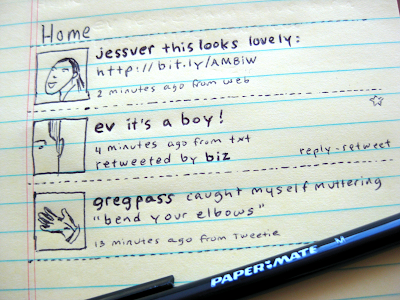
    Original Article: Back in the summer time, Twitter announced that it intended to add a retweet option to its service and the API. Twitter is now rolling out the feature to a small percentage of Twitter users.

    "You may remember that we shared the mechanics of this feature with developers a while back so they could think about how to work it into Twitter apps," says Twitter Co-founder Biz Stone on the company blog. "Now we’re ready to start trying it on Twitter. The plan is to see how it goes first with this small release. If it needs more work, then we’ll know right away. If things look good, we’ll proceed with releasing the feature in stages eventually arriving at 100%."

    If you are a regular Twitter user, it’s pretty much a given that you know what retweeting is, but Stone describes what the button does to those in the dark. "Retweet is a button that makes forwarding a particularly interesting tweet to all your followers very easy," he says. "In turn, we hope interesting, newsworthy, or even just plain funny information will spread quickly through the network making its way efficiently to the people who want or need to know."

    Retweeting
    The Impact of Retweets

    Retweets have already been a great way for content and updates to go viral. Now as the actual feature rolls out, that should only increase. Read this article for a look at the pros and cons of retweets (there are more pros).

    Now that retweeting is becoming an actual feature of Twitter, you’re going to want to keep in mind the tweetability of your content. Shéa Bennett, who writes the blog Twittercism, came up with a helpful equation for maximizing retweet potential. We talked about that here, but basically what it boils down to is leaving enough room in a tweet to accommodate what others will add to it as they retweet it.

    This means keep titles short (at least in the tweet). For example, if you use some form of "tweet this" button on an article that automatically fills out the Twitter form with the article info, make sure there are not too many characters taken up. As you’re probably aware, Twitter only allows for 140, and that’s not very many. Keep in mind the "RT," hashtags, usernames, etc.

    Tweaking Twitter Trends

    In another piece of Twitter-related news, the company also announced that it is experimenting with improvements to trends that will help users find more relevant tweets. They say they’re working to show higher quality results for trend queries by returning tweets that are more useful.

    "The improvement won’t be very noticeable at first, but this is a small step toward unearthing more value in search and getting you more relevant results," says @JennaDawn.

    This means you will probably see less spammy trending topics popping up, which should benefit anyone who follows the trends.

    Related Articles:

    An Equation for Getting More Traffic from Twitter

    Wonder What Percentage of Tweets are Retweets?

    More to Retweeting Than Meets the Eye for Businesses?


  • Square Enix publishing Taito’s new Lufia game

    Famitsu.com has broken the news on a new entry in Taito’s Estpolis series. If the name doesn’t ring a bell, the series was released outside Japan as “…

  • Modern Warfare 2 sells almost 5M copies on launch day

    mw2

    We all knew that Call of Duty: Modern Warfare 2 was destined to smash industry sales records, but the pace at which the game is reported to be selling is absolutely shocking. By Activision’s own internal estimate, the first 24 hours of availability in the US, Canada and UK saw 4.7 million copies sold and generated approximately $310 million of revenue. As for the rest of the world, a good estimate is proving itself rather hard to come by, but Joystiq believes we’re looking at another 2.7m copies on the first day. Yes indeed, it looks as if Activision CEO Bobby Kotick will indeed be getting that mega yacht for Christmas.

    Read

  • The agreement: Intel and AMD ‘wipe the slate clean’

    By Scott M. Fulton, III, Betanews

    Intel alternate top story badgeThe complete text of this morning’s agreement between AMD and Intel was filed with the US Securities and Exchange Commission, and was made public early this afternoon. The agreement explicitly brings to an end three different legal disputes: the 2005 AMD antitrust suit against Intel in Delaware; the 2005 AMD antitrust suit against Intel in Tokyo, Japan; and Intel’s objections to AMD’s restructuring plan, specifically to spin off GlobalFoundries from a subsidiary to an independent unit.

    The agreement acknowledges the gist of AMD’s complaints about Intel’s prior conduct, but Intel does not in turn acknowledge having acted as AMD suggested. But from there, the agreement effectively acts as if to say, “You know what? Let’s forget about all that and start over.”

    “To avoid the time and expense of litigation, and without any admission of liability or fault, the Parties wish to fully, finally and forever resolve, compromise and settle the Actions on the terms and conditions set forth below,” the agreement explicitly reads. “Further, Intel and AMD acknowledge that for most of the last three decades, their relationship has been difficult, challenging and often acrimonious. Intel and AMD wish to change that relationship going forward, both by ‘wiping the slate clean’ as to all past grievances, and by approaching future grievances in a constructive manner designed to address and resolve such grievances amicably, if possible.”

    The business practices which Intel has agreed to abide by, are very carefully worded so as not to suggest that Intel never abided by them in the first place. For example, the agreement does not say Intel will “discontinue” any practice, or “refrain from” doing something, which would imply that it did so in the past.

    It’s a long section, but what it boils down to is the following:

    • No rebates to OEMs for exclusivity. Intel won’t enter into any deals with manufacturers that would give them benefits or awards for restricting their own freedom from being able to purchase parts from any other producer, anywhere in the world.
    • Intel can make exclusionary deals, and no, that is not a typo. There are conditions that have to be met, one of which being that Intel must compete (presumably with AMD) for those deals. The explicit language states Intel is not prohibited: “…to lawfully compete on the merits for selection by the customer for any then-current design award or for satisfaction of any or all of the customer’s then-current demand for microprocessors in a manner consistent with this Agreement.” So if an OEM is offering exclusivity, it must offer it to both competitors, and in writing. And the winner must execute its agreement with the OEM explicitly, and in writing.
    • Intel cannot reward a company for refraining from advertising AMD parts, or for not entering into marketing agreements with AMD, nor can it penalize a company by saying such an agreement with its competitor is against an existing agreement with Intel.
    • Intel can’t rebate anyone for using mostly or entirely Intel parts. That type of exclusivity doesn’t constitute a “design award” or a marketing program, and is thus forbidden.
    • Intel can compete for a design award by a manufacturer were mostly or all Intel parts are used, just as long as AMD can compete as well.
    • Intel cannot create artificial technological impairments such as, for instance, a compiler state that would render some software better or faster on Intel multicores but defeated or dampened on AMD multicores.
    • Both AMD and Intel may offer discounts to customers, especially volume discounts. That’s been a point of contention with Intel, whose accusations against it in recent months have extended to include the ability to offer deep discounts to OEMs for high-volume purchases. As Intel executives have questioned, since when has discounting been illegal, even for a dominant player? Later in the agreement, it specifies that Intel’s ability to offer retroactive discounts — markdowns on current and future purchases based on volumes of past purchases — may be preserved as well, depending on the outcome of current regulatory challenges worldwide.

    The agreement explicitly states that Intel will not challenge the findings of the European Commission, the US Federal Trade Commission, and the New York Attorney General’s office, although it may be free to challenge the language of those decisions. AMD will continue to argue against Intel’s use of retroactive discounts with respect to these regulatory actions, assuming they continue.

    As for any other Intel conduct, AMD says it’s releasing its complaints against Intel; and Intel in turn is releasing its IP complaints. In the terms of a new covenant, neither party can hold the other party or its customers liable for past conduct.

    Copyright Betanews, Inc. 2009


    Add to digg
    Add to Google
    Add to Slashdot
    Add to Twitter
    Add to del.icio.us
    Add to Facebook
    Add to Technorati


  • Are you experiencing problems with BlackBerry App World?

    bbappworlderror1

    UPDATE: We’re hearing that the issue may have been corrected, but there was definitely an interruption in service for some.

    Lucas over at BBleaks is reporting that BlackBerry App World is down. I’ve tried it myself on AT&T here in California and it seems to be working fine. Lucas is running on the Verizon network and they have also tested it on AT&T.

    It seems the problem isn’t about the network, but possibly a node somewhere in the RIM network.

    How is your App World doing? Sound off!


    © Kyle for BlackBerry Cool, 2009


  • Yahoo Launches Spanish Version of Mobile Home Page

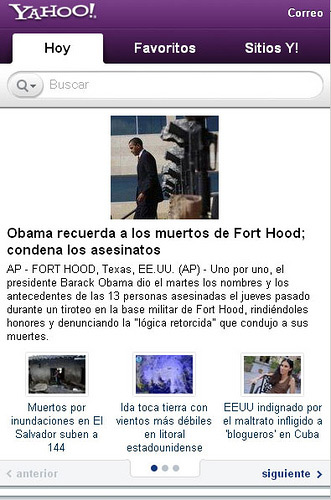
    Yahoo has launched Yahoo Mobile in Spanish. This is a Spanish-language version of the Yahoo Mobile home page, which is customized specifically for U.S. Hispanic consumers, and is available on over 1,900 devices.

    "By bringing together U.S. Hispanic consumers’ favorite content and services from across the Internet, Yahoo! Mobile en Español enables users to create both culturally and personally relevant mobile experiences," a spokesperson for Yahoo tells WebPronews.

    "Yahoo! Mobile en Español targets a significant addressable set of influential and increasingly mobile U.S. Hispanic consumers," she says. "According to the U.S. Census Bureau there are 46 million U.S. Hispanics, making it equivalent in population to the second largest country in Latin America behind Brazil. According to comScore, mobile Internet usage among Hispanics is outpacing that of all other groups, with 88% of Hispanics consuming content on their mobile phones."

    Yahoo Mobile Goes Spanish

    Yahoo says Yahoo! Mobile en Español will give users the ability to:

    – Discover via results from Yahoo!’s award-winning mobile Search, editor-selected content, and U.S. and global news content presented in Spanish, including the “América Latina” news section, which provides relevant content from the Latin American region.

    – Stay connected through access to email and social networking accounts from the most popular Web providers, as well as instant messaging, address book, and calendar functions.

    – Stay informed by bringing favorite Web content —sports, news, local information, RSS feeds, weather, stocks, horoscopes, and more — to a single location.

    Users can find Yahoo Mobile en Español at espanol.yahoo.com. There are more details in Spanish in this blog post from Yahoo.

    Related Articles:

    > Yahoo Adopts Mobile Advertising Guidelines

    > Twitter Expands Into More Than Just 2 Languages

  • Video: Some random, but amazing, 3D modeling demo

    You look like you could use a break. Go grab your lunch and something to drink and then come back and watch this sweet 3D modeling demo. You just wish you had these skills. [via Autoblog]


  • New Glitter Today Plus BlackBerry theme for the ladies

    glitter_blackBerry_theme

    Bplay has a new theme out and this one is definitely for the ladies, or guys who really like pink. The theme features the Today Plus style and some nice looking icons.

    Buy this one for yourself or a friend you know may like it. Glitter Today Plus costs $6.99.


    © BlackBerry Cool for BlackBerry Cool, 2009


  • Modern Warfare 2 sold nearly five million copies in North America and UK at day one

    If Activision’s internal estimates are to be believed, then the much-hyped, much-anticipated launch of Modern Warfare 2 for the Xbox 360, PS3, and PC…

  • Prime Minister visits Kent


    Sorry, you do not appear to have the flash player installed
    – please use the link below to get it now.

    Get Adobe Flash player

    The Prime Minister has visited Kent today to meet local people and talk about their concerns on issues such as immigration.

    He took part in a question and answer session with local people in Maidstone hosted by the Kent Messenger Group, where he discussed the changes to the immigration system that he had announced earlier.

    Gordon Brown also answered queries on topics such as Afghanistan, the jobs market and local development plans in Kent.

    Talking about plans for immigration, the PM told the audience:

    “I see this as a turning point in the debate. We have created a points system so that nobody who has got very few skills or nothing to offer this country is going to be invited into this country. So you have got to be assessed on a points system. What we have said today is that over the next few months…we will now tighten up the points system.”

    Asked by primary school children about the job market they might expect to find when they are adults, the PM said the global economy is set to double in the next 20 years and British products and services would be well placed to meet the increasing demand.

    “I think despite the pessimism about the economy today around the world – every country has had this huge banking problem – that we can say to the younger generation that their prospects in the next generation will indeed be better than ours so I’m optimistic about the future. And if you take a long term view looking at what’s happening, the world is going to need the sort of goods and the sort of services and the sort of quality that we can offer and what we can produce in Britain.”

    Earlier, Gordon Brown had toured manufacturer Delphi’s factory in Gillingham, which produces parts for the diesel automotive industry, and met staff and apprentices.

  • Top 10 BlackBerry Apps for the Mobile Worker

    FireceMobileIT have published their Top 10 BlackBerry Apps for the Mobile Worker and it has some really useful apps that are worth checking out.

    Here are their Top Ten:

    1. Call Time Tracker – Helps business professionals keep track of their time on their BlackBerry so they can better bill their clients. (FREE)

    2. Nice Office – A cool app that turns your BlackBerry into a virtual mobile office. Manage your email, calendar, contacts, and tasks. Store forms and documents online and send them directly to your customers and more. (FREE)

    3. Exgis Expense Tracker – Exgis Expense Tracker is an easy-to-use productivity tool that lets you track your expenses from your BlackBerry as soon as they are incurred. ($4.99)

    4. Personal Assistant – Helps you keep track of spending by tracking all of your online accounts. (FREE)

    5. Poynt – One of the best LBS apps for BlackBerry and with their upcoming features they’ll be even better. (FREE)


    6. WorldMate Live – WorldMate Live is a great app for keeping yourself organized while traveling. (FREE with Subscriptions)

    7. DriveSafely – DriveSafely reads your text messages and emails out loud so you can concentrate on the road. (FREE)


    8. Ascendo DataVault – Ascendo DataVault stores confidential information like Credit Card numbers, usernames, passwords, PINs, etc. on your BlackBerry and Desktop using AES, the most powerful encryption available. ($29.99 USD)

    9. File Manager Pro – File Manager Pro helps you manage all of the files and zip archives on your BlackBerry. ($4.99)

    10. UberTwitter – A great ad-supported, free Twitter client. (FREE)

    © BlackBerry Cool for BlackBerry Cool, 2009


  • Quick Look: Chumby One

    Ladies and germs: the Chumby One. Hot on the heels of its soft, leathery older brother, the Chumby One goes for a more non-nonsense aesthetic with hard edges and a more clock-radio feel. As you recall, the device costs $99.95 and allows you to play back little widgets on a tiny touchscreen. It is at once banal in its simplicity and amazingly unfettered in the amount of content you can stream to the device.

    Our Chumby One came pre-installed with a few widgets including our own news feed and Twitter, which lets you view your Tweets whenever the widget rolls around. I’m going to place this thing on my desk and treat it like a third screen in order to really test the value of this wee fellow. More soon.

    Special note: the battery is not included and is an optional part available from Chumby.

    Product Page