Author: Serkadis

  • Kohlberg Capital Delays Q3 Results

    Kohlberg Capital Corp (KCAP.O) said the filing of its third-quarter results would be delayed after its independent public accountants Deloitte & Touche LLP raised questions about the process of valuing certain loan portfolio investments.

    The business development company said Deloitte issued an unqualified opinion on its financial statements for the fiscal ended Dec 31, 2008.

    Because Kohlberg’s financial statements for the third quarter incorporate its balance sheet as of December 31, 2008, the finalization and filing of the company’s quarterly report will be delayed, Kohlberg said in a statement.

    The company said net investment income for the third quarter was about $4.4 million, or 20 cents per share, which includes the impact of higher interest costs on its credit facility.

    Kohlberg also said in addition to its regular fourth quarter dividend, a further incremental or special dividend would be declared once the company determined the amount of remaining undistributed taxable income for 2009.

    Shares of the New York-based company closed at $5.52 on Friday on Nasdaq. (Reporting by Brenton Cordeiro in Bangalore; Editing by Jarshad Kakkrakandy)

    ShareThis


  • Six Flags Agrees to Avenue Capital Bankruptcy Plan

    WILMINGTON, Del. (Reuters) – Bankrupt Six Flags Inc. has submitted a new reorganization plan that represents a victory for hedge fund Avenue Capital Management, which fought an initial proposal that gave little to bondholders.

    The world’s largest regional theme park operator filed for bankruptcy in the middle of the year with a plan that transferred almost all of its stock to senior lenders, including JPMorgan Chase & Co (JPM.N), in return for cutting its debt.

    The plan sparked immediate opposition, in part because it was far more favorable to bank lenders than what the company had proposed just prior to bankruptcy.

    The company said it realized it had to modify its plan of reorganization after discussions with creditors, and as financial markets improved.

    The “stabilization and loosening of the credit markets has created financing opportunities that did not exist at the times these cases were filed and the original plan was formulated,” the company said in a court filing.

    The new plan, which was filed with the court on Saturday, is based on proposals by the Avenue Capital group of bondholders and includes selling $450 million in new stock to increase the money available for creditors.

    Led by Chairman Marc Lasry, Avenue Capital invests in distressed companies such World Color Press Inc (WC.TO), which filed for bankruptcy as Quebecor World Inc, and MagnaChip Semiconductor, which recently emerged from Chapter 11.

    The new plan does not change Six Flags senior management, which is headed by Mark Shapiro, a former ESPN executive. It also leaves in place some of the management bonuses Avenue Capital criticized in the first plan.

    Bondholders are the biggest winners of the changes.

    Holders of one class of unsecured bonds with claims of $420 million now stand to get up to 47.1 percent of the company under the new plan. Six Flags originally proposed giving them 7 percent.

    Another class of unsecured bondholders with claims of $1.3 billion now stand to get as much as 4.8 percent of the company, compared to the original plan that offered 1 percent.

    The plan may increase the recovery for the junior or holdco noteholders, but falls short of what might have been expected, judging by trading levels for the debt, according to Shawn Abboud, an executive director of trading at APS Financial Corp in Austin, Texas.

    “I fully expect the holdco bondholders to fight this. This doesn’t mean it will be an easy fight,” said Abboud.

    While the company said the plan had broad support, it was not negotiated with the official committee of creditors and will likely face challenges.

    “While we’re reviewing the plan, we haven’t had the opportunity to speak with everyone on the committee to get their sense of what the next step should be,” said Steven Levine of Brown Rudnick, which is representing the committee.

    Holders of preferred equity known as PIERS were also lining up against the plan.

    “We think any plan that doesn’t provide some significant recovery for PIERS and some recovery for common shareholders is delusional and will be dead on arrival before the judge,” said Lance Laifer, the chief executive of Resilient Capital Management.

    Resilient Capital Management has led a fight for its own plan that focused on raising capital through convertible debt and cutting expenses to provide a recovery for all creditors and some equity holders.

    The company has also attracted the attention of former managers, who in August offered to run the company for a $1 salary and said they could increase its value.

    The case is In re Premier International Holdings Inc. and Six Flags Inc., U.S. Bankruptcy Court, District of Delaware, No. 09-12019.

    By Tom Hals
    (Editing by Maralikumar Anantharaman, Dave Zimmerman)

    ShareThis


  • My Dad Doesn’t Want to Talk to Me Anymore

    jetsonsYesterday I called my dad on my cell phone (neither of us have landlines) to tell him about something his granddaughter did, and a few minutes into the conversation he asked if I were near my computer. If I was, couldn’t we Skype instead? In my home Skype is both the P2P telephony program and a verb for video chat. My dad now prefers to Skype with me rather than talk on the phone, a tipping point of sorts in the way we communicate. He said he grew up watching cartoons where folks like the Jetsons talked via videophone, and since the possibility is here today he wants to use it.

    In this multimodal communications world, the phone companies, which still rely on voice for both wired and about a quarter of their wireless revenue, should be worried. Voice revenue isn’t growing in the U.S., but that doesn’t mean that it couldn’t if carriers got a bit more creative. So far, data is helping phone companies that have wireless networks as well as those that are providing Ethernet backhaul for anticipated growth in data.

    voicearpu

    However, the real focus at carriers should be about getting beyond merely providing the pipe in this multimodal world. Check out what BT is doing with its Ribbit acquisition, as an example.

    Skype CEO Josh Silverman would certainly be thrilled to hear about my dad’s preferred form of communication, as would the Telepresence folks at Cisco hoping to get the same thing happening in the business world. Silverman told Om in September:

    “We are pretty big on video calling,” Silverman told me. The company is putting a lot of resources into building a better video conferencing experience, he said, because he believes that person-to-person video calling is going to be as big as video. That absolutely makes sense because today the definition of communication is constantly changing. In the past, the world was all about voice, then instant messages and now video calling. People are sending messages and status updates via Twitter and Facebook. The communications are now multimodal.

    Perhaps in the not-too-distant future my phone calls with be less about voice and more about video, voice, link sharing, and even media sharing all within the context of a television or PC screen. I can turn parts of it on or off as needed. It’s like the vision for social TV that Liz outlined back on March (subscription required) rather than the Jetsons-style videophone that my dad is so excited about right now. The carriers are implementing on this social vision for television, but they should be thinking about adding this to voice as well.

  • Thanks, iPhone: Google buys mobile advertiser AdMob for $750 million

    By Tim Conneally, Betanews

    Google today announced it will acquire mobile display advertising company AdMob for $750 million.

    “For publishers of mobile Web sites and applications, this deal will mean better products and tools and more effective monetization of their content, allowing them to focus more on their users and less on how to generate revenue. For advertisers who want to reach users when they are engaged with mobile content, this deal will bring better, more relevant ads and greater reach. It will also mean more interesting, engaging ad formats. Last, but certainly not least, we believe users will benefit from this deal: through more mobile content and through better mobile ads that deliver useful information,” vice presidents of Product Management and Engineering at Google Susan Wojcicki and Vic Gundotra posted in Google’s Official Blog today.

    AdMob gained a good deal of media exposure thanks to its continuous stream of market pseudo-statistics which were pulled exclusively from its mobile advertising network. While not indicative of the mobile market as a whole, the company at least provided frequent behavioral metrics on iPhone/iPod and Android, the platforms most widely supportive of AdMob’s in-app and mobile-formatted Web display ads.

    “We launched the first iPhone ad units focused on the web and quickly added the capability to run ads in applications. Now with the addition of excellent devices from Palm, Nokia, RIM, and plethora of Android powered smartphones, we have all the preconditions necessary for what will be a tidal wave of mobile browsing and app usage. But let there be no mistake. Our business, and the mobile industry in general, owes Apple a debt of gratitude,” AdMob’s Founder Omar Hamoui said today.

    Copyright Betanews, Inc. 2009


    Add to digg
    Add to Google
    Add to Slashdot
    Add to Twitter
    Add to del.icio.us
    Add to Facebook
    Add to Technorati


  • Murdoch Says Fair Use Can Be Barred By Courts; Will Probably Remove Sites From Google

    And we thought that perhaps — just perhaps — Rupert Murdoch was coming to his senses with the plan to delay putting up a paywall. Turns out that may have been wishful thinking. Mathew Ingram alerts us to the news that Murodch has suggested that News Corp. might actually remove its sites from Google. Of course, I won’t actually believe it until it happens, but he has had his minions going around slamming Google even as News Corp. offers its own aggregators. But actually following through and removing News Corp’s sites from Google would be a huge step to take — though one right off the side of a big cliff. Still, I’m sure it would make for a fun case study.

    In the meantime, his explanation is really quite stunning. He claims that he believes fair use is a concept that the courts will reject:


    “There’s a doctrine called fair use, which we believe to be challenged in the courts and would bar it altogether…”

    Wow. Of course, if that’s true, then (again) we need to point out that News Corp. has been making use of fair use for years with its own aggregators. In fact, most news organizations regularly make use of fair use. Perhaps News Corps’ lawyers who work in their news divisions might want to sit Murdoch down and explain the importance of fair use from a reporting perspective. They might also want to point him to the history of fair use within copyright law, in case he thinks it’s something that was just made up yesterday.

    Permalink | Comments | Email This Story


  • IBM developing zero-emission data center technology

    ibmdata

    We’ve already established that your favorite tech company, from Apple to HP to Nintendo, and everyone in between, is being pressured to go green. While some of the tactics may be a bit silly, I think it’s safe to say that you’d rather see these companies green than not green, right? It makes us feel good about ourselves, that even though we’re buying hunks of plastic and metal—Lord knows what chemicals are in these things—the company in question is trying to make everything as environmentally friendly as possible. In the spotlight today is IBM, which continues to develop technology that could, one day, lead to zero-emission data centers.

    The key to such data centers lies in a new cooling technology that IBM is currently toying around with.

    Says Bruno Michel, an IBM research manager:

    High-performance liquid cooling allows data centers to operate with coolant temperatures above the free cooling limit in all climates, eliminating the need for chillers and allowing the thermal energy to be reused in cold climates. [In so doing, Michel] demonstrated the removal of 85 percent of the heat load from high-performance compute nodes at a temperature of 60 degrees Celsius and compared their energy and emission balance with a classical air-cooled data center, a data center with free cooling in a cold climate zone and a data center with chiller-mediated energy reuse.

    In other words, thanks to this fancy new cooling technology, IBM has to use less energy than it otherwise would have it.

    The whole system reuses about 75 percent of the energy initially put into it. It’s that loss of only around 25 percent that makes the whole thing so efficient.

    In other news, I have a massive headache. Is there an App for that?


  • Microsoft Launches Exchange Server 2010 — But Free Competition Looms

    Microsoft unveiled Exchange Server 2010, which has been in beta testing since April, at its TechEd conference in Berlin today, and showed it working with Outlook 2010.  Exchange 2010 is the company’s latest server technology for on-premise software deployments, but it also incorporates many features aimed at web and online services. It has a new, integrated email archive designed to help companies increase compliance and respond quickly to legal and e-discovery concerns, and there are now previews of voice mails in Microsoft Outlook. It’s also very apparent that Microsoft officials are aware of the new kinds of competition that Exchange is facing.

    It was clear from the product positioning that Microsoft is feeling the heat (GigaOm Pro, sub. req’d) from enterprise adoption of tools from Google, such as Gmail, many of which are free or available in low-cost versions for business use. Cisco — a long-time Microsoft partner — is also taking aim at Microsoft Exchange with a new enterprise email service, WebEx Email. Steve Elop, president of Microsoft’s business solutions division, made numerous mentions of cost savings that enterprises can purportedly reap with Exchange 2010, and there was much focus on the email archiving and legal compliance features to be found in both it and Outlook 2010. Among cost-saving citations, Elop noted that companies can now run Exchange Server on lower-cost storage platforms than SANs.

    Indeed, Google CEO Eric Schmidt has been very vocal recently about that company’s “next billion-dollar opportunities” when it comes to delivering web-hosted applications and other tools that can serve as alternatives to Microsoft’s solutions — and its licensing fees. In fact, many of Schmidt’s recent comments are decidedly anti-Microsoft.

    No doubt with Google’s focus on online-hosted applications in mind, many new features in Exchange and Outlook are designed to allow email inboxes and archives to migrate easily between on-premise deployments and online-hosted ones. For example, a demonstration at the Berlin event included taking an existing on-premise email inbox and transferring it to a web-hosted implementation. Exchange Server is available now for trial use, here (Microsoft Silverlight req’d.).

    Microsoft officials also announced that the company is acquiring SourceGear’s Teamprise technology. Teamprise allows Java and Eclipse developers to create applications with Microsoft’s Visual Studio. We’ll be on the lookout for more announcements slated to arrive at TechEd this week and will update you as they come in. Stay tuned.

  • 1 Goal, girls and the super Eaglets

    New scoreboard

    New scoreboard

    Nigeria is currently going through its own mini World Cup fiesta. After many months of doubt, deliberation and dubious ‘readiness reports’ the FIFA Under 17 World Cup is on and much of this football crazy nation are intensively following the super Eaglets quest for glory, to restore national pride and re-capture their 1999 Crown. 

    It’s hard to pick a favourite as some of the squads were radically altered after FIFA introduced new imaging techniques of player’s wrists that accurately determine age: one nation withdrew completely!

    Barca fan, Nigeria

    Barca fan, Nigeria

    At six locations around the nation large crowds are turning out to cheer on the teams, adding African style noise and intensity to make the occasion. I decided to make the effort and headed down to the home of our local team, Kano Pillars: the Sani Abacha Stadium in Kano.

    Kano hosting the U17 World Cup

    Kano hosting the U17 World Cup

    Getting a match ticket was the easy part, getting past the baton wielding police, shut gates and crowds of disaffected ticket holders was not. Most of my friends gave up when a camera was pick-pocketed. Eventually though, a FIFA ‘risk assessment’ officer let me in.

    Let there be light!

    Let there be light!

    Inside the atmosphere was electric as the 10-man Spanish team scored to go 2-1 up over the USA.  The quality of the play was a lot better than I expected and the crowd enthusiastic. Fans chatted with me about the stars of the Premiership and La Liga, giving sympathy for my home team Newcastle United. The stadium, complete with giant video screen was great, I really felt like I was at Old Trafford.  Only when the floodlights failed (twice) and 14 minutes of extra time added was I reminded of the problems that plague Nigeria’s quest to become one of the 20 most developed nations.

    DFID has been supporting the international 1 GOAL! Campaign, in collaboration with FIFA, to use the World Cup competition to focus both public and political attention on getting all children into school – a lasting legacy, beyond stadiums and video scoreboards. Africa has most of the out of school children in the world, with Nigeria having the dubious distinction of topping this league table. 1GOAL was recently launched in Nigeria by a passionate football fan and governor of Lagos, Babatunde Fashola. Video messages promoting schooling are being broadcast together with all the U17 World cup games in Nigeria.

    Teenage girls, rural Kano classroom

    Teenage girls, rural Kano classroom

    The healthy, literate Western teenagers on display in Kano have had the benefits of a well rounded education and great prospects lie ahead. Outside the stadium the Almajarai street boys scavenge for a living on Kano’s dusty streets and girls younger than the soccer stars on display die from maternal complications, following arranged marriages. Girl Effect, a Nike Foundation initiative eloquently illustrates the potential of adolescent girls – if they are given the opportunities of education and empowerment.

    Educated but unruly...

    Educated but unruly…

    The Eaglets are now in the final knock out stages of the competition that will culminate in the capital Abuja on Nov 15th. I hope both they and the other 30+ million school age children in Nigeria get the education and opportunities they all so richly deserve.

  • Wounded Warriors at the White House

    The President hosted a remarkable group of wounded veterans a few weeks ago on the White House basketbal court. These "Wounded Warriors" from Walter Reed Army Medical Center showed President Obama a thing or two about wheelchair basketball. Check out the impressive moves that can be performed on four wheels:


  • Google Buying AdMob for $750 Million

    Google has agreed to buy AdMob, a San Mateo, Calif.-based mobile advertising marketplace, for $750 million in stock. AdMob has raised over $46 million in VC funding, from firms like Accel Partners, Sequoia Capital and DFJ Growth Fund.

    PRESS RELEASE

    Google Inc. (NASDAQ:GOOG) today announced that it has signed a definitive agreement to acquire AdMob, a mobile display ad technology provider, for $750 million in stock. This acquisition will enhance Google’s existing expertise and technology in mobile advertising, while also giving advertisers and publishers more choice in this growing new area.

    “Mobile advertising has enormous potential as a marketing medium and while this industry is still in the early stages of development, AdMob has already made exceptional progress in a very short time,” said Susan Wojcicki, Vice President of Product Management at Google. “AdMob is the quintessential Silicon Valley startup — generating impressive year on year revenue growth — and we’re excited to welcome this talented team to Google.”

    “I think people underestimate how important ads have been to funding the development of innovative content on the Internet. Our goal all along at AdMob has been to make it possible for developers and publishers to bring their products and ideas to mobile with the same business model,” said Omar Hamoui, Founder and CEO of AdMob. “We’re proud of the progress we’ve made towards accomplishing this goal, and joining Google will only accelerate this process, ultimately leading to very real benefits for end users around the world. As publishers and developers generate more revenue from their mobile products, they will invest more, and their mobile offerings will become richer, more creative and more robust.”

    The deal will help Google in its efforts to develop more effective tools for creating, serving and analyzing emerging mobile ads formats. As this ecosystem continues to grow, the company expects these new marketing media to offer significant benefits:

    • Advertisers will be better able to engage mobile users with AdMob’s ad formats
    • Publishers and developers will be able to monetize their content more effectively, which has benefits for the wider mobile ecosystem
    • Users will see more relevant ads and ultimately get access to more ad-supported content and applications – improving their mobile experience

    “Attracting the world’s top engineering talent and people with entrepreneurial vision to Google has always been crucial to our success. AdMob’s proven track record in innovating at speed will help maintain that culture  which is why we are so excited to be working with them,” added Vic Gundotra, Vice President of Engineering at Google.

    Both companies have approved the transaction, which is subject to customary closing conditions.

    About Google Inc.

    Google’s innovative search technologies connect millions of people around the world with information every day. Founded in 1998 by Stanford Ph.D. students Larry Page and Sergey Brin, Google today is a top Web property in all major global markets. Google’s targeted advertising program provides businesses of all sizes with measurable results, while enhancing the overall Web experience for users. Google is headquartered in Silicon Valley with offices throughout the Americas, Europe and Asia. For more information, visit www.google.com.

    ShareThis


  • Google to Buy AdMob

    ad_mob_logo_headerIn a clear sign that mobile advertising has arrived and become a major revenue opportunity, Google today announced that it is buying AdMob, the upstart mobile advertising company based in Mountain View, Calif., for $750 million in stock. On AdMob’s blog, Google’s Susan Wojcicki, VP of product management, and Vic Gundotra, VP of engineering, write:

    For publishers of mobile websites and applications, this deal will mean better products and tools and more effective monetization of their content — allowing them to focus more on their users and less on how to generate revenue.

    For advertisers who want to reach users when they are engaged with mobile content, this deal will bring better, more relevant ads and greater reach. It will also mean more interesting, engaging ad formats.

    AdMob has long been the dominant pure-play ad company in mobile, gaining traction as a kind of automated ad clearinghouse for inventory on the mobile web. The company has also expanded into mobile app advertising, which has exploded thanks to uptake of superphones such as the iPhone and Android handsets. Google, meanwhile, has primarily focused its mobile ad business on search.

    As Google pointed out, the deal follows a handful of similar acquisitions by traditional online companies looking to move into mobile: AOL bought Third Screen Media more than two years ago, Yahoo picked up Actionality several months later and Microsoft bought its way onto the field with the pickup of ScreenTonic. But Google’s move raises the stakes for all the players in the game, and fires a warning shot across the bow of smaller mobile startups. Expect Google to move quickly to integrate AdMob’s business with its own mobile ad division as the company’s Android platform picks up steam.

    While Google certainly paid a premium for not buying in earlier — or for establishing a thriving mobile ad placement business of its own — the tie-up appears to be a good fit. UBS analyst Brian J. Pitz speculated that Google is likely to integrate AdMob’s technology, clients and publishers into its AdSense network, which launched a mobile component two years ago. And J.P. Morgan said the acquisition “makes perfect strategic sense,” allowing Google to leverage AdMob’s technology to serve and analyze emerging ad formats:

    “In our opinion, Google has invested heavily in growing the mobile Internet business through its development of Android and inclusion of mobile ads on AdWords,” the firm wrote in a research note. “The acquisition of AdMob should allow Google to monetize its support of the development and use of mobile Internet content further.”

    AdMob doesn’t disclose revenues, but J.P. Morgan estimates the company generates between $45 million and $60 million in revenue on an annual basis. The company has raised $47.2 million in venture capital from Accel Partners, Draper Fisher Jurvetson and Sequoia Partners, and it has seen its number of monthly ad requests increase sixfold over the last two years, reaching 10.2 billion in September.

  • Nokia recalls several mobile phone chargers over shock hazard

    Nokia has recalled several mobile phone chargers, manufactured by third-parties for the company, because of the chance of electrical shock. There’s been no reports of any injuries, so consider this a precaution.


  • Murdoch: We May Block Google

    Rupert Murdoch, founder and head honcho of News Corp., the largest media company in the world, wants to block access to his content and set up pay walls around it. News Corp. already does it at The Wall Street Journal.

    “The people who simply just pick up everything and run with it — steal our stories, we say they steal our stories — they just take them,” Murdoch says in an interview with David Speers of Sky News Australia, which is one-third owned by News Corp. “That’s Google, that’s Microsoft, that’s Ask.com, a whole lot of people…They shouldn’t have had it free all the time, and I think we’ve been asleep.”

    The move is aimed at Google, as outlined in this conversation:

  • Tagged.com Reaches Settlement With NY AG

    New York Attorney General Andrew Cuomo said Monday that his office has stopped social networking site Tagged.com from misappropriating the contacts lists and identities of its members and from sending out millions of deceptive and unsolicited emails.

    Through an agreement with Cuomo’s office, Tagged will pay $500,000 in penalties to the state and take measures regarding the access and use of its members’ personal information.

    "Unsuspecting users had no idea that Tagged had hijacked the email addresses of their colleagues, families and friends for the purpose of blasting them with spam," said Attorney General Cuomo.

    Andrew Cuomo
    Andrew Cuomo

    "This agreement holds the company accountable for its invasion of privacy and puts the proper safeguards in place to keep it from happening again."

    In June, Cuomo announced his intent to sue Tagged for deceptive acts after his office became aware that the company had sent more than 60 million misleading emails to people stating that Tagged members had posted private photos online for their friends to view.

    In reality, the photos did not exist and the email was not from their friends. When people tried to access the photos, they were required to become a new member of Tagged. The company would then gain access to their email contacts and send more fake invitations.

    As part of the settlement, Tagged will now provide clear disclosures when asking for access to a new user’s email contacts and will no longer access those contacts or send messages without the member’s permission.
     

    Related Articles:

    >Tagged.com Sued By NY AG

    >NY AG Hits Intel With Antitrust Suit

    >Dell Settles New York Fraud Case For $4 Million


  • RIM’s new loves: OpenGL ES, Java GUI Builder, Advertising and Push Services

    rim-logo1

    We’ve already talked about some of the news from the first day of the 2009 BlackBerry Developers Conference, but another blast of PR from RIM has hit out inboxes, and wow, are we ever excited. The biggest news of the day is that developers will finally be able to unlock the full potential of the latest generation of BlackBerry smartphones — OS 5.0 and hardware permitting, of course — with the latest beta of the Java SDK 5.0 thanks in part to its OpenGL ES support. Still, there’s a lot of things to cover and we don’t want to clutter up our newly redesigned site with a bunch of text, so join us after the jump.

    Previewed today but not expected to be available until the middle of 2010, the BlackBerry Java Plug-in for Eclipse will be updated with a new drag and drop WYSIWYG interface which will greatly reduce the amount of time it takes for a developer to put together all of the graphical elements in an app. More importantly, as BG is screaming up and down with excitement, this should allow BlackBerry applications to utilize a more streamlined and consistent user interface instead of, well, utter crap. More information about the new BlackBerry Theme Studio which replaces the Plazmic Content Developer’s Kit has also come out. Comprised of the Theme Builder and Composer, Theme Studio works for all devices running OS 4.2.2 and up and can not only directly import images from Adobe Photoshop but create a new generation of themes that are capable of zooming, sliding, wiping and fading while devices with OS 5.0 and up will have support for ringtones and screen transitions (oooooh, aaaaah). And now on to some slightly drier content (as far as consumers interests go.)

    One of the things RIM has focused very hard on since the launch of App World has been helping to create an environment in which developers can generate more revenue and heighten the app-friendliness of the OS. With this in mind, RIM has announced its very own advertising service, BlackBerry Advertising Service, which amongst other things will “include the ability to easily initiate a call from an ad, add a calendar entry or contact entry from an ad, and directly link to an application in BlackBerry App World from an ad” while providing deep analytics. Speaking of monetization, BlackBerry Payment, available in mid-2010, will open the flood gates to activities such as premium content, subscriptions and in-app purchases. GPS has been a strong point of any BlackBerry, but now developers will have the means to do crazy new-fangled things like use cell site geolocation, reverse geocode and figure out how many minutes it will take to arrive at ones destination. Mindblowing? Definitely not. Abso-positively-necessary for RIM to do? Yes.

    Read

  • Further collaboration with Adobe and BlackBerry Academic Program announced at Dev Con

    bb-devcon09

    With the 2009 BlackBerry Developer Conference kicking off today in San Francisco, RIM has doled out two press releases to get the ball rolling. As many of you may recall, it was back in August that we first broke the news that RIM was going to implement support for Adobe Flash in its browser for 2010. Two months later, this and more was confirmed by Adobe. Now RIM has come forward and announced a furthering of their partnership. Developers will be able to take advantage of Flash and Creative Suite 5 by directly exporting elements created within into various BlackBerry development tools. The goal of this is to quickly and efficiently create applications and widgets that are more multimedia rich and offer a far greater user experience than is currently possible. The same family of Adobe products will also be able to work in tandem with the new BlackBerry Theme Studio. Another thing announced today was the BlackBerry Academic Program. Having already been piloted by some 500 students over the past year, the Academic Program gives colleges and universities the knowledge, tools and curriculum it needs to offer students BlackBerry-specific courses in development, administration and support, a field which has been and still is experiencing tremendous growth. More details for both Adobe’s further collaboration with RIM and the BlackBerry Academic Program are available in the read links after the jump.

    Read – Adobe Collaboration Deepens

    Read – BlackBerry Academic Program

  • Last minute reminder: CrunchGear meetup in Columbus

    57057-1bk77v577u
    Don’t forget: John and I will be at the Surly Girl Saloon tonight around 6:30 PM. Look at the happy smiles on those faces! That could be you, this time! Feel free to tell us about the cool world-changing projects on which you’re working. We love to meet people working on amazing stuff.


  • Exchange Server 2010 goes live, will extend rights-managed e-mail to browsers

    By Scott M. Fulton, III, Betanews

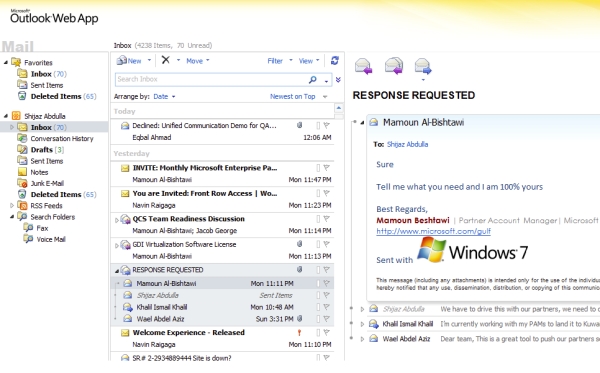
    Microsoft Exchange top story badgeOne of the more important features of Microsoft Exchange Server 2010 (or Exchange 2010, depending upon whom you’re talking to), officially launched for sale this morning during a TechEd conference in Berlin, is a system for mail administrators to implement policy-driven rights management that’s ensured not just for Outlook 2010 (Office) users, but also users of the Outlook Web App running through Web browsers, including Mozilla Firefox and Apple Safari.
    These rights management features, called Transport Protection Rules, will enable admins to generate extensive rules that restrict, where necessary, an e-mail recipient’s ability to make alternate uses of the content of e-mail, including simply copying and pasting its text elsewhere, if messages are deemed confidential. Corporate Vice President Stephen Elop and Exchange product manager Julie White demonstrated TPR to a TechEd crowd that appeared, at least from the live feed from Berlin, to be less-than-capacity, though which Microsoft described as a sellout crowd of 7,000.

    During this morning’s demo, White showed how OWA typically enables the e-mail client to prohibit unrestricted use of an e-mail’s content if the sender explicitly flags the mail as confidential. Transport Protection Rules, by contrast, enables the creation of a policy restriction template that may be applied whenever any content sent from a specified account meets the criteria. That criteria includes the inclusion of phrases within the content of the mail itself — White’s demo involved the phrase launch plans.

    Outlook Web App for Microsoft Exchange Server 2010

    A TPR can be designed, the demo showed, where a rule can search outgoing content for the specific phrase, and if that phrase is located, Exchange can apply the confidentiality rule that the original sender may have neglected to apply. The message becomes confidential because content is always being evaluated by Exchange. The restrictions, including inability to copy and paste text or to forward the message to other recipients, may be enforced on non-Microsoft browsers including Firefox.

    In fact, TechEd attendees this morning saw more of Firefox than Internet Explorer; and when Elop pointed this out, attendees offered the biggest round of applause of the day.

    “Integrated information rights management is now natively supported within Outlook Web App,” said White, “so that now users can create protected messages without needing an additional plug-in, or taking any extra steps. And that means fewer support desk calls for you [the admins].”

    TPR was perhaps one of the few Exchange features that was actually new to at least some of the admins in the audience today, as Microsoft execs would later acknowledge that the ES 2010 beta program was perhaps the largest in the company’s history — even larger than for Windows. The reason, stated Corporate Vice President Chris Capossela during a staged Q&A following the TechEd keynote, was that a multitude of colleges worldwide adopted Exchange during the beta program, and signed their students up. Over 10 million students worldwide effectively became users of Exchange Server, and many of those effectively of the new Outlook Web App.

    So some of the other features execs showed off today ended up being old news to many, including how Exchange and OWA implement conversation view — the ability to automatically categorize e-mails as threaded conversations based on their subject lines — and the “Ignore Conversation” feature, which lets the client skip future messages belonging to unwanted conversations. At one point, Elop prodded the audience for a response. “Some applause, something, anything?” he asked. “A little love, please?”

    Today’s Exchange rollout comes on the same day as Cisco announced its own Unified Communications System 8.0 platform update, which integrates a new collaboration toolkit and a hosted e-mail option, putting Cisco in direct competition with Microsoft Exchange and Lotus Notes.

    This morning, Capossela dismissed Cisco’s move by painting it as something less than unified, pushing Exchange as a product that has grown organically over the years “rather than stitching together acquired products and calling that the solution,” referring to Cisco’s propensity for acquisition. Cisco’s platform does include the secured instant messaging tool it now calls Unified Presence 8.0, but which came to prominence as Jabber prior to a Cisco acquisition in September 2008.

    Copyright Betanews, Inc. 2009


    Add to digg
    Add to Google
    Add to Slashdot
    Add to Twitter
    Add to del.icio.us
    Add to Facebook
    Add to Technorati


  • Skype Names SIP Guru as Chief Tech Strategist

    Skype has hired well-known VoIP expert Jonathan Rosenberg as its chief technology strategist, the company announced today. Rosenberg was highlighted as one of the Cisco executives Index Ventures’ Michael Volpi would bring over to Skype in order to help the company figure out a way around the JoltId stranglehold. As you might know, Skype and Joltid, the company that owns the technology used by Skype (and controlled by founders Niklas Zennstrom and Janus Friis), settled with the company last week.

    Rosenberg is well-regarded in SIP circles and his hiring means that Skype is making a stronger push into the enterprise. Rosenberg was a Cisco Fellow at Cisco Systems, where he directed technology strategy for its enterprise voice product portfolio. When I last spoke to Skype CEO Josh Silverman, he was pretty clear about his desire to turn Skype into a major enterprise voice and collaboration player. Rosenberg’s hiring is a smart step by Skype. (Related post: How Skype Plans to Dominate Business Telephony.)


  • MojaMix, a web service that lets you make your own cereal and granola

    moja 2_jpg
    Back in the olden days, long before the advent of electric light, our forefathers dreamt of a better place. They dreamt of running hot and cold water in their wash rooms, wireless telegraphy, and the rise of the horseless carriage. They dreamt of threshing machines that could tie down an acre of millet an hour and helioplanes that could transport humans from one place to another in comfort and style. But what was the dream that drove our forefathers to strive for better things, always? What dream sustained them through a Depression and two World Wars? What was the silent prayer they mumbled nightly to the heavens from their pinched and chapped lips? Friends, they dreamt of a website that lets you mix your own trail mix and cereal. And that dream is now a reality.

    Mojamix is an online granola manufacturing system. You select your base, then add dried fruit, seeds, and nuts. They package up your foodstuff and send it to your home via first class mail. The average 12-ounce bag costs about $12 and there is the possibility of adding chocolate-covered cashews to the mix. This last part is what clinched it for me.

    The company sent me two handmade concoctions GORP and cereal. It was packed on November 3 and arrived on November 7. The GORP was quite tasty with plenty of fruit yet, sadly, a small smattering of chocolate covered cashews. The cereal was also good with a good flake-to-fruit ratio, ensuring I wasn’t just eating flakes although, to be honest, I’d have preferred to have seen a fewer flakes.

    The company offers some Popular Mixes including the “Happy Camper” and “Runner’s Fuel,” and each of these mixes can be improved through the addition of chocolate covered cashews. You can also add flax seeds, but nothing good will come of that.

    Let it be known: 12 ounces of cereal is not enough for a family of four, especially since there aren’t enough chocolate covered cashews in there to go around. I’d recommend getting two bags at a time, a pricey proposition.

    Is Mojamix for you? I don’t even know what to tell you. If you’re too busy to head down to the health food store and really like goji berries, godspeed. The dried fruit was fresh and the granola was quite tasty so quality wise you’re going to get a better experience then you would back at the local food co-op where the granola is picked over by children and besmirched with hippie cooties.

    That said, Mojamix has decided to be nice to you and offer a contest and a coupon code. First, enter “crunchgear” in the coupon code for 10% off of your order. Second, Mojamix has agreed to give away bags of goodness to 10 random commenters. What’s in your Mojamix (besides chocolate covered cashews)? We’ll close the commenting on Weds and send emails to the winners.