Author: Serkadis

  • If Microsoft sites lead time online, pigs can fly

    By Joe Wilcox, Betanews

    On Friday, ComScore reported that in September, worldwide, Internet users spent more time at Microsoft sites than at Google, Yahoo or even Facebook. It’s an amazing statistic that has questionable street cred. ComScore has presented the data in a favorable way to Microsoft but which doesn’t accurately represent exactly how Internet users really spend time on popular Websites.

    Time-spent-online data is hugely important to Microsoft and other popular destinations, such as Facebook, Google or Yahoo. While bloggers and news organizations obsess over every pageview, time spent online is a much more important metric. People coming and staying for hours is potentially more valuable to online advertisers than Internet users who click in and click out, which too often is the only measurable value of pageviews.

    How people spend their time online is important, too. There — when read between the lines — ComScore’s data has some value for Microsoft. Are site visitors reading blog posts or news stories? Banner advertising and contextual search keywords could be effective. Are they playing interactive games with other Internet users? Contextually relevant ads within games could be better. Are they chatting with friends via IM or social status updates? Banner ads and interactive surveys might be more effective.

    Time after Time

    ComScore claims that worldwide during September, Microsoft sites accounted for 14.5 percent of the time spent online, followed by Google at 9.3 percent. What a strange perspective. After so many months — years — of Microsoft trailing Google by huge amounts, roles are decidedly reversed. But in the United States, Google and Yahoo led Microsoft, which overwhelming dominated online time in Europe,Latin America and Middle East (see first chart), ComScore claims.

    The ComScore report is big on “What?” or “How much?” but offers scant reasons on “Why?” that makes the data relevant. The reasons are hugely important for understanding how consumer Microsoft marketing and new product releases could be paying off. Additionally, the phenomenon could show where Microsoft could leverage against Google and how Yahoo might be fumbling. I couch with “could” and “might” because of the caveats coming in the next two paragraphs.
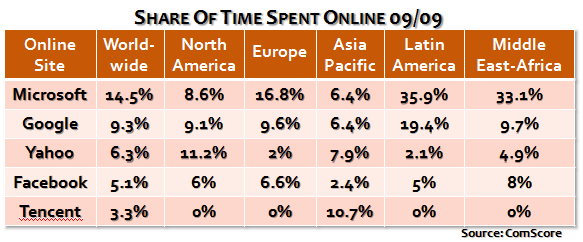
    Time Spent Online 09/09

    The ComScore data, while important for Microsoft, is incomplete. ComScore excludes Internet cafes, public computers and smaller mobile devices, such as cell phones, PDAs and smartphones. Internet cafes could be good for Microsoft because of some emerging markets, where the MSN and even Windows Live brands are strong; ditto for Yahoo. Public computers, if these count education institutions, could be good for Google. Cell phones and smartphones are a grabbag.

    The data also is unspecific in a crucial area: How much actual time did individuals spend online. ComScore findings are in aggregate. For perspective, back in February, AOL and Yahoo led with most time online per Internet user, according to Nielsen. Per individual: 3:58:22 (hours, minutes, seconds) for AOL but only 2:16:54 for Microsoft. Caveat: Nielsen’s data only measures United States, while ComScore offers worldwide view. That said, U.S. data is inconsistent between the online analysis firms, too (see both charts).

    Nielsen’s most recent data, also for September, shows Microsoft sites as No. 5 not No. 3 in the United States (see chart 2). Nielsen’s data is inconsitent with ComScore’s findings. AOL, which ComScore ranks No. 3 in the United States doesn’t show up at all in ComScore’s US rankings. Most startling, ComScore puts Facebook at No. 4 for time spent online among US Internet users, while Nielsen ranks Facebook as No. 1.

    Facebook’s placement is hugely significant. In February, the social networking site didn’t even make Nielsen’s US top five. Now Facebook is tops, with time-spent-online per individual a whopping 5:24:38. Right, almost five-and-a-half hours per Internet user. Something else: Nielsen shows time online at Microsoft sites going down by about 8 minutes between February and September. By comparison, time online at Google sites rose about 40 minutes, nudging ahead of Microsoft.

    Means to a Measure

    Metrics and measurement mean everything for online data such as this. But to companies like Facebook, Google or Microsoft, marketing matters more. Microsoft will gain immeasurable PR value from ComScore’s study. But Nielsen’s consistency tracking time online — and measurement per individual — is more credible. Then there is the “Why?” ComScore does give, which makes sense of its approach to measuring time spent online at various Websites. Quoting the ComScore press release — a rarity for me:

    Mearly 27 billion hours were spent on the Internet globally by a record online population of 1.2 billion Internet users age 15 and older. Microsoft Sites accounted for 14.5 percent of total minutes spent online in September, making it the most engaging global property, with Microsoft’s Windows Live Messenger representing nearly 70 percent of time spent on the property during the month.

    Whoa. Seventy-percent came from Windows Live Messenger? Exactly how does usage of Microsoft’s desktop IM client count as time spent on the company’s sites? Surely only a fraction of Live Messenger users come through the the Web-based version, based on Microsoft data about client downloads. I ask again: How does time spent in Live Messenger count as time at Microsoft sites? Windows Live log-ins perhaps?
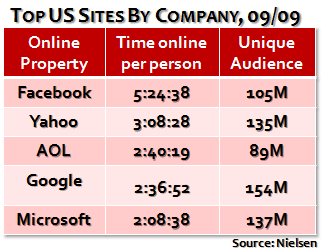
    Time Spent Online 09/09 Individual

    Maybe Safeway or Trader Joes should tally everyone using one of their shopping bags in monthly store customer counts. Perhaps Visa should count everyone using its cards to buy products as visitors to its Website. How about beauty product companies like Clinque, Mac or Sephora count every free product sample as customer purchase.

    Something about ComScore’s data — at least as presented — doesn’t make sense.

    Still, behind the measure, Microsoft can gain valuable insight. Windows Live Messenger is an arguably hot on-desktop/online property. It’s real estate Microsoft could connect to other properties, particularly broader Windows Live services or Windows 7.

    To reiterate, ComScore’s data is questionably valid as presented (other than for Microsoft marketing purposes) because:

    • ComScore ignores public PCs, Internet cafes, PDAs and smartphones
    • The measurement is aggregated rather than for individual time spent online
    • Windows Live Messenger accounts for 70 percent of the time spent at Microsoft sites
    • Nielsen data, which does track individual time spent online, is more consistent over many months and contradicts some ComScore’s findings.

    So, Betanews readers, I have to ask: Where do you spend most of your time online? Gulp, I would hope it would be Betanews. Comments are open for your answer.

    Copyright Betanews, Inc. 2009


    Add to digg
    Add to Google
    Add to Slashdot
    Add to Twitter
    Add to del.icio.us
    Add to Facebook
    Add to Technorati


  • First reviews of Modern Warfare 2 published: Two perfect scores

    mw2reviews

    So to recap: nobody has been given permission to sell Modern Warfare 2 early. It’s a crazy Internet rumor that has no basis in reality. But it’s happening like whoa. What is based in reality is that the first reviews of the game have started appearing online, and they’re all from UK newspapers. A strange place to see the first reviews of what’s probably going to end up being the biggest game of the year (with all due respect to Assassin’s Creed II).

    Both The Daily Telegraph and The Guardian (my favorite British paper, if only for its football coverage) gave the game perfect scores. I’ll quote each review’s final paragraph, because it’s easy and my head still aches like nobody’s business.

    The Daily Telegraph:

    All told, Modern Warfare 2 crosses into the must-have category of video games effortlessly. It offers an unmatched shooter experience, a compelling story mode, a slick package of mini missions and a multiplayer which is pretty much unparalleled in depth. It’s sure to satisfy the demands of its fan base, and anyone who considers themselves a fan of shooters in general should definitely pick up a copy. It may be debatable as to whether Modern Warfare 2 is objectively the best release of 2009, but it’s certainly the finest game in its genre, as well one of the truly great games of this or indeed any year.

    The Guardian:

    All in all, MW2 is exactly what fans were expecting. Yes, it carries a hefty price-tag, a shortish single player campaign and only adds a handful of genuinely new elements to the prequel, but you won’t find a more polished, intelligent FPS this year. For non-stop action, superior AI and perfectly balanced weapons, it’s a worthy chart-topper that hammers a nail into any hope of the COD franchise returning to its WW2 roots anytime short of the next round of console upgrades. And, on this evidence, you won’t find too many complaints about that.

    Sounds to me that if you’re even remotely a fan of the FPS genre, then you’ll probably at least like the game.

    Look for more exciting reviews to hit the Web in the coming hours.


  • Twitter Analytics Service Gets Off To Great Start

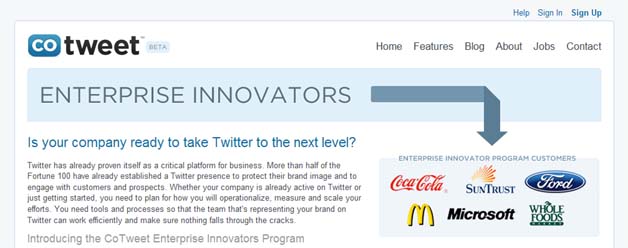
    CoTweet, a company that helps businesses use Twitter, released some details about a new service today, and in doing so, demonstrated that there’s a real demand for such things.  The CoTweet Enterprise Innovators Program already has at least six major customers despite costing $1,500 per month.

    Coca-Cola, Ford, McDonald’s, Microsoft, SunTrust, and Whole Foods are among the early adopters, which is quite impressive.  Another interesting detail is that CoTweet isn’t exactly begging for clients; the program’s existence was discovered by Wall Street Journal reporter Andrew LaVallee, and businesses in fact have to request an invitation to scope out the new offering.

    As for what their interest (and monthly payments of $1,500) will net them, the CoTweet Enterprise Innovators Program offers engagement, influence, and reach analytics, along with archives of customer interactions and a couple other things.

    Anyway, this development could provide a number of clues concerning the future of Twitter.  One point in the site’s favor is that corporate users are so fascinated by it.  This should give Twitter some staying power.

    Also, although the launch of the CoTweet Enterprise Innovators Program might seem like yet another missed revenue opportunity (Twitter’s indicated before that it might try to make money by selling premium accounts and analytics services), Twitter could still presumably join the game at any point in time.

    The interesting thing is that these well-connected companies didn’t wait for it to do so.  Microsoft and the others almost surely would have heard if Twitter had a service in the pipeline, and then would have held out another couple of weeks or months to use it.  So any sort of official offering may be quite a ways off.

    One last item of note: a post on the CoTweet Blog made clear, "The CoTweet public beta remains free for consumers and enterprises."

    Related Articles:

    > 20 Goals For Business Social Media Use

    > 8 Reasons You Need To Stop Ignoring Twitter

    > A Suggested Users List For Twitter That You Can Actually Use

  • Nokia’s ‘limited number’ of recalled chargers exceeds 14 million

    By Tim Conneally, Betanews

    Leading mobile phone maker Nokia today announced a recall of three types of Nokia-branded phone charger which were found to be a shock hazard.

    The chargers were manufactured by Chinese mobile phone component firm BYD International Electronic Company this year. Nokia today said that the plastic covers of these chargers could come loose and open up to expose the internal components which could shock the user if handled improperly. Nokia said it was not aware of any injuries or incidents related to these chargers.

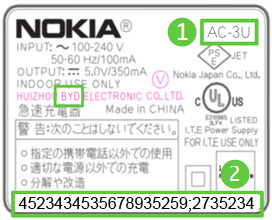
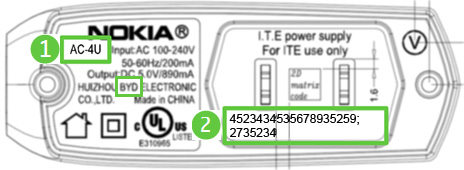
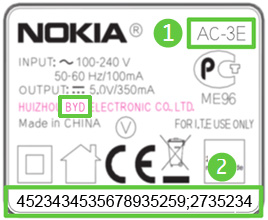
    Nokia is offering a free replacement to affected units, which carry the model numbers AC-3U, AC-3E, or AC-4U. Since these were all made within the last six months, if you purchased a Nokia charger before June 15, 2009, you are not impacted by this recall.

    Nokia Charger Recall
    Nokia Charger Recall
    Nokia charger recall

    Nokia has not detailed the breadth of this recall, saying in the recall statement that only “a limited number” of chargers are affected. In Nokia’s blog, the company was equally vague, noting that it’s only “a limited number of chargers manufactured over a short period available in a select number of countries.”

    The US Consumer Product Safety Commission has not yet issued a warning for consumers in the United States, which would indicate exactly how many units were affected in the US, if at all. Several sources have reported that the recall encompasses 14 million units, but that has not been officially declared by Nokia.

    We contacted the company this morning to confirm this number and find out which devices shipped with these adapters, but the company has not yet responded.

    Copyright Betanews, Inc. 2009


    Add to digg
    Add to Google
    Add to Slashdot
    Add to Twitter
    Add to del.icio.us
    Add to Facebook
    Add to Technorati


  • Final day for the Halloween Costume Contest Vote-Off!

    Happy post-Halloween! Thanks for sending in your costumes and thanks, most of you, for following the rules. That said, I’m proud to show you the 11 best costumes in this line-up, as judged by all of us at CG. I added one extra because we just couldn’t bear to choose between the various Iron Men we saw.

    Here’s how to vote:


  • O2 UK to Officially Unlock iPhones Following Competitor Launch

    o2-logoO2 just announced what seems like a fairly magnanimous gesture on its part today, in preparation for the launch of the iPhone on other UK carriers and the end of iPhone exclusivity in that country. That should mean that O2 customers who want to take their business elsewhere can have their phones unlocked as early as tomorrow, since Nov. 10 is the stated launch date for Orange UK’s iPhone offerings.

    The news, which comes via The iPhone Blog, is a promising sign for all iPhone users. If Apple is at all a party to the decision to allow unlocking of its devices in countries where the iPhone is available on multiple networks, then hope exists for countries like Canada, too, where the iPhone recently became available on Bell and Telus, as well as Rogers, the original carrier.

    O2 CEO Matthew Key describes in an interview with the Times Online how customers will be able to unlock, though that won’t relieve them of their contractual obligations:

    Once the iPhone becomes available on other UK networks, we will allow O2 customers to unlock their iPhones, although of course they will still need to honor any outstanding contract period they have. At the end of their contract period, they are entirely free to move to another operator — though naturally we hope they won’t want to!

    It isn’t clear how the unlocking procedure will actually work. Will users have to physically visit an O2 store, or can it be done over the phone using iTunes at home? Whatever the method, O2 is doing the right thing by providing its customers a choice, which is a good faith gesture which should end up building customer loyalty and avoiding resentment. No word yet on whether or not other UK carriers will be offering the same service for their iPhone devices.

  • Ubuntu 9.10 upgraders report frustration

    By Katherine Noyes, LinuxInsider

    Following the Karmic Koala’s joyful reception last week, sentiments toward the FOSSy marsupial have become distinctly less enthusiastic in recent days — at least for some.

    “Early adopters bloodied by Ubuntu’s Karmic Koala” was the headline on a piece that ran in The Register last week, which chronicled multiple cases of frustration among some users upgrading to the new version.

    “More than a fifth of people upgrading to Ubuntu 9.10 have reported issues they can’t fix, according to an Ubuntuforums.org poll,” The Register reported. “Only around 10 percent of those upgrading or installing reported a completely flawless experience.”

    A biased snapshot

    Of course, the opinions represented in said poll aren’t exactly representative of the population at large, as Slashdot bloggers quickly pointed out, biased as it is toward those with problems.

    In fact, at the top of the poll, the following red-ink warning is given:

    *** Disclaimer for those willing to analyse this poll ***
    Most of users voting here are users with issues.
    Users with painless experience are not likely to come here."

    Nevertheless, word of The Register’s report quickly spread, and bloggers far and wide didn’t hesitate to register their own reactions.

    “I upgraded to Ubuntu 9.10 and it is quite buggy,” wrote MichaelSmith on Slashdot, for example. “Much more than previous releases. I have had to go back to the NDIS wrapper to use my WG511 PCMCIA wifi adapter. I haven’t had to do that in years.”

    On the other hand: “The statistics derived by The Register are invalid, and probably quite wrong, being from a non-representative self-selected subset of Karmic installations or upgrades,” countered AliasMarlowe.

    “Here’s another non-representative data set: I have installed or upgraded 4 PCs from Jaunty to Karmic at home (2 upgrade 32-bit, 1 upgrade 64-bit, 1 conversion 32-bit to 64-bit),” AliasMarlowe added. “All went flawlessly, even the migration of user accounts and reinstallation of applications (including commercial paid-for apps) on the 32-bit to 64-bit reinstallation.”

    Over on LXer, meanwhile, HoTMetal warned, “I’ve said it before and here it goes again: never, ever upgrade. Clean installs are the only way to go.”

    Then again: “Never upgrade? Clean install only? That’s Windows-think,” shot back tuxchick. “I have Debian boxes that have gone for years without ever needing a reinstallation, upgrade and dist-upgrade all the way. Though with Ubuntu upgrading to a new release has always been a roll of the dice.”

    Bottom line? If you’re upgrading, be prepared at least for the possibility of a bumpy ride early on.

    Does Wine make Linux too loose?

    The problems one is likely to encounter with Linux tend to pale by comparison with the security problems one is likely to have using Windows. Unless, that is, you’re using Wine.

    Indeed, alert blogger fsufitch recently uncovered a situation in which Wine allowed Linux to get infected by a virus targeting Windows.

    “Wine emulates Windows well enough to get infected by a Windows virus,” fsufitch wrote — noting, however, that the observed virus didn’t work as intended.

    “So WINE can get a virus intended for Windows, if you jump through some hoops to help the virus along,” wrote AliasMarlowe on Slashdot, where bloggers took quick notice of the news. “Color me unworried.”

    Then again: “Linux is by no means impervious to infection, but you would need to really put an effort into getting and staying infected,” wrote Jeff901 over on Digg. “Things just don’t run without your knowledge or control.”

    And an anecdote: “Using Linux, I’d gotten into the habit of ignoring warnings about all the Web sites I knew spread malware and viruses — sometimes because I was looking for something, and sometimes just because it’s fun to walk through a battlefield with godmode on,” JanusTheDoorman began.

    “Then, because I needed to run certain software for school, I reinstalled Windows onto my laptop, and absentmindedly continued my usual browsing habits for about a week without so much as spybot to keep me safe,” JanusTheDoorman added. “The moment of realization was a bit like what I imagine it’d be like waking up in a doorway, noticing a syringe on the ground next to you, and feeling an itch in your arm…”

    Just how big a security concern is Wine? Linux Girl felt it her duty to ask around.

    “As long as said virus can’t punch through my web browser and install itself, I’m fine with it,” Montreal consultant and Slashdot blogger Gerhard Mack told LinuxInsider. “As long as viruses need user intervention to install, we can keep it down to a user education problem.”

    Indeed, “unless there is an inside job like Wine, it is very difficult to get a virus in GNU/Linux,” blogger Robert Pogson agreed. “The GNU/Linux ecosystem is so diverse, hackers cannot build their stuff for all the varieties of drivers, kernels, GUIs, apps and builds to make overflows and such to work. They would rather compromise millions of willing zombies running that other OS — it’s just too easy.”

    The result is “1000:1 more security against malware with GNU/Linux these days,” Pogson noted. “I love it.”

    “Reading the anguish of users of that other OS struggling for days to cleanse their systems only to reinstall after nothing works brings tears to my eyes,” he added. “I just have to tell them about running malware free for eight years without a scanner.”

    Is the Linux user simply more educated?

    A bigger question lies behind the current news, however, and that’s, “Why does Linux not get viruses?” Slashdot blogger hairyfeet told LinuxInsider.

    “Ultimately, I believe it comes down to the fact that the malware writers know that Linux users are generally more savvy, less likely to fall for tricks, and less likely to fall for the really dumb attacks,” hairyfeet said. “Which is why I say, ‘Linux users: hope and pray to Linus and RMS you never have a year of a Linux desktop.’”

    With mainstream users comes “‘the Velma problem,’” hairyfeet explained. “Velma is sweet and nice and always remembers your name and all about your family, but Velma has a darker side: she is what we in the repair biz call … DUM DUM DUM … the disaster area.”

    Specifically, Velma is a user who “followed step-by-step instructions to turn off her antivirus and put the password in a password-protected .zip file,” hairyfeet explained. “For what? It was supposed to be a ‘happy puppy’ screensaver.”

    Then there’s the user who “would run anything — .exe, .vbs, you name it — as long as it had the word ‘lesbians’ in it,” hairyfeet added.

    “So WINE running a Windows virus is nothing more than a ‘stupid Linux trick’… for now,” he said. “What will be ultimately more interesting is whether the volunteer nature of Linux will hold up to a tidal wave of stupidity if the year of the Linux desktop ever comes to be.”

    The minute they find out the “Velma problem” has come to Linux en masse, hairyfeet predicted, “your old friends in the Russian Business network and their friends in Nigeria and China will be happy to cook up ‘Happy_Pup.sh’ and ‘lesbian_video_player.deb’ and nicely provide step-by-step instructions that Velma and all her friends will follow to the letter.”

    Of course, whether those “Velma” users will all be using the same distro is another question entirely, as is whether hackers will be able to do significant damage amid the formidable strength that lies in Linux’s diversity.

    Then, too, there’s the fact that any mass migration to Linux will surely have to involve at least some learning and education on the part of all those new users.

    Dare we hope that the Year of the Linux Desktop — whenever it happens — may also bring about the Era of the Educated User? Now that would be a milestone in computing history.

    Originally published on LinuxInsider

    © 2009 ECT News Network. All rights reserved.

    © 2009 BetaNews.com. All rights reserved.

    Copyright Betanews, Inc. 2009


    Add to digg
    Add to Google
    Add to Slashdot
    Add to Twitter
    Add to del.icio.us
    Add to Facebook
    Add to Technorati


  • Jailbreakers: First iPhone Worm Discovered, Features Rick Astley

    ikee-170The first iPhone worm has been discovered. It comes to us via Australia, and appears to be limited to that country for now, although it has the potential to spread. It also stars Rick Astley, so to speak. The work changes the iPhone’s wallpaper to an image of the 1980s pop singer, who’s enjoyed a recent resurgence thanks to the Rick-rolling Internet phenomenon.

    The worm has the ability to break into jailbroken iPhones only. Even if you’ve jailbroken, you still aren’t vulnerable unless you’ve also installed SSH, and not changed the default password after doing so. As a result, only a small fraction of the larger iPhone community is probably susceptible to the “ikee virus,” as it is called in its own source code.

    Still, it shows that as the platform matures and becomes more widespread, it also becomes the target of more malicious attacks. Most hackers, like any businesspeople, are interested in the bottom line, and part of that involves targeting the largest group of people possible. With millions of users worldwide, the iPhone is definitely an appealing mark. ikee’s creator, a hacker calling himself “ikex,” cites a different explanation for this particular worm’s creation:

    Why?: Boredom, because i found it so stupid the fact that on my initial scan of my 3G optus range i found 27 hosts running SSH daemons, i could access 26 of them with root:alpine. Doesn’t anyone RTFM anymore?

    In the case of this worm, which only changes the background wallpaper to the Astley photo with the slogan, “ikee is never going to give you up” across the top, Graham Cluley of SophosLabs suggests it’s really only an experiment:

    The source code is littered with comments from the author suggesting the worm has been written as an experiment. One of the comments berates affected users for not following instructions when installing SSH, because if they had changed the default password the worm would not have been able to infect them.

    While not dangerous in and of itself (it actually sort of provides a service by reminding users to take precautions), it could open the door for similar programs with less innocuous payloads. Hopefully, jailbreak users will learn from the experience and be prepared if someone more sinister tries to do the same thing again.

    It’ll be interesting to see whether Apple latches onto this as a means to further decry the evils of jailbreak. If it leads to more serious exploits, it definitely would constitute a good reason to stay on the straight and narrow. In either case, expect to see more security concerns surrounding the iPhone as it continues its commercial success.

  • Some iPhone Coders Padding Resumés With Lies

    Resume IconAccording to a report by the Silicon Alley Insider, if you’re looking to hire an iPhone dev, it’s probably best to make sure you do a thorough background check before you do. Some coders have been claiming credit for work they didn’t do, and are using the false accolades to try and wrestle more work from unsuspecting companies and individuals looking to cash in on the App Store phenomenon.

    Some of the lies being perpetrated are coming from firms that look otherwise legit. Lots of offshore development companies are cashing in on the trend by providing low-cost alternatives to in-house or domestic U.S. solutions, and some of those are taking serious heat for what appear to be bald-faced lies.

    One of the more high-profile apps involved in the scam is TapBots‘ popular iPhone unit conversion application, ConvertBot. ConvertBot’s design and intuitive interface have earned it praise from both the press and iPhone users, and it remains a popular app in its category. According to Ars Technica, TapBots partner Paul Haddad recently received a surprising inquiry from a client about his program:

    This prospective client wasn’t looking to hire TapBots for any development work, they were looking for confirmation that a development firm out of India did the coding on ConvertBot, a popular TapBots application. The client had found Trucid, the supposed coders of ConvertBot, on the Rentacoder.com website, a virtual cork board where companies can hang their business cards. Trucid quoted a sum of $2,400 for an application similar to ConvertBot. The only problem? TapBots designs and writes all of its applications entirely in house.

    At least the company in this case was smart enough to make some inquiries before going ahead and hiring the coding company making the false claims. Other people might not be so discerning and cautious.

    Another developer, Sugar Cube, Inc. operating out of San Francisco, only discovered that others were taking credit for its work when prospective clients noted that they’d already seen the screenshots included in Sugar Cube’s pitch materials in packages from other development firms. Apparently, Sugar Cube had been trying to secure referral relationships with some other firms, and in so doing had sent around a sampler package. Some of these companies were then redistributing the materials as their own.

    It’s a disturbing trend, but one to be expected with something like the App Store, which many see as an opportunity to cash in quickly and easily. As the industry matures, expect to see this sort of thing become less and less common, but until then, check and double-check any claims that seem to good to be true.

  • Virtual Goods, Scams, Investigative Reporting And The Media

    For many years, we’ve been quite skeptical of any business model in virtual worlds/social networks that rely on “buying virtual goods.” That’s because these are all based on artificial scarcities, and as we all know (hopefully, by now), relying on artificial scarcities for a business model is incredibly risky, especially once people realize the scarcities are artificial. And yet, over the past few years, a number of businesses have been built on this very premise. In fact, Silicon Valley is crawling these days with businesses built on selling virtual goods, and if you talk to many VCs about it, you’ll quickly note that they’re positively giddy over the fact that people are paying for this stuff. What they don’t seem to realize is that it’s unlikely to last.

    In the last couple weeks, Mike Arrington, over at TechCrunch, did an amazing job calling attention to the widely known, but rarely discussed in polite company, dark underbelly to most of those business models: quite a large part of their revenue is based on scammy offers that effectively trick unsophisticated purchasers (often kids) into signing up for expensive subscriptions to things they don’t want. I was at an investor “roundtable” a couple months ago, which was mostly bankers in suits, and they were laughing about just how gullible people are on these things, and it’s great to see TechCrunch exposing them, and pushing the worst abusers to clean up their act. Of course, even when some, like Zynga, claim to be cleaning up their act, Arrington was able to dig up a video where Zynga’s CEO proudly talked about the scammy tactics he used — and then noted that these same scammy tactics showed right back up on Zynga, after the company promised they were gone. Those who use these kinds of tactics may find that while they “bring revenue now,” it may be short-lived. Companies that focus on such abusive tactics live to regret it (just ask RealNetworks).

    But, the really amazing thing, as pointed out by Dan Lyons/Fake Steve Jobs, in an amazingly un-Fake-Steve-Jobs-like rant, is to compare the series of writeups by Arrington with the love letter to Zynga and other “virtual goods” companies in the NY Times, which came out after most of Arrington’s posts, and makes no mention of them at all. As Lyons/FSJ notes:


    So: they walked into this shit-storm and somehow, by some miracle, managed not to notice the fecal matter flying all around them. It’s like covering a football game that took place in the middle of the blizzard and neglecting to mention the weather.

    Now, maybe they did all the reporting before Arrington’s stuff broke. In which case they should have gone back and updated their info. Or maybe, just maybe, Zynga’s PR people teed up a Times story as a kind of rebuttal to what Arrington was reporting. Either way, that’s what ended up happening: Zynga used the Times to deflect the bad shit flying at them from Arrington. They need good press because they’re hoping to cash out by going public next year. That story in the Times will be worth millions. Many millions.

    Meanwhile, Arrington, still digging, blasted again on Saturday night, reporting that sleazy ads had popped up again on Zynga, despite promises that they would be taken down.

    Um, New York Times? If you guys are still wondering why people are dropping their subscriptions and getting their news from blogs instead of you — this is why.

    After which, Lyons/FSJ notes:


    And to all those people who go around wringing their hands and saying what are we going to do when the “real newspapers” all die and we have to get our news from Gawker and HuffPo and TechCrunch? Friends, I think we’re going to be just fine…. What really cracks me up is how often I still hear people say that bloggers are mere “aggregators” and the “real journalism” gets done at places like the Times. Because time after time, blogs are simply beating the shit out of the newspapers. They’re the ones who still dare to go for the throat, while their counterparts at big newspapers just keep reaching for the shrimp cocktail.

    Of course, there’s just a bit of irony in noting that Dan Lyons wrote one of the quintessential blog bashing articles four years ago, when he was writing for Forbes, at one point suggesting that blogger “journalists” were no different than notorious (NY Times) maker-up-of-stories, Jayson Blair. Nice to see he’s coming around to recognizing things perhaps aren’t so bad in the blog world.

    Permalink | Comments | Email This Story


  • Google Buys Mobile Ad Firm For $750 Million In Stock

    Google said today it has signed an agreement to acquire mobile display advertising firm AdMob for $750 million in stock.

    Google says its acquisition will improve its existing expertise and technology in mobile advertising, while also giving advertisers and publishers more choice in the growing new area.

    Highlights of Google’s purchase of AdMob include:

      Types-of-Mobile-Advertising

    •   The deal will bring new innovation and competition to mobile advertising, and will lead to more effective tools for creating, serving, and analyzing emerging mobile ads formats.
    •   This deal will benefit developers, publishers, and advertisers by improving the performance of mobile advertising, and will provide users with more free or low-cost mobile apps.
    •   The mobile advertising space will remain highly competitive, with more than a dozen mobile ad networks. The deal is similar to mobile advertising acquisitions that AOL, Microsoft, and Yahoo have made in the past two years

    "Mobile advertising has enormous potential as a marketing medium and while this industry is still in the early stages of development, AdMob has already made exceptional progress in a very short time," said Susan Wojcicki, Vice President of Product Management at Google.

    "AdMob is the quintessential Silicon Valley startup — generating impressive year on year revenue growth — and we’re excited to welcome this talented team to Google."

    Related Articles:

    >Usage Of Mobile Web And Apps Doubles In 2 Years

    >Mobile Advertising Guidelines Get An Update

    >Best Buy Now Installing Google Mobile Apps On Smartphones


  • With Wireless Data, Smaller Carriers Must Mind the Gap

    The floundering economy hasn’t kept consumers from spending on mobile data, according to the latest quarterly report on the wireless industry from Chetan Sharma, one of our GigaOM Pro analysts. U.S. data service revenues grew 27 percent year-over-year in the third quarter, Sharma reported, with Verizon Wireless and AT&T accounting for 80 percent of the rise, underscoring what I wrote last week about how the rich carriers are getting richer. Given the investment needed to build out new networks, and the incredible growth in data, both the smaller carriers and U.S. regulators should mind the growing gap between those that are raking in the wireless data dough and those that are not.

    gap

    Verizon’s data revenue exceeded $4 billion during the quarter, and is now approaching longtime global leader NTT DoCoMo.  Overall, the top four U.S. carriers “are now a permanent fixture” among the top 10 worldwide carriers in terms of mobile service revenues. Other nuggets from Sharma’s report include:

    • 3G penetration in the U.S. stayed at “a healthy” 43 percent in the third quarter of 2009, with Verizon outpacing its competitors and T-Mobile slowly expanding its 3G coverage. The growth in 3G and smartphones helped offset some of the downward pressure on the data revenues and overall ARPU.
    • Flat-rate pricing continued to gain steam in the U.S. market with industry-wide flat-rate pricing plans that included data. Almost all of the major carriers are offering flat-fee access plans for most of the new smartphones being introduced in the market, and roughly 20 percent of the consumers have flat-rate data plans.
    • The subscriber gap between the two largest carriers (AT&T and Verizon) and the next-largest two (Sprint and T-Mobile) will continue to increase, Sharma predicts, rising from 28 percent.

    U.S. mobile data traffic is likely to exceed 400 petabytes by the end of 2009, according to Sharma, up 193 percent from 2008. And that increased usage is forcing carriers to accelerate their 4G strategies and adopt a multipronged model to manage traffic more effectively. With the larger carriers seeing the greatest revenue gains from data, it stands to reason that as more investment is needed to “keep up with the Verizons” both AT&T and Verizon will continue their data lead. That’s bad news for T-Mobile and Sprint. Sprint’s investment in WiMAX was its attempt to get out in front of this demand for data, but so far it looks like its timing may have been off.

  • Products/Brands Atop Blogger’s Most Discussed Topics

    According to Technorati’s 2009 State of the Blogosphere report, 70% of bloggers talk about products or brands on their blogs, eMarketer reports. And obviously some of these mentions would be prompted by free sample products, etc.—a practice popular enough to draw the notice of the FTC, which now requires disclosure on such review products.

    Interestingly, corporate bloggers were least likely to blog about brands and products (lawsuit anyone?), and hobbyist bloggers were second least likely. Technorati defined hobbyist bloggers as those that blog for fun. They don’t make money (and only some of them want to, which I think is awesome). Instead of brands and products, they mostly share “personal musings” (53% of hobbyists), and 76% blog to speak their minds. 72% of bloggers fell into this category.

    technorati brands

    “Part-timers” were most likely to mention brands and products. They blog to supplement their main income. 15% of respondents, most part-timers blog to share their expertise or attract new clients.

    “Self-employed” bloggers, 9% of the survey respondents, blog full time for their own company or organization. (Corporate bloggers, 4%, blog for someone else’s company/organization—including their employer.)

    Despite the focus on products and brands, bloggers felt that the free goodies weren’t the most important benefits from their blogs—gaining visibility (individually or for their business) and bringing in new business were the top two benefits cited by bloggers surveyed.

    technorati benefits

    What do you think? Do you blog about brands? What benefits have you seen from blogging? Which group do you fall into?

    Comments

  • Twitter Squatters Have Brands Upset At Twitter

    If you were the folks at Twitter and you are talking about offering commercial level services that are going to eventually generate the mythical revenue that everyone is yapping about wouldn’t hate to hear about enterprise unrest among the ranks? The issue of Twitter account squatting is nothing new. There has also been little mention of it in the news as of late. I actually made the mistake to think that maybe Twitter took control and really started to crack down on the practice.

    Apparently not. AdAge is reporting that Twitter is in the process of ticking off more than a few of the hands that might feed them in the future. Of course, Twitter may now be in the position to tell anyone, paying now or possibly later, for their services that they will just have to wait until Twitter is good and ready. While the argument exists that they are truly that powerful it would be a shame that if they used that power as an excuse to ignore the needs of corporate clients.

    AdAge reports

    On Twitter’s @Hyundai page, there is a collection of 140-character blasts in English and Korean about oysters, cellphones and the Yankees. Clicking on a profile photo reveals a collage of scantily clad ladies bearing cleavage and more, and a caption saying, “Have a Lustful Day.”

    This kind of stuff leaves the folks at Hyundai Motor America less than thrilled

    After having contacted the social-media site’s headquarters repeatedly to evict the squatter without success, the frustrated automaker has gone so far as to contemplate legal action. “They simply haven’t responded to requests,” said Chris Hosford, VP-corporate communications at Hyundai Motor America. “Our brand name is extremely important to us. … We’re very disappointed that Twitter has shown no interest in protecting brand names.” Unable to use the handle, the company has resorted to sending out official company tweets from @HyundaiNews.

    Ughh. The L word. No not that one you sick person but L for “legal”. Last thing any start up needs is the fun and games of legal issues to get in the way of putting together a better service and offering.

    The article talks in greater detail about how celebrities have been afforded special badges but the corporate side of the ledger (you remember, the one that could make money) is left to fend for themselves for now. Twitter’s policies are there but there is no guarantee of remedy in a timely fashion so some companies are left to get creative. Of course, one could argue that a big brand being late to the game and not securing these names years ago is on the company. There are two sides to every coin, after all.

    So what is Twitter doing, if anything?

    Twitter’s head of commercial products, Anamitra Banerji, said, “We understand brands’ frustration when it comes to account verification. We are working on ways to make the process easier and faster …. Given the volume of requests we receive, sometimes it might take a little while to close requests but we are trying to improve that too.” The social-media service, he said, is “[working] with business owners extensively to ensure that they own their trademarks/brand names on Twitter as our terms of service doesn’t allow name-squatting or impersonation.”

    Ahh yes. The old volume of requests complaint. That one might have worked when Twitter was the little start up that could but the recent influx of investment takes the air right out of that argument. HIRE SOME PEOPLE, TWITTER!

    So it’s interesting to see that not everyone is bent out of shape on this issue

    Not all marketers are ruffled, though. Pfizer doesn’t own the handle @Pfizer, and a mystery tweeter is regularity tweeting updates about the company. Ray Kerins, VP-worldwide communications at Pfizer, told Ad Age that the company isn’t planning to take any action. “We are obviously watching any site that discusses our company or our products,” Mr. Kerins said. “We’re going to continue to watch. These social communities are actually very self-policing.”

    Wow, now there is either great confidence in the ability of people to keep the street clean or a level of naiveté that will end up badly when the next brand firestorm comes up for Pfizer and the fake account is at the center of it. Maybe the folks who make Viagra are suffering from one of those side effects than impair judgment. Just a thought.

    What’s your experience with getting Twitter to help in these situations? Should Twitter care? Happy Monday Pilgrims, let’s hear it!

    Comments

  • Geocaching targeted by hateful (but true) t-shirt

    2256_87eaGeocachers, please don’t take offensive to this t-shirt, but sometimes the truth hurts. [Zazzle via reddit]


  • HTC netbook may soon become a reality


    If there is a company that wants to jump into the netbook market and offer something unique and solid, it would be HTC. It has already produced some rock-solid handsets like the Hero, Eris, Touch Pro2 and HD2, so why not a netbook? HTC CEO Peter Chou mentioned that his company is still very much interested in building a netbook. We think that Mr. Chou may be onto something with the idea that HTC should put out something unique and not just another “me too” netbook. After all, it seems like the entire netbook market is one giant clone army. With the Nokia Booklet 3G coming very soon, HTC is probably thinking that if one major handset manufacturer can pull it off, why not take a crack at it? As long as HTC doesn’t bomb like it did with the Shift, we think it will be a hit.

    Read

  • Google May Have Bought Gizmo5

    ceomichaelrobertson002jpg

    Gizmo5 founder Michael Robertson

    Google is rumored to have bought Gizmo5, provider of a SIP-based service, for an undisclosed amount of money, according to a report on TechCrunch. If true, the deal would add another arrow to Google’s quiver as it takes on incumbents Microsoft and Cisco Systems in the hotly contested collaboration market. While it does have Google Voice, the search engine giant lacks a truly enterprise-quality VoIP offering.

    Given that most of Google’s customers are also likely Skype users (aka web workers), it makes perfect sense for it to buy Gizmo5. The San Diego-based company recently developed OpenSky, a gateway that allows you to call Skype from any VoIP-based phone/application. As founder Michael Robertson told us at the time:

    What we’ve done is create a SIP alias for every Skype user. So if you want to call a Skype user named echo123 you simply dial [email protected] from any SIP-aware device (which is just about every piece of VOIP equipment). Users can even have any SIP call forwarded to their Skype address using my.gizmo5.com.

    This application could come in handy for Google to capture some of the Skype magic as it tries to expand into the enterprise and increase its collaboration offerings. Gizmo5 could also help Google extend its reach on mobiles and bring much-needed expertise for soft clients for voice calls.

    Gizmo5 says it has 6 million users; that number is unverified. If the deal is indeed true, Robertson, who been desperately looking for an encore since his first company, MP3.com, must be thrilled. Gizmo5 has raised closed to $20 million, a majority of it coming from Robertson.

    P.S.: I want to apologize to readers for writing the original post outlining that Skype had bought Gizmo5. I guess the rumors of Skype buying Gizmo5 were still swirling in my head.

  • Supreme Court considers patentability of abstract methods today

    By Scott M. Fulton, III, Betanews

    US Supreme Court top story badgeThe US Supreme Court is hearing oral arguments this afternoon in the case of a pair of inventors who produced a formula for enabling energy commodity companies to manage the costs of energy that is often both bought and sold at fixed prices as “hedges” against future fluctuations. If you’re thinking, what in the world has that to do with information technology, the outcome of this case — whatever it is — will have a tremendous impact on the IT industry, particularly with respect to companies that hold intellectual property portfolios.

    The argument deals with whether a methodology that boils down to a mathematical formula for determining the safest hedge for a commodity that both buys and sells energy — basically a business method — is worthy of a patent. The decision the Supreme Court will render will determine whether simple formulaic concepts or principles that are case-specific deserve patents, and if they are not, whether existing patents granted in such situations may be canceled.

    Currently, the score with regard to formula patentability is “no,” in a Federal Circuit Appeals Court decision in October 2008, which ruled against inventors Bernard Bilski and Rand Warsaw. After years of a back-and-forth tug-of-war with itself, the US Patent and Trademark Office finally decided to reject the inventors’ claims, and that rejection was upheld by the Appeals Court. Now, Bilski and Warsaw’s attorneys are arguing that the Appeals Court’s reasoning was flawed, by applying a test of patentability that they believe goes against the higher court’s precedent.

    “Section 101 of the Patent Act provides patent eligibility for ‘any’ new and useful process. Consistent with its plain language, this Court has interpreted § 101 to be extremely broad,” reads the inventors’ merit brief before the Supreme Court (PDF available here). “Moreover, the courts should not place additional limits on patent-eligible subject matter that have not been expressed by Congress. To be sure, natural laws and phenomena can never qualify for patent protection because they cannot be invented at all. And abstract ideas are not eligible either because they are not ‘useful’ and they must be applied to a practical use before they can be patented. But the Federal Circuit has gone much further in limiting patents on processes, holding that the only patent-eligible processes are those that meet the court’s mandatory ‘machine-or-transformation’ test.”

    That last test is practically an existential philosophy unto itself, a way of finding some concrete language — even if it exists in the clouds somewhere — for fundamentally explaining where the boundary line falls between an invention and an alteration. “Machine-or-transformation” does not mean one or the other; it’s a twofold approach for determining patent worthiness, outlined by the Federal Circuit. You might not want to read the explanation itself; it makes most software EULAs seem plainly spoken by comparison.

    But the ideas are these: If somebody patents a method, and that method involves the use of a particular machine (like a computer) or other apparatus (like a sledgehammer), then the patent should not preclude someone from using that method for another purpose with another machine. And if the purpose of the method is to transform something from one state of being into another, then the patent shouldn’t preclude someone from using that same method to transform perhaps that same thing into something else. It’s a way of narrowing a patent down to something that makes a into b using c.

    Math is not an apparatus, however, and there’s the problem. In some people’s minds, math merely serves as an observation of an existing fact, just as the universe was probably curved before Albert Einstein came up with e = mc2. If the Federal Circuit’s interpretation holds (and the Supreme Court has followed that interpretation in recent cases), then it will not be enough for a method to simply “do something new,” such as, come up with the most reasonable price to charge a customer in advance for electricity.

    “The term ‘process’ in Section 101 encompasses industrial and technological methods, broadly conceived, but does not extend to methods of organizing human activity,” reads the merit brief for the defendant — in this case, the US Commerce Dept. (PDF available here). “In identifying processes that ‘involve technology’ in the relevant sense, this Court has focused on whether a patent applicant’s claimed method either (1) concerns the operation of a particular machine or apparatus or (2) has the effect of transforming matter…That definition of ‘process’ provides an effective means of differentiating between the industrial and technological methods that have historically been eligible for patent protection, and human-activity methods that have not traditionally been viewed as patent-eligible. The machine-or-transformation definition, in other words, provides a framework for analyzing patent claims in every extant field of technology and industry.”

    If the high court upholds the Federal Circuit decision, then the fight will be on to determine whether patents should be overturned for methods that use software. Though many have argued that such patents might be instantly invalid, the situation isn’t that black-and-white: Patent holders for software methods, such as Amazon’s method for changing a TV channel, could claim that such methods are bound to machines, as the machine-or-transformation test would stipulate. And they could, arguably, change the state of something, even if that state is somewhat virtual in nature — like the state of a set-top cable box to a new channel, or the state of an on-screen menu to “open.”

    IP portfolios for software methods will not go down without a fight; and the outcome of this Supreme Court decision may simply set the time for the starting gun.

    Copyright Betanews, Inc. 2009


    Add to digg
    Add to Google
    Add to Slashdot
    Add to Twitter
    Add to del.icio.us
    Add to Facebook
    Add to Technorati


  • CVC Drops Plans To Bid with GE for Areva T&D

    LONDON (Reuters) – Private equity firm CVC dissolved a consortium with General Electric (GE.N) that had been planning a joint bid for the transmission and distribution (T&D) business of Areva (CEPFi.PA) , a person familiar with the matter said on Monday.

    CVC was reluctant to be a minority shareholder and General Electric grew in confidence that it would be able to navigate a French takeover without the aid of CVC’s local team, the person said.

    The withdrawal was earlier reported by French website Wansquare. CVC had no immediate comment.

    (Reporting by Quentin Webb and Simon Meads; Editing by Douwe Miedema)

    ShareThis


  • Car Parts Maker Lear Emerges from Bankruptcy

    NEW YORK (Reuters) – Automobile parts maker Lear Corp (LEA_w.N) said on Monday that it had emerged from bankruptcy protection with less than $1 billion in debt.

    The maker of seats, door panels and electrical distribution systems for cars also said its new common shares would trade on the New York Stock exchange under the symbol “LEA.”

    Lear filed for Chapter 11 bankruptcy protection on July 7 and has worked to restructure debt and operations.

    The company has cut its debt obligations by about $2.8 billion and emerges from bankruptcy with $1 billion in cash and no near-term debt maturities.

    “Moving forward, we are committed to maintaining a disciplined financial profile and an investment grade focus that will enable us to continue investing in new products and technologies globally, as well as growth in emerging markets,” Chief Executive Officer Bob Rossiter said in a statement.

    The current net sales backlog totals $1.4 billion for 2010 to 2012, Lear said.

    The new common shares will list on the New York Stock Exchange under the historical LEA stock symbol. It will begin trading on a “when issued” basis on Monday, with shares to begin “regular way” trading within several days, Lear said. (Reporting by Chelsea Emery; Editing by Lisa Von Ahn)

    ShareThis