Author: Serkadis

  • Reduce Lab Overhead with Independence™ Ductless Fume Hood

    Independence ductless hoods capture and contain toxic particulate, chemical fumes and vapors – protecting the operator, the environment and your lab’s bottom line.

    Motorized vertical sliding safety glass sash and dual wall construction allow for the same user-friendly features found on traditional exhaust hoods. In addition, Independence includes user friendly touch-screen controls, password-protected logins for eight users, and real-time Interfilter™ and Room Air gas detection.

    Independence eliminates costly ductwork and the need for HVAC-supplied ‘make-up’ air, which significantly decreases the electricity consumption of your lab. Automatic face velocity monitoring and a special energy conservation mode further maximize your ductless energy savings. Read on or request a quote to see how Independence can revolutionize your laboratory.

  • Russo and Steele sues tent company over auction damage:

    Four months after its Scottsdale, Ariz., auction was disrupted by severe weather, Russo and Steele is suing tent company Tri-Rentals for damage caused when a tent collapsed on several hundred collector cars.

    In a statement released on Thursday, Russo and Steele said that it was forced to file suit against the rental company to protect its reputation.

    The auction firm says its lawsuit cites negligence, gross negligence, breach of duty of good faith and fair dealing. The statement does not say what Russo and Steele is seeking from the tent-rental company.

    Russo and Steele’s four-day auction was disrupted on its first night, Jan. 21, when severe weather swept through the Phoenix area with rain and high winds. Scottsdale’s Flood Planning Department had warned the auction house of a potential flooding hazard earlier that afternoon.

    According to auction firm’s statement, Tri-Rentals told Russo and Steele that it was reinforcing the tents at the auction site and said they were secure. The auction company also brought in industrial water pumps, ordered concrete barricades and arranged semis and trailers to act as wind blocks.

    Despite the precautions, two 800-foot-long tents came loose during the storm’s high winds. One tent was blown from its anchors onto a nearby freeway and the other tent collapsed onto cars entered in the auction.

    The damage prompted the Scottsdale fire department to close the auction grounds. The grounds were kept closed for two days, and the auction resumed that Sunday.

    For more


    An aerial shot shows two collapsed tents at the site of the Russo and Steele auction in Scottsdale Ariz.

    Source: Car news, reviews and auto show stories

  • Funkmaster Flex to give away customized Ford Fiesta on new MTV2 show

    2011 Ford Fiesta customized by Funkmaster Flex

    Funkmaster Flex night, Funkmaster Flex night, Funkmaster Flex night – we’re pretty sure you’ve heard that before if you listen to Hot-97. Well, you can probably enjoy that same sound in a new 2011 Ford Fiesta because the new FoMoCo compact is getting the hip-hop seal of approval courtesy of Funkmaster Flex himself.

    The car will appear on an episode of Celebrity Customizer Funkmaster Flex’s new TV show ‘Funk Flex Full Throttle’ which premiers on May 2 on MTV2. As a part of the show, one viewer will get to win the keys to a tricked out 2011 Ford Fiesta customized by Funkmaster Flex himself.

    Click here to get prices on the 2011 Ford Fiesta.

    “The Fiesta is definitely a vehicle that has major customization potential but also can stand on its own without having to do anything to it all,” said Funkmaster Flex. “Whoever wins this vehicle is going to be hitting the streets in a mean vehicle that has some serious technology on the inside. Ford really got it poppin’ with this vehicle and showed how you can take a small vehicle and push it to the next level.”

    For more information on ‘Funk Flex Full Throttle’ or for the chance to enter the giveaway, check out www.fordurban.com by July 2, 2010.

    Refresher: The 2011 Ford Fiesta is powered by a 1.6L DOHC 4-cylinder engine making 119-hp with a peak torque of 109 lb-ft. It is estimated to deliver best-in-class highway fuel economy of 40 mpg. Pricing for the 2011 Ford Fiesta starts at $13,320.

    2011 Ford Fiesta:

    2011 Ford Fiesta 2011 Ford Fiesta 2011 Ford Fiesta 2011 Ford Fiesta

    Press Release:

    FORD FIESTA KNOWS HIP-HOP, CELEBRITY CUSTOMIZER FUNKMASTER FLEX TRICKS OUT FORD’S NEWEST SMALL CAR

    * The all-new 2011 Ford Fiesta will star in an episode of Celebrity Customizer Funkmaster Flex’s new TV show ‘Funk Flex Full Throttle’ which premiers on May 2 on MTV2
    * As part of the show, one viewer to win the keys to a tricked out 2011 Ford Fiesta, customized by Funkmaster Flex
    * Filmed in Flex’s car shop, viewers will get to learn more about one of the biggest names in the car customization business and see other Ford vehicles customized by Flex including the 2010 Ford Taurus and 2010 Ford Fusion
    * On sale this summer, the Fiesta features a vibrant design, 15 class-exclusive technologies and is projected to deliver 40 mpg highway

    Dearborn, Mich., April 29, 2010 – The Ford Fiesta has been earning its street credibility since last year’s Fiesta Movement, but now Ford’s newest car is getting its Hip-Hop seal of approval by none other than Celebrity Customizer Funkmaster Flex. The Fiesta will appear in an episode of Flex’s new TV show, ‘Funk Flex Full Throttle’ which premiers this Sunday, May 2, at 2 p.m. EST on MTV2.

    The Fiesta will play a starring role in one of the show’s episodes as Funkmaster Flex puts his creative spin on the vehicle that has a strong following prior to its launch. As part of the partnership, one viewer will win the chance to take home the keys to the Fiesta customized by Flex as part of the Funk Flex Full Throttle Giveaway. The customization is set to include features such as a custom body kit, wheels, tires, lowering kit, a Funkmaster Flex signature two-tone paint job and a custom interior.

    “Ford has had a partnership with Funkmaster Flex that dates back to 2005 which allows us to become a part of Flex’s world and connect with today’s young urban consumers in a way that is most relevant to them,” said Crystal Worthem, manager, Multicultural Marketing. “Being able to incorporate the Fiesta into a show that will allow us to continue to highlight the customization potential of this vehicle by someone who is an authority when it comes to vehicle customization is exciting for us.”

    ‘Funk Flex Full Throttle’ is a high-adrenaline tour of music and car culture—the ultimate ride for fans who love to live in the fast lane. During each 30-minute episode, Funkmaster Flex will interview some of the hottest Hip-Hop artists with his signature raucous, familiar style. Flex will also give the artists and viewers a look at his latest car customization projects. Whether Flex is on location during Spring Break, checking out the latest products at the Ford booth during the New York Auto Show or just hanging out in his shop, ‘Funk Flex Full Throttle’ will be there to take viewers inside the Hip-Hop and car customization lifestyle. Entertainers set to make an appearance on the show include Juelz Santana, Fabolous, Mike Epps, Diddy, Swizz Beatz, Nicki Minaj, Jadakiss and Ludacris.

    “The Fiesta is definitely a vehicle that has major customization potential but also can stand on its own without having to do anything to it all,” said Funkmaster Flex. “Whoever wins this vehicle is going to be hitting the streets in a mean vehicle that has some serious technology on the inside. Ford really got it poppin’ with this vehicle and showed how you can take a small vehicle and push it to the next level.”

    2011 Ford Fiesta: A hit before leaving the gate

    Thanks to the success of the Fiesta Movement social media initiative – which has generated more than 6.2 million YouTube views, more than 750,000 Flickr views and nearly 4 million Twitter impressions – more than 125,000 people have already expressed an interest in the 2011 Ford Fiesta.

    Going on sale this summer, the all-new Fiesta features an expressive, vibrant design, sharp reflexes, and a global track record that will redefine U.S. small car customers’ expectations. Featuring class-leading technologies and a projected best-in-class highway fuel economy of
    40 mpg, Fiesta brings efficiency and convenience together in one package.

    It’s also designed to be versatile, personal and adaptable. In fact, Fiesta is delivers best-in-class convenience and connectivity with the segment-exclusive SYNC® voice-activated communications system, as well as an expressive color palette and available graphics.

    – By: Omar Rana


  • Comment on article from S. Fred Singer: Oh, Mann: Cuccinelli targets UVA papers in Climategate salvo by Courteney Stuart

    Article Tags: ClimateGate, Comment On Article, Fred Singer, Headline Story

    Image AttachmentI have submitted a Comment (which I rarely do) to The HOOK-
    Oh, Mann: Cuccinelli targets UVA papers in Climategate salvo

    “There is a good chance that Virginia’s Attorney-General Ken Cuccinelli will come up with the “smoking gun” — where other so-called investigations have only produced one whitewash after another.

    We know from the leaked e-mails of Climategate that Prof. Michael Mann was involved in the international conspiracy to “hide the decline” [in global temperatures], using what chief conspirator Dr Phil Jones refers to as “Mike [Mann]’s trick.” Now at last we may find out just how this was done.

    A lot is at stake here. If the recent warming is based on faked data, then all attempts to influence the climate by controlling the emissions of the so-called “pollutant” carbon dioxide are useless –and very costly. This includes the UN Climate Treaty, the Kyoto Protocol, the Waxman-Markey Cap & Trade (Tax) bill, the EPA “Endangerment Finding” based on the UN’s IPCC conclusion, and the upcoming Kerry-Lieberman-Graham bill in the US Senate.

    Read in full with comments »   


  • Picasa Gets Twitter, Blogger and Buzz Share Buttons

    Photos are meant to be shared, by nature, so the multitude of services offering to help you share your pics with your friends is unsurprising. One of the most popular is Google’s Picasa. It allows you to store photo albums online and share the ones you want with the world or just specific friends. And, now, it’s even easier to sprea… (read more)

  • AutoblogGreen for 04.30.10

    Sunk Gulf oil rig spilling up to 5,000 barrels of crude every day
    Going from “not bad” to worse.
    James Cameron attempts to terminate the oil and coal lobbies (on CNN)
    First Pandora, now Earth.
    China controls key ingredient for NiMH batteries, supply may run short as hybrids gain popularity
    They’re called lanthanides, and they’re kind of important.
    Other news:

    AutoblogGreen for 04.30.10 originally appeared on Autoblog on Fri, 30 Apr 2010 06:00:00 EST. Please see our terms for use of feeds.

    Read | Permalink | Email this | Comments

  • Iowa Wind Turbines


    This is a great story and it had little if anything to do with Washington.  If ever we need an example of the importance of locally supported leadership, this is it.  In a country with over fifty state governments it is possible to find real performers and innovators.
    I have recently argued that healthcare needs to be pushed down to the state level in order to introduce both competition and a counterweight to insurance company power. This demonstrates why.
    Every success breeds imitation.  That is why a seventy year old banking success in North Dakota is now in the process of been imitated in several other states.
    Iowa has made itself a leader in wind manufacturing and this industry has plenty of growth left in it in the midwest.
    Iowa: Land of Corn and Wind Turbines
    HERMAN K. TRABISH: APRIL 28, 2010
    How do you keep them on the farm? Give them jobs in turbine factories.
    Iowa ranks 30th among the 50 states in population and 23rd in square miles, but it is number two in wind — and it wants more.
    Iowa now has over 25,000 wind turbines and doubled its proportion of wind-generated electricity from 7% to 14% in 2009, the biggest jump in the U.S. Estimates put the current 2010 percentage of Iowa‘s electricity coming from wind above 17%.
    Because Iowa added 879 megawatts of new capacity last year (enough to power more than 200,000 homes), the state’s installed capacity is now second only to Texas. It has 3,670 megawatts of total installed capacity, enough electricity for 880,000 homes — in a state with only 3 million people. And it has over 14,000 megawatts of wind power awaiting approval.
    The state, known for its dairy farms and bucolic rolling cornfields, also became the leading provider of wind energy manufacturing jobs in 2009.
    The numbers reflect the payoff for Iowa‘s transformation from farm country to wind country: 2,300 direct manufacturing jobs, an estimated 5,000-to-10,000 direct and indirect jobs associated with wind, $175 million in major manufacturing facilities’ investments, 2009 annual property tax payments by wind project owners of $16.5 million, and 2009 annual lease payments to Iowa landowners of $11 million.
    Iowa has the seventh best wind energy potential in the U.S. going for it, but a lot of states that have even better wind potential are not yet reaping the bounty that Iowa is. So what’s driving the state’s success? A long history.
    In 1983, Iowa enacted its Alternate Energy Production law, essentially the first U.S. Renewable Electricity Standard (RES). The law required the state’s two regulated utilities to obtain 105 megawatts of renewable energy. The legislation lacked enforcement provisions, however, as did the 2001 voluntary mandate requiring the state to build 1,000 megawatts of wind capacity by 2010. But both were ahead of their time and pointed the way to today’s achievements.
    Earlier in this decade, the state’s agricultural sector was suffering when, according to Mike Kelley, the Corporate Environmental Health and Safety Manager for Upwind Solutions and a member of the Iowa Wind Energy Association Board, current Democratic Governor Chet Culver and his team saw the new opportunity in wind.
    “They saw the wind business beginning to grow, they saw the impact and the Governor and his team became very, very proactive in looking for manufacturers, even out of the country, ” Kelley said. “They really flew the flag of Iowa and what good Midwest values had to offer…and I attribute the growth from the manufacturing standpoint to some visionaries there in the state offices.”
    With many of its farms failing, Iowa had been losing jobs — and the people who needed them. The 200 Iowa companies servicing those manufacturers’ supply chains have added more than $50 million in new revenue every year. Five community colleges and other training institutions now offer wind-related training.
    Governor Culver now says Iowa is ready to become an energy exporter. The next questions are whether the production expansion can be sustained and how big Iowa‘s wind manufacturing industry can get.
    To sustain wind energy production growth, Iowa needs more and better transmission so it can export electricity. Kelley said he expects regulatory hurdles to be cleared and lines to be built in the near future.
    Greg Watkins, the Renewable Energy Planner in the Iowa Office of Energy Independence, says they also expect continued manufacturing growth.
    “This may not ramp up more towers in Iowa, but will stimulate the manufacturers here producing and exporting turbine components to other surrounding states and into Canada,” Watkins said.
    Added Joe Jongewaard, Project Manager with the Iowa Department of Economic Development: “We believe that there is a huge expansion in manufacturing capacity of wind generation equipment and that it’s going to happen somewhere in the world over the next 3 to 4 years…Iowa is positioned to get more than its share of that expansion. We believe that it’s reasonable to expect that 10,000 manufacturing jobs could be created in Iowa by the end of 2014.”
    Jongewaard says the state expects to attract more companies to create those jobs and that those companies will create more opportunity for existing and new supply chain manufacturers. The Governor’s office, Jongewaard said, has two project managers on staff who do nothing but work to attract wind manufacturers.
  • Cattail Update


    This is a quick catch up on Peggy’s efforts in the cattail development business.  Much has been learned and a good body of practice has arisen.
    It appears that the use of drained land is presently the most adaptable to husbandry needs for the ease of operation with equipment that exists.
    I would like to see a fodder field test.  The productivity is huge and it should give us excellent product for cattle.  If not, then we need to figure out why.
    It is noteworthy that the plants will drown if cropped long enough.  This makes paddy control effective and easy.
    Cattail Histhings
    April 2010
    Water Assurance Technology Energy Resources
    40 Sun Valley Dr., Spring Branch TX 78070
    FAX (830) 885-4827; Cell: (512) 757-4499
    Welcome Aboard Investigative Team: Thank you to the sincere and qualified respondents to the request for participants for our rhizome starch study.  Our team members have varied interests, backgrounds, locations and talents—extremely diverse and this is a GOOD thing!  We have closed our admittance because the cost of supplies, postage and time necessary to consolidate reports has limits.  Everyone will benefit from the trials.  Our collaborations are confidential at this time so that we can establish a working protocol among ourselves.  Various supplies are shared and everyone uses his own equipment.  We look forward to a shared educational experience supporting each other along the way.  Over the next several months we may post ideas from certain team members that may be willing to offer services or products to other cattail enthusiasts. 
    Discharge Permit NOT Required: A certified letter addressed to Peggy Korth as the Principle Investigator states that a discharge permit is NOT required to grow cattails as an agricultural field crop using community wastewater/ effluent as per our experimental outline in Otero County New Mexico.  Through the efforts of Sustainable Technology Systems, Inc. the Groundwater Bureau for the state of New Mexico has determined that a discharge permit is not necessary in Tularosa New Mexico on land designated to receive agricultural use of wastewater.  Special permitting often requires expensive protocols.  This letter is worth thousands of dollars and hundreds of hours of time and sets a precedent for projects elsewhere.
    The community project ‘Cattails to Ethanol” is supported by Sustainable Technology Systems, Inc (STS) and funded by the Otero County Commissioners.  The preliminary cattail evaluation study under the control and direction of STS includes professional consultation services from a number of expert specialists in related fields.  We expect to clone projects following proper due diligence.  WATER’s non-profit education and research objectives compliment the efforts by sending highlights to you, the several hundred cattail enthusiasts that subscribe to Cattail Histhings.   
    Congratulations Peggy. Great news!  MH reports…I’m working with a village in Ohio who would like to have their own sewer plant. The EPA says we can do this with little effort if we have a zero discharge plant. Since I want to grow cattails, sell ethanol and develop property in the village, it would be very synergistic to combine all. Do you have any data on water use, in addition to normal evaporation, cattails use to grow on a per acre? I can get the normal rainfall and evaporation data from the government, which is about equal for the area I’m working. So, the additional water usage is what I need to complete the rough estimate.  I plan to grow a 18 x 18 plot of cattails this summer to develop this data in Michigan , where I live. I’ll send you a copy of my results.  In this case zero discharge is zero effluent discharge into any local streams
    YES!  This is what WE NEED!  Thank you so very much for the email and finding out about your plans.  When you mention EPA does that mean your state agency?  Did they send you a written notice?  Do you already release effluent into agricultural land?  I look forward to learning about your results.  Thanks again for the email.

    Dialog Continues… I’m working through the local village and their contacts with the Ohio EPA and the OKI ( Ohio / Kentucky / Indiana) commission that controls the sewers systems in our area. A developer in the next township was able to get approval for a private system, bypassing the county controls, by installing a zero discharge / zero effluent to the local streams system. I’m hoping to do the same, by using cattails to use the effluent. Wastewater sludge, for use as fertilizer, is also available from local treatment plants and is being used by local farmers. I was looking for a cheap source of water and if it has any NPK included so much the better.

    No effluent discharge yet.  Correspondent question…Are there any papers available that indicated the amount of water used to grow cattails? A government sight, I found, indicates pond evaporate about the same as annual rainfall in the area of our Ohio farm, so I am trying to determine the additional amount used by growing cattails.  I’ll send data as I develop the information.
    PK on EPA—An Opinion: Every state’s EPA has different ideas.  Some are more liberal than others.  I was told that definitely I could NOT use sludge (even if approved for release) in a wet environment.  Well, our growing beds do NOT stay wet.  We do NOT keep a crown of water.  We periodically flood the land as is standard in agricultural release of effluent into the countryside where permitted.
    I do not quite understand the containment ideas that are proposed.  The location of our first trials, the land is naturally dry.  There is no regular run-off into streams.  Water does not percolate into the ground water which is 100 feet below.  The effluent is absorbed into the land and the plants take up the nitrogen as natural fertilizer.  The soil microbes are NOT regularly tested, yet dissipate nitrogen as a natural phenomenon.  Yet, we feel that the cattails will substantially lower the pathogenic microbial count even as they do in their natural habitat.  Remember we plant cattails as a field crop and not in a pond.
    Ponds Can Be Microbial Incubators: We found that if a pond is stagnant, no flowing water, then there is an increase in microbial content (pathogens included).  When the sun shines on still water, there is a tremendous incubation effect UNLESS that water is flowing.  The flow does not need to be extreme as in a river.  The flow can be gentle and still have significant microbial reduction in the presence of cattails and other combined botanicals.  It is assumed that a new thin growth will have more filtering effect than a dense mature stand.  The web of rhizome in hardened patches can restrict water flow.
    However, Ponds can CONQUER weeds in Cattail Field Crops.  Words of wisdom from our propagation specialist…  It takes effort to develop a field system that works. A rice paddy system, dry then wet then dry is a better fit for raising cattails as a starch field crop.  Weeds are the enemy with a dry production system cycle. Immersion (temporary POND or temporary standing water) can control weeds until a closed canopy is achieved (growth of stalks and leaves).  Once established cattails are mesic and not aquatic.  Then periodic flood irrigation after an established growth can maintain growth until harvest. 
    Native Plant Specialist: If your community project seeks expert consulting advice on planting your field, obtaining cattails, or any specialized propagation information, please phone.  The STS Ph.D. commercial growing associate specialist can give you a bid for services.
    Harvesting Equipment Scope and Scale: Size of the filed makes a great deal of difference in selecting harvesting equipment.  The harvest system used for cattails grown to be replanted or used in wetland development may be vastly different than harvesting equipment used to collect starch-rich rhizomes.  A proposed field production and harvest system for ethanol production is in a state of evolution.  .Relative small volume and high total plant value as a resale botanical is not the same as gathering rhizomes for starch conversion.  When you develop YOUR ideas, please let us know.  Perhaps we can help with a market for your products.  Let’s talk.
    The SECRET of a Sterilized Field:  Controlling weeds can be achieved through chemical fumigation.  Unknown factors support the commercial field crop growth of cattails.  Cattails grow well on methyl bromide sterilized ground. Past commercial crop failures have been when fumigation was NOT employed/ skipped. (Read the section on conquering weeds above to grow cattails without this sterilization step.)  This is a report.  Please add your comments so we can understand your successes as well.
    KB Asks: Can we plant from seed?
    Absolutely Yes! Those of you that have read the Cattails to Ethanol Vol. 1 know that there is only a two week difference in seed  from root growth in a pond environment.  I have observed that seeds planted too close together have a smaller production rate than seeds planted with space in-between.  A clump of seeds just doesn’t produce anything.  A single seed sprouts better.  This self-thinning is also witnessed in dense field crop growth.  This plant is SO smart that it does not crowd its neighbor.  We could learn something from this.  There is a lot to learn….
    All it takes is time and money to run lab tests.  Report on local findings as actual collected data during consulting trials validate progress.  Reaching into one’s back pocket to pay for confirmation of improvements provides due diligence information.   Collaborating improvement from our cattail enthusiasts provides a basis for universal understand of potential.  Peer-reviewed journals expect qualified scientific reporting.  Adequate compilation of data is necessary to publish new articles that can impact EPA and permitting authorities.  At this time only a scattering of reports fit our particular use.  Therefore, if anyone is gathering lab reports, we would be grateful to compare results.  Thank you for sharing!
    Project Protocols: Start with understanding your compliance needs.  EPA officers may assist in writing protocol or directing you to a group that has implemented successful botanical remediation.  Yet… you may not want to tip them off as to your concerns… because that could trigger their concerns.  Standard agricultural use effluent protocols, should be SAFE within standard operating procedures for community effluent.  Rains and increased population have triggered new problems.  Solutions are sometimes beyond the budgets of the residents or farms.  When our readers find acceptable standards, please document the authority and get back with us.  We need to support each other.
    Books Sold as Donations keep our non-profit organization active.  With steady work the non-profit remains minimally funded.  Two thirds of the annual budget come from my personal funds.  Significant grants require collaboration with large educational facilities.  Most universities demand 40 to 45% indirect costs to host a project and then the professor that serves as the principle investigator and his department get the lion’s share of the grant with minimal consideration to the origin of the initial idea even if I WRITE THE GRANT!  A better tact can be to target funds available to assist local governments make improvements.  Consider addendums to proposals such as microbial reports from local effluent test regimes.  Obtaining reasonable remediation charge for report numbers supports due diligence.
    Excellent Documentation is Stellar:  Rewrite field notes on a regular basis to form a legible and comprehensive review of what is being accomplished.  A weekly summary is often adequate if a daily rewrite is impractical.  Another documentation strategy is to outline highlights and ideas in your computer as soon as you can and then expand the explanation as time allows.
    Community Starts: This work flows through Sustainable Technology Systems, Inc., the group that recently completed the Otero County Cattail Evaluation Study.  We produced a 150 page book which is full of color photo pages of most of what we observed plus many pages of lab reports.  At this time I am working with New Mexico State University to garner funds to develop an educational program for farmers and communities through the non-profit channels.  The university people thought the recent study must have cost about $100,000 dollars.  Our actual cost was about $11,500 with the remaining $8,500 available for further study in that same arena assuming that I don’t ever get paid anything for my work.  And I do hope to get paid some day soon….
    Proposals Proofs: The importance of a well-written proposal cannot be over stressed.  That proposal should outline your steps.  It is wise to include charts of goals, timelines, and costs with good budget justification.  Your periodic reports should validate your accomplishments.  And I believe in an excellent summary ‘book’ to give to the officials as a reference will prove that they got more than their money’s worth.  Combined projects often offer a more well-rounded solution to the communities goals. Please let us know what you are doing.  It is always inspirational to hear about your progress.
    Information Powers Progress: BB Likes Links—The  link to our non-profit organization is www.waterC3.com.  However, if you have questions, please send them.  The web page, like the book was written several years ago.  Most new news and correspondence from the cattail people is sent via the newsletters, Cattail Histhings.  The newsletter gives me a way to highlight what is important and not repeat too many questions as a forum might do.  In this nascent development we need people willing to experiment and share their results.  Contributing information helps everyone and especially the person doing the trials.  Everyone appreciates the giving of information and sharing of experiences.   .
    CM Caring: I’m curious about the cattails being used to make ethanol, is it the root that has the starch?  How do they harvest them? 
    PK: A number of people on the newsletter list use a variety of harvesting methods.  I personally prefer the field-crop planting using a lifter shaker (potato harvester).
    DB: Anything new on the cattail front?  I see the name Peggy Korth in many searches for information on cattail ethanol, but instead of trying to read the reams of info you’ve put out there, I figure I can take a shortcut and ask you directly.  Are you still on the cattail bandwagon and how does it look going forward?
    PK: I did not see your name on my newsletter list.  How did you hear about me?  We seem to always have something new to report.  The reams of information continue with lots of publications… some more applicable to ‘your’ projects than others may be.  I wear many different hats and encourage people to take self-sufficiency steps both solo and as communities.  Farmers should most definitely be self-sufficient
    Scientific American Headlines: Breaking the Growth Habit Society can safeguard its future only by switching from reckless economic growth to smart maintenance of wealth and resources. 
    Checklist for Registration for Conventional Ethanol Production
    We, the small and mid-sized biofuels producers, are NOT conventional.  We do not produce the quantities the require RIN’s.  However, if you would like to have access to this very long and detailed explanation of the RFS2 compiled by the RFA team, please let me know.  (Those of you that assume that you will be in the million gallon-a-year production arena but have not taken the steps to hire and pay your environmental attorney need good compliance planning.  Small and mid-sized production just took another step in practical production reasonability.  EXEMPT!
    Keep Records anyway…  Now as a reasonable and prudent small and mid-sized producer, please keep accurate records of all phases of your project and processes.  These records become more valuable as biofuels become more available.  If a regulatory agency becomes obsessed with controlling the small and mid–sized producer, then we need to support each other with real information that goes beyond theory.  Too often regulatory and compliance people are not thorough in their research and evaluation of potential problems.  If there is a case report that is detrimental, we need to quickly support the other side of the equation so that there is no BAD REP being falsely being built.  Also, it should be made clear to the industry producers that we are not their competition.  Our work can actually build a better overall image as well as supporting the peripheral/ adjunctive uses and processes.
    CM Sharing a Joke: Thought I would share the link to this crazy machine with you http://dkenvironmental.com/aquamog-ccx-in-action-ripping-up-cattails.htm
    PK Gasps: Thanks for the entertainment, my friend.  The machine is not harvesting anything, but certainly disturbing the plants.  Any rhizome/ root fragment, or seed can re-grow the plant to maturity in one inch to two meters of water within two years.  One seed head has 300,000 seeds.  So this is an example of big boys with big toys that are not actually doing a whole lot of good.  If destruction is the goal, it would be better to cut the re-emerging plants six inches below the surface of water about three times in the following season.  Drowning is the best way to actually eliminate the cattails without the use of chemicals.  But it takes repeated cutting and not allowing the plants to emerge from the water.  After about three cuttings several inches below the water line, they usually die.
    What is happening in the video is a real waste of good biomass.  The green leaves make excellent animal fodder.  The stalks are superior in pulp and fiber than trees or most other plants.  The rhizomes (the white stuff floating in the water after being macerated) are reported to have 40% starch content.  Concerning the environment, a habitat works best with channels going through a dense growth to allow better flow patterns for animals, fish, and water remediation.
    What a trip!  Perhaps, some of our heavy duty equipment operators can use such a machine and the ideas to modify the equipment into a harvesting design.  Whoever thought up the equipment didn’t do his homework.  Mostly, when the machine is used as demonstrated, he has a perpetual job—sort of like mowing grass.
    Another Bad Idea for Culling Plants: There is a program in the Texas Rio Grande Valley to remove hydrilla from the resacas.  The work crew dredges the biomass and stacks it on the side of the drainage ditches.  Then the first rain washes the seeds replanting the seed berries that are be lying on the side of the ditch.  Within two years, the plants have repopulated to the same extent )depending on the weather).  We should use this biomass and the ditches as a crop and cropland.  During our cellulosic trials the hydrilla was the easiest to break down into glucose.  But… I do not have the time or the location to prove this in trials at this time.  Let me know if anyone wants to address this biomass.  It continually clogs the waterways in South Texas and other parts of the world.
    Investigate Sterilization and Sanitation Methods and Products:  On a small scale, it should be easier to clean our equipment than at the industrial sites.  Access and ease-of cleaning will help to control contaminants.  Abundant culprits await their chance to grow and thrive.  When meeting with Lynn Margalis—the famous microbiologist and author of 5 Kingdoms (among other publications), she stresses how colonies change to optimize their environment.  Providing basic nutrients should attract all kinds of multiplying organisms—including humans.
    Avoid Dings, Chips, and Scratches: Excellent cleaning of all vessels, utensils, and counter tops, are a must.  When possible sterilize everything you can reach.  Any ‘tool’ that has a nick in it can harbor bacteria/ spores.   Unless a plastic (Teflon) product is new, then it can be contaminated in small scratches or manufacturing flaws even if you think you scrubbed it.  Do NOT tap your utensil on your vessel to remove water.  The tap can ding the rim offering another place for microbes to hide.  .  Ultrasound is amazing at loosening microscopic particles in pores and dents and a requirement in medical sterilization processing.  Discount stores have inexpensive stainless steel implements that can serve your needs.  Dilute sodium hypochlorite (Clorox) is pretty good to sanitize surfaces, but cannot be introduced into the mash.  A long treatise on sanitization is under development.  Do not tap the top of your containers.  Any dip or nick will make a place for bacteria to hide.  Keep everything clean and SMOOTH.
    Quick, Easy and Effective Sanitizing: Most brew shops sell a rather benign oxygenating rinse/ dip.  As kind as the product is to your environment, it is a powerful antimicrobial.  The one that I use is Carlson’s Easy Clean.
    Stay in Touch: This has been a busy month organizing our summer trials, writing a grant proposal and planning our next steps.  Please email us and let us hear about your plans.
    Best wishes,
    Peggy
    Thank you for your support of our non-profit organization.  Water Assurance Technology Energy Resources forwards research and development of technologies to solve environmental problems in clean air, clean water, and clean energy.  WATER’s focus on education and outreach continues to bring public awareness to a better understanding of how each individual and community can work in concert to address positive impact for a better world.
    Books of Interest by Peggy G. Korth
    Bioenergy Terms Glossary—An in-depth compilation of industry terms for biofuels, biomass energy, and electrical generation.
    Small Scale Biofuels Production: Vol. 1, Cattails to EthanolA comprehensive selection of scientific papers, related narratives, pilot project study, and documents to address cattail fuel ethanol production and small flow remediation.
    Small Scale Biofuels Production: Vol. 2, Bioenergy BusinessThe only Education, Outreach, and Training guidebook for small scale bioenergy business visits performance standards, protocol, learning objectives, and other educationally related information that can be an integral part of building your company specific Standard Operating Procedure or grant funding submission.  The sections that address building your business plan and writing grants offer a comprehensive overview of common criteria.
    2008 and 2009 Cattail Histhings Newsletters—A compilation of reports from cattail enthusiasts, scientific and farm related advice, and cattail project related news.  Packed with useful information and growing like a weed, the latest issues include interchange of ideas and projects with cattail growers plus comments on current research and development.  Issues also highlight outreach and education with comments on government regulations, trials and successes.
    Cattails: A Contender if the Age of Biofuels Coming Soon through Sustainable Technology Systems, Inc.: Off-site project development consultation and strategic planning.
    Excellent References:
    Alcohol Fuel References:
    Biofuels Wiki http://www.biofuelswiki.org  (Search Cattail)
    http://gillesenergies.webs.com/ Simplicity in Applied Technology
    Dave Blume’s Site  http://www.alcoholcanbeagas.com/
    Basic distilling not related to alcohol fuel. (Distilling is distilling is distilling.)
    The Complete Distiller” sold by Amphora Society http://www.amphora-society.com/
    Water Assurance Technology Energy Resources
    40 Sun Valley Dr., Spring Branch TX 78070
    FAX (830) 885-4827; Cell: (512) 757-4499
    Book Order Form
                                                                    Price                        Quantity                       Total
    Bioenergy Terms Glossary                                       $50.00        X  _______          =        _____
    Small Scale Energy and Fuel Production Vol. 1
    Cattails to Ethanol                                          $50.00       X  _______          =        ______
    Small Scale Energy and Fuel Production Vol. 2
    BioEnergy Business                                      $50.00        X  _______          =        ______
    Shipping and Handling Book Rate                     $ 5.00
    Priority Shipping                                               $10.00                                                ______
    Donation to Education and Outreach                                                                                   ______
    Newsletter booklets for 2008 and 2009                    $25.00                                                 ______
    Sum Total Enclosed                                                                                                               ______
    Business Development Guide Perks—Free to patrons of WATER
    Send check to: Water Assurance Technology Energy Resources OR WATER as the abbreviated name for our non-profit, 501C3 organization.  A PayPal invoice is also available.  Please phone to confirm the current mailing address as this is our transition month. 512 757-4499
    WATER                                   WATER
    40 Sun Valley Dr,                     P O Box 572
    Spring Branch TX 78070           Cloudcroft NM 88317
    Your purchase and support are greatly appreciated.  Please state if you would like to receive a statement of donation for tax deduction purposes and include the name and address of the party to receive the tax donation letter.
    Best wishes for a future of self-sufficiency
    Peggy G. Korth, President
    Name: _________________________________ Company: _____________________________
    Address: __________________________City ________________ State : ____ ZIP: _________
    Contact Phone: _____________________________ Email: _____________________________
  • Fiat’s new chairman says company doesn’t need other partners beyond Chrysler

    John Elkann – Fiat Chairman

    Fiat’s new chairman John Elkann said that the company ‘doesn’t need other partners’ beyond Chrysler Group, and that it is focused on turning Chrysler around. “We have a strong relationship with Chrysler and that is what we are actively working on,” said Elkann, 34, the grandson of former Fiat Chairman Giovanni Agnelli.

    The company said April 21 that it plans to separate its agricultural and truck-making units into a new body called Fiat industrial, and that it aims to double sales at Fiat Auto by 2014.

    Currently, Exor is the largest shareholder in both units, and intends to remain so, unless the dilution of their stakes meant growth. Elkann said that the company would rather be a smaller shareholder in a bigger Fiat than stifle growth by remaining the largest stakeholders.

    – By: Stephen Calogera

    Source: Automotive News (Subscription Required)


  • Massive South Atlantic Current Discovered


    Again we are learning just how badly that the three dimensional ocean current structure needs to be both mapped in decent detail and also continuously monitored.  Variation must occur and we have no idea.


    I have already argued that a minor adjustment in the flow of warm surface water into the Arctic over the past fifty years is sufficient to account for everything we know about the past couple of decades of hemispheric warming, presently confused with global warming.


    We presently are unable to identify the mechanism behind this change.  It appears likely to be a simple yet subtle alteration in the subsea current geometry.  I am encouraged in this line by the reality of the Gulf Stream having been two degrees warmer during the Bronze Age.


    I notice that folks are now making the same linkage and recognizing that we possibly have it all backwards.  It is Arctic warming rather than global warming.


    Massive Southern Ocean current discovered

    Apr 27, 2010
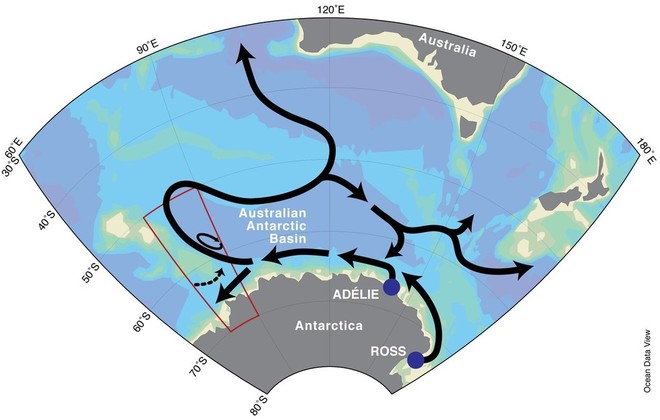
    In a paper published today in Nature Geoscience, the researchers described the current – more than three kilometres below the Ocean’s surface – as an important pathway in a global network of ocean currents that influence climate patterns.
    “The current carries dense, oxygen-rich water that sinks near Antarctica to the deep ocean basins further north,” says co-author Dr Steve Rintoul from the Antarctic Climate and Ecosystems CRC and CSIRO’s Wealth from Oceans Flagship.
    “Without this supply of Antarctic water, the deepest levels of the ocean would have little oxygen.
    “The ocean influences climate by storing and transporting heat and carbon dioxide – the more the ocean stores, the slower the rate of climate change. The deep current along the Kerguelen Plateau is part of a global system of ocean currents called the overturning circulation, which determines how much heat and carbon the ocean can soak up.”
    While earlier expeditions had detected evidence of the current system, they were not able to determine how much water the current carried. The joint Japanese–Australian experiment deployed current-meter moorings anchored to the sea floor at depths of up to 4500 m. Each mooring reached from the sea floor to a depth of 1000 m and measured current speed, temperature and salinity for a two-year period.
    “The continuous measurements provided by the moorings allow us, for the first time, to determine how much water the deep current carries to the north,” Dr Rintoul said. The current was found to carry more than 12 million cubic metres per second of Antarctic water colder than 0 °C (because of the salt dissolved in sea water, the ocean does not freeze until the temperature gets close to –2 °C).
    “It was a real surprise to see how strong the flow was at this location. With two-year average speeds of more than 20 cm per second, these are the strongest mean currents ever measured at depths three kilometres below the sea surface.
    “Mapping the deep current systems is an important step in understanding the global network of ocean currents that influence climate, now and in the future. Our results show that the deep currents near the Kerguelen Plateau make a large contribution to this global ocean circulation,” Dr Rintoul said.
    Antarctic waters carried northward by the deep currents eventually fill the deep layers of eastern Indian and Pacific Oceans.

    A deep ocean current with a volume equivalent to 40 Amazon Rivers has been discovered by Japanese and Australian scientists near the Kerguelen plateau, in the Indian Ocean sector of the Southern Ocean, 4,200 kilometres south-west of Perth. 
    In a paper published today in Nature Geoscience, the researchers described the current –more than three kilometres below the Ocean’s surface – as an important pathway in a global network of ocean currents that influence climate patterns.

    ‘The current carries dense, oxygen-rich water that sinks near Antarctica to the deep ocean basins further north,’ says co-author Dr Steve Rintoul from the Antarctic Climate and Ecosystems CRC and CSIRO’s Wealth from Oceans Flagship.

    ‘Without this supply of Antarctic water, the deepest levels of the ocean would have little oxygen.’

    ‘The ocean influences climate by storing and transporting heat and carbon dioxide – the more the ocean stores, the slower the rate of climate change. The deep current along the Kerguelen Plateau is part of a global system of ocean currents called the overturning circulation, which determines how much heat and carbon the ocean can soak up.’

    While earlier expeditions had detected evidence of the current system, they were not able to determine how much water the current carried. The joint Japanese-Australian experiment deployed current-meter moorings anchored to the sea floor at depths of up to 4500m. Each mooring reached from the sea floor to a depth of 1000m and measured current speed, temperature and salinity for a two-year period.

    ‘The continuous measurements provided by the moorings allow us, for the first time, to determine how much water the deep current carries to the north,’ Dr Rintoul said. The current was found to carry more than 12 million cubic metres per second of Antarctic water colder than 0 °C (because of the salt dissolved in sea water, the ocean does not freeze until the temperature gets close to -2 °C).

    ‘It was a real surprise to see how strong the flow was at this location. With two-year average speeds of more than 20cm per second, these are the strongest mean currents ever measured at depths three kilometres below the sea surface.’

    ‘Mapping the deep current systems is an important step in understanding the global network of ocean currents that influence climate, now and in the future. Our results show that the deep currents near the Kerguelen Plateau make a large contribution to this global ocean circulation,’ Dr Rintoul said.

    Antarctic waters carried northward by the deep currents eventually fill the deep layers of eastern Indian and Pacific Oceans.

    The research team included scientists from the Institute of Low Temperature Science (ILTS) at Hokkaido University in Japan, the Centre for Australian Weather and Climate Research, the Antarctic Climate and Ecosystems Cooperative Research Centre and the Wealth from Oceans National Research Flagship. Funding support was provided by the Australian Climate Change Science Program, the Cooperative Research Centre Program and logistics support from the Australian Antarctic Division. The lead author of the paper is Dr Yasushi Fukamachi, from the ILTS.


  • Mozilla Labs Releases the Jetpack SDK 0.3

    Mozilla has announced the release of the third iteration of its nascent Jetpack Software Development Kit. With Jetpack SDK 0.3, the project gets a couple of new APIs that should prove pretty important if not crucial for add-on developers, the “context menu” and the “self” APIs. The platform is still in the early stages, but thing… (read more)

  • Legal Analysis Of Italian Criminal Conviction Of Google Execs Says Judge Made A Big Legal Error

    We were among those amazed back in February, when an Italian court ruled that three Google execs were criminally liable for a video posted on Google Video, and were sentenced to six months suspended sentences. The video in question involved some kids taunting a mentally challenged boy and throwing a tissue box at him. Within hours of Google being alerted to the video, it was taken down. Part of the debate focused on whether or not Google should have known about problems with the video or whether or not Google had actually been informed earlier — but the only evidence that seemed to have been presented was that the comments on the video complained about the content. But it wasn’t clear that anyone at Google had read the comments. Still, when the decision came out, it was just the decision — not the full ruling by the judge, leading to some detailed legal guesses for the judge’s reasoning.

    However, it looks like the ruling has finally come out, and one Italian legal expert, after reading through it in detail, suggests the ruling was based on a pretty big legal interpretation error by the judge. The details are a bit complex, but basically, it seems the judge may have combined two separate parts of a law that were disconnected (and, the key part of the law wasn’t even brought up in the case itself) to suggest that Google’s big mistake was in not prominently telling users that they should not upload videos without the permission of everyone in the video. That information was in the Google Video’s terms of service, but the judge felt that wasn’t enough.

    The problem is that the law doesn’t actually say that Google had to make that information clear to users — and, even if Google didn’t satisfy that part of the law, not only was it not mentioned during the trial at all, it’s also not connected to the part of the law Google was actually charged under:


    The trouble with the ruling, said [Elvira] Berlingieri, is that Section 13 of the law was not mentioned in the case against the Google trio at all. One charge laid against them by prosecutors was to do with defamation, and that failed. The other was to do with privacy but that was based on a supposed data-processing violation of Section 167 of the law.

    Section 167 of the Act says that anyone who breaches particular Sections of the Act with a view to gain or with intent to cause harm shall be punished by imprisonment of between six and 24 months. The Sections to which it refers, though, do not include Section 13.

    “If you put together Section 13 and Section 167, that is how you get a sentence of six months,” she said. “The problem is that Section 167 does not talk about Section 13. In the charge written by the prosecutors, Article 13 is never mentioned.”

    This definitely seems like good news for Google in its planned appeal.

    Of course, even outside of the legal nuances of this, just from a common sense standpoint, this ruling is incredibly troubling. It’s difficult to see how anyone (outside of those with logic deficiencies) could defend the ruling. The video itself was actually helpful in punishing the kids responsible. If Google had actually stopped the video from being uploaded, they would have gotten away with the bullying. On top of that, making the sanctions criminal against individuals seems way over the top, especially for individuals who had absolutely no knowledge of the video in question whatsoever. The whole thing seems ridiculous on any level.

    Permalink | Comments | Email This Story


  • Palit mejora la GeForce GTX 470

    La empresa Palit anunció oficialmente la GeForce GTX 470 con un sistema de refrigeración alternativo.

    La placa cuenta con dos nuevos fans que hacen su tarea de una manera sorprendente al bajar 12 grados centígrados menos y a demás es alrededor de 4 dB más silencioso que el modelo referencia de NVIDIA, sin embargo, la tarjeta sigue funcionando con las frecuencias de referencia, 607 MHz núcleo, shader 1215 MHz y 3348 MHz para la memoria.

    La GTX 470 tiene 448 Stream Processors y 1280 MB de memoria GDDR5 con interfaz de 320 bits. Y en este caso Palit decidió ir tras las huellas de AMD al agregar un puerto DisplayPort mas 2 DVI y 1 HDMI.

    Vía benchmark.kz

  • Greece Sized Mat of Microbes


    ]Just is case biologists were ever in fear of running out of thesis material, we have this.  A billion different genera certainly taxes the imagination.
    Rather annoyingly we still get the almost obligatory pass on how little we know about the impact of global warming.  It would be more appropriate to simply state that we are now getting so much data it is physically impossible to classify and organize it.
    We already suspected this depth of speciation and sub ocean penetration.  It is now confirmed and surely provides all the feedstock needed to support oil manufacture.
    It is interesting that they are oxygenating the subsea environment.  The energy path will need to be clarified.

    Mat of microbes the size of Greece discovered on seafloor
    Apr 18, 2010
    Gargantuan whales and hefty cephalopods are typically thought of as the classic marine mammoths, but they might have to make way for the mighty microbes, which constitute 50 to 90 percent of the oceans’ total biomass, according to newly released data. 

    These tiny creatures can join together to create some of the largest masses of life on the planet, and researchers working on the decade-long Census of Marine Life project found one such seafloor mat off the Pacific coast of South America that is roughly the size of Greece.

    A single liter of seawater, once thought to contain about 100,000 microbes, can actually hold more than one billion microorganisms, the census scientists reported. But these small creatures don’t just live in the water column or on the seafloor. Large communities of microscopic animals have even been discovered more than one thousand meters beneath the seafloor. Some of these deep burrowers, such as loriciferans, are only a quarter of a millimeter long. 


    “Far from being a lifeless desert, the deep sea rivals such highly diverse ecosystems as tropical rainforests and coral reefs,” Pedro Martinez Arbizu, of the German Center for Marine Biodiversity Research and leader of the Census of the Diversity of Abyssal Marine Life, said in a prepared statement. 

    Thanks to high-throughput DNA sequencing, researchers have been able to vastly expand their catalogue of marine microbes. “Scientists are discovering and describing an astonishing new world of marine microbial diversity and abundance,” Mitch Sogin, of the Marine Biological Laboratory in Woods Hole and leader of the International Census of Marine Microbes, said in a prepared statement.

    This genetic data has revealed that there might be as many as 100 times more microbe genera than researchers had assumed. One study conducted in the English Channel landed 7,000 new genera alone. Current estimates place the number of marine microbial species at about a billion, according to a prepared statement by John Baross of the University of Washington and chair of the International Census of Marine Microbes’s scientific advisory council. 

    And research has yet to plumb the guts and surfaces of more macro ocean life, which, like humans, can play host to billions of microbial cells. The species living on and in “marine animals alone may account for hundreds of millions of microbial species,” Baross said. “This is a huge frontier for the next decade.”

    Despite their small individual size, microbes play a big role in the oceans—and the planet overall. Microbes help to turn atmospheric carbon dioxide into usable carbon, completing about 95 percent of all respiration in the Earth’s oceans. Even those deep in the seafloor, such as the deep-sea burrowers, “help oxygenate sediments and interact with microbes to cycle nutrients and carbon on the ocean floor,” Arbizu said. But little is known about these creatures’ susceptibility to the changes in ocean temperatures, dissolved gasses and acid levels that are predicted to occur with climate change. 


    “Tracking and visualizing such complex populations was impossible 10 years ago,” Baross said. “Sequencing allows us to give the equivalent of an Internet URL to millions of microbes, to which we can attach all kinds of other information, like their favorite temperature and amount of salt and light.” 

    The full findings of the census will be presented in October in London. For the coming decade Baross suggests a survey of marine viruses.

    Image of loricciferan Culexiregiloricus tricchisccalida, which was discovered off the coast of Africa some 4,100 meters below the surface last year through the census, courtesy of Gunnar Gad/Marco Buntzow/German Center for Marine Biodiversity Research/Census of Marine Life
  • Opera Software Buys FastMail.FM

    Opera Software is one of the oldest browser manufacturers in the world, but, despite its best efforts and continually improving software, Opera on the desktop hasn’t managed to pick up any steam. Opera, the company, on the other hand, is doing pretty well, thanks in large part to its mobile browser. So well in fact that it’s made its second acquisitio… (read more)

  • Opera 10.53 disponible para windows y mac os

    Uno de los navegadores mas rápidos, Opera, acaba de recibir su actualización numero 10.53 que sera automática para quienes ya tengan el navegador instalado. Si todavía no lo probaste lo puedes descargar desde su web opera.com o desde aquí.

    La actualización a esta versión es altamente recomendable ya que corrige un bug de seguridad que permitía correr código arbitrario a través del navegador.

    En el resto de los sistemas operativos tristemente seguimos con la versión 10.10.

  • Media Create hardware sales: April 19 – 25, 2010

    Here are the numbers for last week’s hardware sales (April 19 April 25, 2010), courtesy of Media Create. The PSP still holds strong at… well, a not so strong 28, 758 units, but given how every

  • YouTube Getting Ready to Disco

    YouTube has just rolled out a new version of its video player to a lot more users, but it looks like it’s also getting ready for a brand-new feature it’s been working on for a few months. The YouTube Music Discovery project was introduced in TestTube, YouTube’s ‘Labs,’ in January. It is now getting ready for graduation, as it is integ… (read more)

  • 2012 Land Rover Defender illustrated from all angles

    Though it was only sold in limited quantities over a handful of sporadic years in North America, Land Rover’s Defender – a direct descendant of the first 1948 Land Rover – continues to thrive in many markets across the world. Our illustrator has now created what is believed to be an accurate representation of the reportedly codenamed Project Icon – the next generation Land Rover Defender, to be released for the 2012 model year.

    Based heavily on the T5 steel platform chassis currently used in the Range Rover Sport and LR4, according to Britain’s Autocar, the Project Icon replacement will be capable of meeting the ever-stricter emissions and safety laws that have spelled doom for the Defender as U.S. laws outlawed the sale of new Defenders beginning in 1997 due to the lack of airbags.

    The chassis will allow the next-generation rig to be offered in a multitude of bodystyles, including hard- and soft-top variants and a utilitarian pickup style.

    Our illustrations show the likely move towards a slightly longer, slightly more modern design when compared to the original which remained virtually unchanged for decades.

    Expect the LR4’s 195 horsepower 2.7-liter diesel V6, which isn’t offered in North America, to be the standard powertrain in the next-generation Defender for global markets. If the model is earmarked for North American consumption, the advanced 5.0-liter V8 developed with Jaguar used in the LR4 and Range Rover Sport seems like a match made in heaven.


    Source: Leftlane

  • General Motors cancels Chevrolet Orlando crossover for U.S.

    General Motors has confirmed that the Orlando will not come to market in the U.S. despite previous plans to sell the seven-seat crossover. GM says the move was made to allow it to focus on its existing core brands.

    According to the Kansas City Star, GM has announced that it will limit the Orlando’s sales to Canada, Europe and Asia, canceling previous plans to begin selling the CUV in the U.S. in 2011.

    Bloomberg is reporting that auto dealers are to be notified of the change today, according to an interview with Margaret Brooks, Chevrolet’s product marketing director for small cars and crossovers.

    “The best thing to do for Chevrolet is to focus on the brands we’ve already brought to market: the Traverse, Equinox, Malibu and, soon to come, the Cruze,” Brooks said. “We feel that with those vehicles, Chevrolet has plenty of options for the modern family.”

    The Orlando had been unveiled at the 2009 Detroit Auto Show, and was intended to effectively replace the HHR in Chevrolet’s lineup. The Orlando was based on the same Delta platform as the Chevrolet Cruze and Volt, but was configured to seat seven.

    The Orlando was originally planned to be built in the U.S. at the Hamtramck, Michigan, plant, but those plans were canceled in late 2008.

    References
    1. ‘The consumer memo, 4/30…’ view
    2. ‘GM scraps plan to sell seven…’ view


    Source: Leftlane