When we usually speak of a lock screen, we are talking about something very simple like the WM6.5 lock screen, or even S2U2, but this one is not that simple. This new lock screen created by slackersink, who resides in the HD2 forum is a very peculiar one. It does not come with directions or instruction, but from the image it seems to have much information all in one place, but I am not quite sure where the unlock part is.
The lock screen to me looks like a map of my locale Mall of America(the biggest Mall in the world) except it has some good details like time, date, notifications, and more.
When you read the title it says it is suppose to be a Star Trek related lock, but for the life of me, I do not know what that is or plan to learn the nature of it(okay, I know what it is… but never watched it).
Thankfully the creator wrote a little note for us to know before using his new look screen:
My first mod, the LCARS Lockscreen! Make your lockscreen resemble the panels on the Enterprise! Yay! Also included, the original files they replaced.
Ahem…
Anyway, here is a zip file of everything needed to make your own lcars lockscreen. It’s a zip because apparently the cabs I had up here didn’t work properly… Can’t beat placing real files yourself, I guess. haha
– Instructions:
First- Add files in the icons folder to windows\ directory in phone. Just the icons in the folder, not the full folder. Either use icons in the zip or install the icons cab file.
Second- Add lcarswallpaper.png and LS_LockScene_480×800.cpr to windows\lockscreen.
Third, reset the phone and you’re done!
I’ve also included the original files for what this mod changes in case you want to revert back. –
I have no lockscreen mods, cookie’s home tab lockscreen is set to the default lockscreen so it won’t interfere, or anything aside from the memclock app as you can see on the top right of the screenshot so I can’t guarantee it will work with any mods. Like I said, This is my first so I apologize if it doesn’t work properly on your HD2. As far as mine goes, everything lines up perfectly.
Restart your phone and enjoy!
When you tap the slider to get your notifications, the calendar and clock disappear. I don’t know how to keep them their the entire time. If anyone can help with that, I’d appreciate it.
The Bentley Continental Supersports sees custom modifications by the German tuning firm Wheelsandmore. As their name implies, Wheelsandmore installed sport wheels and tires in addition to new brake and suspension systems. Striking under-hood tweaks also grace this modification package. Already Bentley’s fastest and most powerful coupe, Wheelsandmore took the Bentley Continental Supersports from 630 HP to 702 bhp and 650 lb-ft torque via their in-house ECU tuning upgrade, custom stainless steel exhaust, and special sport catalysts.
Large (16.54 inch) carbon ceramic brakes stop the special 21” matte-black and red-racing striped lightweight wheels, while wrapped in Dunlop Sport Maxx tires. “LowMaXX” suspension automatically drops the car around 0.79 inches once it reaches 70 km/h. Buyers of the Wheelsandmore Bentley Continental Supersports will need these modifications. The company’s tweaks allow this improved package to reach a hair-straightening top speed of 336 km/h!
Are you one of those super nerds that think its okay to have your device start up with a BIOS gif? Well I am too, and I found this CAB laying around XDA, that I though you might be interested in. The image is nothing more than an animated GIF that brings up something similar to a BIOS page, but thankfully has some accurate information that other nerds like us might find cool.
The post has a BIOS page for the basic European HD2, and then an image for the more advanced T-mobileUSA version, with more things(okay guys, just pulling your strings.)
Well if your in the mode to try out a new look/startup on your Windows Phones… Then follow this link, and head over to XDA for the lowdown.
In just over two weeks, Lexus has recalled, issued a stop-sale and fixed its GX 460 SUV after concerns about the stability control system were raised by Consumer Reports.
Bugatti buffs know that only one Type 64 was built in 1939. What they may not know is that an two Type 64 chassis were stamped but never finished. Until now.
This vide has been posted before, but this time it comes with a little twist. This new video comes with the latest in technology… sound. Yes, that’s right, it has sound. The previously posted video portraying the new Office app, and Calendar all working nicely from the HUB.
Anyways, if you are interested in re-watching this video to finally hear what his saying, go for it, and comment below.
While I have some very serious concerns about the way the UK’s collection agency PRS for Music conducts its business when it comes to threatening small businesses — including going after a woman playing music to her horses and woman singing while stocking the shelves at a store — over the past few months I’ve been having a series of interesting conversations with Will Page, the Chief Economist for PRS.
Page, of course, put out that famous report last summer, that pointed out that the music industry in the UK appeared to be getting bigger, not smaller (contrary to what you hear from many people). Page is a fun guy to talk with about music industry economics, and we decided to run a little interview with him here. There’s plenty that I disagree with him about, but plenty that we agree on too. There’s so much in this interview that I’d like to dig deeper on, and I hope to do that in a series of posts in the future — and some more back and forth with Page — but I figured at this point it was worth getting our discussion as it stands out there for people to read.
We wrote about your study last
year showing that the UK music industry was actually increasing — contrary
to most of the headlines were saying. Can you give a quick summary
of why your numbers show a very different story than the popular press
keeps saying?
It’s a
‘different story’ to what people are accustomed to simply because,
for too long, people have characterised the music industry as being
about just the recorded music industry. That’s largely due to the
fact that the only data out there for people to discuss is recorded
music statistics. When we published ‘Adding
Up The Music Industry for 2008’ last year, it was an important step towards showing (i) how much the
whole music industry was worth and more importantly (ii) how it all
hangs together. One of the many audiences we aimed this work at was
Government, who need to understand the broader picture of what the music
industry comprises of, and the value that it brings.
The Insight paper allowed two new pieces of the pie to be illustrated
and properly understood: firstly live music revenues of
£1.4 billion and secondly business-to-business licensing revenues which
were over £900 million. From a total pie worth
£3.6 billion, that implied that recorded music made up a nudge over
a third of the total revenues — that’s a significant sum, but definitely
not the only show in town.
Both of us are
skeptical that the digital music sales market will ever replace the
physical music market. Can you summarize why and what numbers
you've seen about the digital market?
My concerns about the digital market
start with the same word that introduced me to economics:
‘scarcity’ — there is little scarcity in selling digital media
goods and that inevitably affects price. I think the best way to illustrate
this is to look, instead, at the live music industry as those folks
are the masters of pricing scarcity
— they view tickets as ‘lots’ and want to maximise the willingness
to pay for each. Live music mastered their demand curve a long time
ago; digital music is still trying to discover theirs. Another problem
with this topic is that interpreting digital music revenues is not a
straightforward exercise, especially in Europe. We published a paper
on ‘Understanding
and Interpreting the Digital Market’ two years ago to help folks try and get their head around this
complex market, and it’s not got any easier since!
I’d like to flag two observations
for your readers. Firstly, don’t view digital in isolation, when it’s
shown that one-in-five albums sold in America were digital, that tells
you more about the collapse in the five, that the outperformance of
the one. Secondly, the UK has really outperformed its European neighbours
in developing a large, and importantly diverse, digital market. UK digital
revenues per capita are twice, maybe three times, that of our main European
neighbours, which is a great testimony to the work that Jez Bell at
PRS for Music and folks like Francis Keeling at Universal have done
on the licensing front as well as the
incredible achievements of the services
like We7, Spotify and 7 Digital which have taken out the licences and
launched here.
Finally, whilst the digital makes
up 20% of recorded music revenues, and 5% of PRS for Music collections,
what I really have learnt to appreciate is that these digital services
are legal ‘venues’ — a concept that Eric Garland drilled home
to me — and somewhere north of four million
folks in the UK are going to sites like
Spotify or We7 and doing their thing
— now it might not be producing the monies people once wished for
but they are arguably not going to Mininova, an illegal venue, and that’s
an important achievement — especially when Mininova celebrated its
10 billionth torrent download
three months before iTunes celebrated theirs. Engagement with legal
venues is worth more than the top line
revenues might initially suggest.
You mention ‘scarcity’ in the context of live vs. digital, but live has a real scarcity (seats — over which they can control access). Digital doesn’t have that kind of scarcity. You say that digital hasn’t ‘discovered their demand curve,’ but might the bigger issue really be that without the scarcity the supply curve is the issue? My view has always been that the digital market is a red herring due to the lack of scarcity, but instead the music world should focus on external scarcities that widespread digital music creates (including things like seats at concerts). Is the real issue not the demand curve but the supply and the failure (of some) to recognize that they need to think broader in terms of what they’re selling?
That’s a very insightful question — and you’re right as one of the many mistakes economists make is to forget about the supply side dynamics of a problem, and instead focus on demand. It’s worth citing Jean Baptiste Say, and his Law of Markets which is that “supply creates demand.” What this means, with regards to your question, is that “overproduction” in a free economy is actually impossible. That’s a controversial proposition though, as I think it comes up against another trade off which we could call the attention economy, where a wealth of information leads to a poverty of attention. Stepping back from the theory, there is clearly more noise in the market place — more artists, more songs, more places to hear them — therefore more investment is needed to stand above the noise, to enable the benefits of your ‘external scarcities’ to kick in. One final piece of twisted economics is this idea of a ‘freemium’ model, which is cool but has a flaw — if everyone did it, the less successful it would be. Point being there would be more noise in the free market, which erodes the value of the premium offering — an increase is supply depresses price, and we shouldn’t lose sight of that basic principle.
You call services like Spotify and We7 “legal venues” and things like Mininova as an “illegal venue,” which I assume many of our readers may have an issue with — especially given that Mininova has long had a program for artists to offer up their own content, and there certainly are a small, but growing, number of artists who have embraced those venues for legitimate marketing reasons. Is there an argument to be made that, given the size of some of the userbases of those venues that you (and many) deem illegal, that there may be ways to embrace and engage with them, rather than write them off as such?
The best way to embrace those users is to ensure the services they use are licensed and respect the value of music. Now, we have over a thousand digital music licencees here in the UK, and we’ve been granting online licenses since 2002, long before iTunes — a fact often overlooked. The best way to approach the unlicensed services is to think of it this way — we’re all chatting about whether Spotify will sink or swim, right? That’s the hot debate at the moment. Well, I would argue that at the margin Spotify would have far more chance of swimming, or up selling the subscription service, had they not had to face this unfair competition of illegal free. That’s a powerful argument when you run it through, as it moves away from the old arguments and towards a more plausible observation: what opportunities are being foregone in the legal digital market due to the unfair competition of illegal free? One last thing on Spotify, which is that they went legal before going popular, bucking a regrettable trend. When you explain that to an emerging artist or songwriter, offering a counterfactual of many other sites which have become incredibly popular (and then flipped for incredible amounts of money) before taking out licences — it really hits the message home.
Both of us are still
quite optimistic that there's still a huge opportunity for the overall
music market to grow. Where do you think that opportunity exists
— and why is it mostly ignored?
If we pick up on
‘Business-to-Business’ revenues, or licensing income, this makes
music free at the point of consumption with compensation taking place
elsewhere. This part of the music industry is likely to make up an increasing
part of an increasing pie, and that by default presents opportunities
However, what’s frustrating is that music licensing is an area of
the industry that’s often least understood by emerging bands
and songwriters — the MySpace generation —
who are trying to get one foot on the ladder to success. To realise
those opportunities, the first thing artists and songwriters
need to do is protect their rights by joining PPL and PRS for Music
in the UK, or their equivalents in their respective territories. Secondly,
it’s very important that the licensing bodies
around the world get involved with the artists and songwriters. Here
at PRS for Music, we’ve got Myles Keller leading our membership development
and we’re getting increasingly involved with our songwriters through
programming events like The
Great Escape on the 13th May, whereas in America you have
‘walking encyclopaedias’ like Todd and Jeff Brabec who are very
accessible on the panel circuit and their bible ‘Music Money and Success’ is required reading. I guess my point is
that the best way to realise the licensing opportunities that exist
is to get involved. Passivity doesn’t pay.
You stress the importance of getting people to sign up for collection societies/licensing organizations — which isn’t surprising, given your employer — but myself and many of our readers are concerned about the incentive structures when musicians rely on such organizations (even when– as in many cases — they’re non-profits). With such organizations, you can take away some aspect of market-pricing, especially when there are issues of compulsory licensing and/or only one provider in the market. It also creates situations where those organizations constantly push for greater rights, or the ability to collect from more places for more reasons– often upsetting other aspects of the market (for example: bars and restaurants no longer letting bands play live or hosting open mic nights to avoid having to pay licensing fees). While I agree that, given today’s setup, it makes sense for musicians not to pass up revenue that’s there for them via these organizations, isn’t there a risk that these types of organizations distort the market from a purely economic viewpoint?
Each collecting society is different, so firstly — let’s be wary of generalisations. In America, for example, you are absolutely unique in that you have competition within collecting societies with ASCAP, SESAC and BMI — the latter which is owned by the broadcasters! Similarly, the story behind SoundExchange is unique too — and in many cases the US is playing ‘catch up’ with the rest of the world when it comes to neighbouring rights. So, I just want to be clear for a predominantly US Techdirt audience, the US experience with collective rights organisations will be unlike anywhere else in the world. I really mean that too — it’s such an exception to the rule.
Now to your question — let’s start by asking what is the rational for collecting societies. I would argue that the answer is three-fold: (i) reducing transaction costs for both rights holder and user, (ii) preventing fragmentation and (iii) solving co-ordination in many-to-many markets. The bottom line is this: PRS for Music enables start ups to start up, and songwriters to get paid. If you wiped the board clean and tried to devise a new model, which can hold together a blanket licence and balance the needs of unprecedented digital services, you would probably end up with what PRS for Music is doing just now. It’s not an easy task, and armchair critics would do well to consider the complexity in this two-sided market and the trade-offs that we face every day, but to read that We7 now feel that add funded music can add up is heartening as it suggests we’re getting this delicate balancing act right.
You've noted that the UK music
market appears to have again gone up in
2009 over 2008 and appears to be growing faster than other countries.
Why do you think the UK market has been different than elsewhere?
Firstly, The UK is not alone in bucking
the downward trend as Sweden, Denmark and Australia can also claim to
be outliers in some form. However, these are the exceptions as
opposed to the rule, and it’s a stark contrast to the downbeat sentiments
I’m hearing from the US, and chalk-and-cheese to the situation in
Spain which really is frightening on many levels. I’d offer three
exceptions which have bucked global trends rule. Firstly, the live music
industry has continued to exhibit robust growth in the UK even in the
middle of a credit crunch, whereas other territories suggest the market
might have matured. Secondly, UK labels have arguably done a better
job of diversifying their revenue streams , due in part to the success
story that is PPL, and I doubt that level of diversification is being
reflected by labels in many other regions. Third, the UK really values
music. It’s a simple point, but it really matters. Think: the role
of the BBC in championing emerging bands, the explosion in music festivals
in every corner of the country, the insane amount of work of Feargal
Sharkey at UK Music has put in to get all the stakeholders (including
ISPs) to banging heads together to face up to the challenges — all
these ingredients help illustrate that this thing called “music”
actually matters to the UK. Conversely, I’m spending an increasing
amount of time in Spain now, and what you see there is that music doesn’t
matter as much…if at all. It’s one of the few western countries
that can claim a thriving digital AND physical piracy problem and investment
in domestic talent is drying up as there simply no return. It’s actually
kind of eerie when you compare the quality of debate and level of activity
being had in the UK to that of other countries, it’s not that we’ve
solved all the problems, far from it, but it’s more about not dodging
them and actually doing something about them.
On Spain, I know the IFPI’s recent report said the industry is in trouble there, and you do the same here, but we keep hearing from people who claim otherwise — that there’s a renaissance of music in Spain due to more widespread ability to promote and distribute musicians. Anecdotally, in the last year, I’ve actually picked up (yes, legally bought, on CD) albums from a few Spanish bands. Do you have some numbers for Spain — since between the two of us, we seem to have very different anecdotal experiences? Could it just be that the business models haven’t adapted yet?
Neither of us is from Spain, nor do we currently live there — so we have to work this one out based on our own anecdotal experiences. What I’ve noticed is that trade revenues of record labels have halved in less than a decade, in nominal terms. I’ve also noticed incredible resentment to ‘paying for music’ in Spain, there’s a real ‘stick it to the man’ attitude which is puzzling. I come back to the point on domestic investment — given the situation there, would you (and that could be a label, publisher, manager or third party) invest in developing domestic talent in Spain, or would you invest somewhere else with a lower risk profile and then import into Spain. I’m sure there are lots of opportunities down there on the ground, but how many of those opportunities lead to a sustainable living for professional artists and songwriters. For me, Spain’s situation is like a tipping point which other countries should take note of.
One point that you’ve noted is
that the live music market has grown and actually
surpassed revenue from recorded in the UK. Critics dismiss this,
claiming that the live numbers are dominated by "heritage"
or "legacy" acts. Is this true? You claim that
the revenue for live covers "more bands, more tickets, more seats,
more events." Who's right?
You’re right to pick up on the changing
of the guard observation from last year, and it’s incredible to think
that five years prior, live was less than half the size of recorded
— which makes you ask three questions: (i) how has live captured so
much value, (ii) how has recorded lost so much value and (iii) is there
a link. However, read beneath the top line and you can consider the
distribution of those revenues: who got what share of the spoils.
As with recorded music, in live we’re witnessing a hit heavy skinny
tail distribution, and that intuitively makes sense. The bigger you
are, the more forms of revenues you’re able to exploit and the distribution
skews to the head naturally. When Take That played to over a million
people, that’s an example of more tickets, more seats and more events
but it’s just one band. Down in the tail, the picture is less clear
— with worrying stories of support bands having to pay to play needing
to be balanced with the fact that the explosion in festivals gives more
opportunities for acts to get wider exposure. There’s some interesting
signals coming out of the market place though, for example I was told
that there was noticeably less record label A&R presence at SXSW
this year, with agents and promoters filling up the bars on Sixth Street
— perhaps that’s a sign of the times.
You've noted in the past that
60% of the UK population don't buy music anyway and that "you can't
cannibalize zero" when it comes to things like file sharing "taking
away" revenue. Do you believe there's evidence that the 60%
of people who don't buy music are helping to contribute revenue elsewhere
— and if so how and where?
It’s a vital observation that needs
to be rammed home as the rights holders are understandably obsessed
with cannibalisation, but sometimes blinkered to the wider problem.
The legendary Rory
Sutherland remarked on
that "Can't Cannibalize Zero" phrase as a masterpiece and
told me that it reminded him:
“Of working with
ATOC, and First Great Western. They were obsessed with the risk of Revenue
Abstraction — the rail phrase for cannibalisation. In other words, any
special off-peak offer was viewed with terror, lest it attract people
prepared to pay full fare. But, just like music, 60% of people don't
use trains – ever!”
Rory makes you think about the problems
differently — and here, the problem is how can we re-engage the lost
majority? I collaborated with Spotify on a piece of research called “How
to dance to ARPU” which
allows rights holders and users to approach that infamous acronym with
more clarity. At the back of my mind, though, is this: most of the folk
of my parents generation love Spotify and none of them ever bought music
…ever. Engagement is the horse, and monetisation is the cart — if
services like Spotify are helping re-engaging those who gave us nothing,
there’s a better chance of getting something going forward.
Following up on the B2B side
of the market, some also point out that this part of the market may
also be dominated by large legacy acts who can score big sponsorship
deals. Do you think that's true and if not why not? What
opportunities are there for less well known bands in this area?
To quote from the paper, ‘brands
investing in music trough sponsorship are drawn to it through the potential
audience affinity and reach; this means that much of the major expenditure
is biased towards the larger priorities and artists, which provide larger
fan bases.’ That means that it’s tough in the tail for bands wanting
to strike sponsorship deals. That said, there is a lot of scope to use
initiative to innovate in this sector. Here in the UK, we have organisations
like Music Ally and FRUKT who are doing some great work in this sector,
especially in terms of offering training and workshops for artists and
managers — their material is well worth tracking as opportunities
in this sector don’t find you, you have to find them.
Lots of people have suggested
that even if live is now outpacing album sales, it was still the record
labels that really financed tours and the growth of live. Are
there mechanisms to support and nurture live if the record labels continue
to decline? Where might it come from?
The kicker is this — the money is
live is centred around the head, and much of that head is heritage in
status — so the question I always ask is who’s going to offer the
tour support for new bands to build the sort of fan bases that provide
the live industry with the heritage acts of the future. That’s a legitimate
question to ask, and not an easy one to answer, but you’ve got to
look forwards not backwards, and I’m really hype on the company Songkick it’s basically Facebook for folk who
love going to gigs with full functionality for ticketing, recommendations
et al. I think that what Ian Hogarth has done there is a real game changer
when you fully think it through — and it also helps level a heavily
tilted playing field as emerging acts can benefit as much as the established
bands from Songkick’s functionality. You have to manage expectations
as it won’t make touring across a country in a bus sitting next to
a drummer with an odour problem any less unpleasant, but it does have
the potential to lead to more bands performing to more fans, and importantly
more data to build upon that success.
Notably absent from your discussions
on these numbers is anything (outside of live) having to do with direct-to-fan
opportunities that we've discussed on Techdirt. These numbers
may get mixed in elsewhere as they sometimes include
album sales and sometimes include live, but do you have any thoughts
on that market? Do you have any numbers on how those efforts are
doing?
Firstly, I’ve recommended your excellent Trent
Reznor case study to literally
everyone and their dog. What’s really good about that is that you
echo what I’ve stressed every time I’ve explained ‘In Rainbows, On Torrents’ case study which was that this was a solution
for Radiohead, and was NOT a solution for the music industry. That said,
what Radiohead and NIN did were ‘experiments’ and we’ve got to
learn from these experiments. You got to ask the right questions —
so ‘of what worked, what’s transferable?’ Second, whilst Topspin
was behind your Trent Reznor case study, there’s another Toronto based
company worth checking out called Official
Community. They’re providing
direct artist to fan infrastructure which allows for disintermediation
of the value chain, more empowerment of the artist and faster cash flow.
When you look into these models though, it’s important to keep a balanced
perspective and manage expectations — it’s not going to change the
world, and it might not even change the actors involved in a ‘conventional
deal,’ but this existence of more options should, if anything, allow
artists and songwriters to negotiate better terms. Third and
finally, I agree with the premise of the question — what’s happening
outside the conventional radar is probably bucking the southward trend,
but because it’s not being picked up — the trend continues southward.
I learnt recently that the annual Cambridge Folk Festival is a massive
player in selling CDs of those folk artists to fans — literally tens
of thousands of CDs being shifted on location. Now, you may be tempted
to dismiss this as just a niche festival and just niche CDs, but they’re
shifting lots of them and there’s are lots more similar festivals
up and down the country who are increasingly doing the same thing and
its questionable how much of this is getting picked up on the conventional
radar. That offers optimism for the future as regards the “known unknowns”
which are out there, but also presents numerous headaches for myself
and Chris Carey as we try to calculate this year’s ‘Adding up the
Music Industry’ report together which is due for publication in July
2010.
You mention the “skinny tail” and that some of the success today is from heritage acts, but then we see numbers from folks like TuneCore that show a massively successful long tail. It makes me wonder if — as TuneCore notes — the long tail success stories simply aren’t being seen in the data because it’s the wrong data. We hear so many stories of musicians successfully embracing new business models down the tail that it makes me wonder if what’s happening down there is simply not being counted. Thoughts? Any ideas on better ways to measure?
Both Chris Anderson’s work on Long Tail, and our analysis since, has suffered a lot of misinterpretation because you can’t dive into this topic and expect a simple tabloid headline to explain it all. Statistical distributions of large data sets are not the sexiest topic for the music industry to discuss — on that we can both agree! But let’s roll back to what I’ve stated repeatedly in our work here — I loved the concept of the Long Tail, still recommend the book to colleagues and wish it would work the way we all hoped. However, it is a book about the supply curve — here’s what happens when lots of goods can get to market. What I was able to do, thanks largely to the mathematical guidance of Andrew Bud, is derive the demand curve for digital music — which is like saying “okay, once you’re on the digital shelf, who actually wants you.” You need two curves to tango in economics, and we’ve been able to develop an unprecedented understanding of this digital music market place as a result. What’s great though, is to know where economics needs to hand over to other disciplines, such as psychology, sociology or anthropology — basically how do we understand culture.
I can illustrate what I mean by offering your readers a genuine exclusive — by exhibiting the Lorenz curves for We7 and Spotify side by side, and comparing those with the sort of distribution Chris Anderson’s theory predicted:
The red line is to show what a “great example of the Long Tail at work” should look like, where 95% of the niche inventory (reading from bottom left to bottom right) makes up 75% of the streams — a fat tail. Clearly, neither We7 nor Spotify look like that, with both curves tugging into the bottom left hand axis point and this is what’s meant by a hit heavy, skinny tail distribution. However, the curves are different, and that is to be expected — as We7 has a strong editorial with excellent artist promotional campaigns, whereas Spotify is editorial free and allows the consumer to graze the field at their leisure. Consequently, you can see that We7 (blue line) is more hit centric with a 90/5 rule and Spotify (green line) is more democratic with an 80/5 rule which, when you step back, is common sense made complicated but it’s nice to see the math adds up!
The key thing for Techdirt readers is that’s what economics can tell us when rights holders and users collaborate to understand unprecedented markets, and it’s great that PRS for Music and Digital Music Services are willing to work together like this — I think it’s a important part of the success story in the UK. However, economic analysis can only tell us so much and it’s at this point when the baton must be passed on to folks from other disciplines or backgrounds who can bring new insights to the table to work out what that actually means in terms of this intriguing thing called ‘culture’ — which also means this is a good point to conclude this interview.
Thanks to Will for this fun discussion… which I fully expect to continue. If you want to see one of Will’s recent presentations on the state of the music market, it’s embedded below:
Grynch raps a tribute to “My Volvo” – Click above to watch video after the jump
Rapper Grynch isn’t about Maybachs and Phantoms – he’s straight up all about a 1986 Volvo 240 DL… wagon. So much so, in fact, he’s penned a song and made a video for it. One never knows what to expect when told to check out a rap video about a Volvo, but we found it a lot cooler than we think we had a right to. Follow the jump for the rhymes, but be ready before you click – Grynch says “I’m gon’ need you to feel me on this…”
With the growing popularity of Android OS in the mobile smartphone world, Window Mobile developers have kicked it into over drive, and have been working ever so hard to getting the latest software on our device. In the latest release by XDAndroid, they managed to get the latest Android software(Android 2.2 has yet to be released) running on the Touch Pro2, with the software we all love to see and use… Sense UI.
Now they did not only add new software, but they put some new fixes into it. This release comes with a host of new fixes that can be easily seen from their well documented change log:
NEW Apr 23 New 2 new builds added to the download section. First we have a 2.1 Android Open Source Project build. This is built by phh using stinedb’s new kitchen. Second we have 2.1 with SENSE UI! Thanks to Klinux for his work on this sqsh!
NEW Apr 23 New zimage adds 17MB RAM for Android OS use.
NEW Apr 23 New Startup Utility updates: WinMo auto backlight off/on thanks to bedoig Thread Here
3/31 Startup Utility Updates: Force CDMA checkbox enables the use of MrPippys combined CDMA & GSM Rootfs! (For .rar CDMA users add "htc_hw.force_cdma=1" to your startup.txt!)
3/31 Thanks to MrPippy’s work the CDMA and GSM rootfs have now been combined!!
3/31 System.sqsh from babijoee! Adds Gallery, Calculator, and Desktop Clock. Updates to some apps as well!
3/25 Zimage/modules: This re-enables the so called "turbo mode". Some benchmarking figures indicate better memory performance. (topa/rhod: Drive AXI bus @160Mhz when A11 is @528Mhz)
3/25 Additions to the Startup Utility! Progress bar & Rootfs.img Auto-Update should also have fixed some compatibility issues, and crashes during the update!
3/17 Additions to the Startup Utility! Auto Update & App Manager! (Pieteckhart is going crazy with this one!)
3/17 zImage/Modules: Re-enable speakerphone by adding "external.rhod_speaker=1" to startup.txt (ONLY SPEAKERPHONE, no external audio, Mic also will not work.)
3/08 3D Finally working(ish) Will not show Nexus boot screen, or some other 3D apps that require LOTS of RAM. (Remove cmdline "hw3d.force=1" from your startup.txt to go back to the old settings and get your splash screen back)
3/08 System.sqsh from babijoee, includes Home++ (you can still select standard Android Home as default)
3/08 Startup Utility! (Thanks pieteckhart and DaveShaw, woulda never gotten done otherwise) No more multiple downloads, keyboard selection tool will load before Android Haret.
Audi’s major push for Iron Man 2 tie-ins begins now, with the Tony Stark Innovation Challenge. A real way for life to imitate art, Challenge entrants will create videos to showcase their ideas that will make the world better through technology – just like Tony Stark does in Iron Man, but without the guns. The winner gets all kinds of swag, including $15,000 to make it all come true. Sadly, there’s no mention of Audi making you a billionaire or having your contracts notarized by Scarlett Johansson. Follow the jump for all the details and Audi’s first video.
Nissan predicts that its new 2011 Nissan LEAF will be in short supply within the first three months of sales. The Japanese automaker says that demand will outstrip supply.
Nissan said that sales may be strong due to the company’s claim that the LEAF will be cheaper to buy and operate than its main competitor – the Toyota Prius.
It was recently reported that more than 6,600 people in the U.S. have reserved the LEAF, just a few days after Nissan started taking reservations on April 20. Prices for the start at $32,780 or $25,280 with a federal tax-credit. That works out to a lease payment of $349 a month.
Refresher: Power for the Nissan Leaf comes from a 107-hp electric-motor that runs on power supplied by lithium-ion cells. On a full-charge, the Nissan Leaf allows for a driving range of 100 miles with a top speed of 87 mph. A full charge takes up to 8 hours on a standard 200V outlet. Buyers can opt for the DC 50kW quick-charger, which recharges the battery up to 80 percent in under 30 minutes.
Chevrolet Camaro goes to South Korea – Click above for high-res image
General Motors decided several years ago to begin heavily promoting Chevrolet as its global mainstream brand even in markets where its existing brands like Opel and Daewoo were a dominant force. Today, at the Busan Motor Show in South Korea, GM Daewoo president Mike Arcamone announced that the Camaro would lead the way in GM’s efforts to market Chevrolet in South Korea.
For now at least Chevrolet and Daewoo-branded vehicles will coexist in the Korean market. However, while we were in China last week GM officials told us that the Daewoo brand, which has been somewhat tainted by past quality issues, would eventually be phased out in favor of Chevrolet. When the new Aveo launches next year it will likely be badged as a Chevrolet even though GM Daewoo is in charge of engineering the car.
Refresher: Weighing in at 3,285 pounds (the standard BMW M3 coupe weighs 3,704 pounds), the 2011 BMW M3 GTS is powered by a 4.4L V8 making 450-hp. Power is transmitted to the wheels through a 7-speed M DKG Drivelogic gearbox.
Highrise Tout lets you templatize your email campaigns and track the results in Highrise
Tired of re-writing the same e-mails? Tout lets you templatize your emails so you can reach out to potential customers, journalists, and bloggers faster and then analyze the results. And it now integrates with Highrise. That means the people you pitch to are automatically added to your Highrise address book.
[Case study] UK’s largest graduate job website uses Highrise to manage thousands of business contacts
“On our desktops, we have it hooked it into our VOIP phone system so we can just ‘click-to-dial’. It’s fast and easy. Using the iCal feeds, our tasks appear on our Google Calendar’s and iPhone calendars, so we’re always aware of what to do next. Integration with Mailchimp means we can see who received our newsletter and whether they opened it, right in Highrise. The export functions & API are very simple for extracting data, so we use these to make extra reports and spreadsheets when the need arises.”
“Can I select the contacts I want to export by tags?”The answer: Yes. When viewing a group of contacts filtered by tag, you can choose “Export contacts tagged…” at the top of the right sidebar to download a vCard containing just those contacts.
Basecamp A preview of the new Basecamp messages and comments editor
The new editor (a WYSIWYG – “What You See Is What You Get” – editor) lets you turn text bold or italic without having to know the special “Textile” formatting codes you used to have to use. You can also create bullet lists and numbered lists by just clicking a button. No more battling with Basecamp just to make a bullet list or some bold text in a message.
Mazda2 Yozora edition – Click above for high-res image gallery
Canadian buyers can now get a Mazda2 with “2”s all over it, since that’s apparently what you’ve been dying for. The Mazda2 Yozora edition wears a suit of black as well as a rear spoiler, short antenna, chrome pipe and special alloys on winter tires summer tires, with an additional set of steel wheels on winter tires thrown in. And a decal theme that looks like it was designed by John Nash in A Beautiful Mind. Just five hundred will be made at a starting price of $19,280 ($19,178 U.S.). Follow the jump for the details on its “captivating design,” or go straight to the gallery of high-res photos below.
Social networking companies don’t have it easy. Advertisers covet their users’ data, and in a niche that often seems to lack a clear business model, selling (or otherwise leveraging) that data is a tremendously tempting opportunity. But most users simply don’t want to share as much information with marketers or other “partners” as corporations would like them to. So it’s no surprise that some companies try to have it both ways.
Monday evening, after an exasperating few days trying to make sense of Facebook’s bizzare new “opt-out” procedures, we asked folks on Twitter and Facebook a question:
The world needs a simple word or term that means “the act of creating deliberately confusing jargon and user-interfaces which trick your users into sharing more info about themselves than they really want to.” Suggestions?
And the suggestions rolled in! Our favorites include “bait-and-click”, “bait-and-phish”, “dot-comfidence games”, and “confuser-interface-design”.
Although we didn’t specifically mention Facebook in our question, by far the most popular suggestions were variations on this one from @heisenthought on Twitter:
How about “zuck”? As in: “That user-interface totally zuckered me into sharing 50 wedding photos. That kinda zucks”
Other suggestions included “Zuckermining”, “Infozuckering”, “Zuckerpunch” and plenty of other variations on the name of Facebook’s Founder and CEO, Mark Zuckerberg. Others suggested words like “Facebooking”, “Facebaiting”, and “Facebunk”.
It’s clear why folks would associate this kind of deceptive practice with Zuckerberg. Although Zuckerberg told users back in 2007 that privacy controls are “the vector around which Facebook operates,” by January 2010 he had changed his tune, saying that he wouldn’t include privacy controls if he were to restart Facebook from scratch. And just a few days ago, a New York Times reporter quoted a Facebook employee as saying Zuckerberg “doesn’t believe in privacy“.
Despite this, we’d rather not use Zuckerberg’s name as a synonym for deceptive practices. Although the popularity of the suggestion shows how personal the need for privacy has become for many Facebook users, we’d prefer to find a term that’s less personal and more self-explanatory.
No, our favorite idea came from Twitter user @volt4ire, who suggested we use the phrase “Evil Interfaces”. The name refers to a talk by West Point Professor Greg Conti at the 2008 Hackers On Planet Earth conference.
Here’s Conti explaining Evil Interfaces to a puppet named Weena:
As Conti describes it, a good interface is meant to help users achieve their goals as easily as possible. But an “evil” interface is meant to trick users into doing things they don’t want to. Conti’s examples include aggressive pop-up ads, malware that masquerades as anti-virus software, and pre-checked checkboxes for unwanted “special offers”.
The new Facebook is full of similarly deceptive interfaces. A classic is the “Show Friend List to everyone” checkbox. You may remember that when Facebook announced it would begin treating friend-lists as “publicly available information” last December, the change was met with user protests and government investigation. The objections were so strong that Facebook felt the need to take action in response. Just one problem: Facebook didn’t actually want to give up any of the rights it had granted itself. The result was the obscure and impotent checkbox pictured here. It’s designed to be hard to find — it’s located in an unlikely area of the User Profile page, instead of in the Privacy Settings page. And it’s worded to be as weak as possible — notice that the language lets a user set their friend-list’s “visibility”, but not whether Facebook has the right to use that information elsewhere.
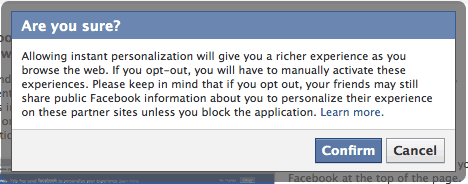
A more recent example is the process introduced last week for opting out of Instant Personalization. This new feature allows select Facebook partner websites to collect and log all of your “publicly available” Facebook information any time you visit their websites. We’ve already documented the labyrinthine process Facebook requires users to take to protect their data, so I won’t repeat it here. Suffice to say that sharing your data requires radically less work than protecting it.
Of course, Facebook is far from the only social networking company to use this kind of trick. Memorably, users of GMail were surprised last February by the introduction of Google Buzz, which threatened to move private GMail recipients into a public “frequent contacts” list. As we noted at the time, Buzz’s needlessly complex “opt-out” user-interface was a big part of the problem.
OK, perhaps the word “evil” is a little strong. There’s no doubt that bad user-interfaces can come from good intentions. Design is difficult, and accidents do happen. But when an accident coincidentally bolsters a company’s business model at the expense of its users’ rights, it begins to look suspicious. And when similar accidents happen over and over again in the same company, around the same issues, it’s more than just coincidence. It’s a sign something’s seriously wrong.
While reading the long list of threads on the touch HD2 section of XDA, I found something that might interest those hardcore HTC sense users. This mod/tab was created by a Russian Fed citizen on XDA, whose called xaoc747. He managed to envision a new way to display your compass, and GPS data, and has made it happen with the first release of his new Sense Tab.
This Tab contains many thing going on at once, and I am sure all HTC HD2 users that want the experience will loss a lot of battery in the process. But that’s neither here or there. If you want to have your GPS in your face and easily accessable at all time this tab comes with:
– work with GPS module without using a third-party navigation software – definition of current position – definition of object motion parameters for calculation between the current and previous points – Determination of directions and distances to given calculation points – recording of tracks (routes) in automatic and manual modes in a format Yandex maps with further viewing them – an analysis of the tracks (the specified distance route, maximum and average speed on the route and time of movement on the route) – Work with the payment points (in the format tags Yandex maps) – sending SMS with your coordinates in the automatic and manual modes for a given number – to set the maximum speed and control the speed while driving with the gradation by the fine
Now this might not be the best GPS system you will have on your Windows Phones(I personally use iGo,) but for a free software that looks good and comes with all these features… I only have one question, where do I sign up .
You can download it, and install it with the instructions.
Given a chance, what would you say to a top federal policy maker about rural broadband? I had my chance at the Broadband Properties Summit this week in Dallas with USDA Rural Utilities Services Administrator Jonathan Adelstein. I first saw him in the elevator and he asked me what I wanted to hear from him during his keynote. I asked him how we will get broadband to the countryside surrounding RBOC-served communities that have been CLEC’d by smaller independent companies who have cherry-picked the significant customer base in the town but are unable to overbuild the countryside. He told me that this was too hard of a question! As we got off the elevator, I saw that he was heading to the restaurant for breakfast alone. I overcame my natural shyness and asked him if I could join him and he welcomed me to his table. What followed was a very interesting discussion (at least for me!).
He was a very good questioner. We talked about the marvel of cooperatives as a model for rural broadband development. We talked about the appropriate scale for this type of cooperative development and whether new cooperatives could make it economically today as start-ups. Necessary scale versus local control – how does one find that balance. As Minnesota’s telecommunications providers get larger through acquisitions (CenturyLink purchasing Embarq and Qwest, growing independent telcos like ACS, Iowa Telecom and New Ulm Telephone), will the connection to the local community remain a priority?
The Broadband Properties Summit includes a focus on the business linkages between real estate development and telecom services. Telecom providers like ATT and Verizon pay real estate developers commission when tenants sign on with these providers. This got me thinking about if there was any real differences between an apartment building and a community? If communities are actively working to boost broadband adoption and subscriptions for community economic vitality, what is the proper role between communities and their providers on broadband promotion initiatives? I will be meeting with Minnesota’s telecom providers to discuss this very topic as we prepare to implement the Blandin Foundation’s MN Intelligent Community NTIA BTOP program.
Suzuki announced today that it is launching its nationwide “Free Gas for Summer” sales promotion. The incentive offers three months of free gasoline on retail purchases of any new 2010 Suzuki Kizashi, SX4 SportBack, SX4 Sport sedan, SX4 Crossover, Grand Vitara and Equator.
“Suzuki recognizes the economic challenges Americans continue to face and thought this promotion was a great way to provide relief for car buyers,” said Koichi Suzuki, executive vice president, American Suzuki Automotive Operations. “Working through our U.S. dealer network, we’re happy to extend this program to consumers across the country, providing potential buyers even more reason to consider purchasing a Suzuki during the summer shopping season.”
Suzuki is recognized as the second most fuel-efficient automaker in Corporate Average Fuel Economy (CAFE) with 29.7 mpg, as reported in the EPA 2009 Light-Duty Automotive Technology and Fuel Economy Trends Report,
The Suzuki “Free Gas for Summer” sales program kicks off May 1 and runs through Aug 31.
A bunch of folks have been submitting this story of a New Jersey middle school principal sending an email to all parents telling them to ban Facebook for their kids and to spy on all of their text messaging habits. Because, apparently, at Benjamin Franklin Middle School, “trust” is not something they want to teach. We see this sort of overreaction to new things all of the time. In the past, school administrators have needlessly freaked out about such things as comic books, dungeons and dragons, walkmen and mp3 players. If the principal, Anthony Orsini, had just sent out a note saying “talk to your kids and pay attention to what they’re doing online,” it would have been fine. But, instead, he went all out:
It is time for every single member of the BF Community to take a stand! There is absolutely no reason for any middle school student to be a part of a social networking site!
Let me repeat that – there is absolutely, positively no reason for any middle school student to be a part of a social networking site! None….
Actually, there are plenty of reasons why a middle school kid might be a part of a social networking site: it’s called communicating with their peers. That doesn’t mean parents should let their kids use them entirely freely, but a blanket ban is clear overkill by someone who apparently doesn’t understand how these things work.
Please do the following: sit down with your child (and they are just children still) and tell them that they are not allowed to be a member of any social networking site. Today!
Let them know that you will at some point every week be checking their text messages online! You have the ability to do this through your cell phone provider.
Let them know that you will be installing Parental Control Software so you can tell every place they have visited online, and everything they have instant messaged or written to a friend. Don’t install it behind their back, but install it!
He goes on to then urge parents to contact the police any time their child gets a message they don’t like:
If your son or daughter is attacked through one of these sites or through texting – immediately go to the police! Insist that they investigate every situation. Also, contact the site and report the attack to the site – they have an obligation to suspend accounts or they are liable for what is written.
That last line, saying that the sites are liable is simply not correct, but why let facts get in the way of a good rant.
Orsini then goes on to explain that he’s absolutely positive that social networks will be found in studies to be damaging to kids:
It is not hyperbole for me to write that the pain caused by social networking sites is beyond significant – it is psychologically detrimental and we will find out it will have significant long term effects, as well as all the horrible social effects it already creates.
Of course, similar things have been written about every “new” thing that the older generation in society doesn’t get — including the waltz (“we feel it a duty to warn every parent against exposing his daughter to so fatal a contagion”), movies, videos games… and chess (“chess is a mere amusement of a very inferior character, which robs the mind of valuable time that might be devoted to nobler acquirements, while it affords no benefit whatever to the body”). I assume, we can add Orsini’s quote to the other quotes about those other things soon.
Basically, it looks like Orsini has fallen prey to yet another moral panic. He claims that it doesn’t make sense to teach “responsible” computing, because middle school kids can’t handle it. It appears that many kids in his school disagree, and are quoted in the article saying so. Clearly, many kids will abuse social networks and the will bully others. But doing a blanket ban certainly won’t work, and is just someone overreacting because he was unable to handle some kids acting poorly. It’s an attempt to prevent kids from doing stuff, just so that the administrators might get a little “security” from kids being kids.
Perhaps the principal of the Benjamin Franklin Middle School, should pay attention to Ben Franklin’s words:
They who can give up essential liberty to obtain a little temporary safety, deserve neither liberty nor safety.
Specialist for applications in wet and marshy terrain
The special steering of the front drive wheels permits a wide range of applications in marshy terrain and in deeper water. The special rig form ensures very low driving resistance. The machine can be raised extremely high for large wading depths.
Features
•Low driving resistance when driving in mud
•Triple steering mode: Leg and wheel steering at front and rear
•Low ground pressure
•Wide spread driving and steering with permanent all-wheel drive
•Maximum stability even on soft ground




 .
.


