Author: Serkadis

  • Salão de Pequim 2010: GM apresenta minivan derivada do Volt

    GM Volt MPV5 Concept

    A Chevrolet apresentou no Salão do Automóvel de Pequim o conceito Volt MPV5, uma minivan/crossover multi-uso com capacidade de levar cinco passageiros e que utiliza uma motorização hibrida, além de contar com um design baseado no Volt.

    Medindo 4,5 metros de comprimento, o conceito oferece maior espaço para os ocupantes e para a bagagem. Seu porta-malas tem uma capacidade inicial de 863 litros com os bancos no lugar original e de até 1.764 litros com o rebatimento dos bancos traseiros. Por fora, a dianteira da minivan já é bem conhecida e o que mais chama atenção é seu design traseiro com lanternas afiladas e suas rodas de 19 polegadas.

    O interior do Chevrolet Volt MPV5 Concept tem um design limpo e bem definido e é revestido com materiais inéditos. De acordo com Doug Parks, engenheiro chefe no desenvolvimento de carros elétricos da GM: “O Volt conceito MPV5 demonstra a flexibilidade do sistema de propulsão Voltec, que pode produzir energia elétrica suficiente para impulsionar uma série de veículos a partir de um sedã compacto, como o crossover do Volt, o conceito MPV5 Volt “.

    Seu sistema de propulsão funciona como no Volt, onde no ciclo urbano e de menores velocidades o veiculo pode percorrer até 51.5 km apenas com o motor elétrico. Depois disso, o motor a combustão é acionado para recarregar sua bateria de íon de lítio de 16 kWh. Quando houver a necessidade de mais potencia como nas estradas, o conceito Chevrolet Volt MP5 utiliza os dois motores simultâneos que possibilitam alcançar a velocidade máxima de 160 km/h e uma autonomia de 482 km.

    GM Volt MPV5 ConceptGM Volt MPV5 ConceptGM Volt MPV5 ConceptGM Volt MPV5 Concept

    GM Volt MPV5 Concept
    GM Volt MPV5 ConceptGM Volt MPV5 ConceptGM Volt MPV5 ConceptGM Volt MPV5 ConceptGM Volt MPV5 ConceptGM Volt MPV5 ConceptGM Volt MPV5 ConceptGM Volt MPV5 ConceptGM Volt MPV5 ConceptGM Volt MPV5 Concept

    Fonte: AutomobileReviews


  • Bin Laden in Iran

    In nine years, this is the first creditable sniff regarding the fate of Osama Bin Laden that could be plausible.  When the towers fell, not only was he the biggest single target on earth he also would have been a valuable trading chip to everyone.
    Hot footing it to Iran before his Taliban hosts did the calculus was a simple act of self preservation.  There at least, he was in one of three countries engaged in a cold war with the USA.  Yet Iran has no reason to brag about it, because it would introduce a dangerous wild card when they have their own.
    His engagement in the falcon business also rings true and is why this dribble of evidence actually surfaced.  Food and lodging would never have drawn attention and intelligence intercepts appear pretty unlikely with a chap who will certainly operate through secretaries.  Yet involvement in falconry needs personal contact and long associations.  He has not given it up.
    That in itself is a compelling reason to think we have him.  It would be the one thing that I could believe he would not abandon.  So it has revealed him.  And it tells us how to find him sooner or later.
    He will be a secondary casualty when the present regime ends.
    Bin Laden in Iran, Documentary Claims
    Monday, 26 Apr 2010 05:35 PM

    By: Ken Timmerman


    A new documentary film premiering at the prestigious Tribeca film festival in New York this week presents stunning new evidence that al-Qaida leader Osama bin Laden is living in Iran, where the Iranian regime is sheltering him.

    The film, “Feathered Cocaine,” began as a simple documentary of the illicit trade in hunting falcons to Middle East desert sheikhs. But as filmmakers Thorkell (Keli) Hardarson and Örn Marino Arnarson delved deeper into their subject, they discovered a dark underworld in which terrorism and falcon smuggling met with astonishing regularity.

    In March 2008, the filmmakers ventured into Afghanistan and the former Soviet republics along with Alan Parrot, the head of the Union for the Conservation of Raptors, a conservationist group that seeks to protect wild falcons, to interview a falcon smuggler they code-named “T-2.”


    For three days, the team waited in a mountain village while the smuggler kept them under surveillance from afar. Satisfied that they hadn’t been followed, he granted them a 55-minute interview — only if they agreed to disguise his voice and his appearance.

    “He was suspicious of the cameras – probably because he had seen too many movies about the CIA and was afraid we might be able to identify him,” Hardason told Newsmax.

    “T-2” told the filmmakers that he met bin Laden by chance in late November 2004 at a falcon-hunting camp in northeastern Iran.


    “I met him five times after 2004,” he said. “The last time we met was in October 2007. Every time, it was in Iran.”

    Newsmax was given exclusive access to the interview last year and interviewed a U.S. intelligence official who confirmed that the United States had electronic interceptsindicating the presence of a very important person in the region at the dates “T-2” mentioned. 

    Iranian authorities were moving the VIP from Tehran to Zahedan, a center of the falcon-hunting grounds, which were closed off to all foreign visitors for security reasons.

    “There was no doubt in my mind that they were expecting a big shot, and it makes sense to think it was bin Laden,” the U.S. official said. 

    “Feathered Cocaine” includes excerpts from the footage with “T-2,” as well as interviews with lawyer John Loftus, former CIA clandestine officer Bob Baer, and others, including this reporter and former Washington Post reporter and terrorism expert Steve Coll.

    Loftus revealed that “T-2” provided the filmmakers with the specific frequencies of small transmitters bin Laden had strapped to the backs of his hunting falcons so he could find them if they failed to return to base. 

    Loftus said the CIA could use that information to track bin Laden and capture him, and that he offered it to the director of the Central Intelligence Agency and to the heads of other U.S. intelligence agencies at the request of the filmmakers, with no response.

    Last year, they approached “Rewards for Justice,” the State Department office that is offering a $50 million reward for information leading to bin Laden’s capture, but never received any acknowledgement of their information.

    Speaking to a packed house after the Tribeca premier on Friday, Parrot was asked to speculate about why “T-2” agreed to talk to the filmmakers, because the details surely would allow bin Laden to guess his identity.

    “I believe that bin Laden wanted ‘T-2’ to send a message through us,” Parrot said. “He wanted the world to know that he was in Iran, but that he couldn’t leave.”

    In the movie, Parrot said the Iranian regime is giving bin Laden “a long leash” but is holding his family hostage in Tehran in the event bin Laden revealed his relationship to them. “This was confirmed by one of bin Laden’s sons last year,” Parrot said.

    Omar bin Laden, who married a British woman and broke with his father before the 9/11 attacks, revealed in December 2009 that seven of his siblings were living in Tehran and seeking to leave the country.

    The story of American-born falconer Alan Howell Parrot lies at the center of this extraordinary tale and lends it credibility. Parrot began breeding falcons and selling them to the ping of Saudi Arabia and then to the president of the United Arab Emirates (U.A.E.) in the late 1970s, and was a frequent guest at their royal palaces and elaborate hunting camps in the wilds of southern Afghanistan.

    In the late 1990s, so was renegade Saudi financier Osama bin Laden. Parrot described the royal hunting camps “al-Qaida’s board room,” because they gave bin Laden the opportunity to spend weeks of quality time with wealthy backers from the U.A.E. and other gulf states.

    Parrot alleges that bin Laden’s royal backers transferred “hundreds of millions of dollars” in cash to him during these hunting expeditions, as well as military equipment and off-road vehicles. The movie includes footage of a U.A.E. military C-130 transport plane landing at a makeshift airstrip in western Pakistan to deliver equipment to the hunting camps.

    “I see bin Laden as a falcon smuggler,” Parrot states in the film, “and in that capacity I went after him. All the locals in Kandahar hated bin Laden because he stole all the falcons.”

    After al-Qaida blew up two U.S. embassies in Africa in July 1998, the CIA also began hunting for bin Laden in earnest. Local agents in Afghanistan spotted him at a royal hunting camp near Kandahar in February 1999, according to an account that appeared in the final report of the 9/11 Commission.


    CIA Director George Tenet asked the White House for permission to launch a cruise missile strike on the camp on Feb. 8, 1999, but soon ran into interference from an unusual source: Richard Clarke, the top counter-terrorism adviser to President Clinton.

    As the 9/11 Commission report concluded, “policymakers were concerned about the danger that a strike would kill an Emirati prince or other senior officials who might be with bin Laden or close by,” so they called off the strike. 

    On March 7, 1999, Richard Clarke called Sheikh Mohammed bin Zayed, the U.A.E. defense minister, to “express his concerns about possible associations between Emirati officials and bin Laden,” the 9/11 Commission report states.

    It is not clear whether Clarke told Mohammed that U.S. intelligence had evidence that U.A.E. officials were with bin Laden in Afghanistan, but after the call, bin Laden and his patrons quickly dispersed and the camps were dismantled.

    Clarke claims the CIA approved the tip-off call. However, former CIA official John Mayer III told the commission it was “almost impossible” for the CIA to have approved Clarke’s move.

    “When the former bin Laden unit chief found out about Clarke’s call, he questioned CIA officials, who denied having given such a clearance,” the report states. “Imagery confirmed that, less than a week after Clarke’s phone call, the camp was hurriedly dismantled and the site was deserted.”

    Asked by Newsmax to comment on his reported tip-off to the U.A.E. sheikh, Clarke said, “I’m not going to get into that. What I said to the 9/11 Commission is what I said to the 9/11 Commission.” He similarly declined repeated requests from Parrot and his documentary film team to talk about the hunting camps on camera.
  • Global Cooling until 2030 by Girma Orssengo, B. Tech, MASc, PhD

    Article Tags: Girma Orssengo, [email protected]

    article image

    The observed yearly Global Mean Temperature from the Climate Research Unit can be modelled by a combination of linear and sinusoidal functions as shown in chart above.

    As shown in the chart above, if the global mean temperature cycle behaves the way it behaved for the last 130 years, there will be global cooling until 2030. In contrast, the IPCC projections that started its divergence away from observed temperature about 2005 will continue its imaginary trajectory towards its exaggerated target temperature.

    For detailed discussion of the model, please visit the WUWT website: Predictions Of Global Mean Temperatures & IPCC Projections

    Read in full with comments »   


  • The Iron Hoe


    This item informs us that Cuba has gone further down the road of integrating the separate rural and urban life ways than I had any reason to anticipate.
    I want you to read the underlined component, before we do the kneejerk thing about Cuba.
    It has been my argument that introducing an urban element into our agriculture is necessary in order to achieve the best utilization of human resources for our own modern civilization.  Formal employment has always been only part of our lives.  The remaining part can well be engaged in agricultural pursuits for which we are well adapted.
    In Cuba, it has become a source of private enterprise and local economic health.  Not quite a joint stock company, but beats driving cab.
    As I posted earlier, we can integrate a condominium complex with a large operational farm with sufficient land to provide individual enterprise and multiple part time employment opportunities.  The financing package can easily support acquisition and operating working capital to support all aspects of production.  But key is manpower availability.  It becomes possible to operate labor intensive high yield protocols.
    This can all be done with something as simple as a proper zoning law that does not allow separation of title to permit abandonment.  A farm can then achieve a density equal to single family housing while having negligible impact of cropping space.  This provides the necessary tax base and services.
    THE IRON HOE OF THE STATE
    Cuba’s urban-ag revival offers limited lessons 2
    26 APR 2010 6:15 AM
    Cuba\’s flourishing urban agriculture comes with a strong dose of government control.
    This post originally appeared on Civil Eats.
    Many of us in the U.S. sustainable-food movement idolize Cuba‘s experience in building a vibrant urban-farming sector. This idealization is due to the lack of information available on the Cuban system, as caused by the travel embargo and media blackout there. Compounding this situation is the vast difference between the Cuban and American political and economic systems.
    Cuba’s accomplishments are undeniably astounding, inspiring and a testament to the country’s flexibility and pragmatism: 350,000 new well paying jobs (out of a total workforce of 5 million) created in urban agriculture nationally; 4 million tons of fruits and vegetables produced annually in Havana, up ten-fold in a decade; and a city of 2.2 million people regionally self-sufficient in produce. These accomplishments have been supported by an extensive network of input suppliers, technical assistance providers, researchers, teachers and government agencies.
    Yet, Cuban urban agriculture, no matter how inspiring, is largely irrelevant to Americans. The state is pervasive throughout Cuba and controls virtually all aspects of the official economy. The government can mobilize quickly and massively around its priorities through an array of powerful policy tools at its disposal. After 50 years of socialist rule, Cuban institutions, as well as the mentality and expectations of the Cuban public, differ vastly from those in the U.S. By way of example, the ruling motto of Cuban urban agriculture states, “We must decentralize only up to a point where control is not lost, and centralize only up to a point where initiative is not killed” embodies the vast differences between their planned economy and our free market system.
    The fundamental differences between the Cuban and American systems as they relate to the success of urban agriculture are vast and, for the most part, are insurmountable.
    Land ownership key
    Case in point, the success of urban agriculture in Cuba has been grounded in the distribution of public land for food production. For example, a law passed in 2008 allowed any citizen or entity to request idle lands up to 33 acres to be passed out in usufruct for 20-40 years. This law resulted in 16,000 persons requesting land in the past two years. Since all land in Cuba – with the exception of private homes – is the property of the State, the government has resources at its disposal to support its policies far beyond that of any American jurisdiction.
    On the other hand, in the U.S., land use laws and private property land tenure represent a very real challenge to the expansion of urban farming. While some cities have made their minimal idle lands available for urban farming, when they do so, garden land tenure is not assured. For example, in New York City, hundreds of community gardens were threatened with destruction and dozens were ultimately plowed under when city government prioritized housing developments.
    Land use planners here typically view urban agriculture as an interim land use at best, until a development opportunity with higher economic utility, such as housing, retail or manufacturing, becomes feasible. Few communities have protected urban agriculture as a permanent use in their planning documents, although this phenomenon is beginning to change. Neighbor complaints about noises, smells, visual clutter and dust created by urban farming are made frequently and deter farm permanence.
    Salary controls nurture Cuban farming
    In Cuba, virtually everyone works for the State. The State sets salaries; economic incentives are controlled by the government. To incent fruit and vegetable production, the government has allowed urban agricultural enterprises to distribute part of their profits back to the workers. These quasi-free enterprise farming operations have led to some unique salary structures wherein farm workers can earn two or three times the salary of the local physicians. These incentives have thus allowed urban farms to retain high quality human resources and maximize production.
    U.S. policymakers have few tools at their disposal to shape the earnings of urban agricultural producers, beyond the nigh-impossible extension of commodity subsidies. Urban farms have to compete with the rest of the labor market for qualified workers, with immigration policy also playing a large factor in agricultural labor supply.
    Profit, capital and the marketplace
    The economic conditions under which Cuban urban farms operate are extraordinarily different than the conditions of similar enterprises in the U.S. For example, since they do not purchase or rent the land, they have no mortgage or rental costs to pay. Inputs and technical assistance are subsidized by the government. (A visit from a technician to assess a pest problem costs one cooperative member the equivalent of two bits.) They enjoy little competition from other sources for their fruits and vegetables, which they may sell at farmers’ markets or at on-site farm stands. While capital may be difficult to access from the government, there is no private banking sector and no interest charges to bear. As a result, the urban farms in Havana are profitable enough to redistribute a significant portion of their earnings (85 percent in one case) back to the workers. In a country where the basic wage is $10 per month and a monthly incentive of $50 per month is quite substantial, these farms clearly do not need to be making enormous profits to make a difference in the lives of their workers.
    Running a profitable urban farming business in the U.S. entails a much more complex set of calculations than in Cuba. In the U.S., small farms struggle to break even, under the weight of high monthly payments for land, inputs and machinery. On the wholesale level, they face difficult access to markets for selling their products and typically receive prices near or below their cost of production. Small farms selling directly to consumers frequently face stiff competition from other farmers or other retail outlets, which are typically better capitalized. The more socially-minded farming enterprises subsidize their operations with grants for educational programs or through agri-tourism schemes. To be profitable, urban farmers must find a market niche at which they excel, such as providing ultra-fresh micro-greens to high-end restaurants or through cause-related marketing.
    Necessity, the mother of invention
    Cuba‘s shift to urban and organic agriculture was driven by necessity. As the Soviet bloc fell in the late 1980s and early 1990s, Cuba lost the primary market for its products and its source of subsidized agricultural inputs and petroleum. The crisis that ensued was referred to by the Orwellian term, “the special period,” and they were hungry and dark times for Cuba. To its credit, the Cuban government found partial solutions to this emergency by pushing the country toward organic and urban agriculture. As one highly placed Cuban official said about the decision to support urban farming and farmers’ markets, “We moved food production and the markets as close to the people as possible because there was no oil for transportation to get the people out to the food.” This policy decision came at an ideological cost. It entailed a partial opening of urban food production to the free market, which resulted in increased social inequality through income distortions. It also was a 180-degree turn from the capital and input-intensive, Soviet-influenced production methods valued in Cuba at the time.
    American interest in urban agriculture has been influenced by the state of the economy. Backyard vegetable production and seed sales for 2009 spiked significantly over 2008 levels, and urban farming in Detroit has grown rapidly as a means to deal with acres of vacant land. But, by and large, increased policymaker and public interest in urban agriculture is traced to concerns about food literacy, urban sustainability, community building, obesity prevention and – to a lesser degree – economic development and job training. These goals are important, but they are not driven by a state of emergency as Cuba suffered.
    The success of Cuba‘s urban agriculture program is a true inspiration to the people working to green cities here in the U.S. Yet, what is best learned from Cuba’s experience is not the specifics of how to produce more food in urban communities, but the value of alternative economic, political and social structures that can help us accomplish our goals.
  • Peter Boockvar: Greece Crisis Marks The Unwind Of The Largest Monetary Easing In History

    cash dollars money

    Even if the Greece crisis doesn’t turn into a major crisis for all of Europe and its banks, the economic implications are still signifianct, as Miller Tabak’s Peter Boockvar nicely spells out in a morning note:

    Most European bond markets remain under pressure again. Whatever happens with
    Greece now, the cost of capital is going up for most of the Euro region and that
    has implications for companies and consumers that borrow in these markets.

    Death, taxes and easy money, the only certainties in life. Actually the last one
    is not always the case but REAL interest rates have been negative for 5 of the
    last 8 years and the FOMC will tell us today that they will remain that way for
    an ‘extended period.’ They will tell us that inflation is benign, even as the
    Journal of Commerce index is up 9% from the last meeting at the highest level
    since Aug ’08 and just 7% from a record high. There will be some coffee talk on
    selling their large pile of MBS at some point. Unwinding the largest monetary
    easing in the history of the world will not be easy and the longer the Fed
    waits, the more rough it will be due to the misallocation of capital they have
    created, again
    . II: Bulls 54 v 53.3, highest since Dec ’07, Bears 18 v 17.4

    Join the conversation about this story »

  • Indonesian Taps Volcano Power


    Sometimes one needs to be reminded of the obvious.  Indonesia not only has a massive geothermal energy resource it is also within easy reach of over half the world’s population by the new super conducting power lines we are soon to build.
    One internal line simply following the islands of Sumatra and Java taps the resource and a single short sub sea link to Thailand connects it to a future land line system.  That could be built through Burma to access India and China both.  It does not have to follow valleys.
    While building a system in the USA is necessary to develop a future electric car economy it is hugely more important in this region of the world were power access is far from been universal     They have ten times the population not nearly the opportunities in hydro and are forced to otherwise rely on coal and nuclear.
    Present plans are ambitious not need to be even more ambitious.  Coal plants are cheap and easy if you are in a hurry, but geothermal is a permanent solution that is good forever.
    Also it would provide Indonesia an additional source of foreign exchange beside its depleting oil.
    Indonesia aims to tap volcano power
    by Staff Writers

    Kamojang, Indonesia (AFP) April 24, 2010

    Indonesia has launched an ambitious plan to tap the vast power of its volcanoes and become a world leader in geothermal energy, while trimming greenhouse gas emissions.

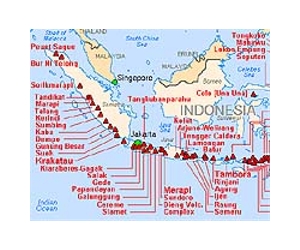
    The sprawling archipelago of 17,000 islands stretching from the Indian to the Pacific Oceans contains hundreds of volcanoes, estimated to hold around 40 percent of the world’s geothermal energy potential.

    But so far only a tiny fraction of that potential has been unlocked, so the government is seeking help from private investors, the World Bank and partners like Japan and the United States to exploit the power hidden deep underground.

    “The government’s aim to add 4,000 megawatts of geothermal capacity from the existing 1,189 megawatts by 2014 is truly challenging,” Indonesian Geothermal Association chief Surya Darma said.

    One of the biggest obstacles is the cost. Indonesia currently relies on dirty coal-fired power plants using locally produced coal. A geothermal plant costs about twice as much, and can take many more years in research and development to get online.

    But once established, geothermal plants like the one built in Kamojang, Java, in 1982 can convert the endless free supplies of volcanic heat into electricity with much lower overheads — and less pollution — than coal.
    This is the pay-off the government is hoping to sell at the fourth World Geothermal Congress opening Sunday on the Indonesian resort island of Bali. The six-day event will attract some 2,000 people from more than 80 countries.

    “An investment of 12 billion dollars is needed to add 4,000 MW capacity,” energy analyst Herman Darnel Ibrahim said, putting into context the recent announcement of 400 million dollars in financing from lenders including the World Bank and the Asian Development Bank (ADB).

    “Field exploration can take from three to five years, suitability studies for funding takes a year, while building the plant itself takes three years,” he added.

    If there is any country in the world where geothermal makes sense it is Indonesia. Yet despite its natural advantages, it lags behind the United States and the Philippines in geothermal energy production.

    Southeast Asia‘s largest economy and the world’s third biggest greenhouse gas emitter exploits only seven geothermal fields out of more than 250 it could be developing.

    The case for geothermal has become stronger with the rapid growth of Indonesia‘s economy and the corresponding strain on its creaking power infrastructure.

    The archipelago of 234 million people is one of the fastest growing economies in the Group of 20 but currently only 65 percent of Indonesians have access to electricity.

    The goal is to reach 90 percent of the population by the end of the decade, through a two-stage plan to “fast-track” the provision of an extra 10,000 MW by 2012, mostly through coal, and another 10,000 MW from clean sources like volcanoes by 2014.

    President Susilo Bambang Yudhoyono’s pledge to slash greenhouse gas emissions by 26 percent against 2005 levels by 2020 has also spurred the push to geothermal.

    Many of the best geothermal sources lie in protected forests, so the government aims to allow the drilling of wells inside conservation areas while insisting that the power plants themselves be outside.
    Geothermal fans welcomed the recent completion of negotiations between a consortium of US, Japanese and Indonesian companies and the state electricity company, Perusahaan Listrik Negara, over a 340 MW project on Sumatra island.

    The Sarulla project will be Indonesia‘s second biggest geothermal plant, after the Wayang Windu facility in West Java.

    “The Sarulla project is a perfect example of how Indonesia can realise its clean energy and energy security goals by partnering with international firms,” US Ambassador Cameron Hume wrote in a local newspaper.

    Several firms such as Tata and Chevron have submitted bids to build another geothermal plant in North Sumatra, with potential for 200 MW.
  • A Week Ahead Of Election, UK PM Gordon Brown Makes Horrible Gaffe Caught On Camera

    Gordon Brown Head In Hands

    A week before the election, UK PM Gordon Brown has made a horrible, career-ruining gaffe caught on camera.

    Basically, after doing a little street-level chit-chat with an old lady, he gets into his limo and calls the woman bigoted, not realizing his mic was still on. Here’s the video. The bigoted line comes at the very end.

    Photo from Tim Montgomerie, editor ConservativeHome.com

    Join the conversation about this story »

  • Vw in talks with several battery manufacturers for its upcoming electric car

    Vw Up ConceptAs Volkswagen AG searches for companies to supply it with electric-car batteries, it is reportedly in talks with a Robert Bosch GmbH and Samsung SDI Co. joint venture and LG Chem Ltd.

    In an interview, Ulrich Hackenberg, head of Volkswagen brand development, said that the company is keeping its options open and is expected to study the development of various battery systems. However, Hackenberg didn’t say when the deal with SB LiMotive Co. and LG Chem, the largest South Korean chemical maker, will be signed. Hackenberg added that mass-produced battery cells aren’t likely to start delivery until one or two years from now. The list of companies that VW is said to have been cooperating with include makers of rechargeable batteries: BYD Co., the Chinese carmaker supported by billionaire Warren Buffett; Sanyo Electric Co.; and Toshiba Corp. Hackenberg admitted though that Japanese suppliers “are still a step ahead” of BYD. VW intends to begin manufacturing battery-powered cars in China as early as 2013. VW also said that it wants to add 1.6 billion euros ($2.1 billion) to its investment to create more models and two new facilities in China, raising total investments in China to 6 billion euros.

    [via autonews – sub. required]

    Source: Car news, Car reviews, Spy shots

  • Buy a $4.3 million Malibu house and get a rare Ferrari F40

    Ferrari F40

    In the current market, getting bidders to visit a exclusive resident spot in Malibu, California has become very difficult for listing agents. One agent has recognized this and is offering an incentive that may be difficult for a wealthy enthusiast to turn down.

    If you drop $4,399,333 for his client’s 6,000 sq-ft home, he will throw in a rare Ferrari F40. Only 213 units of the 200 mph F40 supercar made it to the United States and according to Michael Sheehan, a Ferrari historian, a F40 can still fetch around $350,000. He said a low mileage F40 can demand nearly $600,000.

    The odometer reading on the Ferrari F40 on the car in Malibu right now? 734 miles – making it one of the lowest-mileage F40s available on the open market.

    – By: Kap Shah

    Source: Wheels


  • Safety light grids with teach-in function for blanking

    Flexibly securing hazardous areas with optoelectronics

    Compared to conventional safety doors, optoelectronic safety guards often provide for a more flexible machine operation. The operator’s flexibility is even enhanced, when safety light curtains with comfortable parameterizable muting and blanking functions are used.

    The “blanking” feature enables an area in the protection field to be blanked out without a stop signal being triggered. In this way, a conveyor belt or an auxiliary or support construction of the machine can be positioned in this area. The “floating blanking” feature provides for enhanced flexibility. With this function, light beams can be blanked at non-permanently defined positions. This is useful, when objects such as movable electrical cables are located inside the protection field. The blanking is moving up or down together with the object to be blanked – this explains the “floating” designation. If the object size changes, the safety light grid is switched off.

    In the SLC 420 series, all light beams except the synchronisation beam can be used for blanking. Different blanking functions are available: a fixed blanking and a dynamic blanking. The chosen mode depends on the duration of the presence of the object (permanently either temporarily) in the protection field. In this way, the user can flexibly adjust the blanking function to the individual application.

    These functions become ever more popular in actual practice; as a matter of fact, the flexible production trend also extends to the non-contact safety guards. Safety Control GmbH – the Centre of Competence of the Schmersal Group for optoelectronic safety guards – now has developed a new series of safety light curtains, for which the blanking function can be parameterized without PC software or programming device. In the SLC 421 series, these functions are defined in the teach-in mode using external command devices.

  • Special transfer machine for assembling ball joints

    AGME design and manufacture special purpose machines for assembling ball joints. The assembly, marking and control processes are automated as much as possible. In this way the assembled parts are very homogeneous and human errors are avoided.

    These machines are capable of performing the following operations:

    • Marking of components
    • Automatic feeding of components
    • Assembly of ball pin, plastic seat, housing and closing cap
    • Part presence control
    • Component greasing
    • Housing rolling with control of time, force and course
    • Assembly of springs and sealing boot
    • Rotating, tilt and break away torque control
    • Air seal check
    • Component final control with artificial vision

  • Brand new Scrapers: IBS BELT CLEANING SYSTEM

    With the IBS Belt-Cleaning-System you are entering a new dimension of belt cleaning.

    With PDC Primary diagonal cleaner and SDC Secondary diagonal cleaner, we developed a scraper system which ensures a special protection of the belts:

    • Extremely low surface pressure
    • Low wear and tear of scrapers and belts
    • Significantly improved cleaning performance with almost maintenance-free operation

    Please contact us: www.ibstec.de / [email protected]

  • Flex-Pro A3 Peristaltic Pump has New Terminal Block

    Blue-White has re-engineered the junction box and connectors on their Flex-Pro A3 Peristaltic Metering Pump. With the Flex-Pro A3s’ Newly Engineered Terminal Block – complete with color-coded overlays – making connections is fast and efficient. Plus, the Flex-Pros’ New junction box provides extra working room.
    There are no loose wires. The Flex-Pro A3s New terminal block board, located within the junction box, utilizes eleven pluggable terminal blocks. The easy-to-understand, color coded overlay clearly identifies terminals and connections. Just follow the handy overlay guide. The Flex-Pro A3 Junction Box has five cable glands, and the A3 is equipped with water-tight connectors.
    With Flex-Pro A3s’ thoughtfully designed user-friendly connectors you choose what’s right for your installation – hardwire or corded.
    The Flex-Pro A3 Peristaltic Metering Pump has Outputs to 33.3 GPH/126 LPH, and Output Pressure ratings to 125 psi/8.6 Bar.

  • Comprehensive Inspection of Round Parts

    The O-INSPECT multi-sensor measuring machine from Carl Zeiss allows the very easy, very accurate and thus very efficient inspection of small and complex parts. It can be used in the electronics and plastics industries, for medical and automotive technology, and precision engineering. A rotary table is now available for O-INSPECT.

    Rotary table increases effectiveness
    The new rotary table developed specially for O-INSPECT can be mounted and removed by the measuring machine operator. The rotary table can be positioned both horizontally and vertically for added benefit. In particular, it enhances the effectiveness of the measurement of round parts which no longer have to be reclamped for the optical measurement. Simple stylus systems are sufficient for the contact measurement.

    The rotary table enables users to quickly and completely inspect parts. Mechanical influences are minimized as the measuring axes of the coordinate measuring machine are only subject to minimal movement with the rotary table. Schwan-STABILO, which manufactures cosmetic pens under the Schwan-STABILO Cosmetics name, has already had positive experiences with the new rotary table on O-INSPECT.

    Four-in-one principle
    O-INSPECT features a four-in-one principle. It unites the best of optics with the best of contact measuring. In the past, four measuring machines were needed to manage the entire range of measuring applications: a profile projector, a measuring machine, a microscope and a contour measuring machine. O-INSPECT covers all four areas, and simplifies and accelerates the entire measuring process.

  • Watch: Naughty Bear turns into Freddy Kruebear via Amazon pre-order promo

    There’s a new Nightmare on Elm Street coming out, but that movie’s not the only time Freddy Krueger is making an appearance. He’s also making a cameo of sorts in Naughty Bear via a pre-order freebie that turns

  • Oh, Look At That, The Market’s Heading Up Again

    Are we about to see a repeat of every single other time the market’s swooned on its relentless march since March of 2009?

    The market fell on Monday, and then got bloodied on Tuesday, but now… we’re heading back into the Green already.

    The climb higher continues.

    StockCharts.com:

    chart

    Join the conversation about this story »

  • Video Professor Loses Lawsuit Against Amazon Over Keyword Advertising

    The Video Professor is the company that is notoriously litigious over critics of its marketing practices — and just a few months ago even sent us a threatening email after we wrote a post about some of the company’s actions. After a quick discussion between lawyers, the company agreed that it would not take action against us. But its lawyers have still been busy elsewhere — though, the company also seems to lose a lot of lawsuits. This particular one involved Amazon.com, and The Video Professor’s annoyance that Amazon had bid on the keywords “video professor” on various ad platforms. Of course, given that Amazon might be selling either products from The Video Professor or some of its competitors, that’s a perfectly reasonable (and lawful) use of keyword advertising. The trademark does not give the trademark holder complete control over the mark.

    Either way, it looks like the Video Professor has lost again on this one, even if the trademark analysis didn’t even come into play. It turns out that way back whenever the company had signed an earlier deal with Amazon to be a vendor on Amazon, it had also signed a vendor agreement that included a “perpetual trademark license.” Summary judgment, case closed.

    Permalink | Comments | Email This Story


  • North Korea Makes Major Troop Shift, Postures For Direct Attack

    kim jong il north korea vladimir putin russia

    North Korea has adopted a new war invasion strategy and shifted troop reserves accordingly, according to JoongAng Daily.

    The new plan calls for the immediate occupation of part of Seoul, followed by negotiations for a cease-fire. It replaces plans for a Sherman’s March-type invasion.

    While it could be mere posturing, the plan shows ruthless understanding of the peninsula balance of power. South Korea is too timid to retaliate when attacked. North Korea has a failed economy and wants to move from charity case to parasite.

    Donald Kirk makes a similar argument at Asia Times:

    South Korea is doing so well economically and living standards are so high that the idea of seeking anything other than rhetorical revenge for the sinking of the Cheonan with a loss of 46 lives on March 26 appears almost unthinkable. Certainly South Korea would get no support for such a venture from its American ally, bogged down in wars in the Middle East and attempting to force South Korean generals reluctantly to believe they should take full command of all forces in the South in the event of a second Korean war.

    While South Korea’s economy grows at a pace ahead of that of the rest of the industrial world, South Korean military people worry over what they see as the North’s alarming new strategy. That is, to chip away at the South Koreans with attacks such as that on the hapless navy corvette in the West or Yellow Sea – and maybe bold quick hits on Seoul and Incheon.

    There was more evidence of a takeover strategy over the weekend, as North Korea seized a joint-operated hotel near the border.

    Can Kim Jong-il poach one of the Four Asian Tigers? Here’s What You Need To Know About The South Korea Economy –>

    Join the conversation about this story »

  • NormalTanks: Contrafied tank action on PS Store tomorrow

    Beatshapers’ NormalTanks made some waves in this year’s Independent Game Festival. If that has you interested, it’s coming to the PlayStation Store this week as a mini.

  • Honda boss asks engineers to speed up next Insight, working on larger hybrids

    2010 Honda Insight

    There is no hiding the hybrid wars between Honda and Toyota and their hybrid models, the Insight and Prius. In hopes, to overtake the Prius for once and for all, Honda President Takanobu Ito challenged his engineers to speed up the launch of the next-generation Honda Insight hybrid, which has been a major sales disappointment.

    He said he wants the next-generation Insight to beat the Prius in terms of fuel economy.

    Honda, which has not capitalized on Toyota’s recall issues and lost U.S. market share, has grown “complacent” and needs to refocus on better products and stronger marketing, Ito said.

    Click here for prices on the 2010 Honda Insight.

    “I’m not satisfied,” he said of American Honda Motor Co.’s slide to a 10.1 percent share of the U.S. market in the first quarter, from 10.5 percent a year earlier.

    Ito says he is also working on rolling out a new hybrid strategy for larger vehicles as well.

    Click here to read our review of the 2010 Honda Insight.

    Review: 2010 Honda Insight:

    Review: 2010 Honda Insight Review: 2010 Honda Insight Review: 2010 Honda Insight Review: 2010 Honda Insight

    All Photos Copyright © 2009 Omar Rana – egmCarTech.

    – By: Kap Shah

    Source: Automotive News (Subscription Required)