Author: Serkadis

  • Smallville Creators Sue Warner Bros, Say They Never Got Fair Market Price For Their Work

    AdamR points us to this story about the Smallville creators suing Warner Brothers — the creators claim that they were cheated out of the “fair-market price” for the show and are demanding additional compensation for the successful show, which was just renewed for its 10th season. The lawsuit alleges that since WB owns both the studio that creates the show and the networks that air it, the negotiated price for the show was not fair. Hollywood has had a long history of wrestling with matters of vertical integration, with the the 1948 anti-trust case United States v. Paramount Pictures taking down the classic “studio system” that prevailed during that era. So, to accommodate the anti-trust regulations, negotiations between studios and networks must be held at “arms length.” In recent days, the producers from Home Improvement, Will & Grace and The X-Files have won settlements worth millions of dollars in similar suits. That said, it’s ridiculous to claim that fair-market price was not negotiated — the fair-market price was whatever the producers could get for it, at the time that the show was sold, before it proved to be a huge hit. The producers accepted and signed the deal when it was negotiated. If a show appreciates in value after the deal is already done, why should the original producer get a piece of that upside? The network assumed the risk in this case when they negotiated the deal. What the producers are seeking is akin to a baseball player trying to renegotiate a previous season’s contract after having a great season — it doesn’t make sense. If this tactic were ok, then networks should try and recoup money from the producers of all of the shows that have failed. If the producers want more money, then they need to negotiate for it in future contracts, and that should be easier to do with a hit show under their belts.

    Permalink | Comments | Email This Story


  • Brand Spankin’ New Images: Lamborghini Gallardo LP570-4 Superleggera

    What a better way to kick off your Tuesday morning than with new pictures of the Lamborghini Gallardo LP570-4 Superleggera. Yeah, we’re not going to take up too much of your time so here is the usual refresher followed by the high-res image gallery (posted after the jump).

    Click through for the updated high-res image gallery

    Refresher: The weight of the Lamborghini Gallardo LP570-4 Superleggera has been dropped by 154 pounds to a total dry weight of no more than 2,954 pounds. Power comes from a 5.2L V10 making 562-hp with a maximum torque of 399 lb-ft. Mated to a 6-speed e-gear automatic transmission, that allows the LP570-4 Superleggera to go from 0-62 mph in just 3.4 seconds, 0 to 124 mph in 10.2 seconds and allows it to keep going up to a top speed of 202 mph.

    Lamborghini Gallardo LP570-4 Superleggera:

    – By: Omar Rana


  • Ford: Economia de energia chega a $1.2 milhão ao ano ao desligar computadores à noite


    Um exemplo de que uma uma grande empresa não precisa consumir grandes quantidades de energia, e preservar o seu caixa é a Ford. Através de uma atitude simples, onde todos os computadores da empresa são desligados à noite, a companhia deixa de gastar $1.2 milhões de dólares ao ano.

    O programa se chama “PC Power Management“, e funciona utilizando recursos de economia de energia fornecido pelo Microsoft Windows. As configurações são usadas em todos os laptops e desktops da companhia visando o desperdício de energia em horários menos movimentados. Então, todas as noites os computadores se desligam, e também durante os finais de semana.

    Segundo a Ford, estima-se que 60% dos computadores da empresa estavam gastando energia após o horário de expediente. E com a nova medida adotada pela companhia, milhões de dólares estão sendo economizados, além de dar um bom exemplo para todos os concorrentes e para o bolso também. Bela iniciativa!

    Via | Autoblog


  • Helpless Beijing Watches The Housing Bubble Spreads To Rural China

    china peasants

    Real estate developers have bought up cheap land in rural China, despite laws against land hoarding, according to Caing.

    But getting around the laws is laughably easy:

    Ministry of Land and Resources (MLR) Chief Inspector Xu Shaoshi recently warned about the importance of overseeing real estate companies and real estate development money that’s started flowing into second- and third-tier cities.

    Yet some developers learned how to beat MLR’s supervision system, which relies on satellite images to enforce rules against hoarding. Developers who sit on vacant land can use MLR insiders to tip them to upcoming fly-overs, then hire temporary laborers to pretend to build on the land when a satellite camera passes overhead.

    “MLR’s satellite can only scan one area at a time,” said a lawyer familiar with the hoarding issue. Developers can find out “when they want to scan a city’s land ahead of time. They send out a few vehicles and pretend to dig. Once the satellites have moved on, the vehicles are called back.”

    It’s not a bad sign that prices are forcing some developers out of major cities, as the ‘bubble’ will deflate as it expands.

    On the other hand, Beijing’s incompetence as a regulator is a very bad sign. This is their biggest failure since a purported crackdown on inflation was followed by a record-high land auction in the capital city.

    See also: The Complete 60-Second Guide To The Chinese Real Estate Market

    Join the conversation about this story »

    See Also:

  • The wing is back! 2011 Subaru Impreza WRX STI gets teased before NY debut

    Joining the 2011 Subaru Impreza WRX at the 2010 New York Auto show tomorrow will be the 2011 Subaru Impreza WRX STI.

    All we got from Subaru was this image and short press release saying “The wing is back! Exclusive world debut at the New York International Auto Show.”

    We’ll have live images and all the details for you on Thursday, April 1. Stay tuned and make sure you join us for live coverage of the 2010 New York Auto Show starting tomorrow.

    – By: Kap Shah


  • Housing Sales Surge Again As Buyers Rush To Beat Tax-Credit Expiration

    As expected, sales are picking up again (contracts must be signed before April 30th to qualify for the Federal tax credit):

    Continue on Calculated Risk >

    Join the conversation about this story »

  • Potholes, if you can’t fix them at least make them visible

    Living in New Jersey, I can attest first-hand to the ravaging effects that roadways littered with potholes can cause on a vehicle; I’ve destroyed two rims and tires this winter. An initiative thought up by students at Milan Polytechnic University in Italy has devised a plan to make potholes more noticeable to drivers.

    By making the lower layer of asphalt a bright and vibrant color, an eroding road surface will show the brighter color and make the pothole noticeable to approaching drivers. The plan will be tested in the town of Rho, just outside of Milan.

    The project will test for affordability and viability, and though it may cost more to manufacture the asphalt in the first place, the thought is that municipalities will save money on roadway repairs. Some experts however, caution that the only real solution is to figure a way to prevent potholes in the first place.

    – By: Stephen Calogera

    Source: NYTimes


  • Ford con nuevos descuentos, no cobrará el IVA

    Ford acaba de presentar nuevos y suculentos descuentos en todos sus concesionarios españoles. Dichas ofertas estarán vigentes desde el día de hoy hasta el 28 de Abril en toda su gama de vehículos.

    Ford Logo

    El descuento en concreto es del 16% del precio del modelo, lo que viene a ser el IVA del mismo. Además, esta oferta podrá ser sumada al actual Plan 2000E asi que podriamos calificar de muy buen momento para adquirir un modelo de Ford.

    Con estas ofertas, la marca espera vender alrededor de 10.000 unidades durante el próximo mes de Abril y así poder mantener las subidas en las ventas obtenidas durante los últimos meses.

    Related posts:

    1. SsangYong ofrece descuentos durante el mes de Septiembre
    2. Ford confirma el motor V8 de 5.0 litros para el Mustang GT
    3. Ford Fiesta elegido coche del año en Castilla La Mancha
  • Despite recalls, Toyota boosting production by 83 percent

    Japanese automakers saw a surge in production for the month of February as Toyota realized an increased output of 83% greater than a year previous, despite their recent recall troubles.

    The company said today that it increased production in almost all regions, and that February represented the seventh straight month of rising production, with 655,180 vehicles rolling off the lines.

    Honda also posted a significant rate of growth, boosting their numbers 49.3% to 284,711 units, but it was Nissan who posted the largest growth by percentage coming in with an increase of 72.4% from last year, making their total 270,366 units produced.

    – By: Stephen Calogera

    Source: Detroit News


  • Mahindra U.S. dealers still waiting on products

    India’s Mahindra & Mahindra recently said it will shortly announce a timeframe for the launch of its “Pikup” model within the next two to three weeks. Originally slated for 2010, the model has been pushed back due to safety and emission certification issues.

    More than 300 prospective dealers, who thought they would be selling the Mahindra pickups by now, are still left with questions as the company missed its third launch date.

    Dealers like Chip Bennett, a partner with Sarasota, Fla., Land Rover dealer Jack Urfer, planned to launch Mahindra sales in February or March, the company’s latest target.

    It is reported that critical issues such as services and parts distribution are keeping dealers from getting Mahindra trucks on time. Nonetheless, some dealers say that Mahindras should be here by the summer.

    “You will see Mahindra here this summer,” Bennett says. “I’m totally confident of that. And I think very soon we’ll be hearing all the details.”

    – By: Kap Shah

    Source: Automotive News (Subscription Required)


  • Post Facebook Status Updates from Yahoo Mail

    The integration of social features, courtesy of Facebook, on Yahoo properties is moving forward with the launch of a big, new feature. Users will now be able to update their status on Facebok from inside Yahoo Mail. The feature will be added to the existing Yahoo status update tool and will only be available in “select markets.” Yahoo contacts in Mai… (read more)

  • Affluent Americans Going Even More Gaga For High-End Groceries (WFMI)

    From JPMorgan analyst Charles Grom, good news on the Whole Foods (WFMI) front:

    • *  Sales trends remain strong. Based on our store work and conversations with industry contacts, we believe that WFMI’s IDs have remained very healthy and are likely trending above the 6.0% the company experienced during the first four weeks of 2Q. Recall, the 6.0% QTD ID represented a meaningful 350 basis point improvement over the +2.5% 1Q trend (+260 bps improvement 2-yr stacked) and was 650 bps above the trailing 3-quarter average. While the bears would point out that WFMI’s strong QTD sales were modestly boosted by February’s Mid-Atlantic region snowstorms (we don’t completely disagree), we believe the company has managed to hold on to its pre-storm momentum and think the top-line is still seeing improvement. Looking ahead, we think Whole Foods’ IDs will continue to benefit from 5 factors going forward: (1) strong unit volume, (2) solid traffic trends, (3) a modest uptick in discretionary sales (e.g. floral, coffee, some confectionary), (4) reflation trends as product costs turn positive, and (5) an expanding basket size.

    But, this is telling, in terms of our jobless recovery:

    • *  Take #3: SG&A in Focus – Evidence of Ongoing Expense Control. We believe Whole Foods is firmly on its way to achieving 100 bps of SG&A improvement (direct store expenses, G&A, pre-opening, relocation) within the next 3-5 years. Two noteworthy observations: First, on the labor front, the company (1) plans to keep leveraging its full-time employee base as it opens new stores, which will further reduce its full-time/part-time split below the current 83% – driving it closer to the 70% target, and (2) has been very cautious about hiring new team members into stores less than a year old – enabling the location to reach target margins before ramping up the employee base. Second, the challenging environment has also enabled Whole Foods to completely eliminate some underperforming gourmet departments in certain stores (for example we observed noticeably fewer chocolate fountains) – thus cutting costs and helping drive the shift back to a healthy product assortment at the same time.


    Join the conversation about this story »

  • Cisco's Tandberg Acquisition Gets Regulators' Approval

    Cisco has announced that its proposed acquisition of teleconferencing service provider Tandberg has been approved by both the European Commission and the US Department of Justice. The transaction can now move forward and the two companies believe the acquisition will close in no longer than a few weeks. Cisco made its intentions to buy the N… (read more)

  • EU Keeps Pushing Canada To Make Massive Changes To IP Law, With No Concern For User Rights

    While everyone’s been focusing on ACTA, there are other (falsely named) “trade agreements” that are being discussed as well. Last year, we mentioned one that has mostly flown under the radar, involving the EU pressuring Canada to change its copyright laws, for the “Canada – EU Comprehensive Economic Trade Agreement” (CETA). Canada has come under some criticism for having copyright laws that the entertainment industry doesn’t feel are “strong enough,” and it looks like CETA is yet another attempt to change that.

    Michael Geist reports on a recent leak of parts of CETA, and it’s pretty extreme. As Geist notes:


    The breadth of the demands are stunning — the EU is demanding nothing less than a complete overhaul of Canadian IP laws including copyright, trademark, databases, patent, geographic indications, and even plant variety rights.

    Jamie Love also has a nice analysis of the leaked documents, where he notes some of the rather telling language choices — especially compared to the existing TRIPS agreement that concerns intellectual property. For example, in TRIPS, there’s talk of balance and user rights, such as this statement in the objectives:


    Objectives

    The protection and enforcement of intellectual property rights should contribute to the promotion of technological innovation and to the transfer and dissemination of technology, to the mutual advantage of producers and users of technological knowledge and in a manner conducive to social and economic welfare, and to a balance of rights and obligations.

    As for CETA? The objectives are noticeably one-sided:


    Objectives

    The objectives of this chapter are to:
    (a) facilitate the production and commercialization of innovative and creative products between the Parties; and
    (b) achieve an adequate and effective level of protection and enforcement of intellectual property rights.

    Yes, this is what is happening to intellectual property law these days. Now that the industry folks have basically taken over the process, they’re pretty much throwing any semblance of the supposed “bargain” between creators and society out the window, and doing their best to turn intellectual property law into a purely one-sided deal, for the benefit of producers only.

    Permalink | Comments | Email This Story


  • Google Chrome (OS) to Come Bundled with Adobe Flash

    The enemy of my enemy is my friend seems to be the common thinking at Google and Adobe. An interesting rumor has popped up recently saying that the two companies are about to announce, later today, a deeper partnership and perhaps a deeper integration of Flash with Google Chrome, though what exactly that implies is anyone’s guess.

    … (read more)

  • You Could Not Make It Up: James Lovelock: Humans are too stupid to prevent climate change by Leo Hickman, The Guardian

    Article Tags: You could not make it up

    In his first in-depth interview since the theft of UEA emails, the scientist blames inertia and democracy for lack of action

    Humans are too stupid to prevent climate change from radically impacting on our lives over the coming decades. This is the stark conclusion of James Lovelock, the globally respected environmental thinker and independent scientist who developed the Gaia theory.

    It follows a tumultuous few months in which public opinion on efforts to tackle climate change has been undermined by events such as the climate scientists’ emails leaked from the University of East Anglia (UEA) and the failure of the Copenhagen climate summit.

    “I don’t think we’re yet evolved to the point where we’re clever enough to handle a complex a situation as climate change,” said Lovelock in his first in-depth interview since the theft of the UEA emails last November. “The inertia of humans is so huge that you can’t really do anything meaningful.”

    One of the main obstructions to meaningful action is “modern democracy”, he added. “Even the best democracies agree that when a major war approaches, democracy must be put on hold for the time being. I have a feeling that climate change may be an issue as severe as a war. It may be necessary to put democracy on hold for a while.”

    Click source to read more of this “rant” from James Lovelock, such is the passion James has against people who do not agree with AGW, he has overlooked that he could be wrong. The IPCC says it’s 90% but thats not important, James has it marked down as 100% certain, people who do not accept his view are just stupid, and that includes the IPCC!

    Source: guardian.co.uk

    Read in full with comments »   


  • Google Chat Web Apps Now Support File Transfers

    There are a multitude of file-sharing options out there. For huge files, there are always peer to peer protocols like BitTorrent, you can share files on countless ‘file locker’ sites like Rapidshare or you could use simple tools like Drop.io. Yet, there are times when even the simplest of services is too much of a hassle, for example when wanting … (read more)

  • My inner Captain Renault is shocked, SHOCKED!

    Who would have thought that the gentlemen at left and Sean Hannity would be accused of being frauds…yet again?

    A potentially damaging scandal erupted today that implicates Fox News Channel personalities Sean Hannity and Oliver North in the worst kind of charitable fraud. According to complaints filed with the Federal Trade Commission and the IRS, the two right-wing icons have exploited American veterans for personal and partisan gain.

    Is Iran involved? Is Hal Turner?

    In its IRS complaint against Freedom Alliance, CREW says that the group’s charitable tax status should be voided because it has engaged in “prohibited political activities” such as its annual “Freedom Cruise” with Republican politicians, including Newt Gingrich and Michael Steele.

    Michael Steele “makes it rain” and Newt then leaves his last wife for the one who collects the most bills. It’s quite a system.

    This sure sounds like the ultimate summation of how conservatives have exploited the armed forces over the last ten years. And who better as representatives than Hannity and North?

  • Atlantic Conveyor not Slowing


    It forever amazes me when rather speculative theories find their way into textbooks and then return as fact with a new generation of scholars.  Oh well.  At this point no one wants to think that the really big event over ten thousand years ago was the crustal shift that I have been pushing which likely modified the conveyor belt pretty sharply.
    Today we are able to note that the crucial part of the conveyor belt has sped up by twenty percent or so since 1990.  That means that the implied dynamics of the system has delivered twenty percent more heat to the Arctic than it has in the past.  We actually do not have such great data but we certainly seem to have the direction.
    That heat was absorbed by the Arctic Sea.  It still is been absorbed by the Arctic Sea.  So unless one is an idiot, it is quite clear that a lot more heat got delivered directly to the Arctic by this mechanism and it provides a good explanation for the decadal deteriation of the sea ice presently been experienced.
    In fact the heat was likely absorbed as a buoyant surface layer of warmer water that just happened to be larger than normal.  I cannot imagine a more effective way to reduce sea ice.
    I think that we are looking at our principle agency for long cycle climate change and it is on a gentle rise.
    NASA Study Finds Atlantic Conveyor Belt Not Slowing
    by Staff Writers

    Pasadena CA (SPX) Mar 26, 2010
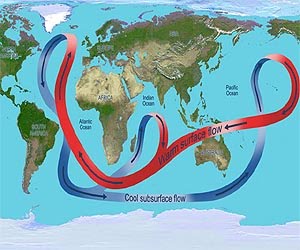
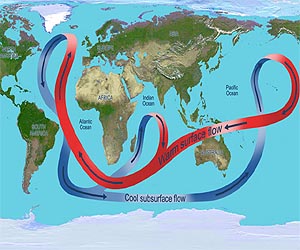
    Illustration depicting the overturning circulation of the global ocean. Throughout the Atlantic Ocean, the circulation carries warm waters (red arrows) northward near the surface and cold deep waters (blue arrows) southward. Image credit: NASA/JPL
    New NASA measurements of the Atlantic Meridional Overturning Circulation, part of the global ocean conveyor belt that helps regulate climate around the North Atlantic, show no significant slowing over the past 15 years. The data suggest the circulation may have even sped up slightly in the recent past.

    The findings are the result of a new monitoring technique, developed by oceanographer Josh Willis of NASA’s Jet Propulsion Laboratory in Pasadena, Calif., using measurements from ocean-observing satellites and profiling floats. The findings are reported in the March 25 issue of Geophysical Research Letters.

    The Atlantic overturning circulation is a system of currents, including the Gulf Stream, that bring warm surface waters from the tropics northward into the North Atlantic.

    There, in the seas surrounding Greenland, the water cools, sinks to great depths and changes direction. What was once warm surface water heading north turns into cold deep water going south. This overturning is one part of the vast conveyor belt of ocean currents that move heat around the globe.
    Without the heat carried by this circulation system, the climate around the North Atlantic – in Europe, North America and North Africa – would likely be much colder.

    Scientists hypothesize that rapid cooling 12,000 years ago at the end of the last ice age was triggered when freshwater from melting glaciers altered the ocean’s salinity and slowed the overturning rate. That reduced the amount of heat carried northward as a result.

    Until recently, the only direct measurements of the circulation’s strength have been from ship-based surveys and a set of moorings anchored to the ocean floor in the mid-latitudes.

    Willis’ new technique is based on data from NASA satellite altimeters, which measure changes in the height of the sea surface, as well as data from Argo profiling floats.

    The international Argo array, supported in part by the National Oceanic and Atmospheric Administration, includes approximately 3,000 robotic floats that measure temperature, salinity and velocity across the world’s ocean.

    With this new technique, Willis was able to calculate changes in the northward-flowing part of the circulation at about 41 degrees latitude, roughly between New York and northern Portugal. Combining satellite and float measurements, he found no change in the strength of the circulation overturning from 2002 to 2009.

    Looking further back with satellite altimeter data alone before the float data were available, Willis found evidence that the circulation had sped up about 20 percent from 1993 to 2009. This is the longest direct record of variability in the Atlantic overturning to date and the only one at high latitudes.

    The latest climate models predict the overturning circulation will slow down as greenhouse gases warm the planet and melting ice adds freshwater to the ocean. “Warm, freshwater is lighter and sinks less readily than cold, salty water,” Willis explained.

    For now, however, there are no signs of a slowdown in the circulation. “The changes we’re seeing in overturning strength are probably part of a natural cycle,” said Willis. “The slight increase in overturning since 1993 coincides with a decades-long natural pattern of Atlantic heating and cooling.”

    If or when the overturning circulation slows, the results are unlikely to be dramatic. “No one is predicting another ice age as a result of changes in the Atlantic overturning,” said Willis.

    “Even if the overturning was the Godzilla of climate 12,000 years ago, the climate was much colder then. Models of today’s warmer conditions suggest that a slowdown would have a much smaller impact now.

    “But the Atlantic overturning circulation is still an important player in today’s climate,” Willis added.

    “Some have suggested cyclic changes in the overturning may be warming and cooling the whole North Atlantic over the course of several decades and affecting rainfall patterns across the United States and Africa, and even the number of hurricanes in the Atlantic.”

    With their ability to observe the Atlantic overturning at high latitudes, Willis said, satellite altimeters and the Argo array are an important complement to the mooring and ship-based measurements currently being used to monitor the overturning at lower latitudes. “Nobody imagined that this large-scale circulation could be captured by these global observing systems,” said Willis.

    “Their amazing precision allows us to detect subtle changes in the ocean that could have big impacts on climate.”
  • North Korea on Verge of Collapse?


    The recent sinking of a South Korean vessel in suspicious circumstances makes this report quite timely.  The situation in North Korea is presently sliding downward and will likely halt with a contraction of the population.
    A people who are dying of starvation do not do rebellion very well so that part will simply be awful.
    The big question is who will prop up the regime?  I think that no one is prepared to do so.  This could mean that North Korea is about to collapse politically.
    It is also long obvious that their war making ability is massively degraded and would falter for a mere lack of calories in any sort of confrontation.
    I also suspect China sees no further advantage here and in fact sees serious liabilities.  Would you like a local whack job trying to play with nuclear bombs on your doorstep?  Their escape is to facilitate absorption of North Korea by South Korea while dodging all the costs.  They would end up with a reputation for solid statesmanship and completely avoid all the annoying details.  They could even get credit for saving millions of lives.
    I do not know what is going to trigger regime change but it is eminent and I think it is no longer avoidable.  This sudden sinking may put the military imitative in South Korea’s hands so even that option opens up.
    Maybe China should announce that they are thinking of invading North Korea to remove the present government and march a million men to the border to glower a lot.  North Korea would have to mobilize to those same borders so that their soldiers can watch well fed Chinese soldiers sit on their butts.
    Everyone knows that South Korea wants to fund the recovery of North Korea and that it will happen.  Perhaps it is time China gave its permission.
    North Koreans fear the country is on the verge of a new famine

    March 20, 2010
    http://www.timesonline.co.uk/multimedia/archive/00699/news_korea_699322a.jpg
    Farmers work the land near the Chinese border, but agricultural output is low, leading to growing food shortages and malnutrition
    Jane Macartney, Tumen
    Once again, rice has disappeared from tables in North Korea. A famine looms and — as happened in the 1990s — millions could die.

    Desperation is stamped on the faces of those few who have braved barbed-wire fences, armed guards and patrols to slip into neighbouring China. They seek food over freedom.

    The Times met four women in a safe house in China this week who fled recently across the frontier. They described despair in North Korea at the growing prospect of starvation in the Stalinist state. The youngest, only 16, crossed the frozen river last month. The other three, in their 50s, left last year and were tight-lipped about how they got out because they must go back to help the families they left behind.
    While snow falls outside, Choi Kum Ok squats on the floor of an anonymous apartment not far from the border. Her eyes fill with tears as she talks of the son she had to leave behind. “I came over to earn money for his medical care. I need to get him food or he will starve.”
          Top of Form
    Bottom of Form
    Top of Form
    Bottom of Form

    She covers her face and sobs as she remembers the 1990s, when harvests failed and up to 10 per cent of the population starved. She lost a sibling. “I don’t want to talk about it,” she says.

    A former security guard and member of the elite ruling Workers’ Party, she cannot understand how the leaders that she still worships could have failed their people so completely.

    The flow of refugees from North Korea has slowed to a trickle in recent years, as Pyongyang has issued shoot-to-kill orders to guards, and China has lost patience with the arrivals. Beijing — nervous about instability across its border — props up the nuclear-armed regime with oil and food.

    The few who have made the dangerous journey live in constant fear of discovery. Most plan to spend a few weeks or months in China to build up savings to take home. A few want to go to South Korea.

    They risked the crossing to survive the famine they believe is now imminent. The crisis they face now is the “barley hump”, or the barren period around April when rice stocks run out and barley has yet to be harvested. One said: “This is the most dangerous period. This is when I’m afraid we will start to see people begin to starve.”

    Some are already dying from malnutrition, the women said. Food had been available, if not plentiful, since the Government relaxed the ban on free markets after the 1990s famine.

    In late November, however, the Government abolished old banknotes and introduced a new currency at the rate of 100 old won to one new. The maximum people could change was 100,000 won. Private savings, such as they were, were wiped out. The North Korean minister held responsible for the reform was executed by firing squad last week.

    Mrs Choi said: “I heard about the currency decision at midday. So we had only until the banks closed about five hours later to change our money. A lot of people lost everything.”

    Food disappeared overnight as the black markets closed. Traders had no incentive to sell now-worthless products; better to hoard their rice and oil for the times of need they knew lay ahead. Venting their frustrations, many people with savings threw them away.

    Song Hee, a round-faced 16-year-old, said: “Some tossed the money into the river. I even heard one man burnt his notes. The money has the face of Kim Il Sung on it, so it’s like you’re burning the Great Leader — and that’s a crime. The man was executed. Really, it’s a true story. It happened in Chongjin city.”

    True or apocryphal, the rumour reflects an unprecedented sense of dissatisfaction with the leadership of a rogue nuclear power that the West is trying to corral.

    In a country where obedience equals survival and where Kim Il Sung, the late Great Leader, and Kim Jong Il, his son and successor, the Dear Leader, are revered as divine, opposition is almost unheard of. The currency reform, however, was deeply unpopular. One woman said: “People complained. It’s not like it was. Everyone has an opinion.”

    Such grumbling is voiced only among those who trust one another. Song Hee said: “If people hear you, then you get sent to prison.”

    Jeong Hee Ok says she finds it difficult to believe government pledges that reforms will succeed by 2012 — the centennial of the birth of the Great Leader.

    “I am able to eat three times a day in China and I think about my daughters every time I eat.”

    Li Mi Hee, 56, waded through a freezing river to China, where she cares for an elderly man and makes 500 yuan (£50) a month — the equivalent of 10,000 won.

    “My son tells me people are already dying of hunger again,” she says. “In the 1990s I would see dead bodies lying in the streets and now this could happen again.”

    She sends back anything she can. “I hear from my son. He tells me he has no food. He will starve. I have to do something.”

    The World Food Programme says that the food situation is getting more acute. A spokesman said: “With even more food shortages, the situation could deteriorate even further.”

    Those who have left are torn between an enduring belief in the omnipotence of their leaders and despair at their poverty and hunger. Jeong Hee Ok was shocked by criticisms of Kim Jong Il in China. “People curse him. It’s so upsetting. Since I was a child I learnt he was the kindest and the best person.”

    Before they left, all had attended political sessions at which they learnt that Kim Jong Il was to have a successor: his 26-year-old son, Kim Jong Un. Jeong Hee Ok said: “He is very young, not even 30, and very intelligent. We are happy because he will bring new ideas.”

    To celebrate the birthday of the heir-apparent, extra food rations were distributed on January 18 — even rice and a little oil. Jeong Hee Ok plans to slip back after making money to pay for her daughter’s wedding.

    “My country is good. Here in China if you want a child you have to pay, but we can have children for free.”

    Mrs Choi says everyone she knows believes in the leadership. But then her eyes slide away. “They believe because they don’t know what it’s like outside. No one tells them. The younger people know more.”

    Li Mi Hee is the least afraid, perhaps because her eldest son died in a labour camp. “China is a great place to live. I never want to go back. When North Koreans can live like China, that will be so good. People are complaining. Before they were scared, but things have changed since the 1990s when so many people died and said nothing.

    “We can’t eat, but we know people outside can. In China, they throw away rice, while we haven’t seen white rice for so long. It’s like the difference between Heaven and Earth.”

    Unlike the other women, who whispered, Mrs Li raises her voice with confidence. “All North Koreans know that even during the Japanese occupation they didn’t live in such terrible conditions.” She pauses. “My son thinks something might happen.” And then she gives voice to thoughts that mean she can never return. “I don’t believe any more. The general [Kim Jung Il] is doing a bad job and people want change. Why will the son do better?”

    Timeline

    1995 State food distribution collapses after flooding and a cut in Soviet aid. Famine kills three million people; more than one tenth of the population, according to the Government’s own estimates

    2002 Regime allows small-scale private farming, and permits “farmers’ markets” to sell wider range of goods. UN says one third of population is malnourished

    2005 Centralised food rationing is reinstated and private sale of grain forbidden. The Government bans most international humanitarian operations

    2007 Severe summer flooding makes chronic food shortages worse. Government appeals for foreign aid

    2008 The US donates 500,000 tonnes of food through the World Food Programme but Government rejects aid from South Korea. The shooting in July of a South Korean tourist results in the closure of tourism projects

    2009 Economy is thought to have grown thanks to better weather and foreign assistance, but more sanctions come into force. Government rejects US food aid. Currency is revalued, with cap — in effect, confiscating private savings

    2010 Regime accepts 10,000 tonnes of corn from South Korea. The official behind the currency revaluation is executed

    Sources: International Crisis Group; CIA World Factbook