Author: Serkadis

  • Occasionally it does work

    I know that the health care fight has and will continue to be difficult for Democrats — after all we’re the only ones even trying (sometimes half-assed, but half-hearted still beats no-heart at all).

    But there are more than a few moments when having the Democrats in control does more than disappoint:

    Jamie Leigh Jones claims she was raped by fellow Halliburton employees when she was working in Iraq in 2005…

    Jones employment contract with Halliburton (now known as KBR) contained an arbitration clause that required “any and all personal injury claims’ to be heard by an arbitrator. Jones eventually refused to arbitrate, wanting her lawsuit to be heard in court.

    The Fifth Circuit eventually held that some of Jones’ claims did indeed belong in court because the assault was not related to her employment. KBR had appealed the decision to the Supreme Court, but after initial briefing, KBR withdrew its appeal on March 11.

    Why? Sen. Al Franken! Franken successfully advocated a prohibition that keeps contractors receiving federal defense funds from forcing employees to arbitration to resolve certain claims, including civil rights and harassment disputes.

    And Franken has done more than just this, he taught Joe Biden how to use profanity effectively.

    Thank you Al Franken.

  • Ten Predictions for Housing Future


    Home construction has visibly evolved during my lifetime toward less labor driven systems.  That evolution is no ways complete.  The materials aspect has supported this evolution but is not a convincing driver per se as the cost of labor is.  It labor were cheap, we would still be using slats and plaster.


    I have actually had the pleasure of spending quite a lot of time and effort investigating this subject in assisting an effort to launch stress skin panel housing.  The project never got of the ground but clearly should for both economic and performance reasons.


    It is possible for me to make several assertions.  Let us refer to stress skin panel housing as SSP housing.


    1          SSP panels can be manufactured using OSB sheets that are eight feet wide and however long (say forty feet even), one inch low grade cut stock, other surface sheeting and polyurethane foam as the pressure binder and filler.  Manufacturing is tricky but had been worked out by the folks that I worked with.  A large range of other protocols are available for customized applications.  (That has included housing a smelter for the past thirty years) 


    2          SSB panels can be cut to order as needed and shipped.  Or the panels can be shipped to cutting shops and assembled with other components for site construction.


    3          This system allows a site with the foundation established to be assembled to lockup inside of two days.  I am not familiar with current work on ‘chassis’ methods but it is suggestive of similar thinking that attempts to displace a lot of normal foundation work.


    4          The resultant building is twice as strong as conventional wood frame construction and is easily strengthened beyond that.  It represents a natural replacement for present housing methods in hurricane and earthquake prone areas.  Far more importantly, I know that this system can be delivered inside the cost envelop of present housing systems. 


    5          Relying on wood based system allow easy owner modification and later renovation and change outs in terms of design.


    Again it is all about cost.  Strength usually costs a lot of money and that cost increase is often not linear at all.  A system that easily matches present design needs while naturally far stronger and cost equivalent is a great beginning.


    Thus item 6 in this article is generally way underestimated.  No one has been able to exploit the need properly to date.  The moment a system as I have just described is implemented it will take over the global housing industry everywhere because it will combine cost competitiveness with magnificent design flexibility.  Every thing else is simply sliding toward plug and play methodology.


    10 Predictions for the Future of the Home


    http://constructionmanagementdegree.org/blog/2010/10-predictions-for-the-future-of-the-home/


    Along with food, clothing, water, and air, one of the very basic necessities of living ever has been and ever shall be the home. As a fundamental aspect of life itself, shelter understandably must undergo changes both minor and major in order to cozily accommodate mankind’s perpetually shifting needs and wants. Take a peek at current technologies and studies that may serve as veritable crystal balls for what may be in store for future construction projects. Keep in mind, of course, that these are merely predictions and not steadfast declarations. Time will tell whether or not they eventually come to bear fruit or current technologies veer humanity on an entirely unexpected course altogether.
    1.      Use of sustainable and/or organic materials
    Materials engineers, contractors, and architects are already starting to take advantage of recycled, sustainable, or completely organic substances in the construction of new homes. On the synthetic end of the spectrum, for example, Serious Materials has developed an environmentally-friendly drywall known as EcoRock. This revolutionary new invention uses up to 80% less energy during production than the traditional drywall made of gypsum. Made of 80% post-industrial recycled materials – including leftovers from cement and steel factories – it is also 50% more efficient at repelling mold without the use of harmful anti-fungals, produces 60% less dust than traditional gypsum drywall, and does not release mercury into the air. At the end of its life, Serious Materials intends for EcoRock to be utilized as a pH additive in soil or recycled into another generation of drywall. Even if it ends up in a landfill, however, the material decomposes in a safe manner that leaves behind no negative environmental impacts. The company intends to release this hopefully influential new drywall in Alaska and the Western part of the United States in 2010.
    Other architects look towards the natural world for inspiration, building upon the previous efforts of Frank Lloyd Wright and other organic architects. Some find creative ways to include the surrounding environment in their designs, building around pre-existing rock outcroppings, tree groves, bodies of water, and other structures. A few cutting-edge architects, however, take this concept one step further by experimenting with the use of nature itself. Magnus Larsson has sent ripples of excitement throughout the industry with Dune – his amazing use of Saharan sand and Bacillus Pasteurii bacteria to construct a 6,000 km wall that prevents further desert encroachment. Mimicking the shape of spacious tafoni, the project sets a potentially revolutionary precedent challenging other architects to design sustainable structures straight from the Earth itself.
    2. Powered by alternative energy sources or wireless electricity
    As humanity attempts to wean itself off of nonrenewable resources and focus on solar, nuclear, wind, and other alternative fuels, its residential and commercial spaces will understandably come to follow suit. A dwindling need for natural gas, for example, means the gradual phasing out of heating, stoves, and other systems incorporating technology that channels the fossil fuel directly into a building. Instead, they will gradually come to host solar panels, small wind-powered generators, and other related machinery as they become more streamlined, sophisticated, and viable for long-term home use. Obviously, this process would take a considerable amount of time to complete as the technology evolves, but it is not outside the realm of possibility.
    Before the full transition to renewable, sustainable energy sources, wireless electricity may begin trickling into homes before improved solar panels and similar constructs. WiTricity currently offers power for electronics such as television, cars, pacemakers, and other technologies through Original Equipment Manufacturers. It boasts an impressive 95% efficiency rate with no obstructions and a reasonable distance between the transmitter and the recipient and emits no radiation. In addition, walls built of any material other than metal do not block out signals. While it will not replace traditional wiring systems anytime soon, it would be more realistic to think that WiTricity will find its way into architecture prior to other energy sources.
    3. Repurposing
    Due to rising environmental concerns, architects and builders are scrambling to find creative, sustainable solutions to long-term issues. One of the most popular and celebrated strategies involves the repurposing of spacious, abandoned shipping containers as viable living spaces. Frequently made of steel, they provide residents with safe, eco-friendly, and sturdy housing that can be fully assembled in 90 days. Within 60 days, the buildings are completed from the outside and contractors can start in with the interior.
    Companies such as Tampa Armature Works construct these homes from 4 stacked 40×8×8 units, which results in 3 bedrooms and 1,280 square feet. With the addition of a trussed or hip roof, a ½ inch plywood floor (which sits upon a pre-existing ¾ inch sub-floor, drywall, hat channels, metal studs, windows, doors, shingles, wiring, and fiber-cement siding, the former shipping containers are fully transformed into secure, viable homes that clear landfills of potential waste. For more detailed information on how these resourceful contractors convert consumer leavings into excellent living spaces, visit Bob Vila’s Green Home Improvement Library.
    4. Small living spaces
    MIT researchers predict a shift from larger homes to more compact spaces over time. Part of this does stem directly from the current downswing in the housing market of course, but smaller homes also mean smaller energy bills. Aging Baby Boomers will come to appreciate the efficiency and ease of maneuvering through fewer rooms. This also means that contractors pay for less materials and labor, which in turn drives the overall cost of a home lower. With technological advances also becoming more and more infused into everyday life, this also means quicker installations and more controlled consumption as well.
    5. A movement away from retirement communities and nursing homes
    Because the Baby Boomer generation has more money and a higher standard of living, civil engineers and architects at MIT predict that it will gravitate towards a more self-reliant lifestyle free from the elder care facilities of their forebears. Advances in technology that will allow them longer and healthier lives will help foster comparatively more independence than previous generations as well. Baby Boomers also possess greater financial resources as well, with many able to afford home-based care once frail health begins to descend. This trend, should it come to pass, will signal a reduction in retirement and assisted living communities in addition to nursing homes. In turn, the facilities could very well be converted into single or multi-family living spaces so they do not go to waste.
    6. Panelized and modular forms
    Another projection by MIT researchers posits a shift towards panelized, modular architecture. These allow for better, more streamlined integration of technology over time, expediting the installation process. Tyson T. Lawrence at MIT proposed the Chassis + Infill system, consists of two main facets, in his 2003 master’s thesis. The chassis conforms to a specific set of standards, making mass production the most efficient means of construction. What provides the flexibility, however, is the infill aspect of the system. Consisting of a series of interchangeable parts, it grants homeowners the ability to alter their living spaces without the hassle of an expensive, disruptive, messy, and potentially dangerous renovation. In turn, this renders conversion to newer technological innovations far easier than traditional housing designs.
    7. “Mass customization”
    Not only does the Chassis + Infill system involve smoother transitions to updated technology, but it also lends far greater customization to a home above and beyond that of previous architecture. The infill half, given its very nature, places far greater control over how a living space looks and feels than ever before. Homeowners unable to afford a custom house once had to content themselves with interior design as their only method of self-expression within a standardized setting. Drastic changes to flooring, walls, counters, cabinets, and other ingrained elements require a hefty cost, a shift in lifestyle as the change takes place, plenty of dust, and an increased safety risk that many people simply cannot afford. A Chassis + Infill setup provides a far more economical environmentally-friendly option with a much higher level of customization. Lawrence conceived of the project as a viable solution to increasing consumer demand for multiple options, resulting in yet another personalized product that caters to their unique needs, wants, and tastes. However, the main downside to this trend is that it only applies to new homes, as infusing them into existing architecture entirely negates the point.
    8. Quicker assembly
    One of the many advantages accompanying architecture’s trending towards sustainable and/or organic materials, repurposed shipping containers, and the Chassis + Infill system as well as the increased possibility of wireless electricity involves, simply, a much faster assembly. Families finding themselves having to transfer to other cities will be able to make the transition sooner and smoother, and in addition to easing their lives somewhat it also does the same for those who build the homes in the first place. Decreased construction time means a decrease in labor costs. Decreased labor costs, in turn, result in decreased housing prices – a move which allows more consumers to purchase homes at an affordable rate. More individuals and families buying houses means more work for contractors and construction workers alike. Some companies even subscribe to various formalized philosophies and standards, such as Enterprise Resource Planning, Just-in-Time, VirAps, and Design for Manufacture and Assembly, to increase productivity and decrease expenses. Others prefer to bring prefabricated structures and materials straight to the construction sites. Fast but efficient and safe assembly benefits nearly everyone involved in the process of building a house.
    9. More integrated technology
    So many upcoming trends skew towards embracing the possibility of incorporating technology into the home. MIT’s House_n project, an exhaustive experimentation concerning itself with the future of architecture and construction, explicitly looked into issues of technology integration and put forth some predictions of their own based on their findings. Healthcare as an everyday facet of the home particularly stands out, especially considering the burgeoning demographic involving the retiring and the elderly. For example, aging Baby Boomers will have the ability to receive certain medical procedures – such as the recharging of pacemakers – using wireless electricity. Video surveillance and security systems may someday be able to issue alerts should a resident fall unconscious or otherwise unable to call for help, which serves as a valuable early-warning system to medical professionals. They will also make it far easier to identify guilty parties in home invasion or domestic violence situations. As technology progresses, the applications in a living space extend to near-limitless levels. Architects and contractors alike are already utilizing interactive programs such as VirAps to work with customers on creating and customizing their dream home.
    10. Better compliance with green initiatives
    With the rise of the environmental movement, consumers latched onto the trend and began demanding more sustainable, eco-friendly products. Contractors, architects, and suppliers catering with their desires found themselves enjoying increased business. Keeping up with the newest and latest developments in environmentally-conscious design grants them an advantage over the competition. Green industry standards and practices, such as Energy Star, even reward qualifying companies with tax credits – provided they adhere to certain restrictions, of course. With so many incentives available from both buyers and the government, professionals ignoring the swelling demand for goods and services that cause little to no negative environmental impact find themselves at a glaring disadvantage. Possessing the flexibility necessary to ebb and flow as the market’s needs and wants change remains one of the cornerstones of the industry. As green initiatives begin filtering into and affecting nearly every aspect of everyday life, those making the effort to meet or exceed these expectations will find themselves flourishing over their more traditional peers.
    If current movements are to be believed, the future of mankind’s hearth and home embraces technology and the environment in a way that celebrates and simplifies life and its place in nature. While it is entirely possible that these predictions prove false, they still provide one valuable glimpse into what may be in store for architecture, construction, and related industries.
  • Work With EFF and Tor for Google’s Summer of Code

    Interested in working with EFF or Tor, and getting paid for it by Google? If you are a student and a coder, then we have good news for you: A few of our projects have been accepted for Google’s Summer Of Code 2010.

    At EFF, there are three projects we’re focused on: First, TOSBack, which tracks changes to the terms of service of the Internet’s most popular websites. Secondly, OurVoteLive, which tracks problems in elections with polling places and voting machines across the US. Third, you could help us implement improvements to Switzerland, a passive IP-layer network neutrality testing system. You can read more about our possible summer projects here.

    Also, our friends and colleagues at the Tor project have dozens of ideas for improving their software, which allows users to route around Internet censorship and surveillance.

    If those sound interesting, first check out the Summer Of Code FAQ to make sure you’re eligible to participate. Introduce yourself to us — email [email protected] or visit the #tor IRC channel. Then, write down your project idea using our template and submit your application to Google.

    Correction, March 26: I originally wrote that the deadline for applications is March 29. This was incorrect. Students can begin submitting applications on March 29, and the deadline is April 9.

  • How to Fail at Financial Reform


    It is a year and six months since the proverbial cow excrement hit the fan and the electorate arose one morning to discover that the finely tuned global financial system  had been bankrupted by six large Wall Street firms who had done exactly what their forebears had done in the run up to 1929.
    This has brought on a global credit contraction that has at least two more years to fully run its course.  The folly and general behavior of all participants is both astounding and I will go further.  I believe a proper case can be made against every signature attached to a failed AAA bond for outright treason to the USA.  That is the main reason the fools are sticking close to Uncle Sam these days.
    The regulatory regime most certainly does not need more regulators.  It needs a clear set of regulations that prevents this type of occurrence.  Please observe that such a set of rules and guidelines have existed in Canada for almost a century.  Yet our regulatory regime is still provincial and subject to plenty of criticism and shortcomings.  It remains unclear if a proposed national regime will contribute anything whatsoever.
    The end result is that Canadian banking has ridden through both this crisis and also the Great Depression intact but not unscathed.
    If the right way is both so obvious and also do necessary for the American economy, why are we been subjected to this rabbit of a regulatory process that acts as though the wheel has yet to be discovered?
    On this most critical of issues, it has fallen on the shoulders of Chris Dodd to grasp the issues and bring forth a solution because the administration of Barack Obama has actually abdicated the responsibility.  The ghost of FDR must be spinning in its grave to see this.
    How to Fail at Financial Reform
    I don’t know about the rest of you, but I’ve been waiting with bated breath for a broad, meaningful financial-reform package. And we didn’t get it yesterday, when what we got from Sen. Chris Dodd, chairman of the Senate Banking Committee, fell far short.
    Right from the get-go, the senator’s 11-page summary of the massive 1,336-page bill gives us a pretty good idea why the reform package will badly miss the mark. In an explanation of why new consumer financial protections are needed, the bill summary asserts: “The economic crisis was driven by an across-the-board failure to protect consumers.”
    While that may be a heart-warming sound bite, it shows either an acute misunderstanding of the true causes of the financial crisis, or an unabashed willingness to pander to populist views.
    (Supposedly) cracking down 

    In his press conference, Dodd made the reform package sound as though it was going to go on the attack from all fronts. He highlighted four specific components of the bill: ending too-big-to-fail bailouts, creating a consumer-protection watchdog, introducing an early warning system for systemic risk, and requiring more transparency for hedge funds and derivatives.
    On the surface, that would mean U.S. taxpayers won’t be left with the bill for another AIG(NYSE: AIG) or Citigroup (NYSE: C) — or, hopefully, Fannie Mae 
    (NYSE: FNM)  or Freddie Mac. It would also protect consumers from the wiles of major credit card issuers such asCapital One Financial (NYSE: COF) or unscrupulous mortgage lenders. And it would supposedly shine a bright light on the dark corners of the financial world, where companies such as Goldman Sachs (NYSE: GS) and Morgan Stanley (NYSE: MSseem to mint money.
    But don’t be too quick to judge this book by its cover, because this is hardly the meaningful reform that we’ve all been waiting for.
    How to fail at reform in three easy steps 

    Why isn’t Dodd’s package going to be a financial panacea? Let me count the ways.
    1          Bet on bureaucracy. As I read through the summary and browsed the text of the bill itself, it became painfully obvious that Dodd’s bill is long on new bureaucracy and short on actual new rules.
    Get ready for the Bureau of Consumer Financial Protection, the Financial Stability Oversight Council, the Office of Financial Research, the Orderly Liquidation Authority Panel, the Office of National Insurance, und so weiter. The bill creates heaps of new bureaucratic organizations all queuing up to slather red tape on the system while they inevitably trip all over themselves and don’t really solve the underlying problems.

    Banks and financial institutions were being watched before the crisis unfolded. It was a lack of effective rules and regulations that allowed the system to go haywire, not a dearth of acronymed government organizations in the already thick regulatory soup.

    2          Stifle with studies. The government’s definition of “study” generally seems to be something along the lines of “bury a difficult issue until someone else eventually deals with it.” And that’s why it’s so concerning to me that the financial-reform bill is riddled with studies — from short-selling and the obligations of brokers, dealers, andinvestment advisors, to the actual implementation of any new regulations, including the so-called “Volcker Rule.”
    By burying key issues of financial reform in governmental studies, I envision that our end result will be heaps of toothless reports that will be beaten down with extreme prejudice by well-funded banking lobbyists. Maybe we can take small comfort in knowing that we’ll have existing studies to tell us why everything went wrong again when it does, eventually, all go wrong again.
    3          Miss the point entirely. When it comes to financial products, are enhanced consumer protections a bad idea? No. But let’s get real here: The crisis wasn’t simply about big, bad banks that preyed on the entire country. It was about the same thing that panics, meltdowns, and crashes are always made up of: greed run wild.

    This wasn’t a greed that started or ended with the financial institutions. It ran the gamut from the average Joe on the street all the way up to Dick Fuld at Lehman Brothers. And amid the greed-induced euphoria, the folks who were supposed to be regulating bought into it, including rating agencies such as 
    Moody’s (NYSE: MCO), financial risk managers, and even former Federal Reserve Chairman Alan Greenspan.

    Unfortunately, there’s nothing we can do to eliminate greed entirely. However, in the sober light of day following this most recent meltdown, we had the opportunity to set down new, explicit rules to prevent some of the abuses that nearly bankrupted the system. If Dodd’s plan is really the best that we can do, it looks like we may be completely missing our opportunity for real change.

    What do you think about the proposed financial overhaul? Will it do anything significant to help prevent another crisis? Or is it just more empty Washington legislation? Head down to the comments section and share your thoughts.
    Is this the only place the government is blundering? Check out why my fellow Fool Morgan Housel thinks Social Security is messed up.
  • Partnership with Scion Technologies

    Advanced Cyclone Systems announces a commercial partnership with South African environmental engineering company Scion Technologies for the commercialization of ReCyclone Systems in that market.

    As a subsidiary of the Ilitha Group, Scion specialises in providing integrated technology solutions to clients in the fields of environmental control, renewable energy and energy efficiency. At present, Scion’s specific focus is air pollution control technologies. In association with leading technology suppliers worldwide,

  • THE MUSHIELD CO. PARTNERS WITH A T WALL ON MAGNETIC SHIELDING SEAMLESS TUBING

    LONDONDERRY, NH— The MuShield Company, Inc, a leading supplier of high permeability magnetic shielding, announced that it has partnered with The AT Wall Company, of Warwick, Rhode Island to develop MuShield high permeability magnetic shielding seamless tubing. The product is a result of extensive research and development, and is superior for applications that require precision machined magnetic shield components or where long lengths of small diameter tubing are needed. Typical applications include aircraft instrumentation, medical and surgical equipment, oil exploration, and imaging equipment.
    “A T Wall was able to use its deep drawing capabilities to take plate supplied by MuShield, cup it and then draw it into tubing. Being able to supply the product in tubing form greatly reduces the cost of manufacturing for MuShield and its customers as it reduces scrap.” said Donna Parker, A T Wall’s director of sales.
    The MuShield seamless tubing’s shielding capability is 20-30 percent better than a formed and welded product, depending on the welding method used. The seamless tube offers complete shielding homogeneity and attenuation uniformity throughout the walls and length of the tube.
    The MuShield product can also decrease machining times significantly and save on material costs, important for applications with tight tolerances on machined details and roundness.
    When compared to machining product from solid bar or fabricated cylinders, the MuShield seamless tubing is a sure choice. It can hold both outside and inside diameters to .002” along with wall thicknesses within .002”. MuShield seamless tubing is available with wall thicknesses from .005” through .250”. Sizes range from outside diameters of .080” to 2.625” Lengths are up to 20′.
    MuShield seamless tubing meets the standards of ASTM A753-08, standard specification for wrought nickel-iron soft magnetic alloys.
    A.T. Wall Company is a subsidiary of ATW Companies, which also includes Judson A. Smith Company, located in Boyertown, PA, and Parmatech Corporation, located in Petaluma, CA.

  • X2004CC Chopper X-GUN® – internal mix

    ULTRA-LIGHT Chopper-gun
    #1Gun of choice is the X-GUN®
    Proven Reliability

    – Easy to disassemble internal mix nozzle assembly – no bolts!
    – Modular components
    – Easy disassembly
    – Lightweight billet aluminum
    – Hi-torque GS motor
    – Low pressure pneumatic controls
    – Ergonomically designed air trigger to reduce operator fatigue

    X-GUN® Also available for Granite coatings Adhesives – Epoxy – Urethanes

    NO NEEDLES/NO O-RINGS!!
    Pneumatic cylinder activates rack/gears to open ball valves (coated balls for abrasives)

    Leading edge technology in NON-ATOMIZED resin application

    About Us – History

    GS Manufacturing is a family owned business known for providing custom built dispensing systems for a fabricators specific application. We are pioneers in the industry with over 100 years of combined experience in the industry that meets and exceeds the competition. We are known for meeting our customer needs and challenges the customer faces in a changing industry.

    – Customer Service Oriented
    – In-House R & D program to evaluate new and special applications for customers and chemical suppliers
    – GS Manufacturing is often sought after to solve dispensing applications when the competition has failed

  • Profichip receives the Innovation award IT 2010 for its product proficonn

    Proficonn – the smallest PROFIBUS-DP Interface module worldwide – of profichip GmbH in Herzogenaurach received the Innovation prize 2010 as part of the Initiative Mittelstand in the category hardware. For the seventh time Initiative Mittelstand selects with its Innovation prize IT 2010 the most innovative products and solutions from over 2000 transmittals.
    All presented products are evaluated by the 80 member jury including professors, scientist and experts from industry, trade and IT as well as specialized journalists according to the content of innovation, relevance for the practice and suitability for the middle class.
    In the category Hardware, profichip GmbH competed successfully with its product proficonn. The high integrated interface modules enable the immediate hardware integration of a PROFIBUS-DP slave interface with a transmission rate up to 12 Mbit/s. The development of VPC3+S, the smallest PROFIBUS-ASICs worldwide of profichip GmbH, provides the best basis for a space-saving and cost effective interface in module type. Thereby all PROFIBUS protocol versions (DP-V0, DP-V1 and DP-V2) will be supported.
    The module contains beneath the PROFIBUS protocol ASIC the complete RS485 interface including DC/DC transducer, dc decoupling and RS485 driver chip.
    The power supply for both modules is 3,3V combined with a very less current consumption. State LEDs displaying the available power supply and the active data interchange.

  • Gribble Worm Catalyst for Biofuel


    This helps us catch up to a bit of the noise surrounding cellulosic ethanol and its many promoters.  As posted here a long time ago, I am not overly optimistic that we will have a commercial solution anytime soon. This item and the associated comment will help clarify.
    It is amusing to observe that the EISA has downgraded its expectation to 6.5 million gallons from 100 million.  This surely means though that they are sure of this delivery?
    Recent posts have alerted us to the fact that better fuel stocks can be produced than ethanol.  All this tells us though is that a lot of organic chemistry research remains to be done and it is not just one fix required.
    Breaking down wood chips into chemical feed stocks does look feasible but presently not cheap.  As posted before, this is a long process that is likely to outlive its present class of business enthusiasts.
    Biofuel Catalyst from a Crustacean?
    Is the “Gribble worm” the future of cellulosic ethanol?
    It seems that not one week goes by without a new “breakthrough” in advanced biofuels (see  Solar + Water + C02 = Diesel?).
    While we are sanguine about the long-term prospects of advanced biofuels that do not compete with food sources (see Biofuels 2010: Spotting the Next Wave), in reality, there are a dearth of commercial projects out there.
    In 2010, we hope to see the first second-generation cellulosic ethanol facility come online from Range Fuels (though there is skepticism over whether Range will actually be producing ethanol in 2010, as discussed in this blog post by Robert Rapier).  As noted in recent posts (seeEPA Issues Renewable Fuel Standards), cellulosic ethanol is behind the production schedule outlined under the Energy Independence and Security Act (EISA) of 2007.  Originally, EISA required 100M gallons of cellulosic ethanol to be produced in 2010. This number has now been downgraded to 6.5 million.
    Second-generation cellulosic ethanol is produced either from non-food sources (woody biomass, municipal solid waste, construction debris, energy crops, etc.) or the agricultural residues of food crops (e.g., corn stover or corn cobs).  To the degree that cellulosic feedstocks are produced using marginal land (or no land at all), cellulosic ethanol is insulated from the “food vs. fuel” debate.
    Most biomass contains complex carbohydrates called polysaccharides and lignin.  When producing cellulosic ethanol, one first has to pre-treat the biomass to separate the lignin from the cellulose and hemi-cellulose.   Once separated, the lignin can be burned, reducing the need for external energy sources to fuel the process, and providing economic and environmental benefits, as well.
    Most cellulosic ethanol companies that are using bio-chemical methods require the use of expensive enzymes to breakdown the polysaccharides into simple sugars that can be further fermented into ethanol.   While Novozymes and Genencor recently made a large splash by announcing that they had reduced enzymes to $0.50/gal (see Denmark Makes A Stab for Biofuels Greatness), enzymes still represent a first-order economic cost for cellulosic biofuel producers.
    Which brings us to the announcement by the University of York and University of Portsmouth in the United Kingdom that a crustacean called the “Gribble worm” is an idiot savant when it comes to transforming wood into sugars.
    The Gribble worm is more known as a pest that eats the hulls of ships.  It turns out the bacteria in its stomach produces the requisite enzymes that can break cellulose into simple sugars. 
    While the discovery of this worm is novel, the idea of using an organism to produce enzymes that breakdown C5 and C6 sugars is not.
    Advanced pioneers like Mascoma, Amyris, LS9, and Qteros (see A Closer Look at the Q Microbe) are pursuing microbes that enable saccharification and fermentation to occur simultaneously.
    Whether the Gribble worm’s process is scalable is another issue, but such minor details do not seem to make it into the hyperbolic press releases announcing these ‘discoveries.’

    Mark Radosevich 03/11/10 2:35 PM

    Most biomass contains complex carbohydrates called polysaccharides and lignin.  When producing cellulosic ethanol, one first has to pre-treat the biomass to separate the lignin from the cellulose and hemi-cellulose.  Once separated, the lignin can be burned, reducing the need for external energy sources to fuel the process,
    Joshua,
    You and many others are missing the most obvious point in producing a new, profitable biofuel which does not compete in any way with food supplies.  Simply examine what ethanol or other biofuels are made up of…  And this is carbon, hydrogen (hydrocarbon oils) and if a oxygen atom is included, then the end product is methanol, ethanol or other higher mixed alcohols such as propanol, butanol, pentanol, hexanol, heptanol, octanol, nananol and 10-carbon decanol. 
    Now how do you source-separate these basic carbon, hydrogen and oxygen building blocks from non-food feedstocks?  Should we utilize enzymes, yeasts or Gribble Worms?  Or should we maybe revert to something 24×7, continuous (not batch) and thermal like clean and super-heated steam?
    Using genetically engineered biobugs (enzymes and yeasts) is the wrong way to go about this process.  The lignin (stalky material) which you quote above needs enzymes and cooking to be separated from cellulose and hemi-cellulose in wood chips.  This same left-over lignin still contains lots of available basic carbon building blocks which could have been transformed into alternative fuels.  The Danish enzyme pre-cursors to bio-driven, slow and inefficient batch fermentation processes can’t break apart this tougher lignin material—so you suggest that it be burned to provide process heat AFTER it was inefficiently separated from other components in biomass waste streams.
    What IF the all the basic elements contained within the biomass waste material were cleanly gasified instead?  This process of gasification re-arranges ALL of the carbon atoms, hydrogen ions and oxygen atoms contained within the raw feedstock (be it wood, garbage, sewer sludge, tires, coal, pet-coke, etc.) into intermediate synthesis gas composed of CO & H2.  Then these basic building blocks can be re-arranged into fuels through a second-step of gas-to-liquids (GTL) fixed-bed catalysis and reconfigured very profitably into synthetic and biodegradable higher mixed alcohols at low cost.
    If more expensive oils are wanted—then this same CO & H2 syngas can be converted to synthetic oils in a slightly different GTL process.
    Expect some additional ‘discoveries’ to dawn upon you and other reviewers in the very near future which are totally opposite of the technologies which you have described in your article. 
    Mark Radosevich
    Standard Alcohol Company
    p.s.  You were correct in saying that there are a dearth of commercial projects out there which are not being covered (nor understood) by the media amid the hype of hyperbolic press releases.
  • CO2 Halo Effect


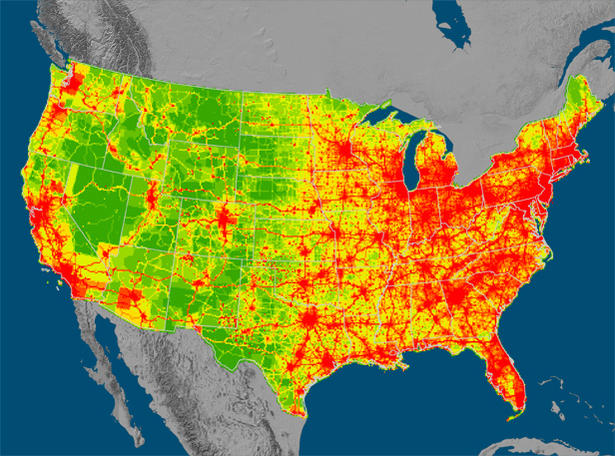
    This picture is a handy reminder of the present CO2 emissions profile as presently measured.  I am not overly sure that it would survive finer resolution, but it surely is pretty.  And as this chap informs us, there is a real halo of fouled air around most urban centers on many days.
    It is nice to see what we will shortly be loosing when the electric car takes over.
    And loose it we shall.  Aerial pollution will remain a factor in places for some years to come, but the largest part of the problem is slated to disappear overnight.
    But it is worth remembering that a century ago our urban society was operated on soft coal and oats.  The advent of gasoline ended that particular horror
    The present regime is about to end just as abruptly.  We may even pretend that we are helping avert global warming instead of adopting a cheaper mode of transportation
    If it does matter where CO2 is released, cities are in trouble 
    17 MAR 2010 8:48 AM
           
    There’s some fascinating new research about “CO2 domes,” invisible clouds of carbon pollution that hover above urban areas. Bradford Plumer at The New Republic does a great job setting the context:
    Does it matter where carbon dioxide is emitted? From a climate perspective, at least, the standard answer has always been, “Not really.” Carbon dioxide mixes pretty evenly and uniformly throughout the atmosphere, so that the heat-trapping gases coming out of a factory in China have the same effect on global temperatures, pound for pound, as the greenhouse gases emitted by, say, cars in Delaware. (This is in contrast to a number of other air pollutants, whose effects are often localized—sulfur dioxide only causes acid rain in discrete areas.)
    The new finding:
    But a new study just published in Environmental Science and Technology by Stanford’s Mark Jacobson adds a slight twist to this standard view. Older research has found that local “domes” of high CO2 levels can often form over cities. What Jacobson found was that these domes can have a serious local impact: Among other things, they worsen the effects of localized air pollutants like ozone and particulates, which cause respiratory diseases and the like. As a result, Jacobson estimates that local CO2 emissions cause anywhere from 300 to 1,000 premature deaths in the United States each year. And presumably the problem’s much worse in developing countries.
    Mark Jacobson, professor of civil and environmental engineering and director of the Atmosphere/Energy Program at Stanford, has been vocal about the need for a complete clean-energy transformation. This week, with the political world consumed by health care, his work offers a reminder that carbon pollution is a serious health problem. It makes traditional air pollution—such as particulates and ozone—more harmful, so it poses particular threats to the places with the worst air pollution—cities.
    Here’s a map of CO2 released from fossil fuels (with red and yellow marking the biggest pollution points), compiled from 2002 data by the  at Purdue University. It’s a map of emissions, which isn’t quite the same as airborne concentrations, but it gives a sense of where pollution happens:
    Jacobson’s urban-dome research presents two implications worth teasing out:
    Trouble for cap-and-trade?  The new evidence adds a wrinkle to cap-and-trade plans by suggesting that it matters where pollution happens. Cap-and-trade rests on the assumption that a ton of carbon has the same impact regardless of where it’s emitted, so it doesn’t matter if a factory in Nashville and a power plant in Phoenix trade emission permits. It only matters where emissions can be reduced most cheaply.
    But, says Jacobson, “This study contradicts that assumption.”  Stanford’s press release on the researchplays up the contradiction; “Urban CO2 domes increase deaths, poke hole in cap-and-trade proposal,” blares the headline. 
    If the research proves correct, it doesn’t argue against cap-and-trade so much as highlight the need for a multi-pronged approach to CO2 regulation. The Clean Air Act can set plant-by-plant performance standards while a declining cap covers the broader economy. (That’s the approach taken by the Kerry/Boxer Clean Energy Jobs & American Power Act.) So the study shouldn’t be used to entirely discount the idea of cap-and-trade plans–but that doesn’t mean it won’t be.
    Urban vs. rural.  Jacobson’s research also pits the interests of rural and urban communities against each other.  Cities could stand to suffer more under climate change, but the senators representing large urban areas already have proportionately less power to push through legislation that would curb CO2 pollution.  California, with its 37 million residents and numerous polluted urban areas, has two senators who want to enact climate legislation; Wyoming, with 540,000 residents and vast expanses of rural land, has two senators who oppose climate legislation. 
    Urban and rural areas have already been at odds over climate policy—and that was before we had any evidence that cities might really get the short end of the stick.  The “domes” research provides more fodder for the fight. It underscores the essential unfairness of the effects of carbon pollution, and raises the question of just how much Wyoming should have to say about the health of Californians.
  • Capcom talks Super Street Fighter IV, DLC’s, new characters and more

    With the impending release of Super Street Fighter IV next month, Street Fighter series producer Yoshinori Ono assures the public that this game is not just an enhance version of SFIV, it also promises to bring back

  • How Can The Startup Visa Be Improved Upon?

    When the startup visa was first put forth by Paul Graham, I was a big supporter. When Brad Feld took the idea and got political support for it, I was still a big supporter. But when the bill was actually introduced, I expressed some serious worries about it — specifically over the fact that it was entirely focused on enterpreneurs who could raise a certain amount of money. As I noted, there were some potentially serious unintended consequences of requiring enterpreneurs to raise a specific amount of money just to stay in the country. The leverage between enterpreneurs and VCs can be a delicate enough balance without adding in the fact that you might get deported if you don’t take the deal being handed to you.

    While many of the people I know and respect in the industry have been vocal champions of the current bill, it was good to see at least someone make a big deal of these serious deficiencies in the bill. Pascal-Emmanuel Gobry wrote up a post for Business Insider that basically reflects this same viewpoint. We both think that a startup/entrepreneur visa makes a ton of sense, and it’s something the country needs, but we’re a bit worried by the current bill, which seems entirely focused on venture capital, rather than actual entrepreneurship.

    Some have responded and suggested that this is better than nothing, but I’m not entirely convinced of that. A bad bill with unintended consequences could create more harm than good and could derail future attempts to put forth more serious (and needed) reform.

    In the end, I think (former VC) Jeff Nolan put it best: this is a “well-intentioned bad idea that shouldn’t be stopped.” The real thing is that it should be fixed. Now, some of the bill’s supporters have suggested that the problems with this bill are necessary, in that it’s the only way they’ll get passed, but that seems like a defeatist attitude. We have an opportunity to actually get this right and to bring smart entrepreneurs who can create a lot of jobs and tremendous value to the US. We shouldn’t rush it through in the easiest manner possible: we should focus on getting it right, even if it takes more effort.

    Update: It looks like the folks at the Kaufman Foundation have had similar concerns as well, supporting the concept, but worried about tying it to funding. They suggest an alternative, focused on job creation:


    Here’s a way to improve on the Kerry-Lugar plan. Create a true “job creator’s visa,” one tied directly and only to job creation by new immigrant entrepreneurs. The visa could be a temporary one for immigrants already here on another visa who establish a business. It could then be extended if the firm hires at least one American non-family resident. The visa should become permanent once the enterprise crosses a certain job threshold (such as five or 10 workers). But it would not be tied to financing.

    There are plenty of immigrants who might qualify: the one million skilled foreign workers now here on H1-B visas who otherwise must go home after six years, as well as the roughly 60,000 foreign students who earn degrees at American universities each year. These are far larger numbers than those who could qualify under the Kerry-Lugar proposal.

    Permalink | Comments | Email This Story


  • The New Rotronic HygroLog NT data logger is now available

    Bassersdorf (Switzerland), 10th February 2010 – The new HygroLog HL-NT data logger with HygroClip2 sensors and the AirChip3000 is a powerful system when there are many different physical parameters to record. The logger also meets all requirements for FDA, CFR Part 11 and GAMP compliance.

    Many uses
    The HygroLog HL-NT is the perfect measuring instrument for applications in which long-term recording of humidity and temperature values is critical. The Rotronic data logger is indispensable in the pharmaceutical, food industries and in electronic parts production. The HygroLog NT is also an ideal companion for recording measurements during the transportation of goods and foods, in store monitoring, and in climate controlled zones such as museums, schools, libraries and hospitals. The recorded data provides valuable information about the environmental conditions, which can sometimes seriously affect people, animals, materials and objects.

    Complex, yet simple to operate
    Although the newly developed data logger deals with complex measurements, its simple operation, accuracy and guaranteed long-term stability make the HygroLog NT very attractive to own.
    The data logger system can be used with a wide range of HygroClip2 sensors, and it is this variety that offers users such great flexibility for a customer-specific measurement system.

    Advanced features
    The data logger can record up to 1,500,000 measurement values (storing them on a 32MB flash card). Data can be downloaded with a standard card reader, PDA, PC with HW4 Software, or docking station. Overall range of the logger: 0…100% relative humidity / max. –100 .. 200°C (sensor-dependent); precision: sensor-dependent to 1% relative humidity with SCS calibration certificate; alarm via e-mail, acoustic signal or LED; freely configurable relay contacts; operates with standard alkaline 9V batteries or rechargeable; can also record data from other external analog sensors (optional docking station); and optional TCP/IP RJ45 & RS485 interface guarantees full integration in a network.

    You can find further detailed information about the new HygroLog HL-NT Logger and all about humidity and temperature measurement at ROTRONIC at www.rotronic.ch or by telephone at 044-838 11 44.

  • VOCAL FOLDS – WHEN IT’S TOO FAST TO SEE, AND TOO IMPORTANT NOT TO®

    Take a moment to think of the impact that losing your voice could have on your life. It could ruin your career, especially if you rely on your voice like a singer or broadcaster does, or make life terribly difficult as far as simple communication between friends and family is concerned. Unfortunately, according to the
    National Institute on Deafness and Other Communication Disorders, approximately 7.5 million Americans have trouble using their voices and are facing this frightening prospect today.
    Voice disorders are a widespread problem and much is still left to be learned. Several organizations exist to help raise awareness about the issue and a host of scientists and researchers are dedicated to uncovering the mysteries of the human voice, including Dr. Dimitar Deliyski, a renowned researcher at the University of South Carolina’s Arnold School of Public Health. Committed to advancing the scientific understanding of the human voice, Dr. Deliyski has recently embarked on a five-year study to develop a new methodology to help diagnose voice disorders and to advance the basic science of understanding voice. The research is supported by a $3.1 million RO1 grant from the National Institute on Deafness and Other Communication Disorders.
    With the help of Vision Research, a leading manufacturer of high-speed digital imaging solutions, Dr. Deliyski will explore the movements of the human vocal folds using a revolutionary procedure known as laryngeal high-speed video-endoscopy (HSV). Through the use of HSV, Dr. Deliyski will be able to analyze and capture the motions of human vocal folds as they vibrate to produce sound. Due to the fact that human vocal folds vibrate at considerable speeds – sometimes upwards of 1,000 times per second – Dr. Deliyski required a high-speed digital camera that was as unique and revolutionary as the project that he was spear-heading. It was essential to the success of the research that the high-speed digital camera employed boasted an impressive marriage of features, including high-sensitivity, bit-depth, resolution and speed, and for this Dr. Deliyski turned to Vision Research.

  • 8 Meter USB Cables for Connecting USB 2.0 Cameras

    IDS Imaging Development Systems GmbH announces the introduction of extra long USB connecting cables to their accessories range. The new cables are 8 m in length and designed for industrial machine vision applications. They provide the same transmission reliability as conventional 5 m cables while offering the user much more flexibility. The USB cables are fitted with standard mini-B connectors in both locking and non-locking versions.

    For many machine vision applications with USB cameras, the conventional 5 m cables are simply too short. Users previously had to “extend” the cables using active components. The new cables now allow covering distances up to 8 m in a simple and cost-effective way.

    The particularly high quality of the cables ensures according to IDS that the cables provide the required transmission reliability up to the full data rate of 480 MB/sec despite their long length. At the same time, they also supply power to the cameras without any problems.

    The 8 m cables are available from now and offer many new application possibilities for the broad range of USB uEye camera models. The new USB connecting cables are offered for both the compact board-level versions of the LE series and the machine integrable models of the SE and ME series.

  • Engineering Safety into Highly Critical Components

    NETZSCH LFA 427 – Now with a range up to 2800°C

    Thermal conductivity and diffusivity are thermophysical material parameters necessary for describing the heat transport properties of a material or component. These physical parameters are the basis for accurate thermotechnical simulations or for the analysis of temperature fields in components for electronic assemblies, power plant turbines or drive units.

    The Laser Flash technique is one of the most widely used methods today for the precise measurement of thermal diffusivity and conductivity. Quick test execution and exact measurement results, along with the ability to handle a broad range of thermal diffusivity and conductivity applications, are some of the many advantages of this non-contact measuring method.

    For more than a decade, the NETZSCH LFA 427 has been known as one of the most versatile and precise measuring systems in Laser Flash Analysis. The simple operation of this instrument, its wide variety of sample holders, and its complex analytical capabilities have made it the standard for LFA research applications. NETZSCH LFA 427 instruments can be found in renowned institutes for space exploration, turbine optimization, and fusion technology around the world.

    Until recently, the temperature range of the LFA 427 had been restricted to a maximum of 2000°C. Now as of 2010, a new version is available which allows measurements up to 2800°C. This enables materials required to perform in extreme environments – such as power trains for space shuttles – to be analyzed directly under typical use conditions. This makes it possible to engineer much more safety into such highly critical components and to eliminate any possible sources of mishap during the design stage.

    This new system is yet another example of the innovative spirit and technological leadership of NETZSCH, this time in the thermal characterization of high-performance materials.

  • Avantes introduces Direct Attached Cuvette Holder with Attenuator

    Avantes introduces Direct Attached Cuvette Holder with AttenuatorCUV-DHC-XE-LED-DA improving light throughput significantly
    We have introduced a completely new designed cuvette holder with attenuator for Avantes Xenon and LED light sources, with substantial benefits for the user. Attaching the CUV-DHC-XE-LED-DA directly to the light source removes the need for an extra fiber with its subsequent surface transfers and attenuation in the optical path.
    Compared to a normal Cuvette holder improves the new CUV-DHC-XE-LED-DA design the light throughput by a factor of 200 in the UV range and 60 in the VIS/ NIR range.
    The new cuvette holder is designed for 10×10 mm cuvettes and is directly attachable to all Avantes Xenon and LED light sources. The new attenuator, incorporated in the design of the cuvette holder, provides the ability to control the intensity of the light beam with an incorporated iris. The cuvetteholder is equipped with a 5 mm slot for filters.
    For additional information about Avantes¡¦ products and services or to request Avantes¡¦ new Solutions in Spectroscopy„¥ catalogue VII, please visit the Avantes site at www.avantes.com or email to [email protected] or in North America [email protected].

  • Rheintacho M12 2-channel Hall-sensor for detection of speed and direction

    Rheintacho has added a new 2-channel differential Hall-effect sensor to its product portfolio. This speed sensor in M12-thread design, offers simultaneous detection of rotational speed and rotation direction.
    The features of the new sensor are as follows:
    – M12 x 1 housing
    – M12 connector integrated into sensor housing
    – Total length 70 mm
    – IP67 protection class
    – Withstands temperatures up to 125°C

    Hall-effect sensors are well suited for precise measurement of rotational speeds on ferromagnetic structures. These may be both traditional gear wheels or other geometric shapes. With two-channel sensors, rotation direction can be detected as well as rotational speed. The outputs of the sensor are two phase-shifted square-wave signals.

    The sensor housing takes the form of a thread sensor and is in high-strength stainless steel. The connection interface is designed compatible to standard M12. connectors.

    With its thread-sensor design the device can be used with different insertion depths and offers substantially more flexibility in this regard than does a flange sensor. The 180°-connector support this flexibility.

    It is planned to gradually extend this series with different connector designs, eg. cable outlet (planned length 2m).

  • Buschjost valves for CNG filling stations: High reliability

    For over 75 years Buschjost produces solenoid valves and systems for numerous applications. Since early 2008, the Bad Oeynhausen company is now also active in the high-pressure valve technology.

    If CNG is offered in gas stations, this constitutes the highest demands on function, leaks and the security of the solenoid valves. The valves are exposed to high loads, as the storage density requires an increased pressure of the gas supplied from the conventional low pressure pipeline network. The natural gas is compressed in the gas plant to a pressure of 250 bar to 300 and stored in high pressure bottle bundles, before it is filled into the natural gas-powered vehicles.

    The solenoid valves need to meet highest requirements. Depending on the customer frequency at the gas station, the high-pressure solenoid valves must be able to withstand a high number of switching operations. The pressure differences typically amount to 200 bar. These pressures mean highest demands to the solenoid valves. The quality of workmanship and material selection are crucial. Therefore only high quality materials and very durable sealing materials are used. The solenoid valves are tested dynamically at a pressure of 350 and statically at a pressure of 525 bar, before they leave the Buschjost factory. The burst pressure of these valves is at least about 1200th

    The individual components are precisely matched to each other, thus ensuring a very high durability of the valves. In addition, the valves are easy to install and service friendly. Based on the technical design and the high-performance sealing materials used in the solenoid valves they achieve a very high tightness. This of course requires the natural gas to be free of any particles. Buschjost suggests to place appropriate filters, which usually are part of a natural gas fuelling facilities anyway.

    And of course the high pressure valves meet the regulations of the Pressure Equipment Directive and are certified according to ATEX.

    Due to their compact design, the valves can also easily be integrated into any thing from simple 3-fold to complex 11-fold solenoid valve manifolds with integrated filters and check valves. Buschjost already has developed several customized solutions for different customers.

  • New plug cover reinforces AUMA’s adaptable design

    AUMA has developed a new cover for plug and socket connections for electric actuators and controls. The S-105 cover provides more space for cable gland/conduit assembly. Increased interior capacity makes cable connection easier and accommodates thicker cabling.

    Based on AUMA’s modular actuator design philosophy, the cover – which is 15 mm higher than the company’s previous model – is fully compatible with its predecessor version, ensuring that early generation products can be incorporated.

    As standard, AUMA actuators are equipped with a plug/socket connector for motor and control cables. AUMA reports that the significant advantage of this type of connection is that, once connected, wiring remains undisturbed, even if the actuator has to be removed from the valve, e.g. for maintenance purposes.

    The new plug cover is designed for all AUMA weather-proof and explosion-proof actuators with or without controls

    AUMA’s earlier model plug cover will continue to be supplied for a defined period.