Author: Serkadis

  • Exempting telecommunications equipment from sales tax build jobs in North Dakota

    There was an interesting editorial in the Grand Forks Herald over the weekend urging Minnesota to look at creating policies that support technology sector growth. It builds the case that North Dakota has made policies to exempt telecommunications equipment purchases from sales tax and it has reaped benefits; the Minnesota Legislature is looking at doing the opposite.

    There is more to North Dakota’s strong success than the oil boom. Lawmakers in North Dakota at the state and local levels are making sound policy decisions that create a climate favorable to business and job creation. For example, well-known tech firms such as Microsoft are choosing to locate and expand operations in the state. …

    Case in point: North Dakota recently passed legislation that exempts telecommunications equipment purchases from the sales tax, thus creating an incentive and a “welcome sign” to high tech firms to invest in North Dakota’s communications infrastructure.

    Technology is growing exponentially, and this kind of forward-looking policy is sure to put North Dakota in an excellent position to continue to be one of the most attractive places in America for new investment.

    Minnesota, on the other hand, seems to be going in the opposite direction, especially as it relates to new, high-tech investment.

    Minnesota is seriously looking at eliminating its sales tax exemption for telecommunications equipment. Investments in communications equipment is what will help to break down the digital divide, a stated goal of Minnesota’s Gov. Mark Dayton’s broadband taskforce.

    Increasing taxes on investment in this infrastructure is a step backwards for Minnesota if it wants to attract modern business and the jobs it creates.

  • The Billion Dollar Data Centers

    An overhead view of the server infrastructure in Google’s data center in Council Bluffs, Iowa, where the company has invested more than $1 billion. (Photo: Connie Zhou for Google)

    Maiden. Council Bluffs. Boydton. Bluffdale. And now Lenoir and perhaps Altoona. These are the cities you’d never heard of that have become the homes of billion-dollar server farms.

    Your iTunes downloads, Facebook posts and YouTube videos travel through these small rural communities en route to your desktop and mobile device. The growth of the digital economy is not just reshaping how we use the Internet, but creating a new data center geography in which armadas of servers now reside in suburbs or rural towns, often outnumbering the humans in these communities.

    The economics of hyper-scale computing favor cheap land and cheap electricity, which are unavailable in many of the historic Internet hubs, which are located near major cities. This has created an unusual side effect – major data centers are transforming the economies of small towns around the U.S., placing them on the front line of the race to build out the infrastructure that runs the Internet.

    A handful of these towns have received concentrated investment of more than $1 billion on a campus of server farms. Google, Apple, Microsoft have each deployed these billion-dollar data centers in little-known towns, and Facebook is not far behind.

    Symbols of the New Economy

    These projects have been hailed by governors and economic development officials, who see data centers operated by Internet titans as symbols of the new economy. Huge server farms are hailed as saviors of rural communities, which have often been abandoned by the factories that were once the lifeblood of the local economy.

    Yet data centers don’t fit neatly into the traditional model of economic development engines. They have been reliable generatos of hundreds of construction jobs, which are welcome but temporary. But the advanced level of automation at work in data centers translates into a limited number of permanent full-time jobs, and much of the investment arrives in the form of servers, generators and UPS equipment.

    Here’s a look at the billion-dollar data centers:

    • Maiden, North Carolina – This town of 3,300 people in Catawba County is home to the iDataCenter, Apple’s first company-built data center facility. The campus began with a 500,000 square foot main building and a 30,000 square foot “tactical” data center next store. Apple has since added two massive solar arrays and a “fuel cell farm” featuring Bloom Energy Servers fueled by gas from a nearby landfill.
    • Council Bluffs, Iowa – Google kicked off the data center craze in Iowa in 2007 when it announced plans to invest $600 million in a new facility in this town of 60,000, located just across the Missouri Rover from Omaha . Google clearly loves the location, as three successive rounds of expansion have raised its investment in Council Bluffs to more than $1.5 billion.
    • Boydton, Virginia – With its latest expansion, Microsoft’s investment in its data center campus in southern Virginia has reached $997 million. Microsoft has built more than 316,000 square feet of data center space in Boydton, a town in Mecklenberg County with just 431 residents as of the 2010 census. The company plans two more phases at the data center, a hybrid facility that includes traditional raised-floor space as well as IT-PAC modules.
    • Bluffdale, Utah – The U.S. government is also in the mega-data center business with its $1 billion-plus facility for the National Security Agency (NSA). The secretive project includes a 30-megawatt first phase featuring 100,000 square feet of data center space and 900,00 square feet for technical support and administrative space. Bluffdale, a suburb of Salt Lake City, has about 7,500 residents.
    • Lenoir, North Carolina – This town in Caldwell County in western North Carolina is home to 18,000 residents and more than 50,000 servers. Google opened a $600 million data center in 2007, and this month expanded its investment to more than $1.2 billion.

    There are two other examples of data center clsuters that have transformed small rural communities:

    • Quincy, Washington: This town of 5,000 residents in central Washington state is home to data centers for Microsoft, Yahoo, Sabey, Dell, Intuit and Vantage, which likely total more than $1 billion in investment. The server farms are attracted by the extraordinarily cheap hydro-electric power from dams on the Columbia River , and a climate ideal for using fresh air to cool servers.
    • Prineville, Oregon – Facebook put this central Oregon town of 10,000 residents on the map when it picked Prineville as the location for tis first company-built data center. Apple has also decided to build a major server farm in Prineville. Between the two companies, Prineville may eventually one McDonald’s and six buildings filled with servers housing the world’s music, photos and status updates.

    These locations all offer abundant land for massive facilities that can house of tens of thousand of servers, and the electricity to power these armadas of servers. They offer tax incentives that make it cheaper for data center operators to buy their land and servers. They also offer the opportunity to cool servers using outside air instead of power-hungry chillers, slashing the cost of operating the data center.

    The Economic Impact of a Data Center

    What have these data center developments meant for these communities? Some of the best data comes from Quincy, Washington, where construction of Yahoo and Microsoft data centers boosted property tax values in the city of Quincy from $260 million in 2006 to $764 million in 2009. As a result, property tax collections grew by more than $1.4 million over the period, while school taxes in Quincy grew by $1.6 million.

  • I cannot recommend Nexus 4 Wireless Charger [review]

    Gadget geeks love their toys, the more sci-fi the better. Several manufacturers offer wireless charging solutions, Google and LG among them — for Nexus 4. The idea is simple: Rather than plug in the device, you rest it on something else connected to electricity. My question: If the phone lays down to charge anyway, why not just plug in and save, in this instance, $59.99 before tax and shipping?

    I paid Google Play just that in a moment of weakness, and later regret. Don’t bother, and that’s really good advice. The Nexus 4 Wireless Charger is more than a wasteful, redundant accessory. The design is fundamentally flawed, where form goes before function to ruin. If you read no further, take away this: Save your money for something else.

    Charge Me Up

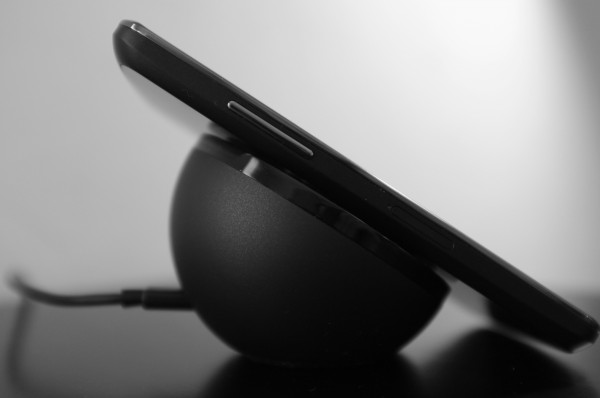
    Inductive charging is a fad that serves only one purpose: To con you to spend more money on needless accessories. You slap down the phone on a charger, which juices the battery in Stargate Universe-like fashion. What sets apart Nexus 4’s add-on apart from others is the half-orb shape, utility and unwanted function as dust-mop.

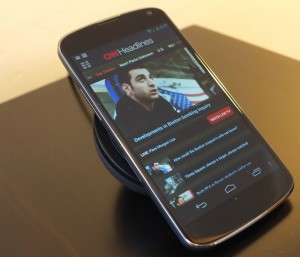
    Using the wireless charger is easy enough. You plug the USB cord into power brick and device, then set Nexus 4 on the half-orb’s surface, which is Post-it note-like sticky. The adhesive is a huge problem, collecting particles like you wouldn’t believe. Cleaning is difficult, since pieces of paper towel or cloth adhere to the surface. Suffice to say that the Nexus 4 Wireless Charger can look quite gross really fast, even when cared for.

    Charging time is about 4 hours, just as the marketing material states. That’s about twice the time my Nexus 4 takes plugged in directly. But I find the adhesive, while sticky enough for dust, isn’t so good for the smartphone, which succumbs to gravity’s pull. Just a little slippage is enough to stop charging. Strangely, in my environs, this problem typically occurs between 60 percent and 80 percent charge. So it’s too common for me to check at 4 hours only to find partial charge and need to wait another hour or two after repositioning the phone.

    For my purposes, and maybe yours, too, the USB cord is too short. I want to place Nexus 4 Wireless Charger high on my desk, but the cord won’t reach the power strip.

    Let Me Down

    The half-orb nicely elevates the screen, so you can see notifications or easily answer calls with wired or wireless headphones. Two problems: Touching the phone can cause enough slippage to stop charging; the phone is otherwise inaccessible, because it can’t be handled. When plugged into the wall, I can check Google+, respond to text messages or go through email — all of which really needs me to pick up the phone. Voice activation is perhaps an alternative, but not something I tried for this review.

    Bottom line: I see too many shortcomings and not enough benefits. The wireless charger’s design — too sticky for dust and not enough for Nexus 4 — is a big problem, which could be remedied by using a flat surface and no adhesive. Then there is the inductive-charging concept. Connection to electricity is still required. You pass off the device to the wireless charger.

    How wireless is it, really? Inductive charging requires contact — surface to surface. Perhaps in the future there will be real wireless charging, and that has huge potential benefits. But that’s not the tech LG and Google offer.

    Longer charging time is another needless trade-off. Shouldn’t you want to juice up as fast as possible?

    I cannot recommend Nexus 4 Wireless Charger. I wasted $59.99, so you don’t have to.

    Photo Credits: Joe Wilcox

  • Why turmeric is the fountain of youth and the key to vibrant health

    To the many traditional cultures around the world that have long utilized the spice in cooking and medicine, turmeric’s amazing anti-inflammatory, antioxidant, and anti-cancer benefits are no secret. But modern, Western cultures are only just now beginning to learn of…
  • GMO multi-toxin crops continue to backfire as more insects become resistant to crop chemicals

    Promises made by the biotechnology industry about the alleged robustness of its genetically modified (GM) crops are proving to be false, as research out of the University of Arizona (UA) uncovers a growing resistance by pests to even the most advanced crop chemical technologies…
  • Boston: locking down the city where the American Revolution was born

    No taxis. No buses. No trains. No flights. Stores shuttered. Empty streets. Doors locked. Massive police presence. Stay inside. Don’t move. Watch television. Get the latest reports. If you need to muse on something, you might remember a few significant events that…
  • Socialist medicine in decline: One quarter of all Canadian nurses say they wouldn’t recommend their own hospitals

    The working conditions, quality of care being provided, cleanliness, and overall operating procedures at Canada’s thousands of government-run healthcare facilities appear to be in major need of reform, according to the findings of a new investigative survey. As reported…
  • Studies prove that consumption of sugar and cancer are connected

    Sugar lurks in many places within our food system today. From certain breads and juices, to children’s cereal, it has been discretely introduced into the food supply on a catastrophic level. Over the years, much research has been conducted regarding the toxic effects…
  • New GMO labeling bill will be the ultimate test between the will of the people versus the greed and power of the biotech industry

    In an exciting move in Washington, Senator Barbara Boxer (D-CA) and Congressman Peter DeFazio (D-OR) together have sponsored new federal legislation that requires the labeling of all genetically engineered food in the U.S. The Genetically Engineered Food Right-to-Know…
  • Top five most powerful self-help books

    With all the second rate psychology out there these days, we need to give credit to self-help books that make a genuine contribution. Self-help books should tell the truth about issues you were not aware of and not be full of hype, hokie techniques and false promises…
  • Accused Boston marathon bomber was collecting welfare benefits

    In one of the more bizarre developments surrounding the Boston Marathon bombings, it appears as though federal and state taxpayers subsidized the attack. According to the Boston Herald newspaper, Tamerlan Tsarnaev, the accused “mastermind” behind the attacks who was…
  • Police stake out hydroponics shops, harass customers who grow their own food

    Apparently Americans who employ hydroponics are the newest targets in an insane “drug war” that has gone from bad to ludicrous since it was first “declared” in the early 1980s. Consider this case in point: A couple of years ago, narcotics officers knocked on the door…
  • Needle-less vaccine trial on the way – Soon you can get a toxic chemical infusion without getting jabbed

    An Australian professor has developed a new vaccine delivery technology that could make it easier than ever for people to quickly and painlessly receive infusions of chemicals and live viruses directly into their bodies – and it does not even involve the use of a needle…
  • Majority of Southern California’s airspace to be declared test range for drones

    Don’t look now, Southern Californians, but the remaining shreds of your privacy rights – and they are threadbare already, to be sure – are about to vanish into the dustbin of history, if the “see everything all of the time” crowd gets its way. ”Business and military…
  • Fracking: A silent death sweeps across the nation

    Farmland is tainted. Drinking water turns flammable. And humans along with animals are sick. The cause? Fracking. It’s terrorizing the environment, destroying the health of those who live close to the sites and contaminating the food supply. With more than 600,000 fracking…
  • Cancer, the avoidable epidemic

    Cancer strikes every other man and every third woman in the United States, and roughly 50 percent survive it. The cure, we are told by the mainstream media and doctors, is under way, but prevention is already nearly 100 percent proofed. Who knew? How could you take certain…
  • Prostate cancer linked to high intake of protein and calcium from dairy

    The European Prospective Investigation into Cancer and Nutrition (EPICN) is a multicenter meta-epidemiological (broad statistical survey) study designed to assess cancer risks by investigating past and current relationships between diet, lifestyle, environmental factors…
  • Here is what I wrote about iTunes Music Store’s opening 10 years ago

    A decade ago yesterday, Apple launched the iTunes Music Store and changed how we buy music. For those of you too young to remember or so old to have forgotten, Microsoft and Apple engaged in an epic struggle to dominate the fledgling legal digital music market — all while trading in ripped files soared, despite Napster’s closure. You remember it, right?

    I was all too glad to pay for music, if only given the opportunity, as clearly were others. iTunes Music Store launched with 200,000 tracks — a gigantic number at the time — from five labels: BMG, EMI, Sony Music Entertainment, Universal and Warner. Singles priced at 99 cents, albums at $9.99, hit the sweet spot for what consumers would pay, while undercutting physical media prices. Of course, the real competition was free, pirated stuff.

    Apple sold 1 million songs the first week, and that with limited distribution (see last paragraph for more on that), showing that at least some people would pay rather than steal. Nine more days (May 14, 2003) and the number was 2 million.

    In commemorating the 10-year anniversary, I look back to the commentary posted to my personal blog the day before the grand opening. I corrected one spelling error, otherwise it’s verbatim. My objective is to give a sense of how I saw the service as it launched and to provide some historical context.

    I remember being in one of my moods when penning this ditty, in the evening during non-work hours (there’s no such thing in this decade). So there’s a bit more edge than even my more cutting posts for BetaNews. With that introduction, here is post “One Bad Apple” in its entirety:

    Apple is expected to launch a new online music service on April 28, 2003, that will work with a new version of the company’s iTunes digital music software. Rumors are buzzing louder than a ruptured hornet’s nest about the service. Most people believe Apple will make the new service available for Macs only. But I can’t imagine Apple CEO Steve Jobs is that dumb. If he’s smart, he’ll release an iTunes version for Windows and make a bold move into the digital media market.

    No other company on the planet has executed a better digital media strategy than Apple. Doing digital media on a Mac is much easier and more satisfying than on a Windows XP PC. Apple’s iLife digital media suite is the best thing going for working with digital photos, music, movies or DVD burning. Too bad you need a Mac to get it. But a music service available for both platforms through iTunes would extend Apple’s reach and give AOL Time Warner and Microsoft executives catastrophic heart failure. How many ways can you say, “Pushing up daisies?”

    The executives over at AOL Time Warner sneeze and the company loses $50 billion. (Show me any successful AOL Tme Warner digital media product? You can’t!) Microsoft’s idea of digital media marketing is getting every hardware manufacturer on the planet to support Windows Media formats. Most computers come with a floppy drive or cars a cigarette lighter, but that doesn’t mean most people use the gear. Get real, Microsoft.

    Mr. Jobs has the right Hollywood connections, he’s successfully courted record labels for his new service and rumor has it his company is even negotiating deals directly with music artists. Apple has the right relationships, right strategy and right technology to pull off a successful music service. Don’t forget that Apple’s iPod music player is the retail market share leader as measured in revenue, according to NPDTechworld.

    If Apple executes as well on the music service as it has on Macs, the service should turn out to offer great music selections, reasonable prices, unsurpassed ease of use, delivery through one of the best digital music software packages available and portability on a great music player. The combination would be great for Apple, its shareholders, consumers and, more importantly, competition.

    That’s because Microsoft’s idea of digital media is controlling file formats the way it uses them in Office to dominate productivity suites. (You knew there had to be a reason why your waffle maker supports Windows Media formats, right?) In Microsoft parlance, competition is a market where all the products are made by Bill Gates & Co. (Hey, you can choose from six different versions of Windows XP. Woo Hoo!) Microsoft is trying to establish its digital media format as the defacto standard through the aforementioned hardware partnership and also by creating what arguably is great digital rights management technology. Too bad, but the DRM only works with Windows Media file formats, folks.

    Microsoft has given music labels a free tool kit (What’s $500 million in unrecovered research and development costs between friends?) so they can make CDs with some content protected by Microsoft’s DRM. It’s a good Windows Media format proliferation technique, but music labels haven’t been biting. The labels, which are uncertain about how to deal with online music file trading, appear frightened of a devil’s deal with Microsoft. At the same time, Microsoft hasn’t had a lot of luck with music downloads of copy-protected Windows Media Audio files.

    Apple would like nothing better than to steer digital media toward open standards, such as MPEG-4. The consumer electronics industry, Hollywood and music labels generally have favored that approach. Apple’s music service could be instrumental in providing a viable and attractive alternative to making a Windows Media format devil’s deal. That would also ensure that Microsoft could not in the future choke the Mac out of being able to access or use digital media, which is driving new computer sales.

    As for AOL Time Warner: I’ll be the first person to admit I could use to knock off about 40 pounds. But AOL Time Warner is really huge! That company can’t get off its fat ass to compete with lettuce. Until AOL Time Warner trims down some, that company is just going to continue sitting there picking its teeth and talking about digital media and online entertainment. But the company never does anything but add more weight, as in buying more digital media technologies, and staying sitting down on its even fatter ass doing nothing.

    Now comes along svelte Apple, Hollywood ties, great technology, legendary stylishness and ease of use in tow. Would you buy music from Microsoft? Hey, don’t yell at me for asking! But Apple’s cool, right? You might buy music from Apple rather than searching for it on file trading sites, right?

    Maybe the next Apple Records won’t be the Beatles’ label. If not, than I was wrong, Mr. Jobs isn’t as smart as I thought and there will be no iTunes for Windows. But I’m never wrong, am I?

    Apple did not launch with a Windows Store as I surmised. Mac-only was the price Steve Jobs paid to secure licensing deals to sell any music at all. Windows users didn’t wait long, though, just until October 2003. What a difference they made. Five weeks before the launch, iTunes sales reached 9 million. Three months later (Dec. 15, 2003): 25 million.

    Photo Credit: Joe Wilcox

  • Nexus 7 dock review

    Accessories can make a portable device better. If you own the ASUS-manufactured, Google-branded Nexus 7 tablet, surely there is a case protecting it; sometimes, anyway. Some can prop the tablet, but there’s another option. Can a dock improve the user experience and even extend the utility? That’s what this quickie review seeks to answer.

    The Nexus 7 dock is the official issue, made by ASUS, and sold from Google Play for $29.99. I ordered mine in late January, for $39.99, from B&H Photo, back when only third parties carried the accessory. Since then, the retailer dropped the price by five bucks. B&H took my order when the dock was out of stock, but shipped 8 days later. If you want this thing, don’t be deterred by availability elsewhere but forget Google Play, which isn’t taking orders as I write. Expect to spend more elsewhere. By the way, I would have waited and paid less, had I known better.

    Unlike Nexus 10, Google’s smaller tablet is meant to be used more-often in portrait mode (there’s a reason why most product shots show the orientation). The dock flips things around, and as such should be seen as entertainment extension, particularly for music and videos — even displaying photo slideshows. The accessory also makes placing Nexus 7 convenient in a kitchen area for, say, looking at recipes while cooking. There is potentially good utility here, depending on needs.

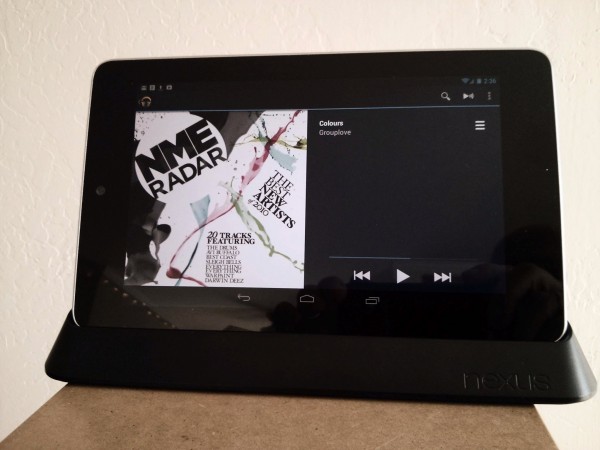
    The dock feels fairly hefty, weighing 280 grams and measuring 220 x 65 x 30 mm. The thing is sturdy, quite solidly-built. There’s quality here. The dock comes with standard audio jack, Micro-USB connector and built-in speakers. The speakers are functional, but produce tinny sound. You’ll want to plug in your own. But, strangely, on my device, there is no through-sound unpowered, which surprises me. I have the Bose Companion 3, which only work when the dock is plugged into electricity.

    The tablet snuggly fits horizontally into the dock, but there is too much movement otherwise. Extended lip supports Nexus 7 firmly in the back, but frontways is rocky. You could easily knock over the tablet onto the glass front. Additionally, I find that when touching music controls, the tablet’s pins sometimes lose contact with the connectors on the dock. This can interrupt playback or, worse, if charging, stop the activity. I am surprised by how easily even slight jostling of the surface the dock sits on can break the connection and stop charging.

    While I use the dock several ways, the most common is work-day companion. I set the peripheral and Nexus 7 behind my computer plugged into power and speakers to play music. I generally stream from my own library stored in the Google Music cloud. On the PC, Chrome sometimes closes down tabs, stopping playback. Nexus 7 is great alternative, providing continuous play, and there is a graphic equalizer.

    But I don’t need the dock to do this. I can just as easily lay down the tablet, or use a case with built-in prop, connected directly to the speakers. From this perspective, the add-on is more convenience than necessity.

    Something else: Google I/O starts in mid-May, and there is massive speculation (and quite reasonable, I should say) across the InterWebs about a new model with higher-resolution display. If ASUS and Google modify the design, the current dock becomes obsolete for use with next-generation Nexus 7. Of course, the enclosure might stay the same, which is better for dock dalliers.

    Bottom line: I/O is good reason to wait, and anything over $30 is too much (right, I overpaid). The accessory doesn’t add enough value for the price. Nexus 7 already has headphone and power jacks. The case you might already own can prop the tablet.

    Don’t get me wrong. I personally like the dock and find it both functional and useful. But I don’t need it and certainly wouldn’t have spent $40 if knowing then what I do now. Nexus 7 dock is great kit, but in many ways redundant.

    Photo Credit: Joe Wilcox