Author: Big Gav

  • Australia’s biggest-ever LNG deal signed

    The SMH reports that BG has signed a large coal seam gas export deal with China’s – Gas: Australia’s biggest-ever deal inked.

    In what is Australia’s largest trade deal, a Chinese company has signed off on the purchase of about $60 billion worth of liquified natural gas (LNG) from a Queensland project.

    The signing was also the world’s first fully termed sales contract for LNG sourced from coal seam gas (CSG), according to a statement from Resources Minister Martin Ferguson, who witnessed the signing in Beijing today.

    The deal was between Britain’s BG Group, which owns the CSG fields, and the state-owned China National Offshore Oil Corp (CNOOC).

    ‘‘This deal makes Australia the world leader in the coal seam gas-based LNG industry and it brings us one important step closer to opening up a new LNG province on Australia’s east coast in Queensland,’’ Mr Ferguson said in a statement. ‘‘It also further demonstrates Australia’s attractiveness as an internationally competitive and safe destination for global capital.’’

    CNOOC’s 20-year deal with BG Group was proposed in May 2009 and will allow CNOOC to buy 3.6 million tonnes per annum (Mtpa) of LNG from the British firm’s Queensland Curtis CSG-to-LNG project near Gladstone.

    The amount is about half of the output expected during the first phase of the project, which is slated to commence production in 2014 and will cost more than $10 billion to develop.

    CNOOC was involved in China’s first purchase of Australian LNG from the Woodside Petroleum-operated North West Shelf in Western Australia in 2006.


  • ZENN Motors and Mystery of The EEStor Ultracapacitor

    Gas 2.0 has an update on the rather pitiful tale of ZENN motors and ultracapacitor company EEStor – ZENN Motors and Mystery of EEStor Ultracapacitor Gets Deeper. More at TreeHugger.

    The whole EEStor/ZENN saga is getting so ridiculous that I often find myself debating whether or not I should even cover it anymore. The (so far) mythical EESU energy storage unit that’s supposed to revolutionize personal mobility by providing instantaneous charge times in a lightweight “battery” that can take a car 700 miles on a charge has yet to see the light of day.

    EEStor missed its deadline of introducing a working EESU to the world by the end of last year. When that happened I couldn’t even bring myself to write about it. It just seemed, well, pathetic.

    Now ZENN Motors, the company with a huge stake in EEStor, has said they have “successfully” ceased actually building cars and laid off 15 people so that they can stop bleeding cash. All of their eggs are now in the EEStor basket.

    ZENN Motors’ new plan revolves around the EESU actually working. Their self-stated goal is to be the sole provider of EESUs to manufacturers — akin to intel supplying chips for computers. But as time goes on and we hear nothing, not a peep, from EEStor, the chances of ZENN actually surviving this change seem slim.


  • Australia too reliant on resources: Tanner

    I occasionally moan about Australia suffering from the “Dutch disease” as our economy becomes increasingly dependent on exports of coal and LNG from natural gas and coal seam gas. The ABC reports finance minister Lindsay Tanner is starting to worry about it too – Australia too reliant on resources: Tanner.

    The Federal Finance Minister says Australia has become too reliant on resources and needs to expand its export base.

    Lindsay Tanner says there has been a “worrying period” over the last decade where resources have increased their domination of Australia’s exports.

    Lindsay Tanner says the 1990s saw great diversification, with strong exports across a range of sectors, and he says there needs to be a return to that kind of diversification.

    “We had a huge growth in tourism, in education, in specialised manufacturing, in wine, in pharmaceuticals that helped us to diminish our enormous reliance on minerals,” he told ABC radio 774 in Melbourne.

    “That’s kind of almost gone into reverse in recent times. So it’s not so much that there’s one country that we’re dependent on, it’s that we have, I think to some extent, too many eggs in that basket.” …

    The Grattan Institute’s program director for productivity growth Saul Eslake says, while the mining boom certainly has contributed to wealth creation and an increase in tax revenues, it also has some negative side-effects.

    He says the recent boom in mining activity may actually be damaging some of the sectors of the economy that Lindsay Tanner wants to revive.

    “The mining industry can’t possibly guarantee prosperity for the vast majority of Australians, given that it accounts for less than 3 per cent of total employment,” Mr Eslake told ABC News Online.

    “One of the corollaries of the present mining boom is a very high value of the Australian dollar that is hurting the competitiveness of sectors such as agriculture, manufacturing, tourism and education, most of which employ considerably more Australians than the mining industry does.”

    He says the currency impacts will be exacerbated by wage pressures as Australia’s economy nears full-employment again.

    “Growth in demand from the mining sector could well put upward pressure on wages in other sectors of the economy contributing, in the context of a strong exchange rate, to a further squeeze on the profitability of employers in other parts of the economy and thus diminishing the viability of those industries.”

    Mr Eslake says, while the damage to those other industries could be long-lasting, the current mining boom has a finite lifespan.

    The danger is that, when the mining boom does come to an end, there will be few other internationally competitive export industries left standing to provide employment alternatives.

    “The mining boom, though it may well go on for more than a decade, isn’t going to go on indefinitely any more than previous mining booms have, and future generations of Australians are going to look for other sectors of the economy for their employment prospects long after this present mining boom has come to an end,” he noted.


  • Academic Paper in China Sets Off Alarms in U.S.

    The New York Times has an article on a Chinese student who has written a paper on US power grid vulnerabilities – Academic Paper in China Sets Off Alarms in U.S..

    It came as a surprise this month to Wang Jianwei, a graduate engineering student in Liaoning, China, that he had been described as a potential cyberwarrior before the United States Congress.

    Larry M. Wortzel, a military strategist and China specialist, told the House Foreign Affairs Committee on March 10 that it should be concerned because “Chinese researchers at the Institute of Systems Engineering of Dalian University of Technology published a paper on how to attack a small U.S. power grid sub-network in a way that would cause a cascading failure of the entire U.S.”

    When reached by telephone, Mr. Wang said he and his professor had indeed published “Cascade-Based Attack Vulnerability on the U.S. Power Grid” in an international journal called Safety Science last spring. But Mr. Wang said he had simply been trying to find ways to enhance the stability of power grids by exploring potential vulnerabilities.

    “We usually say ‘attack’ so you can see what would happen,” he said. “My emphasis is on how you can protect this. My goal is to find a solution to make the network safer and better protected.” And independent American scientists who read his paper said it was true: Mr. Wang’s work was a conventional technical exercise that in no way could be used to take down a power grid.

    The difference between Mr. Wang’s explanation and Mr. Wortzel’s conclusion is of more than academic interest. It shows that in an atmosphere already charged with hostility between the United States and China over cybersecurity issues, including large-scale attacks on computer networks, even a misunderstanding has the potential to escalate tension and set off an overreaction.

    “Already people are interpreting this as demonstrating some kind of interest that China would have in disrupting the U.S. power grid,” said Nart Villeneuve, a researcher with the SecDev Group, an Ottawa-based cybersecurity research and consulting group. “Once you start interpreting every move that a country makes as hostile, it builds paranoia into the system.”

    Stuart at Early Warning has a post (and video) on a hacking experiment which managed to blow up a diesel generator remotely – Hacking the Power Grid.

    This is old hat in the computer security community, but I thought many of the readers of this blog might appreciate it. The really cool part starts at about 1:20 where they show video of an official government experiment in which they physically destroyed a 27 ton diesel generator just by hacking the network control interface.

    Hacking and physically damaging a material fraction of the power grid would, I think, be pretty much the end of civilized life in the target country for a long time. It’s not easy to do – it requires a lot of specialized knowledge and skills – but it almost certainly is possible and there are specialized offensive cyber-attack units in various countries that are tasked with knowing how to do this kind of stuff (there have been persistent rumors that the Chinese were involved in the North East power grid outage of 2003, but it’s never been confirmed and might well be speculation).


  • Australia’s Looming Power Crisis

    Robert Gottliebsen has a thought provoking, albeit slightly confused, article in the Business Spectator, arguing Australia (like Britain) faces a crisis in power generation capacity in the coming years (“Our power vacuum“) and that action needs to be taken if the looming supply gap is to be filled by private investment rather than a rushed program of government built power stations when blackouts become more frequent (given the enormous prices rises forecast for power in NSW over the next 3 years we seem to be seeing the impact of this already).

    Australians expect their governments to provide them with reliable electricity and if, or when, that doesn’t happen, community anger will be white hot. With the exception of a period in Perth, for the past few decades – except in extreme weather conditions – power has been reliable. But unless we take action now Australia is about to enter an era where electricity supply will be much less reliable. We have received an alert from the UK where, like Australia, the country moved away from the traditional model of one government supplier. …

    It takes about four to five years to put together a major power project, we must make decisions fairly quickly. The biggest problem is in Victoria. In the 2009/10 summer, Melbourne had only one very hot day and that took place in January when industry was shut and many people were on holiday.

    Had Melbourne experienced a hot January/February, black outs would have been widespread and Premier John Brumby would have copped the blame – possibly leading to his electoral defeat later this year. Yet Brumby is fully aware of the problem but can’t act to solve it because of the buffoons in Canberra. Australia not only needs more baseload power, but also needs to reduce its dependence on coal, particularly brown coal. Renewables are important, but they can’t fill the gap. Gas, or nuclear, is essential.

    Robert’s conclusion is confusing for a number of reasons – nuclear power simply isn’t an option on any level (it’s too expensive compared to the alternatives, could never be built in time to avert a 2015 crisis in any case and would meet intractable public opposition) and thus could be discounted without further thought.

    While gas could be used to avert any potential failure to meet future demand (as I’ve noted before, if you take natural gas, coal seam gas, biogas and unconventional gas into account, we could generate all our power from gas and still be chugging along happily – discounting all the carbon emissions – for more than a century) its hardly the cleanest option and keeps us locked into an extract and pollute model of power generation.

    While Robert glibly dismisses renewables without explanation, these are clearly the best option for shifting Australia onto a sustainable, carbon free power generation model – and are eminently suitable for meeting the near term challenge of growing peak consumption on hot summer afternoons in the major east coast capitals.

    Looking at the available options:

    wind power available from the South Australian coast is often strong when days are hottest in Melbourne and Sydney (as the southerly change approaches)

    – solar PV can be deployed locally within the big cities and follows load on hot summer days

    solar thermal power can be built in northern Victoria and Western NSW, which will also have maximum production on hot summer afternoons

    – solar thermal power could also be combined with gas, as is being proposed for some new Queensland power stations to provide “baseload” power if combining energy storage proves too expensive for the time being

    – solar thermal power can be built out in small units (and on brownfield sites close to cities, eliminating transmission costs) which requires smaller amounts of capital

    – home insulation projects implemented as part of the stimulus package should decrease summer power demand (as should solar hot water programs) regardless of all the bad press the program received

    geothermal power could be pursued more vigorously (as could tidal power in bass strait, as the British are looking to do in Scotland)

    – smart meters / smart grids can be used to manage demand without the need for blackouts / brownouts (and are something we need to accelerate the implementation of regardless)

    Robert goes on to note that creating a price for carbon emissions would annoy foreign investors in Victorian brown coal fired power stations:

    The emissions trading scheme legislation would have had the effect of destroying the Australian equity of major global power generating companies (led by China Light & Power). If their capital was destroyed by government action, there is no way those global generating companies would fund new developments in Australia given the attractive proposals being offered to them by India and China.

    Our local power generating groups like Origin and AGL do not have the capital for extensive investments and even if they could raise the equity funds, banks would not lend the enormous sums required to a few groups.

    In response to this it would be tempting to ask who cares about foreign investors in the dirtiest form of power generation – global warming science was already on their radar when they bought these assets so they need to be prepared to take a loss for ignoring it – and they will invest whenever they see an opportunity to profit, regardless of past mistakes.


  • China Developing “Combustible Ice” as New Energy Source

    Inhabitat has a post about a Chinese discovery of large amounts of methane hydrates on the Tibetan plateau – China Developing “Combustible Ice” as New Energy Source.

    Last September, China discovered a large reserve of “combustible ice” on the tundra of the Qinghai-Tibet Plateau. “Combustible ice” is essentially frozen natural gas – a natural gas hydrate, and is one of the newest energy sources to be discovered. The new reserves found in China reveal a very large supply equal at least 35 billion tonnes of oil, enough to supply China with 90 years worth of energy.

    Combustible ice has been found in high altitude frozen plateaus as well as underwater in marine sediments. Natural gas hydrates are essentially just frozen methane and water and can literally be lit on fire bringing a whole new meaning to fire and ice. Researchers still need to get a better understanding of how best to handle the fuel, for it to be commercially exploited. The US DOE is looking into it as well and researchers expect that the hydrate will have to go through a phase change and melt it into methane and water before it can be efficiently combusted. If left to melt on its own as the earth warms though, methane could be released into the atmosphere, and it could cause even more damage than if it were just burned.


  • Butterflies offer climate warning

    The SMH has an article on the effect of rising temperatures on butterfly populations – Butterflies offer climate warning .

    SCIENTISTS have shown for the first time that man-made climate change is the direct cause of changes to the life cycle of a native Australian animal species.

    Researchers have found that because of a rise in temperature, caused by an increase in greenhouse gas emissions by humans, the common brown butterfly now emerges from its cocoon 10 days earlier than it did 65 years ago.

    “This is the first study in Australia, and one of the first studies around the world, that has linked changes in a natural system to regional climate change, and shown that the change in regional temperatures are due to increases in greenhouse gases in the atmosphere,” said an author of the study, David Karoly, of the University of Melbourne.

    Until now, many studies have only been able to demonstrate “links” between climate change and observed changes in flora and fauna. It has been hard to prove that climate change was the direct cause of such changes.

    In the case of the brown butterfly, observations around Melbourne over the past 65 years have suggested it has been emerging earlier in spring each year. The butterfly is also found in South Australia, and the east coast of NSW.

    Melbourne’s weather over that period has been getting warmer, said the lead author, Michael Kearney, also of the University of Melbourne, whose research is published in Biology Letters.

    To determine if the two changes were linked, Dr Kearney and his graduate student measured how fast a group of common brown caterpillars developed at different temperatures. They then compared their lab experiments with temperature records for Melbourne over the past 65 years, to predict when the butterflies would have emerged each year.

    Dr Kearney said these predicted emerging times ”matched” the actual butterfly emergence times that had been observed and recorded by scientists.

    It was then left to the leading climate scientist, Dr Karoly, to discover if the rise of almost 1 degree since 1944 as recorded by the Bureau of Meteorology was caused by greenhouse gas emissions released by humans.

    Using multiple climate models, Dr Karoly was able to show that the increase in temperature observed in Melbourne was outside the range of natural climate variability. The rise in temperature could be explained only when the effect of greenhouse gas emissions were added to the models, he said.

    Dr Kearney said man-made climate change probably had a similar effect on other butterfly species.


  • Alcoa Eyes Solar Industry

    The New York Times has an article on Alcoa’s interest in making reflective solar troughs for the solar thermal power industry – Aluminium Maker Eyes Solar Industry. Perhaps Alcoa Australia should have looked harder at some form of CSP (perhaps combined with gas or geothermal energy) for their Australian operations.

    Alcoa, the aluminum giant, is testing a new type of solar technology that the company said it believed will lower the cost of renewable energy.

    The company has replaced the glass in parabolic troughs with reflective aluminum and integrated the mirror into a single structure.

    Parabolic troughs focus sunlight on liquid-filled receivers suspended over the mirrors to create steam that drives an electricity-generating turbine. Parabolic trough technology has been in modern use in solar power plants since the early 1980s, but Alcoa executives said they saw an opportunity to refine the technology and get a foothold in the rapidly expanding renewable energy market.

    “If you go out and look behind large parabolic troughs, you’ll find an elaborate truss structure,” said Rick Winter, a technology executive with Alcoa. “From our understanding of aerospace structures, we said if we can modify the wing box design used in aircraft and integrate a parabolic reflector, it would give us a light and stiff structure that would fundamentally affect the cost equation.” …

    Current solar troughs use glass mirrors that are formed in the shape of a parabola and then attached to a support structure made of aluminum or steel. The executives said they estimate that the all-aluminum Alcoa parabolic trough, which is being tested at the National Renewable Energy Laboratory in Colorado, will cut the price of a solar field by 20 percent due to lower installation costs.

    Aluminum manufacturing, however, is the nation’s most energy-intensive industry, according to the Energy Department. Mr. Kerns said Alcoa had not performed a life-cycle analysis of the total energy costs and benefits of deploying such parabolic troughs, but noted that the company planned to use recycled materials to make the solar collectors.

    “We can take the energy intensity out, as much of the structural elements have the potential to use recycled aluminum,” Mr. Kerns said.

    Alcoa will face competition from start-ups like SkyFuel, which has developed a lighter-weight parabolic trough that uses a reflective film instead of glass mirrors.

    The Alcoa executives said the company planned to have its solar trough in commercial production within two to three years.


  • UK Energy minister will hold summit to calm rising fears over peak oil

    The Guardian reports that the UK Government is starting to wonder if peak oil might be something they need to be concerned about – Energy minister will hold summit to calm rising fears over peak oil.

    Lord Hunt, the energy minister, is to meet industrialists in London tomorrow in a bid to calm mounting fears about the disruption that could follow a sudden shortage of oil supplies.

    In a significant policy shift, the government has agreed to undertake more work on whether the UK needs to take action to avoid the massive dislocation that could be caused by the early onset of “peak oil” – the point that marks the start of terminal decline in global oil production. …

    The issue of peak oil arose last November when whistleblowers inside the International Energy Agency alleged the problem had been deliberately downplayed over a long period. BP and other oil companies insist that there is little danger of the world running out of oil because new areas such as Brazil, and more recently Uganda, are always opening up to development. BP chief executive, Tony Hayward, believes demand will fall as prices move up., pushing back any major peak-oil dislocation.

    But booming demand in China, India and the Middle East has pushed up the price of crude to more than $80 a barrel and UK petrol prices are close to record levels.

    Amrita Sen, an oil analyst at Barclays Capital, believes the price of crude could pass $100 this year and reach nearly $140 by 2015. Francisco Blanch, of Bank of America Merrill Lynch, has speculated it could hit $150 within four years.

    Leggett says all these scenarios could be much too optimistic. He is convinced that Britain must prepare as quickly as possible for a situation when oil becomes so expensive that international trade is hampered and globalisation breaks down.

    Peak oil used to be the preoccupation of a small minority, but a parliamentary group has been set up to follow the issue and an increasing number of industrialists have begun to worry about it.

    Ian Marchant, Scottish and Southern Energy’s chief executive, is one who now believes global demand for oil is on the brink of outstripping the ability to produce it. At the launch of the Oil Crunch report, he said: “The west has been far too profligate in its use of oil and the price is going to say: stop it now and start using your oil as a scarce commodity.”


  • Arrow Accepts Shell / PetroChina Offer

    The SMH reports that coal seam gas company Arrow Energy has accepted Shell and PetroChina’s bid for the company – Arrow backs sweetened bid.

    Arrow Energy has recommended its shareholders accept a new, improved joint takeover bid from Royal Dutch Shell and PetroChina.

    Shell and PetroChina lifted their offer to $4.70 a share in cash for Arrow’s Australian assets plus one share in a new listed entity to be called Dart Energy, which will house the group’s Asian exploration assets and some Australian assets, Arrow said this morning. …

    Dart Energy will comprise of 90 per cent of Arrow’s interest in Arrow Energy International, which holds the existing portfolio of international assets in China, India, Vietnam and Indonesia, Arrow said. It will also include come Arrow Energy stakes in companies listed on the Australian Securities Exchange.

    Farm-in rights into Apollo Gas’s licences in NSW will also be part of Dart Energy, as will $45 million cash, a $US25 million ($27.3 million) loan facility from Shell and ‘‘co-operation with PetroChina in relation to future coal seam gas opportunities in China’’.


  • What’s Killing the Great Forests of the American West ?

    Yale E360 has an article on the impact of global warming on the world’s forests – What’s Killing the Great Forests of the American West?.

    For many years, Diana Six, an entomologist at the University of Montana, planned her field season for the same two to three weeks in July. That’s when her quarry — tiny, black, mountain pine beetles — hatched from the tree they had just killed and swarmed to a new one to start their life cycle again.

    Now, says Six, the field rules have changed. Instead of just two weeks, the beetles fly continually from May until October, attacking trees, burrowing in, and laying their eggs for half the year. And that’s not all. The beetles rarely attacked immature trees; now they do so all the time. What’s more, colder temperatures once kept the beetles away from high altitudes, yet now they swarm and kill trees on mountaintops. And in some high places where the beetles had a two-year life cycle because of cold temperatures, it’s decreased to one year.

    Such shifts make it an exciting — and unsettling — time to be an entomologist. The growing swath of dead lodgepole and ponderosa pine forest is a grim omen, leaving Six — and many other scientists and residents in the West — concerned that as the climate continues to warm, these destructive changes will intensify.

    “A couple of degrees warmer could create multiple generations a year,” she said, as she chopped off a piece of bark on a dead lodgepole pine to show the galleries of burrowing larvae. “If that happens, I expect it would be a disaster for all of our pine populations.”

    Across western North America, from Mexico to Alaska, forest die-off is occurring on an extraordinary scale, unprecedented in at least the last century-and-a-half — and perhaps much longer. All told, the Rocky Mountains in Canada and the United States have seen nearly 70,000 square miles of forest — an area the size of Washington state — die since 2000. For the most part, this massive die-off is being caused by outbreaks of tree-killing insects, from the ips beetle in the Southwest that has killed pinyon pine, to the spruce beetle, fir beetle, and the major pest — the mountain pine beetle — that has hammered forests in the north.

    These large-scale forest deaths from beetle infestations are likely a symptom of a bigger problem, according to scientists: warming temperatures and increased stress, due to a changing climate. Although western North America has been hardest hit by insect infestations, sizeable areas of forest in Australia, Russia, France, and other countries have experienced die-offs, most of which appears to have been caused by drought, high temperatures, or both.


  • Electric cars an ‘attractive proposition’ for Australia

    Alan Kohler has an interview at the ABC with Better Place CEO Evan Thornley following the Victorian motoring association, RACV, committing $2 million to an investment in the company – Electric cars an ‘attractive proposition’ for Australia. The impact of electric cars on the local motor vehicle manufacturing industry is also discussed.

    Evan Thornley how does the deal with RACV work, are they just buying a piece of Better Place?

    EVAN THORNLEY, BETTER PLACE AUSTRALIA: Yeah, well it’s a strategic partnership, the RACV obviously represents 2 million motorists in Victoria and they’re very excited about the transition to electric vehicles so we’ll be working with them in roadside assistance, we’ll be working with them on a range of strategic projects but they are also putting their money where their mouth is and making an investment in the company.

    ALAN KOHLER: How much do they get for $2 million?

    EVAN THORNLEY: Oh, well we don’t talk about valuation Alan but I think it’s part of the wider trend that we are seeing. Obviously we’ve raised our first round in Australia, led by Lend Lease. ACTEW AGL, our utility partner in Canberra, is also an investor.

    And that’s part of what we are seeing globally. Better place globally has raised about $US700 million in the last two years through the middle of a global financial crisis. …

    ALAN KOHLER: What do you think the market in total is going to be in supplying electricity both batteries and so on to cars?

    EVAN THORNLEY: We think it’s somewhere between 10 and 20 per cent of the Australian car fleet by 2020 will be running on electric.

    So that means probably a larger proportion of the petrol market because the cars that are most likely to be most attracted to going electric are the large ones, the people who drive around the outer suburbs of Australia in our large cities, they’ve got three, four, sometimes five, six thousand dollar petrol bills.

    If you can replace that with a $1000 worth of renewable electricity and cover the capital cost of the battery then that’s a pretty attractive financial proposition.

    ALAN KOHLER: I suppose as a sidelight that’s not great news for Australian manufacturing since most of the large cars are made here and it doesn’t look like the electric cars will be made here?

    EVAN THORNLEY: Well I hope that they will Alan, I think it’s an enormous opportunity for the Australian car industry and the Auto Innovation Council which is a representative body of the whole industry recently put out a vision statement saying that they thought that Australia should be one of the world’s leading producers of large, powerful, zero emissions vehicles.

    I think they’re right, it’s what customers want in this country, it’s what we know how to build, it’s where the money is, there’s much more margin in large cars than small cars and there’s certainly much more money in the energy for large cars than small cars and I think there’s still a global leadership position open in the large car market so we think that’s – and obviously others think – that’s a tremendous opportunity for the Australian car industry and I hope they take it up. …

    ALAN KOHLER: And when are you going to start rolling these things out, when are you going to start doing it?

    EVAN THORNLEY: So we will be building the infrastructure (obviously there are car makers across the world making electric cars, we don’t make cars we provide the infrastructure for the energy) we’ll start in Canberra in late 2011, Canberra and southern New South Wales to do our first roll out and then we’ll be rolling out throughout the country starting late 2012.

    ALAN KOHLER: And will there be cars on the market here, electric cars?

    EVAN THORNLEY: Absolutely. I think there’s 51 models currently that are scheduled to be in production in terms of plug-in vehicles around the world by 2012.


  • Alcoa Gets Energy Chill From Australia’s $130 Billion Gas Boom

    Bloomberg reports that Alcoa’s alumina refinery expansion remains stalled because of an inability to obtain cheap long term gas supplies (as a result of LNG exports forcing local prices towards global levels) – Alcoa Gets Energy Chill From Australia’s $130 Billion Gas Boom (via the FT). The Varanus Island incident a couple of years probably hasn’t helped matters either. Alcoa has managed to obtain long term supply contracts for its refinery in Victoria – but using brown coal fired power – the dirtiest power source of all…

    Australia is attracting more than $130 billion of investment in some of the world’s richest natural gas fields to supply buyers in Japan and China. Domestic customers, including Alcoa Inc., will have to wait.

    Alcoa’s stalled alumina refinery expansion in Western Australia “will not be back on the agenda until we can secure long-term competitive gas supply,” Michaela Southby, a Perth- based spokeswoman for the biggest U.S. aluminum producer, said in an e-mailed response to questions. The project may cost $4 billion, according to a 2008 estimate by ABN Amro Holding NV.

    Royal Dutch Shell Plc plans to deploy a production vessel larger than an aircraft carrier off the coast of Western Australia to feed the liquefied natural gas boom that may see annual exports hit almost A$40 billion ($37 billion) by mid- decade. The state’s gas shortage will last to at least 2020, hindering mine projects, according to the DomGas Alliance.

    “You have all this energy and gas but most of it’s exported,” said Peter Arden, a Melbourne-based mining analyst at Ord Minnett Ltd., a JPMorgan Chase & Co. affiliate. “It’s going to be a really big cost input for the whole of Western Australia, especially the miners who rely on it for power.” …

    New York-based Alcoa suspended a plan to double capacity at the Wagerup refinery more than a year ago because of the financial crisis and gas supply constraints. Gas prices in the state, the source of half Australia’s commodity exports, rose almost fourfold in the past decade and may keep rising until supply becomes available, said consultant ACIL Tasman Pty.

    “The prices that are being asked will certainly preclude the development of a lot of future projects,” Tony Petersen, chairman of DomGas, a user’s group that includes Newmont Mining Corp. and Fortescue Metals Group Ltd., said in an interview.

    More than 1,000 mine sites operate in Western Australia, which generates 70 percent of the nation’s exports to China, the biggest buyer of raw materials. The nation is the largest shipper of iron ore, alumina, lead, zinc and coal. It ranked sixth among LNG exporters in 2008.


  • Urban CO2 Domes Increase Deaths, Poke Hole in Cap-and-Trade Proposal

    Science Daily has an article on a paper my Mark Jacobson pointing out that (contrary to rumour), carbon dioxide isn’t good for you – Urban CO2 Domes Increase Deaths, Poke Hole in Cap-and-Trade Proposal.

    Everyone knows that carbon dioxide, the main greenhouse gas driving climate change, is a global problem. Now a Stanford study has shown it is also a local problem, hurting city dwellers’ health much more than rural residents’, because of the carbon dioxide “domes” that develop over urban areas.

    That finding, said researcher Mark Z. Jacobson, exposes a serious oversight in current cap-and-trade proposals for reducing emissions of heat-trapping gases, which make no distinction based on a pollutant’s point of origin. The finding also provides the first scientific basis for controlling local carbon dioxide emissions based on their local health impacts.

    “Not all carbon dioxide emissions are equal,” said Jacobson, professor of civil and environmental engineering. “As in real estate, location matters.”

    His results also support the case that California presented to the Environmental Protection Agency in March, 2009, asking that the state be allowed to establish its own CO2 emission standards for vehicles.

    Jacobson, director of the Atmosphere/Energy Program at Stanford, testified on behalf of California’s waiver application in March, 2009. The waiver had previously been denied, but was reconsidered and granted subsequently. The waiver is currently being challenged in court by industry interests seeking to overturn it.

    Jacobson found that domes of increased carbon dioxide concentrations — discovered to form above cities more than a decade ago — cause local temperature increases that in turn increase the amounts of local air pollutants, raising concentrations of health-damaging ground-level ozone, as well as particles in urban air.


  • Tough Coatings for Airplanes

    Technology Review has an article on some biomimicry inspired design work to enable lighter, more fuel efficient aircraft – Tough Coatings for Airplanes.

    For decades, materials scientists have looked to naturally existing composites as inspiration for tough, lightweight materials that could lighten vehicles. Such materials could save on fuel costs, protect airplanes, and be used in engine turbines that run more efficiently. The material that lines abalone shells, called nacre, has been of particular interest: it’s lightweight and strong, yet shatter-resistant. But mimicking the microscale structures responsible for its properties has been difficult, and hasn’t resulted in materials that can be manufactured on a large scale.

    Now researchers in Helsinki, Finland, have developed a simple method for making large-area, nacre-like papers and coatings that could be painted on building walls and airplane skins for lightweight reinforcement. The researchers will work with the Finnish paper company UPM to commercialize the material.

    “The excitement with nacre is that its properties are impressive when you consider what it’s made out of: calcium carbonate and a protein,” says Robert Ritchie, chair of the materials science and engineering department at the University of California, Berkeley, who is not involved with the coatings research. Nacre’s combination of interconnected plates of a very hard but shatter-prone material with an infill of a very soft but ductile material results in a composite whose properties are better than the sum of its parts. By starting with better materials, such as industrial ceramics and polymers or metal, it should be possible to make a synthetic composite whose properties are even better than those of nacre.

    Most efforts to mimic the nacre structure’s combination of hard and soft materials have centered on structural materials that could provide a lightweight alternative to steel in building and vehicle frames and engine turbines. Steel is tough–that is, it doesn’t fracture when it’s stressed. Materials such as ceramics can’t be used for structural applications because they’re not tough. They can hold up under the stress of a great weight, but they’re prone to shattering. Last year, for example, Ritchie’s group made a nacre-like material that is the toughest ceramic ever made. In the form of a coating, such a strong, tough material could reinforce walls and airplane skins without adding significant weight. Previous work on making tough biomimetic coatings has stayed in the lab because these materials involved very laborious processes, such as dipping a glass slide in two solutions 1,800 times, to make thin coatings over small areas.


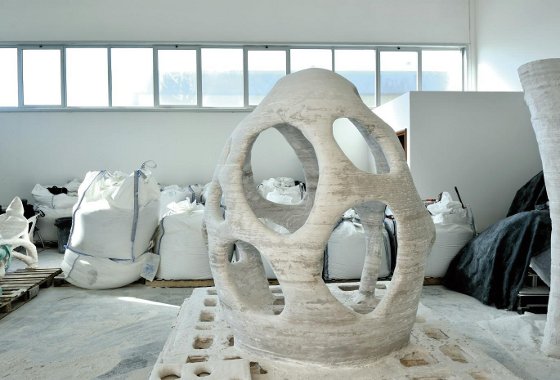
  • 3-D Printing Whole Buildings in Stone

    Fast Company has an article on a fabrication device which can make stone buildings – 3-D Printing Whole Buildings in Stone…in Space: This Printer Rocks.

    In Pisa, Italy, mad genius Enrico Dini is building sandcastles on the moon. His giant 3-D printer is the first of its kind with the potential to print whole buildings, and it makes them out of solid rock, cutting down a thousand-year-long process into a few minutes. It uses sand, but someday it’ll use moon dust.

    The machine, called D-Shape, sprays a thin layer of sand with a magnesium-based glue from hundreds of nozzles–its resolution is about 25 dpi, not bad for printing on this scale. The glue binds the sand into solid rock, which builds up, layer after layer, into a sculpture, or a piece of furniture or, someday, into a cathedral. “What I really want to do is to use the machine to complete the Sagrada Familia,” Dini says. Okay, it seems a little crazy, but not much.

    Dini claims the d-shape process is four times faster than conventional building, costs a third to a half as much as using Portland cement, creates little waste and is better for the environment. But its chief selling point may simply be that it makes creating Gaudiesque, curvy structures simple.

    It’s not enough for D-Shape to be the missing link between the tiny 3-D printers of today, which never really caught on beyond gimmicky jewelry and model-making, and bigger printers capable of making full-size structures. No, Dini wants the moon. As part of the European Space Agency’s Aurora program, he’s talking with La Scuola Normale Superiore, Alta Space, and Norman Foster to modify D-Shape to build with moon dust. Voila: instant moonbase.


  • Clean Energy 2010 Trending Up

    Renewable Energy World reports that this year’s Clean Edge report has been released – Clean Energy 2010 Trending Up.

    Last year around this time, clean tech research and publishing firm Clean Edge predicted we’d be talking about flat or even downward clean energy revenue trends in 2009. However, the report the firm issued today, Clean Energy Trends 2010, shows that combined global revenue for three major clean-energy sectors –- solar photovoltaics (PV), wind power and biofuels -– grew by 11.4 percent over 2008, reaching $139.1 billion.

    Given the state of the economy, “this reported 11.4 percent increase in global revenues is quite remarkable,” said Ron Pernick, Clean Edge co-founder, managing director and co-author of the report, on a conference call. Clint Wilder, senior editor at Clean Edge and report co-author, was also on the call.

    In another good sign for the clean energy sector, the Clean Energy Trends 2010 report shows that even though U.S.-based VC investments in energy technologies declined a whopping 31% — from $3.2 billion in 2008 to $2.2 billion in 2009 — clean energy’s percentage of total U.S. VC investments rose to an all-time high of 12.5% percent of total activity in 2009. “So while total investments were down for the first time in 7 years, the total percentage [invested] represented the largest share in the history of the clean-energy asset class,” said Pernick.

    China, China, China

    The Clean Energy Trends 2010 report also points to five trends in renewable energy that the authors believe are worth watching in the coming year.

    The trends, which are detailed in the report, are as follows:

    * Carbon as a Feedstock
    * Steep PV Price Drops
    * Biomass for Utilities and District Heating
    * Clean-Tech Megaprojects
    * High Speed Rail (HSR)

    In 3 of the 5 trends, China figures prominently. The country is the world’s largest PV cell manufacturer and is a contributing factor in lower PV module pricing due to its low-cost production scale.

    China has announced some of the largest wind and solar “megaprojects” in the past year, including a 2-GW First Solar PV Farm in Inner Mongolia and the 2 GW of CSP towers that eSolar is building. China remains a close second to the U.S. lead in installed wind power capacity. It seems likely that wind “megaprojects” will be announced in China in the near future. And in high-speed rail, the country intends to install 10,000 miles of dedicated HSR by 2020. According to the report, there will be more high-speed rail built in China over the next five years than the rest of the world combined.

    While the authors point out that the real advances in biomass are coming out of Europe, Pernick said he wouldn’t be surprised if China would start making advances in that sector, too.


  • The convergence of the internet and the smart grid

    The SMH has an article suggesting we might see the convergence of the telecom, ISP and utilities (power) industries over the coming decade (ie. network companies that deliver more than just bits) – Google could be your next ISP.

    Instead of relying on third parties to deliver its services, the search giant has spent billions over the past several years building data centres spanning millions of square feet all over the world.

    Its equipment is in place at more than 60 public exchanges and, Labovitz said, over the past year the company has deployed its Google Global Cache servers in more than half of all large consumer networks in North America and Europe.

    Google has effectively cut out the middleman and now more than half of its traffic is sent directly from its servers to the world’s consumer ISPs, Arbor revealed. Next, it could cut out the ISPs as well by offering internet plans itself.

    With a wealth of infrastructure already in place, Google recently announced it was taking the next step by building an experimental fibre-to-the-home network in parts of the US servicing initially between 50,000 and 500,000 homes.

    Google plans to connect these homes to the internet at blistering speeds of 1Gbps. By comparison, the upcoming National Broadband Network in Australia is predicted to offer about 100Mbps.

    “I think Google is gearing up to be potentially quite a formidable competitor to existing telcos and ISPs, given their moves into the infrastructure level,” Warren Chaisatien, research director and principal analyst at Australian firm Telsyte, said.

    Indeed, at the recent Mobile World Congress in Barcelona, Google chief executive officer Eric Schmidt was heckled by telco representatives in the audience who feared that Google was increasingly competing with them not only on the infrastructure level, but also by selling its mobile phone, the Nexus One, directly to consumers online, and by releasing apps such as Google Voice, which allows users to bypass the networks to make voice calls.

    Schmidt stressed the Google was purely experimenting in an effort to see what was required to bring networks up to 1Gbps, which could pave the way for more exciting applications and convince telcos to upgrade their networks.

    Analysts aren’t buying it. “I think what we are seeing today is that Google is conquering the world, starting from online content but now they are building infrastructure,” Chaisatien said.

    Chaisatien believes that, in the next five to 10 years, the ISP, telecoms and utilities industries will merge to form “smart grids”. He said this was “one of the key arenas that Google intends to play very strongly in”.


  • Nissan to build electric car in Britain

    The Daily mirror reports that Nissan plans to manufacture electric cars in Britain (something Australia needs to do too) – Delight at Nissan jobs boost as firm plans to build electric car in Britain.

    Nissan yesterday saved thousands of jobs by announcing plans to make its new electric car in Britain. The Japanese giant will pump £420million into its Sunderland plant for production of ultra-green motor the Leaf.

    The news was greeted with joy on Wearside where just two months ago 1,200 jobs were under threat as the firm struggled to cope with a slump in sales due to recession. Nissan’s contractual manager Denise Slater said: “I have been very busy recruiting a lot of people. This is great news.” Programme trainer at the plant Eric Du Bois, 27, added: “It’s a super thing for the area. And for the UK too.


  • Element: Recyclable Concrete

    Transamterial has a post on a cardle-to-cradle compliant waterproofing treatment for concrete – Element.

    Hycrete’s Element is an environmentally friendly admixture that integrally waterproofs concrete used in commercial construction. Certified Cradle-to-Cradle by McDonough Braungart Design Chemistry, LLC (MBDC), Element eliminates the need for external membranes typically used to waterproof concrete, thereby making the concrete more-easily recyclable following demolition. This approach can eliminate thousands of pounds of Volatile Organic Compounds (VOCs), CO2 and non-renewable content. Additionally, the admixture enhances structure durability by protecting against corrosion of steel rebar.