According to local lore, Portuguese travelers as far back as the late 19th century suspected that oil might lie beneath parts of East Africa after noticing a thick, greasy sediment wash up on the shores of Mozambique. More interested in finding cheap labor, though, the explorers had little use for oil.
A century later, it turns out that the Portuguese were right. Seismic tests over the past 50 years have shown that countries up the coast of East Africa have natural gas in abundance. Early data compiled by industry consultants also suggest the presence of massive offshore oil deposits. Those finds have spurred oil explorers to start dropping more wells in East Africa, a region they say is an oil and gas bonanza just waiting to be tapped, one of the last great frontiers in the hunt for hydrocarbons. “I and a lot of other people in oil companies working in East Africa have long been convinced that it’s the last real high-potential area in the world that hasn’t been fully explored,” says Richard Schmitt, chief executive of Black Marlin Energy, a Dubai-based East Africa oil prospector. “It seems, for a variety of geopolitical reasons, that more than anything else, it’s been neglected over the last several decades. Most of those barriers are currently being lowered or [have] disappeared altogether.”
Few have wanted to pay the cost of searching for oil or gas in the region, or risk drilling wells in volatile countries such as Uganda, Mozambique or Somalia. But better technology, lower risk in some of the countries and higher oil prices in recent years have changed the equation. Wildcatters and majors such as Italy’s Eni, Petronas of Malaysia and China National Offshore Oil Corporation (CNOOC) have all moved on East Africa in the past few years.
They’re hoping to mimic London-based Tullow Oil, which discovered some 2 billion bbl. of oil in landlocked Uganda over the past four years. Last month, Texas-based oil company Anadarko Petroleum Corp. announced that it had tapped a giant reservoir of natural gas off the coast of Mozambique. “Anadarko’s find went off like a bomb here in Houston,” says Robert Bertagne, a Texas-based oil wildcatter. “It was, ‘Wow, we are finding large quantities of gas, and that means we have hydrocarbons in the area.’ Once you have a discovery, more people are going to go in there.” (See pictures of oil fires.)
Much of East Africa’s hopes are focused on a fault line running from Somalia to Madagascar known as the Davie Fracture Zone. It’s there that Bertagne’s analysis — using Cold War–era sea-floor mapping originally intended for use by Soviet submarines — has prompted speculation about oil deposits rivaling those of the North Sea or Middle East. There’s still a lot that’s unknown: North Africa has seen 20,000 wells sunk over the past few decades, while drillers have sunk 14,000 wells in and off West Africa. In East Africa, the total is about 500 wells.
For the second year in a row, global nuclear generating capacity has dropped slightly, reaching 370.9 gigawatts (GW) at the end of 2009. Just over 1 GW of capacity was added during the year, as India and Japan each connected a new plant to the grid. At the same time, Japan closed two reactors and Lithuania one, so there were 2,506 GW worth of shutdowns.
While installed capacity has been virtually flat for the past five years, construction starts surged in 2009 thanks to a burst of activity in China. Altogether, construction began on 11 nuclear power reactors in 2009, the highest number since 14 units were started in 1985. Some 56 nuclear reactors are now officially being built—but 13 of these have been “under construction” for more than 20 years, and 26 reactors have encountered “construction delays.”
As noted, 3 nuclear reactors were permanently closed in 2009, bringing the total number of decommissioned units to 126, representing a retired nuclear capacity of nearly 40 GW. The average age of all decommissioned reactors is 22 years. Hamaoka 1 and 2, the two reactors that were shut down in Japan, were originally damaged by a 2007 earthquake that struck while they were undergoing safety-related upgrades. The cost of seismic retrofitting of these two reactors was so high that the operator, Chubu Electric, decided to close them permanently and plans to build a single large reactor to replace them by 2018.
Stuart at Early Warning has one of the better blog post titles I’ve seen in a while, commenting on John Michael Greer’s recent pessimistic posts about solar power – Limits on the Thermodynamic Potential of Archdruids.
I often read John Michael Greer, the Archdruid. He’s a smart and thoughtful guy who worries about some of the same things I worry about, though he tends to have decided they are all hopeless, whereas I tend to see society as having a lot more options than he perceives. He has read very widely and often comes up with interesting historical analogies that hadn’t occurred to me, so he’s well worth the spot in my reader.
Where he tends to go horribly wrong, and why I think his overall take on the subject is too negative, is when he tries to talk about physics. In a recent series of three posts:
* Energy Follows It’s Bliss * An Exergy Crisis * Barbarism and Good Brandy
He has been trying to argue that there are fundamental physical barriers to society surviving the transition away from fossil fuels, and getting horribly snarled up.
Now, I am not a working physicist, but I may well be the nearest thing that will admit to reading the Archdruid – I trained in Physics, have a PhD in the subject, and then went into Computer Science. But the points at issue are pretty elementary here, so let me try to straighten the Archdruid out, and at least place something in the record for anyone that might be confused by his arguments.
In short, there are no fundamental physical barriers to a non-fossil-fuel based economy – the main problems are social, economic, and practical, not issues of physical law.
This post is the latest installment of my series on Bucky Fuller and was prompted by my reading Fred Turner‘s book “From Counterculture To Cyberculture: Stewart Brand, the Whole Earth Network and the Rise of Digital Utopianism“, which looks at the influence Bucky Fuller had on a range of people, in particular Stewart Brand, who helped create first the hippie counterculture and the back to the land movement of the sixties and seventies, then later the cyberculture that grew up around the San Francisco bay area.
I won’t try to review the book here as I wouldn’t do it justice – but I highly recommend it if you have any interest in this particular piece of history.
Brand has had a significant influence on the environmental movement which has continued through to the current day and the evolution of his views over that time is worth spending some time considering.
As they came of age, Stewart Brand and others of his generation faced two questions: How could they keep the world from being destroyed by nuclear weapons or by the large-scale, hierarchical governmental and industrial bureaucracies that had built and used them? And how could they assert and preserve their own holistic individuality in the face of such a world?
As he sought to answer those questions, Brand turned first to the study of ecology and a systems-oriented view of the natural world. Later, after graduating from Stanford and serving several years as a draftee in the army, he found his way into a series of art worlds centered in Manhattan and San Francisco. For the artists of those communities, as for Brand’s professors at Stanford, cybernetics offered a new way to model the world. Even at the height of the cold war, many of the most important artists of this period, figures such as John Cage and Robert Rauschenberg, embraced the systems orientation and even the engineers of the military-industrial research establishment. Together they read Norbert Wiener and, later, Marshall McLuhan and Buckminster Fuller; across the late 1950s and well into the 1960s, they made those writings models for their work. At the same time, both the artists he met and the authors they read presented the young Stewart Brand with a series of role models. If the army and the cold war corporate world of Brand’s imagination moved according to clear lines of authority and rigid organizational structures, the art worlds of the early 1960s, like the research worlds of the 1940s, lived by networking, entrepreneurship, and collaboration. As he moved among them, Brand came to appreciate cybernetics as an intellectual framework and as a social practice; he associated both with alternative forms of communal organization.
Ecology as Alternative Politics
Brand first encountered systems-oriented ways of thinking at Stanford in a biology class taught by Paul Ehrlich. By the end of the decade, Ehrlich was famous for predicting in his book The Population Bomb (1968) that population growth would soon lead to ecological disaster. In the late 1950s, however, he was concentrating on the fundamentals of butterfly ecology and systems-oriented approaches to evolutionary biology. These preoccupations reflected the extraordinary influence of cybernetics and information theory on American biology following World War II. At the level of microbiology, information theory provided a new language with which to understand heredity. Under its influence, genes and sequences of DNA became information systems, bits of text to be read and decoded. In the 1950s, as Lily Kay has pointed out, microbiology became “a communication science, allied to cybernetics, information theory, and computers.” Information theory also exerted a tremendous pull on biological studies of organisms and their interaction. Before World War II, biologists often focused on the study of individual organisms, hierarchical taxonomies of species, and the sexual division of labor. Afterward, many shifted toward the study of populations and the principles of natural selection in terms modeled on cybernetic theories of command and control. …
For Brand, even as a student at Stanford, the ability to think outside the dominant paradigm of cold war conflict both marked and made possible an advancement in human evolution. The liberation of the individual was simultaneously an American ideal, an evolutionary imperative, and, for Brand and millions of other adolescents, a pressing personal goal.
The question was, How could that liberation be achieved in daily life? Brand’s search for individual freedom led to a decade-long migration among a wide variety of bohemian, scientific, and academic communities. In the course of these travels, Brand encountered both communal ways of living and a series of technocentric, systems-oriented theories that served as ideological supports for communalism. Often enough, the theories themselves were not explicitly theories of social organization so much as theories of local social practices, such as how to make art or how to take LSD or how to run a business meeting. As he moved among these communities, however, and later, when his Whole Earth Catalog became a forum in which such communities met, Brand began to see how the systems orientation of Paul Ehrlich’s population biology, combined with new, countercultural modes of living, might offer an appealingly individualistic lifestyle—not only for him, but also for anyone else who could abandon the halls of bureaucratic America. …
The same tension between global humanist ideals and local elite practice would haunt much of the New Communalist movement over the next decade, and the Whole Earth network for years after that. But in the early 1960s, the linking of the global and the local helped account for much of Marshall McLuhan’s appeal within the emerging counterculture. McLuhan’s simultaneous celebration of new media and tribal social forms allowed people like Stewart Brand to imagine technology itself as a tool with which to resolve the twin cold war dilemmas of humanity’s fate and their own trajectory into adulthood. That is, McLuhan offered a vision in which young people who had been raised on rock and roll, television, and the associated pleasures of consumption need not give those pleasures up even if they rejected the adult society that had created them. Even if the social order of technocracy threatened the species with nuclear annihilation and the individual young person with psychic fragmentation, the media technologies produced by that order offered the possibility of individual and collective transformation. McLuhan’s dual emphases also allowed young people to imagine the local communities they built around these media not simply as communities built around consumption of industrial products, but as model communities for a new society. In McLuhan’s writing, and in the artistic practice of groups like USCO and, later, the psychedelic practices of groups like San Francisco’s Merry Pranksters, technologies produced by mass, industrial society offered the keys to transforming and thus to saving the adult world.
No one promoted this doctrine more fervently than the technocratic polymath Buckminster Fuller. Architect, designer, and traveling speechmaker, Fuller became an inspiration to Stewart Brand, the Whole Earth network, and the New Communalist movement as a whole across the 1960s. The geodesic domes Fuller patented soon after World War II came to be favored housing on communes throughout the Southwest. Fragments of his idiosyncratic conceptual vocabulary, such as “tensegrity,” “synergy” and “Spaceship Earth,” bubbled up steadily in discussions of how and why alternative communities should be built. And Fuller himself—seventy years old in 1965, short, plump, bespectacled, and, when he spoke in public, often clad in a three-piece suit with an honorary Phi Beta Kappa key dangling at the waist— seemed to model a kind of childlike innocence that many New Communalists sought to bring into their own adulthoods. If the politicians and CEOs of mainstream America were distant and emotionally reserved, Fuller was playful and engaged. And like his young audiences, he displayed a highly individualistic turn of mind and a deep concern with the fate of the species. Fuller made his name designing futuristic technologies such as the three wheeled Dymaxion car and, most famously, the geodesic dome, but the roots of his interests reached deep into America’s pre-industrial past. …
Fuller, like Emerson, saw the material world as the reflection of an otherwise intangible system of rules. But unlike Emerson and the Transcendentalists, Fuller linked that system of rules not only to the natural world, but also to the world of industry. During World War I, Fuller had watched his four-year-old daughter Alexandra die of infantile paralysis, contracted in part, he believed, because the family’s home was badly built. At the time, he was working as a contractor with the navy. Earlier, as a junior officer, he had seen how, with proper coordination, extraordinary industrial resources could be mustered to solve military problems. In his view, his daughter had died directly from a disease but indirectly from a failure to distribute the world’s resources appropriately. This conviction grew during World War II and the early years of the cold war, when once again Fuller saw the full scope of industrial production at work, as well as the inequality with which the world’s resources were distributed. What humankind required, he came to believe, was an individual who could recognize the universal patterns inherent in nature, design new technologies in accord with both these patterns and the industrial resources already created by corporations and the military, and see that those new technologies were deployed in everyday life.
In a 1963 volume called Ideas and Integrities, a book that would have a strong impact on USCO and Stewart Brand, Fuller named this individual the “Comprehensive Designer.” According to Fuller, the Comprehensive Designer would not be another specialist, but would instead stand outside the halls of industry and science, processing the information they produced, observing the technologies they developed, and translating both into tools for human happiness. Unlike specialists, the Comprehensive Designer would be aware of the system’s need for balance and the current deployment of its resources. He would then act as a “harvester of the potentials of the realm,” gathering up the products and techniques of industry and redistributing them in accord with the systemic patterns that only he and other comprehensivists could perceive. To do this work, the Designer would need to have access to all of the information generated within America’s burgeoning technocracy while at the same time remaining outside it. He would need to become “an emerging synthesis of artist, inventor, mechanic, objective economist and evolutionary strategist.” Constantly poring over the population surveys, resource analyses, and technical reports produced by states and industries, but never letting himself become a full-time employee of any of these, the Comprehensive Designer would finally see what the bureaucrat could not: the whole picture.
Being able to see the whole picture would allow the Comprehensive Designer to realign both his individual psyche and the deployment of political power with the laws of nature. In contrast to the bureaucrat, who, so many critics of technocracy had suggested, had been psychologically broken down by the demands of his work, the Comprehensive Designer would be intellectually and emotionally whole. Neither engineer nor artist, but always both simultaneously, he would achieve psychological integration even while working with the products of technocracy. Likewise, whereas bureaucrats exerted their power by means of political parties and armies and, in Fuller’s view, thus failed to properly distribute the world’s resources, the Comprehensive Designer would wield his power systematically. That is, he would analyze the data he had gathered, attempt to visualize the world’s needs now and in the future, and then design technologies that would meet those needs. Agonistic politics, Fuller implied, would become irrelevant. What would change the world was “comprehensive anticipatory design science.’ …
At another level, though, the swirling scene at the Trips Festival, and Brand’s role in it, represented a coming together of the New Communalist social ideals then emerging and the ideological and technological products of cold war technocracy. The festival itself was a techno-social hybrid. The Longshoreman’s Hall surrounded dancers with the lights, images, and music of electronic media. The bodies of many dancers were infused with LSD. To the extent that they felt a sense of communion with one another, the sensation was brought about by their integration into a single techno-biological system within which, as Buckminster Fuller put it, echoing Norbert Wiener, the individual human being was simply another “pattern-complex.” Brand himself had organized the event in keeping with the systems principles he had encountered at Stanford and afterward. Far from asserting direct control over events, he had built an environment, a happening, a laboratory. He had set forth the conditions under which a system might evolve and flower, and he had stocked the biological and social worlds of those who entered that system with technologies that allowed them to feel as though the boundaries between the social and the biological, between their minds and their bodies, and between themselves and their friends, were highly permeable. He had helped found a new tribe of technology-loving Indians, artistic engineers of the self. Very soon these new Comprehensive Designers would set out from San Francisco to found their own communities in the wilderness.
When they got there, thought Brand, what they would need most would be tools and information.
Stewart’s particular genius has been in the creation of forums (ranging from magazines to conferences to online discussion groups to consulting organisations) that have enabled people with expertise in different disciplines to come together and exchange ideas about innovative uses of technology.
The Whole Earth Catalog and the back to the land movement
One of the better reviews of Turner’s book looks at the emergence of sixties youth culture and influence thinkers like Marshall McLuhan, Paul Ehrlich and Bucky Fuller had on Brand the counterculture in general.
Turner gives the label “ New Communalism” to the utopian impulses that led both to the portion of the sixties counterculture which found its central text in the Whole Earth Catalog, and to the embrace of technology which found itself eventually at home in the 1990’s with some aspects of insurgent Republicanism. He suggests further that the values of the communal 1960’s utopian movement exemplified by Brand and his Whole Earth Catalog were not co-opted and distorted in later years by the forces of capitalism or the state as some believe, but rather became a part of the cyberculture of both creators and users of computers and new forms of computing.
The book opens with the defining computational metaphor as expressed by contemporary writers such as Esther Dyson, John Perry Barlow and Kevin Kelly: digital technologies transcend the world of governments and restrictions, and are instead tools by which stultifying bureaucracies can be overthrown and new, flexible ways of living, working, and producing for a strong economy can be achieved. Yet, to the students of the Berkeley Free Speech movement in which these writers began and which provided the origin of the counterculture, cybernetics represented a militarized and menacing force antithetical to the longed-for new society. The students of the Berkely Free Speech movement of the 1960’s and their colleagues across the country sometimes demonstrated and protested using computerized punch cards as the emblem of a repressive society.
In spite of the 1960’s students’ perceptions, Turner suggests that the seemingly closed world of the military-industrial complex was not monolithic. Within that complex, beginning with the great collaborative research enterprises of World War II, could be found a computation subculture bound by, in anthropological terms, a “trading language” and a “legitimacy exchange” which facilitated border-crossing and group work by professionals from various backgrounds. At the same time, Norbert Wiener and his associates, pioneers of cybernetics and associated with the wartime computing effort, expressed an idea of human being as automated mechanical information processors but with an added, more benign idea of a system in which men and machines collaborated. Thus it seems, even in the founding metaphors of computing, there were possibilities for divergence in how computing was regarded, along with spaces in which computing work was boundary-spanning and non-hierarchical.
It was the youth culture of the 1960’s, emerging as it did as a reaction against the systems which included the computing of the time, which added the notion of a liberated egalitarian society and communal ideals. It was during this time that two youth movements emerged. One was political, as represented by the SDS and the civil rights struggle, which became the so-called New Left. The other, more inward-turning, embracing new ways of consciousness and relationships and accompanied by drugs and rock and roll music, became the “counterculture”. It is in this non-political, utopian stream that Turner places the countercultural origins of cyberculture in the New Communalism. It is here that Turner arrives at the central questions he hopes to answer: how did the systems visions of the cold war and the seemingly antithetical communitarian visions of the New Communalists become so entwined that, years later as the Internet evolved out of the Cold War systems, it could appear to many to be the New Communalist ideal reborn? Here, Turner suggests, is the pivotal role of Steward Brand as the node connecting these networks.
Brand’s own intellectual journey into the counterculture began as a Stanford student learning about the then-new system-oriented ecological theories of population biologist Paul Ehrlich. After college and military service, he found his way into the avant-garde arts scene in New York city. These artists were developing a countercultural artistic system which were labeled “happenings”—seemingly spontaneous, egalitarian, and participatory, combining lighting, drama, music, art and systems thinking along with Eastern mysticism and involving multidisciplinary collaboration in a workshop setting. These artists were steeped in the communication theories of Marshall McLuhan which celebrated new media and tribal social forms, and the ideals of futuristic technology of architect Buckminster Fuller. Indeed, Brand credited Fuller as the inspiration for the Whole Earth Catalog.
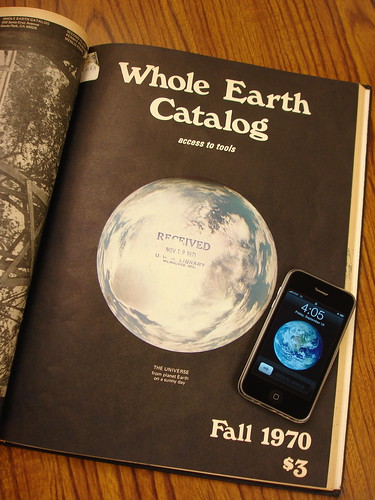
Brand maintained that given access to the information we need, humanity can make the world a better place. The Whole Earth Catalog magazine he founded was promoted as a “compendium of tools, texts and information” which sought to “catalyze the emergence of a realm of personal power” by making technology available to people eager to create sustainable communities. Brand eventually achieved his goal of persuading NASA to release the first photo of the Earth from space (wandering around for some time wearing a badge saying “Why Haven’t We Seen A Picture of the Whole Earth?”) and the photo became the cover for the Catalog.
There is an interview by Massive Change with Stewart that describes his first meeting with Bucky Fuller and the story of his “whole earth” badge:
Massive change: What was Bucky Fuller’s reaction to your button campaign that asked, “Why haven’t we seen an image of the whole earth yet?”
Stewart Brand: It was all because of LSD, see. I took some lysergic acid diethylamide on an otherwise boring afternoon and came to the notion that seeing an image of the Earth from space would change a lot of things. So, on next to no budget, I printed up buttons and posters and sold them on street corners at the University of California, Berkeley. I went to Stanford and back east to Columbia, Harvard, and MIT. I also mailed the materials to various people: Marshall McLuhan, Buckminster Fuller, senators, members of the U.S. and Soviet space programs.
Out of everyone, I only heard back from Bucky Fuller, who wrote, “Dear boy, it’s a charming notion but you must realize you can never see more than half the earth from any particular point in space.” I was amused, and then met him a few months later at a seminar at Esalen Institute in Big Sur, California. I sat across from his lunch table and pushed the button over to him, asking him what he thought about it. He said, “Oh yes, I wrote to that guy.” I said, “I’m the guy. So what do you think? What kind of difference do you think it will make when we actually get photographs of the earth from space?”
There was this slow, lovely silence. Then he said, “Dear boy, how can I help you?”
Whole Earth (and later Wired) editor Kevin Kelly has noted that style of the Whole Earth Catalog preceded the modern internet / blogosphere, and was eventually made redundant by it.
For this new countercultural movement, information was a precious commodity. In the 1960s, there was no Internet; no 500 cable channels. Bookstores were usually small and bad; libraries, worse. The WEC not only gave you permission to invent your life, it gave you the reasoning and the tools to do just that. And you believed you could do it, because on every page of the catalog were other people doing it. This was a great example of user-generated content, without advertising, before the Internet. Basically, Brand invented the blogosphere long before there was any such thing as a blog. …
This I am sure about: it is no coincidence that the Whole Earth Catalogs disappeared as soon as the web and blogs arrived. Everything the Whole Earth Catalogs did, the web does better.
The Whole Earth Catalog was succeeded by a journal called CoEvolution Quarterly (CQ). CQ often included content related to futurism and the science of ecology, including authors like Lewis Mumford, Howard T. Odum, Karl Hess, Ivan Illich, Wendell Berry, Ursula K. Le Guin, Gregory Bateson, Amory Lovins, Hazel Henderson, Gary Snyder, Lynn Margulis, Eric Drexler, Paul Hawken, John Todd, Kevin Kelly and Donella Meadows (and not to forget Bucky Fuller of course), many of whom would be familiar to students of peak oil and the limits to growth.
The Whole Earth Catalog was something of a bible for the “back to the land” movement of the hippie counterculture, however its influence waned as the seventies progressed and the hippies became disillusioned with communal life out of the cities and as they faded from media attention.
The hippies weren’t the first (or the last counterculture) to emerge – there are some interesting parallels with the German Wandervogel of the early 20th century (who, like the followers of the “local currencies” movement of that period, eventually went rogue) and with the modern day “rippies” trying to go off the grid in the US.
The WELL
Between 1968 and 1972, two communities began to mingle within blocks of the Whole Earth Catalog offices in Menlo Park. One, centered around the Stanford Research Institute and composed primarily of engineers, was devoted to the ongoing pursuit of increased human-computer integration. The other, clustered around the Catalog and the countercultural communities it served, focused on the pursuit of individual and collective transformation in a New Communalist vein. Stewart Brand positioned himself between these worlds and, in a variety of ways, brokered their encounter. – From Counterculture to Cyberculture
In the mid-1980’s, Brand cofounded the “Whole Earth ‘Lectronic Link” (WELL) with Larry Brilliant (now of Google.org), the prototype online community which still continues today and spawned both the EFF and Craigslist.
As it turned out, psychedelic drugs, communes, and Buckminster Fuller domes were a dead end, but computers were an avenue to realms beyond our dreams. – Stewart Brand
In a review of Turner’s book, The New York Times noted that it was unsurprising that many members of the counterculture would end up being part of the “computer revolution”.
It might be argued that so prevalent was the counterculture, and so experimental and energetic were its most vocal proponents, that it would have been surprising had many of them not found their way to the computer revolution. But Mr. Turner demonstrates something more essential in the continuity.
First, he suggests, we are mistaken in thinking that the postwar technological world was dominated by hierarchies and rigid categories. Under the influence of the mathematician Norbert Wiener, it became increasingly common to think of humans and machines as interacting elements of “cybernetic systems” — organisms through which information flowed. This also led to a different way of thinking about living organisms and their networks of interaction.
Marshall McLuhan wrote in 1964: “Today we have extended our central nervous system itself in a global embrace, abolishing both space and time as far as our planet is concerned.” Buckminster Fuller proposed the idea of a Comprehensive Designer, a creator who would embody “an emerging synthesis of artist, inventor, mechanic, objective economist and evolutionary strategist.”
These writers were the patron saints of the “Whole Earth Catalog,” their books appearing alongside macramé and carpentry manuals, their ideas presumably brought to life in the commune, where the natural and human world would be bound together, creating a single organism from which new possibilities would unfold.
During this period Brand coined the famous expression “information wants to be free”, though that was only half of his commentary at the time.
On the one hand information wants to be expensive, because it’s so valuable. The right information in the right place just changes your life. On the other hand, information wants to be free, because the cost of getting it out is getting lower and lower all the time. So you have these two fighting against each other.” That was eventually compressed into “Information wants to be free. Information also wants to be expensive. – Stewart Brand
GBN was co-founded by Brand and is a classic example of his ability to assemble a diverse group of thinkers – in this case including people like Francis Fukuyama, Pierre Omidyar, Freeman Dyson, Peter Gabriel, Bill Joy, Amory Lovins, Paul Hawken, William Gibson and Bruce Sterling.
The Viridian Design Movement
At the beginning of the 21st century, author and futurist (and GBN member) Bruce Sterling published what he dubbed “The Viridian Manifesto“, looking to spark a design movement to solve the problem of global warming and other collisions with the limits to growth. Since Bruce published his manifesto, a range of web sites that I’d categorise as Viridian have sprung up, with some openly acknowledging this heritage and other perhaps entirely oblivious to it – and with many of them also noting Bucky Fuller as an inspiration.
One of Stewart Brand’s recent projects is a collaboration with computer scientist Danny Hillis to build the “Clock of the Long Now”, a 10,000-year timepiece; his Long Now Foundation also runs a number of related projects, such as the Rosetta Project, cataloguing the world’s languages, and the Long Bets (“the arena for accountable predictions”) website.
Wired And Newt Gingrich – Did Something Go Terribly Wrong ?
Turner’s book ends on something of a down note, as it describes how Brand and the Wired crew become involved with Esther Dyson, Newt Gingrich and the mid-90s “Republican Revolution”.
One chronicler of both the counterculture and the cyberculture that followed it is RU Sirius (whose “Mondo 2000” magazine was prominent in the pre-Wired era). RU has a review of Turner’s book in which he notes his disquiet with the period when “Brand’s digital countercultural elite” engaged with Gingrich and co.
While I welcome Turner’s critical vision, I must say honestly that, although I was repulsed by the Gingrich alliance and by much of the corporate rhetoric that emerged, at least in part, out of Brand’s digital elitist clan — I think Brand’s tactics were essentially correct. Turner implies that valuable social change is more likely to happen through political activism than through the invention and distribution of tools and through the whole systems approach that is implicit in that activity. But I think that the internet has — palpably — been much more successful in changing lives than 40 years of left oppositional activism has been. For one example out of thousands, the only reason the means of communication that shapes our cultural and political zeitgeist isn’t COMPLETELY locked down by powerful media corporations is the work that these politically ambiguous freaks have accomplished over the past 40 years. In other words, oppositional activism would be even more occult — more hidden from view — today if not for networks built by hippie types who were not averse to working with DARPA and with big corporations. The world is a complex place.
RU has some more choice words about the failure of cyberculture (like the counterculture before it) to make the world a better place, lamenting the atomisation of modern society and the power this has gifted to faceless corporations in this interview with Jon Lebkowsky (another fixture of the Viridian movement) entitled “It’s Better to be Inspired than Wired”.
Cyberculture (a meme that I’m at least partly responsible for generating, incidentally) has emerged as a gleeful apologist for this kill-the-poor trajectory of the Republican revolution. You find it all over Wired – this mix of chaos theory and biological modeling that is somehow interpreted as scientific proof of the need to devolve and decentralize the social welfare state while also deregulating and empowering the powerful, autocratic, multinational corporations. You’ve basically got the breakdown of nation states into global economies simultaneous with the atomization of individuals or their balkanization into disconnected sub-groups, because digital technology conflates space while decentralizing communication and attention. The result is a clear playing field for a mutating corporate oligarchy, which is what we have.
I mean, people think it’s really liberating because the old industrial ruling class has been liquefied and it’s possible for young players to amass extraordinary instant dynasties. But it’s savage and inhuman.
Maybe the Wired elite think that’s hip. But then don’t go around crying about crime in the streets or pretending to be concerned with ethics.
It’s particularly sad and poignant for me to witness how comfortably the subcultural contempt for the normal, the hunger for novelty and change, and the basic anarchistic temperament that was at the core of Mondo 2000 fits the hip, smug, boundary-breaking, fast-moving, no-time-for-social-niceties world of your wired mega-corporate info/comm/media players. You can find our dirty fingerprints, our rhetoric, all over their advertising style. The joke’s on me.
RU interviewed Turner about his book (the audio can be found here [mp3]), noting the Fuller connection and the failure of the counterculture to achieve long term change because of their refusal to engage with politics.
RU Sirius: Brand works his way through Wiener to Buckminster Fuller, another systems thinker.
Fred Turner: Brand has had a series of very powerful intellectual inspirations. Fuller would be one, Kesey would be another. For Brand, Fuller was a model in two senses. He was a model of systems thinking, and he was also a model of an intellectual entrepreneur. Fuller moved from university to university, from setting to setting, knitting communities together. That’s what Brand learned to do. He learned to do it partly by watching Fuller.
RU: Fuller was, in a sense, one of the first cyber-Ronin, the wandering techno-entrepreneur type that is much touted later in the 1990s by people like John Brockman and “Wired” magazine.
FT: Absolutely. I think of Fuller and Kesey and Brand as P.T. Barnums. They are people who can’t ride a trick horse, can’t ride an elephant, can’t ride a trapeze. And yet they build the rings of the circus; they bring the performers in; and they learn the languages and the styles of the circus. And they speak the circus’ meanings to the audience. Brand has very much been the voice of a series of very important circuses.
RU: So, into the hippie era, Brand is part of the Merry Pranksters for a while; he does the “Whole Earth Catalog,” but he’s never really a hippie. And most hippies are not, generally, systems thinkers. “Hey man, spare change, I’m going to Woodstock” isn’t systems thinking. Brand is very much off on his own distinctive trip. And yet there is this through-line that takes Brand from the avant-garde through the trips festivals to Whole Earth and on to the Global Business Network and then on through the creation of “Wired.” Can you describe what those memes or through-lines are?
FT: There’s a misapprehension that has plagued a lot of Americans, including a lot of historians, about the 60s counterculture. We tend to think of the counterculture as a set of anti-war protests; as drug use and partying. But we don’t tend to differentiate between two groups that were very importantly differentiated in that time: the New Left, and the group that I’ve called the New Communalists. Brand speaks to the New Communalists. Though it’s mostly forgotten now, between 1966 and 1973 there was the largest wave of communal activity in all of American history.
Between 1966 and 1973, conservative estimates suggest that 10 million Americans were involved in communes. Brand speaks to that group by promoting the notion that small-scale technologies like LSD, stereos, books, Volkswagens; are tools for building new alternative communities.
The New Left wanted to change the world by doing politics in order to change politics. They formed SDS (Students for a Democratic Society). They protested. Brand and his group turned his backs on all that. Brand said, what we need to do is go out and build these communities, and my job is to build a catalog of tools through which people can gain access to the technologies that they can build communities around. So the core idea that migrates from the 60s to the 90s is the idea that we can build small-scale technologies and communities of consciousness around those technologies. So we no longer need to do politics per se. That idea kicks in again in the 80s around the rise of the personal computer, the ultimate in small-scale technology. It gives us the idea of virtual community, a distributed community gathered around small-scale technologies. And it ultimately plays very directly into the beliefs of Newt Gingrich in the 1990s. …
RU: The new communalist movement failed pretty much entirely. The idea of leaving behind the urban and suburban settings and going off and starting your own world failed. Even in terms of ecological or environmental ideas, the hip idea now is urban density. The attitude about tools survived, but the idea of back-to-the-country was pretty much useless.
FT: The idea of back-to-the-country didn’t work. But I think something deeper didn’t work, and it haunts us today, even as it underlies a lot of what we do. The notion that you can build a community around shared style is a deeply bohemian notion. It runs through all sorts of bohemian worlds. The notion that if you just get the right technology you can then build a unified community is a notion that drove a lot of the rural communal efforts. They thought by changing technological regimes; by going to 19th century technologies; by making their own butter; sewing their own clothes — they would be able to build a new kind of community. What they discovered was that if you don’t do politics — explicitly, directly, through parties, through organizations — if you don’t pay attention to and articulate what’s going on with real material power, communities fail.
So I argue that there’s a fantasy that haunts the internet, and it’s haunted it for at least a decade. And it’s the idea that if we just get the tools right and communicate effectively, we will be able to be intimate with one another and build the kinds of communities that don’t exist outside, in the rest of our lives. And I think that’s a deep failure and a fantasy.
The fantasy hasn’t died entirely however, with one unlikely champion being the leader of Britain’s rebranded “progressive” conservatives, David Cameron, saying we’re entering a new era – where governments have less power (and less money) and people empowered by technology have more.
Jamais Cascio has echoed Turner’s claim that in order to be effective, politics cannot be avoided, in an essay entitled “The End Of Politics Delusion“.
You have my express permission to kick the next person — especially someone advocating the embrace of radical forms of technological advancement — who tells you that they wish nothing more than to get rid of, move beyond, or otherwise avoid “politics.” Kick them hard, and repeatedly. They have adopted a profoundly ignorant and self-serving position, one that betrays at best a lack of understanding of human nature and society, and at worst a malicious desire to preemptively shut down any opposition to their goal. …
In the early days of the dot-com era, this attitude resulted in the absence of digital tech industry voices in Washington, DC, allowing the incumbent telecom and entertainment industries free rein to write laws and buy politicians without opposition. Companies and industries that had considered themselves beyond politics found out just how wrong they were. Stung by that experience, today’s advocates of the “escape politics” position usually articulate it as more of a wishful whine, as with [Peter] Thiel’s line [“In our time, the great task for libertarians is to find an escape from politics in all its forms…”] …
there’s a profound ignorance across the tech advocacy community of the importance of politics to human society. Politics means conflict, debate, and frustration. It also means choice. A world without politics is a world where disagreement is illegitimate. It’s a world where your ability to choose your future — to make your future — has been taken away, whether you like it or not.
Brand’s Environmental Heresies And The Eco-Pragmatist Manifesto
Since “Counterculture to Cyberculture” was published Brand has continued to be active, creating a large amount of controversy in the environmental movement with an article on his “EnvironmentalHeresies” – taking aim at 4 areas where he thinks the environmental movement has gone the wrong way – population growth, urbanisation, genetically engineered organisms, and nuclear power.
Wired had an interview with Brand where he puts the case for the formation of huge slums in the developing world as a positive thing (the opposite to the argument made in Mike Davis’ “Planet Of Slums“).
Wired: What makes squatter cities so important?
Stewart Brand: That’s where vast numbers of humans—slum dwellers—are doing urban stuff in new and amazing ways. And hell’s bells, there are a billion of them! People are trying desperately to get out of poverty, so there’s a lot of creativity; they collaborate in ways that we’ve completely forgotten how to do in regular cities. And there’s a transition: People come in from the countryside, enter the rickshaw economy, and work for almost nothing. But after a while, they move uptown, into the formal economy. The United Nations did extensive field research and flipped from seeing squatter cities as the world’s great problem to realizing these slums are actually the world’s great solution to poverty.
Wired: Why are they good for the environment?
Brand: Cities draw people away from subsistence farming, which is ecologically devastating, and they defuse the population bomb. In the villages, women spend their time doing agricultural stuff, for no pay, or having lots and lots of kids. When women move to town, it’s better to have fewer kids, bear down, and get them some education, some economic opportunity. Women become important, powerful creatures in the slums. They’re often the ones running the community-based organizations, and they’re considered the most reliable recipients of microfinance loans.
Wired: How can governments help nurture these positives?
Brand: The suffering is great, and crime is rampant. We made the mistake of romanticizing villages, and we don’t need to make that mistake again. But the main thing is not to bulldoze the slums. Treat the people as pioneers. Get them some grid electricity, water, sanitation, crime prevention. All that makes a huge difference.
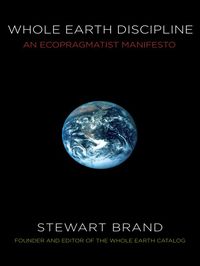
The 4 “heresies” form the foundation of Brand’s latest book “WHOLE EARTH DISCIPLINE: An Ecopragmatist Manifesto” (along with another one – geoengineering will be required to mitigate global warming), which Brand discusses in this Long Now seminar called “Rethinking Green“.
Personally I’d say Brand has 2 of his original 4 “heresies” right – population (which isn’t the problem many believed back in the 1970’s – and some grim hangers on still think today) and urbanisation (with “cities are the future” being a key Viridian catchphrase).
I remain somewhat dubious about genetically modified crops and think Brand is simply wrong about nuclear power, which is (at best) an expensive diversion of resources from our key task of replacing and extending our existing power generation capacity with truly clean and renewable power sources (in fact, its a remarkable about-face to go from promoting tools for individual use to recommending the ultimate centralised power source, one which can’t be used by individuals and always requires massive government subsidies and regulation, and completely at odds with his “Long Now” school of long-term thinking for that matter).
The topic of Geoengineering is worthy of a post of its own, so I’ll leave that for later.
Brand discusses “Whole Earth Discipline” in this talk at EDGE.
About 40 years ago I wore a button that said, “Why haven’t we seen a photograph of the whole Earth yet?” Then we finally saw the pictures. What did it do for us?
The shift that has happened in 40 years which mainly has to do with climate change. Forty years ago, I could say in the Whole Earth Catalog, “we are as gods, we might as well get good at it”. Photographs of earth from space had that god-like perspective.
What I’m saying now is we are as gods and have to get good at it. Necessity comes from climate change, potentially disastrous for civilization. The planet will be okay, life will be okay. We will lose vast quantities of species, probably lose the rain forests if the climate keeps heating up. So it’s a global issue, a global phenomenon. It doesn’t happen in just one area. The planetary perspective now is not just aesthetic. It’s not just perspective. It’s actually a world-sized problem that will take world sized solutions that involves forms of governance we don’t have yet. It involves technologies we are just glimpsing. It involves what ecologists call ecosystem engineering. Beavers do it, earthworms do it. They don’t usually do it at a planetary scale. We have to do it at a planetary scale. A lot of sentiments and aesthetics of the environmental movement stand in the way of that.
The next post in the series will look at one of the key enablers of a fully renewable energy powered future – smart grids – and how they are a stepping stone towards one of Bucky’s visions – the Global Energy Grid.
Why would you ever put a skyscraper in the countryside? In the case of Design Crew for Architecture’s Freshwater Factory skyscraper, the idea actually makes sense. The skyscraper, designed for the 2010 eVolo skyscraper competition, isn’t meant for human inhabitants. Instead, its series of bubbles are filled with water-filtering mangroves that desalinate seawater without using any electricity.
The system works with a series of circular tanks filled with brackish water. The water is pumped through the mangrove plants via tidal power, and is ultimately stored in freshwater tanks for later use. Design Crew for Architecture estimates that the tower could potentially produce 30,000 liters of fresh water daily.
Design Crew’s system is intended for the Spanish province of Almeria–a fruit and vegetable heavy region.
Crikey has an article on a bizarre rant by ABC Chairman Maurice Newman for journalists to ignore climate science and seek to achieve some sort of false balance in reporting on global warming (something they’ve already gone above and beyond the call of duty for if you look at the relative reporting of the loony lord Chris Monckton’s tour versus that of NASA’s James Hansen) – Maurice Newman’s pudding tastes a little off.
Newman has an outstanding business background and he’s been a pretty good ABC board member and chairman. His resignation over board leaks in 2004 commendably shone a light on the iniquity of a staff representative holding a position on the ABC board, prompting the Howard government to finally getting around to removing it.
But his comments yesterday about media coverage of climate change were grubby and contemptible.
Let’s boil his claims down to their essence: he compared climate science with the spivs and shonks of the 1980s, the corporates house of cards such as Enron in the 1990s, and the financial chicanery that prompted the GFC. Journalists failed to spot those until too late, he told ABC staff, and a similar thing is happening on climate change. He thus implicitly compares climate scientists with frauds and criminals.
It’s no wonder climate scientists get hate mail and death threats when public figures of standing like Newman equate them with Christopher Skase and Bernie Madoff.
But if the proof of the pudding is indeed in the eating, Mr Newman, let’s see what fare your corporation has served up. Because this is the other fiction Newman is perpetuating — the idea that somehow climate sceptics and denialists don’t get a run in the media. Chris Monckton — conspiracy theorist and serial fantasist — got extensive and frequently uncritical coverage from the ABC during his recent visit — radio interviews locally and nationally, online coverage, a 7.30 Report piece, ABC-hosted debates. Indeed, the ABC gave far more coverage to Monckton than any other single outlet. And all for a man who is taking seriously only by the extreme right in his homeland.
Compare and contrast: James Hansen is currently in Australia. Hansen is probably the best-known climate scientist on the planet, but you wouldn’t know he was here from the ABC, which, a Phillip Adams interview last week excepted, has barely mentioned his presence. The bald figures tell the story: as of today, Monckton has been discussed on the ABC 161 times this year, while Hansen has only been mentioned nine times. …
Newman is a stereotypical climate denialist — wealthy, white, male, conservative. Like nearly all other climate denialists, from the editors of The Australian and conservative bloggers right down to the angry old men penning poisonous emails from their Sunshine Coast dens, he will never see the true consequences of climate change. And like other denialists, he will pay little if any of the cost of actually doing something about it. These people have no stake in either climate change or action to prevent it.
The climate change “debate” is a parlour game for them, something to bait environmentalists and “the Left” about. At least the rentseekers who corrupted the CPRS with their alarmism and demands for handouts were motivated by self-interest. For most denialists, they have no motivation other than to continue the culture wars.
The moral equation here is straight forward. To the extent that climate denialists — whether powerful media figures, or crank retirees with a chip on their shoulder and too much time on their hands — delay action on climate change, they bear responsibility for some of the future costs of it, including the cost in human life. It shouldn’t be a parlour game for smug conservatives such as Newman.
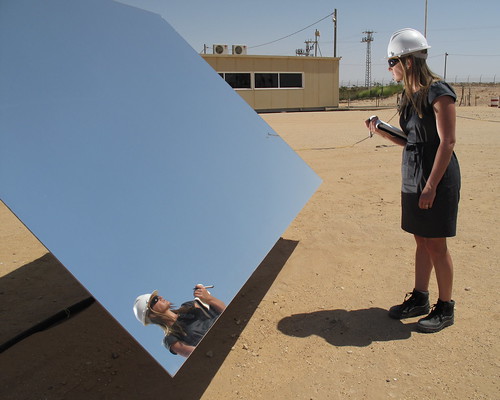
The US Department of Energy granted a US$1.37 billion loan guarantee to Brightsource Energy last week which could help clear the way for over 15 gigawatts of solar thermal power projects in California. Brightsource built a pilot plant in Israel to prove their technology and has tested it over the past 18 months. Their flagship Ivanpah project in California got a big boost when construction giant Bechtel agreed to build the plant.
Solar thermal (often referred to as CSP) is a way of harnessing the largest source of energy available to us, so in this post I’ll have a look at the upswing in interest in the technology in recent years and look at some of the approaches being pursued to make it economically competitive with coal fired power generation.
One-time Australian solar thermal company Ausra was the leader in terms of publicity a couple of years ago when I last covered this topic, but the company seems to have slipped off the pace, failing to build a large scale facility and recently being purchased by French energy company Areva.
Interest continues to bubble away in solar thermal power in Australia, with energy policy advocacy group “Beyond Zero Emissions” launching their “T10” campaign to switch Australia to 100% renewable power in a decade, largely using solar thermal power, and the Desertec Asia proposal also featuring CSP heavily. At one point Prime Minster Kevin Rudd was promising to build the world’s largest CSP plant here but that idea hasn’t had any media airtime lately – and neither has Worley Parsons’ proposal to build a large scale plant in north west WA. The most active plans to build a local CSP plant seem to be coming out of ERM Power, who are proposing gas / solar hybrid plants to be built in Queensland and/or NSW in conjunction with Siemens.
The company making the most waves from a technology point of view lately is Californian company eSolar, founded by IdeaLab’s Bill Gross. eSolar has been in the news lately as a result of their partnership to construct turnkey CSP systems with German company Ferrostaal in Spain, the United Arab Emirates and South Africa. eSolar has also received attention for Chinese plans to build 2000 MW of combined solar/biomass facilities using their technology.
eSolar’s Gross was recently interviewed for Yale Environment 360 and outlined his vision for improving the performance of solar thermal power generation, with some of his key points being :
* Use software to analyse and optimise performance of plants
The biggest lesson that we brought was — I don’t know if it was a lesson, but it was a philosophy — which is Internet-enable everything and put monitoring into everything.
So we have a microprocessor in every mirror and we have statistics second-by-second on the status, position, reliability, pointing accuracy — everything — of every single mirror. We structured ourselves almost like an Internet company from the beginning to have logs of everything — every revolution of the turbine, every control from the control room, every Web cam image captured — so we could do data mining and data analysis on everything.
We want the ability to make software upgrades and impact every power plant around the world. That’s probably one of the biggest differences between our technology and all other solar technology. If you [have] a big field of [photovoltaic] panels, those PV panels are there for 25 years. They’ll have that same performance, and there’s nothing you can do to change that.
We can make a software upgrade and every power plant in the world can suddenly put out 3 percent more power potentially. And we found already a number of software improvements that we can make even over the past six months, which significantly boosts performance of an already-constructed power plant. There’s new improvements we can make to the actual hardware, too, but even without changing the hardware there are software changes that can make more power, so we’re really excited about that.
* Don’t build plants, get utilities (customers) to.
For renewable energy, about 80 percent, maybe 90 percent, of the cost is upfront and there’s no fuel costs and the only cost over the years is operation and maintenance, which is small. The biggest bottleneck is that these things cost big dollars, and you’re limited how fast you can grow by how much money you can raise to build plants.
Our particular strategy to deal with that is to not have us be the bottleneck for raising that money. Our customers raise that money. If we want to renewably power this planet, it’s going to take a lot of capital, and that capital has to be spent upfront.
* Avoid environmental conflicts and transmission line costs by building smaller plants on brownfield sites near cities.
We have a strategy at eSolar to never impact pristine land. And the way we address that is several-fold. First, we have a higher output per acre, so we take a smaller footprint. Second, we’re economical at a smaller size. We can be fully economical at our 46-megawatt size. Those two things combined let us use a small enough footprint that we can locate on private land closer to population centers.
So rather than needing 2,000 acres contiguous to make the economics work — which you almost only can find far away on pristine land or [federal] land — we can locate on only 200 acres very close to a city and we can buy previously disturbed farmland or other properties that’s already been developed so we’re not causing any disturbance to natural habitat. And that’s an important part of our philosophy. It gives us an economic advantage because we’re locating closer to transmission. That’s probably even a bigger factor.
It takes years and years to build the transmission out to the pristine lands. [But] the power plant, for example, in Lancaster [California], is across the street from a transmission line. We didn’t have to build miles and miles of transmission, which takes years and years to get people to approve.
* Leverage energy storage and volume of scale in manufacturing to reduce costs.
I feel we still need to get almost another factor of two in the reduction of energy costs to potentially compete with coal. We’re already close to competing with natural gas. It depends on the sunshine and the region. Another factor of two is going to require two things to make that happen: Approximately 25 percent of that can be gotten by adding [energy] storage, and 25 percent can be gotten by increasing efficiency and lowering costs by volume production.
We produced 500 mirrors two years ago, 24,000 last year, and this year we’ll produce a million. So we’re going to get a quantity break just by going to a million mirrors from 24,000.
And everything gets more efficient in the supply chains as you get up to those volumes. Anything that we buy in our lives that has dramatic cost reduction has seen a million — a million cars, or a million iPhones, or a million laptops. So far there’s only been thousands of heliostats. So finally this year we’ll cross the million number and that’s when we can get the price reduction to really be competitive with fossil fuels.
Google recently announced they have developed a prototype for a new mirror technology that could cut by half the cost of building a solar thermal plant, with both eSolar and BrightSource expressing interest in using the technology.
Tyler Hamilton has an article at Technology Review on a new process using concentrated solar thermal power to convert biomass to biofuel – Gasifying Biomass with Sunlight.
Sundrop Fuels, a startup based in Louisville, CO, says it has developed a cleaner and more efficient way to turn biomass into synthetic fuels by harnessing the intense heat of the sun to vaporize wood and crop waste. Its process can produce twice the amount of gasoline or diesel per ton of biomass compared to conventional biomass gasification systems, the company claims.
Gasification occurs when dry biomass or other carbon-based materials are heated to above 700 ºC in the presence of steam. At those temperatures, most of the biomass is converted to a synthetic gas. This “syngas” is made up of hydrogen and carbon monoxide, which are the chemical building blocks for higher-value fuels such as methanol, ethanol, and gasoline.
But the heat required for this process usually comes from a portion of the biomass being gasified. “You end up burning 30 to 35 percent of the biomass,” says Alan Weimer, a chemical engineering professor at the University of Colorado, Boulder.
A few years ago, Weimer and his research team began looking at ways of using concentrated solar heat to drive the gasification process. It worked so well that Weimer and Chris Perkins, the graduate student who came up with the idea, went on to cofound Copernican Energy to commercialize the approach. Copernican was acquired by Sundrop Fuels in 2008, and its solar-reactor technology is now at the heart of a 1.5-megawatt thermal solar gasification demonstration facility in Colorado.
The SMH has an article on the possibility of further mergers and acquisitions in the Australian coal seam gas industry in the wake of the recent bif for Arrow Energy by Shell and PetroChina – More gas mergers in the pipeline.
WOODSIDE’S Don Voelte is a sceptic. The Nebraskan-born oil and gas devotee has been one of the most vocal doubters of the potential of coal seam gas as feedstock for the liquefied natural gas export market.
Voelte believes the handful of projects proposed for the Queensland coal seam gas market will prove uneconomic. In his view, the low calorific value of the gas, which is 98 per cent methane, and the absence of oil and condensate, puts these projects at a comparative disadvantage to conventional LNG projects.
”Selling gas from Pluto or the North-West Shelf from Woodside is different than a newbie that has never proven themselves, and your sophisticated customers in Japan, Korea, Taiwan and other places certainly look for that,” Voelte said last year.
”What I’m waiting for is the front-end engineering and economic analysis of this gas to get to the stage where a board of directors have to make $10 billion and $15 billion commitments to build. What are the economics of this lean gas? Where’s the marketplace for it?”
PetroChina helped answer Voelte’s question earlier this week when it announced it would join Royal Dutch Shell in a proposed $3.3 billion acquisition of Arrow Energy. The deal, which Arrow is considering, is a pure coal seam gas play, excludes Arrow’s international assets, and appears to be all about Shell securing enough gas for its proposed 16 million tonnes a year Curtis Island development. Shell would provide the technical expertise while PetroChina’s involvement creates a market for the gas.
It is an embarrassment for Voelte, who saw PetroChina walk away from a potential $45 billion deal to receive 2 million to 3 million tonnes a year of gas from Woodside’s $30 billion Browse Basin development due to a project delay.
His view on coal seam gas is one that has been shared by many oil and gas veterans. For many years, coal seam gas was referred to by many in the industry as ”girly gas”.
US farmers, who discovered coal seam gas in the 1970s, had little understanding of how to extract it, or interest in doing so. But the subsequent oil crisis led to some crucial early work. In Australia, BHP was a pioneer in the 1980s and ’90s but the gas proved uneconomic to extract. In fact, before Origin Energy started buying Queensland acreage in the Spring Gully and Fairview basins in 2002, total Australian production was about five petajoules and was not expected to increase.
But depleting oil reserves around the world and the ever-present focus on developing cleaner energy sources prompted a coal seam gas boom in 2008.
Graeme Bethune, chief executive of independent adviser Energy Quest, compares the flood of interest in coal seam gas two years ago to an ageing actor who becomes an overnight star.
”Now the whole sector is in the execution and implementation phase,” he said.
”There is no escaping the fact that oil is getting harder to find and the national oil companies have a large chunk of those reserves.
”Remember, the Western oil majors have only about 10 per cent of the world’s oil reserves,” Bethune said. ”So we are seeing them diversify into gas. LNG is a market that is growing and it has the added environmental advantage for them as well.”
The impact upon the climate caused by our current energy use cannot be sustained. The economic costs of current energy arrangements have been analysed in the Garnaut Climate Change Review Final Report.
There exists a large difference between the price paid by consumers in Australia for electrical energy, over 80% of which is produced from black and brown coal, and the true cost of this energy, when we factor in the environmental impacts. Such market distortions hinder the development and deployment of cleaner alternatives.
Likewise, in the area of transport, current practices in terms of supply and environmental impact are unsustainable in the longer term. At present, our transport needs are driven by the use of liquid hydrocarbons. This was at least domestically serviceable when Australia was self-sufficient in oil production, but this is no longer the case. A recent report has highlighted Australia’s growing dependence on foreign oil, which doubled our petroleum trade deficit to $10.85 billion in 2007–08.
This deficit can only grow over time, as Australia’s oil reserves continue to be depleted and production continues to fall. … With an assumed price of oil at US$100 per barrel, by 2020 our petroleum trade deficit will have risen to over $40 billion per annum, comparable to the size of the recent economic stimulus package.
The adaptation of the electricity and power distribution grid to facilitate the low-carbon economy appears to be pivotal. The current model of a ‘dumb’ grid, centralised power generation, and high-loss transmission is unsustainable. To quote our sister academy, the Australian Academy for Technological Sciences and Engineering:
Australia’s energy security requires a major increase in base-load electric power generation capacity to meet the expected growth in demand. The electricity grid must be planned to meet the long-term demands imposed by a diversity of technologies supplying power, including base-load and intermittent renewables, remote locations for some power generation and the need for stability of the system under variable supply and demand situations. There is a need to introduce consideration of the ‘national interest’ when planning future expansion of the grid.
Replacing the current energy generation regime with a model based upon renewable technologies will not be easy. Minister Martin Ferguson argues, ‘the factors limiting the uptake of renewables remain technical, not political. We must have a rational science-based pathway to overcome those hurdles. Faith alone will not get us there’.
This report aims to inform such a rational science-based pathway offering contributions to overcoming these technological problems. However, as the lecture series clearly demonstrated, there are many areas where the key science and technical problems have already been solved. Impeding the deployment of these technologies is a lack of both routes and financial support for innovation. To hasten the transition to the low-carbon economy, advantages of scale need to be achieved.
Several speakers in the lecture series acknowledged that further research by scientists, engineers, social scientists, economists and public policy researchers is required to expedite deployment of technologies and the cost-effective transition to the low-carbon economy. However, the series as a whole demonstrated beyond doubt that there is no complete science-based pathway to renewable energy that can be found within a single technology. Rather, we find that a holistic approach embracing complementary aspects of different technologies is to be preferred. Only such an approach can successfully address issues such as base-load power supply by renewables. …
Likewise, our approach to infrastructure development needs to be holistic and many-faceted. A report commissioned by WWF Australia states:
… modelling finds that there are sufficient low emission energy resources, energy efficiency opportunities and emissions reduction opportunities in non-energy sectors to achieve reductions of 60 to 80%, and even emissions reductions of 90% or more if livestock emissions are reduced; and that there is sufficient time for the low emission technologies and services to grow at sustainable rates if development starts promptly. The model finds that a sequential approach to low emission industry development (lowest cost technology first, then the next lowest cost technology and so on) requires much higher growth rates for each industry than one that grows a number of technologies/industries concurrently.
As Australia makes the transition to the low-carbon economy, some jobs in emission intensive industries will inevitably be phased out as alternative technologies and jobs appear to meet ongoing needs for energy, materials and services. The history of civilisation has many examples of occupations that have been revolutionised by new technologies which have served to raise living standards. Efforts should be taken to quantify the nature of the renewables revolution, especially in terms of workforce transitions and the need and perspective for retraining. However, to quote a CSIRO document:
… achieving the transition to a low carbon sustainable economy will require a massive mobilisation of skills and training – both to equip new workers and to enable appropriate changes in practices by the three million workers already employed in these key sectors influencing our environmental footprint. Current approaches do not appear sufficient for meeting these challenges.
We can become more energy efficient and at the same time grow our economy, as demonstrated by the example of Sweden. Since 1990, the economy of this country has grown by 50% while reducing its greenhouse emissions by 10%. To achieve a similar outcome, Australia must build infrastructure to reduce our greenhouse gas footprint, cut our dependence on liquid fuels, and enable the transition to a low-carbon economy. The full gamut of low-carbon renewable energy generation techniques has been ably reviewed in the report A Clean Energy Future for Australia.
This document builds upon the lecture series. It outlines the state of the technological alternatives, and provides a set of development options for consideration by policy-makers. The report is based upon, but is not strictly representative of, the inspiration and data provided by speakers at the Academy’s series of monthly public lectures, Australia’s Renewable Energy Future, held between 2 September 2008 and 4 August 2009.
Ten of Europe’s largest energy and engineering firms today joined forces to launch a new lobby group committed to advancing plans for a pan-European Supergrid capable of supporting new renewable energy capacity.
The Friends of the Supergrid (FOSG) group brings together renewable energy developers, producers of advanced transmission cables, engineering firms and grid operators.
The founding members include 3E, AREVA T&D, DEME Blue Energy, Elia, Hochtief Construction AG, Mainstream Renewable Power, Parsons Brinckerhoff, Prysmian Cables & Systems, Siemens and Visser & Smit Marine Contracting.
Speaking at the launch of the new group, Mainstream Renewable Power’s chief executive Dr Eddie O’Connor said the coalition of companies could play a key role in promoting an idea that will be essential to the long-term decarbonisation of Europe’s economies.
“The UK government has recently shown its commitment to large-scale offshore wind by announcing the development of up to 50GW by 2020,” he said. “We now need to integrate this huge resource into Europe to enable the open trade of electricity between member states. The FOSG is uniquely placed to influence policy-makers towards creating the Supergrid and, ultimately, change how we generate, transmit and consume electricity for generations to come.”
Experts have long argued that the development of a Supergrid will make it far easier for grid operators to manage intermittent energy supplies from renewable resources such as offshore wind farms, allowing them to export excess power when winds are good and import energy from other regions when poor winds result in less power.
The concept is now climbing up the political agenda after nine EU member states, including the UK and Germany, signed up to the N orth Seas Countries Offshore Grid Initiative (NSCOGI) late last year, agreeing to co-operate on the development of a grid that will allow them to share energy produced by new offshore wind farms.
Meanwhile, in Germany the Destertec consortium of firms is working on plans for a similar supergrid designed to import power from solar farms in North Africa to much of continental Europe.
Designed for the Phillips Simplicity Event in 2008, the Sustainable City Light is an intelligent outdoor lighting system meant to enhance city life by providing accurate lighting on demand as needed. The LED lights feature motion sensors that are triggered once the sun sets by individuals walking in close proximity to the light. If no one is around, the lights conserve energy by remaining off.
Powered by the sun, the street light blooms open during the day to collect energy through its solar panels. The five solar panel petals generate more than enough power to keep the lights on and any extra power is fed directly into the grid for use elsewhere.
This seems to be the year for green iPhone apps, with already over 100 to choose from, including TreeHugger’s own which was launched last month and the Green Map app launched recently. Now here is one for the biomimicry and architecture fans amongst you. Dennis Dollens, the architect who grows buildings, has just made his work available via the iPhone.
Dollens’ latest comic carries on where his last one left off. It is about developing ideas to combine technology with biology in an architectural context. He is constantly studying plants and looking for biomimetic ideas to apply to buildings and designs, in order to create bio-architecture; clean, eco-friendly buildings that could filter pollution, harvest energy and much more.
In order to communicate these ideas and inspire others to come up with more, Dollens writes comic books. Most of them are available as downloadable PDFs via his site on Issuu, but now you can read BioDesign #3 as an iPhone application in a beautifully re-designed, much easier to handle, format.
The FT has an article on a joint Shell / Chinese takeover bid for Queensland CSG producer Arrow Energy (I was pleased to see they included a link to my old coal seam gas post – I haven’t seen many incoming links from the mainstream media lately – unsurprisingly given the scarcity of original content here lately) – Shell, PetroChina and Arrow: the next big resources grab.
One potential glitch, however, might be the sensitivities Down Under about China’s growing interest in buying up Australian natural resources companies. Although all has been relatively quiet recently, the reverberations from a string of deals – successful and otherwise – last year are still being felt.
Not only does the offer highlight the push by Shell and PetroChina to dominate Australia’s coal-bed methane gas sector. It also puts the focus on Australia’s emergence as a leader in unconventional gas – even as analysts predict a wave of consolidation in the sector amid too many competing projects.
Even so, as the FT notes in a separate analysis, the boom in the domestic US shale gas industry – another form of unconventional gas – comes just as Australia is set to secure its path to becoming the world’s biggest exporter of unconventional gas.
Technology Review has an article on 1666 Technologies’ “hopes to cut the cost of solar with cheaper manufacturing” (yet another company aiming to make the cost of solar power lower than that of coal)- Making More Solar Cells from Silicon.
A new manufacturing process could cut the cost of making crystalline silicon wafers for solar cells by 80 percent. The process is being developed by Lexington, MA-based 1366 Technologies, which this week showed off the first solar cells made this way. The technology is key to the company’s plan to make solar power cheaper than the electricity generated from coal within 10 years.
Silicon wafers are the core component in conventional solar cells–they’re what absorbs sunlight and generates electrons. Yet the way wafers are currently manufactured wastes half of the expensive, ultra-pure crystalline silicon they’re made from. When large ingots of silicon are cut into hair-thin wafers, waste silicon is lost as sawdust. The new process–details of which remain secret–produces wafers directly from molten silicon without any sawing. This saves material and reduces the number of steps needed to make solar cells, both of which bring down costs.
“The technology could be disruptive,” says Reidar Langmo, the CEO of Novus Energy Partners and the founder of the solar company REC. Langmo recently joined the board at 1366.
The shift to clean energy can occasionally make for some bizarre political spectacles, with George Monbiot’s latest column in The Guardian being a spectacular example (in this case a socialist making the economic rationalist argument against solar PV in the UK) – Are we really going to let ourselves be duped into this solar panel rip-off?.
Those who hate environmentalism have spent years looking for the definitive example of a great green rip-off. Finally it arrives, and nobody notices. The government is about to shift £8.6bn from the poor to the middle classes. It expects a loss on this scheme of £8.2bn, or 95%. Yet the media is silent. The opposition urges only that the scam should be expanded.
On 1 April the government introduces its feed-in tariffs. These oblige electricity companies to pay people for the power they produce at home. The money will come from their customers in the form of higher bills. It would make sense, if we didn’t know that the technologies the scheme will reward are comically inefficient.
The people who sell solar photovoltaic (PV) panels and micro wind turbines in the UK insist they represent a good investment. The arguments I have had with them have been long and bitter. But the debate has now been brought to an end with the publication of the government’s table of tariffs: the rewards people will receive for installing different kinds of generators. The government wants everyone to get the same rate of return. So while the electricity you might generate from large wind turbines and hydro plants will earn you 4.5p per kilowatt hour, mini wind turbines get 34p, and solar panels 41p. In other words, the government acknowledges that micro wind and solar PV in the UK are between seven and nine times less cost-effective than the alternatives.
It expects this scheme to save 7m tonnes of carbon dioxide by 2020. Assuming – generously – that the rate of installation keeps accelerating, this suggests a saving of about 20m tonnes of CO2 by 2030. The estimated price by then is £8.6bn. This means it will cost about £430 to save one tonne of CO2.
Last year the consultancy company McKinsey published a table of cost comparisons. It found that you could save a tonne of CO2 for £3 by investing in geothermal energy, or for £8 by building a nuclear power plant. Insulating commercial buildings costs nothing; in fact it saves £60 for every tonne of CO2 you reduce; replacing incandescent lightbulbs with LEDs saves £80 per tonne. The government predicts that the tradeable value of the carbon saved by its £8.6bn scheme will be £420m. That’s some return on investment.
The reason for these astonishing costs is that the government expects most people who use this scheme to install solar panels. Solar PV is a great technology – if you live in southern California. But the further from the equator you travel, the less sense it makes. It’s not just that the amount of power PV panels produce at this latitude is risible, they also produce it at the wrong time. In hot countries, where air conditioning guzzles electricity, peak demand coincides with peak solar radiation. In the UK, peak demand takes place between 5pm and 7pm on winter evenings. Do I need to spell out the implications?
We have plenty of ambient energy, but it’s not to be found on people’s roofs. The only renewables policy that makes sense is to build big installations where the energy is – which means high ground, estuaries or the open sea – and deliver it by wire to where people live. But the government’s scheme sloshes money into places where resources are poor and economies of scale impossible.
Jeremy Leggett has an opposing column, arguing “economies of scale in manufacturing are causing rapid reductions in costs and solar energy has a bright future” – Solar panels are not fashion accessories.
First, Monbiot gets the workability of solar wrong. He says: “The amount of power PV panels produce at this latitude is risible, [and] they also produce it at the wrong time.” Those who buy panels, therefore, will own a mere “fashion accessory”. The companies who manufacture solar PV in the UK have shown that putting solar panels on all available building surfaces would generate more electricity in a year, under typical cloudy British skies, than the entire electricity consumption of our energy-profligate nation. Some fashion accessory.
Of course, just a fraction of that area of buildings would suffice because we would want to mix and match renewable technologies – large and small, onshore and offshore – so matching loads and compensating for the fact that solar generates by day and not by night.
Second, Monbiot says the government’s scheme targets money where economies of scale are “impossible” – an incorrect assumption because solar electricity costs will inevitably fall to the point, within just a few years, where they are cheaper than any form of fossil fuel and nuclear electricity. Systemic economies of scale in solar manufacturing and installation techniques are causing rapid reductions in solar PV costs globally, just as Ofgem and others worry so loudly about the inevitable rise of traditional electricity costs.
Third, Monbiot gets the precedent for the British government’s solar “cash-back” scheme – the German feed-in tariff – upside down. He says the “German government decided to reduce sharply the tariff it pays for solar PV, on the grounds that it is a waste of money”.
But all feed-in tariffs are supposed to decline, and indeed reduce to zero within some years – that is the whole point. They are not like the market-building schemes for the nuclear technologies that Monbiot advocates, where subsidies – open and hidden – are needed for decades. Most Germans are rightly proud of their feed-in tariff regime. They have, after all, created over 50,000 jobs in solar PV alone.
Fourth, Monbiot has it wrong about who pays the cash back. “The government is about to shift £8.6bn from the poor to the middle classes,” he says. But the number is not the cost to “the poor”. It’s not even the cost to all electricity consumers over the next two decades. The cumulative cost to all consumers – including all non-domestic industrial, public sector, and commercial users and covering all technologies in the scheme – is £6.7bn, and is spread over 20 years.
The average household levy in 2013, when tariff rates are all up for review, is likely to be less than £3. This is far less than the average saving from the government’s various domestic energy efficiency measures over the same period. So there is no net subsidy. The levy is not “regressive” at all.
I’ve reworked my recent post on the Tea Party movement and added some more commentary and a oil consumption scenario that shows the magnitude of the transition facing the average American, even under a fairly optimistic “peak oil” assumption of 2026 – Peak Oil And The Tea Party Movement.
Time Magazine recently had an article (Why the Tea Party Movement Matters) that looked at the latest manifestation of populism in the United States, with widespread discontent at the state of the US economy and the US political system, particularly the lack of transparency evident in many government initiatives ranging from the bail-out of the financial system to proposed changes to healthcare, along with discontent about costly wars in the middle east that seem to be never-ending.
The “tea partiers” remain a somewhat disorganised grass-roots movement (albeit one with concerted efforts by the conservative establishment to pull their strings) and they are showing some signs of adopting the tactics of the hippie counterculture of past decades and simply dropping out of mainstream society (see this piece on the “Rippies” for some background), but they do have the potential to grow as a result of a number of problematic trends affecting the western world in general and the United States in particular.
The graph below shows a possible scenario for average per capita oil consumption in the United States over the next 40 years, which could possibly drop by 90%. In this post I’ll have a look at the boost this is likely to give to populist politics and some of the possibilities for addressing this.
The oil production scenario is a simple one most peak oil analysts would find optimistic – it is based on peak production being achieved in 2026.
Global and US population numbers are based on population models that show global population rising to 9.5 billion (and US population rising to 530 million) in 2050.
The US consumption model assumes that US per capita oil consumption will equalise with that elsewhere in the world over the next 40 years as a result of globalisation.
Today there is a lot of worry and concern–you see it in the papers, you see it in the speeches of politicians–about climate change, about environmental damage, about falling water tables, about food and oil scarcity, and so forth. These are really not problems, they are symptoms. It is like your friend has cancer, and therefore has also a headache. The headache is a symptom. It is not in itself the problem. You can take care of the headache–you can give pain killers, or something, but if the headache goes away you don’t imagine that the problem is solved.
Climate change, energy scarcity, these things are symptoms. Maybe we could solve them, maybe we won’t. But even if we do, it doesn’t eliminate the problem. The problem is physical growth, continued population expansion, continued increase in material standards of living, in a world that has finite limits.
The Arctic Ocean seabed off eastern Siberia has destabilized and is leaking methane, threatening to add to global warming, scientists in Russia, the U.S. and Sweden said today.
About 8 teragrams (8 million metric tons) of the greenhouse gas is leaking yearly from the East Siberian Arctic Shelf, the researchers said in a study in the journal Science. That’s as much as is emitted from the rest of the oceans, they said.
Methane leaks are important to scientists studying climate change because it is 25 times more potent than carbon dioxide as a global warming gas. While the researchers said the leakage doesn’t “alarmingly” alter estimates for global emissions, it may be a precursor to larger venting of the gas.
“Subsea permafrost is losing its ability to be an impermeable cap,” said Natalia Shakhova, a scientist at the University of Alaska Fairbanks who led the research. “If it further destabilizes, the methane emissions may not be teragrams, it would be significantly larger.”
The United Nations Intergovernmental Panel on Climate Change in 2007 estimated some 582 teragrams of methane are emitted yearly. The atmospheric concentration of the gas in 2008 rose to a record 1,797 molecules per billion molecules of air, the UN’s World Meteorological Organization said Nov. 24.
Todd Woody (who seems to be writing for half the green business periodicals in the US) has an interview with (solar thermal power company) eSolar CEO Bill Gross at Yale Environment 360 – A High-Tech Entrepreneur On the Front Lines of Solar. Gross talks about how techniques from the software industry are being applied to continuously improve the performance of next generation CSP plants, how the Chinese market is moving much faster than that in the US, how eSolar tries to build smaller plants on private land close to cities to avoid the transmission bottlenecks plaguing remote locations currently and what is needed to make CSP cost competitive with coal fired power.
Bill Gross is not your typical solar energy entrepreneur. In a business dominated by Silicon Valley technologists and veterans of the fossil fuel industry, Gross is a Southern Californian who made his name in software. His Idealab startup incubator led to the creation of companies such as eToys, CitySearch, and GoTo.com. The latter pioneered search advertising — think Google — and was acquired by Yahoo for $1.6 billion in 2003.
That payday has allowed Gross to pursue his green dreams. (As a teenager, he started a company to sell plans for a parabolic solar dish he had designed.) Over the past decade, Gross has launched a slew of green tech startups, including solar power plant builder eSolar, electric car company Aptera, and Energy Innovations, which is developing advanced photovoltaic technology.
But it has been eSolar, backed by Google and other investors, that has been Idealab’s brightest light. In January, the company signed one of the world’s largest green-energy deals when it agreed to provide the technology to build solar farms in China that would generate 2,000 megawatts of electricity — at peak output the equivalent of two large nuclear power plants. And last week, eSolar licensed its technology to German industrial giant Ferrostaal to build solar power plants in Europe, the Middle East, and South Africa. Those deals followed eSolar partnerships in India and the U.S.
ESolar’s power plants deploy thousands of mirrors called heliostats to focus the sun’s rays on a water-filled boiler that sits atop a slender tower. The heat creates steam that drives an electricity-generating turbine. Last year, eSolar built its first project, a five-megawatt demonstration power plant, called Sierra, in the desert near Los Angeles.
This “power tower” technology is not new, but what sets the company apart is Gross’ use of sophisticated software and imaging technology to control the 176,000 mirrors that form a standard, 46-megawatt eSolar power plant. That computing firepower precisely positions the mirrors to create a virtual parabola that focuses the sun on the tower. That allows the company to place small, inexpensive mirrors close together, which dramatically reduces the land needed for the power plant and cuts manufacturing and installation costs. …
e360: Were there any particular lessons you were able bring from the Internet industry to the solar industry?
Gross: The biggest lesson that we brought was — I don’t know if it was a lesson, but it was a philosophy — which is Internet-enable everything and put monitoring into everything.
So we have a microprocessor in every mirror and we have statistics second-by-second on the status, position, reliability, pointing accuracy — everything — of every single mirror. We structured ourselves almost like an Internet company from the beginning to have logs of everything — every revolution of the turbine, every control from the control room, every Web cam image captured — so we could do data mining and data analysis on everything.
We want the ability to make software upgrades and impact every power plant around the world. That’s probably one of the biggest differences between our technology and all other solar technology. If you [have] a big field of [photovoltaic] panels, those PV panels are there for 25 years. They’ll have that same performance, and there’s nothing you can do to change that.
We can make a software upgrade and every power plant in the world can suddenly put out 3 percent more power potentially. And we found already a number of software improvements that we can make even over the past six months, which significantly boosts performance of an already-constructed power plant. There’s new improvements we can make to the actual hardware, too, but even without changing the hardware there are software changes that can make more power, so we’re really excited about that. …
e360: At a time when some big solar power plant projects are bogged down in disputes over their environmental impact on desert ecosystems and their water consumption, eSolar so far has avoided such controversies.
Gross: We have a strategy at eSolar to never impact pristine land. And the way we address that is several-fold. First, we have a higher output per acre, so we take a smaller footprint. Second, we’re economical at a smaller size. We can be fully economical at our 46-megawatt size. Those two things combined let us use a small enough footprint that we can locate on private land closer to population centers.
So rather than needing 2,000 acres contiguous to make the economics work — which you almost only can find far away on pristine land or [federal] land — we can locate on only 200 acres very close to a city and we can buy previously disturbed farmland or other properties that’s already been developed so we’re not causing any disturbance to natural habitat. And that’s an important part of our philosophy. It gives us an economic advantage because we’re locating closer to transmission. That’s probably even a bigger factor.
It takes years and years to build the transmission out to the pristine lands. [But] the power plant, for example, in Lancaster [California], is across the street from a transmission line. We didn’t have to build miles and miles of transmission, which takes years and years to get people to approve. …
e360: Where do you see the next big innovations in solar thermal technology coming from?
Gross: I feel we still need to get almost another factor of two in the reduction of energy costs to potentially compete with coal. We’re already close to competing with natural gas. It depends on the sunshine and the region. Another factor of two is going to require two things to make that happen: Approximately 25 percent of that can be gotten by adding [energy] storage, and 25 percent can be gotten by increasing efficiency and lowering costs by volume production.
We produced 500 mirrors two years ago, 24,000 last year, and this year we’ll produce a million. So we’re going to get a quantity break just by going to a million mirrors from 24,000.
And everything gets more efficient in the supply chains as you get up to those volumes. Anything that we buy in our lives that has dramatic cost reduction has seen a million — a million cars, or a million iPhones, or a million laptops. So far there’s only been thousands of heliostats. So finally this year we’ll cross the million number and that’s when we can get the price reduction to really be competitive with fossil fuels.