Author: Big Gav

  • IBM’s Chinese Smart Grid Ambitions

    Earth2Tech has an article on IBM’s involvement in Chinese smart grid initiatives – IBM’s Chinese Smart Grid Ambitions.

    When Forbes reported in November that IBM was launching a major utility and energy research lab in China and planned up to nine big smart grid projects in the country, it came as little surprise to many. After all, China is going to be spending much more than the U.S. or Europe on building out its grid to meet its massive population’s growing energy needs — a fact that’s drawn other grid giants like General Electric, ABB and Siemens into the country as well. IBM has already said that it expects to generate $400 million in smart grid revenues in China over the next four years. What’s it planning to do to earn the money?

    On Thursday, IBM drew back the curtain a bit on its Energy & Utilities Solutions Lab, including details of various pilot projects underway with China’s massive government-owned utility, State Grid Corporation of China and other partners. Those projects range from managing the flow of power from nuclear plants and massive wind farms to transmission and distribution grids — similar to the work IBM does for utilities in the U.S. and in Europe — to some smart grid realms where IBM has made less of a splash, such as managing energy efficiency down at the consumer level, including electric vehicles.

    “We’ve expanded from smart grid, to look at the energy value chain, from the supply source all the way down to the consumer source,” is how Bradley Gammons, IBM’s vice president of energy and utilities sales and distribution, put it to us in a phone interview from Beijing. In particular Gammons said that IBM has been looking more closely at the consumer and the role the consumer will play as a dispatchable demand response resource as they adopt electric vehicles. China is expected to see half the world’s installations of electric vehicle chargers over the coming years, according to Pike Research.

    Smart grid industry watchers will no doubt be keeping an eye on which Chinese smart grid companies IBM chooses to partners with. The Chinese government requires that its wind power projects have at least 70 percent made-in-China components, and observers have noted that State Grid and other massive government-owned utilities will be making similar pushes to help domestic companies get a piece of the smart grid pie.

    Gammons noted that State Grid has already announced technology standards for manufacturers who want to build some of the 170 million smart meters it wants to deploy over the coming years. While U.S. smart meter makers including Itron and Echelon are eying that market, major Chinese meter makers such as Jiangsu Linyang Electronics, Ningbo Sanxing Technology and Wasion Group will no doubt be contenders as well.

    On the other hand, some industry observers have noted that giants like IBM, GE, Siemens, Cisco and Hewlett Packard may have a leg up on the Chinese competition when it comes to cutting-edge smart grid technologies — particularly in the “system of systems” integration projects that IBM specializes in.

  • The questions we don’t ask: A review of the Australian Energy Resource Assessment

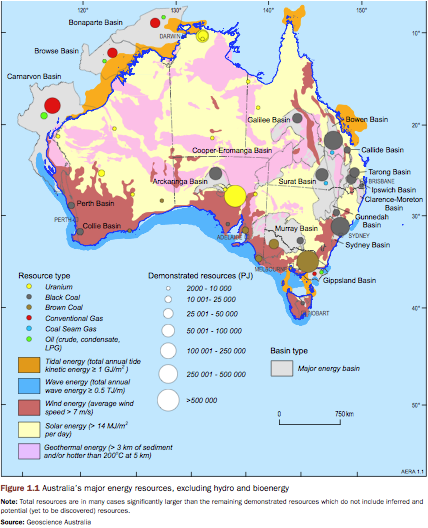
    Cameron Leckie of ASPO Australia has a review of the Australian Energy Resource Assessment (AERA)The questions we don’t ask: A review of the Australian Energy Resource Assessment.

    The recently released Australian Energy Resource Assessment (AERA), particularly the aspects related to oil, is yet another example of how our Government, and the bureaucracies supporting it, are failing to ask the right questions. The unfortunate consequences of this approach implies that Australia will be left with few options to respond to a very challenging set of problems, something that could and should be avoidable.

    It should be noted that most of the information in Chapter three – oil of the AERA is good, particularly the assessment of Australia’s future oil production. To the lay person it would appear to be a thorough and accurate appraisal of Australia’s oil situation. The problem’s lie in the nuances, the fallacies, the assumptions and the reliance on a narrow and far from fool proof set of data and projections on the international oil arena. These shortfalls could have significant implications for Australia, so lets take a closer look.


  • Shell Aims for ‘New Nigeria’ as Qatari GTL Plant Starts

    Bloomberg reports that Shell’s gas to liquids plant in Qatar has commenced operation – Shell Aims for ‘New Nigeria’ as Qatari Plant Starts.

    Royal Dutch Shell Plc spent $19 billion to build the world’s largest gas-to-liquids project, triple the original estimate. Now, it’s pay-off time and the plant may generate $6 billion a year for the company and Qatar.

    Shell needs the plant, known as Pearl, to bolster output, which fell for a seventh year in 2009 in part because rebel violence hampered oil ventures in Nigeria. Qatar, the arid Gulf state that’s become the biggest exporter of gas on ships, may account for 10 percent of the company’s production after Pearl and a liquefied natural gas project start deliveries next year.

    Shell’s work in Qatar is “like creating a new Nigeria,” Andrew Brown, the company’s executive vice president for the country, said in an interview in the capital, Doha. Pearl will begin processing gas toward the end of this year and start delivering fuel in early 2011, he said.


  • 918 Spyder is Porsche’s First Ever Plug In Hybrid Electric Car

    Inhabitat reports that Porsche is looking to produce a plugin hybrid sports car – 918 Spyder is Porsche’s First Ever Plug In Hybrid Electric Car.

    Porsche recently blew everyone at the Geneva Auto Show out of the water with their freshly unveiled electric concept car – their first plug-in hybrid ever. Dubbed the 918 Spyder, this stealthy-looking ride is a parallel hybrid just like the Prius – well, except much, much sexier. It also supposedly gets 78 miles per gallon, has emissions of 70g CO2/km, can go 16 miles on electric charge alone, and does 0-60 in just 3.2 seconds. Oh and did we mention that it’s drop-dead gorgeous too?


  • Western Power names smart meter suppliers

    ZD Net has a report on Western Australia’s first steps towards a smart grid – Western Power names smart meter suppliers.

    Western Power has announced the partners which will be providing software and meters for its smart grid trial, with meters expected to be installed by June.

    Western Power smart grid project manager Andrew Wood told ZDNet.com.au that it had chosen suppliers for the four-year trial, aimed at remotely collecting and analysing customers’ energy consumption patterns.

    Silver Springs, an American smart grid services provider, will supply communications and network software, while Landis + Gyr will provide the meters, with contracts valued at a combined $5.33 million. Western Power’s in-house IT team will complete the systems integration.

    Landis + Gyr, an international provider of meters for smart grid projects, also recently signed a contract with CitiPower and Powercor to provide similar technologies to the Victorian smart meter roll-out — the biggest so far in Australia.

    Field deployment across WA’s eastern corridor, Denmark and Walpole areas, will be conducted by Western Power’s metering services provider Service Stream for the sum of $880,000.

    IBM, another contractor in Western Power’s smart grid trial, won a $500,000 deal in December last year to design the network that connects the smart meters with Western Power’s existing systems. According to Wood, the provisions of the contract with IBM have been completed, with IBM “fulfilling its role” in the project.

    The trial will see around 11,500 meters installed between April and June this year. The meters will be connected to Western Power systems via its fibre network, with RF mesh communications being used for the last mile.

    Over the next two years, data will be collected and analysed to justify the business case of rolling out meters to 1 million users, according to Wood.


  • Cars about to get cleaner and faster

    The Business Spectator has an enthusiastic look at the prospects for electric cars, citing improving technology, global warming and peak oil as drivers – Cars just got cleaner and faster.

    When we focus on news that reinforces our environmental challenges, of which there’s no shortage, we forget just how exciting the opportunities in fixing them are and how fast these solutions are now accelerating. Every story about melting icecaps or raging floods brings a smarter, cleaner world closer. My favourite example at the moment is electric cars. While they had a bad start, we are now on the verge of the breakthrough we’ve been waiting for, with around 30 models coming into the market from the major car companies and new start-ups over the next three years.

    If we get this right, it’s hard to overstate the significance of the upside. This is a real game changer for our transport and energy systems. Forget any old ideas you have about niche markets, limited range and slow cars. There are some very exciting cars on the way and some business concepts that could change not just personal transport but the whole electricity sector. How will this unfold? …

    Heard all this before and wondering if its real? Warren Buffet certainly thinks its is. He invested US$230 million in Chinese electric car company BYD in 2008 and his 10% stake is now worth close to $2 billion. China plans to put a million electric cars on the road by 2012 so BYD (Build Your Dream) is looking like delivering on its name for its owners.

    As a transition this dramatic takes off in a market, it’s hard to tell where it will head but in any outcome the implications for consumers, business and markets are certainly profound. Alan Kohler makes an interesting argument in his investment newsletter The Eureka Report as to why all cars will be electric within 20 years. He points out that when people come to believe that the electric car is going to be the clear winner, they will suddenly realise their old petrol car will have close to zero resale value within a few years. At that point there will be a rush to go electric, to avoid the inevitable price collapse in second hand petrol cars. This will of course be self-reinforcing when it takes off.

    Of course we can’t be sure which technologies, business models and companies will succeed. What we can now safely accept however is that with so many people and so much money focused on making this work, the time has clearly arrived when the internal combustion engine is heading for a rapid sunset.

    Let your mind run over the implications of that for the oil industry and peak oil.


  • Bill McKibben: The Attack on Climate-Change Science

    TomDispatch has a guest post by Bill McKibben on global warming politics and perceptions – The Attack on Climate-Change Science.

    “In early 2009,” writes Bill McKibben in a soon-to-be-published new book, “just as Obama was getting set to unveil his energy plans, word came that 2,340 lobbyists had registered to work on climate change on Capitol Hill (that’s about six per congressman), 85 percent of them devoted to slowing down progress.” By early 2010, you can see the results of such efforts, multiplied many times over by the staggering levels of support available for anti-climate-change work from the richest industry on the planet: the energy business. All this was not helped, of course, by the much hyped “climate-gate” which proved that climate-change scientists were fallible human beings and not simply extraterrestrial super-brains. These “scandals” were, in turn, blown up to proportions that seemed to blot out the very image of the disappearing Arctic icepack.

    Not surprisingly, perhaps, the latest poll on the American public’s attitude toward climate change shows startling drops in the belief in the very existence of climate change, in humanity’s role in causing it, and in its import for the planet: a 14-point drop since October 2008 in Americans who believe climate change is happening at all (to 57%), a 10-point drop in those who believe that human activity is at the root of the problem (to 47%), and a 13-point drop in those who claim to be “somewhat” or “very” worried about the problem (to 50%).

    What’s strangest in all this is that the evidence for our changing planet seems to stare us in the face — from the previously mythical, now navigable Northwest Passage to melting glaciers just about everywhere to more intense storms (including, of course, more intense snowstorms because, despite the name “global warming,” no one has yet banished winter from the planet). What makes this sadder yet is that, if the U.S. refuses to deal with our planet’s health and well-being (and ours), everything becomes so much harder, so much less likely.


  • India Studies Feasibility of Over 100 MW Of Tidal Energy Projects

    Ocean Power Magazine has an article on Indian interest in tidal powerIndia Studies Feasibility of Over 100 MW Of Tidal Energy Projects.

    A small British-based tidal energy company has won a landmark contract to attempt to harness the power of the sea around India for the first time. Atlantis Resources has forged a deal with the western state of Gujarat, under which the privately owned company will establish the feasibility of developing tidal power projects capable of generating more than 100 megawatts of power — enough to supply about 40,000 households.

    Of particular interest are the Gulf of Kutch and the Gulf of Khambhat in the Arabian Sea: two sites renowned for extreme daily tides. The project could lead to hundreds of millions of pounds worth of investment in tidal energy if the results of the study are positive.

    India has more than 4,500 miles of coastline and is scrambling to tackle a gaping power deficit but has yet to establish a single tidal power project. The move to explore the untapped resource comes ahead of the United Nations Climate Change Conference in Copenhagen, an event where India will strive to demonstrate that it isdoing its utmost to limit emissions while refusing to cap economic growth.

    India, which imports 70 per cent of its oil and relies on modest coal reserves to generate most of its electricity, is on course to become the third-largest user of energy by 2030, behind the US and China.

    Atlantis’s backers include Morgan Stanley and Statkraft, the Norweigan state utility. The company, which is run by Tim Cornelius, an Australian former pilot of manned submersibles, is also hoping to establish a £400 million project to build one of the world’s biggest tidal power plants in the Pentland Firth, off the Scottish coast.


  • U.S. Offers BrightSource CSP Project Loan Guarantee

    The NYT reports that the US Government is offering loan guarantees for a large scale solar thermal power project in California – U.S. Offers Solar Project a Crucial Loan Guarantee.

    The United States Department of Energy offered a $1.37 billion loan guarantee on Monday to a California company planning to build a large-scale solar power plant in the Southern California desert, The New York Times’s Todd Woody reported.

    The loan guarantee for BrightSource Energy of Oakland, Calif., is the largest the department has given for a solar power project. BrightSource’s planned project, the Ivanpah Solar Electric Generating System, is the first utility-scale solar power plant to undergo licensing in California in nearly two decades.

    It would use solar thermal technology, in which mirrors concentrate sunlight to heat a fluid and generate steam. If built, it would be the largest of its kind.

    “We’re not going to sit on the sidelines while other countries capture the jobs of the future — we’re committed to becoming the global leader in the clean energy economy,” Steven Chu, the energy secretary, said in a statement.

    The loan guarantee is contingent on the Ivanpah project passing state and federal environmental reviews. …

    Executives at BrightSource, which is backed by Google, Morgan Stanley, Chevron and BP, have said the loan guarantee is crucial to obtaining financing to build the plant at a time when banks are reluctant to finance new technologies. The company will not disclose the total projected cost of the power plant.

    The Ivanpah plant will deploy thousands of mirrors, called heliostats, that focus the sun on three towers that will each contain a boiler filled with water. The focused heat creates steam that drives a turbine to generate electricity. The plant, to be built by Bechtel, is expected to create 1,000 construction jobs.

    BrightSource has signed contracts to deliver 2,600 megawatts of electricity to the utilities Pacific Gas and Electric and Southern California Edison.

    The NYT also reports that Chevron is looking to build a CPV (Concentrating Solar Photovoltaic) system at a New Mexico mine site – Chevron Technology to Build N.M. Solar Plant .

    Chevron Corp.’s emerging technologies unit will build the largest U.S. power plant that uses lenses to focus sunlight onto photovoltaic cells, company officials said yesterday

    Chevron Technology Ventures will build the 1 megawatt concentrating photovoltaic power array on the tailing site of Chevron Mining Inc.’s molybdenum mine in Questa, N.M. The project will use lenses — instead of mirrors, like those employed at solar thermal arrays — to focus sunlight onto 175 photovoltaic panels. Germany’s Concentrix Solar GmbH will provide the concentrating photovoltaic system. …

    The array will be the largest concentrated photovoltaic (CPV) installation in the United States and one of the largest in the world, Chevron Technology Ventures President Des King said. The technology is expected to work best in areas such as New Mexico’s desert, which have high direct solar radiation.


  • WalMart’s carbon ultimatum

    The Business Spectator reports that WalMart is looking to exert pressure on its suppliers to reduce embedded carbon emissions in the products it sells – WalMart’s carbon ultimatum.

    Last week, the world’s largest retailer, WalMart, laid down a challenge to its more than 100,000 suppliers around the world: it told them it intends to cut 20 million tonnes of carbon dioxide emissions from its supply chain within five years.

    Whatever you think about the course of international climate change negotiations or even of a domestic cap-and-trade policy in the US, when the largest company and biggest private employer in the world’s biggest economy decides that its long term competitiveness, value and costs will gain from a lower carbon footprint, then it is likely to have just as big an impact on global commerce and goods and the further development of energy efficiency and sustainability.

    The $US405 billion retailer is the first to address its supply chain on a global scale, although other corporate leaders such as the carpet group Interface have also looked to cut their emissions dramatically through the supply chain.

    WalMart estimates that 90 per cent of its carbon footprint comes from the supply chain, and this move will add to other measures it has taken on its own emissions, which include the installation of solar energy sources on top of its stores and sourcing power from wind turbines as it seeks a move to 100 per cent renewable energy, and take a whole range of other environmental measures.

    The US Environmental Defense Fund, which has helped Walmart shape its policy, said it would have the effect of launching “a race and a treasure hunt among its suppliers to reduce carbon”.

    A pilot scheme had already proved successful, with 28,000 tonnes of greenhouse gas emissions eliminated last year because its DVD supplier, Fox Home Entertainment, reduced packaging.

    Walmart’s other major suppliers include the likes of Procter & Gamble, Unilever, Coca-Cola, PepsiCo, Kraft, Sony, Apple, HP, and Dell – a who’s who of the US’ largest corporates who will now have to focus on their own carbon emissions, and look to use less energy, do more recycling and make things more efficiently. It is very likely to have a cascading effect through the economy.


  • Sweden to Build 2,000 New Wind Turbines, Aims for 50% Renewables by 2020

    TreeHugger reports on Sweden’s progress towards a clean energy economy – Sweden to Build 2,000 New Wind Turbines, Aims for 50% Renewables by 2020.

    Sweden’s Enterprise and Energy Minister Maud Olofsson announced that 2,000 new wind turbines will be built in the in the Scandinavian country over the next 10 years. This would add a projected 10 terawatt hours (TWh) per year of renewable energy generation to the country’s grid, which is already very low-carbon because it gets most of its power from nuclear and hydro.

    “Sweden has extremely good prospects for rapidly increasing the production of renewable energy, especially from the burning of biofuels, cogeneration plants and windpower,” Olofsson wrote in a newspaper column.

    Sweden wants about 50% of its electricity to come from renewable sources by 2020 (this would mean more wind, but also more solar and biofuels).


  • 10 Companies Reinventing Our Energy Infrastructure

    Wired has a look at some of the companies searching for solutions to peak oil and global warming – 10 Companies Reinventing Our Energy Infrastructure – featuring cellulosic ethanol company Agrivida, high altitude wind power company Makani, transmission line company Superconductor Technologies, geothermal energy company Potter Drilling and others.

    When most people think about changing the way America uses energy, they imagine new ways of generating electricity like solar farms or new nuclear reactors.

    But at an innovation summit organized by the Department of Energy’s high-risk, high-reward research branch, ARPA-E (modeled after Darpa), it’s not just power generation that’s getting a makeover. The companies hawking their ideas there, which all received grant money from ARPA-E or were finalists, are trying to reinvent the entire energy system. Everything is getting a technological re-evaluation from the actual wires that power is transmitted on to the waste heat produced in industrial processes.

    And of course there are also new ways of making electricity beyond just burning some rocks or oil to create steam to drive a turbine.

    Here are 10 companies that caught our attention. Any one technology is unlikely to solve the looming climate change and peak oil problems, but working together within the larger system, they could tilt the globe away from catastrophe and towards a sustainable future.


  • True cost of oil ‘not reflected at the bowser’

    The SMH reports Terry Tamminen is in town warning that oil won’t last forever and that it should be priced to reflect all the externalities the consumption of it causes – True cost of oil ‘not reflected at the bowser’.

    How does more than $3 for a litre of petrol sound? Steep, especially for struggling families in car-dependent suburbs, but according to the man who introduced some of America’s toughest environmental standards, it reflects the real cost of our dependence on oil.

    Terry Tamminen – who was a until recently the head of the California Environmental Protection Agency and a member of Governor Arnold Schwarzenegger’s cabinet – says fuel prices do not include ”externalities”, such as the effects on public health, congestion, even wars to secure foreign oilfields.

    ”If people were paying the true price at the pump, in the US, it would about $10 a gallon, instead of $3,” said Mr Tamminen, who will address an NRMA conference in Sydney today on alternative fuels.

    If Mr Tamminen’s calculation applied to Australia – where one gallon is the equivalent of 3.8 litres – petrol prices would rise from about $1.20 a litre to $3.60.

    ”We are bearing this cost now, just not at the pump,” he said. ”Our taxes are higher because of healthcare costs related to lung disease and asthma, the damage to crops and plants that are stunted, environmental clean-up and in the cost of defending oil around the globe, which is not on any company balance sheet [because] the taxpayers pay for that.”

    The US Defence Department has revealed that $100 billion is spent every year deploying troops to defend oil interests around the world, not including the Iraq war, which has so far cost $1 trillion.

    As Mr Schwarzenegger’s environment tsar, Mr Tamminen oversaw the US’s toughest vehicle emission laws, which the Obama administration adopted as a national standard.

    Even if governments and consumers question the broader costs of oil dependence, Mr Tamminen says they cannot ignore one sobering fact: ”We are going to run out of oil.”


  • Big potential seen in outback hot rocks

    The ABC has a report on Origin Energy and GeoDynamics’ search for shallow geothermal energy sources in outback Australia – Big potential seen in outback hot rocks.

    A major Australian energy company says it believes geothermal resources in parts of the outback have enormous potential to meet the nation’s future energy needs.

    Origin Energy has established a new joint venture with Geodynamics Limited to explore for shallow geothermal resources in the Eromanga Basin in south-west Queensland and parts of far north South Australia.

    The exploration will focus on developing renewable energy generation.

    Origin spokesman Andrew Stock says geothermal could play a significant role in providing Australia’s future energy needs if its potential can be realised.

    “It is another significant investment and commitment by Origin to its belief that in the medium term this is a huge resource that if we can – in a sense – crack the nut as to how it can be developed, it is worth staying the course,” he said.

    “That’s what we’re doing in opening up this new opportunity with Geodynamics.”

    Mr Stock says the initial work will include drilling and testing two wells at a cost of about $10 million.


  • Australia’s oil reserves ‘dwindling’

    The SMH has a report on Australia’s increasing dependence on imported oil, following the release of a report into Australia’s energy resources by Geoscience Australia and ABARE (the Australian Energy Resource Assessment) – Australia’s oil reserves ‘dwindling’.

    Australia’s oil reserves are dwindling and the nation is becoming increasingly reliant on imports for transport fuels, a new report shows.

    The Australian Energy Resource Assessment (AERA) report has been released by Resources Minister Martin Ferguson.

    The peak industry body for oil and gas producers says the report into Australia’s energy resources has debunked the myth the nation won’t have enough energy resources into the future.

    But the Australian Petroleum Production & Exploration Association (APPEA) says the report also shows the nation will need to import more oil to run its transport network.

    That reliance is likely to increase unless there are new significant discoveries of crude oil or alternatives are made using the development of condensate resources using the offshore gas reserves.

    APPEA chief executive Belinda Robinson said in general the report painted a bright picture for the future of the energy industry, citing over $200 million in projects on the drawing board.

    BusinessWeek reports that in the short term, production of both oil and natural gas is on the rise – Australian Oil, LNG Production to Increase Next Year.

    Australian oil output may rise 6 percent next fiscal year and liquefied natural gas exports may climb 4 percent, boosted by new projects led by BHP Billiton Ltd. and Woodside Petroleum Ltd., a government forecaster said.

    Oil production is expected to jump to 29.5 billion liters, or about 508,000 barrels a day, in the year ending June 30, 2011, on projected increases from BHP’s Pyrenees project and Apache Corp.’s Van Gogh development, the Australian Bureau of Agricultural and Resource Economics said in a report today. LNG exports may rise to 18 million metric tons, buoyed by Perth- based Woodside’s Pluto venture in Western Australia, it said.

    Australia’s total energy exports may increase 20 percent to A$66 billion next fiscal year as a global economic recovery drives oil prices higher, the report said. The average price for the West Texas Intermediate benchmark will gain 25 percent to $77 a barrel in 2010, the Canberra-based bureau forecasts.

    “Energy demand is closely linked with economic growth, and in 2010-2011 we are expecting things to rebound,” Alan Copeland, an analyst at ABARE, said by phone today. “When you talk about exports, the numbers paint a fairly positive story.”

    Oil production is set to gain 4 percent in 2011-2012, then gradually fall to 25 billion liters three years later, it said. LNG exports may rise at an average annual rate of 9 percent over the following four years and could “increase significantly” after 2014-2015 with first production at Chevron Corp.’s A$43 billion Gorgon venture, ABARE said. Coal-seam gas-to-LNG projects in Queensland state also could add to Australian exports, according to the bureau.


  • Empires on the Edge of Chaos

    Niall Ferguson has an article in Foreign Affairs on how imperial overstretch can lead to collapse and suggests “a combination of fiscal deficits and military overstretch suggests that the United States may be the next empire on the precipice” – Empires on the Edge of Chaos.

    There is no better illustration of the life cycle of a great power than The Course of Empire, a series of five paintings by Thomas Cole that hang in the New-York Historical Society. Cole was a founder of the Hudson River School and one of the pioneers of nineteenth-century American landscape painting; in The Course of Empire, he beautifully captured a theory of imperial rise and fall to which most people remain in thrall to this day.

    Each of the five imagined scenes depicts the mouth of a great river beneath a rocky outcrop. In the first, The Savage State, a lush wilderness is populated by a handful of hunter-gatherers eking out a primitive existence at the break of a stormy dawn. The second picture, The Arcadian or Pastoral State, is of an agrarian idyll: the inhabitants have cleared the trees, planted fields, and built an elegant Greek temple. The third and largest of the paintings is The Consummation of Empire. Now, the landscape is covered by a magnificent marble entrepôt, and the contented farmer-philosophers of the previous tableau have been replaced by a throng of opulently clad merchants, proconsuls, and citizen-consumers. It is midday in the life cycle. Then comes Destruction. The city is ablaze, its citizens fleeing an invading horde that rapes and pillages beneath a brooding evening sky. Finally, the moon rises over the fifth painting, Desolation. There is not a living soul to be seen, only a few decaying columns and colonnades overgrown by briars and ivy.

    Conceived in the mid-1830s, Cole’s great pentaptych has a clear message: all empires, no matter how magnificent, are condemned to decline and fall. The implicit suggestion was that the young American republic of Cole’s age would be better served by sticking to its bucolic first principles and resisting the imperial temptations of commerce, conquest, and colonization.


  • Scaling Up Solar Power

    Technology Review has an article on Applied Materials’ efforts to expand solar manufacturing capability – Scaling Up Solar Power.

    In 2006, semiconductor-equipment giant Applied Materials got into the solar-power market in a big way. At the company’s headquarters in Santa Clara, CA, you can see just how big: a ceiling-mounted crane lifts a piece of glass the size of a garage door onto a table for testing. The glass sheet, covered with a thin orange film of amorphous s­ilicon, ­is destined to become one of the world’s largest solar panels.

    Applied Materials developed the equipment to produce these extremely large photo­voltaic panels in order to lower the price of solar power–­crucial if solar is to compete on price with fossil-fuel electricity. The value of a solar installation comes down to the cost of each watt of power it can produce over the lifetime of a panel, and Applied Materials’ panels bring down costs in two ways. The equipment for manufacturing thin-film solar cells operates more efficiently when the panels are bigger. And larger modules need less hardware and labor to wire them together and support them.

    Applied Materials, which was already the largest equipment supplier to the semiconductor and liquid-crystal-display industries, brought its expertise to solar power in 2006. The company’s photo­voltaics and its display backplanes are both based on glass panels coated with amorphous silicon. Its production facilities were already set up to make those panels in 10 sizes, so achieving the best cost per watt was simply a matter of picking the right surface area, says Jim Cushing, senior director of the photo­voltaic-equipment line. The result was “by far the fastest ramp to production in the PV industry,” he says–from lab to market in just under two years.

    Applied Materials now sells a complete set of equipment for transforming large glass panels into thin-film solar cells, transporting it to manufacturers in several shipping containers. The company claims that each factory using its equipment can produce enough solar cells every year to generate 80 megawatts of power, enough to provide energy for 35,000 U.S. homes during peak hours of electricity use.


  • Origin, Conoco to sell coal seam gas to BG

    Reuters reports that Origin and Conoco will be selling some coal seam gas to rival BG’s planned Gladstone LNG plant – which makes me wonder when their own plant will go ahead – Origin, Conoco in Australia gas jv with BG Group.

    Australia’s Origin Energy and partner ConocoPhillips will sell feed gas to BG Group’s rival liquefied natural gas project, marking the first collaboration in the country’s LNG sector.

    The partnership could herald more cooperation among the five rival projects at Gladstone port in the northern state of Queensland, analysts said, as operators seek ways to lower their costs in multi-billion dollar LNG projects.

    While the gas sales agreement is set to add value for Origin, some analysts have raised concerns about possible delays in its own LNG project, known as Australia Pacific LNG (APLNG), with the firm giving little update on its progress on LNG sales negotiations.

    “We are still in discussions with potential LNG customers… but we are now in a buyers’ market and they now have substantial choices between competing LNG developments,” Managing Director Grant King told analysts at a results briefing.


  • Google’s search for smart power

    The Business Spectator has a look at some of Google’s initiatives to transform the way we produce energy – Google’s search for smart power.

    Most people expect there to be a transformation of the energy industry, but what if it turns out to be a total revolution?

    Most talk focuses on a possible move to distributed rather than centralised power supplies, the introduction of smart grids and the replacement of fossil fuels with renewable energy supplies such as wind, solar, marine and geothermal.

    In other words, the structure of the industry pretty much remains the same, except for a few whiz-bang technologies that make it greener, more efficient and more available.

    But what if it went further than that, and the whole industry was turned upside down? Two developments in the past few days in the US give a hint of what is being envisaged and what might be possible – the entry of Google into the energy utility business and the much-hyped release of the stand-alone fuel cell, the Bloom Box

    TreeHugger also has a post on Google’s interest in the energy market – Government Clears the Way for Google to Play in Energy Markets.

    Google is now officially in the energy business after the Federal Energy Regulatory Commission yesterday cleared the way by granted a subsidiary of the search giant the authority to sell electricity on wholesale markets. The move paves the way for Google to operate as a sort of energy broker–buying power from providers and the selling it just like utilities do. Many are left to wonder now just how serious Google is about getting deep into the energy business. …

    FERC’s order grants Google Energy the rights “for the sale of energy, capacity, and ancillary services at market-based rates” but it also says that it cannot “own or control any generation or transmission” facilities.

    Google is not alone as a non-utility or power producing company that deals in energy. Safeway and the pharmaceutical company Merck & Co. Inc. also do, but they don’t use the massive amount of power that Google does nor do they market energy solutions like Smart meters as Google does.

    Google appears to be serious about both cleaning up its own footprint and helping the nation clean up its massive pollution problem. In 2007, Google introduced its own plan to fight climate change and convert the nation to renewable energy. it called for 100 percent renewable energy by 2030 and for half of vehicles to be plug in hybrids.


  • Is homemade bioplastic viable fodder for 3D printers ?

    Make has an article on experiments in using bioplastic in distributed manufacturing devices – Is homemade bioplastic viable fodder for 3D printers?.

    We recently posted a video showing how to make “bioplastic” — an easily manageable substance made with vinegar, glycerine, starch, and water. Even better, it’s biodegradable.

    This recipe has created a modest amount of buzz. MAKE reader Matt Daughtrey has been playing around with the stuff and Joris of the Shapeways Blog recently posted a how-to.

    The big question is, can this be a DIY source of plastic for 3D printers? With ABS plastic sold at the MakerBot store for fifty bucks a reel, the prospect of creating your own has got to tempt home fabbers. According to Joris, the bioplastic made with this technique doesn’t look too promising …