Author: Big Gav

  • When Focus Becomes More Important Than Knowledge

    PSFK has picked up up a good point from this year’s Edge question – with so much “knowledge” (I’d say its often information rather than knowledge, with wildly varying reliability characteristics) available to anyone with rudimentary search skills and decent internet access, doing many tasks is as much a result of being able to focus ln geting a task done as it is knowing how to do it – When Focus Becomes More Important Than Knowledge. Of course, John Brunner would say that its wisdom that really matters…

    How is the Internet changing the way you think?

    That was the question posed to Edge’s group of influential thinkers for 2010. Amongst a number of intriguing answers was this remarkable quote from David Dalrymple of MIT, which explains that the ability to focus will trump knowledge:

    Before the Internet, most professional occupations required a large body of knowledge, accumulated over years or even decades of experience. But now, anyone with good critical thinking skills and the ability to focus on the important information can retrieve it on demand from the Internet, rather than her own memory. On the other hand, those with wandering minds, who might once have been able to focus by isolating themselves with their work, now often cannot work without the Internet, which simultaneously furnishes a panoply of unrelated information — whether about their friends’ doings, celebrity news, limericks, or millions of other sources of distraction. The bottom line is that how well an employee can focus might now be more important than how knowledgeable he is. Knowledge was once an internal property of a person, and focus on the task at hand could be imposed externally, but with the Internet, knowledge can be supplied externally, but focus must be forced internally.


  • A Green Wall Clock

    Lushe points to this novel form of clock – Green Wall Clock.

    As reported on Yanko Design, a grass clock has been developed based on vertical garden concepts. Designed by J Yu, the grass clock is a glass-and-stainless-steel-bodied clock that can house your grass or other small plants.

    The hour and minute hand double as blades that cut the grass to a preset length. Watering is through a reservoir at the top. The grass clippings fall to a bin at bottom of the clock. Ventilation comes is at the top of panel.


  • GS Engineering to build new tidal power plant in South korea

    AFP reports on the latest tidal power project in South Korea (the global hotspot for such initiatives) – GS Engineering to build major tidal power plant.

    South Korean firm GS Engineering and Construction said Wednesday it has won a 3.4-billion-dollar contract to build one of the world’s largest tidal power stations. Under the deal signed with the state-run Korea Hydro and Nuclear Power Co, GS Engineering will build the power station on the west coast near Gangwha Island, 50 kilometres (30 miles) west of Seoul.

    Construction will start in late 2011 with a view to completion in 2017. The power station will have a capacity of 1.3 million kilowatts per hour or 2.41 billion kilowatts per year. …

    South Korea is also in the process of building three other tidal power plants on the west coast.


  • Global warming? Don’t blame the electric car

    The SMH has an article on the chief of GM’s Volt initiative who, bizarrely, is a climate skeptic – but thinks electric cars are inevitable anyway because of peak oil – Global warming? Don’t blame the car.

    Senior General Motors executive Bob Lutz has slammed scientists and environmentalists, saying global warming has little to do with humans and more to do with solar flares and sunspots. The self-confessed petrolhead and man who proudly claims to be a progenitor of the Chevrolet Volt electric car (due in Australia in 2012) still scoffs at global warming.

    Lutz, who in 2008 memorably described global warming as a “crock of shit”, once again aired his views while meeting with a group of Australian journalists at the Detroit motor show last week. “I am not going to give a speech on this because everytime I do I get in trouble,” Lutz said, then immediately began explaining his views. …

    So why is Lutz such a strong proponent of the Volt and the electrification of the automobile? Peak oil is the answer.

    Lutz argues that continued dependence on oil as demand inevitably increases will simply exacerbate boom and bust economic cycles. That’s especially the case as Chinese car sales grow. In 20 years he estimates the China market will equal the rest of the world combined.

    “At that point we have to have alternative drive systems, which to me have to be electric,” Lutz said.


  • Oil In Haiti ?

    Time for a bit of tinfoil (can’t let the global warming skeptics have all the fun) – Cryptogon points to an article about a US military disaster relief system test that coincided with the Haitian earthquake (with the linkage presumably being to similar exercises that took place at the same time as 9/11, 7/7 etc) – PENTAGON DISASTER RELIEF EXERCISE FOR HAITI WENT LIVE AFTER EARTHQUAKE HIT. One commenter points to this conspiracy theory about Haiti having lots of oil, another to this article at AlterNet about the history of US invasions of the country and the latest bout of “disaster capitalism”.

    As personnel representing hundreds of government and nongovernment agencies from around the world rush to the aid of earthquake-devastated Haiti, the Defense Information Systems Agency has launched a Web portal with multiple social networking tools to aid in coordinating their efforts.

    On Monday, Jean Demay, DISA’s technical manager for the agency’s Transnational Information Sharing Cooperation project, happened to be at the headquarters of the U.S. Southern Command in Miami preparing for a test of the system in a scenario that involved providing relief to Haiti in the wake of a hurricane. After the earthquake hit on Tuesday, Demay said SOUTHCOM decided to go live with the system. On Wednesday, DISA opened up its All Partners Access Network, supported by the Transnational Information Sharing Cooperation project, to any organization supporting Haiti relief efforts.


  • Lord Monckton is on the fringe: Barnaby Joyce

    The Age reports that even Barnaby Joyce thinks that Lord Monckton (about to commence his climate charlatan circus’ circumnavigation of the country) is out of order – Lord Monckton is on the fringe: Barnaby Joyce.

    Christopher Monckton, 3rd Viscount Monckton of Brenchley, the eccentric UK climate sceptic, is proving too hot for some of Australia’s most prominent climate sceptics — including Barnaby Joyce.

    Joyce, who famously said that climate change sceptics were being treated like holocaust deniers and likened environmental campaigners to eco-Nazis, believes Monckton is on the fringe of the debate and unhelpful to those who question human induced climate change.

    Monckton, an adviser to former British Prime Minister Margaret Thatcher, is about to embark on an Australian tour with our very own climate sceptic celebrity Ian Plimer.

    The tour is reaching most of Australia, except the Northern Territory and Tasmania, and it will cost $100,000. That enormous sum is being underwritten by two semi-retired engineers in Noosa, John Smeed and Case Smit — and includes the $20,000 stipend Lord Monckton has requested to do the 13-day tour.

    Monckton has had his fair share of strange moments. One of his more obscure was proposing to quarantine all aids victims in the 80s (he has since said the idea is unworkable because the epidemic has grown so much it would unfeasible).

    But it is his scepticism of the science underpinning global warming that has returned him to the public’s attention. Monckton not only promotes the usual gamut of solar radiation and hockey stick criticisms of the science, but also claims any global efforts to curb emissions is a plot to establishing a world government and give power to the World Bank.

    Monckton also says that after the Berlin Wall fell, the communists needed another way to centralise power and have created climate change as their Trojan horse.

    Joyce told Greenlines this week that while he would listen to Lord Monckton when he is in town, people should not read much into it.

    ‘‘Obviously I and my constituency have some doubts (about the science) but when you find yourself waltzing with the fringe you should take a step back,’’ Joyce said.

    ‘‘Lot’s of people from the fringe often take up causes and it can do more harm than good.’’

    A spokesman for Opposition leader Tony Abbott said he would not meet with the Lord when he speaks at the National Press Club on February 3 in Canberra (it is a private function not as a formal speech on the Gallery’s speaking roster).

    On Wednesday conservative columnist Janet Albrechtsen in The Australian wrote that Monckton was an extremist in his language and is hurting the cause of those who want to ask hard questions of the science.

    That is despite Albrechtsen’s column of October 28, which is devoted to Lord Monckton’s global world government theory and demanding why the Rudd Government doesn’t reveal what they are signing up to in Copenhagen.

    ‘‘Monckton became aware of the extraordinary powers to be vested in this new world government only when a friend of his found an obscure UN website and hacked his way through several layers of complications before coming across a document that isn’t even called the draft treaty,’’ Albrechtsen wrote in the October opinion piece that you can find here.

    Well, American essayist and philosopher Ralph Waldo Emerson did say foolish consistency is the hobgoblin of small minds.

    Only Opposition Energy and Resource spokesman Nick Minchin was more positive about the Lord, telling Greenlines he listens to both side of the debate and would be very happy to meet him.

    Lord Monckton begins his lecture tour in Sydney on January 26 with a luncheon at the Union Club.


  • Revolution In The Air ?

    Crikey has a look at the upset Republican victory in MAssachusetts over the anointed heir to Ted Kennedy – The GOP: They’re baaack. It looks like any hope Obama had of making any real changes has disappeared entirely (not that he appeared to be trying particularly hard).

    “The upset of the century,” claims George Stephanopoulos of the loss of the Kennedy ancestral seat of Massachusetts in the US Senate. As I write, it is almost certainly lost. With it goes the Democrats filibuster-proof control of the Senate and, despite protestations, health-care reform. The market is already viewing Big Pharma and managed care as winners, while health-care stocks that have risen in expectation of reform look shaky. Wait until the deluge.

    But again the great divide is evident. While the mainstream media is busy inventing all manner of reasons for this unthinkable defeat — I expect the poor weather will soon join the list — the net-roots sees this as a simple rejection of the political class that rules the US. Which is why the mainstream media can’t see what’s happening as it, of course, is the ruling political class.

    The Kennedy heir Martha Coakley is already ducking bricks, including abuse for forcing President Obama from his desk to pound the Boston flesh when he should be saving Haiti and seeing the health-care package through. But, on the later count, there can be no package without that Senate seat. And the criticism of Coakley is thin. She is but an Attorney-General who was seemingly the right woman for the Kennedy mantle — cut from the cloth of the established establishment — the perfect loser in the current environment of a pox on all your parties. I suspect Kennedy himself might have had trouble holding his seat.

    Luckily for the Republicans, who doubted they had a chance at taking a seat Ted Kennedy had held for 47 years, they nominated a nobody called Scott Brown who drove a truck — a fact the Democrats somehow allowed to become an issue. Naturally Brown, equipped with political advisers as the Republicans smelled not blood but a bloodbath, drove at their behest to Wall Street, where he somehow managed to park.

    It wasn’t a huge issue but it played well — the message presumably was that sophisticated people from places such as Boston were not represented by folks who drove trucks. Kennedy sure didn’t drive a truck.

    The shell-shocked mainstream media better get used to it, for there are many shocks to come. That the Republicans had the sense to see “truck” and “Wall Street” and bring the two to one was clever indeed. But I suspect the election was long lost. The scattered polls —  the ones with the little dots that seem the best gauges — already had Brown well ahead. Ten percent and climbing.

    Texas Congressman Ron Paul, a Republican of the grand old party tradition, explained what was happening in a speech he gave this week outlining what he thought of the current political and economic system. I saw no mention of it in the US MSM but it sure made the internet rounds.

    The Ron Paul speech mentioned above has had plenty of attention around the blogs, with Jesse’s Cafe Americain being but one example quoting the speech – Ron Paul: “Prepare for Revolutionary Changes in the Not-too-distant Future.”.

    “Could it all be a bad dream, or a nightmare? Is it my imagination, or have we lost our minds? It’s surreal; it’s just not believable. A grand absurdity; a great deception, a delusion of momentous proportions; based on preposterous notions; and on ideas whose time should never have come; simplicity grossly distorted and complicated; insanity passed off as logic; grandiose schemes built on falsehoods with the morality of Ponzi and Madoff; evil described as virtue; ignorance pawned off as wisdom; destruction and impoverishment in the name of humanitarianism; violence, the tool of change; preventive wars used as the road to peace; tolerance delivered by government guns; reactionary views in the guise of progress; an empire replacing the Republic; slavery sold as liberty; excellence and virtue traded for mediocracy; socialism to save capitalism; a government out of control, unrestrained by the Constitution, the rule of law, or morality; bickering over petty politics as we collapse into chaos; the philosophy that destroys us is not even defined.

    We have broken from reality–a psychotic Nation. Ignorance with a pretense of knowledge replacing wisdom. Money does not grow on trees, nor does prosperity come from a government printing press or escalating deficits.

    We’re now in the midst of unlimited spending of the people’s money, exorbitant taxation, deficits of trillions of dollars–spent on a failed welfare/warfare state; an epidemic of cronyism; unlimited supplies of paper money equated with wealth.

    A central bank that deliberately destroys the value of the currency in secrecy, without restraint, without nary a whimper. Yet, cheered on by the pseudo-capitalists of Wall Street, the military industrial complex, and Detroit.

    We police our world empire with troops on 700 bases and in 130 countries around the world. A dangerous war now spreads throughout the Middle East and Central Asia. Thousands of innocent people being killed, as we become known as the torturers of the 21st century.

    We assume that by keeping the already-known torture pictures from the public’s eye, we will be remembered only as a generous and good people. If our enemies want to attack us only because we are free and rich, proof of torture would be irrelevant.

    The sad part of all this is that we have forgotten what made America great, good, and prosperous. We need to quickly refresh our memories and once again reinvigorate our love, understanding, and confidence in liberty. The status quo cannot be maintained, considering the current conditions. Violence and lost liberty will result without some revolutionary thinking.

    We must escape from the madness of crowds now gathering. The good news is the reversal is achievable through peaceful and intellectual means and, fortunately, the number of those who care are growing exponentially.

    Of course, it could all be a bad dream, a nightmare, and that I’m seriously mistaken, overreacting, and that my worries are unfounded. I hope so. But just in case, we ought to prepare ourselves for revolutionary changes in the not-too-distant future.”


  • Solar and Biomass Plants to Work in Tandem in China

    Todd Woddy has an article in the New York Times on solar thermal power plants using biomass to generate power around the clock – Solar and Biomass Plants to Work in Tandem in China. A longer version can be found at Grist.

    China’s plans to build 2,000 megawatts of solar thermal power using technology from a California company, eSolar, will also include the construction of biomass power plants to generate electricity when the sun sets.

    The solar and biomass plants will share turbines and other infrastructure, reducing the projects’ cost and allowing around-the-clock electricity production, according to Bill Gross, eSolar’s chairman.

    “That supercharges the economics of solar,” said Mr. Gross in a telephone interview, noting that the addition of biomass generation will allow power plants to operate at 90 percent of capacity.

    Under terms of the deal announced Saturday in Beijing, eSolar will license its “power tower” technology to Penglai Electric, which will manage the construction of the power plants over the next decade.

    Another Chinese company, the China Shaanxi Yulin Huayang New Energy Company, will own and operate the first projects to be built in the 66-square-mile Yulin Energy Park in northern China.

    A local shrub grown in the surrounding region to fight desertification, called the sand willow, will supply fuel for the biomass power plants, according to Penglai Electric.

    “It’s an economical use of a resource that’s already in place,” said Nathaniel Bullard, a solar analyst with Bloomberg New Energy Finance, a research and consulting firm. “That’s a very savvy move, rather than attach an energy storage system to the solar project.”

    (A 107-megawatt project in California being developed by a Portuguese developer plans to use a similar biomass hybrid solar design.)

    As The Times’ Keith Bradsher pointed out in his story, one issue with solar power plants in China is the large amount of land they require.

    Eric Wang, a spokesman for Penglai Electric, wrote in an e-mail message that the relatively small footprint of an eSolar plant compared with other solar technologies proved attractive to the Chinese developer of the $5 billion project.


  • Goldman Calling For US$100 Oil By 2011

    The Daily Reckoning reports that Goldman Sachs is calling for the oil price to return to the US$100 per barrel mark – Goldman Calling For US$100 Oil By 2011.

    When Goldman Sachs makes a prediction about the price of an asset, you can never be sure if it’s a self-fulfilling prophecy or a psychological investment operation exercised by an elite trading team. Is Goldman calling for US$100 oil by 2011 because it’s already long oil? Or is it just early on the trade in predicting that oil demand will recover faster than oil supply will grow and that the result will be higher prices this year and next?

    Hmmn.

    Goldman’s oil analyst Jeffrey Currie is referring to what we termed last year, “The Long Aftershock.” It refers to the 2007 oil price crash sowing the seeds for the next oil bull market. Currie says his analysis leads to the conclusion that, “By 2011, the [oil] market is back to capacity constraints…The financial crisis created a collapse in company returns which has significantly interrupted the investment phase.”

    You can’t find oil that you’re not looking for. And the oil price crash-along with the credit crisis-wiped out the exploration budgets of major oil companies. Obviously, in a free market this would be self-correcting. Higher oil prices would attract more investment and new exploration. All things being equal, more people would look for oil. More people would find it. More people would produce it. And supply would again match demand.

    But life is not a textbook. And finding oil and producing large deposits of oil cheaply is not an academic exercise. The ‘Peak Oil’ theory is often deliberately mischaracterised by its opponents as concluding that the world is “running out of oil.” But that’s not the case.

    The world is running out of cheap, easy-to-find, inexpensive to produce, and easy to refine oil. There is plenty of oil. But is it “economic” oil? Well the answer to that is no! Whether it’s political risk (where supply is artificially tight because of regimes unfriendly to U.S. or Western interests), or it’s just several miles under the surface of the ocean, finding and pumping oil to meet the world’s 85 million barrel per day demand is not an easy task.


  • Portland High-Rise To Feature Green Wall

    PSFK has an article on a green building renovation in Portland – Portland High-Rise To Feature Living Architecture.

    The Edith Green/Wendaell Wyatt Federal Building in Portland, Oregon is scheduled to undergo major remodeling as part of the American Recovery and Reinvestment Act, with plans to cover the entire west side of the building in vertical greenery. Architectural plans specify a series of metal fins protruding outward, allowing for a 250-foot tall garden that allows light in the winter and shade in the summer.


  • Solar Shingles See the Light of Day

    Technology Review has an article on Dow’s easy to install solar roof shingles – Solar Shingles See the Light of Day.

    Dow Chemical is moving full speed ahead to develop roof shingles embedded with photovoltaic cells. To facilitate the move, the U.S. Department of Energy has backed Dow’s efforts with a $17.8 million tax credit that will help the company launch an initial market test of the product later this year.

    In October 2009, the chemical giant unveiled its product, which can be nailed to a roof like ordinary shingles by roofers without the help of specially trained solar installers or electricians. The solar shingles will cost 30 to 40 percent less than other solar-embedded building materials and 10 percent less than the combined costs of conventional roofing materials and rack-mounted solar panels, according to company officials.

    Dow isn’t the first company to incorporate solar cells into building materials. In recent years, a number of leading solar manufacturers have launched small lines of solar shingles, tiles, and window glazes. But as Dow looks to bring its shingles mainstream, other solar manufacturers are backing away from the products. Suntech Power, the Chinese solar maker, and the largest crystalline silicon photovoltaic manufacturer in the world, has several integrated solar systems on the market, but with the recent downturn in new housing construction, the company has focused instead on ramping up conventional photovoltaic panel output, says Jeffrey Shubert, Suntech Power marketing director for North and South America.


  • Mighty River Power tests $430m geothermal project

    The National Business review has an article on the expanding geothermal power industry in New Zealand – Mighty River Power tests $430m geothermal project, lodges consent for another.

    Mighty River Power is a step closer to completing its $430 million Nga Awa Purua geothermal power station and has lodged consents for another $400 million geothermal station at Ngatamariki, near Taupo.

    The state-owned company said testing at Nga Awa Purua was conducted over the weekend and electricity was added to the national grid.

    The 132 MW station north east of Taupo, is a joint venture between Mighty River and the Tauhara North No. 2 Trust and is a welcome new addition to electricity reliability to the peak North Island, the company said.

    Maximum output, expected in April, will provide power to 130,000 homes – or the equivalent of every home in Hamilton, Tauranga, Rotorua and Taupo. Until then, testing will continue, with electricity added to the grid in stages.

    The planned station at Ngatamariki, 17 kilometres north east of Taupo, is also in partnership with the trust.

    Mighty River Power chief executive Doug Heffernan said it had been fortunate to develop a cooperative business model with Maori Land Trust partners, including Tauhara North No. 2 Trust, that enabled such projects to be feasible, given the significant capital investment needed.

    “At $430 million for Nga Awa Purua; $300 million for Kawerau; and at least $400 million for Ngatamariki, its easy to see how we are nearing the end of our initial $1.2 billion geothermal investment programme,” he said.

    “These are great projects that are providing a secure source of renewable electricity to help power the New Zealand economy.”


  • Deep Walkability

    Alex at WorldChanging has a post on pedestrian friendly urban design – Deep Walkability.

    Several pieces of Net flotsam today (local columnist Danny Westneat’s clueless call for more parking lots around Seattle’s new light rail stations; a NYT article on findings that walkable density appears to increase property values and buffer against real estate crashes), got me pondering again the nature of “walkability.”

    Walkability is clearly critical to bright green cities. You can’t advocate for car-free or car-sharing lives if people need cars to get around, and the enticement to walk is key to making density wonderful, to providing realistic transit options, to making smaller greener homes compelling and to growing the kind of digitally-suffused walksheds that post-ownership ideas seem to demand. So knowing how to define “walkable” is important.

    That said, I’m skeptical of most measurements of walkability. Though I’m a fan of efforts like WalkScore, I think it’s important to acknowledge their very real limitations. WalkScore, for instance, is a measurement not of walkability but proximity. If we’re going to make decisions based on algorithms, we’d better make sure we’re using the right formula.

    The big thing I think falls out of most walkability formulas is a quality critical to the actual experience of walkability, and that’s the extent to which the place in which you live is connected (by walking routes and easy transit) to other places worth walking to.

    Unfortunately, in North America many great neighborhoods are islands of comparative pedestrian friendliness in seas of sprawl and pedestrian hostility. They may offer a lot of services close by — you may be able to walk to buy a quart of milk or drink a cup of coffee in the cafe — but going anywhere else involves a choice of long walks through forbidding surroundings and along dangerous streets or unhappy waits for inconvenient and underfunded transit.

    To live in such a neighborhood is to understand the full impact of a half century of planning and public investment that treated a person walking as at best an afterthought, and very often as an inconvenience to cars that ought to be discouraged. No matter how great the cafes, sidewalks and street trees are in these ‘hoods, they are not actually truly walkable because unless you want to feel like a prisoner trapped within their boundaries, you still must own a car.

    The true test of walkability I think is this: Can you spend a pleasant half hour walking or on transit and end up at a variety of great places? The quality of having a feast of options available when you walk out your front door is what I’m starting to think of as “deep walkability.”

    It’s this deep walkability that ought to be the top priority driving urban design and development in our communities. We ought to be looking at how to knit our walkable communities together and how to make friendlier the unwalkable streets between them.

    In most cities, serious walkers (and bikers) share stories about the routes they’ve taken, hidden paths through the fractured landscape that let you walk safely and happily from one people-centered place to another. A killer urban ap would be one that revealed these urban songlines. A smart urban policy would be one that aimed to weave new walking routes through the whole urban fabric, until places walkers feared to tread were the exception rather than the expectation.


  • Electric Avenue

    The SMH has a look at the electric section of the Detroit Motor Show – Clooney’s electric new wheels.

    With a curiously squashed body, the Tango electrically powered car is as nippy as a motorbike and can reach a speed of 200km/h. Satisfied customers include the actor George Clooney and its inventor describes the bizarre vehicle as a “chick magnet”.

    The Tango is among the quirkier exhibits on Electric Avenue, a corner of the Detroit motor show devoted to electrically powered vehicles. Every manufacturer of any note, from General Motors to Toyota, Mitsubishi and Hyundai, has a plug-in car or, at the very least, a petrol-electric hybrid on display.

    The future of motoring, according to political and environmental enthusiasts, is electric. But barely 1 per cent of industry sales last year were hybrid or electrically powered vehicles. PricewaterhouseCoopers’ automotive institute expects to see a small rise to 4 per cent by 2015. “What’s holding them back?” asks Anthony Pratt, an analyst from PricewaterhouseCoopers. “Cost.”

    Typically buying an eco-friendly car involves a price premium and the recession has not helped. Toyota this week unveiled a smaller, cheaper version of the Prius called the FT-CH concept.

    Its Japanese rival, Nissan, displayed a pure electric plug-in car called the Leaf, which has a socket in its bonnet and needs to be recharged every 160 kilometres. Mitsubishi has a similar model, the MiEV prototype (short for Mitsubishi Innovative Electric Vehicle). But until somebody builds a network of electric charging stations, they are awkward for longer trips.

    The most keenly awaited “green” launch will be GM’s Chevrolet Volt, a hybrid that can go 64 kilometres on a single electric charge but also harness power from its engine to generate more electricity on the go. This means it can cover hundreds of kilometres on one tank of petrol.


  • Gulf Keystone raises Kurdish oil reserves

    Upstream Online has a report on an increase in Iraqi oil reservesGulf Keystone raises Kurd reserves.

    London listed Gulf Keystone Petroleum today raised its reserve estimate for the Shaikan find in Iraq’s Kurdish region to between 1.9 billion and 7.4 billion barrels.

    “This discovery greatly reduces the geologic risks in the Sheikh Adi, Akri Bijeel and the Ber Bahr blocks, Gulf Keystone’s adjacent opportunities,” Dynamic Global Advisors said to the company in an evaluation report on the well. “The Shaikan discovery proves the presence of hydrocarbon source and migration in the area.”

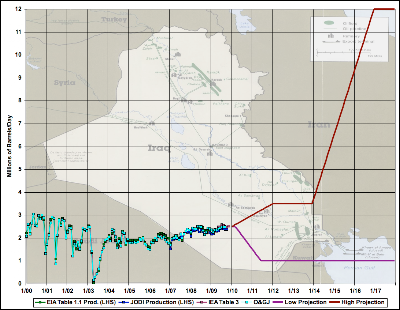
    Stuart Stanifrod continues his stream of posts on Iraqi oil, the latest being a look at the range of possible production profiles – Uncertainty Range for Iraqi Production. Also see Iraq Contract Negotiations Proceeding Steadily.

    In thinking about how to synthesize all the key drivers of oil production/demand, it seems like the period between now and 2017 is of particular interest – the contracted-for plateau for the new contracts in Iraq is seven years out, and they are being signed over the next few months. Furthermore, if the meteoric rise in the Chinese car fleet were to continue, then it would reach the size of the US fleet somewhere around 2017.

    So it seems of interest to try to construct uncertainty envelopes of some of the key variables and then try to fit them together into a range of reasonable overall scenarios.

    Probably the largest uncertainty in the evolution of the global economy over that timeframe is the uncertainty about Iraqi oil production. In the graph above (click for a larger version), I give my subjective guesstimate of the 90% confidence interval, with a “Low Projection” for if things go very badly from the perspective of Iraqi oil production, and a “High Projection” if things go very well.

    The reasoning behind the “High Projection” is as follows: the country in the past produced a maximum of 3.5mbd and likely doesn’t have much more capacity to produce and distribute/export the oil than that. The giant megaprojects in Iraq required for the al-Shahristani plan would take three years if they were in Saudi Arabia, so let’s allow four as the best case in Iraq, given it’s a much more difficult environment to operate in than Saudi Arabia, which has far more infrastructure and has been stable for a long time. So then the idea is that things continued to get fixed over the next couple of years up until the 3.5mbd level has been reached. Production plateaus out there for a while, until all the various elements of the al-Sharistani plan start to come together, and all projects hit their plateau together at the start of 2017. For lack of basis for making a more complex plan, I just linearly interpolated between these various constraints.

    Hopefully, the reader will agree that it’s hard to imagine things going much better than that.

    For the low projection, the assumption set is that the elections in March result in renewed civil war, that the US leaves despite the renewed unrest, and the country descends into increasing fighting, with only a small amount of oil exported intermittently. Obviously, the smooth estimates in my “Low Projection” above are just a general indication of what this might look like.


  • ‘Warlike’ blondes get what they want – study

    The Australian may have the answer to why that good looking blonde you’ve been going out with gets so cranky – ‘Warlike’ blondes get what they want – study.

    IT’S official – blondes do have more fun. According to a study by the University of California, that’s because blondes are more confident and aggressive, even displaying “warlike” tendancies to get their own way in life.

    The study of 156 US students showed that because blondes believe they are more attractive to men than redheads or brunettes, they “feel more entitled” to getting their own way.

    “What we did not expect to find was how much more warlike they are than their peers on campus,” study leader Aaron Sell told UK tabloid The Sun. “Many blondes exist in a kind of bubble where they have been treated better than other people for so long, they may not even realise they are treated like a princess.”

    His research indicated that the more “special” people felt, judged by physical strength for men and looks for women, the more likely they were to get angry as a strategy to reach social goals.


  • Stunning Solar Roof Rises Over Perugia, Italy

    Green Building of the week from Inhabitat is this Italian roof – Stunning Solar Roof Rises Over Perugia, Italy.

    At first glance it may look like a cyber-robotic monster is eating the historical district of this lovely Italian city, but in reality it’s the roof of a new energy-generating walkway in Perugia, Italy. The ‘Energy Roof’, designed by Coop Himmelb(l)au is powered by both the wind and the sun and serves as the canopy of a gallery that explores important archeological sites around the city. …

    The Energy Roof is self-sufficient and is powered by both the wind and the sun. The west wing of the canopy is covered in transparent solar cells, which are oriented to optimize energy production. The east wing captures the wind and generates energy through five wind turbines placed within the structure of the canopy. It is certainly a crazy looking architectural addition to the city, but it’s really quite creative and serves as an example for other cities to incorporate renewable energy generation into architectural icons and urban scultpures.


  • Mining boom expected to place strain on infrastructure

    The ABC has a report on the impact of the coal seam gas boom in Queensland – Mining boom expected to place strain on infrastructure.

    A central Queensland council says it will have to boost local infrastructure to meet the needs of an expected mining boom over the next decade.

    The Queensland Resources Council estimates more than 18,000 new jobs will be created in the coal seam, gas and LNG industries and another 23,000 in the minerals sector by 2020.

    Mayor of the Rockhampton Regional Council Brad Carter says local infrastructure needs to be improved to cater for an influx of workers.


  • An endangered species: the environmental reporter

    The Energy Collective has a post on the decline of environmental reporting by Tyler Hamilton – An endangered species: the environmental reporter.

    We’re doomed. It seems the mainstream media believe that the most pressing issues of our times — climate change, environmental degradation, energy security, etc. – should be left to general assignment reporters or treated as political news covered by political reporters. Copenhagen, for the most part, was covered as a political event, yet the issues underlying this political conference were highly scientific in nature. Covering these issues properly requires a certain expertise, specifically when we’re dealing with a politically charged issue like climate change. Environmental reporters know when they’re being duped by faux experts; political or GA reporters don’t. Environmental reporters are better at explaining complex issues in a way that the average person can better understand; political or GA reporters can often make matters even more confusing to the reader or gloss over important details.

    Sadly, the environmental reporter has become an endangered species. I heard yesterday that the Oregonian just disbanded its environmental reporting team and made them all into general assignment reporters. Also yesterday Keith Johnson announced that his Wall Street Journal blog Environmental Capital was “closing its virtual doors.” In October, the prestigious Columbia School of Journalism announced it had stopped accepting applications for its Earth and Environmental Science Journalism program because of “the current weakness in the job market for environmental journalists.” In a letter to its faculty, the school wrote “media organizations across the country are in dire financial straits and thousands of journalists’ jobs have been eliminated. Science and environment beats have been particularly vulnerable.”

    Again, this is all happening at a time when we need this kind of experienced coverage most, and when governments and the business community both are giving environmental issues more attention than ever. My own newspaper, the Toronto Star, used to have two environmental reporters a year ago. Through newsroom attrition both positions are vacant, but given plans to downsize the newsroom there appears no desire to fill those spots. It’s discouraging to say the least.

    But, hell, we can all take comfort that Sarah Palin is joining Fox News.


  • Otago Harbour tidal power idea gets boost

    The Otago Daily Times has an article on a tidal power project proposed for Dunedin’s harbour – Otago Harbour tidal power idea gets boost.

    There are renewed calls for Dunedin to consider investing in tidal power generation in Otago Harbour, stimulated by progress towards a $600 million scheme north of Auckland.

    Auckland-based power company Crest Energy is seeking consent for a 200-turbine, 200-megawatt scheme, costing about $600 million, at the entrance to Kaipara Harbour. The scheme would be the first of its kind in New Zealand, and could power 250,000 homes.

    The Environment Court has given a positive recommendation to Conservation Minister Tim Groser, while requesting work to address lingering environmental concerns.

    The progress encourages David Tucker, of Dunedin, who argues a similar scheme should be considered for Otago Harbour. Mr Tucker, a semi-retired consultative engineer and former Dunedin City Council consultant, said Otago Harbour could be as effective as a source of renewable energy.

    He envisaged turbines on the sea floor at the mouth of Otago Harbour, driven by the tide to generate power, or a barrage from Port Chalmers to Portobello – or both.