Author: Big Gav

  • A pivotal year for coal-seam gas in Australia

    The Business Spectator has a look at the year ahead for coal seam gas in Australia – A pivotal year for coal-seam gas.

    Santos’ update on the progress of its planned export LNG project in Queensland provides an early taste of what is to come in what will be a decisive year for the competing coal seam gas-fed projects at Gladstone.

    With the big players – Santos and its partner Petronas, Origin Energy and its partner ConocoPhillips and BG Group – all pursuing multi-train developments, the race is on to sign up customers ahead of the flurry of final investment decisions that will need to be made at some stage this year. Santos and Petronas have said that their decision will be made in the middle of this year.

    The timeframes are tight, with BG planning to bring its project on-stream in 2013, Santos and Petronas targeting 2014 and Origin and ConocoPhillips 2014-15. All the projects will need to lock in core customers this year, and probably by mid-year, if they are to stay on schedule.

    The Gladstone projects are not just competing against themselves. There are a number of big new conventional LNG projects off Western Australia, the $US15 billion PNG LNG project has received final, albeit conditional, approval and has contracts for just about all its gas and there is also competition from other sources within the region, including expanded production from Qatar.

    The abundance of prospective sources of supply may help explain why PetroChina walked away from a $US40 billion gas contract with Woodside last week because of delays in the development schedule of its Browse project (see Woodside’s PetroChina export agreement expires, January 4).

    While there has been a proliferation of new LNG projects, however, all the Gladstone projects, and indeed the other LNG projects in the region, cite the strong general growth in Asian demand for LNG and the planned quadrupling of China’s terminal capacity by 2020 in particular as reasons for being very bullish about the outlook for their projects.

    The SMH also has a look at CSG LNG, with the focus on Origin Energy – Origin ‘closes the gap’ on LNG.

    ORIGIN Energy’s managing director, Grant King, says the company’s $35 billion liquefied natural gas project is closing the gap on its more advanced rivals, and this is strengthening its bid to sign up a gas buyer.

    The Asia-Pacific LNG project, a joint venture between Origin and ConocoPhillips, is widely seen as the laggard among the companies vying to export LNG from coal-seam gas in southern Queensland.

    Analysts say its share price of $17.66 barely factors the massive earnings potential of APLNG, because unlike its key rivals BG and a Santos-Petronas joint-venture, Origin has not found a buyer for its LNG.

    But, after letting drilling, engineering and construction contracts in recent weeks, Mr King said Origin’s project was gaining ground. All the Queensland projects aim to start exporting gas by between 2014 and 2015.

    ”I think there is an increasing perception that our project is real and can deliver in that timeframe, and that’s all that matters,” Mr King said in an interview with BusinessDay. ”That’s far more important in the buyer’s eyes than being first, because each year buyers have needs for gas.”


  • Top Ten Energy Storage Stories of 2009

    The “best of 2009” parade hasn’t quite finished yet, with Greentech Media posting a “best of” their energy storage stories – Top Ten Energy Storage of 2009.

    Energy storage – you can’t do electric vehicles without it, and it sure would make renewable solar and wind energy a lot more useful.

    That’s the imperative behind 2009’s push into energy storage – from the fast-moving world of batteries for electric and plug-in hybrid vehicles to the slower development of a variety of technologies for storing power on the electricity grid.

    1. A123, Green Tech’s First IPO of 2009: A123 Systems broke the green tech IPO drought in September, when it debuted its shares to the public markets and was immediately rewarded with a doubling of their price. But the lithium-ion battery maker has since seen shares fall to close to their initial offering price of $13.50, perhaps linked to the scaling back of electric vehicle plans by customer Chrysler. A123 is also making batteries for grid energy storage, bridging two worlds that have until now been mostly separate.

    2. The Government Boosts Vehicle Batteries” Next-generation batteries wouldn’t be where they are today without the billions of stimulus dollars the federal government has aimed at the sector. In August, the Department of Energy handed out $2.4 billion to such companies as EnerG2, A123 Systems, Johnson Controls, eTec, EnerDel, Saft and Chrysler and General Motors, most of it to build battery factories in the United States – a key goal of the grants, given Asia’s dominance in battery technology and manufacturing.

    3. Fuel Cells’ Waning Fortunes? What the federal government has given to batteries, it has taken away from a once-favored alternative – fuel cells. Technologies to convert hydrogen into electricity and water are clean, but they also require a massive infrastructure to deliver hydrogen – which is mostly made today by cracking natural gas – to millions of vehicles. Energy Secretary Steven Chu has said he will cut back drastically on DOE funding for vehicular fuel cell research, which he described as decades away from commercial viability. In the meantime, fuel cells soldier on in the stationary power generation market, and are finding niches in forklifts and other short-range heavy vehicles, as well as in military applications.

    But wait? Panasonic has started to deliver fuel cells that burn natural gas to produce heat and electricity in Japan and Bloom Energy is expected to come out of its hidey hole soon to talk about devices that pretty much do the same thing for industrial customers. By exploiting heat and power, these fuel cells can be 80 plus percent efficient. …


  • Asian company eyes solar tower development In Australia

    It seems the “solar tower” dream never dies, with the ABC reporting that a (hitherto unknown to me) company is talking about building 3 plants in Victoria (I’m assuming this is a retread of the old solar tower scheme planned for the area, not a CSP plant – details are sparse) – Asian company eyes solar tower development

    An Asian development company has lodged applications for planned solar towers in north-west Victoria.

    Suntec Solar is not revealing the exact locations of its three preferred sites at this stage, but says they are each about 800 hectares of private land and each would be the site of a 200-megawatt solar tower.

    The company says it has shifted its focus for solar tower development to north-west Victoria because the land is flat, the weather is ideal and the sites are close to transmission infrastructure.

    It says meteorological and solar testing has found the sites are suitable and will finish archaeological and environmental surveys by March.


  • Australian Cleantech Outfits Are Having A Rough Time

    Giles Parkinson has an article on market troubles for the Australian cleantech industry – Cleantech Outfits Are Having A Rough Time.

    Since outperforming both the benchmark S&P/ASX 200 and the S&P/ASX Small Ords indices in 2007, the 75 companies that make up the ACT Australian CleanTech Index (once valued at $16 billion but now worth $10bn) have seriously underperformed those broader indices in each of the 2008, 2009 and 2010 first-half financial years. Essentially, the index fell harder than the rest of the market and recovered less.

    Now it’s falling again. Figures for December show the CleanTech Index down 6.2 per cent for the month, compared with 1.7 per cent gains in the broader index and a 3.8 per cent gain in the small caps. …

    The index and its components are also vulnerable to the vagaries of government policy.

    The December slump coincided with the defeat of the emissions trading legislation and disappointment in Copenhagen, which hit carbon offset stocks such as Carbon Conscious and CO2, and the allocation of renewable energy grants.

    Those that missed out, including Carnegie Wave and Kuth Energy, were among the hardest hit. Solar PV installers such as Quantum Energy went on a roller-coaster ride that pretty much followed government policy.

    Companies such as Jackgreen went into administration, while others, such as Geodynamics, slumped after nearly sending its board of directors into orbit with a blowout at its flagship well.

    The best performer for the past month was solar cell innovator Dyesol. Biodegradable packing group Pro-Pac Packaging was the best performer for the latest quarter, while biodegradable nappies producer Eco Quest was the best performer for the half, trebling its share price, mostly in the first quarter.

    It’s hard to read any trend in the various components of the cleantech index. Solar, which performed well in the 2007 fiscal year and last year, underperformed in 2008 and so far this year, while wind, which boomed in 2007 but fared poorly in 2008 and last year, has performed better so far this year, as have the energy efficiency, geothermal and environmental services sub-indices.

    Perhaps they could be neatly plotted against a graph highlighting policy hope, policy promises, and policy delivery over the same period. O’Brien says the volatility highlights the relatively immaturity of listed stocks in the area.


  • Designing a Generation Ship

    Alex at WorldChanging points to a Charlie Stross post on designing for the long term – Designing a Generation Ship.

    Charlie Stross has a brilliant post up on his blog, taking up the question of how best to design the institutions to run “generation ships” — spacecraft designed to take large numbers of people a very long distance.

    If you can crank yourself up to 1% of light-speed, alpha centauri is more than four and a half centuries away at cruising speed. To put it in perspective, that’s the same span of time that separates us from the Conquistadores and the Reformation; it’s twice the lifespan of the United States of America.

    We humans are really bad at designing institutions that outlast the life expectancy of a single human being. The average democratically elected administration lasts 3-8 years; public corporations last 30 years; the Leninist project lasted 70 years (and went off the rails after a decade). The Catholic Church, the Japanese monarchy, and a few other institutions have lasted more than a millennium, but they’re all almost unrecognizably different.

    Consumer capitalism along our current model simply won’t work as a way of running a long-duration generation ship (the failure modes are lethal and non-recoverable). Communism (or rather, Leninism) has a slightly better prospect, but is still a long way from optimal. Monarchism is just a pretty word for “hereditary dictatorship supported by military caste”. What are the alternatives? And what do we need to consider when designing a society that can survive for a 500-1000 year voyage in a bottle without exploding?

    I’m skeptical of the possibility of deep space exploration and colonization anytime in the next couple centuries, but this is a pretty great gedanken experiment. The comments are pretty phenomenal as well.


  • Sea to provide power for 250,000 homes in NZ

    The NZ herald has an update on a tidal power plant proposed for New Zealand – Sea to provide power for 250,000 homes

    A tidal power station on the Kaipara Harbour seafloor could be providing power to a quarter of a million homes by the end of the decade.

    The Environment Court has made a positive recommendation to Conservation Minister Tim Groser on a plan to generate electricity from the harbour’s swift tidal flow. The approval is subject to fine-tuning of consent conditions.

    Crest Energy plans to spend $600 million on sinking 200 tidal power turbines to the seabed of the harbour entrance, creating New Zealand’s first tide-driven power station. The project will start with 20 turbines.

    Last month, Todd Energy said it was taking a 30 per cent stake in Crest, which aims to be fully operational within nine years generating 200MW of power, enough to supply 250,000 homes.


  • A Fossil Fuel Free Cargo Ship

    Ecogeek has a post on a sail powered cargo ship – Fossil Fuel Free Cargo Ship.

    Cargo ships are a very efficient means of shipping cargo in terms of cost and energy per ton of freight moved. But the ships use some of the dirtiest fuel, and global shipping is responsible for 3-4% of all greenhouse gas emissions. So, while cleaning up ocean freight isn’t the sole solution to atmospheric greenhouse gasses, it’s an area that could stand some improvement.

    One solution may come from B9 Energy, the largest independent operator of wind farms in the UK. B9 is now venturing into shipping with a carbon neutral cargo ship that is due to set sail in 2012. At only 3,000 tons, this ship will be considerably smaller than a typical bulk freighter, which tends to be in the range of 15,000 to 30,000 tons. But, unlike a typical freighter, it will be carbon neutral. 60% of the ship’s energy is to be provided by sails, just like the clipper ships of the 1800s. The remaining 40% of the ship’s energy will be provided by engines running on liquefied methane produced from biogas sources. If demand for biofuel outstips supply, the ship can also be run on liquefied natural gas.

    The prototype vessel is expected to cost about $24.4 million. If the ship proves successful, as many as 50 more might be built.


  • Small British Company Bets on Tidal Power

    The New York Times reports that British tidal power company MCT has raised a fresh round of money to develop their technology – Small British Company Bets on Tidal Power.

    A British company with a device that creates energy from tidal movement announced late last month that it had received $5.6 million in financing that it hopes will help it reach larger commercial production within two years.

    With this most recent injection of cash, which came from Carbon Trust Investments, Bank Invest, EDF Energy and High Tide, as well as private and government investors, Marine Current Turbines has raised roughly $48 million. The company is trying to raise further cash to help it build a five megawatt array based on its “SeaGen” prototype.

    The SeaGen is akin to a submerged windmill that is driven by flowing water, and the Bristol-based company already has a small-scale operation established in Strangford Lough, Northern Ireland, where it has been generating 1.2 megawatts of electricity since April 2008.

    (It sells that output to ESB Independent Energy, a private utility, under a power purchase agreement.)

    Considering SeaGen’s development costs, its makers reckon the device generates electricity at about $5.5 million per megawatt installed — or roughly double the cost of offshore wind energy.

    They consider that a victory.

    “How many millions of kilowatts of wind are installed already, and here I’ve got one machine and I’m one small firm and I’m only twice the price?” said Martin Wright, the company’s managing director. “We haven’t even started going down the cost-reduction curve yet.”

    Cleantech Scotland reports that some large wind power projects have been approved – Moray Firth And Firth Of Forth Offshore Wind Schemes Approved.

    We welcome the news that the Crown Estate – The owner of the UK’s coastal seabeds – has granted offshore wind rights for energy companies in the Moray Firth and the Firth of Forth. This is a major renewable energy scheme and will comprise of more than 950 offshore wind turbines, capable of powering over three million homes and generating 4.7GW of electricity.

    The move comes a mere matter of days after Holyrood’s approval of the highly controversial Beauly-Denny Power Line. The new schemes are expected to create thousands of new jobs in research, engineering, manufacturing, installation and operations. The Firth of Forth will be developed by SeaGreen Wind Energy, Airtricity and Fluor. The Moray Firth will be developed by EDP Renewables and SeaEnergy.

    Jim Murphy, the Scottish Secretary, said: “This is one of the strongest signals yet that Scotland is right at the heart of the UK’s commitment to a low carbon, energy secure, prosperous future. But it’s also great news for the manufacturing industry and supply chain in Scotland.”

    Recharge News has a report on the transmission line mentioned above – Scottish Government approves key transmission line project.

    The Scottish government has approved the highly controversial Beauly-Denny electrical transmission line, seen by many as critical to the future of Scotland’s renewables industry.

    The decision comes more than four years after ScottishPower and Scottish and Southern Energy first applied to upgrade the line.

    The £320m ($512.6m) line will stretch 137 miles across picturesque wilderness. It received more than 18,000 public objections during its consultation – the most in any public enquiry since Scotland devolved from Westminster.

    Proponents of the line say it holds the key to linking Scotland’s wind, wave and tidal resources in the north to its population centres in the south.

    UK wind industry body British Wind Energy Association (BWEA) welcomes the decision, calling it a “vitally important step forward in delivering the UK’s 2020 renewable target.”

    BWEA head of grid Guy Nicholson says the decision is “the first step in building a 21st century grid system capable of connecting decentralised green energy throughout the UK”.

    Interest in wind and tidal power is also high south of the border in Cumbria – the North west regional development agency reports – Cumbria’s huge renewable energy potential revealed.

    The Scope for Renewable Energy in Cumbria has been written by former Government energy adviser and environmental scientist Sir Martin Holdgate on behalf of Cumbria Vision’s Renewable Energy Panel. It is believed to be the first study in Britain to identify the economic opportunities arising from renewable energy development at a county level.

    It says Cumbria is poised to meet a third of its total energy needs from renewable sources by 2020, and double that by 2050. By 2050 the County could become a significant exporter of renewable energy with 5.5gigawatts** (5.5GW) of installed capacity, and meet the energy needs of over 300,000 people through a vibrant mix of wind, hydro, tidal, solar, geothermal and biomass. In turn this could create and safeguard in the region of 7,000 jobs and bring a significant boost to businesses and investors. Sir Martin stresses these impressive figures can be achieved without damaging Cumbria’s internationally-prized landscape, which is the major draw for the 16 million visitors who flock to the County each year. …

    The study predicts energy outputs and economic impact of seven renewable energy sources and sets them against the timescales of 2010, 2020 and 2050. The 2050 scenario sees Cumbria generating enough wind energy to meet the needs of 300,000 people – mostly from offshore because the international importance of the Cumbrian landscape limits opportunities on land. However, this massive expansion would only support in the region of 500 jobs unless turbine manufacture can be based in the County, in turn helping to revitalise West Cumbria’s traditional manufacturing sector. Tidal power also has huge potential, with a Solway Barrage in theory producing only slightly less than the much-publicised Severn Barrage, but sharing the same massive environmental challenges. Modest tidal schemes in the Solway, Duddon Estuary and Morecambe Bay not only have potential to produce more energy than onshore wind but bring much-needed improved communications links along Cumbria’s west coast.


  • A Spiraling Skyscraper Pod City For a Future London

    Green building of the week from Inhabitat is this rather out-there conceptual design for “spiralling skyscrapers” in London – Spiraling Skyscraper Pod City For a Future London.

    Design team Chimera has conceived of an incredible series of spiraling skyscrapers for London modeled after the complex ecosystems created by the mangrove tree. Dubbed Mangal City, the project is an “urban ecological system” composed of modular pod capsules that shift to adapt to environmental and contextual conditions. A beautiful example of biomimicry and certainly a flight of fancy, the plan proposes a futuristic building system based upon flexibility.

    Featuring a twisting latticed frame reminiscent of Eric Vergne’s Manhattan skyscraper farms, Mangal City harnesses biomimetic principles borrowed from a range of sources. The skyscraper’s structure is modeled after mangrove trees, spiraling plant growth patterns, and the interaction of natural ecosystems.


  • Top 10 cleantech promises to watch for in 2010

    Cleantech.com is looking forward at 2010 instead of back at 2009 and has a list of promised innovations to keep an eye on this year – Top 10 cleantech promises to watch for in 2010.

    Just because promises don’t happen in 2010 doesn’t mean they won’t happen ever. But, for what it’s worth, here are 10 of the most interesting developments in our estimation to watch for in 2010, in no particular order:

    1. EEStor’s ultracapacitors: 2010 is thought to be the make-it-or-break-it year for the partnership between Toronto-based electric vehicle maker Zenn Motor and super-stealthy EEStor. At last count, Texas-based EEStor promised to deliver its potentially breakthrough ultracapacitors to Zenn before the end of 2009. …

    2. Big win for desalination: Poseidon Resources plans to begin construction in the first quarter of next year on a desalination facility to process 50 million gallons of seawater per day in Carlsbad, Calif. The ground-breaking is a long time coming for Poseidon, which faced delays of more than 10 years because of added scrutiny and lawsuits by environmental groups. …

    3. Ambitious targets: California’s Renewable Portfolio Standard calls for 20 percent energy demand to come from renewables by 2010. The state’s two big utilities have already said this isn’t likely to happen. As of November, Pacific Gas & Electric was getting 13 percent from renewables, while San Diego Gas & Electric gets only about 10 percent of its energy from renewables. The next big target is 33 percent by 2020.

    4. Japan’s new EV infrastructure: Shai Agassi’s startup Better Place aims to install its first battery swapping station in Tokyo in January, a preview of what’s being developed in Denmark and Israel for mass deployment in 2011 (see Better Place’s battery-swap stations for Tokyo taxis get investor approval). …

    5. Greener bricks: Just as Serious Materials is aiming to overhaul the energy-intensive drywall industry, Newark, Calif.-based CalStar Products wants to improve brick-making. The startup expects is first factory for low-carbon bricks in Caledonia, Wis., to begin full-scale manufacturing in January. …

    6. Space solar: Solaren might be the best-known startup in this space, but its contract with Pacific Gas & Electric doesn’t start until mid-June 2016. Everett, Wash.-based PowerSat has more immediate plans: It wants to build a 10-kilowatt Earth-based demonstration project early next year. …

    7. Baby steps for cellulosic ethanol and biofuel: Watch for a number of biofuel developers to announce the opening or ground-breaking at new facilities in 2010. Range Fuels said it plans to complete a 10 million-gallons-per-year ethanol and methanol plant in Soperton, Ga., in the first quarter of 2010, with volume production to begin in Q2. LS9 plans to develop a demonstration facility in the first quarter of 2010, with production slated for that year using a tank of 50,000 to 100,000 liters. …

    8. Large-scale solar: Tempe, Ariz.-based First Solar says it expects development for the $1 billion, 550-MW thin-film solar plant under a power-purchase agreement with California utility Pacific Gas & Electric to begin on-schedule in 2010. First Solar bought the development rights from OptiSolar (see First Solar buys OptiSolar’s pipeline of projects for $400M).

    9. Big auto embraces electric: 2010 is expected to see the debut of two hotly anticipated electric vehicles in the U.S. market. The latest word on the Chevrolet Volt, which is supposed to drive up to 40 miles without gasoline, is that production could start in late 2010 …

    10. Small auto gets up to speed: Irvine, Calif.-based Fisker Automotive said its $87,900 luxury sports sedan Karma is due in showrooms in summer 2010 (see $529M DOE loan clears path for Fisker’s new $39,000 hybrid), while Norway’s Think Global said it plans to produce 2,500 cars in the U.S. starting in mid-2010, about a year later than first anticipated …


  • this place is best shunned and left uninhabited

    mammoth has an interesting post on ways of making nuclear waste sites recognisably dangerous over long periods of time – this place is best shunned and left uninhabited.

    Triggered by the recent revelation that tests at the Pacific Northwest National Laboratory reveal that a seemingly innocuous white substance filling a glass bottle dug up in 2004 is actually “the oldest existing sample of bomb-grade plutonium from a nuclear reactor, with a half-life of 24,110 years,” Juliet Lapidos reviews the Department of Energy’s 1993 recommendations for the construction of a massive nuclear-waste disposal warning landscape. The trouble, of course, is that anything one does to communicate danger is likely to also communicate mystery and excitement to future treasure-hunters or archaeologists:

    The report’s proposed solution is a layered message—one that conveys not only that the site is dangerous but that there’s a legitimate (nonsuperstitious) reason to think so. It should also emphasize that there’s no buried treasure, just toxic trash. Here’s how the authors phrase the essential talking points: “[T]his place is not a place of honor … no highly esteemed deed is commemorated here.” Finally, the marker system should communicate that the danger—an emanation of energy—is unleashed only if you disturb the place physically, so it’s best left uninhabited.

    As for the problem of actually getting these essentials across, the report proposes a system of redundancy—a fancy way of saying throw everything at the wall and hope that something sticks. Giant, jagged earthwork berms should surround the area. Dozens of granite message walls or kiosks, each 25 feet high, might present graphic images of human faces contorted with horror, terror, or pain (the inspiration here is Edvard Munch’s Scream) as well as text in English, Spanish, Russian, French, Chinese, Arabic, and Navajo explaining what’s buried. This variety of languages, as Charles Piller remarked in a 2006 Los Angeles Times story, turns the monoliths into quasi-Rosetta stones. Three rooms—one off-site but nearby, one centrally located, and one underground—would serve as information centers with more detailed explanations of nuclear waste and its hazards, maps showing the location of similar sites around the world, and star charts to help intruders calculate the year the site was sealed…

    Proposals for the “earthworks” component demonstrate that the whole project of communicating with the future is really a creative assignment, more dependent on the imagination than on expertise… The report proposes a “Landscape of Thorns” with giant obelisklike stones sticking out of the earth at odd angles. “Menacing Earthworks” has lightning-shaped mounds radiating out of a square. In “Forbidding Blocks,” a Lego city gone terribly wrong, black, irregular stones “are set in a grid, defining a square, with 5-foot wide ’streets’ running both ways. You can even get ‘in’ it, but the streets lead nowhere, and they are too narrow to live in, farm in, or even meet in.”


  • Staniford On Iraqi Oil

    Stuart Staniford has followed up his recent post on Iraqi oil with a spate of follow up posts. First up, a look at the role water plays in increasing production – The Water Constraint In Iraq.

    I emailed a few people with links to yesterday’s Iraq post. One person who responded (and gave me permission to post his response) was Matt Simmons, who wrote:

    At last fall’s Oil and Money conference, the EIG advisory board discussed BP’s just announced service contract. It was the opinion of both Sadad al-Husseini and Issham Chalabi, former Iraq Oil Minister, that the likelihood of these companies ramping up these oil targets is remote at best and if they happen, it will be like Cantarell, doomed for over production and subsequent rapid collapse. A big problem never addressed is the lack of quality water from the shrinking Iraq rivers to due water injection for creating artificial reservoir pressure.

    Hope this helps shed some truth into these great hypes.

    The other points I’ll respond to at some future time, but the water issue I hadn’t thought about at all, and seemed quite interesting and important. Matt is alluding to the fact that it’s common practice to inject water into oilfields to help drive the oil through the rock to the producing wells, and this water has to come from somewhere.

    So this morning I’d like to present a few back-of-the-envelope calculations of how much water might be involved. First, it’s helpful to have a picture of the geography in question. Therefore, here’s a map which I’m borrowing from the Library at the University of Texas. It shows the major oilfields in question, as well as the Tigris and Euphrates, Iraq’s major rivers, and the access to the Persian Gulf. You can click for a larger version. It’s worth noting in passing how many oilfields were not in the table of contracts yesterday.

    As you can see, the Southern fields are fairly close to both rivers, as well as the Persian gulf, but water to be injected into the northern fields would most conveniently come from the Tigris.

    Stuart continues with more at Does al-Shahristani Really Think Six Years? and How Long Do Mega-mega-projects Take?.

    The al-Shahrastani plan in Iraq raises a number of interesting questions. I think there are generally two directions that scepticism could go in. One is scepticism over the reserves and/or plateaus – is there really enough oil in Iraq and in the auctioned fields specifically, to produce 12mbd at any point in the future?
    The second set of questions is around the timing. Is it really realistic that this can be done in six or seven years as the oil minister is claiming?

    To me, the second set of questions seems the more urgent to answer. While the exact amount of oil in Iraq is highly debatable, there’s not much doubt that there’s a heck of a lot of it.

    One way to think about the timing issues is that each of these field contracts is basically a huge megaproject. What al-Shahrastani is proposing, and what Big Oil is signing up to deliver, is a huge set of megaprojects, conducted in parallel, in a country that was a war zone until fairly recently. The potential for chaos is considerable. The potential for some folks to make an awful lot of money is also considerable.

    Consider, for each field, the following things are necessary:

    * Drilling of the oil wells and injector wells
    * Pipelines to bring injection water from somewhere.
    * A water treatment plant to make sure nothing in the injected water will clog the pores in the reservoir rocks and to process any water produced from the field.
    * A GOSP facility to separate out the water, oil, and gas brought to the surface
    * Pipelines to take the oil from the field somewhere
    * A share in export facilities of some kind

    Until all these are present, oil production cannot go too much above the scale it is currently at. So if the al-Shahrastani plan really goes ahead according to the current schedule, we are about to see a sizeable fraction of the world’s oil and gas engineering capabilities, of all kinds, moved to Iraq, as the global oil industry spends over a hundred billion dollars there. By comparison, the GDP of Iraq in 2008 was, on a purchasing power parity basis, 105$b according to the IMF. It seems to me that the best guide to how long these things will take is the set of megaprojects recently conducted in Saudi Arabia. These projects represent similar operating conditions (flat deserts in the Middle East) in neighboring countries. Saudi Aramco is a technically competent operation, as are the big western oil companies that will be developing the Iraqi fields. The projects were generally conducted in a hurry with a desire to restore/enhance Saudi oil production capacity as quickly as possible. The major differences were,

    * Saudi Arabia started with a lot more oil production infrastructure than Iraq has.
    * Saudi Aramco and the Saudi oil ministry had more experience than the Iraqi oil ministry has.
    * Saudi Arabia has had no political instability that would affect oilfield development.
    * The Saudi projects were all smaller than the largest Iraqi megaprojects.

    So Saudi megaprojects probably represent a best case estimate for what could be achieved in Iraq.


  • Pesticides Behind Mass Die-Off ?

    Yale Environment 360 has an article on the possible link between pesticides and various animal die-offs (including bee colony collapse disorder) – Behind Mass Die-Offs, Pesticides Lurk as Culprit.

    Ever since Olga Owen Huckins shared the spectacle of a yard full of dead, DDT-poisoned birds with her friend Rachel Carson in 1958, scientists have been tracking the dramatic toll on wildlife of a planet awash in pesticides. Today, drips and puffs of pesticides surround us everywhere, contaminating 90 percent of the nation’s major rivers and streams, more than 80 percent of sampled fish, and one-third of the nation’s aquifers. According to the U.S. Fish and Wildlife Service, fish and birds that unsuspectingly expose themselves to this chemical soup die by the millions every year.

    But as regulators grapple with the lethal dangers of pesticides, scientists are discovering that even seemingly benign, low-level exposures to pesticides can affect wild creatures in subtle, unexpected ways — and could even be contributing to a rash of new epidemics pushing species to the brink of extinction.

    In the past dozen years, no fewer than three never-before-seen diseases have decimated populations of amphibians, bees, and — most recently — bats. A growing body of evidence indicates that pesticide exposure may be playing an important role in the decline of the first two species, and scientists are investigating whether such exposures may be involved in the deaths of more than 1 million bats in the northeastern United States over the past several years.

    White-nose Syndrome, named for the tell-tale white fuzz it leaves on bats’ ears and noses, has killed more than a million bats in the northeastern United States.
    For decades, toxicologists have accrued a range of evidence showing that low-level pesticide exposure impairs immune function in wildlife, and have correlated this immune damage to outbreaks of disease. Consumption of pesticide-contaminated herring has been found to impair the immune function of captive seals, for example, and may have contributed to an outbreak of distemper that killed over 18,000 harbor seals along the northern European coast in 1988. Exposure to PCBs has been correlated with higher levels of roundworm infection in Arctic seagulls. The popular herbicide atrazine has been shown to make tadpoles more susceptible to parasitic worms.

    Bee extinction also features in Douglas Coupland’s new novel “Generation A“, reviewed by The New York Times – Stung Together.

    “Generation A” (the term comes from a Kurt Vonnegut quotation) is not a sequel to but rather a thematic wink at Coupland’s first novel, “Generation X” (1991), about young slackers experiencing ­postindustrial fin de siècle ennui and sitting around telling stories. That novel kicked off both Coupland’s career and — to his ire — a global media frenzy and commodification orgy. From the beginning, Coupland’s novels have explored the vertiginous acceleration of culture as it intersects with media and technology, as well as the impact of those forces on a disaffected subgroup of drifters and eco-freaks, teenagers and young adults, dropouts and designers, programmers and cubicle inhabitants, gamers and geeks. All of it is rendered with the paradoxical combination of empathy and irony that marks Coupland’s work. And “Generation A” is no exception.

    Narrated by five characters who begin as strangers and come from five different parts of the world, the novel is set in a near future when bees are thought to have become extinct. A global “pollination crisis” results, and “a six-ounce bottle of 2008 Yukon fireweed honey” now fetches some $17,000 at Sotheby’s. Also extinct are heroin addicts, because, of course, “poppies require bees.” Instead, a sinister prescription drug called Solon has filled the gap, treating anxiety by blocking thoughts of the future.


  • Innovation as Resource and China’s New Magnetism

    Jamais Cascio has a post on the kerfuffle about Chinese rare earth export restrictions and how the best solution is innovation – Innovation as Resource and China’s New Magnetism.

    You’ve probably seen “neodymium” (actually neodymium-iron-boron) magnets advertised in techie-oriented magazines and gadget blogs. They’re actually the strongest type of magnet available, and a pair of them can easily smash fingers. They’re also incredibly useful, with small neodymium magnets found in everything from hard drives to wind turbines. Neodymium is one of 17 “rare-earth metals,” and these elements have turned out to be critical to the rapidly-growing green technology industries. Rare-earth metals are used in hybrid and electric cars and low-energy lightbulbs, along with windmills (and numerous other greentech applications).

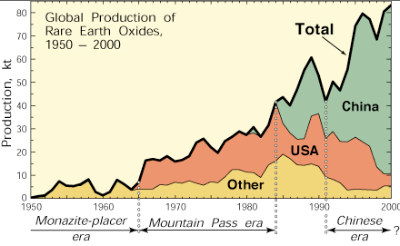
    And China is the source for over 95% of the rare-earth metals now in use–something that increasingly looks like a problem. How we respond to this problem can tell us something about how we can respond to other imminent resource and sustainability crises.

    Conventional wisdom says that we live in a globalized economy and if China can offer the metals at cheaper prices than other sources (namely, now-closed mines in South Africa, Greenland, and Canada), it’s good for us all, right? The fact that many high-tech military technologies rely on Chinese rare-earth metals may give some people pause, but so far, so good. But that model assumes that China is willing to sell as much mineral as it can produce, to whomever wants to buy–and that assumption may no longer be true.

    The U.K.’s Independent reports that China has been gradually cutting the amount of rare-earth elements it exports, now down 40% from seven years ago. China now exports only 25% of the rare-earth elements it mines. […]

    So what are our options? We (as in, the non-China parts of the industrialized world) could try to pressure China to sell more, but that’s unlikely to work–and China tends not to respond well to even mild criticism. We could try to rapidly reopen the now-closed rare-earth element mines, but mining is, frankly, an environmental nightmare and incredibly dangerous–hardly a sustainable practice.

    Our best option is to innovate our way out of the problem.


  • Frozen Britain

    The BBC has a report on freezing (and energy guzzling) Britain – No respite as UK hit by coldest night of winter.

    The UK has suffered its coldest night of the winter so far with temperatures plummeting to -22.3C (-8.1F) in a village in Sutherland in the Highlands. …

    Meanwhile, 27 firms – 12 in the East Midlands and 15 in the North West – are still using alternative fuels after National Grid told them to turn off their gas supply, with demand for energy soaring. At one stage on Thursday, 95 major firms were affected.

    Environment Secretary Hilary Benn insisted there were “plenty of supplies” of gas, with storage about 70% full. He said firms affected were on special contracts – paying less but losing supplies when demand was high – and that there was no need for domestic customers to worry.

    Of some 5,000 homes in southern England which were without power throughout Thursday, all but “a few hundred” were reconnected overnight, energy suppliers said.


  • World’s largest solar project prompts environmental debate

    The San Jose Mercury has an article on opposition to a solar power proposal that seems as well sited as you could get – World’s largest solar project prompts environmental debate.

    Panoche Valley is known mostly for cattle and barbed wire, a treeless landscape in eastern San Benito County that turns green every spring but for much of the year looks like rural Nevada.

    A posse of lawmen gunned down the famous Gold Rush bandit Joaquin Murrieta, an inspiration for the fictional character Zorro, near here in 1853. Nothing that exciting has happened since.

    But now the remote valley 25 miles south of Hollister is finding itself at the center of a new showdown. A Silicon Valley company is proposing to build here what would be the world’s largest solar farm — 1.2 million solar panels spread across an area roughly the size of 3,500 football fields.

    “This is renewable energy. It doesn’t cause pollution, it doesn’t use coal or foreign oil, and it emits no greenhouse gases,” said Mike Peterson, CEO of Solargen Energy, the Cupertino company behind the $1.8 billion project.

    But critics — including some environmentalists — say green energy isn’t always green. In a refrain being heard increasingly across California, they contend the plan to cover this ranch land with a huge solar project would harm a unique landscape and its wildlife.

    From the Bay Area to the Mojave Desert, green energy supporters are frustrated that a state that wants to lead the green revolution is facing roadblocks.

    Peterson, a former vice president of Goldman Sachs, looked across the Panoche Valley last week and noted its attributes.

    It sits 20 miles from the nearest town. It has 90 percent of the solar intensity of the Mojave Desert. Five willing sellers, mostly longtime ranching families, have signed options to sell his company 18,000 acres. And huge transmission lines run through the site, negating the need to build the kind of costly and controversial new power lines that have stalled similar projects. “From our standpoint, this is a perfect place,” he said. “If not here, where?”

    The project would produce 420 megawatts of electricity, roughly the same as a medium-sized natural gas power plant, and enough to power 315,000 homes.

    Meanwhile, in the UK, transmission line costs are provided added friction to getting offshore wind and tidal power projects underway – Wave of protest over tidal power charges.

    Plans to build Europe’s biggest wave farm off the coast of Scotland are under threat after energy firms threatened to pull out over “unfair” charges to connect to the national grid, a lobby group has claimed.

    The Scottish Council for Development and Industry (SCDI) said that some of the 20 firms involved in the project, in the Pentland Firth, have said that they may withdraw in protest at the charges imposed by Ofgem, the energy regulator.

    Under the charging scheme, electricity generators are forced to pay more the farther away they are from the national grid and urban centres.

    According to the council — an independent body that represents 1,200 businesses, trade unions and local authorities — Scottish generators pay about 40% of total UK transmission charges, but produce just 12% of the country’s renewable energy. It claims they pay £100m a year more than their “fair share”.

    The threat of firms pulling out will be a blow to Alex Salmond, who has claimed that the farm could transform the Pentland Firth into “the Saudi Arabia of marine power”. The first minister used his new-year message to call for a cut in connection charges, which he claimed were preventing Scotland from becoming the “energy powerhouse of Europe”.

    The SCDI has raised its concerns in a policy report for ministers that urges Ofgem to consider a flat-rate scheme, irrespective of location.

    “Wave and tidal companies involved in the Pentland Firth process face higher generation costs than established technologies such as onshore wind,” the SCDI submission states. “They have emphasised that without projects remaining viable they will not proceed and the locational charging regime could destroy viability.”

    Gareth Williams, the head of policy at the SCDI and author of the report, added: “We are concerned that higher charges are proposed for renewables projects in Scotland where there are the best resources. Onshore wind projects already face far higher transmission charges and members in the marine energy industry have warned that higher connection charges will become a disincentive for investment in developing offshore wind, wave and tidal projects in Scotland.”


  • A New Spin on Climate Engineering

    TreeHugger has a post on a proposal for mitigating climate change using a form of biomimicry from Pax Scientific’s Jay Harman (which I admit makes little sense to me) – A New Spin on Climate Engineering.

    Jay Harman’s idea of using spiral dynamics to create spinning, vortex-shaped impellers that serve as heat sinks and buy us time to avert climate changes with a clean energy economy is not new. We’ve chronicled Harman’s biomimicry-inspired inventions before. And geoengineering’s promise has yet to be realized in combating warming temperatures. Yet Pax Scientific, a company Harman helped found, is now proposing to carry out a one-year study, says a special issue of Ode, to figure out exactly how much anthropogenic warming might be offset by Harman’s brand of atmospheric engineering, and at what cost.

    Pax Scientific is proposing to carry out a one-year study that would use atmospheric modeling, energy scaling, and modeling of vortices to see if Harman’s theory that a vortex impeller could be used to mix the atmosphere, bringing it back into balance, and providing some cooling will work.

    Computer modeling had already confirmed, according to Ode, that a 747 aircraft engine could create a vortex that could redistribute energy in a sky space 6 miles by 31 miles.

    Of course, there are some unknowns and dangers, the first being how to keep the vortex under some semblance of control, as if it cut loose from its source, it could wreak havoc. Harman proporses setting up a nearby vortex to cancel out the first.

    The city of Cleveland is also consider some less wild uses of biomimicry – Using the natural methods of ‘biomimicry’ to fix Cleveland’s Cuyahoga River.

    This is the last in a series of stories printed in The Plain Dealer this year as part of “The Year of the River,” a recognition of the Cuyahoga River’s return to health 40 years after it infamously caught fire. This story looks to new hope for bringing life to the industrial mouth of the river.

    Maybe biomimicry can finish saving the Cuyahoga.

    The new, nature-inspired engineering could be the source of environmental improvements to the river that runs through Cleveland — especially in the biologically challenged, steel-lined shipping channel.

    That someday is already dawning, some key river advocates say.

    Biomimicry is the fast-growing field in which engineers, artists and designers are drawing more and more from natural examples of successful adaptations to solve human problems.


  • Baker-Hughes Rig Count Blog

    For those interested in such details, Stuart Staniford points to a blog from Baker Hughes posting US rig counts – Baker-Hughes Rig Count Blog.

    Huh! I was just over grabbing the latest copy of the Baker Hughes rig count spreadsheet, and I discovered that they now have a blog! It’s not super active, but there is one very nice post up from a couple of days ago with trends in US rig counts. The graph above is from there. Notice that we are already close to the peak of 2008 drilling activity. Maybe US production will increase a little more next year.


  • And Thus Ends the Hottest Decade on Record . . .

    TreeHugger reports that the noughties were the hottest decade since record keeping began – And Thus Ends the Hottest Decade on Record . . ..

    Yup, the aughts or naughts or naughties or whatever you want to call them have been confirmed to be the hottest decade in recorded history–a full 0.2 degrees C warmer than the nineties. And now, as Joe Romm puts it, “the hottest decade begins.” So were do we stand?

    Yes, barring a spate of supervolcano eruptions or some sort of galactic alien cooling beam directed at earth, the ’10s are almost certainly going to be even hotter than the ’00s. The trend, unfortunately, is continuing interrupted (the ’90s were previously the hottest on record, with temps 0.14 degrees C warmer than the ’80s) thanks in part to the near complete lack of carbon emissions reductions by the world’s biggest polluters. Here’s looking at you, USA and China.

    It is a shame that we’re ending this decade, in which awareness of climate change rose to an all time high, mired in global discord on how to mitigate the threat, without a binding agreement from Copenhagen, still stuck battling big coal and oil funded climate change skeptics who’d rather protect their interests in the status quo than help forge solutions to an incoming worldwide disaster, and without any meaningful legislation in the US addressing global warming.

    The Australian notes that last year was Australia’s second hottest (while remaining mired in the politics of global warming) – Labor seizes on temperature figures as evidence of global warming.

    AUSTRALIA had the second warmest year on record last year, the Bureau of Meterology confirmed today in a finding the Rudd government has seized on as fresh evidence of climate change.

    The BOM said 2009 “will be remembered for extreme bushfires, dust-storms, lingering rainfall deficiencies, areas of flooding and record-breaking heatwaves”.

    Extreme heatwaves across southern Australia during late January/early February set a new Melbourne maximum temperature record of 46.4C, new State maximum temperature records for Victoria (48.8C at Hopetoun) and Tasmania (42.2C at Scamander), and contributing to the Black Saturday bushfires.

    Victoria, South Australia and NSW also recorded their warmest July-December periods on record.

    Environment Minister Peter Garrett said today the finding that Australia’s annual mean temperature for 2009 was 0.9C above the 1961-90 average exposed Tony Abbott’s false climate change claim that global warming has stopped.

    George Monbiot at the Guardian says “Obama’s attempt to put China in the frame for failure had its origins in the absence of American campaign finance reform” – If you want to know who’s to blame for Copenhagen, look to the US Senate.

    The last time global negotiations collapsed like this was in Doha, in 2001. After the trade talks fell apart, the World Trade Organisation assured delegates that there was nothing to fear: they would move to Mexico, where a deal would be done. The negotiations ran into the sand of the Mexican resort of Cancún, never to re-emerge. After eight years of dithering, nothing has been agreed.

    When the climate talks in Copenhagen ended in failure last week, Yvo de Boer, the man in charge of the process, urged us not to worry: everything will be sorted out “in Mexico one year from now”. Is Mexico the diplomatic equivalent of the Pacific garbage patch: the place where failed negotiations go to die?

    De Boer might pretend that this is just a temporary hitch, but he knows what happens when talks lose momentum. A year ago I asked him what he feared most. This is what he said. “The worst-case scenario for me is that climate becomes a second WTO … Copenhagen, for me, is a very clear deadline that I think we need to meet, and I am afraid that if we don’t then the process will begin to slip, and like in the trade negotiations, one deadline after the other will not be met, and we sort of become the little orchestra on the Titanic.”

    We can live without a new trade agreement; we can’t live without a new climate agreement. One of the failings of the people who have tried to mobilise support for a climate treaty is that we have made the issue too complicated. So here is the simplest summary I can produce of why this matters.

    Human beings can live in a wider range of conditions than almost any other species. But the climate of the past few thousand years has been amazingly kind to us. It has enabled us to spread into almost all regions of the world and to grow into the favourable ecological circumstances it has created. We enjoy the optimum conditions for supporting seven billion people.

    A shift in global temperature reduces the range of places which can sustain human life. During the last ice age, humans were confined to low latitudes. The difference in the average global temperature between now and then was 4C. Global warming will have the opposite effect, driving people into higher latitudes, principally as water supplies diminish.

    Food production at high latitudes must rise as quickly as it falls elsewhere, but this is unlikely to happen. According to the body that summarises the findings of climate science, the Intergovernmental Panel on Climate Change, the potential for global food production “is very likely to decrease above about 3C”. The panel uses the phrase “very likely” to mean a probability of above 90%. Unless a strong climate deal is struck very soon, the probable outcome is a rise of 3C or more by the end of the century.

    Even in higher latitudes the habitable land area will decrease as the sea level rises. The likely rise this century – probably less than a metre – is threatening only to some populations, but the process does not stop in 2100. During the previous interglacial period, about 125,000 years ago, the average global temperature was about 1.3C higher than it is today, as a result of changes in the earth’s orbit around the sun.

    A new paper in the scientific journal Nature shows that sea levels during that period were between 6.6 and 9.4 metres higher than today’s. Once the temperature had risen, the expansion of sea water and the melting of ice caps in Greenland and Antarctica was unstoppable. I wonder whether the government of Denmark, whose atrocious management of the conference contributed to its failure, would have tried harder if its people knew that in a few hundred years they won’t have a country any more.

    The Business Spectator has some notes on options for global warming mitigation policy in Australia – Is that hot enough?.

    In the past week alone, South Korea has announced it will launch a pilot emissions trading scheme this year, European nations have announced plans for a $30 billion renewable energy grid to link wind, solar and hydro, wave and tidal energy sources, and India has announced that its Planning Commission is to map a path to a low carbon economy. In other measures, high emission vehicles have been banned from the centres of Berlin and Hanover, and soon from the centres of 40 other German cities, and 11 US state governors have agreed on plans to introduce a low carbon fuel standard.

    Australia does not seem to be in a position to follow such initiatives. The ETS that is about to be resubmitted to parliament faces the same opposition as it did pre-Christmas and the problems surrounding the renewable energy target – which have brought the renewable energy industry to a halt – are yet to be resolved.

    But as we discussed in December, Australia has another weapon in its arsenal.

    A report released by the government just before Christmas highlights exactly what could be done. The first review of the country’s Environment Protection and Biodiversity Conservation Act in a decade, undertaken by Dr Allan Hawke, recommended the government introduce a ‘greenhouse trigger’ in the absence of an ETS.

    A local wire agency report suggests that the government rejects this approach. But that’s not quite the case. It only says he sees no need for regulation because it intends to introduce an ETS. What’s left unstated is what the government would do if the ETS is not passed into law.

    Dr Hawke has a suggestion: “In light of the current uncertainty about the CPRS, and the urgency in starting to tackle Australia’s carbon trajectory, the review recommends that the government implement an interim greenhouse trigger to be introduced as soon as possible by way of Regulation and to sunset upon commencement of the CPRS.

    “A trigger threshold of at most 500,000 tonnes of carbon dioxide equivalent emissions is recommended on the basis of prior research and previous proposals, noting that previous triggers considered by both major parties have recommended thresholds of 500,000 tonnes.

    “It is intended that the trigger would capture a wide range of actions, including projects that would have a large amount of emissions released during construction, and those that would result in a large amount of emissions released during any period of operation.“

    Industry bodies will be mortified. Expect them to be contacting their local (coalition) member sometime soon. An ETS, particularly one with such generous concessions to industry, is infinitely preferable to business.

    Meanwhile, the argument that a carbon tax as opposed to an ETS could somehow avoid those pesky lobbyists and industry carve outs does not get much truck going by the experience of the French.

    President Nicolas Sarkozy, with an eye for a possible headline of ‘Sarko saves the planet’ had decided to introduce a carbon tax in France to supplement the EU ETS. But the country’s Constitutional Court would not have a bar of it, and rejected it on the basis that there were too many exemptions. All the major emitters had been exempted from the tax, and only people heating their own homes or driving their own cars would have had to pay the tax.

    Next stop, carbon tariffs?