Author: Big Gav

  • Power station plans put on hold by ETS freeze

    The Australian reports that Tony Abbott’s scuttling of the CPRS means that investment in new power stations is stalled until some clairty emerges about carbon pricing – Power station plans put on hold by ETS freeze.

    UP to $2 billion of investment in new power stations will be put on hold as a result of Kevin Rudd’s decision to delay his emissions trading scheme, as major power generators are unable to close financing of projects because of uncertainty about climate policies. …

    Energy Supply Association of Australia chief executive Brad Page said yesterday about $2bn of shoulder and baseload power projects could be put on hold by the deferral of the CPRS because the continuing uncertainty over the future price of carbon would mean they could not close deals with financiers.

    The Australian also has some good news from the government’s clearing the decks of controversial legislation, with the minister for censorship having his evil internet filter plan shelved – Rudd retreats on web filter legislation .

    KEVIN Rudd has put another election promise on the backburner with his controversial internet filtering legislation set to be shelved until after the next election. A spokeswoman for Communications Minister Stephen Conroy said yesterday the legislation would not be introduced next month’s or the June sittings of parliament. With parliament not sitting again until the last week of August, the laws are unlikely to be passed before the election.


  • Concentrated Solar PV Set to Shine

    Technology Review has an article on concentrating solar PV company Amonix – Concentrated Solar Set to Shine.

    Amonix recently launched its newest solar concentrator, which converts one fourth of the sunlight that falls on it into AC electricity. That’s compared with the approximately 18 percent system efficiency–including inverters that convert solar’s DC power to useable AC power–of the most efficient photovoltaic systems that don’t use special optics or track the sun.

    To collect sunlight as efficiently as possible, Amonix starts with a massive 23.5-meter-by-15-meter array. The array is covered with thin, plastic Fresnel lenses, each measuring 350 square centimeters, that focus sunlight to an area that’s .7 square centimeters. The sunlight, concentrated to 500 times its normal intensity, hits an ultra-efficient multi-junction solar cell that converts 39 percent of the light into electricity. The cell, made by Spectrolab, is the most efficient in the world, demonstrating more than 41 percent efficiency in lab tests. To further enhance performance, Amonix uses a tracking system that keeps the lenses pointed within .8 degrees of the angle of the sun throughout the day.

    Utility companies, however, have been reluctant to invest in any concentrated photovoltaic systems due in part to the device’s high level of complexity. Proper functioning of each component is crucial because the lenses require very precise alignment with the sun in order to focus light on the solar cells. “The difference between being in alignment and being one degree off is the entire system works or it doesn’t,” says Johanna Schmidtke, an analyst with Lux Research.

    Amonix’s technology already accounts for some 13 megawatts of installed capacity, which represents more than half of all installed concentrated photovoltaic capacity in the world. And so long as Amonix can prove its reliability, its technology offers several distinct environmental advantages over other types of utility-scale solar.


  • Lexus’s hybrid bike

    The SMH has an article on a concept electric bike from Lexus – Lexus’s hybrid bike.

    Lexus’s Hybrid Bicycle concept features a 240-watt electric motor that boosts man-made torque (pedalling) for more effortless riding.

    Unlike a regular bike that is rear-wheel drive, the 17kg carbon-fibre concept uses a belt-drive arrangement and an electric eight-speed gearbox from Japanese component specialist Shimano to put power to the road through both wheels.

    The rider has a choice of Eco or Power modes, while the all-wheel-drive bike also mimics the regenerative braking of the Toyota/Lexus Hybrid Drive System by recharging the lithium-ion battery with the kinetic energy captured whenever the rider squeezes the callipers.


  • Indian Jatropha biofuel efforts falter

    UPI reports that Indian efforts to produce biofuel from Jatropha aren’t working out as well as hoped – Indian biofuel efforts falter.

    Jatropha has long been promoted as a promising biofuel substitute to ease the global energy crisis. One hectare is capable of yielding 390-456 gallons of jatropha oil, equivalent to 433.7 gallons of diesel. …

    Jatropha’s growing conditions proved to be more complex than originally thought. Jatropha requires close care. Chhattisgarh Renewable Energy Development Agency analyst Preeti Kaur noted that while initially specialists assumed that jatropha could flourish on wasteland, without irrigation it in fact requires moderate irrigation. As a result, nationwide investments in jatropha of more than $5 billion are at risk.

    Kaur added, “The plans have almost failed and our investments are stuck due to the poor quality of jatropha seeds. Other than this, small land holdings are a major reason for the failure of jatropha plantations.”


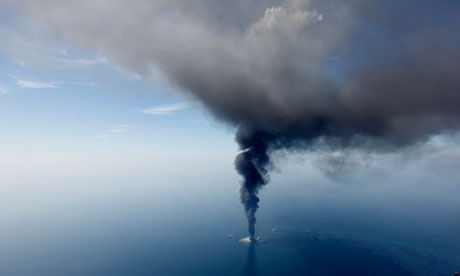
  • Oil spill from BP rig explosion at 5,000 barrels a day

    CNN reports the volume of oil spilling into the gulf of Mexico from BP’s Horizon disaster has risen to 5000 barrels per day – Oil spill from rig explosion at 5,000 barrels a day.

    The oil spill from last week’s deadly rig explosion in the Gulf of Mexico has increased to 5,000 barrels a day — five times more than the original estimate, said Coast Guard Rear Adm. Mary Landry.

    A third underwater oil leak has been located in the pipeline that connected the rig to the oil well, said Doug Suttles, chief operating officer for BP.

    The head of BP Groups said the explosion could have been prevented, and he is focusing blame on rig owner Transocean Ltd.

    CEO Tony Hayward told CNN’s Brian Todd in an exclusive interview that Transocean’s “blowout preventer” failed to operate before the explosion. A blowout preventer is a large valve at the top of a well, and activating it will stop the flow of oil. The valve may be closed during drilling if underground pressure drives up oil or natural gas, threatening the rig.

    “That is the ultimate fail-safe mechanism,” Hayward said. “And for whatever reason — and we don’t understand that yet, but we clearly will as a consequence of both our investigation and federal investigations — it failed to operate. …

    BP owns the oil well. Before the explosion, Hayward had announced a significant discovery of at least 50 million barrels of oil. “Of course, all of that is completely irrelevant in the context of what we’re now dealing with.”

    The Australian reports that attempts are being made to brun the oil slick on the surface – Controlled burn of Gulf of Mexico oil slick begins .

    EMERGENCY crews have begun controlled burns of a giant oil slick in the Gulf of Mexico, but a cruel wind shift raised fears the spill could hit Louisiana’s fragile shores by the weekend. …

    Two skimming vessels dispatched by the US Coast Guard and energy giant BP swept the thickest concentrations of oil into a 150m fire-resistant boom. They then towed it to a 8km “burn zone” set up inside the slick roughly 80km south of the mouth of the Mississippi where it was set alight a few hours before nightfall. “They lit it with a little float that has a fuel source on it that floats into the oil and ignites. It did successfully ignite,” Coast Guard petty officer Cory Mendenhall told AFP. …

    As a back-up, engineers are frantically building a giant dome that could be placed over the leaks to trap the oil, allowing it to be pumped up to container ships on the surface.

    Another Transocean drilling rig is also on stand-by to drill two relief wells that could divert the oil flow to new pipes and storage vessels.

    But that would take up to three months and the dome is seen as a better interim bet even though engineers need two to four weeks to build it.

    Coast Guard Rear Admiral Mary Landry, who is leading the government’s response to the disaster, warned on Tuesday that if BP fails to secure the well it could end up being “one of the most significant oil spills in US history.”


  • Accelerating Solar: A Look at the Next Decade

    REW has an article by Charlie Gay of Applied Materials on the future of solar pv power – Accelerating Solar: A Look at the Next Decade. I like the note about Chinese utilities producing aluminium as a way of leveling load – remember that next time some nuclear power zealot starts raving away about the need for “baseload power”…

    There is a lot of price pressure and cost pressure in the photovoltaics industry. Much of that is coming from the scale that’s happened and the capacity that’s been installed. We’ve seen costs come down fairly rapidly in addition to those prices coming down and that’s helping make this technology evolve and grow even faster. (Many) of the markets are geographically significant — Germany and Europe more broadly — but what we’re seeing is also a lot of change and growth happening in China, in India, in the U.S. and other parts of the world.

    Many parts of the world already have electricity rates that are over $0.40/kWhr. Solar today averages $0.25/kWhr. In almost all of Africa, Pakistan, Hawaii, Italy and large portions of Japan, the price of electricity is already in excess of what the cost of electricity is coming from solar. Solar can make a difference and what’s exciting is that the markets can grow as the industry grows. We’ve had a lot of different opportunities to be able to scale this industry in an organic and continuous fashion.

    Of the changes that are happening, we see a lot coming from China. We see utilities in China where there are basically less than 10 major utilities already getting actively engaged in solar and becoming vertically integrated. A utility in China is very different than a utility in the U.S. so those utilities are able to bring the market along with the manufacturing. Many of them today make their own aluminum, for example, as part of how they do load leveling. Rather than worrying about pumping water uphill for storage, they use that nighttime power to create other products. Several utilities have already taken large steps toward getting to large-scale manufacturing. Many of them are becoming significant players, able to bring down the total costs across the value chain.


  • Home Sensor Startup Snapped Up

    Technology Review has an article on Belkin’s purchase of Zensi, a maker of sensors to track domestic energy and water usage (which would be a useful supplement to the data gathered by smart meters, allowing more fine grained understanding and tuning of household power consumption) – Home Sensor Startup Snapped Up.

    If you knew how much electricity your plasma television used or how much water your dishwasher drank at different times of day, would you change your habits to conserve more and spend less on utilities? Researchers at the University of Washington, Duke University, and Georgia Tech believe that you might. Several years ago they invented sensors that could track the electricity consumption and water usage throughout an entire building via a single point on each system. In 2008, the researchers founded a company called Zensi to commercialize the technology, and last week, they sold that company to Belkin, an electronics hardware manufacturer.

    A line of easy-to-install sensors for homes could be commercially available within the next year, says Shwetak Patel, professor of computer science and engineering at the University of Washington, and co-inventor of Zensi’s sensors. Data from such sensors could lead to itemized utility bills–and customers who are more aware of the energy sinks in their homes, he says.

    Right now it’s impossible for a consumer to get an accurate gauge of energy use without deploying numerous expensive sensors. But cost reductions in key technologies have made the concept of watching every device in a home more feasible, says Ivo Steklac, executive vice president of sales and strategy at Tendril, a Boulder, CO-based, energy-monitoring startup. The key technologies are high-speed analog-to-digital conversion devices, digital signal processing algorithms, low-power communications, and ubiquitous Internet access and connectivity, Steklac says.

    The concept behind Zensi’s technology is simple: a single sensor is plugged into a wall outlet, where it “listens” to the high-frequency electrical noise produced in the wiring when different devices are turned on. Each electrical device has a signature that is unique to the kind of device it is, its brand, and its location within a house. This information, in turn, reveals its energy consumption. MIT professor Fred Schweppe, and others tested a similar idea more than a decade ago. In the case of plumbing, a sensor is connected to the hose spigot on the side of a house. When a toilet is flushed or a sink is turned on, the sensor detects the characteristic change in pressure.

    Data from the electricity and water sensors is sent via the Internet to a base station for analysis. The algorithms differentiate between different devices and calculate electricity and water usage.


  • Eyeless in Gaza

    TomDispatch has an article by Noam Chomsky which makes an interesting link between the Israeli naval blockade of Gaza and the extraction of gas offshore (and also gives one time Australian foreign minister Gareth “Biggles” Evans a serve while he is at it) – Eyeless in Gaza.

    It cannot be too often stressed that Israel had no credible pretext for its 2008–9 attack on Gaza, with full U.S. support and illegally using U.S. weapons. Near-universal opinion asserts the contrary, claiming that Israel was acting in self-defense. That is utterly unsustainable, in light of Israel’s flat rejection of peaceful means that were readily available, as Israel and its U.S. partner in crime knew very well. That aside, Israel’s siege of Gaza is itself an act of war, as Israel of all countries certainly recognizes, having repeatedly justified launching major wars on grounds of partial restrictions on its access to the outside world, though nothing remotely like what it has long imposed on Gaza.

    One crucial element of Israel’s criminal siege, little reported, is the naval blockade. Peter Beaumont reports from Gaza that, “on its coastal littoral, Gaza’s limitations are marked by a different fence where the bars are Israeli gunboats with their huge wakes, scurrying beyond the Palestinian fishing boats and preventing them from going outside a zone imposed by the warships.” According to reports from the scene, the naval siege has been tightened steadily since 2000. Fishing boats have been driven steadily out of Gaza’s territorial waters and toward the shore by Israeli gunboats, often violently without warning and with many casualties. As a result of these naval actions, Gaza’s fishing industry has virtually collapsed; fishing is impossible near shore because of the contamination caused by Israel’s regular attacks, including the destruction of power plants and sewage facilities.

    These Israeli naval attacks began shortly after the discovery by the BG (British Gas) Group of what appear to be quite sizeable natural gas fields in Gaza’s territorial waters. Industry journals report that Israel is already appropriating these Gazan resources for its own use, part of its commitment to shift its economy to natural gas. The standard industry source reports:

    “Israel’s finance ministry has given the Israel Electric Corp. (IEC) approval to purchase larger quantities of natural gas from BG than originally agreed upon, according to Israeli government sources [which] said the state-owned utility would be able to negotiate for as much as 1.5 billion cubic meters of natural gas from the Marine field located off the Mediterranean coast of the Palestinian controlled Gaza Strip.

    “Last year the Israeli government approved the purchase of 800 million cubic meters of gas from the field by the IEC…. Recently the Israeli government changed its policy and decided the state-owned utility could buy the entire quantity of gas from the Gaza Marine field. Previously the government had said the IEC could buy half the total amount and the remainder would be bought by private power producers.”

    The pillage of what could become a major source of income for Gaza is surely known to U.S. authorities. It is only reasonable to suppose that the intention to appropriate these limited resources, either by Israel alone or together with the collaborationist Palestinian Authority, is the motive for preventing Gazan fishing boats from entering Gaza’s territorial waters.

    There are some instructive precedents. In 1989, Australian foreign minister Gareth Evans signed a treaty with his Indonesian counterpart Ali Alatas granting Australia rights to the substantial oil reserves in “the Indonesian Province of East Timor.” The Indonesia-Australia Timor Gap Treaty, which offered not a crumb to the people whose oil was being stolen, “is the only legal agreement anywhere in the world that effectively recognises Indonesia’s right to rule East Timor,” the Australian press reported.

    Asked about his willingness to recognize the Indonesian conquest and to rob the sole resource of the conquered territory, which had been subjected to near-genocidal slaughter by the Indonesian invader with the strong support of Australia (along with the U.S., the U.K., and some others), Evans explained that “there is no binding legal obligation not to recognise the acquisition of territory that was acquired by force,” adding that “the world is a pretty unfair place, littered with examples of acquisition by force.”

    It should, then, be unproblematic for Israel to follow suit in Gaza.

    A few years later, Evans became the leading figure in the campaign to introduce the concept “responsibility to protect” — known as R2P — into international law. R2P is intended to establish an international obligation to protect populations from grave crimes. Evans is the author of a major book on the subject and was co-chair of the International Commission on Intervention and State Sovereignty, which issued what is considered the basic document on R2P.

    In an article devoted to this “idealistic effort to establish a new humanitarian principle,” the London Economist featured Evans and his “bold but passionate claim on behalf of a three-word expression which (in quite large part thanks to his efforts) now belongs to the language of diplomacy: the ‘responsibility to protect.’” The article is accompanied by a picture of Evans with the caption “Evans: a lifelong passion to protect.” His hand is pressed to his forehead in despair over the difficulties faced by his idealistic effort. The journal chose not to run a different photo that circulates in Australia, depicting Evans and Alatas exuberantly clasping their hands together as they toast the Timor Gap Treaty that they had just signed.


  • Taiwanese solution to soaring house prices: don’t have kids

    The Age has an interesting article on house prices and population growth – Taiwanese solution to soaring house prices: don’t have kids.

    In Taipei the other day, a crane drove up to the front of the Parliament building. It lowered a man sitting in a plastic container shaped like a house, and suspended him in the air in a protest against the high price of real estate. Through a microphone, he urged onlookers to rise up against high housing prices, declaring: ”People without homes, slaves to property, stand up!” …

    This matters because housing is not just an asset like shares or bonds. It is where we live. It’s natural for investors to prefer the security of bricks and mortar. But as governments throughout the region are discovering, it is also natural for people to want to own a home – and to turn against governments that allow prices to soar out of their reach. In Taiwan, the costs have become particularly serious, as we shall see. Their would-be home buyers – ”snails without shells” as they call themselves – have reacted by scrapping the other big expense facing young couples: children.

    At home, the Rudd government last week reversed its 2008 liberalisation of foreign investment rules on real estate, and set up a unit to ensure the rules are obeyed. It also set up a joint working party with the states to ask why housing prices have soared out of reach. But that will work only if it tackles the single biggest cause: the tax-driven growth of rental investors, whose borrowing has grown 30-fold in 20 years, squeezing out home owners. …

    Taiwan has become rich very fast, largely by inching its way into a central role in global IT and communications manufacturing. This year, the International Monetary Fund estimates, its GDP per head will overtake that of its one-time colonial master, Japan. Its economy is almost as big as Australia’s, and growing twice as fast. Yet its new wealth shows only fleetingly amid the grimy, cramped apartments built in earlier, poorer times.

    Taiwan is in the grip of a housing crisis worse than ours. It is a rich country, but wages and most prices are roughly half the levels here – because the government, like China’s, holds down the exchange rate to keep its manufacturing globally competitive. …

    Why can’t they build more apartments? Because ownership of those grimy old apartment blocks is fragmented among dozens of occupants and investors. To demolish, even to upgrade, a developer must buy them all out, which is prohibitively expensive in time and money. There are classy new apartments on the urban fringe, on greenfields sites, but too few to meet the demand from occupiers and investors. So prices have soared.

    So the snails save hard to buy a shell, and do without other things. That means, above all, they do without children, or with just one child. By 2008, Taiwan’s fertility rate was the lowest in the world. Its women bear on average just 1.05 children over their lifetimes. The cost of housing is not the only reason, but analysts say it is the main one.

    But not having children creates even bigger costs ahead. Right now, Taiwan has 6.8 people of working age for every retiree. But preschools are already closing for lack of children, and the population is set to shrink dramatically. By 2032, demographers project, Taiwan will have just 2.5 potential workers for every retiree – and by 2056, just 1.4. If nothing changes, Taiwan – like China, Japan and Korea – will slowly become economically unviable.

    So far, that hasn’t happened here. But if governments keep subsidising investors to outbid first home buyers and low income earners, it will. Snails want shells. Taiwan – and soon, possibly China – are showing us what else can go wrong when the price of shells soars out of the snails’ reach.


  • The Methadone Economy

    Tom Konrad’s latest peak oil investment article has a look at alternative fuels – the “methadone” for fossil fuel addicts – The Best Peak Oil Investments, Part IX: The Methadone Economy.

    The first eight parts of this series looked into alternative fuels. I concluded that no alternative fuel listed could replace oil as we use it today fast enough to replace dwindling oil supplies. Conventional biofuels cannot be produced in enough quantity, and making hydrogen is an inefficient use of electricity or natural gas. Electric vehicles are too expensive or have too little range. There is not enough natural gas and there is too little fueling infrastructure to make natural gas vehicles practical on a large scale. Gas-to-liquids makes sense for stranded natural gas, but there are too many other high value uses for natural gas to make a large dent in declining oil supplies. Coal to liquids does too much environmental harm, and algae needs too much more technological development to achieve its promise in time.

    The biggest problem with alternative fueled vehicles, however, is not the alternative fuels, the problem is the vehicles and how we use them.

    Oil was a one-time bonanza of a readily available, easily transportable, durable, energy-dense liquid. With oil, humanity won a natural resources lottery ticket. Like a lottery winner who blows cash that could have lasted a lifetime in a few months, we now need to realize that we’ve spent most of our winnings. It’s unreasonable to expect that we’re going to win another such jackpot before we have to start watching our fuel budget again. The main question is how soon and how deliberately we will make the necessary adjustment. Will we act like the lottery winner who uses his last hundred thousand to tide him over while he looks for a job? Will we keep partying to the bitter end, until one day we wake up, hung over in the gutter? Will it be something in between?

    The Methadone Economy

    Switching to a drug analogy, most alternative fuels are the methadone to treat our petroleum/heroin addiction. Methadone is given to heroin addicts in treatment because it mitigates withdrawal symptoms and can block the euphoric effects of heroin, morphine, and similar drugs, reducing the urge to use.

    Alternative fuels can be sufficient to allow our society to function, but we’re not going to feel the highs we felt when the oil was flowing freely. Alternative fuels cannot take us back to a “normal” pre-peak oil state because our use of petroleum over the last few decades as been far from “normal:” it has been one long, fossil-fueled high. We will eventually kick the petroleum habit with the help of alternative fuels not because alternative fuels are better than petroleum and can bring us something that petroleum cannot, but because our supplier will be getting smaller shipments over time, while the number of fellow junkies knocking on his door will keep going up with big increases in petroleum demand from emerging economies.

    There are several competing visions of a future powered by alternative fuels, ranging from wildly optimistic to gloom-and-doom, with variations depending on how effectively the prognosticator thinks we can replace fossil fuels with alternatives.

    A high-technology optimistic vision includes smoothly running efficient pods in mass transit systems powered by renewable energy. High speed bullet trains network the land, making overland air travel unnecessary. The low-technology optimistic vision involves a peaceful return to local economies where food is grown locally, and increasing local interdependence fosters strong local community ties, and people grow happier as they become more connected to the land and each other. The low-technology pessimistic vision is a free-for-all scramble for dwindling resources like the vision out of Mad Max referenced above.

    I’m long on optimism about technology, but short on optimism about our will to make the necessary sacrifices to implement that technology quickly or efficiently. I’m betting on a pessimistic, high-technology future. In this future, we manage to cobble together a hodge-podge of last-minute, jerry-rigged solutions to keep the economy functioning at a basic level, but not at all smoothly or evenly. In it, we lurch from a crisis caused by financial melt-down, to a crisis caused by peak-oil to one caused by climate change. We’ll tackle each crisis with incredible ingenuity, staving off total chaos, but at the cost of mis-allocated resources and a deteriorating standard of living. We hold out in the belief that after just this one more fix, the world will be back to normal and we can stop worrying. But that day will never come.

    Forward thinking planners in some municipalities and communities will work on implementing true, long-term solutions. But they will not have enough money or resources to do more than ameliorate the next crisis. The large-scale, system wide solutions of better mass transit, algae biofuels, and continent-wide electricity transmission of the high-technology optimistic vision will be implemented too slowly, on too small a scale to achieve the economic stability the techno-optimists hope for. But these half-built systems will still bring considerable benefit, and keep the succession of crises from being the complete disaster that would come with a complete lack of planning.

    This is the Methadone Economy. Alternative-fuel oil replacement therapy is necessary because oil supply will not keep pace with demand; we must replace oil or do without. But alternative fuels are not oil, and will require more effort devoted to energy production to produce the same effect. The Methadone economy will function, but it won’t give us the highs we got from the cheap, concentrated, easily accessible energy of oil.


  • Peak Everything ?

    Ronald Bailey at Reason – a long time skeptic of peak oil – has a new article looking at some other potential resource extraction peaks (peak lithium, peak neodymium, and peak phosphorus), arguing – correctly in my view – that substitution and recycling can overcome these problems – (Peak Everything ?.

    Peak Lithium

    Lithium is the element at the heart of the electric car revolution that many green energy enthusiasts are trying to foment. For example, the Chevy Volt, scheduled to be at dealers this fall, will be energized by 400 pounds of lithium ion batteries, plus a gasoline engine to produce electricity to extend the car’s range of travel once the batteries are drained. In 2007, William Tahil, an analyst with the France-based consultancy, Meridian International Research, issued a report that alarmingly concluded that there is “insufficient economically recoverable lithium available in the Earth’s crust to sustain electric vehicle manufacture in the volumes required.” Tahil added, “Depletion rates would exceed current oil depletion rates and switch dependency from one diminishing resource to another.” Not everyone agrees with Tahil’s peak lithium prognostications. …

    Even Tahil’s original report argued that there were alternative battery technologies in the works using far more common substances that could substitute for lithium. For example, the Swiss company ReVolt is developing rechargeable zinc-air batteries which hold 300 percent more charge than lithium ion batteries and cost half as much. And then there is Fluidic Energy which claims that it can develop a metal air battery that will hold 11 times the charge of the best lithium ion batteries for less than one-third the cost. A car running on such batteries would have a range of 400 to 500 miles on a single charge. These batteries are made from far more available materials which can be fairly easily recycled.

    Peak Neodymium

    Neodymium is a rare earth metal used extensively to produce permanent magnets found in everything from computer magnetic disks and cell phones to wind turbines and automobiles. For example, the magnets that drive a Prius hybrid’s electric motor use more than two pounds of neodymium. Interestingly, neodymium magnets were invented in the 1980s to overcome the global cobalt supply shock that occurred as the result of internal warfare in Zaire. Because China can more cheaply produce neodymium than any other country in the world, that country is now the source of 95 percent of the world’s neodymium. …

    On the other hand, if neodymium supplies really are a problem, perhaps there is a technical fix. For example, the privately held Chorus Motors has invented and developed an improved AC induction motor that completely eliminates the permanent neodymium magnets to supply the energy needed to accelerate hybrid or electric vehicles. If this technology is widely adopted, it would free up neodymium supplies for other uses and also tend to lower the metal’s price.

    Peak Phosphorus

    In the 1840s, scientists discovered that plants need the element phosphorus to grow. The phosphorus fertilizer industry grew rapidly, initially by exploiting vast deposits of seabird guano left on oceanic islands. Today phosphate rocks are mined to produce the fertilizer. The Global Phosphorus Research Initiative (GPRI) notes that modern agriculture is dependent on continual inputs of phosphorus fertilizer and that known reserves could be depleted within the next 50 to 100 years. The current issue of Foreign Policy ominously warns that failing to meet the challenge of “peak phosphorus” would mean that “humanity faces a Malthusian trap of widespread famine on a scale that we have not yet experienced.” But unlike petroleum or natural gas, phosphorus, as an element, is not destroyed when it’s used and so could be recovered and recycled.

    The folks at the GPRI point out that the phosphorus in just one person’s urine would be close to the amount needed to fertilize the food supply for one person. So why not recycle urine? …

    Stanford University economist Paul Romer has observed, “Every generation has perceived the limits to growth that finite resources and undesirable side effects would pose if no new recipes or ideas were discovered. And every generation has underestimated the potential for finding new recipes and ideas. We consistently fail to grasp how many ideas remain to be discovered. The difficulty is the same one we have with compounding: possibilities do not merely add up; they multiply.” The above examples show that while the production of physical supplies of resources may peak, there is no sign that human creativity is about to peak.


  • The “Epistemic Closing” of the Conservative Mind

    Billmon has an article looking at the strange process going on within the conservative echo chamber, with mindless loyalty commanding an ever higher premium and even nuts like David Frum beginning to get ejected from the circle of trust for minor breaches of cult discipline – The “Epistemic Closing” of the Conservative Mind. Billmon also had another column recently looking at some disinformation tactics being used lately (and lapped up by some of the dumber sections of the media, like The New York Times) – Spock with a Beard.

    One of the more striking features of the contemporary conservative movement is the extent to which it has been moving toward epistemic closure. Reality is defined by a multimedia array of interconnected and cross promoting conservative blogs, radio programs, magazines, and of course, Fox News. Whatever conflicts with that reality can be dismissed out of hand because it comes from the liberal media, and is therefore ipso facto not to be trusted. (How do you know they’re liberal? Well, they disagree with the conservative media!) This epistemic closure can be a source of solidarity and energy, but it also renders the conservative media ecosystem fragile.

    Julian Sanchez
    Frum, Cocktail Parties, and the Threat of Doubt
    March 26, 2010

    An epistemic community may consist of those who accept one version of a story, or one version of validating a story . . . In philosophy of science and systems science the process of forming a self-maintaining epistemic community is sometimes called a mindset. In politics, a tendency or faction is usually described in very similar terms . . . Some consider forming an epistemic community a deep human need, and ultimately a mythical or even religious obligation.

    Wikipedia entry
    Epistemic Community

    A few weeks ago I pointed out that the conservative propaganda machine was resorting to a standard “disinformation” technique to try to negate (or at least blunt) the PR damage done by the teabagger fit of rage following the passage of health care reform.

    The specific disinformation tactic (which I like to call “Spock With a Beard”) essentially consists of creating a false narrative in which black is white, up is down — and, in this particular case, where liberal Democrats are “inciting” violent threats against peace-loving Republicans like GOP Minority Whip Eric Cantor by, well, making a big fuss about violent threats from angry teabaggers.

    By disinformation, I meant:

    the systematic creation and dissemination of false narratives . . . aimed at constructing an entire alternative reality — one in which the truth can find no foothold because it conflicts just not with a specific falsehood, but with the entire fabric of the false reality that has been created.

    Since then, I’ve noticed the conservative fondness for propaganda methods that would not be out of place in Orwell’s Minitrue (oldspeak translation: Ministry of Truth) is also drawing attention from other observers — including, at least obliquely, some on the right.

    Paul Krugman, who is rarely oblique about anything or anyone, points the Orwellian finger at GOP Senate Majority Leader Mitch McConnell, for his stubborn insistance that fiercely defending the interests of huge Wall Street banks is actually a way of preventing future government bailouts.

    Has there ever been a time in US political history when one of the two major political parties was so addicted to doublethink, so committed to pretending that it’s advocating the opposite of its actual agenda?

    To which, one can only reply: Do the years 2001 through 2008 count? Or are the Rove Administration’s two terms in office still too fresh to be treated as history?

    But what really caught my attention was a blog entry by fellow New York Times columnist Ross Douthat (posted, coincidentally or not, on the same day as Krugman’s question) which managed, in Douthat’s pretentious yet obtuse way, to talk all the way around the current state of the conservative “mind” without ever acknowledging, much less addressing, the fact that this “mind” is, to a large and ever-increasing degree, a propaganda construct, and thus not really a “mind” at all — more like an anti-mind.

    But, fortunately, Douthat also linked to a much more interesting take from the libertarian writer Julian Sanchez, who digs a bit closer to the truth (although not quite all the way there) in the quote cited at the beginning of this diary.

    Sanchez’s post, which appears to have caused a buzz in both left and right Blogistan (I’m usually late to party these days) was in reaction to the summary excommunication of David Frum, banished from the American Enterprise Institute for his apostasy on health care reform. (It’s a telling sign that the AEI’s commissars deported Frum to the conservative version of Siberia not for dissenting on the substance of health care — he didn’t, really — but rather for questioning the political line, i.e. extreme stonewalling, adopted by the GOP. Truly, the party must always be right. …

    All in all, Sanchez paints a pretty accurate, not to mention damning, picture of the modern conservative ideological machine and its increasingly Orwellian methods — both of message propagation and social control. But, apart from the China reference, he more or less elides the question of intentionality. In Sanchez’s telling (and even more so in Douthat’s retelling) the current withered, sectarian and paranoid state of the conservative “mind” is something that just happened — a bottom-up social trend, not a top-down directive.

    This is partially true, I guess, in the sense that a formal Republican Politburo does not exist (and even if it did, its members most likely would be found chilling at a lesbian bondage club, not steering a high-tech dictatorship from the bowels of a fortress-like ministry.)

    But it’s also not true, in the sense that the conservative propaganda machine referenced at the start of this diary does exist, and has shown a relatively high degree of self-awareness and top-down control — as witnessed, for example, by the infamous daily guidance memos circulated within Fox News by vice president John Moody (“Let’s be on the lookout for any statements from the Iraqi insurgents, who must be thrilled at the prospect of a Dem-controlled Congress.”) and the talking points distributed directly to Fox commentators by the White House in Rovian times).

    It may not qualify as a bona fide Inner Party, but it is a party cadre, and it knows its business. (Figuring out exactly where and how and from whom it learned that business would make for a fascinating social study — or possibly a legal one).

    The business, of course, is disinformation: the creation of a closed loop of emotions, beliefs and pseudo-facts that buttress, at all times and all points, the party line.

    However, the more I study this, the more I’m convinced the primary goal of the exercise isn’t to convince the broader public, whom I think the Rovians essentially view as the equivalent of the “proles” of 1984 — dull lumps of unthinking flesh who, nine times in 10, will follow the loudest, most simplistic and most passionate voice they hear.

    The goal of conservative disinformation, then, is to provide that voice by creating the kind of “mind” (e.g. epistemic community) among the true conservative faithful that Sanchez is talking about: one impervious to reason, logic and — most importantly of all — factual evidence. The growing nervousness of some conservative intellectuals, like Douthat and Frum, about this project perhaps reflects the dawning realization that they are basically irrelevant to its success.

    The creation of a closed mind is, of course, a prerequisite for successful doublethink (defined as the ability to hold two diametrically opposed beliefs at the same time, and to immediately change one or both of those beliefs when instructed). By their very nature, doublethink constructs tend to be fragile. They have a low tolerance for contact with non-managed reality — much less open debate (thus the need, in 1984, for the constant writing and rewriting of history, to ensure a seamless and timeless continuity to the party line).

    But the real breakthrough discovery by the conservative propaganda machine (Fox News, in particular) is that despite this inherent fragility, it doesn’t take an Orwellian police state to create and maintain the kind of self-contained, artificial consciousness that doublethink requires.


  • Peter Newman: Global downturn cushioned peak oil impact

    The ABC has an article quoting Peter Newman and Kjell Aleklett talking about peak oil and the credit crunch (personally I think oil prices were just one factor causing the GFC, and not the main one) – Global downturn cushioned peak oil impact.

    One of the Federal Government’s top infrastructure advisers is warning of an oil crunch that could send the global economy spiralling back toward recession.

    Curtin University Professor Peter Newman sits on the Government’s Infrastructure Australia Council and says peak oil – when demand outstrips dwindling supply – has already hit but that the global downturn has kept prices low.

    Professor Newman even blames oil for causing the global recession in the first place, and he is not alone.

    It is an issue being taken seriously by some local councils which have drawn up peak oil contingencies. Proponents of the scenario said the cost of oil and therefore petrol would rise exponentially in the first decade of this century when increasing demand outstripped finite supply.

    With oil now hovering at about $US85 a barrel it does not seem to have happened – at least in the original timeframe. But Professor Newman says the world reached peak oil in 2008 when it spiked at about $140 a barrel and sent petrol prices soaring.

    “Peak oil did happen I believe in 2008 and it didn’t happen because some oil exporting country had a revolution or something. It just happened because we couldn’t produce enough to meet the demand,” he said.

    Professor Newman largely blames the global financial crisis on oil prices. “Subprime mortgages were mostly out on the urban fringes miles away from work. People had to drive and when the price of fuel tripled in American cities they couldn’t pay their mortgages,” he said.

    As the global economy has strengthened in recent months so has the oil price, and Professor Newman says it does not bode well for recovery. “As the demand increases again the supply crunch will happen and the price will go up,” he said.

    Peak oil solutions

    Professor Kjell Aleklett, the Swedish-based president of the Association for the Study of Peak Oil and Gas, is in agreement with his Australian counterpart. “The fact is that we are producing less oil now than we did in 2008, so just now we have 2008 as the peak year for peak oil,” he said.

    Professor Aleklett says he thinks the world will find a way around the problem simply because it will grind to a halt if it does not.


  • Silicon Valley company to replace every window in the Empire State Building

    The Silicon Valley Mercury has an article on making the Empire State Building more energy efficient – Silicon Valley company to replace every window in the Empire State Building.

    Some people don’t do windows. Kevin Surace does. In a very big way.

    The Silicon Valley CEO is about to oversee a green-building project on the most high-profile stage in the world when his company — Serious Materials, in Sunnyvale — begins replacing all 6,514 windows in the Empire State Building.

    And no, all that glass — an estimated 26,000 panes — will not be dumped into New York City’s trash bins.

    Instead, over the next nine months, laboring at night so as not to disturb tenants and tourists in New York’s 102-story Art Deco landmark at Fifth Avenue and West 34th Street, Surace’s workers will use a high-tech process to remove every window from its frame and separate the glass. Renovating roughly 50 windows a night, they’ll install a clear, mylar-like plastic sheath in between the double panes, then fill the windows with an argon-krypton gas, reseal them and rehang them.

    The result? Silicon Valley meets the Big Apple: windows that are four times more insulated than the old ones and will save $410,000 a year in heating and air conditioning costs.


  • The humble battery: 210 years later, the breakthrough we still await

    Energy Bulletin has an article from Steve LeVine on the history of battery – The humble battery: 210 years later, the breakthrough we still await.

    The battery could be a shoo-in for the most confounding of all technologies. Invented in 1799 by Alessandro Volta, it not only has yet to be perfected, but has operated all along on essentially the same chemical principles. Were that it were different: If engineers could figure out how to store sufficient electricity in a sufficiently small, light, safe container, there would be a cascading revolution — in super-utilities, electric cars, laptops and mobile phones. With the possibility of a trillion-dollar industry at stake — if consumers en mass decide that they want plug-in hybrids, for instance — engineers and scientists from the Silicon Valley to Japan, China and Korea are manically working on the technological challenge.

    Henry Schlesinger, a New York-based science journalist, sets out to right a gaping authorial wrong in his new book, The Battery: How Portable Power Sparked a Technological Revolution. In the introduction, Schlesinger notes rightly that an omnibus account of the this exceedingly fascinating technology — from Volta to today — simply doesn’t exist.

    It still doesn’t. This is less a history of the battery than a romp through some of the biggest names in the most exciting periods of invention in the last two centuries — Davy, Faraday, Edison and Marconi. It reads like an extended Google search of such personalities, with a special focus on electric-powered devices. Schlesinger hints as to why the book turned out this way: “If there are detours,” he writes, “it is only because the facts uncovered were either too interesting or too much fun to leave out.”

    Point made. The missing history of the battery is still missing. Yet the result is still fun. Schlesinger’s zest for those detours is infectious.

    A bit of advice: Skip the first 18 pages, in which Schlesinger orphans far-afield basic science history. From there, he plunges in to his broad tale. …

    Yet we do end up understanding that batteries are important. In the last few pages, Schlesinger casts his gaze on current efforts to realize the battery’s potential, hop-scotching through carbon nanotubes, genetically altered virus batteries, and bio-batteries using vodka, sugar or urine. The book ends on a hopeful note. Schlesinger writes, “Battery development is, at long last, catching up to related fields.”


  • Deepwater Horizon oil spill: Underwater robots trying to seal well

    The Guardian has a look at BP’s disaster drilling in the Gulf Of Mexico, with the rig sunk, 11 people dead and the well leaking oil into the waters and looking rather difficult to stop anytime soon – Deepwater Horizon oil spill: Underwater robots trying to seal well. More at the Wall Street Journal and Houston Chronicle.

    Underwater robots dived to the ocean floor yesterday in a new effort to staunch the 42,000 gallons of oil a day being pumped into the Gulf of Mexico in America’s worst offshore oil rig spill in 40 years.

    The robots will attempt to activate a blowout preventer, a 450-tonne valve on the ocean floor that offers the only timely option for stemming the flow.

    With the oil now coating 1,800 square miles of water, BP officials acknowledge it could take months to entirely contain two separate leaks from the wrecked oil rig.

    The US coastguard discovered the leaks on Saturday, two days after the Deepwater Horizon oil rig leased by BP sank off the coast of Louisiana. The rig was destroyed in an explosion last Tuesday, with 11 workers missing and presumed dead.

    What initially seemed a manageable spill is now rated by the US coastguard as a serious environmental problem, with 1,000 barrels of oil a day being pumped into the Gulf of Mexico, an area rich with dolphins, whales and other marine life.

    Three sperm whales have been sighted in the area of the slick, officials said yesterday.

    The spill, which occurred just as senators were preparing to roll out energy and climate proposals, has deepened debate about America’s energy policies.

    In an effort to win support for the proposals, Barack Obama had come out in favour of more oil and gas drilling in the Gulf of Mexico.

    High winds and big waves forced clean-up vessels, which have been trying to skim the oil from the surface of the water before it washes up on shore, to remain in port at the weekend.

    But Mary Landry, the coast guard commander, insisted the four states that lie in the path of the slick would have ample warning to protect fragile wetlands. Forecasts suggest the oil will make landfall on Thursday.

    The plan put into operation yesterday called for four underwater robots to dive 1,500 metres (5,000 ft) below the surface of the water to try to activate the gargantuan system of pipes and valves that sits next to the well on the ocean floor.

    BP said it was the first time such an operation had been mounted at this depth.


  • Better Place starts electric cab trial in Tokyo

    BusinessWeek has an article on a Better Place trial in Tokyo – Better Place starts electric cab trial in Tokyo.

    Three electric cabs began a 90-day trial in Tokyo on Monday that officials and the company involved say could eventually lead to the electrification of the city’s entire taxi fleet.

    The cabs run on lithium-ion batteries that can be changed in less than one minute with a fully charged one. The charge starts running low after 300 kilometers (190 miles), according to Better Place, the California-based electric-vehicle services provider that’s part of the government-backed project.

    There is only one such “switch station” in Tokyo now, and the city would need 300 for the entire fleet of 60,000 cabs on Tokyo streets — more than New York, London and Paris combined — to go electric, said Better Place Chief Executive Shai Agassi.

    He said the move to electric is inevitable because the burgeoning number of cars in countries like China is sure to push up oil prices while the price of electric vehicles is sure to come down like flat panel TVs.

    “There is no other alternative,” Agassi said at an opening ceremony.


  • When does surplus = resilience ?

    Stuart at Early Warning has a look at the ability of societies to muster resources to meet existential threats – When does surplus = resilience?.

    Optimists about our current civilization tend to ignore the fact that history is full of past civilizations, all of which collapsed except the ones that happened to be around when modern civilization arose and managed to get themselves incorporated into it. For example, in checking the index of Ray Kurzweil’s The Singularity is Near, I find that he has a single one sentence mention (p346) of the issue. Similarly, Julian Simon’s Ultimate Resource II takes almost all its data series from the industrial era and simply ignores the collapse of past civilizations. Clearly, these authors are not thinking very deeply about the data points that might tend to contradict their optimism.

    On the other hand, more pessimistic thinkers often subscribe to some flavor of environmental determinism and assume that our current civilization is governed by very similar laws to past civilizations, and therefore is at risk of collapsing along similar lines. For example, Tainter in his book Collapse of Complex Societies argues that all civilizational collapses share a common dynamic: as the society becomes more complex there is a declining marginal return to more complexity, and eventually the civilization becomes overstressed and must collapse. He believes the same law applies to modern civilization and shows a variety of data series arguing that modern civilization is experiencing declining marginal returns along certain dimensions. While he’s careful not to claim specific timing, he clearly thinks the same thing could happen to us that happened to past civilizations.

    In this post, I want to explore the idea that there is at least one important class of threats where we might expect modern civilization to be much more resilient than past civilizations. Specifically, modern civilization operates at far higher levels of economic surplus than past civilizations, and this means that it is in a position to devote far higher levels of economic resources on solving certain kinds of problems.

    It’s hard to be terribly accurate about this, of course, since modern civilization and pre-industrial civilizations are very different, and past civilizations tend to be poorly documented. Still, the overall pattern is clear. For example, in a post last month, The Net Energy of Pre-Industrial Agriculture, I pointed out that the fact that 75-97% of the population of medieval European countries lived in the country must mean that the overall energetic return of their agricultural sector, taken as an entire system, must have been quite small. By contrast, in modern western countries, only 2-3% of the population is involved in agriculture.

    Of course, that comparison overstates the situation; in pre-industrial societies, agriculture was the source of most primary energy, whereas in modern civilization that is fossil fuels. So I present the following graph with rough estimates showing the fraction of global GDP being expended on primary energy. Here I have used methods similar to yesterdays post, in which I am taking global fossil fuel production figures, US price indices, and PPP global GDP estimates from the IMF to estimate the fraction of global world product being expended to obtain fossil fuels. The use of US price indices introduces some inaccuracy, particularly for natural gas and coal which are less globally integrated markets than oil. Further, I have used wellhead/mine-mouth prices – delivered to the customer, you would need to add a few percentage points.

    Still, the overall point is clear – we expend less than 10% of our effort as a society in securing our primary energy source, whereas our distant ancestors needed to expend well more than half of theirs. …

    Bart at Energy Bulletin comments :

    In the past, much of society’s surplus was appropriated for war and luxury (status-related objects and services). And the pattern isn’t much different today, is it? According to Wikipedia today (Military Budget of the US):

    The U.S. Department of Defense budget accounted in fiscal year 2010 for about 19% of the United States federal budgeted expenditures and 28% of estimated tax revenues. Including non-DOD expenditures, defense spending was approximately 25–29% of budgeted expenditures and 38–44% of estimated tax revenues.

    Thus a big part of the problem is political, rather than just technological.


  • RTA changes could be boost for electric bikes

    The SMH reports that electric bikes might get greater encouragement from the local regulators – RTA changes could be boost for electric bikes

    ELECTRIC bikes could be the answer to traffic congestion, the obesity crisis and our carbon footprint. But over-regulation and a cycling culture that looks down on battery-assisted bikes as “cheating” have slowed their take-up in Australia, enthusiasts say.

    However, changes proposed by the RTA could allow more powerful models on our roads.

    The bikes do not need to be registered as long as their maximum power is 200 watts or less. But some models can have throttle control and resemble mopeds, with users being booked for riding them without registration.

    ”The beauty of this is people who are way past riding a bike can suddenly ride again. It integrates casual exercise into people’s daily lives,” says Mike Rubbo, 71, a filmmaker and e-bike enthusiast who runs the blog situp-cycle.com. ”It’s the ideal urban transport vehicle.”

    Overseas, e-bikes with up to 1000-watt motors are permitted in some jurisdictions. European e-bikes are typically 250 watts. In response to a growing push to allow e-bikes without registration to be used in Australia, the RTA has submitted a report to the federal government proposing changes to regulations.

    “Times have changed and bikes have changed so they need to bring the law into line with Europe, which is what they’re proposing,” said Paul van Bellen, co-owner of Gazelle Bicycles Australia, a “bikes for transport” shop in Matraville.

    The SMH also has a report on haggling over a Sydney light rail plan (probably a fantasy, like most state government transport initiatives) – Bureaucrats want light rail stops every 700m – passengers or not.

    The Sydney Metro Authority folded last month after the Premier, Kristina Keneally, abandoned the controversial $5.3 billion, seven-kilometre underground line between Central and Rozelle and announced instead an extension of the light rail to Dulwich Hill and a line between Central and Barangaroo.

    Under a proposal the Herald understands the department is considering, there would be no light rail stops at Lewisham train station and New Canterbury Road, which several popular bus services – including 428 between Canterbury and the city and the 444 and 445 between Campsie and Balmain – use.

    ”This makes no sense,” the deputy mayor of Leichhardt, Michele McKenzie, said. ”The light rail stops should be at the quickest interchange point with other modes of transport. In our case, stops need to be at the main western [train] line and Canterbury Road.”

    Cr McKenzie and public transport experts fear the proposal will prevent the light rail reaching capacity.

    The minister’s spokesman said work was under way on a pre-construction study for the light rail extension, which would take three months. ”No decision has been made on the exact locations of stops for the light rail,” he said.

    Garry Glazebrook, an urban planning expert at the University of Technology, Sydney, who was invited to sit on the government’s transport planning taskforce, said light rail was a flexible form of transport that could fit around existing land use and encourage new, more dense land use and improve street life. ”The stops can be 200 metres apart or a kilometre apart,” he said.

    ”Your aim, when designing a system, is to pick up the major catchments of people.”


  • Wind Turbines Shed Their Gears

    Technology Review has an article on GE and Siemens adopting direct drive wind turbines – Wind Turbines Shed Their Gears.

    Wind turbine manufacturers are turning away from the industry-standard gearboxes and generators in a bid to boost the reliability and reduce the cost of wind power.

    Siemens, the world’s largest turbine manufacturer by volume, has begun selling a three-megawatt turbine using a so-called direct-drive system that replaces the conventional high-speed generator with a low-speed generator that eliminates the need for a gearbox. And last month, General Electric announced an investment of 340 million euros in manufacturing facilities to build its own four-megawatt direct-drive turbines for offshore wind farms.

    Most observers say the industry’s shift to direct-drive is a response to highly publicized gearbox failures. But Henrik Stiesdal, chief technology officer of Siemens’s wind power unit, says that gearbox problems are overblown. He says Siemens is adopting direct-drive as a means of generating more energy at lower cost. “Turbines can be made more competitive through direct-drive,” says Stiesdal.

    Siemens’s plans hinge on a new design that reduces the weight of the system’s generator. In conventional wind turbines, the gearbox increases the speed of the wind-driven rotor several hundred fold, which radically reduces the size of the generator required. Direct-drive generators operate at the same speed as the turbine’s blades and must therefore be much bigger–over four meters in diameter for Siemens’s three-megawatt turbine. Yet Siemens claims that the turbine’s entire nacelle weighs just 73 metric tons–12 tons less than that on its less powerful, gear-driven 2.3-megawatt turbines.