Author: Bob Hicks

  • ‘Rose’: a flower among the thorns

    Benedict Nightingale, reviewing the new London theater season for the New York Times in 1999, put his finger on the big trouble with Rose, Martin Sherman’s one-woman play about an 80-year old Holocaust survivor sitting on a park bench in Miami and remembering the high and low points of her extraordinary life.

    Wendy Westerwelle stars in "Rose"“Rose’s life sometimes seems too exemplary to be true,” Nightingale writes. “Add some convenient coincidences to her tale — like meeting a bitter old shopkeeper in the Arizona desert and realizing he is the spouse she thought she had lost to Dachau — and Rose could easily be a case study rather than a character.”

    But Nightingale also saw beyond Sherman’s desire to embrace the entirety of the post-Holocaust Jewish dilemma in a single overstuffed play, instead championing the drama’s extraordinary heart and the quietly stunning performance of its star, Olympia Dukakis — “the permafrost beneath the surface, the Siberia in her soul.”

    He praised Rose for its “always lively, often distressing, sometimes hauntingly strange observation,” and concluded: “If you think that sedentary bravura is a contradiction in terms, this should change your mind.”

    England liked Rose. It was nominated for the Olivier Award for best new play, and moved in 2000 to New York, again with Dukakis, where its reception was chillier. Bruce Weber, also writing in the New York Times, reacted like this: “(H)er story resonates on the tired frequency of a lecture about the wages of forgetting the past. If you are not of a certain age, you may react to her as a child to a relative who has overtaken one too many family gatherings: Yes, Grandma. Now can we go out and play?”

    Then, echoing a theme sounded by several reviewers, he lamented the script’s streaks of jokiness amid the general despair: “Either Mr. Sherman is talking through her, or else in the year it took Rose to become fluent in English, she assimilated a lifetime of Borscht Belt humor.”

    Well, maybe. But then, Rose is 80 years old when she sits shiva on that park bench, and she’s lived in America for most of her adult life. And Borscht Belt humor doesn’t come just from the Catskills. The Catskills are only a pipeline to older places and older times, where that peculiarly Jewish humor of survivors’ exaggeration was born and nourished before it immigrated to summer camps on American lakes. So Rose couldn’t be a little funny? So she shouldn’t be a little funny? Jews have been laughing about the unlaughable for a long, long time. It’s one way you get through.

    About that other point, the “wages of forgetting the past”: Rose and Sherman are guilty as charged. Except, you should pardon the expression, I’m not sure why that’s something to feel guilty about. We do forget the past. Forgetting is disastrous. One can remind without being a nag. Even then, in the orbit of Jewish comedy, the old nag, the busybody, the yenta, is a stock character. You hear, you nod, you shrug, you laugh. Rose is not exactly a yenta and not exactly a nag: her complaints are visceral and rooted in real horrors, not imagined or exaggerated slights. And Rose is not a tale of elegant construction and beautiful words, like Jerzy Kosinsky’s (or whoever actually wrote it) The Painted Bird. So be it. Rose is not an elegant woman. But she’s memorable.

    All of which is an extremely long way around to pointing out that Triangle Productions‘ Portland version of Rose, featuring Wendy Westerwelle and directed by Don Horn, is nearing the end of its run (final performances are 7:30 p.m. Friday and Saturday and 2 p.m. Sunday at CoHo Theater) and well worth your time. No, it’s not a perfect play. But it’s an intense, intelligent, funny and deeply moving play, and Westerwelle inhabits it with remarkable restrained passion.

    Before the show opened I talked with Westerwelle about it and then wrote about our conversation here. It was obvious she’d made an enormous commitment to the role, and it shows on stage. She delivers a terrific performance, technically smart and emotionally vivid and precise.

    I suspect her performance is very different from Dukakis’s: This Rose is not a permafrosted soul. People who know Westerwelle from past performances as varied as her Sophie Ticker show Soph: A Visit With the Last of the Red Hot Mamas and the old Storefront Burlesques know her as an extrovert, an outsized personality, an ambassador of the broad gesture. In Rose, she doesn’t reject that so much as she channels it to the sobering realities of the life of a woman who endured and survived some of the worst atrocities the 20th century threw at the world.

    From a Ukrainian shtetl to the Warsaw pogroms to the postwar detention camps to her almost magical-realist transformation to freedom and eventual wealth in the United States, Rose relates the story of a woman bobbing on the waves of vast historical movements, trying to find ground. Her losses and occasional gains are intensely personal, and that is part of Sherman’s point, which Westerwelle and Horn so ably bring home: Great cultural tragedies are intense private tragedies, too. Small, common lives are ripped apart, and in the process, become uncommon. Yes, Rose is a survivor, with the guilt and the scars that go with it. And, yes, she leavens the horrors she relates with some wry jokes. Wouldn’t you?

    So, I forgive the play its sometimes awkward leaps, its desperation to tell everything, its occasional ungainly coincidence. Those are small potatoes compared to what it achieves. Rose speaks truth about history, and hope about surviving it, and looks forward as well as back: It carries Rose’s story into the ongoing tragedy of the Israeli-Palestinian conflict, lamenting that victims have also become victimizers. That final chapter is bound to anger a few people in the audience. But from Rose’s (and, presumably, Sherman’s) perspective it resounds with emotional and spiritual truth. Enough with the slaughter. Time for life.

    *

    “Looks like you’re the only goy who stayed for the talkback,” a friend commented after the post-show discussion on the afternoon I saw the play. Her comment surprised me: I hadn’t thought of it in those terms at all. I had noticed that I was one of only a few men in the audience, but only because a couple of women in front of me were joking about it as we walked from the lobby into the theater. Jew, goy — yes, it’s a Jewish story, but it’s a story for and about all of us. History has a way of drawing us together as well as pushing us apart.

    In addition to Westerwelle and Horn, the post-show talk included Eva and Les Aigner, both Jewish and both Holocaust survivors. Their stories were simple and profound: stories of luck, stories of delivery. Stories of what these days we call post-traumatic stress. Les told of his 15 years of nightmares, of the job he held for decades in Oregon without ever telling anyone about his background. They told about how having each other made things easier, and how having children gave them a future. And Eva revealed why they finally decided it was time to start telling people their stories. It was when the Holocaust denial movement started gathering steam, she said. It just made them angry. How could anyone say it hadn’t happened? They were there. So they began to speak.

    Sometimes, theater really is about life.

    *

    ILLUSTRATION: Wendy Westerwelle as Rose. Photo by Mark Larsen.

  • Fanfare for the Common Woman

    “I’m not sure when ‘accessible’ became a dirty word,” Ms. Alsop said. “I’m not of the belief that something has to be inscrutable in order to be great.”

    Composer Jennifer HigdonMs. Alsop is Marin Alsop, music director of the Baltimore Symphony (and, early in her career, of Oregon’s Eugene Symphony) and she’s being quoted in this morning’s New York Times in Vivien Schweitzer’s engaging profile of composer Jennifer Higdon, the freshly minted Pulitzer Prize winner for her Violin Concerto, written for performer Hilary Hahn.

    Alsop, a fan, expanded on Higdon’s music: “Her scores are ‘very strong rhythmically … with real scope and shape and architecture. She knows how to bring out the best of the various instrumental colors in the orchestra.’ She added that Ms. Higdon’s music is ‘very immediate, authentic, sincere and without pretense.’”

    Sounds right. Almost a year ago — on May 18, 2009 — Mr. Scatter had this to say about Higdon’s music, on the occasion of an impending concert of her music by Third Angle:

    As I type I’m listening to a recording that Third Angle artistic director Ron Blessinger gave me of Philadelphia composer and double Grammy winner Jennifer Higdon’s Celestial Hymns and Zaka, and I’m liking it a WHOLE lot.

    It’s jangly, insouciant, nervous, brash yet somehow introspective music. It’s thoroughly American. And it’s accessible, which in this case means not dumbed down but smart and extroverted — speaking, like Gershwin and Copland and Ellen Taaffe Zwilich and many others, in a voice that would actually like to be heard by an intelligent general audience. Makes me think of Bartok crossed with Charles Lloyd, maybe because of the clarinet and flute.

    What’s more, from everything I’ve heard and read, Higdon’s a delightful person, exactly the sort of public ambassador that contemporary classical music (I know; that sounds like an oxymoron. Can you think of a better way to say it?) needs.

    Prizes are prizes, with all of the politicking, guesswork and compromises that go along with that. But sometimes you’re glad they turn out they way they do. Cheers, Jennifer Higdon. Enjoy the Champagne.

  • Miracle elixir, that’s wot did the trick, sir

    Do not go gentle into that good night. Rage against the dying of the light with a well-mixed martini in your hand.

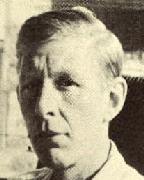
    W.H. Auden, Library of Congress/Wikimedia CommonsIn a recent post about a Vox spoken-poetry performance, Art Scatter mentioned in passing “the magician’s drone of listening to the likes of W.H. Auden reciting his own work.” That phrase caught the attention of playwright, novelist and filmmaker Charles Deemer, who passed along the following memory of the great gimlet-eyed poet. (And, yes, we know it was Dylan Thomas who advised against going gentle into that good night. Thomas was known to pack away a brew or two, himself.)

    Since you mention Auden …” Deemer writes, “his magical readings were more magical than meets the eye.

    Dirty little martini/Wikimedia CommonsIn 1963 I had the honor of hosting Auden, who was giving a reading at a community college I attended at the time. There was a dinner and reception before the reading, during which he drank, by my own nervous count, a dozen martinis! And seemed drunk. We didn’t know what to do, and when approached he assured us all was fine, no, he didn’t want any coffee …. so off we went to the reading, nervous as hell. He still seemed drunk to me when he went to the podium. Then somehow he didn’t. He gave a brilliant, flawless reading. Then he stepped away, seemed drunk again, and wanted to know when he could have a drink.

    Remembering Auden’s feat got Deemer going, and he passed along another couple of encounters.

    Deemer continues:

    My other favorite “famous writer” story happened in the mid 70s.

    United States postage stamp, Katherine Anne Porter and the ship of foolsAt a university dinner party in Maryland I was seated next to the visiting and very old Katherine Anne Porter. She was a remarkable woman, telling me story after story about Paris in the 20s. Anyway, dinner ended, the drinking began (it was an English Dept party known for its drinking), but we stayed at the table, she talking, me listening. After an hour or so, some faculty member with too much to drink stumbled and knocked down a lamp behind us. Porter grabbed my arm, leaned close, and said, “Why are people throwing things?” I’ll never forget it!
    So I might as well add my Ken Kesey story and conclude the deal.

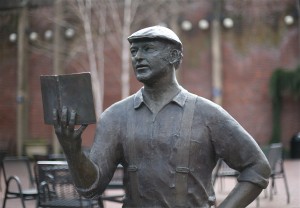
    Statue of Ken Kesey in Eugene, Oregon. Photo: Cacophany/2007, Wikimedia CommonsIn the 80s (aha, a famous writer story for each decade!) I was performing my Woody Guthrie one-man show at a camp ground on the coast at night. Some asshole was singing along out of key. He intro’d himself after the show, yep, Ken Kesey, looking the part dressed like a logger, boots, plaid shirt and suspenders etc. He invited me for a drink, we drove down the coast in his convertible and stopped at a bar. In which Ken Kesey drank … MAI TAIs! The picture of this rugged logger guy drinking these dainty drinks with little umbrellas in them … another unforgettable moment.
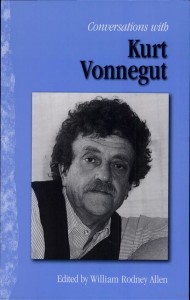
    That got me thinking about my own college-days encounter with Kurt Vonnegut, Jr., who was something of a reluctant god in university circles in the late 1960s. He made the circuit, got paid a lot of money for giving 20-minute readings, and of course was obligated to show up at cocktail parties littered with the needy souls of those few and lonely locals who could truly appreciate the genius of the literary man of the moment.

    The book "Conversations with Kurt Vonnegut." Evidently, some lasted longer than Mr. Scatter's/The party took place in a swaybacked Craftsman-style flat gone to pot in more ways than one, and Vonnegut, Einstein hair crackling under the bare light bulb, clearly wasn’t in a party mood. He kept edging into corners, which were mostly stacked with yellowed copies of the New York Review of Books, and one particularly eager faculty member kept edging in on him, like a yawping poodle, begging for attention. The closer he got the farther Vonnegut retreated, but the space was narrowing. Then the faculty member tripped — and spilled his red wine all over the front of Vonnegut’s rumpled corduroy sport jacket. Vonnegut and the poodle froze, one in anger, the other in acute embarrassment. I happened to be standing nearby, and Vonnegut looked at me. “Do you have a car?” he asked coolly. Yes, I said, I did. “I have a headache,” Vonnegut said. “Would you mind delivering me to my hotel?” So I did. The great man was ruthlessly quiet on the drive. “Thank you,” he said when we reached the hotel. He opened the door and got out, and that was the last time I saw Kurt Vonnegut, Jr. I returned to the party, which had thinned out considerably. The academic literati who remained seemed thoroughly depressed. The potheads didn’t seem to notice. They just kept partying on.

    Maybe you have your own stories about great figures behaving badly, or just humanly. Let’s gather them here. Hit that comment button.

    *

    ILLUSTRATIONS, from top:

    – W.H. Auden, Library of Congress/Wikimedia Commons

    – Dirty little martini/Wikimedia Commons

    – United States postage stamp, Katherine Anne Porter and the ship of fools

    – Statue of Ken Kesey in Eugene, Oregon. Photo: Cacophany/2007, Wikimedia Commons

    – The book “Conversations with Kurt Vonnegut.” Evidently, some lasted longer than Mr. Scatter’s.

  • Poetry off the page, or, the fat lady sings

    On Saturday night Mr. and Mrs. Scatter went down to the industrial east Willamette waterfront, to Waterbrook Studio, the little theater-in-a-warehouse just north of the Broadway Bridge, to catch Poetry Off the Page.

    voxpostcardIt’s the latest in Eric Hull’s Vox series of staged — I almost want to say composed — poetry readings. Composed, because it’s done by a chorus of actors in a chamber-musical fashion.

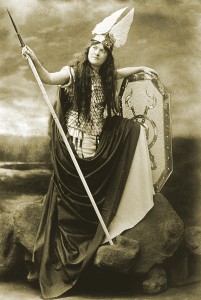
    Brunnhilde, George Grantham Bain Collection/Library of CongressWaterbrook is basically a room with an entrance area and a door leading to what serves as a green room for the performers. Somewhere around the corner, down a broad-plank floor, is a restroom. On Saturday the performance space had a few rows of folding chairs for the spectators, a lineup of music stands up front for the six performers, and three chairs to the side for the performers who occasionally sat a poem out. In other words: all the tools you really need to create some first-rate performing art.
    It helps, of course, if you have some first-rate performers, and for this show Hull has cast impeccably. His six actors are adept at making their diction precise without squeezing the life out of the words. They are masters of rhythm, as crisp and casual at passing the ball as a good basketball team on a fast break, and beautifully cast for pitch, color and range. Grant Byington is the tenor, Gary Brickner-Schulz the baritone, and Sam A. Mowry the bass. The women — Adrienne Flagg, Theresa Koon, Jamie Rae — are similarly cast for their complementary vocal qualities.

    What they do is this. They take a poem (twenty-five of them, actually), break it down to its component parts from stanza to line to syllable to vowel and consonant, settle on a rhythm, and deliver it as a group, sometimes passing it around phrase by phrase, sometimes word by word, sometimes in unison, sometimes as a soloist and chorus.

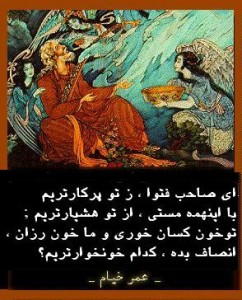
    An illustration from Divan-e-Khayyam, Iran.The evening begins with If I Told Him, a Completed Portrait of Picasso, a jaunty little number that brings out the meaning and wit in the sometimes dense and brackish work of Gertrude Stein; and ends with a remarkably staccato and refreshingly surprising rendition of Omar Khayyam’s famous quatrain about “a loaf of bread, a jug of wine, and thou beside me in the wilderness”: imagine a Rubaiyat by Thelonious Monk.

    In between come poems classical (Lord Byron’s She Walks in Beauty; Dylan Thomas’s Do Not Go Gentle Into That Good Night), comical (Shel Silverstein’s Sick; Hillaire Belloc’s George, Who Played with a Dangerous Toy, and Suffered a Catastrophe of Considerable Dimensions) and lyrical (Li T’ai Po’s Autumn River Song; e.e. cummings’ all which isn’t singing is mere talking — something of a statement of challenge for this performance, which so neatly combines the two).

    Poetry Off the Page hovers somewhere between the literary and the musical (after all, isn’t all great writing musical at its core?), and it’s Hull who triangulates the precise position with his arrangements. I half-expected the script to be written like a musical score. It isn’t. Brickner-Schulz showed me his, and it’s typed out in full, with colored-marker lines to make his own parts stand out. That mean that all the rhythm is internalized, settled during the hard work of rehearsal. What emerges is literate, entertaining, humorous, light yet sometimes touching. It’s not the silent hymn of reading a poem to yourself, or the magician’s drone of listening to the likes of W.H. Auden reciting his own work, or the rugby-scrum excitement of a poetry slam. It’s more like chamber jazz, smart and civilized and pleasurable.

    Pleasurable for the performers, too. Need I mention that nobody’s doing this for the money? Afterwards, as audience and performers mingled on the way out, the word “fun” kept popping up. We all meant it, I think, a little more deeply. We just couldn’t come up with a better word.

    Poetry Off the Page has three more performances, at 7:30 Friday, Saturday and Sunday nights, April 23-25.

    To prepare you, here’s one of the poems, by Marge Piercy, from her collection Colors Passing Through Us (Knopf):

    One reason I like opera

    In movies, you can tell the heroine
    because she is blonder and thinner
    than her sidekick. The villainess
    is darkest. If a woman is fat,
    she is a joke and will probably die.

    In movies, the blondest are the best
    and in bleaching lies not only purity
    but victory. If two people are both
    extra pretty, they will end up
    in the final clinch.

    Only the flawless in face and body
    win. That is why I treat
    movies as less interesting
    than comic books. The camera
    is stupid. It sucks surfaces.

    Let’s go to the opera instead.
    The heroine is fifty and weighs
    as much as a ‘65 Chevy with fins.
    She could crack your jaw in her fist.
    She can hit high C lying down.

    The tenor the women scream for
    wolfs down an eight course meal daily.
    He resembles a bull on hind legs.
    His thighs are the size of beer kegs.
    His chest is a redwood with hair.

    Their voices twine, golden serpents.
    Their voices rise like the best
    fireworks and hang and hang
    then drift slowly down descending
    in brilliant and still fiery sparks.

    The hippopotamus baritone (the villain)
    has a voice that could give you
    an orgasm right in your seat.
    His voice smokes with passion.
    He is hot as lava. He erupts nightly.

    The contralto is, however, svelte.
    She is supposed to be the soprano’s
    mother, but is ten years younger,
    beautiful and Black. Nobody cares.
    She sings you into her womb where you rock.

    What you see is work like digging a ditch,
    hard physical labor. What you hear
    is magic as tricky as knife throwing.
    What you see is strength like any
    great athlete’s. What you hear

    is still rendered precisely as the best
    Swiss watchmaker. The body is
    resonance. The body is the cello case.
    The body just is. The voice loud
    as hunger remagnetizes your bones.

    *

    ILLUSTRATIONS, from top:

    – The Vox logo.

    – Brunnhilde, George Grantham Bain Collection, U.S. Library of Congress

    – An illustration from Divan-e-Khayyam, Iran.

  • Hair today, art tomorrow (well, Monday)

    That prominent inhabitant of Chez Scatter, the Large Large Smelly Boy, recently visited the barber for the first time in close to a year and had his lordly lion’s mane buzzed off. The shearing revealed, to our surprise, the makings of muttonchops: a good pair of sideburns settling in. We see a chin crop in his future. (The moustache is already making inroads.)

    "Don't Shave," by Bryan KepleskySo it is with heightened interest that Mr. Scatter notes the opening of Keep Portland Beard, an exhibition of hairy art that opens Monday at The Tribute Gallery near downtown Portland and will luxuriate through May 1. Mr. Scatter has been seeing a lot of minimalism and a bit of Papa Murphy’s art of late (it comes half-baked, and you’re supposed to finish it at home in the oven of your own mind), so the chance to catch a show that glorifies excess suggests a welcome break.
    Mr. Scatter tries to keep his own beard well-trimmed, with varying degrees of success: Sometimes it’s just too much bother.

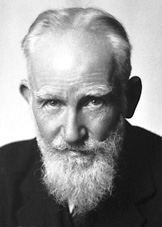
    George Bernard Shaw in 1925, when he won the Nobel PrizeHe recalls the story, perhaps apocryphal, about George Bernard Shaw as a lad, observing his father in mid-shave. “Why do you shave your face, Papa?” the little critic is supposed to have asked. Father Shaw stopped, held his razor in mid-air, turned to his son and replied: “I’ll be damned if I know.” Then he wiped the lather from his face and never shaved again. Or so we recall the tale.
    Keep Portland Beard is the brainchild of Michael Buchino, proprietor of the quirky online Beard Revue, which displays and grades public displays of hirsute vitality. No, we didn’t know it existed, either. After happily wasting a few minutes at the site, we’re glad we know now.

    Buchino has curated a show that includes artworks by Rachel Caldwell, Erin Dollar, Chad Eaton, Chris Hornbecker, Jamie Reed, Ashley Goldberg, Bryan Keplesky, Brooke Weeber, Ian Seniff, Kyle Durrie, Lloyd Winter, Santiago Uceda, BT Livermore and Patrick Weishampel, in addition to himself. You can see their bios here.

    And if this seems to you like a thin idea for an art exhibition, give it a chance: It might grow on you.

    *

    ILLUSTRATIONS, from top:

    – “Don’t Shave,” by Bryan Keplesky

    – George Bernard Shaw in 1925/Wikimedia Commons

  • Art: the Pleistocene made us do it

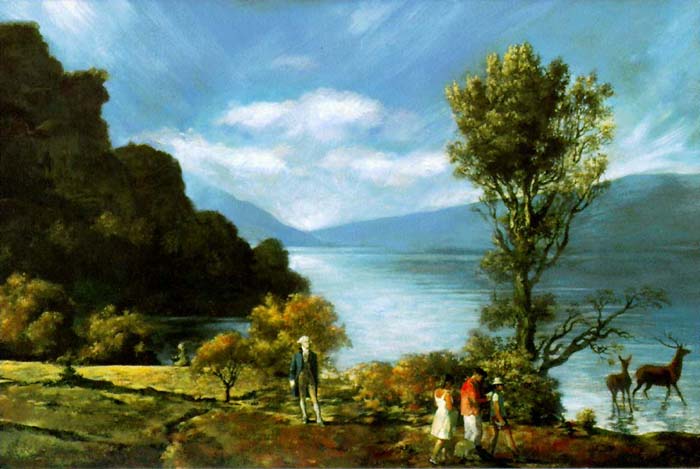
    Komar and Melamid, Most Wanted Painting, United States

    Mr. Scatter apologizes for his recent silence. He’s been a little scattered.

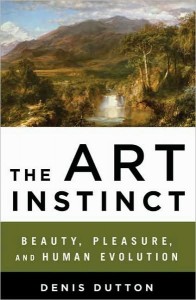
    One of the things he’s been doing is reading The Art Instinct: Beauty, Pleasure, and Human Evolution, by Denis Dutton, the philosopher of art who is also founder and editor of the invaluable Web site Arts & Letters Daily.

    Denis Dutton, The Art InstinctThe Art Instinct talks a lot about the evolutionary bases of the urge to make art: the biological hard-wiring, if you will. Dutton likes to take his readers back to the Pleistocene era, when the combination of natural selection and the more “designed” selection of socialization, or “human self-domestication,” was creating the ways we still think and feel. To oversimplify grossly, he takes us to that place where short-term survival (the ability to hunt; a prudent fear of snakes) meets long-term survival (the choosing of sexual mates on the basis of desirable personal traits including “intelligence, industriousness, courage, imagination, eloquence”). Somewhere in there, peacock plumage enters into the equation.

    There’s a lot to like and a little to argue about in this book, which comes down squarely on the biologically determined as opposed to the culturally determined side of the art-theory fence. Mr. Scatter is an agnostic on this subject, although he leans slightly toward the Darwinian explanation, if for no better reason than that he finds Barthes, Derrida, Foucault and their academic acolytes a bit fatiguing, and he sees no reason why we should consider the analysts of art more important than the artists themselves. Mr. Scatter says this despite his own penchant for analyzing stuff. Besides, The Art Instinct uses a lot of anthropological evidence in support of its argument, and long ago Mr. Scatter was actually awarded (he hesitates to say “earned”) a university degree in sociology and anthropology, although he usually just says “anthro” because that’s the part that seems to have stuck with him in his later adventures in life.

    One of Mr. Dutton’s most entertaining passages comes in his first chapter, when he examines the infamous America’s Most Wanted, the 1993 painting by Vitaly Komar and Alexander Melamid. You probably recall it. It’s a sort of “paint-by-survey” artwork, created after polling lots of people on what subject matter they liked most and least in their art. (The Russian expatriates created versions for several nationalities.)

    As it turns out, most people want comforting pictures of natural surroundings, and Komar and Melamid’s project, which seems to have purposely wired its survey questions to get specific sorts of answers, makes great sport of that. It was seized upon by experimentalists and academics alike as proof of the cultural cretinism of the common person, who lacks creative imagination and is no doubt a dullard in most other ways, to boot. The most prominent feature of America’s Most Wanted, it could be argued, is the long nose down which it looks.

    Dutton proposes another, far more fascinating, way to look at the Most Wanted series of paintings. Never mind how George Washington got at the center of the action: The key is the terrain, which seems like something vaguely out of the Hudson River School. More precisely (or ancestrally), Dutton argues, the ideal human landscape, “what human beings would find intrinsically pleasurable,” is from our common genetic recollection of East Africa. Quoting Gordon H. Orians from his 1992 essay with Judith H. Heerwagen, Evolved Responses to Landscapes, published in the book The Adapted Mind: Evolutionary Psychology and the Generation of Culture, Dutton describes an emotional “home base” landscape of open spaces with low grasses, water either directly in view or nearby, an opening that offers a view of the horizon, animal and bird life, and a lushness of flowers, fruit plants and greenery. In other words: precisely the sort of place that our forebears found fortifiable and capable of providing a good life. A garden, if not precisely Eden.

    Is this lowbrow, or unsophisticated, or sentimental? Or is it simply the way we’re wired? Is it, in fact, an extremely sophisticated emotional connection to the defining physical factors of our beginnings as a social species? When Dutton calls it the art “instinct,” he isn’t kidding, although he takes pains to stress that there is no single source, no “art gene,” that can be isolated: It’s a combination of many evolutionary factors, some more direct than others. We are all out of Africa, we are all out of the Pleistocene, and we all have an inbred stake in this thing called art.

    Maybe we don’t know much about it, and maybe even our lords of culture know far less about it than they think. But if we can believe Komar and Melamid, at least we all know what we like. It’s in our blood.

    *

    ILLUSTRATION: “America’s Most Wanted,” by Komar and Melamid.

  • A contemporary art museum for Stumptown?

    At Portland Architecture, Brian Libby has posted an intriguing piece (citing an original story by Nathalie Weinstein in the Daily Journal of Commerce) about a possible contemporary art museum in a proposed gateway tower to the Pearl District.

    At this point the proposal, by a group of Portland State University graduate students, is something of a pipe dream: there’s a recession going down, and developers are still pretty much in hunker-down mode.

    John Baldessari, “Stonehenge (with Two Persons) Blue,” 2005. Mixographia print on handmade paper. Jordan Schnitzer CollectionBut as Libby points out, the museum part of the proposal gets interesting when you consider two things:
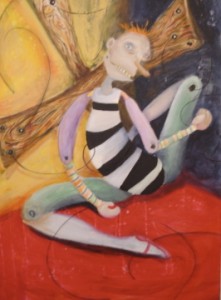
    1. The new museum’s collection would be built from the holdings of Portland arts patron Jordan Schnitzer.

    2. Schnitzer is president and CEO of Harsch Investment Properties, which owns the two parcels in question, between West Burnside and Northwest Davis streets and Northwest 13th and 14th avenues.

    Schnitzer is a significant arts player on the Portland scene, and more and more, along the West Coast. His name is on the University of Oregon’s Jordan Schnitzer Museum of Art. His primary focus as a collector is contemporary prints, and he’s serious about it. (Libby’s post includes interesting passages from an interview with Schnitzer by The Oregonian’s D.K. Row). The son of important regional patrons and collectors Arlene and Harold Schnitzer, Jordan Schnitzer has displayed genuine enthusiasm for getting his own continually evolving collection out to museums and educational institutions around the Northwest: He wants people to benefit from what he’s pulled together.

    Obviously this is a “soft” report: Nothing concrete is happening. But who knows what might be going on behind the scenes? Portland has longed for a contemporary art museum for a long time, and Schnitzer has both the collection and the educational interest to get something kick-started. In general, metropolitan areas with multiple museums have stronger art scenes, so a viable contemporary art museum would have a ripple effect. Right now, Portland has the Portland Art Museum and the Museum of Contemporary Craft. Our nearest big-town neighbors, Seattle and San Francisco, have much more diverse museum scenes, and that’s made a big difference to their entire arts scenes.

    So. Pipe dream or not, let’s keep an eye on this one and see if anything develops.

    *

    ILLUSTRATION: John Baldessari, “Stonehenge (with Two Persons) Blue,” 2005. Mixographia print on handmade paper. Jordan Schnitzer Collection

  • Damn everything but the circus!

    Just in time, on a gray Portland day with far more static than electricity in its air, comes this note from Allan Oliver, who runs Onda Gallery on Northeast Alberta Street.

     "Show Time," acrylic on canvas, Deborah Spanton/Onda Gallery“Damn everything but the circus!” Allan advises, quoting the great, undercapitalized e.e. cummings, who wrote in full:


    Damn everything but the circus!
    . . . damn everything that is grim, dull,
    motionless, unrisking, inward turning,
    damn everything that won’t get into the
    circle, that won’t enjoy, that won’t throw
    its heart into the tension, surprise, fear
    and delight of the circus, the round
    world, the full existence . . .

    Mr. Scatter finds himself in complete agreement today, and feels a sudden compulsion to wheel his unicycle out of the garage and go cavorting with a trained elephant. Citizens of the world, we have nothing to lose but the liars, lackeys and cheats!

    Before Mr. Scatter dons his clown costume, though, he should explain why Mr. Oliver sent this most appropriate of poems. It was to announce a new, circus-themed show at the gallery of paintings and prints by Deborah Spanton (that’s her acrylic on canvas Show Time pictured) and prints by Gene Flores. The show doesn’t open until April 29 (it runs through May 25), but we simply couldn’t wait to spread the news.

    Excuse us, please. We’re off to find the hurdy gurdy man.

  • Scatters revisited: Let’s play catch-up

    Art Students and Copyists in the Louvre Gallery (for Harper's Weekly), 1868, wood engraving, National Gallery of Art, Washington, D.C.

    Art Scatter is considering a new motto: All the news that fits, comes back to bite you again.

    Maybe it’s not as elegant as the New York Times’s All the news that’s fit to print or as slobberingly juvenile as The Onion’s Tu Stultus Es (translation from the Latin: You Are Stupid). But we seem to be getting pingback, and we are not referring simply to those odd “comments” that pop up semi-regularly from online hucksters selling axle grease or whoopie cushions. (Mr. Scatter attempts to zap those into oblivion before our readers have a chance to see them, unless the links are unusually entertaining, such as the one that seemed to translate this post into some unknown language and back to English again, transposing “large smelly boys” into “vast sharp boys” and “Portland public schools” into “Portland open propagandize system.”) Stories don’t always end when the writer thinks they do. So consider this a chance to revisit some of our recent hits, with updates and amplifications:

    *

    COPY CATS: In our recent musings on the value of museums (we had worked ourselves into something of a dither, a century late, over the idiocies of the Futurist Manifesto, which called for abolishing them) we tossed in this aside: “Why are our young artists not haunting the halls of the museums? Rarely — almost never — do you see someone set up with easel and paints in a Portland Art Museum gallery, copying the masters to learn their techniques, a sight that is common in European museums.”

    That prompted this note from the museum’s Jennifer Amie:

    I thought you might be interested to hear that this summer, you WILL see people drawing from the masters in the galleries at the Portland Art Museum! We’re offering a five-part drawing workshop in conjunction with this summer’s exhibition of Old Master drawings from the Crocker Art Museum. The workshop will be led by Eduardo Fernandez, who was recently commissioned to paint the governor’s portrait.

    Friends, don’t trip over those easels. Pay attention, copy carefully, and you might win the commission to paint Randy Leonard and Rosie Sizer duking it out in the final seconds of their fifteen-round championship bout (don’t forget to sketch in Mayor Sam as referee). The Crocker show of master drawings (Durer, Rembrandt, Ingres, Boucher, Callot, Carpaccio, Fra Bartolommeo and a few other old-timers) runs June 12-Sept. 19. The drawing sessions will run Saturday afternoons, July 31 through Aug. 21, with an introductory talk July 29. Keep an eye on the museum Web site for details on signing up.

    *

    THE GREAT PAINT-OFF: In that same museum post, we linked to a story in The Guardian about the artistic battle royale between Michelangelo and Leonardo, creators, respectively, of a couple of modest pieces known as David and the Mona Lisa. That prompted this note from playwright and Friend of Scatter George Taylor, himself something of a Renaissance man:

    Thought you might be interested to hear that this is the very subject of my 2007 play Renaissance. Leo and Mick’s famous rivalry is at the center of the play, both in their own time and 500 years later. The play was a finalist for the 2008 Oregon Book Awards, and was recognized with fellowships from the Oregon Arts Commission and Oregon Literary Arts. It’s had staged readings in 2007 in Portland and Denver at the invitational Playwright’s Showcase of the Western Region.

    George is hoping for a full production in Stumptown this fall. For more on Renaissance, visit his Web site here.

    *

    IFCC AFTER THE WAKE:
    A little over a week ago we filed this report on the impending shutdown of the Interstate Firehouse Cultural Center, which has suffered apparently fatal aftershocks from the Great Economic Quake of 2008 and ‘09. This morning’s Oregonian offered two dissections, a news analysis by Allan Brettman, following an opinion piece by columnist Anna Griffin. Whatever you think of them, lots to think about in both pieces, and lots for arts groups to chew on: In a struggling economy, who goes forward and who falls behind? What is the public’s role in keeping a company viable? What is the board’s role? How should tough times change how you think and what you do?

    *

    TALE WAGS DOG: Finally, we filed this report a few days ago on a couple of old-timers, actress Wendy Westerwelle and the improv comedy troupe Waggie and Friends, hitting the boards again. For the Waggies, it was the first reunion since the group disbanded in the mid-1990s, making this a little like a rerun of the Macarena except a lot less frightening.

    On Friday night Mr. Scatter & Son ambled down to the Brody Theater to take in the Waggie action, and it was a love fest. Mr. Scatter ran into so many old friends and acquaintances his cheeks are chapped from European-style brush-kisses. The Large Large Smelly Boy, a keen student of the comedy-improv arts, talked smartly and politely with several of these older folk, and during audience-participation periods peppered the stage with enough verbal powder to set the whole room into a sneezing fit. Most of his suggestions were quite clever.

    So were the Waggies. This was no mere nostalgia trip: We’d forgotten what a genuine kick they could collectively be. Scott Parker and his stuttering little-boy telling of the nativity story. (”I thought you were a round yon virgin!” Joseph says in astonishment when he discover’s Mary’s going to have a baby.) David Fuks as a rabbinical stand-up comedian, parsing talmudic queries with demented logic. Scolding schoolmarm/tease Cindy Tennant. Dipsydoodle country singer Victoria Parker-Pohl, headed for another breakdown. Pie-eyed and rubber-boned Eric Hull, master of the physical double and treble takes. And filling in for Gary Basey and representing the younger generation, the quick-witted and very funny Ian Karmel, another in the long and honorable line of nimble-footed portly comics that stretches from Oliver Hardy and Fatty Arbuckle to John Belushi and John Candy.

    Maybe you can’t go home again, and maybe the old jokeslingers couldn’t keep this thing flying night after night. But on one night, at least, they had the crowd roaring happily — and one 15-year-old apprentice comic dreaming of a whole career of knocking ‘em dead.

    *

    ILLUSTRATION: Winslow Homer, Art Students and Copyists in the Louvre Gallery; Harper’s Weekly, 1868; wood engraving; National Gallery of Art, Washington, D.C.

  • Wendy & Waggie: play it one more time

    Wendy Westerwelle stars in Martin Sherman's "Rose." Photo: Don Horn/Triangle Productions!

    Blink, and it’s 1984 all over again.

    Over here: Waggie and Friends, skipping sweetly through the landmines of improv comedy, quick wits and crack timing in tow.

    Over there: Brassy Wendy Westerwelle, going for the gold in a one-woman show.

    Turn off the radio, will you, please? Sounds like they’re playing Karma Chameleon again.

    No, this is not an April Fools joke. Through some sort of cosmic coincidence, the ghosts of Portland past are flitting across the city’s stages starting tonight. The sweetly funny Waggie, pioneers of comedy improv in Stumptown (they were the first group to bring TheatreSports to town) are taking over the Brody Theater stage for a two-nights-only reunion Thursday and Friday.

    Waggie and FriendsAnd Westerwelle, the irrepressible onetime Storefront stalwart who scored a big hit with her Sophie Tucker show Soph: A Visit With the Last of the Red Hot Mamas, takes on a very different personality in the Northwest premiere of Martin Sherman’s play Rose, opening Friday at CoHo Theater.

    *

    Waggie’s reunion gig at the Brody is a smash before it opens: both nights are sold out, and, as producer Domeka Parker says, she has “a waiting list for the waiting list.” The good news: there’s already talk about scheduling more dates, although nothing’s settled yet.

    Waggie was so good and so influential in Portland not just because it was early to the improv game but also because its performers were seasoned veterans of the legit stage; actors who had both dramatic and comic chops. Domeka Parker’s parents, Scott Parker and Victoria Parker-Pohl, were core members, and they’ll be joined onstage by fellow alums David Fuks, Eric Hull, Cindy Tennant and Bob Zavada. Original funnyman Gary Basey couldn’t make the trip from his California home. His spot is being taken for these shows by a shirttail Wagger, Domeka Parker’s cousin Ian Karmel, who is a Groundlings alumnus and a member of her improv group, the Gallimaufry. (The younger Parker may not have been born in a suitcase, but she was “raised in the throes of improv,” and she’s become an improv performer and teacher herself: “I cannot escape it, and I promise you … I have tried.”)

    Waggie, which stayed together until the mid-1990s, worked up a fine sweat on the TheatreSports circuit, playing tournaments in San Francisco, Los Angeles, Seattle, Edmonton and Calgary. It opened shows for the likes of gonzo journalist Hunter S. Thompson, Monty Python’s Graham Chapman, and cartoonist Lynda Barry. And it performed plenty of shows for the home crowd, including some memorable New Year’s Eve gigs.

    Obviously people remember, and they’re eager to turn back the clock. Let’s just leave Kenny Loggins and Duran Duran out of it, though, shall we?

    *

    In England, Martin Sherman’s Rose was nominated for the Laurence Olivier Award as best new play in 2000. It hasn’t enjoyed such a welcoming reception in the United States.

    “No one in this country has done it, except Olympia Dukakis,” Westerwelle said a couple of weeks ago over coffee and tea at Costello’s Travel Caffe. “And I talked with her on the phone yesterday, for 20 minutes. I don’t know how I got hold of her. I just called everyone I know across the country, I said, ‘How do I get hold of Olympia Dukakis?’ And I did.”

    Sherman’s play was also revived last fall in the Upstate New York town of Croton Falls, with Annie McGreevey in the role.

    Some of Westerwelle’s questions to Dukakis surely were technical. It’s a solo play, and its demands can be daunting — as Westerwelle says, “forty-seven pages of just you.”

    Westerwelle is used to the peculiarities of the one-person show from her success with Soph, which opened on Thanksgiving Day 1984 at Storefront, played for six months, and took her around the country, including a hit run in Los Angeles, where she ended up living from 1985 to 1992, when she moved back to Portland. But Sophie and Rose are fundamentally different characters. For one thing, no song and dance this time around.

    “Soph was an entertainer, a performer,” Westerwelle says. “Rose is not an entertainer. She’s older, she’s close to 80, she has a Yiddish accent. And she’s real. She’s just a woman with this incredible story.”

    Wendy Westerwelle as Rose, remembering on a bench. Photo: Mark LarsenSherman is best-known for his 1980 Tony-nominated play Bent, about gay prisoners in a Nazi concentration camp. He wrote Rose for his maternal grandmother, and the story, Westerwelle says, is not only about her but also about the extraordinary 20th century journey of the Jewish people.
    As the play begins, Rose is sitting shiva in southern Florida, far from the Russian shtetl where she was born in 1920. “It’s just me, sitting on a bench in a park across from the ocean,” says Westerwelle.

    Just who Rose is sitting shiva for isn’t revealed for a long time as she recalls the highlights of a remarkable life. Moving to Warsaw at 16, the arrival of the Nazis, the fires, escape. “Rose wound up in the sewer beneath Warsaw, and she stayed there two years,” Westerwelle says.

    She became part of the exodus to Palestine but was refused entry. Put on a train back to Europe, she jumped off “and she was literally caught by an American sailor” — whom she married, and with whom she moved to Atlantic City.

    Marriages, deaths, children, work, some dabbling in communes and drugs, a new American life that eventually has her running a hotel in Miami Beach. There’s a lot to remember — for actor and character alike — and that is the core of the play. Westerwelle praises director Don Horn, whose Triangle Productions! is producing in conjunction with Roscoe Nelson, for his sensitive approach to the story.

    If Westerwelle feels a special connection to this material, it may be because she sees parallels in her own life. A Jewish girl from Chicago, she spent her years between 12 and 20 caring for her mother, who had multiple sclerosis, until her mother died. She got married, and her husband came down with leukemia. She was 26 when he died. Eventually she picked up and moved to Oregon. That was 1978.

    “I was here for six months,” she says, “and I went to the Veritable Quandary, before it was hip. And I met Ross Kerr. And I guess I was being all dramatic like I do, and he said, ‘Who are you?’”

    Kerr, a prominent actor at the old Storefront and elsewhere, hooked her up with Storefront and director/impresario Ric Young. Her career bloomed, from comic turns in the old Storefront burlesques to kids’ shows to a knockout production of Dario Fo’s We Won’t Pay! We Won’t Pay! and to Soph, the show people still talk about after all these years, which she wrote with Vana O’Brien.

    For Westerwelle, Ric Young was something of a godsend.

    “You know, what you really need in this world is someone to believe in you,” she says. “And he did. He believed in a lot of people. He’d say, ‘You’re a genius. Now go do what you do.’”

    She pauses and reflects, like Rose sitting on her bench. Right now, in this coffee shop, at this moment, the past is very much with her.

    “He created miracles all the time,” she says.

    *

    Illustrations, from top:

    – Wendy Westerwelle stars in Martin Sherman’s “Rose.” Photo: Don Horn/Triangle Productions!

    – The “Waggie and Friends” logo.

    – Westerwelle as Rose, sitting with her memories on a bench. Photo: Mark Larsen.

  • Museums: Who needs ‘em, anyway?

    Well, Mr. Scatter does, for one.

    Sitting here at the Scatter International Clearing Desk this afternoon he ran across a press release from the Portland Art Museum, announcing an upcoming lecture by Iwona Blazwick, director of Whitechapel Gallery in London. The talk will be at 2 p.m. Sunday, April 18, in the museum’s Whitsell Auditorium, and it’s titled Just What Is It That Makes Today’s Institutions So Different, So Appealing?

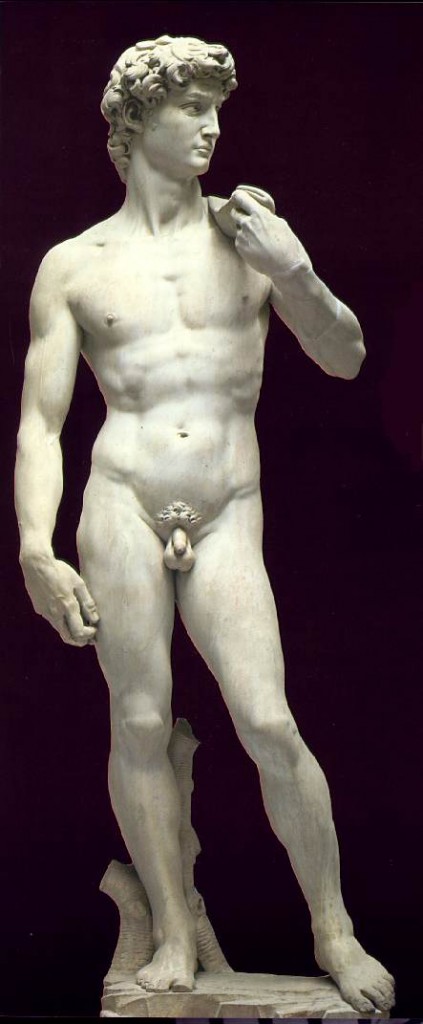
    David, by MichelangeloThe press release begins with this provocative quote from Filippo Tommaso Marinetti’s 1909 Futurist Manifesto, denouncing museums as “cemeteries … absurd abattoirs of painters and sculptors ferociously slaughtering each other … cemeteries of crucified dreams, registries of aborted beginnings.”
    Provocative, and dead wrong, which Mr. Scatter believes is precisely Ms. Blazwick’s point. The manifesto is a fire-breathing document, and a century later it still has the furious charm of a comic-book battle between a superhero and an archvillain. It’s filled with the sort of seductive fantasies that would turn a 17-year-old’s head ( “We want to glorify war — the only cure for the world — militarism, patriotism, the destructive gesture of the anarchists, the beautiful ideas which kill, and contempt for woman” ) and led naturally, in all its adolescent streamlined illogic, to Mussolini and Italian Fascism.

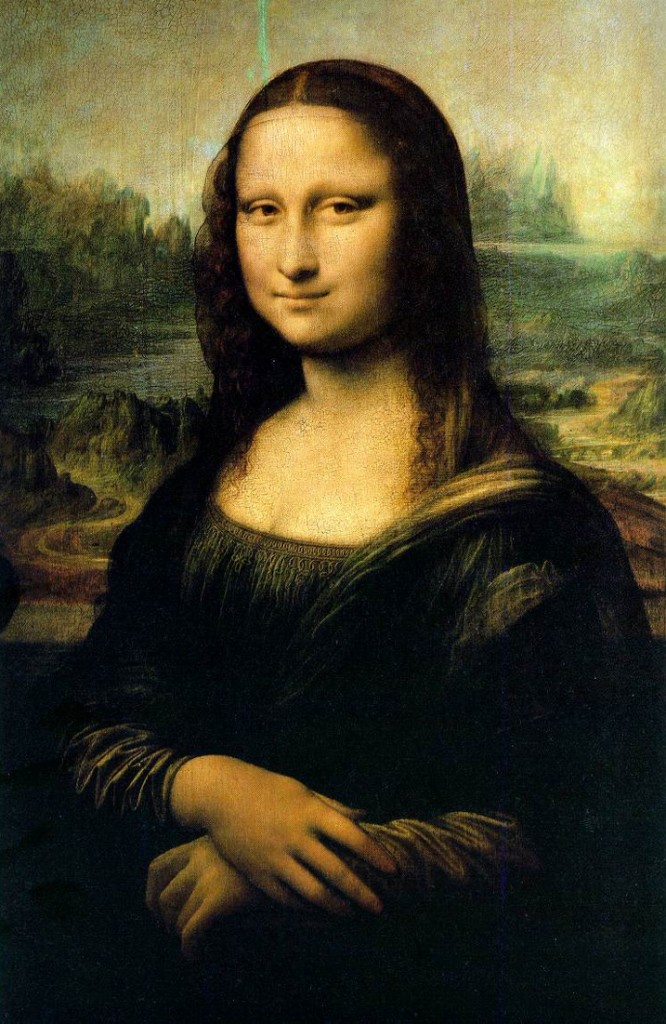
    Mona Lisa, by LeonardoWhich is not to say that the existence of museums had a wisp of a deterring influence on Fascism or Communism or any other ism. Once humankind gets the Ism bug it’s almost impossible to get rid of it until it’s run its destructive course. Nor does it reduce the irony that the marbled walls of the world’s museums now hang with Futurist works, one more category of historical relic, testament to a movement that had its day of glory and then flamed out.

    But in a larger sense the world of museums is a line of defense against the fools. Wisdom and beauty, while infinitely debatable, are real, and when we lose or ignore them we lose or ignore not just some immaterial specter of the past but our very sense of who and where we are, and what we might become. It’s tough to throw bricks through the windows of the past once you realize that the past has shaped what you are — unless, that is, you are so self-loathing or recklessly thrill-seeking that you want to punish yourself.

    Yes, museums can be intimidating. The better ones are working on that. But this is our story, friends. This is the repository of human creativity at its best. Mr. Scatter confesses to astonishment over the number of artists he has heard speaking impatiently or dismissively about museums and the objects that they hold, as if it were a badge of bravery and independence to create afresh with little knowledge of what has been created before. Why are our young artists not haunting the halls of the museums? Rarely — almost never — do you see someone set up with easel and paints in a Portland Art Museum gallery, copying the masters to learn their techniques, a sight that is common in European museums. Are our artists afraid that if they study their forebears they will have no ideas of their own? Do they have so little confidence, or are they so bull-headed? A museum is a despot only if you choose to be a slave. Mr. Scatter thinks of museums as places of intellectual and spiritual refreshment, places where we discover ideas that are greater than our own; ideas that sometimes in turn can spark ideas that are genuinely new. A little humility opens marvelous doors.

    And it opens those doors to all of us, or at least to the great majority of us. Art that might have been made for the ruling class is now available to anyone who walks through those doors. It’s the same democracy as the democracy of the library: one of the great, true achievements of progress. Mr. Scatter notes with pleasure that the Whitechapel Gallery was founded in 1901 “to bring great art to the working class people of east London,” and that commitment to redistributing the cultural wealth ought to be at the core of every museum.

    A museum is not a place to worship blindly. We argue with it, sometimes vociferously, because we all have a stake in it. Over the years museums change, partly because of that pressure: they evolve, innovate, reassess; sometimes they even undergo mini-revolutions. Still, it’s a good idea to keep a grip on the baby when you’re throwing out the bathwater. Mr. Scatter assumes that the process of keeping the tub fresh will be central to Iwona Blazwick’s lecture. Sounds invigorating — in a post-adolescent way.

    *

    Coincidentally, a friend of Mr. Scatter in Santa Fe sent this link this afternoon to a story in The Guardian, which she’d been sent by her husband, who’s in Paris right now. Jonathan Jones’ column, titled Leonardo or Michelangelo: who is the greatest?, offers a terrific reappraisal of the two most famous works in Western art history, Michelangelo’s David and Leonardo’s Mona Lisa, digging below the contempt of familiarity to rediscover the sources of their greatness. In the process he revives the fascinating history of the rivalry between these two masters and what it meant. Far more, as it turns out, than the blustering dictums of the Futurist Manifesto.

    You can find David and Mona Lisa, by the way, in museums. Sure, you’ve got to fight the crowds. But there they are. And not a reactionary cobweb in sight.

  • Trouble in Tahiti: Witness for the persecution

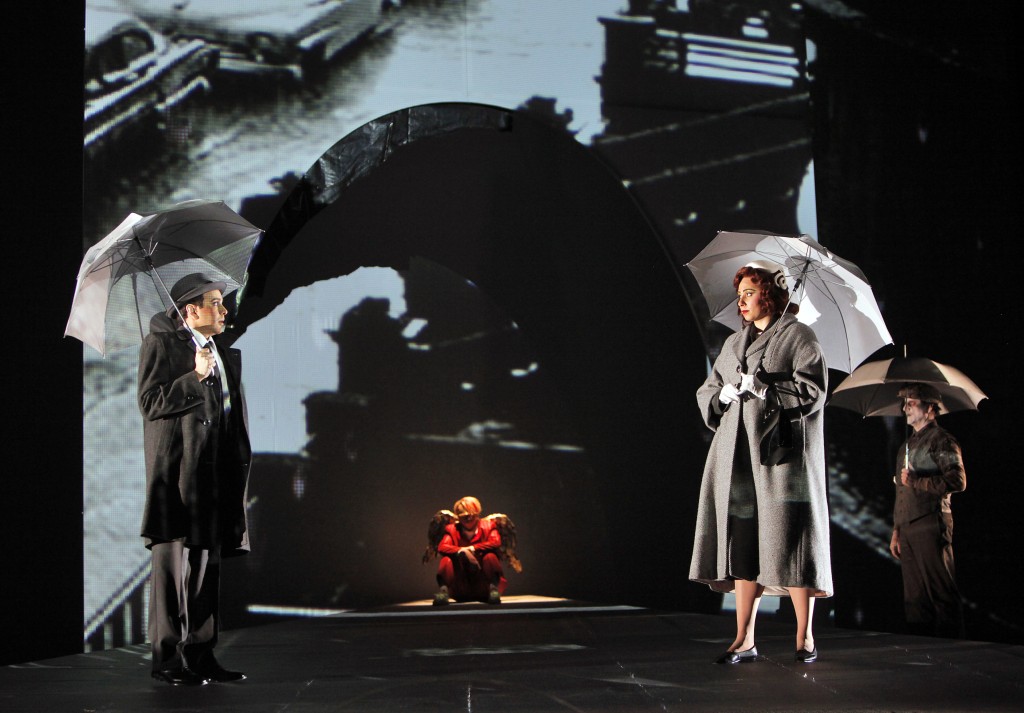
    Jose Rubio as Sam and Daryl Freedman as Dinah in "Trouble in Tahiti."  Photo: Portland Opera/Cory Weaver

    Counsel, call your next witness.

    Your honor, Leonard Bernstein calls Claudio Monteverdi to the stand. Or maybe it’s the other way around.

    Mr. and Mrs. Scatter went to the opera over the weekend, where Bernstein’s 1952 Trouble in Tahiti followed Monteverdi’s Il Ballo delle Ingrate (The Dance of the Ungrateful Women) from 1608 and Il Combattimento di Tancredi e Clorinda (The Battle of Tancredi & Clorinda) from 1624, and it got Mr. S to thinking about observers. It was pretty hard not to. There they were, he observed, skulking about the stage: gray, grotesque, kind of creepy, very sad. Tormented souls stuck somewhere between the passions of the flesh and the soul-sucking chill of the Underworld.

    Claudio Monteverdi, circa 1597, by an anonymous artist, (Ashmolean Museum, Oxford). Thought to be the earliest known image of Monteverdi, at about age 30, painted when he was still at the Gonzaga Court in Mantua. Wikimedia CommonsWitnesses — those “I alone am escaped to tell you” chroniclers of catastrophe and adventure — are crucial figures in the world of the imagination. From the cautioning choruses of Greek tragedies to Melville’s wide-eyed sailor Ishmael, we’re used to the idea of the witness as a cornerstone of civilized life.

    What really happened? Who saw it? How can we determine the truth? What does it mean?

     Leonard Bernstein, conductor and musical director of New York City Symphony, 1945. Library of Congress. New York World-Telegram & Sun Collection. Fred Palumbo, World Telegram staff photographerFrom the lofty perch of the present we stand as witnesses to time, looking back on history, rewriting it as we gain new reports from the trenches and rethink what we’ve already seen. We judge, revise, rejudge: In the courtroom of culture, the jury never rests.

    But what if the past looks forward and witnesses us? What does it see? What can it mean?

    That’s what happens in Portland Opera’s new production of these three short works, which span roughly three and a half centuries in their composition and many more — back to the cavortings of the classical Greek gods — in their subject matter. Stage director Nicholas Muni, whose last visit here resulted in a hair-raisingly good version of Benjamin Britten’s The Turn of the Screw, has linked these seemingly alien pieces audaciously in time and space, rendering them chapters in a neverending story of misbegotten love. And those gray grotesque observers are the key.

    David Stabler and Mr. Mead have filed insightful reviews (with very different conclusions), and Mr. Scatter does not wish to add a formal review to territory they’ve covered well. But he does want to think a little about those witnesses.

    The program opener, Il Ballo delle Ingrate, tells the tale of Cupid, who is heartbroken because his love-arrows aren’t working anymore: humans, wrapped up in their own selfish pursuits, are mocking the very idea of love (it seems it’s the women’s fault). Cupid’s mom, Venus, takes him to the Underworld and sweet-talks Pluto into releasing a few of the dead to show the living humans what happens when they let their hearts grow hard. That leads, in Il Combatimento, to the story of Tancredi and Clorinda, lovers from opposite sides of the tracks (he’s Christian, she’s Muslim) who battle fiercely in a war. Only after he’s wounded her mortally does he realize it’s his own true love he’s slain. Darn. Gods and the ashen dead alike gather around the fringes of the story, willing it forward, dreading its outcome, observing the follies they’ve already lived through as the follies repeat themselves in slightly altered form. The witnesses gather again, after admission, in Trouble in Tahiti, a mid-twentieth century story of a perfect suburban couple putting itself through the same, age-old tortures of love stunted by anger and isolation. The more things change, the more they stay the same.

    One of the most significant things that has occurred under Christopher Mattaliano’s artistic direction of Portland Opera has been its blossoming as a place where acting and stagecraft count — not as substitutions for singing and orchestral excellence, but as partners. Mattalianio has nudged the company toward a sense of theater that was not always there in the past, and this production is further proof of his belief that theater and music go hand in hand; that the role of opera is melodrama, the fusion of music and drama. You can come for the music and be satisfied. You can come with little background in the music and be pulled into it by the accessibility of the theater.

    That doesn’t mean a little background doesn’t help. Monteverdi was the original master of baroque opera, when the musically sophisticated, theatrically rudimentary masque was giving way to true musical theater. Mr. Scatter doesn’t know whether stage director Muni meant it this way, but what he saw in this production was a sort of historical melting of theatrical style. Il Ballo delle Ingrate begins in a stiff, stylized movement vocabulary, a contemporary riff on the slow baroque flourish, very studied and still: If it has a rough modern equivalent, it might be butoh, with its deliberate weighted trudge through time and space. Muni takes a big gamble here: If the audience looks only through contemporary eyes (and eyes accustomed mainly to film-style realism) the pace can seem static and awkward. Sometimes the audience has a responsibility, too.

    The pace picks up with the battle-passion of Il Combattimento, and by the time of Trouble in Tahiti we find ourselves in a quick contemporary nostalgia zone, easy and familiar and bright. Bernstein throws in a little pop-jazz, a sort of Andrews Sisters swing; and a savage little satiric jab at South Pacific (this is where the title Trouble in Tahiti comes from); and Muni adds an acting style that echoes the midcentury modern ironies of Mad Men. His gray witnesses from the past are still with us, linking this modern story to the imagined realities of Monteverdi’s and Cupid’s times, and perhaps because the dead witnesses are made flesh, Muni adds some contemporary flesh of his own: the unhappy couple’s son, and the straying husband’s secretary/mistress, characters usually alluded to but not seen, are there on the stage.

    Mr. Scatter asked what it might mean that the past peers forward into the present. In this production, at least, he thinks it means that some things that are long ago are also very much with us in the present. We live with ghosts because we share their values, their failures, their skins. Sometimes we look at the past to discover how different we are from it. Sometimes we look at the past and see ourselves. There is a kinship between Bernstein’s world and Monteverdi’s, a kinship that the gray grotesques bring strikingly home. You feel it in the emotions, and you also hear it in the music: both composers give their audiences tastes of the easy aural pleasures of their respective eras, and when the going gets tough, both cut the frills and shoot straight for the heart. It’s another example of the ties across time between the pre-classical and post-romantic musical worlds. Mr. Scatter is far from the only one who has escaped alive to tell you.

    A couple of things to mention, even though this is not a formal review: Sue Bonde’s costumes (Mr. Scatter assumes, in the absence of another credit, that she is also responsible for the effective makeup) lends a great deal of credibility to Muni’s vision. The singers are present and past members of the opera company’s Studio Artist Program, and they acquit themselves well. And conductor Robert Ainsley, leading the Third Angle New Music Ensemble, nimbly leaps the stylistic breach between baroque and modern, matching the singers nicely with the small ensemble. The decibel level is ideal for the Monteverdi. It seems right for the singers with the Bernstein, too, although Tahiti was originally orchestrated for 26 musicians and later cut to 14, and here is performed by just eight.

    Mr. Scatter does not know what difference those extra musicians might make. He does know that the witnesses he witnessed pulled this risky project together with aplomb.

    Case closed.

    *

    ILLUSTRATIONS, from top:

    – Jose Rubio as Sam and Daryl Freedman as Dinah in “Trouble in Tahiti.” Photo: Portland Opera/Cory Weaver

    – Claudio Monteverdi at about age 30, circa 1597, by an anonymous artist, (Ashmolean Museum, Oxford). Wikimedia Commons

    – Leonard Bernstein, conductor and musical director of New York City Symphony, 1945. Dig that groovy jacket. Library of Congress. New York World-Telegram & Sun Collection. Fred Palumbo, World Telegram staff photographer. Wikimedia Commons

  • The big bounce: BodyVox’s ‘Trampoline’

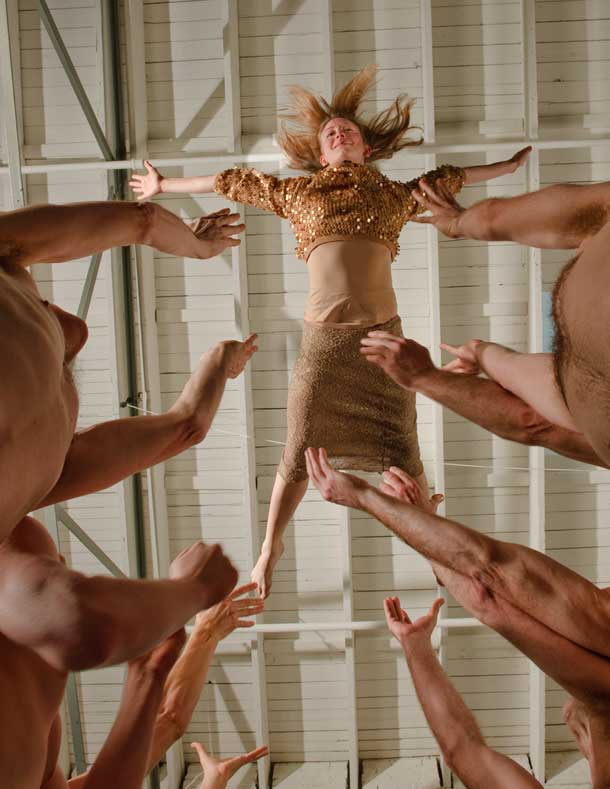
    Jamey Hampton's "Trampoline," at BodyVox. Photo: Michael Shay, Polara Studios

    Feeling a little low? Need to bounce back from a bad day? This looks like a dizzy way to do it.

    Una Loughran of BodyVox sent along this photo, by Michael Shay of Polara Studio, of Jamey Hampton’s new piece Trampoline, part of Smoke Soup, a program of new works opening tonight at the BodyVox Dance Center. Mr. and Mrs. Scatter are out of town and so won’t be there, but it looks like a real upper.

    Trampoline started with six men and a woman,” Hampton says. “I wanted to see how high three men could throw a dancer if three men were going to catch her. Dramatically, it became a dance about how people can support and help each other.”

    Sounds like the woman has more on the line than the men in this relationship. This is no time for butterfingers. Opening weekend’s sold out, but the show continues through April 10.

  • Ten Tiny Taiko Dances: the first steps

    Life comes at you in waves, and before one wave pounds against the rocks another one’s just beginning to rise toward its crest. Arts groups in particular know this universal truth: While you’re busy smacking against the shoals of one opening night, several others are already gathering strength.

    "The Great Wave Off Kanagawa," from "36 Views of Mount Fuji," by Hokusai; between 1826 and 1833. Wikimedia Commons.Portland Taiko’s 2010 season begins this weekend with Saturday matinee and evening performances of The Way Back Home, featuring songs from last year’s CD Rhythms of Change. By the time it hits the stage this wave of sight and sound is going to be polished and shaped and sure of itself, like a Katsushika Hokusai print.

    That’s this crest. While it was racing toward the shore, a group of almost 20 people met last Friday at Portland Taiko’s warehouse home just off industrial Northeast Columbia Boulevard to start the process toward the next big taiko wave, a collaboration between PT and Ten Tiny Dances that will play June 19-20. I was there in dual roles, as a journalist and a taiko board member. Here’s a taste of what happened:

    “When people think of Portland Taiko they think of vast spaces with huge amounts of power,” says Michelle Fujii, PT’s artistic director. “And this is just the opposite of that.”

    She isn’t kidding. The sound of taiko drums, born in Japan and modernized in the contemporary fires of North and South American performance troupes such as Portland Taiko, can be small and sensitive but tends toward the big and propulsive. The whole idea behind Ten Tiny Dances, which head honcho Mike Barber began at a wine bar in 2002 in what he thought would be a one-off, is to minimize. Each performance (this will be the 20th public series) consists of 10 short dances performed on a four-foot-by-four-foot platform. It’s all about compactness and discovering a fullness of expression through extreme limitations — like a haiku, or a rhymed couplet. So this collaboration promises to be something of a Mutt and Jeff: a meeting of attractive opposites.

    “What happens when things get restrained?” Barber asks. “What does it bring out?” Everyone in the room — mostly choreographers, composers, dancers, musicians — seems pumped by the possibilities. As odd as this matchup may seem, that’s precisely what makes it so intriguing for the collaborators. Plus, it has its internal logic. Fujii has a background in Japanese dance and has made movement a strong focus of Portland Taiko’s style. And something radically different, Barber says, is just what his popular dance project needs: “After 20 times, to bring fresh edges to Ten Tiny Dances is great.”

    Cydney Wilkes and Mike Barber dance small in a previous Ten Tiny Dances.Byron Au Yong, the Seattle composer who’s worked with Portland Taiko before, arrives with a score already in hand. He passes copies around the circle: it’s elegant, intricate notation.

    Composer Heather Perkins, who is working with Barber, has a different approach.

    “We made up a score the other afternoon,” Barber tells the group.

    “Oh yeah,” Perkins says, and holds up a dense furious scribble in her notebook.

    It’s the beginning of what’s looking like a very intense wave. Barber has bounced back and forth between narrative and non-narrative approaches, he explains. Right now he’s thinking non-narrative, with taiko as the heartbeat of his dance — “and the idea I’m working with is anger.”

    Perkins has been listening to PT’s Rhythms of Change CD and calls it a sexy sound: “It’s beautiful. And I want to do something that’s not beautiful.” Maybe put contact mikes on the drums, she muses, and send the sound through something electronic. “Rhythmically it’s going to be more … fast. Angry.”

    A gathering like this is partly reunion, partly meeting new collaborators, partly throwing out ideas, partly anticipating technical challenges, and all about the next great adventure. Especially if you’re more used to first meetings for play productions, which have a literary script to focus everyone’s attention, it can seem vague. Dance and music, unless they’re recapitulations of pieces already in the canon, start from more elemental, often emotional, ideas. Everyone in the room has done some thinking, even some planning, before this meeting, but things are still speculative and broad-stroke. “I feel really open,” says choreographer and dancer Carla Mann, “because I’m very interested in collaborating.” She just knows she wants to do something intimate rather than grand.

    Portland Taiko in concert. Photo: Copyright Rich Iwasaki, 2003What exactly does that four-by-four-foot platform mean? How do dancers, let alone musicians with big drums, fit on it, let alone stay on it?

    At points in Ten Tiny Dances’ history, Barber has had strict rules. Everyone on the platform. Dancers allowed to step off for up to 15 seconds, and no farther than one foot offstage. The rules, he adds, didn’t last long: “I realized that the rules weren’t as important as the heart of the idea, the integrity of that four-by-four space.”

    The looser approach can be liberating conceptually as well as physically.

    “Could it be that musicians could be onstage but not dancers?” Mann asks.

    “Yes,” Fujii and Barber add in unison.

    Aha. A possibility is born.

    Other possibilities: Angelle Hebert and Phillip Kraft of the dance troupe tEEth are considering “precise chaos. We’re thinking of creating this violent but precise violent” piece, which would be videotaped and played back in slow motion.

    Fujii and choreographer Suba Ganesan, who works in the southern Indian classical dance form of Bharathanatyam, are exploring what Ganesan calls “this ancestral thing that we both seem to have” — Indian and Japanese traditions. Her question: “How do we work with these ancestral traditions while being respectful in our innovation?”

    Taiko member Toru Watanabe will somehow work with masks that artist Rick Bartow made for the company during a collaboration last year, and the masks will somehow tell a tale: “I was Japanese folk dancer, so I know how to use dance in taiko.”

    Au Yong is working with the number 15, because this is Portland Taiko’s fifteenth season. The number contains mathematical and musical possibilities, various rhythmic and structural components. As he was thinking about the number, he read a Newsweek report about 21st century slavery, about girls being sold in South Africa, where the World Cup will be played in June, when this performance will take place. “So that began to put a human face on the number 15. If your body is taken away from you, how do you survive?” For all that, he adds, “musically, I want this to be a very quiet work.”

    Seems like a big wave working up steam. As time permits I’m going to try to ride inside the curl, and let you know what it looks like from the wet and wild side.

    *

    ILLUSTRATIONS, from top:

    – “The Great Wave Off Kanagawa,” from “36 Views of Mount Fuji,” by Hokusai; between 1826 and 1833. Wikimedia Commons.

    – Cydney Wilkes and Mike Barber dance small in a previous Ten Tiny Dances.

    – Portland Taiko in concert. Photo: Copyright Rich Iwasaki, 2003.

  • It’s spring break: Scatter hits the links

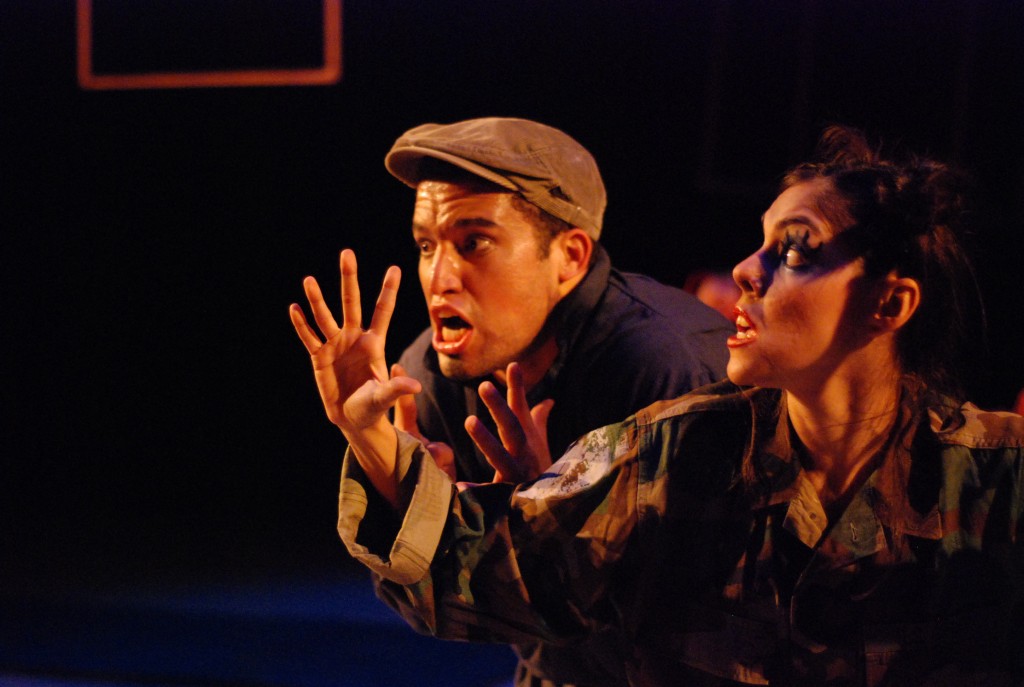
    CarlosAlexis Cruz and Mayra Acevedo as Pedro and his militant wife on an attempt to confront a human in "A Suicide Note from a Cockroach." Photo: Drew Foster

    No, not the golf course. Mr. and Mrs. Scatter do not do the Scottish thing. (Maybe the Scotch thing, but that’s different.) This morning the Scattermobile is heckbent for the Oregon coast to take the salty waters for a few days, Large Smelly Boys in tow and hoping that some Susan Cooper on tape will quell the teen and pre-teen insurrections.

    The Scatter notebooks will be included among the various baggage for this trek into the semi-wild, and yet we cannot guarantee that anything will emerge from them. Perhaps. Perhaps not. But the ingestion of clam chowder and fresh oysters is a better bet.

    In the meantime, let’s do the links. Here are a few things from other places we think you might like to read:

    COCKROACHES BITE THE BIG ONE. On Saturday night Mr. Scatter went to Imago Theatre to catch Pelu Theatre’s circus-skill performance of A Suicide Note from a Cockroach …, an hour-long spectacle based on Nuyorican poet Pedro Pietri’s 1979 piece A Suicide Note from a Cockroach in a Low Income Housing Project. It’s good, utterly nonrealistic stuff. A brief review is in this morning’s Oregonian, and you can read the the longer Oregon Live version here.

    Melody Owen, "Drought in Kenya -- Buffalo," Elizabeth Leach GalleryMELODY FOR THE MEEK. Portland artist Melody Owen has a pair of shows up in town, one at Elizabeth Leach Gallery and one in The Art Gym at Marylhurst University.

    They are both elegant exhibitions, and both consider, to one degree or another, the position in our midst of the meek — specifically, of the members of the animal kingdom, who have no say in the decisions that humans make about the world in which they live. Mr. Scatter reviewed the shows on Friday in A&E; you can read it here.

    PBS UNPLUGS THE ARTS. Scatter friend Holly Sanders relayed this column from the always provocative Terry Teachout of the Wall Street Journal.

    Notice a dumbing-down of arts programming on PBS, America’s public-interest television network? It’s not your imagination: After years of stolid denials by PBS brass, even the network’s chief is now admitting it. Teachout’s rallying cry: Less Nutcracker and Antiques Roadshow, more Lynn Nottage and Samuel Barber. Whatcha think? It’s worth a read.

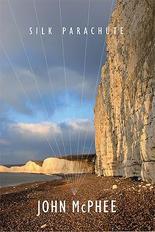
    Silk Parachute, essays by John McPheeTHE GEOLOGY OF DESIRE. Perhaps the most significant of many significant things we can say about John McPhee is that he makes geology fascinating. Way back last Sunday Mr. Scatter reviewed Silk Parachute, McPhee’s newest collection of essays, mostly from The New Yorker; you can read it here.
    One of McPhee’s essays is a warm salute to the extraordinary fact checkers of The New Yorker, whose abilities he has come to rely upon utterly. Nobody fact-checks like The New Yorker’s fact-checkers, he points out; especially most book publishing houses. (The lesson: If it’s reliable accuracy you’re after in a book, check out one whose contents were published in The New Yorker first.)

    Reading it reminded Mr. Scatter of a Rising Young Playwright he profiled several years ago for a newspaper of high factual standards. (That is, for a newspaper, which as an institution perpetually in a rush to ferret out and record the first draft of history, of its nature sometimes gets things wrong.)

    In the course of the interview Mr. Scatter asked the RYP, who had recently spent some months in New York, what he liked about being in a bigger city and whether he thought he might relocate for good. RYP replied that for career reasons he might have to eventually move, and that he loved New York’s larger pool of good actors.

    Mr. Scatter recorded those thoughts, and the RYP blew a gasket. He posted a rebuttal on a local theater Web site, claiming that he had been misquoted and then archly blaming the Reputable Newspaper for not having fact-checkers to call him up and, presumably, allow him to reinvent his quote. It was the slipshod press’s fault, he proclaimed: The fair burg in which he still temporarily resided was simply chock full of wonderful actors whom he’d be proud to have in his shows.

    Now, Mr. Scatter knew what Mr. Rising Young Playwright said. Mr. Rising Young Playwright knew what Mr. Rising Young Playwright said. Mr. Rising Young Playwright knew that Mr. Scatter knew what Mr. Rising Young Playwright said. And yet. Those missing fact-checkers, apparently, were large enough to cover Mr. Rising Young Playwright’s exposed behind.

    The last we heard, Mr. RYP was in A Very Large City Somewhere to the South. We’re not sure how he’s doing on that accuracy thing.

    *

    ILLUSTRATIONS, from top:

    – CarlosAlexis Cruz and Mayra Acevedo as Pedro and his militant wife on an attempt to confront a human in “A Suicide Note from a Cockroach …” Photo: Drew Foster

    – Melody Owen, “Drought in Kenya — Buffalo,” Elizabeth Leach Gallery

    – “Silk Parachute,” essays by John McPhee.

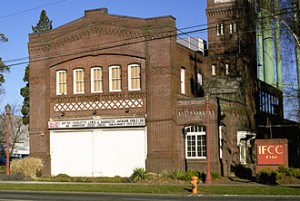
  • Recession blues: IFCC shuts down

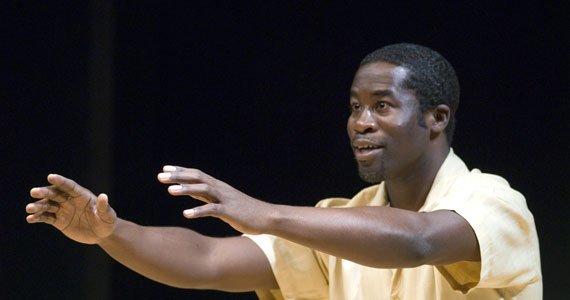
    Actor Daniel Beaty in 2008's "Resurrection" at IFCC

    Bad news often breaks on Friday afternoons, and today is no exception: The Interstate Firehouse Cultural Center is shutting its doors.

    The Oregonian’s D.K. Row has the story on Oregon Live; expect him to explore it in greater depth soon.

    Interstate Firehouse Cultural CenterThe city-run Portland Parks & Recreation, which owns the old firehouse and its grounds, announced that the non-profit IFCC’s board has voted to cease operations because of persistent deficits, in spite of decent attendance at events.

    The center’s failure is a blow to Portland’s alternative and multicultural arts scenes. Over the years IFCC has had its ups and downs, but since it began in 1982 it’s been a welcoming space for emerging theater and dance companies, visual artists, musicians, and community events. Artists who often felt shut out of downtown spaces found a congenial home here, as did North and Northeast Portland residents who discovered the joys of having a vital art center close to home.

    The shutdown takes effect May 1, but existing rental contracts through June 30 will be honored. That means, presumably, that upcoming shows by Rose City Vaudeville and Vagabond Opera, as well as IFCC’s share of Disjecta’s Portland2010 biennial art exhibit, will go on as planned.

    IFCC’s problems reflect the difficulties that the prolonged international economic crisis presents to cultural organizations, especially small and midsized ones. Put simply, everyone’s strapped for cash, and traditional sources are either tapped out or stretched thin. IFCC’s budget is built on just 20 percent earned income, the rest coming from foundation, corporate, individual and government grants. For everyone, those are getting tougher and tougher to nail down.

    Read the parks department’s press release after the jump:

    (Portland, OR) – Faced with decreasing donations and grants during the continuing recession, the board of directors of the Interstate Firehouse Cultural Center, Inc. (IFCC) has made the difficult, but responsible decision to shut down operation of the nearly 28-year old non-profit arts organization as of May 1, 2010.

    Despite generally good attendance at its exhibitions and performances, IFCC, Inc. is still faced with a significant budget shortfall, one that has forced the operating board to make the decision that the program needs to close indefinitely while the board regroups and determines a transition plan.

    IFCC, Inc. has been a tenant of the City of Portland, operating out the City’s historic former firehouse located on North Interstate Avenue. The firehouse building is managed by Portland Parks & Recreation (PP&R), who will be exploring possible future tenants for the site.

    PP&R will review events that have been scheduled at the facility after May 1 and will make determinations about any staffing needs that may be required. Existing rental agreements will be honored until June 30.

    IFCC, Inc. is governed by a community-based Board of Directors and run by a staff of three, with help from volunteers. Earned income, including rental fees, class fees and ticket sales, account for 20% of the organization’s income. The remainder comes from foundation and government grants, and corporate and individual contributions.

    IFCC, Inc. has historically been subsidized through Portland Parks & Recreation in the form of an annual grant and through maintenance of the facility.

    IFCC, Inc. may explore reorganizing in some form in the future and continue their focus of celebrating culturally diverse artists and audiences.

    In the meantime, in an effort to limit closure of the firehouse building and continue programs for the North Portland community, Portland Parks & Recreation staff are open to exploring options with other non-profit organizations interested in providing programming at the site.

    History
    Founded in 1982 under the leadership of then Portland Parks Commissioner Charles Jordan, IFCC quickly became an important multicultural arts organization in Portland. IFCC, Inc. was established as a private non-profit organization in 1988.

    *

    PHOTOS, from top:

    – Actor Daniel Beaty in 2008’s “Resurrection” at IFCC.

    – Exterior of the cultural center.

  • Thursday scatter: money and manure

    “Money, pardon the expression, is like manure,” the indefatigable Dolly Levi maintains in Thornton Wilder’s stage comedy The Matchmaker. “It’s not worth a thing unless it’s spread around, encouraging young things to grow.”

    Actress Ruth Gordon in 1919, at age 23. Wikimedia CommonsFunny, isn’t it, that both money and manure hit the fan in the world of politics? This isn’t a condemnation. It’s the necessary nature of the political beast. You shovel and shovel, and spread and spread, and hope you’ve put the seeds in the right places. In tough times, the process tends to get heavy on manure and light on money — and these, as you might have noticed, are tough times. Do we spend our way out of our economic mess, or batten the hatches and risk total shutdown?

    It’s a red-flag question for partisan bulls and bears, and trying to step through the muck dispassionately, looking for solid footing, is no easy chore. Dolly, I suppose, is a liberal, although at the time the play hit Broadway in 1955 she might have been considered an early Rockefeller Republican.

    When it comes to money and the arts, Oregon has a long tradition of deciding there just isn’t enough manure to go around. The state’s system of cultural spending is a little more like the theory behind growing world-class wine grapes in a marginal climate: stress the vines, and they’ll concentrate their fruit better.

    In the arts, sometimes that works. A lot of times, it just kills the plant. Even the vaunted Oregon Cultural Trust is essentially a pay-your-own-way plan, coming down to this overriding policy: If you want culture, make a donation. It was supposed to stabilize state funding for cultural matters and get arts advocates off the Legislature’s back. But last year at budget-crunching time, the Democrat-dominated state Legislature had no qualms about raiding the fund, which supposedly was an inviolable trust. It was, quite simply, a betrayal — or, in the cynics’ lexicon, just politics.

    Meanwhile, cultural advocates keep pressing their case for better and more consistent public funding, arguing that the cultural industries create jobs, have a high economic multiplier effect on local economies, are key industrial attractors as the state makes its transition to a high-tech and idea-driven economic base, and work hand in hand with education to create and attract a sophisticated workforce. Less often voiced but I believe crucial is the argument that a solid arts and cultural grounding in the public education system is essential to the development of citizens who actually have the intellectual flexibility to know what they’re voting about and why. As John Keats might have put it, Truth and beauty, Jack: Is that such a tough political sell?

    In a word, yes. The art that engages the political world is the art of the possible. And it is the Sisyphean task of arts advocates to persuade political leaders that backing cultural funding is not only a good idea, but also possible to do without risking a backlash at the polls. A Dolly Levi or three in the House and Senate might get things rolling.

    Ah, people say. But can we afford this? Of course I believe in the value of the arts, but what about priorities? When people are going hungry and have no jobs or homes or health insurance, when our roads and sewer systems are a mess, when we face huge costs dealing with a stressed environment, let alone waging wallet-draining wars in a couple of foreign countries, how can we justify giving public money to an arts group?

    Arts advocates roll their eyes over these questions at their peril. They are honest questions, and deserve honest consideration. Are the arts more important than all of these other matters of public concern? No.

    But when it comes down to social services and cultural projects, the question always seems to be framed as either/or. In Dolly Levi terms, maybe we should be fertilizing the whole garden, not just the cash crop. Corn and broccoli: monocultural agriculture is an outmoded idea. Things grow better, more healthily, when they’re planted together: in diversity is strength.

    I don’t mean to assign magical qualities to art. Many people live perfectly happy and productive lives without much consideration of formal aesthetics at all. I do, however, think that the arts are synergistic with all sorts of other social values, from education to (yes) a robust economy, that are good for the body politic — they can be the grease that keeps the gears from grinding. Do the public and its money have a vested interest in that? I say yes.

    A couple of days ago Scatter friend D.K. Row posted this story, Portland area arts levy will have to wait a year — or two, on Oregon Live. In it, he reports that the Creative Advocacy Network has tabled its push to pass a tri-county levy that could bring in $15 million to $20 million a year for cultural programs. CAN had hoped to have it ready for ballots this fall. Now, it says, it’s aiming for 2011 or 2012.

    This is probably a smart strategic withdrawal. The cold fact is, getting those votes this year, in this economy, would be a monumental challenge. And the case has not been made to the public that would be casting its votes.

    Making that case won’t be easy, but it is both good and necessary to do so. It’s complicated by the fact that it’s so easy for detractors to point to their versions of the Defense Department’s hundred-dollar toilet seats: lousy shows, half-baked ideas, companies that fold in spite of public funding. Some people will claim that art is for the elite, and they will be partly right. Some will claim that artists are arrogant and subversive, and they will be partly right.

    One answer to these complaints is that failure is an essential aspect of success, and that an arts scene that does not regularly fail is an arts scene too timid for anyone’s good. A healthy arts community is the research and development department of the broader culture, and good R&D is essential to continuing success. Further: a vigorous democracy needs to continually test itself against subversion, and make adjustments when it turns out the subversives are right. When the subversives are just being childish, well, sometimes the democracy has to be better than its artists and understand that a little kicking and screaming goes with the territory.

    Arts advocates need to be cautious about being cautious. Politics is a hurlyburly business, and you don’t get anything without wading into the fray. But this delay, as long as it doesn’t turn out to be a capitulation, seems strategically right.

    Time to spread the manure. Time to bring out the seed catalog and show people what can be grown. Hello, Dolly. Mind if we borrow your rototiller for a while?

    *

    PHOTO: Actress Ruth Gordon in 1919, at age 23. In 1956 she was nominated for a Tony for creating the role of Dolly Levi on Broadway in Thornton Wilder’s “The Matchmaker.” The play was the basis for the musical-comedy hit “Hello, Dolly!” Wikimedia Commons

  • Art Scatter officially runs off at mouth

    prolific-blogger-award

    Here at Art Scatter World Headquarters we’re identifying proudly these days with the good townswomen of River City, Iowa, in The Music Man: “Pick a little, talk a little, pick a little, talk a little, cheep cheep cheep, talk a lot, pick a little more.”

    With emphasis on the “talk a lot.”

    Thanks to the silver-tongued Mead Hunter of Blogorrhea and The Editing Room, who generously passed this honor along to us, we are now recipients of the coveted Prolific Blogger Award, a sort of Oscar for best supporting prattler. In other words: You can’t shut us up. Mrs. Scatter made passing reference to this blogospheric milestone in this post, in which she got all sentimental and teary-eyed over Mr. Mead’s enshrining of her with the honorific “retinue.”

    But we blather.

    Here’s what it’s all about. Adhering to the biblical code of sevens (like Joseph and his dream-interpretations), the Prolific Blogger Award moves in waves. Each recipient must in turn pay it forward to seven other bloggers who feed the beast regularly. They must also link to the original PBA post (we did that above; it’s on the blog Advance Booking) and, most confoundingly, hook up with the mysteriously named Mister Linky.

    Our friend and benefactor Mr. Mead has noted the dismaying phenomenon of once-prolific bloggers who have fallen by the wayside, some no doubt waylaid by the strumpet sirens of Twitter, Buzz and Facebook; others perhaps realizing that there is Life on the Other Side. Yet we found many good and noble blogs worthy of this award. Without further ado ….

    THE MAGNIFICENT SEVEN


    Noble Viola
    . Charles Noble, assistant principal violist for the Oregon Symphony, subtitles his blog Life on the Working End of the Viola, and that’s the view he gives you: the world of art music from the inside. It’s smart, provocative, sometimes funny, and almost always illuminating. A good musician isn’t always a good writer. Noble is. Like Lenny Bernstein, he knows how to use words to get inside sounds.

    Rose City Reader. You’d think RCR would already own the franchising rights to the Prolific Blogger Award. A busy lawyer by day, she’s a compulsive reader, list-maker and blogger by night (or maybe early morning). Her reading is catholic, roaming from classics to contemporary lit to arcane food-and-drink books to history, politics, and the occasional P.G. Wodehouse caper. And she writes about her literary adventures with wit and savvy independence.

    Portland Through My Lens. Having completed (with occasional additions) the terrific Fifty Two Pieces, in which she and a friend spent a year writing about art and artists connected to the Portland Art Museum, LaValle Linn has picked up her camera and embarked on this visual adventure, recording life and images around and about Portland’s streetcar line. Following it is like taking your morning coffee in a different little hangout every day.

    Portland Architecture. If you build it, they will argue. Brian Libby’s ambitious blog serves the dual purpose of keeping up with the city’s maze of architectural news and providing a platform for architects and planners and citizen-advocates to vent on issues as broad-ranging as neighborhood design and the fates of Memorial Coliseum and the Rose Quarter.

    Powell’s Books Blog. We aren’t sure who actually puts this together, but Portland’s iconic bookstore runs an excellent blog. It’s wide-ranging, with lots of topics and lots of guest bloggers, often writers with fresh books on the market. Sure, it’s a commercial blog, but it pops with good writing and stimulating ideas. You can never keep up with what’s going on in the publishing biz, but this is a good start.

    Splattworks. Playwright Steve Patterson’s blog begins with matters theatrical but often veers sharply into other obsessions, from photography to guitars to the inanities of the political world (on which he can be witheringly caustic). Smart, funny, passionate; a blog of admirable exasperations.

    Eva Lake. A lively checking-point for gallery hoppers. The artist and journalist Eva Lake, whose Art Focus program on KBOO-FM features often fascinating interviews with Portland artists and curators, tracks what’s happening on the city’s art scene.

  • Let the great world spin in its grave

    “When I see three oranges, I juggle,” the then 24-year-old highwire daredevil Philippe Petit is supposed to have said in 1974 after his 110-story-high prance between the two unfinished towers of the World Trade Center. “When I see two towers, I walk.”

    Glenn Beck. Photo: Gage Skidmore, Feb. 20, 2010. Wikimedia CommonsWhen Glenn Beck sees his foot, he inserts it in his mouth, and then brags about the taste.

    Mr. Scatter hesitates to write about the ubiquitous Mr. Beck. He looks back fondly on his days of innocence, just last summer, when he was able to ask, with all seriousness, “Who’s Glenn Beck?” How he’d managed to cocoon himself for so long he doesn’t know, but he misses those warm and fuzzy days.

    letworldspinTwo recent events, conjoined by accident, have brought Mr. Beck unfortunately to mind.
    First, Mr. Scatter attended his monthly book group, where the topic of discussion was Let the Great World Spin, last year’s National Book Award-winning novel by Colum McCann, in which Petit’s act of acrobatic bravado is the springboard to a grand contemplation of chance, hope and grace.

    Second, Mr. Scatter read Laurie Goodstein’s report in the New York Times, Outraged by Glenn Beck’s Salvo, Christians Fire Back. It seems that Mr. Beck, on his radio program, urged his followers to “run as fast as you can” if they see or hear anything in their churches referring to “social justice” or “economic justice.” Those are code words, he said, for Communism and Nazism and should be shunned like, well, the devil. It’s an odd pairing, at any rate: Was Mr. Beck down at the pool hall or out stoning adulteresses the day his high school history class covered the Siege of Leningrad? “If you have a priest that is pushing social justice,” he intoned, “go find another parish. Go alert your bishop.”

    This upset a lot of Christians, including not a few fundamentalists and evangelicals, many of whom have been in a quiet vanguard of such social and economic justice actions as rebuilding communities struck by crisis (the Gulf Coast, Haiti), spreading literacy, and helping subsistence cultures feed and shelter themselves on their own terms. You could argue, although I’m sure Mr. Beck doesn’t, that Jimmy Carter has been our finest post-president because of his commitment to a Christianity of social and economic justice.

    Mr. Scatter understands that Mr. Beck makes a living out of this sort of profitable jeremiad, and he supposes there’s some sort of thrill in poking at rattlesnakes. He understands that Mr. Beck is a rear-guard agitator, a gatherer and focuser of resentments from people who believe they’ve been mistreated and left behind by the course of history.

    He is also glad to see a cross-section of Christians responding to the calumny, striking back at the co-option of the name “Christian” for the exclusive use of radical reactionaries of the demagogic right. Divisiveness, resentment and exclusion seem strangely unstable rocks on which to build a church.

    In McCann’s novel, it’s the artist Petit who inspires the metaphor of hope and possibility. But it’s the conflicted man of action, the seeker Corrigan, who spreads a quiet theology of deeds, not dogma. Not even deeds, really, but a fundamental notion of treating people with acceptance and respect. Corrigan can’t live up to his own ideals — no human could — but his simple concept of Christianity is about as far from Mr. Beck’s us-versus-them theology as you can get:

    Corrigan told me once that Christ was quite easy to understand. He went where He was supposed to go. He stayed where He was needed. Ho took little or nothing along, a pair of sandals, a bit of a shirt, a few odds and ends to stave off the loneliness. He never rejected the world. If He had rejected it, He would have been rejecting mystery. And if He rejected mystery, He would have been rejecting faith.

    Novelist Colum McCann. Photo: Brennan BourkeWhat Corrigan wanted was a fully believable God, one you could find in the grime of the everyday. The comfort he got from the hard, cold truth — the filth, the war, the poverty — was that life could be capable of small beauties. He wasn’t interested in the glorious tales of the afterlife or the notions of a honey-soaked heaven. To him that was a dressing room for hell. Rather he consoled himself with the fact that, in the real world, when he looked closely into the darkness he might find the presence of a light, damaged and bruised, but a little light all the same. He wanted, quite simply, for the world to be a better place, and he was in the habit of hoping for it. Out of that came some sort of triumph that went beyond theological proof, a cause for optimism against all the evidence.
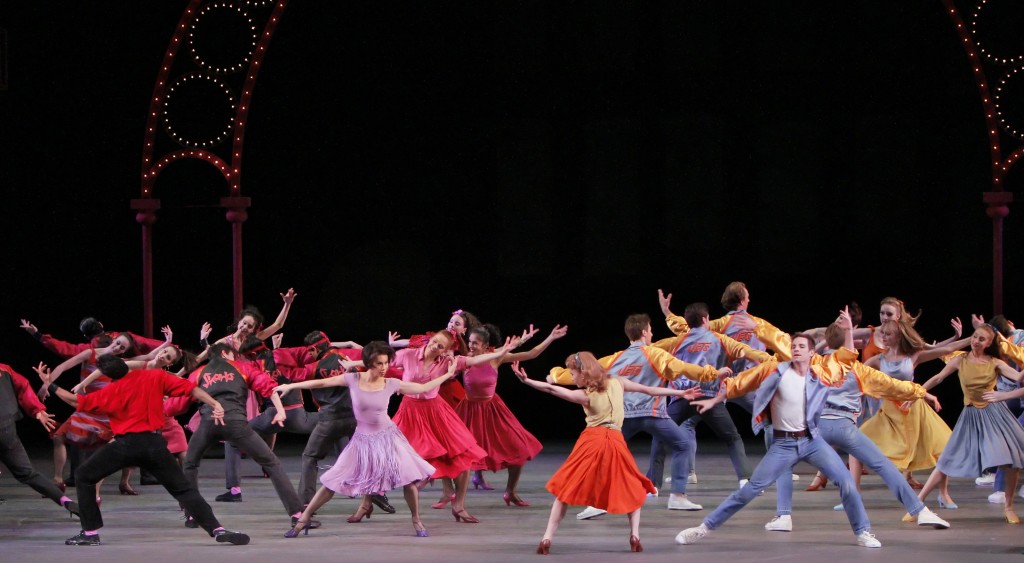

    “Someday the meek might actually want it,” he said.

    Like a lot of other people, Mr. Scatter has spent a lifetime thinking about these matters, and something akin to liberation theology is the closest that any catechism comes to making sense to him. We are each other. Love one another. Help where help is needed. Understand that the fortunate have a responsibility to the unfortunate, and that means not just a handout but also an even opportunity. Do unto others as we would have others do unto us. It’s an impossible standard but a magnificent goal. What is a life of the spirit that is not led moment to moment, that is not open to things that make us uncomfortable, that does not seek justice as a matter of humility and respect? Without such things, what right does any religion have to lay a claim on any of us?

    Nothing humble about Mr. Beck, whose interpretation of the way, the truth and the life seems to run to roadblocks and litmus tests and a devil’s portion of scorn for anyone not in ideological lockstep with him. It’s a free world, in spite of the best efforts of the megaphone radicals to clamp it down, and Mr. Beck has the right to profit from his attention-grabbing misrepresentations of conservatism, Christianity and, one assumes, literature. As for him and his house, they will serve his career.

    What would Jesus do? Mr. Scatter isn’t sure. Maybe throw the huckster out of the temple. Maybe offer him a loaf and a fish, and ask him to pass them along.

    Or maybe just turn off the radio.

    *

    ILLUSTRATIONS, from top:

    – Glenn Beck. Photo: Gage Skidmore, Feb. 20, 2010. Wikimedia Commons

    – Colum McCann’s National Book Award winner, “Let the Great World Spin”

    – Novelist Colum McCann. Photo: Brennan Bourke

  • Belly-dancing on the Nile: Our far-flung correspondent hobnobs and returns

    Martha Ullman West, Art Scatter’s chief correspondent, has been trotting the globe. She’s endured an evening of wretched belly-dancing on the Nile, chatted with a centenarian ballet dancer in Philadelphia, revisited the works of Jerome Robbins in New York, and returned home to Portland, where she found irritation with Random Dance and happiness with Oregon Ballet Theatre. Here’s her report:

    c29801-9westside

    Here are some scattered (no pun intended) thoughts about what I’ve been seeing in the world of performance, mostly dance, since I departed on February 1st for a glorious Metropolitan Museum of Art tour of Egypt with a postlude in Jordan, followed by 10 days in New York, where I ploughed through many clipping files in the New York Public Library for the Performing Arts, at Lincoln Center.

    These endeavors were interrupted by snow and a day trip to Philadelphia to interview Yvonne Patterson. She is a former dancer in Balanchine’s first companies, now a whisker away from turning 100, still swimming every day and teaching the occasional master class in ballet, no kidding. There was also a fair amount of hobnobbing with my New York colleagues, during which the state of dance and dance writing was discussed with a certain amount of hand-wringing on both counts.

    The River NileThe worst performance shall come first: an unspeakably godawful belly dance demonstration on board the Nile River boat on which I spent four otherwise glorious nights.
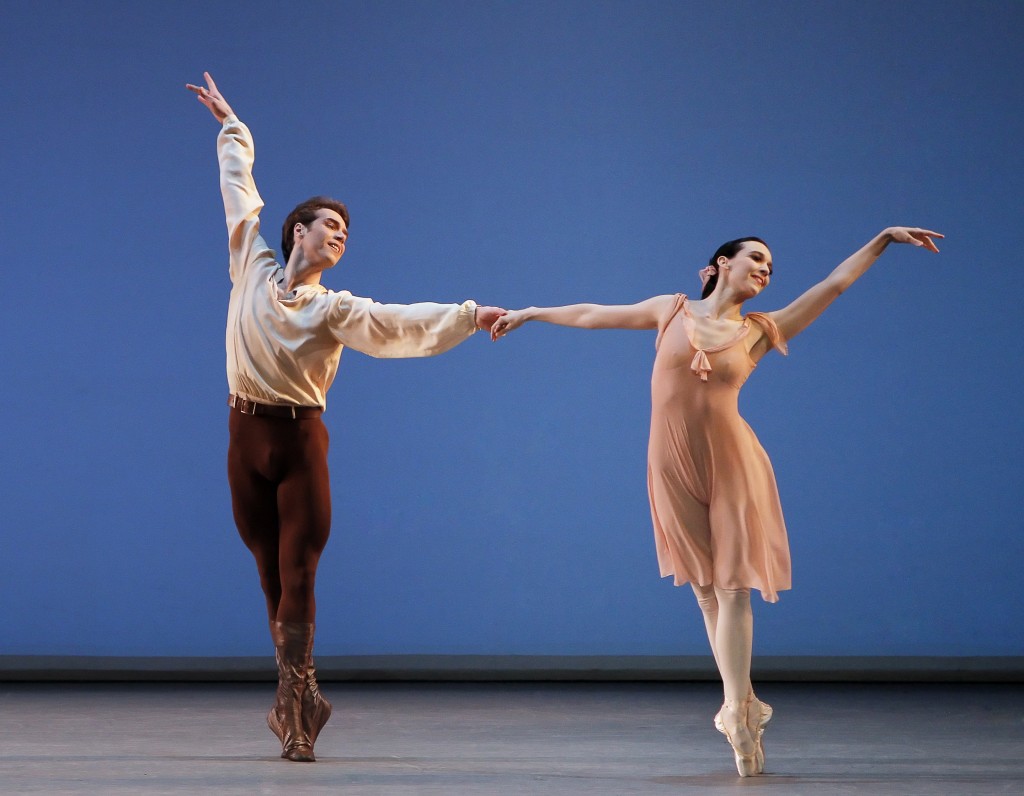
    I’ve seen better at various restaurants in Portland, although the effects of her lackluster undulations, which bored even the men in the audience, were somewhat mitigated by the sufi dancer who followed, a very young man who was completely committed to spinning himself into a trance, and therefore pretty compelling.

    In New York, I was taken to see a play called Mr. and Mrs. Fitch, oh so cleverly written by Douglas Carter Beane, at Second Stage Theatre, starring the suave John Lithgow as a gossip columnist running out of copy and Jennifer Ehle as his equally ambitious and rather more unethical wife. They invent a celebrity to write about, and despite such wonderful lines as “I swear on a stack of Susan Sontag’s Against Interpretation” and the cast’s finely tuned delivery of the lines, the ethics practiced by the real-life press these days made it all rather less than funny for someone who still thinks journalism is an honorable profession, or at the very least that it should be.

    Jenifer Ringer and Gonzalo Garcia in Dances at a Gathering, New York City Ballet. Photo: ©Paul Kolnik

    A matinee performance of an all-Jerome Robbins program by New York City Ballet gave me far more pleasure; especially Dances at a Gathering, Robbins’ masterpiece of a Chopin ballet, with former San Francisco Ballet dancer Gonzalo Garcia in the pivotal role of the man in brown. The piece is slightly more than an hour long, but so deftly choreographed, with references to Eastern European folk dance as a part of seemingly endlessly innovative use of the classical vocabulary that you want more. Cameron Grant, who played the music, is a terrific musician and highly skilled at performing concert music as dance accompaniment, no mean trick. Maria Kowroski as the girl in green and Jenifer Ringer in pink combined impeccable technique with a spontaneity that seems to elude many City Ballet dancers these days, a crying pity in Balanchine and Robbins’ house.

    West Side Story Suite completed the program. I don’t think this works very well as a ballet, and the men in particular were extremely unconvincing as Jets and Sharks, with the exception of Benjamin Millepied (whose choreography we saw performed here by Baryshnikov last fall) as Tony. Georgina Pazcoguin, however, was a truly fiery Anita, which was fun to see. Robbins did this arrangement of dances himself; nevertheless, taken out of the context of the entire show, I thought it looked cobbled together and randomly so.

    Wayne McGregor/Random Dance at White Bird. Photo: Ravis DeepresSpeaking of random, I got back into the swim, so to speak, of Portland’s remarkably active dance pond with opening night of Wayne McGregor’s Random Dance last Thursday at the Newmark Theatre. And frankly I loathed Entity, like Dances at a Gathering an hour-long piece. It is extremely well-crafted, but about as coldly clinical a treatment of the dancers (who are wonderful) as I’ve seen in more than half a century of watching dance of all kinds.
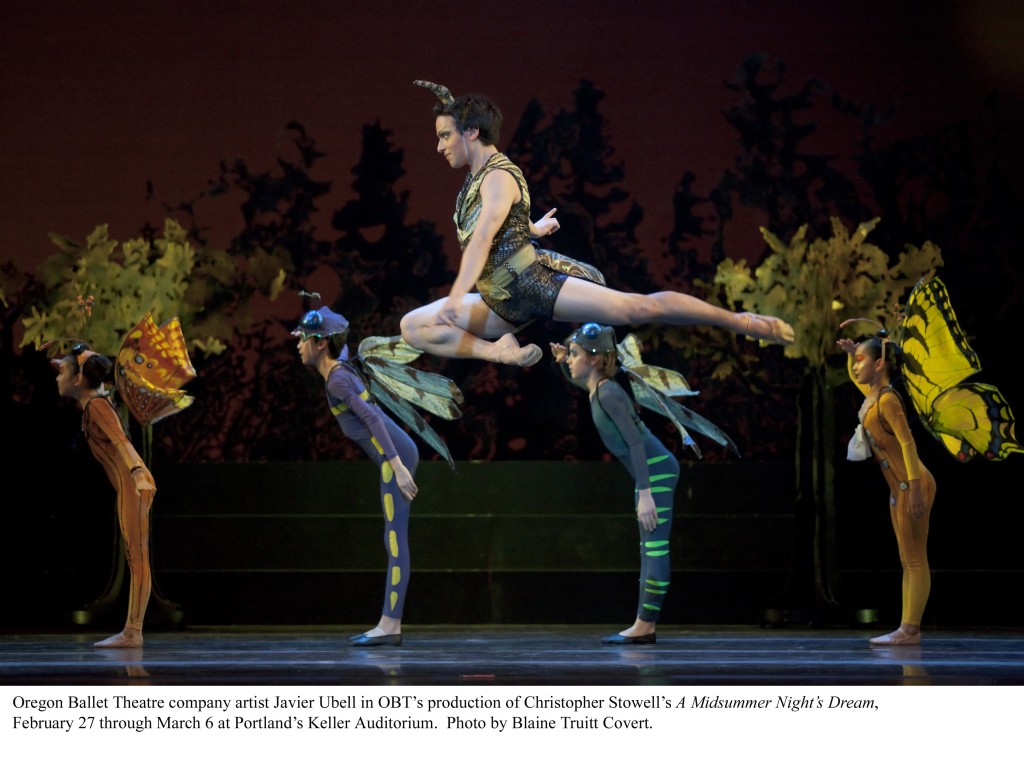
    Admittedly it was amusing from time to time to spot the references to classical ballet that McGregor, (who is resident choreographer at London’s Royal Ballet) was busily rendering spastic. One example was a supported pirouette that finishes with a tilt of the head that’s straight out of Frederick Ashton’s Sleeping Beauty, which I suppose was meant to be funny. For me, however, movement that skews the dancers’ bodies to make many of them look as if they were battling scoliosis, even if McGregor is vividly rebelling against balletic spinal placement, is extremely unpleasant to watch.

    Certainly McGregor knows how to move dancers around a stage, in solos, duets, trios and ensemble dances. And the high-tech set, commissioned score and superb lighting design made it a very well-integrated work, but with not a shred of emotional affect. It was billed as sensual and sexy. I was reminded of what Dorothy Parker once said about Beat writers: “They turn sex into the dreariest calisthenic imaginable.”

    McGregor is a hot ticket in England for his use of technology, among other things. He’s not, in fact, doing anything new to Portland audiences, not those of us who have been watching Tere Mathern and Mary Oslund’s work for lo these many years. Both are technically and visually sophisticated choreographers who manage nevertheless to convey the human qualities of the dancers, and tell us something about ourselves as people. Oslund’s work will be on White Bird’s next season, when Uncaged returns to Portland State ’s Lincoln Hall. I’m looking forward to it.

    Javier Ubell as Puck in A Midsummer Night's Dream at OBT. Photo: Blaine Truitt Covert

    Finally, on Saturday night, I saw for the first time Christopher Stowell’s one-act version of A Midsummer Night’s Dream, its sophisticated opening wedding scene a soignee contrast to the forest action, Shakespeare’s mechanicals transformed into waiters and a bartender, Puck a Master of Ceremonies as well, reminding us that dreams are rooted in reality. Mr. Scatter is dead right: The return of Oregon Ballet Theatre’s orchestra to play Mendelssohn’s sublime music, which they played brilliantly under the passionate directorship of Niel DePonte, contributed mightily to the delight of the performance.

    Stowell’s one-act version of Dream is intensely musical, far more in tune with Mendelssohn’s score than with Shakespeare’s language, which my companion thought was a flaw. I don’t agree. Packed with humor that isn’t cute, romantic passion, a pas de deux of marital rage worthy of Edward Albee’s Who’s Afraid of Virginia Woolf and an innovative use of the classical vocabulary, this Dream should become a staple of OBT’s repertory. And it’s clear from their performances that OBT’s dancers enjoy themselves just as much as the roaring audience does.

    Adrian Fry and Gavin Larsen in The Four Temperaments at OBT. Photo: Blaine Truitt CovertThe program opener, Balanchine’s The Four Temperaments, to Paul Hindemith’s difficult score (alas, not played live) was met with almost as much audience approval on Saturday night as Dream, for which I congratulate the dancers themselves — particularly Yuka Iino and Chauncey Parsons in the second variation, known as “Sanguinic”; Gavin Larsen and Adrian Fry in the opening and closing “Theme”; Artur Sultanov’s “Phlegmatic,” and Kathi Martuza’s furious “Choleric,” the fourth variation. To Francia Russell’s staging, I think I owe this performance’s vitality and immediacy. It took me back to my youth, when I was a dedicated second \-balcony audience member at the time that City Ballet was still performing at City Center and the dancers still looked human, their individuality coming into play — no longer the case much of the time since the company became institutionalized at Lincoln Center.

    It was a wonderful welcome home from New York, which will always be home to me as well.

    *

    ILLUSTRATIONS, from top:

    – Jerome Robbins’ West Side Story Suite, New York City Ballet.
    Photo: ©Paul Kolnik

    – Map of the Nile River basin: belly dancer no, sufi dancer yes.

    – Jenifer Ringer and Gonzalo Garcia in Dances at a Gathering, New York City Ballet. Photo: ©Paul Kolnik

    – Wayne McGregor/Random Dance at White Bird. Photo: ©Ravi Deepres

    – Javier Ubell as Puck in A Midsummer Night’s Dream at OBT. Photo: ©Blaine Truitt Covert

    – Adrian Fry and Gavin Larsen in The Four Temperaments at OBT. Photo: ©Blaine Truitt Covert