Author: Darren Rickard

  • ABC NEWS VIDEO: Warren Buffett on Taxing Bonuses

    Warren Buffett on Taxing Bonuses

    Billionaire investor says restricting banker bonuses only benefits shareholders.


    In an interview with ABC News at a special investors conference in his hometown of Omaha, Neb., Buffett said it was unnecessary to go after banks that had already repaid the loans they had received through TARP. The country’s largest banks, including Bank of America, Citigroup, JPMorgan Chase and Goldman Sachs, have all repaid their TARP funds.

    “I don’t think it makes sense … The banks are not going to be the cause of big losses in the TARP program, maybe the auto companies will,” Buffet said.”It’s a separate situation.”


    Share Investor Links

    Share Investor Blog – Stockmarket & Business commentary
    Share Investor New Zealand Business News– Get more business news
    Discuss this topic @ Share Investor ForumRegister free
    Share Investor’s Daily Forex Updates

    Recommended Amazon Reading

    The Snowball: Warren Buffett and the Business of Life The Snowball: Warren Buffett and the Business of Life by Alice Schroeder
    Buy new: $13.60 / Used from: $11.85
    Usually ships in 24 hours
    The Intelligent Investor: The Definitive Book on Value Investing. A Book of Practical Counsel (Revised Edition) The Intelligent Investor: The Definitive Book on Value Investing. A Book of Practical Counsel (Revised Edition) by Benjamin Graham
    Buy new: $14.95 / Used from: $10.44
    Usually ships in 24 hours


  • WALL STREET JOURNAL: Munich Re: Buffett Voting Rights Potentially Over 5%


    By Ulrike Dauer
    Of DOW JONES NEWSWIRES

    FRANKFURT (Dow Jones)–Munich Re AG (MUV2.XE) Thursday said billionaire investor Warren Buffett owned financial instruments as of Jan. 19 that could lift his voting rights in the company to 5.029%.

    Munich Re said in a regulatory filing that Buffett, the chairman of investment company Berkshire Hathaway Inc. (BRKA, BRKB), said “he directly or indirectly held financial instruments that granted him the right to subscribe to shares in our company” carrying 1.945% of voting rights.

    Buffett already held 3.084% in the company on that day, Munich Re said. The exercise date of the financial instruments is March 11.

    Financial instruments that Buffett held directly were through Berkshire Hathaway Inc., OBH Inc. and National Indemnity Company, which are controlled by Buffett, Munich Re said.

    A Munich Re spokeswoman said the company is “pleased about every investor, that’s a confirmation of our sustainable strategy.” She declined to comment further on the type of financial instruments and whether they will have to be exercised on March 11.

    According to the figures, Buffett was Munich Re’s largest investor on Jan. 19, ahead of Blackrock Inc. (BLK), which reported in December that it held 4.58% in the company.

    On Tuesday, Munich Re, one of the world’s largest reinsurers, said Buffett’s stake had gone above the 3% threshold on Jan. 18 to stand at 3.045%.

    Share Investor Links

    Share Investor Blog – Stockmarket & Business commentary
    Share Investor New Zealand Business News– Get more business news
    Discuss this topic @ Share Investor ForumRegister free
    Share Investor’s Daily Forex Updates

    Recommended Amazon Reading

    The Snowball: Warren Buffett and the Business of Life The Snowball: Warren Buffett and the Business of Life by Alice Schroeder
    Buy new: $13.60 / Used from: $11.85
    Usually ships in 24 hours
    The Intelligent Investor: The Definitive Book on Value Investing. A Book of Practical Counsel (Revised Edition) The Intelligent Investor: The Definitive Book on Value Investing. A Book of Practical Counsel (Revised Edition) by Benjamin Graham
    Buy new: $14.95 / Used from: $10.44
    Usually ships in 24 hours


    Bookmark and Share


  • CNBC: Berkshire Hathaway Won’t Issue More Shares In Response to S&P Addition – Stock at 14-Month High

    Published: Thursday, 28 Jan 2010 | 3:14 PM ET

    By: Alex Crippen
    Executive Producer

    Warren Buffett’s Berkshire Hathaway says today it will not issue more shares in response to the company’s just-announced addition to the benchmark S&P 500.

    In a news release this afternoon (Thursday), Berkshire says the S&P news prompted “several inquiries” on whether the company “would be issuing additional shares of its common stock in what is often referred to as an ‘Index Add’ issuance.”

    The response: “Berkshire does not intend to issue any additional shares of its common stock other than the common stock it will issue upon the completion of the previously announced acquisition of BNSF.”

    That’s a positive for the stock, because the big S&P index funds will have to buy the stock when it is formally added, but there won’t be any additional supply to accomodate that demand.


    UPDATE: Berkshire B shares closed today at $73.90, a gain of $2.54, or 3.56 percent, from Wednesday’s 4p ET close. That builds on yesterday’s gain of almost 5 percent following the S&P announcement, and puts the stock at a fresh 14-month closing high, topping last Thursday’s $72.72. That was the day Berkshire’s 50-for-1 split of its B shares went into effect.

    Current Berkshire stock prices:

    Class A: [BRK.A 114600.00 3600.00 (+3.24%) ]

    Class B: [BRK.B 76.43 2.68 (+3.63%) ]


    Share Investor Links

    Share Investor Blog – Stockmarket & Business commentary
    Share Investor New Zealand Business News– Get more business news
    Discuss this topic @ Share Investor ForumRegister free
    Share Investor’s Daily Forex Updates

    Recommended Amazon Reading

    The Essays of Warren Buffett: Lessons for Corporate America, Second Edition The Essays of Warren Buffett: Lessons for Corporate America, Second Edition by Warren E. Buffett
    Buy new: $25.86 / Used from: $24.96
    Usually ships in 24 hours
    Warren Buffett and the Interpretation of Financial Statements: The Search for the Company with a Durable Competitive Advantage Warren Buffett and the Interpretation of Financial Statements: The Search for the Company with a Durable Competitive Advantage by Mary Buffett
    Buy new: $16.47 / Used from: $16.21
    Usually ships in 24 hours


    Bookmark and Share


  • BUSINESSWEEK: Buffett May Boost Holding in Munich Re to More Than 5 Percent

    By Oliver Suess

    January 28, 2010, 04:55 AM EST

    Jan. 28 (Bloomberg) — Munich Re, the world’s biggest reinsurer, said Warren Buffett owns the rights to shares that would bring his stake in the company to more than 5 percent.

    Buffett held “financial instruments that granted him the right to subscribe to shares in our company which bear 1.945 percent of the voting rights” as of Jan. 19, the reinsurer said in an e-mailed statement today. Buffett also “held directly or indirectly 3.084 percent” of Munich Re’s voting rights and “therefore by way of aggregation he would have 5.029 percent of the voting rights,” the company said.

    Buffett, whose Berkshire Hathaway Inc. owns the world’s third-biggest reinsurer, would become the German company’s largest shareholder if he were to subscribe to the shares. Asset manager BlackRock Inc. held 4.58 percent of Munich Re as of Dec. 1.

    Stakeholders in German companies must declare purchases or sales that bring their investments above or below certain thresholds. Buffett’s stake exceeded the 3 percent threshold on Jan. 18, the Munich-based reinsurer said in a statement distributed by the DGAP newswire on Jan. 26. The exercise date of the financial instruments is March 11, Munich Re said today.

    Munich Re spokeswoman Johanna Weber reiterated earlier comments, saying the company “welcomes any investor.”

    The German reinsurer rose 1.35 euros, or 1.2 percent, to 111.20 euros in Frankfurt, bringing this week’s gain to 1.6 percent. That compares with a 0.9 percent advance in the 29-member Bloomberg Europe 500 Insurance Index this week.

    –With assistance Mike Gavin in Frankfurt and Mariajose Vera in Munich. Editors: James Amott, Ben Vickers

    Share Investor Links

    Share Investor Blog – Stockmarket & Business commentary
    Share Investor New Zealand Business News– Get more business news
    Discuss this topic @ Share Investor ForumRegister free
    Share Investor’s Daily Forex Updates

    Recommended Amazon Reading

    The Snowball: Warren Buffett and the Business of Life The Snowball: Warren Buffett and the Business of Life by Alice Schroeder
    Buy new: $13.60 / Used from: $11.85
    Usually ships in 24 hours
    The Intelligent Investor: The Definitive Book on Value Investing. A Book of Practical Counsel (Revised Edition) The Intelligent Investor: The Definitive Book on Value Investing. A Book of Practical Counsel (Revised Edition) by Benjamin Graham
    Buy new: $14.95 / Used from: $10.44
    Usually ships in 24 hours


    Bookmark and Share


  • BUSINESSWEEK: Cheapest Route to Walmart From China May Skip Buffett’s Railway

    January 27, 2010, 10:17 PM EST

    By Kyunghee Park and Eric Sabo

    Jan. 28 (Bloomberg) — Chinese toys and sneakers headed to Wal-Mart Stores Inc. and Target Corp. on the U.S. East Coast may bypass Warren Buffett’s $33.8 billion railway as the expansion of the Panama Canal slashes the cost of shipping them by sea.

    The deeper, wider canal will allow A.P. Moeller-Maersk A/S, China Ocean Shipping Group Co. and other lines to ship more cargo directly to New York and Boston instead of unloading it on the West Coast for trains and trucks to finish the journey east. That could save exporters 30 percent, the canal operator said.

    The $5.25 billion Panama Canal project, scheduled for completion during its centennial in 2014, may take business from ports including Los Angeles and Seattle, and railroads including Berkshire Hathaway Inc.’s Burlington Northern Santa Fe Corp. It costs as much as $1,000 more per cargo container to use trains than ships, said Lee Sokje, a shipbuilding analyst at Mirae Asset Securities Co. in Seoul.

    “It is inevitable that railways, such as Burlington Northern, will lose some of their cargo once the Panama Canal is expanded,” said Jee Heon Seok, a shipping analyst for NH Investment & Securities Co. in Seoul. “Many more containers can be moved in a single voyage on a ship than going through the West Coast ports.”

    More Cargo

    China, poised to overtake Japan this year as the world’s second-biggest economy, may boost exports by 20 percent during the first quarter as the global economy recovers, according to Macquarie Securities Ltd. and Royal Bank of Scotland Group Plc.

    China Cosco Holdings Co., Asia’s biggest shipping company by market value, and 14 other container lines said Jan. 14 they expect a “significant” increase in transpacific cargo this year on rising U.S. consumer sentiment.

    That prospective growth spurred Berkshire to pay $26 billion for the remaining 77.4 percent of Fort Worth, Texas- based Burlington Northern it didn’t already own. Buffett, the Berkshire chairman, said the largest U.S. railroad will benefit from “moving around more and more goods.” The acquisition is pending and expected to be completed by March 31.

    Burlington Northern customers in Gulf of Mexico ports — including Houston and Galveston, Texas — may benefit from more traffic going through a wider canal.

    Buffett didn’t respond to a request for comment. A Burlington Northern spokeswoman, Suann Lundsberg, said trains deliver cargo from the West Coast to the East Coast as many as nine days faster than ships using the canal.

    30 Percent Savings

    Rail traffic is expected to continue growing, although probably at a slower rate than in the past, Lundsberg said.

    “We know he doesn’t make short-term investments,” Art Wong, spokesman for the port in Long Beach, California, said of Buffett. “He must be making it because he thinks it’s a great long-term investment.”

    About 43 percent of Asian cargo shipped to East Coast ports — including Savannah, Georgia, and Jacksonville, Florida –goes through the Panama Canal, said Rodolfo Sabonge, director of marketing for the Panama Canal Authority. That share may increase to 49 percent by 2025.

    “It will become less expensive overall to ship through the canal,” Sabonge said. “Savings could go up to 30 percent.”

    The expansion project, started in 2007, is building locks on both sides of the 50-mile canal, digging a new channel linking the locks and deepening the waterway connecting the Pacific Ocean with the Caribbean Sea.

    New York Harbor

    Currently, ships loading fewer than 5,000 20-foot boxes use the canal. The expansion will accommodate vessels carrying about 12,600 containers and may generate cargo growth of about 5 percent a year, Sabonge said.

    “It will, of course, help reduce costs for exporters to the U.S.,” said Victor Fung, chairman of outsourcer Li & Fung Ltd., the world’s biggest supplier of toys, clothes and furniture to retailers including Walmart, Target, Macy’s Inc. and Marks & Spencer Group Plc.

    The company reported HK$46.3 billion ($5.96 billion) in sales during the first half of last year, with 61 percent of that coming from the U.S.

    East Coast ports are readying for the changes. The Port Authority of New York and New Jersey is deepening more channels to 50 feet and considering options for a 78-year-old bridge between New Jersey and New York City that may be too low.

    “Increasing numbers of big ships are anticipated at our port facilities following an expansion of the Panama Canal,” the agency said in September.

    Ports, Railroads Collaborate

    Hanjin Shipping Co., South Korea’s largest shipping company that operates two California terminals, is building its first East Coast terminal in Jacksonville to handle an increase in cargo through the canal. The facility opens in 2013.

    The ports around Charleston, South Carolina, are dredging to accommodate vessels carrying more than 8,000 20-foot containers.

    Six ports on the opposite coast — Los Angeles; Long Beach; Oakland, California; Seattle; Tacoma, Washington; and Portland, Oregon — handle about 70 percent of containerized trade between Asia and the U.S., according to an Oct. 12 statement.

    They are collaborating with Burlington Northern and Union Pacific Corp. to convince Asian exporters they are better options than the canal for reaching East Coast markets. They cite advantages including deep-water terminals, connections to inland transportation networks, and storage and distribution facilities.

    Trains also use less fuel, reducing costs and carbon emissions, they said.

    “We don’t think those alternative gateways will go away,” said Tay Yoshitani, chief executive officer for the Port of Seattle. “If we don’t improve our competitiveness, we could lose a lot of cargo.”

    –With assistance from Craig Trudell and Erik Holm in New York and Frank Longid in Hong Kong. Editors: Michael Tighe, Bret Okeson.

    Share Investor Links

    Share Investor Blog – Stockmarket & Business commentary
    Share Investor New Zealand Business News– Get more business news
    Discuss this topic @ Share Investor ForumRegister free
    Share Investor’s Daily Forex Updates

    Recommended Amazon Reading

    The Snowball: Warren Buffett and the Business of Life The Snowball: Warren Buffett and the Business of Life by Alice Schroeder
    Buy new: $13.60 / Used from: $11.85
    Usually ships in 24 hours
    The Intelligent Investor: The Definitive Book on Value Investing. A Book of Practical Counsel (Revised Edition) The Intelligent Investor: The Definitive Book on Value Investing. A Book of Practical Counsel (Revised Edition) by Benjamin Graham
    Buy new: $14.95 / Used from: $10.44
    Usually ships in 24 hours


    Bookmark and Share


  • MSN INDIA: What American billionaires do for media hype? Visit space!

    By Katie Evans, Forbes , 27/01/2010

    Doctors couldn’t explain this 16-year-old’s bizarre neurological and psychiatric symptoms.

    There’s no escaping him. Donald Trump is everywhere – and he loves it that way. In New York City there are at least 13 buildings with the Trump name on them and at least 20 more around the world.

    For nearly a decade Trump has had his own reality television shows, The Apprentice and Celebrity Apprentice, where he showcases his flare for bravado, brashness and product placement. Then there is Cirque du Soleil cofounder Guy Laliberte who took his need for attention to new heights this year by flying into space. The former fire-breather flew with a slew of Russian astronauts in October for a two-week visit to the International Space Station. The cost for his mission: $30 million.

    Donald Trump’s stamped Trump on everything from water and vodka to suits and online business courses, and he’s paid a nice royalty anytime something with his face flies off the shelves.
    Then there’s the television commentary he provides (for free, to anyone who will listen) every time a big celebrity story hits the airwaves.

    Miss USA runner-up Carrie Prejean says she doesn’t believe in same-sex marriage? Trump: “It was a controversial question. It was a tough question. If her beauty wasn’t so great, nobody really would have cared.”

    Trump is one of 11 billionaires Forbes selected for their list of the most overexposed billionaires, which recognizes 10-figure tycoons for their appetite for frequent media appearances and endless self-promotion. Their combined net worth: $75 billion.

    Broadcast from Space

    Guy Laliberte’s highly publicized trip, which included a live broadcast to a U2 concert, was used to raise awareness for Laliberte’s clean water charity, the One Drop Foundation.

    Another billionaire using space to keep his name in the world’s headlines is Richard Branson. The chief of Virgin Group unveiled Virgin Galactic’s SpaceShip Two in December and plans to use the vessel to pioneer commercial space travel. The rocket ship will launch test runs this year and offer commercial space tours as early as 2012. Tickets are $200,000.

    Branson’s career has been loaded with media hype. He crossed the Atlantic in a red, Virgin-branded hot air balloon, broke records in a similar-themed speedboat and launched a short-lived realty TV show: The Rebel Billionaire.

    World’s richest most exposed

    Investor Warren Buffett is the world’s richest overexposed billionaire. The Berkshire Hathaway maven, who often appears on CNBC in interviews with Becky Quick to offer up his views on the economy and investments, was worth $40 billion when we published our list of the 400 richest Americans in September.

    This fall Buffett made “an all-in wager on the U.S. economy” through the purchase of Burlington Northern Santa Fe Railway and has recently been in the middle of Kraft’s purchase of Cadbury. Buffett leveraged his 9% stake in Kraft to assert his disapproval of the stock-heavy structure of the original bid and told CNBC’s Quick he would have voted against the final deal that closed Tuesday.

    The Oracle of Omaha also stars in a new on-line cartoon series that teaches children about finance.
    Dallas Cowboys owner Jerry Jones clinched a spot on the list for milking every opportunity to promote the opening of the new $1.2 billion Cowboys Stadium in September. In addition to scores of interviews for sports news outlets and the Forbes.com Video Network, Jones also made a CNBC commercial on the stadium, declaring, “I am American business.”

    Before the Cowboys’ playoff loss Jones hosted a high-profile college basketball game in the new venue and is now planning for a boxing match.

    He also allowed Michael Irvin to award the winner of the former wide receiver’s reality TV series 4th and Long a spot on the Cowboys practice team, and made a few appearances on the show. This came a year after he was the star of his own HBO reality series, Hard Knocks.

    Share Investor Links

    Share Investor Blog – Stockmarket & Business commentary
    Share Investor New Zealand Business News– Get more business news
    Discuss this topic @ Share Investor ForumRegister free
    Share Investor’s Daily Forex Updates

    Recommended Amazon Reading

    The Snowball: Warren Buffett and the Business of Life The Snowball: Warren Buffett and the Business of Life by Alice Schroeder
    Buy new: $13.60 / Used from: $11.85
    Usually ships in 24 hours
    The Intelligent Investor: The Definitive Book on Value Investing. A Book of Practical Counsel (Revised Edition) The Intelligent Investor: The Definitive Book on Value Investing. A Book of Practical Counsel (Revised Edition) by Benjamin Graham
    Buy new: $14.95 / Used from: $10.44
    Usually ships in 24 hours


    Bookmark and Share


  • WALL STREET JOURNAL: Warren Buffett and the S&P: What it Means

    By Matt Phillips

    January 27, 2010, 7:56 AM ET

    Baby Berkshires are getting bid up in premarket trading, after Tuesday’s announcement that the class B shares in Warren Buffett’s iconic company will replace shares of Burlington Northern Santa Fe in the S&P 500 stock index. The Journal’s Scott Patterson reports:

    Berkshire’s addition to the index means fund managers who track it will need to rush to buy shares. Many index funds controlled by money managers, such as Vanguard Group, are benchmarked to holdings in the S&P 500, a broad gauge of corporate America. S&P estimates that more than $3.5 trillion in assets are held in investment funds, including index funds, tied to components of the S&P 500.

    Previously, Berkshire Hathaway shares had been excluded from the S&P 500 because their high prices cut down on how often they were traded. But that changed when shareholders approved a 50-1 stock split of its Class B shares last week as part of Berkshire’s deal to buy railroad Burlington Northern Santa Fe Corp. last year, likely making the shares more liquid. Berkshire will replace Burlington Northern in the index, as well as in the S&P 100 index. As far as a hard date for the actual addition, that’s yet to be announced.


    Share Investor Links

    Share Investor Blog – Stockmarket & Business commentary
    Share Investor New Zealand Business News– Get more business news
    Discuss this topic @ Share Investor ForumRegister free
    Share Investor’s Daily Forex Updates

    Recommended Amazon Reading

    The Snowball: Warren Buffett and the Business of Life The Snowball: Warren Buffett and the Business of Life by Alice Schroeder
    Buy new: $13.60 / Used from: $11.85
    Usually ships in 24 hours
    The Intelligent Investor: The Definitive Book on Value Investing. A Book of Practical Counsel (Revised Edition) The Intelligent Investor: The Definitive Book on Value Investing. A Book of Practical Counsel (Revised Edition) by Benjamin Graham
    Buy new: $14.95 / Used from: $10.44
    Usually ships in 24 hours


    Bookmark and Share


  • INVESTOPEDIA: Wells Fargo Delivers

    Posted: Jan 27, 2010 06:59 AM by Sham Gad

    Tickers in this Article: USB, GS, C, BAC, WFC

    Not all banks are created equal, and Wells Fargo (NYSE: WFC), one of the most well-run banks in the country, is proof positive. Like fellow competitors Bank of America (NYSE: BAC) and US Bancorp (NYSE: USB) demonstrated, all U.S. banks were not spared the wrath of the real estate and credit markets when they came crashing down.

    Managing Risk Management
    Yet Wells Fargo has managed to prosper while most have faltered. For the full-year 2009, Wells Fargo earned record net income of $12.3 billion on record revenue of $89 billion. If that wasn’t enough, the company’s pre-tax pre-provision profit, defined as total revenues minus non-interest expense, was a staggering $39.7 billion. To put this figure in perspective, it was more than twice the amount of net charge-offs. Wells Fargo’s numbers are all the more impressive when you consider that both Bank of America and Citigroup (NYSE: C) still continue to report staggering losses. (For related reading, check out 3 Secrets Of Successful Companies.)

    An Immensely Profitable Institution
    On an earnings per share basis, Wells Fargo earned $1.76 for the 2009 year. Unlike other major banks, Wells Fargo and Goldman Sachs (NYSE: GS) actually did not need the infusion of TARP money. Consider this EPS figure when Wells Fargo was trading for under $10 a share last year. On a going-forward basis, investors could have bought one of the best banks in the country, endorsed by no less than Warren Buffett, for less than four times forward earnings.

    Still Working
    While Wells Fargo has clearly demonstrated its superiority among many other financial institutions, the U.S. is a far cry away from a normal credit and real estate market. All that means is a continued environment where Wells Fargo will outshine the rest. In banking, management is everything, and Wells Fargo has excellent management that knows how to manage risk. Today and tomorrow, Wells Fargo will solidify its position as the standard of banking excellence.

    For more, check out The Evolution Of Banking.

    By Sham Gad

    Sham Gad is the Managing Partner of Gad Partners Fund’s, value inspired investment partnerships modeled after the Buffett Partnerships of the 1950’s. Previously, Gad ran the Gad Investment Group and delivered annualized returns of 22% from 2002 to 2005. Gad is also the author of “The Business of Value Investing” which will be out in the fall of 2009. Gad earned his MBA at the University of Georgia in May of 2007. Gad runs a value investing blog. He can also be reached by visiting the Gad Partners Funds site. When not writing or analyzing businesses, Gad enjoys hanging out with his wife Maggie, reading, golf, and yoga

    Share Investor Links

    Share Investor Blog – Stockmarket & Business commentary
    Share Investor New Zealand Business News– Get more business news
    Discuss this topic @ Share Investor ForumRegister free
    Share Investor’s Daily Forex Updates

    Recommended Amazon Reading

    The Snowball: Warren Buffett and the Business of Life The Snowball: Warren Buffett and the Business of Life by Alice Schroeder
    Buy new: $13.60 / Used from: $11.85
    Usually ships in 24 hours
    The Intelligent Investor: The Definitive Book on Value Investing. A Book of Practical Counsel (Revised Edition) The Intelligent Investor: The Definitive Book on Value Investing. A Book of Practical Counsel (Revised Edition) by Benjamin Graham
    Buy new: $14.95 / Used from: $10.44
    Usually ships in 24 hours


    Bookmark and Share


  • BARRONS: Berkshire Stock Surges After Joining S&P 500

    WEDNESDAY, JANUARY 27, 2010

    Will gains stick after index-funds finish buying?

    BERKSHIRE HATHAWAY’S CLASS B SHARES have gotten a boost, rising 5 points, or 7%, this morning to 73 after Standard & Poor’s announced late yesterday that it will be finally adding the stock to the S&P 500 index.

    Since the news, Wall Street firms have been trying to estimate the amount of Berkshire stock that will need to be purchased by index funds that seek to track the index. There appears to be some debate about the matter, with estimates ranging from 110 to 160 million of Berkshire’s class B shares (ticker: BRKB), which are the ones that will be added to the S&P index. Berkshire’s better-known class A shares (ticker: BRKA), now trading at $109,575, up $7,824, are also up 7% today.

    Whatever the total amount of index buying, it’s a lot relative to the recent volume in Berkshire’s class B shares. That accounts for the sharp rise in Berkshire stock this morning. Ultimately, the big question is whether Berkshire shares hold gains following the closing of its purchase of railroad operator Burlington Northern, expected around Feb. 11.

    Since the 50-for-one split last week, Berkshire’s class B shares have traded more than five million shares a day. That’s up from the equivalent of one to two million shares prior to the split. S&P had long kept out Berkshire from the S&P because of its low liquidity and concerns that index buying would drive up the share price if Berkshire were added to the index. S&P’s index committee chairman, David Blitzer, said yesterday that with the stock split and higher Berkshire trading volume, liquidity isn’t an issue.

    Still, indexers will have to buy a lot of Berkshire stock relative to its recent, elevated trading volume in the next two weeks. S&P didn’t set a specific date for the addition of Berkshire to the index, but it’s likely to occur around the time that the $34 billion Burlington deal closes.

    S&P weights companies in the S&P 500 by their public float. That means that Berkshire’s weight will be about 67% of its total outstanding shares, or about 1.05 million class A shares, or 1.6 billion class B shares. That will be about 1.1% of the S&P index. Berkshire has about 1.55 million class A shares outstanding (when the class B stock is converted on an equivalent basis). Each class A share equates to 1,500 B shares. Public float is less than the total Berkshire shares outstanding largely because of CEO Warren Buffett’s sizable holdings.

    If indexers own about 10% of the S&P 500, they would need to buy an estimated 160 million Berkshire B shares, which is about $11.6 billion of stock. However, that buying may be offset by Berkshire stock that indexers will receive for their Burlington shares. Indexers may receive 15 million to 20 million Berkshire shares as consideration in the merger.

    Berkshire is using a 60%/40 mix of cash and stock. Burlington has about 340 million outstanding shares. Any Berkshire stock received for Burlington would reduce the amount that indexers need to buy. Burlington will leave the S&P when Berkshire is added.

    A mild offset to the index buying in the coming days could be selling by arbitragers who hold Burlington stock. The pricing period for the Berkshire stock is due to start today and continue for the next 10 trading days.

    The index addition is good news for Berkshire holders because it likely will mean that the company will issue less stock to Burlington holders than it appeared when the deal was announced in late October. Berkshire’s class A shares then traded around $100,000.

    Buffett suggested recently in an interview with Bloomberg that Berkshire shares were undervalued and that he wasn’t crazy about using stock in the Burlington deal but had little choice in order to get the deal done.

    Berkshire’s fans also think the stock is attractive, now trading for about 1.3 times our estimate of Berkshire’s year-end book value of $84,000 a share.

    Berkshire stock could continue to trade higher in the next two weeks ahead of the Burlington closing. The big issue is whether the gains stick after the index buying ends. Berkshire might stay strong because active money managers, who own little Berkshire, will have greater incentive to own it or risk trailing the S&P 500 if Berkshire stock does well. Active managers may decide that Berkshire’s attractive business mix, substantial earnings power and strong balance sheet are too good to ignore. There is little analyst coverage of Berkshire, whose ownership is dominated by individuals.

    The index buying of Berkshire could depress the S&P 500 index around the time it is officially added to the index because indexers will have to sell the other 499 stocks in the index to make room for Berkshire. The index selling could total $8 billion or so.

    Share Investor Links

    Share Investor Blog – Stockmarket & Business commentary
    Share Investor New Zealand Business News– Get more business news
    Discuss this topic @ Share Investor ForumRegister free
    Share Investor’s Daily Forex Updates

    Recommended Amazon Reading

    The Snowball: Warren Buffett and the Business of Life The Snowball: Warren Buffett and the Business of Life by Alice Schroeder
    Buy new: $13.60 / Used from: $11.85
    Usually ships in 24 hours
    The Intelligent Investor: The Definitive Book on Value Investing. A Book of Practical Counsel (Revised Edition) The Intelligent Investor: The Definitive Book on Value Investing. A Book of Practical Counsel (Revised Edition) by Benjamin Graham
    Buy new: $14.95 / Used from: $10.44
    Usually ships in 24 hours


    Bookmark and Share


  • SEEKING ALPHA: Wells Fargo Q4 Review: It Ain’t Pretty

    January 27, 2010 | about: WFC

    Reggie Middleton picture
    Reggie Middleton

    I have decided to release a significant amount of opinion on Wells (WFC) to the public, and have created an extended version of the report for subscribers with geo-specific charge-off estimates stemming from the FDIC/NY Fed model that we have created in house. A rather comprehensive piece of work. It appears that much of the sell side community is much, much more optimistic on the prospect of Wells than I am. It must be the Warren Buffett investment…

    In short:

    Total revenues of Wells Fargo in 4Q09 increased 1.0% primarily coming from increased non interest income from mortgage banking and realized gains on debt securities as well as other trading activities. The interest income was down 2.0% (q-o-q) owing to reduced interest earning assets. Loans declined nearly 2.1% or $17.1 billion and the securities AFS (primarily MBS) declined 6.0% or $11.1 billion. The interest expense declined by 4.0% offsetting some of the decline in interest income. Net interest income declined 1.6% to $11.5 billion in 4Q09 from $11.7 billion in 3Q09. Non interest income increased 3.8% to $11.2 billion in 4Q09 from $10.8 billion in 3Q09 primarily owing to increase in mortgage banking income, net gains on debt securities and net gains on trading activities by $344 million, $244 million and $150 million, respectively. Mortgage banking income increased largely due to changes in the fair value of MSR (Mortgage Servicing Rights – a level 3 derivative with valuation derived by management opinion from non-market inputs). Thus, the increase in non interest income was largely driven by trading gains and changes in fair value due to changes in assumptions in valuation models.

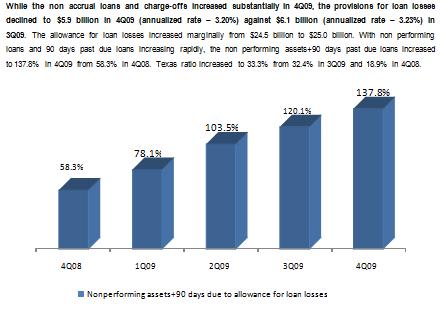
    Provision for loan losses declined to $5.9 billion in 4Q09 from $6.1 billion in 3Q09 while the total net charge-offs increased to $5.4 billion in 4Q09 from $5.1 billion in 3Q09. The increase in charge-offs primarily came from commercial real estate while the charge-offs of the residential mortgage increased marginally. All readers are welcome to download my CRE 2010 Overview in order to see where this is going. The nonperforming assets increased from $23.4 billion in 3Q09 to $27.6 billion in 4Q09 with non accrual loans increasing from $20.9 billion to $24.4 billion. The increase primarily came from a) residential mortgage where non accrual loans increased $2.2 billion and b) commercial mortgage where non accrual loans increased $1.4 billion. While the NPAs increased substantially in 4Q09, the allowance for loan losses increased marginally from $24.5 billion to $25.0 billion.

    Non interest expense increased to $12.8 billion in 4Q09 from $11.7 billion in 3Q09 primarily from higher Wachovia merger integration and severance expense and expense on ARS settlement. Net income was down 9.1% to $3.0 billion in 4Q09 from $3.3 billion in 3Q09. WFC charged nearly $2.4 billion in preference dividends in 4Q09 out of which $1.9 billion was deemed the dividend upon redemption of TARP preferred stock. The net income available to common shareholders was $394 million against $2.6 billion in 3Q09.

    My Take

    The bursting of the massive real estate bubble and associated Asset Securitization Crisis has seriously impaired the US financial system. US banks’ profitability and solvency will continue to be threatened until their balance sheets are purged of the loan losses by writing down the portfolio to the realizable value. This value is currently, in our opinion, on a continuous downward trend, contrary to the opinion of many analysts, consultants and pundits. As pointed out in the CRE 2010 Overview and my blog posts as far back as 2007, commercial real estate (CRE) is the next major crisis brewing due to the inability to rollover underwater debt and the signs of the same have started to emerge in the banks’ books. This, coupled with continuing losses from the rolling losses across various classes of debt in the residential space and weak consumer lending and associated non-performing assets, underlines the huge risk attached to the sector and undermines any investment proposition.

    wfc_q4_charge-offs.jpg

    The credit quality of WFC loan portfolio

    Credit conditions continue to deteriorate as the delinquency rates continue to climb and the nonperforming assets continue to increase. Total nonaccrual loans increased 17.0% (q-o-q) to $24.4 billion or 3.34% of total loans* at the end of 4Q09 from $20.9 billion (2.8% of total loans*) at the end of 3Q09. Non accrual loans in commercial real estate increased 25.9% (q-o-q) to $7.0 billion in 4Q09 (5.6% of loans*) from $5.6 billion (4.5% of loans*) in 3Q09. The non accrual loans in residential real estate increased 22.2% (q-o-q) to $12.4 billion in 4Q09 (4.2% of loans*) from $10.1 billion (3.4% of loans*) in 3Q09. The increase in non accrual loans in residential mortgage came primarily from in residential first lien with nearly 53% of the total increase in the segment coming from Pick-a-Pay (mainly Option ARM) portfolio acquired from Wachovia. Total non performing assets increased 17.9% (q-o-q) to $27.6 billion (3.78% of total loans*) from $23.4 billion (3.15% of total loans*) at the end of 3Q09.

    wfc_q4_allowances.jpg

    Loans 90 days or more past due and still accruing increased 13.9% (q-o-q) to $6.8 billion in 4Q09 from $6.0 billion in 3Q09 with q-o-q increase in commercial real estate and residential real estate at 18.5% and 5.0%, respectively.

    There are 27 pages of Wells Fargo Q4 opinion and analysis awaiting those who are interested. Subscribers also have access to geographic charge-off analysis.

    WFC 4Q09_Review WFC 4Q09_Review 2010-01-26 05:37:52 1.32 Mb

    WFC 4Q09_Review- subscriber edition WFC 4Q09_Review- subscriber edition 2010-01-26 05:38:43 1.46 Mb

    Morgan Stanley (MS), Goldman Sachs (GS) and Suntrust (STI) are up next, then I will extend my China short thesis (which is paying off handsomely as are the MS and GS shorts) and I will finally released the Central European short thesis – which should be a biggie.

    Disclosure: short WFC


    Share Investor Links

    Share Investor Blog – Stockmarket & Business commentary
    Share Investor New Zealand Business News– Get more business news
    Discuss this topic @ Share Investor ForumRegister free
    Share Investor’s Daily Forex Updates

    Recommended Amazon Reading

    The Snowball: Warren Buffett and the Business of Life The Snowball: Warren Buffett and the Business of Life by Alice Schroeder
    Buy new: $13.60 / Used from: $11.85
    Usually ships in 24 hours
    The Intelligent Investor: The Definitive Book on Value Investing. A Book of Practical Counsel (Revised Edition) The Intelligent Investor: The Definitive Book on Value Investing. A Book of Practical Counsel (Revised Edition) by Benjamin Graham
    Buy new: $14.95 / Used from: $10.44
    Usually ships in 24 hours


    Bookmark and Share


  • CNBC VIDEO: Berkshire Hathaway Shares Soar As Warren Buffett Joins the S&P 500

    Published: Tuesday, 26 Jan 2010 | 5:31 PM ET
    By: Alex Crippen

    Executive Producer

    Anyone betting that last week’s 50-for-1 stock split of Berkshire Hathaway’s Class B shares would lead to Warren Buffett joining the benchmark S&P 500 stock index .. is absolutely right and making some money tonight.

    S&P says tonight (Tuesday) that Berkshire will replace Burlington Northern Santa Fe in both the S&P 500 and the more exclusive S&P 100.

    Berkshire, of course, is acquiring BNSF in a deal expected to close next month. When that happens, the railroad itself will no longer be publicly traded.

    Not surprisingly, Berkshire B shares were up 8 percent in after-hours trading minutes after the news hit .. rising to $73.50 from today’s 4p ET close of $68.06.

    The higher-priced Class A shares were up 5 percent to $107,000 from today’s 4p ET close of $102,010.

    The big index funds that try to mimic the returns of the S&P 500 will now need to buy Berkshire Class B shares, boosting demand for the stock.

    Longtime Buffett fan and value investor Whitney Tilson tells CNBC’s Fast Money tonight that he’s been stocking up on Berkshire shares because he expected S&P would tap the stock now that the split has brought its trading price closer to $70 than $3500. (Tilson comments start about 2:15 into the clip to the left.)

    He says he plans to hold onto the purchases because he expects the stock to rise even more because even after tonight’s gain shares are still 20 to 30 percent below his estimate of the company’s “intrinsic value.”

    And Buffett himself is probably smiling tonight. During last week’s CNBC live interview with Becky Quick, he sounded like he wouldn’t mind at all if Berkshire made the S&P:

    BECKY: There are some people who say, hey, this could mean that Berkshire Hathaway could now become a member of the S&P 500. What do you think of that?

    BUFFETT: Well, I don’t know. I’ve never talked to S&P about it. I do know that we’re probably four times as large in market cap as any company that isn’t in it. And we will have – when we get through with this we could have like 700,000 shareholders or something of that sort. We’ll have a lot of trading volume. But that’s up to S&P.

    BECKY: Would you like to be in?

    BUFFETT: Well, I think probably for our shareholders it’s a net plus, yeah.

    Current Berkshire stock prices:

    Class A: [BRK.A 101751.00 -1449.00 (-1.4%) ]

    Class B: [BRK.B 68.00 -0.84 (-1.22%) ]


    Berkshire Portfolio

    Share Investor Links

    Share Investor Blog – Stockmarket & Business commentary

    Share Investor New Zealand Business News– Get more business news

    Discuss this topic @ Share Investor ForumRegister free

    Share Investor’s Daily Forex Updates

    Recommended Amazon Reading

    The Snowball: Warren Buffett and the Business of Life The Snowball: Warren Buffett and the Business of Life by Alice Schroeder

    Buy new: $13.60 / Used from: $11.85

    Usually ships in 24 hours
    The Intelligent Investor: The Definitive Book on Value Investing. A Book of Practical Counsel (Revised Edition) The Intelligent Investor: The Definitive Book on Value Investing. A Book of Practical Counsel (Revised Edition) by Benjamin Graham

    Buy new: $14.95 / Used from: $10.44

    Usually ships in 24 hours


  • HUFFINGTON POST: One Year Before Crisis, I Told Jamie Dimon and Warren Buffett AIG Had Serious Trouble

    Janet Tavakoli

    Janet Tavakoli Her books @ Amazon

    Posted: January 26, 2010 08:54 AM

    In August 2007, the Wall Street Journal’s David Reilly called for hot news.* I replied that AIG had material mark-to-market losses for the second quarter of 2007, yet it took no write-downs whatsoever for its credit default swaps on underlying mortgage related “super senior” collateralized debt obligations (CDOs). I looked at one aggregate position of credit default swaps (CDSs) amounting to more than $19 billion.** The mark-to-market losses were just one part of the problem. Since too many of the assets backing the position had high risk of severe principal losses, it also had a lot of “cliff risk,” as in falling off of one. AIG had a grave problem just from this position alone, and AIG had other serious problems.

    Initially, I agreed to talk to Reilly on background, but I didn’t want to be named or quoted. AIG vigorously denied it would ever take a write-down or a loss on the CDSs, much less one that was material to its earnings statement. Reilly called me again asking if I were sure. I said I was positive. He called AIG again and then me, asking for a quote this time. I didn’t want to get into a fight with AIG in the “Heard on the Street” column and reminded Reilly that I only agreed to talk to him on background. Reilly’s editor called me and said that given that AIG’s denial was so forceful, the paper needed me to go on the record. I know and trust this editor, so I agreed. Reilly quoted me but omitted that I said the difference was material. Even the Wall Street Journal hesitates to use the word “material” to describe an accounting misstatement. It guarantees a conference call with lawyers.

    I called Warren Buffett about my concerns, but stuck to the public information already in the article. (Dear Mr. Buffett Pp. 164-165, 246).

    I stuck my neck out and met with Jamie Dimon, CEO of JPMorgan Chase, adding that the difference was material. JPMorgan Chase’s credit derivatives positions exceeded those of all other U.S. banks combined at the time. JPMorgan was not a participant in the problematic deals, and it was not a recipient of AIG’s subsequent settlement payments, but stability in the credit derivatives markets was an important issue. Jamie dismissed my explanation of the looming cliff risk and said he understood CDOs. (Dimon later said he wished he had listened to me back then.) In August of 2007, he did not want to contemplate a potential implosion of AIG.

    Goldman Knew (or Should Have Known) the Consequences
    Unbeknownst to me at the time, in July 2007, Goldman Sachs and AIG began a prolonged battle over prices and collateral payments. In February 2008–six months after Reilly’s Wall Street Journal article–PricewaterhouseCoopers (PWC) said it found “material weakness” in AIG’s accounting. PWC was also Goldman Sachs’s auditor. Goldman hedged against the possibility that AIG could go bankrupt and also extracted billions more in collateral from AIG before the crisis. By September 2008 initial bailout, Goldman Sachs had extracted $7.5 billion in collateral from AIG against these trades.

    Goldman should have been well aware of the cliff risk posed by CDOs that it hedged with AIG. Moreover, Goldman created CDOs that other banks hedged with AIG, including some hedged by French banks Calyon and Societe Generale. In fact, Goldman Sachs was a key architect of AIG’s crisis. (See details here).

    If any of the assets backing the CDOs were as bad as Goldman Sachs Alternative Mortgage Products’ GSAMP Trust 2006-S3, the BBB-rated tranches (and most of the higher rated tranches) would be worth zero today. Goldman itself created some assets that amounted mostly to hot air, so it was in a good position to know that the CDOs AIG hedged were “backed” by too many value-destroying “assets.”

    Details of AIG’s Trades Were Kept Secret Even by the SEC
    The government’s 100% payout to AIG’s counterparties was extraordinary under these circumstances, and the negotiations were done in secret. In September of 2008, the Fed agreed to the first AIG bailout rather than let it sink into bankruptcy. It was very much to the benefit of Goldman Sachs and the other recipients of bailout funds that the details of the CDOs and the assets backing them were kept secret. Some CDOs held up moderately well, but others looked so bad, a public view of details would have prompted an immediate investigation. There appears to be a cover-up, and even the SIGTARP report did not reveal key details. So much for Washington’s “investigations.”

    Even the SEC allowed details to be suppressed until 2018. (Click here to see the redactions on the last four pages of the March 2009 SEC filing.)

    In September 2008, a good negotiator would have insisted that the collateral already extracted from AIG by Goldman Sachs, Societe Generale and others should be recharacterized as a loan and paid back after the crisis. As for subsequent payments including those made in November 2008–if they were made at all–they would only have been made as a loan.

    Goldman Sachs Worried About Billions in Crippling Losses
    Public funds bailed out AIG in September 2008, and the public did not get transparency. The secrecy benefited those involved in the initial negotiations, those involved in subsequent negotiations, and the banks that received the payments.

    Now that the crisis is over, this issue should be reopened, and billions in collateral should be clawed back to pay down public debt, before Goldman Sachs pays more than $16 billion in taxpayer subsidized bonuses to its employees.

    Goldman’s CEO Lloyd Blankfein knew that if AIG failed, Goldman’s counterparties would suffer collateral damage (Dear Mr. Buffett P. 167), and if AIG failed in September 2008, Blankfein worried about billions in crippling losses for Goldman Sachs. Yet, in an October 2009 Wall Street Journal interview, Blankfein said he didn’t suspect AIG had problems producing collateral: “I never had reason to suspect….[I]t never occurred to me.”


    * David Reilly is now with Bloomberg News.

    ** I gave Reilly an example of an aggregate position of AIG’s credit default swaps (CDS) amounting to more than $19 billion. It was backed by BBB-rated tranches of residential mortgage backed securities (including some subprime loans) and other BBB-rated asset backed securities (auto loans, student loans, and more). Mark-to-market means one shows the market price, or if no market prices are available, one records a price based on a model that calculates a price at which one would expect to trade in the market. Given then market conditions, AIG’s assertions were not plausible.

    Share Investor Links

    Share Investor Blog – Stockmarket & Business commentary
    Share Investor New Zealand Business News– Get more business news
    Discuss this topic @ Share Investor ForumRegister free
    Share Investor’s Daily Forex Updates

    Recommended Amazon Reading

    Structured Finance and Collateralized Debt Obligations: New Developments in Cash and Synthetic Securitization (Wiley Finance) Structured Finance and Collateralized Debt Obligations: New Developments in Cash and Synthetic Securitization (Wiley Finance) by Janet M. Tavakoli
    Buy new: $56.70 / Used from: $49.50
    Usually ships in 24 hours
    Dear Mr. Buffett: What An Investor Learns 1,269 Miles From Wall Street Dear Mr. Buffett: What An Investor Learns 1,269 Miles From Wall Street by Janet M. Tavakoli
    Buy new: $16.47 / Used from: $8.15
    Usually ships in 24 hours


    Bookmark and Share


  • BLOOMBERG: Berkshire Surges After Being Picked to Join S&P 500

    By Andrew Frye

    Jan. 26 (Bloomberg) — Berkshire Hathaway Inc., Warren Buffett’s insurance and investment company, surged in extended trading after being picked to join the Standard & Poor’s 500 Index.

    Berkshire Class B stock jumped $6.15, or 9 percent, to $74.15 at 6:26 p.m. in New York. The Omaha, Nebraska-based firm will replace Burlington Northern Santa Fe Corp. after completing the acquisition of the railroad, S&P said today in a statement.

    Buffett split the stock 50-for-1 last week as part of the $26 billion railroad purchase. The move brought Berkshire’s stock price below $75, making shares available to a larger group of investors and increasing the trading volume. Buffett told investors at a Jan. 20 meeting that inclusion in the S&P 500 may prompt index-tracking fund managers to buy as much as 7 percent of Berkshire.

    “There’s obviously going to be quite a bit of buying,” said Michael Quigley, a fund manager at Wedgewood Partners, which oversees $550 million in St. Louis. “There should be a steady bid over the next few weeks as indexers square their positions.”

    Funds that track the S&P 500 have about $1 trillion in assets, according to David Guarino, a spokesman for S&P in New York. The after-hours trading boosted the value of Buffett’s personal Berkshire stake, which includes Class A and Class B shares, by $3.17 billion. The firm has advanced 11 percent since the share split was approved on Jan. 20.

    More Investors

    Buffett, the 79-year-old Berkshire chairman and chief executive officer, is welcoming a broader base of investors to the firm he built in the past four decades. Traders and equity analysts have long paid Berkshire less attention than other companies of similar size because of its elevated share price and relatively stable investor base, led by Buffett, who owns roughly a quarter of the stock. Berkshire’s Class B traded as high as $3,340 the day before the split took effect.

    “I can’t imagine another stock that’s more deserving of being in the S&P,” said Michael Yoshikami, chief investment strategist at YCMNet Advisors, which holds Berkshire shares. “It will naturally have higher demand from the index funds.”

    Buffett says his ideal investment horizon is “forever.” Berkshire is the biggest shareholder of Coca-Cola Co. and American Express Co., and Buffett has held those stocks for more than two decades even as both trade below their top prices in the 1990s. He’s recorded multibillion dollar gains for Berkshire on investments in Capital Cities/ABC Inc. and PetroChina Inc.

    Index funds may give Berkshire shares stability, Buffett told shareholders last week.

    “You’ve got a permanent stockholder for 6 or 7 percent of your shares,” Buffett said. “We like permanent shareholders. That’s exactly what we’re looking for.”

    Share Investor Links

    Share Investor Blog – Stockmarket & Business commentary
    Share Investor New Zealand Business News– Get more business news
    Discuss this topic @ Share Investor ForumRegister free
    Share Investor’s Daily Forex Updates

    Recommended Amazon Reading

    The Snowball: Warren Buffett and the Business of Life The Snowball: Warren Buffett and the Business of Life by Alice Schroeder
    Buy new: $13.60 / Used from: $11.85
    Usually ships in 24 hours
    The Intelligent Investor: The Definitive Book on Value Investing. A Book of Practical Counsel (Revised Edition) The Intelligent Investor: The Definitive Book on Value Investing. A Book of Practical Counsel (Revised Edition) by Benjamin Graham
    Buy new: $14.95 / Used from: $10.44
    Usually ships in 24 hours


    Bookmark and Share


  • PRESS ENTERPRISE: Berkshire will replace BNSF in S&P indexes

    07:30 PM PST on Tuesday, January 26, 2010

    Standard & Poor’s will add Warren Buffett’s Berkshire Hathaway Inc. to its S&P 100 and S&P 500 indexes after Berkshire acquires Burlington Northern Santa Fe.

    S&P announced the stock index changes Tuesday. Buffett’s company will replace BNSF in both indexes after shareholders approve Berkshire’s acquisition of the railroad company next month.


    Share Investor Links

    Share Investor Blog – Stockmarket & Business commentary
    Share Investor New Zealand Business News– Get more business news
    Discuss this topic @ Share Investor ForumRegister free
    Share Investor’s Daily Forex Updates

    Recommended Amazon Reading

    The Snowball: Warren Buffett and the Business of Life The Snowball: Warren Buffett and the Business of Life by Alice Schroeder
    Buy new: $13.60 / Used from: $11.85
    Usually ships in 24 hours
    The Intelligent Investor: The Definitive Book on Value Investing. A Book of Practical Counsel (Revised Edition) The Intelligent Investor: The Definitive Book on Value Investing. A Book of Practical Counsel (Revised Edition) by Benjamin Graham
    Buy new: $14.95 / Used from: $10.44
    Usually ships in 24 hours


    Bookmark and Share


  • THESTREET.COM: Buffett’s Munich Re Stake Tops Threshold

    By Andrea Tse
    01/26/10 – 01:32 PM EST

    NEW YORK (TheStreet) — Berkshire chairman Warren Buffett has brought his stake in reinsurer Munich Re to more than 3% of voting rights, exceeding reporting thresholds.

    Munich Re said today that Buffett’s stake in the world’s biggest reinsurer rose to 3.045% in voting rights on Jan. 18. The stake was declared by Munich Re because it had gone above a required 3% reporting threshold on Jan. 18.

    It is unclear whether Buffet had any stake in the company prior to Jan. 18.

    Around the same time, Warren Buffett’s Berkshire Hathaway(BRK.B Quote) put down a $1.3 billion wager on a block of Swiss Re’s low-return U.S. life reinsurance business.

    The more than $1 billion deal that was announced on Jan. 18 would free up Swiss Re’s capital, while possibly resulting in great rewards — or losses for Berkshire Hathaway, observers believe.

    Berkshire Hathaway’s General Re is currently one of the top four reinsurers in the world.

    — Reported by Andrea Tse in New York

    Share Investor Links

    Share Investor Blog – Stockmarket & Business commentary
    Share Investor New Zealand Business News– Get more business news
    Discuss this topic @ Share Investor ForumRegister free
    Share Investor’s Daily Forex Updates

    Recommended Amazon Reading

    The Snowball: Warren Buffett and the Business of Life The Snowball: Warren Buffett and the Business of Life by Alice Schroeder
    Buy new: $13.60 / Used from: $11.85
    Usually ships in 24 hours
    The Intelligent Investor: The Definitive Book on Value Investing. A Book of Practical Counsel (Revised Edition) The Intelligent Investor: The Definitive Book on Value Investing. A Book of Practical Counsel (Revised Edition) by Benjamin Graham
    Buy new: $14.95 / Used from: $10.44
    Usually ships in 24 hours


    Bookmark and Share


  • REUTERS: Warren Buffett holds $1 billion stake in Munich Re


    FRANKFURT
    Tue Jan 26, 2010 12:30pm EST

    FRANKFURT (Reuters) – U.S. investor Warren Buffett has built a $1 billion stake in Munich Re, adding to his array of insurance holdings and boosting shares in the world’s biggest reinsurer.

    Munich Re said on Tuesday Buffett’s shareholding rose just above the mandatory reporting threshold on January 18 and amounted to 3.045 percent of the voting rights on that date.

    Analysts said Buffett probably saw Munich Re simply as a good buy in an undervalued sector. The stock has gained 1.7 percent over the last 18 months, compared with a 21 percent decline in the DJ Stoxx European insurance index .

    “It appears to be a portfolio investment for Buffett rather than a strategic one,” JP Morgan analyst Michael Huttner said.

    JP Morgan in a research note last week said the insurance sector looked cheap at about 1.0 times book value, compared with a historical valuation of 1.4 times, adding tighter insurer solvency rules due to come into effect in the next three years were a major worry for investors.

    Munich Re stands to be a big winner from the new rules because of its ability to generate excess capital and grow its business, particularly with mutual insurers, JP Morgan said.

    Munich Re has resumed share buybacks and is expected to deliver a 2009 net profit of 2.36 billion euros ($3.3 billion) according to Thomson Reuters StarMine.

    Industry observers said Buffett’s move was a vote of confidence in reinsurers, which make their money by selling cover for big risks such as hurricanes and earthquakes to insurance companies.

    PLAYING THE FIELD

    The billionaire investor is already a major player in the world’s reinsurance market with his Berkshire Hathaway Inc unit, the world’s third-biggest reinsurer.

    He also pumped 3 billion Swiss francs ($2.9 billion) into the world’s No. 2 reinsurer, Swiss Re, at the height of the financial crisis after the Swiss group wrote down billions on illiquid assets.

    Swiss Re last week said it had agreed to transfer a U.S. life reinsurance contract to Buffett for 1.3 billion Swiss francs, allowing it to reinvest capital more profitably elsewhere.

    Swiss Re shares have fallen 30 percent over the last 18 months.

    Munich Re shares turned positive on news of the Buffett purchase, rising by as much as 2 percent before paring gains to close up 1.2 percent at 109.80 euros. The DJ Stoxx index of European insurance shares rose 0.4 percent.

    The stake was worth around 740 million euros ($1 billion), according to a Reuters calculation.

    “We rejoice at every investor as evidence of our sustainable strategy,” a Munich Re spokeswoman said.

    Rumors that Buffett was buying stock had boosted Munich Re shares on Friday.

    Berkshire is the largest U.S.-based company by market value not included in the S&P 500 because the highly priced shares trade on thin volume.

    Data from Thomson Reuters StarMine, which weights analysts’ forecasts according to their track record, shows Munich Re trading at 8.6 times 12-month forward earnings, a slight premium to Swiss Re’s multiple of 8.1

    (Editing by Rupert Winchester and David Holmes)

    ($1=1.041 Swiss Franc)

    ($1=.7097 Euro)

    Share Investor Links

    Share Investor Blog – Stockmarket & Business commentary
    Share Investor New Zealand Business News– Get more business news
    Discuss this topic @ Share Investor ForumRegister free
    Share Investor’s Daily Forex Updates

    Recommended Amazon Reading

    The Snowball: Warren Buffett and the Business of Life The Snowball: Warren Buffett and the Business of Life by Alice Schroeder
    Buy new: $13.60 / Used from: $11.85
    Usually ships in 24 hours
    The Intelligent Investor: The Definitive Book on Value Investing. A Book of Practical Counsel (Revised Edition) The Intelligent Investor: The Definitive Book on Value Investing. A Book of Practical Counsel (Revised Edition) by Benjamin Graham
    Buy new: $14.95 / Used from: $10.44
    Usually ships in 24 hours


    Bookmark and Share


  • BLOOMBERG: Warren Buffett Increases Stake in Munich Re Above 3%

    By Oliver Suess

    Jan. 26 (Bloomberg) — Munich Re, the world’s biggest reinsurer, said Warren Buffett raised his stake in the company to more than 3 percent.

    Buffett’s stake rose to 3.045 percent on Jan. 18, Munich Re said in a statement distributed by the DGAP newswire today. Stakeholders of German companies must declare share purchases or sales that bring their investments above or below certain thresholds.

    Buffett, whose Berkshire Hathaway Inc. owns the world’s third-biggest reinsurer, is Munich Re’s No. 2 shareholder after asset manager BlackRock Inc. New York-based BlackRock increased its stake in Munich Re through the purchase of Barclays Global Investors, and held 4.58 percent on Dec. 1, according to the reinsurer.

    “I would doubt that Buffett is interested in taking over Munich Re as that would expose Berkshire, which already has a significant reinsurance business, too much to the sector,” said Konrad Becker, an analyst at Merck Finck & Co. in Munich who recommends buying Munich Re shares. “I think Buffett rather bets on rising share prices at Swiss Re as well as Munich Re.”

    Munich Re rose 1.30 euros, or 1.2 percent, to 109.80 euros in Frankfurt, valuing the company at 21.7 billion euros ($30.5 billion). That compares with a 0.3 percent gain in the 29-member Bloomberg Europe 500 Insurance Index.

    Swiss Re Stake

    The investment by Buffett “acknowledges our sustainable strategy,” spokeswoman Johanna Weber said via telephone.

    Buffett didn’t respond to an e-mail message left with his assistant, Carrie Kizer, before business hours in Omaha, Nebraska, where Berkshire Hathaway is based.

    Billionaire investor Buffett has been a shareholder in Munich Re since at least 2008. Munich Re Chief Executive Officer Nikolaus von Bomhard told shareholders at the annual meeting in Munich that year that he expected Buffett to remain a shareholder in the company. At the time, Buffett’s stake was below the 3 percent threshold, the lowest that requires disclosure.

    Buffett’s Berkshire held 3 percent of Swiss Re as of March 2009, data compiled by Bloomberg show. The Zurich-based reinsurer is increasing surplus capital as it bids to regain its AA credit rating and repay 3 billion francs ($2.87 billion), which Buffett injected into the company last February.

    Swiss Re last week also sold Berkshire Hathaway a block of closed U.S. individual life reinsurance business to cut risk and improve its capital position.

    Reinsurers help primary insurers such as Allianz SE and Axa SA shoulder risks for clients.

    Share Investor Links

    Share Investor Blog – Stockmarket & Business commentary
    Share Investor New Zealand Business News– Get more business news
    Discuss this topic @ Share Investor ForumRegister free
    Share Investor’s Daily Forex Updates

    Recommended Amazon Reading

    The Snowball: Warren Buffett and the Business of Life The Snowball: Warren Buffett and the Business of Life by Alice Schroeder
    Buy new: $13.60 / Used from: $11.85
    Usually ships in 24 hours
    The Intelligent Investor: The Definitive Book on Value Investing. A Book of Practical Counsel (Revised Edition) The Intelligent Investor: The Definitive Book on Value Investing. A Book of Practical Counsel (Revised Edition) by Benjamin Graham
    Buy new: $14.95 / Used from: $10.44
    Usually ships in 24 hours

    Bookmark and Share


  • CNBC: Munich Re ‘Pleased’ With Warren Buffett’s $1 Billion Stake

    Published: Tuesday, 26 Jan 2010 | 12:56 PM ET

    By: Alex Crippen
    Executive Producer

    The German reinsurance giant Munich Re says its happy Warren Buffett has a built a stake in the company worth over $1 billion.

    A spokeswoman for the company tells Dow Jones, “We are pleased about every investor, that’s a confirmation of our sustainable strategy.”

    This morning, Munich Re announced that Berkshire Hathaway’s stake stood at 3.045 percent on January 18. The three percent level triggers a public disclosure under German rules.

    Reuters quotes JP Morgan analyst Michael Huttner as saying, “It appears to be a portfolio investment for Buffett rather than a strategic one.” According to Reuters, Morgan believes industry regulatory changes could greatly benefit Munich Re “because of its ability to generate excess capital and grow its business.”

    Merck Finck analyst Konrad Becker agrees that Buffett is simply betting on Munich Re’s stock price, telling Bloomberg, “I would doubt that Buffett is interested in taking over Munich Re as that would expose Berkshire, which already has a significant reinsurance business, too much to the sector.”

    Back in April of 2008, Munich Re first told shareholders that Buffett had a stake, but didn’t say how big it was.

    Buffett also has ties to another big reinsurer in Europe. Last week, Berkshire took on some of Swiss Re’s U.S. individual life reinsurance business and last year Berkshire bought a three percent stake.

    Current Berkshire stock prices:

    Class A: [BRK.A 103040.00 -160.00 (-0.16%) ]

    Class B: [BRK.B 68.70 -0.14 (-0.2%) ]

    Share Investor Links

    Share Investor Blog – Stockmarket & Business commentary
    Share Investor New Zealand Business News– Get more business news
    Discuss this topic @ Share Investor ForumRegister free
    Share Investor’s Daily Forex Updates

    Recommended Amazon Reading

    The Snowball: Warren Buffett and the Business of Life The Snowball: Warren Buffett and the Business of Life by Alice Schroeder
    Buy new: $13.60 / Used from: $11.85
    Usually ships in 24 hours
    The Intelligent Investor: The Definitive Book on Value Investing. A Book of Practical Counsel (Revised Edition) The Intelligent Investor: The Definitive Book on Value Investing. A Book of Practical Counsel (Revised Edition) by Benjamin Graham
    Buy new: $14.95 / Used from: $10.44
    Usually ships in 24 hours


    Bookmark and Share


  • THE STREET.COM: Best in Class: Berkshire Hathaway


    By Eric Rosenbaum 01/26/10 – 12:06 PM EST

    OMAHA, Neb. (TheStreet) — With Warren Buffett about as close as a capitalist can come to being canonized by the markets, Berkshire Hathaway(BRK.B Quote) can’t exactly fly under the radar. Still, one of the most unique aspects of Berkshire Hathaway is that, unlike other marquee securities within the U.S. corporate elite, Berkshire Hathaway’s shares have always traded on the QT.

    This, of course, all changed last week, when Berkshire Hathaway’s B shares completed a 50-to-1 stock split.

    Granted, five days of trading history with the new Berkshire B shares doesn’t provide much of a window onto long-term return potential. Average daily trading volume in the Berkshire Hathaway B shares has soared though, from 41,000 shares traded to as high as 6.6 million shares traded — and that was just on Monday. In the past five days, approximately 50 million Berkshire Hathaway shares have been traded.

    Consider this: the 50 million Berkshire Hathaway shares traded over the past five days represent what would have previously amounted to almost three-and-a-half years’ worth of trading volume for the Berkshire Hathaway B shares.

    It’s not hard to understand why there was such interest in Berkshire Hathaway after the stock split. The difference between a $3,400 share and a $70 share means the market’s most revered investment company can be purchased for a similar price to a few mail-order grass-fed Omaha steaks.

    All of which justifies, by our way of thinking, a closer look at today’s new Buffett B shares. For that, read on….

    Investors clearly feasted during the first days of the “Buffett for All” era; tt was a market-specific turn on a U.S.-specific cultural phenomenon. And it makes sense: this country has always been about transforming luxury into an item of mass consumption — the proverbial keeping up with the Jones’ — and, suddenly, Americans could keep up with the formerly off-limits stock of Warren Buffett.

    Still, it would be wrong to get caught up in the publicity of the Berkshire Hathaway stock split as a reason, in and of itself, to purchase shares. Market analysts, and even Buffett himself, have shied away from placing too much emphasis on the historic event, and with good reason: intrinsic value doesn’t change just because one share becomes 50.

    The critical question for investors then, amidst the stock-split publicity, is whether now is a uniquely good time to invest in the cut-rate version of Warren Buffett?

    Ultimately, this question should lead investors to take two issues into consideration: what makes Berkshire Hathaway unique when its trading profile is no longer unique; and how Berkshire’s Hathaway’s underlying portfolio holdings are positioned given the economic outlook.

    When it comes to stock structure, Berkshire Hathaway is a best-in-class stock that is effectively its own peer group. Standard & Poor’s classifies Berkshire Hathaway as a financial company, but that is really for lack of a definition that fits. And even though there are market conglomerates that seem hard to classify — such as a General Electric(GE Quote) making kitchen appliances and wind turbines, while also structuring mortgage pools and creating television programming — Berkshire’s unique three-pronged structure is what ultimately distinguishes it from the broader equities universe.

    Berkshire’s first business pillar is the portfolio of public traded securities, the big names: Coke(KO Quote), Kraft(KFT Quote), Wal-Mart(WMT Quote) and Wells Fargo(WFC Quote), to name a few.

    The other pillars of the Berkshire business are much harder to value than the public securities, and they are what make Berkshire a unique stock. If Berkshire were no more than a collection of big-cap U.S. companies, Buffett would likely be a little known mutual fund manager fighting the Sissyphean battle to beat the index returns year after year.

    Insurance operations are the second big pillar of the Berkshire business, and as we have seen in the past two weeks, will continue to be a major driver for Berkshire shareholders. Berkshire Hathaway announced last week that it bought the biggest book of insurance business ever, from Swiss Re, for $1.3 billion. What’s more, Reuters reported on Tuesday morning that Berkshire has also increased its stake in Munich Re to $1 billion, or a 3% stake in the world’s biggest reinsurer.

    Larry Coates, manager of the Oak Value Fund, which has Berkshire Hathaway as its largest holding, says the insurance business is ultimately a spread opportunity. The spread exists between the cost of underwriting insurance at a low cost of capital — with the Swiss Re transaction, Buffet estimates $50 billion in premium income over the next several decades — and being able to reinvest those profits. This spread has always been one of the key drivers of return for Berkshire.

    Oak Capital Management’s Coates estimates that the Berkshire spread opportunity is between 50 to 150 basis points. For example, if Berkshire has 100 basis points in underwriting profits and can reinvest those profits at a 6% rate of return, it results in a 700 basis point spread.

    “We’ve done analysis that shows that every 100 basis point change in the spread incrementally increase the value of Berkshire’s A share by $10,000,” Coates said.

    The final pillar of the Berkshire portfolio is its wholly owned operating subsidiaries, among which Burlington Northern (BNI Quote) is about to become the newest addition.

    These Berkshire Hathaway operating subsidiaries run the gamut across stocks tied very tightly to Buffett’s “all-in wager” on the U.S. economy. Housing, through Clayton Homes, and related stocks in the home furniture and carpet business, such as Shaw Industries.

    This portion of the Berkshire portfolio is the one most sensitive to the cyclical nature of the economy. In addition to the focus on the housing market, Berkshire owns several jewelry companies. Anyone who has wandered into a Tiffany’s in the past few years and watched the flocks of salespeople descending on one customer buying a gold pen knows how sensitive these stocks are to economic peaks and valleys.

    Thus, the cyclical stocks in the Berkshire Hathaway portfolio are a good place to look at what the company’s biggest backers think is its most unique trait in the current market: its undervaluation.

    Granted, when it comes to discussing the Oracle of Omaha, Berkshire Hathaway shareholders often seem about as independently minded as the proverbial Jonestown Kool-Aid drinkers, but these days they are talking about some hefty discounts built into Berkshire shares as a result of its recent underperformance. It is not uncommon for long-time private investors to estimate the current Berkshire Hathaway valuation as 30%-35% below fair value. Buffett himself said last week on television that he thought the shares were the cheapest they had ever been, on a price-to-book ratio.

    “There is more potential recovery in those operating subsidiaries than the market currently thinks,” said Bill Bergman, an analyst at Morningstar. Bergman believes fair value on Berkshire Hathaway’s B shares is $88 — the shares were at $68.84 at the close on Monday.

    Jerome Bruni, a longtime private investor in Berkshire, says that Berkshire is selling at about 10x economic earnings, and for a company with its strength and outlook, that is cheap. He thinks that a conservative estimate values Berkshire Hathaway shares at least 25% higher.

    Paul Lountzis, of Lountzis Asset Management, another longtime private investor in Berkshire, says the discount is 30% to 35% now.

    Oak Value Fund’s Coates, who doesn’t make such bold claims, still said, “You can certainly say that Berkshire is undervalued by 30% or 40%. That undervaluation adds an attractive margin of safety at this point in the market cycle.”

    Still, there are several reasons to believe that the hefty claims about Berkshire’s current undervaluation are not just the delirium of the Berkshire Kool-Aid drinkers.

    Coates explained that the best time to buy cyclical companies is not going into a recession, but coming out of one. Over the next three to five years, Coates sees those operating subsidiaries in the niches of the housing market and the U.S. consumer market, more generally, as regaining their normalized earnings power. “Berkshire subsidiaries are far from a price-to-earnings peak right now,” Coates said.

    Conventional market wisdom dictates that the biggest-cap names are usually the slowest to regain footing in a recovering economy.

    This market dynamic played out last year, as the most beaten down, smaller-cap names recovered by wide margins. In the case of Berkshire’s public securities portfolio, this market dynamic suggests that Berkshire’s underperformance of the broad markets in 2009 may just mean its public securities are more attractively valued in a later stage of the economic recovery.

    Morningstar’s Bergman noted that it is possible to construct many 12-month intervals during the past 15 years when the S&P 500 outperformed Berkshire shares.

    What’s more, in each annual interval, the S&P 500 has outperformed Berkshire a third of the time. However, over the past 15 years Berkshire Hathaway shares have outperformed the S&P by a factor of two times.

    “If we had $20 million in new money coming through the door in the next 90 days, based on where the Berkshire stock is trading now, there is a pretty good likelihood we would buy more,” Oak Value Fund’s Coates said.

    The recent stock split may not matter in what makes Berkshire Hathaway unique as a security. It also doesn’t impact the argument as to whether Berkshire Hathaway is presently positioned as one of the market’s most attractively valued equities. However, Coates does think that all the talk about the S&P 500 adding Berkshire will prove correct. And if that happens, the most important repercussion won’t be all the index funds buying Berkshire, but that Berkshire will suddenly become a big factor in investor benchmarking.

    “If you don’t invest in Berkshire, you will effectively be shorting the company, making a bet against Buffett,” Coates argues.

    As a result, there is likely to be much greater research coverage of Berkshire Hathaway. “Berkshire is a company where if you go to a cocktail party, everyone has an opinion, but a very small number of them are qualified to have one. If the byproduct of the stock split is that it eliminates the disincentive that exists for research coverage, then maybe it does benefit us, perhaps leading to a reduction in the current discount,” Coates said.

    Courtesy of the Berkshire Hathaway stock split, the party invite list just got a lot bigger. And if you believe the Berkshire bulls, it’s time to RSVP: there is still, it seems, a long way to go before the current discount in Berkshire Hathaway shares is eliminated.

    — Reported by Eric Rosenbaum in New York.

    Share Investor Links

    Share Investor Blog – Stockmarket & Business commentary
    Share Investor New Zealand Business News– Get more business news
    Discuss this topic @ Share Investor ForumRegister free
    Share Investor’s Daily Forex Updates

    Recommended Amazon Reading

    The Snowball: Warren Buffett and the Business of Life The Snowball: Warren Buffett and the Business of Life by Alice Schroeder
    Buy new: $13.60 / Used from: $11.85
    Usually ships in 24 hours
    The Intelligent Investor: The Definitive Book on Value Investing. A Book of Practical Counsel (Revised Edition) The Intelligent Investor: The Definitive Book on Value Investing. A Book of Practical Counsel (Revised Edition) by Benjamin Graham
    Buy new: $14.95 / Used from: $10.44
    Usually ships in 24 hours


    Bookmark and Share


  • WALL STREET JOURNAL: Munich Re Touts Berkshire’s 3% Stake

    By ULRIKE DAUER

    JANUARY 26, 2010, 12:22 P.M. ET

    Munich Re AG, one of the world’s largest reinsurers, said it welcomed the 3% stake in the company held by billionaire investor Warren Buffett, chairman of investment company Berkshire Hathaway Inc.

    Munich Re on Tuesday said Mr. Buffett’s stake had gone above the 3% threshold on Jan. 18 to stand at 3.045%.

    A spokeswoman for the reinsurer declined to say if Mr. Buffett’s investment had increased gradually or abruptly since he first took a stake of less than 3% two years ago. The actual size of the holding was never disclosed. Neither Mr. Buffett nor Berkshire Hathaway was available to comment.

    “We are pleased about every investor; that’s a confirmation of our sustainable strategy,” the Munich Re spokeswoman said.

    In April 2008, Munich Re Chief Executive Nikolaus von Bomhard told shareholders that he expected Mr. Buffett to remain a long-term investor in the company.

    A week before his comments, German daily newspaper Frankfurter Allgemeine Zeitung said Berkshire Hathaway had bought more than one million Munich Re shares, or a stake of at least 0.5%, then valued at about €125 million. Munich Re and Berkshire Hathaway declined to comment at the time.

    Mr. Buffett’s Berkshire Hathaway also bought a 3% stake in Swiss Reinsurance Co. in early 2008. In 2009, Berkshire helped the Swiss reinsurer with a 3 billion Swiss franc loan after it ran into trouble because of the U.S. subprime-mortgage crisis, prompting it to strengthen its balance sheet.

    The loan could eventually give Berkshire a 20% stake in the company should Swiss Re fail to pay it back within the next few years, a possibility that is deemed low by analysts.

    Berkshire Hathaway itself has reinsurance operations, Berkshire Hathaway Re, which is among the largest three reinsurers world-wide by gross premium income.

    Mr. Buffett has repeatedly said in the past that he isn’t looking at a takeover of the Swiss company. However, during the past two years, Swiss Re and Berkshire have entered several reinsurance deals, raising speculation that the two firms could merge at some point.

    —Goran Mijuk in Zurich contributed to this article.

    Share Investor Links

    Share Investor Blog – Stockmarket & Business commentary
    Share Investor New Zealand Business News– Get more business news
    Discuss this topic @ Share Investor ForumRegister free
    Share Investor’s Daily Forex Updates

    Recommended Amazon Reading

    The Snowball: Warren Buffett and the Business of Life The Snowball: Warren Buffett and the Business of Life by Alice Schroeder
    Buy new: $13.60 / Used from: $11.85
    Usually ships in 24 hours
    The Intelligent Investor: The Definitive Book on Value Investing. A Book of Practical Counsel (Revised Edition) The Intelligent Investor: The Definitive Book on Value Investing. A Book of Practical Counsel (Revised Edition) by Benjamin Graham
    Buy new: $14.95 / Used from: $10.44
    Usually ships in 24 hours


    Bookmark and Share