By Steve Jordon
WORLD-HERALD STAFF WRITER
Published Sunday January 31, 2010
Nothing like a stock split to get people interested in share prices.
Since Berkshire Hathaway Inc. split its Class B shares 50 for 1 at a special shareholders meeting on Jan. 20, its share prices have bounced around, with a record 14.5 million B shares trading the next day.
That record lasted only four days, surpassed Wednesday when Standard & Poor’s announced that the B shares would be added to its index of 500 stocks when next month’s acquisition of Burlington Northern Corp. takes effect. Many mutual funds will buy shares in Berkshire so they can mirror the S&P 500 stocks, boosting demand for the shares.
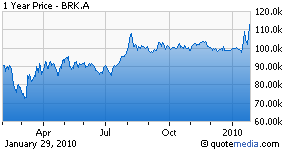
The A share price closed the week at $114,600, its highest since Oct. 31, 2008, with the B shares at $76.43. The company’s Class A and Class B prices are closely linked because each A share can be converted into 1,500 B shares.
Where will the stock price go, starting from the pre-split B price equivalent of about $66 a share?
One shareholder at the special meeting said he expects the Class B price to hit $100 fairly quickly. That’s likely based on instances of much smaller companies that split their shares 2 for 1 or 3 for 1 to duck under $100 per share and then see prices rise again.
It took about five years for Berkshire’s A shares to increase from $66,000 to the current $100,000-plus level, if you rule out the ups and downs in between.
Although the price of Berkshire stock has gained significantly over the past 50 years, past performance, as Buffett himself said at the special meeting, is no predictor of the future.
For the B shares to reach $100 each, the total value of the company’s stock would have to increase by half to about $240 billion, larger than any U.S. corporation except ExxonMobil.
At that level, Class A shares would be priced at a record $150,000 each.
Without giving specific numbers, Buffett said Berkshire’s share price has been at the low end of the historical range of its price-to-book ratio. The ratio, used by many investors to measure a stock’s potential, is calculated by dividing a company’s price by its book value, which is an accounting measurement of a company’s holdings minus its debts.
At the end of 2008, Buffett reported Berkshire’s book value was $70,530 per Class A share. Its share price was $96,600, or 1.37 times book value. Berkshire’s price-to-book ratio was 1.82 at the end of 2007, 1.57 at the end of 2006, 1.49 at the end of 2005 and 1.57 at the end of 2004.
A reasonable estimate of its current book value is $86,000, a local investment expert said. At its year-end price of $99,200 per share, that’s 1.15 times book value. If the price rose to 1.82 times book value, the high end of its historical range, the stock price would be about $156,000 for each A share, or about $104 for a B share.
For Buffett, however, such calculations are not the way to make investment decisions. Rather, you should choose reasonably priced companies with good management, good prospects for future earnings and advantages over competitors. It’s up to you to decide whether Berkshire fits that description.
Support for Bernanke
Buffett has strongly supported Ben Bernanke, the Federal Reserve chairman whose nomination for a second term won approval last week in Congress.
Buffett has said Bernanke acted properly to avoid a financial meltdown in the fall of 2008 and has taken the right steps since then to help the economy recover.
In a CNBC interview before Bernanke’s confirmation vote, Buffett was asked what would happen if Bernanke lost.
“Well, just tell me a day ahead of time so I can sell some stocks,” Buffett said.
Not in attendance
Reports on National Public Radio about the World Economic Conference mentioned that you might bump into Buffett, along with other political and business leaders, who gather in Davos, Switzerland, each year to discuss weighty matters.
While his close friend Bill Gates was at this year’s conference and has attended in the past, Buffett has never been there, his office said. Must be busy with other things.
Kraft comments
Reuters commentators Rolfe Winkler and Richard Beales wrote that Buffett’s opposition to Kraft Foods’ purchase of Cadbury, the British candy maker, will be put to the test, assuming the deal goes through.
Buffett criticized Kraft CEO Irene Rosenfeld for raising the bid price for Cadbury and for using Kraft stock for a large portion of the payment. The final offer, which won the support of Cadbury management and is awaiting a Cadbury shareholder vote, is not subject to a vote of Kraft shareholders like Buffett.
“It’s gutsy to go against a big shareholder, especially one with Mr. Buffett’s aura,” Winkler and Beales wrote. The deal leaves Rosenfeld “exposed to the slightest mishap as the deal unfolds.”
“If Kraft shares do strengthen sustainably, Ms. Rosenfeld will no doubt gladly debate Mr. Buffett about whether they did so because of, or in spite of, the Cadbury deal. Ms. Rosenfeld’s alternative — defending a deal done against her biggest shareholder’s judgment with nothing in Kraft’s share price to show for it — would be a much less attractive proposition.”
More shares sold
With each share split into 50, the Bill & Melinda Gates Foundation now has 78.3 million shares of Berkshire’s Class B stock, donated by Buffett toward his long-term pledge to transfer most of his wealth to the foundation.
The foundation’s investment arm has been selling shares almost every day over the past year, no doubt using the proceeds for operations and diversifying its holdings.
Until last week, the trading was mostly in blocks of 100 shares, since the price was in the $3,000-per-share range.
Now at post-split prices in the $70 range, the sales are in bunches of 10,000 or more.
Biggest shareholder?
Berkshire could become the biggest shareholder of Munich Re, a large German reinsurance company, counting what it owns plus the right to acquire more shares, Munich Re said last week.
Berkshire has its own reinsurance operations in General Reinsurance and National Indemnity Co. of Omaha, plus holdings in Swiss Reinsurance, another European company in the same line of business. Reinsurers take over risk from other insurance companies, receiving payments in return for promising to pay claims that arise over a period of time.
Munich Re said that besides owning 3.084 percent of Munich Re’s voting rights, Berkshire also owns the right to acquire an additional 1.945 percent by March 11, which would give the Omaha company a total of 5.029 percent, just ahead of asset manager BlackRock Inc.’s 4.58 percent, according to Bloomberg News.
Munich Re spokeswoman Johanna Weber said the company “welcomes any investor.”
Mutual fund ties
Berkshire’s S&P listing attracted buyers, but the Associated Press noted that mutual funds based on the S&P index would typically keep only 1 percent of their money in Berkshire stock.
If you want lots of Berkshire stock in a mutual fund, here are the 20 funds that invest heavily in Berkshire shares:
Blue Chip Investor, 26.3 percent; Midas Special, 26.3 percent; Sequoia, 20.6 percent; Academy Select Opportunities, 12.7 percent; Weitz Value, 11.8 percent; Fidelity Select Insurance, 11.2 percent; Weitz Partners III Opportunity, 10.7 percent; Clipper, 10 percent; Weitz Hickory, 9.7 percent; Tilson Focus, 9.7 percent.
Meehan Focus, 9.3 percent; Gratio Values, 9.1 percent; Weitz Partners Value, 8.7 percent; Oak Value, 7.3 percent; FIMCO Select, 6.8 percent; Matthew 25, 6.7 percent; Bread & Butter, 6.6 percent; Ariel Focus, 6.3 percent; BlackRock Exchange BlackRock, 6.2 percent; and Wintergreen, 6.2 percent.
Of course, if you just buy Berkshire stock, you get 100 percent exposure.
Share Investor Links
Share Investor Blog – Stockmarket & Business commentary
Share Investor New Zealand Business News– Get more business news
Discuss this topic @ Share Investor Forum – Register free
Share Investor’s Daily Forex Updates
Recommended Amazon Reading


 media worship the ground he walks on and the air he breathes. The media are unable to get any critical quotes from his investors, and nobody wants to be caught disagreeing with the Oracle of Omaha – after all he’s been right more often than wrong – and so we only get positive puff pieces. On the rare occasion when Berkshire Hathaway (


