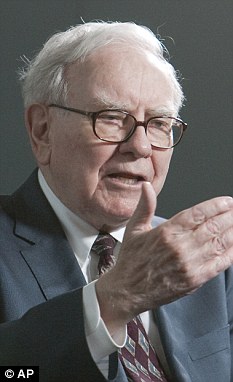
FRANKFURT, Jan 26 (Reuters) – U.S. investor Warren Buffett has added a big stake in Munich Re (MUVGn.DE) to his stable of insurance holdings, boosting the company’s shares on Tuesday.
The world’s biggest reinsurer said in a statement Buffett’s shareholding rose above the threshold of 3 percent on Jan. 18 and amounted to 3.045 percent of voting rights on that date.
Munich Re’s share turned positive on the news, rising by as much as 2 percent, before paring gains to be up 0.4 percent at 108.90 euros by 0855 GMT. The DJ Stoxx index of European insurance shares fell 0.8 percent .SXIP.
Rumours that Buffett was buying stock had boosted Munich Re’s share on Friday.
Buffett is already a major player in the world’s insurance market with his Berkshire Hathaway Inc (BRKa.N)(BRKb.N) unit, the world’s third-biggest reinsurer.
Berkshire also pumped 3 billion Swiss francs ($2.88 billion) into Swiss Re (RUKN.VX) at the height of the global financial crisis after the Swiss company wrote off double that amount in toxic assets. [ID:nL5719257]
NEW YORK (TheStreet) — Warren Buffett’s Berkshire Hathaway( BRK.B Quote) recently put down a $1.3 billion wager on a block of Swiss Re’s low-return U.S. life reinsurance business.
But while the amount wagered on this business would be quite daunting for most investors, Warren Buffett and Berkshire Hathaway are, of course, in the business of taking risks.
“We just wrote the largest life insurance contract I believe that’s ever been written,” Buffett told Fox Business in an on-air interview posted on the Web on Jan. 21. “It’ll probably have over $50 billion in premium income over the next 40 or 50 years. It’s on hundreds of thousands of lives.”
The more than $1 billion deal that was announced on Jan. 18 would free up Swiss Re’s capital, while possibly resulting in great rewards — or losses for Berkshire Hathaway. Under the terms of the contract, Swiss Re will, on a 100% quota share basis, reinsure a closed block of yearly renewable term individual life reinsurance business, written prior to 2004, with Berkshire Hathaway Life Insurance Company of Nebraska.
The transaction was effective October 1, 2009, and is scheduled to be reported by Swiss Re in the first quarter of 2010. Swiss Re will receive a ceding commission in the region of CHF 1.3 billion and release CHF 0.3 billion of capital to support the business. Swiss Re will continue to provide administration and reporting services for the subject business.
Swiss Re said it believes the proceeds and capital released by this transaction can be more efficiently employed to achieve a higher return. Meanwhile Swiss Re said it remains committed to the U.S. life reinsurance marketplace as well as to its clients, and, through this transaction, will be in an even stronger position to respond to the rising demand for reinsurance solutions.
“This is a significant step forward in Swiss Re’s strategy to increase capital efficiency,” Christian Mumenthaler, Swiss Re’s head of life & health, said. “By transferring this block of life business, Swiss Re is monetizing intangible assets and freeing up capital. The transaction puts us in an excellent position to redeploy the capital at more attractive returns.”
Buffett said that Swiss Re was reinsured at Berkshire Hathaway Life. Following the deal, Berkshire could be liable for up to $1.5 billion in claims, a cap that Swiss Re said will unlikely be reached in our lifetime.
In true Buffett form, Buffett on the surface appears to be taking quite a cheery attitude towards his latest gamble, laughing as he told Fox Business that “the premiums could end up being over $50 billion eventually; we just hope that the losses aren’t over $60 billion.”
This announcement was made two days before Berkshire Hathaway shareholders approved a 50-for-1 split of Berkshire Class B shares. The move was made to support the acquisition of railroad company Burlington Northern Santa Fe(BNI Quote).
All of which begs the question: Is Buffett taking too big of a gamble regarding the Swiss Re bet?
Jan. 26 (Bloomberg) — Jia Sheng Holdings Ltd. jumped the most in six years after agreeing to sell a HK$292 million ($38 million) stake to billionaire Li Ka-shing and announcing plans to buy a maker of batteries for electric vehicles.
The company soared as much 67 percent, the biggest intraday gain since July, 2003, to HK$1.50, and was at HK$1.24 as of 11:40 a.m. in Hong Kong trading. The stock was suspended for the past six days.
Jia Sheng will use some of Li’s money to build plants for making batteries, after buying Union Grace Holdings Ltd. and units for HK$2.8 billion to access lithium and yttrium-based technologies. Warren Buffett bought a stake in Chinese battery- maker BYD Co. last year as environmental concerns spur demand for electric vehicles.
“Even market rumors about Li investing in a company can push shares through the roof, never mind an official announcement,” said Vivien Chan, an analyst with SinoPac Securities Asia Ltd. in Hong Kong. “His influence is much like Buffett’s in the U.S.”
Buffett’s Berkshire Hathaway Inc. last year bought a 9.9 percent stake in BYD for HK$1.8 billion. BYD is also the largest car maker outside state control in China. The country last year surpassed the U.S. as the world’s biggest auto market.
Jia Sheng also plans to raise about HK$262.5 million through a placing of 366 million shares at HK$0.73 apiece in addition to the 400 million shares it will sell to Li’s Jade Time Investments Ltd., it said in a statement today. The Hong Kong-based company will pay for Union Grace using a combination of cash, shares and convertible bonds.
Li’s 400 million shares will represent a 2.5 percent stake once all of the other new shares and bonds are issued.
–Tian Ying with assistance from Stanley James in Hong Kong. Editors: Neil Denslow, Anand Krishnamoorthy.
FORT WORTH, Texas–(BUSINESS WIRE)– The Board of Directors of Burlington Northern Santa Fe Corporation (“BNSF”; NYSE:BNI) has declared a conditional cash dividend on the outstanding shares of BNSF common stock. The dividend is expected to be paid on the closing date of the previously announced merger of BNSF and a subsidiary of Berkshire Hathaway Inc. (the “merger”), to BNSF shareholders of record as of February 4, 2010. Payment of the dividend is contingent upon and subject to the satisfaction or waiver of all closing conditions set forth in the merger agreement executed in connection with the merger.
If all of the closing conditions to the merger are satisfied or waived, the dividend will be paid in an amount per share equal to (1) the number of calendar days between (and including) December 15, 2009 and the closing date of the merger multiplied by (2) $0.0044, rounded to the nearest $0.01 per share. For example, if the merger closes on February 11, 2010, the dividend will amount to $0.26 per share of BNSF common stock.
BNSF’s subsidiary, BNSF Railway Company, operates one of the largest North American rail networks, with about 32,000 route miles in 28 states and two Canadian provinces. BNSF Railway Company is among the world’s top transporters of intermodal traffic, moves more grain than any other American railroad, carries the components of many of the products we depend on daily, and hauls enough low-sulfur coal to generate about ten percent of the electricity produced in the United States. BNSF Railway Company is an industry leader in Web-enabling a variety of customer transactions at www.bnsf.com.
FORWARD-LOOKING STATEMENTS
Statements contained herein concerning projections or expectations of financial or operational performance or economic outlook, or concerning other future events or results, or which refer to matters which are not historical facts, are “forward-looking statements” within the meaning of the federal securities laws. Similarly, statements that describe BNSF’s or Berkshire Hathaway’s objectives, expectations, plans or goals are forward-looking statements. Forward-looking statements include, without limitation, BNSF’s or Berkshire Hathaway’s expectations concerning the marketing outlook for their businesses, productivity, plans and goals for future operational improvements and capital investments, operational performance, future market conditions or economic performance and developments in the capital and credit markets and expected future financial performance. Forward-looking statements also include statements regarding the expected benefits of the proposed acquisition of BNSF by Berkshire Hathaway. Forward-looking statements involve a number of risks and uncertainties, and actual results or events may differ materially from those projected or implied in those statements.
Important factors that could cause such differences include, but are not limited to: adverse changes in economic or industry conditions, both in the United States and globally; continuing volatility in the capital or credit markets and other changes in the securities and capital markets; changes affecting customers or suppliers; competition and consolidation in the industries in which BNSF and Berkshire Hathaway compete; labor costs and labor difficulties; developments and changes in laws and regulations; developments in and losses resulting from claims and litigation; natural events such as severe weather, fires, floods and earthquakes or acts of terrorism; changes in operating conditions and costs; and the extent of BNSF’s or Berkshire Hathaway’s ability to achieve their operational and financial goals and initiatives. In addition, the acquisition of BNSF by Berkshire Hathaway is subject to the satisfaction of the conditions to the completion of the acquisition and the absence of events that could give rise to the termination of the merger agreement for the acquisition, and the possibility that the acquisition does not close, and risks that the proposed acquisition disrupts current plans and operations and business relationships, or poses difficulties in employee retention.
We caution against placing undue reliance on forward-looking statements, which reflect our current beliefs and are based on information currently available to us as of the date a forward-looking statement is made. We undertake no obligation to revise forward-looking statements to reflect future events, changes in circumstances, or changes in beliefs. In the event that we do update any forward-looking statements, no inference should be made that we will make additional updates with respect to that statement, related matters, or any other forward-looking statements. Any corrections or revisions and other important assumptions and factors that could cause actual results to differ materially from our forward-looking statements, including discussions of significant risk factors, may appear in BNSF’s or Berkshire Hathaway’s public filings with the Securities and Exchange Commission (the “SEC”), which are accessible at www.sec.gov, and which you are advised to consult.
ADDITIONAL INFORMATION
In connection with the proposed transaction, Berkshire Hathaway has filed with the SEC a registration statement that includes a definitive proxy statement of BNSF that also constitutes a prospectus of Berkshire Hathaway relating to the proposed transaction. On or about December 28, 2009, BNSF began mailing the definitive proxy statement/prospectus to stockholders of record as of the close of business on December 18, 2009. Investors are urged to read the definitive proxy statement/prospectus (including any amendments and supplements) and any other relevant documents filed with the SEC because they contain important information about BNSF, Berkshire Hathaway and the proposed transaction. The registration statement and definitive proxy statement/prospectus and other documents relating to the proposed transaction can be obtained free of charge from the SEC’s Web site at www.sec.gov, Berkshire Hathaway’s Web site at www.berkshirehathaway.com and BNSF’s Web site at www.bnsf.com. In addition, these documents can also be obtained free of charge from Berkshire Hathaway upon written request to the Corporate Secretary or by calling 402-346-1400, or from BNSF upon written request to Linda Hurt or John Ambler or by calling 817-352-6452 or 817-867-6407.
BNSF, Berkshire Hathaway and certain of their respective directors and executive officers may be deemed to be participants in the solicitation of proxies from stockholders in connection with the proposed transaction under the rules of the SEC. Information regarding the directors and executive officers of BNSF may be found in its 2008 Annual Report on Form 10-K filed with the SEC on February 13, 2009, and in its definitive proxy statement relating to its 2009 Annual Meeting of Stockholders filed with the SEC on March 16, 2009. Information regarding the directors and executive officers of Berkshire Hathaway may be found in its 2008 Annual Report on Form 10-K filed with the SEC on March 2, 2009, and in its definitive proxy statement relating to its 2009 Annual Meeting of Stockholders filed with the SEC on March 13, 2009. These documents can be obtained free of charge from the sources indicated above. Additional information regarding the interests of these participants in the solicitation of proxies in connection with the proposed transaction can also be obtained from the registration statement and definitive proxy statement/prospectus filed with the SEC in connection with the proposed transaction, which may be obtained free of charge from the sources indicated above.
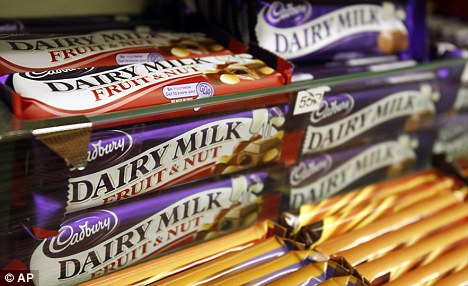
Ferrero formally ruled itself out of the running for Cadbury today, leaving Kraft’s £11.9bn takeover bid uncontested.
The statement from the Italian choclatier came on the day that the Takeover Panel deadline for competing offers expired.
Hershey, the other prospective bidder for Cadbury, which had been tipped to make a joint approach with Ferrero, stepped out of the race on Friday.
In accordance with Takeover Panel rules, Ferrero has reserved the right to come back with an offer within six months if there is a “material change in circumstances”, if Kraft withdraws, or if Cadbury agrees to an offer from elsewhere.
Kraft now has until 2 February to convince Cadbury’s shareholders to accept the cash and share offer. The US food conglomerate made its first approach in early September, and increased the cash value early this year. But the Cadbury board repeatedly dismissed the approaches as “derisory” and warned shareholders not to allow Kraft to “steal” the company.
But last week, when the US giant upped its offer by nearly £2bn, Cadbury’s board capitulated and recommended that the group’s shareholders accept the new deal. When the bid was announced last week, it valued Cadbury’s shares at 840p each, including a 10p special dividend. On the day before the first approach from Kraft, the stock closed at 568p.
If the deal goes ahead, it will create the world’s largest confectioner. But despite the support from the Cadbury board, there is still considerable opposition to the deal. When he announced the deal last week, Chairman Roger Carr acknowledged the likelihood of job cuts at the company’s Bournville factory. MPs and trade unions are also warning about job losses, and there is to be an adjournment debate on the issue in Parliament on Tuesday. But at the weekend, Kraft said it expects the deal to create more manufacturing jobs in the UK.
Kraft is to finance the deal with a $9.5bn (£5.9bn) bond issue and the issue of a tranche of new shares. Billionaire investor Warren Buffett, who is Kraft’s biggest shareholder, branded the takeover as a “bad deal” last week, blaming the $1.3bn reorganisation costs and the $390m deal fees that Kraft will incur.
The final iteration of the offer for Cadbury raised the cash component to 60 per cent and reduced the volume of new shares to less than 20 per cent of Kraft’s market capitalisation. The changes were in part a response to Cadbury shareholders’ push for more money and fewer Kraft shares. But they also followed public comments from Mr Buffett that Kraft shares were an “expensive currency” in which to buy Cadbury.
Is it an insurance company, a holding company, a hedge fund, a conglomerate, a closed-end mutual fund, private equity? The answer depends on who you ask and when. The annual report says “holding company.” The SEC files it under “fire, marine, and causality insurance.” I use conglomerate in my vernacular, but I’m just a casual observer.
I’m speaking of Berkshire Hathaway(NYSE: BRK-A), of course, which, as most of us know, comprises a lot of moving parts. If you count everything — complete ownership, partial ownership, and passive ownership — you’re looking at least 80 different parts covering nearly as many different businesses. Berkshire covers a wide swath of the US, and increasingly world, economy.
Book smarts I’ll admit that I’ve always been intimidated by Berkshire. I’ve never been sure how to value it — so much size, so much scope, so much Warren Buffett, so much opportunity for me to screw it up. Other analysts, many I’m sure possessing greater insight and sharper number-crunching skills than I do, are less reserve. Many of them are more than willing to proffer an opinion.
Many of these opinions are centered on book value, which I’ve always found a little odd.
Rarely do I hear an analyst lead an argument with book value when opining about lesser companies. More often, the analysis leads with P/E multiples, profit margins, earnings trends, revenue growth, new product development. Book value is often a tertiary mention, if it’s mentioned at all.
But with Berkshire, it’s different: Barron’s Jan. 11, 2010 edition featured a Berkshire-centric article, which included a very prominent book-value-centric opinion: “After rising just 3% in 2009, the stock, which is way below its late 2007 peak of $147,000, fetches a mere 1.2 times our estimate of the company’s year-end 2009 book value of $84,500 a share — compared with an average 1.65 times in the past decade. The stock rarely has been cheaper, relative to book value, in 15 years.”
This focus on book value is understandable. After all, you could label Berkshire a financial company, or as the SEC says “a fire, marine, and casualty insurer.” What’s more, Berkshire has posted a remarkable streak of adding assets that generate persistently higher earnings, which is more than you can say about Dell(Nasdaq: DELL), which trades at a rich 5.3 multiple of book value, or American International Group(NYSE: AIG), which trades at a well-deserved 0.7 multiple, or even perhaps Blackstone Group(NYSE: BX), which trades at a comparable multiple to Berkshire, yet has nowhere near Berkshire’s history nor its record of earnings persistence.
Value and potential But is a low price-to-book value a precursor to a higher share price, as Barron’s suggest? In 1995, Berkshire’s average price-to-book value multiple was 2.6, more than double what it is today. Berkshire was a much smaller, much more nimble entity then. In 1995, total revenue was a mere $4.5 billion, producing net income of $795 million. By 2000, total revenue had swelled to $34.9 billion, while EPS had more than trebled to $3.3 billion.
You could easily argue Berkshire was worthy of the premium, particularly when considering the stock price — the most important measure for shareholders. Berkshire’s shares closed 1995 at $32,100 and then more than doubled over the subsequent five years to close 2000 at $72,400.
But the book-value premium eroded along the way. The average book-value multiple was only 1.5 in 2000, a much lower multiple compared to 1995.
So how would Berkshire shareholders fare over the subsequent five years? One would think admirably, given the implied value in the company’s price-to-book value multiple. In 2005, total revenue grew to $81.7 million, while net income increased to $8.5 billion. Impressive, to be sure, but the share price failed to maintain the torrid pace, increasing only to $88,620.
Today, Berkshire’s shares trade around $100,000 each and, according to Barron’s, sport a 1.2 price multiple to book value.
Buy, sell, hold, or consider the alternatives Does that mean Berkshire is undervalued? The price doubled in five years from a high book-value multiple in 1995. The stock nearly doubled from a low book-value multiple in 2005 before trading lower to its current 15% premium.
As we’ve learned over the years, it’s never a good idea to bet against Warren Buffett, but it is a good idea to be grounded in reality. Reality says this isn’t 1995 when Berkshire’s book value per share was around $14,000. Today’s it’s around $84,000 a share. That’s a lot more girth, a lot more notoriety, and a lot more potential for diseconomies of scale.
That said, Berkshire could be undervalued. If you are unsure (like me), or think Berkshire’s overvalued and that book-value is still important, here are two holding companies that might be worthwhile surrogates: WR Berkley(NYSE: WRB), with a price-to-book value multiple of 1.1, and Leucadia National(NYSE: LUK), with a multiple of 1. Both remind me of Berkshire circa 1980: They are little less unwieldy, a little easier to analyze, and a lot less dependent upon a famous CEO.
What’s more, both have easily outpaced Berkshire in the all-important measure of price appreciation over the past decade.
Berkshire Hathaway Chairman and CEO Warren Buffett sat down with FOX Business Network’s Liz Claman and spoke about the President’s new bank proposal, saying that he feels that “the CEO has to be the chief risk officer” and if a bank fails “the CEO and his wife would forfeit their net worth.”
LIZ CLAMAN, FBN ANCHOR: This is the perfect day to be joined by Warren Buffett in town for a Washington Post board meeting, but let’s get Mr.
Buffett’s reaction to the president’s proposal. He is dead set on getting after the big banks and does not want them to take risks. What do you think of this proposal?
WARREN BUFFETT, CEO, BERKSHIRE-HATHAWAY: Well, I have not heard the proposal. I was in the directors’ meeting all morning. I have not heard it.
I would say this, that the real key in my view, you always have banks that are too big to fail, unfortunately. We cannot operate in this world without having some very big banks. Regulators hate that fact, I hate that fact, but there will be institutions that if they are — government will have to do something about it.
The answer — one of the answers – could be many answers – but one of the answers is to make it so the CEO of the institution that fails or that goes with the government and needs help really gets destroyed himself financially. I mean, why should he come out any better that somebody who gets laid off from a job as an autoworker? General Motors? So, I would — if I was running things, if a bank had to go to the government for help, the CEO and his wife would forfeit all their net worth. And that would apply to any CEO that had been there in the previous two years.
I think you have to change the incentives. I mean, the incentives a few years ago was to try to report higher quarterly earnings every quarter.
That’s what Wall Street applauded, that’s what the world applauded. It is nice to have carrots, but you need sticks. And the stick – the idea that some guy is worth $500 million leaves and only has $50 million left is not much of a stick as far as I am concerned.
I really think there should ought to be huge downsides because the CEO has to be the chief risk officer of a big bank.
CLAMAN: But that is not what is here. What he is proposing he wants to limit the scope and size – the scope of the risks that these banks can take, especially if they have depositors’ money within them. He doesn’t want them to make proprietary trades, you know, where — on their own books. He feels that is the way to prevent another type of financial meltdown. Is the right or is he wrong?
BUFFETT: I’d have to see the legislation. It is pretty hard to define risk. I mean, Genree (ph) when I inherited it, we had 23,000 derivative contracts. I could not understand them, so I got out of the business.
But there will be big transactions in this world and lots and lots of commerce worldwide between very large institutions. So, exactly how you police that, I am not sure. The way I would try to do it, in one way, I would try to make sure the person in charge paid a huge penalty if the place got in trouble.
CLAMAN: OK, well…
BUFFETT: And that has not happened in the last few years.
CLAMAN: Yes, and also, again, that is not really on the table. It is more of a “let’s go back to the some of the tenets of Glass-Steagall which separated investment banking from basic depositors’ banks.” And Paul Volcker, the former Fed chair under Ronald Reagan, is front and center here saying this is what we need to at least get closer to. Do we need we should bring back Glass-Steagall, Warren?
BUFFETT: Well, I was not unhappy with Glass-Steagall when it was in place. That is not something in any way that I champion getting rid of. Sometimes it is hard to put the genie back in the bottle. So, I would have to see the specifics.
But the idea of the banks taking huge risks were, in effect, the CEO — the bank shareholders suffer. If you own stock in Citigroup, if you own stock in Bank of America, if you own stock in Fannie and Freddie, AIG – you don’t have to worry about moral hazard. Those people lost 90, 95 percent of their money. But it’s the person that got them into their trouble that’s walked away. So, I would have a lot of downside for the CEO.
CLAMAN: Fannie and Freddie don’t get mentioned a lot when it comes to getting crimped (ph) on that type of risk and all of the involvement that regulation that has bored down on. And I look at that and I say, “Well, they still have billions and billions of our taxpayer dollars.”
BUFFETT: Well, Fannie and Freddie were creatures of Congress. They were supervised by Congress, and they actually sent the report annually to Sarbanes and Oxley. And every year, a 100-page report would go over and say these places are operating fine and risk looks (ph) and all that sort of thing. Congress was in charge of supervising, and they had a 200-person office that did nothing but look after those two, and look what happened.
So, I have some doubts of the efficacy of simple regulations. I like the really great personal downsid. I think that can be more reflective.
CLAMAN: Well, in the short term, if this proposal were to get some traction, at least on behalf of the president and Congress, how long before Goldman, which you own, and Morgan Stanley, they split off and get rid of their bank charters?
BUFFETT: I think it would be logical that they would do so. I mean, I don’t know anything about the specifics of this, but the banking aspect is a very small part. If you talk about banking, you’re talking about JP Morgan and B of A and Wells Fargo and those other kinds of institutions.
CLAMAN: But looking at Goldman Sachs, and looking now at how everybody is breathing down Goldman’s back — you’ve made a $5 billion investment last year at the lows. It looks brilliant now. What are you, on paper
— we’re trying to calculate this, but it’s hard with the dividends – 3-plus billion dollars to the upside now?
Aren’t you tempted to cash in on some of that? I know you said you would hold onto it for five years, but sooner rather than later, if the regulatory atmosphere ices out and (INAUDIBLE) Goldman Sachs…
BUFFETT: I am not tempted at all. No, that thought does not cross my mind.
CLAMAN: So, you’ll hold for five years?
BUFFETTF: Or longer. With the warrants (ph), we have to exercise in five years. With the preferred — they can call us at some point at a 10 percent premium. But no, I would not be bearish on Goldman Sachs at all.
Goldman Sachs, they fulfill an enormous function in this world. The world without investment banks, we’d be moving back a long way into a different century if you did not have investment banks do what they do.
CLAMAN: Yet President Obama is – let’s call it what it is — demonizing them, and some Americans agree with that because they feel like it was these very institutions that took crazy risks and darn near brought down the whole system. And Warren, isn’t it you and Charlie Munger, your partner, who have always been against outsized compensation and outrageous risk that of course ended up on the backs of the American taxpayer?
BUFFETT: Yes. Although it wasn’t – it wasn’t just the banks. I mean, we all participated. Congress participated through Freddie and Fannie and a million other ways. Millions of Americans participated through liars’ loans and signing up and misstating income. 309 million Americans thought houses could do nothing but go up, and that translated into all kinds of folly throughout the system.
CLAMAN: What were you thinking back then at the height of the housing craziness and the market?
BUFFETT: Well, I wish I’d been thinking a little harder.
(LAUGHTER)
BUFFETT: It looked a little crazy to me, but I should have done more about it than I did. But…
CLAMAN: What would you have done?
BUFFETT: Well, I would have tried to figure out some way – yes, you cannot short houses very well, but I would look for instruments that were similar. I would happen much more in tune if I’d really paid attention. I would have been looking at those instruments and maybe shorting the companies that were big and the mortgage business or something of the sort.
CLAMAN: Goldman Sachs…
BUFFETT: Although I would not be shorting, but I would have looked for ways to protect myself from the bubble that was going to pop.
CLAMAN: Goldman Sachs earnings out today. Don’t know if you heard; they knocked the ball out of the park, the cover off the ball – whatever analogy you want to use. Three dollars better than expected earnings per share. At the lows, at the most worrisome times in 2008, did you expect that this name and others would come back as quickly as they have?
BUFFETT: We also buy General Electric and it is not back up to the price of our warrants, in that case.
So — I never know what will happen in the next six months or one year in the stock market or the economy, but I felt Goldman Sachs was very well managed. We did put $5 million in before the government when – at a time when people were petrified in this country.
But I felt they had excellent management. I felt they had very conservative marks in terms of how they kept their books, and I wrote a check because I thought the country — I thought Bernanke and Paulson would do the right thing, and Sheila Bair, and they did.
CLAMAN: Ben Bernanke. Obviously, reconfirmation hearings coming up.
You just said you feel he did the right thing. There are some members of Congress, mostly Republican, who feel he should not be reconfirmed.
They’re railing and yelling and say he’s not the guy and this is the guy that shepherded a wrong direction and didn’t see it coming. What do you say to that?
BUFFETT: Well, I would say they ought to get down on their knees every night and thank the Lord that Bernanke was there through this. He took some unprecedented actions, he took them quickly, he kept us from going on in to the precipice. No question in my mind about that.
(CROSSTALK)
BUFFETT: Guaranteeing — these are actions collectively — collectively but guaranteeing the money-market fund, in terms of guaranteeing commercial paper, he took the actions that were necessary to prevent absolute panic from paralyzing this country. We came close enough as it was. And there wasn’t anyone else doing it. Congress was not doing it
— whoever they criticize now was not explaining this thing rationally at that time. Those guys, I’m talking about, Paulson and Bernanke particularly – they stood up and did what they had to be done.
CLAMAN: And you say reconfirm Ben Bernanke?
BUFFETT: Absolutely.
CLAMAN: Timothy Geithner, the Treasury secretary. Your thoughts on him?
BUFFETT: I think he’s terrific. I think – you can always dream up something that could have been done a little – but I describe that period as the economic Pearl Harbor. Now, maybe we did not send the ships out of Pearl Harbor, you know, San Diego, out at the right place the next day precisely or anything. The important thing after Pearl Harbor, was what the country saw their government was going to act and act properly and decisively, and that we would win the war. And that’s what happened…
CLAMAN: And the markets are way up off of the lows, so clearly, that part worked. But looking at what the Fed has done, it has propped up a lot here, and they bought mortgage-backed securities — at some point you have to kick the crutches away and walk on your own.
What happens – have you thought, Warren, because your mind works differently than most of ours — have you thought about what happens when the Fed exits that propping-up stage? Some people are worried interest rates would jump exponentially and that might derail the recovery.
BUFFETT: Well, if we run huge fiscal deficits the Fed is not going to exit. I mean, they are not going to be selling into a market that also the United States Congress is also forcing to buy, maybe a trillion or a trillion-and-a-half of U.S. government securities.
So, I think fiscal policy is going to be the real problem to figure that out right…
CLAMAN: Spending less at the government level and bring down the deficit.
BUFFETT: We’re taking in 15 percent of GDP and we’re spending 25 percent of GDP, very roughly. We can do that for a short time, and it is proper that we do it for a short time. But we have to get weaned off of it, and Congress has to be the one to wean us off of that.
CLAMAN: You just supported some of what President Obama’s says. Timothy Geithner, the Treasury secretary, Ben Bernanke, the Fed chief. You’re a true capitalist, yet you continue to support an administration that proposes regulation that appears to be against what, in great part, you believe them. How long do you wholeheartedly support this administration?
BUFFETT: Oh, I support it. There is plenty of regulation needed with financial institutions. There’s no question about that. You have
to look at how it’s written, and I – I’ve seen nothing on that. But
our financial institutions should be regulated.
And incidentially, before the bubble – and the bubble took in everyone.
I mean the regulators were fooled, the bankers were fooled, the mortgage bankers were fooled. The American people was fooled, Congress was fooled. I mean, we all fell into the trap that housing prices could do nothing but go up. So, no matter what you borrowed against it, it did not make a difference. They’d be worth more next year.
That was probably not a failure of regulation. People have a propensity periodically to do some very stupid things in financial markets, and this time they did it in the housing market.
CLAMAN: Warren’s going to stay with us. We’re going to take a quick commercial break. When we come back, we’ll be talking about his ideas of saving newspapers. He just came from “The Washington Post.” Of course, he’s shrugging his shoulders, if that tells you anything.
(LAUGHTER)
CLAMAN: We will be talking much more about that and his view of the world, especially financing when we come back. More with Warren Buffett right here on Fox Business.
(COMMERCIAL BREAK)
CLAMAN: Mr. Buffett goes to Washington, D.C., and we are with him, right here on Fox Business. Welcome back to Warren Buffett.
We’re continuing our conversation, of course. Your view on so many things matters to a lot of people because you are arguably the greatest living investor and I’d love to know your thoughts on this Massachusetts election. I bring that up because it makes me wonder about the whole financial zeitgeist in people’s minds about — thinking that any kind of change is the change that they want. Three major elections since President Obama has taken office. And that would be the gubernatorial races in Virginia, in New Jersey, and then of course the state Senate race in Massachusetts. All three went to Republicans.
What does Massachusetts tell you?
BUFFETT: Well, it tells us that people are unhappy with how they see the world around them right now. They see a high jobless rate, they see people having problems with their mortgages. They’re in a fairly negative mood currently. They’ll get over it at some point.
But right now they’re not happy with Congress, they’re not happy with banks, they’re not happy with the administration, they’re not happy with the health care bill. Whatever it may be, some combination of that so they’re going to vote against whoever they think is down here in Washington.
CLAMAN: Is that misguided?
BUFFETT: It probably is but it does send a message. I mean, you have to respond to that, because in the end, to get things done in this country, you need — you’ve got people marching with you. And people right now are not marching with Washington
CLAMAN: Well, yes. I mean, we, at Fox Business do this thing called “Red Ink Watch.” If you print out the stimulus bill, it’s about this
high. I mean, how many trees had to die for this thing? And people
look at it and they say, we don’t feel any job creation even though we’ve come way off of the job losses and the bleeding that we saw in the employment world.
BUFFETT: Yes, and they saw that stimulus bill with 8,000 earmarks or something of the sort.
They do not view Washington favorably. And that feeling, I think, is probably — about Washington — has soured some during the past year.
Partly because of the factors like the economy, but partly because of what they see on television when they watch Congress.
CLAMAN: Congress is such — not running very high on the polls at the moment.
Let’s get to Berkshire. Of course, yesterday, you have the big meetings and everybody voted to split the B shares, the cheaper shares, less expensive, let’s not say “cheaper.” And today is the first day they’re trading.
Warren, the volatility is crazy. Five times normal volume which is what you always have bristled against. You wanted long term shareholders.
Again the stock is hitting a new high.
Does this make you happy? Or does it disconcert you a little bit?
BUFFETT: Well, we want to get the same kind of shareholders we’ve attracted in the past. We want to get people who look at buying a share in Berkshire like buying a piece of a farm or an apartment house that they intend to hold forever. And it’s up to us to attract those kind of people what our policies are, or communications are with them. And I think it’ll be OK. But my guess is there’s been a little more action than is idea today.
CLAMAN: Well, they’re running about $72 and change at the moment.
BUFFETT: Well, I’m not talking about the price on it. But just, in the end, you know, we hope we have shareholders who are in sync with us, who measure us the way we measure ourselves. We’ve got this sort if
(INAUDIBLE) and all that sort of thing.
CLAMAN: What do you say to the day traders who are in today?
BUFFETT: We don’t want any day traders.
CLAMAN: No day traders.
BUFFETT: No. And incidentally, we get very, very few of them in the end.
CLAMAN: You know, you did this so you could complete the purchase of Burlington Northern — the railroad. I want to make a comparison here, because you are also, of course, Kraft’s largest shareholder. You’ve been adamant saying you were against Kraft buying Cadbury.
How does issuing shares of Berkshire at what many believe is a lower valuation with these B shares, to buy Burlington Northern, a business that is far more cyclical, perhaps than Cadbury would be to Kraft.
How does that differ than what Kraft is doing?
BUFFETT: Well, Kraft is paying — Kraft, for example, sold a piece of business in part. Whether they sold it at nine times operating earnings, after tax they only have 2.5 billion after tax. They said they sold it for 3.7 billion, but they sold in a very tax-inefficient manner. So, they did that to buy something that’s probably, by the time you get through adding the cost they’re going to incur deal, costs and everything is 16 and 17 times earnings.
We’re not doing anything like that at Berkshire. We are issuing some shares which I hate issuing — Charlie hates issuing, the board of directors hates issuing them. But, it was the only way we could make the deal and we are using $22 billion of cash in what we think is a very effective manner.
And we’re not selling off any of our businesses to do so.
CLAMAN: Not selling any businesses?
BUFFETT: No, no.
CLAMAN: But you used the liquidity from the 50 /1 split that’s leftover to buy more businesses other than Burlington?
BUFFETT: We’ll keep buying businesses. Yes. As long as I’m alive we’ll be buying businesses.
CLAMAN: You’ll be buying businesses.
BUFFETT: Yes. And we’ll try to buy them for cash. Sometimes we may have to use some stock. But we’ll use as little stock as possible.
CLAMAN: This reminds me, of course, and you’re the biggest shareholder of Coca-Cola, as well. You were against Coke buying Quaker Oats. And PepsiCo picked it up and that, of course, was Gatorade and it worked out very well for PepsiCo.
BUFFETT: I’m not so sure. Look at Gatorade lately?
CLAMAN: Do you disagree?
BUFFETT: Have you looked at Gatorade lately? It’s down, I think it’s down — I shouldn’t name a figure, probably, but I think it’s down something like 20 percent or so in sales.
CLAMAN: But you don’t think you’re wrong with being against Kraft and Cadbury.
BUFFETT: No, no. Listen, I respect Irene Rosenfeld. She’s a first-class person. She likes the deal, I don’t like the deal. It’s that simple. But I don’t question the motives, I don’t question their straightforwardness or anything like that at all.
CLAMAN: Was this the first time you publicly have stated that you were against a deal?
BUFFETT: It would be of long time. Yes, I can’t remember. I’ve privately been against some.
CLAMAN: I think you haven’t tasted Cadbury’s Fruit and Nut Milk Chocolate. Because it’s very good.
BUFFETT: Nothing wrong with the products. It’s the price.
CLAMAN: What intrigues you these days out there? And I know you don’t like to tip your hand, but — you’re not tipping your hand. But, a couple years ago now, you bought an Israeli company Iscar, and it turned out to be a money printer. You just bought it outright. At the time you said the Israelis are the smartest people to do business with, or at least among them.
Are you looking in Israel?
BUFFETT: I would love to have another one like Iscar, I can tell you that.
The people of Iscar came to me, and actually they did about a year ago when we bought a company in Japan. If they say, we think it’s a good idea to do X, I’m going to do X.
CLAMAN: They’re that smart?
BUFFETT: They’re good.
They’re not just smart. They’re hardworking, too. They just keep going. I mean, they don’t have time to stop by Omaha and tell me what’s going on in. I don’t want them too. I’d rather have them out there doing things.
(LAUGHTER)
CLAMAN: You go visit them.
BUFFETT: Absolutely.
CLAMAN: You’re a believer, obviously, in stocks and of course the stock market. What would you tell — I’m just going to throw this out there and say, a 25 year-old guy who’s making $40,000 right now and has a long time horizon?
You know, are you still really pro putting into individual names and thinking about stocks?
BUFFETT: I would tell him, whatever he saves maybe he saves $2,000 a year, maybe he saves $4,000 a year. It’s tough to say when you’re making $40,000 a year, particular if you have a family. But, whatever he saves, I would just tell him to put it regularly month after month after month in an index of funds.
CLAMAN: Let me go back to General Re. You mentioned them. Today it’s announced, or yesterday, that they have settled paying a $92 million fine for the problems with AIG.
Looking at that situation what have you learned from that? There were fake trades made at General Re.
BUFFETT: We did something wrong and we pay the price. It’s that simple. I mean, it’s five years since it started but it shouldn’t have been done. And there’s nothing inappropriate about the fine we paid.
So, I have no problem with it.
CLAMAN: They say that parents are very vulnerable through their children. When you buy a company sometimes you don’t know the problems that are going on. You got a new board member — Stephen Burke of Comcast. Comcast just spent a big chunk of change on NBC and they opened up a can of worms with the Jay Leno/Conan O’Brien thing.
BUFFETT: Well, we didn’t buy NBC. We have 225,000 or so employees. If you have a city of 225,000, probably someone is doing something wrong.
What you try to do is, you try to catch it, you try to minimize it, you try to correct it if you find it.
By today, I’m sure somebody at some operation at Berkshire is doing something they shouldn’t be doing. I mean, 225,000 people. That’s a lot of people. And it’s our job to try to and minimize it. It’s our job if we find out about it to do something properly to correct it. We can’t eliminate it forever. I mean, I wish we could but we can’t.
CLAMAN: As a new board member for Stephen Burke. Is he replacing somebody on Berkshire’s board?
BUFFETT: No. No, no. Absolutely not. No, no. no. I should have asked him a long time ago but — to join us but he is not replacing anybody.
CLAMAN: One of your other board members Bill Gates — he’s blogging now. Did you see he’s got a blog out there — Gates Notes.
You always say that you’re a —
BUFFETT: I taught that guy everything he knows about computers. I’m glad he’s finally picked up on it.
(LAUGHTER)
CLAMAN: And he’s Twittering. What he put on his blog was an interview with he and you and Charlie Rose.
Are you going to say, OK, Bill, I’m going to blog, too.
BUFFETT: You’ve got it backwards. I mean, I’m glad Bill’s mastered it.
(LAUGHTER)
BUFFETT: I’ll give up the blogging.
CLAMAN: I’ll be seeing Bill Gates in Davos next week. And there’s so much discussion about pandemics. And, of course, he and the Gates Foundation — you’ve given most of your money to them — work to make sure that we can stem any kind of problem there.
What do you think about that risk? You take risk every day with a lot of your insurance companies.
BUFFETT: We just wrote the largest life insurance contract, I believe, that’s ever been written. And we’ll probably have $50 billion of premium income over the next 40 or 50 years. It’s on hundreds of thousands of lives.
CLAMAN: What company is that?
BUFFETT: Well, we reinsured them at National Indemnity, a subsidiary of ours, or, the life company — Berkshire Hathaway Life.
CLAMAN: And the value of that again is?
BUFFETT: The premiums could end up being over $50 billion eventually.
Now we just hope the losses aren’t over $60 billion. But a pandemic would not be good news for Berkshire.
CLAMAN: You’d be out there inoculating people.
BUFFETT: I’d do whatever it took. I mean —
(LAUGHTER)
BUFFETT: No, I mean, that’s a risk we run. We run a risk of, you know, in terms of terrorists doing a lot of things, but we’re in the business of taking risks and we try to get paid appropriately.
CLAMAN: Well, as we finish up, that is the story of the day is risk and how the President doesn’t want financial institutions taking risks.
So, as we finish up, what’s your final thought on that?
BUFFETT: Well, I tell people — and it’s going to be in the annual report again this year — when you have a company as large as Berkshire and with all the obligations we have to paraplegics that have been injured we’re going to have to pay for 50 years, to all the employees we have, all the staff members we have, I have to be the chief risk officer.
And the truth us, I should be the best person to do that because I have this overview of this whole operation and I understand the risk and I think that should be the case. Every large financial institution — that the CEO regards his position as number one, as the chief risk officer. You have a lot of other functions, too. But he wakes up every morning and thinks about, is this place built to take anything?
CLAMAN: And this should take the hit that come with it?
BUFFETT: Absolutely.
CLAMAN: Warren Buffett of Berkshire Hathaway. Good to see you.
Jan. 20 (Bloomberg) — Warren Buffett, chairman and chief executive officer of Berkshire Hathaway Inc., talks with Bloomberg’s Betty Liu about the prospects for more acquisitions following Berkshire’s purchase of Burlington Northern Santa Fe Corp. Buffett also discusses Kraft Foods Inc.’s purchase of Cadbury Plc, the performance of Goldman Sachs Group Inc. and his opposition to President Barack Obama’s proposed levy on financial institutions.
Sham Gad is Managing Partner of Gad Capital Management and runs the Gad Partners Fund, an investment partnership inspired modeled after the 1950’s Buffett Partnerships and he sat down with Warren Buffett in 2007 to do this interview. He is also the author of The Business of Value Investing: Six Essential Elements to Buying Companies Like Warren Buffett a new book on Warren Buffett. Opening remarks by Mr. Buffett-
The following notes are from my two-day visit with Mr. Buffett in Omaha. As always, Warren was very warm, simple, and loaded with brilliant nuggets of worldly wisdom.
Everyone has the potential to achieve their dreams. The point is to get out of each of us what we are capable of producing. I will invite you to play a game. Suppose that when this class ends, you have one hour to pick a classmate that you will own 10% of his or her earnings for the rest of their life. Besides picking the one with the richest father (laughter ) you would choose the person who is most effective. I would predict that you would not necessarily pick the student with the best grades or highest IQ. Instead, you would look for someone with the most integrity and intelligence. Think about the person that has a 300 horsepower motor and operates at 300hp and compare that person to someone who has a 400hp motor but operates at 150hp. You would pick the 300hp everyday.
My point is to suggest that you should become an effective human being…the chains of habit are too light to feel until they are too heavy to break!
Highlights of the Q&A:
Given the steady decline in the textile industry in the Northeast and the economically depressed nature of New Bedford and other companies in the industry what made you purchase Berkshire Hathaway at the time that you did?
Well in 1962 I learned from Ben Graham how to assess businesses. He also had the cigar butt analogy for buying businesses…you can usually get one good puff out of it and it’s free. Berkshire made a lot of money after WWII (more than Pfizer and Merck) and then it steadily went downhill. Between 1955 and 1965 Berkshire went from 12 mills to 2 mills and they bought their own stock as mills closed. We bought 100,000 shares out of 1 million in 1962 at $7 3/8 and the company had $10-11/share in working capital…I knew I wouldn’t lose money because of the working capital. It was losing money but it was also liquefying assets by closing mills. Seabury Stanton was running Berkshire at the time and I went to go visit him. We had an agreement that Berkshire would tender $11-1/2 for my shares of the company. At this point, I could not buy any stock as I had inside information. A few weeks later I received a letter from Old Colony Trust containing a tender offer of $11-3/8. Early the following week, Seabury tendered the stock at 11 3/8. As result, I began buying more Berkshire. Other family members of Seabury Stanton sold their shares to me and I gained controlling interest in the company. The family members weren’t very happy with Seabury either really. We ran the mills until 1985. .
See’s Candy is an example of low rate of return on capital expenditures individually yet the company as a whole makes loads of money because of the great brand of See’s. We bought See’s in 1972 and every year since then we have raised the prices the day after Christmas and it never hurt the business. When we invest we ask one question, how long do you have to wait to raise the prices? If you are an airline today and you try to raise your prices, an hour later, you will be lowering them because of competition. Not the case with a good brand like See’s. If I were to give you a $100 million, I’m not going to, but if I did, you could not damage the See’s brand in the minds of 30 or so million Californians. Only See’s can do that. Their brand is their promise to provide the quality and service that people have grown to expect.
Mr. Buffett, you have described Berkshire Hathaway as your masterpiece painting, a masterful business entity that has compounded shareholders equity at 21.5% per year since you have taken over. You have described your work as being a capital allocator and that it has been a joy for you to do that work all your life. In July 2006 you allocated all the Berkshire Hathaway shares you accumulated to the Bill and Melinda Gates Foundation and four other foundations. This act was enormous in its scope, brilliant in execution, and magnanimous in its goal. It now becomes the Bill and Melinda Gates Foundations’ job to allocate $15,000,000 each and every business day because of your donations. In your mind which part of this incredible act was most important or most concerning to you and why?
I actually gave the stock away 15 years ago in my mind, created a trust mentally. When my wife died, I was forced to do something. Soon after I discussed my plans with Bill and Melinda they gave me an original copy of Adam Smith’s Wealth of Nations. In the first chapter Adam Smith talks about “Specialization of Labor”, which talks about markets and allowing countries to specialize and work on what they are good at. Mike Tyson doesn’t try to run Berkshire, and I don’t try to get in the ring with Mike Tyson. This is how I look at philanthropy. I started looking for people that were younger, smarter, more experienced, and doing it with their own money. I looked for people that had similar goals, who would do the best with the money. In effect, I outsourced the handling of my philanthropy. It was a no brainer.
In the Fortune article, I stated that business is a game that I love because I get to hit the easy pitches. Ted Williams had written a book about hitting and he said to succeed in baseball, you had to wait for the best pitch. See’s Candies to me was an easy pitch. It is not like Olympic diving, where one could do a simple dive perfectly, but score lower than someone who might have made a big splash attempting a more difficult dive. In diving you are judged on the degree of difficulty. Philanthropy is the opposite of investing with degree of difficulty. Philanthropy deals with trying to solve the toughest problems in society, so you expect to fail very often. I personally don’t like failing, so I’d rather let someone else do it. I wouldn’t personally enjoy working on something where I couldn’t get any feedback on how I was doing and in fact, expected the project to fail. My lifespan is 12 years now and I should be able to add tens of billions of dollars to my “donation” in that time. I am going to stick with what I love doing and I am glad others will work on giving the money away.
I’m just lucky to have been in the right place at the right time. Another place, another time, I wouldn’t have been as successful. Society enabled me to make my money and my money should go to society.
You have said that the last 50 or so years were a unique time for investing in American securities markets—numerous mis-pricings. Do you believe that something like this will happen again? And if you were 26 today and you had only a $1,000,000 how would you generate the 50% returns that you said you might do with smaller amounts of capital? Attractive opportunities come from observing human behavior. In 1998, people behaved like frightened cavemen (referring to the Long Term Capital Management meltdown). People make their own opportunities. They will be frozen by fear, excited by greed and it doesn’t matter what their IQ, degrees etc is. Growth of 50% per year is with small capitalization, not large cap. The point is I got rich looking for stock with strong earnings. The last 50 years weren’t unique. It’s just capitalizing on human behavior. It’s people that make opportunities when others are frozen by fear or excited by greed. Human behavior allows for success if you are able to detach yourself emotionally.
In 1951, I got out of school at 20 years old. At the time there were two publishers of stock information, Moody’s and Standards and Poor’s. I used Moody’s and went through every manual. I recently bought a copy of the 1951 Moody off of Amazon. On page 1433, there’s a stock you could have made some money on. The EPS was $29 and the Price Range was from $3-$21/share. On another page, there is a company that had an EPS of $29.5 and the price range was $27-28, 1x earnings. You can get rich finding things like this, things that aren’t written about.
A couple of years ago I got this investment guide on Korean stocks. I began looking through it. It felt like 1974 all over again. Look here at this company…Dae Han, I don’t know how you pronounce it, it’s a flour company. It earned 12,879 won previously. It currently had a book value of 200,000 won and was earning 18,000 won. It had traded as high as 43,000 and as low as 35,000 won. At the time, the current price was 40,000 or 2 times earnings. In 4 hours I had found 20 companies like this.
The point is nobody is going to tell you about these companies. There are no broker reports on Dae Han Flour Company. When you invest like this, you will make money. Sure 1 or 2 companies may turn out to be poor choices, but the others will more than make up for any losses. Not all of them will be good, but some will and those will make you rich. And this didn’t happen in 1932, this was in 2004! These opportunities will be there in the next 30 years. You’ll have streaks where you’ll find some bad companies and a few times where you’ll make money with everything that you do.
The Wall Street analysts are brilliant people; they are better at math, but we know more about human nature.
In your investing life you will have several opportunities and one or two that can’t go wrong. For example, in 1998 the NY fed offered a 30-year treasury bonds yielding less then the 29-½ year treasury bonds by 30 basis points. What happened was LTCM put a trade on at 10 basis points and it was a crowded trade, they were 100% certain to make money but they could not afford any hiccups. I know more about human nature; these were MIT grads, really smart guys, and they almost toppled the system with their highly leveraged trading.
This was definitely a good time to act.
When looking at other countries Mr. Buffett, do you look at the country’s overall financial status or do you look at the financials of that specific company in a foreign country? You mentioned investing in Korean companies – do you ever look at the state of the country you are investing in?
We care about the country where the company is run. There is a disadvantage being outside of the US. A few years ago we were looking to invest in either PetroChina or Yukos in Russia. We ended up picking PetroChina because the political situation was more stable. It turned out to be a good decision. I care about the country and the geopolitical environment I am investing in.
The whole company was selling for $35 billion. It was selling for one-fourth of the price of Exxon, but was making profits equal to 80% of Exxon. I was reading the annual report one day and in it I saw a message from the Chairman saying that the company would pay out 45% of its profits as dividends. This was much more than any company like this, and I liked the reserves. If it were a US company, it would sell for $85 billion; it’s a good, solid company. I don’t understand the Chinese culture like I understand the US culture. However it said right in their annual report that they will payout 45% of their earnings as dividends, basically they say if they make money they will pay it out. I invested $450 million and its now worth $3.5 billion. I decided I’d rather be in China than Russia. I liked the investment climate better in China. In July, the owner of Yukos, Mikhail Khodorkovsky (at that time, the richest man in Russia) had breakfast with me and was asking for my consultation if they should expand into New York and if this was too onerous considering the SEC regulations. Four months later, Mikhail Khodorkovsky was in prison. Putin put him in. He took on Putin and lost. His decision on geopolitical thinking was wrong and now the company is finished. PetroChina was the superior investment choice. 45% was a crazy amount of dividends to offer but China kept its word. I am never quite as happy as I am in the US, because the laws are more uncertain elsewhere, but the point is to buy things cheap. Russia is just a bad geopolitical environment. On the other hand, China has kept their word on paying the dividends. In fact, when the dividends check comes in, it is calculated out 10 or so decimals, these guys keep their word. I don’t know the tax laws in China, but you can buy a good business cheap. At Berkshire Hathaway, you have to spend hundreds of millions of dollars to move the needle. We have a problem of finding things worth investing in.
In respect to Africa how would you find above average stocks given the information cots and limitations in Africa? What is your best advice about obtaining acceptable information? There aren’t too many companies in Africa that are big enough for Berkshire to look at, except for maybe DeBeers, Anglo-American, or SAB Miller. Also, there isn’t a lot of information on these companies. I know South Africa has stock information available. The key is to get good information.
In comparison, Korea has plenty of information available. There is Kissline online. Within seconds I can get Korean Stock Exchange Information, Annual and even quarterly information. I’m not sure if the same is available online for South Africa. This is OK because I don’t need to win every game, just the ones I play.
I have three mailboxes in my office – IN, OUT, and TOO HARD. I was joking with the MIT students that I should have a TOO HARD bin and they made me one, so now I have it and I use it. I will only swing at pitches that I really like. If you do it 10 times in your life, you’ll be rich. You should approach investing like you have a punch card with 20 punch-outs, one for each trade in your life. I think people would be better off if they only had 10 opportunities to buy stocks throughout their lifetime. You know what would happen? They would make sure that each buy was a good one. They would do lots and lots of research before they made the buy. You don’t have to have many 4X growth opportunities to get rich. You don’t need to do too much, but the environment makes you feel like you need to do something all the time.
How would you define your character? And what portion of your character do you believe contributed the most to your success?
The important qualities you need are intelligence, patience, and interest, but the biggest thing is to be rational. In ‘97-8, people weren’t rational. People got caught up with what other people were doing. Don’t get caught up with what other people are doing. Being a contrarian isn’t the key, but being a crowd follower isn’t either. You need to detach yourself emotionally. You need to think about what is going on around you. Being in Omaha helps me in that regard. When I was in NYC, I had 50 people whispering in my ear before noon. It’s hard sometimes, like when the Internet craze hit. Nobody likes to see their neighbor doing stupid things and getting rich. It was like Cinderella’s ball, I think I’ll just have one more dance, it’s not midnight yet. Sounds simple – but it is hard to leave the party. The problem with stocks is they don’t have clocks. You don’t know when it will be midnight so you can leave the party. My partner Charlie Munger and Tony Nicely at Geico are always rational. 160 IQs can say stupid things that sound good. People do silly things, whether they have 120 IQ or 160. You can always improve your rational thought. Rationality is the only thing that helps you. One thing that could help would be to write down the reason you are buying a stock before your purchase. Write down “I am buying Microsoft @ $300B because…” Force yourself to write this down. It clarifies your mind and discipline. This exercise makes you more rational.
What is your opinion on exchange-traded funds and how to do you accurately judge them?
ETF’s are a fairly low cost way to get into a market or industry. We don’t hold any and never will. I recommend index funds for people who don’t want to spend time studying the market. They are good for 95% of the population. If you don’t bring anything to the game, you shouldn’t expect to win.
How do you hope to tackle administrative cots when it comes to Aids treatment in Africa?
Bill and Melinda Gates can tackle these issues better then I can. I work on giving them more money so they can have more to work with. I am better suited to raise the capital, let others do the work they are good at. We can do a lot more with private charities than the government can. We judge our success on how intelligent we attack a problem rather than success or failure. Bill Gates regards every human life as valuable; we in the US need the help much less then other countries do.
The inheritance or estate tax has continued to be debated on Capital Hill, yet your position has not changed in the fact that you feel this tax should be maintained. Could you please share your views on why legislators should not change this tax law?
Well it’s not a death tax. 2.2 million people die in the US and out of that only 4,000 estates will be taxed. The federal government collects $30 billion in tax revenue per year from estate taxes and a high percentage of the heirs of these estates will receive $50 million or more.
We have to ask ourselves what is the proper tax policy for our society. Let me illustrate with a game. Imagine 24 hours before your birth a genie comes to you and lets you design the world into which you will come. You define all of the political, economic, and societal facets of the world. But there is one catch. You have to draw a ticket from a pool of 6 billion. On this ticket will be your characteristics in this world, i.e. if you are born in the US or Bangladesh, if you are male or female, black or white, retarded or normal, etc. What would you do? You would design a world with rules that would initially foster abundance. A world that produces lots of output where everyone is productive. You would create an abundant society. Secondly, you would want justice. You would want the output to be spread out. You would design a world where there was freedom from fear, freedom from fear of old age. You would want equality of opportunity, a market system, and that the best people were in the right places. You would want a world that would take care of the people who got the bad tickets. This has nothing to do with religion, I’m agnostic. At the time that I was born, the odds were about 50 to 1 that I was born in the United States. I won the ovarian lottery.
You would make sure all of the lucky tickets are incentivized to keep working. Also you would want others to have equality of opportunity, not equality of outcome though. One bigger thing would be a good system of the rule of law. You would also want to make sure you have people in the right places according to their talents. You would also want to help others that have no opportunity. I could set it up so that my descendants would not have to work for ten generations. So I would end up effectively taking my descendants out of the pool of proactive people. The descendants of wealthy people could potentially become welfare recipients. Lots of families (I won’t name names) create dynasties where society contributes to them just because they are part of the “lucky sperm club”. Instead of using food stamps, they would have stocks and bonds. The estate tax modifies the ability to create a family dynasty that takes the descendants out of the work pool, the group of productive citizens.
We all participated in the ovarian lottery, it’s probably the most important thing we have ever done. In fact, you all are in business school, you are pretty smart and you have a bright future ahead of you; if you had the chance to trade in your lottery ticket for the chance to pick 100 tickets of which you would have to take one. Would you do it? I would argue you should not. Out of the 100, only 4 or 5 would be born in the US. Out of that only not many would be headed on the path you are headed down. So we are part of the top 1% in society, we are pretty lucky. My descendants are part of the top 1 tenth of one percent of society. This means that you are in the luckiest 1% of the world.
Early on in you career you bought some land and then rented this out to some local farmers? Why didn’t you pursue this type of investment in real estate? I made an initial investment farm real estate when I was 14. Someone else handled the whole transaction; I just bought 40 acres. A guy would farm the land and harvest X number bushels of soybean and sell if for $X per bushel at the market and say here is your check. I did virtually nothing for this investment. I had no idea if he actually harvested what he said he did, or if he sold the bushels he said he sold, or for that matter what price he sold it at. It’s kind of like the guys who kept all his cows in with a big herd. As they are taking them to market, the owner of the big herd says, sorry but all of your cows died. How would you know which cows were yours?
In 1980 with the S&L crisis, land was selling for $2,000 an acre. Well, an acre produced 120 bushels of corn or 45 bushels of soybeans. At a couple dollars a bushel, this was basically $80 an acre in revenue. At the time with the interest rates, you would pay $150 per acre in interest. So you were taking in $80 and paying out $150, it just did not make sense. The bankers went crazy lending money at $2,000 an acre prices for farms at 10% interest rates to produce $80 an acre in crops. Well after a bunch of people lost big time, the FDIC took control of the farms and ended up selling them at $600 an acre, which at the time was a good deal. The FDIC took over hundreds of farms because people went crazy and lost their shirts.
The S&L’s lost their fundamentals and the Government owned $100 million worth of properties they needed to dump at a low cost. This was an opportunity to make some money, however I still don’t like farms because they are too passive. I still don’t like farming. My son likes farming, I don’t.
Mr. Buffett it has been well documented that you don’t manage your managers. Do you possess a strong intuition about people or do you have a process when you evaluate the management of companies that you are looking to possible purchase?
Good question. The question I ask is will they still work after they have sold their business? Do they love the money or the business? If it’s the business, then we have a deal. If it’s the money, and that’s ok, it’s just not what we are looking for. I don’t have to identify all of the ten’s out there; I just have to make sure the ones I make deals with are tens. I can’t look at the class and say, “You’re a 6.5. You’re an 8.” I just need to find a few 10s. Do I have an intuition when judging a business owner? Sometimes. People give themselves away; I don’t know what it is. We don’t have any contracts at Berkshire; people stay because they have a passion for their business and I don’t want to screw that up. Not much changes at 65 years old. I have 40 CEO’s working for companies owned by Berkshire. Since 1965, not one of them has left Berkshire Hathaway. If I told Lou Simpson of Geico to be at the office at 9am and he could only get one hour for lunch, he would leave. I don’t need to identify every ten out there, just the ones we invest in.
Machiavelli said that a man could be feared and loved. But one might want to be more feared than loved. Do you agree with this? Has there ever been a situation where you had to be more feared than loved?
I don’t believe in fear as a manager. Ben Graham, Don Keough, and my dad are the people I have worked for and they never tried to get people to respond by fear. Certain industries may be conducive – platoon operators maybe – but even then, if you turn back and desert your buddies…I don’t operate like that. I don’t like this life. Probably certain circumstances call for it: operate this way for a policeman. I believe the most powerful force is love and that is the most effective way of dealing with people. I would not want to live a life where people are afraid of me. People don’t operate well under fear. Some circumstances where mutually assured destruction is the end result, fear is good. But not at Berkshire Hathaway, love is way better to operate. By the way, how did Machiavelli do? There is no religion of Machiavelli 500 years later, is there?
Sometimes we learn more from our failures than our successes. What do you consider your greatest mistake or failure?
I have made lots of failures of omission more than failures of commission. Things that I understand, there have been a few, a couple that cost $10B. If a business was selling cheap and I did not buy, I consider that a failure. As Charlie would say, I was sucking my thumb on that one. I made a terrible deal buying Dexter Shoe. I did not learn much from it either. I bought it for $400M, but the biggest mistake is that I gave up stock that is now worth $3B.
You’re going to make mistakes. You can’t play in the game without making any mistakes. I don’t think about it, I just move on. Most business mistakes are irreversible setbacks, but you get another chance. There are two things in life that you don’t get another chance at – marrying the wrong person and what you do with your children. Business, you just go on. It’s a mistake to dwell on mistakes, it’s unproductive. It’s like Mark Twain’s story about the cat that sat on a hot stove – he never sat on a hot stove again, but he never sat on a cold one again either.
Talking about values and morality, is there a moral connection to whom you give your money to and why?
Charlie and I went to Memphis to look at a chewing tobacco company. In the end, we decided we didn’t want to own it. We would buy stock in a tobacco company, but we didn’t want to own it.
A good example is Charlie’s favorite company, Costco. They are the #3 distributor in the US of cigarettes, but you wouldn’t avoid buying it because of that. You’ll drive yourself crazy trying to keep track of these things. Our philosophy is that it’s impossible to grade marketable securities, but we’ll buy the stocks without any problems, but we just won’t be in certain businesses.
My view is that energy production should move to nuclear. It’s clean, cheap and safe. Coal emissions are bad for the environment; however it’s still a good company. It’s impossible to grade marketable securities on moral activity. Berkshire Hathaway has and will buy what trades, but will not buy companies that engage in certain behaviors. PetroChina owns 40% of the oil in the Sudan that is government owned. If they did not own it, someone else would. Also, you have to keep in mind, if PetroChina did not buy it its possible the Sudan would own 100% of the oil rights and that’s not so good either.
I find it funny that people find time to protest PetroChina for ownership of the Sudanese oil, but with the $300 billion or so of imported goods from China, these same people don’t protest Chinese goods. They protest investment in Chinese companies though.
Besides the type of management that you look for, when you look at financials you make decisions rather quickly. In regards to the financial information and the business overall what factors do you look at?
Mr. Buffett: We make quick decisions because we have filters before we get to the point of making a decision.
Filter #1 – Can we understand the business? What will it look like in 10-20 years? Take Intel vs. chewing gum or toilet paper. We invest within our circle of competence. Jacob’s Pharmacy created Coke in 1886. Coke has increased per capita consumption every year it has been in existence. It’s because there is no taste memory with soda. You don’t get sick of it. It’s just as good the 5th time of the day as it was the 1st time of the day.
Filter #2 – Does the business have a durable competitive advantage? This is why I won’t buy into a hula-hoop, pet rock, or a Rubik’s cube company. I will buy soft drinks and chewing gum. This is why I bought Gillette and Coke.
Filter #3 – Does it have management I can trust?
Filter #4 – Does the price make sense?
Since 1972 we have made no change in the marketing, process etc. Take See’s candy. You cannot destroy the brand of See’s candy. Only See’s can do that. You have to look at the brand as a promise to the customer that we are going to offer the quality and service that is expected. We link the product with happiness. You don’t see See’s candy sponsoring the local funeral home. We are at the Thanksgiving Day Parades though.
Sham Gad is currently working on setting up Gad Investment Partners, a value oriented investment fund modeled after the Buffett Partnership of 1956
Buffett’s Berkshire Hathaway Inc. is Kraft’s largest stockholder and he has been vocal about his belief that Kraft overpaid for the European chocolate and gum maker. Kraft sold its pizza business for about $3.7 billion to help fund the deal.
Buffett said Wednesday that Kraft paid too much for Cadbury and used an extremely undervalued stock to do so.
“I think this deal is a mistake, and I think selling the pizza business was a mistake,” Buffett said.
But Buffett told The Associated Press in an interview before Berkshire’s special shareholder meeting that he plans to keep the 138 million Kraft shares his company holds.
Berkshire shareholders voted Wednesday to split the company’s Class B shares 50-for-1 in a move tied to Berkshire’s $26.3 billion acquisition of Burlington Northern Santa Fe Corp. Buffett acknowledged that both Berkshire and Kraft are using what he considers undervalued stock to complete acquisitions, but he said only Berkshire’s deal is priced right.
“In the case of Kraft, they’re paying an extremely full price and using an extremely undervalued stock,” Buffett said.
Kraft and Cadbury announced agreement on their sweetened deal on Tuesday. Kraft eliminated the need for a shareholder vote on the deal by reducing the share portion of the deal below 20 percent, so Berkshire won’t get a vote on it.
For each share of Cadbury, stockholders are to receive 500 pence cash and 0.1874 new Kraft shares — which closed down 17 cents at $29.41 Tuesday. The bid values Cadbury 50 percent higher than its market value before Kraft first said it wanted to buy the company in September.
Kraft shares slid Wednesday as Buffett voiced his dissent, trading down 2.4 percent at $28.70. At the lower share price, the Cadbury deal would be valued closer to $19.4 billion.
From the perspective of a Cadbury shareholder, this dismissal from the American investment genius – and Kraft’s biggest single shareholder – may seem astonishing.
Cadbury’s iconic status in Britain parallels Coca-Cola’s status in the US.
Buffett, 79, one of the world’s richest men, is a longtime Coca-Cola share-holder. He knows the value of the customer loyalty expressed in the UK anger at the prospect of the Cadbury sale.
And he’s a chocolate aficionado – I’ve often seen him enjoy eating it at his desk at breakfast time.
He has studied the business of confectionery ever since he first traded cocoa futures in the Fifties.
Chocolate offers what Buffett calls a ‘durable competitive advantage’: a protective moat filled with customer loyalty which rivals cannot get across to storm a business’s castle walls.
Confectionery has few peers for such product loyalty. This is why, in 1971, Buffett’s investment firm Berkshire Hathaway bought See’s Candies, a luxury confectioner that dominates the market in California. He called it ‘the prototype of a dream business’.
It is an all-weather product: people both celebrate and comfort themselves with chocolate. Importantly, it gives high cash-flows without requiring additional capital investment. Yet if Buffett is so fond of the business, why does he so dislike the Kraft takeover of Cadbury?
He says the Cadbury deal makes him feel ‘poorer’. On the surface, this has to do more with Kraft’s financial management. Yet it adds up to this: Buffett thinks Cadbury is not worth the price agreed.
Kraft upset Buffett after it bought back its own stock at a higher price than the stock issued to buy Cadbury – buying dear and selling cheap. Buffett had harsh words, too, about Kraft’s decision to sell its frozen pizza business to Nestlé for an after-tax price of £1.5billion.
The cash Kraft received will help pay for Cadbury, but Buffett considers it a bad trade.
Annual earnings for the pizza business amounted to 11 per cent of the sale price, by Buffett’s estimate, whereas Cadbury’s earnings will equate to 6.25 per cent. ‘You don’t get rich that way,’ he said.
Poor returns: Cadbury’s earnings will equate to just 6.25 per cent of the sale price, said Buffett
Buffett has ‘a lot of doubts’ about the deal. Some must concern Kraft’s £20billion debt load, newly increased to pay for Cadbury.
The great investor also doubts Kraft CEO Irene Rosenfeld’s ability. He complimented her as a business ‘operator’, implicitly criticising her as a financial manager.
Buffett has a near-moralistic view of executives’ duty to steward investors’ money. Failure is, for him, a sin that could be termed ‘theft by incompetence’ (or indifference).
He criticised Kraft directors for admitting their stock was under-valued only after he said so. He fears Rosenfeld succumbed to ‘deal momentum’ that drove up the price.
That no other bid than Kraft’s arose buttresses his view. However painful for fans of Cadbury, Kraft’s bid was not ‘derisory’.
Buffett stewards money by avoiding auctions and negotiating in private. He is utterly inflexible, waiting patiently for the other party to become desperate and talk his own price down.
I call this ‘Buffetting’ the seller. We saw it in action during the financial crisis when only one investment bank, Goldman Sachs, dangled a high enough reward to make him bite on their stock, even though all of their peers were in danger of bankruptcy. Buffett has made an estimated £2.5billion profit on that £3billion deal.
Of such discipline is Buffett’s great fortune made. Behind it lies a mind incapable of succumbing to deal momentum over Cadbury.
Case in point: when Buffett bought See’s Candies, he would have walked had the seller wanted just £60,000 ($100,000) more on a £15million deal. Inflexibility over trivial amounts has saved him billions in losses over the years.
With See’s, it almost turned a triumph into one of Buffett’s greatest mistakes. Could he be wrong this time?
The way Buffett is talking about Cadbury, he doesn’t seem to think the difference in value trivial here. Still, he says it takes five years to know whether a deal worked out.
Until then, Cadbury fans, don’t take Buffett’s reaction personally.
Lloyd Blankfein, the chairman and chief executive of Goldman Sachs, is attracting criticism for the firm’s actions largely because Goldman Sachs has been the most successful financial company, Berkshire Hathaway Inc. Chairman Warren Buffett said last week.
He said Blankfein succeeded in raising money for Goldman in the fall of 2008 when others couldn’t, and steered the company through difficult times. But when things go wrong, Buffett said, people look for someone to blame and Blankfein is attracting critics, Buffett said at the Holland Center in Omaha, where Berkshire shareholders held a special meeting.
Blankfein was one of several CEOs of financial firms called to testify before a congressional committee about their actions during the financial crisis of 2008-09.
“He’s the piñata,” Buffett said.
A reporter asked whether Buffett had learned anything from listening to the testimony.
“I learned that I didn’t want to testify,” Buffett said.
He also said that the economy will likely recover slowly because the excess that led up to the recession lasted for many years.
“The hangover is sort of proportional to the binge,” Buffett said.
Political battle
Charles T. Munger Jr., son of the vice chairman of Berkshire, is contributing to a political battle over redrawing congressional districts in California, where he lives.
At stake is the political affiliation of as many as a half-dozen seats in Congress.
The Sacramento Bee reported that Munger, whose father is the longtime partner of Buffett, has contributed more than $2 million to a petition drive that would expand the powers of an independent commission so that it could redraw the state’s congressional districts after the 2010 Census.
Bee reporter Dan Walters wrote that the dispute could become “a very expensive political shootout” because a competing group wants to give redistricting power back to the Democratic-controlled State Legislature.
“There’s little doubt that the Munger measure will make the ballot” for the November election, Walters wrote.
The competing group, backed by some leading California Democrats, faces a struggle to get its proposal on the ballot, the Bee said, likely requiring millions of dollars to hire professional signature gatherers.
Gov. Arnold Schwarzenegger, a Republican, and political reform groups succeeded in setting up the independent commission in 2008, saying that state legislative districts drawn after the 2000 Census locked in political power and contributed to state government gridlock.
But because of Democratic opposition the commission doesn’t determine congressional districts. The Munger-backed measure would expand the commission’s power to include the congressional district boundaries.
The Bee said that if the California Legislature redraws the congressional districts, as many as a half-dozen seats in Congress could shift from Republican to Democratic hands. The impact would be less if the boundaries were redrawn by the commission, the newspaper said.
Steel executive visits
The CEO of South Korea’s leading steel maker came to Omaha last week to meet with Buffett, the newspaper Asia Pulse reported, and Buffett might reciprocate.
Posco Iron & Steel Co. said that Buffett is interested in boosting Berkshire’s 4.5 percent stake in the company. He met with Posco CEO Chung Joon Yang at Berkshire’s Omaha office.
According to Posco, Buffett said during the meeting that he should have purchased more Posco shares last year and that he hopes to visit South Korea this fall. Buffett last visited South Korea in 2007.
Posco said it expects to benefit from rising demand from automakers and shipbuilders as the economy recovers. Its goals for this year include increasing production by 16.6 percent and sales by 9.3 percent.
“Buffett offered support for our plans to acquire companies to boost (Posco’s) global presence,” said a company official.
Posco plans to build two steel plants in India and one in Vietnam and is in talks to purchase Thailand’s Thainox Stainless Plc.
Big plans for BYD
BYD Co., the Chinese car company partly owned by Berkshire, plans to enter the Australian market within two years, the Sydney Morning Herald reported.
BYD sold 450,000 cars last year and aims to sell 800,000 this year. Its goals include leading the Chinese market by 2015 and the global market by 2025.
Henry Li, the general manager of BYD’s export division, said at the Detroit auto show that BYD plans to take its gasoline-powered and electricity-powered cars to Australia, but right now the company doesn’t make right-hand-drive vehicles.
“Those are in the schedule a bit later,” Li said.
Last year another Chinese company, Ateco, started exporting to Australia an auto called the Great Wall.
People responding to a previous blog posts have made some interesting comments saying I am bitter. At first I was surprised at these. It didn’t occur to me that people would deconstruct my point of view, as opposed to just taking my opinions for whatever value they offer (or not). But look, you’re welcome to, and I’m happy to address it directly.
It’s understandable that some of you think I might harbor bitter motives toward Warren. He’s certainly behaved vindictively toward me. Every few weeks I find out some new thing. There is no reason to lay it all out in its undignified detail. It’s been depressing, though, and having one of the world’s most powerful people angry at you also is frightening. I often wonder what else might be happening that I don’t know about.
So yes, at times, I am really angry to be treated so childishly. But there are also times when I find the whole situation darkly hilarious. And times when I can almost feel Warren’s pain, and want to comfort him. And times when I am overcome with gratitude toward him and toward the universe for having given me the opportunity to spend so much time with so many fascinating, intelligent and sometimes wise people — including him. I have all kinds of conflicting feelings. It’s quite a complicated situation. To be clear, though, anger is not the same as bitterness.
You also have to recognize that, despite his actions, he has nothing personal against me. It’s not about me, it’s entirely about him. He is trying to cope with the cause of his emotional pain — that’s what I represent to him. As you get to know Warren, if you’re psychologically sophisticated, you begin to understand the way he objectifies people. Although your own feelings can never become fully detached, once you grasp the degree to which something is an instrumental relationship, you can begin to depersonalize. This is an enormously valuable skill, and learning it is one of the best lessons I received from writing The Snowball. People are bitter about personal slights and offenses. There’s nothing personal here for me to be bitter about.
Believe it or not, I still feel affection for the man. I don’t know whether that’s a tribute to him, a measure of what a strong hold he has on people, or something else. For whatever it’s worth, though, people who know me well keep telling me to stop covering for him and to quit defending him. They are probably going to tell me I was pulling my punches in the previous three paragraphs. But the truth is that I still like Warren, a lot of the time anyway.
Perfect objectivity is a myth. Everybody’s feelings influence their writing. Still, what you’re seeing that is probably coming across as bitterness is, I think, something else. For years, I have read and listened to people talk about Warren Buffett in a way that is frustrating. One the one hand, you have a cadre of people who appear to be envious and who slam everything the man does as if it were either for some evil purpose (usually having to do with taxes) or, “Buffett doesn’t get it,” as if they have to feel intellectually superior to him. On the other hand, you have a group of people who uncritically assume that he is perfect and everything he does is unassailably correct. This latter group can be extremely frustrating to deal with because their views are internally inconsistent. I had a conversation like this the other day with someone who insisted that Buffett’s various investments are part of a master plan to vertically integrate the entire U.S. economy into one giant monopolistic enterprise that would, because of his sterling character, escape the notice of anti-trust regulators. This supposed plan is benevolent on Buffett’s part, and would be a good thing for the economy. The person I was talking to would not listen to any sort of reason, either on the merits or on the internal inconsistencies of this dopey idea. So, you get the picture.
Out of this frustration at the lack of objectivity on both sides comes my genuine attempt to bring perspective and balance to the discussion. A lot of times that means interjecting the one or two pieces that I think are missing. I tend not to restate what has already been said adequately by others. Perhaps that is a fault. Very frequently, as someone correctly observed, it has meant pointing out that Warren is motivated by the need for attention. People who are astute often get nearly all the rest correct in writing about him, and miss this part.
Because I am human you are going to see me make mistakes, of all different kinds. This is a sort of disclaimer — something I feel very strongly about and did as an analyst, is that the free flow of information is far more important to our society than holding people up to a standard of perfection. When someone admits an error they should be praised for owning up, not punished for having made the error. Whatever its imperfections, and of course they are many, the medium of the Internet has liberated the truth. Our ability to be manipulated by those in power is far less today than it was a decade ago, and we should all be so grateful for that. (This is a manifesto and you will probably see it repeated from time to time.)
Okay, I’ve gone on long enough about this subject. I know you won’t all agree with me, or like me, and this may set off a debate. Some of you may feel I’ve said too much and others too little — perhaps there will be more dialogue on this subject — who knows — but at least you are somewhat better informed now than before and can form your opinions however you like. will read them and think hard about what you say.
(RTTNews) – Packaged foods company Kraft Foods Inc.’s (KFT: News ) said Friday that its final offer price for U.K.-based confectioner Cadbury plc (CBY: News ,CBRY.L: News ) shares is currently valued at 827 pence per share plus 10 pence cash dividend.
On January 19, Kraft had issued details of its offer to acquire all the outstanding shares of Cadbury. Kraft, based on the closing share price of USD 29.58 per Kraft Foods Share on 15 January 2010, valued its offer at 840 pence per Cadbury Share and GBP 33.60 per Cadbury ADS. This excludes the special dividend of 10 pence per Cadbury Share which will be paid following the date on which the Final Offer becomes or is declared unconditional.
Excluding the special dividend of 10 pence per Cadbury share, Kraft based on its January 21 closing price of US$ 28.24 per Kraft Foods share, values the offer at 827 pence per Cadbury Share and 3,308 pence per Cadbury ADS.
In addition, the company provided information regarding the Mix and Match facility according to which Cadbury shareholders who choose to get additional cash for their Cadbury share will receive 799 pence per share and 3,195 pence per Cadbury ADS. The company noted that the cash price excludes a special dividend of 10 pence per Cadbury share. The company reached the value of 799 pence keeping December 1 closing price of US$ 26.50 Kraft’s share as reference share price.
The company noted that its final offer value is currently higher than the value which Cadbury shareholders may receive if they choose for additional cash under the mix and match facility.
Earlier today, U.S. chocolate maker Hershey Co. (HSY: News ) said it would not counter-bid Kraft Foods offer to buy Cadbury. Italian chocolate maker Ferrero SpA was in talks with Hershey to jointly acquire Cadbury. But reports in early January indicated that Ferrero had ended talks with Hershey on the possibility of launching a joint bid for Cadbury.
Billionaire investor and Kraft’s single largest shareholder, Warren Buffett commenting on the increased offer noted that Kraft was paying a higher price to acquire Cadbury.
KFT closed Friday down US$ 0.37 or 1.31% to US$ 27.87 on the NYSE. In after hours the stock slipped by 0.09 or 0.32% to trade at US$ 27.78.
Friday, HSY closed at US$ 36.28, up US$ 0.09 or 0.25% and CBY closed at $53.46, down $0.37 or 0.69% both on the NYSE. CBRY closed Friday at 832.5 pence, down 0.50 pence or 0.06% on the LSE.
HONG KONG, Jan 23 (Reuters) – Chinese car and battery maker BYD Co Ltd (1211.HK), 10 percent owned by U.S. billionaire Warren Buffett’s Berkshire Hathaway (BRKa.N), will invest 22.5 billion yuan ($3.30 billion) over five years to build China’s largest solar power battery plant, a report said on Saturday.
Shenzhen-based BYD, which aims to sell 800,000 vehicles next year, will build the plant in China’s Shaanxi province, a report in the South China Morning Post said, citing the Shaanxi Provincial Development and Reform Commission website.
The plant will have capacity to produce a total of 5,000 megawatts of batteries, the report said.
In December, BYD received 15 billion yuan in credit from the Bank of China (601988.SS)(3988.HK).
The company is likely to use the credit to invest in new areas, such as solar energy and new energy vehicles, Frank He, an analyst with BOCI Research in Hong Kong, said at the time. [ID:nPEK209770]
BYD’s F3 sedan was the best-selling car in China in the first 11 months of 2009, leading other popular domestic and foreign models, such as Hyundai Motor’s (005380.KS) new Elantra and Chery Automobile’s QQ.
BYD plans to start selling its first electric car, the e6, in the first quarter of 2010, Paul Lin, manager of the company’s marketing department said in late December. [ID:nTOE5BT05H]
($1=6.827 Yuan)
(Reporting by Joseph Chaney; Editing by David Fox)
OMAHA, Neb. (TheStreet) — The arbitrage opportunity between the Berkshire Hathaway(BRK.B Quote) A shares and B shares just got revised by 1%, by Warren Buffett himself.
On Thursday, Berkshire Hathaway B shares began trading post a 50-to-1 stock split, a watershed day for investor access to the Oracle of Omaha.
Investors accessed the new, more liquid B shares — trading at the $70 mark, as opposed to $3,400 — in droves on Thursday.
Berkshire Hathaway stock had its biggest volume day ever, not surprisingly, with close to 14.5 million shares traded, versus an average volume of 41,000 shares previous to the stock split. Warren Buffett said yesterday that he thought the trading level was higher than he would have hoped.
Buffett himself set the course for more retail investor trading when he first created the class-B Shares, and compounded that trading trend with the 50-to-1 stock split.
And it’s not a bad thing: Why shouldn’t more Americans be invited to the party celebrating Buffett’s “all-in wager on the U.S. economy?” It’s as close as we will ever likely come to a Warren Buffett/Berkshire Hathaway version of America’s beloved Dollar Store.
The arbitrage opportunity between the two Berkshire Hathaway share classes is a niche trading issue, of little interest to most retail investors who might be attracted to the opportunity to buy a bit of Buffett at $70.
Buffett also revised an existing letter on the Berkshire Hathaway Web site regarding the arbitrage opportunity between the famed Berkshire Hathaway A shares and the newer and more liquid B shares.
In the previous July 3, 2003 letter from Buffett to Berkshire Hathaway shareholders, Buffett had written:
“In my opinion, most of the time, the demand for the B will be such that it will trade at about 1/30th of the price of the A. However, from time to time, a different supply-demand situation will prevail and the B will sell at some discount. In my opinion, again, when the B is at a discount of more than say, 2%, it offers a better buy than the A. When the two are at parity, however, anyone wishing to buy 30 or more B should consider buying A instead.”
The most notable revision is that Buffett now says that it will only take a 1% discount — as opposed to 2% — to trigger an arbitrage buying opportunity between the A shares and B shares.
Whether the reverse arbitrage opportunity could open up in the B shares post-stock split, with investors viewing the B’s as more attractive versus the As with their added liquidity, was a question posed yesterday by Keefe, Bruyette & Woods analyst Cliff Gallant.
It didn’t happen on Thursday, and Ravi Nagarajan, a private investor who has written on Berkshire Hathaway arbitrage opportunities in the past at his Web site, explained that the factor that would keep the B’s from trading at a higher than 1500:1 ratio to the A’s is that A’s have conversion rights into B.
Nagarajan explained that if the B’s are consistently trading at a premium, that would motivate traders to buy A’s, then immediately convert their A shares into B’s and sell at the higher price. In other words, the presence of a premium on the B’s will cause the supply of B shares to increase as more get manufactured through A to B conversions. Ultimately it’s a supply/demand dynamic at work with an incentive for the supply of B’s to increase if they trade at a consistent premium to A.
Nagarajan, who has witnessed opportunities in the past to arbitrage the Berkshire Hathaway share classes with the B shares discounted, believes the more liquid B shares should make trading more efficient, and ultimately, decrease the opportunity for arbitrage.
Nagarajan is in agreement with Buffett, who wrote in his letter that the B shares “can never sell for anything more than a tiny fraction above 1/1,500th of the price of A. When it rises above 1/1,500th, arbitrage takes place in which someone — perhaps the NYSE specialist — buys the A and converts it into B.”
Is Buffett’s “tiny fraction” big enough to present arbitrage opportunities in an age of market trades being executed in milliseconds?
Nagarajan said, at least theoretically, the question really is whether there is enough liquidity in both the Berkshire Hathaway A shares and B shares to execute the arbitrage strategy of simultaneously buying the A, converting it into 1500 B shares, and then selling the B’
“In practice, I assume that one would have to buy the A, short 1500 B, and then convert the A into B to cover the short,” Nagarajan wrote in an email, however, he questioned whether the trade could ever be executed in a timely fashion.
Nagarajan said it doesn’t seem like an opportunity that could exist for more than a very small amount of time either.
On Thursday, the B shares did end the day at a slight premium to the A shares.
On Friday afternoon at 11:45 a.m. ET, the Berkshire A shares were down 2.81%; the B shares were down 2.97%.
The oracle has spoken, or we should say, has written: for investors wanting to make an “all-in wager” on when to arbitrage the discount between the B share and the A Share, the trigger is now 1%.
Jan. 22 (Bloomberg) — Treasury Secretary Timothy F. Geithner spoke with Berkshire Hathaway Inc. Chief Executive Officer Warren Buffett, JPMorgan Chase & Co. CEO Jamie Dimon and Goldman Sachs Group Inc. CEO Lloyd Blankfein in the last three months of 2008 when he ran the Federal Reserve Bank of New York, phone logs show.
The logs were submitted by the New York Fed in response to a subpoena last week from the House Oversight and Government Reform Committee.
Jan. 22 (Bloomberg) — Symetra Financial Corp., partly owned by Warren Buffett’s Berkshire Hathaway Inc., climbed 5.7 percent to $12.68 in its first day of trading following its initial public offering.
The Bellevue, Washington-based insurer sold shares at the low end of the price range for its IPO yesterday, while investors won concessions from three other companies in the first U.S. offerings of 2010.
Link to Company News:{BRK/A US CN } Link to Company News:{SYA US CN }
Pennsylvania chocolate maker Hershey (HSY: 36.78, 0.59, 1.63%) said Friday that it does not intend to make a competing bid for Cadbury (CBY: 53.58, -0.32, -0.59%), leaving Kraft’s (KFT: 28.0175, -0.2025, -0.72%) bid as the only option available for the British confectionery maker.
Hershey was required by U.K. takeover laws to announce a formal bid or withdraw from the competition for six months. Kraft and Cadbury announced a friendly transaction on Tuesday that would allow Kraft to purchase Cadbury for $19.4 billion.
Hershey gave no reason for its withdraw from the competition, but said if there a “material change in circumstances” regarding Kraft’s bid for Cadbury it would reevaluate its options.
With Hershey formally withdrawing from the competition, Kraft now is the only major company with a bid for Cadbury. While some Kraft shareholders like Warren Buffett are against the idea of Kraft purchasing Cadbury, Kraft does not need shareholder approval for the transaction.
Hershey is now in a vulnerable position. Several of its major competitors like privately-owned Mars. Inc. have grown in size from acquisitions in recent years while Hershey remains a mostly domestic chocolate maker.
It was considered that Hershey was too small to buy Cadbury on its own. Hershey executives reportedly pondered the idea of going in for a joint bid for Cadbury for several months, possibly with Italian chocolatier Ferrero SpA or with another company. None of those ideas came to fruition.
The Wall Street Journal reported earlier this week that Hershey may eventually have to sell its business to a foreign competitor, such as Swiss company Nestle.
Hershey was down 0.1% in early Friday trading to $36.14 a share, Kraft shares were lower by 0.9% to $28.00 and Cadbury shares were down 0.74% to $53.44.
Warren Buffett would seem to think so. Buffett said this week in an interview with CNBC that if Ben Bernanke wasn’t reconfirmed as Federal Reserve chief, “just tell me a day ahead of time so I can sell some stocks.”
Then today, several more Democrats voiced opposition to Bernanke’s nomination. A vote is expected next week.
Here was Buffett’s take on the matter:
CNBC:….Should he be confirmed?
Buffett: If I could vote twice I would. He should be. He did a magnificent job over this period… We can’t sit here and armchair quarterback him. But when we look back at September and October 2008, he took some extraordinary actions….we talked about it being an economic pearl harbor. He did what he should have done in response.
Q: What happens if he’s not recommended?
Buffett: Well, just tell me a day ahead of time so I can sell some stocks.
Q: You think there would be a strong sell off in the market?
Buffett: Oh, I think so. Sure.
Q: Across the Board
Buffett: Yeah, I think it would be justified.
Q: You do?
Buffett: Yeah, I think Congress is a worry of the American people, particularly what they have seen over the last 12, 18 months. If Congress essentially said we can do this better than Ben Bernanke…I would get very worried.
So far today, the market appears to be ignoring Buffett’s advice, or at least thinks Bernanke still has a good chance of being reconfirmed.
After dropping sharply this morning, the Dow Jones Industrial Average recently was down only 35 points and the volume is light. Then again, maybe Mr. Market is too nervous to trade.