Tonight, National Geographic is premiering a new series called “Known Universe”. I happen to know that this is a good show because, y’see, I’m in it.
Well, kinda. It’s an astronomy show, and they have lots of astronomers on talking about astronomy and astronomical things, including astronomers (I get paid every time I use the word “astronomer” I may have neglected to mention). So I will sometimes pop up when they decide that the other astronomers are too serious and interesting, and then I’ll talk about the end of the world or some other topic I’m typecast in.
The first episode is Cosmic Collisions (see?) and I’m pretty sure I’m in that one. I filmed a bunch of green-screen interviews last year with them, talking about gamma-ray bursts. Colliding neutron stars came up, so given the title, I think I’ll be in it at some point gesticulating a lot and using words like vast and titanic.
And before you ask, no, this is not the Sooper Sekrit Project. If it were, I would have titled this post something obscure, like The Sooper Sekrit Project revealed or some such. I’ll tell you more about that when I am legally obligated to.
So anyway, “Known Universe” premiers tonight at 8:00 (check your local listings). If you love it, please feel free to leave a comment. If you hate it, then try here.
For all those outdoorsy types, a Swiss army knife, preferably by Victorinox, is a must. The all-purpose knives can come packed with everything from blades to screwdrivers to tweezers, but over the years, Victorinox has upgraded its knives to give them more modern tools–like small flashlights, ball-point pens, and even USB flash drives. However, still not satisfied, the company upgraded one of its products. It now offers a knife with a removable USB flash drive with 32GB storage and enough security features to make a high-tech bank vault hang its head in shame. Like they say, this is not your grandfather’s knife.
The new Victorinox Secure’s USB stick won’t let just anybody plug it into a computer to download its contents. The memory drive features a system that first identifies your fingerprint before allowing you in. If something happens to you and your finger, um, falls off, you can’t stick the detached digit onto the device and expect to gain access, the company says. The system relies on both a fingerprint scanner and a thermal sensor, “so that the finger alone, detached from the body, will still not give access to the memory stick’s contents,” Victorinox said.
It’s also been made tamper-proof. Any attempt to forcibly open it triggers a self-destruct mechanism that irrevocably burns its CPU and memory chip.
The company is so confident about its product, that it held a “Crack the Code” competition, where it dared contestants to breach the security of the knife. Apparently, 45 participants tried and failed. “We were so confident in the design and development of these devices, we were willing to put $100,000 on it,” Victorinox Swiss Army President, Rick Taggart, stated. “The fact that no one was able to crack the code really demonstrates the unparalleled security of these new products.”
The company is reportedly working on another version of the device that will print out of the memory stick’s contents on e-paper, writes TG Daily.
The ghost fleet, mothball fleet, reserve fleet—whatever you want to call the long-obsolete U.S. Navy ships that have been rusting in California’s Suisun Bay for decades, they might finally be gone this decade. The federal government’s Maritime Administration says it will spend $38 million to remove about half of the crumbling convoy from the waters near San Francisco by 2012, and dispose of the rest by 2017.
After World War II, there were thousands of surplus ships, and, in 1946, the Maritime Administration began keeping the best of them in reserve. At one time, more than 350 ships were in the fleet, including cruisers, destroyers, supply ships, transports and tankers [San Fransisco Chronicle]. The Navy dusted off some of them for use in the Korean and Vietnam wars. But the rest became relics, slowing decaying over the next six decades. And while the ghost fleet provides some nostalgia for Navy vets, it provides something less romantic for Suisun Bay: pollution. Twenty tons of lead-based paint had leached into the water.
Because of those concerns, environmental groups including the National Resources Defense Council sued the Maritime Administration, leading to this disposal plan. The 25 most decrepit ships will be removed by 2012, and stripped of loose paint, barnacles and plants before they are towed to Texas to be cut apart and recycled [The New York Times]. A federal judge still must approve this settlement, but if one does, then the Maritime Administration will remove the other 27 old vessels by 2017.
Not all the ships are headed for disposal, though. One resident of the bay is the battleship Iowa, which carried President Franklin D. Roosevelt to the Cairo and Tehran conferences in 1943. The ship was recommissioned in 1984 but was laid up again in 1990 after an explosion in a turret that killed 47 sailors. The Iowa will be retained at Suisun Bay pending disposition as a museum ship [San Fransisco Chronicle].
Those are the words of Michael Beard, the Nobel laureate physicist long past his prime who is the anti-hero of Ian McEwan’s new novel Solar, out this week in the United States. McEwan, no stranger to writing scientist characters or scientific themes, dives this time headlong into climate change. McEwan says he was nervous attempting to write fiction about a subject that has the potential to be, well, dull. But Solar is a laugh-out-loud read thanks to its ridiculous protagonist and willingness to make light of the apocalyptic seriousness of the conversation.
At the book’s outset, in the year 2000, Beard isn’t particularly convinced about climate change. He’s coasting on his reputation as a Nobelist, making money giving repetitive lectures and sitting on various boards, when suddenly he finds himself in charge of a shiny new British government research center out to build the next new thing in alternative energy. In the second part of “Solar,” Beard has become a believer in global warming, working on a way to get non-carbon power from artificial photosynthesis—a new application of a never-quite-explained theory that he came up with in his 20s. Unfortunately, he didn’t discover the application himself. He stole it from his dead assistant [Wall Street Journal], the marvelously enthusiastic (or at least enthusiastic until an unfortunate encounter with a coffee table) Tom Aldous.
McEwan says he’d been thinking about writing a book connected to climate change for a decade or so, but many bits of Solar capture the feel of the current climate change landscape (including some of the lunacy on both sides). Indeed, artificial photosynthesis is one of the hottest ideas in solar energy, given its potential to use up carbon dioxide in the process of making energy, just like plants do. DISCOVER will soon be covering some of the real-life scientists trying to use the sun’s energy to split water, freeing electrons that could start energy-creating chemical reactions. In the third and final part of Solar, Beard’s New Mexico artificial photosynthesis plant doesn’t turn out so well, though that has more to do with his sad personal life than his solar technology.
The running gag that might appeal most to scientist readers is Beard’s repeated failings to connect with people in the humanities. Despite his numerous personal failings, Beard regards himself as a man of rationality and can’t quite figure out how to converse with post-modernists. Science news followers will recognize the darkly comic scene in which Beard makes some politically incorrect remarks about women and becomes the subject of a media feeding frenzy, somewhat reminiscent of the 2005 imbroglio involving Lawrence H. Summers, then president of Harvard [The New York Times].
In a knowing episode that many critics praise as the book’s funniest, Beard attends one of those trips to the Arctic to see climate change firsthand, only to find himself the only scientist in a cadre of artists and activists, including one artist who carves polar animals from ice blocks and others who also balance solemnity and naivety. “All these demonstrations, like prayers, like totem-pole dances, were fashioned to deflect the course of a catastrophe,” McEwan writes. The Arctic trip is an exaggerated version of one he made himself. For example, on the real trip McEwan was preoccupied by the thought of having to urinate at -40 °C but was never desperate enough to risk it, as Beard does, only to have his penis freeze to his zipper [New Scientist].
There are spots when Solar bogs down, but they concern Beard’s train-wreck personal life (which also prevents the admittedly smart man from accomplishing his plan of saving the world and making a lot of money). McEwan does an admirable job of sliding climate change science into a novel without getting too hung up on it for the reader’s good. Says McEwan: “I think one of the reasons I find a lot of novels boring is that they’re only about the emotions; they don’t have enough muscular intelligence. I like novels that have got both. A good number of novels are just so timid, intellectually” [New Scientist].
The LOST Slapdown videos are an excuse for Damon Lindelof and Carlton Cuse, head writers on the show, to have some fun with the mythology and the fans. And occasionally the actors. Here we have Michael Emerson thinking about a spinoff for his character, Ben Linus.
And even if today weren’t April Fool’s, anyone who thinks there are real spoilers in this clip is looking for a slapdown of their own.
Well, I shouldn’t say “arrived”—I went and got it. There are a ton of them at the UPS depot on Washington Street (”MSONY,” in UPS lingo), just waiting to be distributed to panting fanboys and -girls on the official unveiling day, this Saturday, April 3. It took some fast talking, energetic digging, and skillful use of bribes, but I finally managed to escape the UPS facility with Discover’s very own iPad. (Note that many legal theorists would probably not consider this “theft,” as we did actually pre-order an iPad. We just borrowed it for a few days before it would eventually go on to becoming ours on Saturday anyway.)
Back to the device itself. We at the Discover office have been playing with the thing non-stop since we “acquired” it last night—even while it charges—and we can say that everything people have said about the iPad is true (well, all the good things): It’s the best way to browse the Web, it feels like you are touching the future, and it has very few buttons. But the actual shipped version of the iPad turns out to be far superior to those crude, clunky things that testers used fleetingly and even the ones Apple showed in its own videos. Out of the many improvements, these have so far proven to be the most impressive:
▪ BabelPad: Simply activate this app and the iPad will instantly translate any of over 4,000 spoken languages (some spoken by only a few living people) into any other. It can display the translated text on the screen or flawlessly speak content aloud in one of its pre-installed voices, including those of Morgan Freeman, FDR (voice based on archival recordings of fireside chats), or Steve Jobs himself.
▪ Being James Cameron: Contrary to the pre-release rumors, the iPad does indeed have a webcam—but it’s also so much more. To create the amazing spectacle of Avatar, James Cameron worked for years to create the Fusion 3-D virtual camera system. In a few months, Apple has managed to pack comparable technology into its relatively tiny iPad. Just point its camera at your friends and you can turn them, in real time, into Na’vi, the lithe blue aliens of Avatar. Discover staff actually used the iPad to made a short fan-fic sequel to Avatar last night, but in truth, it could use a little more time in the editing room.
▪ Jetpack: We’ve been hesitant to really go wild with this one inside the office. Suffice to say it seems like it works.
So there you have it. The agony of people who must wait two more days—or longer!—to have the device must be excruciating, and we sympathize. But your meaningless pre-iPad life will soon, mercifully, be at an end.
PS: If you’re one of those oh-so-clever, skeptical-by-nature people, you might be wondering why, if we’ve been so madly, joyously playing with our iPad, we didn’t take a bunch of pictures and throw them all over the Web. Anyone who asks this has obviously never sauntered up to a highly fortified UPS depot and emerged with one of the hottest new tech gadgets before anyone else. We’re not posting any pictures because that’s admissible evidence in a court of law. By merely publishing this post, we have plausible deniability: This could just be some kind of lark, a big joke. Which it isn’t.
This morning, during my daily graze of news and commentary, I’ve come across some fairly excellent science-themed April Fool’s jokes. But it will take an exceptional hoax to mount a serious challenge to what is arguably the finest science-themed April Fool’s joke of all time, which today celebrates its fifteenth anniversary: the tale of the hotheaded naked ice borer.
Then-Discover-senior-editor, now-contributing-editor, and forever-all-around-good-guy Tim Folger concocted an article detailing the mystery of penguins vanishing from sight, and the discovery of a thermally endowed rodent that melted the ice under their feet and dragged them into their frozen tunnels.
In fairness to the fooled, science is often so bizarre, it’s not always easy to distinguish the reality from the hoax. (And fortunately, this morning’s good news about science writer’s Simon Singh’s victory against chiropractors and the ridiculous libel laws of England is no joke.) So far, here the ones I’ve encountered that have made me smile…add you own in the comment thread.
Dylan Otto Krider wrote a nice piece about antivaxxers in the Denver magazine recently. He interviewed me for it, and I’m pleased with how it came out. Otto is one of the good guys, and one of the few in the MSM willing to take this topic on without pandering to nonsense to provide false “balance”:
One of [Plait’s] latest causes has been debunking the antivax movement that he sees as dangerous. “They don’t have anything to stand on except emotions,” he says. “They play on the heartstrings, and unfortunately, people tend to listen to their emotions.”
He says the antivax movement is having an effect. “You can see it,” he says. “The number of people getting vaccines is going down.” What he finds particularly annoying is that when things change — for example, thimerosal has been largely, although not entirely, eliminated as a preservative in vaccines — antivax groups just “move the goalposts” and claim vaccines do something else.
I’m glad to see this getting more press, and I’m very glad to see the antivaxxers getting hit harder and harder. Every time their garbage is aired out, a few more kids get a chance to live a life with a lower risk for preventable diseases.
My recent focus on the lack of genetic continuity between hunter-gatherer and farming populations genetically and culturally is primarily due to the fact that we’re not in theory-land; the extraction of ancient DNA samples is steady-as-it-goes and is sharpening and overturning our understanding of the past. The relationship between culture and genetics is of particular importance in this case, genes serve not only as markers which we can track population movements, but genes themselves are embedded in dynamics which need not be connected to population movements.
Consider lactase persistence, which confers the ability to digest milk as an adult. In the 20th century “lactose intolerance” was assumed to be a pathology, but it turns out that most human populations can not digest milk sugar as adults due to the lack of production of the lactase enzyme. This is the ancestral type. Rather, different mutations which result in the persistence of lactase production into adulthood seem to have arisen independently in several regions of western Eurasia and Africa. This suggests that the mutational target zone here is large, that is, given particular selection pressures (cattle culture) mutants will arise in the background and increase in frequency which produce the phenotype of lactase persistence.
The region of the world where lactase persistence is at highest frequency and greatest extent is northern Europe. It turns out that the region around LCT, the locus functionally implicated in variance of the trait of lactase persistence, has an enormous region of linkage disequilibrium around it. In other words, recombination hasn’t chopped up correlations of genetic variants along DNA strands. As you know this implies several possible evolutionary events, and may be a telltale signature of natural selection in the recent past. In much of western Eurasia it seems that one SNP, -13910*T, is responsible for the shift from ancestral to derived state in regards to lactase persistence. In other words, one gene copy which had a mutant from C to T rose rapidly in frequency from northwest Europe to northwest India (there are different alleles among Arabs and various populations in the Sahel).
Results
Here we investigate the frequency of an allele (-13910*T) associated with lactase persistence in a Neolithic Scandinavian population. From the 14 individuals originally examined, 10 yielded reliable results. We find that the T allele frequency was very low (5%) in this Middle Neolithic hunter-gatherer population, and that the frequency is dramatically different from the extant Swedish population (74%).
Conclusions
We conclude that this difference in frequency could not have arisen by genetic drift and is either due to selection or, more likely, replacement of hunter-gatherer populations by sedentary agriculturalists.
The sample size here is small. But they ran some simulations and it seems unlikely that so few hunter-gatherers would have the derived frequency which is extant at high frequencies among modern Swedes. Additionally, we know that this locus shows signatures which might indicate recent natural selection. That is, it rose in frequency recently in many populations. And there are a other studies from Germany which suggest a similar transition, whereby ancient populations lacked lactase persistence.
The samples were from the island of Gotland, and date from 2,800-2,200 BCE. In other words, contemporaneous with the Sumerian civilization and Old Kingdom Egypt. This might be prehistoric in Europe, but not on a worldwide scale. They were from the Pitted Ware Culture, and predated agriculture in this region by about ~1000 years. Here’s what Wikipedia says about the PWC:
The Pitted Ware culture (ca 3200 BC– ca 2300 BC) was a neolithic Hunter-gatherer culture in southern Scandinavia, mainly along the coasts of Svealand, Götaland, Åland, north-eastern Denmark and southern Norway. It was first contemporary and overlapping with the agricultural Funnelbeaker culture, and later with the agricultural Corded Ware culture.
Some sources seem to suggest that the in the zone of the Funnelbeaker culture which succeeded the PWC we invariably see contemporary high frequencies of lactase persistence. So these results are not inexplicable or a total shock. The main question is this: did the genetic variant spread to Scandinavia through positive selection, or population movement, or a combination? A reasonable guess would be some of both, but the real answer lay in establishing the proportion. In other words, how many of the hunter-gatherers were assimilated? The high fitness benefits conferred by LCT means that even in an admixed population it would rise in frequency. The main suggestive aspect here is the one individual who is a heterozygote. Phenotypically they should express lactase persistence. Who was this individual? Unfortunately they didn’t get more of the total genome, but this person might have been of mixed origin, and so illustrate the complex dynamics of how farming spread.
A few years ago I would have assumed that LCT spread in Europe by natural selection, introgressing into the hunter-gatherer substrate as they adopted farming and cattle culture. Today I am not sure. It is clear that lactase persistence has been subject to natural selection, but that does not entail that it spread only through individual level dynamics. On other words, population replacement is now a serious possibility. That opens up the likelihood that much of the population of northern Europe are relatively new settlers in the context of human history, that they even post-date the civilizations of Egypt and Mesopotamia. Interesting times.
Helena Malmstrom, Anna Linderholm, Kerstin Liden, Jan Stora, Petra Molnar, Gunilla Holmlund, Mattias Jakobsson, & Anders Gotherstrom (2010). High frequency of lactose intolerance in a prehistoric hunter-gatherer population
in northern Europe BMC Evolutionary Biology : 10.1186/1471-2148-10-89
Scientists have discovered the part of the brain that makes people gullible, it was claimed today. The findings could have massive implications for treating the growing number of people who fall wide-eyed for sensationalist media reports.
Professor Cristoph Morris, who led the research, said that a part of the brain called the inferior supra-credulus was unsually active in people with a tendency to believe horoscopes and papers invoking fancy brain scans. “This correlation is so strong that we can speculate about a causal link with a high degree of certainty,” he concluded.
Morris made his discovery using a brain-scanning technique called fluorescence magnetic resonance imaging (fMRI), which can read people’s thoughts with an incredible degree of accuracy, just slightly better than chance. His results are published in the Journal of Evolutionary Psychoimagery.
When Morris studied individual neurons within the supra-credulus, he found that gullibility was associated with the activity of a single gene called WTF1. The less active it was, the more feckless people were. This fits with existing evidence, for faulty versions of WTF1 have already been linked to a higher risk of being Rickrolled and buying the Daily Mail. “You could say that gullibility is in your genes,” said Morris. “You’d be shatteringly wrong, but that wouldn’t matter to gullible people.”
The researchers described their discovery as “the holy grail of behavioural neurogenetics”. Morris explains, “It’s a real breakthrough. It means that we can fire a magic bullet right into the heart of sensationalist media stories. We can develop vaccines that stop people from buying things on the grounds that the packaging has a smiling farmer on it or that they’re endorsed by the cretin who may or may not have lost Big Brother.”
Morris has been collaborating with nutritionist Patricia Marber to develop just such as vaccine. Together, the duo found that they could completely stop the activity of neurons in the supra-credulus by smashing them with a giant hammer.
“We think that the iron in the hammers is somehow suppressing WTF1 in a way that stops nerve signalling in the supra-credulus,” explains Marber. “We might need some clinical trials to check that the hammers are effective and to work out any side effects, but you go right ahead and write your headline. Say something about Thor. Everyone likes Thor.”
“It’s not like the people who need the treatment will question it,” she added.
The fMRI scans also revealed that the supra-credulus was more active in the brains of women than in men. Evolutionary psychologist Stephan Koogin, who also worked on the study, thinks he knows why.
“Picture, if you will, a group of Pleistocene-Americans. The men are out hunting for mammoths and bears, and they can’t afford to be fooled by fake tracks. The women stayed at home picking berries or something, and they needed to tell each other far-fetched stories to keep each other entertained, because berries are really boring. Sounds reasonable, doesn’t it? Assuming all of this is true, and who’s to say it isn’t, I’m right.”
The Wellcome Trust Case Control Consortium has just published the results of a massive survey of common, large DNA duplications and deletions (collectively termed copy number variation, or CNVs) in 16,000 patients suffering from complex diseases and 3,000 controls. The results come as no surprise, but are nonetheless disappointing: the study identified absolutely no novel CNVs associated with complex disease. Although three such variants were found to alter disease susceptibility, all three had been identified from previous studies.
The study’s findings suggests that – despite their size – common CNVs play very little role in the etiology of common, complex diseases like rheumatoid arthritis and type 2 diabetes, and researchers will have to look elsewhere to uncover the notorious “missing heritability” for these diseases.
…
Where to next? The field has already moved on with a new focus on rare variants, which (given the selection-based argument above) seem far more likely to yield useful findings. This year will see the launch of several very large studies taking a variety of approaches to dig into the lower end of the frequency spectrum: imputation using existing data-sets; new genome-wide association chips containing larger numbers of rare SNPs; and large-scale sequencing of candidate genes, whole exomes and even entire genomes. Rare variant discovery has already proved successful in the CNV field, and it seems likely that the next round of CNV association studies will prove enormously more fruitful than this study.
Missing heritability is a major issue. Though I guess it does science some good to have white whales to chase….
Influence of the epicanthal fold on the perceived direction of gaze.
“Judged direction of gaze from straight and turned heads is known to be biased from its true direction. We have tested the additional influence of epicanthal folds on the perceived direction of gaze. Western observers (U.S. residents of Western appearance) and Eastern observers (native Japanese) judged the direction of gaze from cathode ray tube-imaged heads with and without epicanthal folds (Japanese vs. Western models) when the heads, both straight and turned, gazed in different lateral directions… When the gazers’ heads were straight and gave eye contact, both Western and Eastern observers judged the gaze to be giving eye contact. However, with straight heads and gaze to the side, epicanthal folds produced significant differences in the judged direction of gaze. Observers judged the right and left eyes to be gazing in nearly the same direction when the gazer had the eye appearance that the observers were used to viewing within their own country, but in very different directions when the gazer had eyes typical of the other country. When the gazers’ heads were turned, the Western and Eastern observers judged the direction of gaze of the Western gazer’s right and left eyes similarly, but both judged large differences in direction of gaze between right and left eyes for the Eastern gazer. CONCLUSION: Direction of gaze from eyes that have epicanthal folds is judged very differently than gaze from eyes that do not have epicanthal folds. This difference is sensitive to the cultural experience of the observers.”
Bonus figure:
“FIGURE 1. Photos of the Western and Eastern models that provided the background over which we layered their eyes as they looked in different directions of gaze. Top left—Western gazer, head straight. Top right—Western gazer, head turned 30° to the observer’s left. Bottom left—Eastern gazer, head straight. Bottom right—Eastern gazer, head turned 30° to the observer’s left. The observers viewed these images in color.”
What’s to be done with the waste oil left behind in fast food restaurants after all the French fries, onion rings, and chicken nuggets have been sizzled to perfection? While many enterprising tinkerers use the stuff to run modified cars, one group of scientists is hoping to use fast food waste oil in an entirely new way: They want to turn it into a “smart roof coating system” that would help keep houses warm in winter and cool in summer.
Presenting the idea at a meeting of the American Chemical Society, project leader Ben Wen from United Environment and Energy says the waste oil can be turned into a high-tech polymer that reacts to the environment.
Wen notes that most houses traditionally have light or dark roofs, depending on their geographic location. People who live in warm locations typically have white roofs (think of those Grecian islands) to reflect the sun’s heat and help keep the homes cool. Colder places typically have houses with darker roofs to absorb heat in the winter and warm the home. But what about those people who live in regions that have both punishingly hot summers and frigid winters? For them, Wen set out to make a roof coating that changes function with the seasons.
To make the roof coating, fast food waste oil is processed into a liquid polymer that hardens into a plastic after application. At a certain temperature, the roof coating undergoes a “phase change,” and switches from heat-absorbing to heat-reflecting. (Wen wouldn’t go into more detail about the science behind this cool trick, to the frustration of one science reporter.) The non-flammable, non-toxic material is also odorless–in contrast to some waste oil biodiesel blends that can have a distinct odor of fried foods.
When tested the new roof coating showed a decrease between 50 and 80 percent in warm weather when compared to regular asphalt shingles, and an increase in roof temperature by 80 percent in cold weather.
The coating can be applied to virtually any type of roof. Wen expects that the coating can last many years and can be reapplied when it wears off. If further testing continues to go well, he estimates that the coating could be ready for commercial use in about three years.
Calling it the “most innovative and practical roofing coating materials developed to date,” Ben Wen added that the new technology would also “provide a new use for millions of gallons of waste oil after it is used to cook French fries and chicken nuggets.”
We’re getting closer to the premier of Doctor Who… and here’s the trailer the BBC released. Spoilers, of course:
Hmm, hard to say what’s what here, but it looks like the gravitas and buffoonery are both still there, which are the two aspects I really like about the character. I guess we’ll find out in a couple of weeks: the premier is Easter in the UK and a week later (April 17) here in the States!
Offshore oil and gas drilling is coming to much of the east coast. Today President Obama announced plans for energy exploration through 2017 that would open up drilling in coastal areas off the southeastern United States, and potentially some areas near Alaska.
Under the proposal, 167 million new acres in the Atlantic Ocean from Delaware to Florida, as well as new swaths in the Gulf of Mexico, would be opened to energy development. Parts of the Chukchi Sea and Beaufort Sea, both of which are north of Alaska in the Arctic Ocean, could see drilling after 2013 if viability studies give them the go-ahead. But not all areas that energy companies would like to explore are available in the plan.
No areas off the west coast would be made available. Obama also said proposed leases in Alaska’s Bristol Bay would be canceled. He would also limit any oil and gas drilling off the coast of Florida to no closer than 125 miles from the shore [USA Today]. Bristol Bay has been off-limits since the Exxon Valdez incident in 1989, when the tanker spilled at least 10 million gallons of crude oil into the ocean. President George W. Bush’s energy plan, which Obama overturned upon taking office, would have opened the bay to drilling.
In his announcement, Obama stressed that the United States should allow oil and gas drilling in new areas to reduce foreign dependence and add to the country’s energy portfolio. But just how much energy is down there is unclear. There could be as much as a three-year supply of recoverable oil and more than two years’ worth of natural gas, at current rates of consumption. But those estimates are based on seismic data that is, in some cases, more than 30 years old [The New York Times]. The first results could come from the waters off Virginia, as the first new lease could be sold there next year.
More than the country needs that oil, it might be that Obama needs the political support from drilling advocates. With health care finished, the President’s next major task is to drum up support for a bill to address climate change. The administration is pushing expanded offshore exploration as a bargaining chip in its attempts to enact sweeping legislation to curb oil imports and reduce greenhouse gas emissions [Los Angeles Times]. As another part of the energy push, Secretary of Energy Steven Chu wrote an op-ed in the Wall Street Journal last week (viewable free on the DOE Web site) praising nuclear power, and specifically the potential for small nuclear reactors.
1) When challenged about their bizarre and provably false beliefs, a lot of antivaxxers claim that they have personal experience with their kid. That’s anecdotal and uses a small sample size, and so is prone to all sorts of logical failings. But what if the sample size is much larger and uses scientific reasoning? Then you get something like this good spanking of antivax nonsense by an actual pediatrician.
Tip o’ the syringe to David Whalley.
2) The Australian Vaccination Network is one of the most pernicious and awful of the antivax groups, as regular readers know. They may be on their way out — science, apparently, can inoculate us against such infections — but it’s still worth keeping up with the sort of offal they spew, since other groups do it as well. This article by The Australian Skeptics is an excellent exposé of AVN mendacity.
3) Healthday has an alarming article about the San Diego 2008 measles outbreak which exposed over 800 people because one family decided not to vaccinate their kid. Yes, one family started an minor epidemic that cost over $170,000 to contain and nearly killed one infant. I hope antivaxxers are proud of that one.
4) Orac once again leaps into the fray with a magnificent exposure of some bold antivax lies. It’s amazing to me just how low some antivaxxers are wiling to go — cheating, twisting, distorting, and out-and-out lying — to promote their agenda of bringing back preventable diseases.
They say they care about kids. Maybe they do. But making sure children get measles, rubella, pertussis, and other life-and-limb-threatening diseases is sure a funny way of showing it.
Imagine filming a movie hundreds of thousands of times with an infinitely patient crew. Every time you shoot it, you remove just one thing, be it an actor, a line of dialogue or a crew member. By comparing the resulting films, you’d soon work out which elements were vital to the movie’s success, and which could be lost without consequence. Beate Neumann, Thomas Walter and a group of scientists known as the Mitocheck Consortium have taken just such an approach to better understand one of the most fundamental processes of life.
Some directors employ inanimate objects like Keanu Reeves, but Neumann and Walter wanted to work with far more dramatic stars – DNA, proteins and the like. Their task was to work out which genes were vital for the process of mitosis, the immensely complicated operation where one cell divides into two. To do that, they systematically went through each of the 21,000 or so genes in the human genome and inactivated them, one by one, in different cells. They then filmed these subtly different actors as they divided in two.
This incredible library of around 190,000 films, all shot in time-lapse photography, is publicly available at the Mitocheck website. It’s a treasure trove of data, whose doors have been left for the entire scientific community to walk through, and no doubt they will. Name a gene, any gene, and with a couple of mouse clicks, you can find a movie that shows you what happens when it’s knocked out. You can work out if your favourite gene is essential to cell division, and you can even find other genes that have similar effects.
The study’s leader Jan Ellenberg says, “The response of human cells to silencing each gene is already pre-recorded and scientists can simply log in to our database to check the result, rather than spending weeks or months of time in the laboratory to obtain the data.”
The movies are certainly useful, but they are beautiful in their own right. For a daily and microscopic process, mitosis is an astonishingly beautiful dance. It begins with cells creating the right number of partners, by duplicating all of their chromosomes. At first, the dancers haphazardly mingle with each other but as things get underway, they separate and line up in a neat row. Then, dramatically, they shimmy across to opposite ends of the room, following long spindles of protein. Once the partners split up, the cell pinches down its middle and separates them forevermore. Without this courtly dance, you would never have been anything more than a fertilised egg. Life simply wouldn’t work.
Clearly, mitosis already has all the makings of a good drama. Neumann and Walter just needed to develop the right filming techniques. To prep their actors, they used short RNA molecules designed to silence individual genes. To sort out the cinematography, they set their microscopes to automatically record time-lapse movies as soon as the nullifying RNA molecules were introduced into cells. Finally, to get the lighting right, the duo labelled all the chromosomes in their cells using proteins that glow in the dark.
The video below shows mitosis working normally, when no genes have been silenced. Each cell is green and its chromosomes are decked out in red. It’s all very festive. Two days are condensed into 36 seconds, and two cells become eight. Once things happen, they happen very quickly, so the series of screengrabs below the video shows what happens to the bottom cell.
This next video shows the chaos that ensues when a single gene called OGG1 is turned off. No longer is mitosis the orderly tango of before; this is more like a rave. Cells fail to separate properly, leaving multiple bundles of chromosomes jangling about in the same space. Just look at what happens at 00:16.
For each inactivated gene, Neumann and Walter shot footage of around 67 cells over the course of two days, capturing an astonishing total of 19 million cell divisions. Analysing so much data would be unfeasible for a human scientist, even a graduate student, so that work fell to computers. The group created a program that analysed all their footage. Whenever mitosis wasn’t quite happening in the usual way, the program flagged the video, and even grouped together genes that had similar effects.
In the end, Neumann and Walter identified 572 genes that play a role in mitosis and less than half of these had been linked to the process before. The rest were new, and they reveal just how much we still don’t know about this most fundamental of processes.
To check that their new candidates are actually involved in mitosis, the team shoved the mouse version of each gene into the deficient cells. The mouse versions are different enough from ours that the silencing RNA molecules ignored them, but similar enough that they managed to restore some decorum to the disordered mitotic dances. These sorts of experiments are crucial because RNA-silencing experiments can sometimes go astray if the molecules deactivate genes other than their designated targets.
So the researchers have a list of 600 or so mitosis genes. The movies provide a rough idea about what these players do and which stages of mitosis they influence. Now, the real work begins in trying to pick apart their individual roles.
If there is one caveat to this study, it’s that it was done in HeLa cells, an immortal line of human cancer cells that’s commonly used in laboratory work. Being cancerous, HeLa cells already have a few faulty genes. Their style of cell division might not quite represent the “normal” situation and it’s important that the team confirms their results in other cell lines.
But already, the sheer scale of the data that have been collected is a tremendous boon to scientific research. There implications for cancer alone are huge. Cancer cells divide all too often and many cancer drugs are designed to stop them from doing so. Scientists could use the Mitocheck data to find new targets for tomorrow’s drugs or to better understand how existing drugs work. They could also work out the genetic differences that cause cancer cells to divide differently from normal cells. “Now that we have narrowed down the gene set relevant for cell division to about 600, we can systematically investigate those differences in a number of different cell types, which would not be possible across the entire genome,” says Ellenberg.
Even cell division is just the tip of the iceberg. The movie library also contains shots of cells growing, moving and dying and they can be used to understand the genes that underlie these processes too. The Mitocheck team are even working on next-generation technologies that will allow them to watch proteins interacting in living cells, revealing the dances of not just mitotic chromosomes but of all a cell’s molecular characters.
For years to come, scientists will be watching, poring over, and adding to the movies that have been unveiled today. There has surely never been a more informative or intimate video collection of our lives.
Is the Vietnamese government following China’s example, and muffling online dissent to pursue its own political ends? Internet giant Google seems to think so. Writing on the company’s online security blog, Neel Mehta of Google’s security team has revealed that tens of thousands of Vietnamese computers were subject to a potent virus attack this week–and that the attack targeted activists who are opposed to a Chinese mining project in Vietnam.
Google writes that the activists mistakenly downloaded malicious software that infected their computers. The infected machines could be used to spy on the users, and were also used to attack Web sites and blogs that voiced opposition to the mining project. This cyber attack, Google says, was an attempt to “squelch” opposition to bauxite mining in Vietnam, a highly controversial issue in the country. The computer security firm, McAfee Inc, which detected the malware, went a step further, saying its creators “may have some allegiance to the government of the Socialist Republic of Vietnam.” The Vietnamese Foreign Ministry had no immediate comment [Moneycontrol].
Google’s current spat with China began with a similar accusation, when the company accused Beijing of hacking into and spying on Chinese activists’ gmail accounts. Just this week, journalists in China said their email accounts were compromised because of yet another spyware attack.
In Vietnam, activists were angered by state plans to allow Chinese mining company, Chinalco, to start mining in the country’s central highlands. Bauxite is used in making aluminum and is an important natural resource for Vietnam, but critics have argued that the new project will have serious environmental consequences and will also displace ethnic minorities. Online discussion of the project soon erupted. Although the discussion was mostly centered on social and environmental concerns, it veered into sensitive territory when bloggers started tapping into the country’s latent Sinophobia [Financial Times].Some bloggers worried about the influx of Chinese workers, while others were distressed that a Chinese state-owned company would run the project. Vietnam was a tributary state of China for 1,000 years and was invaded by China in 1979, and the two countries continue to joust for sovereignty in the South China Sea [The New York Times].
Several prominent Vietnamese Internet activists have already been thrown into jail for voicing their dissent. McAfee added that the current cyber attack underscores that not every attack is motivated by data theft or money, saying: “This is likely the latest example of hacktivism and politically motivated cyberattacks, which are on the rise” [The New York Times].
At age 90, James Lovelock is a bit misguided. He’s a quirky character and has had some good ideas in the past, but I hope he retires from the limelight soon and stops giving Drudge fodder for links by saying ridiculous things like trying to save the planet is ‘a lot of nonsense.’ But then again, this doomsday stuff always gets loads of press. The truth is that the world’s not ending, it’s changing. And we can still save the planet James–we just have to stop being so damn cheap and lazy about it.

 The ghost fleet, mothball fleet, reserve fleet—whatever you want to call the long-obsolete U.S. Navy ships that have been rusting in California’s Suisun Bay for decades, they might finally be gone this decade. The federal government’s Maritime Administration says it will spend $38 million to remove about half of the crumbling convoy from the waters near San Francisco by 2012, and dispose of the rest by 2017.
 Because of those concerns, environmental groups including the National Resources Defense Council sued the Maritime Administration, leading to this disposal plan.
  “It’s a catastrophe. Relax!”
 Well, I shouldn’t say “arrived”—I went and got it. There are a ton of them at the UPS depot on Washington Street (”MSONY,” in UPS lingo), just waiting to be distributed to panting fanboys and -girls on the official unveiling day, this Saturday, April 3. It took some fast talking, energetic digging, and skillful use of bribes, but I finally managed to escape the UPS facility with Discover’s very own iPad. (Note that many legal theorists would probably not consider this “theft,” as we did actually pre-order an iPad. We just borrowed it for a few days before it would eventually go on to becoming ours on Saturday anyway.)
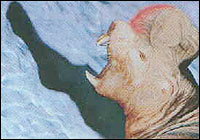 This morning, during my daily graze of news and commentary, I’ve come across some fairly excellent science-themed April Fool’s jokes. But it will take an exceptional hoax to mount a serious challenge to what is arguably the finest science-themed April Fool’s joke of all time, which today celebrates its fifteenth anniversary:
 The samples were from the island of Gotland, and date from 2,800-2,200 BCE. In other words, contemporaneous with the Sumerian civilization and Old Kingdom Egypt. This might be prehistoric in Europe, but not on a worldwide scale. They were from the
  Scientists have discovered the part of the brain that makes people gullible, it was claimed today. The findings could have massive implications for treating the growing number of people who fall wide-eyed for sensationalist media reports.


 Influence of the epicanthal fold on the perceived direction of gaze.

 What’s to be done with the waste oil left behind in fast food restaurants after all the French fries, onion rings, and chicken nuggets have been sizzled to perfection? While many enterprising tinkerers
  Offshore
  Imagine filming a movie hundreds of thousands of times with an infinitely patient crew. Every time you shoot it, you remove just one thing, be it an actor, a line of dialogue or a crew member. By comparing the resulting films, you’d soon work out which elements were vital to the movie’s success, and which could be lost without consequence. Beate Neumann, Thomas Walter and a group of scientists known as the Mitocheck Consortium have taken just such an approach to better understand one of the most fundamental processes of life.
 Is the Vietnamese government following China’s example, and muffling online dissent to pursue its own political ends? Internet giant Google seems to think so. Writing on the company’s