Author: Guest

  • Kill Spill, Pass Bill! – As BP stems flow (for now), Obama asserts, “This disaster should serve as a wake-up call that it’s time to move forward on” climate bill.

    Kill SPillThe 37th day since the explosion at the Deepwater Horizon oil rig saw several very dark clouds in the BP oil disaster, as well as a silver lining.

    BP undertook a “top kill” maneuver to staunch the river of oil coming from the damaged well.   This effort involved shooting drilling muds into the drilling apparatus on the ocean floor to block the oil from escape:

    In the top kill maneuver, a 30,000-horsepower engine aboard a ship injected heavy drill liquids through two narrow flow lines into the stack of pipes and other equipment above the well to push the escaping oil and gas back down below the sea floor.

    This effort appears to have worked – for now.  The New York Times just reported

    Engineers appeared to have stemmed the flow of oil, Adm. Thad W. Allen of the Coast Guard, the leader of the government effort, said on Friday morning. But he stressed that the next 12 to 18 hours will be “very critical” in permanently stanching what is already the worst oil spill in United States history.

    The success of this effort to plug the hole is critical to the public, economic, and ecological health of the Gulf Coast because experts now believe that much more oil is flooding the Gulf than previously estimated.  The federal government’s analysis of the oil flow rate through the drill site found that it was two to five times greater than the earlier estimate of 5,000 barrels of oil per day.

    USGS Director Dr. Marcia McNutt today announced that the National Incident Command’s Flow Rate Technical Group (FRTG) has developed an independent, preliminary estimate of the amount of oil flowing from BP’s leaking oil well…

    Based on three separate methodologies, outlined below, the independent analysis of the Flow Rate Technical Group has determined that the overall best initial estimate for the lower and upper boundaries of flow rates of oil is in the range of 12,000 and 19,000 barrels per day.

    This translates to 504,000 to 798,000 gallons of oil per day have flowed from beneath the seabed into the Gulf of Mexico.  The flood of oil could total between 18 million to nearly 30 million gallons since the Gulf nightmare began on April 20th.  The Exxon Valdez incident spilled over 11 million gallons of oil into Prince William Sound in 1989.   The BP oil disaster now has the dubious record as the largest oil debacle in U.S. history.

    After the initial explosion, Secretary of the Interior Ken Salazar launched a quick examination of the BP oil disaster, and to develop recommendations for immediate safety measures.  He also declared a thirty day time out in new drilling, although the New York Times determined that “despite moratorium, drilling projects move ahead.”

    On May 28th, the Department of Interior presented that report to the President. It recommended a longer time out for oil leasing, exploration, and drilling time in deep waters until the completion of the independent investigation led by former Senator Bob Graham and former EPA Administrator William Reilly.  During his remarks today, the President announced this six month time out.

    Its initial recommendations include aggressive new operating standards and requirements for offshore energy companies, which we will put in place.

    Additionally, after reading the report’s recommendations with Secretary Salazar and other members of my administration, we’re going to be ordering the following the actions.

    First, we will suspend the planned exploration of two locations off the coast of Alaska.

    Second, we will cancel the pending lease sale in the Gulf of Mexico and the proposed lease sale off the coast of Virginia.

    Third, we will continue the existing moratorium and suspend the issuance of new permits to drill new deepwater wells for six months.

    And four, we will suspend action on 33 deepwater exploratory wells currently being drilled in the Gulf of Mexico.

    This is a welcome reprieve for the northern coast of Alaska because it halts the exploratory wells that Shell was set to drill in the Chukchi and Beaufort Seas.  The Alaska Wilderness League notes that

    The Beaufort and Chukchi Seas, the Arctic waters north of Alaska, are sometimes known as America’s ‘Polar Bear Seas’ – and for good reason…  These waters are home to the entire population of U.S. polar bears…Many of America’s most beloved sea animals thrive here, including the endangered bowhead whale, sea otters, walrus, seals and countless birds.

    Little is known about the effects of a recently-proposed massive oil and gas program on this fragile ecosystem. The government’s Mineral Management Service predicted a 33 to 50 percent likelihood of a large oil spill in the Chukchi Sea alone if drilling proposals were to move forward, while acknowledging that the technology needed to clean up such a spill does not exist.

    The report also made the following recommendations (subscription required) to improve safety on rigs.

    Among the new safety restrictions Salazar is recommending in a report to Obama are requirements for all blowout preventers to be certified, stronger well control, tougher inspections, and expanded safety and training programs for rig workers.

    In addition to describing the Administration’s efforts to respond to the oil spill, President Obama once again urged the Senate to pass comprehensive clean energy and global warming legislation:

    This economic and environmental tragedy … underscores the urgent need for this nation to develop clean, renewable sources of energy.

    The House of Representatives has already passed a bill that would finally jump-start a permanent transition to a clean-energy economy. And there is currently a plan in the Senate, a plan that was developed with ideas from Democrats and Republicans, that would achieve the same goal.

    This disaster should serve as a wake-up call that it’s time to move forward on this legislation. It’s time to accelerate the competition with countries like China who’ve already realized the future lies in renewable energy. And it’s time to seize that future ourselves. So I call on Democrats and Republicans in Congress, working with my administration, to answer this challenge once and for all.

    To accomplish this critical goal, President Obama and Senate leaders must role up their sleeves, and pass legislation which would reduce oil use, establish new safety standards for offshore oil drilling, and cut global warming pollution.  We don’t have much time left.

    Guest blogger Daniel J. Weiss is a Senior Fellow and Director of Climate Strategy at the Center for American Progress.

  • Stavins on Senate climate bill: “82% of the value of allowances accrue to consumers and public purposes, and some 18% accrue to covered, private industry.”

    Harvard economist Robert Stavins analyzes the American Power Act’s allowance distribution in this repost.  Here are his main conclusions:

    Going forward, many observers and participants in the policy process may continue to question the wisdom of some elements of the Kerry-Lieberman proposal, including its allowance allocation.  There’s nothing wrong with that.

    But let’s be clear that, first, for the most part, the specific allocation of free allowances affects neither the environmental performance of the cap-and-trade system nor its aggregate social cost.

    Second, we should recognize that the legislation is by no means a corporate give-away.  On the contrary, 82% of the value of allowances accrue to consumers and public purposes, and some 18% accrue to covered, private industry.  This split is roughly consistent with the recommendations of independent economic research.

    Finally, it should not be forgotten that the much-lamented deal-making for shares of the allowances for various purposes that took place in the deliberations leading up the announcement by Senators KerryLieberman was a good example of the useful, important, and fundamentally benign mechanism through which a cap-and-trade system provides the means for a political constituency of support and action to be assembled, without reducing the policy’s effectiveness or driving up its cost

    [JR:  What follows is Stavins’ full analysis from Harvard’s Belfer Center for Science and International Relations Blog.]

    As with the Waxman-Markey bill (H.R. 2454), passed by the House of Representatives last June, there is now some confusing commentary in the press and blogosphere about the allocation of allowances in the new Senate proposal — the American Power Act of 2010 — sponsored by Senator John Kerry, Democrat of Massachusetts, and Senator Joseph Lieberman, Independent of Connecticut.  As before, the mistake is being made of confusing the share of allowances that are freely allocated versus auctioned with (the appropriate analysis of) the actual incidence of the allowance value, that is, who ultimately benefits from the allocation and auction revenue.

    In this essay, I assess quantitatively the actual incidence of the allowance value in the new Senate proposal, much as I did last year with the House legislation.  I find (as with Waxman-Markey) that the lion’s share of the allowance value — some 82% — goes to consumers and public purposes, and only 18% accrues to covered, private industry.   First, however, I place this in context by commenting briefly on the overall Senate proposal, and by examining in generic terms the effects that allowance allocations have — and do not have — in cap-and-trade systems.

    The American Power Act of 2010

    You may be wondering why I am bothering to write about the Kerry-Lieberman proposal at all, given the conventional wisdom that the likelihood is very small of achieving the 60 votes necessary in the Senate to pass the legislation (particularly with the withdrawal of Senator Lindsay Graham — Republican of South Carolina — from the former triplet of Senate sponsors).  Two reasons.  First, conventional wisdoms often turn out to be wrong (although I must say that the vote count on Kerry-Lieberman does not look good, with the current tally according to Environment & Energy Daily being 26 Yes, 11 Probably Yes, 31 Fence Sitters, 10 Probably No, and 22 No).  Second, if the conventional wisdom turns out to be correct, and the 60-vote margin proves insurmountable in the current Congress, then when the Congress returns to this issue — which it inevitably will in the future  — among the key starting points for Congressional thinking will be the Waxman-Markey and Kerry-Lieberman proposals.  Hence, the design issues do matter.

    The American Power Act, like its House counter-part, is a long and complex piece of legislation with many design elements in its cap-and-trade system (which, of course, is not called “cap-and-trade” — but rather “reduction and investment”), and many elements that go well beyond the cap-and-trade system (sorry, I meant to say the “reduce-and-invest” system).  Perhaps in a future essay, I will examine some of those other elements (wherein there is naturally both good news and bad news), but for today, I am focusing exclusively on the allowance allocation issue, which is of central political importance.

    Before turning to an empirical examination of the Kerry-Lieberman allowance allocation, it may be helpful to recall some generic facts about the role that allowance allocations play in cap-and-trade systems.

    The Role of Allowance Allocations in Cap-and-Trade Systems

    It is exceptionally important to keep in mind what is probably the key attribute of cap-and-trade systems:  the particular allocation of those allowances which are freely distributed has no impact on the equilibrium distribution of allowances (after trading), and therefore no impact on the allocation of emissions (or emissions abatement), the total magnitude of emissions, or the aggregate social costs.  (There are some caveats, about which more below.)  By the way, this independence of a cap-and-trade system’s performance from the initial allowance allocation was established as far back as 1972 by David Montgomery in a path-breaking article in the Journal of Economic Theory (based upon his 1971 Harvard economics Ph.D. dissertation). It has been validated with empirical evidence repeatedly over the years.

    Generally speaking, the choice between auctioning and freely allocating allowances does not influence firms’ production and emission reduction decisions (although it’s true that the revenue from auctioned allowances can be used for a variety of public purposes, including cutting distortionary taxes, which can thereby reduce the net cost of the program).  Firms face the same emissions cost regardless of the allocation method.  When using an allowance, whether it was received for free or purchased, a firm loses the opportunity to sell that allowance, and thereby recognizes this “opportunity cost” in deciding whether to use the allowance.  Consequently, the allocation choice will not — for the most part — influence a cap’s overall costs.

    Manifest political pressures lead to different initial allocations of allowances, which affect distribution, but not environmental effectiveness, and not cost-effectiveness.  This means that ordinary political pressures need not get in the way of developing and implementing a scientifically sound, economically rational, and politically pragmatic policy.   With other policy instruments — both in the environmental realm and in other policy domains — political pressures often reduce the effectiveness and/or increase the cost of well-intentioned public policies.  Cap-and-trade provides natural protection from this.  Distributional battles over the allowance allocation in a cap-and-trade system do not raise the overall cost of the program nor affect its environmental impacts.

    In fact, the political process of states, districts, sectors, firms, and interest groups fighting for their share of the pie (free allowance allocations) serves as the mechanism whereby a political constituency in support of the system is developed, but without detrimental effects to the system’s environmental or economic performance.  That’s the good news, and it should never be forgotten.

    But, depending upon the specific allocation mechanisms employed, there are several ways that the choice to freely distribute allowances can affect a system’s cost.  Here’s where the caveats come in.

    Some Important Caveats

    First, as I said above, auction revenue may be used in ways that reduce the costs of the existing tax system or fund other socially beneficial policies.  Free allocations forego such opportunities.

    Second, some proposals to freely allocate allowances to electric utilities may affect electricity prices, and thereby affect the extent to which reduced electricity demand contributes to limiting emissions cost-effectively.  Waxman-Markey and Kerry-Lieberman both allocate a significant number of allowances to local (electricity) distribution companies, which are subject to cost-of-service regulation even in regions with restructured wholesale electricity markets.  Because the distribution companies are subject to cost-of-service regulation, the benefit of the allocation will ultimately accrue to electricity consumers, not the companies themselves.  While these allocations could increase the overall cost of the program if the economic value of the allowances is passed on to consumers in the form of reduced electricity prices, if that value is instead passed on to consumers through lump-sum rebates, the effect can be to compensate consumers for increased electricity prices without reducing incentives for energy conservation.  (There are some legitimate behavioral questions here about how consumers will respond to such rebates; these questions are best left to ongoing economic research.)

    Third, “output-based updating allocations” can be useful for addressing competitiveness impacts of a climate policy on particularly energy-intensive and trade-sensitive sectors, but these allocations can provide perverse incentives and drive up the costs of achieving a cap if they are poorly designed.  This merits some explanation.

    An output-based updating allocation ties the quantity of allowances that a firm receives to its output (production).  Such an allocation is essentially a production subsidy.  While this affects firms’ pricing and production decisions in ways that can, in some cases, introduce unintended consequences and increase the cost of meeting an emissions target, when applied to energy-intensive trade-exposed industries, the incentives created by such allocations can contribute to the goal of reducing emission leakage abroad.

    This approach is probably superior to an import allowance requirement, whereby imports of a small set of specific commodities must carry with them CO2 allowances, because import allowance requirements can damage international trade relations.  The only real solution to the competitiveness issue is to bring key non-participating countries within an international climate regime in meaningful ways, an obviously difficult objective to achieve.  (On this, please see the work of the Harvard Project on International Climate Agreements.)

    Is the Kerry-Lieberman Allowance Allocation a Corporate Give-Away?

    Perhaps unintentionally, there has been some potentially misleading coverage on this issue.  At first glance, about half of the allowances would be auctioned and about half freely allocated over the life of the program, 2012-2050.  (In the early years, the auction share is smaller, reflecting various transitional allocations that phase out over time.)  But looking at the shares that are auctioned and freely allocated can be very misleading.

    Instead, the best way to assess the real implications is not as “free allocation” versus “auction,” but rather in terms of who is the ultimate beneficiary of each element of the allocation and auction, that is, how the value of the allowances and auction revenue are allocated.  On closer inspection, it turns out that many of the elements of the apparently free allocation accrue to consumers and public purposes, not private industry.  Indeed, my conclusion is that over the period 2012-2050, less than 18% of the allowance value accrues to industry.

    First, let’s looks at the elements which will accrue to consumers and public purposes.  Next to each allocation element is the respective share of allowances over the period 2012-2050:

    I.  Cost Containment

    a.  Auction from cost containment reserve, 3.1%

    II.  Indirect Assistance to Mitigate Impacts on Energy Consumers

    b.  Electricity local distribution companies, 18.6%

    c.  Natural gas local distribution companies, 4.1%

    d.  State programs for home heating oil, propane, and kerosene consumers, 0.9%

    III.  Direct Assistance to Households and Taxpayers

    e.  Allowances auctioned to provide tax and energy refunds for low-income households, 11.7%

    f.  Allowances auctioned for universal tax refunds, 22.3%

    IV.  Other Domestic Priorities

    g.  State renewable and energy efficiency programs, 0.6%

    h.  State and local agency programs to reduce emissions through transportation projects, 1.9%

    i.  Grants for national surface transportation system, 1.9%

    j.  Auctioned allowances for Highway Trust Fund, 1.9%

    k.  Domestic adaptation, 1.0%

    l.  Rural energy savings (consumer loans to implement energy efficiency measures), 0.1%

    V.  International Funding

    m.  International adaptation, 1.0%

    VI.  Deficit Reduction

    n.  Allowances auctioned for deficit reduction, 7.4%

    o.  Remaining allowances auctioned to offset bill’s impact on deficit, 6.1%

    Next, the following elements will accrue to private industry, again with average (2012-2050) shares of allowances:

    I.  Allocations to Covered Entities

    a.  Energy-intensive, trade-exposed industries, 7.0%

    b.  Petroleum refiners, 2.2%

    c.  Merchant coal-fired electricity generators, 2.2%

    d.  Generators under long-term contracts without cost recovery, 0.9%

    II.  Technology Funding

    e.  Carbon capture and sequestration incentives, 3.8%

    f.  Clean energy technology R&D, 0.7%

    g.  Low-carbon manufacturing R&D, 0.3%

    h.  Clean vehicle technology incentives, 0.3%

    III.  Other Domestic Priorities

    i.  Manufacturing plant energy efficiency retrofits, 0.1%

    j.  Compensation for early action emissions reductions prior to cap’s implementation, 0.1%

    The bottom line?  Over the entire period from 2012 to 2050, 82.6% of the allowance value goes to consumers and public purposes, and 17.6% to private industry. Rounding error brings the total to 100.2%, so to be conservative, I’ll call this an 82%/18% split.

    Moreover, because some of the allocations to private industry are – for better or for worse – conditional on recipients undertaking specific costly investments, such as investments in carbon capture and storage, part of the 18% free allocation to private industry should not be viewed as a windfall.

    I should also note that some observers (who are skeptical about government programs) may reasonably question some of the dedicated public purposes of the allowance distribution, but such questioning is equivalent to questioning dedicated uses of auction revenues.  The fundamental reality remains:  the appropriate characterization of the Kerry-Lieberman allocation is that about 82% of the value of allowances go to consumers and public purposes, and 18% to private industry.

    Comparing the Kerry-Lieberman 82/18 Split with Recommendations from Economic Analyses

    The 82-18 split is roughly consistent with empirical economic analyses of the share that would be required – on average — to fully compensate (but no more) private industry for equity losses due to the policy’s implementation.  In a series of analyses that considered the share of allowances that would be required in perpetuity for full compensation, Bovenberg and Goulder (2003) found that 13 percent would be sufficient for compensation of the fossil fuel extraction sectors, and Smith, Ross, and Montgomery (2002) found that 21 percent would be needed to compensate primary energy producers and electricity generators.

    In my work for the Hamilton Project in 2007, I recommended beginning with a 50-50 auction-free-allocation split, moving to 100% auction over 25 years, because that time-path of numerical division between the share of allowances that is freely allocated to regulated firms and the share that is auctioned is equivalent (in terms of present discounted value) to perpetual allocations of 15 percent, 19 percent, and 22 percent, at real interest rates of 3, 4, and 5 percent, respectively.  My recommended allocation was designed to be consistent with the principal of targeting free allocations to burdened sectors in proportion to their relative burdens, while being politically pragmatic with more generous allocations in the early years of the program.

    So, the Kerry-Lieberman 82/18 allowance split (like the 80/20 Waxman-Markey allowance split) turns out to be consistent  — on average, i.e. economy-wide — with independent economic analysis of the share that would be required to fully compensate (but no more) the private sector for equity losses due to the imposition of the cap, and consistent with my Hamilton Project recommendation of a 50/50 split phased out to 100% auction over 25 years.

    The Path Ahead

    Going forward, many observers and participants in the policy process may continue to question the wisdom of some elements of the Kerry-Lieberman proposal, including its allowance allocation.  There’s nothing wrong with that.

    But let’s be clear that, first, for the most part, the specific allocation of free allowances affects neither the environmental performance of the cap-and-trade system nor its aggregate social cost.

    Second, we should recognize that the legislation is by no means a corporate give-away.  On the contrary, 82% of the value of allowances accrue to consumers and public purposes, and some 18% accrue to covered, private industry.  This split is roughly consistent with the recommendations of independent economic research.

    Finally, it should not be forgotten that the much-lamented deal-making for shares of the allowances for various purposes that took place in the deliberations leading up the announcement by Senators KerryLieberman was a good example of the useful, important, and fundamentally benign mechanism through which a cap-and-trade system provides the means for a political constituency of support and action to be assembled, without reducing the policy’s effectiveness or driving up its cost.

    Robert N. Stavins is the Albert Pratt Professor of Business and Government, Director of the Harvard Environmental Economics Program, and Chairman of the Environment and Natural Resources Faculty Group.

    Related posts:

  • Why do we give oil companies such large subsidies?

    How can we hold oil companies more accountable? Sima Gandhi, Senior Policy Analyst at CAP has the scoop in this “ask the expert” video.


    For more information, see:

  • Fox news anchors: “We can’t trust BP”

    Five weeks into the worst environmental catastrophe in the history of the United States, even the right-wing Fox networks are turning on BP, the foreign oil behemoth responsible for the undersea oil volcano now fouling the shores of Louisiana.  Brad Johnson has the story in this TP repost.

    On Monday, Fox News anchor Shepard Smith challenged top White House adviser David Axelrod why the administration continues to trust BP, whose CEO Tony Hayward bet the disaster will have a “very very modest” impact on the Gulf of Mexico, claimed BP had “contained” the spill, and complained that Americans are too litigious:

    And this is the chief executive of the company that’s in charge of cleaning up this disaster now? Who calls us litigious? Who makes comments about the comparative volume of oil and then says the environmental impact is very minimal? And this is the guy we as Americans are supposed to entrust with the largest ecological disaster in American history? Tony Hayward?

    On Wednesday, Fox Business Network anchor Liz Claman interviewed John Williams, executive director of the Southern Shrimper Alliance, whose industry is threatened with extinction by the millions of gallons of dispersed oil contaminating the Gulf Coast. Claman noted that “we can’t trust BP”:

    I think one thing we do know is that we can’t trust BP with information at this point. They were the ones, absolutely, you’re correct, who said, “Oh, don’t worry, the oil will not reach the beaches.” Oh, come on!

    Watch a compilation:

    This righteous anger at big oil is a remarkable turnaround for the networks that lied about the oil spills caused by Hurricane Katrina, deny the threat of oil pollution to the planet, and shilled for offshore drilling during the “Drill, Baby, Drill” summer of 2008.

    Update: Various media outlets are reporting that BP’s “top kill” procedure has apparently halted the flow of oil and gas from the well.
    Think Progress repost by Brad Johnson.
  • Rove finally admits Bush really blew it during Katrina

    Today in the Wall Street Journal, Karl Rove pens an op-ed titled: “Yes, the Gulf Spill is Obama’s Katrina.” He predictably places blame on Obama for a supposedly inadequate response to the BP oil spill. But the real significance of the op-ed is not what conservative-strategist Rove has to say about Obama; rather, it’s that Rove is implicitly acknowledging that Bush screwed up the response to Katrina. Rove is essentially trying to make the case that Obama mismanaged a disaster almost as terribly as he and Bush did.  TP explains why this op-ed is news, but not the way Rove thinks.

    This is breaking news because, for years, despite all the evidence to the contrary, Rove has defended his administration’s disastrous response to Hurricane Katrina. As recently as March, Rove told ABC News:

    The federal government’s responsibilities were met under Katrina which were to provide the immediate assistance, to pluck people off of the roofs.

    And in his recently released memoir, Rove “staunchly defends” Bush’s handling of the disaster, and praises former FEMA administrator Michael “Heck of a job, Brownie” Brown.

    It’s refreshing to see Rove finally concede his own failures, albeit in a roundabout way. After all, it was he who “was in charge” of the botched reconstruction effort. In his book, Rove touted, “I’m one of the people responsible” for the administration’s response to Katrina.

    Rove’s analysis would be sharper if he noted that “Obama’s Katrina” actually highlights some very real Bush and Cheney failures. By filling the Minerals Management Service — the government agency responsible for regulating off shore oil drilling — with industry shills who took drugs and had sex with the officials they were supposed to be policing, the Bush administration dangerously eroded the regulatory regime, and missed warnings that could have helped prevent the BP disaster.

    Reposted from Think Progress.

    JR:  I would add that in the case of Katrina, the Bush administration ignored its own administration’s weather forecasts for days.   In the case of the spill, the reverse is true.  BP basically misled everybody about the size of the spill — by a factor of 5 — and hence their ability to control it.  It was NOAA — which is to say the Obama administration — that realized BP was lowballing the leak, that the problem was beyond the company’s resources, and that much broader action was needed (see “Looks like BP stands for Burning Petroleum; worst spill since ExxonValdez heads for LA coast“).

  • Fishermen hired by BP for oil clean up weren’t provided protective equipment, have now fallen ill.

    The Los Angeles Times reports that some fishermen have “become ill after working long hours near waters fouled with oil and dispersant.”  This is a TP repost.

    With last month’s massive oil spill at the Deepwater Horizon rig in the Gulf of Mexico threatening the livelihood of the area’s fishermen, BP said it would “hire as many local residents as possible to clean the beaches and distribute booms through the surrounding marshes and waterways.” But the effort has hit a few bumps with fishermen complaining that “too few people” were being hired and their cleanup contracts contained problems.

    At least one worker says he wasn’t given protective equipment by BP:

    Like other cleanup workers, Jackson had attended a training class where he was told not to pick up oil-related waste. But he said he wasn’t provided with protective equipment and wore leather boots and regular clothes on his boat.

    “They [BP officials] told us if we ran into oil, it wasn’t supposed to bother us,” Jackson said. “As far as gloves, no, we haven’t been wearing any gloves.”

    BP spokesman Graham McEwen told the LA Times that “he was unaware of any health complaints among cleanup workers,” adding that “the fishermen the company is training are not being deployed into areas that require respirators or breathing apparatus. Those who are working for BP laying booms or skimming oil are issued protective coveralls and gloves.” However, George Barisich, president of the United Commercial Fishermen’s Association. in St. Bernard Parish, said that fishermen “complained to a BP representative about illness” at a recent meeting. “BP has the opinion that they are not getting sick,” Barisich said.

    Related Posts:

  • BP runs full-page ads in major newspapers defending its oil spill response: “We have taken full responsibility” – Plus a must-see spoof TV ad: “Brown. It’s the New Green.”

    Two new ironic ads on the BP oil disaster — though only the first one is intentionally ironic:

    What follows is a Think Progress repost.

    Since the disastrous Gulf Coast oil spill, BP and the other companies responsible for the tragedy have been beefing up their lobbying and public relations efforts. Today, the oil giant has full-page ads in the Washington Post, New York Times, Wall Street Journal, and USA Today defending its response to the oil spill. From the ad:

    Since the tragic accident on the Transcocean Deepwater Horizon rig first occurred, we have been committed to doing everything possible to stop the flow of oil at the seabed, collect the oil on the surface and keep it away from the shore.

    BP has taken full responsibility for dealing with the spill. We are determined to do everything we can to minimize any impact. We will honor all legitimate claims.

    BP’s ads come as a new poll finds that 76 percent of the American public disapproves of how the company is handling the spill. And BP is not taking “full responsibility” for the spill. In fact, officials have repeatedly tried to downplay the disaster and argued that attempts to accurately measure the rate of flow at the seabed are impossible and unnecessary:

    – Tony Haywood, BP CEO: “I think the environmental impact of this disaster is likely to be very, very modest. It is impossible to say and we will mount, as part of the aftermath, a very detailed environmental assessment as we go forward.” [5/18/10]

    – Haywood: “The Gulf of Mexico is a very big ocean. The amount of volume of oil and dispersant we are putting into it is tiny in relation to the total water volume.” [5/14/10]

    – Lamar McKay, President of BP America: “The volume estimates are based effectively on surface expression, because you can’t measure what’s coming out at the seabed.” [Senate testimony, 5/12/10]

    – Tom Mueller, BP: “We’re not going to take any extra efforts now to calculate flow there at this point. It’s not relevant to the response effort, and it might even detract from the response effort.” [5/14/10]

    – Doug Suttles, BP COO, Global Exploration: “Since the beginning, we’ve said it’s almost impossible to get a precise number. But ourselves and people from NOAA and others believe that something around 5,000 — it’s actually barrels a day — is the best estimate.” [ABC News, 5/14/10]

    In Boston Globe op-ed today, columnist Derrick Z. Jackson hits BP for its ads:

    It is difficult to conceive of a more resounding insult to our intelligence than BP’s full-page advertisements in the New York Times and USA Today about its response to the massive oil spill in the Gulf of Mexico.

    The most intriguing paragraph of the BP ad was, “This is an enormous team effort. More than 2,500 of our operational and technical personnel from around the world are working tirelessly in coordination with the U.S. Coast Guard, and federal, state and local government agencies.’’

    But until Deepwater Horizon exploded, BP’s idea of working tirelessly with government agencies was lobbying them to bypass environmental-impact reviews for well permits. Yesterday, the Times had yet another story on how drilling projects have proceeded with environmental waivers, despite President Obama’s so-called moratorium on permits. Deepwater Horizon received an environmental waiver last year and received another one just before the April explosion.

    While BP will likely survive this tragedy because of its massive profits, these attempts to shirk responsibility are already beginning to drag the company down in the public’s eyes.

    Amanda Terkel

  • Study: With $27 trillion global market at stake, it’s time for the U.S. to lead in clean technology

    A new WWF report has come out further emphasizing the great need for the US to do more to seize its fair share of the growing multi-trillion dollar clean energy export market. This repost by Lynn Englum from WWF’s blog gives an overview.

    Numerous news articles/op-ed pieces (see here, here & here) along with warnings from high-ranking governmental officials (see here & here) and Congressmen from both sides of the political spectrum have warned that the U.S. is losing the clean energy race to Europe, Japan and China.  These countries are ramping up their national renewable energy portfolios and gaining export market share, positively positioning themselves for the largest future export markets in clean technology deployment—the developing world. According to the International Energy Agency (IEA), approximately $27 trillion will need to be invested in clean technologies in developing countries over the next four decades.

    Why will these future markets be so large? In coming years, emissions will grow most sharply in developing countries, making clean technology deployment vitally important. The U.S. has enormous potential to lead in these markets, but without U.S. legislation that puts a price on carbon and includes public finance to help unlock developing country markets for clean energy, America will continue to fall behind top competitors and miss important opportunities.

    A new WWF report, Getting Back in the Game, reveals the potential for U.S. market share in clean technology deployment in the developing world. WWF estimates that the $27 trillion investment needed in developing countries translates into a $150-450 billion annual export market. The report finds that if the U.S. is able to capture a 14% market share of this potential clean tech export market—on par with our current market share in environmental goods and services in developing countries—280,000-850,000 new, long-term American jobs would result.

    A crucial component for harnessing the clean technology export market is public financing. Although private capital will provide the substantial majority of the finance for clean energy development, public financing to undertake key policy and institutional reforms and reduce investment risks in developing countries is needed to prime the pump. Well-targeted public investments can leverage much larger amounts of private capital and benefit American businesses by opening new markets for U.S. clean energy industries, spurring innovation and lowering costs for clean technologies.

    Including public finance in a climate and energy bill is vital for generating a dedicated stream of revenue, avoiding the volatility of yearly congressional budget approval. Previous versions of the climate bill (House-passed Waxman-Markey bill & Senate’s Kerry-Boxer bill) set aside 1% of revenues from allowances to develop markets and overcome barriers to clean technology uptake in developing countries and help facilitate U.S. exports to these new markets.

    To unlock new opportunities, this set-aside (which is not currently in the American Power Act) must be preserved and a climate and energy bill must be passed. Without legislative passage and public finance components, the U.S. will continue to hemorrhage clean energy market share to overseas competitors and fall behind in the energy race.

    See press release, Investing in Clean Energy Projects Abroad is Key to Creating Jobs, Growing Energy Tech Economy in U.S.

    ************************************************************

    Key findings of the report:

    • The US is falling behind top competitors, both in clean technology investments domestically, but also in exports of clean technologies abroad.
    • Developing countries offer the largest future export markets— The International Energy Agency estimates $27 trillion will need to be invested in the developing world in coming decades.
    • Getting back in the game requires that the US pass legislation that both puts a price on carbon domestically and includes public finance to help unlock developing country markets and accelerate demand for clean technologies.
    • US companies are positioned to take advantage of those new markets. Capturing a 14% market share in this new market could result in 280,000-850,000 new, long-term American jobs. However, being positioned to capture that market share depends on whether domestic industries are supported by passing comprehensive climate and energy legislation that puts a declining limit on carbon pollution

    Related Post:

  • ExxonMobil says we need to destroy our grandchildren’s future to save them

    http://www.greenpeace.org/usa/assets/graphics/exxonlies

    ExxonMobil anxiously grasps its gigantic but unsustainable gold mines, pumps cash (much of it from your wallet to places far away), pours GHGs into the atmosphere, pushes its publicity machine, and doesn’t seem to comprehend the relationships between a healthy climate and the lives of our grandchildren.  They try to confuse you in the process.  Their actions delay the creation of millions of jobs and our ability to author a healthier future.  And that’s putting it politely.

    ExxonMobil will be holding its Annual Meeting of Shareholders this week, on May 26 in Dallas.  If you get your news from the status quo media, you might not have a full picture of the company (see NYT suckered by ExxonMobil in puff piece titled “Green is for Sissies”).

    Guest columnist, frequent commenter, and former Chevron employee, Jeff Huggins paints a poignant portrait of the petro-giant.

    Huggins has worked for companies as diverse as Chevron, Disney, and McKinsey & Co. — he even had a job offer from Exxon at one point. Now he provides philosophical and strategic consulting to progressive companies, good causes, and individuals. His website is www.thewindingriver.org.  For details of Exxon’s role in funding the disinformation campaign on climate science, see “Another ExxonMobil deceit: They are still funding climate science deniers despite public pledge.”  See also this excellent commentary by award-winning journalist, Eric Pooley, “Exxon Works Up New Recipe for Frying the Planet.“

    In concluding his speech to the Royal Institute for International Affairs, titled “Meeting Growing Energy Demand and Addressing Climate Risks” (June 21, 2007), ExxonMobil Chairman and CEO Rex Tillerson quoted Bertrand Russell and expressed these sentiments:

    “The British philosopher and social activist Bertrand Russell once said, ‘We must care about the world of our children and grandchildren, a world we may never see.’

    “Indeed, we cannot yet see our grandchildren’s world, its economy or its climate. But we must care about it. We must care enough to treat the risks of global poverty and global warming seriously. We must care enough to take actions to address them.”

    Barely a year later, on July 19, 2008, The New York Times ran a short interview of Chairman Tillerson.  In response to the questions, “Where do you see your company in 20 years?  Will oil and gas still be your dominant business?”, he answered:

    “Yes.  In 2030, oil and gas will represent 60 percent of the world’s energy needs.  My view is I am going to keep doing what we do better than anyone else in the world—finding, developing and delivering oil and gas to the world.”

    (Petrarch wrote, “Anyone who wants a certain result, but is quite happy with the absence of what would bring it about, has obviously no understanding of either causes or effects.”  Einstein observed, “The significant problems we have cannot be solved at the same level of thinking with which we created them.”  But never mind them.)

    I can’t say, definitively, whether these are the same Rex Tillersons, whether he misunderstood what Bertrand Russell meant, or whether Version 2008 forgot his 2007 speech or neglected to read the IPCC reports and the urgent statements from the world’s leading scientific organizations.  Perhaps the news media should press him on the matter?

    Given that I’m not a member of the media, however—and thus I have no fear that ExxonMobil will stop running ads on my front page or network—I thought I should offer a timely portrait of ExxonMobil to The American Public, as the big event nears.

    The “big event”?  ExxonMobil will be holding its Annual Meeting of Shareholders this week, on May 26 in Dallas.

    Before I begin, I should say that the following is not meant to be financial investment advice and should not be taken as such.  Harvard lawyers—some of them who are not already in Washington—advised me to say so.  And, if any of this causes dizziness, or any unwanted symptoms that last more than 24 hours, you may want to see your doctor.  Importantly, you should check any of the following factors and figures before using them to form any opinions of consequence.  Yet, from a human and ethical standpoint, if you want to have your investments in companies that act responsibly with respect to humankind, other species, the planet, and your grandchildren, my suggestion would be to promptly dump Exxon.  That said, you be the judge.

    Let’s start with the big picture—and indeed it’s Big:

    According to ExxonMobil’s 2009 Summary Annual Report, they had a “Total net production of liquids and natural gas available for sale of 3.9 million oil-equivalent barrels per day”.

    Based on that figure, and according to a rough but easy estimate, that suggests that ExxonMobil products, when used, generate over One Trillion Pounds of CO2 each year.  That’s from ExxonMobil products alone.  In a single year.  And it doesn’t even include another huge number, which is the amount of GHGs generated in ExxonMobil’s internal operations.

    What’s the precise number?  I don’t know.  I’ve asked ExxonMobil, and they’ve corresponded with me, but they won’t provide it.  Maybe The New York Times will think to ask them.

    For now, suffice it to say that ExxonMobil products and operations generate well over One Trillion Pounds of CO2 per year and perhaps even more than Two Trillion Pounds per year (in CO2-equivalent terms) of total GHGs.  In any case, the amount generated weighs considerably more than the weight of the entire human species living on Earth today—in other words, more than all 6.8 billion of us weigh, in total.

    Yes, that’s a lot!  Certainly enough to warrant a very, very heavy conscience!

    That said, they do make money:  ExxonMobil is the most profitable company in the U.S. and, possibly, in the galaxy.  According to the recent Fortune 500 listing, ExxonMobil’s profits in 2009 were greater than the combined profits of the top fifteen companies in the motor vehicles and parts industry (Ford, GM, etc.), the top three apparel companies (Nike, etc.), the two major advertising conglomerates, the seven major entertainment companies (Disney, News Corp., Time Warner, etc.), and the five major networking and communications equipment companies (Cisco, Motorola, etc.) combined.

    You read right:  ExxonMobil’s earnings were greater than the net earnings of all of the leading companies in those industries combined!

    And that was in a down year for ExxonMobil.  Their net income in 2009 was $19.3 Billion.  In 2008, it was $45.2 Billion.

    (To avoid misinterpretation before we proceed, I’m not suggesting that healthy profits are unhealthy or ungood.  Nor will I be suggesting, below, that a few other aspects of ExxonMobil’s modus operandi are problematic in and of themselves.  Instead, it’s the combined picture and its outcomes that cause concerns.)

    Yep, they’re the most profitable U.S. company.  A huge American company—headquartered in Texas (land of the Cowboys) and incorporated in New Jersey (land of the Boss).  But wait, where is the real action, according to the numbers?

    Well, in 2009, only 20% of their capital and exploration expenditures were spent in the U.S.  Eighty percent was spent in other countries.  Over three quarters (76%) of their total average capital employed is employed outside of the U.S., aside from corporate-level financing stuff.

    Here are a few other figures:

    Only about 16% of their net production of crude oil and natural gas liquids occurred in the U.S.

    Only about 14% of their “net natural gas production available for sale” occurred in the U.S.

    Only a third (33%) of their refinery throughput occurred in U.S. refineries.  (This actually surprised me:  I had thought that at least their refining capacity was mostly in the U.S.)

    About 39% of their petroleum product sales and chemical prime product sales occurred in the U.S.

    And here’s an interesting one:  Only one sixth (roughly 16.6%) of their earnings after income taxes were earned in the U.S.  In other words, over eighty percent of ExxonMobil’s earnings after taxes were attributable to operations outside the U.S.—presumably anyhow.  Only their tax accountant knows for sure.

    Apparently, home for Exxon is not exactly Kansas!

    Indeed, in their 2009 report, they list as a key highlight the “start-up of a world-scale, fully integrated refining and petrochemical complex in Fujian Province, China.”

    And here I was, thinking that we should be trying to reduce our use of fossil fuels and encouraging China to do the same.  Silly me!

    Let’s now consider ExxonMobil’s apparent attitude toward employment.  Set aside what those API ads would like you to believe—that the oil companies genuinely care about employment to the degree that they’d put their money where their mouth is—and let the numbers tell the story:

    In 2009, ExxonMobil’s revenues were $301.5 Billion, their net income was $19.3 Billion, and they employed roughly 80,700 people worldwide.  Eight years earlier, in 2001, revenues were about $210 Billion, income was roughly $15 Billion, and they employed about 98,000 people.  In other words, in 2009 they employed roughly seventeen thousand fewer people than in 2001.  During most of the recent decade, ExxonMobil has cut employment as its revenues and profits have soared, until the downturn of prices in 2009 from levels in 2008.  (In 2008, revenues were a whopping $459.6 Billion, net income was $45.2 Billion, and they employed 79,900 people.)

    And how do ExxonMobil’s employment figures compare to the big picture?  Is ExxonMobil a major employer—a pro-employment employer—a champion for the American worker?

    Well, not really.  As mentioned, ExxonMobil employs about 80,700 people, worldwide.  That compares to over 300,000 public school teachers employed by California alone, UPS’s 408,000 employees, General Electric’s 304,000 employees, HP’s 304,000 employees, GM’s 217,000 employees, Safeway’s 186,000 employees, Wal-Mart’s 2.1 Million employees, and over 6 Million teachers in the U.S.

    The oil industry is a small employer, relatively speaking.  (General Electric alone employs more people than ExxonMobil, Chevron, ConocoPhillips, Valero, Marathon, Sunoco, Hess, and Murphy combined, with room to spare.)  Exceptions to this point include the Chinese and Russian oil and gas industries, which are huge employers there—all the more reason why we’ll need to take steps to end our own addiction to oil if we ever expect to have any credibility whatsoever in working globally to reduce GHG emissions.

    Also, it’s unclear how many of ExxonMobil’s 80,700 employees are in the U.S.  Remember, less than one quarter of ExxonMobil’s capital is employed within the U.S., and U.S. operations accounted for only one sixth of their earnings after taxes.

    According to CBS News, General Motors’ employment in the U.S peaked in the late 1970s at over 600,000 employees—and about 850,000 worldwide.  GM has lost far more employees during the last three decades than the total number of employees, worldwide, of ExxonMobil, Chevron, ConocoPhillips, Valero, and Marathon combined.

    What about R&D?  Again, stats speak: For every dollar of revenue, ExxonMobil spent substantially less than one penny on R&D.  The figure in 2009 was 0.35 cents—about a third of a penny—spent on R&D, per dollar of sales.

    And that’s total R&D, including all the conventional R&D that oil companies pursue regarding conventional hydrocarbon-based fuels, production and refining processes, additives, chemicals, and so forth.  In other words, only a fraction of that fraction of one little penny is spent researching renewable sources of energy.

    So, imagine paying ExxonMobil $3 for a gallon of gas.  Of that $3, they spend about one penny on total R&D.  Only a fraction of that little penny is spent researching renewables.  Meanwhile, when you burn that gallon in your car, it generates about 20 pounds of CO2.  (For example, burning just seven gallons of gasoline generates an amount of CO2 that weighs as much as a 140-pound person.)  And where does the vast majority of your $3 go?  Not into R&D, to be sure.  Instead, most of it goes to places and people outside the U.S., where most of ExxonMobil’s capital is employed, most of their expenditures are made, and most of their oil and gas resources happen to be.

    Here’s another way to assess ExxonMobil’s commitment to R&D, all things considered:  ExxonMobil distributed more money to its shareholders in the recent five-year period alone—a total of over $150 Billion—than it would spend on R&D, at the current rate, in 142 years.  That’s only slightly less than the time since the Civil War.

    Does that sound like a company that’s genuinely “taking on the world’s toughest energy challenges” and acting responsibly to help address climate change?

    In their 2009 Summary Annual Report, ExxonMobil tells us, “Energy-related carbon dioxide (CO2) emissions represent close to 60 percent of global GHG emissions attributed to human activities, and are expected to increase about 25 percent from 2005 to 2030.”  Then, instead of telling us what we and they should do to make sure this increase doesn’t come to pass—after all, scientists inform us that we should decrease emissions, not increase them—ExxonMobil tells us that we’ll need more and more oil and gas.  In essence, their strategy perpetuates the problem.  Remember what Chairman Tillerson told The New York Times:  “I am going to keep doing what we do better than anyone else in the world—finding, developing and delivering oil and gas to the world.”  But the problem they perpetuate is the same one they tell us they care about!

    Are you dizzy yet?

    Would Chairman Tillerson suggest that we “care about the world of our children and grandchildren” by pouring GHGs into the atmosphere, altering and destabilizing the climate, acidifying the oceans, sending boatloads of money overseas, and blindly protecting an industry that employs few people, relatively speaking?  Or, would he admit that it would be much better to transition to clean energy sources, preserve the climate, keep our money here, generate brave new worlds of American jobs, and embrace a healthier future?

    And consider this:  When the U.S. House Select Committee on Energy Independence and Global Warming held its high-profile hearing back in 2008—on April Fools Day, no less—ExxonMobil sent one of its execs and Board members at the time, J.S. Simon, to deliver a prepared statement.  Mr. Simon explained to the Committee that the oil industry depends on very high earnings when times are good in order to sustain a high level of investment in the business over the long-term, including during less-good times.  In essence, he argued that enactment of the changes in tax law being considered—i.e., changes intended to encourage investment in clean energy—would unfairly reduce oil company cash flow and would “impact investment in future energy supplies”.  Yet, in their written statement, ExxonMobil didn’t bother to tell the Committee about the many billions of dollars it distributes to shareholders each year as dividends and buybacks.  (In their 2009 report, for example, they highlight the fact that they distributed a total of more than $150 Billion to shareholders in the last five years alone, including $26 Billion in 2009.)  How is it that the oil industry truly depends on a continuation of favorable tax treatment, supposedly necessary to its ability to sustain investment in oil and gas, when it distributes so many billions of dollars each year instead of reinvesting them?

    Another main point that Mr. Simon (ExxonMobil) wanted to convey to the Committee was that “all reliable and economic forms of energy are needed to meet growing needs—but the pursuit of alternative fuels must not detract from the development of oil and gas.”  Minutes later, he wanted the Committee to understand a forecast that “renewable energy sources such as biofuels, wind, solar and geothermal will account for only about two percent of global energy supply in 2030”, adding “again, an indicator of the scale [of continuing investment in oil and gas] required.”

    In essence, it seems that ExxonMobil told the Committee:  Don’t dare change our tax treatment.  We won’t find it attractive to continue to invest in our own business if you do.  Never mind our huge cash distributions.  And by the way, renewable energy sources aren’t going to amount to much anyhow.  But thanks for asking!

    (As a side note:  Very soon after appearing before the Committee on ExxonMobil’s behalf, Mr. Simon announced his retirement.)

    Of course, we haven’t even discussed ExxonMobil’s confusing and often misleading PR campaign, their lobbying efforts, and so forth.

    So what’s up?

    About 83% of ExxonMobil’s substantial “net proved developed and undeveloped reserves” of liquids is in countries other than the U.S.  And about 82% of their “net proved developed and undeveloped reserves” of natural gas is in countries other than the U.S.  In other words, the vast majority of ExxonMobil’s “black gold” mine is outside the U.S.  Most of it isn’t “Texas tea” as we heard on the Beverly Hillbillies.

    ExxonMobil anxiously grasps its gigantic but unsustainable gold mines, pumps cash (much of it from your wallet to places far away), pours GHGs into the atmosphere, pushes its publicity machine, and doesn’t seem to comprehend the relationships between a healthy climate and the lives of our grandchildren.  They try to confuse you in the process.  Their actions delay the creation of millions of jobs and our ability to author a healthier future.  And that’s putting it politely.

    Just think of the shiploads of money we’ll be sending overseas for years and years, the trillions of pounds of GHGs we’ll be pouring into the atmosphere, the lost opportunities to generate clean energy jobs here, and the world-class refineries that ExxonMobil will happily build in China, if we continue to foolishly follow the Exxonian way.

    Then just say no!

    (By the way, did I tell you the one about the new Chairman of General Motors who is also on ExxonMobil’s Board of Directors?)

    Be Well—or at least Get Well Soon,

    – Jeff Huggins

    Related Post:

  • Contests: Name the BP oil disaster and write Obama’s ‘pivot’ speech to the climate and clean energy jobs bill

    In my post last night, I noted that  many people are expecting the President to pivot from the BP oil disaster to the climate and clean energy bill.  But how exactly should he do that rhetorically?  I’m writing a piece on that subject and would love to hear your thoughts.

    Also, I have been mostly calling the unfolding disaster in the Gulf the “BP oil disaster,” which certainly beats the President’s “BP Deepwater Horizon Oil Spill.”  Guest blogger Dominique Browning has some  thoughts about the name and messaging below.  Again, I’d love to hear your ideas.

    As a professional editor, I’ve always paid close attention to words. Now that I’m writing regularly about climate change, I’m even more attentive to the language people use in engaging with this subject. It’s rife with jargon, rhetoric and innuendo–handy tools that environmentalists could use more adeptly. These days I’m focused on naming names.

    A scan online of news and blog headlines shows that we–editors and writers and, for that matter, politicians and environmentalists–are all over the place in giving a name to this disaster in the Gulf of Mexico. The New York Times is calling it the Gulf oil spill; others refer to the Gulf crisis or the BP spill. Environmentalists are in danger of missing the chance to give this gusher a name that will stick in the historical record. That would be a shame, because this event could alter our collective awareness of the grave danger we are facing.

    It is time to settle on a name. If you think this is irrelevant, consider, for instance, the Exxon Valdez. Notice how every single time that spill comes up (with great regularity these days, as it is dawning on us just how bad things are in the Gulf) the name of the culprit is attached. That’s perfect. We should be reminded of the perpetrators of environmental catastrophe.

    The only people who have settled on the terms with which they are discussing (or not) this disaster are the folks at BP. Why do you think they keep pushing the name Deepwater Horizon into the conversation? Whoever heard of that company before? Note that Wikipedia has now listed this disaster as the Deepwater Horizon Oil Spill, with secondary reference to it as the BP oil spill. Wonder how that happened? (An example of innuendo, but I do wonder….)

    BP doesn’t want to own this problem. They just leased it. But we don’t have to buy that. We need a name that eternally links BP with the Gulf–because BP is responsible. And we need a much stronger word than spill. Before much longer, we’ll be wishing a spill is all we were facing. This is a gusher with no known end.

    Speaking of rhetoric, by the way, when trying to persuade people that global warming is a crisis, all reference to “grandchildren” is unnecessary and inaccurate. This is a threat to you and your children; the problem isn’t a generation away. It is happening now. As usual, the “I don’t believe in global warming” crowd is better at defining the terms of the argument. (What argument? Well, they’ve created one, simply by using that phrase.) Just look at the idea embedded in the word “belief”. Belief, of course, has nothing to do with science. But it perfectly captures the margins of skeptical thinking that are always, and necessarily, at play among scientists–captures them, and co-opts them, with a spiritual twist.

    Environmentalists who want to join the public debate effectively have to name problems accurately, and find the most persuasive, honest and durable ways to talk about them. And stick with the terms until the terms stick. If we don’t do that, we are going to get caught in tricky, unpredictable, and endless currents. Just like the oil from the 2010 BP-Gulf Gusher. And yes, hyphens matter too.

    Guest blogger Dominique Browning writes a column called PERSONAL NATURE for the Environmental Defense Fund website. Her new book is SLOW LOVE: How I Lost My Job, Put on My Pajamas, & Found Happiness. She blogs at SLOWLOVELIFE.com

    As  I noted last night, it is time for the president to reframe the energy debate, as many have begged him to do (see “Is Obama blowing his best chance to shift the debate from the dirty, unsafe energy of the 19th century to the clean, safe energy of the 21st century?“ and Video: Robert Redford tells President Obama it’s time to lead “America on a path to cleaner, safer energy”).

    The public  is certainly craving leadership Obama’s campaign pollster: “In the aftermath of the oil spill disaster, voters overwhelmingly support a comprehensive clean energy bill…. Voters understand the dangers of our dependence on oil. Now, they’re ready to hold Congress accountable.”

    Even the uber-insiders at Politico point out it’s time for “President Obama to seize control of a deteriorating narrative. One solution: Step up in a bigger way on his promise to deliver comprehensive energy legislation, by reframing the debate over the spill from “who’s at fault” to “how we fix this problem in the long run.” Moving in this direction would shift the conversation away from a situation over which they have no control, to a key administration priority and a legislative debate that they can shape and drive.”

    Some commenters think the pivot is tricky in the face of this unfolding disaster.  How would you do it?

  • Good for your buns, good for the environment – Plus exercise bikes that turn human power into electricity

    Summer is right around the corner. This means that the time to make good on that New Year’s resolution to get in shape for the summer is upon us. But while planning your routine to achieve those killer glutes and abs, don’t forget about the effect your workout has on the environment. This CAP repost has some simple tips to keep getting fit earth friendly,  including how you can generate clean electricity during your workout.

    First of all, the great outdoors has some of the most energy efficient—and simple—workouts nature has to offer. Walking or jogging outside requires little waste-producing equipment other than running shoes, and saves precious CO2 compared to a treadmill workout, which uses two pounds of the stuff for a 30-minute run. And if hitting the pavement for half an hour sounds like a drag, combine a brisk jog to the supermarket with a stroll back home while toting your purchases for a workout that gets your heart rate up and helps tone your arms. Gardening, biking, and hiking also offer excellent opportunities for a zero-emission outdoors workout, and plenty of traditional exercises—jumping rope, squats, and pushups, to name a few—are easy to take outside as well.

    If you need a little more structure for your exercise plan, consider joining a gym over buying a home cardio machine, which produces extra waste and gets used less over its lifetime compared to gym machines that are constantly in use. Gyms use lots of electricity to power their machines, air conditioning, and lights, but eco-friendly ones are becoming more and more common. Look for a gym that uses energy efficient equipment, such as treadmills that use about one-third less energy than traditional ones, and lights and televisions that are turned on only when needed. Using refillable water bottles and your own towel to wipe down equipment, rather than single-use disposable ones, can also help keep waste down.

    Some gyms take energy efficiency a step further. The Green Microgym in Portland, Oregon, generates as much as 36 percent of its energy from solar panels and human-powered generators attached to stationary bikes and ellipticals. The Portland gym saved 37,000 kilowatt-hours in 2009 through its use of human and solar power and other energy-saving measures. If you prefer to keep your workout at home, and you’re feeling extra crafty, you can even build your own human-powered generator.

    A vigorous workout will produce  on average of 50 Watts of  clean electricity.   You can also build your own:

    Whether you decide to workout at home or at the gym, choosing eco-friendly gear is a must. Hit up Craigslist or a garage sale for gently used bikes, free weights, or other equipment. Shop around for yoga or exercise mats made of non-PVC material, and look for breathable workout clothes made from organic soy or cotton blends, and recycled rubber-soled shoes.

    This is reposted from CAP.

  • The Tennessee deluge of 2010: Nashville’s ‘Katrina’ and the dawn of the superflood

    One of the epic extreme weather events in U.S. recorded history devastated one of America’s great cities this month.   But the status quo media has barely told the story of Nashville’s Katrina (let alone its link to human-caused climate change).

    Since the great Tennessee deluge of 2010 foreshadows the shape of things to come for many of the world’s great cities if we stay anywhere near our current emissions path, I’m going to begin a multipart series on it.  Uber-meteorologist Dr. Jeff Masters and I have already touched on the link to warming already (see AP: Calling deadly Tennessee superstorm an “unprecedented rain event” did “not capture the magnitude”), and I’ll have more scientific analysis on that next week.  What follows is some straightforward — but stunning — reporting on the disaster by guest blogger Eric Normand, a Tennessee-based writer and musician.

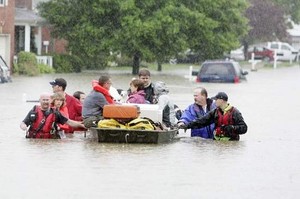
    The rain began falling on the morning of Saturday, May 1st, 2010, and by the time it finished, approximately 36 hours later; it had dumped a record rainfall of between 12 and 20 inches across Middle and Western Tennessee, devastating 52 of Tennessee’s 95 counties. Rivers that normally spanned 100 feet across swelled to a half-mile or more, flooding cities, towns, and roadways, washing away homes and bridges, destroying businesses and infrastructure, and leaving thousands homeless. At least 33 people died across Tennessee, Mississippi, and Kentucky; some while trapped in cars on flooding interstates, others who were swept away from flooding homes by the raging waters, while thousands more were left stranded in remote communities without power or communication for days. Water plants were decimated, the Grand Ole’ Opry and many other historic buildings and icons damaged or destroyed, and more than $1.9 billion of damage has been sustained to the private sector in Nashville alone.

    And where was our national media in all of this? During the flood, and in the days that followed, mainstream news media like CNN, MSNBC, and Fox, provided minimal coverage of this disaster, a disaster that is likely to be the costliest non-hurricane water related disaster in American history. Our plight was dwarfed by the Gulf oil spill and the New York City car bomber which, while being important stories, we’re not the only stories. In spite of the American press corps residing under a blanket of ineptitude, all levels of government, combined with an army of volunteers, quickly began to mobilize.

    “The President was on the phone to me before the sun came up practically on Monday morning” stated Tennessee Governor Phil Bredesen. FEMA administrator Craig Fugate, along with Bredesen and Nashville Mayor Karl Dean, toured flooded areas later in the day. By Tuesday, several counties had been declared federal disaster areas which began to allocate funding for the relief effort (the number of counties declared federal disaster areas would eventually reach 42). By Wednesday, almost 300 members of the Tennessee National Guard were assisting in rescue and relief efforts and the Red Cross was present early on as well.

    In the center of this disaster were the people of Tennessee who showed great strength and unity from the onset, when thousands of volunteers showed up at multiple locations; filling sandbags, assisting with boat rescues, and helping with other relief efforts. Community centers and churches across the state became havens for families who lost homes. Schools became water distribution centers. Some citizens even took it upon themselves to rent excavation equipment to clear roads, as the county road crews were overwhelmed. When officials announced the need to conserve water, water usage almost immediately decreased.

    While all this was going on, the minimal media depiction was that of a flood that primarily affected Nashville. And while a small percentage of America was hearing about a flood in Music City; 20,000 people in Hickman County, some 50 miles south of the capital, were completely cut off and isolated and without power or communication for almost a week. Much of their community was devastated and many roads and bridges were washed out, with months of repairs still ahead. On Highway 7 in Maury County, an area the size of three football fields collapsed. The city of Clarksville, some 80 miles to the northwest of the capital, was also particularly hard hit, with dozens of small businesses on Riverside Drive under 4 to 5 feet of water. An AT&T call center was flooded, rendering 1400 people out of work indefinitely, and 2 weeks after the disaster, one neighborhood of homes was still under water. In fact this storm system also killed four in Arkansas, and flooded many parts of Mississippi and Kentucky, where it caused statewide damage estimated at more than $30 million. All of this was accompanied by, essentially, no national media coverage to speak of.

    This is the worst disaster to hit the state of Tennessee since the Civil War, and all these statistics and facts don’t even begin to paint the picture of the loss and suffering had by many. For some, the disaster will remain a part of their lives for a long time to come. Thousands of damaged or destroyed homes and businesses were not in flood zones, leaving many with mortgages on structures that no longer exist, and without insurance money to rebuild. Thousands have also lost their jobs and livelihoods. Communities and infrastructure have been damaged or destroyed over an area that spans thousands of square miles, with the totality of destruction still yet unknown.

    So while the people of Tennessee are rebuilding, most of the nation remains unaware, and most will unlikely ever know the whole story. Tennesseans will survive, rebuild, and emerge from this wreckage, but for many, life will never be the same. Natural disasters affect everybody as we are all interconnected. After Katrina, thousands of hurricane refugees relocated to neighboring states to restart their lives, Tennessee among them, and this catastrophe will inevitably have its own unique set of social and economic impacts that will be far-reaching as well.

    Even though I didn’t lose any loved ones or personal property in this flood, what I have lost, is piece of mind. Three weeks after this epic storm, a rainstorm fell in middle Tennessee, causing flood warnings in five counties. While it didn’t cause widespread flooding, it put us all on edge. I used to like rainy days, their once mellow mood almost comforting. Now I fear them. As a nation, we must get our collective heads out of the sand and better understand this world we live in. The absence of this monumental event from our MSM was irresponsible and reckless, leaving us all vulnerable to the next extreme precipitation event. We may not be able to change the weather patterns, but we can at least prepare for what they can do. And if our media could begin to cover all of the pertinent stories in this new dawn of the superflood, we just might stand a chance.

    I have put up a slide show that  shows some of the damage in my community. Most of these pictures were taken within 10 miles of my home in Pegram, TN. You can also read more about the flood at my blog.

    Guest Blogger Eric Normand is a Tennessee-based writer and musician. Originally from New England, where he attended the Berklee College of Music, he is currently authoring his first book “The Nashville Musician’s Survival Guide.”

    Related Posts:

  • Review of Bill Mckibben’s must-read book “Eaarth”

    You had to wonder when it would happen.  That moment when someone would take us from talk of how to prevent climate change to acknowledging that it was here already, here to stay, and that it had — and would continue — to irrevocably foreclose on many of the opportunities humanity has taken for granted for millennia.

    Figures it would be Bill McKibben. His first book, The End of Nature was one of the earliest to introduce global warming into popular culture. His latest book, Eaarth: Making a Life on a Hot New Planet, lays out our grim new reality relentlessly (excerpt here). Yet it is not, fundamentally, a pessimistic book.

    McKibben’s premise, that we’re already on a new and different planet just as surely as if we’d boarded a spaceship en masse and arrived at a new world, is presented convincingly.

    This new world is less friendly, less accommodating, less commodious, just when we needed the old Earth to be more benign.

    If you are a regular reader of Climateprogress, you already know we’re now inhabiting an alien place but McKibben’s book is still a must read.

    For one thing, he has a knack for expressing complex scientific issues in ways that are accessible to the general public, often in sound bites, and in the age of Twitter this is increasingly the lingua franca of social discourse and cultural exchange – for good or ill.

    Here are a few gems:

    We’re running Genesis backward, decreating.

    Decreating.  My spell check wants to reject that word, yet it is too apt to discard.  It is precisely what we’re engaged in.

    Or take this example of ultimate irony McKibben uses with great skill to drive home how lemming-like our behavior has been on our trip to Planet Eaarth.  It appeared in Australian papers back in June of 2009:

    New construction plans for the World’s largest coal export facility had been quietly altered to raise the structure two or three meters for fear of rising sea levels.

    And yes, it’s true that lemmings don’t actually commit mass suicide, but some myths are too valuable to discard – besides, it appears that people do.

    In describing how we’ve completely overshot any hope of preserving the old Earth, McKibben almost makes this stuff funny:

    We have, in short, goosed our economy with one jolt of Viagra after another, anything to avoid facing the fact that our reproductive days were passed, and hence constant and unrelenting thrust was no longer so necessary.  (I suspect global warming is the planetary equivalent of the dread “erection lasting more than four hours” that we’re warned about …)

    Or take this passage, where he skillfully lampoons the whole consumer excess that brought us to Eaarth when he notes the effect of $4.00 a gallon gas:

    Suddenly, in fact, you felt a little less confident that you were an Explorer, a Navigator, a Forrester, a Mountaineer, a Scout,  a Tracker, a Trooper, a Wrangler, a Pathfinder, a Trailblazer. You all of a sudden were in Kansas or maybe in New Rochelle – not Durango, or Tahoe, or Denali, or the Yukon. Discovery and Escape and Excursion suddenly seemed less important than the buzz-killing fact that it took a hundred bucks to fill the tank.

    Yes, he actually entertains us while mapping out our collective trip to perdition. No mean feat.

    He holds out hope for a world that is richer in some ways than the one we left behind.  A world where community matters, where the scale is manageable, and where connections between people and the land are stronger, if less global.  A world, McKibben points out, that is not like Freidman’s Hot, Flat and Crowded. The time when we could grow green and maintain and expand our current globalized consumer economy came and went, according to McKibben.  On the less commodious Eaarth, the investments to do so are simply too staggering; the paucity of natural capital upon which to do it, too scant; and the share of capital spent just coping with what we’ve wrought, too high.

    To a lot of global warming luminaries his message will feel like a cold mackerel slapped across their collective cheek.  Growth is civilization’s drug of choice, and like any addict, we will fight with tooth and claw to keep partaking of it.

    But McKibben makes his case convincingly.  He invokes the much maligned  Limits to Growth and the Club of Rome (which, it turns out wasn’t wrong in its prognostications, merely off by a couple of decades), Jared Diamond’s Collapse and the relentless litany of facts that describe the detritus of the old Earth that is even now washing up on our shores.

    But McKibben doesn’t advocate obsessing on our collapse – which he says gives us only two choices: “Either you’ve got your fingers stuck firmly in your ears or you’re down in the basement oiling your guns” – rather he calls on us “… to choose, instead, to manage our descent.”  To “… aim for a relatively graceful decline” (emphasis is McKibben’s).

    While McKibben is standing on firm ground for most of Eaarth, he does make one misstep.  In recommending a world that is more local — in which provision of food, energy, raw materials and goods are distributed, not centralized — McKibben maintains that political power must be similarly dispersed.  He suggests that our institutions should be scaled to our technologies.  Yet managing a “graceful decline” or even a steady state economy will be the greatest collective challenge humanity has ever taken, and it is one we must take together. To presume that the actions of thousands of small entities can effect such a change — or that we can count on every one of them to do it — is to ignore most of human history.  Any strategy that invests most of the responsibility for change to a bunch of individual and essentially autonomous entities runs smack into Hardin’s Tragedy of the Commons.

    If humanity is to make a transition as profound as McKibben says we must, then we need even stronger institutions at both the national and international level.

    The world, including many who have been tireless advocates of climate action, will likely reject McKibben’s diagnosis and his prescription — hoping against hope that we can return to Earth and have what we’ve always had by slapping a green veneer over the massive consumption machine that is our contemporary economy. But they fool only themselves. We are now on planet Eaarth, and much of out talent, capital and time will be spent coping with this harsher, less forgiving new world.

    Regular CP book reviewer John Atcheson, has more than 30 years in energy and the environment with government, private industry, and the nation’s leading think tanks.  He is working on his own novel about climate change.

    Related Post:

  • Climate change: The new national security challenge

    On August 6, 2001, President George W. Bush famously received an intelligence briefing titled, “Bin Laden Determined to Strike in U.S.” Thirty-six days later, al Qaeda terrorists tragically turned threat into reality.

    Today, scientists tell us we have a 10-year window — if even that — before catastrophic climate change becomes inevitable and irreversible.

    This is our intelligence briefing — it tells us the threat is real and time is not on our side.

    The national security threat posed by unrestricted greenhouse gas emissions is great (see “NYT: Climate Change Seen as Threat to U.S. Security” and “Quadrennial Defense Review Should Spark Interagency Climate Conversation“),  The threat is so clearcut that even the Bush Administration’s top intelligence experts were raising the alarm (see “The moving Fingar writes“).

    And that’s why 33 generals and admirals announced support for the climate bill last month, asserting “Climate change is making the world a more dangerous place” and “threatening America’s security.”  Now, Sen. John Kerry has written a compelling op-ed explaining the grave national security threat posed by climate change and thus the urgent need to take action now to reduce greenhouse gas emissions:

    If Vice President Cheney can argue that even a 1 percent chance of a terrorist attack is 100 percent justification for preemptive action, then, surely, when scientists tell us that climate change is nearly a 100 percent certainty we should join in an all-out effort to make ourselves safe.

    Make no mistake — this is an American national security challenge.

    Climate change injects a new major source of chaos, tension and human insecurity into an already volatile world. It threatens to bring more famine and drought, worse pandemics, more natural disasters, more resource scarcity, and staggering human displacement. In an interconnected world, that endangers all of us.

    Anyone who doubts the threat should talk to the 11 retired American admirals and generals who warned in 2007, “Climate change can act as a threat multiplier for instability in some of the most volatile regions of the world, and it presents significant national-security challenges for the United States.”

    In their final national security analysis, the security planners in the Bush Administration recognized climate change among key trends that will shape U.S. defense policy in the coming years.

    Just last week, former United States Central Command (CENTCOM) Commander William Fallon warned that, left unchecked, climate change will “be significantly destabilizing to our future.”

    Another Former CENTCOM Commander Anthony Zinni put it simply: “We will pay for this one way or another. We will pay to reduce greenhouse gas emissions today, and we’ll have to take an economic hit of some kind. Or, we will pay the price later in military terms. And that will involve human lives. There will be a human toll.”

    Heed the warnings of the National Intelligence Council — the U.S. intelligence community’s think tank — which concluded “global climate change will have wide-ranging implications for U.S. national-security interests over the next 20 years.”

    Nowhere is the connection between climate and security more direct than in South Asia, home to al Qaeda.

    Scientists now warn the Himalayan glaciers, which supply fresh water to a billion people in India and Pakistan, will face severe impacts from climate change. India’s rivers are not only vital to its agriculture but also critical to its religious practice. Pakistan, for its part, depends on irrigated farming to avoid famine.

    At a moment when our government is scrambling to ratchet down tensions across that strategically vital region, climate change could work powerfully in the opposite direction. Failure to tackle climate change risks much more than a ravaged environment: It risks a much more dangerous world and a gravely threatened America.

    Unfortunately, not everyone in Washington appreciates the stakes.

    If a politician completely dismissed or denied the threat of terrorism, he or she would be sent home in the next election. But there are seemingly few political consequences if you dismiss the science or the threat of climate change.

    Here’s one fact that should awaken every rock-ribbed defense hawk to the stakes: There will always be excuses to wait, but every day that Washington fails to price carbon and embrace clean energy, America sends another $100 million to Iran. That’s not a choice America can afford.

    Last week, Sen. Joe Lieberman (I-Conn.) and I unveiled the American Power Act, a comprehensive energy and climate approach that sends the price signal on carbon that the market needs to unleash America’s entrepreneurial energy.

    In 2010, that is the test of a serious policy to combat climate change.

    When our admirals and generals warn that failure to act will put America and the world in danger, it is clearer than ever:  This is our August 2001 memo. These are our warnings. The time to act on them is now.

    Kerry is the Chair of the Foreign Relations Committee

    Related Posts:


    February 15th, 2010 | Posted in National Security | Edit | 21 Comments »


  • What questions do you think the BP disaster commission should answer? – Investigation must be free, clear, and complete

    CAP’s Daniel J. Weiss, who first proposed the commission idea on May 4, offers his answer to the question of what areas the investigation should pursue.

    A dead Portuguese Man-O-War floats on a blob of oil in the waters of Chandeleur Sound, Louisiana.  Source:  AP/Eric Gay

    President Obama is likely to sign an executive order sometime during the next several days that would create an independent commission to investigate the causes behind the tragic BP oil disaster. A thorough independent investigation is essential to understand what caused the explosion that cost 11 workers their lives, and what led to the failure of the blowout preventer that was supposed to prevent an oil gusher.

    The independent commissions established by Presidents Jimmy Carter and Ronald Reagan to investigate the Three Mile Island near-nuclear meltdown and the Challenger Space Shuttle accident, respectively, provide valuable guidance for the design and operation of the BP investigation.

    Unlike many congressionally chartered commissions, the TMI and Challenger commissions were not required to have a particular bipartisan balance. The TMI panel did not establish specific criteria for its membership. President Carter appointed prominent people from various fields. The chair was Dartmouth College President John Kemeny, who had worked on the Manhattan Project to develop the atom bomb. The panel included five professors, a union president, a CEO, a governor, an environmental leader, and a resident near TMI.

    The executive order to create the Challenger panel required members “from among distinguished leaders of the government, and the scientific, technical, and management communities.” Its chair was former Attorney General and Secretary of State William Rogers. The panel included two former astronauts, a former test pilot, and physicists and engineers from both academia and the aerospace industry.

    The BP disaster panel should follow the Challenger model. The executive order should require that the panel includes members who are senior or retired government officials, distinguished marine biologists, oceanographers, chemists, geologists, and petroleum engineers, as well as management experts. It should also include at least one member of a nongovernmental environmental organization, a union leader, and a local official or citizen of an affected community.

    The executive order establishing the TMI commission provided much more guidance for its investigation than the Challenger commission. The TMI charter included “a technical assessment of the events and their causes,” as well as an assessment of the utility’s management, emergency preparedness and response by federal agencies, and “an evaluation of the Nuclear Regulatory Commission’s licensing, inspection, operation and enforcement procedures as applied to this facility.”

    The BP disaster commission should follow the TMI model. The executive order should require the study and investigation to include:

    • A technical assessment of the explosion, blow out, oil flow, and their causes
    • An estimate of the quantity of oil released into the Gulf of Mexico
    • An analysis of the roles of BP, Transocean, and Halliburton in this event
    • An assessment of the emergency preparedness of these three companies, as well as the U.S. Coast Guard, Department of Interior, and the Department of Homeland Security
    • An appraisal of what agency should coordinate future emergency responses
    • A review of occupational safety measures on the rig
    • An evaluation of the Minerals Management Service’s leasing, permitting, oversight, and enforcement procedures applied to this and similar deep sea wells
    • A preliminary analysis of the public health, economic, and ecologic impacts of the blowout
    • An assessment of the public’s right to know about the accident and its aftermath, and BP’s, Transocean’s, and Halliburton’s responsibility to provide accurate, comprehensible, and timely information
    • A review of the technologies and safeguards employed by other nations to prevent similar disasters at their wells
    • Appropriate recommendations based on the commission’s findings

    Neither the TMI nor Challenger executive orders explicitly required public hearings, but both panels conducted them. The BP panel should conduct public hearings, including at least one in the most heavily affected area to receive testimony on the disaster’s effects on the public health, economy, and ecology of affected communities.

    The TMI and Challenger commissions had six and four months, respectively, to conduct their investigations and issue their reports and recommendations. Since the BP oil disaster is much larger than either of these events, the commission should have up to a year to complete its work. This event will continue to wreak havoc for years to come, but the commission should have a relatively short time for its investigation and report. This would enable oil companies and federal agencies to promptly implement the recommendations and significantly reduce the likelihood of a recurrence.

    The federal government should also take a time out on issuing new offshore oil or gas leases and commencing development on idle deepwater leases until the BP oil disaster commission issues its final report and recommendations. We cannot risk the further expansion of deepwater oil and gas drilling until we understand what went wrong and how to fix it.

    Both the TMI near-nuclear meltdown and the Challenger accident were shocking, unprecedented events. The postincident independent investigations produced sober assessments of what went wrong, and recommendations to avoid future occurrences. The breadth and size of the BP oil disaster will dwarf either of these unfortunate events. President Obama must design the commission so that its investigation into this catastrophe is independent, comprehensive, and transparent. This is an essential element to prevent another oil blowout like the BP Deepwater Horizon oil disaster.

    Guest blogger Daniel J. Weiss is a Senior Fellow and Director of Climate Strategy at the Center for American Progress. This was reposted the Center for American Progress website.

  • The BP oil disaster is a health disaster, too

    How do we protect public health in the aftermath of major disasters?  CAP’s Lesley Russell and Ellen-Marie Whelan have the answer.

    The tragic BP oil disaster in the Gulf of Mexico has taken 11 lives. The immediate economic and environmental damages are still unfolding as the 7,500 square mile oil slick oozes toward the Atlantic Ocean. But Louisiana’s vibrant fishing and seafood industries have been shut down in anticipation of oil contamination.

    The oil gusher also poses a less visible, but just as dangerous, threat to public health from the oil, its fumes, and the dispersants—the chemicals used to clean up the oil. All can be highly toxic and harm the health of those exposed to them, especially volunteers and workers engaged in cleanup operations and those with respiratory ailments, the elderly, and young children living on the Gulf Coast.

    There is no clear public health infrastructure to monitor and address these potential human health hazards or any others that may arise in the future. So we need to learn from the health disasters of the past, such as those that occurred from the Exxon Valdez spill in 1989 and the World Trade Center attack of 2001, and not wait for this to become a public health emergency before responding.

    The human health problems evolving from the BP oil disaster are insidious and unknown. The first and most obvious are the health effects from the oil itself. This is mostly a risk for those in the immediate Gulf region and the cleanup workers. More concerning is the ill effects that may come from the way that BP cleans up these oil disasters using dispersants. These are chemicals sprayed directly on the oil slick to break it up into much smaller particles. This does not remove the oil, but the dispersal makes it less visible and prevents it from washing up on the shoreline by breaking the oil into droplets that then often sink to the ocean floor.

    First, consider the effects of the oil itself. We know that Exxon Valdez cleanup workers faced average oil mist exposure that was 12 times higher than government-approved limits, and those who washed the beach with hot water experienced a maximum exposure 400 times higher than these limits. Many of those workers suffered subsequent health problems and in 1989, 1,811 workers filed compensation claims, primarily for respiratory system damage, according to National Institute of Occupational Safety and Health. The cleanup efforts in Louisiana’s coastal marshes may look very different, but cleaners can also face heavy exposure to oil mist. In fact, some are reporting that EPA studies now show that airborne levels of dangerous chemical compounds from the oil far exceed pre-determined safety standards.

    But what may be an even larger problem are the unknown, long-term health effects of the dispersants. BP has reportedly bought up more than a third of the world’s supply of these dispersants. The issue is that we do not actually know what chemicals are in many of these dispersants, or what their long-term effects will be since their exact makeup is kept secret under competitive trade laws.

    There are some things we learned after the dispersants were used following the Exxon Valdez spill. Studies performed on organisms exposed to these chemicals after the cleanup found that the dispersants accumulate in living organisms at very high concentrations and harmed the developing hearts of both Pacific herring and pink salmon embryos. The salmon appear to have recovered in the years after the Exxon Valdez disaster, but the herring were not as fortunate. The herring population has never rebounded, even 20 years after the spill, due to a combination of issues including disease and poor nutrition from decreased plankton production. How sure can we be that these chemicals will not also affect humans? And what happens when oysters in the gulf harvested for consumption are exposed to the dispersants and eventually consumed?

    BP has taken an unprecedented step of testing these chemicals underwater at the source of the oil in a desperate attempt to stem the flood of oil coming from the ocean floor. This has never been done before, and the EPA has authorized BP to test and monitor this approach. But are we letting the fox guard the hen house by letting the oil companies determine the safety of these cleaning agents?

    Although the exact chemical content of the dispersants is not public, the National Academies of Science 2005 report on these dispersants included several sobering cautions, including how the chemicals are tested in the first place. Most lab studies use the fluorescent lighting usually found in the labs when they test toxicity and chemical breakdown, but research conducted under conditions more equivalent to natural sunlight indicate that toxicity increases significantly after sun exposure—by 12 to 50,000 times as much. Worse still, The New York Times reports that BP chose to use dispersants manufactured by a company with which it shares close ties, “even though other U.S. EPA-approved alternatives have been shown to be far less toxic and, in some cases, nearly twice as effective.”

    As the President’s Cancer Panel recently noted, exposure to chemicals in the air, food, and water pose a serious risk to Americans’ health. The panel notes that dangerous chemicals in the environment are a much larger threat to the nation’s health than was previously identified, and calls for a new national strategy to focus on these threats. The panel found that federal chemical laws are weak, funding for research and enforcement is inadequate, and regulatory responsibilities are split among too many agencies. The panel called for a new national strategy to focus on these threats.

    President Obama will likely soon appoint an independent commission to investigate the BP oil disaster soon. Part of its responsibility should include assessing the on and offshore health risks posed by the oil gusher and efforts to stop it. This should include finding out what is in those dispersants and whether there were cleaner, safer alternatives. The House Energy and Commerce Committee has begun the process of overhauling the Toxic Substances and Control Act, an important step in protecting public health by setting government standards for safe chemical exposure in workplaces and the environment based on the most up-to-date science. This will require appropriate enforcement authorities and resources. But this important regulatory reform will come too late for those involved in the gulf oil cleanup and those who live nearby.

    It is not too early to implement an ongoing monitoring program aimed at ensuring the utmost minimization of negative health effects. This will require intensive, long-term testing and monitoring of people, food, water, and air; timely analysis of the data; and transparent communications with the people most exposed and most likely to be harmed. It will also require the coordinated, best efforts of a raft of federal and state agencies working together with businesses and local groups. Strong leadership from the very top of government and an ongoing commitment of needed revenue are essential. An integral part of this monitoring program must be a mechanism for people who may have been affected to report their health problems and have them addressed.

    Many agencies are ramping up monitoring particular effects of this disaster—including the EPA and the Centers for Disease Control and Prevention—but none are ultimately responsible for the overall coordination of what could be a public health emergency. We saw in the aftermath of the World Trade Center attack that haphazard responses were not enough to adequately address health problems for the first responders and workers. No one could predict at the time of the building collapse what effect the dust would have on those at the scene. What followed were numerous hearings, studies, and pieces of legislation to mount the proper federal response, including a number of new programs at CDC’s National Institute for Occupational Safety and Health. And many still wonder if we’ve done enough.

    We were also worried about what health effect the flood waters would have after Hurricane Katrina, yet the federal government left this monitoring up to the local governments. Despite the lessons from these very real public health emergencies, we are now facing what some are calling the worst-ever ecological disaster without an appropriate public health response in place.

    The good news is that there has recently been a major increase in federal investment in public health infrastructure and workforce. The public is reassessing the importance of the public health system after the disasters of 9/11 and Hurricane Katrina and the threatened pandemics of Avian Flu, SARS, and H1N1.

    The recently enacted health care reform legislation provides additional tools to begin to ramp up the nation’s public health infrastructure. It establishes a National Prevention, Health Promotion, and Public Health Council to help coordinate activities across agencies and numerous provisions to strengthen the public health workforce. These include a public health services educational track to train health care professionals that will emphasize public health, epidemiology, and emergency preparedness; a public health workforce loan repayment program; and a Ready Reserve Corps within the Public Health Commissioned Corps for service in times of national emergency. These are the people with the expertise and the mission to protect the public’s health.

    But there is much more that needs to be done to protect public health at times of natural and man-made disasters. The principal aim at this time must be for the federal government to act quickly and put monitoring and response systems in place in the threatened Gulf communities. These can be models of a system that could routinely be implemented at such times, regardless of where in the United States it occurs. We can hope that these systems are not needed and that the cleanup work can be done quickly and safely with no adverse after effects. But as we learn more about this disaster, this does not seem to be the case, and action now must occur to ensure that there is no public health version of shutting the stable door after the horse has bolted.

  • Gingrich’s book argues Obama poses Hitler-like threat – Former GOP Rep. Molinari says that’s ‘crazy’ and ‘outrageous’

    Since retiring from Congress, former House Speaker Newt Gingrich has devoted much of his time leading a pro-drilling front group with “resources” from the oil industry (see “Gingrich’s ‘drill here, drill now’ campaign continues as BP oil disaster grows“).

    Now, he is promoting his new anti-regulation, pro-drilling book, To Save America, which argues repeatedly that the Obama administration and Democrats in Congress are a “secular-socialist machine” that “represents as great a threat to America as Nazi Germany or the Soviet Union.”  TP has the story of Gingrich’s defense of that hate speech — and how even people in his own party are attacking his extremist views.

    Gingrich has repeatedly defended this claim, telling both NBC’s Meredith Vieira and Fox News’ Chris Wallace that he truly believes that the Obama administration is an equivalent “threat” to America as brutal dictators like Adolf Hitler and Joseph Stalin:

    VIEIRA: Can you honestly compare what’s going on with the Democrats with Nazi Germany?

    GINGRICH: No it’s not a question of how evil they were. Nazi Germany was terrible, Stalin’s Russia was terrible, Mao’s China was terrible. It’s a question of finality. Had we lost either of those contests, we would have become a radically different country.

    * * * *WALLACE: So — but you compare that to the Nazis and the Communists?

    GINGRICH: I compare that as a threat.

    Watch it:

    In reaching to make his case, Gingrich repeatedly tries desperately to connect the Obama administration with Nazi Germany. The index of Gingrich’s book cites Nazi references eight times, many of which are attempts to compare Obama and progressivism to totalitarianism (view a screen shot of the index below):

    Index for Gingrich's book

    – pp. 48-49 Gingrich quotes David Horowitz arguing that the great atrocities of the modern era, whether from Nazis or Communists, were committed by people who believe in a “future that would save mankind.” Gingrich uses Horowitz’s quote to draw a comparison to “the current leaders of the Democratic Party.”

    – pp. 295-296 argues that “the Left” is pursuing an “international strategy to take away” Second Amendment rights to own firearms. Gingrich writes that if Hitler had not disarmed “Jews and other anti-Nazi groups,” then the “Holocaust would have been virtually impossible to implement.”

    – pp. 268-269 says that “Marxism, Nazism, and Fascism” each “required the use of a powerful, centralized state authority” where “those who resisted were eliminated,” “religion was enemy number one,” and “religious texts” were replaced with “nationalist propaganda in schools.” Gingrich then writes that “there are many parallels between the anti-religious governments of the twentieth century and the anti-religious elite of the United States in the twenty-first.”

    While Gingrich’s book is laced with these Nazi comparisons, he also rehashes other absurdities, like a defense of Palin’s “death panel” charge and an argument that there are actually too many regulations on offshore oil exploration. Gingrich — who has repeatedly backed establishment Republican candidates like Sen. Bob Bennett (R-UT) and Dede Scozzafava over tea party challengers — seems to be trying to establish his credibility within the fringe base of the conservative movement by touting Nazi comparisons popularized by Glenn Beck and other hate radio personalities.

    While Gingrich hopes that social and religious conservatives will forget that he left his dying wife to be with another woman, it is unlikely that Gingrich will be able to deceive tea parties with his Beck-like Nazi rhetoric.

    This repost is by Lee Fang at Think Progress.  What follows is an excerpt from another TP pieces.

    On Fox News Sunday this past weekend, host Chris Wallace challenged Gingrich on that quote, asking if it was a “wildly over the top” comparison. Gingrich said it wasn’t:

    WALLACE: You also write this, and let’s put it up on the screen. “The secular-socialist machine represents as great a threat to America as Nazi Germany or the Soviet Union once did.” Mr. Speaker, respectfully, isn’t that wildly over the top?

    GINGRICH: No, not if by America you mean the historic contract we’ve had which says your rights come from your creator, they’re unalienable, you’re allowed to pursue happiness. I mean, just listen to President Obama’s language.

    On her CNN Headline News show last night, Joy Behar asked former GOP congresswoman Susan Molinari — who served in Congress while Gingrich was speaker of the House — if Gingrich was “losing his marbles” by making such comparisons. Molinari replied that Gingrich’s comments were “outrageous” and “crazy”:

    BEHAR: Susan, when Bush was called a Nazi, the right wing went berserk on him. And yet, Gingrich just throws the word around as if it’s nothing. What is up with him? What is he, losing his marbles?

    MOLINARI: This has always been — let me distance myself from that remark first of all in all seriousness. To compare anything that is going on in this country to the atrocities of Nazi Germany in any way, shape or form is just crazy. And you know that Newt was so smart. He got the Republican majority back in a generation, contract with America. And then, you know, moved quickly into a government shutdown and complained about his seat on President Clinton’s plane.

    This is Newt. He can be really smart sometimes and sometimes he can just say some absolutely outrageous things. I would be like to be in that corner of saying that is outrageous.

    Watch it:

    Later in the show, Molinari tried to change the subject, saying, “let’s just take Newt off the table because that’s just not even worth talking about.” “Let’s put him under the table,” replied Behar. “Right. Exactly. Thank you,” responded Molinari.

    JR:  The bottom line is that Gingrich’s extremist hate speech should take him out of the bounds of public and political discourse.

    Related Post:

  • Brit Hume shrugs off BP disaster: ‘Where is the oil?’

    On Sunday, Fox News anchor Brit Hume scoffed at the BP oil disaster in the Gulf of Mexico, wondering, “Where is the oil?”  I guess he’s using the same playbook as BP’s Tony ‘Soprano‘ Hayward.  TP has the story:

    Hume followed the lead of Rush Limbaugh and Mississippi Gov. Haley Barbour (R), who have been aggressively downplaying the disaster and bristling at comparisons to the 1989 Exxon Valdez spill. During the Fox News Sunday roundtable, Hume dismissed the expert analysis that many times more oil have spilled already than the Exxon Valdez disaster, a point raised by fellow panelist Juan Williams:

    WILLIAMS: First of all, don’t you think, this spill now is going to be in excess of what happened with Exxon Valdez.

    HUME: Let’s see if that happens. There’s a good question today if you are standing on the Gulf, and that is: Where is the oil?

    WILLIAMS: “Where is the oil?”

    HUME: It’s not on — except for little of chunks of it, you’re not even seeing it on the shore yet.

    Watch it:

    Independent experts, using both surface and subsea estimates, believe the vast sea of oil gushing from multiple leaks on the seabed surpassed the Exxon Valdez weeks ago. “Scientists are finding enormous oil plumes in the deep waters of the Gulf of Mexico, including one as large as 10 miles long, 3 miles wide and 300 feet thick in spots.” “The millions of gallons of crude, and the introduction of chemicals to disperse it, have thrown this underwater ecosystem into chaos, and scientists have no answer to the question of how this unintended and uncontrolled experiment in marine biology and chemistry will ultimately play out. ”

    The slick on the surface of the Gulf is now about 4,922 square miles, larger than Los Angeles County, Delaware, or Rhode Island. On the surface, oil contamination has reached the barrier islands of Louisiana, Mississippi, Alabama, and Florida.

    After Hume repeated the “natural seepage” talking point to falsely imply the oil industry’s catastrophic record of spills is unimportant, he then mirrored Rush Limbaugh’s argument that “The ocean will take care of this on its own“:

    WILLIAMS: But I think it will damage the environment in the gulf and damage tourism and damage fishing. I don’t think there’s any question this is in excess of anything we’ve previously asked the ocean to absorb.

    HUME: We’ll see if it is. We’ll see if it is. The ocean absorbs a lot, Juan, an awful lot. The ocean absorbs a lot.

    WILLIAMS: I think Rush Limbaugh went down this road, “The ocean can handle it.” I think we have to take some responsibility for the environment and be responsible to people who live in the area, vacation in that area, fish in that area. It’s just wrong to think, “You know what? Dump it on the ocean and let the ocean handle it.”

    HUME: Who said that? Who is saying that? No one’s making that argument.

    Nearly two weeks ago, Gulf Coast marine scientists told ThinkProgress they “shudder to think” of the devastation this underwater apocalypse could entail, because “oil is bad for everything” that lives in the ocean.

    This repost brought to you by Think Progress.

  • Transocean to give shareholders $1 billion while trying to cap its responsibility for Gulf spill at $27 million

    Transocean, Ltd., the giant oil contractor that leased its Deepwater Horizon rig to BP, held a “closed-door meeting” with shareholders Friday, “just days after” executives appeared before Congress to explain the company’s role in the massive Gulf of Mexico oil spill.  As ThinkProgress noted, the meeting took place at the company’s headquarters in Zug, Switzerland, where Transocean relocated two years ago to avoid paying taxes. Though CEO Steven Newman “ignored questions from reporters,” the company said in a statement that it would distribute $1 billion in dividends to shareholders:

    The revelation that Transocean is distributing a $1 billion profit to shareholders as one of its drill sites leaks millions of gallons of oil into the sea is sure to inflame an already smarting debate over offshore drilling and the company’s role.[…]

    To put the distribution in perspective, the amount of profit that Transocean plans to pay out in the next year is half of what Exxon ultimately paid for the Exxon Valdez disaster off the Alaska Coast.

    It’s also more than double what BP has said they’ve spent on the cleanup to date.

    Meanwhile, Transocean has “passionately argued” to limit its financial responsibility for the disaster. The company filed a court request last week to cap its liability under $27 million, a paltry sum considering BP has already spent over $450 million on cleanup, and analysts estimate the effort could ultimately cost up to $8 billion. As Raw Story notes, Transocean has actually made money from the disaster, collecting over $400 million from insurers, leaving it with a profit of $270 million after the costs of the rig are subtracted. As maritime attorney Jeff Seely told NPR, “They are the only people who have been compensated for this tragedy. The decedents [of the 11 workers killed in an explosion on the rig] haven’t been the compensated. The injured people who still are suffering, all the fishermen out in the Gulf that can no longer work haven’t been compensated.”

    Reposted from Think Progress.

  • Gingrich: ‘Of course’ Gov. Barbour should encourage tourists to visit oil contaminated gulf beaches

    Weeks after the massive BP oil spill in the Gulf of Mexico, Newt Gingrich still continues his “Drill Here, Drill Now” mantra, writing that “human progress is not without risk” and that “[o]ffshore drilling is no exception.” Even though the oil leak at BP’s Deepwater Horizon rig continues largely unabated and is “already far larger” than the Exxon Valdez crash, Gingrich is holding firm.  Think Progress has more original investigative reporting:

    At the NRA’s annual conference in Charlotte, NC, yesterday, ThinkProgress asked Gingrich if he still accepts this level of risk to continue offshore drilling:

    TP: So given the scale of the oil spill in the gulf, do you still think that it represents an acceptable risk to continue offshore drilling?

    GINGRICH: Yes. … One oil spill since 1969 with 4,000 wells. If the Coast Guard had a reasonable research program, we’d be much further down the road to solving this kind of thing.

    ThinkProgess also asked the former GOP House Speaker if he agrees with Mississippi Gov. Haley Barbour’s (R) recent campaign to encourage tourists to visit gulf beaches despite oil and dead sea animals washing ashore. While Gingrich hesitated for a moment, he replied, “Of course.” Watch the interview:

    While it’s unclear which “4,000 wells” Gingrich was referring to, his claim that there has only been one spill since 1969 is not accurate, as the Wonk Room’s Brad Johnson has noted:

    Between 1992 and 1998 there were 319 failures of blowout preventers found in US offshore drilling, an average of 45 a year. [MMS, 1999] Between 1992 and 2006 there were at least 39 blowouts off the US coastline, 38 of them in the Gulf of Mexico. [MMS, 7/07] From 2007 to 2009 there were 19 blowouts, all in the Gulf of Mexico. [MMS]

    Moreover, the largest accidental oil spill in history was a Gulf of Mexico exploratory rig blowout in 1979 and other major offshore spills have occurred elsewhere around the world. In “one of Australia’s worst oil disasters,” a PTTEP oil rig blew out in the Montara deepwater oil field on August 21, 2009.

    Sunday morning, Newt Gingrich sat for a softball interview with Fox News’ Chris Wallace to discuss his new book. Wallace never asked Gingrich — the originator of the “drill here, drill now, pay less” slogan — about the oil spill.

    Alabama Gov. Bob Riley (R) has been arguing that his state’s beaches have never been so clean:

    Alabama Governor Bob Riley said Thursday that the beaches of Gulf Shores are safe for this weekend’s Hangout Festival despite the oil rig explosion that continues to dump as much as 200,000 gallons into the Gulf daily.

    “The atmosphere has never been as electric, and I don’t think Orange Beach and Gulf Shores has ever looked as attractive as it does now,” Riley said from the Hangout.