Author: Harvard Gazette Online

  • Slavery in 2010

    Examples of modern-day slaves could be the workers who make our cotton shirts, pick cocoa for our chocolate, and harvest shrimp for our dinner plates while imprisoned aboard ships at sea. Enslaved prostitutes — more than 1.3 million worldwide — also provide the labor force for much of the world’s sex trade.

    Modern slavery’s ubiquity — and our collective responsibility for it — were two of the messages driven home in an Institute of Politics lecture on Thursday (Feb. 18) at the Harvard Kennedy School’s John F. Kennedy Jr. Forum.

    Co-sponsors were Harvard College for Free the Slaves, the Carr Center for Human Rights Policy, the Committee on Human Rights Studies, and Harvard College Human Rights Advocates.

    The man behind the messages was Luis CdeBaca, who directs the U.S. State Department’s Office to Monitor and Combat Trafficking in Persons. When he was a federal prosecutor, he sent more than 100 traffickers to prison and freed 600 sex and garment workers kept in involuntary servitude.

    Trafficking in humans “is a crime akin to murder,” said CdeBaca, who seasoned his 40-minute talk with case studies and statistics. “It’s a crime akin to rape, and to kidnapping.”

    Worldwide, there are more than 12 million people who exist in some form of slavery, he said, part of a shadow economy that turns a $32 billion annual profit for traffickers. About a tenth of those are in what experts call “commercial sex servitude.”

    Yet in a typical year, nations around the globe initiate only 3,000 prosecutions against traffickers,  “an unforgivably low percentage,” said CdeBaca.

    Nations all over the world have to get to the root causes of human trafficking, he said, including understanding what creates the markets that make the practice viable. (So far, 136 countries have signed on to a decade-old U.N. protocol against slavery.) Stepping up criminal prosecutions is still a prominent key, said CdeBaca, along with a range of other strategies to “rescue and punish.”

    He outlined a “3-P paradigm” for addressing human trafficking: prosecute, prevent, and protect.

    CdeBaca was introduced by journalist E. Benjamin Skinner, a Carr Center Fellow this year and author of the 2008 book “A Crime So Monstrous: Face-to-Face with Modern-Day Slavery.”

    Skinner’s research, conducted both in public and underground, took him to child markets, trafficking networks, illegal brothels, and other slave venues in a dozen countries in the Middle East, Asia, Europe, and North America. Even suburban America, he discovered, contains its own parallel universes of hidden slavery.

    CdeBaca’s office every year rates nations around the world on their measures to fight slavery. The 2010 ranking — called the Trafficking in Persons, or TIP, report —will include the United States for the first time. That announcement drew a brief burst of applause in the crowded hall.

    To illustrate the problem in the United States, consider the case of Shyima Hall, whose story was outlined in the 2009 TIP report. She was a teenager from a poor family in northern Egypt who was moved by a wealthy Egyptian couple to work in their California home. In exchange for up to 20 hours of labor a day, Shyima was locked in a windowless garage and paid $45 a month.

    CdeBaca mentioned another case, one of an “escaped slave” who fled from virtual imprisonment in an Arlington, Mass., home. Her passport was locked in a safe.

    He told other American stories: about the illiterate garment workers who studied the boss’ dictionary one word at a time to compose a note that they threw over a high wall. (They were rescued.) And the woman who rushed up to a policeman in a Dollar Store with a desperate plea to escape domestic servitude: “Arrest me.”

    Modern slavery will prompt “the next great abolitionist movement,” said Skinner. He provided a chilling definition of modern slaves, who are so inadequately uncovered and protected: “Those forced to work, held through fraud, under threat of violence, for no pay beyond subsistence.”

    Skinner acknowledged that slavery is a “contentious term” that some Westerners even sometimes equate to the drudgery of corporate jobs, mortgages, and credit card debt. But the world’s real slaves are “people that cannot walk away from their work.”

    And the commercial enterprises that underlay slavery, Skinner said, potentially involve every consumer. To address the slave trade, he said, “takes all of us.”

    Understanding modern slavery also invites comparison to the U.S. war on the drug trade, which has more resources and prominence, said Skinner. The annual budget to fight slavery, he said, is the equivalent to what is spent in a single day to combat trafficking in illegal drugs.

    Without disparaging the need to target drugs, Skinner asked a rhetorical question about which is more important: “Is it a 15-year-old selling pot on the street corner, or is it a 15-year-old being sold on the street corner?”

    Prosecution alone is not enough to stop modern slavery, said CdeBaca, who called for protection that extended beyond the courtroom, including provisions for social services. Ignoring the victim after the crime, he said, would only “replicate” the way the victim was treated by a trafficker.

    Meantime, there is the third “P,” said CdeBaca: prevention, which remains “an afterthought” to most nations. Real prevention means more than policy pronouncements, public-awareness advertising campaigns, or “interesting documentaries,” he said. It means stopping human trafficking at the source, in part by understanding the demands behind forced labor and commercial sex.

    Stopping trafficking at the source is also a matter of awareness, said CdeBaca in discussing the imprisoned shirt-makers and shrimp fishermen. Just as people are now aware of their carbon footprint, he said, they should be aware of their “modern-slavery footprint.” That means taking a critical look at the goods and services they buy.

    “The prevention-P,” said CdeBaca, “is where every American can play.”

  • Hey squash, time for your close-up

    Humans likely “auditioned” plants and animals that they eventually domesticated by first managing wild populations during a long transition period — sometimes thousands of years — that led from hunting-gathering to farming lifestyles, a speaker at the Harvard Museum of Natural History (HMNH) said Thursday (Feb. 18).

    Bruce Smith, an authority on the rise of eastern North American agriculture and the curator of North American archaeology at the Smithsonian National Museum of Natural History in Washington, described current thinking on the rise of agriculture, one of the major changes in human history that created the modern world.

    Scientists believe there were roughly a dozen places where agriculture arose independently through the domestication of plants and animals. Some species — such as cattle and pigs — were domesticated independently from wild stock in more than one place at different times, he said.

    Smith spoke at the Harvard Museum of Natural History as part of its “Food for Thought” lecture series, which examines the past, present, and future of our food supply and runs into this spring. Elisabeth Werby, the HMNH executive director, introduced Smith, while Noel Michele Holbrook, Bullard Professor of Forestry, moderated the event, fielding audience queries during a question-and-answer session.

    Agriculture is a relatively recent development in human history, with the earliest traces found about 10,000 years ago. Despite that late arrival, agriculture has had a dramatic impact on human society, supporting larger, stable populations and the development of urban centers.

    Scientists have established discrete dates for plant and animal domestication at various locations around the world, ranging from about 10,000 years ago for squash domestication in Mesoamerica and wheat domestication in the Middle East to 4,800 years ago for sunflower domestication in eastern North America and 2,000 years ago for rice in sub-Saharan Africa. Other locations where agriculture is thought to have arisen independently include South America, East Asia, and New Guinea. But Smith said those dates may give the impression that domestication was a before-and-after kind of event, with hunter-gatherers before and farmers afterward. The reality, he said, was likely far more complex.

    There’s a large gray area between “wild” and “domesticated” plants and animals, Smith said. Humans likely managed wild populations of everything from nuts to berries to clams by manipulating the wild environment to foster the success of food sources important to them without actually domesticating them. He cited cases of burning forest canopy trees to foster growth of sun-loving food plants below and building rock walls at the low-tide mark to foster sand accumulation and improve the environment for clams.

    Species that were successfully domesticated had key characteristics, he said. Plants tended to be early-succession species that did well in disturbed environments that humans could create for them. The animals tended to be naturals for domestication — less skittish and easily led. Dogs and cats are an exception to that rule, Smith said, since they took a “let’s make a deal” approach of mutual benefit.

    Even after the first plants were domesticated — illustrated in the archaeological record by larger seed sizes when compared to wild progenitor species — true agricultural societies took time to develop. Smith defined agricultural societies as those that got 60 percent of their food from domesticated plants and animals. Reaching that level, he said, took thousands of years. While the first evidence of squash domestication in Mesoamerica came 10,000 years ago, the first remains of an agricultural village only dates to 4,000 years back, indicating a 6,000-year transition period to agricultural living. While Smith acknowledged that future archaeological finds may shift those dates, he said that, even if they do shift, it seems likely there was a long transition between the first plant domestication and the development of settled villages dependent on farming as a lifestyle.

    Most research on the roots of agriculture is focused on the initial transition where the first plants were domesticated, Smith said, leaving ample room for future researchers to investigate the long transition afterward.

    The next lecture in the “Food for Thought” series is “From Cooking Food to Cooking the Planet:  Growing Constraints to Food Production,” 6 p.m., Tuesday (Feb. 23).

  • Mouthpiece


  • Business Schools Tap Veterans

    Five years ago, Augusto Giacoman was commanding about 30 soldiers and leading raids in Iraq. Now he spends his days in classrooms alongside former bankers, engineers and other civilians earning a master’s in business administration.

    Mr. Giacoman, a retired U.S. Army officer, is evidence of a growing effort among business schools to lure ex-military members into M.B.A. programs, where they are prized for their leadership skills and ability to bring an alternate perspective to the classroom, say school administrators.

    At Harvard Business School, veterans currently make up 3% of the class of 2011’s 930 students…

    Read more here

  • Songs without words

    Anyone wandering by the Radcliffe Gymnasium on Wednesday (Feb. 17) would have wondered at the sounds emanating from the vaulted hall, and likely stopped to investigate. There they would have found a young woman with a microphone in each hand performing a curious and captivating symphony of sound and song.

    Erin E. Gee’s compositions are as whimsical as they are hard to define.

    Gee, a trained pianist and composer, grew unhappy with her works for voice and changed direction with her vocal compositions in the late 1990s, eliminating any comprehensible words in her text. She decided instead to rely on the International Phonetic Alphabet to structure the vocal sounds in her work, which range from buzzes and whirs to whistles and pops, all created with the human voice. The textual elements are arranged with a melodic line for a “vocalist,” and often include a line for instruments that frequently mimic the voice’s sounds.

    Gee discussed the genesis of her Mouthpiece series, a group of 19 works for solo voice and ensemble, during a lecture and mini-performance. While at the Radcliffe Institute for Advanced Study, Gee, the 2009-10 Rieman and Baketel Fellow for Music, is working on “‘SU-O’ for Voices and Orchestra,” an extension of her Mouthpiece compositions.

    Her first Mouthpiece work was based on a text from the Rigveda, a collection of Vedic Sanskrit hymns. The musician, who currently lives in Graz, Austria, explained that her aim was to transform the text to something unrecognizable.

    “I tried to keep the structure of the order of the sounds of the text the same, but I changed them past intelligibility so they become something else,” said Gee of her work “Mouthpiece I” from 1999.

    For the composer, the ultimate goal is to create pieces that remove the element of the ego-based performance and the “heightened emotion” and “strong attachment to the meaning of the words” that is often found in vocal literature. Instead, Gee said she aims in her work to “move away from the vocal performer as a person … and “move as much as possible toward instrumental use of the voice.”

    “It just seemed natural on some level to move toward sound.”

    Gee later drew inspiration from traditional Japanese vocal styles as a guest artist in 2005 at the Akiyoshidai International Art Village in Japan. Other inspirations for her compositions include the scat singing of jazz great Ella Fitzgerald, tongue twisters, and a Pygmy tribe from the African rainforest.

    While her work may be hard to define or describe, the crowd didn’t find it hard to enjoy. Many attendees were smiling during Gee’s brief performances. Audience members peppered the composer with questions following her talk, calling her compositions “beautiful” and “fantastic.”

    One critic compared the experience of listening to Gee’s works to a ride on the back of a beautiful butterfly, said Judith Vichniac, the institute’s associate dean of the fellowship program, and to “learning a whole new language, one that, simply by hearing, not even understanding, elevates your being.”

  • Knitting Europe together

    The Obama administration seeks a “path to a better way” for the nations of southeastern Europe, and a top administration official laid out the components of that strategy during a talk on Wednesday (Feb. 17) sponsored by Harvard Kennedy School’s Kokkalis Program on Southeastern and East-Central Europe.

    Phillip H. Gordon, U.S. assistant secretary for the Bureau of European and Eurasian Affairs, told an audience in the Goodman Classroom that “the political and economic integration” of southeastern Europe within the rest of the continent is the key to regional stabilization and development in the years ahead.

    “We have a vision of a peaceful and stable Europe that will extend to Turkey and the Caucasus,” he said. “The solution lies in transnational cooperation and institutions that guarantee the rights of citizens, promote economic freedom, insure the viability of the border, and provide a reliable forum for the peaceful resolution of disputes.”

    Gordon pointed to the critical importance of regional and international institutions in this effort, specifically NATO and the European Union. Several southeastern European countries are now members of the EU, including Bulgaria, Greece, and Romania, and several belong to NATO, including Albania, Croatia, and Turkey. Other nations are seeking entry into one or both organizations.

    “The opportunity for political engagement that crosses national borders reduces the salience and pressure of ethnic and regional disputes within countries. That is the promise of the project of European integration,” Gordon said.

    Recent decades have brought tremendous change to the region, Gordon added, and the United States is now developing close and productive relations with several nations in the area, including Serbia, which was beset by violence and instability as recently as a decade ago.

    “I certainly believe … that with pragmatism and goodwill on both sides, U.S.-Serbian relations could be a model of a productive partnership by the end of the administration’s first term,” Gordon said. “This change in the Balkans is a reminder not only of what can be possible, but also what remains to be done” elsewhere.

    Kosovo is another example of a “remarkable story of progress” in the Balkans, Gordon said, although he admitted the country faces serious challenges that will require a “great deal of work” moving forward.

    Gordon also pointed to the critical roles that Greece and Turkey will play in helping stabilize southeastern Europe, arguing that “regional political leadership and courage and vision is necessary for progress.”

    In his concluding remarks, Gordon cited the fact that “some of the same fault lines” that have plagued the region for many years still remain, but that he is hopeful there is a “clear potential solution” in the full economic and political integration of the southeastern states within greater Europe.

    Gordon was introduced at the podium by Elaine Papoulias, director of the Kokkalis Program. About 100 people attended the lecture.

  • Turning to the wind

    Last August about 100 residents of an island off Maine gathered at their pristine little port to watch the arrival of three giants.

    From shore, the islanders could see their enormous white arms, resembling a surfaced submarine or the bony remnants of a prehistoric beast, lying on the deck of an approaching barge.

    The onlookers on Vinalhaven were welcoming the massive blades of three wind turbines, part of a community-based power project guided by Harvard Business School Professor George Baker as part of an effort to slash the islanders’ high electricity costs.

    “The islands pay about three times the national average for electricity, and the wind blows all the time,” said Baker, Herman C. Krannert Professor of Business Administration, who is on leave from Harvard Business School to help complete the project. “The question was, ‘Can’t we generate electricity with wind?’”

    The answer has been a resounding “yes.”

    For the past three years, Baker has split his time between his home in Newton, Mass., and a house on Frenchboro, a small island east of Vinalhaven, to work on the effort. He jokes that his wife would like to know exactly where he lives. He makes the four-hour trip to Maine weekly.

    The HBS professor, an authority on organizational economics, enjoys a personal challenge. Fifteen years ago he designed and built his home on Frenchboro, a remote fishing outpost with a year-round population of 43. He embraced the wind-power effort after volunteering with a local electric cooperative.

    “Partly because I was an HBS professor and partly because I was … wanting to be a helpful member of the community, I served as a volunteer member of the board of trustees of the Swan’s Island Electric Cooperative,” said Baker of his work with a consumer-owned electric cooperative serving nearby Swan’s Island as well as Frenchboro.

    Building on that experience, he has used his time away from Harvard to explore the economic and financial feasibility of wind-power generation on Maine’s islands, ultimately heading the effort to create the largest community wind-power facility on the East Coast, known as the Fox Islands Wind Project.

    The complicated process included permitting, detailed environmental impact and engineering studies, and a complex financing structure for the turbines that involved federal tax credits and the creation of a limited-liability company. There were also community meetings, where Baker was frank with the facts.

    “I told the residents, ‘Here’s what it would look like. Here’s how it would work. It’s absolutely not without risk, but there is real benefit,’” he said.

    The islanders ultimately backed the plan, 284 to 5.

    What makes the current project free from much of the “not in my back yard” squabbling that can plague wind projects is its immediate and direct benefit to the community, said Baker.

    “It’s a community-owned project where the community gets all the benefit,” he said. “There is no developer that owns the turbines and takes all of the power. The power is used locally by the community.”

    Now residents can harvest their own electricity with the help of Mother Nature, instead of relying on the noisy diesel generator downtown or purchasing power from a nuclear plant down the coast or the oil-fired plant on another island, in the process paying exorbitant costs to access electricity through underwater cables.

    Enlisting the support of the giant General Electric Co., Baker, who is vice president of Community Wind at the Island Institute, a nonprofit based in Rockland, Maine, was able to secure three turbines, each about 400 feet tall. The turbines were installed last summer and started turning in December. They are expected to generate 11,605 megawatt hours of electricity each year and cover all of the island’s annual energy needs.

    Currently at work on several other wind projects along Maine’s coast, Baker called the Vinalhaven experience “incredibly satisfying and fulfilling.” He said he hopes someday to be able to harvest the vast opportunity presented by “the much bigger and richer wind resources” available farther offshore.

    “For the last 100 years, we have ignored wind as an energy source because we invented diesel engines,” he said. “We should be using that resource. We should be using it as effectively as we possibly can.”

  • Working the night shift

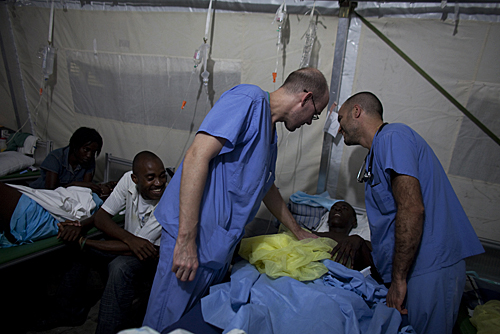
    The patient groaned as Shahram Aarabi pressed firmly but gently on his stomach, applying a clean dressing over the incision through which the Harvard School of Public Health student and surgical resident at the University of Washington had removed a burst appendix the night before.

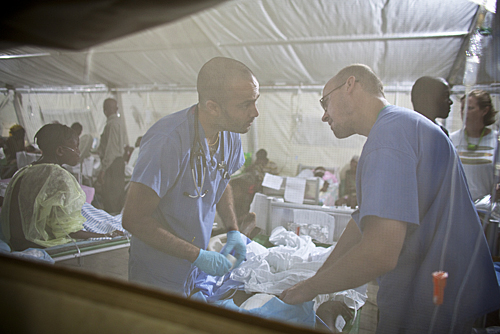
    Aarabi and Jason Smithers, a pediatric surgeon at Harvard-affiliated Children’s Hospital Boston and an instructor in surgery at Harvard Medical School, worked as a team on the man, one of three patients they had operated on the night before. Darkness had fallen, and the two were among volunteer medical personnel staffing the night shift at Port-au-Prince’s largest hospital, providing badly needed care for residents of Haiti’s earthquake-devastated capital and filling a personnel hole as Haitian hospital staff returned to day-shift jobs.

    Smithers and Aarabi are among the many Harvard-affiliated personnel — doctors, nurses, and medical technicians — who have responded to the titanic medical emergency created by the Jan. 12 earthquake that devastated the island nation.

    During a week in mid-February, Aarabi and Smithers made their rounds under the auspices of Partners In Health, a nonprofit with close ties to Harvard Medical School (HMS), the Harvard School of Public Health, and Harvard-affiliated Brigham and Women’s Hospital, while nurses from Beth Israel Deaconess Medical Center worked alongside physician Jennifer Scott, a specialist in humanitarian response, on outreach operations at a field hospital led by the Harvard Humanitarian Initiative at Fond Parisien, an hour’s drive away.

    Tom Monaghan, a medical equipment technician from Harvard-affiliated Massachusetts General Hospital, worked in Port-au-Prince to set up newly arrived equipment and to repair broken machines, while Natasha Archer, a Brigham resident whose family immigrated to the United States from Haiti decades ago, coordinated volunteers for Partners In Health in Port-au-Prince, using vacation time to extend her stay.

    Working next to the Harvard-affiliated volunteers are skilled medical personnel from an array of institutions across the country. Volunteers from the University of Chicago Medical Center, Northwestern University, the Children’s Hospital of Philadelphia, and the University of Miami work alongside a retired orthopedic surgeon who is lending a hand, along with independent physical therapists who are getting patients up and walking again, and a former Peace Corps volunteer helping with logistics at Fond Parisien.

    The initial tidal wave of the injured has eased, after washing over Port-au-Prince’s University Hospital and out to places like HHI’s Fond Parisien field hospital, which specializes in rehabilitation after initial treatment. But the need for medical volunteers remains acute. Hilarie Cranmer, an assistant professor at HMS and HSPH and an HHI-affiliated faculty member who is directing the Fond Parisien field hospital, said the focus has moved from amputating limbs to saving them.

    With a devastated infrastructure and the personal toll the earthquake took on Haitian medical staff, skilled volunteers still are needed to meet medical needs of survivors living in and around Port-au-Prince as they begin to rebuild their lives.

    Partners In Health, founded decades ago as a health organization with operations largely in Haiti, has brought to Haiti roughly 300 medical personnel — many from Harvard — to augment their nearly 4,000 Haiti-based staffers.

    “I’m pretty proud of Harvard’s response,” said Paul Farmer, the Maude and Lillian Presley Professor of Global Health and Social Medicine who co-founded Partners In Health and who, among the many hats he wears, is also the United Nations deputy special envoy to Haiti.

    Though the volunteers’ stays are temporary, their experience teaches enduring lessons and carves indelible marks on them. Dima Awad, a clinical pharmacist at the University of Chicago Medical Center who arrived to help at Fond Parisien, was met with a room full of donated drugs and medical supplies, some years out of date, and tasked with creating a pharmacy. She thought the job impossible, but set to it with the help of local carpenters who created shelves in what had been an orphanage classroom. Nine days later, Awad was low on sleep, but reflecting on success.

    “When I got here, I thought this was an impossible job,” Awad said. “After working on it, I can tell you nothing is impossible, it’s all a matter of will.”

    Anthony Croese, a paramedic from New York Presbyterian Hospital, spent a week at Fond Parisien traveling with colleagues to satellite sites to deliver care, identify patients who needed to be brought to the hospital, and provide vaccinations. He said they saw a lot of infections, respiratory problems, abdominal problems, and fevers.

    “This is definitely going to leave its mark. I don’t think I can ignore something like this again.” Croese said. “I’ll be back, whether I have to take vacation time or use my own money…. This is way beyond what you see in the news.”

    Miles to go

    Miles to go

    Hilarie Cranmer gazes beyond her computer screen where she sits beneath one of the many tents erected. Cranmer, an assistant professor at Harvard Medical School and the Harvard School of Public Health, is a Harvard Humanitarian Initiative-affiliated faculty member who said the “focus has moved from amputating limbs to saving them.”

    Tent town

    Tent town

    Tents line a stretch of grass in Fond Parisien, where the Harvard Humanitarian Initiative has set up a rehabilitation hospital led by Michael VanRooyen of the Harvard School of Public Health and Harvard Medical School. More medical volunteers are still needed.

    Devastation

    Devastation

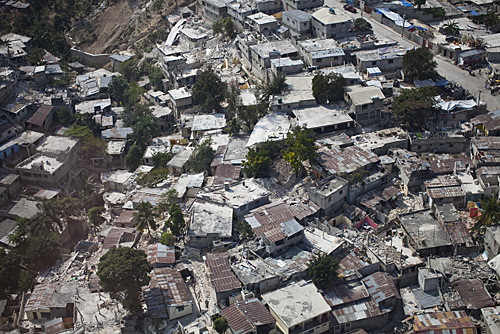
    An aerial view shows the town of Fond Parisien lost amid debris and crushed buildings after the 7.0 earthquake.

    Night shift

    Night shift

    Night falls as Aarabi (right) and Smithers make rounds at Port-au-Prince’s main hospital.

    Hands on

    Hands on

    Aarabi (left) and Jason Smithers (right), from Children’s Hospital Boston, consult each other while working on a patient.

    A moment to think

    A moment to think

    Shahram Aarabi, a graduate student at the Harvard School of Public Health, peers from a bus window in reflection.

    Photo slideshow: 24-hour care

    Justin Ide/Harvard Staff Photographer

  • The road to Khelshala

    It was in the works for months, years even — a trip that finally turned dreams to reality as the Harvard varsity women’s squash team traveled to India over January’s winter break. Harvard allows its varsity athletes to travel internationally once per four years, but for members of the squash team it was the trip of a lifetime.

    We traveled to Mumbai, Chennai, Delhi, and Chandigarh in 11 days, training, sightseeing, and doing community service in a facility set up in Chandigarh by head coach Satinder Bajwa. The general sentiment prior to the trip was one of undeniable excitement and unavoidable anxiety, but, most importantly, a widespread willingness to be open-minded about whatever came our way. As coach Bajwa regularly reminded the team, the theme of the trip was “adjustment,” for adaptability would be necessary to deal with the new environment and fully appreciate what India had to offer.

    Many college teams take international trips solely to train, but the three days of service and learning in Chandigarh were what made this trip a unique experience. The community service involved squash coaching and academic tutoring for underprivileged children living near the squash facility, called “Khelshala,” or “Place of Play.”

    Coach Bajwa opened Khelshala last August in an area of Chandigarh known as Sector 42. The squash facility boasts two international courts as well as a yoga room, pristine fitness equipment, and locker rooms. The facility is in the village of Attawa, home to most of the children who play there. There are dirt roads and piles of trash, derelict shops and empty spaces. The one-lane road leading to the facility is barely wide enough for the van in which the team arrived.

    The opening of Khelshala created a singular juxtaposition of wealth and poverty, of hope and hopelessness, of opportunity and incapacity in Sector 42. In the midst of dust-laden pathways and tangled power lines, Khelshala stood as a beacon of optimism and opportunity for the children, who otherwise would have had no exposure to a sport as exclusive as squash.

    It was beautiful to see the ways in which the sport could unite people as different as college students and village children living halfway across the world from one another. Though separated by a considerable language barrier, we were able to gain valuable exposure to the children’s ways and views. Furthermore, we were able to overcome differences in culture, lifestyle, and values to share a common love for a game that had so significantly affected our lives and would affect theirs.

    On the final day in Chandigarh, the children gave us a tour of their village, allowing us into their daily lives. Though we had caught a glimpse of the kind of lifestyle they led, we were largely unprepared for the sights the village had to offer. Their homes were one-room enclosures housing entire families, overlooking a stream of dirty sewage water and standing opposite to a maze of power lines. Learning English from an old woman with a slate and pointer, some village children looked up, startled, as the team marched by in tracksuits emblazoned with the Harvard crest proclaiming “Veritas,” or “truth” — the very truth so difficult to bear.

    Despite this, the children arrived at Khelshala thinking of opportunity, not adversity. This was the most astonishing and eye-opening aspect of the trip: that they could find so much happiness despite all they endured outside of the squash facility.

    Coming from Harvard, a place with resources and doors wide open, we were awed by the visit to Chandigarh and, at the same time, finally able to understand that it had taken a trip across the world to a village of bright-eyed children to realize that their infectious, unrelenting joy gave others no excuse for concern. They had nothing, but they still had aspirations.

    But for many of us, it was unsettling to consider the notion that some of the children may never leave this lifestyle. Many boys will grow up to have similar occupations as their fathers: vendors, shop owners, manual laborers. Many girls will be poor housewives. It’s an endless cycle because, as the governor of Punjab said during his visit to the squash facility, the “haves” and the “have-nots” run parallel without intersecting. Things are stagnant, and there may be nothing in store for them.

    But this is the beauty of an organization such as Khelshala. As assistant coach Chris Smith said, unlike many U.S. inner-city squash programs, it was not built with an end goal in mind. It is simply a haven for village children, a place to go for those who cannot dream of affording to play squash otherwise.

    There is so much untapped potential among the children who play at Khelshala. Many are intelligent, talented, and eager to learn. Truly, they could easily do much more if brought up in another environment, under different circumstances. But perhaps what Khelshala provides is a step in the right direction, the first of many necessary to achieve greatness.

    They deserve more. They will remember us, and we will remember them in turn.

    If you’re an undergraduate or graduate student and have an essay to share about life at Harvard, please e-mail your ideas to Jim Concannon, the Gazette’s news editor, at [email protected].

  • Virtually connected

    Last semester, while sitting at her dining-room table, Hannah Poole helped young girls in southern Sudan to go to school.

    In that northeast African region, early marriage, coupled with fears of sexual harassment and gender-based violence, mean a high dropout rate for girls. But Poole wants to change that. Based on studies in the area indicating that female teachers have a positive impact on girls’ school attendance and achievement, she helped to craft high-level education policies through her virtual internship.

    Her classroom discussions — which involved policy frameworks, gender education issues, and cultural norms that prevent young girls from attending school — contributed to her virtual internship, said Poole, who did extensive reading on the importance of female teachers to girls’ education.

    Using data compiled from Sudan’s census, along with education statistics, she was able to chart the parts of the country with the fewest female teachers. She also completed case studies of successful education programs in other countries, such as India and Afghanistan, and used her findings to craft recommendations for southern Sudan’s education officials.

    “I really get to be part of shaping the country’s future,” said Poole, who is part of UNICEF’s education initiative. The Canadian hopes that her work, conducted out of her Cambridge apartment, will convince education ministers to increase educational opportunities for girls.

    Using the Web, Poole and a group of her master’s degree classmates at the Harvard Graduate School of Education (HGSE) are gaining a kind of field experience without leaving home. They are part of an ongoing virtual internship pilot program offered through the school’s Career Services Office and its Field Experience Program (FEP) in collaboration with its International Education Policy (IEP) master’s program.

    The virtual internships represent a trend in an increasingly connected world, with communications technologies such as e-mail and video conferencing making it easier for those eager to explore career opportunities in distant locations to work remotely.

    “With the Internet, we realized there was a limitless opportunity for students to work beyond the local area,” said FEP specialist Sarah Deighton. “In terms of their future careers, we wanted to help them build connections and networks not only in this country but around the globe.”

    Fernando Reimers, director of the IEP, developed partnerships with international institutions that agreed to work closely with the students during the semester.

    “International development institutions, ministries of education, and education policy think tanks abroad all offered their support to this programmatic innovation at HGSE,” said Reimers, who is also Ford Foundation Professor of International Education. “The result has been a very rich experience for our students who are engaged in a variety of exciting programs.”

    Last semester 11 students worked on various international initiatives.

    In the fall, master’s student Simon Thacker and his classmate Jessica Malkin helped children in Jamaica to have more fun. Working with the Jamaican Ministry of Education, the pair developed policy around a child’s right to play.

    “The perception in Jamaica is that play is a waste of time, so don’t let kids play,” Thacker said, despite evidence that play is essential to a child’s cognitive, linguistic, and social development. “This policy is to ensure that the children of Jamaica do get what they need.”

    Using Elluminate, an online platform with a phone and instant-message function as well as a public whiteboard that participants can use to mull over ideas in cyberspace, Thacker and Malkin connected with their contact, a senior adviser to the country’s Minister of Education, to review their work.

    In addition to affording him high-level policy experience and helping him to put his quantitative skills to use, Thacker said the program was a great way to network and search for employment.

    There are some drawbacks. Students admit they miss the face-to-face interaction available in a traditional office setting. The flexible nature of the internships — students are required to devote at least eight hours a week to their projects — involves a greater degree of discipline. Getting in touch with contacts can sometimes be a challenge, and stopping an officemate or co-worker in the hall for the answer to a quick question is impossible. Still, they agree, the tradeoffs are worth it.

    “This program shows you that the work that you do has real-life consequences,” said Poole, “and that gives you a really good perspective on what you learn and its implications.”

  • A bridge to somewhere

    Bady Balde’s path to Harvard University began at age 4, on a six-mile trip along a dusty, rural African road. Alone.

    It’s the reason he’s a good runner.

    Balde recalled trying to catch two older, long-legged classmates on their way to and from school, three miles away. “I couldn’t keep up with them,” he said. For the boys, school was a lucky privilege that was afforded only a few.

    Today, the only running Balde does is for fun, and the only people he chases are his two rambunctious young sons.

    This spring, Balde, a one-time dishwasher with Harvard’s Dining Services, will graduate from the Harvard Kennedy School (HKS), thanks to help from Harvard’s Bridge Program. He will leave with a diploma in his hand and a determination in his heart to help change his homeland, where a lack of education often has devastating repercussions.

    “There are parents who can’t read prescriptions for their children,” said Balde. “That is something that I lived with. I know exactly what happens to kids who grow up in a family where the parents don’t know how to read and write.”

    In a remote village in his native Guinea, Balde, one of 13 children from his father’s two marriages, was tapped as the son who should continue in school rather than help the family and harvest cotton. The result was an 11-hour day away from home. The decision carried a deep emotional burden for the young Balde, who understood that others would have to work the fields in his place, and that his parents would have to sacrifice for his school supplies.

    Then, when he was 12, his mother, dying from complications with her ninth pregnancy, uttered a last wish. “She told me, ‘The only thing I want is for you to complete school.’ ”

    Determined to become a doctor and combat maternal mortality, Balde excelled in school, ultimately passing a rigorous national college entrance exam. Lacking money for medical school, he studied economics and general management in the nation’s capital, Conakry. After graduating, he returned to remote areas, showing women how to better manage their micro businesses and market their handicrafts and textiles, as part of his work with the international development agency GTZ.

    Next, he landed a job at the nation’s central bank, but instead of helping him explore economics on a macro level, the position opened his eyes to a system rife with ignorance.

    “I saw people making decisions that would have terrible consequences for the country, but they had no clue,” said Balde, who realized he had to “learn how to get things right.”

    He soon found himself on another long road in search of education.

    With his wife Jennifer, a Connecticut native he met while she was working in Guinea, Balde arrived in Boston in 2005 to look for a job, and made his way to the famous campus across the river. Harvard was always his ultimate destination, and despite his education and professional experience, he resolved to take any job available. With support from Susan Simon, human resources manager for Harvard’s Dining Services, who helped him complete his application, he started working in a dining hall part time.

    Simon directed Balde to the Harvard Bridge Program, where he met the director, Carol Kolenik, who told him, “We can help you.”

    “He was such a quick study. I just have never seen anyone fly like this,” said Kolenik, adding that Balde’s success “means so much to all the Bridge students and staff, and exemplifies our mission of giving people the opportunity to move up and change their lives and be who they deserve to be.”

    Under Kolenik’s guidance, Balde enrolled in intensive English classes and met daily with Bridge volunteer tutor Jessica Engelman, a Web editor at HKS. Through the program, he also worked with career development counselor Carla Fontaine, who helped him with his resume and his search for full-time employment. Eventually, the Bridge connected him with the Harvard University Employees Credit Union, where he worked as a teller for two years. With a 9-to-5 work schedule at the credit union, he was able to take math and statistics classes at the Harvard Extension School to help him prepare for a graduate degree.

    One day, while surfing the Internet, he pulled up the Web site for Harvard’s Kennedy School and was drawn to the M.P.A./ID program, leading to a master’s degree in public administration in international development.

    “I couldn’t stop going back to that Web site,” he said. “It seemed so tailored to what I wanted to do.”

    What Balde wants to do is to reduce illiteracy in African nations, particularly his native Guinea. Through his work, he hopes to improve school attendance rates for girls, who often never attend school or leave their studies early to marry and never return.

    “I think there are great opportunities available today,” he said. “There are so many ways that we can use technology and resources now that were not available before. There are so many easy changes we can make that can improve the lives of so many.”

    But perhaps his greatest accomplishment, he said, will be to act as a role model to young children in his country, to show them what they can achieve.

    “For me, the most important part is not actually what I will do myself, but what I will be able to show other kids like me — that Harvard is possible,” said Balde. He recently decided to return to his village directly after graduation, to teach math and explore the best ways to address some the area’s most pressing issues. “I believe in leading by example.”

    Balde is certain his story would have inspired someone else, too. “If I could tell my mother that I am graduating from Harvard,” he said, “I am sure she would be happy.”

    Now in his second and final year with the master’s program, Balde admits that his status still feels slightly surreal. He calls the lectures with scholars such as the Kennedy School’s Dani Rodrik, Rafiq Hariri Professor of International Political Economy and a leader in the development field, “a dream come true.”

    “You are going to the source to learn,” he said, adding that the Kennedy School’s curriculum has taught him new ways of thinking. “After every course, you come out and you start looking at things differently.”

    Despite what he called a “grueling” schedule, Balde said his Harvard experience — which included studying for calculus in the hospital next to his wife when she was in labor — has been tremendously fulfilling, and would have been impossible without the University’s support.

    Balde credits the Bridge program, among others.

    “The result is so tangible,” he said. “They really do change people’s lives. I am so grateful to all the hard work, dedication, and sacrifices of so many people who have made my dream a reality. Now it’s my turn to do the same for others.”

  • Surrendering their secrets

    Ann Pearson is a chemical sleuth, tracking traces of ancient life and environments through the chemical fingerprints they left behind.

    Pearson, a professor of biogeochemistry in the Department of Earth and Planetary Sciences, initially thought she would become a biologist before she became enamored with chemistry as an undergraduate at Oberlin College. She made the shift, but remains involved in both disciplines today, as she wields the tools of chemistry to look back at biological systems and environments from millions of years ago.

    Pearson’s favored tools are isotopes, which are heavier or lighter versions of elements — such as carbon, nitrogen, and oxygen — that are important in living systems. Ordinary carbon is known as carbon-12, because it has six protons and six neutrons in its nucleus. Carbon-13, with six protons and seven neutrons, is heavier and rarer, but still common enough to be regularly detected and measured by scientists.

    In her work, Pearson uses the ratio between different isotopes in lipids, proteins, and whole cells to infer things about ancient life. In a recent project conducted in collaboration with researchers at the University of Illinois, for example, she examined the carbon isotopes in ancient grass pollen to learn more about the environment in which they grew. Grasses that grow in hotter, dryer environments take up carbon isotopes in different ratios than those in cooler, moister environments, Pearson said.

    Pearson’s main area of research doesn’t involve ancient grasses, however. It involves microbes living in the seabed, and it examines their chemical composition for clues about the oceanic environment in which they lived. Because the chemical elements inside those microbes come from what they consume, Pearson says her work employs an unusual strategy to understand ancient life and ecosystems.

    “We use the ‘you are what you eat’ philosophy for microbes,” Pearson said. “In the end, what that does is provide windows into the past climate — not temperature directly, but more like reconstructing ecosystems that lived in warm or nutrient-rich environments versus ecosystems in very cool and low biological productivity situations. I suppose you could say we try to understand the microbial contributions to modern and ancient ecosystems.”

    One such project probes the Mediterranean Sea over the last 150,000 years. At various times, Pearson said, the Mediterranean has been dominated by large freshwater inflows from the Nile River at one end or large saltwater inflows from the Atlantic Ocean at the other. Pearson and graduate student Meytal Higgins examined the interplay between these two flows and how they affected life in the sea by studying the isotopes nitrogen-14 and nitrogen-15.

    Pearson learned much about biology early and firsthand, on her family’s farm on the San Juan Islands of northwest Washington state. Every evening she milked the goats and collected eggs from the chickens. The daughter of the town accountant and the middle school science teacher, Pearson tore through the tiny island high school’s curriculum, leaving a year early at age 16 because she’d already taken all of the courses in core subjects that the school offered.

    So, with the blessing of her parents, Pearson started her freshman year at Oberlin. She had intended to major in biology, but she liked her freshman chemistry class so much, she moved into that field.

    “I liked chemistry because it was very well-defined in terms of being quantitative and having clear-cut problems with definite solutions,” Pearson said. “I found it to be rewarding rather than challenging.”

    After graduating with a chemistry degree in 1992, Pearson joined the Peace Corps, drawing on her family farm experience to work as an agricultural volunteer with sheep ranchers high in Ecuador’s mountains. She recalled applying for graduate school from her chilly house two miles above sea level.

    On her return, she entered the oceanography program run by the Massachusetts Institute of Technology and the Woods Hole Oceanographic Institution. After a brief postdoctoral fellowship at Woods Hole, Pearson came to Harvard as an assistant professor in 2001.

    Pearson is the 2009–10 Radcliffe Alumnae Fellow at the Radcliffe Institute for Advanced Study. Her project is titled “Investigating the Deep Biosphere.”

  • Daniel Henry Holmes Ingalls

    Daniel H.H. Ingalls, Wales Professor of Sanskrit, Emeritus, was born in New York City on May 4, 1916. He attended Harvard College, and studied the Classics, including his first courses in Sanskrit with Walter E. Clark. While Ingalls’ father apparently expected Harvard to prepare his son to join the management of The Homestead in Hot Springs, Virginia, Daniel Ingalls’ years at Harvard gradually turned him to the lifelong study of Sanskrit philosophy and poetry. He graduated in 1936 with an A.B. cum laude in Classics. He thereupon enrolled in the Harvard Graduate School to study Sanskrit, Chinese, and Japanese, earned an A.M. in 1938, and was elected to a Junior Fellowship in the Society of Fellows (1939–42), where he continued his study of Sanskrit.

    In 1941 he persuaded the Senior Fellows to send him to India, where he worked on Indian logic with M.M. Sri Kalipada Tarkacharya at the Sanskrit Research Institute in Calcutta. After Pearl Harbor he returned and entered the O.S.S. In 1942 he and his colleague Richard Frye traveled as civilians to Afghanistan, where his job in Kabul was to watch for contacts by Indians (then British subjects) with Axis agents. As cover he taught English at the Habibi Lycee and worked on his doctoral dissertation. The completed draft of the dissertation was sent home by diplomatic pouch, but was lost. After the war he rewrote it as his first book. He returned home in 1943, was commissioned in the Army, and spent the remainder of the war working on Japanese code-breaking in Military Intelligence near Washington.

    After the war he was elected to a second term in the Society of Fellows (1946–49). Since Junior Fellows are permitted to do some teaching, he helped out with Sanskrit courses after the retirement of Walter E. Clark, his predecessor as Wales Professor, and in 1949 became an assistant professor, in 1954 associate professor, and in 1958 Wales Professor of Sanskrit, continuing in that post until his retirement in 1983.

    While Ingalls was a dedicated teacher and scholar, he was not an empire builder. He remarked in a note to the president, “The less administration I have, the happier man I shall be.” During his tenure, the study of India was largely defined by classical studies. In 1951, however, he instigated a change in the name of the Department from Indic Philology to the Department of Sanskrit and Indian Studies. By the late 1950s, it came to include Indian and Tibetan Buddhism, and by the time of his retirement in 1981, it included positions in Hindu Studies and Indo-Muslim Studies as well.

    During the golden period of rapid expansion in Asian studies, some 50 of his students finished with a Ph.D. and began teaching at major universities throughout the world. Through the students he trained, Ingalls had an enormous influence on the development of Sanskrit studies in North America. Among both his students and collaborators were Indian scholars as well. Though a political conservative himself, Ingalls had a lifelong friendship with the Indian Marxist historian D.D. Kosambi, who became the text-editor for the Subhasitaratnakosa. Of Kosambi, Ingalls wrote, “I have never met a man with whom I disagreed on such basic questions, yet whose company I so constantly enjoyed.”

    Throughout most of his career at Harvard, Dan Ingalls constituted a one-man department, teaching at all levels from beginning Sanskrit to advanced courses in Indian philosophy and poetry. The Sanskrit Library in Widener became the center of energetic and demanding study for generations of Sanskrit students. He also met students by appointment in his Widener study where he had no telephone, but could be found by those with the temerity to knock on his door. This was open for business and visitors once per week from 8-9 a.m., had no phone but a typewriter built in 1888.

    He had the reputation for being a demanding teacher, to be sure. It is said that his description of the department for the undergraduate manual, Fields of Concentration, began, “Sanskrit is a difficult language. Only the rare undergraduate would be advised to take it.” But as one former student remembers, “Studying with Daniel Ingalls was exhausting, demanding, and rewarding.” He taught with patience and authority, bringing out the beauty of the classical Sanskrit texts that he loved and communicating this to his students. Ingalls taught not only Sanskrit but also Harvard’s first General Education course on Indian Civilization.

    In 1950, Ingalls published his first book Materials for the Study of Navya-Nyaya Logic (Harvard Oriental Series Volume 40) based on his intended Ph.D. work. It is an introduction of the “new” school of Indian logic, bringing to light its analytic and intellectual achievements. Here Ingalls “sought to demonstrate that Indian philosophy not only can be as careful and precise as Western analytic philosophy but in fact may well have something of vital importance to teach it” (S. Pollock). In the West, this launched an entirely new field of studies.

    While Ingalls continued to write on Indian philosophy, his deep interest in poetry came increasingly to the fore. In 1964, he published a 460 page volume An Anthology of Sanskrit Court Poetry. Vidyakara’s Subhasitaratnakosa. (H.O.S. Volume 44), containing some 1,700 Sanskrit verses collected by a Buddhist monk around 1050 C.E. Ingalls’ great intuition for Sanskrit along with his magisterial command of English made this translation among the very best. It is still available in a paperback edition. His introductions, notes, and commentaries make the entire work a masterful and enduring contribution to Sanskrit literary studies. In the introduction, Ingalls sheds light on the development of Indian poetry and compares the impersonality of Sanskrit poetry with the predominantly personal poetry of the West. As the project came to a conclusion, Ingalls said that Vidyakara had furnished him with “the happiest hours of labor that I have yet known.”

    In 1981 the Department of Sanskrit and Indian Studies joined the Center for the Study of World Religions in hosting a dinner for Ingalls to celebrate the recent publication of a Festschrift dedicated to him as “one of the great humanistic scholars of our time” and entitled Sanskrit and Indian Studies: Essays in Honour of Daniel H. H. Ingalls. Its preface emphasized his immense breadth of scholarship and the pioneering impact and lasting value of his two books, one for the study of logic and the other for literary studies. A flood of telegrams and letters of appreciation arrived from India, England, Japan, and many parts of the United States.

    In 1990, after his retirement, Daniel Ingalls brought to conclusion his third major contribution to the Harvard Oriental Series, a joint undertaking with Jeffrey M. Masson and M.V. Patwardhan, The Dhvanyaloka of Anandavardhana with the Locana of Abhinavagupta, edited with an introduction by Ingalls himself (H.O.S. Volume 49). The book deals with the culmination of Indian poetics by the Kashmiri scholar Abhinavagupta in the 9th century C.E. In this, he makes one of the most influential texts and commentaries of Sanskrit aesthetics and literary theory available in English.

    In addition to his three major books, he published some twenty-seven articles on Indological topics. After his retirement, Ingalls worked with his son, computer scientist Daniel H. H. Ingalls Jr., Harvard ‘66, on a computer-assisted analysis of the literary technique of the Mahabharata, and their first findings were published in 1985 in the Journal of South Asian Literature.

    During these years, Ingalls was the editor of the Harvard Oriental Series (H.O.S. Volumes 42–48) and brought out the long-neglected German translation of India’s oldest text, the Rgveda, by K.F. Geldner (H.O.S. Volumes 33–36, 1951–57). He also served for forty-three years as a trustee of the Harvard Yenching Institute, which has since established a fellowship in his honor. He was President of the American Oriental Society in 1959-60 and Director of the Association of Asian Studies in 1959.

    His entrenched patrician and conservative views, reinforced by his background in the railroad and hotel business, became obvious  in 1969 at the time of the occupation of University Hall. At a  faculty meeting with radicals in the majority, he tried, urged on by conservative colleagues,  to make a motion in support of the administration; it  never occurred to him that this could be voted down.

    Dan Ingalls was a cultured, polite, elegant host to friends, neighbors, and students. He was in close contact with colleagues in classical studies. In addition to the Society of Fellows, he was a member of the History of Religions and Philology Clubs that met for dinner and talks at members’ homes. He kept in contact with students and colleagues even after his retirement to Virginia and he would gather some twenty-five students for a Sanskrit reading salon in his apartment on Memorial Drive.

    Even while he was a professor at Harvard, Ingalls was a member of the Virginia State Chamber of Commerce. From 1963 onwards, he was chairman of the Virginia Hot Springs Corporation, Inc., an enterprise that included the Homestead resort, where he usually spent his summers. Indeed, as he wrote in 1986, he “led a schizophrenic life,” split between his family’s business interests in Virginia and his scholarly pursuits at Cambridge. After retirement he moved back to his home, called The Yard, in Hot Springs, and took up the full time management of the family business.

    Ingalls married Phyllis Sarah Day in 1936, the same year he graduated from Harvard. Over the years, they made their home at 24 Coolidge Hill, Cambridge. They had three children—Sarah Day, Rachel Holmes (Radcliffe ‘64), and Daniel Henry Holmes Jr. (Harvard ‘66). Phyllis passed away in 1982, shortly after he had retired.

    Daniel Ingalls died of heart failure on July 17, 1999, at the Bath Community County Hospital in Virginia, at the age of 83. He was buried at Warm Springs Cemetery in Warm Springs, Virginia. On Virginia’s State Route 39, he is remembered by a memorial monument at the Dan Ingalls Overlook, affording a beautiful vista of his beloved Bath County.

    Surviving are his second wife, Joanne Kreutzer; Sarah Ingalls Daughn of South Dartmouth, Massachusetts; Rachel Holmes Ingalls of London, England; Daniel H. H. Ingalls Jr. of Rio del Mar, California; five grandchildren and three great-grandchildren.

    Respectfully submitted,

    Diana Eck
    Richard Frye
    Zeph Stewart †
    Wei-ming Tu
    Michael Witzel, Chair

  • New fellowship fund

    Samuel P. Huntington, one of the most influential political scientists of his generation, mentored many of America’s leading policy thinkers and scholars during his distinguished career. Huntington, who died in December 2008, taught at Harvard for more than 50 years and was widely admired for his dedication to students.

    To honor his memory and intellectual legacy, a group of generous alumni and friends has established the Samuel Huntington Fellowship Fund at the Graduate School of Arts and Sciences (GSAS). The fund will provide general aid to doctoral students who exhibit academic excellence in the social sciences — including international affairs, American politics, and political science. GSAS will award fellowships to deserving students each year.

    Huntington’s half-century of Harvard service is marked by an extraordinary set of contributions. He was the Albert J. Weatherhead III University Professor, and he chaired the government department and the Harvard Academy for International and Area Studies. He also directed the Weatherhead Center for International Affairs and founded the John M. Olin Institute for Strategic Studies.

    It was in his 2007 retirement letter, however, where Huntington described perhaps his greatest Harvard role. “It is difficult for me to imagine a more rewarding or enjoyable career than teaching here,” he wrote.

    For more information, or to contribute to the Samuel Huntington Fellowship Fund, contact Roger Cheever (617.496.0246 or [email protected] at the Harvard University Development Office, 124 Mount Auburn St., Cambridge, MA 02138.

  • Farmer’s Tiyatien Health wins mental health competition

    Tiyatien Health, a social justice organization co-founded by Paul Farmer, the Maude and Lillian Presley Professor of Global Health at Harvard Medical School, was named the grand prize winner in the Ashoka Foundation’s “Rethinking Mental Health: Improving Community Wellbeing” competition, which seeks “the best solutions to improve mental health in communities around the world.”

    Sponsored by the Ashoka Foundation and the Robert Wood Johnson Foundation, the competition, drew over 340 submissions from 42 countries from around the world.

    Tiyatien Health, which includes a number of Harvard-affiliated physicians, residents, and students, works with communities in rural Liberia and the Liberian Government to promote equity by advancing health care services and the fundamental rights of the poor.

    The organization will receive a $5,000 prize and its work will be highlighted on the Ashoka Foundation Web site, Changemakers.com, “where innovators, investors, and supporters come together to help refine and scale up the impact of the newest, best ideas for social change.”

  • Gelbart receives award from the Genetics Society of America

    William Gelbart, professor of molecular and cellular biology in the Department of Molecular and Cellular Biology, was recently named the recipient of the 2010 George W. Beadle Award from the Genetics Society of America (GSA).

    Gelbart, a developmental geneticist whose research focuses on understanding the molecular basis of pattern formation in higher-order animals, is among five GSA award winners this year who have been nominated and selected by their peers “in recognition of the exceptional value of their work to promote further understanding within the field of genetics.”

  • History of Science Society awards Sarton Medal to John Murdoch

    Professor of the History of Science John E. Murdoch has been awarded the Sarton Medal from the History of Science Society. It is the society’s most prestigious award, honoring lifetime scholarly achievement.

    During a career spanning more than 50 years, Murdoch has distinguished himself as a renowned scholar of ancient Greek and medieval Latin science and philosophy, with a particular interest in the concepts of infinity and continuity throughout early science. He is the author of “Album of Science: Antiquity and the Middle Ages” (1984) and co-editor of “The Cultural Context of Medieval Learning” (1973). He has also penned more than 60 scholarly essays on various aspects of ancient and medieval science.

    Murdoch earned a Ph.D. in philosophy from the University of Wisconsin in 1957. His dissertation, a philosophical introduction to 14th century scholar Thomas Bradwardine’s work on the continuum, earned him a three-year appointment in Harvard’s History of Science Department. He moved to Princeton in 1960 and then returned to Harvard in 1963, where he remains an active faculty member.

    The Sarton Medal honors George Sarton, founder of the History of Science Society’s journal Isis. The award is given annually since 1955 to an outstanding historian of science selected from the international scholarly community. For more information, visit the History of Science Society Web site.

  • Amanda Claybaugh named professor of English

    Amanda Claybaugh, an expert on 19th century novels and on reformist writings from the United States and abroad, has been named professor of English at Harvard, effective July 1.

    Claybaugh is currently associate professor of English and comparative literature at Columbia University, where she has been on the faculty since 2001.

    “Professor Claybaugh’s work is situated at one of the most interesting areas of literary study today, where critical debate about how to ‘place’ American literature continues to propel innovative scholarship,” said Diana Sorensen, dean of arts and humanities in the Faculty of Arts and Sciences (FAS). “Her peers note not only the breadth and reach of her interests, but also her ability to expand, transform, and supply new perspectives even in a much-studied field. Her record at Colombia confirms a stellar reputation as a teacher.”

    To read the full release, visit the FAS Web site.

  • Contrasts between past and present

    Cambridge is half a world away from Iraq and Afghanistan for most Americans, but not for U.S. veterans of those long-running wars. As many as 150 veterans are now students at Harvard, where they have adjusted from combat zones to tidy classrooms, as they study business, government, and law. In a series of interviews, two dozen vets discussed the startling contrasts between past and present. A few shared perspectives from overseas.

    Oasis Garcia

    Oasis Garcia, M.P.A./M.B.A. (HKS/Wharton) ’12
    Captain, U.S. Army, Iraq

    Out of high school, his first service was with the U.S. Marine Corps Band as a trumpet player. Later, as an Army officer, he was an embedded adviser to the Iraqi army and border patrol.

    “The military opens doors so long as you accept the responsibilities that lie on the other side.”

    Hagan Scotten, J.D. ’10
    Captain, U.S. Army, Iraq

    After the rigors of training in Korea (“there are no distractions in Korea”), the Long Island native spent time as a platoon leader — “the plum job, in charge of 40 guys with rifles” — and then post-9/11 on the periphery of Afghanistan, where “I wanted to do more.” He spent three tours in Iraq as a Special Forces officer, conducting raids, collecting and analyzing intelligence, advising Iraqi counterterrorism forces, and managing logistics and convoys. The experience gave him pragmatism, a sense that intelligence is diverse, and insight into national security law. “Experience,” he said, “has some virtue.” After graduation, he will clerk for a year in the D.C. Circuit Court and then with Supreme Court Chief Justice John G. Roberts.

    Of combat veterans at Harvard, said Scotten: “We’re happy to be here.”

    Joe Quinn

    Joe Quinn, M.P.P. ’10
    Captain, U.S. Army, Iraq

    A senior at West Point when his brother James Quinn was killed in the 9/11 attacks on Manhattan. Helped start the Sons of Iraq program, an expansion of the “Sunni Awakening” that reduced violence throughout Iraq.

    “It’s that experience you really can’t duplicate.”

    Jason Saunders, M.P.A.-ID/M.B.A. ’12
    Captain, U.S. Army, Afghanistan and Iraq

    About a year and a half after graduating from West Point in 2003, he was a rifle platoon leader in Afghanistan. Redeployed to Iraq in July 2006, he was a logistics officer stationed near the Syrian border.

    Of youth and warfare, said Saunders: “Going to Afghanistan was my first real job.”

    Pete Hegseth

    Pete Hegseth, M.P.P. ’11
    Captain, U.S. Army, Iraq

    He is still in the military with a National Guard unit in Massachusetts and is chairman of VetsforFreedom.org and a frequent television commentator. Served with the 101st Airborne in Iraq and did liaison work with local governments.

    “Vets come into the classroom with their eyes wide open. Vets also say: I’ve seen the best and the worst.”

    Jared Esselman, M.P.P. ’11
    Staff Sergeant, U.S. Air Force, Iraq and Afghanistan

    After high school in Mooresville, N.C., and one desultory year in college, he worked as a ranch hand in Montana and Wyoming before taking a factory job. After the 9/11 attacks, he joined the Air Force, trained as a loadmaster on a C-17, and by February 2003 was flying missions into Afghanistan. While deployed to Iraq, he flew 300 combat sorties before returning to college and, in the summer of 2008, serving as a White House intern.

    “They say it’s not the years, it’s the mileage,” said the 29-year-old, who plans to return home and run for mayor. “I’ve done things in my lifetime that most people will never do. I’ve stood on almost every continent. I’ve swum in almost every ocean. I’ve seen things that people will never see or ever want to see.”

    David Tier

    David Tier, M.P.A. ’10
    Major, U.S. Army, Iraq

    Still on active duty. His first duty station was as a tank platoon commander in Korea, where he spent two and a half years. During the second of his three Iraq tours he was a cavalry troop commander and led tactical raids.

    Of vets in the classroom: “It’s a great thing for Harvard. One, you have perspective from a proven patriot. It’s very difficult to question someone’s motives or patriotism, having risked a certain level. It’s great for the vets too.”

    Seth Moulton ’01, M.P.A./M.B.A. ’11
    Captain, U.S. Marine Corps, Iraq

    Deciding to join the Marines long before the 9/11 attacks, he gave the English Oration at his 2001 Harvard Commencement on the need for national service, and went on to serve four tours in Iraq. He was a rifle platoon commander at the beginning of the war, helped to establish free-speech media outlets in Iraq (including a twice-weekly television show with his translator called “Moulton and Mohammed”), served in a Marine unit that saw intense combat with Shiite insurgents in Najaf, and twice served on Team Phoenix, a small-scale group organized by Gen. David Petraeus to study and counter renegade militias.

    “One thing I certainly try to do in class is bring a little dose of reality to the discussion about what these wars mean in terms of the actual people on the ground. It’s so easy at a place like Harvard to discuss the grand strategies and the budgets and the politics — and forget that out in Afghanistan today there’s an 18-year-old kid fighting for his life.”

    Kurt White, J.D./M.B.A. ’11
    Captain, U.S. Army, Iraq

    He is a West Point graduate now serving an 18-month stint with the National Guard in Massachusetts. During the first of two Iraq tours, he was an infantry platoon leader starting a week after the fall of Baghdad — and “I still trust my experiences more than what I see in the news.”

    At Harvard, where there are so few veterans, other students meeting them “really want to know and learn, and ask.”

    Scott Osterling

    Scott Osterling, M.P.A./M.B.A. ’10
    Captain, U.S. Army, Iraq

    He was inspired to join the military by a high school teacher who was deployed in the first Gulf War. After 18 months in Korea as an infantry officer he did two tours in Iraq as a Green Beret — and today “it’s sometimes hard to be on the sidelines.”

    One impression from the Nov. 11, 2009 ceremony for Medal of Honor winners at the Memorial Church: “Harvard has a tremendous history of service to the country.”

    Nathaniel Davis, M.P.A. ’11
    Captain, U.S. Army, Iraq

    Still on active duty, he said his next posting will be to teach at West Point. During 19 months in Iraq, he worked in an infantry unit trying to reduce sectarian violence — “cleansing” operations by Shiite factions against their Sunni neighbors. Abandoned Sunni houses were stripped of anything valuable, he said, and often only family photos were left. “You would see a family photo. You’d see father, mother, daughter, son, baby. You’d go in the front yard and start digging, and you’d find them a mass grave: father, mother, daughter, son, baby.”

    At Harvard, “We bring a current, realistic perspective on ongoing conflicts and the capabilities and limitations of Western powers to intervene in those conflicts.” It’s “where strategies meet resources.”

    Christopher Cannon (soldier on the left)

    Christopher Cannon, M.P.A. ’11
    Captain, U.S. Army, Iraq and Afghanistan

    In April 2004, he was in Baghdad’s Sadr City, which was ground zero for the Shiite insurgency, when he was caught in an ambush. Cannon was wounded in one calf. “If there’s a good place to get shot, I got shot in that place.” His second combat tour was with a civil affairs team on a PRT (provincial reconstruction team) in Ghazni Province, Afghanistan, a unit that was “the eyes and ears of our commander.” He turned 26 in Iraq and 30 in Afghanistan.

    As for what’s next: “I still want to serve, just not necessarily at the tip of the spear of our foreign policy.”

    Jordan Brehove, M.P.A./M.B.A. (HKS/Wharton) ’11
    Captain, U.S. Army, Iraq

    He is still in the Reserves, where he has served in a drill sergeants’ training company and as an assistant professor of military science at the Massachusetts Institute of Technology. During his second tour in Iraq, his convoy vehicle was hit 23 times by IEDs (improvised explosive devices).

    Of the hard work in school, he said, “It’s a great problem to have.”

    Thomas Rubel

    Thomas Rubel ’13
    Corporal, U.S. Marine Corps, Iraq

    He joined the service right out of Phillips Exeter Academy, when colleges were recruiting him to play lacrosse. He did two tours in Iraq, starting the first as an 18-year-old lance corporal and ending the second on the day he turned 21.

    Why he joined: “I just decided I wanted to do something else. Kids my age were fighting overseas.”

    Jon Gensler, M.P.A./M.B.A. (HKS/Sloan) ’11
    Captain, U.S. Army, Iraq

    A Russian and German major at West Point, he was assigned to a tank unit that at the start of the Iraq War penetrated nearly to the Iranian border. He helped to train Iraqi police and fought in the Sunni Triangle.

    “Military veterans have a strong sense of consequences for their actions, which is something we can share in the classroom.”

  • Haitian-American artist honored

    Haitian-American musician and record producer Wyclef Jean has been named 2010 Artist of the Year by the Harvard Foundation of Harvard University. The Grammy Award-winning musician will receive the group’s most prestigious medal at the annual Cultural Rhythms award ceremony on Feb. 27.

    The Harvard Cultural Rhythms festival will begin that day at 3 p.m. in Sanders Theatre. The award will be presented around 4 p.m. There also will be an 8 p.m. performance.

    “His contributions to music and distinguished history of creativity have been appreciated by people throughout the world,” said S. Allen Counter, director of the Harvard Foundation, “and he is admired worldwide for his humanitarian efforts on behalf of the people of Haiti.”

    Jean began his musical career as part of the Fugees, a hip-hop trio that rose to fame in 1996 with its second album, “The Score.” The multiplatinum record earned the group two Grammy Awards, including Best Rap Album.

    Jean launched his solo career in 1997 with “The Carnival,” which featured artists such as Célia Cruz and fellow Fugees Pras and Lauryn Hill. Praise for the multiplatinum album emphasized its musical influences, including hip-hop, reggae, folk, disco, soul, “Son Cubano,” and Haitian music. The album earned Jean three Grammy nominations, including Best Rap Album. He has since received three more nominations, including one for “Million Voices,” which also earned a 2005 Golden Globe nomination for Best Original Song in a Motion Picture (“Hotel Rwanda”).

    He is widely known for his humanitarian work through the Yéle Haiti Foundation, which promotes sports and the arts in Haiti. This support includes thousands of annual scholarships, soccer programs for at-risk youth, and free outdoor films in neighborhoods without electricity. The organization distributes food to communities in need throughout Haiti and mobilizes emergency disaster relief, including its current efforts in response to the devastating earthquake in the Port-au-Prince area.

    The Harvard Foundation, the University’s center for intercultural arts and sciences initiatives, honors the nation’s most acclaimed artists and scientists each year. Previous awards have been presented to such artists as Sharon Stone, Andy Garcia, Will Smith, Matt Damon, Halle Berry, Jackie Chan, Denzel Washington, Salma Hayek, and Herbie Hancock.

    For performance times and ticket information.