Author: Harvard Gazette Online

  • Harvard Staff Artists Community to host first meeting on Feb. 24

    The Harvard Staff Artists Community (HSAC) invites all staff artists to its first meeting on Feb. 24 from noon to 1 p.m. at Area 1 in the Gutman Library conference center.

    A newly formed community, the HSAC is a collective of Harvard staff, both active and retired, who are artists working in numerous disciplines, genres, and forms. Visual artists, writers, singers, musicians, dancers, and many others are also invited to come together to celebrate the arts and explore the artistic process. Although their technical training and professional experience vary widely, members share a value for art and art-making that is central to their identities.

    A year ago, Harvard’s Task Force on the Arts affirmed a comprehensive commitment to the arts at the University. In light of this commitment, the HSAC is concerned with discovering the interests, needs, and opportunities that Harvard artist-employees share, and the group is considering such projects as building artist networks, establishing forums for sharing work, and advocating for one another’s artistic goals, as well as workshopping, arts education, and mentoring.

    An online survey has been developed to learn more about Harvard’s community of artists. For more information, e-mail [email protected].

  • Poussaint to receive the Camille O. Cosby World of Children Award

    Alvin F. Poussaint, professor of psychiatry and faculty associate dean for student affairs at Harvard Medical School (HMS), will be honored with the Camille O. Cosby World of Children Award on March 13 at the 2010 World of Children Award Celebration.

    Hosted by the Judge Baker Children’s Center (JBCC), the celebration is an event to benefit JBCC, a Boston-based non profit organization working to improve the lives of children and their families struggling with emotional and behavioral challenges.

    Also the director of the Media Center at the Judge Baker Children’s Center, Poussaint was chosen as the 2010 honoree “for his lifelong commitment to children and to making their world a better place.” Along with his work as a psychiatrist, Poussaint is a longtime advocate of civil rights and a well-known author. His most recent book, “Come on People” (2007), was co-authored with Bill Cosby and named a New York Times best-seller. Poussaint was also a script consultant for The Cosby Show and A Different World.

    The 2010 World of Children Award Celebration will take place at the Seaport Hotel Boston, starting at 7 p.m.

    For sponsorship and ticket information, contact the Judge Baker Children’s Center at 617. 278.4281, or visit the Judge Baker Children’s Center Web site.

  • Arts Medalist named

    Kicking off the Arts First festivities, visual artist, writer, and curator Catherine Lord ’70 will receive the 2010 Harvard Arts Medal. President Drew Faust will present the medal as part of an event hosted by the Learning From Performers Program at 5 p.m. April 29 in the New College Theatre.

    Lord is the 17th distinguished Harvard or Radcliffe alum or faculty member to receive this accolade for excellence in the arts and contributions to education and the public good through arts. Past medalists have included poet John Ashbery ’49, composer John Adams ’69, M.A. ’72, cellist Yo-Yo Ma ’76, filmmaker Mira Nair ’79, and saxophonist Joshua Redman ’91.

    As a visual artist, writer, and curator, Lord addresses issues of feminism, cultural politics, and colonialism. Her artwork has been exhibited at the New York Gay and Lesbian Film Festival, La Mama in New York City, the Los Angeles Gay and Lesbian Center, the DNJ Gallery in Los Angeles, and the Post Gallery in Los Angeles, among other venues. Her books include “Art and Queer Culture, 1885-2005” (forthcoming), “The Summer of Her Baldness: A Cancer Improvisation” (2004), and “Pervert” (1995).  She has organized presentations at venues including the University of California, Irvine Art Gallery, the Center on Contemporary Art in Seattle, and the Laemmle Theater in Los Angeles. Lord received her M.F.A. from the State University of New York at Buffalo in 1983. She is currently a professor of studio art and an affiliated faculty member in the Department of Women’s Studies and Department of Visual Culture at the University of California, Irvine.

    For more information on the medalist or Arts First 2010 (April 29-May 2), visit the Office for the Arts at Harvard Web site.

  • The future is now

    In “The Last Known Good State,” engineers mingle with a female robot; they blow up stars; they fall in love.

    The film, the brainchild of writer and director Alexander Berman ’10, is now in post-production, being edited in Berman’s scattered, near-apocalyptic basement office where working all night seems ordinary, an affect of the setting. Berman prefers it this way. He’ll edit — “binge” — until sunrise, before “purging for days.” Metaphors are, after all, the lifeblood of a filmmaker.

    The film is Berman’s thesis for the Department of Visual and Environmental Studies (VES). It is not his first film, but is the final one he’ll create at Harvard. And he wants to go out with a bang.

    “I wanted to do something you’ve never seen before,” he said, “and something that I may never get a chance to do again when I graduate.” In one of the film’s sequences, his star-struck engineer caresses his lovely blonde mate of artificial intelligence. She’s more Brigitte Bardot than R2-D2, and wearing pasties.

    “It’s sci-fi, so scantily clad is normal,” said Berman.

    Shooting over 10 days in the Carpenter Center, Berman secured two grants from VES and the Harvard College Research Program that afforded him a budget for an elaborate production. Though only 15-20 minutes long, the film is enriched by a litany of special effects and a set that could modestly be described as mind-blowing.

    For instance, imagine tents — used as futuristic office cubicles — that are projected with astral visualizations to create a sensory 3D experience.

    “In a 20-minute film, if you want people to experience something intellectually and emotionally,” he said, “you have to strike them with an image, because otherwise it feels like minimalism.”

    For Berman’s involved and visually arresting projections, he contacted the Alliances Center for Astrophysical Thermonuclear Flashes at the University of Chicago, which maps 3-D images of supernovae. He solicited the help of production designer Amy Davis, A.L.B. ’10, and Tomasz Mloduchowski, a special effects engineer, from Blattaria Design and Effects Ltd., whom Berman put in charge of special effects. Berman’s brother, Benjamin ’12, an animator also in VES, and director of photography Andrew Wesman ’10 are lending their skills to add more layers of artistry to this uniquely cool senior film.

    Berman, who has long been interested in technology, said, “The idea for this film went through a lot of iterations.” But he dubbed it, above all else, a love story. “Looking at all these boy-meets-girl, twenty-something films, the farthest thing from those is a sci-fi.”

    But doing the farthest thing is what Berman does best. He intended to go to law school but during his first semester at Harvard knew he wanted to pursue film. “I’m interested in politics and social issues but wanted to explore those issues instead through art.”

    After his change of heart, Berman embarked to, of all places, Siberia. His parents are Russian, and although Berman was born in the United States he knew he wanted to make a documentary there. The film was supposed to be about Siberian ecology and volcanoes. As Berman traveled from Alaska to Siberia, he found himself ironically “hopping on a plane chartered by Wall Street execs going trout fishing there.”

    When Berman finally arrived, the Russians he met wanted bribes for information, and Berman quickly realized he would go broke trying to make the movie he’d set out to film. So he chartered a cab to a remote part of Siberia, accompanied by his crew of brother and mother, who served as his translator. “I knew one name in this ethnic group of reindeer herders,” he recalled. “The guy’s name was Nikolai.”

    Against the odds, they found him. “He showed me around this village of aboriginal Siberians, closely related to Canadian Inuits,” Berman said. “After the collapse of the Soviet Union, these people went through a gut-wrenching time. Cultural subsidies created everything for them, and when that went away there was no economy.”

    Berman wanted a hopeful note, though, and centered his new film on the village’s makeshift shipping industry. “They take decommissioned Soviet tanks, all-terrain tanks, and run them up and down the Kamchatka peninsula to feed the villages that are most remote.”

    The result was “Songs from the Tundra,” which Berman screened internationally and which won the Grand Jury Prize at the Provincetown International Film Festival.

    He hopes to show “The Last Known Good State” in similar fashion, starting with the VES’s annual screening each April. But now, while he edits, he’s planning for his departure from Harvard and “trying to get some money together to go back to Siberia. I have a really great story to tell there, and that’s my most developed project.”

    He’s also writing a feature-length script based on “The Last Known Good State,” a project special to Berman for another reason. At the end of the film, artificial intelligence takes the engineer back to his college dormitory to before, Berman said, “he got on this very corporate career path.”

    “It was a script that became personal because I’m leaving Harvard and people from Harvard go on to do very high-profile, very well-paid, very successful jobs. But it’s so hard to live up to the variety and the intensity that you have here, and I wanted the character to experience that as well.”

    Berman is entertaining thoughts of where he might go next. He could stay in Boston, or possibly head for Los Angeles, even New York. Anywhere, just as long as he has film.

    “All my films are about frontiers,” he said. “In ‘The Last Known Good State,’ it’s a romantic frontier — how does one love a machine? — and a scientific frontier, which is blowing up these stars. Film’s ability to interrogate that frontier and bring that to people, I think it’s the most exciting thing.”

  • Interpreter of cultures

    Using art forms, such as poetry, music, and calligraphy, Ali Asani is combating ignorance about Islam and Muslim cultures.

    In his office, dotted with delicate weavings and tapestries, and stacked with books on religion and languages, Asani proudly shows off the product of a recent academic endeavor, a handful of music videos created by his students. In the short clips, the men and women are singing their own compositions, inspired by a verse from the Koran.

    “The arts help to humanize cultures where political discourses based on nationalist ideologies tend to dehumanize. They are wonderful pedagogic bridges that help to connect peoples who perceive those different from themselves as ‘the other,’ ” said Asani, Harvard professor of Indo-Muslim and Islamic religion and cultures.

    Asani’s use of the arts as a teaching tool is just part of his broader effort to eradicate what he calls “religious illiteracy.” For more than 30 years, he has dedicated himself to helping others better understand the rich subtext and diverse influences that make religion — in particular, Islam — a complex cultural touchstone.

    “For me, religion is a cultural phenomenon that is complexly embedded in historical, political, economic, literary, and artistic contexts. As these contexts change, people’s interpretation of religion changes, so it’s never really something that is fixed.”

    Those who refuse to see understandings of religion as contextually constructed engage in a dangerous form of religious illiteracy, said the scholar, one that “strips people in a very broad way of their humanity. Looking at people through the exclusive lens of their religious identity and ignoring their historical, cultural, and political contexts is dehumanizing and leads to stereotyping and sometimes to even genocide and ethnic cleansing.”

    His quest is partly personal. Asani, who came to the United States as a young man directly from his native Nairobi to attend college, was stunned when his American peers challenged his African heritage.

    “Because of the way I looked, people were questioning that I really could be African,” recalled the scholar, who has ancestral ties to South Asia. “I thought it was very strange, since my family has roots in Africa dating back 200 years.”

    “It was my first encounter with what people in the United States know about the rest of the world. Most of my peers had no idea of Africa’s racial, cultural, and religious diversity. I hoped it was something that I would get a chance to remedy someday. And then I found out there were larger problems in the academy about how Islam is taught and understood.”

    Asani came to Harvard as an undergraduate in 1973 and has been here ever since. A concentrator in comparative religion, he later pursued his doctorate work on Near Eastern languages, developing his dissertation on the ginans, the religious texts of the Ismaili branch of Islam. Capitalizing on his multilingual fluency in Urdu, Hindi, Persian, Gujarati, Sindhi, and Swahili, he began teaching at Harvard’s Department of Near Eastern Languages and Civilizations. Today a tenured professor, his research focuses on Shia and Sufi devotional traditions of Islam, as well as popular or folk forms of Muslim devotional life.

    In keeping with his mission of promoting religious literacy, Asani held workshops for educators following the terrorist attacks of Sept. 11, 2001, to help them better understand Islam. He also recently developed a detailed historic and cultural curriculum for the study of Muslim societies for the Islamic Studies Initiative, an international professional development program for high school teachers in Kenya, Pakistan, and Texas.

    Most recently, Asani, who is also associate director of Harvard’s Prince Alwaleed Bin Talal Islamic Studies Program, has been working on incorporating the arts into his “Culture and Belief” course, which is offered as part of Harvard’s new Program in General Education.

    “I am interested in exploring the use of the arts not only as lenses to study religious traditions but also as a means of engaging students in deeper forms of learning through art making,” he said.

    “By studying and appreciating a piece of art or a piece of literature from a different culture and then attempting to re-create that artistic or literary form within their own cultural framework, students participate in learning processes that are intimate and bear the imprint of their own personalities. In this manner, education can truly become personally transformative.”

  • Getting Haiti to stand again

    Even before the devastating earthquake on Jan. 12, Haiti was in deep trouble. It was the poorest country in the Western Hemisphere. Most people lived on less than $2 a day, and only a third had formal jobs. In 2008, four successive hurricanes had ruined 60 percent of the country’s harvest and its already shaky health infrastructure. Barely half of the children were immunized, malnutrition stunted the growth of 20 percent of them before age 5, and the average family of seven slept in one room — a trigger for infectious disease.

    Then came even greater trouble: a 7.0-magnitude earthquake that in minutes killed many thousands of Haitians and injured many thousands more. The quake left three million Haitians needing emergency aid. Hundreds of thousands still sleep outdoors, fearing aftershocks or lacking shelter, and many more are fleeing to the countryside, which may soon be overwhelmed. Food, water, sanitation, housing, and security remain concerns.

    About 600 small-scale tent cities will soon shelter the homeless from seasonal rains due in April, replacing what Harvard physician Joia Mukherjee, chief medical officer at the Harvard-affiliated Partners In Health, called the “sheet cities” thrown up in haste atop rubble.

    In the face of such apocalyptic disaster, what should be done to help, now, in six months, and in a decade? The Harvard Gazette asked Harvard experts for their insights.

    A few lessons have already emerged. For one, send cash, not goods. Get the money directly into Haitians’ hands. Expand health care capacity, including postoperative care, mental health, and physical rehabilitation. Most important, let Haitians oversee the long-term rebuilding of their nation.

    — Corydon Ireland

    Paul Farmer
    U.S. Special Envoy for Haiti; co-founder, Partners in Health; Maude and Lillian Presley Professor of Social Medicine at Harvard Medical School

    Justin Ide/Harvard Staff Photographer

    Creating safe schools and safe hospitals, even makeshift ones, is a known need in rebuilding a society, and storm-resistant housing must also be a carefully considered priority, since there is little time before the rainy season. Students need to be back in school. The planting season cannot be missed and requires fertilizer, seeds, and tools.

    Haiti will continue to need the contractors, and the NGOs and mission groups, but, more importantly, we will need to create new ground rules — including a focus on creating local jobs for Haitians, and on building the infrastructure that is crucial to creating sustainable economic growth and ultimately reducing Haiti’s dependence on aid.

    Debt relief is important, but only the beginning. Any group looking to do this work must share the goals of the Haitian people: social and economic rights, reflected, for example, in job creation, local business development, watershed protection (and alternatives to charcoal for cooking), access to quality health care, and gender equity.

    Excerpted from Paul Farmer’s Jan. 28, 2010, testimony on Haiti to the U.S. Senate Committee on Foreign Relations. To read the whole testimony, go to StandWithHaiti.org.

    Jean-Philippe Belleau
    Anthropologist, fellow at the Humanities Center at Harvard, who just returned from Haiti

    Stephanie Mitchell/Harvard Staff Photographer

    The international community needs to recognize that the Haitian state no longer exists. Its destruction was started 50 years ago, and now has come to fulfillment. The population recognizes the impossibility of the authorities to provide a response to the country’s disarray and to coordinate international efforts.

    The international community also needs to look at the 2004 and 2008 relief efforts in Haiti, the United Nations presence (at $600 million a year), and the billions of dollars spent since 1994. Without a look back, aid will again be swallowed by a gigantic black hole of misunderstanding, corruption, and incompetence. Past arrangements between the Haitian state, multilateral organizations, and foreign governments created a Tower of Babel that failed miserably. Recycling the same projects with the same ideas and the same methods will only guarantee failure.

    The first step? Create a centralized command structure composed of the few most dedicated countries and of Haitians invested with the highest authority. Then focus on infrastructure, education, and land planning.

    And listen to Haitian intellectuals, which foreigners rarely do. They have ideas and a social conscience. Ignoring them is anti-intellectual and imperialistic.

    Michael VanRooyen
    Director of the Harvard Humanitarian Initiative, associate professor of medicine, Harvard Medical School and Harvard School of Public Health

    Kris Snibbe/Harvard Staff Photographer

    Haiti is in need of strong governance to coordinate the wide array of available assets being deployed for transition into a developmental effort. Medical and surgical teams from all over the world will soon disappear. Afterwards comes the need: to plan huge displacement centers with many nongovernmental organizations; to plan city and community reconstruction efforts with U.N. and military resources; and to provide contractors.

    Relief and development efforts must get under way at the same time. Haiti needs temporary potable water supplies and food distribution for displaced populations, but it also needs permanent municipal water and sanitation systems. Relief agencies are excellent at relief efforts for displaced populations over the short run. But reconstruction and infrastructure development (roads, electricity systems, etc.) will require a huge effort from U.S. military and private contractors.

    One key to success is political will. Both donor nations and Haiti’s leadership need to support “building back better,” which will stabilize the situation for many injured and displaced Haitians. That’s important to avoid insecurity or mass migration.

    The United Nations will be less involved in long-term rebuilding issues. The private sector could play a big role here.

    Hashim Sarkis
    Aga Khan Professor and director of the Aga Khan Program, Harvard Graduate School of Design

    Stephanie Mitchell/Harvard Staff Photographer

    Haiti’s rainy season begins in April. In the face of imminent rains and hurricanes, providing shelter and adequate infrastructure for the displaced population of Port-au-Prince are critical.

    The physical interventions needed could clear an alternative path to socioeconomic recovery. About 600 makeshift tent cities going up in the countryside will house a million refugees. These new housing centers will likely remain there for a long time, but they will also bring resourceful workers to the countryside who can improve its agriculture. These tent cities could become the nuclei for the rejuvenation of the rural economy and of the whole country.

    Without diminishing the importance of a long-term plan for Port-au-Prince, efforts should focus on building roads to the tent cities and providing safe, collective roofs over the refugees’ heads. They will need generators, latrines, common kitchens, medical services, and schools.

    Around the centers, basic housing units should then be provided to replace the tents. Residents could expand their houses as they invest the returns from their work in agriculture, construction, and administration. A new economy with a polycentric distribution could emerge, and help Haiti transcend the rural-urban imbalance that devastated the country well before the earthquake.

    Arrietta Chakos
    Director, Acting in Time Advance Disaster Recovery Project, Ash Center for Democratic Governance and Innovation, Harvard Kennedy School

    Kristyn Ulanday/Harvard Staff Photographer

    The humanitarian response has to be swift, decisive, and coordinated. The incoming responders must be self-sufficient, collaborative, and focused on immediate need because the Haitian authorities are not yet able to manage the situation. Typically, landscape-scale disasters exponentially magnify pre-event systemic vulnerabilities; this is evident in the situation at hand.

    The immediate order of business is complex. Restoring critical lifelines — water, communications, fuel, power —must be a first priority. Medical services and emergency housing must follow close on.

    Haitian authorities need to reconstitute the continuity of government for the nation. Strengthening the social connections among people is crucial to rebuilding hope and purpose for those devastated by the earthquake. The disaster literature shows that typically 10 years is the period for a region to recover from catastrophe. Haiti will likely follow this trajectory. Social and political reconstitution will emerge with support from responding nations in the form of governance guidelines, social-institution building, and development of safe building practices. Such measures have successfully been implemented in the wake of disasters in the last 20 years.

    Herman “Dutch” Leonard
    George F. Baker Jr. Professor of Public Management, Harvard Kennedy School; Eliot I. Snider and Family Professor of Business Administration, Harvard Business School

    Stephanie Mitchell/Harvard Staff Photographer

    Haiti needs sustained local leadership development. In the end, only so much can be done from outside the country. Disparate recovery rates in different parts of New Orleans teach us that the quality of local leadership — the ability to understand the continuously evolving challenges of building a recovery, and the ability to adapt to those challenges — is the essential key to successful recovery. Development of repopulation and community planning must be indigenously owned and driven.

    Haiti will be in recovery for years and years … Recoveries can go well or very badly. The difference is driven by the ability of local leadership to learn its way through the problem and to catalyze and direct outside assistance. In Haiti’s case, this is all yet to be seen. And if we aren’t careful and vigilant and focused, the outside assistance part of this will disappear before it begins.

    Recovery won’t begin in any serious way for weeks or months, and will go on for years. … and, at this point, significant international engagement is a fragile hope.

    Joia Mukherjee
    Chief medical officer, Partners in Health; assistant professor, Harvard Medical School

    Justin Ide/Harvard Staff Photographer

    Unfortunately, Haiti is going to look a lot like Cambodia looked after the war. We’re going to be a nation of amputees. This is on top of a population that is in desperate need of jobs, at baseline. Add to that, there is a huge amount of psychological trauma. We have inadequate kinds of support for the long-term needs of a population that is this wounded, this traumatized.

    Harvard and other universities … have really stepped up enormously in improving and supporting and accompanying the overall education structure for medical professionals. [It’s important] that we use some of this attention [so] that 10 years from now we have really state-of-the-art facilities to do global health.

    [It’s also important] to focus relief dollars coming in, getting [them] into the hands of people in their community, whether it’s by hiring community health workers or creating small-scale agricultural projects, things that will really help create the microeconomy that’s needed.

    Livelihoods are a major issue. It’s really important to assume the quickest recovery is going to be [the result of] more Haitians who have money in their pockets, not more relief organizations.

  • Break, but no vacation

    The year-old boy had been abandoned at a rural hospital in Uganda’s poorest district. His mother, who showed up days later after a change of heart, was just 17 herself and told the Harvard students visiting there that she had been forced to abandon him by his father.

    Two Harvard undergraduates said their conversation with that young mother one evening in January made an indelible impression on them during a winter break trip to Uganda to work on a project to fight malnutrition. The conversation helped them to understand the challenges and struggles of those living far from Harvard’s academic halls.

    “I saw a child who’s helpless. He hasn’t made any decisions in life yet, and he’s put in this situation,” Harvard junior Gordon Liao said. “That’s what motivates me to do this project. There are children who have no choices.”

    Liao and senior Sarah Nam were just two of many Harvard undergraduates, graduate students, and faculty members who took full advantage of the first winter break since the University moved to a new, unified calendar this academic year. For undergraduates, the change meant that exams occurred in December prior to the break between Christmas and New Year’s Day for the first time. The calendar shift freed up several weeks in January that had previously been occupied with the fall reading period and final exams.

    The change was recommended by the 2004 Report of the Harvard University Committee on Calendar Reform, which suggested that all of Harvard’s Schools adopt the same academic calendar to facilitate cross-School collaboration. Specifically, the committee recommended beginning the school year in early September, concluding fall exams in December before the break, moving Commencement from early June to late May, and coordinating Thanksgiving and spring break across the Schools.

    Among the activities undertaken by students and faculty members over winter break were the service trip to Uganda, a journey to El Salvador to promote literacy by students at Harvard’s Graduate School of Education (HGSE), a water purification project in the Dominican Republic that became an exercise in earthquake relief for neighboring Haiti, and a journey to India by the women’s squash team to play demonstration matches and engage in several days of squash instruction and academic tutoring for poor children in the northern India city of Chandigarh.

    Learning signs of malnutrition

    Liao, Nam, and fellow undergraduate Katherine Lim traveled to Uganda on New Year’s Day guided by Keri Cohn, a clinical fellow in pediatrics at Harvard-affiliated Children’s Hospital Boston. The four traveled to Nyakibale Hospital in Uganda’s Rukungiri District as part of the Initiative to End Child Malnutrition, a collaboration between Nyakibale Hospital; the Harvard College Global Hunger Initiative (a student group founded by Nam and others); and Massachusetts General Hospital’s Division of Global Health and Human Rights, whose Initiative for Emergency Care in Rural Uganda already operates at Nyakibale Hospital.

    For several months before the trip, students worked with Cohn to translate World Health Organization malnutrition protocols into workshops for local nurses, doctors, and other health care providers and hospital administrators. During their three weeks at Nyakibale, the students presented dozens of sessions of the nine-part course to nurses there. Cohn conducted similar workshops for physicians and hospital administrators. The course was designed to improve recognition of malnutrition, as well as to suggest ways to combat it.

    Promoting literacy for all

    A group of HGSE students from the international education policy program spent a week in El Salvador in a varied project that started with literacy and moved on to the arts.

    The seven students were from the student group Learning Through Libraries, founded this year by Jill Carlson and Eleanor O’Donnell. Carlson and O’Donnell came up with the idea for the project and approached fellow student Debra Gittler, who had worked extensively in El Salvador to improve teacher training. Gittler embraced the project.

    Aided by Gittler’s contacts, the group raised money to purchase 1,500 books and then networked with several organizations, including TACA Airlines — which agreed to ship the books — the Salvadoran nonprofit organization FEPADE, the Escuela de Comunicación Monica Herrera, the national art museum Marte, the Amigos School in Cambridge, and three schools in the town of Caluco.

    The group wanted to do more than just ship books, so it arranged workshops on how to use and run a library and brought in local storytellers to work with children and grandparents to uncover local history and paint murals about it.

    “We see it as facilitating the process of transferring from the grandparents to the students,” Gittler said.

    HGSE student Briget Ganske also worked with students from the Escuela de Comunicación Monica Herrera in El Salvador to teach children at the three Caluco schools how to operate digital cameras. They then sent the children home to document their lives. The students’ photos will be on simultaneous display at HGSE and in El Salvador in February.

    Gittler said the HGSE students hope to make Learning Through Libraries a permanent organization before they graduate in May, so that future HGSE students can participate in similar experiences.

    Athletics, academics, and service

    The Harvard Women’s Squash Team spent 11 days in India. The training and service trip was led by the team’s coaches, including head coach Satinder Bajwa, who grew up in India and who runs a nonprofit organization dedicated to sports and academics for underprivileged children. Bajwa said he had the idea for the trip for some time, but it wasn’t possible until the calendar change freed up time.

    “The idea has always been there, but the school calendar never allowed us to make it happen,” Bajwa said. “This is the first year, with the January window.”

    Bajwa said the trip was planned to include rewarding personal activities as well as training that can help the team during the remainder of their season, which ends in March. During their stay, the group trained and played several local teams, including club teams and the Indian National Team, according to freshman Vidya Rajan.

    “We lost,” Rajan said of the match with the Indian National Team. “They were very good. It was great preparation for some of our upcoming matches.”

    Rajan, whose family is from Chennai, India, grew up in the United States but has visited Chennai. She said she enjoyed seeing other parts of the country during the team’s four-city tour. The team spent three days at the end of the trip in Chandigarh, coaching underprivileged children in squash and providing academic tutoring.

    “It was just so rewarding. I’d never really seen those kinds of living conditions up close and personal,” Rajan said. “It was eye-opening, to say the least.”

  • Artistic fun or vocation

    In the open ocean of the professional music world, being a Harvard student is an eyebrow-raiser when applying for summer programs or graduate schools, and mystifying as this is to those familiar with Harvard’s celebrated musical alums — (Ma, Bernstein, Carter) — admissions committees’ skepticism is not groundless. How on earth, conservatory-trained musicians wonder (aloud, to many of us), could anyone simultaneously keep up with a Harvard workload and steadily improve as a musician?

    The answer lies in the bizarre blend of Harvard as an institution and of the personalities and attitudes of Harvard students. Harvard does not offer a performance degree to its student performers, yet there are on campus a few student-run arts groups that resemble professional companies far more closely than do their counterparts at conservatories, and that arguably give students a fuller, more rigorous artistic foundation.

    Let’s take the Dunster House Opera, founded in 1992. It is, well, an opera company — that’s the fact that took the longest to sink in for me when I first heard about it. Maybe, I thought, they perform hit arias with piano accompaniment for fun. Or maybe they just sit around and talk about Pavarotti.

    Er, no. The Dunster group annually performs a fully staged production of a major work of the operatic repertoire whose cast, conductor, director, staff, and orchestra are culled entirely from Harvard’s undergraduate population. Last year, it performed Stravinsky’s “The Rake’s Progress,” an enormously challenging score that demands a cast with utter rhythmic and harmonic assurance, an orchestra and chorus with extraordinary stamina and stylistic unity, and a conductor with the confidence to weave it all together.

    This sort of organization is unique to the School precisely because of what it lacks — a voice program, opera performance specialists — and what it has — students who are happy to overburden themselves with commitments if they love something enough. In the case of this company, that means singers doubling as set builders, conductors as publicity agents. All hands are on deck when needed: The cast and staff even have to build the set before each performance and dismantle it afterward, nightly transforming Dunster House’s dining hall into an opera house and back.

    The members of such organizations are not working for a grade or to please anyone but themselves, yet they hold themselves to professional standards. The question of whether this spirit of self-sufficiency and camaraderie would survive if Harvard increases opportunities for University-funded study of performance is a sensitive one to many students (musicians and actors), some of whom maintain that it is precisely these groups’ independence from any structure resembling that of a conservatory that makes them special.

    This is a fair point but a bad argument against adding performance programs. If Harvard were to grant degrees in the study of music and theater performance, it would attract even more professional-level performers, who would become involved in these organizations. Students would be able simultaneously to get better preparation in class and participate in student-run groups that function like professional companies. In other words, the welcome fruits of Harvard’s past informality would survive even as Harvard grows. Harvard’s miraculous student arts companies would grow right along with it.

    If you’re an undergraduate or graduate student and have an essay to share about life at Harvard, please e-mail your ideas to Jim Concannon, the Gazette’s news editor, at [email protected].

  • New life for old whale exhibit

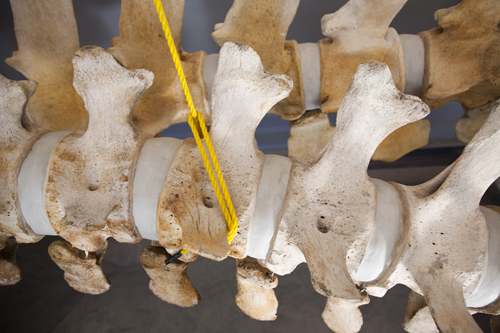
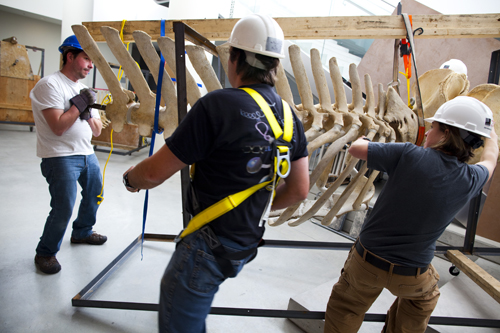
    Two whale skeletons last displayed in the 1930s at the Harvard Museum of Comparative Zoology (MCZ) were given new prominence in January, after they were taken from the MCZ’s dusty attic, cleaned, and moved to the pristine lobby of the new Northwest Laboratory building next door.

    Though they ended up less than 100 yards away, the specimens, a 21-foot killer whale and a 24-foot northern bottlenose whale, made a long trip to get there. They were first shipped to the Maine offices of Whales and Nails, a specialty preparation firm that cleaned, repaired, and then installed the specimens.

    MCZ Director James Hanken, Alexander Agassiz Professor of Zoology, was enthused about the installation, saying it serves several purposes: opening part of the MCZ attic, restoring the two specimens, displaying them publicly, and enlivening the Northwest Building’s lobby. Over the next few months, signs and lighting will be installed to complete the display.

    Hanken, who had a hand in planning the Northwest Lab because there is MCZ collections space in its lower levels, said he was an early proponent of the whale installation.

    “We’ve been anxious to get our materials out of the attic for several years,” Hanken said. “It’s not too often you come across a space where you can display a whale.”

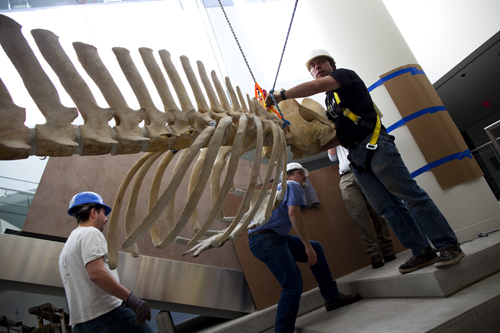
    The skeletons were removed from the MCZ in July and sent north, where they were slowly cleaned and prepped for display. The installation, coordinated by Linda Ford, MCZ director of collections operations, was delayed by a snowstorm but ultimately went ahead in late January. The specimens were hung in the lobby stairwell, the bottlenose whale arranged in a twisting dive down to the lower level, while the killer whale is posed in a jumping breach position, its toothy skull visible through the building’s windows.

    Though the diving and breaching positions are unusual ways to display such specimens, Hanken said they were chosen because they show the animals in more natural postures than their original straight positions.

    The killer whale — the largest member of the dolphin family — is the older of the specimens and was collected near the Faroe Islands in the North Atlantic in 1881. The bottlenose whale, a small, deep-diving whale related to the sperm whale and once prized for its oil, was collected in the 1930s, also near the Faroes.

    A tale of two whales

    A tale of two whales

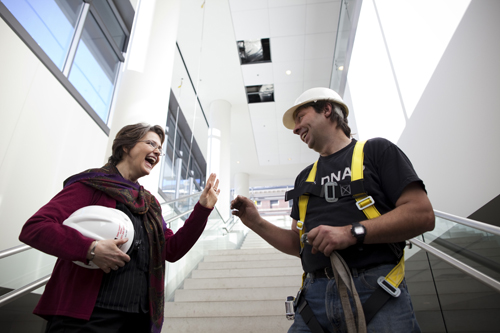
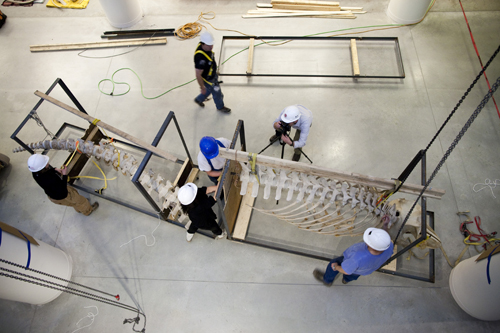
    A killer whale and bottlenose whale, from Harvard’s Museum of Comparative Zoology, are ready to be moved downstairs and installed in the front stairwell of the Northwest Lab Building.

    Moving right along

    Moving right along

    Frank DenDanto (clockwise from left), Courtney Vashro, Greg Howell, and John Hollister work together to transport a whale downstairs.

    A whale of a job

    A whale of a job

    Linda Ford and Dan DenDanto celebrate the successful transport.

    Assembly line

    Assembly line

    The team works to assemble the second skeleton.

    Breathing room

    Breathing room

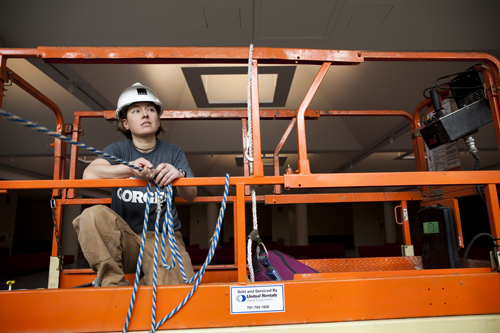
    Courtney Vashro momentarily rests from her skeleton duty.

    Up, up, and a whale

    Up, up, and a whale

    Frank DenDanto (left) gets some help with his hoist from Toby Stephenson, as Linda Ford and Jon Woodward talk about plans in the background.

    Heavyweight

    Heavyweight

    Toby Stephenson and Frank DenDanto lift their cohorts.

    Heavyweight

    Heavyweight

    Frank DenDanto (from left), Dan DenDanto, and Courtney Vashro carry the whale to the front stairwell of the Northwest Lab Building.

    Whale tail

    Whale tail

    Courtney Vashro holds a whale tail as the team lifts one of the skeletons.

    Ready, set, lift!

    Ready, set, lift!

    Judy Chupasko (from left), Frank DenDanto, and Toby Stephenson lift a skeleton into place.

    Skeleton crew

    Skeleton crew

    Frank DenDanto (from left), Toby Stephenson, and Dan DenDanto rely on muscle and one another to hoist the unthinkable — a whale skeleton.

    Teamwork

    Teamwork

    Judy Chupasko (from left), John Hollister, Frank DenDanto, Jon Woodward, and Dan DenDanto know that working together make lifting whales less of a mammoth task.

    Photo slideshow: MCZ Whale installation

    Stephanie Mitchell/Harvard Staff Photographer

  • When success spells defeat

    Invasive plants could become even more prevalent and destructive as climate change continues, according to a new analysis of data stretching back more than 150 years.

    Writing in the journal PLoS ONE, the Harvard University scientists who conducted the study say that nonnative plants, and especially invasive species, appear to thrive during times of climate change because they’re better able to adjust the timing of annual activities such as flowering and fruiting.

    “These results demonstrate for the first time that climate change likely plays a direct role in promoting nonnative species’ success,” says author Charles C. Davis, assistant professor in Harvard’s Department of Organismic and Evolutionary Biology. “Secondly, they highlight the importance of flowering time as a trait that may facilitate the success of nonnative species. This kind of information could be very useful for predicting the success of future invaders.”

    Davis and his colleagues analyzed a data set that began with Henry David Thoreau’s cataloging of plants around Walden Pond in the 1850s, when the famed naturalist kept meticulous notes documenting natural history, plant species occurrences, and flowering times. Since then, the mean annual temperature around Concord, Mass., has increased by 2.4 degrees Celsius, or 4.3 degrees Fahrenheit, causing some plants to shift their flowering time by as much as three weeks in response to ever-earlier spring thaws.

    “We set out to use this data set to examine which plants have been the beneficiaries of climate change,” Davis says. “Our research suggests quite decisively that nonnative and invasive species have been the climate change winners. Climate change will lead to an as-yet-unknown shuffling of species, and it appears that invasive species will become more dominant.”

    Davis and colleagues compared a plethora of plant traits — everything from height at maturity to flower diameter to seed weight — against species’ response to more than a century and a half of climate change. Alone among all these traits, plants that have fared well share a common phenology, a suite of traits related to the timing of seasonal events such as flowering, leaf growth, germination, and migration.

    By contrast, many plants with a less flexible flowering schedule — and thus prone to flowering at suboptimal times — have declined in population, in many cases to the point of local extinction.

    The current work builds on a 2008 paper by Davis and colleagues that showed that some of the plant families hit hardest by climate change at Walden Pond include beloved species like lilies, orchids, violets, roses, and dogwoods. The scientists also reported that some 27 percent of all species Thoreau recorded from 1851 to 1858 are now locally extinct, and another 36 percent are so sparse that extinction may be imminent.

    “Invasive species can be intensely destructive to biodiversity, ecosystem function, agriculture, and human health,” Davis says. “In the United States alone the estimated annual cost of invasive species exceeds $120 billion. Our results could help in developing predictive models to assess the threat of future invasive species, which may become greatly exacerbated in the face of continued climate change.”

    Davis’ co-authors on the PLoS ONE paper are Charles G. Willis of Harvard and Duke University, Brad R. Ruhfel and Jonathan B. Losos of Harvard, Richard B. Primack of Boston University, and Abraham J. Miller-Rushing of the USA National Phenology Network and the Wildlife Society. Their work was supported by Harvard University.

  • Shorenstein Center announces fellows and visiting faculty for spring 2010

    The Joan Shorenstein Center on the Press, Politics and Public Policy, located at the Harvard Kennedy School, recently announced four spring fellows for 2010.

    “The world of the media is expanding at breakneck speed, and this semester’s group of fellows and our visiting faculty member reflect the stunning diversity of what is now included when we use the term ‘news media,’” said Alex S. Jones, director of the Shorenstein Center.

    The fellows who will work on research projects include Deborah Amos, Shorenstein Center Goldsmith Fellow; Steven Guanpeng Dong, director of the Global Journalism Institute at Tsinghua University and professor of political communications at the China National School of Administration; Gene Gibbons, a former executive editor of Stateline.org and former Reuters chief White House correspondent; and Peter Maass, Shorenstein Center Reidy Fellow and contributing writer for The New York Times Magazine.

    In addition, Zephyr Teachout, associate professor of law at Fordham University, will be a visiting assistant professor of public policy.

    For the full release, visit the Harvard Kennedy School Web site.

  • Business lady

    When The New York Times came calling, Nancy Koehn, James E. Robison Professor of Business Administration at Harvard Business School, stepped up to the plate.

    It was 2003. Harvard Business Press presented Koehn with a book prospectus from the Times. The idea? To compile interesting articles across the history of the paper, an assignment Koehn metamorphosed into “The Story of American Business,” which features more than 100 articles spanning 150 years.

    “The NYT had worked on a few books that were syntheses on specific topics, but had never attempted anything of this depth and breadth,” said Koehn, who couldn’t bypass a chance “to follow the arc of time, that is, some of history’s most interesting individuals and events, through the eyes of men and women watching them in real time.”

    Koehn, a historian and scholar of entrepreneurial leadership, calls the book “an incredibly exciting intellectual opportunity.”

    It was an opportunity that included a lot of work. Koehn first had to decide which “thematic avenues the book would travel,” and spent three years simply reading Times backlogs.

    “Then,” she said, “the real work began, the task of selecting the articles. About 100, from almost 15 times that many, that would make it in.”

    Koehn’s themes are expansive but methodical. “From Wall Street to big business, from the transportation revolution to the information revolution — all of these subjects and more form the chapters of the book,” she said. “But these building blocks are laid upon the three-part foundation of business in America: the corporation, the changing nature of work, and defining moments in technology.”

    A book of such historical intensity is ever-pertinent in today’s economic climate. “We forget, in our age of the ‘next new thing,’ that we are not the first generation to stand at a crossroads, despairing and uncertain of what’s to come,” Koehn said. “It was heartening to see how we as a people have navigated through such similar points as the end of the Civil War or the Depression. If today’s leaders are going to make sense of the current financial crisis and its significance, they need the breadth and depth of information that the Times affords — and they need to learn from their predecessors.”

  • Office hours for Dean Hammonds

    Harvard College Dean Evelynn M. Hammonds welcomes students to share their thoughts and concerns about undergraduate life during her office hours.

    Office hours take place in her University Hall office on the following dates:

    • Friday, Feb. 12, 1-2:30 p.m.
    • Friday, March 5, 1-2:30 p.m.
    • Friday, April 9, 1-2:30 p.m.
    • Friday, May 7, 1-2:30 p.m.

    Sign-up begins at 11 a.m. in the University Hall reception area on the day the office hours take place. Students must have a valid Harvard ID and are welcome on a first-come, first-served basis.

  • Around the Schools: Faculty of Arts & Sciences

    Swimming after eating may be a dubious decision, but a film series about food in a pool? That’s another story.

    On Monday (Feb. 8) at 6 p.m., Food at 24fps presents a screening of “Tampopo” at the Adams House Pool Theater. This little-known Japanese film from 1985 is widely loved by foodies and focuses on a single mother’s obsessive pursuit of the perfect ramen noodles. Tom Levenson, professor of writing and humanistic studies at MIT, will offer a brief informal introduction to the film.

    The screening is part of a new semi-regular series about movies that feature food, organized by Harvard students, filmmakers, and food and film lovers from the Cambridge area.

    The Adams House Pool Theater is an unusual venue for a film series — it was originally a swimming pool, built at the turn of the 20th century when that area of campus housed Harvard’s most affluent students. After an eclectic history throughout the 20th century, the space was converted to a theater in the mid-1990s. Seats fill what was the shallow end of the pool, and a state-of-the-art projector and screen make film screenings possible.

    The screening is free and open to the public, but space is limited. To learn more and to check out the schedule of upcoming films, go to www.food24fps.com.

    — Amy Lavoie

  • The Crimson’s Grand Elections

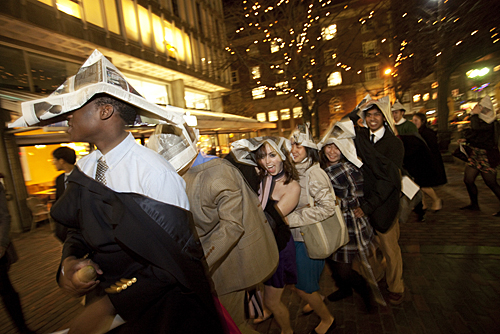
    During Grand Elections, the annual ritual for incoming members of the Harvard Crimson’s editorial board, merry participants sang, danced, and paraded around Harvard Yard. The Crimson Executive Board paid impromptu visits to the dorm rooms of the newly elected, who were barraged with requests ranging from the practical to the ridiculous: “What’s the Crimson’s phone number? How are you going to call in a story if you don’t know — yell it out!” To this challenge, most students responded with their new mantra, “5-7-6-6-5-6-5!”

    Outside Holyoke Center, the initiates then were asked to tell their high school GPA’s to passersby. As a show of humility, the new members were asked to give impromptu performances of pop songs, including “Hit Me Baby, One More Time” by Britney Spears, and “Love Story” by Taylor Swift. The rites embody a physical and mental flexibility that encourages laughter and teamwork — two virtues that go a long way in any field.

    “The spirit of Grand Elections is Crimson community building,” said Charles Wells ’10, an executive board member. “By singling out our new writers as Crimson editors, we’re instilling in them the idea that they are part of a very special community of talented and dedicated writers.”

    “When I was walking to class past the Holyoke Center this morning, I never imagined I would be dancing like a fool in front of it tonight,” said Alice Underwood ’11.  “I mean, what other newspaper asks you to dance and sing as part of the process of becoming a writer?”

    Putting on their party hats

    Putting on their party hats

    New writers for The Harvard Crimson, while donning hats made of newspaper, are initiated outside Wadsworth House.

    'Write' of passage

    ‘Write’ of passage

    New Crimson writer Julia Ryan ’13 can’t hide from onlookers as she stands in front of the Holyoke Center.

    From Conga lines to bylines

    From Conga lines to bylines

    During the initiation, the new writers groove their way down Massachusetts Avenue.

    So you think you can dance?

    So you think you can dance?

    New writers Gautam Kumar ’13 and Alice Underwood ’11 dance off while the rest of the Crimson neophytes circle around and watch.

    Crossing over to 'The Crimson' side

    Crossing over to ‘The Crimson’ side

    Nathan Strauss ’09 (left, wearing tie) and Charles Joseph Wells ’10 engage their new members in the initiation.

    More after the jump

    More after the jump

    Freshman writers Tara Merrigan (left) and Stephanie Garlock leap from one chess table to another during the initiation.

    Photo slideshow: Crimson Ritual

    Kris Snibbe/Harvard Staff Photographer

  • The hunt for healthy answers

    Researchers at Harvard Medical School and Harvard-affiliated Brigham and Women’s Hospital are leading a five-year nationwide trial to find out whether the dietary supplements vitamin D and fish oil can boost the immune system and fight cancer, heart disease, and a host of other ills.

    The “Vitamin D and Omega-3 Trial,” or VITAL, aims to sort out inconclusive and conflicting evidence from earlier research on the effects of the two compounds on human health.

    Previous studies have turned up tantalizing clues that the two nutrients can have considerable protective effects. But JoAnn Manson, the VITAL study’s principal investigator, said those trials — and others showing no protective effect — either involved specialized populations, such as those suffering heart disease, or used low dosages, which may have prevented finding a conclusive answer.

    The VITAL study is a large-scale, randomized trial involving 20,000 people across the country with no previous history of cancer, heart disease, or stroke, and is designed to test whether vitamin D and the omega-3 fatty acids in fish oil can help to prevent cancer and heart disease. Though cancer and heart disease are the study’s primary therapeutic targets, Manson said the study will also provide information on other ailments, such as diabetes, cognitive decline, depression, and respiratory diseases.

    Scientists already know quite a bit about how these nutrients work in the body. Both have powerful anti-inflammatory effects. Vitamin D appears to benefit blood pressure and glucose tolerance, while working to prevent blood vessel growth that allows tumors to enlarge and spread. Omega-3 fatty acids have anti-clotting effects and have been shown to protect against irregular heart rhythms.

    Manson, the Elizabeth Fay Brigham Professor of Women’s Health at Harvard Medical School and chief of Brigham and Women’s Hospital’s Division of Preventive Medicine, said the trial will enroll men age 60 or older and women age 65 and up. The older study population was selected because people of those ages are more commonly afflicted with the ailments the study seeks to test.

    Researchers began seeking participants in January and will eventually send mailings to more than 1.2 million Americans, including health professionals and members of AARP. Potential participants will undergo a three-month screening before enrolling in the full trial. Participants will be divided into four groups and receive blister packs of daily supplements, along with questionnaires to complete and mail back to researchers. Though some participants may opt to visit nearby clinical centers for more-detailed assessments and to provide blood samples, most can participate entirely by mail.

    The groups will receive supplements containing vitamin D, omega-3s, both, or placebos, allowing researchers to examine the effects of vitamin D and omega-3s independently as well as together.

    The study’s vitamin D supplements will contain 2,000 international units (IUs) per day, five times the 400 IUs that the U.S. government currently recommends. Manson said most Americans get only about 300 IUs of vitamin D per day through their diet, and even with supplements few get more than 500 or 600 IUs. The human body can manufacture vitamin D when exposed to sunlight — more than 2,000 IUs for someone working lightly clothed in the sun all day — but the increase in people wearing sunblock to ward off skin cancer and the decreased prevalence of children playing outdoors have reduced the amount of vitamin D that many people get from sunlight.

    Several other factors are working to further reduce the amount of vitamin D that people get. The increase in children drinking sugar-sweetened beverages instead of milk cuts vitamin D intake. Also, because vitamin D is fat soluble, the obesity epidemic is increasing the amount that is stored in fats in our bodies instead of being freely available.

    The supplements will contain about one gram of omega-3s, Manson said, or about twice the amount people would get if they followed the government’s recommendation of two fish meals a week, and about five to 10 times what the typical American usually eats. It’s also about equal to the level in a typical diet in Japan, where heart disease rates are lower.

    Manson said it would be unwise for the public to start taking megadoses of the two compounds before the study’s results come out, citing the examples of earlier large-scale trials of vitamins E and C and beta-carotene that showed little benefit of those vitamins in large doses and even suggested some risks. Should the trial turn up protective benefits to vitamin D and omega-3 fatty acids, it would open the door to greater therapeutic use of the compounds, which are easily accessible, unlike a new exotic drug that would require extensive testing.

    Manson also plans to explore the role of vitamin D in reducing racial health disparities. The study will seek to enroll enough African Americans to make up a quarter of the study population in an effort to see whether low levels of vitamin D in African Americans are linked to higher incidence of diabetes, heart disease, and other chronic diseases and whether treatment with vitamin D can reduce these risks.

    “It’s exciting to get started with this trial,” Manson said. “We’re really hoping it will provide important answers.”

    To learn more about VITAL, visit VitalStudy.org.

  • Yes, Harvard sweats

    When Caitlin Cahow won an Olympic bronze medal in 2006 as a member of the U.S. women’s hockey team, she kept the celebration short. After all, she had to race back to her undergraduate anthropology studies at Harvard.

    When people think Harvard, they usually think academic achievement. So at first glance, it might seem that Cahow ’08, who’s also on the U.S. team that will face China in Vancouver on Valentine’s Day, is an athletic anomaly. But that wouldn’t factor in alternate captains Angela Ruggiero ’04, who’s on her fourth Olympic squad, and Julie Chu ’07, who’s on her third. Nor would that account for the Canadian team’s Jennifer Botterill ’03 and Sarah Vaillancourt ’09.

    In fact, more than 130 Harvard athletes have competed in the Olympics since they resumed in 1896 (including the first medal winner). Ten Crimson athletes and coaches competed in the 2008 Beijing summer games, six in the 2006 Turin winter games, and 13 in the 2004 Athens summer games. There will be five in Vancouver. There has never been an Olympics without at least one Harvard player or graduate involved.

    “Harvard really became my home,” Cahow said, describing why she returned to campus during a short January training break rather than rest up. “This is my central hub. It’s a ‘pay it forward’ kind of a deal. You feel attached to these people for the rest of your life.”

    Harvard offers 41 Division 1 sports, more than any other college in the nation. More than 1,000 undergraduates compete in the University’s robust intercollegiate program.

    Harvard’s vast club sports program has more than 3,000 participants in 40 sports, with 1,100 young men and women competing in 31 House intramural and 16 freshman league sports and special events. In addition, 8,500 members of the Harvard community spend hundreds of thousands of hours each year at the University’s athletic facilities and in recreational classes.

    Harvard teams have won 138 national or NCAA championships, including at least one in 23 of the past 24 years. Since the Ivy League’s inception in 1954, Harvard teams have won 337 league championships. Forty-six Harvard athletes have won the prestigious Rhodes Scholarship, given to young men and women who combine attributes of scholarship, leadership, and athletics.

    The motto of Harvard’s vast sports programs, reflected in the wide participation they draw, is “athletics for all.”

    For Harvard’s Bob Scalise, Nichols Family Director of Athletics, that motto is paramount. “Athletics for all means exactly that,” he said, “whether someone is an intercollegiate athlete and wants to compete at the highest level of their sport, a club athlete, or part of the intramural or recreational programs. It’s for everyone. We have a very broad-based mandate.”

    While academics are undoubtedly the priority for students arriving at Harvard, the strong sports programs prove a bonus for many. The ability to compete at a high level while balancing course work has even meant a professional career for a few talented graduates.

    Four former Harvard football players are now making their mark in the NFL. Matt Birk ’98 plays center for the Baltimore Ravens, Desmond Bryant ’09 is a defensive end for the Oakland Raiders, and Chris Pizzotti ’09 is the back-up quarterback for the Green Bay Packers. Last season’s starting quarterback for the Buffalo Bills was Harvard’s Ryan Fitzpatrick ’05. Other one-time Harvard stars have found success in the National Hockey League, including Don Sweeney ’88 and Ted Donato ’91, the Crimson men’s hockey coach. Forward Dominic Moore ’03 plays for the Florida Panthers, and current freshman Louis Leblanc opted to play for the Crimson instead of the Montreal Canadians. Tennis player James Blake ’91 has found success on the pro circuit.

    Still, while Harvard’s strong program allows athletes to compete against some who are the best in their fields, preparing Harvard students for professional sports careers isn’t the primary goal of any Harvard coach. Across the board, they agree that their purpose is preparing undergraduates for life and the world beyond Harvard’s ivy-dappled walls.

    “Sports reveal character, and that’s sometimes something you are unable to see in the classroom,” said Katey Stone, Harvard’s women’s hockey coach. “A life balance is the most important thing.”

    After 16 years as Harvard’s head football coach, Tim Murphy has seen his share of titles and Harvard standouts. For Murphy, though, what sets a Harvard athlete apart is the University’s avoidance of scholarships.

    “At Harvard you have no financial incentive to play. From that sense, athletics at Harvard are as pure here as at any school in the country. … Here, you play for the love of the game and your teammates.”

    Emphasizing that goal, in his office overlooking Harvard Stadium, Scalise has hung a giant whiteboard. Written at the top in bold black letters are the words “Education Through Athletics,” the core component of Harvard’s athletic mission.

    “We feel you can learn the lessons of athletics whether you are an aspiring Olympian, a team member, an intramural or club participant, or a recreational athlete. Those lessons include the importance of teamwork, leadership, resiliency, risk taking, the importance of maintaining a healthy lifestyle. These are all very valuable lessons for everyone to learn, that’s our philosophy.”

    Star basketball player “Jeremy Lin is wonderful, and his story tells people that we can compete at the highest level, but that’s the tip of the iceberg of many, many thousands of stories of people whose lives we touch,” Scalise added. “They have their own success stories. They aren’t in Sports Illustrated. They are the kids who get involved and win an intramural championship and bond as a House together. That’s fabulous.”

    As in academics, hard work is a key for athletes to thrive. For two hours each night on the third floor of the Malkin Athletic Center, young men and women wage fierce combat against each other. The noise level is jarring, a symphony of electronic beeps that signal hits, the sharp crack of steel on steel, and the slap of fast-moving feet against a narrow, metal strip.

    But as soon as members of Harvard’s fencing program are done sparring, they put down their swords and head as a group to dinner at a nearby dining hall. Like all of Harvard’s athletic programs, camaraderie is a hallmark of the team. For the fencers, the bonds run deep. They travel and compete together, and they practice in tandem, coaching each other and offering advice and encouragement.

    “The team is awesome,” said Noam Mills ’12, a top-ranked fencer who just returned from Qatar, where she was competing with the Israeli national team. “Aside from being good fencers and good athletes, they are also really amazing people,” Mills said, adding that being part of the team made her transition from Israel to Cambridge much easier.

    “You just help each other get pumped up. … It’s the people who make it,” said freshman Felicia Sun, who is looking forward to fencing’s NCAA championships, which will be hosted by Harvard in March. “They are not just other fencers, they are my teammates, and they are my friends, and that’s what keeps me coming back.”

    Head coach Peter Brand, who has run the program for 11 years and led his players to the NCAA championship in 2006, said coaching the team has been his “dream job.” But for Brand, no title can replace the bonds that the players form and the life experience they gain.

    “I believe these relationships and bonds are possible because sport represents a universal language. In the fencing room, what we try to do is use this sport to bring people together, no matter what their origin, background, religious beliefs, or economic status. I also believe that when people participate in sport they can experience real exhilaration even as they learn the ideals of teamwork, a skill that will hopefully serve to the betterment of the Harvard community and society as a whole.”

    Prior to heading for Vancouver, Cahow chatted with Stone, her former coach, at the Bright Hockey Center and prepared to take the ice to practice with her one-time team. While at Harvard, Cahow was part of a powerhouse squad that won two ECAC titles and made it each year to the NCAA tournament, twice reaching the final. She said she was “floored” when she first met Stone, and heard her message.

    “I just was struck by how welcoming and honest she was. She said, ‘We recruit people more than we recruit players. We look for character, and we build character, and those are the most important things about this program. You are going to play great hockey, and you are going to make the best friends that you have ever had in your entire life, but our hope is that you come in a great person and you leave an even better person.’ ”

    “I couldn’t believe it. It wasn’t about the power play, it wasn’t about the record or statistics, it was about ‘we want you to become the best possible person that you can be through being a part of this program,’ and I was sold.”

    Men’s soccer is another strong Harvard program, and last fall the team advanced to the third round of the NCAA tournament before losing to Maryland. While star forward Andre Akpan garnered broad public attention, another talented player quietly came into his own. Both Akpan and central defender Kwaku Nyamekye ’10 were picked in the recent Major League Soccer draft. Akpan ’09 just reported to training camp with the Colorado Rapids. Nyamekye, who will graduate in the spring, will join the Columbus Crew in June.

    During his winter break, Nyamekye, a tall player with a knack for moving forward and attacking with the ball, trained with Rangers Football Club, a team in the Scottish Premier League. A native of Switzerland, where he began playing soccer as a boy, Nyamekye admits that he chose Harvard for the academics and that a career in business is likely in his future.

    But for now he is content to follow his dream of playing professional soccer for as long as he can. Aside from the Harvard soccer program giving him the opportunity to compete at the top of the collegiate game and win two Ivy League titles, Nyamekye said he will always remember the camaraderie he had.

    “It really shows that, more than being just smart students, Harvard kids are really multifaceted,” said Nyamekye, “and it brings a lot of students with a lot of interest together. … It adds an interesting dynamic to the college experience and to college life.”

    Competition comes in many forms at Harvard. Students in the intramural program appreciate that they can compete and put in as much time as their schedules allow.

    “It’s a total break from whatever you are doing,” said Fabian Poliak ’11 of Leverett House, who plays on its B-squad volleyball team. “To me it’s a huge break from studying, great exercise, and a lot of fun.”

    Harvard’s diverse club program also affords students the chance to compete in sports and movement, from badminton to ballroom dance.

    For senior Khoa Tran, who took up martial arts as a boy to stay out of trouble and learn how to say no to peer pressure, the tae kwon do club team has proven invaluable.

    “It’s a way of life, not just a sport,” said Tran, who became an instructor with the team and now is passing along his passion to the next collegiate generation.

    Harvard long ago decided to keep its sports in context as a supportive part of College life. Still, teams that combine passion, talent, drive, and dedication can win championships too.

    Although Harvard’s sports programs focus on the student athletes, they also have been involved in many sports firsts, including:

    • Harvard and Yale faced off in the first intercollegiate sports event in 1852, a crew race on Lake Winnipesaukee.
    • Fred Thayer ’78 created the first catcher’s mask in 1877.
    • Harvard introduced the football scoreboard in 1893.
    • Harvard played the first college hockey game, against Brown, in 1898.
    • Because Harvard Stadium’s shape prevented easy widening of the field, football officials eventually legalized the forward pass.
    • Harvard played the first intercollegiate soccer game, against Haverford, in 1905.
    • Radcliffe competed against Sargent College in the first women’s intercollegiate swim meet in 1923.
    • A Harvard hockey coach and player decided in 1932 to shift hockey lines rather than substitute individual players.

    “The fact that people can come to Harvard and, whatever their talents, whatever their interests might be, they can pursue them to whatever level they want is a very important message,” said William R. Fitzsimmons ’67, Harvard’s dean of admissions and financial aid, who attributes his commitment to staying in shape to his early Harvard experience as a hockey goalie.

    When he travels on recruiting visits, Fitzsimmons said he conveys that message to prospective Harvard students who regularly ask him about the College’s intercollegiate, club, intramural, and recreational community.

    “I tell them,” he said, “that it is a very important piece of Harvard life.”

    Gervis A. Menzies Jr. contributed to this report.

  • No giving up

    For senior Pat Magnarelli, there’s no sense of thinking about what could have been.

    Two years ago, the Harvard men’s basketball team’s talented big man took the court in Harvard’s Ivy League opener against Dartmouth, dominant and on top of the world.

    First on the team in rebounding and second in scoring, Magnarelli was coming off the best game of his collegiate career — a 22-point, 12-rebound effort in an impressive win over Colgate.

    At the time he was averaging 10.8 points and 6.3 rebounds a game, ranking second and first on the team, respectively.

    “Well I hope I’m not peaking right now because I don’t want to stop playing like this,” Magnarelli told The Harvard Crimson after the win. “I’m getting more comfortable.”

    Extolling his sophomore forward, head coach Tommy Amaker (in his first year at the time) says, “He’s been really solid for us. … I think he’s been consistent, we can rely on him, and he’s been dependable. I’m really proud of his play, his effort, and his leadership on the court.”

    Already a long, difficult journey for the Duxbury, Mass. native, Magnarelli hoped the 2007-08 season would be a redemption season after a stress-fractured vertebrae confined him to a back brace for most of his freshman season. In Magnarelli’s first season, he only played nine games.

    In 2007, after just 17 starts, it was already beginning to look like his sophomore season would be his season.

    But fate intervened.

    In the opening minutes of Harvard’s matchup at Dartmouth, Magnarelli went down with a knee injury.

    He spent the rest of the season in street clothes.

    “It was really tough. My teammates were very supportive of me and they helped me though that time because they knew I was really down,” says Magnarelli.

    The midseason injury was a crippling blow for Harvard, who lost all but two of their remaining games, finishing the season 8-22 (3-11 Ivy League) and tied for last-place in the conference.

    After a tough rehab in the offseason, Magnarelli was ready for his second comeback, but two days before the Crimson’s first game he reinjured his knee, and two surgeries sidelined him for the entire 2008-09 season.

    “It’s definitely been a tough experience,” says Magnarelli. “Coming in sophomore year looking to play, playing pretty well, and then getting injured and sitting out all junior year — it’s really tough having to sit at the end of the bench and watch your team and realize there’s nothing you can do about it. It’s a little cliché, but it’s definitely making me stronger.”

    Although no one would have blamed him for putting away his jersey, he wasn’t ready just yet.

    Suiting up on Nov. 13, 2009 — his first game in nearly two years — Magnarelli put together a solid effort, leading the Crimson in rebounding in the return.

    With the Crimson off to its best start in a quarter century, a lot of well deserved attention has been given to fellow senior Jeremy Lin, who’s a lock for first-team All-Ivy League and is in a neck and neck race for Ivy Player of the Year. But with any team, Harvard not an exception, the Crimson’s success is as much predicated on the contributions of its role players, as it is the starters.

    And the leadership Magnarelli has to offer to teammates, in addition to the screens and hustle plays won’t show up in the box score, mean just as much to the team as the statline does.

    “You have hidden leaders and hidden players within your team that are worth their weight in gold,” says Amaker, “Pat is that for us in a lot of different ways. I refer to him as a stabilizer for us when he’s out on the floor.”

    Amaker adds, “He has a great understanding and basketball IQ and it’s really been a neat thing for us because we have a lot of young kids. … I think the world of Pat because of all that he brings. His value to our team is great. There’s no question about it.”

    “I watch Pat a lot,” says sophomore Keith Wright. “He’s a tremendous guy. Unfortunately his knees didn’t allow him to play his full college career, but it’s his senior year, he’s playing a lot this year, and really able to step up for us.”

    Although he has yet to complete an entire season in his college career, Magnarelli has helped the Crimson to their first winning season in nine seasons. Looking for their first Ivy Championship ever, it would mean Harvard would reach the NCAA tournament for the first time since 1943.

    “You only get four years here, and when you miss two of them, the time goes by a lot quicker,” says Magnarelli. “Talking to some of these freshman and sophomores, they’re young and they don’t know how fast it goes yet. As a senior, I try to tell them to just enjoy every moment here because it goes by quick.”

    Although Magnarelli’s career surely hasn’t gone the way he would have liked, it is because of his indomitable spirit and perseverance, which has allowed him to help the Crimson to a 12-3 record.

    “It means the world to have him with us,” says sophomore Oliver McNally, “But just to see him every day, working hard and see he’s having some success, it’s really motivational for the team.”

    And as the psychology major enters his last semester at Harvard, undecided about his future, one thing is certain — the big man is back.

  • Beanpot bound

    There’s nothing like a little neighborly love in early February to get the attention of Boston area hockey fans, but Tuesday night (Feb. 2) the No. 6-ranked Harvard women’s hockey team showed no love to Boston College (B.C.), drubbing the cross-river rival in the Beanpot opener at Bright Hockey Center, 5-0.

    Solid goaltending on both sides kept the game scoreless for the first 38 minutes, but a power-play goal by junior forward Liza Ryabkina with 1:34 remaining in the second period gave the Crimson a 1-0 lead heading into the second intermission.

    Three more goals by Ryabkina and a goal by Josephine Pucci ‘13 blew the door wide open for Harvard, setting the stage for next week’s championship game, a No. 6-vs.-No. 7 matchup against Northeastern.

    “I’m really happy about the way our kids played tonight from the beginning to the end of the game,” said Crimson head coach Katie Stone, who has led the program to nine of its 12 Beanpot titles. “We came out flying in the third period and certainly took advantage of our opportunities.”

    Sweet revenge was finally attained for the Crimson, who had dropped the past three Beanpot games to the Eagles. The result was retribution of sorts, especially after a goal in the final stanza crushed Harvard’s championship hopes in last year’s 1-0 loss.

    “To tell you the truth, we want to beat any team. … We don’t really care what the label says. We just want to play our best,” said Ryabkina after her second career hat trick and first four-goal day. But after a laugh, she added, “Yes, we did want to beat them pretty badly after a couple of rough games … against them.”

    “This is a pressure-packed tournament. Everyone wants a Beanpot,” said Stone. “We value the Beanpot at Harvard University, and to be able to play for a championship in early February is a great experience….”

    The Crimson have now won five of their last six games and will meet the Northeastern Huskies in the title game on Feb. 9 at 8 p.m. in the Bright Center for the 16th time in the tournament’s 32-year history. Harvard holds a 5-10 record in those games and a 12-16 record overall against Northeastern.

  • Student concert to aid Haiti

    As medical relief efforts following Haiti’s devastating earthquake begin to shift toward stabilizing the battered island nation, including feeding, supporting, and housing the survivors, the need for monetary support remains vast. Haiti has many surgical teams, tents, and trucks in place now. But those ongoing efforts require strong fiscal support, as will the upcoming rehabilitation and rebuilding.

    To that end, on Feb. 12, Harvard student artists, in collaboration with the Office for the Arts, will host a benefit concert to raise much-needed funds for Haitian relief.

    Harvard student artists, including noted pianist Charlie Albright ’11, jazz pianist Malcolm Campbell ’10, and dancer Merritt Moore ’10 of the Zurich Ballet Co. will perform, along with student singing and dance troupes, including the Kuumba Singers, the Harvard Glee Club, the Harvard Caribbean Club Dance Troupe, and the Modern Dance Company. The two-hour concert will take place at Sanders Theatre, 7 to 9 p.m. Tickets are available through the Harvard Box Office (617.496.2222). The University and the Office for the Arts are underwriting production costs so that all proceeds from ticket sales can go directly to Partners In Health, a nonprofit group that has been working in Haiti for decades.

    Harvard students, deciding to tap into their own talent to help, developed the concept and organized the benefit concert.

    “The responsiveness, dedication, and skills of the students and faculty are the backbone of the Harvard community,” said B.A. Sillah ’12, one of the concert’s student organizers. “And when we asked the community for help, they gave us a resounding yes.”

    The evening will feature approximately 12 performances, a video highlighting the relief efforts of Partners In Health in Haiti, and readings of poetry and prose by Harvard students. To widen the audience beyond Sanders Theatre’s four walls, the University will broadcast a live feed of the concert. More details about the event will be available through a link at http://www.harvard.edu/haiti when they become available.

    While the concert’s proceeds will help Haiti, another effort is under way on campus to support Harvard employees who have been directly affected by the disaster. Harvard University, in partnership with the Harvard University Credit Union, announced a new emergency relief fund last week. Harvard affiliates can donate online. Eligible employees can apply for grants.

    In addition, a two-hour charity event at the Queen’s Head pub, sponsored by Harvard Public Affairs and Communications, recently raised $650 for Haitian relief. That’s enough money for Partners In Health to treat 30 malnourished children for a month.

    This week, the Harvard Graduate School of Education announced a goal of raising an additional $5,000 by Feb. 5, also to support Partners In Health.

    There are many ways to help. Harvard faculty and staff still can donate to Haiti relief programs of their choice through the Community Gifts Through Harvard program.

    For more information on the range of relief activities and resources benefiting Haiti, go to http://www.harvard.edu/haiti.