Author: Harvard Gazette Online

  • Rating the ratings system

    If the Registrar’s Office in the Faculty of Arts and Sciences (FAS) gave a grade for student participation in course evaluations, it likely would be an A+, since 96 percent of undergraduates submitted course evaluations, or Q evaluations, at the end of the fall term.

    The response rate is a marked increase over a few years ago, when it hovered at 65 to 70 percent. The growth results partly from the transition of several course evaluation processes from paper forms to online only.

    At one time, course evaluations were only on paper and filled out during the last class meeting. At first when course evaluations moved online — meaning that students were no longer a captive audience — response rates dropped. This year, the Registrar’s Office addressed that problem by letting undergraduates receive course grades online a few weeks earlier, but only if they filled out the course evaluations. With this option, participation rose.

    “We thought that this would help our response rate, but it exceeded our wildest expectations,” said Barry Kane, FAS registrar. “These response rates are unheard of. I don’t think that that there is a school in the country that’s getting this kind of response.”

    The Q evaluations are available at http://q.fas.harvard.edu. Students also access the Q evaluations when planning their course schedules at my.harvard.edu.

    The information within, and accessibility of, the online Q also has been augmented this year. As recently as two years ago, course evaluations were published in the “Q Guide,” a 1,000-plus-page book edited by Harvard College students. Jointly implemented by the Registrar’s Office and FAS Information Technology (FAS IT), the new Harvard Q is now integrated into the course planning feature of my.harvard.edu.

    The online Q offers several key advantages over the book: Students can compare the Q scores of several courses side by side, and can also read other students’ complete answers to open-ended questions posed in the evaluation, which were not published in the book.

    “We tried to help them have a snapshot of what their peers think about a faculty member or a course,” said Katie Vale, director of academic technology with FAS IT. “We don’t want students to pick courses solely on the popularity, but if you are vacillating between two courses, it is useful for students to know what courses many of their peers recommend. “

    All courses offered by Harvard College are subject to student evaluation in the Q, and faculty members often integrate the feedback they receive into their subsequent teaching.

    Beyond the Q evaluations, many other new online applications for students make registering and planning for courses easier. The Registrar’s Office and the Advising Programs Office recently developed a tool to help students map out their course schedules for their entire four years at Harvard, allowing students to plan how they will fill their concentration and General Education requirements.

    Term registration, course enrollment, class lists, transcript requests, directory updates, and placement exams have all been moved online in the past couple of years. According to Kane, additional registry processes are slated to move online in the coming year.

    To go directly to an online course evaluation, visit this link.

  • Bringing sexy back to Harvard

    When sexy returned to Harvard, it came in the form of Justin Timberlake.

    Looking dapper under the bright lights of New College Theatre, Hasty Pudding’s Man of the Year took his roast like only a sexy man can: In pink heels and a platinum blonde wig.

    Timberlake, 29, was a member of “The Mickey Mouse Club,” and later of the popular boy band ‘N Sync. He sold more than 7 million copies of his debut solo album, “Justified”; and his later album “FutureSex/LoveSounds” sold more than 9 million.

    But according to the hosts of the Hasty Pudding club’s annual satirical production, Kelly Conley ’11 and Steve Rola ’11, the man who once famously sang that he was “bringing sexy back” had lost his mojo. Dressing like a woman was just one of the ways Timberlake might reconnect with his sexy side. First, however, the Queen of Pop had to pay him a visit.

    Decked out in a cherry red cone bra and bodysuit, Madonna, played by Andrew Cone ’11, brought her sidekick Lady Gaga, Derek Mueller ’10.

    “Justin, it’s me, Madge,” said Madonna dancing around Timberlake. “I’ve brought along Lady Gaga, the result of a horrific accident when I tried to clone myself!”

    The student-run Hasty Pudding Theatricals have presented their unique brand of theater every year since 1844, pausing during World Wars I and II. In addition to putting on its annual spoofs, the group donates thousands of dollars to the arts programs of Cambridge Public Schools.

    Before the night was out, former band mates ‘N Sync stormed the stage, dressed Timberlake in a silver lamé coat, and began a synchronized dance routine. Once they were gone, Timberlake was again confronted with his past.

    “Hi there, Justin. Remember me?”

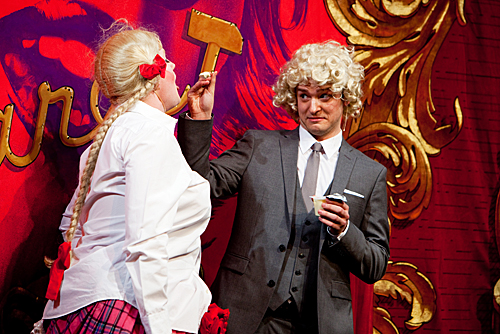
    It was Britney Spears, played to girlish perfection by Cliff Murray ’10, who busted onstage in schoolgirl apparel and long blonde braids. Timberlake, who once dated the real Britney, was obliged to feed the pretend Britney vanilla pudding with a plastic spoon.

    “This is so nostalgic,” he quipped.

    “Alright, we can give him sexy back,” Spears declared. “Only one thing left to do.”

    Enter those aforementioned pink heels, which Timberlake wore with pride, shedding his black oxfords and showing off his bright blue striped socks. He also donned a brassier outfitted with shiny gift boxes.

    “Well, I’ve got to tell you guys,” he said, “I’ve never felt more like a man.”

    Timberlake, who has received multiple Grammy awards, and even won two Emmy awards for his work with “Saturday Night Live,” was awarded the group’s golden pudding pot. He said the show was “cooler than any Grammy or Emmy.”

    “Really, truly this is an honor,” he said. “It’s probably already on YouTube.”

    Timberlake on tour

    Timberlake on tour

    Hasty Pudding’s Man of the year Justin Timberlake took a tour of Harvard Yard the afternoon before his roast.

    Gettin' cheeky

    Gettin’ cheeky

    Pop star, actor, and Hasty Pudding’s Man of the Year Justin Timberlake (center) was presented a Pudding Pot by Alec Brown ’10 (left) and Tyler Hall ’11.

    Feeding time

    Feeding time

    Britney Spears, played by Cliff Murray ’10, confronted ex-boyfriend Timberlake and forced him to feed her pudding.

    Sexy back

    Sexy back

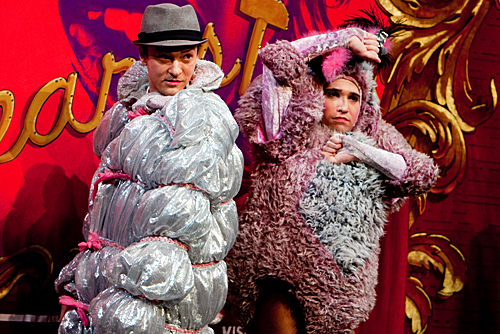
    The “SexyBack” singer poses in a puffy silver jacket next to dog Daniel Kroop ’10.

    Threesome

    Threesome

    Madonna (Andrew Cone ’11) and Lady Gaga (Derek Mueller ’10) were just two of the wacky guests to join Timberlake on the New College Theatre stage.

    It all comes down to pudding

    It all comes down to pudding

    Timberlake displays his Pudding Pot.

    Photo slideshow: Hasty’s Man of the Year

    Photos by Rose Lincoln and Kristyn Ulanday/Harvard Staff Photographers

  • In the clutches of the Taliban

    Never has the path of international journalism been more perilous, says a Pulitzer Prize-winning reporter who was held captive by the Taliban for seven months in the mountainous tribal areas of Afghanistan and Pakistan.

    During the Nieman Foundation’s annual Joe Alex Morris Jr. Memorial Lecture on Thursday (Feb. 4), New York Times correspondent David Rohde described his kidnapping within a wider context of increased threats to journalists who are now less likely to be seen as neutral observers by violent fundamentalists.

    “Both what I found in the tribal areas and having that unfortunate kidnapping showed me the importance more than ever of the need for journalistic institutions that can send people out to do irreplaceable reporting on the ground and also support reporters if they’re kidnapped,” Rohde said.

    The Internet’s instant platform has lured young journalists overseas, but “if something goes wrong, those journalists don’t have the backing of major institutions. I was lucky in my case; I did have that backing.”

    Rohde was a seasoned reporter when he accepted an invitation to interview a Taliban leader in November 2008, just an hour outside Kabul. He had covered the Balkans conflict and had won a Pulitzer for describing the mass execution of 7,000 Bosnian Muslims. He won a second Pulitzer in 2009 as part of a New York Times team that covered Afghanistan and Pakistan. He returned to Afghanistan to work on a book.

    In retrospect, he said, he should have realized that his kidnapping had long been planned. In harrowing detail, he described his captivity, including his young, fanatical Afghan and Pakistani guards who, through a lack of education and fervor, lived in an “alternative reality” in which America was waging war against Islam, neckties were a secret symbol of Christianity, and Christians sought to live for 1,000 years — which revealed their lack of faith in God.

    Even though the United States had a policy against paying ransom, his captors believed that the U.S. government would be willing to shell out millions and release Islamic prisoners from Guantanamo Bay to gain Rohde’s release. When he tried to tell them about being held captive by Christian fundamentalists for his work exposing Muslim executions, his captors simply concluded they could get even more money for him.

    While his captors had beliefs far outside mainstream Islam, he found that the Taliban were able to openly control large areas of Afghanistan and Pakistan, creating a “Taliban mini-state” with their own police patrols, schools, and road construction crews.

    “What I realized very quickly in Pakistan was that the Taliban regime that the United States thought it had toppled in 2001 was alive and thriving; it had simply moved a few miles to the east,” he said.

    Yet mainstream Afghans and Pakistanis do not necessarily support the Taliban. “The Taliban are oppressive when they rule,” he said, describing several executions. The only way to defeat them, however, is to destroy their safe havens in Pakistan, he said.

    The Times and other media did not report Rohde’s kidnapping; he managed to escape in June 2009. He freely admitted that the news blackout raised troubling questions about favoritism for kidnapped journalists when others, such as contractors, are also nabbed.

    During a lively question-and-answer period, Shankar Vedantam, a Nieman Fellow and Washington Post reporter, noted that many crime or kidnapping victims also prefer that “we don’t write about them at all, but we choose to write about them because we say it’s in the public interest.”  He added that many governments believe intense media coverage encourages terrorism.  “How do you wrestle with it?” he asked Rohde.

    “Not very well,” Rohde acknowledged. He said he even has qualms about describing his captors, saying the Taliban may love to be perceived by Westerners as fanatical and greedy. “They want to be seen as irrational, they want to be terrifying,” he said. “I wrestle with whether I serve their purposes in writing their story. I don’t have a good answer.”

    Rohde, who wrote a five-part Times series on his kidnapping, is on leave writing his book and working to help news organizations and families deal with kidnapping and to promote training for reporters in hostile areas. “I hope to help other journalists avoid the mistakes I made,” he said.

    The annual Joe Alex Morris Jr. Memorial Lecture honors a Los Angeles Times reporter who was killed in 1979 while covering the Iranian revolution. For more information about the Nieman Foundation for Journalism at Harvard.

  • Global warnings

    Panelists at the Harvard Kennedy School (HKS) examined two kinds of climate change during the launch of a new seminar series on Thursday (Feb. 4). The first involved global warming. The second concerned another atmospheric shift: the metamorphosis of communications from professional and specialized to public and diffuse, as print gives way to the Internet, and network news to fragmented cable and talk radio.

    The seminar, called “The Public Divide Over Climate Change: Scientists, Skeptics & the Media,” was the first of three on press coverage and global warming, and was jointly sponsored by the Belfer Center for Science and International Affairs and the Joan Shorenstein Center on the Press, Politics and Public Policy. It came just after the release of a survey, sponsored by Yale and George Mason universities, that said almost half of Americans are “cautious,” “disengaged,” “doubtful,” or “dismissive” of the idea that climate change exists and is being caused by humankind.

    “Media has that nice singular sound,” said moderator Cristine Russell, a senior fellow at the Belfer Center and a freelance journalist. “But it’s obviously a diverse group, many of whom are not interested in news or journalism or facts or information.” The debate on global warming seems chaotic, she said, as seen through the Internet and blogosphere, with “increasingly acrimonious” commentary on the issue from both sides. The task of lessening the chaos is complicated by cutbacks in the mainstream press, the rise of skepticism fueled by conservative pundits, a diverse activist agenda, the concern with politics over policy, and the competition for public attention. One goal of the seminar, Russell added, was to examine how public dialogue might be improved.

    Panelist Andrew Revkin has worked toward that goal through his career. “Now we have this instantaneous and intensifying and echo-chamberish concentrating force moving at the speed of light,” said the former New York Times reporter and “Dot Earth” blogger about the Internet, which he contends has helped to intensify the discourse. “What happens is it bounces back and forth within a matter of hours, and then it bounces to Rush Limbaugh or George Will, and then it becomes a really loud message in the political sphere.”

    Unfortunately, he added, the message has never been relayed clearly and productively enough to create a groundswell in the general public. “It’s like water in a shallow pan,” Revkin said. “You get a lot of sloshing around, but not a lot of depth.” He said that climate change, which was at the bottom of Americans’ priorities for 2010 in a recent Pew Research Center poll, will not become a top-tier issue in this country, in part because it hasn’t hit close enough to home.

    “The history of action on the environment, or any issue, is mainly a function of your direct experience,” he said. Furthermore, cutbacks in traditional media outlets mean that scientists are going to have to work harder to get the message out. “The bottom line is that everyone’s going to have to get more engaged, especially if you care about disinformation. … If you’re not in that soup, no matter how ugly it may be, you’re going to be missing an opportunity to exert some authority and control over the discourse.”

    Matthew Nisbet, a social scientist and assistant professor of communication at American University in Washington, D.C., agreed, adding that while skeptics of climate change continue to allege “the uncertainty of the science and the devastating economic consequences of policy action, they are also promoting a relatively new focus on the public accountability of scientists and their institutions.” This narrative, he said, “defines climate change as fundamentally about alleged wrongdoing, politicization, and a cover-up on the part of mainstream scientists.”

    Recent surveys, he added, confirm that public concern about and acceptance of climate change have dipped across the political spectrum. One solution, he emphasized, is for scientists to become more focused on public engagement while considering the greater need for transparency and public access to their research, as well as their own political biases (55 percent of scientists self-identify as liberals, he said, while only 20 percent of the public does).

    Another tack is for scientists and the press to communicate the dimensions of climate change in a way that people can digest. Framing the storyline around public health and national security, for example, is likely to bring about a shift in public opinion as the topic becomes more personally relevant to a larger portion of the population.

    Finally, he said, emphasizing the positive — discussing mitigation efforts rather than simply presenting a doom-and-gloom scenario — may elevate concern. In one survey, he said, “When change was talked about in terms of solutions, people’s positive reactions went way up,” even among the respondents identified as “dismissive.”

    The Shorenstein Center’s Thomas Patterson, Bradlee Professor of Government and the Press at Harvard Kennedy School, spoke from a social scientist’s perspective. He cited polling research done just after World War II showing that a determined effort on government’s part to inform the public usually results in “very little change in public opinion,” in part because there is too much competition among various messages.

    The level of public understanding on a topic is “sometimes shockingly low,” he said, citing studies taken before the Iraq War that said most Americans believed that Iraqi leader Saddam Hussein and al Qaeda were allies, and more recent polls on health care saying that only 26 percent of Americans know how many votes it takes to break a Senate filibuster. (The filibuster question offered four possible answers, making the number of people who got it correct “almost random.”)

    He said another recent survey reported nearly half of the respondents did not believe global warming was happening, or they weren’t sure, or it was caused by something besides human activity. “We can ask the media to do better reporting,” he said, “but this is a monumental task.”

    The series continues on March 4 with “Climate Policy and Politics: Covering Conflict in the Capitol, Copenhagen and Beyond” and on March 31 with “Techno-Optimism or Pessimism: ‘Fixing’ the Planet’s Climate Problems.” For more information.

  • Art for students’ sake

    Walking into Massachusetts Hall’s main corridor, the first thing you’re likely to see is Mohsen Mostafavi’s gigantic statement. It’s mounted on one of the corridor’s five walls, the space for the third annual Mass Hall Student Art Exhibit, “Futures in the Present,” which was furnished by the Harvard Graduate School of Design (GSD), where Mostafavi is dean.

    Printed in black on one side of an oceanic panel, the rest of the panel drifts off into a sea of small, textural GSD logos, which let Mostafavi’s message really pop. He wrote in one section that GSD’s program, which is “aimed at the conceptualization and construction of alternative and sustainable futures, has a footing in the ethical and political realms.”

    Sprawling, blueprintlike plans deck the rest of the halls: arrays of architecture, landscape architecture, and urban design, which reflect Mostafavi’s principles and illustrate a better world.

    In Maja Paklar’s design, an AIDS and tuberculosis clinic and research facility flourishes in Durban, South Africa. Paklar, GSD ’09, said it was “conceived as an interface between public and medical institutions that aims to overcome the stigmatization of disease by softening the social boundaries built up around the sick and impoverished population of South Africa.” It won the 2009 James Templeton Kelley Prize offered by the Boston Society of Architects.

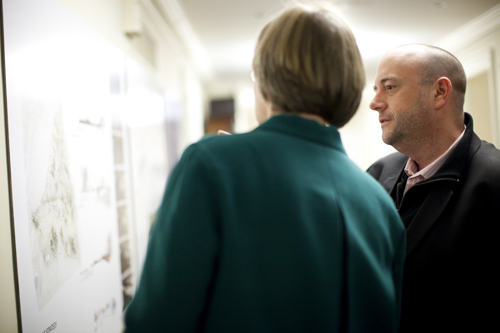
    Megan Panzano, GSD ’10, helped to curate the exhibit with Dan Borelli, the GSD’s director of exhibitions. Panzano mapped and measured Mass Hall to see what each wall could allot. “We wanted to treat each wall as a project,” said Borelli, hence the grand scale of the designs.

    “Think of this exhibit as an unfolding of the School and its various departments,” said Panzano. “We wanted to capture the depth of work and represent different types of projects and research that students took on.”

    The Mass Hall Student Art Exhibit was an offshoot of the 2007 Arts Task Force, which President Drew Faust commissioned and spearheaded. Among her many recommendations was that more physical spaces across campus be dedicated to art. This year marks a change in the exhibit which, since its conception in 2008, has featured undergraduate work.

    Faust thanked the students for their projects, which she called “uplifting and aesthetic enjoyment.”

    “We are delighted to have the GSD offer its professional eye and design eye … And thank you for what you’ll be leaving behind to inspire us through spring.”

    Ph.D. candidate and exhibitor Peter Christensen, GSD ’09, called the displays “wonderful” and said, “It’s nice that the president was interested in our work.” But the exposure helps, too. “I know how many people come through this hall,” he said.

    His exhibit came in book form and rests in the hall’s lobby. Titled “A Geopolitical Unarchitecture: Armenian Antiquity in Modern Turkey,” Christensen’s volume is one of many student works not hanging from the walls. “What we do is not just all visual,” he said. “Design is equal part writing and visual.”

    Mostafavi, who dubbed the event a “fantastic opportunity,” was grateful for the “cohabitation, and the restraint of this wonderful hallway. It’s creative constraint. People who come to the exhibit will visit us at the Design School.”

    “It’s great that our work is being brought to another building and being shared on another platform,” said Anthony Acciavatti, GSD ’09, whose colorful book, “Agri-cultural Regimes: Adventures in the Military-Agri-Cultural Complex in the American Midwest,” also sits in the lobby.

    “It’s really valuable for us to pay more attention to the impact of design, architecture, and urban planning on the environment,” said Mostafavi. “This is everything that surrounds us.

    From the top

    From the top

    Harvard President Drew Faust speaks with Harvard Graduate School of Design Dean Mohsen Mostafavi during the Mass Hall Student Art Exhibit reception. This year the exhibit features work by Harvard Graduate School of Design students.

    Rave reviews

    Rave reviews

    (Right) Peter Christensen, GSD ’09, called the displays “wonderful.” He is joined by Megan Panzano, who helped curate the show.

    Designing men

    Designing men

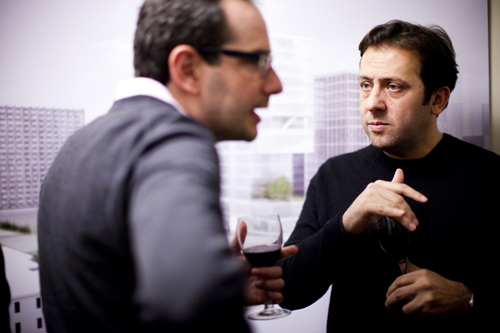
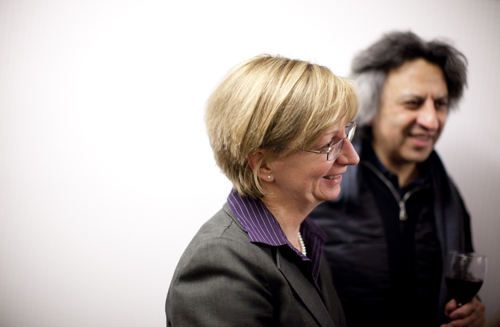
    GSD assistant professor of urban design Felipe Correa and design critic in landscape architecture and urban planning and design Ciro Najle talk during the reception.

    Hallway view

    Hallway view

    Mostafavi (left) offers details of the work as Faust attends the Mass Hall reception.

    Executive moment

    Executive moment

    GSD Dean Mohsen Mostafavi (right) shares insight with Harvard Executive Vice President Katherine Lapp during the Mass Hall art opening.

    Critical eye

    Critical eye

    Harvard President Drew Faust (left) speaks with Chris Reed about the designs on exhibit in Mass Hall. Reed is a design critic from the GSD.

    Opening remarks

    Opening remarks

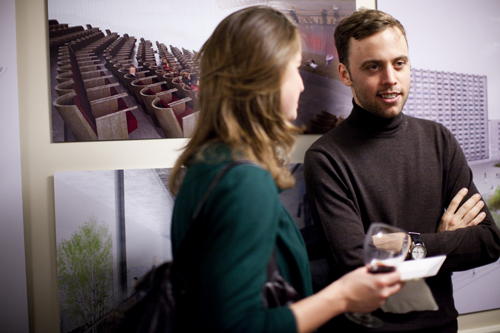
    Meagan Panzano, GSD ’10, engages in conversation during the exhibition opening.

    Design exhibit

    Design exhibit

    Anthony Acciavatti has work in the third annual Mass Hall Student Art Exhibit. Acciavatti is a 2009 GSD grad.

    Photo slideshow: Designs on Mass Hall

    Photos by Stephanie Mitchell/Harvard Staff Photographer

  • Listen to the people

    Americans’ surging political discontent has been years in the making, says Republican National Committee Chairman Michael Steele. The rising unrest, Steele told an audience at the John F. Kennedy Jr. Forum on Wednesday (Feb. 3), is a response to those leaders who have failed to listen to the American people.

    Although the leadership in both parties lost sight of what the electorate wanted them to do, Steele said, “The American people didn’t lose sight of what they wanted and what they expected.”

    From 1994 to 2006, he said, party leaders turned inward and “became more concerned with the wheels of government and the consumption of government than … with productivity and the ability of individuals to do their own thing. This environment has been under way for some time.”

    As a result, Steele argued, the country experienced two major recent political shifts. In 2007 and 2008, a wave of enthusiasm “unlike anything the country has seen” brought young people out to the polls in record numbers and swept Barack Obama into the White House and Democrats into solid majorities in both houses.

    A year ago, Steele told the audience at the Harvard Kennedy School, the conventional wisdom posited that the GOP was badly wounded, and would remain so for some time. Yet in recent months the Republicans have won governorships in New Jersey and Virginia and a Senate seat in Massachusetts, one held by Democrats for more than a half a century, and for more than 40 years by liberal leader Ted Kennedy, until his death.

    Dismissing the contention that the Republicans’ protesting Tea Party faction is made up of “right-wing ideologues,” Steele described the movement that emerged last summer, in response to the health care reform initiative, as relevant and important. Its members, he said, are average citizens who are taking control and shaping the national agenda. They are demanding that someone address their concerns, someone who understands “what my walk is all about,” he said. “There is a certain dynamism that is beginning to explode across the country, and the political elite is largely clueless to it.”

    Recalling advice from his mother, a sharecropper’s daughter and laundress for 45 years who never made more than $3.83 an hour, Steele said political leaders need to know when to “shut up and listen.”

    A former Maryland lieutenant governor and the first African American elected to statewide office there, Steele described a good leader as “someone who leads with a sense of decency and purpose, and who knows how to follow first.”

    “Put yourself second to what is in front of you. It’s a difficult thing to do,” he said. “Don’t lose sight of why you want to serve in the first place, because the moment you lose that, the rest doesn’t work.” It’s important to remember “that flare that ignited your passion.”

    The forum was sponsored by the Institute of Politics.

  • Red hot for bluegrass

    Look for a fire shortly in the Thompson Room at Harvard’s Barker Center: a collection of musicians and scholars burning to play bluegrass. Or at least to talk about it.

    “Fire on the Mountain: A Bluegrass Symposium” on Saturday (Feb. 6) will feature discussions with historians, ethnomusicologists, and musicians on the history and importance of the bluegrass form, as well as live performances.

    The daylong program, which engages scholars University-wide, is sponsored by the Committee on Degrees in Folklore & Mythology, the Office for the Arts at Harvard (OfA), the Office of the Provost, Harvard’s Department of Music, the Humanities Center at Harvard, the Undergraduate Council, and the Harvard College American Music Association (HCAMA).

    Pickin’ and playin’ will be banjo player Alison Brown ’84 (who has won a Grammy); Sam Bush, a mandolin player and the creator of “Newgrass,” a modern form of bluegrass; and fiddler Bobby Hicks. The scholars are from the United States and Canada.

    “It’s very important that the theory of any artistic form never be too distant from the practice of it,” said Deborah Foster, senior lecturer in folklore and mythology. She developed the first such symposium in 2004, on the practice and scholarship of dance. The success of that inaugural conference inspired organizers to make it a yearly event, one that focuses on artistic and academic collaboration.

    “One of the most exciting dimensions to this project has been the collaboration between the Department of Folklore and Mythology, the Harvard College American Music Association, and the Office for the Arts,” said OfA director Jack Megan. “From the beginning, this has been a shared enterprise, with faculty, students, and administrators working closely together. The result is a daylong bluegrass celebration that is more varied and rich than it ever would have been had any one of us gone it alone. It makes me realize yet again how lucky we are to be working in an environment in which collaboration — the pooling of many types of expertise and creative energy — is so valued.”

    Forrest O’Connor ’10, a socio-musicology concentrator and son of a Nashville fiddle player, is behind the bluegrass theme. He helped to secure the participation of some of the country’s top bluegrass talent for the conference.

    O’Connor, a mandolin player, founded HCAMA in his freshman year (with banjo player Clay Miller ’10) to draw attention to a style of music that he felt was underserved on campus.

    Bluegrass traces its roots to the traditional music of immigrants from Scotland, Ireland, and England. Making its first appearance in the United States in the 1940s, the bluegrass sound — heavily influenced by Appalachian folk styles and the blues — fuses jazz, country, and ragtime. It incorporates vocals with mainly acoustic instruments such as guitar, mandolin, banjo, and bass.  Many consider “Blue Grass Boys” leader Bill Monroe (1911-1996) the father of the form.

    Because of its mass commercialization, scholars didn’t always take the form seriously, said O’Connor, noting that some conservative folklorists called it “fakelore.”

    To his delight, the music will be center stage Saturday with a full program of events, beginning at 10:30 a.m. and ending at 8:30 p.m.

    “We are really fortunate to have not only some of the star bluegrass scholars but also star musicians,” said O’Connor. “I think it’s an all-star collaboration.”

  • FAS continues greening its scene

    Editor’s note: This is the first in an occasional series of stories on the measures individual Schools at Harvard are using to reduce greenhouse gas emissions.

    A year after Harvard’s Faculty of Arts and Sciences formally launched its Greenhouse Gas (GHG) Reduction Program, aligned with the University-wide reduction goals, sustainability is becoming second nature across FAS.

    For example, there’s the new [email protected] e-mail account, where members of the Harvard community can report sprinklers running in the rain, athletic facilities ablaze with lights at 2 a.m., and lecture halls where climate control could be improved.

    “The level of engagement is really remarkable,” said Jay M. Phillips, director of energy, sustainability, and infrastructure for FAS, one of eight officials who share these e-mail reports with building managers to see that problems are solved.

    In a notable success story, Harvard College’s sprawling residential buildings in the past year have seen a 15 percent drop in greenhouse gas emissions, a 30 percent drop in water use, and a 9 percent savings on utility costs.

    Heather Henriksen, director of Harvard’s Office for Sustainability (OFS), credits FAS successes such as the undergraduate Resource Efficiency Program, where students act as green representatives within their dorms or Houses, and Green Teams, which harness the power of faculty, staff, and students to improve efficiency in office settings.

    “Both are feathers in the cap of the FAS Green Program,” Henriksen said. “FAS has demonstrated that occupant-engagement programs lead to real resource reductions and, ultimately, economic savings.”

    The concerted conservation efforts in the Houses and dormitories have contributed to the $5,594,908 that FAS saved in the past year through reductions in energy usage and associated utilities costs. FAS has also saved money through an array of energy conservation projects implemented since 2006: reducing building ventilation and heating and cooling loads, adjusting building temperatures and system schedules based on building occupancy, and installing solar panels and a bevy of other retrofits.

    Many FAS employees have embraced a more low-tech approach: “freecycles,” where surplus office supplies are free for the taking. Dozens of staffers have showed up, snapping up much of what is offered for reuse. Inspired by freecycling’s popularity, OFS, Harvard’s Procurement Management office, and FAS have developed a University-wide Craigslist-like site for swapping office supplies, now available online at green.harvard.edu/reuselist.

    Freecycling hasn’t just been a hit at Harvard. Columbia University has begun replicating the practices on its own campus.

    “We’ve transitioned from being a sustainability follower among our Ivy peers some years ago to being a real leader now,” Phillips said, noting that Yale University is now seeking to replicate FAS’s successful greening of laboratories.

    This year, FAS plunged into its biggest sustainability project yet, an ambitious, top-to-bottom makeover of the 102,000-square-foot Sherman Fairchild Biochemistry Building and its smaller neighbor, the Bauer Center. Two technologies never before employed in FAS buildings — an enthalpy wheel and a heat-shift chiller — will recapture heat ordinarily exhausted from the buildings, for reuse elsewhere.

    Other innovations include a system to reclaim “gray” water for reuse in toilets, widespread use of LEDs for task lighting and illumination of laboratory benches, lights that self-dim when ample natural light is present, and a system that will use occupancy sensors to reduce air exchange in vacant areas.

    “Better integrating building controls should help us achieve much greater efficiency,” Phillips said. “This project has been envisioned from the start as a ‘lab of the future.’ ”

    Among the more futuristic touches, building occupants will find interactive screens showing energy use by lab or floor, so they can see, in real time, the energy-saving effects of their actions.

    Next: A look at the Harvard Business School.

  • The Cynthia Wight Rossano Endowed Prize Fund

    A new endowed prize fund, established by Daniel Pierce ’56, has been named in honor of Cynthia Wight Rossano for her services to Harvard University and to commemorate Harvard’s history. The Cynthia Wight Rossano Prize in Harvard History awards the best essay by a Harvard College undergraduate. Drawing upon primary sources, the essays must consider any aspect of Harvard history, contribute scholarly knowledge, and must be no longer than 10 pages. A multimedia presentation by a single Harvard student may be submitted in place of an essay.

    Essays or presentations must be submitted no later than May 1 to the Office of the University Marshal, Wadsworth House. Judging the prize will be University Marshal Jackie O’Neill; the Rev. Professor Peter J. Gomes, the Plummer Professor of Christian Morals and Pusey Minister in the Memorial Church; and a professor in the Faculty of Arts and Sciences to be chosen by committee members. Judges reserve the right not to award the prize in any year when submissions do not meet their standards. The prize amount will be set annually by the committee of judges.

    For more information, visit the Office of the University Marshal Web site.

  • Not afraid to switch focus

    Ask him, and he’ll tell you.

    “I’m a jack of all trades.”

    An information technology support associate for University Information Systems, Jeff Mayes transcends what people typically think of as “the computer guy.”

    Mayes is a campus nomad, a technical virtuoso whose busy schedule repairing, tending, and upgrading Harvard’s vast computer system belies an artist’s world, a place where few computer technicians dare to tread.

    Mayes stumbled onto computers like he stumbled into photography. Back in the early ’90s, Mayes was a freelancer, rigging lighting and technical production for the American Repertory Theater (A.R.T.) Institute.

    “I was what they called a ‘casual laborer,’ ” recalled Mayes. He learned the ins and outs of computers through tracking paperwork for the A.R.T. “People started asking me questions about computers,” he said, adding that offers for work soon followed. “I’m a self-taught man.”

    Similarly, taking pictures was always just a hobby for Mayes. He proudly has no degree in anything, just assorted passions and an ethic to try it all.

    “I started out taking pictures of objects, landscapes,” he said. “I hated taking pictures of people.” Mayes was uncomfortable approaching people for snapshots, but that quickly passed. A friend employed by the Journal of Emergency Medical Services (JEMS) contacted Mayes, and suggested that he send some photos along. Mayes sent his friend one, “a picture of a tech medic on a bike.” That led to a bigger assignment, photographing Boston’s new ambulances in front of local landmarks.

    He traveled via ambulance all around the city, taking pictures at Faneuil Hall and in front of the State House. That day, recalled Mayes, was the opening of the Zakim Bridge — not then a Boston landmark, but a sight to see.

    “I drove there, right past the State Police, turned the ambulance around, hopped out, and started snapping,” he said.

    The shot of the imposing Zakim made it onto the cover of JEMS, which reaches a worldwide audience.

    “If I talk to an EMT now in another country, they remember that image,” he said. “It’s become sort of iconic.”

    Mayes began exclusively photographing EMT runs, documenting their work. “My wife would say, ‘What did you do today?’ and I’d reply, ‘Oh, I was at a heroin overdose,’ ” he said.

    But a photographer friend told Mayes he needed to expand his horizons, so he did.

    In sleepy Ayer, where Mayes lives, he took an interest in local politics. “This was my way of being involved in the community,” he said. “I give my time, they get my talent.”

    He quickly became chairman of the committee for communications. His first order of business was revamping the town’s Web site. He spent three months behind the scenes, drafting blueprints for a more interactive site.

    Most recently, Mayes photographed Attorney General Martha Coakley’s U.S. Senate campaign. Mayes still brightens when he talks about the exposure his work has received, citing the day when Coakley removed her “official” portrait from her Facebook page and replaced it with one of his.

    Mayes’ photographs have appeared all over, but can regularly be found in the Lowell Sun and the Public Spirit in Ayer. A hobby no more, photography has become Mayes’ second job, an incognito passion he carries as he travels the campus, tooling and typing on Harvard’s computers.

  • HRES establishes 2010-11 rents for Harvard University Housing

    Harvard Real Estate Services (HRES) manages approximately 3,000 apartments, offering a broad choice of locations, unit types, amenities, and sizes to meet the individual budgets and housing needs of Harvard affiliates (full-time graduate students, faculty members, or employees). Harvard affiliates may apply for Harvard University Housing online at huhousing.harvard.edu (click on Harvard University Housing). The home page also provides information about additional housing options and useful Harvard and community resources for incoming and current affiliates.

    In accordance with the University’s fair market rent policy, Harvard Real Estate Services (HRES) charges market rents for Harvard University Housing. To establish the proposed rents for 2010-11, Jayendu Patel of Economic, Financial, & Statistical Consulting Services performed and endorsed the results of a regression analysis on three years of market rents for more than 4,000 competing apartments which are either voluntarily posted at the Harvard University Housing Office by non-Harvard property owners, or are provided by a real estate appraisal firm or a local brokerage company, to provide additional comparable private rental market listings of competing apartment complexes in Cambridge and Boston. The results of this market analysis and of other market research indicate that Harvard University Housing 2010-11 market rents are, on average across the 3,000-unit portfolio, flat relative to last year’s rents, although within the portfolio, rents on some units have been adjusted up or down based on current market conditions. All revenue generated by Harvard University Housing in excess of operating expenses and debt service are used to fund capital improvements and renewal of the facilities in HRES’s existing residential portfolio.

    The proposed new market rents noted in this article have been reviewed and endorsed by the Faculty Advisory Committee on HRES Harvard University Housing* and will take effect July 1, for a term of one year.

    Proposed 2010-11 continuing rents for Harvard affiliates

    Most current Harvard University Housing tenants who choose to extend their lease for another year will either receive no rent increase or will be charged the new market rent for their apartment, whichever rent is lower. Heat, hot water, and electricity are included in all Harvard University Housing apartments. Internet service is included in most apartment rents.

    Tenants will receive an e-mail from HRES in March with instructions on how to submit a request to either extend or terminate their current lease. Tenants who would like additional information or help in determining their continuing rent rates for 2010-11 may call the Harvard University Housing Leasing Office at 617.495.1459.

    Proposed 2010-11 rents for new tenants effective July 1

    The annual market analysis for proposed 2010-2011 rents resulted in a recommendation that average rents for affiliates across the portfolio remain unchanged relative to the prior year. Because Harvard’s fair market rent policy is applied on a unit by unit basis, the majority of individual unit rental rates will remain at 2009-10 levels, although market rental rates for some unit types and locations will increase and others will decrease, based on current market conditions.

    Written comments on the proposed rents may be sent to the Faculty Advisory Committee on Harvard University Housing, c/o Harvard Real Estate Services, 1350 Massachusetts Avenue-Holyoke Center 807, Cambridge, MA, 02138. Comments to the committee may also be sent via email to [email protected]. Any written comments should be submitted to either of the above addresses by Feb. 18.

    The comments received will be reviewed by the Faculty Advisory Committee, which includes; David Carrasco, the Neil L. Rudenstine Professor for the Study of Latin America in the Faculty of Divinity and the Faculty of Arts and Sciences (FAS); William Hogan, the Raymond Plank Professor of Global Energy Policy at Harvard Kennedy School (HKS); Howell Jackson, the James S. Reid Jr. Professor of Law at Harvard Law School; Jerold S. Kayden, the Frank Backus Williams Professor of Urban Planning and Design in the Graduate School of Design; Jennifer Lerner, professor of public policy at HKS; Daniel P. Schrag, the Sturgis Hooper Professor of Geology and Professor of Environmental Sciences and Engineering in FAS; John Macomber, the Gloria A. Dauten Real Estate Fellow at Harvard Business School; and James W. Gray, the associate vice resident of Harvard Real Estate Services (chair.

    *In keeping with the University’s fair market rent policy that was established in 1983 by a faculty committee chaired by Professor Archibald Cox, the rents for Harvard University Housing are set at prevailing market rates. The original faculty committee determined that market rate pricing was the fairest method of allocating apartments and that setting rents for Harvard University Housing below market rate would be a form of financial aid, which should be determined by each individual school, not via the rent setting process. Additionally, the cost of housing should be considered when financial aid is determined.

    • 10 Akron St. (all utilities and Harvard Internet service included): studios $1,435-$1,635; one bedroom convertibles $1,804-$1,994.
    • 18 Banks/8A Mt. Auburn: (all utilities included): one-bedrooms $1,578-$1,813; two bedrooms $2,175-$2,250.
    • Beckwith Circle (all utilities included): three bedrooms $2,285-$2,345; four bedrooms $2,700-$2,760.
    • Botanic Gardens (all utilities and Harvard Internet service included): one-bedrooms $1,613-$1,726; two bedrooms $2,077-$2,214; three bedrooms $2,702-$2,809.
    • 472-474 Broadway (all utilities included): one-bedrooms $1,524-$1,583.
    • 5 Cowperthwaite St. (all utilities and Harvard Internet service included): studios $1,473-$1,645; one-bedrooms $1,814-$1,831; one bedroom convertibles $1,840-$1,970; two bedrooms $2,169-$2,577.
    • 27 Everett St. (all utilities included): one-bedrooms $1,715-$2,009; three bedrooms $2,807-$2,928.
    • 29 Garden St. (all utilities and Harvard Internet service included): studios $1,409-$1,484; double studios $1,953-$2,165; two bedrooms $2,385-$2,454; three bedrooms $2,913-$2,973.
    • Harvard @ Trilogy (all utilities and Harvard Internet included): studios $1,461-$1,608; double studios $1,917-$2,485; one bedroom convertibles $1,962-$2,091.
    • Haskins Hall (all utilities included): studios $1,310-$1,382; one-bedrooms $1,497-$1,622.
    • Holden Green (all utilities included): one-bedrooms $1,428-$1,795; two bedrooms $1,890-$2,170; three bedrooms $2,324-$2,747.
    • 2 Holyoke St. (all utilities included): one-bedrooms $1,485-$1,595. Kirkland Court (all utilities included): one-bedrooms $1,520-$1,657; two bedrooms $1,930-$2,163; three bedrooms $2,576-$2,804.
    • 1306 Massachusetts Ave. (all utilities included): studios $1,363-$1,564; one-bedrooms $1,543-$1,924; two bedrooms $2,022-$2,180.
    • 65 Mt. Auburn St. (all utilities included): studios $1,353-$1,590; one-bedrooms $1,584-$1,803; two bedrooms $1,977-$2,126.
    • Peabody Terrace (all utilities and Harvard Internet included): studios $1,121-$1,467; one-bedrooms $1,338-$1,707; two bedrooms $1,685-$1,975; three bedrooms $2,605-$2,969.
    • 8 Plympton St. (all utilities included): studios $1,430; one bedrooms $1,484-$1,786; two bedrooms $2,131-$2,200; three bedrooms $2,790.
    • 16 Prescott St. (all utilities included): studios $1,277-$1,312; one-bedrooms $1,445-$1,500.
    • 18 Prescott St. (all utilities included): studios $1,270-$1,320; one-bedrooms $1,416-$1,548.
    • 20-20A Prescott St. (all utilities included): studios $1,223-$1,361; one-bedrooms $1,401-$1,874; two bedrooms $2,110-$2,200; three bedrooms $2,769-$3,071: four bedrooms $3,180-$3,220.
    • 85-95 Prescott Street (all utilities included): studios $1,262-$1,432; one bedrooms $1,514-$1,743; two bedrooms $2,135.
    • Shaler Lane: (all utilities included): one -bedrooms $1,458-$1,538; two bedrooms $1,875-$2,068.
    • Soldiers Field Park (all utilities and Harvard Internet included): studios $1,352-$1,514; one-bedrooms $1,627-$1,796; two bedrooms $1,983-$2,338; three bedrooms $2,569-$2,814.
    • Terry Terrace (all utilities and Harvard Internet included): studios $1,407-$1,462; one-bedrooms $1,552-$1,731; two bedrooms $2,100-$2,142.
    • 9-13A Ware St. (all utilities included): studios $1,261-$1,335; one-bedrooms $1,468-$1,617; two bedrooms $1,934-$1,946.
    • 22-24 Prescott St. (all utilities included): studios $1,273-$1,456; one bedroom $1,512-$1,700.
    • 19 Ware St. (all utilities included): two bedrooms $2,452-$2,512; three bedrooms $2,885.
    • One Western Ave. (all utilities and Harvard Internet included): studios $1,469-$1,632; one-bedrooms $1,713-$1,948; two bedrooms $2,255-$2,446; three bedrooms $2,953-$3,199.
    • Wood Frame Buildings, Agassiz Area (all utilities included): studios $1,378-$1,521; one bedrooms $1,555-$2,091; two bedrooms $2,025-$2,787; three bedrooms $2,348; four bedrooms $3,285.
    • Wood Frame Buildings, Harvard Square/Mid-Cambridge Area (all utilities included): studios $1,293-$1,439; one bedrooms $1,675-$1,827; two bedrooms $2,280-$2,367; three bedrooms $2,885.
    • Wood Frame Buildings, Riverside Area (older properties, all utilities included; all utilities and Harvard Internet included): one-bedrooms $1,335-$1,843; two bedrooms $1,805-$2,862; three bedrooms $2,135-$3,173.

  • Harvard’s Institute of Politics announces spring resident fellows

    Six individuals have been selected for resident fellowships at the Harvard Kennedy School’s Institute of Politics (IOP). The announcement was made Jan. 11.

    The fellows selected include Mary Catherine (M.C.) Andrews, special assistant to President George W. Bush and director of the White House Office of Global Communications (2003-05); Manny Diaz, mayor, Miami (2001-09), and former president, U.S. Conference of Mayors; Ernest Istook, U.S. representative (R-Okla., 1993-2007) and distinguished fellow, The Heritage Foundation; Greg Nickels, mayor, Seattle (2002-09), and author, U.S. Mayors Climate Protection Agreement; John Sweeney, president emeritus, AFL-CIO, and president, AFL-CIO (1995-2009).

    Former Haitian Prime Minister Michele Pierre-Louis, selected as a spring 2010 IOP Fellow and previously scheduled to join the institute this week, will not begin the semester at the IOP as she remains in her home country working to help the Haitian people in the wake of January’s earthquake. The IOP is hopeful Pierre-Louis will be able to join the institute for a limited time later this semester.

    “This fellows class represents every kind of public service at every level in our world today,” said IOP Director Bill Purcell. “Our students are committed to exploring paths to public service, and our spring resident fellows will be important guides.”

    Over the course of the spring semester, resident fellows will interact with students, participate in the intellectual life of the Harvard community, and lead weekly study groups on a range of topics.

    For more information visit the IOP Web site.

  • The Tennis Academy at Harvard provides tennis instruction for all ages

    The Tennis Academy at Harvard (TAH), which offers summer instruction for children and adults, will start its third season on June 14 at the Soldiers Field Athletic Complex.

    Junior camps include 10 one-week camps from June 14 through Aug. 20. Though campers can sign up for multiple weeks, each Monday through Friday session is a complete unit.

    This season, TAH is offering something for every age with the following programs:

    • Tennis Tykes (ages 4 to 6)
    • Super Tykes (ages 6 to 7)
    • Juniors (ages 7 to 12)
    • Junior Elite Training Program (ages 11 to 12)
    • Elite Training Program (ages 13 to 17)

    TAH will also offer adult classes on weekday evenings and weekends for both recreational and elite players, from June 14 to Aug. 20. Discounts are available for Harvard employees until Feb. 15.

    For more information, visit thetennisacademy.com.

  • Harvard Forest conservation finance initiative seeks to protect water

    The Massachusetts Environmental Trust (MET), one of the largest funding sources in Massachusetts for water quality projects, recently conferred a $25,000 grant to Harvard’s center for research and education in forestry and ecology, the Harvard Forest.

    The grant signals a new understanding of the links between preserving forest landscapes and strengthening freshwater resources in the Commonwealth, and will help Harvard Forest researchers develop new, more effective methods to finance forest conservation. Two major conservation finance prospects have already been identified: the aggregation and protection of adjacent conservation areas as large, intact watersheds, and the use of mitigation (or offset) mechanisms to fund new protection for public and privately owned land in the state.
    Funding Harvard Forest’s initiative is only one step in the MET’s acknowledgement of the critical linkage between land protection and water resource security.

    The Harvard Forest’s finance study for forest conservation is led by James Levitt, director of the Program on Conservation Innovation at the Harvard Forest and research fellow at the Harvard Kennedy School’s Ash Institute for Democratic Governance and Innovation. Levitt is working on this project in conjunction with David Foster, director of the Harvard Forest and faculty member in the Department of Organismic and Evolutionary Biology.

  • Center for the Study of World Religions names Francis X. Clooney next director

    Francis X. Clooney, a Roman Catholic priest and a member of the Society of Jesus, has been appointed the next director of the Center for the Study of World Religions (CSWR) at the Harvard Divinity School (HDS), beginning July 1. He will succeed Donald K. Swearer, who is retiring at the end of June after six years at HDS as the CSWR director and distinguished visiting professor of Buddhist studies.

    Clooney joined the HDS faculty in 2005, as the Parkman Professor of Divinity and Professor of Comparative Theology, after teaching at Boston College since 1984. He served as acting director of the CSWR during the 2008 spring term and began a long and active relationship with the center before coming to HDS, participating in many CSWR programs and events.

    To read the full story, visit the Harvard Divinity School Web site.

  • Around the Schools: Harvard Kennedy School

    Last year, pirates off the coast of Somalia attacked 217 ships, hijacked 47, and snatched $60 million in ransom.

    Worldwide, the zone of risk from piracy is a vast 2.5 million square miles. Ships have been waylaid as far as 1,000 miles from Somalia.

    But ahoy: More than two dozen recommendations for slowing marine piracy appear in a policy brief released Jan. 26, based on a meeting held in December under the auspices of the World Peace Foundation as the Cambridge Coalition to Combat Piracy. Hosting the event was the Harvard Kennedy School, where the foundation’s president, Robert Rotberg, author of the brief, directs the Program on Intrastate Conflict and Conflict Resolution.

    Act in four broad ways, the 38 recommendations say: Discourage piracy on land, follow piracy’s illicit cash flow, make ships harder to capture, and strengthen legal responses.

    On land, for instance, create alternative employment for the 1,500 young men who are pirates. As for money: How about an international pact to cease paying ransoms?

    Making ships harder to capture could include arming them, greasing hulls to discourage boarding, or just ensuring sheer speed. Ships going faster than 15 knots are hard to attack.

    — Corydon Ireland

  • M-RCBG fellows and scholars welcomed for 2010 spring semester

    A former Brazilian electricity regulator and a management professor from the Indian Institute of Technology are among the incoming visitors being welcomed this spring at the Mossavar-Rahmani Center for Business and Government (M-RCBG) at the Harvard Kennedy School (HKS).

    “Fellows and scholars are a vital resource at the center as they provide both valuable experience and a fresh lens through which to view the business-government relationship,” said Roger Porter, the center’s director and the IBM Professor of Business and Government. “We welcome these visitors and look forward to their interaction with our faculty, continuing fellows, researchers, students, and others.”

    Incoming senior fellows and visiting scholars

    Thomas J. Healey, a Partner at Healey Development LLC and former adjunct lecturer at HKS, will rejoin the center as a senior fellow to continue work on new directions in financial services regulation.

    Thillai Annamalai Rajan, a Fulbright Nehru Senior Research Fellow in global business studies, as a senior fellow, will work in the area of infrastructure financing, with specific reference to the role of private equity in infrastructure creation with Jose A. Gomez-Ibanez the Derek Bok Professor of Urban Planning and Public Policy.

    Joisa Saraiva, as a visiting scholar, will focus on the role of demand-side management mechanisms in the electricity industry and also on procurement auctions.

    The visiting scholars and fellows programs are designed to provide fresh perspectives as the center helps examine and develop policies at the intersection of business and government.

    For the full release, visit visit the Harvard Kennedy School Web site.

  • Scott Duke Kominers receives 2010 AMS-MAA-SIAM Morgan Prize

    Scott Duke Kominers ’09, a student in the Harvard Business Economics Ph.D. program, was awarded the 2010 Frank and Brennie Morgan Prize for Outstanding Research in Mathematics by an Undergraduate Student on Jan. 14 at the Joint Mathematics Meetings in San Francisco.

    The Morgan Prize, presented annually by the American Mathematical Society, the Mathematical Association of America, and the Society for Industrial and Applied Mathematics, honored Kominers for “his outstanding and prolific record of undergraduate research spanning a broad range of topics, including number theory, computational geometry, and mathematical economics.”

    Kominers finished his undergraduate degree at Harvard University in 2009, and already has several published papers.  His research in extremal lattices sheds new light on some problems that have been extensively investigated in recent years, and his work, together with collaborators, on “hinged dissections” resolves a problem that dates back to 1864. Kominers has also published puzzles and haikus, as well as papers in musicology.

    For more on the award, visit the American Mathematical Society.

  • Jack Strominger receives AAI mentoring award

    Jack Strominger, the Higgins Professor of Biochemistry in the Department of Molecular and Cellular Biology, was recently honored with the AAI Excellence in Mentoring Award “in recognition of exemplary career contributions to a future generation of scientists,” by the American Association of Immunologists.

    Strominger, who came to Harvard in 1967, served as director of basic science at the Dana-Farber Cancer Institute from 1974 to 1977, and served as chief of the Division of Tumor Virology until 1998.