Author: Harvard Gazette Online

  • Michael Jensen receives AFA award

    Michael C. Jensen, the Jesse Isidor Straus Professor of Business Administration Emeritus at Harvard Business School (HBS), has received the 2009 Morgan Stanley-American Finance Association (AFA) Award for Excellence in Financial Economics.

    Jeremy Stein, the Moise Y. Safra Professor of Economics, who chaired the AFA selection committee, said Jensen’s “research on agency theory, organizational design, and incentives has helped to define the modern paradigm for how both academics and practitioners think about many of the most fundamental issues in corporate finance, corporate governance, and law and economics, to name just a few of the fields that have been shaped by his thinking.”

    Jensen is the author or co-author of more than 100 scientific papers, along with numerous articles, comments, and editorials published in the media on a wide range of economic, finance, and business-related topics.  He has also authored, co-authored, or edited five books, including “Theory of the Firm: Governance, Residual Claims, and Organizational Forms” (2000), “Foundations of Organizational Strategy” (1998), and “The Modern Theory of Corporate Finance” (1984).

    Jensen co-founded the Journal of Financial Economics in 1973, and served as managing editor from 1987 to 1997, when he became founding editor. In 1994 he co-founded Social Science Electronic Publishing Inc., which is devoted to the electronic publication of scientific working papers in the social sciences. He is currently chairman.

    Jensen was an active faculty member at HBS from 1985 until 2000.

  • Stephen Burt named National Book Critics Circle Award finalist

    Associate Professor of English Stephen Burt has been named a finalist for the National Book Critics Circle (NBCC) Award in Criticism for his book “Close Calls with Nonsense: Reading New Poetry.” The announcement was made on Jan. 23.

    Burt, who is a poet himself, has been lauded as one of poetry’s freshest voices. He has written several books of poetry, which include “Parallel Play,” “Popular Music,” and “Shot Clocks: Poems for the WNBA.” Other books include “Something Understood: Essays and Poetry for Helen Vendler,” “The Forms of Youth: Twentieth-Century Poetry and Adolescence,” “Randall Jarrell and His Age,” and “The Art of the Sonnet,” forthcoming in April.

    Burt is a frequent contributor to literary journals around the country, and his critical essays have been featured, most notably, in The Times Literary Supplement and The New York Times.

    The NBCC consists of more than 600 active book reviewers who are interested in honoring quality writing and communicating with one another about common concerns.

    Winners will be announced in a ceremony in New York City on March 11.

  • The Haitian apocalypse

    A Harvard symposium, “The Haitian Crisis,” featured five panelists recently. Unbeknownst to each another, three of the five chose to use the unnerving word “apocalypse” in their opening remarks.

    But there are two meanings to “apocalypse,” one despairing and one hopeful. The word can mean a disaster of epic proportions. But it can also suggest a form of revelation. Both meanings came up during the two-hour panel discussion in a crowded Thompson Room on Jan. 29.

    The symposium was Harvard’s first formal, public exploration from a humanities perspective of the Jan. 12 earthquake that claimed many thousands of lives, destroyed much of the capital city, disabled the main port, and crippled the national airport. It has been an epic disaster that, as one Harvard medical observer said last week, will turn Haiti into “a nation of amputees.”

    A crush of collective emotions remained palpable through the session, which was co-sponsored by Harvard’s Committee on African Studies, the Department of African and African American Studies, and the W.E.B. Du Bois Institute for African and African American Research.

    “The meaning of this tragedy is not just for the people of Haiti, but for the people of the world,” said Evelynn M. Hammonds, who spoke before the panel discussion began. She is dean of Harvard College and Barbara Gutmann Rosenkrantz Professor of the History of Science and of African and African American Studies.

    To panelist Jennifer Leaning, a medical doctor with decades of expertise in humanitarian relief, the quake’s aftermath called to mind the darker meaning of apocalypse in a Haiti gripped by an “incalculable magnitude of pain and loss.” The past three weeks add up to more than a disaster, she said, employing the classic word denoting a sudden event that overwhelms the resources of an area.

    “This one is not improperly called an apocalypse: a catastrophe, a cataclysmic event,” said Leaning, director of the François-Xavier Bagnoud Center for Health and Human Rights at the Harvard School of Public Health. “This is off the scale.”

    She added, “This is going to be one of the worst natural disasters to hit this world in this century.”

    Junot Díaz, Pulitzer Prize-winning author of “The Brief Wondrous Life of Oscar Wao” and a native of the Dominican Republic that borders Haiti, acknowledged the darker meaning of apocalypse as well. “The figures are unimaginable,” he said of Haiti’s plight, “the pain that we are describing and its consequences unspeakable.”

    But the earthquake and its aftermath may yet prompt a revelation, said Díaz, who said there might be a moment of potential awakening for mankind. “The world as most of us thought it [existed] was revealed to be quite a different world,” he said of the  aftermath, one in which people might now see the moral fault lines of an international economy in which profits appear paramount.

    In capitalist terms, said Díaz, “The Haiti catastrophe is not just normal, but natural.”

    Places such as Haiti traditionally have been exploited for their natural resources by richer nations, which remain safe amid great “arks” of wealth, said Díaz, reaching for a biblical metaphor. Meanwhile, exploitation weakened poorer nations, he said, and in fact “stripped them of their capacity to build arks.”

    Panelist Patrick Sylvain, Ed.M. ’98, a Haitian-born poet, said that nation’s successive colonizations — economic and otherwise — included a subjugated physical landscape, a verdant territory stripped for lumber and to grow sugar. The result was not only deforestation and soil erosion, he said, but “a ruling class incapable of organizing a state.”

    Revelation may start small, said Díaz, using the example of his native land, which for decades has occupied an uneasy border with Haiti, disparaging it with racial invective as a dark hell of dysfunction. But after the quake, he said, the Dominican Republic, “a country that itself is catastrophically poor,” reached across a 100-year cultural and historical rift to provide the first aid to reach Haiti.

    In the same way, said Díaz, the Haitian apocalypse might inspire in the wider world a similar “turning point of solidarity” for the beleaguered nation. It might inspire the First World to set aside entrenched ideas about Haiti — and predominantly black places like it — as enclaves of helpless victims.

    As it stands, said Díaz, “Some very toxic narratives are being slipped into these aid packages,” and changing those default narratives “is the best way of helping.”

    Three of the five panelists were medical doctors, all sympathetic with a humanistic perspective on Haitian aid. Leaning, for one, called Díaz’s sense of apocalypse-as-revelation “brilliant” and agreed that the quake would lead to “a major re-conceptualization” of Haiti and the nature of international aid.

    But the three physicians also steered the conversation back into the numbers column.

    Gregg Greenough, an emergency physician and director of research at the Harvard Humanitarian Initiative, acknowledged the power of culture in any medical setting, saying that “health, of course, doesn’t occur in a vacuum.” But “the present tense” of a wrecked and needy Haiti, he said, occupies his thoughts.

    Even before the earthquake, said Greenough, 60 percent of Haiti’s public health infrastructure had been destroyed in 2008 by four hurricanes. Health statistics there were grim anyway. Malnutrition stunts 20 percent of children under 5, infant mortality is among the highest in the world, almost half of Haitians had no access to clean water, and only 58 percent of the people were immunized against common diseases.

    This last statistic, said Greenough, means that, even before the quake, Haiti was without so-called “herd immunity,” the immunization rate (around 85 percent) that keeps epidemics in check.

    After the quake, the pattern of injury — mostly “crush” wounds — normally would require a high degree of technical skill to treat medically, including specialized surgical teams and dialysis machines. This strained a damaged system even more. Greenough said that Haiti needs to “rebuild [its] health system from the ground up.”

    Statistics are behind another problem, said Leaning: the fact that half of Haiti’s population is under 18. The earthquake “killed large numbers of adults,” she said, creating a chaotic diaspora of children who are now vulnerable to exploitation, including by “slavery, precipitous adoption … [and] instructive, marauding adults.”

    Haitian orphans belong in Haiti, said Leaning, and other countries can help that goal by supporting Haitian community organizations, along with family-tracing and identification systems.

    While international aid efforts have focused on water, food, shelter, and medical aid, another critical focus will be on psychological trauma, and the culturally sensitive mental health interventions that need to follow. “I’m living it, day to day, for the past two weeks,” said Haitian-born panelist and physician Marie-Louise Jean-Baptiste, an assistant professor at Harvard Medical School with a practice at the Cambridge Health Alliance. “Everybody is in pain.”

    She described a series of cases, including Haitian patients whose emotional turmoil is spiking blood pressure and worsening diabetes, and patients who suffer from depression, memory loss, and sleeplessness.

    In turn, patients fear that treatment for mental illness will stigmatize them or affect their capacity to find jobs, said Jean-Baptiste. U.S. health providers need to address mental health issues among Haitians early, she said, in a situation “that will not last just a year.”

    Panel members said what is missing in media coverage of the Haitian crisis so far is  context, “the long history of problems and poverty and despair and distress” in Haiti, the realization, as Leaning said, “that this earthquake is playing on in an almost malignant and deadly way.” She added, “The issue to look at in Haiti is all context.”

    Sylvain called Haiti “the founding nation of modernity,” born in a slaves’ revolt and its nationhood established in 1804. Now, members of Haiti’s elites are sleeping outdoors beside their servants, a democracy of fear that may finally create “a social contract.”

    But overshadowing that hope are disruptions to Haitian life, including one dramatic “antithesis of culture,” said Sylvain: burning bodies of many quake victims.

    Then there is the disruption of Haiti’s post-earthquake reverse migration into the countryside, he said, a situation that in the next few months could chill Haiti’s relations with the Dominican Republic, set off a new wave of boat people, and spawn uneasiness in the countryside.

    As displaced Haitians encroach on farms, Sylvain feared, “Peasants will start pulling machetes.”

  • Shorenstein Center announces Goldsmith winners and finalists

    The Joan Shorenstein Center on the Press, Politics and Public Policy at the Harvard Kennedy School (HKS) has announced two winners of the Goldsmith Books Prize and six finalists for the Goldsmith Prize for Investigative Reporting.

    The Goldsmith Prizes are underwritten by an annual gift from the Goldsmith Fund of the Greenfield Foundation. The book prizes, which include an award of $5,000, were created to honor the best academic and trade books of the year on journalism. The Investigative Reporting Prize, which carries a $10,000 award for finalists, and a $25,000 award for winners, is intended to recognize and encourage journalism that promotes more effective and ethical conduct of government, the making of public policy, or the practice of politics by disclosing excessive secrecy, impropriety and mismanagement, or instances of particularly commendable government performance. The winner of the Goldsmith Prize for Investigative Reporting will be announced at an awards ceremony on March 23 at HKS.

    The list of winners and finalists, visit the Harvard Kennedy School Web site.

  • Daffodil Days in full bloom

    At Harvard, the month of February brings the promise of spring with the kick-off of Daffodil Days, a University-wide effort to raise funds to support the fight against cancer.

    Now in its 23d year, Daffodil Days provides an opportunity for the Harvard community to purchase bouquets of daffodils for $10. Offers also include potted bulbs for $15 and teddy bears for $25. Affiliates may also make a donation online by visiting community.harvard.edu/daffodils. All proceeds go to the American Cancer Society (ACS) for prevention, early detection, advocacy, and patient services.

    The Harvard community can order through more than 100 area coordinators in various departments and Schools beginning Feb. 1. Orders must be placed by March 5. For information about your coordinator, contact Julie Moscatel in Harvard Public Affairs & Communications at 617.495.4955 or [email protected].

    “Unfortunately, everyone knows someone affected by cancer in one way or another,” Moscatel said. “This campaign not only raises much-needed funds for a worthy cause, but its spirit is so uplifting that I have people contacting me in January wondering how they can get involved.

    “Daffodil Days literally brightens offices across the campus.  To know that each bouquet we purchase helps the fight against cancer makes the program that much more satisfying,” Moscatel added. “Some of my area coordinators have been doing this longer than I have. Without them, and the support of Mail Services, this fundraiser wouldn’t exist.”

    The daffodils will be delivered via Mail Services on March 22.

    Last year, Harvard was recognized as the top seller in Massachusetts by the American Cancer Society, with Harvard staff, faculty, and students bringing in more than $51,000 in donations. Harvard has raised more than $615,000 in donations to the ACS to date.

    For more information, visit Community Affairs at Harvard.

  • Learning beyond the gates

    Marcel Moran ’11, a biology concentrator, plans on a career in medicine. But last semester he stepped aside from problem sets and laboratory experiments to venture into a course called “Reinventing Boston: The Changing American City.”

    In a small way, Moran ended up reinventing himself, or at least changing the way he perceived the city across the river. His final project was a case study of the recently built Dudley Village Homes development in Dorchester, and how design — lighting, window placement, even playground layouts — can encourage community, reduce crime, and create a welcoming sense of safety.

    Moran, whose Boston ties had been limited despite growing up in Cambridge, told the story of his foray into design, sociology, and urban history at the winter advisory board meeting last Friday (Jan. 29) of the Rappaport Institute for Greater Boston. The institute aided the course by arranging for local experts, many of them Harvard graduates, to be guest speakers.

    “This lets you see Boston happening in real time,” he said of the course, a Gen Ed offering that satisfies the “United States in the World” requirement. “There are no hypotheticals.”

    Moran was joined by two other students with similar stories.

    Stephanie Miller ’10, a sociology concentrator, wrote a paper based on interviews with the directors of three Boston theater companies. “This class gave you that opportunity to have that collective experience” of living in a city, she said. “It’s a wonderful way to learn.”

    And Hermioni Lokko, a third-year student at Harvard Medical School pursuing a joint master’s in public policy at the Harvard Kennedy School (HKS), teamed up with two others on an institute-aided project to assess emergency preparedness at the Codman Square Health Center in Dorchester, a place Lokko said she had never been before.

    She co-wrote her fall paper for MLD-601, an HKS operations management course co-taught by Guy Stuart and Mark Fagan. (Stuart is an HKS lecturer in public policy. Fagan is a senior fellow at HKS’s Mossavar-Rahmani Center for Business and Government.) The course requires practical engagement outside the classroom.

    “It was,” said Lokko, a native of Ghana, “a wonderful way to get out of the Harvard bubble.”

    The Dorchester project was an introduction to the world of community health centers, she said, giving students a chance to apply classroom lessons in the real world and to learn what it takes to execute a project. Among the many unexpected lessons, said Lokko, is that data doesn’t always come in handy spreadsheets. She and fellow students, in assessing the center’s capacity, for instance, spent time counting chairs, observing client flow, and evaluating floor plans.

    Courses that blend traditional learning with hands-on experiences in Boston encourage “engaged scholarship,” said institute executive director David Luberoff, who co-taught the recurrent undergraduate course with Christopher Winship, Harvard’s Diker-Tishman Professor of Sociology.

    “The goal is to take advantage of geography,” he said, “and give students the chance to better understand what they are learning in the classroom by having them see it and do it in the community.”

    The advisory board event also featured an overview of state and local fiscal issues by three officials, all of them former Rappaport Urban Scholars at HKS. They liked the idea of activity-based learning, a practical and positive facet of the town-gown relationship.

    “We’re getting great horsepower on issues” from students, especially in “decision-making support,” said Barbara Burke, a senior adviser to Boston Mayor Thomas Menino. She works with the institute and faculty members to develop and carry out course-based projects.

    Burke called the students “neutral, smart, fact-based individuals.”

    A good addition to the concept would be a systematic view of Harvard courses that require on-the-ground projects in Boston, perhaps “mapped against” the policy needs of the city, she added. “You have a lot of assets.”

    Continuity from course to course would help too — with successive semesters of students building on each other’s work, said Rappaport advisory board member Tiziana Dearing, M.P.P. ’00. She is president of Catholic Charities of the Archdiocese of Boston, a client for several institute-supported projects.

    Like several other advisory board members, Dearing was a guest speaker in the Boston class, where the two weekly lectures usually featured local experts in areas including education, housing, the arts, public safety, business, social services, politics, governance, and public policy.

    Moran said the speakers helped to create a sense of excitement and vitality in the classroom. “There’s definitely a buzz about this course,” he said. “There’s a feeling this was something special.”

    “Engaged scholarship” widens a student’s sense of how and where learning occurs, and it also encourages pathways to public service, said Christine Heenan, Harvard’s vice president of Harvard Public Affairs and Communications, who attended the Rappaport meeting. Learning in the classroom alone, she said, “makes it easy to stay too close to campus.”

    In addition to the students and elected officials, the two-hour meeting in HKS’s Taubman Building included two more special guests, by way of a large-screen video link in the back of a fifth-floor conference room: real estate developer and philanthropist Jerry Rappaport ’47, LL.B. ’49, M.P.A. ’63, and his wife Phyllis.

    In 1997, they and other members of the family created the Phyllis and Jerome Lyle Rappaport Foundation. In 2006, the Rappaport family and foundation provided an endowment gift to fund the core operations of the Rappaport Institute. The Harvard-wide entity aims to strengthen ties among the region’s scholars, students, officials, and civic leaders. (For more information, visit http://www.hks.harvard.edu/rappaport/.)

    From the den of his Florida home, Rappaport said he was happy to see that Harvard’s students and scholars were helping local leaders address key issues. In so doing, he said, “the academic world has really benefited.”

  • Harvard upended by B.C.

    Harvard’s men’s hockey team will have to wait another year for a shot at its 11th Beanpot Championship.

    Overwhelmed and overpowered by No. 14-ranked Boston College (B.C.), the Crimson were throttled, 6-0, in their worst Beanpot loss ever on Monday (Feb. 1).

    The severity of the loss came as a surprise given Harvard’s recent run. Even though the Crimson had entered Monday’s matchup with a 5-11-3 record, they had a 3-1-1 record in the past five games, including a 3-2 victory over No. 5 Yale (Jan. 12) and a 4-1 blowout on the road against No. 13 Union.

    After yielding the first goal less than six minutes into the game, Harvard tightened up on defense, holding off the Eagles at bay for the rest of the period.

    But 18 seconds into the second period, B.C. tacked on its second goal. That score crippled any momentum that Harvard came out with in the second period, and another goal eight minutes later silenced the Crimson for good.

    “They were clearly the better team tonight. They beat us to all the loose pucks, and they used their speed to force us into taking penalties,” said Crimson head coach Ted Donato. “I don’t think we gave ourselves a chance to win.”

    “This is obviously a great disappointment to our team,” Crimson captain Alex Biega ’10 said of the loss, “especially on such a great national stage.”

    The excessive physical play of the Crimson may be the biggest reason for their struggles, since they drew a season-high 17 penalties, for a total of 58 minutes in the penalty box.

    Harvard, which lost a 4-3 nail-biter to B.C. earlier this season (Dec. 6), has now dropped six straight to the Eagles.

    “They were solid. We had a couple of runs that might have given us a chance to get back into the game, but give Boston College a lot of credit,” Donato added. “We were never able to get into what we were trying to do, and their speed and skill had a large role in that.”

    The Crimson will have to regroup quickly, with two Ivy League road contests this weekend against Brown (Feb. 5) and Yale (Feb. 6), before heading back to the TD Banknorth Garden for the Beanpot Consolation game next Monday (Feb. 8) at 5 p.m. against Northeastern. The last time the two teams met in the Beanpot was in 2008, when  Harvard defeated the Huskies, 3-1, to skate into the title game.

    “We’ve certainly built some positive momentum over the last month,” said Donato. “This is a tough pill to swallow, but I think we’re trying to get back to a point where we come into a Beanpot with a real strong record and have a chance to win.”

    “I think, for the most part, we’ll get better as time goes on,” said Biega. “We just have to keep working and stick together. We win and lose as a team.”

  • Scientists Say Crack HIV / AIDS Puzzle For Drugs

    LONDON (Reuters) – Scientists say they have solved a crucial puzzle about the AIDS virus after 20 years of research and that their findings could lead to better treatments for HIV…

    “Despite initially painstakingly slow progress and very many failed attempts, we did not give up and our effort was finally rewarded,” said Peter Cherepanov of Imperial College London, who conducted the research with scientists from Harvard University…

    Read more here

  • Sculptural photos

    New York City artist Leslie Hewitt, a Radcliffe Fellow this year, first trained as a sculptor. But she has since brought the heft and dimensionality of that medium to photography.

    Hewitt’s stark, evocative photographs — composed like still lifes — have been called “photosculptural.” For one thing, some of her pieces match the scale of a public sculpture. They measure 5 feet by 7 feet. Instead of being hung, they are displayed leaning heavily against gallery walls. Other pieces are smaller-scale photographs, composed in layers that evoke the physicality of the pictured objects.

    Riffs on Real Time,” for example, is a 10-photo series that saw two earlier iterations, starting in 2002. It is on display at Byerly Hall through Feb. 25. They are modest in size and wall-mounted, yet still suggest the weightiness of sculpture.

    In a lecture at the Radcliffe Gymnasium Jan. 27, Hewitt talked about breaking photography’s liminal conventions, which is a way to take the art’s framed flatness and fill it out with a kind of illusory heft.

    On display, she said, her work emphasizes “both the visual and the physical experience” of photography, capturing both “the illusion of photography and the undeniable physical presence of objects.”

    Within her photos are collagelike collections of what she called “the residue of mass culture,” including old books, forgotten films, amateur snapshots, tearsheets from newspapers and magazines. “I have the impulse to archive,” said Hewitt, who is captivated by history and its resonant artifacts.

    She is also taken by the power of everyday objects that, when arranged in startling ways, acquire transformative power.

    Hewitt, the child of parents involved in the civil rights struggles of the 1960s, is also the grandchild of people caught up in the great migration of blacks northward in the 1930s. She described growing up in a house full of books meant to change the world. Her work carries the sense that artifacts from the past have the power to ignite present-day political insights.

    Two 1968 books on racial justice appear as props in “Make It Plain,” a series of five large-scale photographs included in Hewitt’s lecture and slideshow. Three were shown at the 2008 Whitney Biennial and are still the objects of conversation, said Lucien Terras, who  co-directs the D’Amelio Terras Gallery in Manhattan’s Chelsea district, which displays the young Hewitt’s work.

    Hewitt is a self-confessed stickler for how her photographs are grouped in a show, but she admits they have a life apart from one another afterward.

    “I have one on my living room wall,” said Terras, “and I enjoy it on its own.”

    Along with her archival urge, Hewitt uses the assemblages within her photographs to grapple with what she called “the slippery process of memory,” a quality of mind she described as sometimes blurring the boundary between individual and collective recollections.

    The composite nature of each piece is also meant to “slow down the process of looking,” said Hewitt.

    To gain insight into the interchange between art and art watcher, she used part of her first semester at Radcliffe to study perspective, the history of optics, and the language of early photography. (Helping her was research assistant Amy Yoshitsu ’10, a concentrator in visual and environmental studies.)

    Slowing down the viewing process is possible in “Riffs on Real Time,” in part because of the layered nature of the photographs.

    At the center of many artworks is a small snapshot, a “vernacular” form of the photographic medium that Hewitt said captures the resonance that memories can have. One is a faded color snapshot from the 1964 World’s Fair. Another shows a black man in shorts standing by a barbeque grill.

    Then comes a second layer in the pieces, one meant to “open the aperture of vision,” said Hewitt. They include scrawls from a notebook, inked doodles, old magazine text, and similar elements. “Mementos and personal documents” like these, she said, help to draw out “an intimate engagement with the viewer.”

    That intimate engagement is important to Hewitt, who compared the photograph to a window. Her layered pictures take the framing aspect of a photo, she said, and repeat it like “a series of windows in succession.”

    In “Riffs on Real Time,” the last and outer layer of the pictures is the floor of her studio, where the photo assemblages are composed. This creates an outer frame of worn and scarred wood, shiny with shellac. The flooring is weighty and physical, and adds to the sculptural quality of the photographs.

    In her large-scale floor pieces like “Make It Plain,” Hewitt refuses to use glass, considering it a barrier in the engagement between viewer and artwork. The photographs are mounted on aluminum, as they lean unsecured within the custom wooden frames.

    The constructed arrangements of these big pieces “operate like words in a sentence,” said Hewitt, in a juxtaposition of the mundane (such as the snapshots) and the politically resonant (such as books from the 1960s). The point is to wrestle “new meaning out of everyday materials,” she said.

    Sometimes those everyday materials are windows onto the way that we use things. During a fellowship in the Netherlands, Hewitt studied 17th century Dutch masters and the objects they gathered for their still lifes.

    There were evocations of death and the temporality of life, she said, repeating what critics often say. But the still lifes also showed consumption patterns as well as an early celebration of capitalism, including the dark side of trade. She showed a 1670 still life by Juriaen van Streeck that displays, among other “goods,” a Moorish slave.

    A similar engagement with objects marks our present age of global capitalism, said Hewitt, who is trying to revive the idea of what she called “pictorial sculptures.” Along the way, she acknowledged a paradox in “the inability of photographs to show materiality.”

    Hewitt called each of her composite photographs, “a quiet history of sorts,” and an attempt not only to create a new “language” for photography but the possibility that pictures might be a way “for engaging [with] radical historical material.”

    Beyond history and artifacts and the impulse to archive, of course, Hewitt said the uncanny mystery of art remains, even to the artist. “There is this desire for more,” she said, “beyond what we already know.”

  • Learning from toys

    Scientists have long studied how atoms and molecules structure themselves into intricate clusters. Unlocking the design secrets of nature offers lessons in engineering artificial systems that could self-assemble into desired forms.

    In the Jan. 29 issue of Science, a team from Harvard led by Vinothan Manoharan and Michael Brenner presents additional clues to how and why groups of atoms and molecules may favor less symmetrical and more complex, flexible geometric patterns.

    The answer relates to a familiar concept in physics called entropy, the ways in which particles are able to arrange themselves. The researchers first caught sight of the link by using magnetic  “stick and ball” construction toys that can make varying shapes.

    Manoharan, associate professor of chemical engineering and physics in Harvard’s School of Engineering and Applied Sciences (SEAS) and the Department of Physics, and his colleagues used colloidal particles, a suspended chemical mixture seen in semi-solid foods such as mayonnaise, to simulate the clustering behavior of atoms and molecules.

    “To allow clusters to form, we put a few tiny polystyrene spheres in microscopic cylindrical wells filled with water. The particles act as  ’sticky’ hard spheres and naturally cluster together just like groups of nearby interacting atoms and molecules do,” said Manoharan.

    The researchers expected that simple, highly symmetric shapes would arise most often. Instead, two surprising, related, and scalable phenomena arose when the number of particles used in their experiments reached six or rose above nine.

    Six particles can form into a symmetrical octahedron and into a more complex tri-tetrahedron shape. In terms of chemical structure, each shape results in 12 bonds, and hence, has the same amount of potential energy. With the potential energy being equal, Manoharan and colleagues thought that both shapes would occur in equal proportion. They found, however, that the tri-tetrahedron occurs 20 times more often than the octahedron.

    “The only possible explanation was entropy,” said Manoharan. “Most people are familiar with entropy as a measure of  ‘disorder,’ but the most useful definition of entropy is simply the number of different ways a bunch of particles can arrange themselves.”

    Natalie Arkus, a former applied mathematics graduate student who worked with Brenner, the Glover Professor of Applied Mathematics and Applied Physics, provided a hint to solving the puzzle, as she discovered a method to calculate all the possible structures that could be formed using geometric magnetic toys made up of magnetic metal rods and silver ball bearings.

    Since there are more ways for the complicated tri-tetrahedron structure to form (something that can be seen by labeling the toy spheres and counting the ways they can be put together), the shape appears far more frequently than the octahedron. In general, among clusters with the same potential energy, highly symmetric structures are less likely to arise.

    The researchers also found that when the number of particles reaches nine or higher, entropy plays another important role.

    Because the number of possible structures with nine or more particles is vast, the team focused on what are called nonrigid, or flexible, structures. Nonrigidity occurs when a cluster is half octahedral and shares at least one vertex, allowing the cluster to twist without  breaking or forming another bond (something also easily seen by using the toys).

    “Because they can move flexibly, the nonrigid clusters have high vibrational entropy,” explained Manoharan. “In cases with nine or more particles, symmetric clusters do not appear as often due to rotational entropy. The ability to rotate is useful, as it allows clusters to have extra bonds.”

    As a general rule, the team found that for all clusters up to eight particles and a select number of structures with up to 12, the most symmetric structures occurred the least often due to entropy.

    “Our findings illustrate, in a tangible way, what the concept of entropy means,” said Manohran.

    Looking ahead, the researchers are interested in using their results to understand the emergence of bulk crystallization, or how particles come together in the early stages of forming a crystal.

    Manoharan and Brenner’s co-authors included Guangnan Meng, a research associate in the Department of Physics at Harvard University, and Natalie Arkus, a graduate of SEAS and now a postdoctoral fellow at the Rockefeller University. The authors acknowledge support from the

    National Science Foundation and the Defense Advanced Research Projects Agency.

  • Pudding Pot princess

    She’s played a princess, a dowdy journalist turned Vogue fashionista, and a secret agent. She’s been nominated for an Academy Award, a Golden Globe, and a Screen Actors Guild Award, but today (Jan. 28) Brooklyn-born actress Anne Hathaway won acclaim of another caliber: the Hasty Pudding’s highest honor, and with it a Pudding Pot.

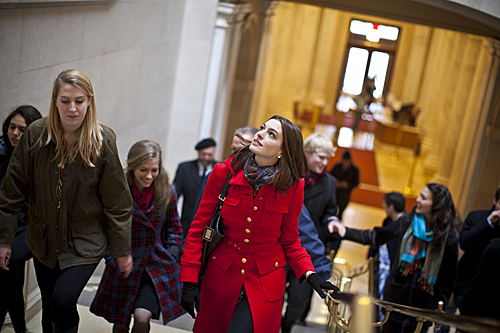
    But all good things must wait, and before Woman of the Year Hathaway, 27, could gain her prize, she took a stroll through a brisk Harvard Yard on a tour led by Lucy Baird ’10. Looking ravishing in a patriotic crimson coat, Hathaway remained spirited even as snow began to fall, and she was without a hat.

    Arriving at the John Harvard Statue, “The Devil Wears Prada” actress playfully greeted it with: “Hi, dude.”

    Awed by Widener Library’s grandiosity, Hathaway sought a more in-depth look, charging the towering stairs and taking a peek around inside.

    Later that afternoon, the actress, fresh from a snowy parade of Harvard Square with the Hasty crew, donned sequins and serious heels for her roast inside the New College Theatre, where she endured the incessant teasing of hosts Clifford Murray ’10 and Derek Mueller ’10.

    Poking fun at her turns in the film “The Princess Diaries” and its sequel, “The Princess Diaries 2: Royal Engagement,” Murray and Mueller called her “the second most famous Anne to keep a diary.” Hathaway never once lost composure, however, coolly shooting back, “Love that Anne Frank line.”

    Not even “Princess Diaries” co-star Julie Andrews could faze her. “What are a few of your favorite things?” sang an ersatz Andrews, played by Walter Klyce ’10.

    “A few of my favorite things, besides Harvard … ” Hathaway replied, before launching into song with, “Raindrops on roses and whiskers on kittens …”

    “Yes, that would be the correct answer for me,” Klyce shot back. “But I think you meant to say, ‘Appearing topless in movies.’”

    The actress will soon appear as the White Queen in Tim Burton’s rendition of “Alice in Wonderland.” She famously starred in “Brokeback Mountain,” “Bride Wars,” “Get Smart,” and “Rachel Getting Married,” which earned her the Oscar nomination. She’s slated to star in “Get Happy,” a biography on Judy Garland, whom Hathaway resembles not only in looks — she can sing, too.

    Ordered to croon by an apparition of the one, the only, Liza Minnelli, 1973’s Woman of the Year, Hathaway beautifully trilled about her skills to the tune of “Over the Rainbow,” a feat which finally persuaded Murray and Mueller to declare her worthy of the golden Pudding Pot.

    “I get a little overeager and excited about things,” explained Hathaway, who didn’t trust herself enough to wing an acceptance speech.

    So she read a poem she’d penned herself.

    “I feel warm and gooey inside,” read Hathaway, “joyous with my reddened backside, that your roast smacked upside. My rump is swollen with pride.”

    Hathaway’s Man of the Year counterpart Justin Timberlake will be at Harvard on Feb. 5. For more on the Man and Woman of the Year, or Hasty Pudding’s production “Commie Dearest.”

    Woman of the Year

    Woman of the Year

    Actress Anne Hathaway is undeterred by the snow on her tour of Harvard Yard by Lucy Baird ’10.

    Books a million

    Books a million

    Wonderment ensues inside Widener as Hathaway seeks a better look at the behemoth library.

    Lady in red

    Lady in red

    Decked in a bright cherry coat, Hathaway takes a breather from the arctic blast inside Widener.

    The parade brigade

    The parade brigade

    Clifford Murray ’10 and Derek Mueller ’10 flank Hathaway on a drive down Mass. Ave.

    The lady & the tramps

    The lady & the tramps

    Vogue-ing it up in a topless Bentley for a joyride around town.

    Backstage cowboys

    Backstage cowboys

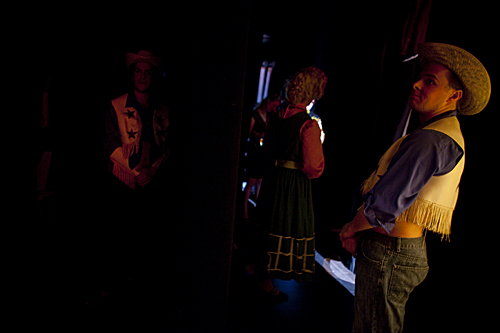
    Matther Bohrer ’10 and Ryan Halprin ’12 wait for their cue.

    A good sport

    A good sport

    Hathaway took Hasty’s jabs and delivered some barbs of her own.

    Glitterati

    Glitterati

    A bedazzled Hathaway takes it to the stage to collect her Pudding Pot.

    Strike a pose

    Strike a pose

    Mueller and Murray showing off their Woman of the Year.

    Beauty and the man dressed like a beast

    Beauty and the man dressed like a beast

    Hathaway had to slay the dragon — just one of the tasks that brought her closer to the coveted Pudding Pot.

    A spoon full of nudity

    A spoon full of nudity

    Walter Klyce ’10, dressed as Julie Andrews, encourages Hathaway to be naked in more films.

    How sweet it is

    How sweet it is

    A Pudding Pot and a smile.

    Photo slideshow: Woman of the Year Gallery

    Justin ide, Stephanie Mitchell, Kristyn Ulanday/Harvard Staff Photographers

  • Freshman at State of Union

    Harvard freshman Janell Holloway of Matthews House was among the select few invited to Wednesday’s (Jan. 27) State of the Union speech. Holloway, a Washington, D.C., resident who was an intern last summer in the D.C. Scholars program, watched the speech from first lady Michelle Obama’s box.

    The Harvard Gazette asked Holloway about her experience. Below is an edited version of that conversation:

    Q. When did you get invited to sit with the first lady, and how did that come about?

    A. About a week ago. My old boss called me and asked, “Janell, what are you doing next Wednesday?” I said, “I’m going back to school because the first day of class was Monday.” She said, “Well the first lady has invited you to sit in her box for the State of the Union address. Can you get a flight back here?” Immediately after that, I called my parents. They booked me a flight, and everything just sort of happened really fast after that.

    Q. Did you fly down just for the day, and were there other events involved?

    A. I flew down Tuesday night right after my classes. [On Wednesday,] two hours before we had to go to White House, we went to the U.S. Department of Education and met [Secretary of Education] Arne Duncan.

    Q. You went to the White House and then the Capitol?

    A. We went to the White House first. We had a little reception, and we got to bring one guest. I brought my dad, Jim Holloway. [There were] mostly staffers there, and then the first lady came just before she had to get ready to go. She came by to say hello and thanked us and kind of told us what to expect.

    Q. How was the speech itself?

    A. The speech was cool. It was kind of funny because whenever he said something really important, they started clapping. Sometimes they clapped so loud you couldn’t hear everything he said. It was interesting to see how they interacted. He threw in a few ad libs and some little jokes, and that was cool too. It was never a dull moment. It was a great speech. It was really amazing.

    Q. Did you interact with other people in the box?

    A. On the van ride over there, we talked to a lot of the people going into the box. Everybody was there for a different reason. The mayor of Oklahoma City was there. There were a few military personnel there. It was pretty interesting. Once we were in the box, while members of House were talking on the floor, we were talking. Even during the speech, when he made interesting points, you heard a few people making comments.

    Q. Did you get to interact at all with the first lady during the speech?

    A. Not during the speech. During the reception and afterward, we were able to take pictures with her and the president. We each got a picture with her and the president.

    Q. Where is it now?

    A. I think they’re mailing it to us.

    Q. How would you describe her?

    A. She’s actually really tall. I didn’t realize she was so tall. She’s very personable, very nice. She seems really down to earth. She’s really funny. What you see on TV isn’t fake.

    Q. Do you know what you’re going to study here at Harvard?

    A. I’m thinking of science, but haven’t made a decision yet.

    Q. Has this experience made an impact on you?

    A. When I first received the call, I was really excited but … it wasn’t until I talked to my parents and saw how they reacted that I realized how big a deal this is. Actually being in the room and seeing how people interacted with each other and the way he [Obama] presented himself and made his points was a really big deal. And being part of history, that had a big impact on me. I think meeting them, seeing how down to earth they are, how calm he is, how honorable, how accessible, despite the criticism he gets, I think is very inspirational. It was a totally amazing experience.

    Q. Did you come up to Cambridge this morning?

    A. I woke up and caught a 7:30 a.m. flight.

  • Faculty Council meeting, Jan. 27

    At its seventh meeting of the year on Jan. 27, the Faculty Council reviewed proposals to rename the Department of Literature and Comparative Literature and to establish a new concentration in biomedical engineering. The council also discussed updates from the Office for Scholarly Communication regarding Harvard’s DASH and Open Access Fund, and from Michael D. Smith, dean of the Faculty of Arts and Sciences, regarding the findings of the Priorities Working Groups.

    The council next meets on Feb. 10. The preliminary deadline for the March 2 faculty meeting is Feb. 15 at 9:30 a.m.

  • Looking at cooking

    Richard Wrangham has a simple answer when asked where humans came from: “the kitchen.”

    Wrangham, the Ruth Moore Professor of Biological Anthropology, talked about his theories on the importance of cooking in the long evolutionary process that made humans human during a lecture at the Harvard Museum of Natural History (HMNH) Wednesday night (Jan. 27).

    Cooking confers several advantages over eating food raw, but most importantly, allows consumers of cooked food to extract far more energy during digestion, according to Wrangham, whose talk was the first in the museum’s spring “Food for Thought” lecture series.

    Even a 5 percent increase in ripe fruit available to chimpanzees can give them a biological advantage, lowering the time between chimpanzee births by four months. Cooking would have conferred an even more dramatic advantage on early humans struggling to find food by increasing the amount of energy from starches and protein extracted during digestion by 50 percent or more.

    “There’s this huge fantastic mystery: Where did humans come from? I think we came out of the kitchen,” Wrangham said.

    Wrangham, who was introduced by HMNH Executive Director Elisabeth Werby, conducts much of his research on chimpanzees at the Kibale Forest in Uganda, where he is co-director of the Kibale Chimpanzee Project. His most recent book, “Catching Fire: How Cooking Made Us Human,” details his ideas about cooking and human evolution.

    It’s likely no coincidence, Wrangham said, that cooking is universal in human societies and that those who today insist on eating a raw food diet lose weight to the point that half of women on those diets stop having periods. The reason, Wrangham said, is that our bodies have adapted to the easy extraction of energy from cooked foods, and there’s no going back. Cooking has not only allowed us to have smaller teeth, it’s also allowed us to have shorter guts relative to our bodies than any other primate. Our guts can’t extract as much energy from raw foods as those of our primate cousins or our pre-human ancestors.

    “People think that animals eat raw food, people are animals, so people can eat raw food. But humans are different kinds of animals,” Wrangham said. “Nobody has appreciated how absolutely vital cooking is. We need it. We absolutely need it.”

    While many scientists put the advent of cooking at 200,000 to 300,000 years ago, Wrangham said he believes that’s far too recent. By that time, Wrangham said, our family tree had already produced modern humans, homo sapiens, so the advantages that cooking confers wouldn’t have had much time to affect our evolution.

    Though the archaeological evidence — fire remains at ancient campsites — is fairly solid through several hundred thousand years ago, Wrangham said the scientific evidence doesn’t provide a clear date when cooking began. There are also possible sites significantly earlier, with the evidence of fires and cooking slowly fading as researchers look earlier in human history.

    To Wrangham, the answer to the question of when cooking arose may lie not in fire pit remains, but in human and pre-human anatomy. Using the length of the gut as an indicator, Wrangham looks much deeper into the past — 1.9 million years ago — to homo erectus. Homo erectus, Wrangham said, had the smaller rib cage and narrower pelvis, also characteristic of modern humans, that would hold a smaller gut. If cooking first occurred with homo erectus, that period would have provided the evolutionary time needed to create the dependence on cooking that modern humans have.

    Wrangham’s ideas about the importance of cooking have their roots in personal experience. As a young graduate student working with primatologist Jane Goodall, Wrangham would spend long days in the field watching chimpanzees. He would often taste the foods chimps were eating, sometimes out of curiosity and sometimes out of hunger. The best of them were small fruits that were not very flavorful. In times of food scarcity, chimps are known to eat less-favored foods and even wood, something humans would have a hard time subsisting on. Instead of chimp food, Wrangham found himself looking forward to a steaming bowl of mashed potatoes or other cooked food when he got back to camp.

    “If you want to rely on eating what they eat all day long, you will be very hungry,” Wrangham said.

    In more recent years, he delved into the subject further, finding that humans can extract just about half the energy available from raw starch. When cooked, that rises to close to 100 percent. Similar differences are seen with the digestibility of proteins. Other benefits of cooked foods include reducing bacteria, detoxifying some poisons, and softening foods’ texture, which allows humans to use less energy to chew and digest. If we chewed our food as much as the great apes do, Wrangham said, we’d spend five or six hours a day just chewing.

    Cooking, Wrangham said, likely had “deep biological significance” affecting not just our diets, but also our life history. When humans could cook and serve softer foods, children could be weaned earlier. They could increase their activities because cooking made more energy available. Cooking may even help to explain the sexual division of labor. Though this needs further exploration, Wrangham said that a possible reason that women are responsible for cooking in every culture is that cooking fires are easy to detect in the wilderness and could potentially attract males who were unsuccessful hunting. It is possible then, Wrangham said, that one outgrowth might be that males would have had to learn to fend off other males who came looking for a handout.

    Cooking may have played a further role in the rise of human social structures, as the change in food consumption from self-picked berries to a pile of common food would require some way to determine who gets what.

    Cooking “is a fantastic advantage, so much so that you have to do it,” Wrangham said.

  • Multiple interests

    Contrary to what many people may think about the originator of the theory of multiple intelligences (MI), Howard Gardner spends little time these days thinking about his breakthrough. As he told a crowd during remarks at Askwith Hall on Tuesday (Jan. 26), “I don’t wake up and say, ‘Hey, there’s a sexual intelligence or a cooking intelligence.’”

    Gardner reflected on his famous theory ― in which he posits that all humans possess numerous autonomous intelligences rather than a single intelligence that can be measured through a tool such as the IQ test ― at an Askwith Forum called “Multiple Intelligences: The First 25 Years.” His theory made Gardner one of the most famous academics in the world, earning him the first MacArthur Prize Fellowship and honorary degrees from 26 universities. Gardner, who is the Hobbs Professor of Cognition and Education at the Harvard Graduate School of Education, was also named one of the world’s top 100 leading public intellectuals by Foreign Policy and Prospect magazines.

    “The heuristic value of this theory simply cannot be overstated,” said Dean Kathleen McCartney of Harvard’s Graduate School of Education. “Howard’s theory of multiple intelligences has been inspiring the work of practitioners, researchers, and policymakers for more than 25 years, not just here but around the globe.”

    Calling himself a “lifer,” Gardner came to Harvard in 1961 as an undergraduate. As founding member in 1967 of Project Zero, of which he is senior director, Gardner began studying children’s artistic development. At the same time, he began research at a veterans’ hospital, studying patients with brain damage.

    “The MI theory would never have been spawned if I hadn’t been working with these two populations,” he said. “That turned out to be the critical spark that led to the ideas, because every day I would see children who had scattered intellectual profiles, [who] were not very good at school, or vice versa.” Gardner found himself immersed in data about what children could and couldn’t do. “I’d try to make sense of it, and it was not easy,” he said.

    In 1979, the Bernard van Leer Foundation awarded the School of Education more than $1 million to probe the nature of human potential. Gardner decided to focus on human cognition using disciplines such as evolution, various cognitive profiles and processes, different cultures, and human abilities.

    “I didn’t know I’d come up with the theory of MI,” Gardner said. “I thought, here’s a once-in-a-lifetime opportunity to put together all this stuff I had been observing and seeing and make sense out of it.” What Gardner discovered was that the human mind operated more like several computers related to one another. These computers, or “intelligences,” are linguistic, logical, kinesthetic, interpersonal, intrapersonal, musical, and spatial.

    Gardner largely credited his use of the word “intelligences” as pivotal to the theory. “I would not be standing here today in this hall if I called it seven abilities or seven powers,” he said, even though he could not recall how he selected that word.

    The theory led to his 1983 book, “Frames of Mind: The Theory of Multiple Intelligences.” Gardner recalled how the theory initially made people uncomfortable, but also seemed to resonate with educators, even though he admitted he never really thought about education.

    Ultimately, it was public reception of the theory that pushed Gardner into a level of fame rarely seen by academics. In fact, Gardner pinpointed the start of his “15 minutes of fame” at a 1984 meeting of the National Association of Independent Schools, where his arrival in the packed and noisy room in New York’s Hilton Hotel immediately caused it to become silent.

    Eventually, Gardner decided not to focus his entire life on MI. Still, 15 years ago, he added an eighth intelligence, naturist. And he has spent many years ruminating on whether there is a ninth intelligence, existential, which contemplates the big questions of life, such as: What is love? Why am I here? Who am I? However, Gardner said that he still needs more evidence on that one, so for now he suggests there are eight-and-a-half intelligences.

    These ideas continue to spread globally, even though Gardner said he has had little to do with what we might see as MI in the world. Today there are Asian milk drinks (promising to develop each intelligence), books, conferences, and schools dedicated to the theory. Although Gardner initially resisted addressing the implications of MI, he found that other people developed their own. While it has been interesting for him to watch people assimilate his work, this prompted a shift in Gardner’s own beliefs.

    “I said to myself, if I developed these ideas, I can’t simply say it’s up to other people how to use them,” he said. “If they’re being abused … I have to take responsibility.”

    In the past 15 years, that notion has largely inspired Gardner’s efforts on the Good Work Project, which identifies individuals and institutions exemplifying the meaning of positive work that encompasses three characteristics: excellence, engaging, and ethical.

    “My first work, and I make no apologies for it, was about intelligences, and a lot of the work on Good Work is about the kind of human being you are,” Gardner said. “The true implication, whether it’s here in this School or the rest of the University or anywhere in the world, [is that we] really need to focus on that … you have a world where [some] people are good people but don’t use their minds well, [and other] people use their minds in ways which are not worthy of human beings.”

  • Attracting stronger federal workforce

    While the private sector long ago streamlined its hiring processes for attracting talented new employees, the federal government is historically sluggish in that area. With as many as 30 percent of federal employees likely to leave their jobs in the next five years, the challenge becomes how to overhaul federal hiring practices to attract top-notch young people who can’t and won’t wait a year to see if they can enter government service.

    In a question-and-answer session, Dean David T. Ellwood of the Harvard Kennedy School examines the problem and explains a School program that aims squarely at a solution.

    To read the full story.

  • ‘Herskovits at the Heart of Blackness’

    PBS will air “Herskovits at the Heart of Blackness,” a documentary that examines the towering influence of controversial anthropologist Melville Herskovits, on Feb. 2 at 10:30 p.m. as part of the series “Independent Lens.” Actress Maggie Gyllenhaal will host the program.

    “Herskovits at the Heart of Blackness,” produced by Vincent Brown, the film’s director of research, features a mix of interviews, animation, and photo collage reenactments. The film asks: What are the consequences when a people — in this case, black and African people — are denied the opportunity to define themselves and their culture? Llewellyn Smith and Christine Herbes-Sommers also produced the film.

    Herskovits founded the Department of Anthropology at Northwestern University in 1938, and established the American program in African studies there a decade later.

    Brown, professor of history and of African and African American Studies, is the author of “The Reaper’s Garden: Death and Power in the World of Atlantic Slavery,” which received the Merle Curti Award, the James A. Rawley Prize, and the Louis Gottschalk Prize in 2009.

    For more on the film, and to check your local listings, visit PBS.org.

  • HBS talks iPad

    Four Harvard Business School professors offer their early thoughts on prospects for the new Apple iPad, which the innovative company unveiled today (Jan. 27). Apple hopes that the iPad, which combines aspects of the cell phone, iPod, movie player, book, and computer, will dominate the market for freestanding, tablet-style electronic devices.

    To read the Harvard Business School story.

  • Perfect landing

    New research is casting doubt on the old adage, “All you need to run is a pair of shoes.”

    Scientists have found that people who run barefoot, or in minimal footwear, tend to avoid “heel-striking,” and instead land on the ball of the foot or the middle of the foot. In so doing, these runners use the architecture of the foot and leg and some clever Newtonian physics to avoid hurtful and potentially damaging impacts, equivalent to two to three times body weight, that shod heel-strikers repeatedly experience.

    “People who don’t wear shoes when they run have an astonishingly different strike,” said Daniel E. Lieberman, professor of human evolutionary biology at Harvard University and co-author of a paper appearing this week in the journal Nature.By landing on the middle or front of the foot, barefoot runners have almost no impact collision, much less than most shod runners generate when they heel-strike.

    “Most people today think barefoot running is dangerous and hurts, but actually you can run barefoot on the world’s hardest surfaces without the slightest discomfort and pain. All you need is a few calluses to avoid roughing up the skin of the foot. Further, it might be less injurious than the way some people run in shoes.”

    Working with populations of runners in the United States and Kenya, Lieberman and his colleagues at Harvard, the University of Glasgow, and Moi University in Kenya looked at the running gaits of three groups: those who had always run barefoot, those who had always worn shoes, and those who had converted to barefoot running from shod running. The researchers found a striking pattern.

    Most shod runners — more than 75 percent of Americans — heel-strike, experiencing a very large and sudden collision force about 1,000 times per mile run. People who run barefoot, however, tend to land with a springy step toward the middle or front of the foot.

    “Heel-striking is painful when barefoot or in minimal shoes because it causes a large collisional force each time a foot lands on the ground,” said co-author Madhusudhan Venkadesan, a postdoctoral researcher in applied mathematics and human evolutionary biology at Harvard. “Barefoot runners point their toes more at landing, avoiding this collision by decreasing the effective mass of the foot that comes to a sudden stop when you land, and by having a more compliant, or springy, leg.”

    The differences between shod and unshod running have evolutionary underpinnings. For example, said Lieberman, our early Australopith ancestors had less-developed arches in their feet. Homo sapiens, by contrast, has evolved a strong, large arch that we use as a spring when running.

    “Our feet were made in part for running,” Lieberman said. But as he and his co-authors write in Nature: “Humans have engaged in endurance running for millions of years, but the modern running shoe was not invented until the 1970s. For most of human evolutionary history, runners were either barefoot or wore minimal footwear such as sandals or moccasins with smaller heels and little cushioning.”

    For modern humans who have grown up wearing shoes, barefoot or minimal shoe running is something to be eased into, warned Lieberman. Modern running shoes are designed to make heel-striking easy and comfortable. The padded heel cushions the force of the impact, making heel-striking less punishing.

    “Running barefoot or in minimal shoes is fun but uses different muscles,” said Lieberman. “If you’ve been a heel-striker all your life, you have to transition slowly to build strength in your calf and foot muscles.”

    In the future, he hopes, the kind of work done in this paper can not only investigate barefoot running but can provide insight into how to better prevent the repetitive-stress injuries that afflict a high percentage of runners today.

    “Our hope is that an evolutionary medicine approach to running and sports injury can help people run better for longer and feel better while they do it,” said Lieberman, who has created a Web site, to educate runners about the respective merits of shod and barefoot running.

    The Nature paper arose out of the senior honors theses of two Harvard undergraduates, William Werbel ’08 and Adam Daoud ‘09, both of whom went to Africa with Lieberman to help collect data for this study.

    Lieberman’s co-authors on the Nature paper are Venkadesan and Daoud at Harvard; Werbel, now at the University of Michigan; Susan D’Andrea of the Providence Veterans Affairs Medical Center in Providence; Irene S. Davis of the University of Delaware; and Robert Ojiambo Mang’Eni and Yannis Pitsiladis of Moi University in Kenya and the University of Glasgow in Scotland.

    The research was funded by the American School of Prehistoric Research, the Goelet Fund, Harvard University, and Vibram USA.