Author: Harvard Gazette Online

  • Peabody awarded NEH grant

    The Peabody Museum of Archaeology and Ethnology will soon put thousands of one-of-a-kind ethnographic and archaeological photos from around the world online for the public and researchers, thanks to a new $215,000 grant from the National Endowment for the Humanities (NEH). The museum’s photographic archive is a treasure trove of late 19th to early 20th century photography, and features indigenous peoples and world cultures. Over time, the photographic collections have developed into a premier resource for national and international research.

    “This grant gives us the ability to complete the preservation and access of the museum’s core negative collection,” says India Spartz, senior archivist at the Peabody Museum. “It includes our oldest and most fragile images.”

    The grant enables the Peabody Museum to begin the second phase of its long-term goal to preserve and make its entire photo archive publicly accessible. One year ago, the museum completed a three-year NEH Preservation and Access grant that allowed more than 30,000 images from the museum’s core negative collection to be digitized, cataloged, and uploaded to the Web, ending the first phase of scanning the Peabody’s photo archive.

    The new grant will fund the scanning of the more than 25,000 remaining core negatives, a process that will include rehousing and cataloging the negatives, and mounting the images online. Completing this work will reduce the need for handling the originals.

    To search the core negatives from the project, visit the Peabody Museum’s Collections Online database.

  • Harvard Neighbors Gallery calls all artists

    The Harvard Neighbors Gallery, located at Loeb House (17 Quincy St.), provides an opportunity for Harvard-affiliated artists to show off their artistic talents. This year, artists will be selected for four-week exhibitions (solo or group shows) between September 2010 and May 2011. To be eligible, you must be an active or retired staff member, a faculty member, or spouse/partner. Temporary employees are not eligible.

    Interested artists should submit a portfolio on CD with 10 digital images, an artist’s statement, and contact information by the recently extended May 1 deadline (submissions must be postmarked by the deadline). For more information, visit neighbors.harvard.edu or call 617.495.4313.

  • Easter at Memorial Church

    The Great Vigil of Easter at the Memorial Church, which celebrates the resurrection of Jesus, is a time for new beginnings in the Christian faith, including baptisms. Its spiritual meanings are illuminated through the window of experience that the participants have shared.

    Marina Connelly ’12 said, “It is a miraculous point of beginning and regeneration, a ritual that extends far beyond the bounds of the Yard.”

    Recounting the joy of presenting his daughter for baptism during the vigil, Alexis Goltra ’92 said, “My wife and I wanted to baptize Josephine at Harvard because we feel so connected to Memorial Church. I know of no other ministry that can simultaneously challenge and inspire one’s faith so profoundly.”

    Diana Eck, professor of comparative religion and Indian studies and a member of the Divinity School faculty, said, “To me, the Great Vigil of Easter is the most dramatic liturgy of the Christian year. I love it both as a Christian and as a historian of religion. There we are, midnight, outside the darkened church. The fire is kindled, we light our candles and enter the sanctuary as the story of creation from Genesis is read, then the crossing of the Red Sea, and on to the rest of the great narrative, right to the empty tomb. Symbolically, it’s a return to the beginning.”

    Lighting the way

    Lighting the way

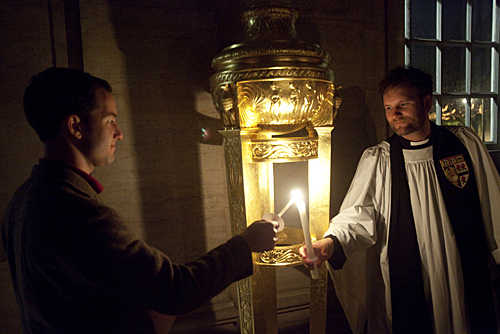
    Dorothy Austin (from left), Sedgwick Associate Minister in the Memorial Church; Peter J. Gomes, Plummer Professor of Christian Morals and Pusey Minister in the Memorial Church; and Martin Wallner ’11, verger, light candles from a bonfire during “The Great Vigil of Easter” at the Memorial Church.

    Vigilant observers

    Vigilant observers

    Eck, who is also the Fredric Wertham Professor of Law and Psychiatry in Society, and Marina Connelly ’12, a member of the Harvard University Choir, witness the lighting of the Easter bonfire.

    Sharing the light

    Sharing the light

    Walter Klyce ’10 (from left) and Rob Mark, McDonald Fellow at the Memorial Church, light a candle during the vigil.

    Father and son

    Father and son

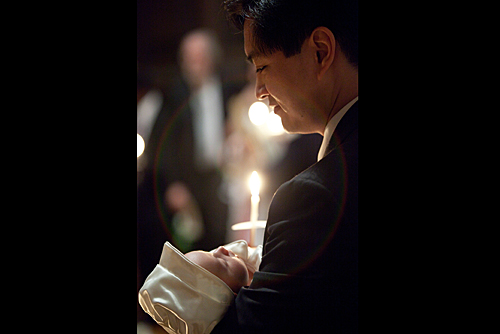
    Michael Sun ’97 holds his son, Michael James Sun Jr., before the baby is baptized.

    Easter vigil

    Easter vigil

    The congregation and procession are illuminated by candlelight.

    A family affair

    A family affair

    Jonathan Page, Epps Fellow and assistant chaplain at the Memorial Church, baptizes Josephine Zoe Goltra while family members Josie Amery (from left, wearing pearls), Alexis Goltra ’92 (father of Josephine), and Lynne Goltra (mother of Josephine) watch attentively.

    Photo slideshow: The Great Vigil of Easter

    Kris Snibbe/Harvard Staff Photographer

  • Bringing men’s lax back

    It’s been quite a few years since the Harvard men’s lacrosse team put together winning seasons. Nine, to be exact.

    But the Crimson are on the rise again, thanks to improving players and third-year head coach John Tillman. The former Ithaca College and Navy assistant coach, after going 6-8 in his first season at Harvard, helped the Crimson in 2009 record their best record (8-5; 3-3 Ivy League) in more than a decade. Last season’s first win, a 9-6 road upset in the season opener over fifth-ranked Duke, now stands as one of the biggest wins in program history, and a turning point.

    “The Duke win was important for us for a lot of reasons,” said Tillman. “To get that win against one of the premier programs in college lacrosse and certainly a group we have a lot of respect for [was a big moment].”

    Fast forward to this season. Despite consecutive losses to No. 5 Duke and No. 10 Cornell after a 5-2 start, Harvard is still ranked 20th in the nation and saw 13,285 fans come to Harvard Stadium to watch the Crimson face Duke — the largest Harvard lacrosse crowd ever.

    “We had hoped to do things like that when we first came in. And to have those things start to happen, even after just 30 months, just makes you step back and think: If we keep working at this, the possibilities are endless. … We could lead the country in attendance. We could have an elite program up here.”

    Tillman’s philosophy is simple. For Tillman, a one-time fleet support officer in the U.S. Navy and a former professional lacrosse player, one of the most important values is for his players to look at the team more like a family.

    “During practices, we’re going to challenge each other and get after it. But as soon as the whistle blows, we walk off and we do anything to look out for each other,” said Tillman. “Whether it’s a guy’s injured, he needs a summer job, he needs academic help, whatever it is, we have to be there for each other, and that’s something that’s nonnegotiable. We always have to be there for each other.”

    His players have bought into the program and the family environment, and increasingly recruits have too. This off-season Tillman recruited the third-ranked class in the country after pulling in a strong class a season ago.

    “Harvard is unique in a lot of ways. Number one, the education you can offer a young man, and the experience that it can offer, is unmatched. To be able to go to the most recognized school in the world and get the best education in the world is a just a special thing to offer. On top of it, the environment that they’re put in, because of the great job the admissions people do, there’s so much personal growth here.”

    As Tillman emphasizes individual growth, he offers a reminder to his players that, for them, Harvard is more than just lacrosse. “On top of being great athletes here, I want them to be very strong students here, great members of the Harvard community, and make sure they remember we’re members of the Harvard community.”

    After the recent two-game skid against top teams, the next three games will be critical for the Crimson if they want to hold on to their hopes not only to put together back-to-back winning seasons, but also to stay within striking distance of their first NCAA tournament appearance since 2006 and just their second since 1996.

    That will be tough for the Crimson, who after taking on last-place Penn will face No. 6 Princeton and No. 16 Yale to close out the regular season. But this team, which traveled to UMass earlier this season to top the Minutemen (now ranked 12th in the nation) by a score of 13-12, is no longer afraid of a top-ranked challenger. The Crimson will be ready now, and likely for years to come.

    “We’re still scratching the surface here, we’re still learning about Harvard … you can’t learn it all in 30 months, but we’re certainly trying to get there. We believe in this place,” Tillman said, “and I think that’s one thing that when recruits come up, they can sense from us.”

  • When cost-cutting backfires

    As efforts to contain rising health care costs intensify, a new Harvard study suggests that shifting costs onto chronically ill elderly patients can backfire and result in higher overall costs through increased hospitalizations.

    The research, conducted by Amitabh Chandra, a professor of public policy at the Harvard Kennedy School, examined patients’ health care utilization after copayment increases for office visits and prescription drugs in the California Public Employees Retirement System (CalPERS), the program that covers state and local government retirees there.

    Chandra, who conducted the study with Jonathan Gruber of the Massachusetts Institute of Technology and Robin McKnight of Wellesley College, said the study doesn’t simply say copayments are bad or good, but rather has a more complex message for those making health system changes. Though the copayment increases were counterproductive for elderly patients with a chronic disease like diabetes or hypertension, the study showed that copayments worked as desired for those not chronically ill. Those patients reduced office visits and prescription drug utilization with no negative effects on their health.

    Those broader results indicate that copayments can be effective cost-sharing mechanisms that prompt patients to consider whether they really need care, Chandra said. And the results show that most patients do a good job of deciding what care to cut out and what to maintain.

    More attention needs to be paid, however, to those who are chronically ill, Chandra said. For the subset of patients who are fighting diseases such as diabetes, high blood pressure, arthritis, and Alzheimer’s disease, the cost shift backfired. Patients with those conditions cut back on prescription drugs and delayed office visits enough to warrant increased hospitalization, more than offsetting any cost savings recognized from their copayments.

    “That’s a disaster because not only is care more expensive, their health is much worse,” Chandra said.

    For those patients, other interventions should be designed that encourage them to get the maintenance care critical to their health, Chandra said. Eliminating copayments, tying copayments to the therapeutic value of the drug, or even establishing a “negative copay” that pays them for taking their medications and making office visits could effectively keep them healthy and costs lower.

    The key, Chandra said, is tailoring the health care system in a way that wrings out costly unneeded aid while encouraging care that is effective at improving patients’ health.

    “In general, people get it right in cutting back,” Chandra said. “The question we’re all interested in is how do you design a system where patients don’t just get less care, but get more valuable care.”

    Understanding health care utilization by the elderly is critical because people over age 65 use 36 percent of health care in the United States, although they make up just 13 percent of the population. In addition, with an aging population, health care costs for America’s elderly promise to rise.

    The study, published in the March issue of the American Economic Review, fills a knowledge gap left by a seminal study conducted 30 years ago. That study, the RAND Health Insurance Experiment, excluded elderly patients and concluded that shifting costs to patients would reduce utilization without a corresponding decline in patient health. In the decades since, Chandra said, the U.S. health system has changed dramatically, and care for the elderly has become a major concern.

    The work of Chandra and his colleagues also highlighted a quirk in the U.S. system that allocates overall savings differentially to insurers involved in patient care. Because Medicare pays for hospital stays and private supplemental insurers provide prescription drug coverage, all the financial benefits of reduced prescription drug use went to the supplemental insurer. Offsetting hospitalization costs from patients not taking their medication, however, were borne not by the supplemental insurer, but by Medicare, which pays for hospitalization. That shift not only costs the government money, but argues for a system where a single insurer pays for all of a patient’s care so that unintentionally created perverse incentives do not wind up undermining a patient’s health.

  • GSD names Krzysztof Wodiczko professor in residence

    The Harvard Graduate School of Design has appointed Krzysztof Wodiczko as professor in residence of art, design, and the public domain, effective July 1, said Dean Mohsen Mostafavi, the Alexander and Victoria Wiley Professor of Design.

    Wodiczko is currently a professor and head of the Interrogative Design Group in the Center for Advanced Visual Studies at the Massachusetts Institute of Technology.

    Wodiczko is renowned for his large-scale slide and video projections on architectural façades and monuments. He has prepared more than 80 such public projections for Australia, Austria, Canada, England, Germany, Holland, Ireland, Israel, Italy, Mexico, Poland, Spain, Switzerland, and the United States. Since the late 1980s, his projections have involved participation by marginalized and estranged city residents. Simultaneously, he has designed and helped to create a series of nomadic instruments and vehicles with homeless, immigrant, and war veteran operators, for their aid and communication.

    Since 1985, he has held major retrospectives at such institutions as the Walker Art Center, Minneapolis; Museum Sztuki, Lodz; Fundació Tàpies, Barcelona; Wadsworth Athenaeum, Hartford; La Jolla Museum of Contemporary Art, San Diego; Contemporary Art Center, Warsaw; de Appel, Amsterdam; and the Zacheta National Gallery of Art, Warsaw.

    His work has been exhibited in Documenta, Paris Biennale, Sydney Biennale, Lyon Biennale, Venice Biennale, Whitney Biennial, Kyoto Biennale, Yokohama Triennale, and in many other major international art festivals and exhibitions. He and architect Julian Bonder have designed the Memorial to the Abolition of Slavery in Nantes, France, which is under construction.

    Wodiczko was awarded the Hiroshima Prize in 1998 for his contribution as an artist to world peace. He also has received the Skowhegan Medal for Sculpture, the Gyorgy Kepes Award, the Katarzyna Kobro Prize, and the “Gloria Artis” Golden Medal from the Polish Ministry of Culture. In 2009 he represented Poland in the Venice Biennale, developed the War Veteran Projection Vehicle in Liverpool, the Veterans’ Flame project at Governors Island in New York, and presented the “Veteran Project” (an interior video-projection installation) at the ICA in Boston. He is currently developing public art projects in Poland and France.

    The work of Wodiczko has been the subject of numerous publications, including “Critical Vehicles: Writings, Projects, Interviews” (1999), “Krzysztof Wodiczko: Guests” (2009), and “City of Refuge: A 9/11 Memorial” (2010).

  • Boston shines 2010

    For the eighth consecutive year, Harvard University is joining with Allston neighbors and local businesses to participate in the city of Boston’s citywide neighborhood cleanup event in Allston on April 23 from 8 a.m. to noon.

    Harvard employees and students have the opportunity to give back to one of Harvard’s host communities by volunteering with cleanup projects in the neighborhood’s parks, streets, schools, and other community locations. Activities will include raking, weeding, and cleaning up brush, painting projects such as benches, fences, and buildings, planting flowers, and other landscape projects. Last year, more than 70 Harvard employees across multiple departments participated.

    The event is set to kick off at 9 a.m., and check-in for volunteers will be at the Brighton Mills Shopping Plaza (400 Western Ave. in Allston), where projects will be assigned and coffee and donuts will be provided. Following the project tasks at approximately noon, lunch will be provided at Brighton Mills for all volunteers.

    Shuttle service will be available from Holyoke Center at 8:30 a.m. and 8:45 a.m., with return service at 12:30 p.m. and 12:45 p.m. Pickup for the shuttle bus will be on the Mount Auburn Street side of Holyoke Center across from University Health Services.
    To sign up to volunteer for a one-hour or three-hour time, visit zoomerang.com/Survey/WEB22AFM2BC7Y9. For more information, call 617.495.3525.

  • Lukas Prize Project Awards announced for 2010

    The Nieman Foundation at Harvard and the Columbia University Graduate School of Journalism recently announced this year’s recipients of the J. Anthony Lukas Prize Project Awards for exceptional nonfiction.

    The Lukas Prizes, established in 1998 and selected by committee members from Harvard and Columbia, recognize excellence in nonfiction writing that exemplifies the literary grace and commitment to serious research and social concern that characterized the work of the awards’ Pulitzer Prize-winning namesake J. Anthony Lukas, who died in 1997.

    Winners for 2010 include David Finkel, for his up-close examination of the human costs of making war; James Davidson, for his study of the homoerotic culture of ancient Greece; and Jonathan Schuppe, for his account of life in inner-city Newark, N.J., which focused on the efforts of an ex-con and former drug dealer to help impoverished children in the city’s most depressed neighborhood.

    To read the full story, visit the Neiman Foundation Web site.

  • From lab trash to treasure

    Harvard’s used and surplus lab equipment is finding new life in laboratories in the developing world through the efforts of a former graduate student and two groups of current students who collect, organize, and ship beakers, centrifuges, and other items to where they’re needed.

    The effort, undertaken by the students and fellows at Harvard’s Longwood and Cambridge campuses, diverts equipment that would otherwise find its way into the waste stream. Instead, it is collected, cleaned, cataloged, and then sent through a nonprofit organization begun several years ago by a Harvard grad student to underequipped labs in developing nations.

    “I started working in a lab my freshman year, and I didn’t realize how much I took for granted,” said Denise Ye, a Harvard College senior, molecular and cellular biology concentrator, and a founder of the Harvard College student group. “[Disposable] pipette tips — I’d throw out a box of them a day — I didn’t know that labs in Africa reuse them.”

    Ye and fellow senior Xun Zhou, a chemistry concentrator, started the undergraduate student group during their sophomore year, modeling their organization after a similar one operating on Harvard’s Longwood Campus. Both groups work closely with Seeding Labs, a nonprofit launched by then doctoral student Nina Dudnik, who began collecting surplus lab equipment while studying molecular biology in the Graduate School of Arts and Sciences.

    Dudnik said she became aware of the desperate needs in overseas labs when she worked as a Fulbright Fellow in the Ivory Coast before coming to Harvard in 2001. While in Africa, she worked on agricultural development in a lab that was so poorly supplied that it was common practice to wash, dry, and reuse “disposable” plastic test tubes for as long as three months.

    She suffered a case of laboratory culture shock when she came to Harvard, and she recalls walking the halls at night seeing discarded equipment left outside the lab doors to be picked up for disposal.

    “It’s a waste stream at most universities, and it’s not a waste stream that anyone is paying attention to,” Dudnik said. “People are buying new equipment all the time.”

    Robert Gogan, associate manager of recycling services for the University’s Facilities Maintenance Operations, said the students’ efforts, together with Seeding Labs, provide a second life for equipment.

    “Seeding Labs is a wonderful example of a group that has succeeded in recovering resources that aren’t state of the art for use at Harvard, but are still useful to others,” Gogan said. “Nina tells me that the used microscopes, centrifuges, and freezers we have picked up from Harvard laboratories are extremely helpful in the South American and African labs to which they have been shipped.”

    To aid the effort, the University provides storage space in Allston and Longwood, and the equipment is shipped several times a year. Gogan expressed gratitude to the Allston Development Group of Harvard Real Estate Services and Harvard Habitat for Humanity, which let the student organizations use their warehouse in Allston.

    The equipment — 140,000 pounds shipped so far — is most often used but still serviceable. Often it is being replaced by newer and faster models, or, in the case of something like pipette tips, was overordered and is sitting unused in supply closets. Older equipment is a welcome addition to faraway labs.

    “The equipment that is most commonly used, it’s most likely to be surplus, but it’s also most likely to be needed overseas,” said Amanda Nottke, a graduate student in Harvard Medical School’s departments of Genetics and Pathology and an organizer of the Longwood effort.

    Though there is a constant stream of donated equipment coming in from working labs, Nottke said more arrives when a laboratory moves or closes and discards equipment it no longer needs. In those cases, working labs get first dibs on equipment, but there is often plenty left over and unwanted. Seeding Labs maintains an online database and allows overseas institutions to build a “wish list” for equipment they particularly need, Nottke said.

    Seeding Labs does charge a small fee for the equipment, about a tenth of what it would cost to purchase, Dudnik said, which augments funding from foundations and individuals for the nonprofit’s operations. Though Dudnik has reached out to other universities, Harvard’s many laboratories in Cambridge and Longwood still provide the bulk of material sent overseas.

    Though giving a second life to lab equipment is the heart of the effort, relationships established along the way are leading to scientific and cultural exchanges as well, Nottke said. In the fall, Harvard Medical School’s Genetics Department and Massachusetts General Hospital’s Molecular Biology Department will sponsor student “ambassadors” who will travel to Kenyatta University in Kenya for several weeks as part of an exchange that will promote cultural as well as scientific understanding.

    Nottke said the ambassadors, who haven’t been named yet, would be asked to blog about their experiences and make presentations upon their return.

  • Boulders that bowl over

    Some rocks — as small as pebbles or as big as houses — are called “erratics,” since they were scattered over continents thousands of years ago by receding glaciers or rafts of ice. They look different than the native rock they come to rest on, and so they seem random and strange.

    Those same qualities, over time, were turned to artistic purposes. Landscape painters of the 19th century used erratics to illustrate the strange majesty of nature. By 1857, when surveys began for what would become Central Park in Manhattan, erratics already on the site were incorporated into the design.

    The science of geology — erratics and all — was a required subject in the nation’s first formal training program in landscape architecture, started at Harvard in 1900.

    “New Englanders hated a boulder. They blew them up,” declared Harvard geologist Nathanial Slater in a lecture that year. “But the modern landscape architect does not do this. In general, we are to appreciate rock surfaces.”

    That appreciation has taken some strange turns, from modest public fountains to faux cliffs to monumental fiberglass “rocks” lit from within. Many examples are on view at “Erratics: A Genealogy of Rock Landscape,” an exhibit at the Harvard Graduate School of Design’s (GSD) Gund Hall through May 12.

    You get a sense of the past from the cases of drawings, photos, manuscripts, and rock specimens on display, all from Harvard collections. Included are recent offerings such as Harvey Fite’s “Opus 40” (1935-76); Michael Heizer’s spooky pile “Adjacent, Against, Upon” (1976); and James Pierce’s long, winding “Stone Serpent” (1979).

    The exhibit’s extensive wall display of photos, diagrams, plans, and text provides a sense of the present as well as the future. Rock and other landscape elements, it seems, can be playful and plastic.

    One section, “Erratics in Practice,“ looks at projects by GSD faculty and affiliated practitioners. “The title simply means built projects that use rocks or the form of erratic boulders as a central element,” said exhibit curator Jane Hutton, a GSD lecturer in landscape architecture.

    Of immediate interest is the Tanner Fountain in front of the Science Center, a 1988 installation comprising 159 erratics, each around 4 feet wide, gathered from western Massachusetts. At dusk, it is a “cool white mass” that reflects light, the notes say, and after a rain “the center of the fountain glows like a warm cloud.”

    “Stock-Pile” (2009) is a more recent Harvard addition to the tradition of rock in landscape architecture. Conical piles of stone, aggregate, sand, and soil — designed and installed in seven days — are “poised to subside,” the notes say. A year after the installation, the points have softened.

    Most of the examples, though, point up rock’s near permanence. An erratic is displayed in a spare open house in China; tall volcanic rocks loom like giant tombstones in California; a walkway of basalt is set into an ancient streambed in the United Kingdom.

    On fullest display is the work of Canadian landscape architect Claude Cormier, a 1994 GSD graduate. His whimsical work includes explicit use of rocks. “Sugar Beach/Jarvis Slip,” an urban beach being built on Toronto’s industrial waterfront, plays off a nearby sugar factory. A large erratic will be candy-striped in red and white.

    A short essay on Cormier appears on one wall, written by the chair of GSD’s department of landscape architecture, Charles Waldheim, the John E. Irving Professor of Landscape Architecture. “In an era when the discipline of landscape architecture has shifted its attention away from a concern with the visual in favor of landscape’s operational potentials,” he writes, “Cormier’s work offers a counterproposal: that landscape is itself historically inseparable from questions of visual perception.”

    Other work by Cormier takes our perception of landscape a step further, creating works that mimic the real thing. “Lipstick Forest” (1999-2002) is a forest of large artificial trees — glossy and pink — in Montreal’s Convention Center.

    “Blue Stick Garden” (2000) used scans of blue poppies to create a bed of blue sticks that are now on permanent display in Montreal, “not as a contemporary installation in a garden,” Cormier’s Web site says, “but a garden itself.”

    Using rocks in landscape architecture has created whimsy too, as in the Nishi Harima Science Garden City in Japan (1994). Monumental fiberglass rocks there “glow like giant lanterns,” according to the exhibit card.

    The “Roof Garden” (2005) at the Museum of Modern Art is a rock garden with few real rocks. Hollow plastic shapes of white and black, eerily uniform, are bolted to runners and set off by beds of crushed glass, shredded tires, and white stone.

    Perhaps the future will echo Waldheim’s view of Cormier’s creations as “constant preoccupation with games of visual perception.”

    Electric blue

    Electric blue

    While looking like something biological — DNA or coral, even — this is actually artificial tree branches stretching into an equally blue sky. Once a diseased tree in Napa Valley, Cormier gave it new life — with 75,000 Christmas balls.

    Lipstick forest

    Lipstick forest

    Artist Claude Cormier avoided using live plants, which he said he would fight to keep alive against the unforgiving local climate. Here, 52 concrete trees, painted lipstick-pink to celebrate the city’s flourishing cosmetic industry, are not your average houseplant.

    My blue heaven

    My blue heaven

    Created in 2000 for the inaugural season of the Métis International Garden Festival in Quebec, one of Cormier’s inspirations was the Himalayan blue poppy, which was painstakingly adapted to the region’s microclimate. Here, folks stroll through the reeds. A real garden, indeed.

    D'Youville

    D’Youville

    Once the site of Canada’s Parliament, D’Youville’s sidewalks have been overlaid with wood, concrete, granite, and limestone, and jet between access points for the city museum, offices, restaurants, and residences on adjacent street facades.

    Photo slideshow: ‘Erratics: A Genealogy of Rock Landscape’ at Gund Hall

  • Oglesby Paul

    Oglesby Paul was a towering figure in the field of internal medicine and cardiology. He was born in Milton, MA and attended Milton Academy, Harvard College and Harvard Medical School.  After his training in internal medicine and cardiology, Paul took a fellowship with the best known cardiologist in the world, Dr. Paul Dudley White at Mass General Hospital and Harvard Medical School. In this role he saw patients with and for Dr. White; he helped in the annual course in cardiology for physicians from all over the world; and he learned the standards of physical examination and history taking that best underlay that specialty.

    Oley left a promising career in Boston to move to Chicago. The next chapter of his career was a combination of private practice, teaching, and service at the Central Free Dispensary of Presbyterian Hospital, later Presbyterian-St. Luke’s Hospital, in Chicago.  He was a leader in clinical cardiology, answering consultations for some of the most distinguished citizens and “… making diagnoses that nobody else could.” When mitral valvuloplasty introduced the era of cardiac surgery, Oley monitored patients in the operating room for the pioneering surgeon Egbert Fell.  He was similarly involved in the OR when heart-lung surgery was pioneered at Presbyterian Hospital.

    Paul moved to Passavant Hospital and Northwestern Medical School in the early sixties. There he combined the positions of Chief of Medicine, Professor of Medicine, and Vice President for Health Sciences. His influence was felt throughout the institution and he received numerous awards and recognitions for clinical and teaching excellence. His colleagues in these years described him as fair-minded, thoughtful, complex and formal. He was especially considerate of younger physicians.

    Oley Paul was a regular contributor to research in cardiology.  In the 1950’s he headed a group of 25 physicians in the Western Electric Study that became a milestone in relating cardiac histories and hypertension to the stresses of the work environment. In 1964, he presented an epochal study on the Natural History of Hypertension to an international Symposium on the epidemiology of hypertension. And in the 1970’s he led the Medical Risk Factors Intervention Trial, one of the first large scale epidemiologic studies to test the role of modifying risk factors in reducing the complications of hypertension and atherosclerosis.

    Among the honors he received was the Presidency of the American Heart Association and the Chairmanship of the Subspecialty Board of Cardiology, the first of the subspecialty boards organized by the American Board of Internal Medicine.

    In 1977 the new Dean of Harvard Medical School, Daniel C. Tosteson, invited Paul to become Director of Admissions. Paul accepted this role and its immediate responsibility, Chair of the Committee on Admissions. In view of the large number of Harvard graduates who become house staff and later go on to faculty positions, this committee is in some ways the most important one in the school.  He brought to the role his usual high standards.

    Oglesby Paul sometimes attracted, and did not shrink from controversy. At Northwestern Medical School Oley proposed a revised organization for the private service at the major teaching hospital. The staff discussion was intense and polarized and the change never took place. At Harvard Medical School, as Director of Admissions, he proposed that the full admissions committee could provide the excellence of decision making needed to keep the extraordinarily successful affirmative action program going. This giant effort of Harvard Medical School began after the death of Martin Luther King and used a subcommittee to bring intense specialized judgment to the evaluation of minority students from non-traditional backgrounds. This proposal was also not adopted, but more than two decades later a version of Dr. Paul’s proposal was adopted as being more consistent with the evolving standards of the United States Supreme Court.

    During this next phase of his career, post ordinary retirement, Paul was one of the emeritus professors of medicine whose presence graced Brigham Medical Rounds and enriched its teaching programs. He served as a clinical teacher for medical students and for cardiology fellows. All of them marveled at his reliance on history, physical examination, and simple tests to make difficult diagnoses and to establish relationships with patients whom he was ostensibly meeting only in teaching rounds. His long experience in cardiology and his personal learning in all of its many technical areas came into easy conjunction for these extraordinary teaching sessions.

    Oley Paul’s contributions to HMS took many forms. He was a dedicated Class Agent who led by example and considered the Alumni Fund and its contributions to student welfare an outstanding philanthropy. He cooperated with Amalie Kass in a major campaign for renovating the Countway Library and preserving its medical manuscripts. He wrote a definitive biography of Paul Dudley White and a major tribute to Francis Peabody.

    Oglesby Paul was married twice, his first wife Marguerite predeceased him in 1979 and left him two children, Rodman and Marnie. His second wife, Jean Paul brought three stepchildren to the union and there have since been three grandchildren and three step grandchildren. The second Mrs. Paul, herself a Mrs. Paul before their marriage, had kept an apartment in New York City when the two were married. After one year of the rigors of the admissions committee, she told Oley that unless he modified the committee’s approaches she was going to return to New York. Eager to preserve their union, Oley modified the procedures with no loss in excellence as a result. HMS, Dr. and Mrs. Paul, and the extended family all benefited from one more bit of Paul’s administrative genius. Dr. Paul will be remembered for this same genius in each of the institutions he served so well as teacher, administrator, researcher and outstanding physician.

    Respectfully submitted,

    Daniel D. Federman, MD, Chairman
    Ronald A. Arky, MD
    Eugene Braunwald, MD
    Joseph V. Messer, MD

  • Paula T. Hammond wins 2010 Scientist of the Year

    The Harvard Foundation presented the 2010 Scientist of the Year Award to Paula T. Hammond, the Bayer Professor of Chemical Engineering at the Massachusetts Institute of Technology, as part of its annual Albert Einstein Science Conference: Advancing Minorities and Women in Science, Engineering, and Mathematics.

    Hammond will be honored for her outstanding scientific contributions in macromolecular design and synthesis of biomaterials. “The Harvard Foundation is pleased to honor Dr. Hammond as the 2010 Scientist of the Year at our annual Albert Einstein Science Conference,” said S. Allen Counter, director of the Harvard Foundation.

    Hammond was also a fellow at the Radcliffe Institute for Advanced Study in 2004.

    To read more about Hammond’s research, visit the Hammond Research Group Web site.

  • Two GSAS physics students named Hertz Foundation Fellows

    The Fannie and John Hertz Foundation, a nonprofit organization focused on empowering young scientists and engineers with the freedom to innovate, has awarded Hertz Fellowships to 15 students for 2010-11. Two of the award-winners, Adam Marblestone, a Ph.D. candidate in the Harvard Biophysics Program, and Tony Pan, a theoretical astrophysics Ph.D. candidate at Harvard, are among the 15 national winners.

    The award lasts up to five years of the recipients’ for their graduate studies. Since 1963, the Hertz Foundation has provided the nation’s most generous Ph.D. fellowships to more than 1,070 gifted applied scientists and engineers with the potential to change the world for the better. This year’s class of Hertz Fellows was selected from a pool of nearly 600 applicants, and winners were “chosen for their intellect, their ingenuity, and their potential to bring meaningful and lasting change to our society.”

  • Stalking the ‘big idea’

    More than 1,000 students packed into Sanders Theatre a few weeks ago for an event that was — as we called it in our original pitch materials — “something new and different.” The concept was simple enough to fit on a bumper sticker: “10 professors speak for 10 minutes each about their one big idea.” It was appropriately titled “Harvard Thinks Big,” and its production and success were the culmination of a year and a half of work by a team of Harvard undergraduates that included me.

    Though much of the excitement surrounding “Harvard Thinks Big” in February can be explained by its scope — by the posters that emphasized “This is Harvard,” by marketing the session as a “buffet of Harvard thinking,” by the all-star professors on the bill — the cause of the excitement was something deeper, an element of truth that universities need to pay more attention to if they care about their research hitting home with students and the population at large, if they care about academia’s ability to generate passion and change the world for the better. The real reason behind the event’s success, and why so many students who had just had of long day of classes submitted themselves to two more hours of lecture, was a simple fact: Ideas excite people.

    If you were in the crowd that night, or if you have viewed the videos online at www.HUTVnetwork.com/HarvardThinksBig, you didn’t just hear facts, figures, and data, or even just analyses, templates, and constructs. You heard ideas. Upon reading it put that way, you might have the same worries that others did when we first proposed the concept: that the night would be a “razzle-dazzlefication” of truth, that we were asking professors to (and I quote an original detractor) “dumb down their research into bite-sized chunks devoid of truth for the sake of shallow entertainment, feeding our already-too-short attention spans.”

    True, we limited the talks to 10 minutes and asked professors to speak so that everyone in the audience could understand. (The literature professor never said “bildingsroman,” and the computer science professor never uttered the phrase “hardware-embedded hypervisor.”) We did that partly because we wanted the night to bring together various disciplines, to be relevant to all students watching, and, yes, to be fun and entertaining.

    The real innovation of “Harvard Thinks Big” (and the West Coast “TEDTalks” that inspired it), though, is not that it made knowledge bite-size. It was that it made professors take their years of work and boil it down to its core, to find the driving force behind their passion for exploration, to find and share the answer to the lingering question: “Professor, what’s the takeaway? What’s the big idea?”

    And what they shared was not “truth for dummies” or “truth, glamorized” or “truth, action-packed.” What they shared was an idea, a tremendously important form of veritas that has been lost to many in academia. Ideas are infused with passion. Ideas are often subjective and often have (gasp!) a spiritual element. Ideas are organized and poetic. Ideas are relevant. They take data and make it matter to people. All ideas, as English Professor Matthew Kaiser said that night, “start as emotion.”

    Big ideas matter: Cooking is what made us human. Social networks have value. Appreciating religious pluralism is tremendously important to our coming century. Protest is the driving force behind American social change. Coding makes you see the real world differently. We should revolt from the king. An invisible hand drives the market. Workers of the world unite. DNA holds our genetic code. All men are created equal.

    Ideas are indeed bite-sized, but — when released — fire the imagination.

    True, some ideas have wreaked havoc, especially in the past century. But, more often than not, the excitement they spur has been used as a force for good. And in an age of rising youth apathy, the power of ideas (in their debating, debunking, and implementing) to draw out passion, drive, and excitement in people cannot be ignored.

    The ideas of Harvard’s students and professors can be tapped more effectively. We need more opportunities to reflect on “the takeaway,” the thing to hold onto, the thing to fight for or against, the thing to experiment with, to debate, to get excited about. We need more forums to share ideas (and we hope “Harvard Thinks Big” was the first of many such sessions). Ideas need to have a larger university presence. That’s our takeaway, our own big idea: Ideas matter.

    If you’re an undergraduate or graduate student and have an essay to share about life at Harvard, please e-mail your ideas to Jim Concannon, the Gazette’s news editor, at [email protected].

  • Often, we are what we were

    Ask babies who they are, and they’ll babble something that seems nonsensical. Turns out, they’re onto something.

    Jerome Kagan, a developmental psychologist and the Daniel and Amy Starch Professor of Psychology Emeritus, has spent the past 30 years of his lengthy career studying the temperaments of those little people, which originate in a child’s unique biology, along with the experiences that shape their personalities. These discoveries are summarized in his new book, “The Temperamental Thread.”

    Twenty percent of Kagan’s 4-month-old infant subjects were labeled high reactive, “a behavioral profile marked by vigorous motor activity and crying to unfamiliar experiences.” And 40 percent were labeled low reactive because they showed the opposite behaviors. Both temperaments are modest predictors of future personalities, depending on how children responded to their environments. (Another 40 percent belonged to neither group.)

    “The high-reactive infants are biased to become children who are timid, shy, and cautious in unfamiliar situations. This is a personality trait known as inhibited,” said Kagan. “The low reactives are biased to develop into outgoing, spontaneous, fearless children — uninhibited.”

    Kagan also explores links between temperament and gender, ethnicity, mental illness, and more. The difference between males and females is always newsworthy fodder, and, according to Kagan, “over the past 50 years, many scientists have discovered intriguing biological differences between males and females that imply different patterns of temperaments in girls and boys.”

    “The most obvious are related to the molecules oxytocin and vasopressin, and the sex hormones. It appears that these molecules, in conjunction with others and experience, bias girls to care more about the quality of their social relationships and bias boys to care more about their potency and relative status with other males.”

    Kagan said he’d always been curious about the mind and “the persistence of beliefs that are not in accord with experience,” and recalled arguing at a young age with his mother, who believed in inborn traits of personality.

    “During the 1940s and ’50s, many citizens and social scientists believed that the main, if not the only, cause of the problems that plague our species were childhood experiences,” said Kagan. “This belief was an heir of Freudian ideas and the confidence of behaviorists, who were demonstrating the power of experience to shape animal behavior. It followed that anyone who discovered the specific experiences that led to a mental illness, crime, or school failure would be a hero doing God’s work. Who would not entertain the idea of becoming a child psychologist, given this Zeitgeist?”

    Although retired, Kagan still enjoys collaborations with colleagues Nancy Snidman of Children’s Hospital and Assistant Professor of Psychiatry Carl Schwartz, and has begun to write “a set of essays on some contemporary but controversial issues that surround the meanings and measurements of the concepts of happiness, morality, brain bases for psychological states, and mental illnesses.”

    But what about Kagan’s baby subjects? Where are they now? “Infant temperaments act to limit what children will become; they do not guarantee a particular personality,” he noted.

    “A life itinerary is like the game of ‘Twenty Questions.’ Each new piece of information eliminates a large number of possibilities, but many still remain.”

  • A la carte for freshmen

    The academic options can seem endless at Harvard, where each course can appear more exciting and challenging than the last. For a student, choosing a concentration, as majors are called at the College, is an exhilarating but potentially overwhelming process. Fortunately, each spring the Advising Fortnight makes all the departments and academic choices at Harvard accessible to freshmen during a two-week series of advising events.

    In Advising Fortnight, which started this year on April 5 and runs through April 18, Harvard’s 45 concentrations host information sessions, panels, and open houses where students learn about departments and committees.

    “The primary goal of advising, in my opinion, is to help an advisee explore, contemplate, and ultimately decide on what they are really passionate about,” said Robert Lue, professor of the practice of molecular and cellular biology and director of life sciences education. “The best advising is not simply about the immediate next step, it is also about the pathway and the doors that may open or close along the way.”

    Harvard College’s Advising Programs Office (APO) coordinates the logistics of all the events. Student input is essential to the Fortnight’s success, and the APO works with numerous undergrads to shape the format and programming and ensure that things run smoothly. Each concentration plans its own events to help students understand what a discipline studies and its methodologies.

    Advising Fortnight kicked off with a buffet extravaganza on April 5 in Annenberg Hall. All of the concentrations were lined up in long rows on one side of the dining hall tables, and students could drop by to speak with advisers.

    In addition to the concentration-specific events, the Fortnight also includes panel discussions with advisers from several departments covering broader fields such as the life sciences or the social sciences, so that students can compare different concentrations.

    “I was looking at psychology or social studies, and I knew that I wanted to do something in that realm. The panels are invaluable, so students can understand the decisions that they are making, take ownership of their decisions, and enjoy the academic experience,” said Kristina Dominguez ’10, a sociology concentrator who worked with the APO to plan this year’s Fortnight. “College is about a lot of things, but you have to enjoy your academics because it’s a huge part of the experience.”

    During the Fortnight, each first-year student must complete a required advising conversation. To do so, students participate in one of the concentration’s events or go to the concentration’s office hours to have a one-on-one conversation with an adviser. Advisers help students to narrow options and identify an area of study that sparks interest.

    “We’d like students to come away with some idea of the structure of the program, but also with an idea of what we might call the culture of the English concentration, and how they might fit in,” said Daniel Donoghue, John P. Marquand Professor of English. “Our three sessions offer different perspectives — from alums, from current concentrators, from the English Undergraduate Office — with the hope that students can find the information they need to make their decisions.”

    Advising Fortnight began five years ago, when the FAS faculty voted that concentration choice should take place during the first semester of the sophomore year, rather than the end of the freshman year. An amendment to that vote required students to have a “conversation” about choosing their concentration in the spring of freshman year. Because the Fortnight occurs at the end of the first year, and students choose their concentration the following fall, they still have time to plan and explore their options before making a final decision.

    First-year students vary widely in their certainty regarding their future concentration. Even students who think they know what they will concentrate in often reconsider their decisions.

    “Even though many students think they are going to do pre-med, it often changes after the first and second semester,” said Inge-Lise Ameer, assistant dean of Harvard College and interim director of the Advising Programs Office. “Even if they have decided on their concentration, there is a lot of decision making that goes on.”

    Freshman students who are certain of their future concentration will still find the Fortnight helpful, participants said.

    “I’ve been interested in psychology since the fourth grade, so today I’m interested in learning about lab work, thesis writing, and letters of recommendation,” said Esther Wu ’13 at the kickoff event. “I’ve also gotten advice on taking courses in other departments, which has opened my eyes to other possibilities.”

  • PBK inducts Class of 2011 members

    The Harvard College chapter of Phi Beta Kappa (PBK), Alpha Iota of Massachusetts, elected 24 juniors at a private ceremony at Leverett House on April 13.

    PBK was first established under a charter in 1779. Shifting from a social and debating club in its early years to an undergraduate honor society in the 19th century, PBK is known as the oldest academic honor society in the country.

    Phi Beta Kappa’s national mission is to foster and recognize excellence in the liberal arts and sciences, and election to Alpha Iota of Massachusetts signifies that an undergraduate has demonstrated excellence, reach, originality, and rigor in his or her course of study. The honor society recognizes students whose course work demonstrates not only high achievement, but also breadth of interest, depth of understanding, and intellectual honesty. Twenty-four juniors are elected each spring, 48 seniors each fall, and a further number sufficient to bring the total membership to no more than 10 percent of the graduating class in the final election shortly before Commencement.

    Elected juniors include:

    Cabot House: Sophie Cai, chemical and physical biology; Eli Jonathan Jacobs, social studies; and Rui Wang, economic.

    Currier House: Meng Xiao He, molecular and cellular biology; Marsha Sukach, psychology; Pramod Thammaiah, applied math; and Helen Horan Yang, molecular and cellular biology.

    Dunster House: Nicholas Oliver Bodnar, chemical and physical biology.

    Eliot House: Darius Sinan Imregun, chemistry and physics; Arjun Ravi Ramamurti, social studies; and Allen Yang, economics.

    Kirkland House: Sundeep Subramanian Iyer, government.

    Leverett House: Lila Grace Brown, environmental science and public policy.

    Lowell House: Alexander Sarkis Karadjian, special concentrations.

    Pforzheimer House: Anne Lisbet Goetz, English; and Arnav Tripathy, math.

    Quincy House: Edith Yee-Heen Chan, economics; and Marco Chan, Romance languages and literature.

    Winthrop House: Ama Ruth Francis, literature; Nell Shapiro Hawley, history and literature; Taylor John Helgren, government; Christopher William Higgins, social studies; Jerry Lai Kung, applied math; and Iya Megre, classics.

  • Stage set for theater festival

    Artists are taking to the streets.

    As part of the Emerging America festival — a new collaboration by the American Repertory Theater (A.R.T.), Huntington Theatre Company (HTC), and the Institute of Contemporary Art/Boston (ICA) — artists will create a “moving party” leading from the A.R.T. theatrical club space Oberon to Harvard Square on May 2 during the Harvard Square Business Association’s annual MayFair. Once there, the artists will perform in sideshows and dance parties throughout the day.

    Conceived by A.R.T. Artistic Director Diane Paulus ’88, the idea for Emerging America took shape last year when Paulus arrived in Cambridge to begin her new role. Eager to celebrate new American artists and art forms happening locally, as well as around the country, Paulus sought to connect with the HTC and ICA, two of the most vibrant performance institutions in the area.

    The inaugural festival is a weekend blast of live entertainment and socializing that runs May 14-16, but the May 2 weekend will kick things into high gear with MayFair celebrations, as well as new media ventures, such as podcasts and narrated walking tours, all downloadable from the Emerging America Web site.

    Podcasts include stories about or sparked by famous personalities who lived, loved, or worked in Boston and Cambridge, original “radio plays” created by the HTC’s playwriting fellows, and walking tours that celebrate the neighborhoods and artists of each organization’s community, past and present.

    The festival’s opening night sets off a smorgasbord of dramatic productions and late-night entertainment.

    The ICA takes center stage with “Disfarmer,” a haunting and original work of puppet theater by award-winning director Dan Hurlin that explores the world of eccentric and reclusive photographer Mike Disfarmer. The festival kickoff party follows with music, performance, dancing, and poetry on the American experience.

    Saturday’s daylong events include comedy. “Mrs. Smith Presents … A Benefit for the Carlyle Foundation Empowerment School for People and Cats with Persistent and Severe Challenges” introduces a wealthy, eccentric socialite who channels her grief and rage over the disappearance of her cat Carlyle into a laugh-out-loud theater happening that teeters on the edge of comedy and pathos. There’s also a bar and live music. There are other plays to choose from, including “Live from the Edge” and “Particularly in the Heartland,” and the night is capped with a midnight showing of the A.R.T.’s critically acclaimed “The Donkey Show,” and a subsequent celebration.

    Sunday promises a brunch at the Boston Center for the Arts, with more plays to ensue. The festival ends with a party at Oberon.

    “Theater is more than simply a play on the stage: It’s a ritual, a social occasion for people to come together and experience community,” said Paulus. “My hope for Emerging America is that the audience will be able to give feedback to the artists through conversations provoked by the social gatherings that will be at the heart of the festival.”

    For a complete schedule, podcast information, and ticketing, visit www.emergingamericafestival.org.

  • Campaign to turn Crimson green

    While the Earth warms, Harvard has warmed to the idea making a difference in climate change.

    For years, and in increasing measure, the University’s research in science, policy, business, design, and even divinity involves thinking globally. Meanwhile, Harvard’s students, faculty, and staff are acting locally.

    In the last decade, Harvard has upgraded heating and cooling systems, changed the fuel it burns, improved construction guidelines, eased green commuting, reordered purchasing standards, rethought food systems, and encouraged energy conservation on both an institutional and personal scale.

    All of this is designed to reduce the University’s output of Earth-warming greenhouse gases (GHG).

    In 2008, Harvard’s ethic of energy reduction was memorialized in an ambitious goal articulated by President Drew Faust, to reduce GHG emissions at Harvard 30 percent by 2016, with 2006 as a baseline year. The goal is inclusive of growth in the University’s physical size.

    Late last year, each of Harvard’s 12 Schools and divisions, with oversight from an executive committee and the Office for Sustainability, submitted a detailed emissions reduction plan. A University master plan is in the works and will appear later this year.

    The results so far are making a difference. From Fiscal Year 2006 to FY 2009, Harvard has reduced its GHG emissions by 7 percent (14 percent if growth is left out of the equation). In some cases, individual progress is remarkable. Harvard Business School, for instance, has already cut its emissions by 29 percent. Reductions at Harvard Kennedy School come in at 16 percent.

    On the eve of the 40th Earth Day, here is a timeline of how Harvard has acted locally in the last decade:

    2000

    • Commuter Choice Program founded. At the time, 27.4 percent of faculty and staff drove to work; now just 14 percent do. (The national average is 75 percent.) The original T-pass discount, set at 10 percent, was later increased to 40 percent, then to the current 50 percent.

    2001

    • Green Campus Initiative founded, giving structure and support to campus sustainability efforts.
    • Green Campus Loan Fund established – capital to Schools for cost-saving resource conservation projects.
    • The University’s first LEED-certified project, the renovation of Landmark Center offices at the Harvard School of Public Health. Harvard now has 23 certified LEED projects, the most of any university. An additional 48 LEED projects are registered.

    2002

    • The Resource Efficiency Program is founded at Harvard College, the University’s first peer-to-peer education program.

    2003

    • First solar array installed at Harvard, atop Shad Hall at Harvard Business School.

    2004

    • Harvard adopts University-wide sustainability principles.

    2005

    • First Green Team started, at Harvard Business School. Current total University-wide: 28.
    • The Green Campus Loan Fund doubles, to $12 million. An increasing number of sustainability projects have a payback of less than five years.
    • The first “shut the sash” program, at Harvard Medical School. Left open for a year, the typical laboratory fume hood will consume as much energy as the average New England house.

    2006

    • Almost 90 percent of Harvard College students vote “yes” on an Undergraduate Council Ballot referendum asking the Faculty of Arts and Sciences to commit to a GHG reduction goal.
    • Harvard achieves its first Platinum LEED rating — the highest possible – for renovations of 46 Blackstone South.

    2007

    • Green building guidelines adopted, required for capital projects of $100,000 or more.
    • Green Building Resource launched online to document Harvard’s green building projects. Partners include the Office for Sustainability, the Schools, and Harvard’s Capital Project Services office.

    2008

    • Over 4,500 students University-wide sign a petition, asking Harvard to set a GHG reduction goal.
    • Faust appoints a GHG reduction task force.
    • In July, Harvard adopts its GHG goal for 2016.
    • Office for Sustainability created, using the Green Campus Initiative as a foundation.
    • On Oct. 22, former vice president and environmental leader Al Gore ’69 speaks to a crowd of 15,000 in Harvard Yard. Total trash generated: one bag.
    • Green Office Certification Program launched. Number of certified offices to date: 38.

    2009

    • Five GHG working groups – more than 200 students, faculty, and staff – meet throughout the year to develop tools and policies to meet the GHG reduction goal. Topics include energy supply, green building, financial analysis, and community outreach.
    • Harvard’s largest solar array is installed on University-owned property on Arsenal Street in Watertown. With a capacity of 500 kW of power, it is one of the largest solar arrays in the Northeast.
    • University-wide temperature policy adopted. Establishes energy-saving set points for heating and cooling.

    2010

    • Harvard Community Garden launched in April, a student-organized initiative in partnership with the University.
    • First annual Green Carpet Awards ceremony scheduled for April 23, a recognition event for student, faculty, and staff contributions to sustainability.
    • While Harvard has adopted broad measures as an institution, separate Schools and divisions have taken their own steps to reduce energy usage, and GHG emissions. Here are a few examples:
    • University Operations upgraded equipment and switched to natural gas at the Blackstone steam operation, which led to the largest cut in GHG emissions so far. It also agreed to purchase more than 10 percent of Harvard’s electricity needs in Cambridge and Allston from a wind farm in Maine. The deal makes the University the largest institutional buyer of wind power in New England.
    • Harvard Medical School’s DePace Lab in the Systems Biology Department is the first University “wet” lab to achieve a LEED Gold ranking. (Wet labs are facilities that use chemicals or biological material.)
    • Harvard Kennedy School upgrades the chiller system in its Littauer Building, eliminating the equivalent of 135 metric tons of greenhouse gases, measured in CDE (carbon dioxide equivalent). The savings are more than $35,000 a year, and are an example of how green standards keep the bottom line black.
    • At Harvard Business School, a cogeneration project at Shad Hall offsets close to 500 tons of greenhouse gas emissions a year.

    Earth Day was the inspiration of Sen. Gaylord Nelson (D-Wisc.). He chose Denis Hayes, a 25-year-old Wisconsinite who grew up in rural Washington, to organize the event. At the time, Hayes — a onetime Vietnam War protester at Stanford University — was a student at the Harvard Kennedy School.

    On the first Earth Day — April 22, 1970 — HBS held an “environmental teach-in,” an event featured two days later on the front page of the Harvard University Gazette. “Scores of groups” across campus discussed pollution and other topics, the 10-line story said. Joining them in similar teach-ins across the country that day were an estimated 20 million people, including participants on 2,000 college campuses.

  • Access Controlled: The Shaping of Power, Rights, and Rule in Cyberspace

    John Palfrey and Jonathan Zittrain of Harvard Law School team up in this all-star collaboration on cyberspace. Whether the subjects are online censorship or surveillance, the wild frontier of the Web gets tamed in this tome.