Author: Harvard Gazette Online

  • The future energy mix

    Shell Oil Co. President Marvin Odum said he expects global energy demand to double by mid-century, with renewable sources making up a much greater part of the supply than they do now, and with fossil fuels remaining a major part of the mix.

    Odum, who spoke Tuesday (April 27) at the Science Center, delivering the Harvard University Center for the Environment’s final “Future of Energy” lecture of the academic year, presented his views and those of the oil industry giant as it looks ahead.

    According to Odum, energy from renewable sources would surge in the coming decades, to a scale that today would equal 60 percent of production. But with the global population expected to climb to 9 billion and the increasing industrialization of the developing world, he expected overall demand to grow enough that renewable sources will make up just 30 percent of the 2050 energy mix.

    Much of the rest, he said, must come from fossil fuels, making mitigation technologies that keep carbon from being released into the atmosphere essential.

    “Supply is going to have trouble keeping up with that kind of demand growth,” Odum said. “All forms of energy will be needed.”

    Consequently, environmental stresses due to energy consumption also will increase, Odum said, resulting in more government regulation. He came to Harvard, in fact, expecting to talk about the new U.S. energy and climate bill, but negotiations on it collapsed last week when one of the sponsors, Republican Sen. Lindsey Graham, abruptly withdrew from talks with Democrats. Though the halt was surprising, Odum said he still expects some type of energy legislation to be passed.

    The global energy industry is so enormous that major changes take a lot of time, Odum said. A look at the past century shows that it takes almost 30 years for any new energy source to reach even 1 percent of the market, he said. First come years of research and development, followed by small demonstration plants that lead to further improvements. That is followed by larger commercial plants that take a long time to site and build. Biofuels are now about 1 percent of the market, and wind will be about 1 percent by the middle of the decade.

    That slow development pattern will have to be radically sped up, he said, if renewables are to be 30 percent of the mid-century energy mix. Government can help, with regulations and incentives. Odum said that government establishment of a carbon market, with pricing and trading, will be a big factor driving growth of renewable energy sources. Without that, he said, it will be difficult to attract the kind of private capital needed to finance that growth, and it is unlikely government will step in to fill the gap.

    Odum said he sees the industry having several roles to play in the future. First, it needs to provide more energy to meet demand. Second, it needs to increase the efficiency of its operations. Third, it needs to provide more low-carbon energy.

    Carbon capture and storage is an example of the third role, Odum said. Shell has begun one such large project associated with its oil sands effort in Canada. It’s being done in partnership with the Canadian government, which has invested $800 million. He expects to begin injecting carbon into underground storage areas by 2015 at the earliest.

    Another example is Shell’s continued investment in natural gas. Though a fossil fuel, gas produces much less carbon dioxide than either oil or coal. By 2012, natural gas is expected to make up more than half of Shell’s production.

    Odum said the company expects the number of motor vehicles to double worldwide by mid-century, with 40 percent of miles driven by electric-powered vehicles. That expected explosion in demand for transportation fuels has Shell investing in biofuels, working with a producer in Brazil.

    Though Shell was not involved, Odum also addressed the recent Gulf of Mexico oil drilling platform tragedy and the spill that has resulted. Such platforms, he said, have so many redundant systems that he doesn’t understand how the tragedy happened. Whether the accident and the resultant oil pollution affects the acceptability of offshore drilling elsewhere depends on how the situation is resolved and how successful mitigation efforts are, he said.

  • Matters of life and death

    In 1987, on her first day at her new job in Washington, D.C., Carol Steiker was handed two giant notebooks by her predecessor and was told, “The boss really cares a lot about this.”

    Her new boss was U.S. Supreme Court Justice Thurgood Marshall, and what he cared passionately about was opposing the death penalty. As a result, Steiker, his new clerk, became well-versed in issues related to capital punishment, and in the intervening years has come to care deeply about the topic herself.

    A group of graduating Harvard Law School (HLS) students listened to parting advice on Wednesday (April 21) from Steiker, who has made studying and teaching classes on capital punishment a large part of her life’s work. The professor took part in the last of four discussion sessions sponsored by the School’s 3L class marshals that let HLS scholars offer the departing class some final words of wisdom.

    “I promise you, there is nothing more satisfying than to work on something … that you care passionately about,” said Steiker, who delivered a talk she titled “Why I Am Against the Death Penalty, and Why You Should Be Against Something Too.” The Howard J. and Katherine W. Aibel Professor of Law described her opposition to the penalty in both procedural and moral terms, and encouraged audience members to “find their inner indignation and harness it for good.”

    In the procedural realm, recalling the campaign of former presidential hopeful Michael Dukakis, she noted that capital punishment has become a “hot-button political issue,” and that intense pressure is put on elected officials to support it. Steiker said that many observers felt Dukakis’ presidential hopes were dashed when he famously remarked during a 1988 debate that he wouldn’t back the death penalty even if his wife were murdered.

    “It’s hard to overstate how the death penalty has played such a potent role in politics.”

    Steiker also called funding for capital defense in the United States “horribly inadequate,” and said there “is just simply no will to correct this.”

    Governments face major demands on their budgets in areas such as health care and education, so passing appropriation or tax bills for lawyers to defend hardened criminals is not a priority for state and local officials, said Steiker.

    Additionally, recent legal changes have drastically limited the review of state death penalty convictions at the federal level, essentially eliminating an important backstop, she said.

    On moral grounds, Steiker, who frequently debates death penalty proponents, worried in part that extreme punishments done in the name of the “public” and “justice” would have a “wearing effect on certain crucial aspects of human nature,” including “the ability to identify — have compassion with — other people, especially people who are different from the way we view ourselves. … We need to protect [these] sensibilities and capacities that are central to moral agency.”

    But turning the audience into death penalty abolitionists wasn’t the goal of her talk, said Steiker. Her aim, she said, was to convince listeners to find their own passion, and to use their “enormous talents, energies, and excellent educations” in pursuing it.

    There is tremendous suffering and injustice in the world, said Steiker, and “you are among the people in the world most equipped to make a difference.”

  • Preserving both planet and profits

    After focusing on technology strategy for many years as a professor at Massachusetts Institute of Technology’s Sloan School of Management, Rebecca Henderson finally took a sabbatical. With time for leisure reading, and at the urging of her brother, a freelance environmental journalist, she decided to explore the literature on climate change.

    The sobering facts and figures that she found made her want to leave academia, she told a group of HBS students, faculty, and staff at the Harvard Business School (HBS) last Thursday (April 22).

    “I was interested in doing something about global warming,” said Henderson, the School’s Senator John Heinz Professor of Environmental Management.

    Luckily, her “green” friends convinced her that as a business professor she was poised to make a difference in an area that really counted: corporate America. So, she shifted her academic focus and joined the faculty at Harvard Business School.

    Henderson delivered her remarks as part of the annual HBS Earth Day celebration, a series of events dedicated to raising awareness of sustainability. Her current research centers on large companies that work to build new businesses or improve their efficiency using sustainable practices and technologies.

    Maintaining a profitable business model and safeguarding the world aren’t mutually exclusive concepts, said Henderson.

    “What we need is a clear-eyed focus on the bottom line, linked to a deep sense of moral purpose. I think that is what leadership in the age of climate change looks like.”

    Henderson said she was hopeful and inspired by the many large corporations adopting stances that merge a successful business model with a moral imperative to make a difference on the environment.

    The concept isn’t new. She offered the example of Johnson & Johnson, established in 1886, which incorporated the notion of helping people into its founding credo, and noted that today more CEOs are weaving a commitment to the common good into their mission statements.

    Additionally, there are tremendous opportunities for innovation and profit in responding to the environmental crisis by developing wind and solar power and rethinking the world’s water, agriculture, and recycling systems, said Henderson.

    Leaders who build communities dedicated to a common goal and who successfully bring the language of a common moral purpose into the daily fabric of their companies, while at the same time making sound economic decisions, are the ones who will succeed, she said.

    “It’s really about understanding the uniting of the two … [and] taking this seriously as a guide to decisions and actions.”

  • Horror, by custom

    Pure naked crime.

    Those three words, in powerful tandem, are from Humaira Awais Shahid, a Radcliffe Fellow this year. She is a Pakistani human rights activist, journalist, and former member of Parliament.

    The phrase, she said, describes how women are often treated by customary practices in Pakistani Islam and in its tribal cultures.

    From 70 to 90 percent of women in Pakistan are subjected to some kind of domestic violence, said Shahid, a consequence of what she called the “male dominance and commodification” of females.

    “Gender-based violence is most of the time pure naked crime … justified through heinous customary practices or cultural norms,” said Shahid. Often, crimes are perpetrated against a woman to “usurp her inheritance” as well as simply to punish, she said.

    The associated crimes are horrible, and they rang strange in sedate Radcliffe Gymnasium during an April 14 lecture: gang rape, marital rape, acid attacks, dowry killings, stove-burn killings, honor killings, forced marriage, and using women as objects of barter.

    As a journalist, she got “very close exposure to such stories,” said Shahid, whose talk was punctuated by more than one picture hard to look at. “I held the hands of so many women who were victims of acid crimes and stove burnings … who took their last breaths in front of me.”

    Such abuses affect men and children as well as women, she said, since they extend to usury, forced beggary, and prostitution. All the victims, regardless of gender, share the reality that they are poor. And they share something else: feudal systems that dominate both agriculture and civil governance in Pakistan — systems that are wielded like weapons to “assert control and violence,” she said.

    The agricultural sector is controlled “by a few thousand feudal families,” said Shahid. When members of the same families take positions in civil service, business, industry, and politics, she added, “their influence is multiplied in all directions.”

    Such are the “facts and realities of Pakistan today,” she said. “I want to take you to the world inside.”

    That world includes government, state, tribal, and religious mechanisms that are arrayed against women, children, and the poor, said Shahid. “Poverty overrides all kinds of mortality.”

    Religion as presently interpreted is not the only bulwark blocking reform, she said. There is the government itself. “I entered a Parliament that was traditional, feudalistic, notoriously corrupt, and literalist with dogmatic religious leaders and tribal chiefs,” said Shahid.

    But there is hope for change, and it comes from Islam itself, she said. “The humanistic ethics of Islam and the true essence of its teaching will emerge.”

    Paradoxically, “the only way to improve the condition of women … is to enforce Islamic rights,” said Shahid.

    She talked of the “criminal silence” on the part of authorities who ignore the women’s rights provisions already contained in Islamic law. “Most of the violence revolves around those issues,” said Shahid.

    They include a woman’s right to chose whom to marry, to divorce without evidence, to remarry without the consent of family, and to manage her own finances.

    The West cannot really help, nor will its wars help, she said, quoting an unnamed French thinker: “Nothing worthwhile can be done in Muslim countries except in the name of Islam.”

    Meanwhile, the deck remains stacked against Pakistan’s poor, and especially its women. Shahid pointed to history to find blame.

    In 1979, the Soviet Union invaded Afghanistan, an event that re-created the notion of jihad as a means to fight the war, transforming it from the concept of personal struggle into a weapon of political struggle.

    With Osama bin Laden and al-Qaeda came damage to true Islam, she said, opening the doors wider to a “Wahabi fundamentalism” that had lain dormant for decades in the Middle East.

    To this day, said Shahid, most Pakistani Muslims regard “Islamism (as) a deviation from Islam” and not the true faith. At the same time, she said, most Pakistanis distrust the West too.

    But Wahabism — in part supported by petrodollars, she said — spread fast through religious schools (madrasas), religious political parties, and down into village councils, where patriarchal tribal cultures “became instrumental in exploiting and punishing women and the impoverished.

    In 1979, Zia ul-Haq, a fundamentalist Sunni dictator, imposed martial law in Pakistan and enforced Nizam-e-Mustafa, the “Islamic system” of law.

    That started “a significant turn” away from Pakistan’s predominantly Anglo-Saxon traditions of common law, Shahid said, which had been inherited from the British during the colonial era.

    One infamous artifact of this time was the Zia Ordinance, said Shahid. It required any woman claiming rape to produce four pious male witnesses, a threshold of evidence so high that women received the lash while the men went unpunished. The ordinance, which failed to distinguish between adultery and fornication, was finally repealed in 2006.

    Then there was the Qisas and Diyat Ordinance of 1990, another law that had the effect of increasing violence against women. It allowed the victim of a crime, or the victim’s heirs, to inflict a punishment on a perpetrator that was equal to the crime. It also allowed the perpetrator to pay the victims for a crime.

    The practical effect of this was to “privatize” crime, said Shahid, with women most often the pawns in cross-family disputes involving honor.

    Village councils, or jirgas, meanwhile, often used such disputes to settle personal scores, arriving at verdicts, she said, “which are against humanistic ethics.”

    Shahid mentioned one infamous case. A Pakistani villager was sentenced in 2003 to be gang raped in order to compensate for her brother’s alleged adultery. Afterward, she was paraded naked in front of hundreds. Her rape was a vani — “women barter” — case, said Shahid. (As a legislator, she introduced a resolution to abolish and punish vani. It was adopted into Pakistani federal law in 2005.)

    Women and the poor are still generally caught between two judicial systems that fail to work in their favor, said Shahid. Government systems, already weakened by gender bias, supported enforcement agencies that were slow to investigate crimes against women, or ignored them all together.

    Informal justice systems like jirgas are “speedy and inexpensive” and take pressure off formal justice systems, said Shahid. But at the same time they are also mechanisms that use “customary norms … for personal gains.”

    While in the United States, Shahid has not been silent or inactive. Since January, she has traveled to Washington, D.C., three times to argue for the passage of the International Violence Against Women Act. It would make combating violence against women a “strategic imperative” for the United States.

    Curb violence by pre-empting it, said Shahid, who will travel to the capital again in May. “You don’t need 30,000 women raped.”

  • HIV, malaria, women, and children

    A new report on global health policy calls for the United States to maintain its commitment to fight HIV, malaria, and tuberculosis and to double the funds committed to maternal and child health, to $2 billion a year.

    The report, unveiled at a Boston University (BU) conference co-sponsored by BU, Harvard, and the Washington, D.C.-based nonprofit Center for Strategic and International Studies on Monday (April 26), also recommends strengthening efforts at disease prevention, setting national global health priorities for the next 15 years, and bolstering collaboration and support of international institutions that can help in the effort, such as the World Health Organization, the World Bank, UNICEF, and the Global Fund to Fight AIDS, Tuberculosis and Malaria.

    Harvard Provost Steven Hyman, who spoke at one of the event’s three panels, said it’s important that, as the academic field of global health emerges, it not be bound in a traditional academic silo. Though the creation of academic disciplines has been an important way to focus efforts in some fields, Hyman said a more problem-centered approach that draws solutions from many fields is more appropriate for global health.

    Hyman said New England is well placed to play a key role in global health, with collaborations already established among universities, hospitals, and businesses.

    BU President Robert Brown said that student interest in global health is “profoundly” greater now than it was a decade ago and that the international flavor of the region’s universities — both with many students from abroad coming here and students studying abroad — will give the area an advantage as global health increases in importance.

    The evidence that more students are interested in global health today is reflected on Harvard’s campuses, Hyman said, in courses that are so packed that students have to be admitted by lottery. When they graduate, though, he cautioned, those students will need careers that can harness their enthusiasm and apply it toward the greater good.

    “The real question is are we going to create the kinds of … opportunities that allow this wonderful burst of idealism to be wedded to a career path that allows a student to make a career in global health,” Hyman said.

    Novartis senior director Phil Dormitzer, who spoke on the panel featuring Hyman and Brown — and which also featured U.S. Rep. Michael Capuano and Genzyme Senior Vice President James Geraghty —  said that New England’s concentration of research institutions attracted Genzyme’s operations a few years ago from the San Francisco Bay area. Still, he said, one of the biggest challenges in global health is not necessarily marshalling the brain power, clinical expertise, and capital to conceive, test, and bring products to market. To be usable in the developing world, where the need is greatest, vaccines and critical drugs need to be made very inexpensively, something that is best done in other parts of the world.

    New England, Capuano said, has long outgrown its textile mill industrial roots and specializes in well-paying, knowledge-based industry. Today the dominant industry is in the biosciences, which Capuano said will likely move elsewhere as it matures, as production practices become refined and as manufacturing costs become more and more important. By then, Capuano said, the region’s powerful combination of knowledge-based resources will likely be on to the next big thing, whatever that may be.

    “We do intellectual capital. We build it in the university, we test it in the hospitals, we commercialize it in our businesses,” Capuano said.

    Outside of New England, Harvard School of Public Health (HSPH) student Amy Bei, participating on a panel of future global health leaders, said it is critical that capacity be built in the developing nations themselves. Bei, who worked in Tanzania on malaria, said she has a passion to help train local scientists.

  • Harvard ends Earth Day festivities

    Harvard capped its nine-day celebration of Earth Day with a lawn festival in the shade of old trees.

    On Malkin Quadrangle Saturday (April 24), experts were on hand in all things natural, from chocolate and heirloom squash to massage and planetary science.

    The festival is the signature undergraduate event surrounding Earth Day every year, and is sponsored by the Harvard College Environmental Action Committee (EAC). Planning started in the fall, said event co-leader Jane Baldwin ’11, an Earth and Planetary Sciences concentrator. With her was co-leader Sachi Oshima ’13.

    Some visitors carried the Harvard Earth Day Passport, a 17-item checklist of questions. Answer them all, or get a line initialed, and you could get a free Nalgene bottle. The Harvard Outing Club led off the passport session with this zinger: “How many spikes does a crampon have?” (Answer: 12.)

    Passport holders had to quiz Sharon, Mass., farmer Jim Ward, the co-owner of Ward’s Berry Farm, on what three heirloom squash he sold to Harvard. (Answer: Long Island cheese squash, New England blue hubbard, and Georgia candy roaster.) Ward also showed onlookers how to cut seed potatoes for planting. And he showed off what was fresh from the farm that morning: stalks of rhubarb piled in a basket.

    “The lesson is eating seasonally,” said Ward, a first-timer at the Harvard Earth Day festival. “Savor a thing when it’s in season.”

    Heather Henriksen, director of Harvard’s Office for Sustainability (OFS), said 25 to 40 percent of the produce served at Harvard dining halls, in season, comes from regional producers.

    Passport or not, quizzes were the language of the day. Lucien Weiss ’10 ran all-comers through the paces of a recycling race. Quick: What can be recycled? Composted? “You guys are on the inside track to victory,” he told one pair of Leverett House visitors, timing them at 27 seconds.

    Weiss, a Phorzheimer House chemistry concentrator, is a “REP rep,” one of 20 House-based representatives of the Resource Efficiency Program run by OFS and the Office of Physical Resources at the Faculty of Arts and Sciences (FAS). They are peer-to-peer counselors on all issues sustainable.

    When not timing racers, Weiss gave tours of a faux dorm room set out in the sunlight, a table and bookcase showcasing the right gear: an EPEAT (green-rated) computer, power strip, lamp with CFL (compact fluorescent) bulbs, and reusables  such as a shopping bag, dishes, silverware, and a water bottle.

    “They learn stuff,” though fun is the point too, said Henriksen, who helped out at a table demonstrating green building materials. “It captures the enthusiasm of the student groups involved.”

    Quizzes, demonstrations and lessons from a local farmer all provide inspiration, said Rachel Mak ’10 of the four-hour festival. “It’s a great way to get people engaged.”

    She was awarded one of Harvard’s first student sustainability grants, announced last week (April 23) by OFS. Mak designed a project for creating herb gardens in all the Houses. “We no longer have to buy herbs,” she said of the Adams House pilot this year.

    As for growing things: The new Harvard Community Garden was tabling at the Earth Day festival too, inviting visitors to assemble their own sun tea mixes from fragrant sachets of mint, calendula, and other ingredients.

    “This is just a preview” of what the garden itself will soon bring, said Louisa Denison ’11, one of the project’s student leaders.

    Competing for nose time with the subtlety of garden mint was the aroma of grilling beef patties, courtesy of another festival first-timer, b.good, a Harvard Square restaurant mainstay.

    Co-founder and owner Jon Olinto was serving up mini-burgers made from organic, hormone-free, grass-and-grain-fed beef from the Pineland Farms, a Maine-based cooperative.

    “I never thought it would be possible,” said Olinto, whose six outlets now serve only regional beef. (In New England, local beef producers are scarce.) His Earth Day-style idea is to support regional farms and trim away the high environmental price of shipping food long distances.

    Nearby, giving away fruit and sweet potato chips, were members of Vegitas, aka the Harvard College Vegetarian Society. Their message: A plant-based diet steps lightly on Mother Earth by using fewer resources to create healthier foods.

    Along with the mix of smells, food lifestyles, and brain-squeezing quizzes, the festival offered music, including the Harvard-based band Gnome, singer-songwriter Caitria O’Neill ’11, and the Harvard College American Music Association.

    But after two acts, there was time out for the festival’s highest moment of noisy drama, the awarding of the Green Cup, the annual eco-competition among Harvard Houses. Looking at the cup, a trash-like tier of recycled objects, Brandon Geller ’08 said, “I would love to have this in my room.” (He is coordinator of the undergraduate REP program.)

    Besides the cup itself, the winning House got a check for $1,040. The extra $40, said Geller, is in honor of the 40th Earth Day.

    He started the countdown. Third place was a tie between eco-powerhouse Mather and up-and-coming Dunster. Second place went to annual eco-tough guy Lowell. The winner was Adams House.

    Tumult and shouting followed, as a joyous scrum from Adams House rushed the stage.

  • For the children

    Since it was first published 41 years ago, a copy of acclaimed author and illustrator Eric Carle’s children’s book “A Very Hungry Caterpillar” has been sold every minute somewhere in the world. Carle, 81, is still surprised and humbled that his work has become so accepted and well-loved by readers and educators.

    Carle shared his story of becoming a “good picture writer” at a packed Harvard Graduate School of Education (HGSE) Askwith Forum last Thursday (April 22). Since “Caterpillar” was published, Carle has illustrated more than 70 books — many of them best-sellers and most of which he also wrote. More than 90 million copies of his books have sold around the world. His work is even in a museum, the Eric Carle Museum of Picture Books, in Amherst, Mass., which aims to inspire children and families to appreciate and understand picture book art.

    “As an educator, you can appreciate Eric Carle’s great work on so many levels,” said HGSE Dean Kathleen McCartney. “These books are perfect teaching tools. They utilize predictions, patterns, and picture cues … and they foster emotional development.”

    However, for many at HGSE — including McCartney — the fondness for Carle’s books goes beyond the educational and into the personal. McCartney talked about Carle’s “Brown Bear, Brown Bear, What Do You See?” and recalled that “My daughter Kimberly’s first word was not ‘mama’ — it was ‘bear.’ ”

    HGSE was the first school of education that Carle has addressed, and he said he was in awe of speaking to a roomful of educators. “I know so little about education,” Carle said as the audience chuckled. “It’s true.”

    He said his own education was a “disaster,” and he dropped out by 16. But many of Carle’s teachers and mentors encouraged him to pursue his talents along the way. In fact, it was a teacher who first noticed Carle’s penchant for drawing and told his parents to nurture his talent. While Carle was growing up in Germany, his father taught him about nature and perspective in comic books, fueling his passion for art. However, as a pre-teen and teenager Carle did not see his father, who had been drafted to fight in World War II.

    During this time, Carle’s grandfather encouraged him to be a doctor or a dentist, which he rejected. This greatly disappointed his grandfather, who told Carle he’d amount to nothing in life. Instead Carle followed his heart, using color, texture, nature, and friendships as muses — themes that are directly reflected in his work to this day. As he grew older, he had more teachers and mentors, many of whom “opened doors” secretly showing him abstract art, which was considered degenerative and socially forbidden in Germany at the time.

    When Carle arrived in 1950s America, he had built up a significant portfolio. He landed work as a designer at The New York Times and later at an advertising agency. In 1967, Carle illustrated “Brown Bear” for writer Bill Martin Jr., which prompted him to leave the advertising business to pursue more creative work.

    While working on a cookbook, Carle was asked to illustrate more children’s books.  He pondered becoming an author himself, though he admitted he wasn’t strong on grammar, spelling, or commas, which he quipped was why his first book, “1, 2, 3, to the Zoo,” only had pictures.

    Now,  “I really do the books for myself — it sounds arrogant, but that’s how it’s done,” he said, noting that in 99.9 percent of cases it is more of a free-flow process that’s intuitive. To this day, Carle said, “Do You Want to Be My Friend?” is his favorite, though not his most successful, book.

    Although Carle said he felt terrible for not providing “helpful hints that might advance your work as educators,” many attendees took the time to thank him for how his books had impacted their own teaching.

    Calling Carle an “amazing educator,” a teacher of 20 years said that he truly is a gift. “Nothing that I have seen in all my years of experience or the three education degrees I’ve earned connects with children the way your work does,” the teacher said.

  • Celebrating the life of Allan Richard Robinson

    A celebration honoring the life of Allan Richard Robinson, the Gordon McKay Professor of Geophysical Fluid Dynamics Emeritus in the School of Engineering and Applied Sciences, will be held at the Memorial Church on May 7 (2 p.m.). Robinson, a longtime member of the Harvard community who received his A.B. ’54, M.A. ’56, and Ph.D. ’59 degrees in physics from Harvard, died on Sept. 25, 2009, at the age of 76.

    The celebration will be hosted by his family, and a reception at Loeb House (the entrance is at 17 Quincy St.) will follow at 3:30 p.m. All who knew Robinson are welcome to attend the event.

    For details and to RSVP, visit the SEAS Web site.

  • Treading the green carpet

    One day after Earth Day, Harvard continued to celebrate the environment, rolling out a green carpet for the individuals, teams, projects, and Schools that have advanced the cause of sustainability.

    There were more than 160 nominees for what Harvard is calling its inaugural Green Carpet Awards. At a side door to Memorial Hall this afternoon (April 23), the walkway was lined with velvet ropes (in Harvard crimson) and overlaid with an all-weather carpet (in pea green).

    The carpet continued into Sanders Theatre, where a raucous crowd of about 800 enjoyed the ceremonies.

    There were no gold statuettes on hand, but there were Oscar-like touches.

    One of the award presenters, Jack Spengler, showed up in a white sports jacket, black shirt, white tie, and wraparound shades. Spengler, a pioneer of sustainability education at Harvard, is the Akira Yamaguchi Professor of Environmental Health and Human Habitation at the Harvard School of Public Health (HSPH.)

    In another Oscar-like touch, the Harvard LowKeys, an a cappella group, opened the show with a bright-colored spoof of “Paint It, Black” by the Rolling Stones. “I see a red door,” the sultry lead vocals went, “and I want it painted green.”

    Three student films added another quasi-Hollywood touch. By the end of the hour, the audience learned the winner in that category: “Harvard Heroes,” a production from the undergraduate TV show “On Harvard Time.” It was a 2-minute, 10-second spoof on best-sustainability practices in a Harvard dorm.

    Among other things, the hero John pops out of a recycling can to: eat leftover food from another tray (to reduce waste); drink directly from the soda fountain (to save on cups); and turn off the lights in the library while everyone else is still there (to save energy).

    But there were real Harvard heroes, and the Green Carpet Awards provided examples.

    A wide-screen slide show behind the podium — another Hollywood touch — flicked past the pictures of 52 individual achievement award winners, which was one category. (The names eventually will be posted at http://green.harvard.edu/greencarpet/awards/1.)

    Many of the pictures drew hoots and shouts, and one group kept waving green bandanas.

    “It isn’t easy being green,” said one of the emcees, Harvard executive vice president Katie Lapp, especially at a University of 600-plus buildings. “But these heroes got results.”

    Team Project Award winners came next. In the Student Project category, the Harvard Community Garden took top honors. An honorable mention went to Seeding Labs, a Harvard Medical School and Faculty of Arts and Sciences project that has distributed used laboratory equipment to 16 developing nations.

    In the Waste/Water Reduction Project category, top honors came down to a tie: the Harvard Divinity School (HDS) Green Team and EcoDiv for a 70-percent composting and recycling rate; and to Sebastian’s Café and the HSPH Green Team café program. Sebastian’s is the first Harvard dining operation to receive a Green Restaurant rating.

    In the running for that same category was the F.A.S. toilet and sink conversion project — surely one of the least Oscar-like nominations in Oscar-like history. But retrofitting 700 toilets and 900 sinks did lead to a 20 percent reduction in water use.

    The Capital Project Award went to HDS for its renovation of Rockefeller Hall, a late-1960s architectural artifact where energy use has been trimmed by 42 percent.

    The Greenhouse Gas Reduction Project category was split into two parts, for energy infrastructure and for behavior/operations.

    In the first category, there was a four-way tie. The winners: University Operations Services for retrofits and fuel switching at the Blackstone Steam Plant; the Graduate School of Education and the Radcliffe Institute for a fuel switch in their shared boilers; the Harvard Business School for its Chilled Water Plant Diversity Project; and Harvard Real Estate Services, in part for installing a 1,600-panel solar power array on an Arsenal Street property.

    In the Behavior/Operations category, there was another tie. “We’ll have to be more decisive next year, said another event emcee, Heather Henriksen, director of Harvard’s Office for Sustainability (OFS).

    One winner was the FAS Chemistry Operations Team, for finding ways to reduce energy use in science laboratories, which account for 48 percent of FAS energy use – but only 25 percent of its square footage. (The savings so far are $200,000 a year.) And the Harvard Law School (HLS) Facilities Team won for a series of energy audits that increased compliance with energy-saving behaviors by 15 percent.

    Then there was the Green Team Project award winner, the team from Alumni Affairs and Development. (Two people accepted the award. One was dressed as Kermit the Frog, who for the occasion wore lime green stockings.)

    OFS this year awarded its first Student Sustainability Grants. A long list of winners won a moment of Green Carpet glory, flashing onto the big screen. Two of the grant proposals were a HDS garden and a HLS dorm composting project.

    Toward the end of the ceremonies, the audience — still revved up — got a look at “Green is Sexy,” a short from the Mather House Council. The film showed two doubtful best practices for sustainable living. (Shower with all your friends, and use body heat instead of the furnace.) But one idea would work: Once you are under the covers, turn out the lights.

    All three film entries, including “Real Men of Genius” from Sam Novey ’11 and Sam Berman ‘12, are available for viewing on YouTube.

    The wrap-up had an Oscar feel as well. Special Achievement Awards went to Spengler and to Thomas Vautin, Harvard’s acting vice president for administration. A dozen years ago, both were on the ground floor of Harvard’s awakening to the power and importance of sustainable practices — a direction that Vautin credited to undergraduate action starting in the 1980s.

    Today, he said of the issue, “The opportunity for continuous learning is endless.”

  • Bill Gates on green technology


  • Bill Gates on life


  • Bill Gates on the humanities


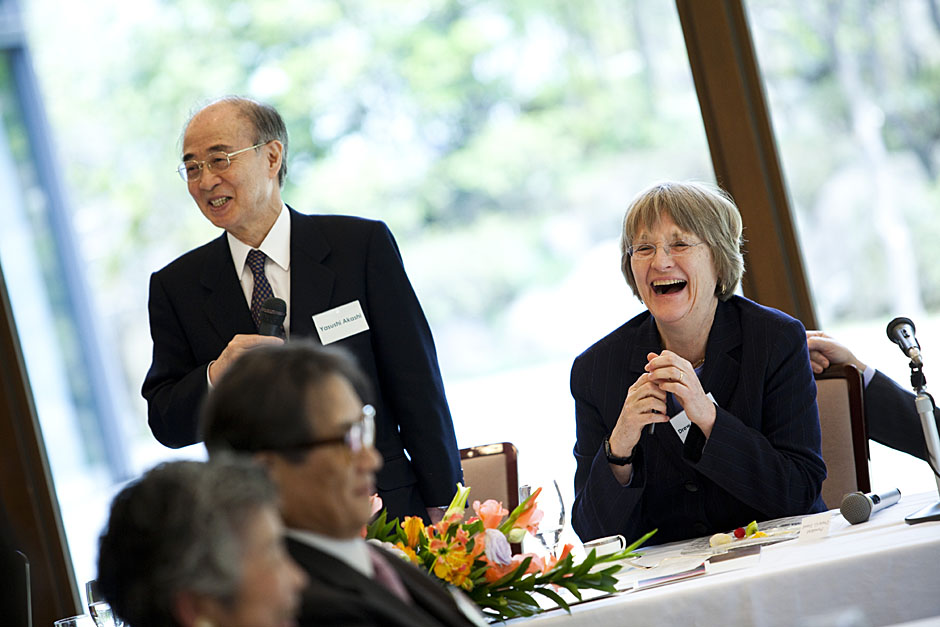
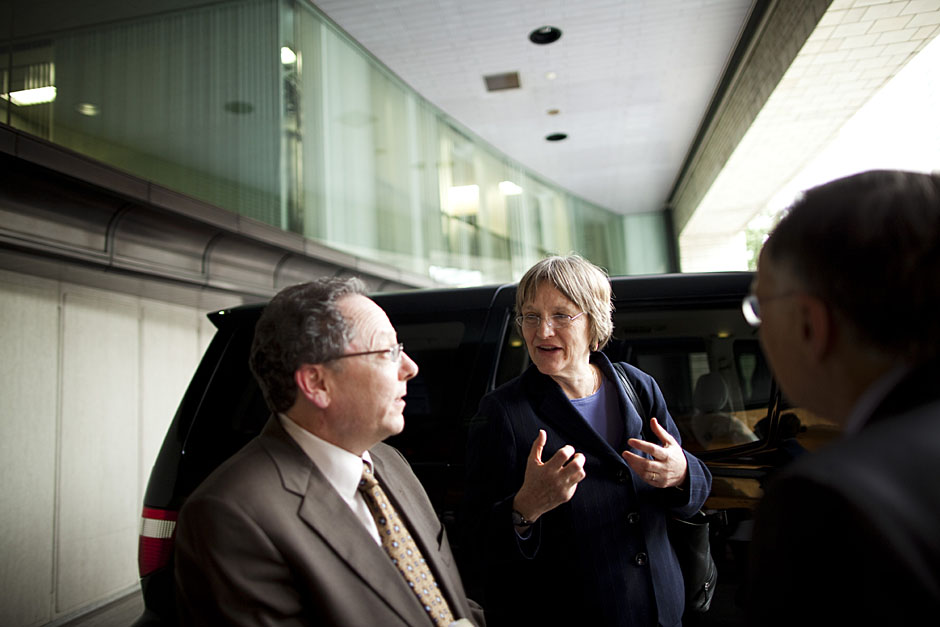
  • Drew Faust visits Asia

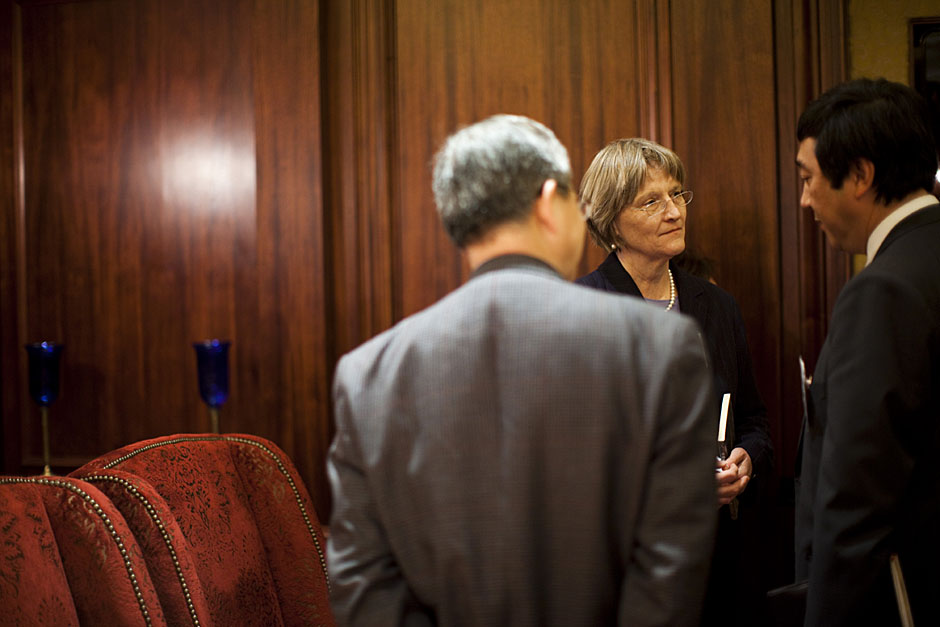
    Harvard President Drew Faust has embraced Harvard’s international image in both practical and symbolic ways. Faust, whose appointment was celebrated around the world as an example of what women now can achieve, has traveled to China, Botswana, South Africa, Western Europe, and most recently took a weeklong trip to Japan and China.


  • Touché: Harvard fencing

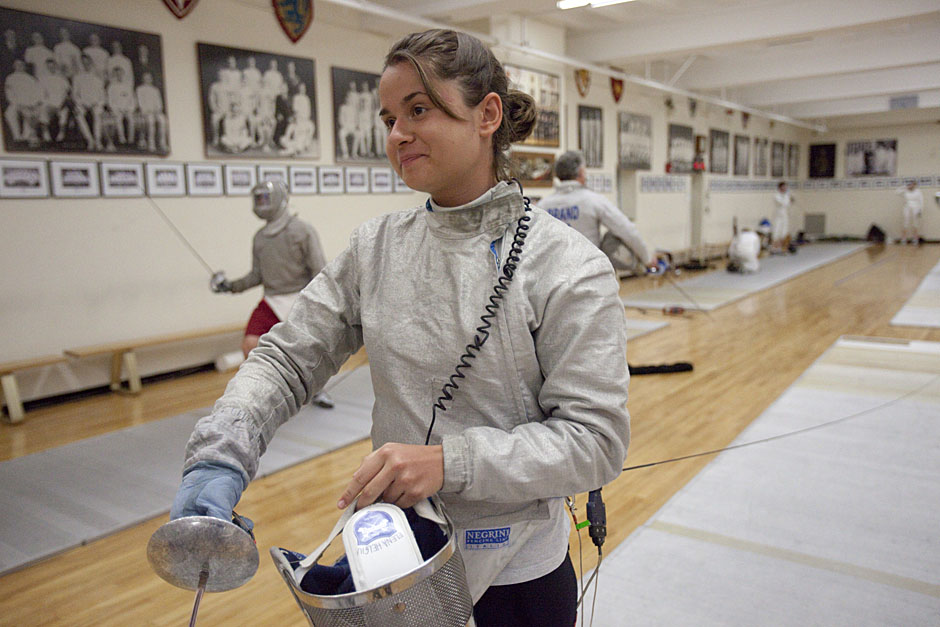
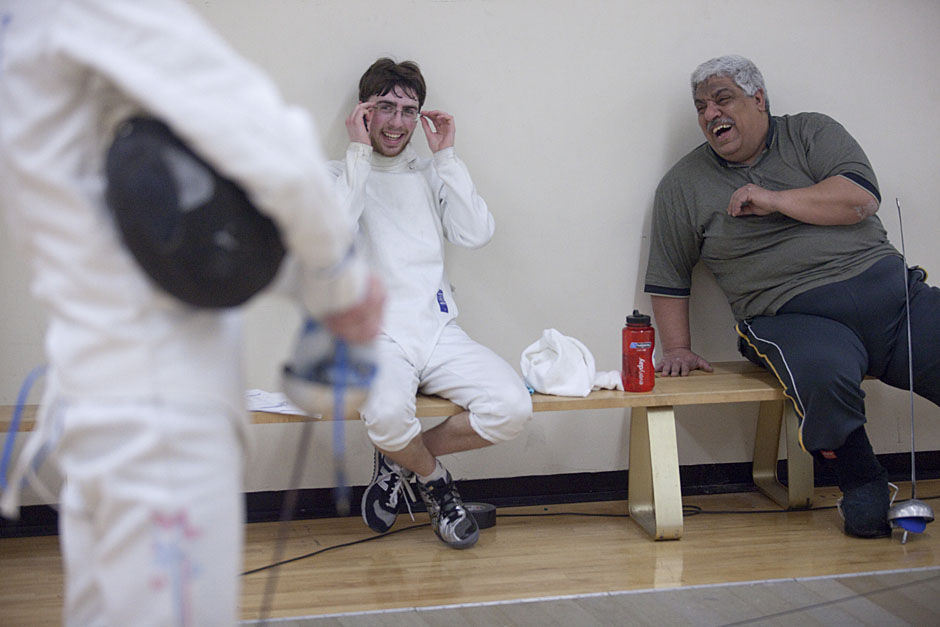
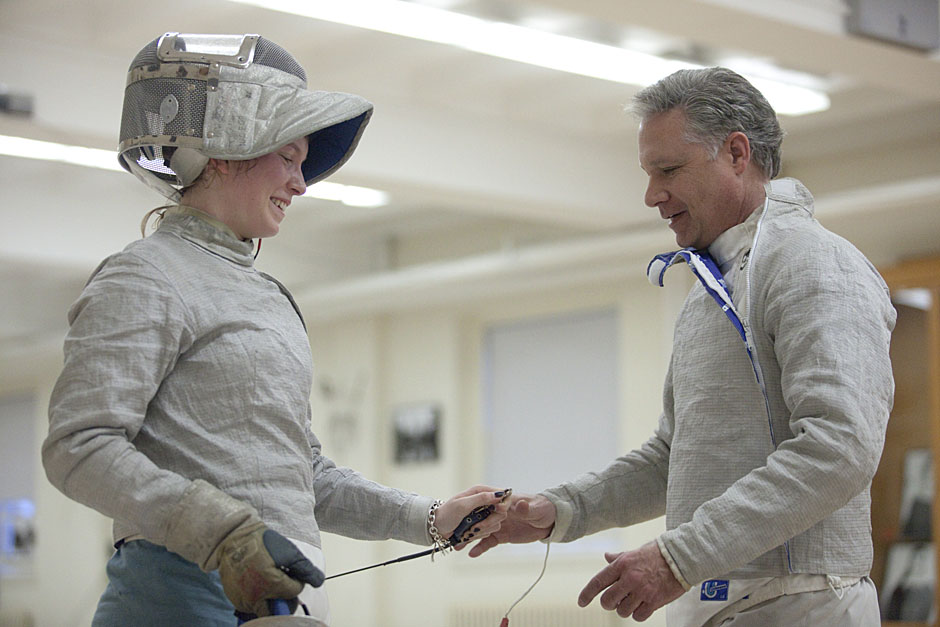
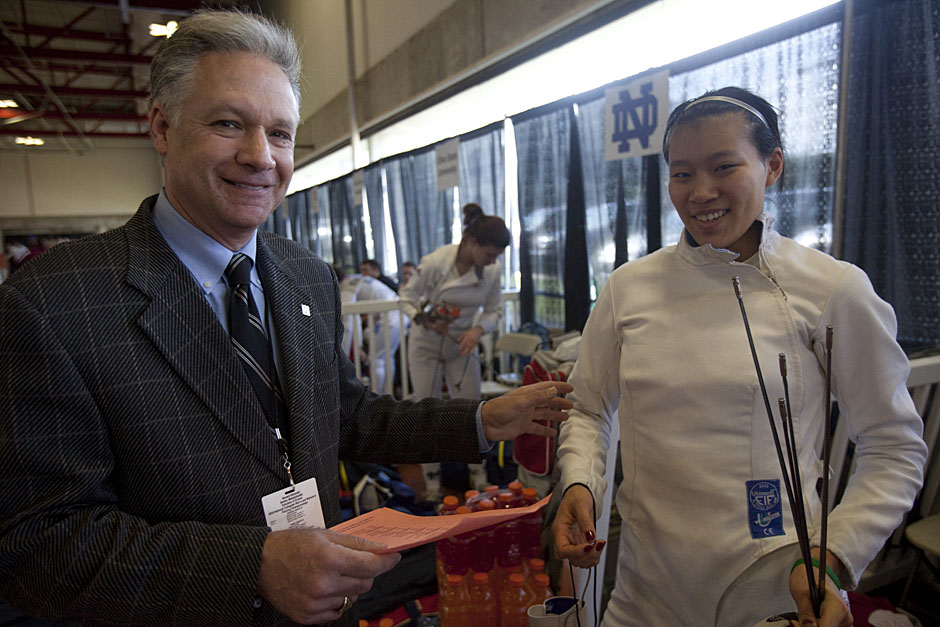
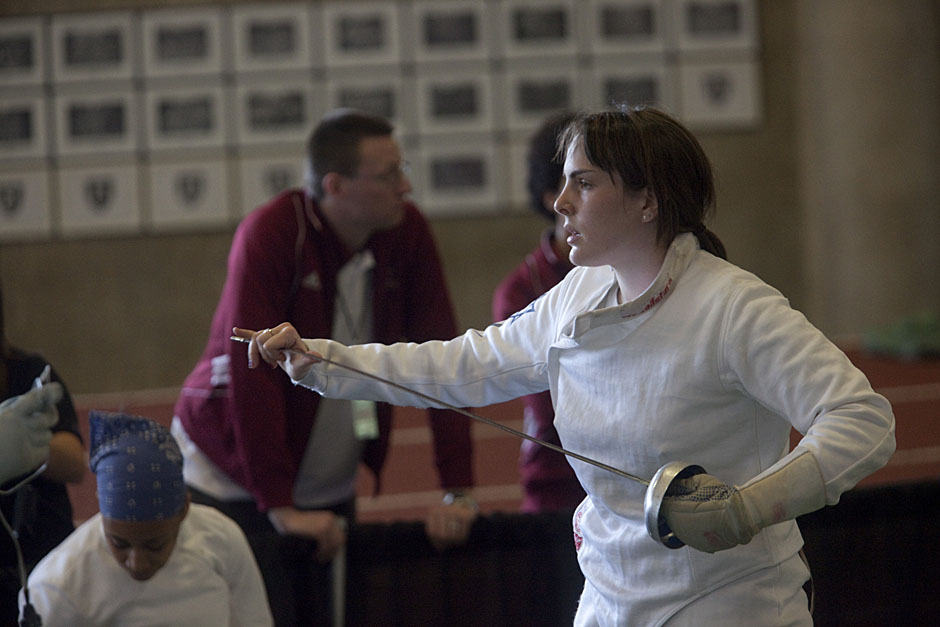
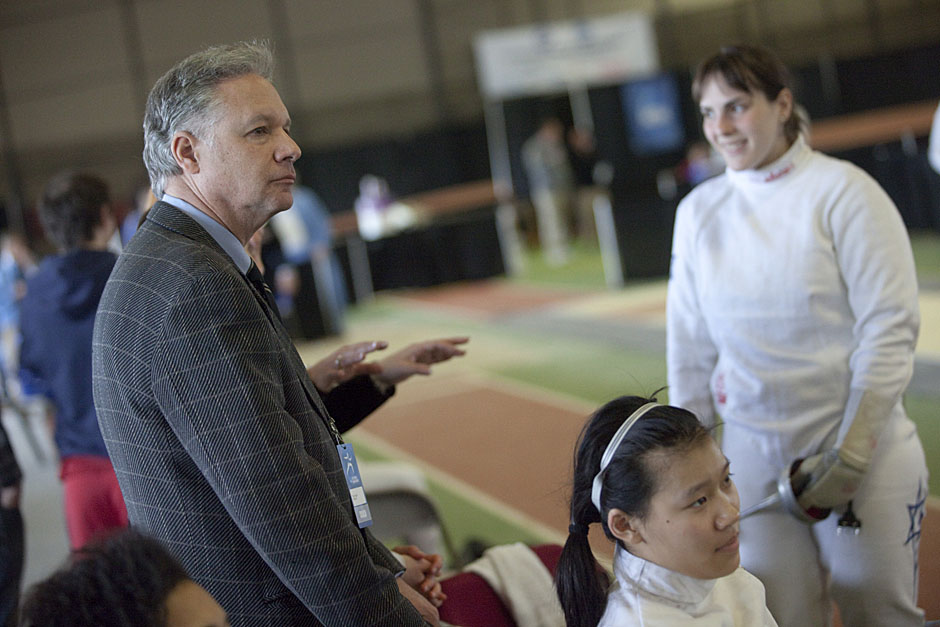
    Harvard University recently played host to the 2010 NCAA Fencing Championships, held March 25-28 at the Gordon Indoor Track. Harvard’s Caroline Vloka ‘12 won the national title in women’s sabre, while her teammate Noam Mills ‘12 finished second in women’s épée. Vloka became Harvard’s first female NCAA champion since Emily Cross ‘08-09 won the women’s foil title in 2005. These are some images from that event.


  • Sumner M. Redstone donates $1M

    Harvard University today (April 23) announced that Sumner M. Redstone has contributed $1 million to be used by Harvard College and Harvard Law School. This contribution by Redstone, a graduate of both Schools, will establish scholarships for 20 Redstone Scholars to attend Harvard College for the 2010–11 academic year. Additionally, Redstone’s gift will furnish funding for 10 postgraduate public service fellowships at Harvard Law School.

    The Sumner M. Redstone Undergraduate Scholarship Fund will provide financial assistance to deserving men and women at Harvard College. The fund will support undergraduates from a broad range of socioeconomic backgrounds who demonstrate a commitment to public service reflecting the civic ideals of President John F. Kennedy.

    “I am deeply grateful to Mr. Redstone for this generous gift. It will help ensure that Harvard College is accessible to students who hold service to the public good as a fundamental value,” said Michael D. Smith, dean of the Faculty of Arts and Sciences and John H. Finley Jr. Professor of Engineering and Applied Sciences. “These immediate-use scholarships support the College’s strong commitment to creating a diverse and outstanding undergraduate class each year.”

    At Harvard Law School, the Redstone Fellowships will support 10 students who wish to pursue postgraduate public service.

    Martha Minow, dean of the faculty and Jeremiah Smith Jr. Professor of Law, said, “In the 50 years since John F. Kennedy inspired a generation with his call to service, Sumner Redstone has steadfastly answered that call throughout the course of his extraordinary career and as a visionary leader in our society. Now, with these fellowships, he shares his inspiration by supporting the newest generation of lawyers who wish to make a difference in the lives of their fellow human beings. I am enormously grateful for his vision and leadership. The 10 recipients of his generosity will magnify his contribution many times over, by helping untold numbers of people. As President Kennedy’s brother Robert said, each time a person acts to improve the lot of others, ‘he sends forth a tiny ripple of hope, and crossing each other from a million different centers of energy and daring, those ripples build a current that can sweep down the mightiest walls of oppression and resistance.’”

    Redstone said, “As a graduate of both Harvard College and Harvard Law School, I have experienced firsthand the culture of excellence and public service that is a fundamental tradition of these great schools. Harvard’s longstanding commitment to leadership through enlightenment and engagement provides an outstanding foundation for the next generation of leaders for the U.S. and around the world.

    “As the 50th anniversary of John F. Kennedy’s presidency nears, we reflect on how his influence sparked an era of optimism, activism, and national service. I have established these scholarships to help celebrate President Kennedy’s spirit by fostering a focus on education and a renewed commitment to public service. I am honored to have the opportunity to recognize and encourage these admirable young men and women.”

    The recipients of the scholarships announced today will be chosen based on criteria that include a commitment to public service that reflects President Kennedy’s civic ideals.

    Redstone has recently awarded more than $100 million in charitable grants to fund initiatives in the United States and abroad. His contributions have funded research and patient care advancements in cancer, burn recovery, and mental health at several major nonprofit health care organizations, and have provided support for groups that care for impoverished children in Southeast Asia.

    Redstone has served as the executive chairman of the board of directors of Viacom Inc. since Jan. 1, 2006. He also serves as executive chairman of the board of CBS Corp. He was chief executive officer of the former Viacom Inc. from 1996 to 2005 and chairman of the board of the former Viacom Inc. since 1986. He has also been chairman of the board of National Amusements Inc., Viacom’s controlling stockholder, since 1986, its chief executive officer since 1967, and also served as its president from 1967 through 1999. Redstone served as the first chairman of the board of the National Association of Theatre Owners and is currently a member of its executive committee. He has been a frequent lecturer at universities, including Harvard Law School, Boston University Law School, and Brandeis University. Redstone graduated from Harvard University in 1944 and received an LL.B. from Harvard Law School in 1947. Upon graduation, he served as law secretary with the U.S. Court of Appeals and then as a special assistant to the U.S. Attorney General. Redstone served in the Military Intelligence Division during World War II. While a student at Harvard, he was selected to join a special intelligence group whose mission was to break Japan’s high-level military and diplomatic codes. Redstone received, among other honors, two commendations from the Military Intelligence Division in recognition of his service, contribution, and devotion to duty, and the Army Commendation Award.

  • Deadline approaches for John T. Dunlop Undergraduate Thesis Prize

    The Mossavar-Rahmani Center for Business and Government (M-RCBG) at Harvard Kennedy School (HKS) is accepting papers for a thesis prize for a graduating Harvard College senior.

    The John T. Dunlop Thesis Prize in Business and Government will be awarded to the graduating senior who writes the best thesis on a challenging public policy issue at the interface of business and government.

    “Recent events have illuminated the crucial nature of the business-government relationship. From macroeconomic policy to health care, from the regulation of financial instruments to energy policy, from technological innovation to protecting private pensions, business and government influence one another around the world,” said Roger Porter, the IBM Professor of Business and Government at HKS. “The John T. Dunlop Thesis Prize, named in honor of a giant in this field, allows us to encourage and recognize a new generation of young thinkers as they explore ways of understanding and improving this vital relationship.”

    The prize will be awarded to the paper that best examines the business-government interface with respect to regulation, corporate responsibility, energy, the environment, health care, education, technology, and human rights, among others. A $500 award will be provided to the author of the winning entry.

    The prize is named after John T. Dunlop, the Lamont University Professor Emeritus, a widely respected labor economist who served as dean of the Faculty of Arts and Sciences from 1969 to 1973. An adviser to many U.S. presidents, beginning with Franklin D. Roosevelt, Dunlop was secretary of labor under Gerald Ford, serving from March 1975 to January 1976.

    In addition to serving as secretary of labor, Dunlop held many other government posts including director of the Cost of Living Council from 1973 to 1974, chairman of the Construction Industry Stabilization Committee from 1993 to 1995, chair of the Massachusetts Joint Labor-Management Committee for Municipal Police and Firefighters from 1977 to 2003, and chair of the Commission on Migratory Farm Labor from 1984 to 2003.

    Dunlop served as the second director of the Center for Business and Government from 1987 to 1991. The center, renamed in 2005 as the Mossavar-Rahmani Center for Business and Government, focuses on policy issues at the intersection of business and government.

    The deadline for this year’s Dunlop Prize is May 7. For more information, visit the M-RCGB Web site.

  • Reischauer Institute of Japanese Studies seeks papers for 2010

    The Edwin O. Reischauer Institute of Japanese Studies seeks submissions for its 2010 Noma-Reischauer Prizes in Japanese Studies, given to the undergraduate and graduate students with the best essays on Japan-related topics. The submission deadline is June 21 by 5 p.m., and $3,000 will be awarded for the best graduate student essay and $2,000 for the best undergraduate student essay.

    Papers written this academic year are eligible, including course and seminar papers, A.B. or M.A. theses, or essays written specifically for the competition. Doctoral dissertations are excluded from consideration. For application guidelines and further information, visit the Reischauer Institute Web site or call 617.495.3220.

  • Sumner Redstone donates $1 million to Harvard University

    Boston, MA (April 23, 2010) — Harvard University today announced that Sumner M. Redstone has contributed $1 million to be used by Harvard College and Harvard Law School. This contribution by Mr. Redstone, a graduate of both schools, will establish scholarships for 20 Redstone Scholars to attend Harvard College for the 2010–2011 academic year. Additionally, Mr. Redstone’s gift will furnish funding for 10 postgraduate public service fellowships at Harvard Law School.

    The Sumner M. Redstone Undergraduate Scholarship Fund will provide financial assistance to deserving men and women at Harvard College. The fund will support undergraduates from a broad range of socioeconomic backgrounds who demonstrate a commitment to public service reflecting the civic ideals of President John F. Kennedy.

    “I am deeply grateful to Mr. Redstone for this generous gift. It will help ensure that Harvard College is accessible to students who hold service to the public good as a fundamental value,” said Michael D. Smith, dean of the Faculty of Arts and Sciences and John H. Finley Jr. Professor of Engineering and Applied Sciences. “These immediate-use scholarships support the College’s strong commitment to creating a diverse and outstanding undergraduate class each year.”

    At Harvard Law School, the Redstone Fellowships will support 10 students who wish to pursue postgraduate public service.

    Martha Minow, dean of the Faculty and Jeremiah Smith Jr. Professor of Law, said, “In the 50 years since John F. Kennedy inspired a generation with his call to service, Sumner Redstone has steadfastly answered that call throughout the course of his extraordinary career and as a visionary leader in our society. Now, with these fellowships, he shares his inspiration by supporting the newest generation of lawyers who wish to make a difference in the lives of their fellow human beings. I am enormously grateful for his vision and leadership. The 10 recipients of his generosity will magnify his contribution many times over, by helping untold numbers of people. As President Kennedy’s brother Robert said, each time a person acts to improve the lot of others, ‘he sends forth a tiny ripple of hope, and crossing each other from a million different centers of energy and daring, those ripples build a current that can sweep down the mightiest walls of oppression and resistance.’”

    Mr. Redstone said, “As a graduate of both Harvard College and Harvard Law School, I have experienced firsthand the culture of excellence and public service that is a fundamental tradition of these great schools. Harvard’s longstanding commitment to leadership through enlightenment and engagement provides an outstanding foundation for the next generation of leaders for the U.S. and around the world.

    “As the 50th anniversary of John F. Kennedy’s presidency nears, we reflect on how his influence sparked an era of optimism, activism and national service. I have established these scholarships to help celebrate President Kennedy’s spirit by fostering a focus on education and a renewed commitment to public service. I am honored to have the opportunity to recognize and encourage these admirable young men and women.”

    The recipients of the scholarships announced today will be chosen based on criteria that include a commitment to public service that reflects President Kennedy’s civic ideals.

    Mr. Redstone has recently awarded more than $100 million in charitable grants to fund initiatives in the U.S. and abroad. His contributions have funded research and patient care advancements in cancer, burn recovery and mental health at several major non-profit healthcare organizations, and have provided support for groups that care for impoverished children in Southeast Asia.

    Sumner M. Redstone

    Mr. Redstone has served as the Executive Chairman of the Board of Directors of Viacom Inc. (NYSE: VIA and VIA.B) since Jan. 1, 2006. He also serves as Executive Chairman of the Board of CBS Corporation. He was Chief Executive Officer of the former Viacom Inc. from 1996 to 2005 and Chairman of the Board of the former Viacom Inc. since 1986. He has also been Chairman of the Board of National Amusements, Inc., Viacom’s controlling stockholder, since 1986, its Chief Executive Officer since 1967 and also served as its President from 1967 through 1999. Mr. Redstone served as the first Chairman of the Board of the National Association of Theatre Owners and is currently a member of its Executive Committee. He has been a frequent lecturer at universities, including Harvard Law School, Boston University Law School and Brandeis University. Mr. Redstone graduated from Harvard University in 1944 and received an LL.B. from Harvard Law School in 1947. Upon graduation, he served as law secretary with the U.S. Court of Appeals and then as a special assistant to the U.S. Attorney General. Mr. Redstone served in the Military Intelligence Division during World War II. While a student at Harvard, he was selected to join a special intelligence group whose mission was to break Japan’s high-level military and diplomatic codes. Mr. Redstone received, among other honors, two commendations from the Military Intelligence Division in recognition of his service, contribution, and devotion to duty, and the Army Commendation Award.

  • Truths and myths on marijuana

    Possession of less than an ounce of marijuana can no longer lead to criminal charges in Massachusetts, but it can lead to suspension from Harvard University. This was just one of the issues discussed at a no-holds-barred Winthrop House event this week.

    Sponsored by Harvard University Health Services’ (HUHS) Office of Alcohol & Other Drug Services (AODS), and organized by the Drug & Alcohol Peer Advisers’ Community Education & Outreach subcommittee, the event provided a forum for students to ask questions about many aspects of marijuana use — from legal risks to the effect on one’s physical and mental health.

    “I’m from Massachusetts, and was completely unsure where the law now stands on marijuana, so it was good to come here and learn the facts and how you’ll be affected legally,” said Harvard freshman Melanie Comeau.

    Massachusetts State Police Sgt. Richard J. Crosby Jr. provided a legal overview of marijuana in the state. Aimed less at zero-tolerance and more on controlling dangerous behavior, the law dictates that possessing an ounce or less of marijuana is now a civil offense that carries a fine of $100 and forfeiture of the contraband.

    In addition to the fine, anyone under age 18 caught with marijuana is required to attend a drug awareness program, and anyone found with more than an ounce will be charged with a misdemeanor that carries a possible sentence of six months and a $500 fine. Harvard prohibits use or possession of any illicit drug on campus.

    Ranna Parekh, a psychiatrist at HUHS and Massachusetts General Hospital (MGH), said car accidents are the No. 1 killer of people ages 15 to 24. “We often think of alcohol when we hear that statistic, but you also need to consider marijuana. It delays your reflexes; it delays your capacity to make quick assessments. Misuse includes when you use it and you get behind the wheel of a car, or you get into a car with a driver who has used it.”

    Parekh, who has worked in MGH’s addiction clinic, spoke of what is known about marijuana’s physiological effects. “Marijuana works by increasing the brain’s neurotransmitter dopamine. People often think it will help them to concentrate, when in fact it decreases that ability and can affect the memory,” she said. “It’s an important thing to think about, particularly now as students are entering final exams.”

    Although marijuana use isn’t the top concern in her field, Parekh cautioned students to be mindful of what it can do to the body. “People in my profession don’t ask about marijuana use. It’s way down the list after alcohol, cocaine, pills, heroin,” she said. “The problem is that we’re missing warning signs in many people who present with depressive issues,” Parekh added. “Research shows that those who use marijuana earlier in life have a higher risk of developing depressive problems later on.”

    AODS planned the event after an equally successful turnout at last fall’s session on study drugs. The organization plans to continue holding such educational forums for students in the upcoming school year, to provide important information on a variety of drug issues.

    Crosby reminded the crowd to consider all the facts about drug consumption and its effects, and to remember that researchers still don’t know everything about marijuana’s long-term medical impact. “You kids will absolutely be the leaders of the world,” he said. “What you do will have a big impact.”
  • A church of words

    Call him a preacher, a soothsayer, a shaman, a poet. It’s the last that Jericho Brown goes by, but it takes all of the above to write lines like “The loneliest people have the earth to love and not one friend their own age” (from “Odd Jobs”).

    Brown, the Radcliffe Institute’s 2009-10 American Fellow, read Wednesday (April 21) inside the Radcliffe Gymnasium from “The New Testament,” his newest collection of poems.

    Born to a New Orleans churchgoing family, Brown read with the breathless urgency of a reverend to a hoard of sinners. Before launching into “Another Elegy,” his opening poem, Brown’s command over the audience was palpable. Lapsing into a silence so long it might otherwise be deemed uncomfortable, Brown could’ve predicted the world’s end and no one would’ve budged.

    Instead he spoke: “Expect death in all our poems. Men die. Death is not a metaphor. It stands for nothing and represents itself. … It enters whether or not your house is dirty. Whether or not your body is clean.”

    In “The New Testament,” Brown mashes up religion, mixing identity, sexuality, violence, race, death, and more death. “The Bible is a text to go back to,” said Brown, “just like ‘The Love Song of J. Alfred Prufrock’ is a text to go back to.”

    Both texts are soaked with death; yet as bleak as Brown’s poems can sometimes be, his performance of them — though never shy in intensity — is a catharsis.

    “I was raised in a church where part of growing up was about getting in front of people and doing what we saw our pastor doing every Sunday,” he recalled. “You have to be able to give over to an audience for them to enjoy it. So I think that’s ingrained in me, no matter what I’m doing.”

    In “Another Elegy,” a different poem with the same title, Brown read: “Every night, / I take a pill. Miss one, and I’m gone. / Miss two, and we’re through. Hotels / Bore me, unless I get a mountain view, / A room in which my cell won’t work, / And there’s nothing to do but see / The sun go down into the ground / That cradles us as any coffin can.”

    “I think of every poem as its own character, so I do my best to embody that character,” said Brown, who won the prestigious Whiting Award while at Radcliffe. The coveted honor, which carries a $50,000 prize, is given to writers in the early stages of their careers who show extraordinary talent and promise. Brown is author of the book “Please” (New Issues, 2008), and teaches at the University of San Diego.

    In “To Be Seen,” Brown read: “You will forgive me if I carry the tone of a preacher, / Surely, you understand, a man in the midst of dying / Must have a point, which is not to say that I am dying / Exactly.”

    Last year, Brown had a life-changing revelation: “I became very afraid that I was going to die. For the first time in my life, I was thinking, ‘Oh, I might die?’ It had never crossed my mind before. It’s that feeling you have when you almost hit a car, that shaking inside, and I was having that feeling all day, every day, that shaking inside.”

    Brown handled those thoughts by writing. “I felt like I could deal with that feeling if I wrote about that feeling,” he said.

    “To Be Seen” takes its title from a doctor’s appointment (“the doctor will see you now”), and in the poem Brown confronts disease, mortality, the doctor he does not trust:

    My doctor, for instance, insists on the metaphor of war;

    It’s always the virus that attacks and the cells that fight or

    Die fighting.  I even remember him saying the word siege

    When another rash returned.  Here I am dying

    While he makes a battle of my body — anything to be seen

    When all he really means is to grab me by the chin

    And, like God the Father, say through clenched teeth,

    Look at me when I’m talking to you.  Your healing is

    Not in my hands, though I touch as if to make you whole.

    Noting the lack of joy in his poems, Brown called himself an elegiac poet, but admitted he is really a happy person. “Maybe the joy hasn’t gotten into my writing just yet,” he said. “But it will.”