Author: Heritage

  • What the House Would Have to Swallow in the Senate Bill

    On 03.08.10 02:00 PM posted by Kathryn Nix

    <ahref="http://blog.heritage.org/wp-content/uploads/2009/03/pelosi_moron090305.jpg"></p>Amidst all the intense speculation about quickly passing the President’s health care agenda through the Budget Reconciliation process before the Easter Recess, ordinary Americans should remember one thing: the House of Representatives must first pass the 2,700-page, $2.5 trillion, Senate health bill. So, the next big step in the national health care debate is floor action in the House of Representatives, where House Speaker Nancy Pelosi must round up at least 216 votes.

    Heritage analysts have conducted some extensive research and analysis of the provisions of the giant Senate bill. If the House passes the Senate bill and it goes to the President’s desk for signature, it then would become the law of the land. For all intents and purposes, the legislative debate would then be over.

    Regardless of Administration or Senate leadership promises to “fix” the new law (the Senate bill) through the Budget Reconciliation process, there are no guarantees. Any “fixes”—if they did come about—would have to survive another round of Senate floor action. So it is worth recalling what the Senate bill would mean for Americans were it to become law.<spanid="more-28332"></span>

    • <ahref="http://www.heritage.org/Research/HealthCare/bg2369.cfm">Failure to address the drivers behind rising spending in health care. The Senate bill attempts to control costs by imposing heavy new federal regulations and punitive taxes on high-ticket medical expenditures such as medical devices, prescription drugs, and high-cost insurance plans. This top-down approach focuses on the symptoms, rather than the causes, of increasing health spending. Health insurance premiums, particularly in the individual market, will go up.
    • <ahref="http://www.heritage.org/Research/HealthCare/cda1002.cfm">An individual mandate with disastrous unintended consequences. To expand coverage, the bill includes guaranteed issue of coverage combined with an individual mandate. However, rather than encourage “young invincibles” to carry insurance, the mandate, which would be less expensive than insurance coverage, would create incentives for young and healthy adults to pay the penalty rather than buy and carry a costly health plan. This would destabilize the insurance market by reducing the spread of risk, leaving the elderly and sickly in insurance risk pools. Premiums would thus skyrocket—further discouraging healthy individuals from obtaining care.
    • <ahref="http://www.heritage.org/Research/HealthCare/wm2774.cfm">Stringent federal requirement push private insurers towards insolvency. The combination of an excise tax on high-cost insurance plans, a federally-defined minimum medical-loss ratio, and federally-defined required benefits could push private insurers to going out of business, should they be incapable of meeting all three requirements and simultaneously covering the cost of enrollees’ care. Alternatively, it could mean that health insurers, “too big to fail”, would become the next big industry recipients of taxpayer bailouts.
    • <ahref="http://www.heritage.org/Research/HealthCare/bg2364.cfm">A public option in disguise. The Senate bill requires the Office of Personnel Management to establish and manage health plans in the state exchanges to compete against private health plans. The bill expands the powers of this federal agency. This could lead to a de facto public option with federally defined premiums, benefits, etc: private insurance in name only. Of course, if the government sponsored health plans do not effectively compete against the other plans, it is likely that they will also be eligible for future federal bailouts at the taxpayers’ expense.
    • <ahref="http://www.heritage.org/Research/HealthCare/wm2767.cfm">Government subsidies which penalize marriage. The structure of the subsidies offered by the Senate bill to purchase insurance are inequitable, offering more financial assistance to non-married couples than to a married couple with comparable income. This is bizarre social policy.
    • <ahref="http://www.heritage.org/Research/HealthCare/wm2756.cfm">Trillions in new federal spending, questionable savings. Congressional liberals claim that their health care proposals are deficit neutral. In fact, they are based on budgetary gimmicks and hidden costs. When these are accounted for, the real cost of the Senate bill skyrockets, further augmented by the implausibility of the many promised savings in the bill.
    • <ahref="http://www.heritage.org/Research/HealthCare/wm2757.cfm">A special Medicaid deal for Nebraska. The Senate bill would force all federal taxpayers to cover the extra cost of expanding Medicaid in Nebraska. It is worthy to note that the President’s proposal would extend the taxpayer subsidies to all states, increasing the total cost of the bill.
    • <ahref="http://www.heritage.org/Research/HealthCare/wm2744.cfm">Expanding Medicaid on the states’ budgets. Though the federal government would initially cover most of the cost of expanding Medicaid, states would eventually have to pick up a portion of the cost. This comes at a time when states are cutting spending in Medicaid and other areas to accrue savings and avoid increasing debt. In fact, <ahref="http://www.heritage.org/Research/HealthCare/wm2712.cfm">we show that states could save significantly if they were to drop their Medicaid programs altogether, which could become an appealing option after adoption of the Senate bill.
    • <ahref="http://www.heritage.org/Research/HealthCare/wm2737.cfm">Encourages employment discrimination. The structure of the bill’s employer mandate would <ahref="http://www.heritage.org/Research/HealthCare/wm2716.cfm">discourage employers from hiring workers from low-income families and from offering insurance to all employees if a large portion of a firm’s workforce consists of low-income workers.
    • <ahref="http://www.heritage.org/Research/HealthCare/wm2730.cfm">Disparate federal assistance for families of comparable income. The generous subsidies available to purchase insurance in the exchanges would be available to only a select few of the millions that fall within the eligible income bracket. This would result in thousands of dollars in additional federal assistance for some individuals and little to no assistance for others, regardless of equal income.
    • <ahref="http://www.heritage.org/Research/HealthCare/bg2350.cfm">Taxing families’ health benefits. An excise tax on high-cost insurance plans is included in the Senate bill with the intention of lowering premiums. However, this tax on insurers would be passed down to the consumer, further raising premiums.
    • <ahref="http://www.heritage.org/Research/HealthCare/wm2706.cfm">Numerous new taxes—and not just for the wealthy. President Obama has promised not to introduce new taxes that would affect the middle-class, but the Senate bill would impose several new punitive taxes on to Americans of every financial background.

    These policies are all embodied in the Senate health bill. For further analysis of the Senate bill,*<ahref="http://www.heritage.org/Research/HealthCare/bg2353.cfm">click here.*Congress should take a different route and <ahref="http://www.heritage.org/Research/HealthCare/bg2377.cfm">start over to do health care reform right.

    http://blog.heritage.org/2010/03/08/…e-senate-bill/

  • Iraqis Vote Despite Violence: Now Comes the Hard Part

    On 03.08.10 02:29 PM posted by James Phillips

    <ahref="http://blog.heritage.org/wp-content/uploads/Iraqi-election-10-03-08.jpg"></p>Despite insurgent threats to murder Iraqis who dared to vote in the parliamentary elections, yesterday’s Iraqi elections went as well as could be expected. There were dozens of bombs that exploded in Baghdad and other cities, killing at least 36 people, but many Iraqis shrugged off the violence and risked their lives to vote. <ahref="http://news.bbc.co.uk/2/low/middle_east/8556065.stm">

    <ahref="http://news.bbc.co.uk/2/low/middle_east/8556065.stm">The turnout was estimated to be about 62 percent of Iraq’s 19 million eligible voters, which is down from the estimated 76 percent turnout in the last parliamentary elections in December 2005. But a positive sign was that turnout in Sunni Arab areas appears to have increased significantly over 2005, when many Sunnis boycotted the elections. This could lead to greater Sunni participation in the next government, which could further weaken Iraq’s faltering insurgency. Also, this time around the security duties were handled by Iraq’s security services instead of the 96,000 U.S. troops still in the country.

    <spanid="more-28343"></span>The full results of the voting are not likely to be known before <ahref="http://www.usatoday.com/news/world/iraq/2010-03-08-election-results_N.htm?csp=34&utm_source=feedburner&utm_med ium=feed&utm_campaign=Feed%3A+usatoday-NewsTopStories+%28News+-+Top+Stories%29&utm_content=My+Yahoo">Thursday. But early projections assess that Iraqi Prime Minister Nouri al-Maliki’s <ahref="http://news.yahoo.com/s/ap/20100308/ap_on_re_mi_ea/ml_iraq">State of Law coalition appears to be the frontrunner, with former Prime Minister Ayad Allawi’s Iraqiya alliance, a secular nationalist coalition, and the Iraq National Alliance, a grouping of Shia religious parties backed by Iran, vying to place second.

    No political coalition is expected to gain the 163 seats necessary to form a government in the 325 seat parliament. This will lead to extensive post-election negotiations between the three big Shia-led parties, the Kurdish coalition, and many smaller Sunni, Shia, Christian and independent parties. For a list of the various political parties see: <ahref="http://www.foreignpolicy.com/articles/2010/03/03/the_definitive_guide_to_the_iraqi_elections">Guide to the Iraqi Elections.

    The election by itself is a necessary but not a sufficient condition for resolving Iraq’s major internal disputes, including disagreements over power sharing, the sharing of oil revenues, how to ease ethnic and sectarian tensions, territorial disputes (particularly between the Kurds, Arabs, Turkmen and Christian minorities in the north), and the relationship between the central government and regional governments. The real test will come in the months ahead, as Iraqis form a coalition government that must effectively resolve these problems.

    For more on U.S. Policy and Iraq, see: <ahref="http://www.heritage.org/Research/MiddleEast/wm2827.cfm">Charting U.S. Policy After Iraq’s Elections

    http://blog.heritage.org/2010/03/08/…the-hard-part/

  • House and Senate Cloakroom: March 8 – 12, 2010

    On 03.08.10 06:00 AM posted by Dan Ziegler

    House Cloakroom: March 8 – 12, 2010

    Analysis:

    Again, the question expected to dominate the discussion in Washington will be whether there are enough votes to pass the health care legislation on the House side. In order to move the ball forward it is expected there will be a health care reconciliation mark up in the Budget Committee sometime during the week. Besides the ongoing health care saga the House and Senate will likely put the finishing touches on a “jobs” bill this week. Two other likely votes include legislation to impeach a district judge and another to withdraw troops from Afghanistan led by Congressman Dennis Kucinich (D-OH).<spanid="more-28242"></span>

    Major Floor Action:

    • <atitle="http://frwebgate.access.gpo.gov/cgi-bin/getdoc.cgi?dbname=111_cong_bills&docid=f:hc248ih.t xt.pdf" href="http://frwebgate.access.gpo.gov/cgi-bin/getdoc.cgi?dbname=111_cong_bills&docid=f:hc248ih.t xt.pdf">H. Con. Res. 248 – Afghanistan War Powers Resolution
    • <atitle="http://frwebgate.access.gpo.gov/cgi-bin/getdoc.cgi?dbname=111_cong_bills&docid=f:hr1031rh. txt.pdf" href="http://frwebgate.access.gpo.gov/cgi-bin/getdoc.cgi?dbname=111_cong_bills&docid=f:hr1031rh. txt.pdf">H. Res.1031 – Impeaching G. Thomas Porteous, Jr., judge of the United States District Court for the Eastern District of Louisiana, for high crimes and misdemeanors
    • Possible action on “jobs” measures

    Major Committee Action:

    • Possible health care reconciliation mark up in <atitle="http://budget.house.gov/" href="http://budget.house.gov/">House Budget Committee in preparation for bringing it to the floor.
    • Budget season continues with several hearings on Fiscal 2011 budgets for federal departments, agencies, and programs.

    Senate Cloakroom: March 8 – 12, 2010

    Analysis:

    It’s a trifecta! Jobs, health and regulatory reform are on the agenda for the Senate this week. On the floor, Senators will focus on a massive tax extenders package that has been billed as a stimulus. Behind closed doors, Senate Democrats will be discussing how to move health care via reconciliation. Also behind closed doors, several Senators will continue to hammer out the details of financial regulatory reform. As with most weeks, the consequential action is taking place out of the eyes of the public.

    Major Floor Action:

    • The Senate will continue on <atitle="http://thomas.loc.gov/cgi-bin/bdquery/z?d111:HR04213:@@@R" href="http://thomas.loc.gov/cgi-bin/bdquery/z?d111:HR04213:@@@R">H.R. 4213, the tax extenders package.

    Major Committee Action:

    • An <atitle="http://epw.senate.gov/public/index.cfm?FuseAction=Hearings.Hearing&Hearing_ID=2 9c259ec-802a-23ad-4b7b-6087cdaf2ceb" href="http://epw.senate.gov/public/index.cfm?FuseAction=Hearings.Hearing&Hearing_ID=2 9c259ec-802a-23ad-4b7b-6087cdaf2ceb">Environment and Public Works subcommittee will hold a hearing on the effort to overhaul the <atitle="http://www.heritage.org/Research/HomelandSecurity/wm2679.cfm" href="http://www.heritage.org/Research/HomelandSecurity/wm2679.cfm">chemical safety law.
    • The <atitle="http://help.senate.gov/hearings/hearing/?id=201fe113-5056-9502-5d36-207b90e58b96" href="http://help.senate.gov/hearings/hearing/?id=201fe113-5056-9502-5d36-207b90e58b96">Health, Education, Labor and Pensions Committee will hold a hearing on reauthorization the <atitle="http://www.heritage.org/LeadershipForAmerica/education.cfm" href="http://www.heritage.org/LeadershipForAmerica/education.cfm">Elementary and Secondary Education Act.
    • The <atitle="http://judiciary.senate.gov/hearings/hearing.cfm?id=4459" href="http://judiciary.senate.gov/hearings/hearing.cfm?id=4459">Judiciary Committee will hold a hearing on the <atitle="http://www.heritage.org/Research/LegalIssues/lm0050.cfm" href="http://www.heritage.org/Research/LegalIssues/lm0050.cfm">Citizens United case.
    • The <atitle="http://foreign.senate.gov/hearings/hearing/20100310/" href="http://foreign.senate.gov/hearings/hearing/20100310/">Foreign Relations Committee will hold a hearing on the future of <atitle="http://www.heritage.org/Research/PublicDiplomacy/bg2346.cfm" href="http://www.heritage.org/Research/PublicDiplomacy/bg2346.cfm">public diplomacy.

    http://blog.heritage.org/2010/03/08/…80%93-12-2010/

  • Morning Bell: A First Step Toward Freedom in the Middle East

    On 03.08.10 06:29 AM posted by Conn Carroll

    Despite as many as 100 explosions which killed at least 38 people in Baghdad, Iraqis defied a desperate insurgency yesterday and turned out in strong numbers to choose a new Parliament. According to <ahref="http://www.nytimes.com/2010/03/08/world/middleeast/08iraq.html?ref=todayspaper">The New York Times, “turnout was higher than expected, and certainly higher than in the last parliamentary election in 2005. … Sunnis who largely boycotted previous elections voted in force, and an intense competition for Shiite votes drove up participation in Baghdad and the south.” The NYT went on to describe the election as “arguably the most open, most competitive election in the nation’s long history of colonial rule, dictatorship and war.”

    The United States still has much work to do in Iraq, but yesterday’s successful election is a major victory not just for Iraqis, but for everyone who wants to see peace and prosperity in the Middle East. Unfortunately there is still at least one nation in the region that is bent on seeing Iraq’s democratic experiment fail: Iran. The latest National Intelligence Estimate on Iran is set to be released in a few weeks, and many insiders fear it is being tweaked to downplay the danger Iran represents to Iraq, the region and the United States. That would be a mistake.

    As CENTCOM commander Gen. David Petraeus <ahref="http://www.politico.com/blogs/politicolive/0310/Petraeus_Iran_becoming_a_thugocarcy.html?showall#" >told CNN this weekend, “Iran has gone from a theocracy to a thugocracy because of the citizens who are outraged by the hijacking of the election that took place last June.” And this thugocracy has responded to internal opposition by doubling down on their nuclear ambitions. Nobody wants to live in a world with a nuclear Iran, but too often we are told our choices are limited between the Obama administration’s do-nothing Iran policy and all out aerial bombardment. There are other realistic and effective steps that can be taken. Specifically, The Heritage Foundation has outlined <ahref="http://www.heritage.org/Press/FactSheet/fs0052.cfm">Ten Steps to a Free Iran, including:<spanid="more-28256"></span>

    1. Impose and enforce the strongest sanctions.
    2. Drop opposition to U.S. gasoline sanctions.
    3. Target public diplomacy to expose the regime’s human rights abuses.
    4. Facilitate communications among dissidents.
    5. Aid opposition groups.
    6. Reduce Iran’s meddling in Iraq.
    7. Target covert actions to discredit the regime.
    8. Modernize the U.S. nuclear arsenal.
    9. Expand U.S. military capabilities to defend U.S. interests and allies.
    10. Deploy a robust and comprehensive missile defense system.

    None of these ten actions constitutes a silver bullet that could dismantle Iran’s thugocracy, but taken together they give the Iranian people a great hope for freedom. That is what makes yesterday’s Iraqi elections so important. A stable and democratic Iraq offers Shiites an alternative model that helps de-legitimize Iran’s Islamist system. Winning in Iraq can be just the first step to bringing freedom to its neighbor to the North.

    Quick Hits:

    • Secretary of Defense Robert Gates <ahref="http://www.politico.com/news/stories/0310/34010.html">does not see eye-to-eye with President Barack Obama’s nuke-free dreams.
    • Responding to reports the White House is considering trying Khalid Sheik Muhammed before a military tribunal, the <ahref="http://www.aclu.org/national-security/aclu-new-york-times-ad-today-calls-president-obama-not-back-down-911-civilian-tria">ACLU is running a full-page New York Times ad showing President Obama morphing into President George Bush.
    • Democratic pollster Mark Penn <ahref="http://www.realclearpolitics.com/articles/2010/03/08/the_health_care_jam.html">explains why the President should abandon his current health care bill for a step-by-step approach that would attract bipartisan support.
    • A Congressional Budget Office <ahref="http://grassley.senate.gov/about/upload/03-04-Ltr_to_Grassley_on_FCRF.pdf">report shows President Obama’s bank tax bill would <ahref="http://blog.heritage.org/2010/03/05/obamas-bank-tax-the-victim-is-you/">ultimately be paid by you, the consumer.
    • According to a new Center for Competitive Politics poll, <ahref="http://blog.heritage.org/2010/03/05/new-poll-new-result-americans-support-the-first-amendment-after-all/">Americans do still support the First Amendment and the Supreme Court’s Citizen’s United decision.

    http://blog.heritage.org/2010/03/08/…e-middle-east/

  • A Piecrust Promise from Pelosi and Reid?

    On 03.08.10 08:19 AM posted by Chuck Donovan

    <ahref="http://blog.heritage.org/wp-content/uploads/Pelosi-Reid-1001263.jpg"></p>A <ahref="http://www.bettycrocker.com/recipes/dishes/pie%20and%20tart%20recipes">piecrust promise is one that is easily made and easily broken. The promise – more a rumor than anything else – that the <ahref="http://www.politico.com/news/stories/0310/34007.html">U.S. Senate will use the reconciliation process to adopt a strong ban on abortion funding if the House passes the Senate-approved bill is flakier than most. Never before in the history of the 34-year abortion funding debate have pro-life members of Congress approved a bill containing abortion funding on the promise that a subsequent vote will fix the problem.
    The scenario being discussed in the media requires some explanation. The House-passed version of health care reform includes the blanket provision known as Stupak-Pitts. <spanid="more-28280"></span>This provision applies to all the terms of the House bill, makes the traditional Hyde Amendment language on abortion (allowing funding only when the life of the mother is at stake and in instances of rape and incest) permanent, and permits individuals to buy abortion coverage only as a personally elected and paid for rider on their policy. The Senate-passed bill, H.R 3590, include <ahref="http://www.heritage.org/Research/HealthCare/wm2823.cfm">numerous mechanisms whereby abortion is either directly funded, subsidized through the state and federal exchanges created under the bill, or susceptible to inclusion via interpretations by the Department of Health and Human Services and the Office of Personnel Management.

    Reports have surfaced of a deal whereby the House would approve the Senate bill on a promise that the abortion language would be fixed in reconciliation. There are at least two (related) problems with this scenario. First, it would require the U.S. Senate, <ahref="http://thehill.com/blogs/blog-briefing-room/news/71239-senators-table-nelsons-abortion-amendment">with a maximum of 45 votes for strong limits on abortion funding, to approve a permanent pro-life amendment that meets the stringent standard set by Stupak-Pitts. Second, it would require Stupak and a cadre of pro-life Democrats that numbers a dozen or more to vote for a bill that the National Right to Life Committee has <ahref="http://www.lifesitenews.com/ldn/2010/mar/10030511.html">described as “the most pro-abortion single piece of legislation that has ever come to the House floor for a vote, since Roe v. Wade” and a “career-defining” vote on abortion policy.

    In this scenario, members in both chambers execute votes that are the polar opposite of their actual views and against the desires of their strongest supporters. Both would be doing so on the basis of promises that no one can predict will be kept. The pro-life House members are being asked to believe that once the Senate-passed bill is adopted in toto by the House and signed by President Obama, the Senate, with its pro-abortion majority, will proceed to enact a permanent abortion funding limitation and other provisions that it did not deem wise to include in its own bill, which will be the law of the land.

    The senators who opposed Stupak-Pitts will be asked to believe that they can return next year, or at some other distant date, and join with President Obama in repealing the permanent Stupak-Pitts law and install full federal funding of elective abortion. President Obama for his part says the bill he supports has no federal funding for abortion, <ahref="http://www.factcheck.org/2009/09/obamas-health-care-speech/">a finesse at best. Is it credible that the President will proceed in 2011 and 2012 and support repeal of Stupak-Pitts, <ahref="http://hotair.com/archives/2009/12/22/quinnipiac-americans-oppose-obamacare-abortion-funding-3-1/">a measure that the latest surveys say has as much as 72 percent public support, as he seeks reelection in 2012?

    Senators opposed to Stupak-Pitts have no reason to believe this, and thus pro-life House Democrats have no reason to believe that the “reconciliation fix” on abortion is anything more than a piecrust promise. If they were to proceed anyway and vote for H.R. 3590, it would indeed be “career-defining” for these House members who have so far stood tall for their, and their constituents’, convictions.

    http://blog.heritage.org/2010/03/08/…losi-and-reid/

  • Think Medicaid Expansion is a Good Idea? Think Again.

    On 03.06.10 06:00 AM posted by Richard Sherwood

    <ahref="http://blog.heritage.org/wp-content/uploads/TN-infant-mortality-100305.gif"></p>Most everyone agrees that decreasing the number of the uninsured is an important goal of health care legislation. What is not agreed upon is the best way to achieve that goal. Obama’s health care plan depends on expanding the number of Americans enrolled in Medicaid – the government-run program for the poor and disabled. <ahref="http://www.cbo.gov/ftpdocs/108xx/doc10868/12-19-Reid_Letter_Managers_Correction_Noted.pdf">The Congressional Budget Office (CBO) estimates the Senate bill would account for about 50 percent of the reduction in the uninsured population at a cost of $395 billion over 10 years.

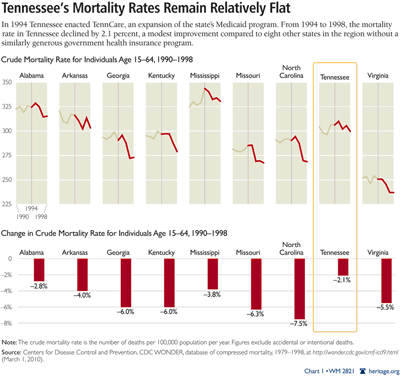
    New <ahref="http://www.heritage.org/Research/HealthCare/wm2821.cfm">research by Heritage’s health fellow Brian Blase presents evidence suggesting that Medicaid expansion would be both costly and do little to improve the health of the uninsured. Blase examines the “TennCare” program, a Tennessee public program enacted in 1994 that dramatically increased the expansion of Medicaid to Tennessee’s uninsured population. The TennCare program quickly added over half a million individuals to Medicaid, enrolling one-fourth of the entire state. And costs also skyrocketed. Per-capita Medicaid spending from 1994-2004 increased by 146 percent in Tennessee, which was over double the national average increase of 71 percent.

    <spanid="more-28249"></span>The most shocking result of Blase’s analysis was not just the increase in costs. It was the apparent lack of improvement in health outcomes in Tennessee in the years following TennCare’s enactment. <ahref="http://www.heritage.org/Research/HealthCare/wm2821.cfm">Blase concluded that, relative to eight surrounding states, the quality of health care in Tennessee actually declined after the expansion of Medicaid. The decline in Tennessee’s mortality rate for 15-64 year olds – those most likely to be impacted by TennCare – compared less favorably after TennCare to the states surrounding Tennessee that before its enactment. On average, the mortality rates of the eight surrounding states to Tennessee declined by 5.2 percent from 1994-1998. Tennessee’s mortality rate declined by only 2.1 percent.

    The lessons learned from TennCare should serve as a warning of what we should expect from a national program of Medicaid expansion. In short, it will be costly and will do little to improve health care quality in the United States. The notion of expanding coverage is meaningless if it does not improve the health of the uninsured. There are seemingly dozens of ways to increase insurance coverage with better results than a vast and costly expansion of Medicaid. Congress should strongly consider the weaknesses of the Tennessee’s experience before they prescribe the nation similar medicine to TennCare.

    Rick Sherwood currently is a member of the Young Leaders Program at the Heritage Foundation. For more information on interning at Heritage, please visit: <ahref="http://www.heritage.org/about/departments/ylp.cfm">http://www.heritage.org/about/departments/ylp.cfm

    http://blog.heritage.org/2010/03/06/…a-think-again/

  • Imagine No God in Our Nation?s Classrooms

    On 03.05.10 03:30 PM posted by Colleen Kaveney

    <ahref="http://blog.heritage.org/wp-content/uploads/InGodWeTrust.jpg"></p>All high school math teacher Bradley Johnson wanted to do was honor our nation’s history and religious heritage the same way he always had. <ahref="http://www.signonsandiego.com/news/2010/mar/02/judge-sides-teacher-god-banners-display/">For twenty five years, a red, white and blue-striped banner adorned his classroom walls with national maxims such as “In God We Trust,” “One Nation Under God, “ “God Bless America,” and “God Shed his Grace On Thee.” A second banner accompanied it, containing an excerpt from the Declaration of Independence, “All Men are Created Equal and They Are Endowed by Their Creator.”

    But displaying a portion of the Declaration of Independence and other national mottos was just too offensive to the Poway Unified School District in San Diego. It ordered Johnson to remove the banners from his classroom because they “over-emphasized” God – one school official said it might “offend” Muslim students. Fortunately, Johnson went to federal court to fight this absurd order (represented by the <ahref="http://www.thomasmore.org/default-sb_thomasmore.html?988880910">Thomas More Law Center), and even more fortunately, given that California is in the 9th Circuit, the most liberal appeals circuit in the nation, a federal judge found on February 26 that the school board’s actions violated Mr. Johnson’s constitutional rights.<spanid="more-28223"></span>

    Judge Roger T. Benitez did not allow the censorship because “it has been clear for over 90 years that teachers do not lose their constitutional rights inside the schoolhouse gate, and that government may not squelch one viewpoint while favoring another.”

    It turned out that the school district allowed teachers to display other posters promoting controversial political issues such as gay rights and global warming, and banners showing other religious preferences such as Tibetan prayer flags, Hindu leader Mahatma Gandhi’s “Seven Social Sins,” and John Lennon and the lyrics of his song “Imagine,” which opens with lyrics about no heaven, no hell, and no religion. The school district just seemed to have a problem with Christian religious and American patriotic sentiments.

    No student, parent or school administrator had ever objected to Johnson’s banners – until January 23, 2007, when the entire school board ordered Johnson to remove the posters which “conveyed a Judeo-Christian viewpoint.”

    Judge Benitez was scathing in his denunciation of the school board, which apparently feared that “students are incapable of dealing with diverse viewpoints that include God’s place in American history and culture.” The fact that “God places prominently in our Nation’s history does not create an Establishment Clause violation requiring curettage and disinfectant for Johnson’s public high school classroom walls.” The board not only failed to comply with the long-standing policy that “a teacher’s classroom walls serve as a limited public forum for a teacher to convey non-curriculum messages,” but also went so far as to silence Johnson’s speech.

    Judge Benitez cracked down on the board’s bias, concluding that “by squelching Johnson’s patriotic and religious viewpoint, while permitting speech promoting Buddhist, Hindu, and anti-religious viewpoints, Defendants clearly abridged Johnson’s constitutional free speech rights.” An “imaginary” Islamic student was “not entitled to a heckler’s veto on a teacher’s passive, popular or unpopular, expression.”

    This is a common-sense decision that hostility towards our nation’s history, its religious heritage, and expressions of patriotism will not be tolerated in our public school classrooms. Hopefully, other school boards around the country will take notice.

    Colleen Kaveney currently is a member of the Young Leaders Program at the Heritage Foundation. For more information on interning at Heritage, please visit: <ahref="http://www.heritage.org/about/departments/ylp.cfm">http://www.heritage.org/about/departments/ylp.cfm

    http://blog.heritage.org/2010/03/05/…ns-classrooms/

  • ICE Student Visa Bust Shows Value of Enforcement

    On 03.05.10 10:00 AM posted by Jena McNeill

    <ahref="http://blog.heritage.org/wp-content/uploads/DHS1.png"></p>Yesterday, 81 international students living in the U.S. on student visas were <ahref="http://www.nytimes.com/2010/03/05/us/05fraud.html?ref=todayspaper">arrested at a Miami language school for repeatedly not showing up for class. No, this wasn’t Senior Skip Day—these students were violating the conditions of their visas which require them to actually go to school here in the U.S. (students must attend class for at least 18 hours a week). Immigration and Customs Enforcement (ICE) for its part took the appropriate steps to stop these students and the school from abusing and defrauding the visa process.

    Student visas are a great public diplomacy tool for the United States–helping to improve America’s image around the world. There is nothing wrong with giving students the opportunity to take advantage of America’s world class high-education system. But at the same time, there are legitimate security concerns surrounding these visas (several of the 9/11 hijackers used student visas). DHS and Congress, recognizing this vulnerability, have addressed this issue head on. The law has been strengthened to require students to be enrolled in a full course of study (among other requirements) and DHS has instituted robust enforcement mechanisms through its Student Exchange Visitors Program.<spanid="more-28165"></span>

    This model demonstrates that the U.S. can maintain a visa process that encourages people to come to the U.S. while also ensuring these visitors are not coming to the U.S. for the wrong reasons. As James Sherk and Diem Nguyen <ahref="http://www.heritage.org/Research/Immigration/bg2190.cfm">describe, other visa categories have a far less successful record. The visa process remains burdensome, bureaucratic, and doesn’t serve the needs of the economy. As a result, illegal immigration gets worse, as employers don’t want to mess with the legal processes. And those who do get a visa often abuse it. Some 50 percent of illegal immigrants inside the U.S. are visa overstays.

    The Obama Administration has pushed for an amnesty-centric immigration reform package in Congress. But as this incident shows, the current immigration system 1) isn’t capable of preventing more people from coming and overstaying their visa, something that will be encouraged if the U.S. moves forward with amnesty, and 2) can’t adequately and efficiently bring people legally in the United States. It* seems like the wrong time to push for legalization of the illegal population. A better approach would be to do something more incremental–put enforcement and border security, as well as improvements in the legal process at the forefront of immigration reform.

    This ICE bust is good news for security and immigration enforcement–its time to look at real reform for other visas.

    http://blog.heritage.org/2010/03/05/…f-enforcement/

  • The Latest Unemployment Report

    On 03.05.10 10:30 AM posted by Rea Hederman

    <ahref="http://blog.heritage.org/wp-content/uploads/2009/10/unemploymentline.gif"></p>The February report showed that, although the labor market is still treading water, there is room for optimism. After all, almost every industry except for construction is either adding jobs or is flat. Job growth in the service sector was positive thanks to health care and temporary services. Manufacturing and retail trade were basically flat over the past month. The economy still shed jobs, but this reduction was the result of steep job cuts in the construction industry, many of which can likely be attributed to last month’s epic blizzards. Overall, the employment picture continues to improve; job creation is occurring in more and more business sectors.

    Another sign of improvement is that, in addition to the continued surge in temporary services, the household survey showed solid employment growth. In the household survey, the number of new jobs created was enough to keep the unemployment rate constant, despite an increase in the labor force. In other words, job creation was equal to the number of new workers in the labor market.<spanid="more-28185"></span>

    While the official unemployment rate was flat at 9.7 percent, the unemployment rate of discouraged workers went from 10.3 percent to 10.4 percent. In the last two months, over 250,000 workers dropped out of the labor force to become “discouraged workers” — the largest two-month increase since the survey’s creation in 1994. This increase in discouraged workers is likely one of the main reasons that the number of workers unemployed by 27 weeks fell by 180,000 last month.

    This report reinforces my prediction that the labor market will turn positive in the spring. However, this coming labor market recovery is likely to be sluggish as job creation numbers remain low — the result of business’s reluctance to add to payroll in the current economic and political climate.

    <ahref="http://corner.nationalreview.com/post/?q=OTYyZDA3MmM2YjFmZmQxNTI3NjJiZjBkYjFjMGY1ZDM=">C ross-posted at <ahref="http://corner.nationalreview.com/">The Corner.

    http://blog.heritage.org/2010/03/05/…oyment-report/

  • The Senate Bill?s Fiscal Madness: Rep. Ryan?s Damning Indictment

    On 03.05.10 11:00 AM posted by Kathryn Nix

    </p>As Heritage analysts have noted <ahref="http://www.heritage.org/Research/HealthCare/wm2498.cfm">time and <ahref="http://budget.house.gov/hearings/2010/01.21.2010_CaprettaTestimony.pdf">again, spending from congressional liberals’ health care proposals would be in the trillions, growing the federal deficit. The President has proposed a modification of the Senate bill with provisions that would make it even more expensive. *At last week’s Health Care Summit, hosted by the White House, <ahref="http://www.washingtonpost.com/wp-dyn/content/article/2010/02/25/AR2010022504074.html">Rep. Paul Ryan (R-WI) echoed these same concerns over the true cost of the <ahref="http://www.heritage.org/Research/HealthCare/wm2816.cfm">President’s proposal for health care reform. Thus far, neither the President nor the leaders of Congress- not one-* have responded to Ryan’s indictment:

    • Budget Gimmicks Galore: “[W]hat has been placed in front of [CBO] is a bill that is full of gimmicks and smoke-and-mirrors…first off, the bill has 10 years of tax increases, about half a trillion dollars, with 10 years of Medicare cuts, about half a trillion dollars, to pay for six years of spending…Now, what’s the true 10-year cost of this bill in 10 years? That’s $2.3 trillion.”
    • Double-Counted Savings: “It takes $52 billion in higher Social Security tax revenues and counts them as offsets. But that’s really reserved for Social Security. So either we’re double-counting them or we don’t intend on paying those Social Security benefits…It takes $72 billion and claims money from the CLASS Act. That’s the long-term care insurance program. It takes the money from premiums that are designed for that benefit and instead counts them as offsets.”* Later, Rep. Ryan went on to point out, “You can’t say that you’re using this money to either extend Medicare solvency and also offset the cost of this new program. That’s double counting.”<spanid="more-28191"></span>
    • Medicare as a Piggy Bank:* “Now, when you take a look at the Medicare cuts, what this bill essentially does — it treats Medicare like a piggy bank. It raids a half a trillion dollars out of Medicare, not to shore up Medicare solvency, but to spend on this new government program…Now, when you take a look at what this does…as much as 20 percent of Medicare’s providers will either go out of business or will have to stop seeing Medicare beneficiaries.”
    • Ignoring the Doc Fix: “…[T]he doc fix, according to your numbers, costs $371 billion. It was in the first iteration of all of these bills, but because it was a big price tag and it made the score look bad, made it look like a deficit, that bill was — that provision was taken out, and it’s been going on in stand-alone legislation. But ignoring these costs does not remove them from the backs of taxpayers. Hiding spending does not reduce spending.”

    Rep. Ryan’s arguments are reinforced by Heritage research regarding <ahref="http://www.heritage.org/Research/HealthCare/wm2756.cfm">the true cost of the House and Senate health bills and <ahref="http://www.cms.hhs.gov/ActuarialStudies/Downloads/S_PPACA_2010-01-08.pdf">other reliable sources.* <ahref="http://online.wsj.com/article/SB10001424052748704548604575097602436388116.html"> As an article in the Wall Street Journal points out, “No one in the political class has even tried to refute Mr. Ryan’s arguments, though he made them directly to the President and his allies, no doubt because they are irrefutable. If Democrats are willing to ignore overwhelming public opposition to Obamacare and pass it anyway, then what’s a trifling dispute over a couple of trillion dollars?”

    The President and congressional Democrats have recently made quite a <ahref="../2010/02/18/a-toothless-commission-on-spending-is-no-substitute-for-true-leadership">show of concern over the sustainability of current levels of federal spending.* Ignoring the fiscal reality of their health proposals questions the seriousness of their intentions to control spending and reduce the federal deficit. The prosecution rests.

    http://blog.heritage.org/2010/03/05/…ng-indictment/

  • The Cartel: The True Nature of Teacher Unions

    On 03.05.10 11:44 AM posted by Sarah Torre

    </p>The problem of continual academic mediocrity that plagues America’s public school system can be laid at the door of union monopolies. That’s the message of <ahref="http://www.thecartelmovie.com/cgi-local/content.cgi">The Cartel, a new documentary that will show <ahref="http://dciff.bside.com/2010/films/thecartel_dciff2010;jsessionid=7CC49570A52232A6EF7 05DCF700F034D">this Sunday at 12 pm at the <ahref="http://www.dciff.org/">Washington, D.C. Independent Film Festival. The film documents the abuses of power exercised by teacher unions, specifically in the state of New Jersey, and the adverse effects such control can have on student achievement and parents’ fight for school choice.

    The movie shows scenes of school buildings with new facades and million-dollar football fields juxtaposed with statistics of failing high schools and abysmal reading proficiency scores across the state. New Jersey is known for its extravagant education funding, currently spending over $350,000 per classroom in some of the state’s worst performing school districts. Why should a state with one of the highest public education budgets in the country boast meager academic achievement? <spanid="more-28204"></span>

    The inability of school districts to fire poorly performing teachers because of union tenure rules, coupled with an expensive and excessive administrative bureaucracy demanded by the same union, leads to an inefficient use of state funds and an ineffective education system. Similarly, when families and communities move to implement voucher programs, teacher unions cry foul, claiming such programs would supposedly drain money from already struggling public schools. What is the motivation for keeping bad teachers in classrooms, wasting millions of taxpayer dollars on renovation projects, and denying families the power of school choice?

    As a principal who was fired for his request to take action against teachers watching pornography while in school, states in the movie:

    You keep quiet if you want this high-paying position; or you take a stance and you’re going to lose your job. And they’ll put your name in the newspaper, which means you’ll never be employed again. Because they play dirty, because there’s so much money involved.

    While the movie investigates the power of teachers unions in New Jersey and demonstrates the negative impact such tactics can have on students, the film’s producer, Bob Bowdon, is quick to show support for teachers who care about educating their students:

    Those good teachers deserve our respect. Wanting lousy teachers out of the classroom doesn’t mean you’re against all teachers. A point so obvious, I can hardly believe it needs to be made. This absurd idea that you have got to support every teacher, or else you hate all teachers, has been an effective myth put forward by the union for years.

    The effects of teachers’ unions on school district governance and student performance is necessary to understanding many of the problems public schools around the country continue to face. Be sure to visit The Cartel website for screenings in the D.C. area and around the country.

    Sarah Torre currently is a member of the Young Leaders Program at the Heritage Foundation. For more information on interning at Heritage, please visit: <ahref="http://www.heritage.org/about/departments/ylp.cfm">http://www.heritage.org/about/departments/ylp.cfm

    http://blog.heritage.org/2010/03/05/…eacher-unions/

  • New Poll, New Result: Americans Support the First Amendment After All

    On 03.05.10 12:00 PM posted by Andrew Odell

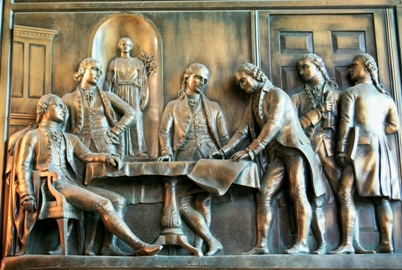
    <ahref="http://blog.heritage.org/wp-content/uploads/founders.jpg"></p>What a difference a question makes. A couple of weeks ago, <ahref="http://blog.heritage.org/2010/02/18/wapo-poll-misrepresents-citizen-united-decision/">we exposed the biased and misleading questions behind a widely-cited <ahref="http://www.washingtonpost.com/wp-dyn/content/article/2010/02/17/AR2010021701151.html">Washington Post poll, which supposedly found broad, bipartisan support for legislative limits on speech following the Supreme Court’s recent decision in the Citizens United case. The Center for Competitive Politics, however, has now released a <ahref="http://www.campaignfreedom.org/newsroom/detail/poll-on-citizens-united-shows-support-for-free-political-speech">poll with dramatically different findings.

    Based on much more accurate and objective questions, the Center’s findings reiterate our call for caution on the part of lawmakers, who appear ready to rush through legislative measures that would curtail the First Amendment rights of free speech and free association.

    <spanid="more-28199"></span>

    The greatest virtue of the Center’s <ahref="http://www.campaignfreedom.org/docLib/20100304_CCPpoll03042010.pdf">poll is its correct representation of the Supreme Court’s decision in Citizens United. The survey began by explaining to those polled that:

    The U.S. Supreme Court recently ruled that incorporated entities—businesses, unions, and nonprofit advocacy groups—have a First Amendment right to spend money from their general treasuries to fund independent advertisements urging people to vote for or against candidates for public office.

    This accurately represents the decision, which merely removed the ban on corporate independent political expenditures.

    Tellingly, when presented with an accurate description of the decision, respondents to the Center’s poll indicated the complete opposite of respondents to the Washington Post poll. For instance, 51.2% of respondents disagreed with the government’s position that it could ban Citizens United from airing ads promoting <ahref="http://www.hillarythemovie.com/">Hillary: The Movie, or that the government could prevent Citizens United from making the movie available on a pay-per-view basis.

    Moreover, 63% opposed the idea that “the government should have the power to limit how much some people speak about politics in order to enhance the voices of others.” And four hypothetical questions about “independent political expenditures by a teachers union, a trade association, an environmental nonprofit, and restaurants” found that a “plurality … supported the First Amendment right” of these organizations to make independent political expenditures.

    Such results call into question the Washington Post’s <ahref="http://www.washingtonpost.com/wp-dyn/content/article/2010/02/17/AR2010021701151.html">contention that “Americans of both parties overwhelmingly oppose” the Citizens United decision, and that a “strong reservoir of bipartisan support” exists for legislative curtailment of the decision. Indeed, the Center’s poll found that only 14.2% thought that McCain-Feingold had successfully reduced the influence of special interests on federal elections, with 44.2% rejecting the proposition. The Center’s data shows that Americans believe in their uninhibited rights to political free speech, and would reject any attempt to again restrict these freedoms.

    Andrew Odell currently is a member of the Young Leaders Program at the Heritage Foundation. For more information on interning at Heritage, please visit: <ahref="http://www.heritage.org/about/departments/ylp.cfm">http://www.heritage.org/about/departments/ylp.cfm

    http://blog.heritage.org/2010/03/05/…ent-after-all/

  • Obama?s Bank Tax ? The Victim is YOU!

    On 03.05.10 12:48 PM posted by Mike Brownfield

    <ahref="http://blog.heritage.org/wp-content/uploads/banktax1.gif"></p>So President Obama wants to slap a tax on banks, but should you really care? Absolutely. Those taxes are going to wind up costing YOU money, whether you’re a customer, a bank employee or an investor, according to the non-partisan Congressional Budget Office (CBO).

    As <ahref="http://blogs.abcnews.com/politicalpunch/2010/03/cbo-warns-obamas-proposed-bank-fee-could-end-up-costing-consumers.html">ABC News reports, the <ahref="http://grassley.senate.gov/about/upload/03-04-Ltr_to_Grassley_on_FCRF.pdf">CBO wrote a letter yesterday to Sen. Chuck Grassley (R-IA) in which it highlighted that the American people will bear the true brunt of the President’s proposal. From the <ahref="http://grassley.senate.gov/about/upload/03-04-Ltr_to_Grassley_on_FCRF.pdf">CBO’s letter:

    [T]he ultimate cost of a tax or fee is not necessarily borne by the entity that writes the check to the government.

    The cost of the proposed fee would ultimately be borne to varying degrees by an institution’s customers, employees, and investors.

    <spanid="more-28225"></span>Customers would probably absorb some of the cost in the form of higher borrowing rates and other charges, although competition from financial institutions not subject to the fee would limit the extent to which the cost could be passed to borrowers. Employees might bear some of the cost by accepting some reduction in their compensation, including income from bonuses, if they did not have better employment opportunities available to them. Investors could bear some of the cost in the form of lower prices of their stock if the fee reduced the institution’s future profits.

    President Obama announced his bank tax during his<ahref="http://www.whitehouse.gov/the-press-office/remarks-president-state-union-address"> State of the Union Address in January and claimed it would be a way to recoup money dished out to banks as part of the Troubled Asset Relief Program bailout. The truth, though, is that those banks already paid-back the bailouts, with interest; the real deadbeat offenders are Freddie Mac, Fannie Mae, Chrysler and General Motors, who have yet to repay their debt. (Take a look at the above chart to see who has repaid – and who hasn’t.)

    The President’s proposal was a not-so-thinly-veiled populist proposal, intended to play to an America disgruntled with government bailouts and those institutions that won government handouts.

    He better brace himself for an America that finds itself even more disgruntled when they realize they’re getting hit with the very tax that was meant to appease them.

    http://blog.heritage.org/2010/03/05/…victim-is-you/

  • Messing Up The FEHBP: More Proof That Americans Can?t Trust Congress With Health Care

    On 03.05.10 01:00 PM posted by Kathryn Nix

    <ahref="http://blog.heritage.org/wp-content/uploads/Pelosi-Reid-1001262.jpg"></p>While Congressional leaders are feverishly plotting to jam the hugely unpopular Senate health bill through the House of Representatives, the moment Speaker Pelosi thinks she has the votes, House liberals are also tinkering around with the Federal Employee Health Benefits Program (FEHBP). This is the program that covers federal workers and retirees; it is a consumer driven program of competing private health plans. Congressional liberals would like to make it look a lot more like Obamacare.

    Historically, the success of the *FEHBP as a consumer-driven and competitive system of private health plans has been largely attributable to its wide range of personal choice, relatively light regulation, and the hands-off approach the Office of Personnel Management(OPM) in its administration. That can change, of course, depending upon who is running the White House.<spanid="more-28208"></span>

    Yet, <ahref="http://www.heritage.org/Research/HealthCare/bg2364.cfm">as we have said before, the powers of OPM are neither limited nor restricted to those which it actively exercises.* OPM does not interfere with the health plans offered in the FEHBP by micromanaging the program or imposing price controls—but that is not to say this must be the case.* In fact, as <ahref="http://www.rollcall.com/news/43716-1.html?type=printer_friendly">Walter Francis outlines in Roll Call, new legislation (H.R.4489) would overturn the current system for something much different.

    This measure is based on the false assumption that FEHBP health plans- all private plans, by the way-spend too much on prescription drugs by contracting with Pharmaceutical Benefits Management firms rather than contracting directly with drug manufacturers. So, basically, the federal government would stop private firms from contracting with each other. **But <ahref="http://www.rollcall.com/news/43716-1.html?type=printer_friendly">Francis points out that the Congressional Budget Office( CBO) has found that the substitute in this case- *government contracting, or in reality, price fixing- *would net no real savings.* In fact, the FEHBP has done as good as or better of a job than any other federal program at containing costs.* Francis argues that FEHBP outperforms original Medicare- a program generating fiscally disastrous debt- and has done for several decades, proving that a consumer-driven market for private health insurance is effective at containing costs and securing consumer satisfaction.

    But the proposed legislation would be disastrous for the FEHBP, undermining both market competition and consumer choice.* <ahref="http://www.rollcall.com/news/43716-1.html?type=printer_friendly">Says Francis:

    The bill would debar CVS Caremark and other firms that combine PBM and pharmacy functions from contracting with any FEHBP plan and would prohibit health-based drug substitution recommendations that did not lower costs. It would also require payment at whatever prices manufacturers charged, would impede the collection and dissemination of information on drug utilization to the Food and Drug Administration and the National Institutes of Health, would have OPM set dispensing fees for FEHBP sales in every pharmacy in America, and would impose an immense array of paperwork burdens on manufacturers, PBMs, and pharmacies.The net effect of these restrictions would be to reduce competition (many PBMs would not or could not bid on FEHBP plan contracts), to raise manufacturer prices to all purchasers including the VA, and in these and other ways to raise prescription drug costs in the FEHBP. OPM, an agency without any competence or expertise in wholesale or retail prescription drug management or in administering national price controls, would administer all these functions.

    Yep. These are the folks who want to micromanage one sixth of the American economy. It is not federal employees and retirees alone who should worry about the impact of this legislation on the FEHBP.* The giant Senate health bill would allow OPM to sponsor select health plans to compete nationwide against private health plans in the newly-created, federally –designed health insurance exchanges.* These government –sponsored plans and the new role of OPM would be very different, and the health insurance markets would be very different <ahref="http://www.heritage.org/Research/HealthCare/bg2364.cfm">instead experiencing the yet-unleashed powers of the OPM.* Given the policies embodied in H.R.4489, the FEHBP would be saddled with a new layer of government regulation, an ominous harbinger for what could come to pass under the Senate bill.

    http://blog.heritage.org/2010/03/05/…h-health-care/

  • Long-term Unemployment Still Too High

    On 03.05.10 01:30 PM posted by Patrick Tyrrell

    <ahref="http://blog.heritage.org/wp-content/uploads/unemployment100224.jpg"></p>The stock market reacted favorably this morning when it was announced that the number of people on payrolls fell by 36,000 in February, better than the 50,000 loss expected by economists. The unemployment rate held steady at 9.7%, also slightly better than expected.

    Another indicator that may have received less attention is the 15-Week unemployment rate—the percent of the labor force that has been unemployed for 15 weeks or longer and is still looking for employment. In December, 2007 this statistic stood at only 1.6%. In February, 2010, it was 363% higher at 5.8%. This, after three “stimulus” bills during the time frame is proof that the idea that we can “<ahref="http://www.nypost.com/p/news/politics/obama_plans_to_spend_our_way_out_Swmgz9e2H5RuGgZuB MaWSI">spend our way out of recession” is for the birds. In fact, after rising the astronomical 363%, the rolls of those unemployed 15 weeks or more has only declined by 147,000 since<ahref="http://stats.bls.gov/web/cpseea12.pdf"> it peaked in November of 2009 at 8 million 976 thousand people looking for work.<spanid="more-28211"></span>

    The longer-term 15-week unemployment rate is most often used to detect the level of economic pain being felt in the economy. Equally important though, this statistic reveals the percent of the workforce whose skills are eroding by not being put to use. People unemployed for 15 weeks or longer are becoming less employable as time goes by. <ahref="http://www.jstor.org/stable/2554901">Skills deteriorate when not put to use. Therefore the chart below is alarming.

    <ahref="http://blog.heritage.org/wp-content/uploads/LTermUnemployed2.gif"></p>“Stimulus Bill” spending crowds out the private sector. There are more government jobs competing with private market jobs and it is not a level playing field. The government jobs are paid by the taxpayers regardless of whether their employers run them prudently because it can operate at a loss indefinitely until the government goes bankrupt and the federal spigot must be turned off. Jane Businesswoman in the private sector though has to remain profitable and compete.

    Another problem with “Stimulus Bill” spending is that many workers hired by the government <ahref="http://www.heritage.org/Research/Labor/bg2158.cfm">are paid Davis Bacon wages, which are artificially high. Therefore fewer workers can be hired, contributing to longer-term unemployment.

    The solution to fighting longer-term unemployment is to put more money in the pockets of small business owners. This can be done through tax cuts such as by:

    • Permanently repealing the Death Tax which keeps business from expanding and growing.
    • The government should provide assurance that small business owners aren’t going to be hit with a per-worker health insurance tax.
    • <ahref="http://www.heritage.org/Research/Taxes/CDA03-02.cfm">The tax on dividends should be abolished so that larger companies can hire with the money they now use to pay higher dividends to shareholders.
    • The corporate tax rate of 15 to 38 percent should be lowered to 15 percent across the board so jobs are no longer lost overseas to other countries that have lower corporate tax rates.

    Until policies such as these see the light of day, it will be nighttime in America—the unemployed will suffer and their skills deteriorate.

    http://blog.heritage.org/2010/03/05/…till-too-high/

  • Sanity Slowly Dawning on White House Detainee Policy

    On 03.05.10 01:42 PM posted by Conn Carroll

    <ahref="http://blog.heritage.org/wp-content/uploads/KSM-100305.jpg"></p>When Attorney General Eric Holder announced that he intended to try Khalid Sheikh Mohammed and five other terrorists* in a civilian court in New York City rather than in a military tribunal, we here at The Heritage Foundation condemned it as <ahref="http://blog.heritage.org/2009/11/19/morning-bell-a-historically-bad-decision/">“A Historically Bad Decision.” It may have taken the Obama administration four months to fully realize just how terrible Holder’s judgment was, but <ahref="http://www.washingtonpost.com/wp-dyn/content/article/2010/03/04/AR2010030405209.html">today’s story from The Washington Post is great news for the rule of law and national security:
    President Obama’s advisers are nearing a recommendation that Khalid Sheik Mohammed, the self-proclaimed mastermind of the Sept. 11, 2001, attacks, be prosecuted in a military tribunal, administration officials said, a step that would reverse Attorney General Eric H. Holder Jr.’s plan to try him in civilian court in New York City.

    <spanid="more-28244"></span>

    The Obama administration should be commended for having the courage to reverse themselves on such a high profile and deeply important policy issue. But today’s announcement is not enough. In order to make the military commission system work, the Obama administration must fully and enthusiastically embrace and promote their legitimacy. The best way for them to do start making this commitment is to give the commissions the full resources that they have lacked, including world-class prosecutors and defense counsel.

    The Obama administration has <ahref="http://blog.heritage.org/2009/02/23/more-detainee-sanity-from-white-house/">matured <ahref="http://blog.heritage.org/2009/02/11/sanity-prevails-at-white-house-on-detainee-treatment/">tremendously on this issue. We sincerely hope they continue to show they have the capacity to transition from their campaign rhetoric to truly protecting the American people.

    http://blog.heritage.org/2010/03/05/…tainee-policy/

  • The President?s Health Plan Won’t Cut the Budget Deficit

    On 03.05.10 02:30 PM posted by James Capretta

    <ahref="http://blog.heritage.org/wp-content/uploads/Obama-Doctors100303.jpg"></p>One of the central arguments President Barack Obama has made on behalf of the health care plan he wants Congress to approve in coming weeks is that it would begin to address the problem of rising costs and thus also begin to bring down future federal budget deficits.

    But will it?

    The president’s plan has not yet been assessed by the Congressional Budget Office. But CBO has provided a cost estimate for the Senate-passed bill, upon which the president’s proposal is built. That estimate shows the Senate bill would reduce the budget deficit by $132 billion through 2019. CBO also says that the Senate bill would likely reduce projected deficits even more during the second decade of implementation.

    But, as Republican Rep. Paul Ryan of Wisconsin noted at last week’s Blair House meeting, there are a number of reasons to be skeptical about this claim.

    For starters, the Senate bill omits the president’s proposal to permanently restore a 21 percent reduction in Medicare’s fees for physician services, now in effect as of March 1. The administration estimates that overriding this cut will cost $371 billion through 2020.<spanid="more-28218"></span> Last summer, the House planned to include a permanent repeal of the cut in its health reform bill. But when the president imposed a 10-year budget of $900 billion on the reform legislation, Democratic leaders decided to pull the physician fee spending out of it and pass it separately.

    The health bill includes scores of Medicare provisions, touching on just about every aspect of the program. The only major Medicare provision not in the bill is the costly “doc fix.” And the only reason for the omission is to make the total cost of the health reform bill appear lower. But passing the “doc fix” in a separate bill doesn’t make the cost go away. When the president’s entire health care agenda, including the “doc fix,” is tallied up, there is no deficit reduction over the next 10 years.

    Ryan noted in his remarks at Blair House that the Senate bill would start up a new long-term care insurance program for the disabled. Participants would be required to pay in premiums for a number of years before becoming eligible for any benefits. Consequently, in the new program’s early years, there would a surplus, which CBO estimates at $73 billion over 10 years. The president’s claim of deficit reduction depends on double-counting these funds, first as an offset for the larger health care bill and then as a revenue source for long-term care insurance benefits beyond the 10-year window of the CBO estimate.

    Over the long run, what matters in terms of the budget in the president’s health plan are the entitlement expansions, the effectiveness of “bending-the-cost-curve” measures, and the tax increases and spending cuts used to pay for broadened insurance coverage.

    CBO expects the cost of the new entitlement spending aimed at coverage expansion in the Senate bill – the premium subsidies in the exchanges and the expansion of Medicaid — to reach about $200 billion by 2019 and then grow at a rate of 8 percent every year thereafter. In other words, this new health entitlement spending is expected to escalate just as rapidly as Medicare and Medicaid have in the past. CBO does not expect the “delivery system reforms” in the Senate bill, which are mainly small initiatives and pilot programs, to amount to much of anything in terms of cost control.

    So how would the president pay for another expensive and rapidly growing entitlement? First, he would try to slow the rate of growth in the Medicare program, but not with new measures to weed out wasteful spending. His claim of long-term deficit reduction comes mainly from across-the-board payment rate reductions for hospitals, nursing homes and other providers of Medicare services. They would get a lower inflation update every year, in perpetuity. But these kinds of cuts do nothing to improve the efficiency of patient care or reward quality.

    The chief actuary of the Medicare program has said repeatedly that these cuts are unrealistic because they would continuously cut reimbursements without touching the actual costs of providing care. He expects many facilities would be driven into serious financial distress. And without these Medicare cuts, the Senate bill is almost certainly a long-term budget buster.

    The Senate bill also includes the so-called “Cadillac tax,” a new fee imposed on insurers and employers offering high-cost plans. As passed, this provision would generate substantial revenue in the second decade of implementation because the threshold for what constitutes “high cost” would rise much more slowly than medical inflation. Eventually, virtually the entire country would be in plans deemed “high cost.”

    The president is relying heavily on the large, second-decade revenue increase associated with this tax for his claim of long-term deficit reduction. But just last week, under heavy pressure from union leaders, the president proposed to delay the tax from 2014 to 2018, well past the point when he will have left office. It will now raise almost nothing over the next 10 years, but the administration still claims credit for the sizeable revenue that would come in a second decade. That revenue would materialize, however, only if future officeholders were more willing than their counterparts today to impose large new taxes on a broad cross-section of the American middle class.

    The federal government is piling up new debt at rates not seen since World War II. As Warren Buffett said recently, what the country desperately needs is a serious plan to slow the pace of rising health care costs.

    What the president’s plan would deliver, however, is dead-certain entitlement spending, financed with speculative revenue and spending cuts that almost certainly will not work as advertised. The president says Congress should pass his plan to improve the budget outlook. In fact, Congress should reject it to protect the budget from more unfunded entitlement obligations.

    Cross-Posted on <ahref="http://www.kaiserhealthnews.org/Columns/2010/March/030510Capretta.aspx">Kaiser Health News

    http://blog.heritage.org/2010/03/05/…udget-deficit/

  • Morning Bell: So, How?s That Pivot to Jobs Going?

    On 03.05.10 06:28 AM posted by Conn Carroll

    Last week President Barack Obama hosted a seven-and-a-half-hour televised health care summit. This week the President launched his “final” campaign for passage of his health care plan. Next week, President Obama will travel to Missouri and Pennsylvania to continue this “final” effort to jam his unpopular plan through Congress. With this all-health-care-all-the-time White House agenda it seems like eons ago that the Obama administration announced, following the complete rejection of its health care plan in the Massachusetts Senate special election,* that President Obama’s first State of the Union would mark a “pivot” from health care and to a “razor sharp focus on jobs”. So how is that pivot to jobs going? Well, the Labor Department’s Bureau of Labor Statistics released its monthly jobs report this morning and it showed the U.S. economy shed another 36,000 net jobs last month. Our nation’s unemployment rate is still at 9.7%.

    So why is our economy having such a tough time pulling out of recession? Here are the facts: the most recent data available show that the U.S. economy actually lost fewer jobs during this recession than were lost during the 2001 recession. Specifically, 50.8 million jobs were lost through the first six months of the ‘01 recession while 48.2 million jobs were lost through the first six months of this recession.

    But if out economy is losing fewer jobs this time, then why is our unemployment rate so much higher under President Obama’s stewardship of the economy? The answer: job creation. Or actually the lack thereof. Back to the BLS data: through the first six quarters of the 2001 recession 47.6 million jobs were created, while only 40.3 million jobs have been created through the second quarter of 2009. That’s a 7.9 million jobs gap. The reason our unemployment rate is so much higher now is low job creation, not high job loss. So why aren’t businesses creating jobs? Here is what entrepreneurs have been trying to tell the Obama administration:

    • At one of President Obama’s many jobs summits, Fred Lampropoulos told The New York Times that businesses were uncertain about investment because “there’s such an aggressive legislative agenda that businesspeople don’t really know what they ought to do.” That uncertainty, he added, “is really what’s holding back the jobs.”
    • Dan DiMicco, CEO of steelmaker Nucor Corp,* told the Wall Street Journal: “Companies large and small are saying, ‘I am not going to do anything until these things — health care, climate legislation — go away or are resolved.’”
    • Porta-King CEO Steve Schulte told USA Today his company is not investing because “proposals in Congress to tackle climate change and overhaul health care would raise costs.”
    • The New York Post’s Charles Gasparino reported on the 600 companies stock analyst Peter Sidoti covers: “‘There hasn’t been one bankruptcy,’ he tells me. How did they survive the recession? By cutting costs and hoarding cash, not expanding their business and hiring more people, even as the economy now is starting to recover. During other recoveries, Sidoti says, firms like these would be hiring workers in droves as demand picks up for goods and services. This time around, they’re not — because ‘they don’t know what their costs are going to be.’”
    • National Federation of Independent Business chief economist Bill Dunkelberg writes: “The horizon is filled with cost unknowns, from healthcare to cap and trade to yawning deficits and the need to come to grips with them, from paid family and medical leave to card check, from expiration of the Bush tax cuts to state decisions about their finances. Washington cannot expect small business owners, facing difficult economic circumstances anyway, to commit themselves to investing in new employees or equipment and vehicles without acknowledging and revealing the policy-inspired costs that will be imposed on them. It is all about uncertainty and confidence.”

    Our economy’s job creators have been trying to send a message to the Obama administration for months: stop creating so much uncertainty in the tax and regulatory environment so that we can figure out how to invest our money and start creating jobs. Stop taking over car companies. Stop shedding financing contracts. Stop taking over 1/6th of our economy. Stop raising taxes on our energy sector. Just stop.

    Our economy will eventually recover and start producing jobs again, probably very soon. But that recovery has already been delayed by an administration that saw this recession as an opportunity to fundamentally rewrite our nation’s relationship with the federal government. Unless this administration completely abandons its far reaching transformation agenda, this recovery will be a very slow one.
    Quick Hits:

    • White House aides are telling The Washington Post the Obama administration is close to reversing Attorney General Eric Holder and will try Khalid Sheik Mohammed in a military tribunal.
    • Speaker Nancy Pelosi (D-CA) lost another two votes on Obamacare yesterday when Rep. Nathan Deal (R-GA) announced he would delay his retirement till the end of the month and Rep. Kurt Schrader’s (D-OR) office moved said Schrader has moved from “yes” to undecided.
    • President Barack Obama reportedly told House progressives that the Senate health care bill was a “foundation” for the public option.
    • According to Rasmussen Reports, 66% of American voters say they prefer a government with fewer services and lower taxes.
    • The Obama administration is pushing to carve out an exemption for China from legislation pending in the Senate and the House that would tighten sanctions on Iran.

    http://blog.heritage.org/2010/03/05/…to-jobs-going/

  • A Bag Idea: DC’s Newest Tax Hurts Businesses, Consumers

    On 03.05.10 07:00 AM posted by Patrick Tyrrell

    DC lawmakers tried to sugarcoat the five cent per bag tax on store bought items, calling it a fee rather than a tax. The tax has been in effect in the District of Columbia since New Year’s Day. Stories in the Washington Post, the Wall Street Journal, and other media have reported of widespread disaffection with the tax among people in DC. The lawmakers behind the tax surely do not understand economics. Furthermore, the legalese used to draft the law would provoke laughter if it was not so deserving of condemnation.

    Consumers must pay five cents per bag on any item bought in a store that sells food. The founders of this great country would question the logic to the law because it makes no sense. For the infraction of stepping foot in our Nation’s Capitol, and having the gall to buy something, you must pay to clean up the Anacostia River. Furthermore business owners are prohibited by law from paying the tax for you. It would only make sense to a person who sees all economic activity as an opportunity to siphon off money for the nanny state.

    The problems with the tax are many.

    • People are shopping in Virginia and Maryland for their groceries instead of DC and are being inconvenienced.
    • Small, irrational taxes such as this one often start off small, but grow larger and are never retired. If the Anacostia River was to become a pristine nature preserve, this tax would not disappear if history is any indication.
    • Many stores sell a small amount of food but mostly non-food items. They are being encouraged to end the food side of their enterprise, or hurt their business. This is an affront to their freedom to transact as they choose.
    • The DC Council member, Tommy Wells, who sponsored the bill apparently doesn’t understand that he is injecting himself in between every private-market food sales transaction in the city. The business owners have every right to have a bone to pick with him as he is alienating their customers. Wells though said, “I have not heard it being a hardship on retail establishments. There has been some customer concerns, but it seems since the fee is charged to the customer and not the business, that really doesn’t make any sense.”
    • Then, there are the true victims of the tax, the Washington DC local grocery store, and restaurant owners, and the poorer residents of DC who can travel less easily to nearby states to shop. The grocery store owners and fast food franchisees in DC are entrepreneurs who run their own businesses in a country where they are free to do so. Now the DC government is piling on one more regulation in an already tangled pile of regulations onto the backs of the DC entrepreneurs. It’s too much.

    The biggest losers as a result of the tax, if not the business owners who may have to close up shop, are the poorer residents of DC. To them the dollars they spend on grocery bags that used to be free really add up. And what are they getting in return for it? Only the promise to clean a river that they did not ask to clean. It is not them, after all, who polluted the river. If people want to clean the river, let them start their own non-profit organization and get those who believe in the cause to go at it or try to find the real polluters of the stream who are not local grocers or people without automobiles.

    Here is the onerous wording of the tax itself:

    Sec. 4. Establishment of fee.

    (a)(1) A consumer making a purchase from a retail establishment shall pay at the time of purchase a fee of $.05 for each disposable carryout bag.

    (2) A retail establishment shall not advertise or hold out or state to the public or to a customer directly or indirectly that the reimbursement of the fee or any part thereof to be collected by the retail establishment will be assumed or absorbed by the retail establishment or otherwise refunded to the customer.

    (3) All retail establishments shall indicate on the consumer transaction receipt the number of disposable carryout bags provided and the total amount of fee charged.

    (b)(1) (A) Each retail establishment shall retain $.01 of each $.05 fee collected; provided, that an establishment that chooses to offer a carryout bag credit program to its customers, as set forth in subparagraph (B) of this paragraph, shall retain an additional $.01 from each fee collected, for a total of $.02 for each $.05 fee collected.

    (B) A retail establishment shall retain an additional $.01 of each $.05 fee for a carryout program which:

    (i) Credits the consumer no less than $.05 for each carryout bag provided by the consumer for packaging their purchases, regardless of whether that bag is paper, plastic, or reusable;

    (ii) Is prominently advertised at each checkout register; and

    (iii) Reflects the total credit amount on the consumer transaction receipt.

    (C) The fees retained by the retail establishment under this paragraph shall not be classified as revenue and shall be tax-exempt for the purposes of Chapters 18, 20, and 27B of Title 47 of the District of Columbia Official Code.

    (D) The fees retained by the retail establishment shall be excluded from the definition of retail sale under D.C. Official Code § 47-2001(n)(2) and from the definition of gross receipts under D.C. Official Code § 47-2761(5).

    (E) The fees to be remitted to the District under subsection (b)(2) of this section shall be added to other tax payments in determining whether the electronic payment requirement under D.C. Official Code § 47-4402(c) applies.

    (2) The remaining amount of each fee collected shall be paid to the Office of Tax and Revenue and shall be deposited in the Anacostia River Cleanup and Protection Fund established by section 6(a).

    (c) The Office of Tax and Revenue shall develop rules for frequency and method for reporting and transmitting the fees, as set forth in subsection (a) of this section, to the District.

    (d) Except to the extent of any inconsistency with this act, the same provisions to Title 47 of the District of Columbia Official Code that are applicable to the gross sales tax shall govern the administration, collection, and enforcement of the fee set forth in subsection (a) of this section.

    http://blog.heritage.org/2010/03/05/…ses-consumers/

  • Senate Rejects Spending Caps, and Reality

    On 03.05.10 07:17 AM posted by Dan Holler

    Senator Daniel Inouye (D-HI), chairman of the Appropriations Committee, took to the floor yesterday to protest an effort led by Senators Jeff Sessions (R-AL) and Claire McCaskill (D-MO) to place a relatively modest cap on discretionary spending. Before raising a budget point of order (which requires 60 votes to overcome), Chairman Inouye made two interesting arguments against the measure.

    First, he argued that the cap on discretionary spending would allow entitlement programs to continue their unabated growth. The chairman is, of course, correct. However, he is most certainly aware that over the past three years, discretionary, non-emergency spending has increased nearly 25%. If Sessions-McCaskill had been in place three years ago, the taxpayers could have saved $165 billion. And, as Senator McCaskill kindly pointed out, the caps mirror President Obama’s budget request.

    Second, the chairman suggested a Congressional spending cap would preempt the President’s debt commission. Earlier this year, my Heritage colleague Stuart Butler suggested that an executive commission “would merely remove pressure on Congress or the President to take action.”

    Inouye’s desire to punt on tough issues and place responsibility in the hands others is one reason why Americans are so frustrated with Washington. Last month, Rasmussen found that 83% of Americans believe Congress’s “unwillingness to reduce government spending” is to blame for our exploding debt. At this point, Congress is clearly incapable of handling these complex issues and the presence of a faux-commission only serves as a scapegoat for inaction.

    Fortunately, there is a silver lining. On January 28, only 56 Senators voted for an earlier version of the Sessions-McCaskill spending caps. This time around, 59 Senators vote for a slightly revised proposal. Senators Thad Cochran (R-MS) and Maria Cantwell (D-WA) switched from Nay to Yea votes and new Senator Scott Brown (R-MA) supported the measure.

    Incredibly, Senator Patrick Leahy (D-VT), who is also an appropriator, actually changed his position during the roll call vote. He initially voted Yea, which would have given the measure the necessary 60 votes in support. However, at some point before the vote was finalized, he changed his vote to Nay resulting in failure for the spending caps.

    Congress has a terminal spending addiction, and spending caps are a good first step to curing that addiction. Time will tell if they are willing to take that step, and more. The American people will certainly be watching.

    http://blog.heritage.org/2010/03/05/…s-and-reality/