Author: Heritage

  • Iran Looms Large at Lula-Clinton Meeting

    On 03.03.10 09:03 AM posted by Ray Walser

    On the fourth leg of her Latin American trip, Secretary of State Hillary Clinton meets with Brazil’s President Lula da Silva **He presides over a Brazil that is rising in confidence, economic power, and global influence but myopic in its treatment of Iran.

    The Secretary will have to make a strong pitch to convince President Lula da Silva to be wary of the budding Iran-Brazil connection which might produce sanctions-evading financial ties and cooperation to develop Iran’s nuclear potential.** The Secretary’s message is: “with influence comes responsibility.”

    Thus far the Brazilian stance on Iran has not been helpful. *Brazil’s foreign minister Celso Anorim recently announced he doesn’t believe sanctions will be effective.* Lula apparently sees sanctions as a path to military force and ardently believes his country’s transition to democracy and its peaceful nuclear program in threat-free South America will carry weight with insecure zealots in volatile Iran.

    Brazil’s diplomatic stance on Iran reflects classic Latin American traits: non-intervention, endless dialogue, misplaced neutrality, and a deep distrust of American leadership.

    Unquestionably a democrat at home, Lula appears to loose sight of these values when dealing with Iran and other nations like Cuba and Venezuela. **Insightful critics like Foreign Policy’s editor Moises Naim ask why a man who was once jailed by Brazil’s military regime as a labor and democracy activist can as president side with the jailers and oppressors of Iran.

    Although an uphill struggle, Secretary of State Clinton needs to make it clear to Lula that the volatile combination of a budding military dictatorship, theocratic repression, support for terrorism, and nuclear weapons ambitions make Iran the most imminent threat to world peace in 2010.

    http://blog.heritage.org/2010/03/03/…inton-meeting/

  • $7-A-Gallon Gas Needed to Meet Government’s CO2 Cuts

    On 03.03.10 09:08 AM posted by Nick Loris

    As the national average of gasoline creeps to three dollars a gallon, economists are warning that high gas prices in the United States could slow the economic recovery. Other countries’ economies are recovering more quickly and increased production and activity is putting upward pressure on oil prices. That coupled with a relatively weak US dollar spells trouble for American drivers. Throw in carbon dioxide cuts and gasoline prices could reach unprecedented levels:

    To meet the Obama administration’s targets for cutting greenhouse gas emissions, some researchers say, Americans may have to experience a sobering reality: gas at $7 a gallon. To reduce carbon dioxide emissions in the transportation sector 14 percent from 2005 levels by 2020, the cost of driving must simply increase, according to a forthcoming report by researchers at Harvard’s Belfer Center for Science and International Affairs. The 14 percent target was set in the Environmental Protection Agency’s budget for fiscal 2010.”

    If you think it’s out of the question, it’s not. Members of Congress are working with oil companies now to levy a carbon fee on the transportation sector: “Key senators are weighing a request from Big Oil to levy a carbon fee on the industry rather than wrap it into a sweeping cap-and-trade system that covers most of the U.S. economy. If accepted, the approach — supported by ConocoPhillips, BP America and Exxon Mobil Corp. — could rearrange the politics of the Senate climate debate and potentially open up votes that may not be there otherwise.”

    Such an approach would do nothing but cause more economic pain for American households. Higher gas prices lower employment, income, and spending, and Americans will have to dip into their savings to pay for higher gas prices. Heritage economist Karen Campbell details these effects in her paper, “How Rising Gas Prices Hurt American Households.”

    Furthermore, a carbon fee would do very little to reduce CO2 emissions. As Senior Policy Analyst Ben Lieberman points out, gasoline prices have already reached these levels in Western Europe where nations have made commitments to cut CO2, yet we are outperforming them in terms of emissions reductions.

    Higher fuel prices adversely affect just about every aspect of the economy. Food prices, for instance, will increase as it costs more to harvest, manufacture and transport food. And as the price of airline tickets rise, people will travel less. It may be easier to support these policies when public transportation is readily available – although the cost of public transportation will rise as well. However, many parts of the country do not have access to public transportation and have to drive a significant distance just to get to a grocery store.

    Indeed, the rural, poorer areas will be hit hardest by a spike in gasoline prices as residents in these areas spend a larger percentage of their income on fuel. When gasoline prices passed the $4-per-gallon mark, Fred Rozell, pricing director at a fuel analysis firm said, “This crisis really impacts those who are at the economic margins of society, mostly in the rural areas and particularly parts of the Southeast. These are people who have to decide between food and transportation.” This map provided by the New York Times shows the percentage of income spent on gasoline throughout the country.

    A targeted approach to reduce carbon dioxide emissions will give us the same results as a cap and trade system: Lots of economic pain for negligible reductions in emissions.

    http://blog.heritage.org/2010/03/03/…%99s-co2-cuts/

  • Guest Blogger: Rep. Henry Cuellar (D-TX) on Free Trade

    On 03.03.10 10:12 AM posted by Rep. Henry Cuellar

    For two decades, the word “trade” has been a dividing force in Congress.

    Its supporters, like me, see trade as a boon to our economy. As the free leader of the world, the U.S. is also one of the largest trading nations, supporting millions of American workers and millions of American jobs.

    Increased trade is good for America. In the past decade, U.S. exports have nearly doubled to $2 trillion a year. More exports from the U.S. can increase production of American-made products, spurring and stabilizing local jobs while supporting small business and increasing consumer choice.

    In my home state of Texas, over 20,000 small and medium-size businesses rely on exporting goods and 1 in 5 manufacturing jobs relies on trade.

    Along the southern border, Laredo, Texas, the nation’s largest inland trade post and 6th largest trade port, has experienced a stabilizing effect in local unemployment, in large part due to trade. While national unemployment hovers at or near 10%, Laredo’s unemployment has remained steady at 8.6% despite a 30% poverty rate.
    Everyday, $1 billion is generated in trade between the United States and Mexico, with 10,000 trucks crossing Laredo’s border every 24 hours. American goods are exported to Mexico as important Mexican goods move into the United States.

    Trade like this helps keep our food prices down. America exported more than $100 billion worth of agriculture products in 2009, supporting a $30 billion agriculture trade surplus here at home.

    In a time of rising deficits and widespread unemployment, trade continues to generate revenues and jobs for the United States. These are revenues that we’d otherwise have to make up with widespread tax hikes or with jobs we’d struggle to recreate.

    This week, President Obama released his annual trade policy agenda and I applaud the President for recognizing that increasing exports has the potential to create 2 million jobs in the next 5 years. However, more can and should be done. That’s why I support implementing three important free trade agreements with Panama, Colombia and Korea.

    The economic opportunities from passing these FTAs will spark new heat in the nation’s economic engine.

    To pass these and other future trade agreements, both sides of the aisle must come together and forge a consensus putting the American economy first.
    That’s why I’ve formed a bi-partisan Pro-Trade Caucus in Congress dedicated to building a bi-partisan coalition to advance an international trade policy that keeps America competitive. By leveling the playing field with 21st Century trade deals, we increase American exports abroad and spur job creation here at home.
    There’s a growing global market share waiting for the U.S. to grab a hold. And there’s no time, nor good reason, to wait.

    (Congressman Henry Cuellar (TX-28) is currently serving his third term in Congress. In 2009, he founded the Pro-Trade Caucus to help advance bipartisan efforts to expand American trade. As a native to Laredo, Texas, Congressman Cuellar has been a long-time advocate for trade and represents the nation’s largest inland trade post. He also serves as the House Homeland Subcommittee Chairman on Border, Maritime and Global Counterterrorism.)

    The views expressed by guest bloggers on the Foundry do not necessarily reflect the views of the Heritage Foundation.

    http://blog.heritage.org/2010/03/03/…on-free-trade/

  • The Truth about Rising Health Insurance Premiums

    On 03.03.10 11:00 AM posted by Kathryn Nix

    Congress and its allies on the left are hell bent to overhaul the health care of every American. They have focused strongly on increasing regulation of insurance companies. They get the most of the blame for increasing premiums and skyrocketing health spending.* Though certain targeted and technical reforms of the health insurance market are sorely needed, making insurers the scapegoat for out-of-control costs in our current health system misses the point.

    Recent premium increases in health plans offered by Anthem Blue Cross in California have attracted federal scrutiny of insurers, but experts attribute increases to external factors beyond the control of insurance companies.* New state mandated benefits increase the minimum level of coverage an individual can purchase.* As Americans embrace frugality in response to high unemployment and economic hardship, many choose to forego health insurance, especially among younger and healthier populations.* Removing these individuals from insurance risk pools leaves behind a greater concentration of sick and costly patients, so that insurers have little choice but to increase premiums in order to maintain solvency.

    In a recent briefing paper, Milliman lies out the internal factors which affect premium costs.* Rates are set according to actual claims and “benefit cost trend”, which reflects the future cost of benefits.* Affecting benefit cost trend are factors such as medical inflation, provider contracts, use of services, mix and intensity of services, and cost-sharing.* Of further consequence are changes in member characteristics, as mentioned above, and administrative costs and taxes.* Insurer profits account for a small fraction of the factors behind increasing costs.

    A study recently published in Health Affairs describes the evermore prevalent effect of increasing provider rates in California.* Robert A. Berenson et al. explain how demand in the insurance market for greater provider choice has given providers greater clout in negotiations with insurers, allowing them to increase their rates.** The formation of accountable care organizations, consisting of multi-specialty groups of providers collaborating to offer efficient and better quality care to their patients, largely accounts for this.

    The mission of accountable care organizations is honorable; however, the effect these provider groups have on rising premiums could negate the benefits of their creation.* According to Berenson et al., “If accountable care organizations lead to more integrated provider groups that are able to exert market power in negotiations—both by encouraging providers to join organizations and by expanding the proportion of patients for whom provider groups can negotiate rates—private insurers could wind up paying more, even if care is delivered more efficiently.”

    In order to address rising costs in health care and the subsequent rises in premiums, Berenson et al. suggest that if the market cannot be altered to discipline providers, the government should impose price controls on insurers and providers both.* This profoundly flawed tactic is reflected in the President’s recent proposal for health care reform, which would require a “Health Insurance Rate Authority” to regulate premium increases.* This approach is doomed to failure, not only due to very nature of price controls, which is the most recurrent economic policy failure in history, and a guarantor of shortages and related miseries, but also because it fails to acknowledge that other factors contribute to the problem of increasing premiums. Milliman warns that “Simplistically limiting premiums rate increases to some predetermined inflation index fails to recognize the fundamental elements involved in setting health insurance rates, and would likely have severe consequences within a short period of time.”

    According to Berenson et al. “The shift in who holds the upper hand in negotiating payments—once held by health insurance plans but now resting with health care providers—has had a major impact on California premium trends”.* To reverse this game of tug-of-war, the “upper hand” must be given to the consumer.* In order for the market to adequately respond to the laws of supply and demand, patients must own and control their own care.* Only when patients are put in charge of the flow of dollars spent on health care can a just equilibrium be achieved.* Insurance price controls that do not take into account all drivers of increasing cost cannot possibly achieve this.

    http://blog.heritage.org/2010/03/03/…ance-premiums/

  • Obama’s Mercantilist Approach to Trade

    On 03.03.10 12:00 PM posted by Terry Miller

    The Obama Administration’s 2010 Trade Agenda, unveiled March 1, is a radical departure from traditional American economic policy and values. It abandons not just the 65 years of trade liberalization on which American and world economic prosperity has been built since the end of World War II, but attempts to turn the economic clock back to the 17th Century and the mercantilist theories that predate Adam Smith.

    Mercantilists viewed the world’s economic production in static terms. Mercantile theory exalted exports and a positive trade balance. Prosperity was defined by the acquisition of wealth in the form of bullion. Think Ebenezer Scrooge hoarding his pile of coins. Better yet, think China and its two trillion dollars of reserves built from trade surpluses. Bizarrely, this seems to be the model embraced by the Obama Administration.

    We first heard Obama’s mercantilist approach in the State of the Union address. He called for greater exports, a “doubling” over five years. He proposed a National Export Initiative “to help farmers and small businesses increase their exports.” That’s policy code for export subsidies. He called for greater enforcement of trade agreements. That’s policy code for protectionism. He even identified China as a country for the U.S. to emulate in revamping our economy. No matter that Chinese incomes are only about one-tenth of average incomes in the United States. No matter that the Chinese who produce the goods we enjoy can’t buy them for themselves because of their government’s desire to build a massive trade surplus.

    The logic of export promotion actually requires the reduction of consumption at home. Reducing the ability of Americans to buy and consume goods and services may seem like an odd policy platform for a democratically-elected leader like Mr. Obama, but this is what he explicitly endorses in his 2010 Trade Agenda, which calls on the United States “to slow the rate of consumption growth.”

    The 2010 Trade Agenda is a recipe for economic failure and stagnation. Much of the focus is on enforcing rules to restrict other countries’ access to the U.S. market. It’s a begger-thy-neighbor approach in which we would sell more to other countries while restricting their ability to sell to us. Such a model is unsustainable internationally: not every country can run a trade surplus. Even worse, it would destroy America’s own economic dynamism. An export promotion strategy may bring quick benefits to a particular firm or business sector, but the price is paid by American taxpayers, consumers, and the businesses and sectors that don’t enjoy government protection or subsidies. For the U.S. economy as a whole, the result is lower productivity, fewer jobs, and slower growth.

    One of the most basic lessons of economics, indeed the foundational lesson of economics, is that specialization and voluntary trade produce benefits for all parties to the exchange. It doesn’t matter whether you’re buying or selling. President Obama seems to have missed that lesson.

    Trade policy needs to be about promoting freer trade, both exports and imports. Americans benefit from selling their produce abroad, but they also benefit by buying goods produced abroad. Even on the job front, millions of Americans are employed in transportation and retail activities that involve bringing imported goods to American consumers. An export-focused trade policy such as proposed by the President in the 2010 Trade Agenda, puts their jobs at risk in the service of politically connected special interests.

    The 2010 Trade Agenda may be written as if it is championing America against other countries. In reality, it is championing some Americans (those who want government help in the form of tariffs, quotas, or subsidies) against other Americans (those who would like to purchase the best products at the cheapest prices no matter where they are made). In other words, it is politics as usual in a government controlled economy, picking winners and losers based on political influence rather than entrepreneurial ability or effort. That has not traditionally been the American way.

    America came into being as a nation at about the same time as western civilization developed its modern understanding of the ways of creating the wealth of nations. Indeed, the American experiment has been one of economic activity blossoming in an environment that guaranteed maximum and expanding liberty for individuals to pursue whatever activity they desired, buying and selling freely, maximizing gains from trade in a continental American free market.

    In the 20th Century, the American model took hold throughout the world, to the benefit of all humankind. That model is being challenged in the 21st Century, and the challenge, surprisingly, is coming in the United States itself. Whether we hold true to our founding principles of individualism and economic liberty, or acquiesce to the lure of collectivism and state control, will define what it means to be an American in the decades ahead. The President’s Trade Agenda is a step in the wrong direction.

    http://blog.heritage.org/2010/03/03/…oach-to-trade/

  • In Pictures: The Obama and Pelosi Job Gaps

    On 03.03.10 01:00 PM posted by Conn Carroll

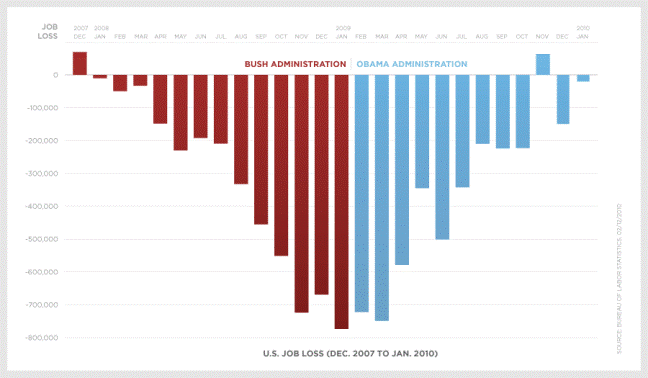
    There are a lot of ways to measure job growth in America, some more accurate than others. Organizing for America (the political arm of the Democratic National Committee) created a chart to “celebrate” the first anniversary of President Barack Obama’s Failed Stimulus. Their chart attempted to cover up the fact that President Obama’s stimulus was a giant failure and came up 9 million jobs short of the number of jobs he promised to create by 2010.

    Well, Matthias Shapiro of 10000Pennies video fame created his own jobs graph showing just how great Speaker Nancy Pelosi’s (D-CA) economic stewardship has been for the American people. It shows how jobs have plummetted under her leadership:


    There are a couple of things we at Heritage would have done differently if we had created the above graphic (for example, Matthias uses the Labor Department’s Table A-1 seasonally adjusted total employed number for his benchmark, while Heritage uses the Table B-1 seasonally adjusted total nonfarm payroll number for our benchmark), but it still does a great job countering the Organizing for America graph below:

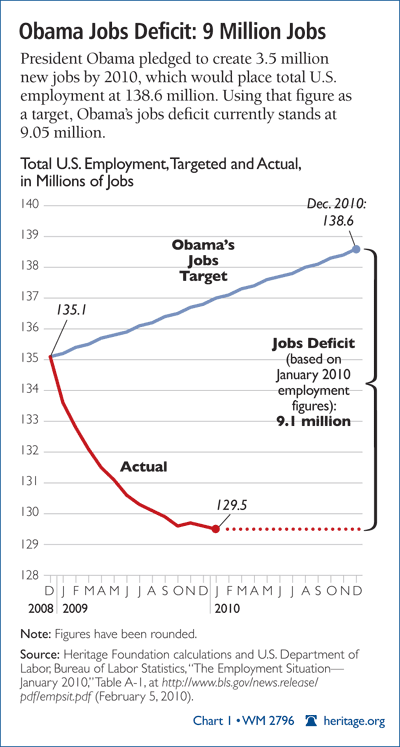
    When holding the Obama administration accountable for their $862 billion stimulus, the key is to remember what the White House promised to deliver when they were selling the plan to the American people, and then compare that to what the objective results have been.

    When the Obama administration first unveiled their stimulus plan in November 2008, they claimed it would create 2.5 million jobs by the end of 2010. At the time, BLS reported that the U.S. economy had about 136.1 million jobs. But by January 2009, that number fell to 134.6 million jobs. Not so coincidentally, the Obama administration upped the job-creating magic of the stimulus to 4 million jobs by the end of 2010. Putting these numbers together, we can create an objective standard to judge both the President and his stimulus by: 136.1 million plus 2.5 million equals 138.6 million, and 134.6 million plus 4 million equals 138.6 million. So the objective, Obama-administration-created, BLS-data-verifiable, jobs-accountability number is 138.6 million.

    According to the most recent BLS jobs report, the U.S. economy currently employs 129.5 million people, thus leaving President Obama’s failed stimulus 9 million jobs short of what was promised to the American people. This is the true picture of his stimulus:

    http://blog.heritage.org/2010/03/03/…losi-job-gaps/

  • All Rhetoric, No Reality from White House on Health Care

    On 03.03.10 01:29 PM posted by Conn Carroll

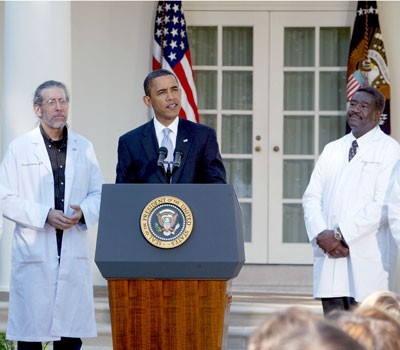
    Flanked, again, by doctors in lab coats, President Barack Obama gave yet another speech this afternoon urging Congress to pass his health care reform plan.

    The President again claimed his plan lowers health care costs. It doesn’t.

    The President again claimed his plan would not give government bureaucrats or insurance company bureaucrats more control over health care. It does.

    The President again claimed that “if you like your plan, you can keep your plan. If you like your doctor, you can keep your doctor.” That simply is not true.

    The President again said his plan gives the American people the same health care as Members of Congress. It doesn’t.

    The President again claimed his plan is paid for. It is not.

    The only “new” wrinkle in this speech was President Obama much telegraphed call for “an up or down vote” on health care reform. Again the White House is completely out of touch with reality. The Senate has already passed Obamacare. It is currently sitting ready for a vote in the House of Representatives. The House could pass Obamacare into law by an up-or-down/simple-majority vote tomorrow if they so desired.

    But the simple reality is that they don’t have the votes. The House may be controlled by an overwhelming Democratic super majority, but the Obama administration simply does not have the 50% plus one votes they need to turn their top domestic priority into law.

    Now the President is claiming he has some new plan that he all of a sudden wants a brand new vote on in the Senate. But that is not going to happen any time soon. President Obama says he is open to four specific conservative ideas, but the White House has produced no details or even legislative language for this new plan. And even if the White House ever does produce such language, it would then have to go to the Congressional Budget Office for scoring.

    More importantly, simply adding so-called conservative ideas to the bill does not change the fundamental direction of the proposal. The bills before Congress, including the President’s new additions, would still result in a massive shift of power over health care financing and delivery of care to Washington politicians and bureaucrats. The public has spoken, and it does not want a federal take over of health care.

    Conservatives should continue to press the Administration and leaders in Congress for bipartisan solutions that are based on elements of common ground, including letting states take the lead on health reform, tackling the tax treatment of health insurance, sensible insurance market reforms, and an honest commitment to fixing existing health care programs that the government already controls.

    http://blog.heritage.org/2010/03/03/…n-health-care/

  • Morning Bell: No Votes Until the People Speak

    On 03.03.10 06:48 AM posted by Conn Carroll

    On March 5th of last year, firefighter Travis Ulerick, of Dublin, Indiana, introduced President Barack Obama at a White House summit on health care. Upon hearing the first rumblings of dissent about the President’s plan, Ulerick tells <ahref="http://www.usatoday.com/news/washington/2010-03-02-healthcare_N.htm">USA Today he thought at the time: “I definitely think it’s going to have to be a huge consensus.” It’s now 12 months later, and the only consensus that exists among the American people is <ahref="http://www.pollster.com/polls/us/healthplan.php">strong opposition to the President’s health care plan.The White House, however, is now completely uninterested in establishing a consensus for their health care plan before they jam it through Congress. Today, in a speech from the White House, President Barack Obama <ahref="http://www.bloomberg.com/apps/news?pid=20601103&sid=aoFq2kdI8ESI">will urge Congress to move swiftly to pass his health care plan by implementing a legislative tactic that can be used to pass legislation that has failed to gain broad support among the American people. It’s known as*<ahref="http://blog.heritage.org/2010/02/19/health-care-nuclear-option-%E2%80%93-liberals-ready-to-launch/">reconciliation.

    Reconciliation has been used in the past, <ahref="http://article.nationalreview.com/426612/unprecedented/michael-g-franc">but only for procedural reasons, not because the underlying policy change was unable to muster 60-vote support. So, for example, the 1996 welfare reform law signed by President Bill Clinton was passed through reconciliation, but it also ended up getting 78 votes in the Senate (28 of them from Democrats). President Ronald Reagan also passed seven bills through reconciliation, but every single one of those bills passed through a Democratically-controlled House and won Senate votes from both parties. Never has reconciliation been used to pass any bill on purely partisan lines.<spanid="more-27858"></span>

    In an attempt to provide some political cover for his nakedly-partisan health care push, President Obama released a <ahref="http://abcnews.go.com/images/Politics/Obama_Letter_to_Leaders.pdf">letter yesterday identifying “four policy priorities” that “I am exploring.” Specifically he is “open” to: 1) random undercover investigations of health care providers that receive reimbursements from Medicare and Medicaid; 2) $50 million in cash for states that reform medical malpractice laws in ways the White House approves of; 3) increased spending on Medicaid; and 4) language that clearly allows Health Savings Accounts (HSAs) to qualify as health insurance.

    The White House has not yet released any legislative language for any of these “policy priorities.” In fact, his letter does not even promise that whatever legislation the White House does eventually offer will contain language on each of these issues. He only says he is “exploring” the issues. This is beyond a sham of bipartisanship. Details matter. The American people must be allowed to see real legislative language and they must be allowed the time to read and comment on it before any votes are taken.

    Most importantly, simply adding so-called conservative ideas to the bill does not change the fundamental direction of the proposal. The bills before Congress, including the President’s new additions, would still result in a massive shift of power over health care financing and delivery of care to Washington politicians and bureaucrats. The public has spoken, and it does not want a federal take over of health care.

    Julia Denton of Yorktown, Virginia, another of the Obama administration’s hand-picked March 5 health summit attendees, tells <ahref="http://www.usatoday.com/news/washington/2010-03-02-healthcare_N.htm">USA Today: “The legislation as proposed is so long and tough to read that people are afraid of it. Health care is such a highly personal issue. I cannot see how anyone will win if unpopular reforms are forced through over vigorous opposition.” Denton is 100% correct. The American people should not have unpopular health care reform forced down their throats in the face of strong bipartisan opposition. At a bare minimum they should have the opportunity to see actual legislation from the White House and be allowed to speak to their members about it while they are home in their districts over Easter break.

    Conservatives should continue to press the Administration and leaders in Congress for bipartisan solutions that are based on <ahref="http://www.heritage.org/Research/HealthCare/bg2377.cfm">elements of common ground, including letting states take the lead on health reform, tackling the tax treatment of health insurance, sensible insurance market reforms, and an honest commitment to fixing existing health care programs that the government already controls.

    For real bipartisanship to work, the President must set aside the current proposals that are based on consolidating power over health care in Washington and instead embrace solutions that would give individuals and families more control over health care dollars and decisions. Simply adjusting the magnitude of the existing proposals or adding so-called conservative provisions does not change this fundamental direction.

    Quick Hits:

    • Twice as many Texans voted in the Republican Gubernatorial <ahref="http://enr.sos.state.tx.us/enr/">primary election than in the Democratic primary. The reverse was true in the <ahref="http://elections.sos.state.tx.us/elchist.exe">2008 Presidential primary.
    • Ethically-challenged Rep. Charles Rangel (D-NY) <ahref="http://thehill.com/blogs/blog-briefing-room/news/84627-rangel-wont-step-down-from-chairmanship">is still chairman of the Ways and Means Committee, but he will be taking a <ahref="http://www.msnbc.msn.com/id/35678683/ns/politics-capitol_hill/">“leave of absence” until the investigation is over.
    • Oral arguments at yesterday’s Supreme Court hearing on a gun control case suggest the majority seems willing to <ahref="http://www.washingtontimes.com/news/2010/mar/03/court-appears-set-to-broaden-gun-rights/">extend the Second Amendment’s right to keep and bear arms to the states.
    • After a slew of scandals and polls showing the number of Americans who believe that climate change is a scientific conspiracy has more than doubled since 2008, scientists now realize they are facing <ahref="http://www.nytimes.com/2010/03/03/science/earth/03climate.html?ref=todayspaper">a crisis of public confidence.
    • Privately-owned Ford Motor Co. surpassed <ahref="http://online.wsj.com/article/SB10001424052748703807904575097322529129104.html?m od=WSJ_hpp_LEFTWhatsNewsCollection">Obama administration-owned General Motors Co. in sales last month for the first time in at least 50 years

    http://blog.heritage.org/2010/03/03/…-people-speak/

  • A Recurring Theme: More Taxes Means Less Jobs

    On 03.02.10 01:30 PM posted by Margot Crouch

    Littered throughout the President’s proposed budget and health care plan are over $2 trillion in new taxes. In the budget we see tax hikes on businesses including the death tax; new detrimental restrictions on a tax provision called “deferral” that is vital for U.S. companies operating abroad; and potential new taxes to raise revenue for health care reform. We also see in the proposed health care plan a new Medicare tax on investment income. Heritage experts have pointed out that tax increases have a negative effect on the economy and hinder job growth. So why is the President insisting on more tax hikes for businesses when they already struggle to compete internationally with an extremely high tax rate?

    Just ask Ireland how well raising taxes is working for their economy when just a few years ago its economy was increasing at one of the fastest paces in Europe. Despite its low tax rate, over the last year we have seen Ireland’s unemployment rise and incomes plunge like many countries around the world.

    One of the significant, bellwether events leading to Ireland’s recession was Dell’s decision to move its operations from Limerick Ireland to Lodz, Poland costing almost 2,000 workers their jobs. A U.S.-based, global computer company, Dell’s exports from Ireland were about 5% of their total economy. How did this happen to a country that has one of the lowest corporate tax rates and used to be one of the main countries companies would use as their manufacturing base?

    One of the reasons for the flight of companies from Ireland and other European nations is the potential for a common tax base across the European Union which forced Ireland to raise its taxes on businesses significantly to be more consistent with high-tax European norms. The high tax burdens incurred across the Union raise the operating costs of companies and lower their ability to compete. This additional tax is intended to create “fair competition” to level the playing field between countries. However, for previously low-cost countries it actually drives away business to countries that have lower operating costs. Is it smart to make a country raise its taxes because the other EU countries like Germany and France want them to be higher?

    This raises the question; why Poland? Poland is also in the EU and will be subjected to the new taxes as well. However, in addition to its low corporate tax rate, the cost of labor in Poland is much cheaper. Companies are naturally going to move to where they can be more competitive at a lower cost – either tax cost, labor cost, or any other costs..

    As we consider the President’s proposal to raise taxes on corporate income, the trend of lower corporate tax rates in other countries should serve as a warning to the United States, which already has the second highest in the world. Heritage experts J.D. Foster and Curtis Dubay point out in their paper that not only will companies struggle to compete abroad, the domestic production in the U.S. will fall as well. In fact, the evidence is clear that when U.S. companies have operations in foreign companies, U.S. jobs increase. The bottom line is that additional taxes hurt, costing jobs and opportunity – a high price to pay for government’s wasteful spending.

    Margot Crouch currently is a member of the Young Leaders Program at the Heritage Foundation. For more information on interning at Heritage, please visit:*http://www.heritage.org/about/departments/ylp.cfm

    http://blog.heritage.org/2010/03/02/…ans-less-jobs/

  • A Second Chance for Fiscal Responsibility

    On 03.02.10 02:10 PM posted by Steve Keen

    Last January, Senators Jeff Sessions (R-AL) and Claire McCaskill (D-MO) introduced an amendment which would have taken the first steps toward restoring fiscal responsibility in Washington. While the amendment failed to attain the necessary 60 votes for passage, it did gain strong bipartisan support, with 16 Democrats joining all but one Republican voting for the measure. Fortunately, all hope is not lost.

    The amendment, which would cap discretionary spending increases at two percent per year, is expected to come up for a second vote tomorrow. The spending caps would mark a distinct departure from the recent past, when annual increases have reached as high as 12.2 percent. While restrictions on discretionary spending alone can not solve the nation’s fiscal troubles, adoption of this amendment would mark an important start.

    Since the first vote failed on January 28th debt held by the public has increased by $88 billion and President Obama’s own budget projects this figure to more than double from $7.5 trillion in 2009 to a record $18.6 trillion by 2020. At some point this borrow and spend policy must come to an end. The next roll call vote for the bipartisan Sessions-McCaskill amendment will reveal which Senators are serious about budget restraint, and which are committed to the status-quo.

    http://blog.heritage.org/2010/03/02/…esponsibility/

  • President Obama’s Clean Energy Speech: A Battered Albeit ‘Clean’ Economy

    On 03.02.10 02:17 PM posted by Nick Loris

    President Obama declared in the State of the Union address that the United States must be a leader in clean energy production. Why? “Because I’m convinced that the country that leads in clean energy is also going to be the country that leads in the global economy,” the president reiterated today in a speech at Savannah Technical College. That’s a good reason if it were guaranteed to be true, but doesn’t it depend on the cost? If a manufacturer in another country can produce these technologies more cheaply than a manufacturer in the United States, doesn’t that benefit both economies? President Obama went on to say,

    “[W]e have the potential to create millions of jobs in this sector. These are jobs building more fuel-efficient cars and trucks to make us energy independent. These are jobs producing solar panels and erecting wind turbines. These are jobs designing and manufacturing and selling and installing more efficient building materials. ”

    “We” meaning the government. This assumes, of course, that the money to build clean energy falls freely from the sky. But it doesn’t; the money is taken from other sectors of the economy where it could be put to more efficient use. So far, the green stimulus hasn’t produced the results initially purported when the American Reinvestment and Recovery Act became law.

    In Baltimore, for instance, stimulus dollars have been spent to patch roads, install newer furnaces and painting rooftops white to conserve energy. According to the Washington Post’s Alec MacGillis, none of these projects, as well as others, have created a single job. Another example is in the state of Indiana, where companies have“weatherized 82 homes out of its three-year goal of 25,000, and reported zero new jobs from the spending.” ABC News reports that at the end of 2009, only 9,100 have been weatherized to save energy through the stimulus as part of a $5 billion program. $522 million of the $5 billion has been spent thus far, which equates to over $57,000 per home.

    President Obama also emphasized the importance of government run energy efficiency rebate program for appliances saying that it will save consumers money on their electricity bill. If it will save consumers money, why does it need a rebate? While these products use less energy, they also cost more up front and if forced into the market too quickly by the hand of government, can be much less reliable. More importantly, these decisions should be left to the consumer – not influenced by the government – writes Heritage Analyst James Gattuso:

    “Congress [or the government] is in no position to determine whether consumers would be better off if they bought more expensive, but more efficient, appliances. Consumers are in the best position to do this, and to decide whether they prefer to save money now on the purchase price, or later, in lower energy bills. A consumer who uses an air conditioner for just a few weeks each summer, for instance, generally would prefer a low purchase price. Poorer consumers, who already must minimize appliance use, would benefit least from higher efficiency and would especially prefer lower purchase prices.”

    President Obama certainly isn’t marching to this drumbeat alone. Today California Governor Arnold Schwarzenegger pushed for more green job creation and for state legislators to pass his California Jobs Initiative. “It will send a clear message to every CEO, entrepreneur and innovator if you invest in California, we will invest in you,” Governor Schwarzenegger said.

    If the CEOs, entrepreneurs and innovators make a successful product, California won’t have to invest in them as taxpayers. They’ll simply buy their products.

    http://blog.heritage.org/2010/03/02/…80%99-economy/

  • A European Jobs Strategy That Isn?t Even Hopeful

    On 03.02.10 03:45 PM posted by Sally McNamara

    Tomorrow, the European Union will unveil its Europe 2020 strategy, designed to make Europe the most competitive, dynamic, knowledge-based economy by 2020. If the slogan appears familiar, that’s because it is.

    In 2000, the EU launched its Lisbon Agenda, to make Europe the most competitive, dynamic, knowledge-based economy by 2010. It failed. Badly. But instead of admitting defeat, the EU has resorted to its time honored tradition – don’t let a good crisis go to waste. It has become even more hubristic, seeking to centralize greater areas of policymaking and determine a “one-size-fits-all” policy for economic growth.

    The centerpiece of Brussels’ agenda is to grow a sustainable and competitive green economy in the next decade. President of the European Commission, José Manuel Barroso, announced yesterday that the EU could save 60 billion in oil and gas imports by 2020 and create 2.8 million jobs in the renewable energy sector.

    Although hope isn’t a strategy, this plan doesn’t even reach that qualification. It’s a pipe dream. Europe’s current contingent of ‘green jobs’ – mostly in Spain, Denmark and Germany – are subsidized to ridiculously high levels, are largely temporary and cost far more jobs in the private sector that they create. If anything, Europe2020 will cost Europe money, rather than reviving its economic fortunes; it merely doubles-down on failure.

    The answer is far simpler: economic freedom is the best path to prosperity. When individuals are free to work, produce, consume, and invest wherever they choose, there are corresponding increases in income, economic growth rates, human development, and environmental protection. The positive relationship between economic freedom and prosperity is confirmed yet again in The Heritage Foundation’s 2010 Index of Economic Freedom. Economic freedom also correlates strongly with poverty reduction, which is a major stated concern of the European Union.

    So, instead of employing vast numbers of bureaucrats and politicians to promote wasteful and ill-thought out EU policies, the EU would do best to promote free trade, reduce red tape, increase property rights and address the pervasive corruption in its own ranks. Until the EU realizes that it is the problem, economic growth will continue to flounder and member states will be back on the same roundabout in 2020 – to agree a Europe 2030 strategy.

    http://blog.heritage.org/2010/03/02/…-even-hopeful/

  • Iran Not Cooperating with IAEA

    On 03.02.10 07:07 AM posted by James Phillips

    The Director General of the International Atomic Energy Agency today warned that he cannot confirm that all of Iran’s nuclear activities are for civilian purposes. IAEA chief Yukiya Amano told the IAEA Board of Governors, which is meeting in Geneva Switzerland, that “we cannot confirm that all nuclear material in Iran is in peaceful activities because Iran has not provided the agency with the necessary co-operation.” His statement is a slightly softer indictment of Iran’s nuclear defiance than a confidential IAEA report leaked last week that indicated that the U.N. agency had “concerns about the possible existence in Iran of past or current undisclosed activities related to the development of a nuclear payload for a missile.”

    Amano’s statement will add momentum to calls for stronger sanctions against Iran at the U.N. Security Council, where the United States, Britain, France and Germany are pressing Russia and China to sign off on another sanctions resolution against Iran. Although Moscow has opposed calls for new sanctions in the past, Russian President Dmitry Medvedev today indicated that Russia may be willing to consider a new round of sanctions.

    But persuading Moscow and Beijing to accede to effective sanctions will require strong American leadership. Unfortunately, the White House has fallen short on the sanctions issue, losing an entire year before pushing for another resolution. Moreover, the State Department has sought to indefinitely postpone gasoline sanctions passed by bipartisan landslide votes in both the House and Senate over the Obama Administration’s objections. This sends exactly the wrong signal about getting serious about penalizing Iran for its nuclear defiance.

    The long-overdue push for a fourth round of U.N. Security Council sanctions has been aided by Iran’s rejection of a nuclear deal brokered by the IAEA to move most of Iran’s stockpile of low enriched uranium out of the country in return for fuel for a nuclear research reactor in Tehran.

    The push for sanctions also has been aided by the replacement of the IAEA’s longtime Director General Mohamed Elbaradei by Amano in December. Amano has been much more forthright in detailing Iran’s continued failure to cooperate on nuclear issues, in contrast to ElBaradei who often seemed more interested in criticizing the West than carrying out his duties regarding Iran’s suspected nuclear weapons activities. After leaving the U.N. agency that he politicized to carry out his own agenda, Elbaradei now has returned to Egypt where he hopes to exploit his anti-western notoriety to launch a political career. This is a worrisome development for Egypt, but a net gain for the IAEA.

    For more on Iran, see: Iran Briefing Room

    http://blog.heritage.org/2010/03/02/…ing-with-iaea/

  • Reconciliation: A Rarely-Used Procedure with Serious Consequences

    On 03.02.10 08:00 AM posted by Michael Franc

    With the dust settled on the health summit, it is clear that the president and his allies on Capitol Hill intend to plow forward with their sweeping proposal to overhaul the nation’s health sector. As the Los Angeles Times observed, it is also clear that “they will have to do it by themselves.”

    And there’s only one way they can “do it by themselves”: an arcane budgetary procedure known as “reconciliation.” Reconciliation lets lawmakers “expedite” consideration of proposals to reduce projected budget deficits, and it allows Senate leaders to circumvent the filibuster — which normally enables a determined minority of 41 or more senators to block legislation. Under reconciliation, a simple majority rules the Senate.

    Speculation that Senate Majority Leader Harry Reid will advance Obamacare in this manner has incited fevered debate over the procedure itself. Is it appropriate to use reconciliation on such a controversial and consequential bill?

    Senator Reid says it is. He argues that the reconciliation process has been used many times over the last three decades — usually, he claims, at the instigation of Republicans. House Majority Whip Rep. James Clyburn (D., S.C.) chimes in that reconciliation “is a normal thing to do in the Congress. It’s just simply a majority vote. It is nothing out of the ordinary.” Sen. Barbara Boxer (D., Calif.) characterizes reconciliation simply as “the way to govern with a majority.”

    The Congressional Research Service reports that 19 reconciliation measures have been enacted into law since the procedure’s first use in the twilight of the Carter administration. It was attempted, but failed, a couple of times more. Reconciliation has been used for virtually all imaginable scenarios — save one: There is no precedent for using it to enact a once-in-a-generation rewrite of the relationship between Americans and their government that appeals exclusively to one side of the aisle.

    Even the current Senate concurs that reconciliation ought not to be used for such mega-bills. Last April, 67 senators — including 26 Democrats and then-Republican Arlen Specter of Pennsylvania — supported a resolution to prohibit reconciliation from being used to advance that other mega-bill lurking out there, the cap-and-trade climate-control bill.

    Our custom has always been to subject such bigger-than-life bills to a rigorous vetting process that allows affected parties to scrutinize the pros and cons and examine alternatives before ultimately arriving at a broad and bipartisan consensus. For good or ill, this process produced such landmark legislation as our civil-rights laws, Medicare and Medicaid, the Clean Air Act, the North American Free Trade Agreement, welfare reform, and the Kemp-Roth tax cuts. On final reading, each of these legislative milestones received over 60 votes in the Senate and a comparable majority in the House.

    NO PARTISAN PATTERN
    “The party of reconciliation,” Sen. Sheldon Whitehouse (D., R.I.) maintains, “is the Republican party.” Not so. Past reconciliation actions reveal absolutely no pattern in this regard.

    With reconciliation, it takes two branches to tango — Congress and the president. In its first use (1980), a defeated Pres. Jimmy Carter and a lame-duck Democratic Congress pushed through a modest package of tax hikes and spending cuts. Since then, reconciliation bills have been enacted under every conceivable combination of Republican and Democratic control.

    All seven reconciliation bills enacted on President Reagan’s watch, for example, required the cooperation of a Democratic-controlled House. And after the Democrats regained control of the Senate in 1987, the Gipper negotiated a reconciliation measure with an entirely Democratic Congress. Similarly, the first President Bush negotiated two reconciliation packages with Congresses controlled entirely by Democrats (in 1989 and 1990). His Democratic successor, Bill Clinton, negotiated a reconciliation measure with a Democratic-controlled Congress in 1993.

    After the 1994 elections ushered in Republican majorities in the House and Senate, Clinton partnered with his new adversaries on three reconciliation bills. In 1997, he signed two reconciliation measures that cut taxes by $80 billion and spending by nearly $110 billion. Pres. George W. Bush worked with Republican-controlled Congresses on four reconciliation measures, including his dramatic tax cuts of 2001 and 2003. In 2007, he reached agreement on a relatively minor reconciliation measure with the newly elected Democratic majority led by Speaker Nancy Pelosi and Majority Leader Reid.

    If you can decipher a pattern here, please let me know.

    CONSEQUENTIAL AND POPULAR
    In keeping with the American tradition of demanding that consequential legislation enjoy broad bipartisan consensus, the most ambitious reconciliation bills of the past have been widely popular on both sides of the aisle. In these cases, reconciliation was used for procedural reasons, not to force through a bill that couldn’t get 60 votes.

    Consider President Reagan’s 1981 package of domestic-spending cuts, the so-called Gramm-Latta bill. It remains the bête noire of liberal acolytes of the welfare state. And that’s understandable. The measure reduced spending by $130 billion over three years on a wide array of federal domestic programs, including food stamps, Medicaid, dairy price supports, and even Social Security. Thirty years ago, $130 billion was real money. But though the Gramm-Latta spending cuts spiked the blood pressure in liberal salons and on the editorial pages of the New York Times, the tone was decidedly different on Capitol Hill. The cuts ultimately sailed through Tip O’Neill’s House on a voice vote. (Yes, a voice vote!) The legislation won an 80-vote majority in the Senate, including the support of 31 Democrats.

    The 1996 rewrite of our welfare laws, also a reconciliation measure, prompted similar paroxysms of moral outrage and dire predictions from liberals. Sen. Daniel Patrick Moynihan assailed the reforms as “the most brutal act of social policy since Reconstruction” and predicted that “those involved will take this disgrace to their graves.” In fact, welfare reform proved to be the single most successful social-policy reform in decades. It garnered 328 votes in the House (98 of them from Democrats) and 78 in the Senate (25 from Democrats).

    The two reconciliation measures negotiated between President Clinton and the Republican Congress in 1997 set in motion the economic boom of the late 1990s. They, too, attracted huge, bipartisan majorities. Eighty-five senators, including all but three Democrats, supported a package containing $118 billion in spending cuts. An even larger majority — 92 senators, including 37 Democrats — signed on to a reconciliation tax-cut package that included the $500 per child tax credit and a significant reduction in the top rate on capital gains. In the House, the support was similarly overwhelming: 346 votes for the spending cuts (including 153 Democrats) and 389 for the tax cuts (including 164 Democrats).

    CONSEQUENTIAL AND CONTROVERSIAL
    Several times in our history, reconciliation bills were both truly consequential and controversial. Here, the protections granted under the reconciliation process (i.e., requiring a simple majority for passage in the Senate) were absolutely essential.

    As a general rule, reconciliation measures that raised taxes inspired considerable opposition.

    In 1982, President Reagan agreed to rescind about $98 billion of the Kemp-Roth tax cuts from the previous year. That move prompted 47 senators (most of them Democrats) to oppose him, thus necessitating reconciliation. Then, in 1990, the first President Bush violated his “read my lips, no new taxes” pledge and worked closely with a Democratic congress to enact $137 billion in tax hikes via the infamous 1990 budget reconciliation bill. It incited years of Republican fratricide and sowed the seeds of the Gingrich Revolution of 1994.

    But, while the margins on final passage for both bills were quite narrow, the coalitions for and against them were decidedly bipartisan. That’s a marked and critical difference from the current situation regarding health care.

    That leaves three reconciliation battles that were both high-stakes and highly partisan: President Clinton’s tax increase of 1993; the Gingrich Revolution’s pivotal package of tax and spending cuts in 1995; and the acceleration in 2003 of Pres. George W. Bush’s signature tax cuts.

    In perhaps the closest analogy to today’s showdown over health reform, Pres. Bill Clinton proposed in 1993 what may still be the largest tax increase in history — a cool quarter-trillion dollars over five years. This tax hike turned out to be downright radioactive. The House passed it by the narrowest of margins, with a mere 218 votes. In the upper chamber, a bipartisan coalition of 50 senators (all 44 Republicans plus 6 Democrats) stood in opposition. Vice President Al Gore took a dramatic trip down Pennsylvania Avenue to cast the tie-breaking vote.

    Ultimately, the process allowed a unified bloc of Democrats in the White House and on Capitol Hill to prevail. But the precedent cannot be reassuring to today’s Democratic leaders. Anyone remember the 1994 elections?

    Buoyed by its historic success in those elections, the new Republican congressional majority bet the ranch on an equally historic reconciliation package. This one would downsize the federal government — cutting spending by $894 billion, slashing taxes by nearly $250 billion, and enacting sundry other reforms such as overhauling farm programs and opening up the Arctic National Wildlife Refuge to oil and gas drilling.

    This exercise proved to be too much for our political system. President Clinton and his party resisted, prompting two government shutdowns and a presidential veto. The Congressional Quarterly concluded that “the new majority seemed to cram several years of work into one when crafting the reconciliation package, but at the end of that one year they had little to show for it.”

    Lesson: If you’re going to ram through a mind-boggling package of spending and tax cuts, make sure your party controls both ends of Pennsylvania Avenue.

    That is precisely what happened in 2001 and again two years later. Few recall now that in 2001, President Bush’s tax-cut agenda passed with respectable bipartisan support, including 28 House and 12 Senate Democrats. The 2003 package accelerating these cuts, however, was too much for the Democrats. Theatrics ensued, and another vice president had to venture into the Senate chamber to break a 50-50 deadlock.

    This time, the political fallout was quite different. President Bush and his fellow Republicans actually prospered at the polls in the 2004 presidential election.

    Reconciliation can yield political dividends, it seems. But only when it’s used to force through controversial and consequential tax cuts.

    Cross-posted from National Review Online

    http://blog.heritage.org/2010/03/02/…-consequences/

  • Spanish Judge Probes Chavez Terror Connection

    On 03.02.10 08:33 AM posted by Ray Walser

    On March 1,* Spanish prosecuting judge Eloy Velasco issued indictments against 12 terrorist members of the ETA, the chief Basque separatist/terrorist organization, and the Revolutionary Armed Forces of Colombia (FARC). *Both ETA and FARC are considered international terrorist organization in Europe and by the U.S.

    The Spanish judge charged the 12 with conspiring to murder Colombia’s President Alvaro Uribe, former president Andrés Pastrana, and other senior Colombian officials on Spanish soil.* International arrest warrants were issued for all 12.

    Judge Velasco wrote in the indictment: “There is evidence in this case which shows the Venezuelan government’s cooperation in the illegal association between FARC and ETA.”

    The indictment singles out long-time ETA member Arturo Cubillas Fontán as the primary liaison between the ETA and FARC. Cubillas, a naturalized Venezuelan citizen, is believed to be employed by Hugo Chavez’s government as chief of security for the National Land Institute. According to Judge Velasco, Cubillas acted as a regular go-between for the ETA with senior FARC officials and arranged training of ETA and FARC terrorists on Venezuelan soil between 2003 and 2008.* Cubillas’ wife – journalist Goizeder Odriozola – was appointed in 2006 to be director of Chavez’s presidential office.

    Evidence in the ETA-FARC case was in part developed from documents found in laptop files recovered in March 2008 when the Colombian military took out the FARC’s chief of staff Raul Reyes and others in a guerrilla base camp just inside Ecuador.

    The indictment prompted Spanish Premier Jose Luis Rodriguez Zapatero to demand explanations from the Venezuelan government. Chavez dismissed the charges as “unacceptable.”* Ironically, it is Chavez who routinely claims to have uncovered plots [unsubstantiated] aimed at assassinating him.

    The Spanish charges further reinforce the case for action by the Obama Administration to place Venezuela on the list of State Sponsors of Terrorism.

    http://blog.heritage.org/2010/03/02/…or-connection/

  • Senator Jim Bunning – “I Object”

    On 03.02.10 08:48 AM posted by Brian Darling

    Liberals are up in arms because Sen. Jim Bunning (R-KY) is blocking a bill that would extend unemployment benefits, extend health insurance subsidies (COBRA), extend highway funding, increase Medicare reimbursement rates for physicians (Doc Fix), extend a temporary “flood insurance” program and continue aid for small business programs. The bill, H.R. 4691, was introduced and passed the House on February 25th by a voice vote. When the bill came up in the Senate, Sen. Bunning objected and requested a vote to offset the estimated $10 billion cost of this bill over the next month. With the two words “I object” Sen. Bunning may save taxpayers $10 billion and Sen. Bunning has provided America a stark example of how Members of Congress refuse to pay for new spending initiatives.

    Bunning said of the bill “if we can’t find $10 billion to pay for it, we’re not going to pay for anything.” A month ago, Congress passed something called pay-as-you-go (PAYGO) budgeting when they increased the the statutory limit of allowable national debt to $14.29 trillion, a $1.9 trillion increase. The current PAYGO rules are loaded with exceptions and loopholes, yet many saw the new PAYGO rules as a step in the right direction to restrain some out of control spending. The problem is that Congress seems to waive the PAYGO rule rather than offset one cent of new spending.

    Brian Riedl has written for The Heritage Foundation about the loopholes and problems with past versions of PAYGO:

    When PAYGO was a law from 1991 through 2002, it was never enforced. Over those 12 years, Congress enacted $700 billion in non-offset entitlement expansions and tax cuts, and then cancelled every single required spending cut that would have enforced the law. As a result, entitlement spending actually grew faster after PAYGO’s implementation.

    Evidently that trend continues today, because in H.R. 4691, Congress waives the new version of PAYGO. The bill explicitly declares the new spending an emergency and the relevant language is as follows:

    (b) Emergency Designation for Congressional Enforcement- This Act, with the exception of section 5, is designated as an emergency for purposes of pay-as-you-go principles. In the Senate, this Act is designated as an emergency requirement pursuant to section 403(a) of S. Con. Res. 13 (111th Congress), the concurrent resolution on the budget for fiscal year 2010.

    (c) Emergency Designation for Statutory PAYGO- This Act, with the exception of section 5, is designated as an emergency requirement pursuant to section 4(g) of the Statutory Pay-As-You-Go Act of 2010 (Public Law 111-139; 2 U.S.C. 933(g)).

    Basically, liberals in Congress love the idea of PAYGO, yet they refuse to enforce the statutory requirements that all new spending be offset. They do this by designating all new spending as an “Emergency Designation.” This is feel good politics at its worst, because the left can claim they are for PAYGO, yet PAYGO has yet to restrain any spending. Furthermore, the vote on PAYGO in the House helped pave the way for a $1.9 trillion increase in the debt limit. Therefore one can argue that PAYGO actually increased spending in the Congress.

    Senator Bunning has proposed an offset of spending to pay for the one month extension of benefits consisting of “the unobligated amounts appropriated or made available under divisions A of the American Recovery and Reinvestment Act of 2009 (Public Law 111-5; 123 Stat. 115). $10,267,000,000 is rescinded on a pro rata basis.” Sen. Bunning is asking that the Obama Administration cut $10 billion of unspent Stimulus monies out of a $787 billion dollar proposal to continue to pay benefits to unemployed Americans.

    Liberals would have you believe that Sen.* Bunning is causing Americans to be furloughed from jobs and to have empty unemployment extension checks. Maybe they should look in the mirror and find ways to pay for this new spending. America is carrying over $12 trillion in debt and Americans should be thanking the one Senator who is educating this nation as to the out of control new spending coming from the federal government at a time when this same Congress refuses pay for it.

    http://blog.heritage.org/2010/03/02/…ject%e2%80%9d/

  • Will 2010 Be a Landmark Year for Education Reform?

    On 03.02.10 09:00 AM posted by Lindsey Burke

    While China rings in 2010 as the year of the tiger, American families and taxpayers might soon be able to refer to 2010 as the year school choice became the norm. Five states in particular are worth watching: Illinois, Indiana, Florida, Virginia and New Jersey.

    Ironically perhaps, Illinois is home to the most notable opponents of school choice in D.C. – Senator Durbin, the chief architect of the plan to eliminate the D.C. Opportunity Scholarship Program, Education Secretary Arne Duncan who exercised school choice by purchasing a home in northern Virginia where the schools – unlike those in the District – are acceptable, but who opposes school choice for low-income students in that same District, and President Obama, himself a scholarship recipient as a child and who has enrolled his two children in the poshest private school in D.C. Yet in Illinois, a robust voucher initiative has been introduced by an unlikely champion: the Rev. James Meeks, a Democratic state senator. Bill McGurn writes in the Wall Street Journal:

    James T. Meeks does not fit the usual stereotype of a voucher advocate. To begin with, he is founder and senior pastor of Salem Baptist Church of Chicago, the largest African-American church in Illinois. He serves as executive vice-president for Jesse Jackson’s Rainbow/PUSH Coalition. Oh, yes: He is a Democratic state senator who chairs both his chamber’s education committee and the legislature’s Black Caucus.

    A few years back, Barack Obama named him someone he looked to for “spiritual counsel.” Now the man they call “the Reverend Senator” has done the unthinkable: He’s introduced a bill to provide vouchers for as many as 42,000 students now languishing in Chicago’s worst public schools. He tells me he thinks he can get enough Democrats on his coalition to get it through.

    ’I’m banking on the difficulty Democrats will have telling these parents, ‘No, you’re not going to have choice. Your kids are locked into these failing schools’

    In Indiana, Governor Mitch Daniels has taken note of the successful education reforms that were implemented in Florida under former governor Jeb Bush’s tenure, and has decided to bring a little of the Sunshine State’s success to the Hoosier State. In September, Governor Bush participated in an education roundtable event with Daniels and Indiana Education Secretary Tony Bennett. Indiana passed an education tax credit program in 2009, and Governor Daniels seems eager to embrace many other reform measures. The Indiana Star Press notes:

    The new tax credit scholarship program is important educational news to all families in Indiana. The tax-credit scholarship program came about from the special session of the 2009 Indiana Legislature, and it is a small step in the right direction for school choice for Indiana parents.

    The fact is that the program is also a tax saver for the taxpayers of Indiana. The program offers private tax credits to donors up to $2.5 million to help fund lower income families who want to choose a school that the parents feel is the best education for their child.

    The tax credit scholarship program will allow Indiana to save thousands of taxpayer dollars that normally would be paid to public schools at a much higher cost per child. This saving to the state is at a time when virtually every other interest group in education is clamoring for more funding.

    And speaking of Florida, the state that has been at the forefront of education reform over the past decade has not slowed down its efforts to improve academic achievement. Education Week writes today:

    State lawmakers from both sides of the aisle in Florida are already voicing support for new legislation that would increase the value of the state’s tax-credit vouchers, which are funded by private corporations that, in exchange for their contributions, receive dollar-for-dollar tax credits.

    Significant opposition to vouchers remains in Florida—chiefly from the Florida Education Association—but a growing number of Democrats in the Republican-dominated legislature and around the state have begun to shed their opposition to the usually politically polarizing issue, observers say.

    And while Virginia has always been “for lovers,” the commonwealth may soon be able to amend that slogan to “Virginia is for education lovers”. Governor Bob McDonnell and education secretary Gerard Robinson are pushing to increase the number of charter schools operating in the state – which has a mere three such charters at present – and will do so this week. The Washington Post reports:

    Instead of the current practice that invests all chartering authority with local school boards, Mr. McDonnell wants charter school applicants to receive a pre-certification of quality from the state. He also would allow charter applicants rejected by their local board to appeal to the state Board of Education. Both changes would support the development of quality charter schools.

    But New Jersey is perhaps the most exciting state to watch in 2010, and may well end up being the unlikely poster child for sweeping education reform. Education Week again writes:

    New Jersey, a heavily unionized state dominated by Democrats, could become the next high-profile battleground over vouchers. Newly inaugurated Gov. Chris Christie, a Republican, championed vouchers and other forms of school choice in his successful campaign against incumbent Gov. Jon Corzine, a Democrat who was a staunch opponent of vouchers.

    Mr. Christie also just appointed Bret Schundler, a pro-voucher former mayor of Jersey City, as New Jersey’s education commissioner… School choice advocates hope Mr. Christie’s leadership will revive a push by a group of influential Democratic urban lawmakers and community activists to bring vouchers to the eight cities in New Jersey where the public schools are most troubled…

    A committee appointed by Mr. Christie to make recommendations on education policy advised the governor in January to back that effort, and to expand it beyond the eight cities.

    And if you’d like to put a human face to the power of vouchers for New Jersey students, check out the trailer for The Street Stops Here, which enjoyed a private screening at Heritage last night and will air on PBS March 31st at 10:00 p.m.

    Despite the promising state efforts afoot across the country, Washington, D.C. families are still fighting for the one bright spot in an otherwise dismal education outlook: the D.C. Opportunity Scholarship Program. Perhaps President Obama will see what’s happening around the country – and take a close look in particular at his home state of Illinois – and afford the same opportunities to the children in the nation’s capital.

    http://blog.heritage.org/2010/03/02/…cation-reform/

  • Awaiting the Nuclear Posture Review

    On 03.02.10 10:00 AM posted by Jeffrey Chatterton

    The New York Times reports that the Obama Administration will probably change the United States’ nuclear policy in its upcoming Nuclear Posture Review. Specifically, President Obama would like to reduce the American nuclear arsenal by thousands of weapons but update the technology of the existing stockpile.

    The Nuclear Posture Review will outline important steps toward the new American policy on nuclear weapons, which is expected to further depart from a Cold War era posture.

    “The Heritage Foundation has proposed a ‘protect and defend’ strategic posture for the U.S. that is based on shifting away from the retaliation-based strategic posture of the Cold War toward a more defensive posture that is adapted to the emerging international structure.”

    It is possible that the Obama Administration’s policy will rely more on missile defense for protection against an attack from a country like Iran as it reduces the nuclear arsenal. Adopting a “protect and defend” strategy is the most effective way to minimize the nuclear threat.

    An effective strategy promotes nuclear modernization, superior conventional weapons, and effective missile defense while reducing the likelihood of armed conflict. Arms control is not the end in itself, but an outcome of the strategy.

    Heritage Fellow Baker Spring argues that “those who strongly favor nuclear disarmament should recognize that robust strategic defensive measures–including ballistic missile defenses–and conventional superiority can create a circumstance where nuclear disarmament is appropriate.”

    The delay in the Nuclear Posture Review’s release is reportedly a result of intense debate between Vice President Joe Biden and Secretary of Defense Robert Gates over U.S. “declaratory policy.” Biden supports limiting the circumstances under which the U.S. is willing to use nuclear weapons, which will eliminate America’s ability to strike first and prohibit the use of nuclear weapons in response to a chemical or biological attack. Gates, on the other hand, wants to maintain a flexible policy closer to the “calculated ambiguity” currently in place.

    Jeffrey Chatterton is a member of the Young Leaders Program at the Heritage Foundation. For more information on interning at Heritage, please visit: http://www.heritage.org/about/departments/ylp.cfm

    http://blog.heritage.org/2010/03/02/…osture-review/

  • What Are Our College Students Learning?

    On 03.02.10 11:00 AM posted by Nick Taddeo

    The recent CPAC conference showed us that the conservative movement is powered, in part, by the students and young leaders who keep important political issues front and center on their respective campuses. A majority of the people who attended the conference were young people, and it was clear they took home a great wealth of knowledge about our founding principles, our political system and our economy. While it is certain that these students are well versed in these subject matters, it may not be true for their peers back on campus.

    On Monday, February 22, the Intercollegiate Studies Institute (ISI) conducted a panel discussion at The Heritage Foundation and discussed their recent studies on how well American colleges teach the political and economic principles that our nation was founded on. The 2007 and 2008 studies tested the civic literacy of respondents through questions on American history, politics and economics. The results were disturbing:

    • Overall, college seniors failed the test.
    • College seniors scored only slightly higher than their freshman counterparts overall.
    • “Negative Learning” (where freshman score higher than seniors) occurs at Duke, Cornell, Princeton and Yale.
    • Only 48% of Americans can correctly identify the 3 branches of government.

    If students aren’t able to pass a basic test on politics and economics after earning a degree, what are they taking away from their time on campus? ISI extended its study in 2009, and the statistics show that the college experience influences people heavily on social issues:

    • College graduates are more likely to support same-sex marriage and abortion on demand.
    • College graduates are less likely to believe in school prayer and the belief that a someone with a good work ethic will achieve success.
    • Those with college degrees tend to be further left on the ideological scale.

    Progressive social ideas seem to be more pervasive than founding principles in our nation’s intellectual institutions. Our founding documents and the principles that the young students at CPAC learned about are too often neglected. Let’s hope the next generation educate themselves on our shared history and do not discount the value of our founding documents for our nation’s future.

    ISI’s study has shown that civic knowledge influences people’s opinions on a wider range of issues including American ideals and institutions, the economy, higher education, culture and society, and public policy. Greater civic education, whether gained at a college or independently, helps people understand the institutions that help our country operate. It’s time for our universities to see the benefits of a greater civic education and begin requiring classes with civic content.

    Nick Taddeo is a member of the Young Leaders Program at the Heritage Foundation. For more information on interning at Heritage, please visit: http://www.heritage.org/about/departments/ylp.cfm

    http://blog.heritage.org/2010/03/02/…ents-learning/

  • Obama Administration Misses the Mark Politicizing Counter-terror Policies

    On 03.02.10 11:45 AM posted by Benjamin Smithwick

    Following Barack Obama’s inauguration last year, the newly-elected commander-in-chief sought to impose his vision of “change” on U.S. counter-terrorism policies. On his third day in office, the President signed an executive order directing that Guantanamo Bay prison be closed within a year. The decision was complemented by an additional order to ban enhanced interrogation techniques, effectively removing life-saving procedures from the intelligence gathering toolbox. While the President’s attempts to transform American counter-terror strategy were welcomed with open arms by his political allies in Congress, others were less enthusiastic.

    President Obama was quick to criticize the Bush administration’s counterterrorism tools at the beginning of his tenure, but as the President is coming under fire, he now finds himself having to cite the value of maintaining continuity in terror policies as justification for his administration’s decisions. The most recent illustration is the administration’s insistence that civilian trials for terrorists are in keeping with Bush-era procedures. Though the President should be praised for keeping intact many of the essential policies that have prevented another 9/11-style attack, using the “consistencies in terror policies argument” as political cover is not an effective counter-terror strategy.

    As Senator Mitch McConnell (R-KY) noted in a recent Heritage lecture, America faces an enemy that is adaptable, and our tactics must reflect the ever-evolving threat posed by terrorism. Instead of putting politics over security, the administration must re-focus its national security strategy. Rather than make national security decisions with political calculations in mind, the President should resist pressure from his political base to treat terrorism as a law enforcement problem. As technology advances and Islamist terrorists develop new methods of attack, the need to remain one step ahead of our adversaries is more important than ever. In order for the nation to successfully meet the ongoing threat of terrorism, President Obama must focus his efforts on winning the war on terror, not reelection.

    Ben Smithwick is a member of the Young Leaders Program at the Heritage Foundation. For more information on interning at Heritage, please visit: http://www.heritage.org/about/departments/ylp.cfm

    http://blog.heritage.org/2010/03/02/…rror-policies/