Author: Heritage

  • Credit Card Regs No Credit to Congress

    On 02.22.10 02:28 PM posted by James Gattuso

    Who said the 111th Congress has never accomplished anything? Today, major parts of the Credit Card Act of 2009 take effect. Enacted last May with great fanfare, the legislation restricts rate increases on existing balances, requires promotional rates to last at least six months, limits over-limit fees, mandates 45 days notice before certain terms of service can be changed, and imposes a <ahref="http://banking.senate.gov/public/_files/051909_CreditCardSummaryFinalPassage.pdf">host of other requirements intended to help credit card users.

    So should consumers be celebrating? Maybe not quite yet. As it turns out, the legislation ran smack dab into the Law of Unintended Consequences, likely leaving consumers worse — not better — off.

    As a first matter, credit card issuers have been raising rates in anticipation of the new limits. In fact, according to one <ahref="http://www.lowcards.com/2010/02/unintended-consequences-of-card-act.html">report, annual percentage rates (APR) for new cards averaged 13.46% last week, compared to 11.51% a year ago. At the same time, the once nearly extinct annual fee is making a comeback.
    <spanid="more-26994"></span>
    And there are new fees as well: Fifth Third Bancorp, for instance, has <ahref="http://www.lowcards.com/2010/02/unintended-consequences-of-card-act.html">announced it will charge a $19 inactivity fee for cards not used for a year. JPMorgan Chase is <ahref="http://money.cnn.com/2010/02/17/news/companies/credit_card_rules/index.htm">raising balance transfer fees from 3% to 5%, and <ahref="npost.com/wp-dyn/content/article/2009/07/01/AR2009070103868.html">minimum payments from 3% of balances to 5%. Discover is adding a 2% fee for transactions made outside the United States.

    So much for Congress’ claim that it would save consumers money. Even worse, the new, supposedly pro-consumer law is making credit harder to get in the first place. The amound of credit made available, in fact, <ahref="http://money.cnn.com/2010/02/17/news/companies/credit_card_rules/index.htm">nosedived 7% from March to September of last year. Some — especially low-income and younger consumers — may be left without credit entirely.

    As unintended as these consequences may have been, they certainly were not unforeseeable. Congress — and the Administration — were <ahref="http://www.heritage.org/Research/Regulation/wm2435.cfm">warned of such un-consumer friendly results, but chose to ignore them, opting instead to pose as the consumer’s protector as they enacted the legislation, hoping that those consumers wouldn’t connect the dots once the downside hit.

    And, rather than scramble to undo the damage, Congress may soon double down on its mistake. Under financial services reform legislation being considered in the Senate, a new consumer financial services agency would be <ahref="http://www.heritage.org/Research/Regulation/bg2314.cfm">created, with broad-ranging powers to regulate not just credit cards, but the whole spectrum of consumer financial services.

    The legislation, however, neglects to repeal the law of unintended consequences. Despite all the efforts to protect them, consumers should not feel very safe.

    http://blog.heritage.org/2010/02/22/…t-to-congress/

  • House and Senate Cloakroom: February 22-26, 2010

    On 02.22.10 05:30 AM posted by Dan Ziegler

    House Cloakroom: February*22 – 26

    Analysis:

    The House will be back in session this week after two weeks off because of the snow and the scheduled President’s day recess.* The biggest event this week will actually be off the Hill and over at the White House Health Care Summit, an effort to push forward a deal to get health care reform passed this year.

    Back on the Hill, the House expects to take up several pieces of legislation including the controversial Native Hawaiians bill which would set up a race-based government of “indigenous, native people of Hawaii,”*one that opponents argue is unconstitutional. *For more on this subject, read a column by Brian Darling, Director of Senate Relations at Heritage, who <atitle="http://biggovernment.com/bdarling/2009/12/14/race-based-government-established-at-expense-of-troops/#more-45986" href="http://biggovernment.com/bdarling/2009/12/14/race-based-government-established-at-expense-of-troops/#more-45986">wrote about this problematic legislation back in December. *Also of concern for next week could be a House Resolution to withdraw troops from Afghanistan. *Lastly, the House plans to take up the Intelligence Authorization bill.<spanid="more-26886"></span>Major Floor Action:

    • <atitle="http://frwebgate.access.gpo.gov/cgi-bin/getdoc.cgi?dbname=111_cong_bills&docid=f:h2701rh.t xt.pdf" href="http://frwebgate.access.gpo.gov/cgi-bin/getdoc.cgi?dbname=111_cong_bills&docid=f:h2701rh.t xt.pdf">HR 2701 Fiscal 2010 Intelligence Authorization
    • <atitle="http://frwebgate.access.gpo.gov/cgi-bin/getdoc.cgi?dbname=111_cong_bills&docid=f:h2314ih.t xt.pdf" href="http://frwebgate.access.gpo.gov/cgi-bin/getdoc.cgi?dbname=111_cong_bills&docid=f:h2314ih.t xt.pdf">H.R. 2314 Native Hawaiian Government Reorganization Act of 2009
    • Possible House Resolution under War Powers Act withdrawing troops from Afghanistan

    Major Committee Action:

    • The <atitle="http://appropriations.house.gov/" href="http://appropriations.house.gov/">House Appropriations Subcommittees will be holding a series of hearings on proposed fiscal 2011 appropriations.
    • The <atitle="http://foreignaffairs.house.gov/" href="http://foreignaffairs.house.gov/">House Foreign Affairs Committee will hold two hearings this week. *The first will be on “Hard Lessons Learned in Iraq and Benchmarks for Future Reconstruction Efforts” and the second will be a full committee hearing on the State Department budget for fiscal year 2011.
    • Both the <atitle="http://oversight.house.gov/" href="http://oversight.house.gov/">House Oversight and Government Reform and <atitle="http://energycommerce.house.gov/index.php?option=com_content&view=frontpage&Itemid =59" href="http://energycommerce.house.gov/index.php?option=com_content&view=frontpage&Itemid =59">Energy and Commerce committees will hold hearings concerning the issues surrounding Toyota vehicles.

    Senate Cloakroom: February 22 – 26

    Analysis:

    The Senate was supposed to focus on jobs this week, but floor action is likely to be eclipsed by several major policy developments.* Senator Chris Dodd (D-CT) is expected to unveil a new financial overhaul bill.* The White House, in advance of its “bipartisan” health care summit, is expected to announce a deal that would move health care reform forward.* That deal is likely to include the controversial use of reconciliation.* Ironically, both proposals are likely to destroy jobs.

    Major Floor Action:

    Before adjourning for recess, Senate Majority Leader Harry Reid (D-NV) introduced his <atitle="http://blog.heritage.org/2010/02/16/morning-bell-dont-celebrate-first-failed-stimulus-with-a-second-one/" href="http://blog.heritage.org/2010/02/16/morning-bell-dont-celebrate-first-failed-stimulus-with-a-second-one/">$15 billion stimulus plan that includes a hiring tax credit, expensing provisions and an extension of highway funding.* Reid also used a procedural tactic called “filling the tree” to prevent any amendments from being offered.* <atitle="http://thehill.com/homenews/campaign/81667-reid-short-the-votes-on-15b-jobs-bill" href="http://thehill.com/homenews/campaign/81667-reid-short-the-votes-on-15b-jobs-bill">Press reports suggest there is bipartisan opposition to his proposal.

    Major Committee Action:

    • <atitle="http://finance.senate.gov/sitepages/hearing022310.html" href="http://finance.senate.gov/sitepages/hearing022310.html">The Finance Committee will hold a hearing on small business job creation.* Perhaps a <atitle="http://www.heritage.org/Research/Economy/wm2808.cfm" href="http://www.heritage.org/Research/Economy/wm2808.cfm">No Cost Stimulus could spur business hiring and job creation.
    • The <atitle="http://armed-services.senate.gov/hearings.cfm?h_month=2#month" href="http://armed-services.senate.gov/hearings.cfm?h_month=2#month">Armed Services and <atitle="http://budget.senate.gov/democratic/hearingstate.html" href="http://budget.senate.gov/democratic/hearingstate.html">Budget Committees will hold hearings on our <atitle="http://www.heritage.org/Research/NationalSecurity/wm2792.cfm" href="http://www.heritage.org/Research/NationalSecurity/wm2792.cfm">defense budget.

    http://blog.heritage.org/2010/02/22/…ry-22-26-2010/

  • Morning Bell: The White House Learned Nothing from Massachusetts

    On 02.22.10 06:38 AM posted by Conn Carroll

    In July of this year, the American people were mostly undecided about Obamacare: <ahref="http://www.pollster.com/polls/us/healthplan.php">equal numbers opposed and supported the health care bills that the White House was shepherding through Congress. But then <ahref="http://blog.heritage.org/2009/08/10/morning-bell-dissent-is-not-un-american/">August <ahref="http://blog.heritage.org/2009/08/13/morning-bell-were-winning-the-health-care-debate/">happened and <ahref="http://blog.heritage.org/2009/08/04/morning-bell-five-questions-for-health-care-townhalls/">informed Americans turned out at <ahref="http://blog.heritage.org/2009/08/03/townhall-downfall-senator-arlen-specter/">townhalls <ahref="http://blog.heritage.org/2009/08/05/townhall-downfall-house-majority-leader-steny-hoyer-d-md/">across <ahref="http://blog.heritage.org/2009/08/12/townhall-downfall-rep-sheila-jackson-lee-d-tx/">the <ahref="http://blog.heritage.org/2009/08/27/townhall-downfall-rep-jim-moran-d-va/">country to express their strong disapproval of Obamacare. The larger American public noticed and <ahref="http://www.pollster.com/polls/us/healthplan.php">pluralities of the American people began to oppose Obamacare. The White House concluded they had a “communications problem” so they scheduled a prime time speech in front of a rare Joint Session of Congress. But the President’s speech <ahref="http://blog.heritage.org/2009/09/10/morning-bell-the-president-learned-nothing-from-august/">arrogantly dismissed the concerns of the American people and after a brief uptick in support (from the low 40s to the mid 40s), <ahref="http://www.pollster.com/polls/us/healthplan.php">opposition to the President’s plan grew.

    Then in November, <ahref="http://blog.heritage.org/2009/11/04/morning-bell-the-state-of-conservatism-is-strong/">liberals lost governor’s races in New Jersey and Virginia as <ahref="http://www.pollster.com/polls/us/healthplan.php">opposition to President Obama’s signature policy priority inched towards 50%. Again the White House concluded that nothing was wrong with their policy agenda and they dismissed their setbacks in two states that had voted for President Barack Obama as local elections with weak candidates. Instead of rethinking their policies and procedures the White House doubled down and pushed for a speedy passage of Obamacare with as little debate as possible. Over the next two months the White House bought support for their health care plan with the <ahref="http://blogs.abcnews.com/thenote/2009/11/the-100-million-health-care-vote.html">Louisiana Purchase, the <ahref="http://blog.heritage.org/2009/12/31/morning-bell-cornhusker-kickbacks-for-all/">Cornhusker Kickback, and <ahref="http://blog.heritage.org/2010/01/14/morning-bell-behind-closed-doors-unions-win-you-lose/">big labor tax breaks. And their behind-closed-doors, backroom-deal tactics almost worked … until Massachusetts happened.<spanid="more-26907"></span>

    Just like in August and November, <ahref="http://blog.heritage.org/2010/01/19/americans-spoke-and-its-time-to-hit-the-reset-button-on-health-care-reform/">Sen. Scott Brown’s (R) upset win over Attorney General Martha Coakley (D) took the Obama administration completely by surprise. Again, the White House concluded they had a “communications problem” so this time they scheduled a six-hour health care summit that is supposed to take place at The Blair House, across the street from the White House, this Thursday. But like everything else that has come out of the Obama administration during this health care debate, the President’s effort to “seek common ground” at the summit is completely disingenuous. <ahref="http://www.nytimes.com/2010/02/19/health/policy/19health.html">The New York Times reported this past Friday that the White House is drafting, and will release this morning, a final health care bill they expect Congress to pass quickly. And this bill is specifically designed to pass without any conservative support:

    Democratic officials said the president’s proposal was being written so that it could be attached to a budget bill as a way of averting a Republican filibuster in the Senate. The procedure, known as budget reconciliation, would let Democrats advance the bill with a simple majority rather than a 60-vote supermajority.

    And a “simple majority” does not mean they need 51 Senators. The nuclear option the White House is now pushing, reconciliation,* only requires the Obama administration to muster 50 votes before Vice President Joe Biden can cast a tie breaking vote in favor of a government takeover of health care.

    And make no mistake, <ahref="http://blog.heritage.org/2010/02/04/has-obamacare-already-won-existing-government-programs-to-take-over-health-care-by-2012/">a government takeover of health care is exactly what Obamacare is. Just last night the White House revealed that one new feature of their legislation will be to g<ahref="http://www.politico.com/news/stories/0210/33258.html">ive the federal government sweeping new authority to set prices for health insurance. This is on top of the <ahref="http://www.heritage.org/Research/HealthCare/bg2364.cfm">sweeping new authority that Obamacare already grants the federal governemnt to micromanage the coverage details of every single health insurance policy in the country. And since the nuclear option only requires 50 Democratic Senators for passage, Majority Leader Harry Reid (D-NV) has signaled that an outright government run health insurance company, the public option, will also be included in the final bill.

    There is a reason that the longer this health care debate has dragged on, more and more Americans have become solidly against Obamacare: the plan has been exposed as a <ahref="http://blog.heritage.org/2010/02/02/morning-bell-a-budget-for-a-european-welfare-state/">welfare state takeover of our health care sector that can only be passed by the most partisan and venal tactics. If the President was capable of listening to the American people, and learning from August, November, and Massachusetts, then he would abandon the legislative disasters still pending in the House and Senate and start over. <ahref="http://thehill.com/blogs/blog-briefing-room/news/81185-most-americans-think-congress-should-start-over-on-health-poll-says">That is what the American people want.

    Quick Hits:

    • At the same time <ahref="http://www.nytimes.com/2010/02/19/us/politics/19medicaid.html">the White House is trying to add 15 million people to the Medicaid rolls, virtually every state is making or considering substantial cuts in Medicaid.
    • The <ahref="http://www.sacbee.com/static/weblogs/capitolalertlatest/2010/02/senate-approves.html">California Senate passed the “Amazon tax” last week, a bill requiring Amazon.com and other online retailers to charge sales taxes on purchases in California.
    • Internal documents show Toyota views the Democratic Congress as <ahref="http://www.politico.com/news/stories/0210/33248.html">“activist” and “not industry friendly,” and anticipates a “more challenging regulatory” environment under the Obama administration.
    • Climate scientists were <ahref="http://www.guardian.co.uk/environment/2010/feb/21/sea-level-geoscience-retract-siddall">forced to withdraw a 2009 study that claimed sea levels would rise by up to 82cm by the end of century.
    • Career lawyers at the Department of Justice <ahref="http://corner.nationalreview.com/post/?q=ZTNkY2FiNmIzNDU2MDU2ZWVlNzBmZjY4N2ZjNmRkNzQ=">c oncluded Friday that Bush administration attorneys Jay Bybee, John Yoo and Steven Bradbury did not violate rules of professional conduct for their work on detainee treatment legal memos.

    http://blog.heritage.org/2010/02/22/…massachusetts/

  • Modern Piracy Endangering Global Commerce and Security

    On 02.22.10 08:30 AM posted by Jessica Zuckerman

    <ahref="http://blog.heritage.org/wp-content/uploads/container-ship-100218.jpg"></p>While Blackbeard may be long dead, the days of piracy and the threats posed by it did not end in the 17th century. Today, piracy proves an ever growing threat to global commerce and the freedom of the seas, as pirates continue to take commercial ships hostage in hope of receiving large ransom sums for the exchange of cargo and individuals held hostage.

    Headlines in 2009 highlighting the capture of the Maersk Alabama and Liberty Sun off the coast of Somalia brought the threat posed by pirates in the region to the forefront of American minds; however, the question of what can be done to combat this ominous threat remains. With <ahref="http://www.heritage.org/Research/HomelandSecurity/wm2397.cfm">as many as 20,000 ships traveling each year in the Gulf of Aden alone, there is a clear need for expanded anti-piracy efforts to protect these ships and ensure the security of global commerce and the maritime domain.

    On Thursday, the State Department’s Principal Deputy Assistant Secretary for Political-Military Affairs, Thomas Countryman, <ahref="http://www.state.gov/t/pm/rls/rm/136909.htm">held an event highlighting America’s efforts thus far. Join The Heritage Foundation, on Tuesday, February 23rd at 10:30 a.m., as we follow on this event by looking at how science and technology can be used to further protect ships from the threat of piracy in dangerous waters.

    Please visit <ahref="http://www.heritage.org/press/events/ev022310a.cfm">Heritage to RSVP to “Anti-Piracy Hardware: Keeping Ships Out of Harm’s Way.”

    http://blog.heritage.org/2010/02/22/…-and-security/

  • A Taste of Health Care Reform

    On 02.19.10 11:11 AM posted by Robert Book, Ph.D.

    Anthem Blue Cross, the California subsidiary of Wellpoint, one of the nation’s largest health insurers, recently announced steep premium increases for its individual (i.e., not employment-based) insurance customers.* The political response to these premium increases – of up to 39% for almost 700,000 customers – was swift and blunt.* Health and Human Services (HHS) Secretary Kathleen Sebelius ordered a federal investigation into how Anthem could “justify” the increases, Rep. Henry Waxman (D-CA) scheduled a hearing, MoveOn.org launched a petition drive, and President Obama himself jumped at the opportunity to claim this as justification for the Democrat health reform effort, calling it “a portrait of the future if we don’t do something now.”*Today, HHS released a report citing similar premium increases in several other states.

    On the contrary – it’s a portrait of the future for the entire United States if either the House or Senate Democrats’ health bill becomes law.* The Wall Street Journal points out that while Wellpoint as a whole is profitable, it has been losing money in this particular market, and*these steep premium increases are the direct result of California’s state insurance regulations.* Regulations require that insurance companies offer individual “conversion policies” to former employees who have exhausted their COBRA continuation coverage rights.*This may be a good idea in principle, but California takes it a step further and sets the premiums to be charged for such coverage by statute.**And, since those electing to take advantage of this option are disproportionately those with higher than average health care costs (often due to pre-existing conditions), the statutory rates aren’t sufficient to cover the costs of providing care for those patients.* To stay in business – and indeed, to meet financial solvency regulations also imposed by the state – insurance companies have to get the money someplace, and the only place left is to increase premiums for customers not covered by the statute. Essentially, several of California’s regulations have combined to, in effect, require these steep premium increases.

    California’s regulations are much less extreme versions of the regulations imposed by both the Democrat health care reform bills – the one that passed the House on November 7 and the one that passed the Senate on December 24.* The House bill would direct a newly-created bureaucracy to determine what services insurance must cover, and directs that the Commissioner of that bureaucracy “shall deny excessive premiums or premium increases,” without defining “excessive” and in particular, without regard to whether premiums not deemed “excessive” are enough to allow insurers to pay for the required benefits.*The Senate bill would also direct bureaucracy to determine what services insurance must cover, but would impose a complicated system of taxes and “medical loss ratio” requirements that could combine to force insurance plans to pay out more in taxes and claims than they take in in premiums.

    Both bills would also require insurers to sell health plans to all comers at prices fixed without regard to their health history.* Therefore, healthy people would have an incentive to forego insurance and pay the tax penalty – which would be less than the price of the health plan – knowing they could enroll in a health plan whenever they “need” it.* The result would be that almost everyone in the insurance pool would have substantial health care needs, spreading the cost of health care over a much smaller insured population.* That would produce very steep premium increases nationwide – no doubt much higher than the increases Anthem Blue Cross has been forced to impose in California.

    The recent premium increases in California may indeed be it “a portrait of the future”—a scaled-down portrait of the future under Obamacare.

    http://blog.heritage.org/2010/02/19/…h-care-reform/

  • Limiting Leviathan: The States’ Role in Protecting Liberty

    On 02.19.10 12:03 PM posted by Deborah O’Malley

    The American Founders recognized that federalism is essential to maintaining individual liberty in the United States. The Constitution therefore grants the federal government only certain limited powers which were specifically enumerated in the document, and thus requires the different sovereigns (state and federal) to compete for the affection of the people. It also allows the people to seek support from one level of government if the other begins to act in a tyrannical way. Those safeguards to liberty in constitutional federalism cease to exist if one sovereign becomes the vassal of the other.

    Yet, over the past 80 years and accelerating in the last several decades, the federal government has steadily wrested power from the states and the people in a variety of areas, often preventing states from protecting the individual constitutional rights of their citizens. On Monday March 1st at The Heritage Foundation at noon, Texas Attorney General Greg Abbott will address this timely issue.

    He will explain what the states can and should do to maintain and exercise their rightful duty to defend their citizens from an encroaching federal government. General Abbott has been at the forefront of this battle, especially with regard to the states’ ability to defend their citizens’ Second Amendment right to keep and bear arms. In a landmark Supreme Court case in 2008, he authored an amicus brief on behalf of 31 states, arguing that the Second Amendment right is an individual right—a position with which the Supreme Court agreed. He is also leading an effort on behalf of 38 states in the next Supreme Court gun rights case, arguing in a brief that cities and states also must respect Second Amendment rights. He will address this issue at our event, which takes place a day before the oral argument in this momentous case.

    Attorney General Abbott will also discuss Texas’ recent lawsuit challenging the U.S. EPA’s far-reaching climate change regulations that threaten to limit our freedom and damage our economy.

    Click here for more information and to RSVP to “Limiting Leviathan: The States’ Role in Protecting Liberty.”

    http://blog.heritage.org/2010/02/19/…cting-liberty/

  • Science or Ideology?: What Lies Behind the Abstinence Education Debate

    On 02.19.10 12:30 PM posted by Christine Kim

    Abstinence education is back in the headlines, prompted by a new study that shows such intervention can reduce teen sexual activity in the long term.

    The study, conducted by researchers at the University of Pennsylvania, appeared in this month’s issue of the medical journal Archives of Pediatrics and Adolescent Medicine, a publication of the American Medical Association.

    It found that, two years after receiving an eight-hour abstinence-only intervention, middle school participants were a third less likely to initiate sexual activity, compared to peers who attended a non-sex-ed health class instead.* Moreover, although the abstinence-only intervention did not teach contraception, sexually active participants were no less likely to use contraception.

    In contrast, sex-ed programs that taught contraception only (i.e., safe sex) or a combination of abstinence and contraception (i.e., comprehensive) did not delay sexual initiation or increase contraceptive use.

    The study used a highly rigorous evaluation method, which randomly assigned students to one of the intervention programs or a general health class for comparison.

    While these findings are encouraging, they are not wholly surprising.* Eleven prior studies have reported similar results.

    Foes of abstinence education, however, continue to disregard the accumulating evidence, ostensibly in the name of sound social science.** In truth, such claims are often disingenuous.

    Take, for example, responses from a panel of experts during a 2008 congressional hearing on abstinence education.

    To the panel, Congresswoman Virginia Foxx (R-NC) directed the following question:

    If provided evidence of abstinence education programs are as or more effective than comprehensive sex education, would you support optional federal funding for such programs?

    The answers are revealing

    Six of the eight panelists gave an unequivocally “No.”* They include a Columbia University medical professor, Executive Director of the American Public Health Association, Chair of the Committee on Adolescence at the American Academy of Pediatrics, a youth speaker, and a policy advocate.

    If not social science research, what then motivates the opposition?

    Heritage senior research fellow Robert Rector provides an acute diagnosis. The debate about sex education is really a debate about values. Authentic abstinence education, he notes, teaches that school-aged children should abstain from sex until they have at least graduated from high school; that sex should involve love, intimacy, and commitment, qualities that are most likely to be found in marriage; and that marriage can benefit children, adults and society.* Despite the fact that nearly all parents want their children to be taught these messages, Congress and the Obama administration recently eliminated all federally funded abstinence programs.

    Heritage’s Robert Rector Concludes:

    In the place of abstinence, they will fund programs that teach that teen sex is fine as long as the teen uses a condom.* Because almost no parents approve of this message, the new programs will be wrapped in deceptive labels.

    http://blog.heritage.org/2010/02/19/…cation-debate/

  • On U.S.-Bound Cargo, Europeans Understand What Congress Doesn?t

    On 02.19.10 01:00 PM posted by Jena McNeill

    Yesterday, the European Commission published a paper which looked at the U.S. mandate requiring scanning of 100 percent of the U.S. bound cargo containers. The July 1, 2012, deadline for implementation is drawing nearer, and U.S. trading partners are beginning to get engaged. The conclusion of the report – that the 100 percent mandate is the wrong course for the global supply chain – is dead-on in its assessment.

    The European Commission is nervous of this mandate for the same reasons Americans should be. It’s costly-and even more so because most of the foreign ports do not have the right infrastructure in place to do this kind of blanket screening. This places an even larger burden on the private sector as it attempts to do business.

    The need for such a mandate was originally couched in the idea that the supply chain, and therefore cargo containers were not secure. Yet, as I put out in a recent paper, the current risk based model for container security can and does work well to spot threats in the global supply chain. Sure, more could be done to make these efforts better and more expansive-but nothing about this approach is inherently flawed. Under the new approach, however, it will be more difficult to get goods from point A to point B-a problem which the European Commission aptly recognizes will directly affect consumers.

    Concerns over the turn to 100 scanning have largely fallen on deaf ears inside the United States. Members of Congress aren’t engaged on the issue or are scared that repealing such a mandate would make them look bad on security. At the same time, trading partners are more and more frustrated over 100 percent scanning-seeing it at best as a trade impediment, and at worst, straight out protectionism.

    The European Commission isn’t exactly a free market champion. But it doesn’t take a dyed-in-the-wool capitalist to realize that this mandate is bad for the global economy. The global and U.S. economies are already bleeding-why should Congress shoot another bullet?

    http://blog.heritage.org/2010/02/19/…ngress-doesnt/

  • Tweet of the Week: On Elvis and the Failed Stimulus

    On 02.19.10 01:30 PM posted by Brandon Stewart

    Representative Aaron Shock (R-IL), currently the youngest member of Congress sent out this tweet on Wednesday in the wake of the first anniversary of President Obama’s failed stimulus bill:

    That’s less than [percentage] of people who think Elvis is still alive RT @GOPLeader Only 6 percent of Americans think ‘stimulus’ has created jobs.

    As Rep. Shock points out, while roughly 7 percent of Americans believe Elvis Presley is still alive, only 6 percent believe this Administration’s claims that it’s policies have resulted in new jobs. President Obama and his staff spent most of this week trying to demonstrate how the stimulus . But while the Administration has begun to realize that many Americans aren’t buying their rhetoric, they show little signs of changing pace. As we reported in today’s Morning Bell, “The New York Times is reporting that the Obama administration is … *set to introduce their own health care bill on Monday that is specifically designed to pass the Senate through reconciliation on a strictly partisan vote.”

    If President Obama and his allies want to appear more credible to the American public, they would be wise to slow down, change course, and pursue policies that have a real chance of elevating both economic growth and public opinion.

    http://blog.heritage.org/2010/02/19/…iled-stimulus/

  • Hype of Global Warming Far Scarier Than Science Shows

    On 02.19.10 03:00 PM posted by Ben Lieberman

    The following Q&A with The Heritage Foundation’s Ben Lieberman is cross-posted from The Washington Post’s Planet Panel:

    Q: As the controversy swirling around the IPCC deepens at the same time some are questioning the significance of global warming now that large portions of the U.S. are buried under record-breaking snow, what kind of information do policymakers need to make decisions about climate change?

    Any risks of global warming need to be weighed against the risks of global warming policies. Policymakers must have accurate information on both sides of the equation in order to avoid measures that do more harm than good. Most of the recent proposals — the Senate’s Boxer-Kerry cap-and-trade bill, a new UN treaty, EPA’s regulatory scheme — fail to accurately weigh the risks because they are based on the false premise that climate change is a dire threat.

    Simply put, global warming is not a crisis and should not be addressed as one. The recent wave of climate science scandals — climategate, glaciergate, hurricanegate, amazongate, others — have exposed a number of efforts initially crafted to hype the issue into something far scarier than the underlying science actually shows. Climategate — the release of internal emails from scientists with key roles in the UN’s 2007 Intergovernmental Panel on Climate Change (IPCC) Report — largely centered around the strained attempt to portray temperatures in recent decades as unprecedented throughout recorded history. The researchers had to go to extreme lengths to create this impression — grafting one data set onto another to manufacture the desired “hockey stick” effect, using computer programs that add warming to the underlying temperature data and then destroying that data before others could see it — which speaks volumes about the weakness of their case.

    To his credit, Phil Jones, the head of the University of East Anglia’s Climate Research Unit who had to step down pending the climategate investigation, recently conceded that temperatures have been statistically flat since 1995 and that the Medieval Warm Period may have been as warm as modern times. Slowly but surely, the hype and false certainty is being replaced by a more accurate picture of what the science really tells us about the earth’s temperature history.

    Similarly, most of the IPCC Report’s apocalyptic claims about the consequences of global warming – that Himalayan glaciers would completely melt by 2035, that damage from hurricanes and other extreme weather events has increased, that African agricultural production is poised to plummet, and that the Amazon rainforest is under grave threat – have been shown to be far-fetched speculation devoid of scientific support. Yvo de Boer, the UN’s top climate official, has just announced his resignation, in part due to the fact that so much so much alarmist junk made its way into the IPCC Report.

    There is a reason proponents of costly measures to address global warming have so exaggerated the risks – they essentially had to for there to be any chance the public would accept the high price tag for action to ratchet down carbon dioxide and other greenhouse gas emissions. Once the gloom and doom is replaced by a more accurate assessment of the risk, such measures as the Senate’s Boxer-Kerry bill, a new UN treaty, or EPA regulations look like an especially bad deal.

    http://blog.heritage.org/2010/02/19/…science-shows/

  • New IAEA Report Warns About Iran’s Nuclear Weapons Efforts

    On 02.19.10 03:54 PM posted by James Phillips

    Yesterday the International Atomic Energy Agency released a report that warned that it has evidence that Iran may be working on a nuclear warhead. This is the first time the IAEA has suggested that Tehran had either resumed such work or in fact had never stopped, as U.S. intelligence agencies had concluded in a controversial 2007 National Intelligence Estimate. The draft report (pdf) cited undisclosed evidence that “raises concerns about the possible existence in Iran of past or current undisclosed activities related to the development of a nuclear payload for a missile.”

    The report also noted that Iran had stonewalled IAEA efforts to discuss issues related to nuclear weapons work since August 2008 and confirmed that Iran had enriched uranium to a level of 19.8 percent, which is a major step toward producing weapons-grade uranium, despite repeated U.N. Security Council resolutions demanding that they stop these and other nuclear activities.

    The new report, which included the U.N. agency’s strongest language to date concerning Iran’s suspicious nuclear activities, was the first prepared under the leadership of new IAEA Director General Yukiya Amano. Amino last year replaced former IAEA chief Mohamed ElBaradei, who repeatedly undermined western efforts to pressure Iran to halt its nuclear program and earned a reputation as the “nuclear watchdog that didn’t bark.”

    The Obama Administration urged Iran to publicly address issues highlighted in the report. State Department spokesman P.J. Crowley complained that “We cannot explain why it refuses to come to the table and engage constructively to answer questions that have been raised.”

    One senior administration official who briefed reporters on the report underscored that the findings showed that Iran’s “pattern of behavior is one that is very disturbing.” Another anonymous senior official told The New York Times that Iran’s actions described in the report “almost suggest the Iranian military is inviting a confrontation.”

    But Tehran may believe that such a confrontation is unlikely with the Obama Administration, which continues to cling to its failed engagement strategy. Earlier this week Vice President Joseph Biden went out of his way to downplay Iran’s nuclear threat. And on February 17, Secretary of State Hillary Clinton told Al-Arabiya television that “Obviously, we don’t want Iran to become a nuclear weapons power, but we are not planning anything other than going for sanctions.”

    The new IAEA report provided fresh evidence contradicting the controversial 2007 National Intelligence Estimate on Iran’s nuclear program that concluded that Iran had suspended weaponization activities in 2003. Rep. Pete Hoekstra (R-MI), the ranking Republican member on the House Select Committee on Intelligence, called for a review of the flawed 2007 NIE by outside experts:

    When the IAEA, a United Nations body, is issuing reports that are more definitive than the US intelligence community, something is clearly wrong. The solution is to set up a “Red Team” of non-government experts to review US intelligence on an Iranian nuclear weapons program and issue an independent report. There is precedent for such an outside review which I believe would help improve and restore confidence in U.S. intelligence analysis.

    For more on Iran, see: Iran Briefing Room

    http://blog.heritage.org/2010/02/19/…apons-efforts/

  • Morning Bell: A No-Cost Stimulus That Can Create Real Jobs for the American People

    On 02.19.10 06:33 AM posted by Conn Carroll

    In today’s Wall Street Journal, former President Bill Clinton’s pollster Doug Schoen writes: “Sen. Evan Bayh’s stunning decision to retire should serve as more than a wake-up call to Democrats. It should spur a fundamental re-examination and reorientation of the party’s policies, practices and approaches leading into the fall election. Let’s be clear. The Democratic brand is in trouble — big trouble. … The Democrats need to do a number of things. First and foremost, they need to recognize there is only one fundamental issue in America: jobs.”

    Unfortunately, the White House is not getting the message. Where Schoen urges President Barack Obama to “go back to square one” on health care, The New York Times is reporting that the Obama administration is doing the exact opposite: they are set to introduce their own health care bill on Monday that is specifically designed to pass the Senate through reconciliation on a strictly partisan vote. And when the left is not continuing to shove a government takeover of health care down the throats of the American people, they are working on a second stimulus plan that repeats all of the same big government borrow-and-spend mistakes of the first.

    And there is no debate: by any objective measure, President Obama’s first stimulus was a complete failure. When President Obama signed the $862 billion first stimulus, the*unemployment rate stood at 7.6% and the U.S. economy employed 133.5 million people. The President promised that, thanks to his stimulus, unemployment would never go higher than 8.2% and the U.S. economy would support 138.6 million jobs by December 2010. Today,*unemployment is 9.7%, after rising above 10%, and the U.S. economy has lost almost 6 million jobs, leaving the White House 9 million jobs short of the 138.6 million they promised to deliver. The White House may claim their stimulus “saved” 2 million jobs, but they have zero real world evidence of this. As Heritage fellow Brian Riedl explains:

    Specifically, the White House’s “proof” that the stimulus created jobs is an economic model that they programmed to assume that stimulus spending automatically creates jobs. How’s that for circular logic?

    The idea that government spending creates jobs makes sense only if you never ask where the government got the money. It didn’t fall from the sky. The only way Congress can inject spending into the economy is by first taxing or borrowing it out of the economy. No new demand is created; it’s a zero-sum transfer of existing demand.

    If deficit spending were the path to real-world economic growth, then the Greek economy would be booming. It’s not. There is an alternative. There are some no-cost measures our federal government could take that could create the space for American entrepreneurship and private investment, resulting in real long-term job growth. Heritage fellow James Sherk identifies eight such measures, including:

    • Freezing all proposed tax hikes and costly regulations at least until unemployment falls below 7 percent;
    • Freezing spending and rescinding unspent stimulus funds;
    • Reforming regulations to reduce unnecessary business costs, such as repealing Section 404 of the Sarbanes-Oxley Act;
    • Reforming the tort system to lower costs and uncertainty facing businesses;
    • Removing barriers to domestic energy production;
    • Suspending the job-killing Davis-Bacon Act (DBA);
    • Passing pending free-trade agreements with South Korea, Colombia and Panama; and
    • Reducing taxes on companies’ foreign earnings if they bring those earnings home.

    Those wishing to score cheap political points against the conservative movement often falsely claim that conservatives hate the federal government. Nothing could be further from the truth. As The Mt. Vernon Statement, signed Tuesday by a broad coalition of conservative leaders, attests, our nation’s Founding Fathers ratified a U.S. Constitution that “created an enduring framework of limited government based on the rule of law.” But while government is necessary to establish the rule of law required for any free market to function, that government must also be limited so that it does not create the uncertainties in the marketplace that undermine economic growth. The specific measures outlined above are consistent with these principles. And Doug Schoen is right -*the Obama administration “needs to understand that the American people, particularly those who support the tea party movement, will only come back to Democrats if it demonstrates that it understands voters’ desire to return to the kind of limited government the movement endorses.”

    Quick Hits:

    Townhall will continue to live-stream all Conservative Political Action Conference (CPAC) events in the Marriott Ballroom today and throughout the conference.

    In light of the failed United Nations Conference on Climate Change in Copenhagen last December, U.N. Climate Chief Yvo de Boer announced his resignation yesterday.

    The International Atomic Energy Agency declared for the first time yesterday that they had extensive evidence of “past or current undisclosed activities” by Iran’s military to develop a nuclear warhead.

    A series of online attacks on Google and dozens of other American corporations have been traced to computers at two institutions in China, including one with close ties to the Chinese military.

    Speaker Nancy Pelosi (D-CA) personally attacked Reps. Eric Cantor (R-VA), Shelley Moore Capito (R-WV), Scott Garrett (R-NJ) and Tom Rooney (R-FL) for their participation in a*video web chat about Obama’s Failed Stimulus hosted by Heritage yesterday.

    http://blog.heritage.org/2010/02/19/…erican-people/

  • Obamacare Bends the Cost Curve Up: Here Is How to Bend It Down

    On 02.19.10 07:02 AM posted by Kathryn Nix

    President Obama often says that bending the curve in health spending downward is one of the main objectives of his health care reform agenda.* There is indeed a consensus that health costs are growing at a rapid rate, and that reformers should work to slow the rising costs of care.

    But as Heritage’s Robert A. Book, Ph.D, and Dr. Jason D. Fodeman, M.D. point out, the big picture is not so simple.* In order to lower costs, legislators must pinpoint the cause. The big House and Senate bill are based on faulty assumptions.

    According to Book and Fodeman, “The House and Senate bills appear to be based on a fundamental misunderstanding of the basic factors driving health care spending upward. As a result, instead of restraining these basic factors, the bills neglect some and reinforce others, driving spending upwards instead of downward.”

    Book and Fodeman break down health spending, explaining that increased spending can be due to negative factors or positive factors, such as medical advances in technology or new treatments for previously incurable diseases. *Furthermore, increased spending can also be caused by higher prevalence of disease. It is not enough to look at overall health spending and declare it excessive; rather, reformers must focus on areas where spending is not correlated to the value of goods received.

    Several factors lead to increased health spending: disease prevalence, increase in insurance coverage, new medical technology, and waste.* All increase health spending, with varied effects on actual health of the patient.

    But, as Book and Fodeman note, all of these increases take place within a distorted health care market, driven by *misaligned economic incentives. Since 1965, “third-party payments increased from 48 percent to 85 percent”.* Third party payers, they argue, “may appear to have an incentive to encourage efficient use of resources, but ultimately they do not pay the price for inefficiency.” Patients, doctors, and insurers alike are thus insulated from the direct effects of increased spending; patients and taxpayers ultimately experience the pain, albeit indirectly.

    So will the giant House and Senate health bills succeed in bending the cost curve downward?* No. Limits on out-of-pocket spending, mandates requiring coverage for a greater number of services, and the Senate bill’s excise tax on high-cost insurance plans would all increase premiums in the private sector.* This is in addition to massive increases in government spending on health care.

    To reduce health spending, lawmakers should reform Medicare, Medicaid, and tax law regarding health insurance.* Finally, Congress should create a true national insurance market.* Promoting choice and rewarding cost-efficient care is the right way to reduce costs.* Loading new mandates, taxes, and regulations onto patients, doctors, and insurers, as the House and Senate bills would do, will only exacerbate current health spending increases.

    http://blog.heritage.org/2010/02/19/…-bend-it-down/

  • Health Care Nuclear Option – Liberals Ready to Launch

    On 02.19.10 07:50 AM posted by Brian Darling

    The Health Care Nuclear Option, also known as reconciliation, is being considered by liberal politicians to insure that Obamacare makes it to the President’s desk by Easter.* According to The New York Times, the plan is to have the President submit reconciliation legislation to be posted on the internet this weekend.*The legislation will be crafted in a manner so that it can be passed using special reconciliation procedures created solely to enact laws to reduce the deficit as part of the annual budget.* The next step is for the President to conduct his half day bipartisan summit at the Blair House on February 25th.*With that faux-bipartisan stunt over with, the President will be free to pass legislation in a partisan manner that tosses aside the regular rules of business in the Senate.

    Here is how the NYT writes it up:

    President Obama will put forward comprehensive health care legislation intended to bridge differences between Senate and House Democrats ahead of a summit meeting with Republicans next week, senior administration officials and Congressional aides said Thursday.

    The legislation is being crafted in a way to allow for partisans in the House and Senate to pass the legislation without any support from Republicans and it a way that avoids a 60 vote threshold of a filibuster in the Senate.

    Democratic officials said the president’s proposal was being written so that it could be attached to a budget bill as a way of averting a Republican filibuster in the Senate. The procedure, known as budget reconciliation, would let Democrats advance the bill with a simple majority rather than a 60-vote supermajority.

    Yet again, the Obama Administration has tossed aside transparency and has crafted this legislation behind closed doors.*Not even all Congressional Democrats have been looped into this secret proposal:

    During a conference call on Wednesday night, the House speaker, Nancy Pelosi, told the White House chief of staff, Rahm Emanuel, and the Senate majority leader, Harry Reid, that she could not agree to a proposal until rank-and-file lawmakers returned from a weeklong recess. A House Democratic caucus meeting is set for Monday evening. … Kathleen Sebelius, the secretary of health and human services, said the president would “take some of the best ideas” from the House and the Senate and “put them into a framework.”

    The plan is for the House would pass the Senate version of Obamacare and use the special reconciliation process as a means to amend it.*This special procedure is clearly an abuse of the reconciliation procedure and helps liberals to toss aside the filibuster in the Senate.* As Charlotte Davis explained earlier:

    Reconciliation was not intended to be the procedure of last resort when other means fail, and to do so would be a complete abuse of reconciliation rules.** Some may bring up other examples of massive legislation passed through reconciliation bills as proof that using reconciliation bills to explode government spending is okay, but past instances of wrongdoing does not make it acceptable to add $2 trillion dollars worth of health care spending.

    This is also a means to empower Vice President Joe Biden to act as President of the Senate during this debate so that he can ignore Republicans who will be outraged by the process.* The election*of Scott Brown to the Senate in liberal Massachusetts was a strong referendum against Obamacare.* Add that to the polling that indicates that a large majority of Americans are opposed to the President’s health care proposal (see Real Clear Politics) and one can understand why Congress was backing away from the proposal.

    But The New York Times article indicates that the Obama Administration and liberal Members of Congress*are*willing to use the Nuclear Option to get the unpopular bill through the House and Senate.

    http://blog.heritage.org/2010/02/19/…ady-to-launch/

  • The D.C. Government’s Strike against Foster Kids – and Religious Liberty

    On 02.19.10 08:00 AM posted by Chuck Donovan

    This week Washington, D.C. became the second U.S. jurisdiction to lose the benefit of Catholic Charities’ adoption and foster care services over the issue of same-sex marriage. Early next month, barring Congressional or judicial intervention, the District of Columbia will become the sixth U.S. jurisdiction to authorize same-sex marriage. As the law developed last year, the Archdiocese of Washington, of which Catholic Charities is a part, endeavored
    to avoid a conflict between its social services and the new D.C. marriage law.

    The two major points of conflict involve the interaction of the marriage law and prior laws enacted banning discrimination on the basis of sexual orientation and marital status. First, the laws would require city contractors, including charities that operate homeless shelters and other programs, to provide any benefits they offer to married couples to heterosexual and homosexual couples on the same basis. Second, the same laws affect licensing practices, so that the adoption and foster care agency operated by Catholic Charities would have been required to place children with same-sex couples.

    Doing so, the Archdiocese asserted, would utterly contradict church teaching, parallel to that of other major religious traditions, that marriage is the union of one man and one woman and children need the care and nurturing of both a father and a mother. The Archdiocese concluded it had no choice but to jettison an invaluable social service it has provided D.C. families for nearly a century. The District of Columbia is among the nation’s jurisdictions with the most intractable rate of family breakdown.

    Tragically, the D.C. government could have done much more to avoid the conflict by including a robust religious exemption in its same-sex marriage law. It chose instead to turn a deaf ear to the pleas of Catholic Charities for an exemption that would allow it to continue to strive to heal D.C. families and give many children hope of a better life. As a result, a vital force in civil society – religiously sponsored charities rich in love and personal voluntarism – has been sapped by the expanding demands of public officials.

    http://blog.heritage.org/2010/02/19/…gious-liberty/

  • A Nuclear Iran? Biden Downplays the Threat

    On 02.19.10 09:00 AM posted by Jessica LaHousse

    If Vice President Biden’s weekend comments are any indication, the White House isn’t taking Iran’s recent claim to be a nuclear state very seriously.* In a report by the New York Times, Biden said of Iran, “It is not a nuclear power.”* Biden went on to explain that, in his opinion, Ahmadinejad is exaggerating.

    Biden is correct in a narrow sense: Iran is not yet a nuclear weapons power.* But it is well on its way to becoming one.* And the Obama Administration must take much stronger action to prevent this, not downplay the threat.

    As a presidential candidate, Barack Obama said that a nuclear Iran is unacceptable and that he will “do everything that’s required to prevent it.”* * But the administration has not followed up on these words with concrete actions.* Instead it has favored the engagement track of its dual track strategy and failed to move forward on the sanctions track.* In fact the Obama Administration has opposed congressional moves to impose further sanctions on Iran.

    In part this is because the Obama Administration entered office with the naïve presumption that it could strike a nuclear deal with Iran because the regime wanted better relations with the West.* But as a 2008 report by Heritage Foundation’s James Phillips and Peter Brookes made clear, the regime feared that better relations with the United States would undermine its own power.* The report warned that:

    [The Obama administration] must learn from the experience of previous Administrations and European governments that have sought negotiations with Iran. The diplomatic path is not promising. Iran has strongly resisted international efforts to pressure it to abide by its legal commitments under the Nuclear Non-Proliferation Treaty and halt its suspect nuclear activities

    Fast-forward to 2010.* We now have an Iran that claims to be nuclear and a White House dismissive of those claims.* Obama promised to do everything he could to stop this from happening.* Yet the administration continues to drag its feet on the gasoline sanctions that both houses of congress approved in separate bills.

    The results of downplaying Iran’s nuclear challenge are very dangerous.* Although Ahmadinejad claimed that Iran isn’t making a bomb right now, an Iran with a nuclear weapons capability would present a grave threat to the American people and our allies. According to a recent Gallup poll, 61% of Americans view Iran’s military power as a “critical threat” to U.S. interests, and only 8% feel that Iran is not important. Unfortunately, the American people are much more concerned about Iran than the government, charged with keeping the nation safe, seems to be.

    It is unclear what the Obama administration plans to do about Iran as it was only mentioned in one sentence at the end of the Defense Department’s recently released 128-page Quadrennial Defense Review.

    Pursuing new U.N. sanctions is an option, according the New York Times, but China isn’t interested in placing sanctions on their largest oil supplier.* One thing is for sure, according to Jim DeMint (R-SC): “hope is not a strategy.”

    Jessica LaHousse currently is a member of the Young Leaders Program at the Heritage Foundation. For more information on interning at Heritage, please visit:*http://www.heritage.org/about/departments/ylp.cfm

    http://blog.heritage.org/2010/02/19/…ys-the-threat/

  • How to Create Jobs and Save the Environment

    On 02.19.10 10:09 AM posted by Nick Loris

    There’s a plan out there that will create jobs, collect revenue for state and federal governments and improve the environment. And it won’t come at any cost to the taxpayer but if the administration doesn’t act, it will be a net drain on the economy. 1.) What is it? 2.) Why haven’t Congress and the administration acted? The answers are increased oil and natural gas production in the United States and we have no idea.

    The costs of the ban: A new study commissioned by the National Association of Regulatory Utility Commissioners (NARUC) details the social, economic and environmental effects of oil and natural gas exploration on and beneath federal lands. The report estimates that consumer energy costs will increase and cumulative gross domestic product (GDP) will decrease by $2.36 trillion over the next two decades.

    The other cost on inaction is an environmental one and specifically relates to offshore drilling. Off the coast of Santa Barbara and elsewhere, oil seeps from the ocean floor release oily bubbles or droplets of oil. The non-profit organization Stop Oil Seeps (SOS) California details that these “Oil slicks of varying thickness form on the sea surface and spread out under the influence of wind and currents. As the oil loses its lighter fractions and undergoes weathering, some of it sinks to the ocean floor, some is dispersed by wave agitation into the water column, and some eventually washes up on shore or sticks to rocks near the high tide line.”

    The benefits of action: An enormous amount of energy in a variety of forms exists in the United States that, if developed and commercialized, would create hundreds of thousands of sustainable jobs and largely benefit our overall economy without accumulating massive debt. The Heritage Foundation estimates that increasing domestic oil production by 2 million barrels a day would create 270,000 jobs. Further, increasing supply will either relieve the upward pressure of prices that is likely to worsen as global demand surges when countries come out of their respective recessions. Since states and federal government would collect royalties from the production, it would actually help to lower deficits.

    A risk of oil spills, albeit greatly diminished with improved technology, does exist with new drilling activity. But it would also significantly reduce the pressure on offshore seeps and decreases marine oil pollution. Bruce Allen, co-founder of SOS California has argued to lift state and federal moratoriums on offshore oil production. SOS California’s new documentary, A Crude Reality, points out the environmental problems oil seeps present. The Heritage Foundation will be hosting the Washington, DC premiere of A Crude Reality, followed by a discussion with Mr. Allen on February 24, 2010 from 12-1:30. You can RSVP here or watch online at Heritage.org.

    http://blog.heritage.org/2010/02/19/…e-environment/

  • War Game Reveals Cyber Security Gaps

    On 02.18.10 01:00 PM posted by Jeffrey Chatterton

    <ahref="http://blog.heritage.org/wp-content/uploads/keyboard.jpg"></p>A recent war game simulating the National Security Council’s response to a cyber attack highlighted the United States’ serious vulnerability to such an attack in an era where it is increasingly important to prepare for the potential consequences of cyber warfare.
    The war game, in which several former government officials tried to manage the commercial and economic crash resulting from the collapse of the internet and cell phone service, indicates that the U.S. needs to do more to prepare for the worst case scenario.

    Director of National Intelligence Dennis Blair <ahref="http://www.latimes.com/news/nation-and-world/la-na-cyber-attack17-2010feb17,0,3859893,full.story">told the Senate Intelligence Committee earlier this month, “Malicious cyber activity is occurring on an unprecedented scale with extraordinary sophistication.”<spanid="more-26724"></span>

    In the 2008 Annual Threat Assessment, former DNI Mike McConnell also warned that we were unprepared for a cyber attack. In the two years since that statement, <ahref="http://blog.heritage.org/2009/09/22/five-things-about-homeland-security-that-nobody-is-discussing-4/">several U.S. government agencies and members of the private sector have experienced cyber security attacks.

    Jim Carafano and Eric Sayers<ahref=" http://www.heritage.org/Research/NationalSecurity/bg2218.cfm"> have recommended that the U.S. create a “cyber security leadership program” to develop the skills necessary to combat this evolving threat. The program should train leaders that understand the cyber environment and can identify potential threats to help reduce vulnerabilities. An understanding of interagency cooperation and partnership between the public and private sectors is also essential to protect against cyber attacks. Carafano and Sayers <ahref="http://www.heritage.org/Research/NationalSecurity/bg2218.cfm">write: “Cyber-strategic leadership is not a specific technical skill or person, but a set of knowledge, skills, and attributes essential to all leaders at all levels of government and in the private sector.”

    Although the U.S. has not paid significant attention to cyber security in the past, recent events, including the recent Chinese attack against Google, have raised awareness in Washington. On February 4, the House easily passed the Cyber Security Enhancement Act, but <ahref="http://www.govinfosecurity.com/articles.php?art_id=2189">the Senate counterpart isn’t likely to pass anytime soon.

    The <ahref="http://thecaucus.blogs.nytimes.com/2010/02/04/house-passes-cybersecurity-bill/">House bill mandates an agency-by-agency review of cyber security strategies and skills and establishes a government recruitment program to better equip the U.S. against cyber threats.

    However, “Looking for single ‘silver-bullet’ solutions will not work,” <ahref="http://www.heritage.org/Research/NationalSecurity/bg2218.cfm">argue Carafano and Sayers.

    “There is no technology, government policy, law, treaty, or program that can stop the acceleration of competition in the cyber universe.” Even in this new field of warfare, the fact remains that “all national security challenges are a series of actions and counteractions between competitors.”

    http://blog.heritage.org/2010/02/18/…security-gaps/

  • A Toothless Commission On Spending Is No Substitute for True Leadership

    On 02.18.10 02:00 PM posted by Kathryn Nix

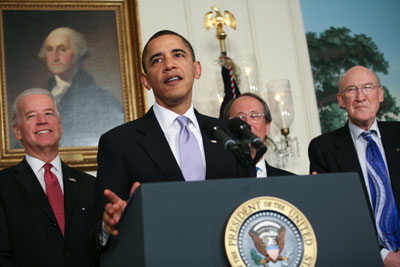
    <ahref="http://blog.heritage.org/wp-content/uploads/Obama-commission-100218.jpg"></p><ahref="http://blog.heritage.org/2010/01/29/senate-puts-politics-over-fiscal-responsibility-in-debt-limit-vote">The recent debt limit increase passed by Congress has sparked a national debate on how to adequately reverse out-of-control federal spending. After much congressional hand-wringing recently over what budget process reform to attach to the must-pass increase in the debt ceiling, support for a <ahref="http://www.heritage.org/Research/Budget/bg2360.cfm">bipartisan commission crafted by Senate Budget Committee leaders Kent Conrad (D-ND) and Judd Gregg (R-NH) crumbled. Lawmakers realized that the framing of the commission would most likely lead to tax increases with little real spending restraint with the same back-room deals of which Americans have become weary.

    Just this morning, the President signed an executive order creating the <ahref="http://www.whitehouse.gov/feed/omb.aspx">National Commission on Fiscal Responsibility and Reform, which will operate similarly to the failed Conrad-Greg proposal except that it would be set up by the White House rather than by statute. The goal of the commission is to balance the budget, excluding interest payments, by 2015. The commission will also be expected to make recommendations regarding entitlement reform in order to rein long-term deficits.

    <spanid="more-26768"></span>

    The National Commission created by the President raises concerns beyond those of the Conrad-Gregg proposal, especially since the President’s proposal is even further from securing the public’s trust and taking into account public opinion on future reform.

    The White House commission lacks the <ahref="http://www.heritage.org/Research/Budget/wm2698.cfm">necessary broad public consultation and steps to gain public support essential to achieving and sustaining major reforms in entitlements. The deadline for the commission’s recommendations, December 1, thoroughly discounts public opinion, as the date conveniently ensures the recommendation will not affect November elections. This also means lame duck members of Congress who have lost their seats and are no longer held accountable to their constituents will vote on the recommendations of the commission, which will be seen by many Americans as an affront to the will of the people as expressed at the polls.

    The structure of the National Commission is also likely to strain bipartisanship. The commission will consist of 18 members, and 14 votes will be required to vote a recommendation out of the commission. Congressional Majority and Minority leaders will respectively choose six members, and the President will choose the remaining six. Of the President’s appointees, two must be Republicans. <ahref="http://corner.nationalreview.com/post/?q=OGY3YmQxNzFiOWQwODk1OTg0NmM3NWMzMWFkZWMyYzQ=">T he President will without doubt choose Republicans who are likely to fall in step with his vision for reform, leaving only two additional Republican votes needed to pass a recommendation.

    <ahref="http://blog.heritage.org/2010/01/20/please-no-white-house-lame-duck-commission">As we’ve pointed out before, an executive commission with no teeth to tackle surging entitlement spending will merely remove pressure on Congress and the President to take true action. This past year saw spending explode to nearly 26 per cent of the economy – well over the 20% historical average – and with a staggering deficit of $1.4 trillion, or nearly 10 per cent of GDP. President Obama can show true leadership <ahref="http://www.roadmap.republicans.budget.house.gov/">by proposing serious and specific reforms to entitlement spending, and he can start to get current spending under control by such things as canceling TARP. But issuing an executive order to assemble a group of tired lawmakers to do the job for him is not the action of a decisive leader and will not produce effective results.

    http://blog.heritage.org/2010/02/18/…ue-leadership/

  • New Climate Chief Won’t Change UN’s Problems with Addressing Climate Change

    On 02.18.10 02:02 PM posted by Nick Loris

    Yvo de Boer, climate chief of the United Nations for four years, <ahref="http://www.nytimes.com/2010/02/19/science/earth/19climate.html">unexpectedly announced his resignation today. Although he officially won’t leave his post until July 1st, it marks another turn for the worse for those hoping to see action on climate policy. De Boer, who led the United Nations Climate Change Conference in Bali (2007) and more recently in Copenhagen (2009) <ahref="http://www.nytimes.com/2010/02/19/science/earth/19climate.html">said, “Copenhagen did not provide us with a clear agreement in legal terms, but the political commitment and sense of direction toward a low-emissions world are overwhelming. This calls for new partnerships with the business sector and I now have the chance to help make this happen.”

    Heritage Senior Policy Analyst Ben Lieberman <ahref="http://blog.heritage.org/2010/01/06/how-big-a-failure-was-copenhagen/">explains just how epic of a failure the Copenhagen Climate Change Conference really was: “To fully appreciate what a step backwards the final Copenhagen accord is, one has to recall the buildup to it. For the last two years, global warming activists and UN officials had circled December 2009 on their calendars as the watershed moment for creating a new carbon-constrained global economy for decades to come. And in the nick of time, they would argue, as the existing targets in the 1997 Kyoto Protocol are scheduled to expire in 2012. Furthermore, with the Bush administration gone in 2009, many in the international community felt that the path was clear for the Obama administration to finally include America in binding, verifiable, and enforceable restrictions on greenhouse gas emissions.”

    <spanid="more-26788"></span>

    It also goes to show just how ill-suited the United Nations is at handling a climate treaty. The vastly competing interests of UN member states make it extremely difficult to reach an agreement. For instance, the Copenhagen conference sought to get developed countries to accept massive economic costs to meet carbon dioxide cuts and provide billions of dollars in wealth transfers to help nations cope with the projected consequences of a changing climate, while simultaneously exempting developing countries (even the large developing country emitters like India and China).. The kicker is that this deal – as bad as it would be for developed countries like the U.S. – would not significantly arrest greenhouse gas emissions.

    More egregiously, the U.N. itself had become too invested in the agreement. As noted by Heritage fellow <ahref="http://www.heritage.org/Research/InternationalOrganizations/sr0073.cfm">and UN expert Brett Schaefer:

    “The U.N. is supposed to be a neutral facilitator, not a decision-making body. The decisions over what commitments nations make should be left to their respective governments — they have to justify them to the citizens who will be affected. In this debate, the U.N. has moved inappropriately beyond serving as bureaucratic “butlers of the process” to full-blown advocates pushing for ever more stringent commitments in the face of countervailing evidence and lack of political support for its suggested actions.”

    With UN Secretary-General Ban-Ki Moon selecting the de Boer’s successor, it’s unlikely we’ll see an effort to minimize the U.N.’s role in negotiating climate change treaties. But reversing that trend was unlikely anyway. The best option is to sideline the UN and shift negotiations on efforts to address climate change to a more effective forum of those states that would be expected to shoulder the burden of any proposed efforts and, therefore, would be sure to view those proposals in a proper cost-benefit framework.

    As for de Boer, working with businesses may be easier said than done. BP, ConocoPhillips and Caterpillar recently left the U.S. Climate Action Partnership (US CAP), a coalition of business and environmentalists that support legislation to reduce greenhouse gases such as cap and trade. With trillions of dollars on the table and up for grabs, corporations worked hard for a seat at that table in search of corporate welfare at the expense of the consumer. But the recent revelations of flaws in the Intergovernmental Panel on Climate Change (IPCC) report as well as the ostensible data corruption and manipulation exposed by leaked emails and documents from East Anglia University’s Climate Research Unit (CRU) have companies jumping off the global warming bandwagon. It’s certainly not going be a cakewalk convincing them to jump back on and willingly cut emissions given the economic cost and faulty science.

    Some say de Boer’s resignation will add to the trouble. Agus Purnomo, Indonesia’s special presidential assistant on climate change <ahref="http://www.google.com/hostednews/ap/article/ALeqM5jz7D7NvuUSckvF-J-k1ptv_K5aJwD9DUNQM00">admitted the resignation “comes at the worst time in the climate change negotiations. His decision will ultimately add to the difficulties we already have in reaching a successful outcome in Mexico.” Hopefully, participating governments take this opportunity to reassess the entire fiasco of UN led negotiations like Copenhagen.

    http://blog.heritage.org/2010/02/18/…limate-change/