Author: Heritage

  • Free Flow of Information: A Great Tool Against Totalitarianism

    On 02.25.10 10:00 AM posted by Helle Dale

    <ahref="http://blog.heritage.org/wp-content/uploads/2009/06/kimjongil090526.jpg"></p>Of all the isolated places on earth, North Korea is a strong candidate for the most dismal. Yet it is the case in the information age that no country can be 100 percent hermetically sealed from the rest of the world. Even in North Korea, cracks are appearing in the government’s information monopoly, which should provide hope that no audience is entirely beyond the reach of U.S. international broadcasting. Societies such as North Korea, Iran and Venezuela, where information is tightly controlled by repressive governments, do present valuable opportunities for U.S. international broadcasting and public diplomacy. In the case of North Korea, Voice of America, Radio Free Asia, and four South Korean broadcasters supported by the National Endowment for Democracy have growing audiences in this most totalitarian of societies. Currently Voice of America and Radio Free Asia each broadcast five hours a day into North Korea.

    Now, progress may seem improbable in a country where radios and televisions are sold only with dials fixed to official government stations, where every household is hardwired to connect with the local Communist Party, where idolization of Kim Jong-Il is the primary content of every official channel, and where attempts to listen to foreign broadcasts can lead to 10 years of hard labor if discovered. As for the Internet, it exists only as an official tool of a very small number of government users. Yet, according to surveys of defectors coming out of North Korea, the appetite for independent information is growing. From the perspective of the North Korean regime, according to defectors, there is no greater challenge to its power. Particularly in North Korea’s border provinces with South Korea and China, growing audiences are able to receive news of the outside world that does not fit with the regime’s relentless propaganda. This creates the opportunity for independent thought, anathema for totalitarians.<spanid="more-27370"></span>

    As presented at the National Endowment of Democracy, (Thursday Feb. 18 — <ahref="http://ned.org/events/the-voice-of-freedom-improving-radio-programs-for-the-citizens-of-north-korea">“The Voice of Freedom: Improving Programs for the Citizens of North Korea”), featuring prominent South Korean newsman Sangsoo Kim, particularly the black-market cross border trade with China provides North Koreans with greater access to technology. Efforts to send radios by balloon from South Korea are also a factor, but the balloons are vulnerable to wind and weather conditions and intercepts. Today, 58 percent of North Korean households have access to a cassette recorder with a radio; 46 percent have access to a color TV; 10 percent to a radio; 21 percent to a VCD player; and 7 percent have access to highly controlled mobile phone networks.

    The most effective medium into North Korea today remains short-wave radio, a medium that unfortunately has become undervalued by the Broadcasting Board of Governors overseeing U.S. international broadcasting. New and sexier venues, such as television and the Internet, is where the focus is today. *Vis-à-vis North Korea, medium wave broadcasts from Russia were an option in the past, but were closed down owing to pressure from Pyongyang on the Russian government. Meanwhile, short-wave can be beamed from South Korea and received primarily at night, when most underground users are able to take the risk and when climate conditions are optimal.

    So what do North Koreans like to listen to? According to surveys of samples of the some 20,000 North Korean defectors living in South Korea, they like to listen to other North Koreans talking about their lives. They listen for information about the outside that gives them a sense of connectedness with the rest of the world. They want information about how to produce and bring their products to market – which stands to reason in a society beset by shortages and famines.* Broadcasts from South Korea also have a strong Christian content, understandably so given that Christian missionaries often are instrumental in facilitating defections.

    During the Cold War, information warfare was one of the most effective tools in the toolkit of the U.S. government against the Soviet Union. Reliable, factual information about the world and the truth about their own society arms citizens of oppressed societies to take the first steps towards freedom.

    http://blog.heritage.org/2010/02/25/…talitarianism/

  • President Obama’s Refusal to Back Britain on Falklands is Disgrace

    On 02.25.10 11:00 AM posted by Nile Gardiner

    <ahref="http://blog.heritage.org/wp-content/uploads/penguins.jpg"></p>The Obama administration’s decision to remain neutral in the dispute between Great Britain and Argentina over the Falkland Islands is a shameful decision that will go down very badly across the Atlantic. As <ahref="http://www.timesonline.co.uk/tol/news/world/us_and_americas/article7040245.ece">The Times has just reported, Washington has point blank refused to support British sovereignty over the Falklands, and is adopting a strictly neutral approach.

    In the words of a State Department spokesman:

    We are aware not only of the current situation but also of the history, but our position remains one of neutrality. The US recognises de facto UK administration of the islands but takes no position on the sovereignty claims of either party.

    The remarks had echoes of <ahref="http://www.telegraph.co.uk/news/worldnews/northamerica/usa/barackobama/4953523/Barack-Obama-too-tired-to-give-proper-welcome-to-Gordon-Brown.html">an earlier statement by a senior State Department protocol official who, when asked about the shoddy treatment of the British Prime Minister in March last year, responded:

    There’s nothing special about Britain. You’re just the same as the other 190 countries in the world. You shouldn’t expect special treatment.

    Even by the relentlessly poor standards of the Obama administration, whose doctrine unfailingly appears to be “kiss your enemies and kick your allies”, this is a new low. The White House’s neutrality in a major dispute between America’s closest friend and the likes of Venezuelan tyrant Hugo Chavez, Argentina’s biggest backer, represents the appalling appeasement of an alliance of anti-Western Latin American regimes, stretching from Caracas to Havana – combined with a callous indifference towards the Anglo-American alliance.<spanid="more-27393"></span>

    Over the course of the last year, we’ve seen a staggering array of foreign policy follies by this administration, from the throwing under the bus of the Poles and the Czechs over missile defence to siding with Marxists in Honduras. But this latest pronouncement surely takes the biscuit as the most brazen betrayal so far of a US ally.

    As the Obama government is amply aware, the tensions between London and Buenos Aires are escalating dramatically, with British military contingency planning already under way. In effect, Washington declared today that it would remain neutral in the event of another war in the South Atlantic, a stunning declaration to make.

    Thousands of British soldiers are laying their lives on the line alongside their American allies on the battlefields of Afghanistan. Yet the president of the United States is either unwilling or too timid to offer a single word of support for the British people, who face a mounting confrontation with a corrupt, populist Argentine government that is threatening a blockade of British territory.

    To put it bluntly, the Obama administration is killing the Special Relationship, and the prospects of a recovery look extremely bleak as long as Barack Obama remains in the White House.

    I am in no doubt though that messages of support for Britain will begin to flow in the coming days from Senators and Congressmen who actually understand the importance of Anglo-American friendship and loyalty, and who recognize the tremendous value of the ancestral, linguistic, economic, cultural, military and intelligence ties that bind the two greatest nations in the world. And I am very sure that the vast majority of Americans will reject the spineless neutrality of the White House and State Department, and wholeheartedly support the British people in the event of another conflict.

    <ahref="http://blogs.telegraph.co.uk/news/nilegardiner/100027381/the-special-relationship-is-under-fire-obama%E2%80%99s-refusal-to-back-britain-over-the-falklands-is-a-disgrace/">Cross-posted at <ahref="http://www.telegraph.co.uk/">The Telegraph.

    http://blog.heritage.org/2010/02/25/…s-is-disgrace/

  • Climate Science Exposed: New Report on the CRU Controversy

    On 02.24.10 04:00 PM posted by Nick Loris

    <ahref="http://blog.heritage.org/wp-content/uploads/earth-100223.jpg"></p>“The science behind climate change is settled, and human activity is responsible for global warming. That conclusion is not a partisan one.” – <ahref="http://www.nytimes.com/gwire/2010/02/23/23greenwire-epa-chief-goes-toe-to-toe-with-senate-gop-over-72892.html">Environmental Protection Agency Administrator Lisa Jackson.

    Forget being partisan or not. That conclusion of settled science isn’t existent. It hasn’t been for a long time, but they are especially bold words in light of the climate scandal involving the University of East Anglia’s Climatic Research Unit (CRU) and the flaws uncovered in the Intergovernmental Panel on Climate Change report. Yesterday, the Senate Minority Committee on Environment and Public Works (EPW) <ahref="http://epw.senate.gov/public/index.cfm?FuseAction=Minority.PressReleases&Conten tRecord_id=fb6d4083-802a-23ad-46e8-c5c098e22aa1&Region_id=&Issue_id=">released a new report that scrutinizes the climate scandal and CRU and its connection with the IPCC and U.S. government policy.

    <spanid="more-27338"></span>

    The report delves into the email trail, the IPCC consensus of “unequivocal warming”, the legal and policy issues of Climategate and the EPA’s reliance on the IPCC to make regulatory decisions in order to reduce greenhouse gas emissions. The EPA’s endangerment finding, which took effect January 14, gives the EPA authority under section 202(a) of the Clean Air Act (CAA) to regulate greenhouse gases (GHGs). Sen. James Inhofe (R-Okla.), Ranking Member of the Senate Committee on Environment and Public Works, said:

    “So this administration has said, “All right. We couldn’t go it legislatively so we’re going to do it on our own. We’re going to do the damage, inflict the economic damage to this country that would have come under cap and trade the same as if we had been able to pass it.” Now, I think that’s interesting. I would like to say this one thing. The chairman made the statement that the Supreme Court’s mandating this stuff. They’re not mandating a thing. The Supreme Court said you have three choices. You can either, well, either find an endangerment finding or do not find it, or you can say that the science is uncertain.

    And I think what we’re going to be asking you to do, during the question and answer time is to find that it’s not certain. You can have an endangerment finding. That can change because you didn’t know at the time that you were basing this on the IPCC flawed science, that the science was flawed. You didn’t believe that, but nonetheless that’s where we are today. We’re going to be making the request, Madam Chairman, that we go back, relook at this and also that — that — and the EPA have their I.G. (Inspector General)looking into this just the same as all the other nations are doing at this time all throughout Europe.”

    You can find the full report <ahref="http://epw.senate.gov/public/index.cfm?FuseAction=Minority.PressReleases&Conten tRecord_id=fb6d4083-802a-23ad-46e8-c5c098e22aa1&Region_id=&Issue_id=">here. What’s most interesting is that it’s the politicians arguing that the science is settled while the climatologists suggest otherwise. Even Phil Jones, former director of the East Anglia’s CRU <ahref="http://news.bbc.co.uk/2/hi/science/nature/8511670.stm">admitted, “I don’t believe the vast majority of climate scientists think this. This is not my view. There is still much that needs to be undertaken to reduce uncertainties, not just for the future, but for the instrumental (and especially the palaeoclimatic) past as well.”

    The EPA needs to reevaluate the science before it moves forward <ahref="http://www.heritage.org/Research/EnergyandEnvironment/wm2768.cfm">on a long road of expensive and expansive environmental regulations.

    http://blog.heritage.org/2010/02/24/…u-controversy/

  • Obamacare and Health Care Nuclear Option Violate First Principles

    On 02.24.10 11:00 AM posted by Brian Darling

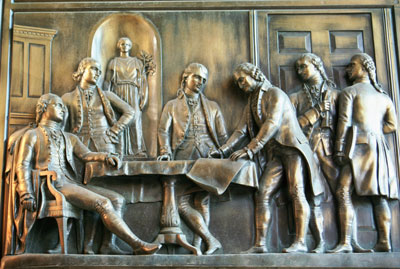
    <arel="attachment wp-att-24343" href="http://blog.heritage.org/2010/01/21/a-history-to-be-proud-of/declaration-100121/"></p>The President’s new version of Obamacare, and his method of passing it, are not popular with the American people. Dubbed the <atitle="http://blog.heritage.org/2010/02/19/health-care-nuclear-option-%E2%80%93-liberals-ready-to-launch/" href="../2010/02/19/health-care-nuclear-option-%E2%80%93-liberals-ready-to-launch/">Health Care Nuclear Option, this tactic will only further anger the American by* sidetracking the filibuster in the Senate and creating an even more highly charged partisan atmosphere in Congress.* The content of Obamacare, and the strategies being employed to pass it, violates one of our nation’s core first principles: the consent of the governed.* Our Republic is not a democracy where bare 51 vote majorities rule. Throughout our nation’s history most major legislative changes in Washington have historically been bipartisan and President Obama’s effort clearly falls short of that tradition.

    As we <atitle="http://blog.heritage.org/2010/02/19/health-care-nuclear-option-%E2%80%93-liberals-ready-to-launch/" href="../2010/02/19/health-care-nuclear-option-%E2%80%93-liberals-ready-to-launch/">reported late last week:<spanid="more-27238"></span>

    The Health Care Nuclear Option, also known as reconciliation, is being considered by liberal politicians to insure that Obamacare makes it to the President’s desk by Easter.* According to <atitle="http://www.nytimes.com/2010/02/19/health/policy/19health.html" href="http://www.nytimes.com/2010/02/19/health/policy/19health.html">The New York Times, the plan is to have the President submit reconciliation legislation to be posted on the internet this weekend.*The legislation will be crafted in a manner so that it can be passed using special reconciliation procedures created solely to enact laws to reduce the deficit as part of the annual budget.* The next step is for the President to conduct his half day bipartisan summit at the Blair House on February 25th.*With that faux-bipartisan stunt over with, the President will be free to pass legislation in a partisan manner that tosses aside the regular rules of business in the Senate.

    Americans treasure the idea that our Republic was set up so that the power of the federal government is derived from the consent of the people.* The extraordinary state power to pass legislation that puts the government in control of more private health care decisions should only be done with the clear consent of the American people.* <atitle="http://blog.heritage.org/2010/02/17/the-mount-vernon-statement/" href="../2010/02/17/the-mount-vernon-statement/">The Mount Vernon Statement released on February 17, 2010, a document defining the conservative movement’s first principles, states:

    We recommit ourselves to the ideas of the American Founding. Through the Constitution, the Founders created an enduring framework of limited government based on the rule of law. They sought to secure national independence, provide for economic opportunity, establish true religious liberty and maintain a flourishing society of republican self-government.

    The Mount Vernon Statement argues that “at this important time, we need a restatement of Constitutional conservatism grounded in the priceless principle of ordered liberty articulated in the Declaration of Independence and the Constitution. The conservatism of the Declaration asserts self-evident truths based on the laws of nature and nature’s God. It defends life, liberty and the pursuit of happiness. It traces authority to the consent of the governed.”* President Obama, Speaker Nancy Pelosi (D-CA) and Senate Majority Leader Harry Reid (D-NV) must seek consent of the governed to move forward on Obamacare. But they are not.

    There is no consent of the governed for Obamacare. As a matter of fact, there is a consensus that the President’s top down approach to reforming health care has the explicit opposition of the American people. Sen. Scott Brown (R-MA) was elected to represent the liberal state of Massachusetts in the Senate by running against Obamacare. The left likes to say that this was just one election. But so was the 2008 elections. The Founders never intended a change in policy as sweeping as Obamacare to be decided by just one election. That is why Senators are not up for reelection in every cycle. The Senate is designed to slow down the passions of the moment in favor of a more deliberative and settled policy.

    That is why all of the major policy changes in our nation’s history have been enacted with strong bipartisan support. When Medicare passed in 1965 there was bipartisan support for the bill.* Democrat Senators supported by a 57-7 margin and Republicans supported by a 13-17 margin (final Senate vote 70-24). In the House, Medicare passed by a 307-116 margin with House Republicans splitting 70-68 in the vote.* President Johnson signed the bill into law after bipartisan majorities supported this controversial new safety net program.

    And President Ronald Reagan got strong bipartisan consent for his revolutionary Tax Reform Act of 1986. The House approved the measure 292-136 and the Senate passed it by a landslide 97 to 3 vote. More recently Republicans and Democrats worked together to enact a major reform of our nation’s welfare system in 1996. President Bill Clinton signed welfare reform into law after over 20 Democratic Senators joined with the Republican majority to pass the bill by a <ahref="http://www.senate.gov/legislative/LIS/roll_call_lists/roll_call_vote_cfm.cfm?congress=104&session=2&vote =00232">74 -24 margin. That is the kind of bipartisan reform the White House should be pursuing.

    <atitle="http://www.realclearpolitics.com/epolls/other/obama_and_democrats_health_care_plan-1130.html" href="http://www.realclearpolitics.com/epolls/other/obama_and_democrats_health_care_plan-1130.html" target="_self">Real Clear Politics (RCP) has links to Obamacare polls that indicate that more Americans oppose Obamacare than support it.* The average RCP poll indicates that 38% are in favor of the President’s health care reforms versus 53% who are against it (an approximate 15% deficit).* It is clear that the American people do not consent to Obamacare. The only bipartisan action on Obamacare will be Democrats voting against the measure. There is broad bipartisan agreement that the government’s treatment of health care needs serious reform, yet there is not bipartisan agreement that Obamacare solves these issues.* The President’s strategy to pull and end around the opposition of the American citizens and the filibuster in the Senate is a true affront to the ideas of the consent of the governed and comprehensive reform efforts need strong bipartisan support to get passed.* It is time for President Obama to scrap Obamacare so as to proceed with negotiation between Republicans and Democrats starting from scratch.

    http://blog.heritage.org/2010/02/24/…st-principles/

  • The President?s Health Summit Proposal: Rhetoric vs Reality

    On 02.24.10 11:30 AM posted by Conn Carroll

    <ahref="http://blog.heritage.org/wp-content/uploads/obama-speaking100128.jpg"></p>The President’s health care proposal contains little that is new.* The well tested rhetoric used by the White House to sugarcoat the health policy outline should not fool ordinary Americans. This proposal is even more expensive than the Senate bill upon which it is apparently based: $950 billion over ten years rather than $871 billion.
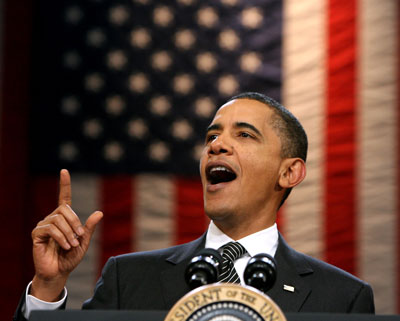
    Consider the <ahref="http://www.whitehouse.gov/sites/default/files/summary-presidents-proposal.pdf">claims made by the White House regarding the effects of the President’s proposal on the health care system.

    The Rhetoric on Affordability.
    “It makes insurance more affordable by providing the largest middle class tax cut for health care in history, reducing premium costs for tens of millions of families and small business owners who are priced out of coverage today.”

    The Reality: In fact, the tax credit would be limited to only a limited number of persons within a limited set of income brackets, not the entire middle class. One cannot ignore the tax increases, or the prescribed cost of the health care benefits packages themselves. As the premiums increase, the cost of the subsidies, based on percentage of income, would track these increases, resulting in another direct cost shift onto all taxpayers. In fact, the President’s proposal, based on the Senate bill, would result in major tax increases (<ahref="http://www.atr.org/userfiles/022210pr-obamacaretax.pdf">estimated at $629 billion over ten years) and would include a variety of *middle class tax increases. This, of course, once again violates the president’s promise to refrain from imposing taxes on those with family incomes of less than $250,000 per year.<spanid="more-27285"></span>

    The Rhetoric on Personal Choice. According to the White House:
    “It sets up a new competitive health insurance market giving tens of millions of Americans the exact same insurance choices that members of Congress will have.”
    The Reality: The Health Exchanges in Congress’ health bills and the President’s proposals are not structured to serve as a real competitive marketplace for insurance, in the sense of anything that would resemble real free market competition; rather these institutions would primarily serve as the federally designed mechanism to impose strict federal regulation on private insurers.* By contrast, in the FEHBP, the federal government does not standardize the health benefits of private health plans for its employees. For federal employees and retirees, there are a wide variety of health benefit offerings and combinations of benefit packages, ranging in price from expensive health plans (like the Blues Standard Option) to low cost plans (like the Mail handler’s Value Plan, a union plan), and a variety of health plan types, ranging from comprehensive plans to health savings accounts and high deductible plans, plus a wide range of premiums and co-payments.

    The Rhetoric on Health Insurance Accountability. According to the White House draft outline:
    “It brings greater accountability to health care by laying out commonsense rules of the road to keep premiums down and prevent insurance industry abuses and denial of care.”

    The Reality: The reference to the proposal’s requirement of guaranteed issue, regardless of pre-existing conditions, raises a number of thorny issues. Whatever one’s views on the wisdom of eliminating pre-existing conditions for enrollment and providing for guaranteed issue, <ahref="http://www.heritage.org/Research/HealthCare/cda1002.cfm">this provision will increase premiums dramatically. The problem is aggravated in the individual health insurance market; most of the problems that politicians cite with denials or discrimination do not apply to the vast majority of Americans in group health insurance. Already under the Senate bill, upon which the president’s latest proposal is based, <ahref="http://www.cbo.gov/ftpdocs/107xx/doc10781/11-30-Premiums.pdf">CBO projects an increase up to 13 percent for the premium price of individual insurance through the state based health insurance exchanges. When health insurance enrollment in the individual market is eased in this fashion for older and sicker persons, those most in need of coverage, the result is an increase in the volume of medical claims and a sharp increase in the average insurance claims costs. This drives up premium costs, and the likely effect is that younger and healthier persons, those least in need of coverage, drop out of the insurance pool.

    The President’s proposed remedy to counteract the bad effects (the inevitable higher premium costs) of this government intervention is to prescribe yet another government intervention: force the younger and healthier persons to buy the government’s higher cost health insurance through the imposition of an individual mandate.

    In the original Senate bill, upon which the President’s proposal is based, the individual mandate would impose an annual penalty for not buying the government specified insurance, progressively increasing year by year until it reaches $750 in 2016. The Obama proposal would lower the flat payment from $750 to $695 in 2016, and would raise the percentage of income that would be assessed by 2016 to 2.5 percent of income. The president proposes that persons who do not file income taxes would be exempt from the penalty; that’s a lot of people. Like the Senate bill, there would be a “hardship” exemption.

    None of these tweaks reverse the plain economic incentives. If a person perceives that payment of the mandate penalty (a cheaper option) is a better deal than buying the health insurance (a more expensive option), then the economic incentives run directly against the purchase of health insurance. The problem is aggravated if the regulatory regime imposed by Obama and Congress would enforce guaranteed issue and pre-existing exclusions, insurers would have to take* “all comers”,* *meaning that as person could literally sign up for health insurance from a hospital bed and drop it later and pay the cheaper fine. This would guarantee higher premium costs, and invite 70’s style price controls (already embodied in the Obama proposal), which means, of course, fewer, not more, hospital beds. Thus, the proverbial liberal cat chases its leftwing tail. <ahref="http://www.washingtonpost.com/wp-dyn/content/article/2009/11/05/AR2009110504327.html">As Professor Martin Feldstein at Harvard has observed, the economic incentives built into this regulatory regime could result in even higher rates of un-insurance, more risk segmentation, and even higher premium costs. As Feldstein points out, the end result, we could end up passing a trillion dollar health bill and find ourselves with even more uninsured Americans.

    The Rhetoric on Fiscal Responsibility. According to the White House outline:
    “It puts our budget and economy on a more stable path by reducing the deficit by $100 billion over the next ten years – and about $1 trillion over the second decade – by cutting government overspending and reining in waste, fraud and abuse.”

    The Reality: The White House promise of fiscal and economic responsibility is based on a prescription for a huge entitlement expansion (through Medicaid), major tax increases and massive spending, and the never-ending crusade against “waste, fraud and abuse.” *This would be comical if the President and Congressional leaders were not so incessantly earnest. That rhetoric only continues to undermine public trust.

    Consider the previous promises of deficit reduction through the health care bills. They were based on transparently dishonest <ahref="http://www.heritage.org/Research/HealthCare/wm2756.cfm">accounting gimmicks- *assumption of the continuation of physician Medicare payment rules and reductions ( or separating out the Medicare physician payment cost increases in other bills), different start dates for full tax and benefit implementation ( $2.5 trillion for the Senate bill according to Senator Max Baucus, the Montana Democrat) and <ahref="http://www.cbo.gov/ftpdocs/110xx/doc11005/01-22-HI_Fund.pdf">double counting of Medicare “savings”, for example.

    Concerning the President’s proposal, <ahref="http://cboblog.cbo.gov/?p=473">the Congressional Budget Office, the official budget scorekeeper for Congress, said,

    “Preparing a cost estimate requires very detailed specifications of numerous provisions, and the materials that were released this morning do not provide sufficient detail on all of the provisions. Therefore, CBO cannot provide a cost estimate for the proposal without additional detail”.

    The President’s proposal is similar to the House and Senate bills, but contains several new and much more costly provisions.* It is thus safe to assume it would cause <ahref="http://www.heritage.org/Research/HealthCare/wm2756.cfm">the same deficit increase, especially when elements such as the “doc fix” or the CLASS Act are properly accounted for.

    Washington’s “political class” supports the Congressional and Presidential health initiatives. But ordinary Americans are tired of official Washington’s deceitful but flowery rhetoric, accompanied by the shameless sellout of taxpayers to special interest pressure groups (the union exemptions from high taxes on health benefits, the Nebraska and Louisiana Medicaid deals, among others).

    Members of Congress attending the Summit must remember that the American people oppose Washington’s takeover of the health care sector of the economy. <ahref="http://www.rasmussenreports.com/public_content/politics/current_events/healthcare/february_2010/61_say_congress_should_start_all_over_again_on_hea lth_care">Elected officials should listen to those they govern and start afresh with health care reform.

    Co-authored by Kathryn Nix.

    http://blog.heritage.org/2010/02/24/…ic-vs-reality/

  • What the HIRE Act Giveth, the Rest of Obama Agenda Taketh Away

    On 02.24.10 12:00 PM posted by Aleksey Gladyshev

    <ahref="http://blog.heritage.org/wp-content/uploads/unemployment100224.jpg"></p>The latest attempt by Congress to wrestle the high unemployment rate is the HIRE Act, which is little more than <ahref="http://www.heritage.org/Research/Taxes/bg2374.cfm">a tax holiday for companies who hire additional workers. Even if this Act works as intended and encourages businesses to hire more workers, which in and of itself is not a guarantee, then other measures undertaken by the Obama Administration have the opposite effect, by actually stifling hiring by business. Some of the measures that counteract intentions of the HIRE Act are the minimum wage increases of the last few years, <ahref="http://blog.heritage.org/2010/02/23/uncertainty-from-washington-hampering-job-creation/">uncertainty of pending legislation on healthcare and cap-and-trade, and the <ahref="http://www.heritage.org/Research/Labor/wm2782.cfm">Davis-Bacon Act that requires government contractors to pay wages that are above the market rates.

    The idea behind the HIRE Act is that the payroll tax holiday would reduce the cost of labor for participating companies by temporarily suspending the employer’s share of the Social Security payroll tax, thus coercing companies to hire new workers. However, the impact of such a measure is unclear, since the tax holiday will only be temporary and will have little impact – a qualified employer who hires a worker earning $51,000 annually will receive a subsidy equaling roughly $264 per month. However, these subsidies amount to lost revenue in the Federal Social Security Trust Fund – an institution that even without this additional burden is running a significant deficit.<spanid="more-27194"></span>

    The minimum wage increases in the last couple of years have contributed to a rise in the unemployment rate. The minimum wage was increased from $5.15 to $7.25 between 2007 and 2009. It is a fact that unemployment goes up as the minimum wage increases because businesses have to pay workers more to keep them employed, and inadvertently not all workers are kept after the minimum wage increases. Congress made their task of decreasing the unemployment rate that is currently hovering around 10 percent more difficult by their actions from several years back.

    Another reason why businesses are reluctant to hire more workers is because they feel a sense of uncertainty for what bills may be enacted by Congress. Critical bills such as healthcare reform and cap and trade legislation are currently being contemplated, which could significantly increase the price of labor for businesses. Until they are certain about whether or not they must pay for healthcare of ever worker on payroll, or whether the cost of energy could potentially rise due to cap-and-trade legislation, businesses are not going to be enticed by a temporary payroll tax hike to hire workers whose wages will need to paid indefinitely into the future.

    The Davis-Bacon Act is yet another measure currently on the books that hinders rather than encourages more hiring. Government construction spending has to cost more than the market rates, and to pay for this extra cost, the government takes money through taxes from elsewhere in the economy. But Congress cannot reduce unemployment through public works projects, because for every job that it creates in the public sector, at least one job is not being created in the private sector and in the best-case scenario the net job creation is zero, but <ahref="http://www.heritage.org/Research/Labor/wm2782.cfm">160,000 jobs are actually lost because of this legislation.

    Although the HIRE Act is intended to reduce unemployment, there are many other bills and laws currently on the books that directly counteract the goals of this bill. Congress should consider how to assuage negative effects of these other laws before looking for new ways to decrease unemployment. The fact that Congress is looking at ways to decrease the unemployment rate is a good sign, but attempts by Congress to decrease the unemployment rate will never succeed if other laws are passed that actually lead to higher rates of unemployment.

    http://blog.heritage.org/2010/02/24/…dministration/

  • Consumer Financial Protection: Thinking Outside the Boxes

    On 02.24.10 12:01 PM posted by James Gattuso

    Is a congressional compromise on financial services regulation in the works? Steven Pearlstein of the Washington Post today <ahref="http://www.washingtonpost.com/wp-dyn/content/article/2010/02/23/AR2010022305097.html?hpid=topnews">reports the answer is “yes,” citing progress in negotiations between Democratic Sen. Chris Dodd of Connecticut and GOP Sen. Bob Corker of Tennessee. Specifically, Pearlstein points to a breakthrough on one of the major sticking points of the debate: whether to create a new agency to enforce consumer protection laws in financial service markets.

    As described, the compromise proposal may alleviate many of the potential organizational objections to the idea. Nevertheless, the new regulator could hurt — rather than help — consumers.

    The creation of an independent super-agency dedicated soley to consumer regulation has been a centerpiece of President Obama’s financial regulation agenda. But, while it was approved last summer by the House, the idea has languished in the Senate, as opponents have <ahref="http://www.heritage.org/Research/Regulation/bg2314.cfm">pointed out that a consumer regulation agency independent of other banking regulators would foster confusion and bureaucratic infighting, and actually undermine efforts to assure the safety and soundness of banks.
    <spanid="more-27265"></span>
    According to Pearlstein, Dodd and at least one Republican — Corker — have come up with an alternative: a single regulator with two divisions, one to enforce consumer protection laws, and the other to look after the safety and soundness of financial institutions.

    The idea seems to address the organizational objections to the plan — facilitating coordination between the two roles. But before the champagne is uncorked, negotiators should take a step back — there are still many more troubling questions about this new regulator that have not been answered.

    One is how extensive its scope will be. Will it regulate only banks with a national charter or financial institutions more generally, as Obama proposed? “Financial services” is a broad term, and could include virtually anything not sold with cash on the barrelhead. If jurisdiction is broad, the new agency could have a dangerously unlimited reach. An agency with broad jurisdiction could also undermine the work of other agencies, particularly the <ahref="http://www.ftc.gov/speeches/kovacic/090728stmtrecord.pdf">Federal Trade Commission, which has broad responsibility and expertise in consumer protection.

    Even more important is what (if any) new powers the agency will have. It’s one thing to gather in one place the existing — and entirely sufficient — powers now held by a variety of other financial services regulators. But Sen. Dodd (and President Obama) have proposed to confer vast new powers on the regulator as well, including ill-defined authority to regulate “unfair” practices, limit sales practices, restrict advertising and more.

    Such new powers are not only <ahref="http://papers.ssrn.com/sol3/papers.cfm?abstract_id=1474006&rec=1&srcabs=148390 6">unnecessary, but harmful — limiting innovation and choice, and raising costs for the very consumers they are meant to protect.

    As negotiations on these complex issues move forward, Congress should move with care and check the details. Containing the dangers of new regulation is not just a matter of organizational boxes.

    http://blog.heritage.org/2010/02/24/…ide-the-boxes/

  • The Health Care Summit: Getting Reform Done Right

    On 02.24.10 12:30 PM posted by Kathryn Nix

    <ahref="http://blog.heritage.org/wp-content/uploads/baby_doctor.jpg"></p>Thursday, Democrats and Republicans will convene at the President’s request to discuss the way forward on achieving bipartisan health care reform.* <ahref="http://www.heritage.org/Research/HealthCare/bg2377.cfm">In a recent paper, Heritage’s Nina Owcharenko discusses how congressional Democrats and the President can use this meeting to start over on health care reform by enlisting Republicans to pass legislation both sides agree on.
    <ahref="http://www.heritage.org/Research/HealthCare/bg2377.cfm">Says Owcharenko, “If the President is sincere and the summit is going to be successful, it must begin by setting aside the highly unpopular bills that the House and Senate have developed. Simply adjusting the magnitude of these proposals or adding new “conservative” provisions as suggested in the President’s latest proposal, does not change their fundamental direction.”

    <ahref="http://www.rasmussenreports.com/public_content/politics/current_events/healthcare/september_2009/health_care_reform">Polls show a majority of Americans stand in opposition to the left’s health care proposals, which fall short of meeting expectations established by promises made by the President. To restore the nation’s trust in Washington, Congress and the President should focus on areas of reform which have bipartisan support.* <ahref="http://www.heritage.org/Research/HealthCare/bg2377.cfm">Owcharenko suggests the following as areas in which to move forward:<spanid="more-27291"></span>

    State-Based Reform: “Congress should embrace a federal–state partnership that would allow states to develop innovative ways to address their unique health care challenges. The federal government should set broad, national goals and then give wide leeway for states to try different approaches and learn from one another.”

    Fixing Broken Entitlements: “Reform should begin with Congress reforming the flawed programs it already controls rather than overhauling one-sixth of the national economy.”* Congress could start by applying the President’s proposal to introduce competitive bidding to Medicare Advantage to all of Medicare, create a level playing field for all Medicare enrollees.

    Reforming the Inequitable Tax Treatment of Insurance: “Congress should replace the current tax exclusion with a fairer and more equitable system of universal tax credits. Short of that, Congress should begin to realign the tax breaks for work-based health insurance with other tax-preferred forms of compensation by capping the tax exclusion.”

    Targeted Insurance Reforms: “The current health insurance rules do not work for everyone, but the solution is not for the federal government to take over private health insurance…Congress can correct the gaps in the current system to make the market work better for those it serves without destroying the market for others.”

    <ahref="http://corner.nationalreview.com/post/?q=MDY3ZjZjNDU1ZTcwNzRhNWFhN2JhZmFkYTI2MWY0OGQ">Am ericans are not concerned with the degree of reform that the left is seeking; they are concerned with the direction.* It is not too late for lawmakers to start over with incremental reform that will give Americans, not the government, more control of their health care.

    http://blog.heritage.org/2010/02/24/…rm-done-right/

  • Obama?s Elimination of CIA Detainee Program Puts Americans in Danger

    On 02.24.10 01:00 PM posted by Kelly Miller

    <ahref="http://blog.heritage.org/wp-content/uploads/Obama_edu090310.jpg"></p>Between the 9/11 terrorist attack and the inauguration of Barack Obama, the CIA’s detention and interrogation program yielded intelligence that foiled several terrorist attacks, according to author Mark Thiessen. That program, according to Thiessen, uncovered plots for attacks on high-rise apartment buildings; the U.S. Marine Camp in Djibouti, the U.S. Bank Tower in Los Angeles – the tallest building on the West Coast; and London’s Heathrow Airport and downtown buildings.

    On the second day of Barack Obama’s presidency, he signed an executive order ending the CIA program. Marc A. Thiessen, author of <ahref="http://www.amazon.com/gp/product/1596986034?ie=UTF8&tag=theheritagefo-20&linkCode=as2&camp=1789&creative=9325&creativeAS IN=1596986034#noop">Courting Disaster: How the CIA Kept America Safe and How Barack Obama is Inviting the Next Attack. explained why this decision compromises American security at a <ahref="http://www.heritage.org/press/events/ev022310b.cfm">Heritage Foundation event on February 23.

    Obama claims that his <ahref="http://edocket.access.gpo.gov/2009/pdf/E9-1885.pdf">Executive Order #13491 put an end to “torture,” even though the Bush Administration had already taken waterboarding off the table by 2003. The interrogation techniques Obama eliminated by his Executive Order included “the facial hold, attention grasp, tummy slap, facial slap, a diet of liquid Ensure and mild sleep deprivation (a maximum of four consecutive days).” <ahref="http://www.washingtonpost.com/wp-dyn/content/article/2010/02/22/AR2010022202298_pf.html">According to Thiessen, none of these methods constitute torture, or even inflict more suffering than training for a typical high school football team.<spanid="more-27222"></span>

    Critics say the interrogation techniques cannot yield good intelligence because the detainees will say anything to satisfy the interrogators. This criticism fails to understand the function of the CIA interrogations. Interrogators asked the detainee for information they already knew until he answered truthfully, demonstrating that he was ready to cooperate. Once the detainee begins cooperating, the interrogation ends and the debriefing begins.

    Abu Zubaydah, a key al-Qaeda operative captured in Pakistan in March of 2002, was the first of only three terrorist detainees to be waterboarded. Afterward, he actually thanked the CIA for waterboarding him, and encouraged it to waterboard other terrorist detainees. He explained that waterboarding had lifted from his shoulders a moral burden.

    Since terrorists believe Allah is ultimately destined to win, they are free to provide information to interrogators once they have made an effort to resist. This means that detainees will cooperate with interrogators once they have been given something to resist. Two-thirds of the 100 or so CIA detainees did not even need enhanced interrogation techniques to convince them they had fulfilled their duty to Allah.

    Only three required waterboarding. One was 9/11 mastermind Khalid Sheikh Mohammed, who initially refused to talk. After being waterboarded, he lectured interrogators on al-Qaeda operations with a chalkboard full of diagrams. The information that he and other detainees provided saved thousands of lives, and that’s what the CIA’s critics have to deny, Thiessen said.

    If they can’t knock down the effectiveness of the program, then they have to admit that the cost of their position would be thousands and thousands of dead people, men, women, and children, if we hadn’t waterboarded Khalid Sheikh Mohammed. And they won’t admit that, because it makes them monsters, and they want to paint us as the monsters. To argue that we should have sacrificed those lives in order to spare Khalid Sheikh Mohammed the experience of waterboarding, which is not torture, that’s the monstrous argument.

    Kelly Miller currently is a member of the Young Leaders Program at the Heritage Foundation. For more information on interning at Heritage, please visit:*<ahref="http://www.heritage.org/about/departments/ylp.cfm">http://www.heritage.org/about/departments/ylp.cfm

    http://blog.heritage.org/2010/02/24/…ans-in-danger/

  • CBO Report Was Pre-Ordained to Show the Stimulus Succeeded

    On 02.24.10 01:30 PM posted by Brian Riedl

    <ahref="http://blog.heritage.org/wp-content/uploads/2009/07/congressional_budget_office.gif"></p>The Congressional Budget Office (CBO) has produced a new<atitle="http://www.cbo.gov/ftpdocs/110xx/doc11044/02-23-ARRA.pdf" href="http://www.cbo.gov/ftpdocs/110xx/doc11044/02-23-ARRA.pdf"> report estimating that the $862 billion stimulus has thus far saved or created 1.5 million jobs.

    Yet the CBO’s calculations are not based on actually observing the economy’s recent performance. Rather, they used an economic model that was programmed to assume that stimulus spending automatically creates jobs—thus guaranteeing their result.

    Logicians call this the begging-the-question fallacy. Mathematicians call it assuming what you are trying to prove.<spanid="more-27311"></span>

    The CBO model started by automatically assuming that government spending increases GDP by pre-set multipliers, such as:

    • Every $1 of government spending that directly purchases goods and services ultimately raises the GDP by $1.75;
    • Every $1 of government spending sent to state and local governments for infrastructure ultimately raises GDP by $1.75;
    • Every $1 of government spending sent to state and local governments for non-infrastructure spending ultimately raises GDP by $1.25; and
    • Every $1 of government spending sent to an individual as a transfer payment ultimately raises GDP by $1.45.

    (note that all CBO figures in this post represent the midpoint between their high and low estimates)

    Then CBO plugged the stimulus provisions into the multipliers above, came up with a total increase in gross domestic product (GDP) of 2.6 percent, and then converted that added GDP into 1.5 million jobs.

    The problem here is obvious. Once CBO decided to assume that every dollar of government spending increased GDP by the multipliers above, its conclusion that the stimulus saved jobs was pre-ordained. The economy could have lost 10 million jobs and the model still would have said that without the stimulus it would have lost 11.5 million jobs.

    The debate over the efficacy of Keynesian stimulus is essentially a debate over the correct multipliers. Some believe the multipliers are <atitle="http://www.economy.com/mark-zandi/documents/Senate_Budget_Committee_11_19_08.pdf" href="http://www.economy.com/mark-zandi/documents/Senate_Budget_Committee_11_19_08.pdf">high, others believe they are as low as <atitle="http://www.heritage.org/Research/Economy/bg2354.cfm" href="http://www.heritage.org/Research/Economy/bg2354.cfm">zero (or even negative). Testing the stimulus requires testing the multipliers. Yet by simply assuming large multipliers, CBO effectively pre-ordained its conclusion that the stimulus worked, regardless of what actually happened in the economy.

    <ahref="http://corner.nationalreview.com/post/?q=ZWVjZTI0Yzg5MTg2YjQ3NDEyYzQ3OTNmNWQ2N2EzN2Y=">C ross-posted at National Review’s The Corner.

    http://blog.heritage.org/2010/02/24/…lus-succeeded/

  • A Hawaiian Punch to the Constitution

    On 02.24.10 02:00 PM posted by Alec Aramanda

    What do you think most Americans would say if the U.S. government created <ahref="http://blog.heritage.org/2010/02/23/a-separate-race-based-government-for-native-hawaiians/">a new and exclusively race-based government with the authority to exempt itself from the U.S. Constitution and state authority at its own discretion? As ridiculous as it sounds, that is exactly what the House of Representatives voted for yesterday by a vote of 245-164. White House Press Secretary Robert Gibbs explained that the passage of the Native Hawaiian Government Reorganization Act of 2010 pleased President Obama, and that he, “looks forward to signing the bill into law and establishing a government-to-government relationship with Native Hawaiians.” But before celebrating the birth of a new tropical bureaucracy (it still needs to pass the Senate) our lawmakers should put some thought into whether this plan is equitable and constitutional. Brian Darling, The Heritage Foundation’s Director of Senate Relations, explains that the plan would create a racially exclusive government, <ahref="http://biggovernment.com/bdarling/2009/12/14/race-based-government-established-at-expense-of-troops/">“to solicit federal monies and create programs to benefit individuals who fit the definition of “Native Hawaiian.”

    Congratulations, Native Hawaiians. You are the 2010 nominee for the government-issued identity politics prize. The winnings include self-governance, with the authority to go over the head of the Hawaiian state government (<ahref="http://hawaii.gov/gov/news/releases/2010-news-releases/statement-by-governor-linda-lingle-on-the-native-hawaiian-government-reorganization-act">without the support of the Governor) to negotiate with the federal government over territorial, resource, and tax matters.* Now, who qualifies as a Native Hawaiian? The plan indicates that a federal commission is to decide using criteria including, but not limited to, “a direct lineal descendant of the aboriginal, indigenous, native people who resided on the islands that now comprise the State of Hawaii on or before January 1, 1893”, as well as being eligible in 1921 for the programs authorized by the Hawaiian Homes Commission Act of 1920, or a direct lineal descendant of such a person.

    <spanid="more-27133"></span>

    However, <ahref="http://article.nationalreview.com/425840/trouble-in-paradise/duncan-currie">National Review’s Duncan Currie uncovered that such eligibility guidelines are “essentially meaningless”, since the Native Hawaiian governing entity would hold the trump card of, “inherent power and authority to determine its own membership criteria, to determine its own membership, and to grant, deny, revoke, or qualify membership without regard to whether any person was or was not deemed to be a qualified Native Hawaiian constituent under this Act” (emphasis added by Currie).

    <ahref="http://biggovernment.com/bdarling/2009/12/14/race-based-government-established-at-expense-of-troops/">Brian Darling elaborates on some of the glaring affronts to equality in the Native Hawaiian plan:

    A United States Office for Native Hawaiian Relations would be created to negotiate a special political and legal relationship between Native Hawaiians and the United States.* The supporters of this bill argue that Native Hawaiians are similar to an Indian tribe and they should be declared a sovereign entity so they can negotiate benefits from the U.S. government.* The fact of the matter is that Hawaii was a kingdom with a monarch before becoming a state, unlike American Indian Tribes.* Furthermore,*the Tribes recognized by the Bureau of Indian Affairs are not racially exclusive and the Native Hawaiian government would be race based.

    It’s worth remembering that Hawaii joined the United States in 1959. Many at the time, on both sides of the political and ideological spectrum, saw it as the triumph of American values:

    Hawaii is America in a microcosm – a melting pot of many racial and national origins, from which has been produced a common nationality, a common patriotism, a common faith in freedom and the institutions of America. – Senator Herbert Lehman (D-NY), <spanstyle="text-decoration: underline;">Congressional Record</span>, April 1, 1954, at 4325.

    Hawaii is living proof that people of all races, cultures and creeds can live together in harmony and well-being, and that democracy as advocated by the United States has in fact afforded a solution to some of the problems constantly plaguing the world. – Testimony of John A. Burns, Delegate to Congress from the Territory of Hawaii, before the Senate Committee on the Interior and Insular Affairs, April 1, 1957.

    <ahref="http://www.heritage.org/Research/LegalIssues/wm1117.cfm">An overwhelming 94.3% of Hawaiians at the time voted for statehood, knowing full well that they would be embracing the American values of freedom and equality of all people regardless of race, class, or ethnic group. Further, nowhere in the debate for Hawaiian statehood did any U.S. Member of Congress suggest that the U.S. treat the so-called Native Hawaiians like an indigenous Indian tribe. Common decency and the U.S. Constitution prohibit the government from bestowing tailored rights or privileges upon one racial or ethnic group at the expense of others. *<ahref="http://www.heritage.org/Press/Commentary/ed083005f.cfm">Former Attorney General Ed Meese and Heritage legal scholar Todd Gaziano explain that:

    The Fourteenth Amendment was adopted precisely to prevent a state from excluding certain of its residents from the privileges and immunities of citizenship, especially on the basis of race or ethnicity…All United States citizens who reside in Hawaii are equally citizens of Hawaii and are entitled to enjoy all the privilege and immunities common to other citizens, including the protection against discriminatory laws—especially racially-discriminatory laws.

    All Americans, regardless of their policy preferences, should be outraged at the prospects of* a law that promotes benefits and extra-constitutional sovereignty to a class of people simply because of their racial or ethnic background. Preserving the indigenous Hawaiian culture is a worthy end, but ignoring the governing law of the land and the U.S. Constitution by administering a racial purity test is not the way to do that.

    http://blog.heritage.org/2010/02/24/…-constitution/

  • The President?s Health Proposal: Further Jacking Up the Cost of Care

    On 02.24.10 02:30 PM posted by Kathryn Nix

    <ahref="http://blog.heritage.org/wp-content/uploads/money_stacks090211.jpg"></p>In anticipation of the February 25th health care summit with members of Congress, the President released his <ahref="http://www.whitehouse.gov/health-care-meeting">proposal for pricey, government-run health care.* The White House estimates the cost of the proposal to be $950 billion over a decade, decreasing the federal deficit.* However, health policy expert James Capretta, a former senior official of the Office of Management and Budget (OMB), *shows in <ahref="http://www.heritage.org/Research/HealthCare/wm2816.cfm">a recent paper that this is not only inaccurate, but far from reality.* <ahref="http://www.heritage.org/Research/HealthCare/wm2816.cfm">Capretta’s research shows that ten full years of implementation of the President’s proposal would cost closer to $2.5 trillion, with the strong likelihood of far exceeding this amount.* Here’s how:

    • The President’s proposal ignores “doc fix” legislation, which would cost roughly $200 billion over ten years.* As Capretta notes, it is ironic that the President does not account for this provision, but includes several other Medicare provisions in his proposal.
    • Non-coverage spending would add about $90 billion to the cost of the bill.
    • Cost estimates for the President’s plan should apply to the ten year window from 2011 to 2020—not to 2019.* This would add approximately $200 billion more to the cost of the bill.<spanid="more-27316"></span>
    • The President’s plan includes the CLASS Act, premiums from which are double-counted.* Fixing this adds $72 billion to the cost of the bill.
    • The true ten year window of the bill, including spending reductions, new revenues, and new spending, is 2014 to 2023.* During this period, the Senate bill would cost $2.3 trillion.* Adding the President’s additional provisions, at $75 billion, as well as the aforementioned provisions, arrives at a grand total of over $2.5 billion.

    According to Capretta, the newly created entitlement programs created by the bill are likely to expand over time to include more Americans.* In addition, spending cuts to current entitlement programs have little chance of coming to fruition, as these cuts would put several institutions in financial trouble.* **<ahref="http://www.heritage.org/Research/HealthCare/wm2816.cfm">Capretta’s full analysis can be read here.

    http://blog.heritage.org/2010/02/24/…-cost-of-care/

  • VIDEO: Want Health Care Summit Success? Start Over.

    On 02.24.10 03:00 PM posted by Mike Brownfield

    </p>Tomorrow, President Barack Obama will host a summit to discuss health care reform, but as Heritage’s Nina Owcharenko notes in this video, if the President is serious and sincere about making the summit a success, he should simply start over.

    Owcharenko, who is Heritage’s Deputy Director of the Center for Health Policy Studies, says that the fundamental direction of the President’s plan is flawed.

    <spanid="more-27314"></span>“Most Americans want the problems in the health care system fixed, but they don’t want a federal takeover,” she notes. *But, as Owcharenko says, that’s what the House, Senate and President’s proposal do.

    A true bipartisan solution would move in a different direction by empowering individuals and families to make health care decisions.

    There are more conservative solutions, too. Watch Owcharenko’s video and share your thoughts below.

    If you’d like to learn more, visit <ahref="http://www.FixHealthCarePolicy.com">FixHealthCarePolicy.c om.

    http://blog.heritage.org/2010/02/24/…ss-start-over/

  • Morning Bell: President Obama?s ?Pro-Business? Policies Are Killing the Free Market

    On 02.24.10 06:43 AM posted by Conn Carroll

    Last night President Barack Obama held a <ahref="http://www.bloomberg.com/apps/news?pid=20601070&sid=aU9tIuyE50hU#">behind-closed-door dinner with 17 chief executive officers from major U.S. corporations including Jamie Dimon of JP Morgan Chase, Verizon Communications’ Ivan Seidenberg, and General Electric’s Jeffrey Immelt. According to <ahref="http://www.bloomberg.com/apps/news?pid=20601070&sid=aU9tIuyE50hU#">Bloomberg, the President made the case to his select guests that his administration is “fundamentally business-friendly.” This comes almost two weeks after the President told <ahref="http://www.businessweek.com/print/magazine/content/10_08/b4167032896448.htm">BusinessWeek: “[T]he irony is, is that on the left we are perceived as being in the pockets of Big Business. And then on the business side, we are perceived as being anti-business.”

    What the President fails to understand is that there is no irony here. It is entirely consistent for big government policies that favor select and politically connected big corporations to hurt the economy as a whole. In fact, almost all well-intentioned government interventions in the market place do exactly that.* In a July 2009 interview with <ahref="http://www.businessweek.com/print/magazine/content/09_32/b4142000676096.htm">BusinessWeek, President Obama spoke of an earlier behind-closed-door meeting he had with top corporate executives:<spanid="more-27174"></span>

    The last lunch that I had, I guess we had the CEOs of Xerox (XRX), AT&T (T), Honeywell (HON), and Coke (KO). We talked about the fact that, in the 1980s, when everybody was afraid Japan was going to eat our lunch, a lot of companies did a 180 in terms of quality improvement, efficiency, increasing productivity. There was a change in corporate culture that significantly boosted corporate productivity for a long time and helped create the boom of the ’90s. What they pointed out was, there were a couple of sectors that were resistant to that: health care, education, energy, and government.

    [What we’re saying] matches up almost perfectly with what those CEOs were saying: Can we introduce the same sort of productivity in the health-care industry, which we know is going to be a growing sector because of the aging population? Can we use the need to transition our energy economy in such a way that it ends up being a huge engine for economic growth? Can we revamp our education system so that it’s producing the kind of workers we need? … we need to get beyond this notion that somehow government is always just the problem.

    But as <ahref="http://douthat.blogs.nytimes.com/2010/02/18/the-lessons-of-the-80s/">others <ahref="http://agenda.nationalreview.com/post/?q=NWJjMTIxNWFmYmEzNTc1YzY5Y2JjMGVmNWE2YmI4ZDg=">h ave pointed out, the reason the health care, education, and energy sectors all failed to improve quality, efficiency, and productivity in the 80s is because those sectors were, and continue to be, the sectors most dominated by government intervention: <ahref="http://stossel.blogs.foxbusiness.com/2010/02/17/government%E2%80%99s-evil-education-monopoly/">our education system is a near total government monopoly; <ahref="http://blog.heritage.org/2010/02/04/has-obamacare-already-won-existing-government-programs-to-take-over-health-care-by-2012/">the federal government controls the majority of health care spending in this country, and <ahref="http://www.heritage.org/Research/EnergyandEnvironment/bg2341.cfm">our environmental laws make new energy development in this country virtually impossible. But President Obama seems completely oblivious to these facts. He is supremely confident that his government “pro-business” interventions will be ahistorically successful. And so he confidently tells <ahref="http://www.businessweek.com/print/magazine/content/10_08/b4167032896448.htm">BusinessWeek: “You would be hard-pressed to identify a piece of legislation that we have proposed out there that, net, is not good for businesses.”

    Never mind that President Obama’s cap and trade proposal would be worth billions to select power companies but <ahref="http://www.heritage.org/Research/Economy/bg2365.cfm">cost the U.S. economy as a whole trillions of dollars. Never mind that his health care plan would <ahref="http://www.heritage.org/Research/HealthCare/hl1145.cfm">turn health insurance companies into public-utility like monopolies at <ahref="http://www.heritage.org/Research/HealthCare/wm2606.cfm">tremendous cost to small businesses. Never mind that <ahref="http://blog.heritage.org/2009/05/08/morning-bell-obamas-job-killing-tax-plan/">the President’s big labor-friendly tax hikes would cripple American competitiveness. President Obama’s “pro-business” TARP related actions helped lower the United States rank in the <ahref="http://www.jobsandfreedom.com/">2010 Index of Economic Freedom, from “free” to “mostly free.”* The President must stop having behind-closed-door meetings with his favorite CEOs and start pursuing an economic agenda that helps everyone.

    Quick Hits:

    • According to the <ahref=" http://news.yahoo.com/s/ap/20100223/ap_on_bi_ge/us_health_care_overhaul">Associated Press there is one point on which Democrats and Republicans agree on health care: “President Barack Obama’s much-touted televised summit has virtually no chance of breaking the political logjam.”
    • In a sign that <ahref=" http://news.yahoo.com/s/ap/20100223/ap_on_bi_ge/us_health_care_overhaul_65">Democratic congressional leaders are beginning to face the reality that they may not be able to pass the comprehensive health care overhaul sought by President Barack Obama, Majority Leader Steny Hoyer told the AP: “We may not be able to do all. … But having said that, if we can’t, then you know me — if you can’t do a whole, doing part is also good.”
    • A new <ahref="http://www.rasmussenreports.com/public_content/politics/current_events/healthcare/september_2009/health_care_reform">Rasmussen Reports poll shows that 56% of U.S. voters oppose Obamacare while only 41% support it.
    • Despite his push to rein in special interests, <ahref="http://thehill.com/business-a-lobbying/83021-ambitious-agenda-pushes-k-street-salaries-skyward">President Obama’s aggressive domestic policy agenda sparked a boom on K Street with with the average payout for health care, energy and financial interests lobbyists reaching as high as $177,000.
    • Led by Greece’s two biggest unions, tens of thousands of Greeks walked off the job Wednesday as part of a 24-hour nationwide general strike protesting <ahref="http://online.wsj.com/article/SB10001424052748704240004575084853361540506.html?m od=WSJ_hpp_MIDDLENexttoWhatsNewsThird">the Socialist government’s deficit reduction efforts.

    http://blog.heritage.org/2010/02/24/…e-free-market/

  • The Obama Administration?s Vision for the Future of NATO

    On 02.24.10 07:30 AM posted by Sally McNamara

    <ahref="http://blog.heritage.org/wp-content/uploads/natomeeting100128.jpg"></p>In a series of events in Washington this week, the Obama Administration has laid out its vision for the future of NATO. As part of NATO’s on-going review of its Strategic Concept, U.S. Ambassador to NATO Ivo Daalder, Secretary of State Hillary Clinton, and Secretary of Defense Bob Gates have each made public speeches outlining what NATO should look like in the future. And for the most part, their recommendations follow The Heritage Foundation’s <ahref="http://www.heritage.org/Research/Europe/bg2220.cfm">Principles and Proposals for NATO Reform:

    • The Alliance needs a new threat perception to address asymmetrical threats such as terrorism, cyberterrorism, ballistic missile attack, and proliferation of weapons of mass destruction;
    • As a pillar of the international security system, NATO remains indispensable, and its enlargement needs to continue;
    • The Alliance needs new, more flexible decision making procedures;
    • Article V remains the heart and soul of NATO;
    • NATO must confront security challenges both in and out of area; and
    • NATO needs more equitable sharing of risks and responsibilities within the alliance.<spanid="more-27192"></span>

    <ahref="http://www.washingtonpost.com/wp-dyn/content/article/2010/02/23/AR2010022303261.html">Secretary Gates’ comments were particularly hard hitting, decrying Europe’s demilitarization and pitiful defense spending. <ahref="http://www.nato.int/docu/pr/2009/p09-009.pdf">Just four (Bulgaria, France, Greece, and the U.K.) of the 21 EU-NATO members spend the NATO benchmark of 2 percent of gross domestic product on defense, and this simply has to change. NATO needs to find a more equitable solution to the questions of manpower, equipment, and resources because in today’s challenging economic environment, the United States should not be expected to carry Europe’s load.

    However, there are two elements of the Administration’s vision for NATO’s future which are particularly worrisome. <ahref="http://www.acus.org/print/7572">Secretary Clinton once again stated the Administration’s support for a separate EU defense policy and for the Lisbon Treaty. The EU’s existing defense policy has provided NATO with little or no valuable complementarity, and serious questions remain about the EU’s motivation in pursuing a military identity. NATO’s primacy in the transatlantic security alliance must remain supreme and the Administration should make this a central element of NATO’s Strategic Concept.

    Secondly, neither Ambassador Daalder nor Secretary Clinton gave a clear answer on the question of whether U.S. nuclear weapons will remain in Europe. Ambassador Daalder is a well-known arms control enthusiast, absolutely committed to President Obama’s vision of a nuclear-weapons-free world. It is rumored that Daalder wants to see U.S. nuclear weapons removed from Europe in their entirety. However, a withdrawal of America’s nuclear arsenal from Europe at this time would send the message that the transatlantic alliance no longer matters. It would be premature and profoundly destabilizing, inviting the worst kinds of provocation from regimes such as Iran.

    NATO’s 2010 Strategic Concept is a big opportunity for the alliance to rally around a new security and defense vision for the 21st Century. NATO Secretary General Rasmussen is a strong leader who will ultimately draft the document. However, he will need a will of iron to make it meaningful.

    http://blog.heritage.org/2010/02/24/…uture-of-nato/

  • Nuclear Yes, Subsidies NO!

    On 02.24.10 08:00 AM posted by Jack Spencer

    </p>The Heritage Foundation’s stance against expanding subsidies for nuclear energy <ahref="http://www.washingtontimes.com/news/2010/feb/03/new-nuclear-subsidies-are-a-terrible-idea/">has once again been manipulated by the anti-nuclear crowd to infer that we are anti-nuclear. This time, Harvey Wasserman on <ahref="http://www.huffingtonpost.com/harvey-wasserman/600-million-lipstick-for_b_470660.html">The Huffington Post wrote that Heritage, along with some other groups, <ahref="http://www.huffingtonpost.com/harvey-wasserman/600-million-lipstick-for_b_470660.html">believe that nuclear energy is “too expensive to matter.”

    To be clear: <ahref="http://www.washingtontimes.com/news/2010/feb/16/all-energy-subsidies-lead-to-inefficiencies/">We are not anti-nuclear. The Heritage Foundation has written in <ahref="http://www.heritage.org/Research/EnergyandEnvironment/wm2475.cfm">study after <ahref="http://www.heritage.org/Research/EnergyandEnvironment/wm1704.cfm">study over the past three years that we not only believe that nuclear energy can be a critical part of America’s energy future but that nuclear technology can revolutionize energy production. However, to reach that potential, the United States must transform the policies and regulations that govern commercial nuclear operations. We believe that only an industry rooted in the free-market, supported by predictable and efficient regulation can yield such an outcome.

    Our stance on nuclear power is not that it is too expensive to matter but that its promise is too important to subsidize.

    <spanid="more-27129"></span>

    Wasserman’s mischaracterization of our position on nuclear is not the only area where he misses the mark.

    On nuclear waste, he states that the industry “can’t solve its waste problems.” This is just not true. The problem with solving the waste problem is not technical. It could be safely stored in Yucca Mountain or recycled or processed in any number of other ways that makes it perfectly safe for disposal. The problem is 100% political. For example, the Obama Administration’s fight to terminate Yucca Mountain is not based on a technical determination. It does not even want to allow the Nuclear Regulatory Commission to look at its feasibility. It is some other calculation that is driving the policy.

    He states that it can not stop leaking radiation. While it is true that there have been a couple of highly publicized tritium leaks in recent weeks, it is also true that the nuclear industry has a long history of safe operations and that the NRC has done an outstanding job of ensuring that policies are in place to protect people and the environment from any such leaks. The Nuclear Regulatory Commission strictly regulates the nuclear industry and the industry has an exceptional safety record as a result. When problems are identified, they are either fixed or operations cease. If contamination occurs, it is cleaned.

    He states that the industry can not pay for itself or insure itself. On these points, Wasserman has a point, to a point. Industry is asking for subsidies as it attempts to restart itself after a 30 year hiatus. These initial subsidies have some justification given the massive risk that government policy poses <ahref="http://www.heritage.org/Research/EnergyandEnvironment/bg2086.cfm">and the way government played an integral role in shutting down nuclear in the past. These subsidies should be used to transition into an environment where the industry can support itself. So whether or not the nuclear industry can or can not pay for itself has yet to be seen. As for insurance, the Price-Anderson insurance program was put in place to ensure that the United States had a nuclear industry capable of support our national security requirements. In a perfect world, the program could be ended, however, industry does pay for the insurance as part of the framework and it fulfills the requirements of the Price-Anderson Act with private funding.

    And finally, he makes the same tired arguments that new nuclear plants take too long to build. He claims that licensing and construction uncertainty the soonest a new plant could come on line is within seven years. Perhaps he is correct on this, but that is not a reason to forgo nuclear power. Just think, had the U.S. started in 2003, we would be bring our first plant on line today. And once the first one is hear, more can follow quickly. So if we start today, we could begin bring our new fleet of nuclear reactors on line by 2017. Similar arguments are made by the anti-drilling crowd, but if those companies who want to build new nuclear or drill in new areas deem a project profitable, why should length stop them?

    That is not too long to wait for an energy revolution. And maybe that is what Mr. Wasserman is afraid of.

    http://blog.heritage.org/2010/02/24/…-subsidies-no/

  • A Separate, Race-Based Government for Native Hawaiians?

    On 02.23.10 02:50 PM posted by Mike Brownfield

    <ahref="http://blog.heritage.org/wp-content/uploads/hawaii-100223.jpg"></p>The U.S. House is expected to vote today on the creation of the largest tribal entity in U.S. history under the Native Hawaiian Government Reorganization Act, despite last-minute opposition by Hawaii’s governor, Linda Lingle (R), and serious questions regarding the bill’s constitutionality. Meanwhile, President Barack Obama <ahref="http://www.starbulletin.com/news/breaking/85095377.html">promised to sign the legislation.

    The bill would establish a separate, race-based governing body to represent Native Hawaiians in negotiations with state and federal governments. As <ahref="http://www.npr.org/templates/story/story.php?storyId=123997295">The National Review writes, the Act would:

    …partly disenfranchise a portion of one state’s residents, create a parallel government for those meeting a legislated criterion of ethnic purity, and would portend the transfer of public assets, land, and political power from those who fail to satisfy the standard of ethnic purity to those who do.

    The goal, as <ahref="http://www.npr.org/templates/story/story.php?storyId=123997295">The National Review notes, is “to apply the model of American Indian tribes’ formal sovereignty to people of native Hawaiian ancestry.”

    <spanid="more-27147"></span>Notably, <ahref="http://hawaii.gov/gov/news/releases/2010-news-releases/statement-by-governor-linda-lingle-on-the-native-hawaiian-government-reorganization-act">Gov. Lingle reversed course after more than seven years of support for the Act (also known as “the Akaka Bill”), citing recent amendments to the legislation she says aren’t in the best interest of Hawaiians:

    The basic problem as I see it, is that in the current version of the bill, the ‘governmental’ (non-commercial) activities of the Native Hawaiian governing entity, its employees, and its officers, will be almost completely free from State and County regulation, including free from those laws and rules that protect the health and safety of Hawai‘i’s people, and protect the environment. ’Governmental’ activity is a broad undefined term that can encompass almost any non-commercial activity.

    “This structure will, in my opinion, promote divisiveness and litigation, rather than negotiation and resolution.

    The Akaka Bill also drew fire from five members of the United States Commission on Civil Rights, <ahref="http://corner.nationalreview.com/post/?q=ZmFlNmNjMTQwZjc0OTgyOTBjM2RkMjY3Njk1NTZmY2U=">w ho sent a letter to House leadership on Monday urging opposition to the proposal. In their letter, they reasserted objections to the bill they initially raised in August of last year. From the August 2009 letter:

    We do not believe Congress has the constitutional authority to “reorganize” racial or ethnic groups into dependent sovereign nations unless those groups have a long and continuous history of separate self-governance. Moreover, quite apart from the issue of constitutional authority, creating such an entity sets a harmful precedent. Ethnic Hawaiians will surely not be the only group to demand such treatment. On what ground will Congress tell these other would-be tribes no?

    And in their letter yesterday, the commissioners also questioned the manner in which the bill came to a vote, stating that it was “slated for a hasty House vote [that] was apparently negotiated behind closed doors…”

    In <ahref="http://corner.nationalreview.com/post/?q=MTc0ZWNlYjc1MDJjMTZlMTY5YTY0MjJlY2ZlOGQzZmI=">N RO’s “the corner,” Commissioner Peter Kirsanow, who was a signatory to the letter, writes that the precedent the Akaka Bill sets is a dangerous one:

    The bill is not only constitutionally defective and morally repugnant, but by logical extension it opens the door for members of other racial classifications to petition the government for sovereign status.

    While the House is poised to pass the bill, concern over those constitutional questions and the precedent the Akaka Bill would set are quite significant. The U.S. Constitution stands for the proposition that all Americans should be treated equally under the law. It certainly stands to reason, then, that Congress shouldn’t be in the business of granting different ethnic groups special treatment under the law in direct contravention of Constitutional principles.

    http://blog.heritage.org/2010/02/23/…ive-hawaiians/

  • Obama’s Health Plan Has Dangerous New Taxes

    On 02.23.10 03:35 PM posted by Curtis Dubay

    The health care plan President Obama recently released is mostly a combination of the different plans passed by the House of Representatives and the Senate. But in one major way it breaks with long-standing precedent, proposing a fundamental wrong-headed change to both entitlement policy and tax policy. He proposes for the first time to tax capital income to support entitlement programs.

    Payroll taxes have always applied just to wages and salaries and the revenue those taxes raise has gone solely to pay for entitlements like Social Security and Medicare. The deal has always been that we pay payroll taxes during our working years and receive the benefits they fund after we retire. President Obama’s health care plan would shatter this compact forever.

    The Hospital Insurance (HI) portion of the payroll tax is 2.9 percent on all wages and salary that is paid half (1.45 percent) by workers and half (the remaining 1.45 percent) by employers. It is supposed to pay only for the hospital insurance portion of Medicare benefits that retirees receive. President Obama’s plan adopts this break with long-held policy and doubles down by further severing the link between HI and Medicare benefits. Obama’s plan not only increases the HI tax on wages and salaries for high-income earners similar to the Senate bill, it also applies the HI tax to investment income for the first time. Obama’s unprecedented plan would levy the current 2.9 percent HI tax on what the administration obnoxiously refers to as “unearned” income, which includes capital gains, interest, dividends, annuities, royalties and rents for families earning more than $250,000 a year ($200,000 for single filers). <spanid="more-27168"></span>

    Applying the HI tax to investment income would also continue to transform entitlements and how they are paid for. Using the revenue raised by levying the HI tax on investment income would open the floodgates for future rate increases to pay for other new spending programs. Adding a new revenue stream for Congress to tap when it needs more money is always dangerous and should be resisted at all costs, otherwise expanding government will be too easy for Congress.

    Yet this is likely the reason President Obama wants to levy the HI tax on investment. Applying the HI tax separately to investment income will forever give Congress yet another tax to hike whenever it wants to fund a new program. If Congress can raise payroll taxes easily to pay for any spending it desires, payroll taxes will no longer be used to pay for entitlements, but as an ATM for Congress to go back each time it needs more cash.

    http://blog.heritage.org/2010/02/23/…ous-new-taxes/

  • Treasury to TARP Inspector General: Drop Dead

    On 02.23.10 08:38 AM posted by James Gattuso

    The special inspector general for the TARP program, Neil Barofsky, has made a reputation for himself by issuing <ahref="http://blog.heritage.org/2010/02/01/tarp-inspector-general-same-road-faster-car/">tough <ahref="http://blog.heritage.org/2009/11/17/aig-did-geithner-give-away-the-farm/">assessments of the troubled federal program for troubled assets. It’s been a problem for Tim Geithner’s Treasury Department. No one, after all, wants a watchdog at their heels. Treasury’s solution: muzzle the dog.

    Specifically, Treasury is considering excluding the special Inspector General — known as “SIGTARP” in bailout circles — from the new $30 billion small-business lending program announced by President Obama in his state of the union address.
    <spanid="more-27056"></span>
    The new program — under which community banks would be given access to low interest funds to lend to small businesses — technically is not part of the original TARP, and needs to be approved by Congress. The funding for the program, however, comes from the leftovers of the original $700 billion TARP authorization. And, many of the recipients will be the same — in fact, some $11 billion in TARP funds now held by banks would be eligible for conversion to the new program. And to a large extent, the issues and concerns raised by the programs are identical.

    Word of his possible emmuzzlement triggered a <ahref="http://republicans.oversight.house.gov/images/stories/Letters/20100219neilsignedtrtoasallisonwf.pdf">sharp response from Mr. Barofsky. In a letter to the Treasury Department, he referred to the proposed exclusion as a “curious change,” one that would be “terribly wasteful and lead to duplicative efforts and, at worst, could lead to significant exposure to waste, fraud and abuse….”

    The Obama Administration <ahref="http://www.washingtonpost.com/wp-dyn/content/article/2010/02/22/AR2010022204783.html">insists that no decision has yet been made on SIGTARP’s role. It is reportedly concerned, however, about getting banks to participate in the new program, many of which are healthy and wouldn’t relish TARP’s restrictions and scrutiny.

    That itself should raise red flags: since when is convincing healthy corporations to take taxpayer money a serious public policy problem? But even if it were, dropping protections against waste of such money is hardly the way to address it. The sorry history of TARP shows us we need more snarling watchdogs, not fewer.

    http://blog.heritage.org/2010/02/23/…ral-drop-dead/

  • What Next After Ukrainian Elections?

    On 02.23.10 08:58 AM posted by Ariel Cohen

    <ahref="http://blog.heritage.org/wp-content/uploads/Tymmoshenko.jpg"></p>The defeated Ukrainian Prime Minister Yulia Tymoshenko has dropped her court case challenging the results from the February 7th presidential election. She had attempted to annul Viktor Yanukovych’s election, <ahref="http://www.kmu.gov.ua/control/uk/publish/article?art_id=243264354&cat_id=156156902">citing fraud in a case appealed to the Supreme Administrative Court of Ukraine. Nevertheless, her <ahref="http://www.heritage.org/Research/RussiaandEurasia/wm2804.cfm">legal challenge was futile. Ms. Tymoshenko <ahref="http://edition.cnn.com/2010/WORLD/europe/02/20/ukraine.election.results/">dropped her case on Saturday, February 20, saying that as an ordinary citizen, she can’t find justice in courts of Ukraine.

    With Yanukovych’s inauguration set for February 25, Ms. Tymoshenko is now fighting to retain her control of the parliament. The challenge for Mr. Yanukovych is to secure enough votes in the Parliament to support a new Cabinet. Otherwise, he needs to dissolve the Parliament and schedule new elections. To force his hand, Ms. Tymoshenko* is attempting to initiate an <ahref="http://www.unian.net/eng/news/news-364029.html">early session of the Verkhovna Rada (Ukrainian Parliament) to avert a vote of no confidence to her existing Cabinet.

    Mr. Yanukovych is now considering candidates for the post of Prime Minister.* He presented a list of three preferred <ahref="http://www.reuters.com/article/idUSTRE61K19520100221">candidates, including businessman and the former Chairman of the National Bank Sergey Tigipko, and former foreign minister Arseniy Yatsenyuk. Both men unsuccessfully ran for presidency in the first round of this year’s elections.<spanid="more-27071"></span>

    Yanukovych’s preference, though, may be the former finance minister Mykola Azarov. Ukrainian media repeatedly accused Mr. Azarov of corruption. While Mr. Tigipko and Mr. Yatsenyuk may undertake the necessary austerity measures to revive the economy and have a positive approach toward Euro-Atlantic integration, Azarov prefers stronger governmental control of the economy and is pro-Russian.

    Dealing with Russian-Ukrainian ties will be a challenge for the Obama Administration. With an assertive Russia and indifferent EU, it will be difficult, if not impossible for Ukraine to sustain a policy or neutrality, which Mr. Yanukovich seems to advocate.

    Co-authored by Khrystyna Kushnir.

    http://blog.heritage.org/2010/02/23/…ian-elections/