As oil prices steadily rise, many oil and gas experts fear higher prices could stunt economic recovery, not just in the United States but around the globe. From the Financial Times:
This week oil climbed to $87 a barrel, its highest level since October 2008 and prompted concerns that triple-digit crude was once again in the offing. This was after a period of eight months when oil traded between $70 and $80, a narrow band that pleased oil producers without hurting consumers too much. The latest surge seems to have been prompted by rising confidence in a global economic recovery, even if most traders and bankers are still cautious about supply and demand fundamentals.
Worries about the Greek economy have pegged prices back over the last couple of days but the more bullish Wall Street banks see prices climbing further, with Barclays Capital forecasting $97, Goldman Sachs $110 and Morgan Stanley $100 next year. But the higher prices go, the deeper the concerns that they will stifle global growth. Jeff Rubin, a former CIBC chief economist and author of a book on oil and globalisation, says: Triple-digit oil prices are going to threaten a world recovery.
Kevin Drum lists higher oil prices as one of the ten reasons to be pessimistic about an economic recovery. Some analysts, however, have less concern. Hussein Allidina, a commodity strategist at Morgan Stanley, believes that triple-digit oil prices would undoubtedly slow an economic recovery but not derail it.* James Hamilton, a professor of economics at the University of California, San Diego says, Changes of this size can certainly provide a measurable drag or boost to consumer spending, but are not enough by themselves to cause a recession.
Oil prices is just one of many variables that can help or hurt the economy, but the consensus is rising prices will inflict economic pain. Yet Congress and the Obama administration have more interest in raising energy prices than increasing supply to lower them. The presidents phantom offshore drilling announcement in effect closes more than opens opportunities for oil and gas exploration. Carbon dioxide regulations proposed by Members of Congress and the Environmental Protection Agency would put upward pressure on oil prices. A Harvards Belfer Center for Science and International Affairs study found that gasoline prices would need to hit seven dollars a gallon to meet the administrations carbon cuts in the transportation sector.
Higher gas prices lower employment, income, and spending, and Americans will have to dip into their savings to pay for higher gas prices. Heritage economist Karen Campbell details these effects in her paper, How Rising Gas Prices Hurt American Households. Her paper shows that if gasoline prices were to increase by two dollars per gallon over the course of a year, employment would fall by 2.1 million jobs. Whether your bullish or bearish on the prospects of an economic recovery, one things for certain: action to curb CO2 emissions and thus raise energy prices wont help.
 </p>Along with many of our allies, we here at Heritage have been focusing attention on Progressivism, <ahref="http://www.heritage.org/Research/Reports/2007/07/The-Progressive-Movement-and-the-Transformation-of-American-Politics">the political movement which is largely responsible for the growth and vast expansion of centralized administration in the federal government. *As I have argued in <ahref="http://westillholdthesetruths.org/">my own book, progressivism challenged the original principles of the Declaration of Independence and the US Constitution as outmoded 18th century ideas and instead promoted evolving rights and a living Constitution that constantly adapts the founding principles and unlimits government to address any and every social problem of the day.* Many decades ago, Progressivism was very controversial, but nearly all Democrats and most Republicans over the decades have made their peace with it.<spanid="more-31069"></span>
 </p>Leaders from 46 nations, the most gathered together since the United Nations was formed in San Francisco in 1945, will meet over the next two days in Washington, DC. The stated goal of this Obama administration-hosted summit is laudable: <ahref="http://www.boston.com/news/nation/washington/articles/2010/04/11/obama_takes_non_nuclear_pledge_to_world_leaders/">keeping nuclear weapons out of terrorist hands. Who could argue with that? And this <ahref="http://www.whitehouse.gov/the-press-office/press-briefing-preview-nuclear-security-summit-gary-samore-white-house-coordinator-">Nuclear Security Summit comes less than a week after President Barack Obama released a <ahref="http://blog.heritage.org/2010/04/07/nuclear-posturing/">Nuclear Posture Review (NPR) and just days after he signed a <ahref="http://blog.heritage.org/2010/04/08/morning-bell-obamas-false-start/">New Strategic Arms Reduction Treaty with Russian President Dmitri Medvedev. As <ahref="http://www.thedailyshow.com/watch/thu-april-8-2010/the-big-bang-treaty">many of the <ahref="http://www.huffingtonpost.com/2010/04/07/giulianis-obama-nuke-crit_n_528439.html">White House’s <ahref="http://www.csmonitor.com/USA/Foreign-Policy/2010/0326/Nuclear-weapons-free-world-a-vision-of-Kennedy-Reagan-Obama">allies pointed out last week, President Ronald Reagan wanted a world without nuclear weapons, and he also signed an arms treaty with the Soviet Union. President Obama’s policy goals are just like President Reagan’s. So why is anyone criticizing the White House’s nuclear strategy? Because <ahref="http://www.washingtonexaminer.com/opinion/columns/Reagan-would-not-start-with-today_s-Russia-90572344.html">how we get to a nuke-free world matters.
 </p>On April 6, last minute action by the Obama administration averted <ahref="http://www.jobsandfreedom.com/?p=116#more-116">a near trade conflict with Brazil concerning the trade-distorting U.S. cotton subsidy programs. With the provisional deal, the U.S. avoided about $830 million in trade sanctions on over 100 American exports targeted by Brazil.* Those retaliatory tariffs would have gone into effect on April 7. More changes to U.S. cotton programs, which were declared illegal under <ahref="http://www.ustr.gov/about-us/press-office/press-releases/2010/april/us-brazil-agree-upon-path-toward-negotiated-solution">the WTOs 2008 ruling, have been pushed back to as early as 2012 when Congress will have to revisit the farm bill.
 </p>The press has rushed to report a minuscule drop in teen births based on data released Tuesday by the Centers for Disease Control (CDC). As usual, the mainstream media are focusing on a trivial, politically correct story while ignoring the real story buried in the data.
 </p>No one can criticize the Obamacare legislation for being too short.* But even at 2K+ pages, the new law fails to address some major problems with the health system.* One of these is the flawed formula Congress created years ago to determine how much the Medicare payment physicians receive for services rendered.
 </p>The Obama Administration continues to talk up the prospects for strong U.N. sanctions on Iran at the same time that it is becoming increasingly clear the United States is unlikely to persuade Russia and China to approve anything stronger than a mild slap on the wrist for their Iranian friends. Yesterday President Obama said We are going to be pushing very hard to make sure that both <ahref="http://www.washingtonpost.com/wp-dyn/content/article/2010/04/08/AR2010040803866.html">smart and strong sanctions end up being in place soon to send a signal to Iran and other countries that this is an issue that the international community takes seriously.
 </p>Section 1251 of the fiscal year 2010 Defense Authorization Bill Congress warned President Barack Obama not to include any “limitations” on U.S. advanced conventional weapons in New START. Now that New START has been signed, the State Department is putting out fact sheets on the agreement. An April 8th fact sheet from the State Department is entitled: <ahref="http://www.state.gov/t/vci/rls/139913.htm">“Key Point: The New START Treaty does not contain any constraints on current or planned U.S. conventional prompt global strike capability.”
 </p>As the Internet is used increasingly in Russia, the Kremlin is fighting to maintain control of Russias new media.
 </p>The Presidents recently-released <ahref="http://www.defense.gov/npr/">Nuclear Posture Review (NPR) has come under intense criticism for its revision of the U.S.s declaratory policy, the statement that sets out when the U.S. would consider employing nuclear weapons. Declaratory policy has two purposes. Publicly, its a warning. Privately, it provides the military guidance for building and modernizing the U.S. force, and so ensures the U.S.s weapons are actually useable in a crisis. In other words, it makes deterrence creditable, politically and militarily.
 </p>The Department of Health and Human Services recently launched its new website, <ahref="http://www.healthreform.gov/">
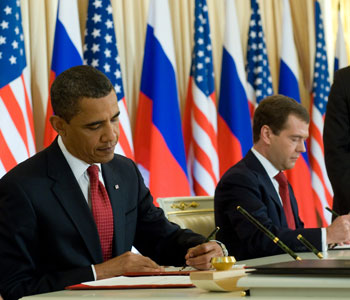 </p>Raising concerns about a new nuclear arms treaty is considered declasse. It’s about as welcome as a wedding crasher who questions the groom’s choice of a bride.