Author: Heritage

  • Rich, Helen DeVos Receive Luce Award

    On 04.09.10 09:39 AM posted by Ken McIntyre

    <ahref="http://blog.heritage.org/wp-content/uploads/devos.jpg"></p>Richard and Helen DeVos, two shining examples of American philanthropy and entrepreneurship, are being recognized today with Heritage’s highest honor, the Clare Boothe Luce Award, for their outstanding contributions to the conservative movement.

    The DeVoses are the guests of honor at a luncheon in Naples, Fla., as part of our annual Leadership Conference and Board Meeting. Heritage President Edwin J. Feulner and Board Chairman Thomas A. Saunders III were scheduled to present the Luce Award on behalf of the think tank’s trustees and over 625,000 members.

    “Rich and Helen made it their purpose, through a generous endowment of the <ahref="http://www.heritage.org/About/Staff/Departments/DeVos-Center-for-Religion-and-Civil-Society">DeVos Center for Religion & Civil Society here at Heritage, to keep fighting for family, faith and civic virtue to remain at the heart of American life — and of effective solutions to poverty, crime and family breakdown,” Feulner said before leaving Washington for Naples.<spanid="more-30985"></span>

    DeVos is best known as co-founder of Amway, the pioneering direct sales company he launched over 50 years ago with a high school pal, and as a <ahref="http://www.amazon.com/How-Like-Rich-DeVos-Succeeding/dp/0757301584">popular motivational speaker and author. He also owns the NBA’s Orlando Magic.

    Stalwarts of the movement know and admire the DeVoses, who’ve been married 57 years, as passionate contributors to candidates and causes, among them the <ahref="http://www.isi.org/homepage.aspx">Intercollegiate Studies Institute. They have given generously*for the betterment of *health care, higher education, the arts and a range of Christian ministries, especially in their hometown of Grand Rapids, Mich., and in central Florida.

    Feulner credits Rich DeVos with inspiring Heritage to painstakingly draft and adopt its own “shared vision statement.” Today, the resulting 17 words are emblazoned above the main entrance of our headquarters on Capitol Hill: The Heritage Foundation is committed to building an America where freedom, opportunity, prosperity and civil society flourish.

    We’ve got more <ahref="http://www.heritage.org/research/reports/2010/04/Vision-of-Richard-Helen-DeVos-Honored-with-Luce-Award">here on the DeVoses, including Ed Feulner’s account of adopting a vision statement.
    http://blog.heritage.org/2010/04/09/…ve-luce-award/

  • Volker’s Volley: The VAT Battle Begins

    On 04.09.10 10:00 AM posted by J.D. Foster

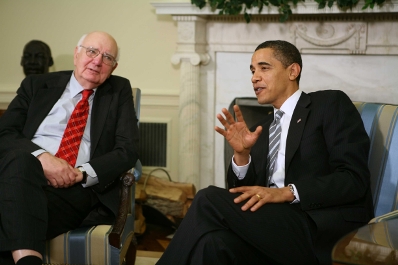
    <ahref="http://blog.heritage.org/wp-content/uploads/Volker.jpg"></p>President Obama’s push to enact a massive tax increase in the form of a new value-added tax (VAT) is now clearly underway. Earlier this week, Obama economic adviser and former Chairman of the Federal Reserve, <ahref="http://online.wsj.com/article/SB10001424052702303720604575170320672253834.html?m od=WSJ_Opinion_AboveLEFTTop">Paul Volker said a “VAT should be on the table.”

    White House claims that Volker was speaking as a private citizen simply do not pass the laugh test.* A senior statesman among economists, Volker is one of the president’s closest economic advisers. *No doubt Volker let the cat out of the bag prematurely from the White House’s perspective, but it is simply not credible to argue that Volker was not conveying the contents of White House thinking.* There can be little doubt now that the unspoken policy of the Obama administration is to pass a massive VAT tax hike.<spanid="more-30976"></span>

    This conclusion is further reinforced by the intense work being done all around Washington by liberal think tankers in preparation for the grand VAT push.* Even the Director of the Congressional Budget Office was quick to point out that <ahref="http://content.usatoday.com/communities/theoval/post/2010/04/presidents-panel-may-consider-vat-tax/1">the CBO is about to begin work on issues relating to a VAT.

    It comes as no surprise that attention is now turning toward the VAT as the liberal solution for unsustainable deficits that threaten the stability and very future of our economy. *Having hiked spending dramatically and then doubling down with his ObamaCare, the nation now faces unprecedented near-term debts as the clock ticks toward the long-recognized entitlements time bomb.* If there’s one thing conservatives and liberals agree on completely, it’s that deficits of this magnitude cannot persist.* Credit markets won’t allow it.* Some fundamental course correction is certain.* The massive amount of revenue a VAT could raise is the only acceptable solution left for most liberals since they steadfastly refuse to reverse course on their recently enacted spending binge.

    Why is the VAT the darling of the left?* Because it can raise vast new revenues without the taxpayers being really sure who took their money.* Consumers would pay the tax when they purchase goods and services.* Buy a car, pay the tax.* Buy groceries, pay the tax.* Buy chemotherapy drugs, pay the tax. In this way, taxpayers would only be aware of a bit of their tax bite with each purchase.* And unless the tax is printed on the receipt and they look for it, consumers would have no idea how much tax they paid on a particular transaction.

    Today’s deficits, and tomorrow’s, result from too much spending, not too little revenue.* Reverse the massive Obama spending surge (and the Bush surge before that) and the deficits would quickly fall to sustainable levels.* Instead, Paul Volker has done the nation a great service in telling us what Obama and his congressional allies are planning.** If that is not the case, if the President and the democratic leadership in Congress really are not planning a VAT attack, let them declare their opposition to a VAT plainly.* Every current and would-be member of Congress should say where they stand on the VAT.** And unless they favor a huge government, much higher taxes, and less transparency from government, they will stand against it.

    http://blog.heritage.org/2010/04/09/…battle-begins/

  • Not the Change Americans are Looking For

    On 04.09.10 05:25 AM posted by Nick Loris

    If you’re not willing to make significant sacrifices in your life to save the environment, don’t worry, you’re not alone. A <ahref="http://www.rasmussenreports.com/public_content/politics/current_events/environment_energy/65_say_americans_not_willing_to_make_major_lifesty le_changes_to_help_environment">new Rasmussen survey “shows that only 17% of adults believe most Americans would be willing to make major cutbacks in their lifestyle in order to help save the environment. Most (65%) say that’s not the case.” But that’s the name of the game for radical environmental agendas and even government regulations geared towards forcing Americans to use less energy.* Environmentalists want people to dramatically change their behavior. Of the ideas suggested by environmentalists or proposed/enacted by Members of Congress, what would the respondents consider major cutbacks?

    • <ahref="http://www.heritage.org/Research/Testimony/The-Economic-Impact-of-the-Waxman-Markey-Cap-and-Trade-Bill">Paying significantly higher electricity bills.
    • <ahref="http://www.heritage.org/Research/Reports/2010/01/What-Boxer-Kerry-Will-Cost-the-Economy">More pain at the gas pump
    • <ahref="http://blog.heritage.org/2010/04/02/epa%e2%80%99s-fuel-efficiency-standards-bad-news-for-the-consumer/">Forced into smaller, less safe vehicles
    • <ahref="http://blog.heritage.org/2009/10/23/reducing-your-carbon-paw-print/">Swapping your pet cat or dog for a pet you can eat
    • <ahref="http://blog.heritage.org/2009/10/27/eat-tofu-save-a-planet/">Reducing your meat consumption
    • <ahref="http://blog.heritage.org/2010/02/02/school-choice-bad-for-the-environment/">Eliminating school choice
    • <ahref="http://blog.heritage.org/2009/09/01/renewable-energy-goals-could-force-blackouts-in-britain/">Rolling brownouts and blackouts
    • <ahref="http://www.heritage.org/Research/Reports/2010/01/The-EPAs-Global-Warming-Regulation-Plans">Regulations on schools, farms, restaurants, hospitals, apartment complexes, churches, and anything with a motor—from motor vehicles to lawnmowers, jet skis, and leaf blowers.

    These are just a few examples of environmental alarmist ideas to reduce our nation’s carbon footprint or actual government-proposed laws and regulations.* Are those major enough?

    http://blog.heritage.org/2010/04/09/…e-looking-for/

  • In the Green Room: Judge Andrew Napolitano on Tea Parties and Why Obamacare is Uncons

    On 04.09.10 06:00 AM posted by Brandon Stewart

    </p>This week, Judge Andrew Napolitano, <ahref="http://www.foxnews.com/bios/talent/andrew-p-napolitano/">senior judicial analyst at the Fox News channel and author of the new book, <ahref="http://www.judgenap.com/">Lies the Government Told You, stopped by the Heritage Foundation to talk about his thoughts about the tea party movement and its prospects for the future.

    He also explained why he feels that Obamacare is unconstitutional and sketched out some points that might form a basis for a possible legal challenge.

    http://blog.heritage.org/2010/04/09/…onstitutional/

  • Confucius to Their Enemies: China’s Investment in Public Diplomacy

    On 04.09.10 07:00 AM posted by Helle Dale

    <ahref="http://blog.heritage.org/wp-content/uploads/Confucius.jpg"></p>Anyone who doubts the value of money spent on competition in the world of ideas – a key aspect of public diplomacy – needs to take a look at what the Chinese are doing in this field. Aspiring to promote their own model of governance, in opposition to that of the United States and the West, the Chinese are investing heavily in making friends overseas. Indeed, there is a real danger of the United States being out-done, for reasons of limited resources and a lack of strategy. The Chinese have both in spades.

    According to <ahref="http://www.washingtontimes.com/news/2010/apr/08/china-60-us-0-culture-centers-in-others-country/">The Washington Times, Sen. Richard Lugar (R-IN), ranking member on the Senate Foreign Relations Committee, has asked Secretary of State Hillary Clinton to account for the fact that China has been able to open 60 cultural centers – so-called Confucius Centers – hosted at universities across the country, such as the University of Minnesota. The centers endow chairs in Chinese language and culture studies and partner with existing university programs, creating hubs for Chinese cultural and political influence. China has established Confucius Centers in many Asian countries, making a Chinese presence felt in a way the United States simply does not. They also allow China convenient covers for “minders” of Chinese exchange student populations in the United States and elsewhere.<spanid="more-30945"></span>

    The Chinese strategy goes back at least as far as 2003, when the Chinese Communist Party promulgated its White Paper “China’s Peaceful Development Road.” In Foreign Affairs magazine in 2005, Chinese strategist Zheng Bijian laid out the concept of ideological competition for all to see, “China does not seek hegemony or predominance in world affairs. It advocates a new international political and economic order, one that can be achieved through incremental reforms and the democratization of international relations.”

    By comparison, the United States so far has no – zero – cultural centers (or comparable institutions) in China. During a hearing in February, Lugar grilled Secretary of State Clinton on the issue, and was told that the United States does not have the money to do what the Chinese are doing. “On the Confucius Centers, the Chinese government provides each center with $1 million to launch, plus they cover operating expenses that exceed $200,000 per year,” she said. “We don’t have that kind of money in the budget, so we are limited in the numbers that we can do.” Directors at the Confucius Centers told The Times that their grants are more modest, in the $100,000-$200,000 range, and are often partnered with existing programs. Either way, the Chinese have found a model that works in free societies.

    Now, the idea that the United States cannot afford what China can afford is preposterous — with an economy three times that of the Chinese, it is hardly a matter of money. The problem here is priorities and access. In the FY 2011 budget, the U.S. State Department has asked for a modest $14.5 million to fund 8-10 American cultural centers – to serve the entire globe. And of course China does not allow the openness* for the United States to partner with existing academic institutions.

    Since the end of the Cold War and the demise of the United States Information Agency, public diplomacy as an arm of U.S. foreign policy has received short shrift, the primacy of Western ideas being taken for granted. That is not good enough anymore.

    http://blog.heritage.org/2010/04/09/…lic-diplomacy/

  • Morning Bell: Heritage Action for America

    On 04.09.10 04:34 AM posted by Ed Feulner

    These are historic and exciting times. Yesterday, The Heritage Foundation took a bold and forward-looking step. Our Board of Trustees approved launching a grassroots advocacy organization to help press the conservative cause with our nation’s lawmakers. The independent organization will be called “Heritage Action for America.”

    Over the last two years, Heritage membership has skyrocketed. Over 633,000 Americans now proudly call themselves a Member of The Heritage Foundation. That staggering number, more than double our 2008 total, testifies to the quality and appeal of our original research and principled policy recommendations.

    Americans are more engaged and better informed than ever before. They’re not only opposing the “progressive” ideas emanating from Washington, but they’re educating themselves on the details, and the alternatives. That is where we come in. Over the past two years, no organization has come close to us in offering fact-based analysis of health care reform, energy and the environment, our nation’s defenses, the government’s fiscal irresponsibility, the entitlement crisis, education, the free enterprise system, American values, and the rule of law.

    The Heritage Foundation is, and will always remain, a beacon of scholarly leadership for conservative policy ideas. What Heritage Action for America will offer are better ways to advance conservative policies at the grassroots level and to aggressively market our ideas. And in doing so, Heritage will once again break new ground. Many organizations in Washington have gone in the opposite direction, establishing a think tank as a façade intended to add credibility to their political goals. <spanid="more-30895"></span>

    President Ronald Reagan once said: “If you can’t make them see the light, make them feel the heat.” Heritage Action for America will be the heat, harnessing grassroots energy to increase the pressure on Members of Congress to embrace The Heritage Foundation’s policy recommendations.

    Heritage Action for America will not get involved in election campaigns. The creation of a sister organization involved in issue advocacy in no way leads The Heritage Foundation away from its stated mission: To build an America where freedom, opportunity, prosperity and civil society flourish.

    America stands at the crossroads. We can become just another European-style welfare state or we can switch course and return to our roots of personal liberty, limited government and responsible stewardship. Charting our course will require intellectual firepower and grassroots political heft. With the creation of Heritage Action, we aim to harness the energy of both.

    Heritage grew from a small townhouse on Capitol Hill in the 1970s to what the New York Times currently describes as the <ahref="http://www.nytimes.com/2009/03/01/magazine/01republicans-t.html">“Parthenon of the conservative metropolis” or more aptly, “the beast” of the think tank universe. Growth is good. It’s the American dream, and we fight for everyone to share a piece of the American dream everyday.

    I thank you for continuing to support that fight. You can visit Heritage Action at <ahref="http://heritageforamerica.org/">HeritageForAmerica.org

    Quick Hits:

    • Economists at the International Monetary Fund project that the amount of <ahref=" http://www.washingtonpost.com/wp-dyn/content/article/2010/04/08/AR2010040801759.html">government debt held in the world’s advanced economies will soon be so great that it surpasses the value of what they produce in a year.
    • The Congressional Budget Office (CBO) said Thursday that <ahref="http://www.politico.com/news/stories/0410/35546.html#ixzz0kWyImUNC">our nation’s fiscal path is “unsustainable,” and the problem “cannot be solved through minor tinkering.”
    • CBO Director Douglas Elmendorf confirmed yesterday that he’s been getting “a lot of questions” about <ahref="http://www.weeklystandard.com/blogs/its-cbo-fielding-vat-questions-congress-0">Value Added Tax (VAT) from Congress.
    • The Labor Department said in its weekly report that the number of U.S. workers filing <ahref=" http://online.wsj.com/article/SB20001424052702304198004575171620576313354.html"> new claims for jobless benefits rose unexpectedly last week.
    • The Obama administration is now <ahref=" http://pajamasmedia.com/rogerlsimon/2010/04/08/breaking-obama-administration-denies-visas-to-israeli-nuclear-scientists/">denying U.S. visas to Israeli scientists and Israeli Prime Minister Binyamin Netanyahu <ahref="http://www.jpost.com/Home/Article.aspx?id=172707">called off his trip to attend President Obama’s nuclear conference in Washington.

    http://blog.heritage.org/2010/04/09/…n-for-america/

  • U.S. Policy in Africa: Long on Promise, Short on Performance

    On 04.08.10 01:00 PM posted by Ray Walser

    On April 5, in a speech at Harvard University Secretary of State Clinton’s lead diplomat for Africa Johnnie Carson outlined policy guidelines for sub-Saharan Africa.

    Assistant Secretary of State for African Affairs Carson is a seasoned, three-time ambassador to Africa with an illustrious career as a diplomat and an analyst of African affairs. **His speech stressed the importance of strengthening African governments and institutions, promoting economic progress, addressing health challenges, preventing and resolving conflicts, and meeting transnational challenges from climate change to drug trafficking.* In short, Carson followed the familiar, consensus-based road map drawn-up by previous Administrations.

    Yet, Ambassador Carson failed to mention Zimbabwe’s Robert Mugabe, “genocide” in Darfur,* Sudan’s fragile elections process, the case of Sudan’s Omar al-Bashir before the International Criminal Court, the presence of Islamist extremists Shabab and its linkage with the al-Qaeda in *Somalia, or the ongoing maritime challenge of Somalia piracy.* The Carson policy speech lifted goalposts, but revealed nothing of a genuine game plan.

    The Carson’s speech failed to bridge the persistent gap between modest if well-intentioned actions by the Obama Administration and tough, often intractable, challenges faced in the conflictive and uncertain arena of many African states that have either failed as nations or preserve only the most tenuous capacity to govern.* He said little about the need for hardball diplomacy, multilateralism with teeth, and the use of military and intelligence assets in the region.

    There is little doubt that the future of sub-Saharan Africa hinges essentially on the will African people to overcome tribal, religious, and social divisions in order to advance within a framework of democracy, free markets, rule of law, and stable national security.

    One critical benchmark largely missing in the current policy for Africa is the importance of economic freedom. *Sub-Saharan African places just one country (Mauritius) in the top 20 and twelve in the top 100 in the 2010 Index of Economic Freedom, the Heritage Foundation’s data-riven annual policy guide.

    Likewise, Assistant Secretary Carson failed to mention that *one of the greatest steps the U.S. can take to assist Africa is the lowering or removal of U.S. agricultural subsidies in order to open the door for more African agricultural imports and for real rural growth in Africa needed to lift millions out of poverty.

    http://blog.heritage.org/2010/04/08/…n-performance/

  • New START Would Render U.S. Vulnerable to Missile Attack

    On 04.08.10 01:30 PM posted by Baker Spring

    The Obama Administration, while acknowledging that there would be language in the preamble of New START alluding to a link between strategic offensive arms and missile defenses, asserted flatly that it would not impose any restrictions on U.S. missile defense options. The assertions have turned out to be misrepresentations.

    The language in the preamble is much more substantive than just an allusion to an undefined link between offensive strategic arms and missile defenses. Basically, the language asserts that missile defense capabilities must come down as the numbers of strategic nuclear arms come down.

    Further, this is language the Obama Administration has agreed to in New START. This is not the unilateral statement issued by Russia today regarding its threat to withdraw over advancements in the U.S. missile defense program, which the Administration could have said it does not share.

    Whether the Obama Administration wants to admit it or not, it has let Russia use New START to impose not just a direct limit on U.S. missile defense options, but a limit that will impose ever more severe restrictions on these options as time goes on and the number of strategic offensive arms come down under New START’s provisions. It is now clear that New START will render the U.S. unable to defend itself against missile attack, and therefore is inimical to U.S. vital interests.

    http://blog.heritage.org/2010/04/08/…issile-attack/

  • Americanism vs. Islamism: The Other Side in the Battle of Ideas Takes the Field

    On 04.08.10 02:00 PM posted by Walter Lohman

    Yesterday, the same day news leaked that the Obama administration intends to abandon references to Islamist ideology in its review of U.S. national security strategy, the other team received a major boost. Tariq Ramadan, European Islamist superstar, arrived in New Jersey for a tour of the United States.

    Heritage Foundation friend and inspiration for the title of this post, the American Islamic Forum for Democracy, has tracked Ramadan’s career and upcoming visit in vigorous detail. The following press release and links concerning his trip are well worth a read for anyone concerned about where the U.S. is headed in the battle of ideas:

    AIFD urges critical engagement of Tariq Ramadan
    April 7, 2010
    Controversial European Islamist scholar coming to New York as he begins his American “Victory Tour”

    Leading Muslim organization warns Americans Muslims to be on guard as Tariq Ramadan enters US
    PHOENIX (April 5, 2010) –The American Islamic Forum for Democracy (AIFD) is warning Americans Muslims, to be on guard as Tariq Ramadan makes his first visit into the United States since the Obama Administration lifted a six-year ban on his entry. Ramadan will be speaking on April 8, 2010 at the Cooper Union in New York City as the guest of the ACLU, the American Association of University professors, the PEN American Center and Slate magazine. He will continue on to speeches in Chicago, Detroit, Washington, D.C. and Garden Grove, CA. that will benefit Islamist organizations within the United States.

    >AIFD considers Ramadan a threat to American Muslims because he puts a passive face on the ideology of political Islam and the concepts of Islamic supremacy that for many Muslims remains a dangerous slope to radicalization. Ramadan is considered a rock star to many European intellectual elites, but if he were engaged in genuine debate with dissenting Muslims people would see that the emperor has no clothes.

    “Tariq Ramadan’s entry into America needs to be met with open dialogue from the Muslim Community, non-Muslim organizations and the media on the real threat of Political Islam,” said Dr. M. Zuhdi Jasser, President and Founder of AIFD. “It is incumbent on all Americans, especially American Muslims, to engage Ramadan at any opportunity to demonstrate that the US Constitution trumps the construct of the Islamic State.”

    Ramadan’s lineage is well known. He is the grandson of Muslim Brotherhood Founder Hassan al Banna and the son of Said Ramadan who spread the Brotherhood to Germany where it eventually spread throughout Europe. While the words Muslim Brotherhood rarely leave his lips, Tariq Ramadan’s ideology is indistinguishable from the Brotherhood which is counter to the principles of liberty and freedom found here in America.

    “To give Ramadan an unfettered platform for his dissimulation while also perpetuating his message of victimization is to give him and his clerical colleagues a status which will forever retard real reform within Muslim thought,” said Jasser. “Real reform comes from those Muslim leaders with the personal strength of character to call for an end to the Islamic state and the separation of mosque and state. Ramadan has not. Rather he is a soft tongued global instrument of political Islam against the bulwark of real freedom and liberty as we know it in the United States.”
    We also bring your attention to a briefer AIFD prepared on Mr. Ramadan and his April visits at this link.

    http://blog.heritage.org/2010/04/08/…kes-the-field/

  • Check Out the 2010 Budget Chart Book?New and Improved!

    On 04.08.10 05:37 AM posted by Nicola Moore

    The federal budget is on an unsustainable course with red ink as far as the eye can see, so it is especially important for Americans to understand spending, taxes, and debt.

    The Heritage Foundation’s Budget Chart Book is a user-friendly way to learn about the federal budget in pictures.

    As Federal Spending Chart 1 shows, spending has been on the rise—even before the recession and stimulus bill—and will continue to climb steeply under President Obama.

    Washington is planning to pay for this and more spending with tax hikes, but as Federal Revenue Charts 1 and 9 reveal, taxes are already a hefty burden and will reach unprecedented levels in the future.

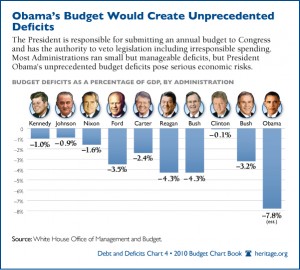
    Yet spending continues to grow far faster than revenues, creating record deficits. President Obama’s annual deficits will add more to the federal debt than every other president before him combined, causing the debt to skyrocket as Debt and Deficits Chart 3 illustrates. The main reason America finds itself on a precipice of disastrous deficits is from spending on the three major entitlements—Social Security, Medicare, and Medicaid.

    As Entitlements Chart 2 shows, these programs will double in size in a few decades. But Chart 10 explains spending cuts alone can’t pay for entitlements, and the level of taxes, shown in Chart 8, required to pay for the programs would devastate the economy.

    Tough policy choices and strong entitlement reforms are necessary to get the budget back on track. The Budget Chart Book will help you appreciate the size and scope of the decisions policymakers must enact to protect America’s fiscal future.

    Visit today to view the federal budget in pictures, download copies, view interactive charts, and share charts on your blog or social networks.

    http://blog.heritage.org/2010/04/08/…-and-improved/

  • High-Tax, High-Spend Model Still Does Not Work

    On 04.08.10 07:00 AM posted by Alex Adrianson

    State government finances are in a bad way, and for an examination of why that is the case, see the latest edition of “Rich States, Poor States,” released this week by the American Legislative Exchange Council. The basic story, as anyone following state fiscal issues will surely know, is that too many states went on spending binges in the early part of the decade when revenue was rolling in, but didn’t leave enough in reserve to handle the collapse in revenues caused by the 2008-2009 recession. The ALEC volume is, as past editions have been, chock full of great information. For instance:

    • Did you know that if states had just kept their spending growth the same as population growth plus inflation between 2002 and 2007, they could have maintained all their services and still provided a $500 billion tax cut?
    • Why did states leave nothing in reserve? Political pressure, especially from government employee unions is a big part of the story. State legislatures, for instance,*have lavishly enhanced pension benefits, but state employees should have little confidence that the states will ultimately make good on those promises. Only 9 percent of state pension plans have enough assets to be considered safe according to government standards.
    • Many state legislatures, unwilling to take on the well-organized lobbies for government spending, have resorted to raising taxes on the rich. But that will only exacerbate the boom-and-bust budget cycles, as Maryland’s experience demonstrates:

    Politicians in Annapolis created a millionaire tax bracket, raising the top marginal income-tax rate to 6.25 percent. … Already, Maryland has seen a one-third decline in tax returns from millionaire households. The rich have literally disappeared from the state tax collectors’ sights. Instead of the state coffers gaining the extra $107 million the politicians predicted, millionaires paid $257 million less in taxes than they did last year… . [Internal citations omitted.]

    • Yes, taxpayers and businesses vote with their feet, because some states’ policies—e.g., lower taxes, less labor regulation—are better for the economy than others. Utah, Colorado, Arizona, South Dakota, and Florida are the top five ranking states in the ALEC-Laffer State Economic Competitiveness Index for 2010. The top ten states in that index have had population growth of 18.5 percent over the decade 1998-2008, while the ten lowest ranking states had population growth of only 5.2 percent over that period.

    Cross-posted at Insider Online.

    http://blog.heritage.org/2010/04/08/…does-not-work/

  • NRC Decision Game Changer for Nuclear Blue Ribbon Commission

    On 04.08.10 07:40 AM posted by Jack Spencer

    The Secretary of Energy’s request that the Blue Ribbon Commission on America’s Nuclear Future not consider Yucca Mountain has been debatable from the beginning.* After all, America’s electricity ratepayers have already invested over $10 billion into the repository.* And besides that, federal statute clearly states that Yucca Mountain will be the nation’s repository.* Whether or not that is the best policy, it is the law.* Ignoring this investment and federal statute seemed like bad policy from the start.*

    However, the Nuclear Regulatory Commission changed what seemed to be bad policy to definitive bad policy on April 6 when it announced that it will not consider the Department of Energy’s motion to withdraw its application to construct Yucca until related lawsuits, which question the legality of DOE’s motion, are settled. Given that such lawsuits could take years to resolve, ignoring Yucca in light of this development would undermine the Commission’s credibility. The fact is that the Commission could well finish its safety review and be prepared to authorize Yucca’s construction by the time the courts finish their business and if the courts decide that DOE’s motion is illegal, then any Commission recommendation that ignores Yucca would be moot.

    That is not to say that the Commission was not going to consider Yucca anyway. It is made up of inquisitive professionals who clearly want to resolve a decade old problem and it is staffed by extremely intelligent and able individuals. That said, the Secretary’s charge to not consider Yucca comes with considerable weight and the Commission surely would prefer to follow his guidance. However, the NRC’s decision should provide the Commission with adequate justification to respectfully decline the Secretary’s request to ignore Yucca.

    Considering Yucca, however, does not mean recommending Yucca. The Commission should first come to a conclusion about Yucca Mountain’s viability. If it determines that Yucca is not technically viable, then it should simply defend that conclusion. However, if the commission concludes that it is viable and still determines that Yucca Mountain is not fit for nuclear waste disposal, then it should also state why that site should not be part of a comprehensive national nuclear waste disposition strategy and put forth a detailed recommendation on how to disengage from the program.

    On the other hand, the Commission could well conclude that Yucca is feasible and should be considered. Under this scenario, the Commission could bring high value to the debate but putting forth recommendations on how to ameliorate the underlying issues that have stifled Yucca’s progress, such as how to make Nevada a true partner in the process. One idea might be to consider making the license available to a third party, such as a private sector non-profit or even the state of Nevada. The new license holder could then negotiate a workable solution that would fully represent the interests of all parities. This process of negotiation was absent from the original decision to name Yucca the waste repository site. If no workable path forward is developed, then Yucca dies on Nevada’s terms. If an agreement could be reached, then Nevada could enjoy the many economic benefits of hosting such a facility.

    By slowing the Administration’s sprint to kill Yucca Mountain, the NRC has provided all parties an opportunity to think through the best policy solution moving forward. The Blue Ribbon Commission should grasp this opportunity to provide a truly comprehensive set of recommendations. Only by considering all options will the Commission truly be able to put the best set of recommendations forward.

    http://blog.heritage.org/2010/04/08/…on-commission/

  • Side Effects: States Will Feel the Effects of Obamacare

    On 04.08.10 08:00 AM posted by Kathryn Nix

    The national health reform rammed through Congress is giving state officials headaches. Writing in The Wall Street Journal, Indiana Governor Mitch Daniels outlines several problems states will have to deal with as a result of Obamacare.

    For example, Daniels now faces the prospect of terminating a popular insurance program for low-income Indiana residents. The “Healthy Indiana Plan” includes health savings accounts that have been widely popular with the program’s participants. Due to new health care law, however, Indiana will most likely have to dump the “Healthy Indiana” enrollees into Medicaid.

    Moreover, the Legislature will probably have to hike state taxes. Though federal funds will cover–initially—the medical cost of expanding Medicaid rolls, the states must cover the additional administrative costs. And the feds won’t cover the extra health costs forever. In later years, states have to pick up the tab of expanding benefits as well. At the end of the day, the Medicaid expansion will prove far more costly than “Healthy Indiana.”

    Daniels also notes that states must now weigh the possibility of dropping insurance coverage for their employees. It might be much cheaper just to pay the new federal penalty for not offering insurance, and letting state government workers use lavish federal subsidies to buy individual or family coverage in the new exchange. A Heritage analysis shows that’s one way private companies with a high proportion of insured, low-income workers can cut operating costs. It might work for some state governments, too.

    Of course, when state governments save in that way, others pay. Hoosier taxpayers would wind up paying the penalty imposed on the state government not complying with the law’s employer mandate. And federal taxpayers would pick up the tab for the subsidies given to help state workers buy coverage in the exchange.

    The unintended consequences of Obamacare outlined by Gov. Daniels demonstrate why we would have been better off letting the states take the lead in reforming the health insurance market. A federalist approach allows states to adopt reforms that best suit the needs and desires of their residents.

    To learn more about successful state health care reform, click here.

    http://blog.heritage.org/2010/04/08/…-of-obamacare/

  • What You Won’t Read in the Media about the New Birth Data

    On 04.08.10 09:00 AM posted by Christine Kim

    Tuesday, the Centers for Disease Control and Prevention (CDC) released preliminary U.S. birth data for 2008.* A flurry of news stories followed.

    Two statistics dominated the headlines: the total number of births fell by 2 percent, after peaking in 2007, and teen birthrates declined as well, reversing a slight two-year uptick.

    But the mainstream media completely ignored the most genuinely concerning trend in childbearing.* In 2008, more than 4 in 10 children, or about 1.7 million births, were born to unmarried mothers.

    For decades, unmarried childbearing has been trending unrelentingly upward.* In 1960, about 5.3 percent of all births were to unmarried mothers.* Ten years later, it had doubled to 10.7 percent.* By 1980, it was 18.4 percent, and in 1990, 28 percent.

    The 1996 welfare reform, which aimed to reduce out-of-wedlock childbearing as it is a primary cause of child poverty, slowed its growth rate for a few years, but by 2003, it resumed the dramatic climb, an increase of 17 percent in 5 years.

    In 2008, 40.6 percent of all births in the U.S, were to unwed mothers, according to the new CDC report.* While unwed teenage childbearing comprised one-half of all unmarried births in 1975, in 2008, the 133,000 births to those under age 18 comprised less than 8 percent of all unmarried births (22 percent if 18- and 19-year-olds are included).

    Indeed, out-of-wedlock childbearing has largely become a twenty-something phenomenon.* About 37 percent of all unwed births were to the young twenty-something, and another 23 percent to unmarried women in their late twenties.

    Why should the steady increase in unwed childbearing concern the public?

    For one, “the 1.7 million out-of-wedlock births are an overwhelming catastrophe for the taxpayers and society.” Heritage senior research fellow Robert Rector explains:

    The steady growth of out-of-wedlock childbearing and the general collapse of marriage lie at the heart of the mushrooming welfare/dependence state.* This year taxpayers will spend over $300 billion providing means-tested welfare aid to single parents.* The average single mother receives nearly three dollars in government benefits for each one dollar in taxes paid.* These subsidies are largely funded by the heavy taxes paid by higher income married couples.

    The public cost of unwed childbearing is burdensome, but weighty social concerns loom large as well.* Heritage’s Robert Rector further explains:

    The U.S. is rapidly evolving into a two caste system with marriage and education at the dividing line.* Children in the top half of the population are born to married couples with a college education; children in the bottom half are born to single mothers with a high school degree or less.

    The disappearance of marriage in low income communities is the predominant cause of child poverty in the U.S. today.* If poor single mothers were married to the fathers of their children, two thirds would immediately escape from poverty.* In addition, the absence of husbands from the home is a strong contributing factor to crime, school failure, drug abuse, emotional disturbance and a host of other social problems.

    And how have the Obama administration and the Congress responded to these worrying trends?

    They have proposed to effectively eliminate the only remaining federal program to strengthen marriage.* Instead, the administration and the Congress have created two new programs, including one in the healthcare legislation, that implicitly endorse a message of permissiveness among teens.* Costing about $200 million per year, the new programs fund additional comprehensive sex-ed, and add to the existing $610 million per year that already support these programs.

    For five decades, unwed childbearing has risen steadily, with no indication of relenting. Yet the only government response has been to spend more, a failing solution that also undermines the institution of marriage.

    http://blog.heritage.org/2010/04/08/…ew-birth-data/

  • This Treaty was Over Before it STARTed

    On 04.08.10 09:13 AM posted by Conn Carroll

    Shortly after Presidents Barack Obama and Dmitri Medvedev signed the New START agreement this morning, the Kremlin released the following statement:

    The Treaty between the Russian Federation and the United States of America on the Reduction and Limitation of Strategic Offensive Arms signed in Prague on April 8, 2010, can operate and be viable only if the United States of America refrains from developing its missile defence capabilities quantitatively or qualitatively.

    Consequently, the exceptional circumstances referred to in Article 14 of the Treaty include increasing the capabilities of the United States of America’s missile defence system in such a way that threatens the potential of the strategic nuclear forces of the Russian Federation.

    Section 3 of Article 14 reads:

    Each Party shall, in exercising its national sovereignty, have the right to withdraw from this Treaty if it decides that extraordinary events related to the subject matter of this Treaty have jeopardized its supreme interests.

    So basically Russia has already informed the United States that this Treaty is dead letter if the Obama administration develops missile defense capabilities in any way. The Obama administration may have scrapped land based missile defense installations in Poland and the Czech Republic, but Defense Secretary Roberts Gates’ 2010 Ballistic Missile Defense Review has made it clear that “further developing proven” missile defense capabilities is “a critical national security priority.”

    As New York University professor of Russian Studies and History Stephen Cohen told MSNBC just seconds after Presidents Obama and Medvedev signed the agreement: “Politically it is an unstable treaty.”

    http://blog.heritage.org/2010/04/08/…re-it-started/

  • The Two Faces of Obama’s Human Rights Policy

    On 04.08.10 10:00 AM posted by Helle Dale

    If you are a human rights activist or suffer under the yoke of an oppressive regime, do not expect the United States to be rushing to your assistance these days. As the U.S. government persists in pursuing engagement with less than savory regimes – such as those of Cuba and Iran – those who fight for liberty for their citizens are feeling the pinch.

    Groups supporting freedom for the citizens of Iran have felt the change in tone since President Obama took office. One example was the defunding of the Iran Human Rights Documentation Center in New Haven, Connecticut, which was denied a $2.7 million grant last fall. Also, despite the fact that Secretary of State Hillary Clinton in January declared open*season on Internet censorship on part of the U.S. government, the State Department has yet to walk the walk.*“We stand for a single Internet where all of humanity has equal access to knowledge and ideas. And we recognize that the world’s information infrastructure will become what we and others make of it. Now, this challenge may be new, but our responsibility to help ensure the free exchange of ideas goes back to the birth of our republic,” she said. Fine words, but what is the reality?

    In this case, the State Department is sitting on a sizable chunk of appropriated funding — $30 million in this year’s budget — for “circumvention” technology aimed at fighting Internet censorship.*This is money that could actually help shorten the timeline for when people in Iran (or China or Cuba for that matter) will be able to share their ideas freely.*Yet, State’s bureau of Democracy, Human Rights and Labor is dragging its feet on releasing the money. Sen. Sam Brownback (R-KS), as a consequence, has threatened to place a hold on Obama administration nominees until something happens.

    Similarly, support for democracy activists in Cuba is getting the squeeze – but this time from the Democratic Chairman of the Senate Foreign Relations Committee, Sen. John Kerry (D-MA). In the case of Cuba, the Obama administration set out to embrace engagement with the Raoul Castro regime and eased the ban on Americans traveling to Cuba (some 300,000 are expected to make the journey in 2010). Yet, tensions between Washington and Havana have recently arisen over the fact that Cuba holds a Maryland-based USAID subcontractor, Alan P. Gross, who was detained in December and has been held since then without charge. According to Politico, Gross was at the time engaged in distributing*telecommunications equipment to Cuba’s Jewish community on a USAID subcontract to promote democracy and civil society.

    As a consequence, the Obama administration is changing its tack somewhat on Cuba to the dismay of Sen. Kerry. The powerful senator, according to The Miami Herald, has put a hold funding for democracy assistance, for which $40 million was appropriated for 2009 and 2010, through the State Department and USAID.* This is allegedly with the purpose of reviewing whether the money is giving Americans taxpayers their money’s worth. A lack of desire to confront the abuses of the Cuban regime seems a more likely reason.

    Rhetoric from Washington about human rights and freedom does not go very far, and in fact becomes counterproductive, unless policy commitments and funding are there to back it up. Emissions of hot air are not likely to impress the world’s dictators.

    http://blog.heritage.org/2010/04/08/…rights-policy/

  • Freedom: Key Indicator of Support for America’s Interests in the U.N.

    On 04.08.10 11:00 AM posted by Anthony B. Kim

    In her March 30 speech at the opening ceremony of the National Model U.N., Ambassador Susan E. Rice, U.S. Permanent Representative to the United Nations, pointed out that:

    Important as the United Nations is as a vehicle to promote global security, foster broad-based development, and advance collective interests, the UN is far from perfect. A serious gap still separates the vision of the UN’s founders from the institution of today. The Security Council still stumbles when interests and values diverge, as they do over such issues as Darfur, Zimbabwe, Burma and Sri Lanka. In the General Assembly, member states too often let political theater distract from real deliberation and decision.

    Not surprisingly, with its complex system of organizations, funds, programs, offices, and other bodies, the U.N. is indeed a profoundly bureaucratic and political body. The U.N.’s 192 members seek to advance their various, and often conflicting interests. As Heritage Foundation Vice President Kim Holmes points out in Liberty’s Best Hope: American Leadership for the 21st Century, “the original principles of freedom and democracy that inspired the founders of the U.N. have been lost in a cynical power game that essentially defines legitimacy and ‘democracy’ as whatever a majority of U.N. members say it is.”

    The American public has correctly recognized the difficulty of working through the U.N. to advance U.S. interests and has expressed frustration with the systematic shortcomings that plague the international organization. As a recent Gallup poll noted, “Americans have never held the United Nations in particularly high esteem.” Since 2003, an average of only 32 percent of Americans have agreed that the U.N. is “doing a good job,” with the lowest approval rating of 26 percent recorded in 2009.

    Indeed, many diplomatic initiatives of America, the largest contributor to the U.N. budget, often meet with blockages and delays by other member nations. Of course, expecting every U.N. member to follow America’s lead is not realistic. Even America’s strongest allies do not agree with the U.S. on every vote. However, America could champion its positions more effectively in the General Assembly, particularly by seeking to build and strengthen coalitions among economically and politically free U.N. members. As shown in research led by Heritage’s U.N. expert Brett Schaefer, “the more economically and politically free a country is, the more likely it is to support America’s diplomatic initiatives in the U.N.”

    In her speech, Ambassador Rice also emphasized the importance of coming together “to advance America’s interests, to stand up for America’s values, and to strengthen our common security by investing in our common humanity.” Forging stronger coalitions with economically and politically free countries in the U.N. will serve as an indispensable long-term diplomatic tool for advancing American priorities.

    However, the reality is that a majority of the U.N. is neither economically nor politically free and the near term prospects for them to become free are slight. The majority of these countries do, however, receive U.S. assistance each year. Yet, according to an annual State Department report on voting practices in the U.N., about 95 percent of U.S. foreign aid recipients voted against the U.S. in a majority of the non-consensus votes, and over 72 percent voted against the U.S. in a majority of the non-consensus votes deemed “important” by the U.S. Department of State.

    If it is to influence these countries, America must also show that it does not view the U.N. as a penalty free zone in which recipients of billions in U.S. aid dollars are free to vote against the U.S. with impunity. If America is to improve this situation, it must be willing to link U.S. assistance to support for key U.S. priorities in the U.N. and other international organizations.

    http://blog.heritage.org/2010/04/08/…ts-in-the-u-n/

  • The Kyrgyz Republic Cries for Economic Freedom

    On 04.08.10 11:41 AM posted by Anthony B. Kim

    The Kyrgyz Republic, host to a strategic U.S. airbase at the Manas airport, is in political turmoil triggered, at least on the surface, by government-mandated price hikes in fuel, electricity, and mobile phone rates. The landlocked economy is one of the poorest of the former Soviet Union, and the economy’s transition to economic freedom has lagged far behind the more Western –oriented former Soviet republics like Georgia or the states along the Baltic Sea.

    Over the years, the Kyrgyz Republic has implemented some positive economic reforms, notably introducing a more flexible labor code and implementing a flat tax rate of 10 percent for both individuals and corporations. However, the country’s overall economic development has been severely constrained by widespread corruption and a weak judiciary. According to the Heritage Foundation’s 2010 Index of Economic Freedom, the Kyrgyz Republic scores just 18 points on the 0-100 scale for freedom from corruption, with the editors noting that “corruption is endemic at all levels of society.”

    President Kurmanbeck Bakiyev, apparently toppled by the current unrest, came into power in 2005 during the country’s so-called Tulip Revolution, with a pledge of more meaningful economic development and democracy. Instead, the country got a different type of sweeping reform that transferred: “management of the economy and security to new bodies controlled by [Mr. Bakiyev’s] family and close associates,” as noted by the Financial Times.

    It is not surprising when people denied economic freedom seek change through political means. If government controls the means of production, all economic decisions become political decisions as well. And when avenues of political protest are blocked, blood runs in the streets.

    http://blog.heritage.org/2010/04/08/…nomic-freedom/

  • A Sneak Attack on NYC?s Electric Bill

    On 04.08.10 12:00 PM posted by Jack Spencer

    The New York Department of Environmental Conservation is guaranteeing that New Yorkers will soon have to pay even more for electricity — when they can get it.

    The department just rejected Indian Point’s request for a water-quality certificate, which the plant needs to keep operating one reactor running after 2013, and the other after 2015. (The plant also needs its license renewed by the federal Nuclear Regulatory Commission, but that’s a different battle.)

    A court fight is expected, but if this holds up, New York City in particular is in trouble: Indian Point provides about a third of Gotham’s power (and nuclear plants overall generate 31 percent of electricity statewide).

    Even assuming that power can be replaced, it won’t come cheap: Nuclear power is the least expensive form of electricity produced in the United States. And New Yorkers already pay more than a third above the US average for electricity (17.8 cents per killowatt-hour, six cents above average).

    Making this even more absurd, there’s no genuine environmental problem here — and the department is making things worse by insisting on a more expensive, and probably less effective, “solution.”

    The State denied the certificate largely because Indian Point’s water-intake system, which draws water from the Hudson to cool the reactors, kills about 1 billion aquatic organisms annually — mostly eggs, larvae and plankton.

    That sounds significant — but industry studies show that Indian Point has had virtually no impact on the populations of life in the Hudson as a whole. The plant draws only about 1 percent of the passing water, returning most of it — and the “kill rate” seems well within the bounds of the ecosystem’s ability to replace. (We’re largely talking microorganisms here.)

    The problem is that the regulation looks only at the mortality rate at the intake structure, not on how the intake structure affects overall environmental quality.

    Nevertheless, Entergy, the plants’ owner, has agreed to make changes. It would install a system of screens underwater to reduce the number of organisms killed by up to 90 percent. This retrofit would cost between $100 million and $200 million and could be in place in a few years.

    But the regulators aren’t satisfied: They’re demanding a larger system that would require the construction of cooling towers — a process of up to 15 years. Thanks to various regulatory delays (see below), these wouldn’t be online until about 2030. The system would cost more than a billion dollars and take the power plant offline for a year.

    It’s also fraught with problems:

    • During the decades of construction, nothing would be in place for decades to save the organisms that regulators claim to be protecting.
    • Cooling-tower systems are often criticized by environmentalists — they use about twice as much water as the current system. Indeed, thanks to evaporation (which is what the towers are for), we’re talking about a net loss to the Hudson of more than a billion gallons of water a day.
    • The project would also require a massive excavation of soil and bedrock. While this is environmentally manageable, it’s unnecessary, disruptive to the area — and very expensive.
    • Add the regulatory realities. For example, the huge cooling towers likely wouldn’t satisfy state visual-impact regulations. And building them would require a host of zoning and land-use authorizations from multiple local jurisdictions — many of which have said they won’t support tower construction.
    • Plus, about half of New England’s natural gas runs through pipelines that cross the Indian Point site. These would have to be rerouted and new right-of-ways established — a regulatory nightmare in and of itself, since the same sort of local activists that want Indian Point gone will also fight gas-pipeline construction.

    Bottom line: The Department of Environmental Conservation is basically imposing hurdles that Indian Point almost certainly can’t clear — which suggests what the real agenda is here. The fact that it’s demand in such an unfeasible system when better, more attainable alternatives are available is just confirmation.

    That is: The decision to deny Indian Point its water-quality certificate is a bid to close the plant down — possibly with an eye on then shuttering other nuclear plants with similar cooling systems across the state or even nationwide.

    This isn’t state bureaucrats doing their job — it’s an ideologically-driven move that could cost New York a vital source of clean, affordable energy.

    First printed in The New York Post.

    http://blog.heritage.org/2010/04/08/…electric-bill/

  • The Liberal’s Biggest Blind Spot: Who Really Rakes In Their Government Largesse?

    On 04.07.10 01:00 PM posted by Terry Miller

    In recent days, some blogging friends from the left have commented on the U.S. dropping from “free” to “mostly free” in the 2010 Index of Economic Freedom, the Heritage Foundation’s data driven policy guide.

    <ahref="http://www.huffingtonpost.com/2010/04/06/us-no-longer-a-free-count_n_527072.html?view=print">The Huffington Post picks up on the long-term erosion of economic freedom in which both political parties have been complicit:

    Though the analysis of American freedom acknowledges a longer-term trend stretching back to the end of the Bush administration, [the Index] seems to put the lion’s share of blame on the policy initiatives of President Obama

    <spanid="more-30772"></span>

    Indeed! As reported in the 2010 Index, it was in late 2008, under President Bush, that a threatened financial meltdown triggered some hasty and dangerous Washington policy decisions to bail out large firms. Unfortunately, President Obama has doubled down and more on those policies, with unprecedented levels of government spending, most favoring big finance, big auto companies, big labor unions, and now big pharma and medical insurance companies.

    The <ahref="http://www.salon.com/news/politics/war_room/2010/04/06/heritage_america_not_free/index.html">blog in the “War Room” of Salon unfortunately seems to miss the point entirely: “Freedom’s just another word for letting corporations do whatever they want.” To the contrary, for the editors of the Index, one of the prime reasons to push for economic freedom is to avoid the pernicious tendency for government intervention that sides WITH the interests of big corporations and special interests rather than with the average man or woman. The pattern we see, in the United States and around the world, is government intervention tending to support the interests of those who are already politically and economically powerful. The rhetoric may be populist, but actual government programs almost always favor the status quo. Economic freedom is the antidote, promoting competition, equal treatment for all, and the empowerment of the individual.

    Anthony Kim Contributed to this post.

    http://blog.heritage.org/2010/04/07/…ment-largesse/