Author: jeremiah_owyang

  • Altimeter Book: ‘Open Leadership’ the Next Phase of Groundswell

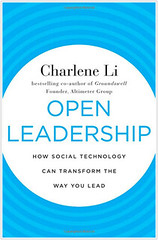
    Open LeadershipIf you’re a catalyst for change within your organization, this book is for you, you should buy several copies for your organization today.

    I’m proud to be part of the next generation of Groundswell, my business partner Charlene Li’s book ‘Open Leadership’ hits the shelves today.  If you want your management team to accelerate their thinking for your social business programs, this book offers insights, examples of how other leaders have embraced these technologies, internal audits, checklists and even ROI formulas that the C-Suite demands.

    Like the prequel Groundswell, Open Leadership stems from solid research and yields real world use cases.  For those of you that are managing existing social business programs you know how the biggest challenge is causing  a culture change to happen from inside out.  One of the key levers in your business program will be to obtain executive buy-in in order to bless organizational change –without it, you’re plane can truly never leave the runway without great risk.

    We work closely with many of the world’s social strategist’s a corporations, and know that the biggest challenge is a cultural change of letting go to gain more. This book, is a useful tome of knowledge that can accelerate learning within your executive suite. Use this book to quickly find examples of how other leaders around the globe are adoption social technologies in order to gain more.

    I’d also like to point out, from an internal point of view (having worked with her a few years now) that she truly lives and embodies the spirit of being open. She ‘let go’ of a lot of control of the company in order to make it a partnership, and is always open to our eccentric ideas. Aside from being a thought leader in the concept of Open Leadership, she lives it within her own company.   I was previously involved in reviewing Groundswell before it was published and joined the Groundswell team, and am very proud to be back again working closely with Charlene here at Altimeter Group.

    So, if you’re already investing your career to catalyze change within your organization, add octane to your efforts by getting your team, and executives moving faster by ordering a case of Open Leadership now, rarely do I ask you to take action and buy anything, but I ask that you do so now

    Open Leadership Resources

  • Industry Index: List of Social Inbox Aggregator (SIA) Providers

    Written by Jeremiah Owyang (Customer Strategy) and Ray Wang (Enterprise Strategy), Industry Analysts at the Altimeter Group.

    We’re tasked with a difficult job as Industry analyst in one of the fastest moving markets. Part of our role is to find new trends, identify them, and rate and rank who offers them. In the past, I did this for this list community platform marketing, and the Social Media Management System market (SSMS). Yet a new set of features is now emerging on the industry, and I’m here to identify it now.

    Situation: More social data causes a cacophony of noise
    Soon your fridge, car, and house will tweet. (plants already do, and I ordered this collar so my dog can too). At work, your server, business applications, and eventually your powerpoints will emit signals as your colleagues make changes to it. The challenge is, all of this information is in different channels, and may not be aggregating to one location. To combat this deluge of information, we should expect a new feature to emerge that will aggregate all content into one locaiton and make sense of it.

    [The Social Inbox Aggregator (SIA) will aggregate multiple social streams and derive signal out of social noise]

    Definition: Social Inbox Aggregator (SIA). The primary purpose of the Social Inbox Aggregator (SIA) will be to derive signal out of social noise. This feature has the following functional requirements 1) It will aggregate social signals from a variety of sources into one location, 2) Allow users to organize, and view multiple sources 3) Derive signal through looking at previous behavior and predictive analytics. 4) Offer analytics and metrics to the user (optional)


    List of Social Inbox Aggregators
    Usually when I start these lists, it starts with just a handful (there’s just 5 listed below) in the case of the community platform space, it grew to be over 100 vendors.

    Consumer

    • Windows Live*: Windows Live (including hotmail) offers features that let you know “What’s new with your network”, while they don’t make it easy to add in social signals from other locations, this could be accomplished with partners like Gigya* or Janrain.
    • Gmail/Buzz:  Gmail’s recent addition to their social networking feature “Buzz” launched with fanfare, then great concern about privacy.  Despite the rough start, they allow users to connect with their friends and aggregate in other signals, such as flickr feed, tweets, and beyond.
    • Friendfeed/Facebook:  Friendfeeed was the early forerunner in this space, they aggregate streams from a variety of sources (including straight RSS feeds) and allow for users to organize and derive signal.  They were recently acquired by Facebook, and we should expect many of these features to surface directly into the newsfeed in future iterations.  Also, there’s market rumors that Facebook will develop a web based email client, that will likely integrate private emails with social signals.
    • My 6th Sense: This application (primarily on an iPhone) offers a “digital intuition” by allowing users to aggregate data streams into one location. I’ve met the CEO and he showed me how it looks at your previous behavior in order to suggest content to you.
    • LinkedIn: Pulls in tweet stream, blog posts, Amazon reviews, and a variety of other data sources to generate signal.

    Enterprise

    • Chatter by Salesforce*: Salesforce has made nods to launch an enterprise system that will “monitor everything that matters most to you in one spot.” Expect this system to be one of the first enterprise SIA systems and will pull in feeds from AppExchange data, external signals, and derive intelligence.
    • Socialcast.  This lightweight tool allows any company to have an internal Facebook. They recently launched a ‘recommended’ feature on the left nav that can prioritize signal based on the gestures of your network. While they have integration with sharepoint, they’ve yet to offer ability to pipe in other streams.

    Takeaway: Most Systems are Immature
    Looking at these vendors, some of them have 2-4 of the required features, but none have all four. We expect this space to evolve rapidly and will conduct continued analysis and rankings. Since we’re early, we’ll hold off on detailed analysis till the feature set standardizes. Remember, in the future, there’s no difference between email systems and social networks.  Expect a new feature to emerge that combines both of these data types into a new interface.  Expect a SIA for your personal life, and a separate one provided by your employer at work.

    *Altimeter discloses our client relationships whenever possible, as a result, we hope you’ll trust us more.

  • Roadmap: Integrating Social Technologies with your Corporate Website (Slides)

    A few years ago, I wrote a controversial post suggesting corporate websites were irrelevant.  Why?  Decisions were being made off-domain by customers and peers.  Secondly, many marketers were trying to get customers to go to their corporate website versus joining where they already are, “Fish where the fish are.”

    Today, I’m pleased to see that the thinking –and technology, has emerged, where we’re finding a variety of companies that are integrating social technologies right into the corporate website, bringing the trusted discussions closer to the corporate site.  In fact, I’m kicking off the Gilbane CMS conference in SF as the keynote, and will be sharing this deck live on stage.


    Although the highest state of nirvana (seamless integration) doesn’t yet exist, we should expect there to be very little difference between social technologies and corporate websites as content will assemble on the fly.  I predict URLs won’t matter, as content will be dynamically assembled around the buyer and their context in a variety of devices.  Sure, that’s far out thinking now, but that’s why we have several other stage gates that companies must first go through.

    In fact, use this presentation (loosely modeled after a post of the same topic) as a roadmap for brands, web strategists, and the vendors that serve them.  Feel free to use these slides with attribution.

    Thanks to our head of Research, Christine Tran for her assistance.

    Related Resources

  • Social Commerce Breakdown: How Levi’s and Facebook Prompt Your Friends To Improve Your Buying Experience

    In the future, the difference between social networks and corporate websites will be hard to distinguish.

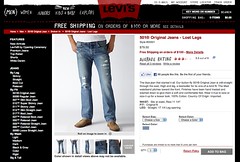
    HP’s social strategist Tony Frosty Welch gestured for me to check out Levi’s recent social moves, his instincts were right, this is unique. Two weeks ago, Facebook announced a crusade in social colonization to spread Facebook across the web, and we’re starting to see Levi’s take advantage of it.  While most brands are only at level 1 of social integration, Levi’s has jumped to level 6 and 7.

    Breakdown: How Facebook Enables Levi’s Social Shopping


    Levis.com homepage spreads awareness
    Awareness (Above Screenshot): Levi’s homepage indicates that it now has Facebook integration

    Education of Facebook Likes is "More Fun"
    Education (Above Screenshot): An intro video indicates how users can gesture they like a product, by “liking” it on the Levi’s site –even if they are not logged into Levis.com, you can watch the video also on YouTube.

    Users can "like" products as they browse the site, and see which one of their friends also 'likes' it
    Social Gestures (Above Screenshot): On each product page, Levi’s encourages users to “Like” the products, and uses standard social features from Facebook that prompt viewers to be the “First of your friends” to like it.

    Social Commerce:  A shopping cart with your friends suggestions is automatically created
    Social Commerce (Above Screenshot):  Using the aggregated Facebook data, Levi’s creates a personalized shopping cart based on what your friends have suggested you’ll like, hoping to increase upsell.

    Customer Demands Signals From Social Networks An Opportunity for Retailers
    Levi’s has launched a promising marketing opportunity at low cost. By simply installing existing social features into their content management systems, they can increase the mouth of the marketing funnel, and benefit from word of mouth marketing.

    • Your friends are shopping with you –even if they aren’t present. This has two major impacts: 1) Consumers real friends are part of the shopping experience –even if they are not physically present. 2) The level of engagement will eventually cascade to mobile devices in store, so eventually as consumers walk into a retailer that has Levi’s they could scan the product and see which one of their friends likes or recommends it.
    • A more engaged user, without forcing them through registration. Registration forms are the bane of marketers: Most consumers disdain them, enter garbage data, and fall off as the forms get longer.  However, As long as users are logged into Facebook they can do this even if they are not logged into Levi’s.com. This means that consumers can ‘like’ a product and engage with the Levi’s product and spread it to their friends on the corporate site and on Facebook. As a result, expect the mouth of the marketing funnel to be wider
    • Consumers take part in marketing and recommendations, increasing upsell opportunity. Levi’s has had social shopping features on their site for some time, you can see the ratings, rankings and comments on each product page, yet in most cases, consumers don’t know who those reviewers are.  Edelman’s Trust research indicates that customers trust each other or ‘people like them’ so this has the opportunity to increase. In theory there could be a great chance of up and cross sell as consumers rely on their actual friends to influence buying decisions. Expect celebrities with large followings to be more influential as what they ‘like’ will cascade over thousands.
    • Social commerce vendors will integrate with Social CRM –yet should be cautious of user privacy. Social vendors like Bazaarvoice, Kickapps*, and Pluck and other customer rating tools that occur post login, need to quickly pay attention to this as it’s both a threat an opportunity. They should develop integration tools and integrate their social data with CRM systems (called Social CRM) to create new and unique forms of data that can anticipate customer needs. Facebook users aren’t fully aware of the long term impacts this has, expect some embarrassing and news worthy stories to appear where a consumer ‘likes’ a product resulting in an unexpected result.

    The biggest opportunities are actually unseen. Expect savvy brands to use demand signals from consumers to indicate which products should be ramped up on production, distribution, and marketing, to learn more read my colleague’s blog on Supply Chain Management, by Altimeter’s Lora Cecere.

    *An Altimeter client, see disclosure page. We hope you’ll trust our analysis more if we disclose our relationships.

  • Altimeter Report: Social Marketing Analytics (Altimeter Group & Web Analytics Demystified)

    A Collaborative Effort Between Two Firms:  Web Analytics Demystified and Altimeter Group
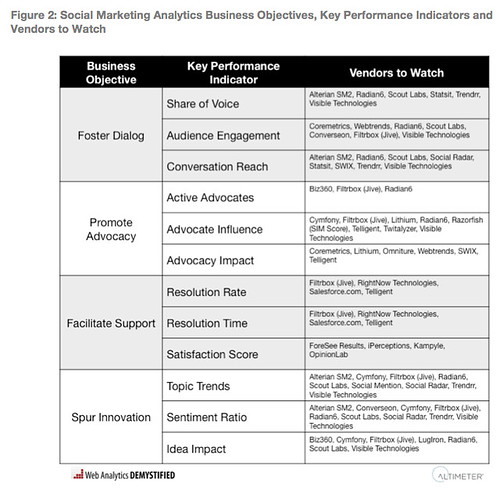
    It’s just been over a month since we published the Social CRM Research paper (over 36k views on slideshare) and we’re continuing our cadence here at Altimeter Group of publishing widely available reports under the spirit of Open Research.  This time, it’s different, we’ve aligned with who I feel are the smartest team of web analytics minds in the space, John Lovett (ex-Forrester analyst) and Eric Peterson (ex-Jupiter analyst) both of the Web Analytics Demystified firm.  Stemming from Altimeter founder Charlene Li’s (ex-Forrester Analyst) framework, we co-developed this framework, and put our collective minds to work on measuring the rapidly changing social media marketing space.   This self-funded research effort resulted in a thorough methodology as we interviewed over 40 ecosystem influencers.

    Interested in learning more?  Attend the no-cost webinar by registering.

    Industry Challenge:  ”I can’t measure social media ROI”
    Marketers around the globe are ranging from toe dipping to jumping all the way into the social marketing space –yet most lack a measurement yardstick.  While experiments can fly under the radar for a short term, without having a measurement strategy, you run the risk of not improving what you’re doing, justifying investments, and the appearance of being aloof to upper management.  To be successful, all programs (even new media) must have a measurement strategy, and we’ve done just that.

    Social Marketing Analytics Framework

    Finally, A Measurement Framework Based on Business Objectives
    If you’re familiar with the Altimeter frameworks of developing a social strategy based on business objectives, then you’re in good shape, as this research report is the natural extension of the business objectives we put forth:

    • Dialog: involves starting a conversation and offering your audience something to talk about while allowing that conversation to take on a life of its own
    • Advocacy: activation of evangelism, word of mouth, and the spread of information through social technologies
    • Supporting: customers may self support each other, or companies may directly assist them using social technologies.
    • Innovation: The business objective of innovation is an extraordinary byproduct of engaging in social marketing activity.

    Our framework is a common denominator, yet if you’re already measuring converted leads, or actual sales from social media, great!     Yet   In this meaty report, which we hope you share with your marketing and analytics team, has actual KPI formulas which you should start to use as the start of your own cookbook.

    Social Marketing Analytics

    View more documents from Jeremiah Owyang.

    A Nod To the Community Spirit
    We’re putting a big stake out there, in order to further the industry to come together around a common set of KPIs and metrics, but we realize we don’t know all the answers.  In the spirit of Open Research, we want this to be an open framework (we’ve even licensed this under Creative Commons) to customize it and make your own for non-commercial reasons with attribution.  If you’ve ideas on how to improve it such as new KPIs, vendors, or approaches, we’re listening, and will incorporate and improve this community body of knowledge for all to benefit.

    Related Links
    I’ll link to others that extend the conversation, feel free to embed the slideshare on your own site.

  • Facebook’s Crusade of Colonization

    Today marks yet another important era in Facebook’s saga.

    Today, I’ll be attending the f8 developer conference hosted by Facebook, they’re anticipated to make some key announcements around new programs for developers to take part in.  I’ll be live blogging from the keynote, and will give my take on what it means.

    What we know from folks that are dissecting the agenda is that Facebook must become more open and spread to the web –not be relegated to their domain only.  In order to compete with Google, they must envelope the web by putting up Facebook connect as small colonies, and grow those into larger towns and thriving cities.  Enter Facebook’s crusade to colonize the web, not just facebook.com –but the whole internet.  More to come soon, as I update this post in real time.

  • Matrix: Building and Managing Your Online Career Reputation (Unvarnished, LinkedIn, Blogs, and More)

    In the digital world, expect your clients, new boss, and recruiters to review your online footprint.  In fact, a Microsoft study “showed that 70 percent of hiring managers have rejected candidates because of what they found on line. It’s not all bad news, though. 85 percent said they were influenced by positive online information.”  With stats like this, it’s important you develop a strategy.

    As more social tools appear, you are losing control over your online reputation
    Recently, I was briefed by the very controversial Unvarnished (in beta), a website where people you’ve worked with can leave anonymous comments about working with you, both good –and bad. After my discussion with the CEO and founder, I learned that Unvarnished has a series of checks and balances, such as: FB connect to verify IDs, human vetting of those IDs, and the a series of programs that helps to identify if someone is coming in and trolling, or actually giving fair reviews to a variety of folks. One of the interesting features was that the tool would look for reciprocation of reviews, as those that come in and review others without getting reviewed themselves would be valued less.  Despite the checks and balances, the power has shifted away from you –and to those of your peers.

    Develop a strategy to build and manage your online career reputation
    Despite the well thought through checks and balances, Unvarnished and other online reputation tools everyone should be conscious of how their online reputation will impact their client work, future jobs, and ultimately your bank account. We’ve seen a variety of technologies emerge for commercial reputation like Amazon rankings, eBay account, to Rapleaf. Yet to best understand how to use the different tools at your disposal for your personal career, I’ve created this handy matrix which you can use to take advantage and minimize risks.

    Matrix: Building and Managing Your Online Career Reputation

    Tools Control Rating and Example Opportunities Risks What no one tells you
    Online Footprint You have a high degree of control. All the things you do online that are discoverable: persona blog, social media accounts (Facebook, YouTube, Twitter). Demonstrate your knowledge of your craft through thought leadership, and show how well you work with others Personal and off topic content could be misconstrued or even used against you. Those embarrassing college photos on frat row may come back to haunt you. Be proactive and develop a personal blog and own your SEO over your name –before someone else does.
    Reference Submissions You have a moderate degree of control. That third page on your resume that you submit to hiring manager and recruiters. Chances are, these are solid references you’ve worked with the past that will vouch for you over the phone or in writing Not fully believable, since these were vetted, coached and pre selected This is really used for confirmation that you’ve worked there. Savvy recruiters are able to find out areas of weakness, so work with your references in advance to align on where you should improve.
    LinkedIn References You have a high degree of control. Vetted references on your LinkedIn profile It’s always great to have confirmation that you’ve worked with others, and see where you’re really strong Believable, but filtered by you, so for many recruiters and hiring folks this is confirmation –not an unbiased review. Careful here, this can quickly become quid pro quo, and you should be selective of who gives your references. Do this too much and you’ll look like a suck up.  I’ve limited my usage of doing it.
    Unvarnished References You have a low degree of control. This controversial new site uses FB connect to verify identity but allows people to give unbiased anonymous reviews of your work. Finally, an platform for unbiased reviews, people can say what they really want about your strengths and weaknesses. Negative information will surface about you, and the more successful you are, the more likely this is to happen Unvarnished has a series of checks and balances setup to ensure reviewers are real people and have experience working with others.
    Google You have a variable degree of control. Google owns reputations, and what surfaces on the top few pages on your name are key. News articles, blog posts, and wikipedia pages that discuss you will score high. Recruiters will certainly seek to find out about you, and the chance to score high with positive content are high. If someone has trashed you online expect it to surface. Lack of control of what can surface. Develop an online personal brand strategy to ensure your top results are clean. In the worst case scenario consider a name change or hire a reputation firm to help, I’m sure they’ll leave comments below.

    Build a Career Strategy Around Your Online Reputation
    Don’t idly stand by  for someone else to own your online reputation develop a strategy now.

    • Be proactive, you’re responsible for your own reputation. Change your mindset, you must be managing your online reputation if you choose not to participate.  Setup Google Alerts for your own namesake and that of your family members.  Recognize that there’s an incredible amount of your ‘private’ information already available through Zabasearch (which gleans public records you’ve used from mortgages, loans, and magazine subscriptions), combined with Google Maps of your home layout, and Zillow to find home value, an incredible amount of information is already out there.  For best results, use the matrix above to decide which toolset will best be used for your strategy.
    • Develop an online career strategy –be decisive.  Every time you press a keyboard key  you’re leaving a digital snail trail online.  Recognize that every online and social interaction you make is forever leaving a mark online.  Those that do so in public forums may be haunted for years or as long as the internet is available.  Be sure to educate the millennials on the impacts that their online antics have to their future careers –likely they have no idea of the ramifications as they can’t see beyond next weekend.
    • Develop tactics to minimize risk. No doubt those that climb the corporate ladder step on a few toes to get there, and those that want to develop a career or personal brand will act outlandish on occasion to get attention.  With those opportunities come risk, and those that are aggressive online will certainly have detractors.  Develop PR skills that professionals have, understand the basics of SEO, own your own namesake domain, and continue to publish on a blog for greatest results.   Those in reputation slump will likely look at online tools that defend reputations or try to clean up past mistakes, those in more dire situations will change their name.

    I hope this was helpful, both to corporate web strategists, but to all professionals.  Please leave your tips below in the comments.

  • People on the Move in the Social Business Industry: April 18, 2010

    In an effort to recognize the changes in the social media space, I’ve started this post series (see archives) to both track and congratulate folks who get promoted, move, or accept new exciting positions. Please help me congratulate the following folks:

    potm-banner-2

    Also, my submission form has changed to a new URL, the former Google form was giving me problems, so please use this one going forward.  Lots of movement in the social business category, including a few key hires at firms that get the social business landscape and quite a few submissions continuing to come in on the form.

    • Bruce Tempkin, top blogger at Forrester and Analyst departs Forrester, you can find his blog announcement. I’ve admired Bruce’s commitment and quality of work as a fellow colleague, and wish him luck on his next ventures. He really is one of the Star Analysts out there, be sure to connect with him and clinch his sage advice early before he gets totally booked.
    • Dr Natalie Petouhoff “Dr Nat”, is a former colleague at Forrester covering the customer experience and knows the Social CRM landscape and social support. She’s also moved on, you can find her blog, and you should connect with her as she launches her consulting career.
    • Dion Hinchcliffe joins the Dachis Group, one of the leading consulting firms that gets social business. The Dachis Group is poised to become the next system integrator vendor and consulting firm, and I expect them to give the ‘big’ consulting firms a run for their money as they continue to hire talent, thought leaders, and stay nimble and flexible.
    • Steve Gillmor, famed Techcrunch IT editor (and former colleague of mine at PodTech) joins Salesforce in the strategy team. This is an extremely smart move for Benioff as Salesforce knows success of the chatter and appxchange platform is to connect with the web startups. Steve is a direct and indirect influencer over the startup ecosystem and this lays a big bridge down for Salesforce to take marketshare in the developer ecosystem.
    • Mona Nomura joins MySpace as a social media marketing manager, her online presence will match with the youthful and active MySpace community, a key hire in the regrowth and build of MySpace.
    • Sanjay Dholakia former CMO at Lithium is now heading up Crowd Factory as the CEO, I’ve worked closely with Sanjay and am looking forward to see the next successes he does in the future.
    • Uwe Hook launches BatesHook focusing on business transformation agency by integrating Social Media initiatives.
    • Maria Ogneva joins Biz360 as Director of Social Media Propel and manage online buzz for Biz360, a social media monitoring and measurement platform.
    • Greg Hollings joins FreshNetworks as Head of Community Management Manages and heads up the community management team at busy social media agency.
    • Glenn Conradt joins CoreMedia as Vice President of North American Marketing, Sales and Operations.
    • Dean McBeth joins Wieden + Kennedy as the Old Spice Community Manager focused on using social media to maximize the positive perception of the brand and the effectiveness of campaigns.
    • Ryan Turner joins ZAAZ as Director, Social Media Lead the social media practice at ZAAZ, part of the WPP network.
    • Brett Goodwin joins MyWebGrocer as Senior Account Director focused on sales.
    • Sabrina Suares joins MyWebGrocer as Director, Eastern Sales
    • Talented Bob Garfield joins Fizz as Consultant in Residence, I look forward to the work he does, find his announcement blog post.
    • Ben Grossman joins Oxford Communications as Interactive Strategist Launch concerted social communications group and serve as interactive strategy lead for digital projects from an integrated standpoint.
    • Ariel Sasso joins DataXu as Marketing Communications Manager Growing DataXu’s reputation and presence with integrated marketing, communications and social media initiatives.
    • Tom Edwards joins Red Urban as VP, Digital Strategy & Emerging Technology Digital & Social Media Strategy

    How to connect with others (or get a job):
    Several people have been hired because of this blog post series, here’s how you can too:

    Submit an announcement
    If you know folks that are moving up in the social media industry, submit to this form

    Seeking Social Media Professionals?
    If you’re seeking to connect with community advocates and community managers there are few resources

    This list, which started with just 8 names continues to grow as folks submit to it. List of Social Computing Strategists and Community Managers for Enterprise Corporations 2008 –Social Media Professionals.

    Job Resources in the Social Media and Web Industry

  • Web Strategy Jobs powered by Job o Matic (Post a job there and be seen by these blog readers, these affiliate fees pay for my hosting)
  • Read Write Web keeps announcements flowing at Jobwire, although is broader than just social media jobs
  • Facebook group for community manager group in Facebook
  • Jake McKee’s community portal for jobs
  • Chris Heuer’s Social Media Jobs
  • SimplyHired aggregates job listings, as does Indeed
  • ForumOne Jobs for Social Media and Community
  • Teresa has a few jobs, some around community
  • New Media hire has an extensive job database
  • Social Media Headhunter
  • Social media jobs
  • Jobs in social media
  • Altimeter Group’s list of social media consultants and agencies
  • Social Media Strategists and Community Managers for 2010
  • Hiring? Leave a comment
    If you’re seeking candidates in the social media industry, many of them are within arms reach, feel free to leave a link to a job description (but not the whole job description, please)


  • Framework and Matrix: The Five Ways Companies Organize for Social Business

    Yesterday’s webinar, you can view all slides (including these graphics below, and recording) on getting your company ready for social included a section on organizational models. I wanted to share more in the usual web strategy matrix style as 5 minutes on a webinar isn’t really enough to do a complicated topic justice. Interestingly enough, I’m often called into companies that are moving out of organic and into coordinated, or dandelion model as a central team needs help working with various business units and setting up the internal program. I plan to do a detailed research report on this topic in Q3, to find out how companies are organizing. First, let’s take a look at the different models that exist to provide blanked education to the market:


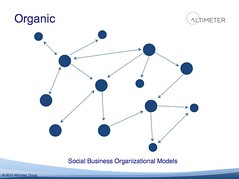
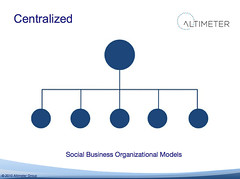
    Frameworks: Organic, Centralized, Coordinated, “Dandelion”, and “Honeycomb”

    Organic
    Organic: Notice that the dots (those using social tools) are inconsistent in size and one set of employees are not directly connected to others.

    Centralized
    Centralized: Notice that a central group initiates and represents business units, funneling up the social strategy to one group.

    Coordinated
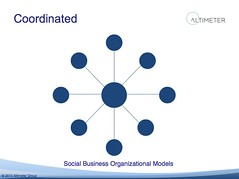
    Coordinated: Notice how a central group will help to provide an equal experience to other business units.

    Multiple hub & spoke "Dandelion"
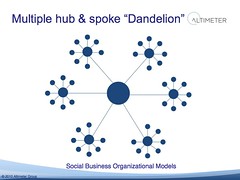
    Multiple hub & spoke “Dandelion” notice how each business unit may have semi-autonomy with an over arching tie back to a central group.

    Holistic "Honeycomb"
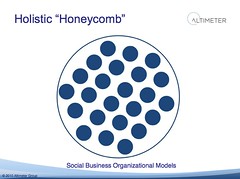
    Holistic “Honeycomb” notice how each individual in the organization is social enabled, yet in a consistent, organized pattern.


    Analysis: Pros and Cons of Each Social Business Model

    Description Advantages Drawbacks What No One Tells You
    Organic Social efforts bubble up from the edges of the company, much like Sun Micrososystems encourage a blogging culture for all employees. Looks authentic and therefore trusted as multiple conversations appear closer to products and customers. Inconsistent experience to customers, one side of the company has no idea what the other side is doing, and multiple enterprise software deployments. Later, a nightmare for IT data management and marketing. This model is typical in large companies where control is difficult to enforce and often in software based companies. Mostly, I see companies transitioning out of this model.
    Centralized One department (Usually corporate communications) controls all social efforts. See how Ford has deployed their efforts to engage in the tough discussions while staying on brand. Great for consistent customer experience, coordinated resources, and rapid response May appear very inauthentic as press releases are rehashed on blog posts or videos by stiff executives. Great for regulated industries or brands over scrutiny, yet make sure you bring forth the employee voices –not just faceless logos, notice how Ford’s Scott Monty is front and center.
    Coordinated A cross-functional team sits in centralized position and helps various nodes such as business units, product teams, or geographies be successful through training, education, support. See how the Red Cross keeps various chapters organized, especially during life-threatening crises. The central group is aware of what each node is doing and provides a holistic experience to customers with centralized resources Costly. Executive support required, program management, and cross-departmental buy in. I see most companies headed this route, in order to provide safe autonomy to business units. Tip: the hub should be an enabler –not social police.
    Multiple Hub & Spoke “Dandelion” Often seen in large multi national companies where ‘companies within companies’ act nearly autonomously from each other under a common brand. Companies with multiple products like HP and IBM may naturally gravitate this direction. Business units are given individual freedom to deploy as they see fit, yet a common experience is shared amongst all units Requires constant communication from all teams to be coordinated which can result in excessive internal noise. Requires considerable cultural and executive buy in, as well as dedicated staff. Most suited for large multi-national corporations with multiple product lines. Look closely, the lines connecting the multiple hubs may be severed. Tip: provide way for spokes to connect to each other, not just be funneled through a central group.
    Holistic “Honeycomb” Everyone is in customer service and support and any employee who wants to be social is enabled. Dell and Zappos fit the bill. Tapping into your entire workforce (Best Buy’s Twelpforce is an example) to support and help customers Requires executives that are ready to let go to gain more, a mature cultural ethos, and executives that walk the talk. Very few companies will ever achieve this as it stems from internal culture, don’t ever force this, be true to your self. Tip: provide training classes on culture, social readiness, and a hotline for help for any employee

    Conduct Internal Analysis Of Your Company
    We focus on providing pragmatic advice to our clients, and it shouldn’t stop with this blog. This blog post should be shared with internal teams and then undergo this discussion:

    • First, identify which organizational model you’re in. Companies should forward this post to the internal teams to have a discussion on which model they think they are in. What’s interesting is that I often ask internal teams to vote on which model they think they are, and most often not everyone agrees, savvy executives should just observe. The dialog that ensues afterwards is most key.
    • Next, discuss which model is your company’s desired state. Companies must evolve to respond to the social customer, yet their current state may be different than the desired needs.  This decision can’t be made in a vacuum various business units, geographical locations, product teams and support and service groups must be considered –this isn’t about marketing alone, instead, put your customer’s experience first.
    • Recognize this isn’t an org chart, it’s a cultural change. Executives and their employees must realize the social web is forcing companies to undergo a cultural change as customers connect directly to each other bypassing companies. As a result, don’t expect these changes to happen quickly or without change management programs.

    Thanks to Richard Binhammer at Dell who recently at 2010 SXSW shared with me Dell’s “enlightened” state of organic, and Christine Tran, Altimeter Researcher for aid in these graphics.

  • Social Strategy 3/3 Webinar Recording and Slides: Getting Your Company Ready

    We finally completed our final third webinar in our social strategy trilogy. It’s been great sharing our insights and widely releasing it to the community, and I hope you enjoy this final segment. The topic? Getting your company ready internally through research, processes, organizational models, policies, resources, and more.

    Above: Download the slides from slideshare and use as you see fit. The “crises plan” is a slide that can be customized for your needs, just provide attribution.

    Social Strategy: Getting Your Company Ready, by Altimeter Group from Altimeter Group on Vimeo.

    Above: Listen to the recording, including the presentation and attendees Q&A

    Love to get your feedback, was there anything we missed? Let us know if this information helped your organization, contact me anytime if you’ve questions jeremiah at altimetergroup dot com.

    The Social Strategy Trilogy

    Part 1: Socialgraphics help you to understand your customers
    Part 2: Developing a Social Strategy
    Part 3: Getting your company ready (you’re here)

  • Quicktake Analysis: What Twitter’s “Promoted Tweets” Means To The Ecosystem

    The Altimeter group was pre-briefed by COO Dick Costolo of Twitter direct last week about this upcoming launch, we’ve had some time to think over what it means to the industry as well as to brand marketers.

    Summary: Twitter has launched promoted tweets
    Brands can now advertise promoted tweets on search pages, however the community has power over which tweets will appear measured by Twitter’s new metric called “Resonance” which factors in behaviors like the retweet, at, hash, avatar clicks. Brands can now purchase CPM based ads to promote these popular tweets at the top of a Twitter search term –even in categories they aren’t well known in spreading awareness and influence.  Unlike traditional advertising or social marketing this is both a combination of earned media and paid media.  This is a smart move for Twitter it taps into deep pockets of online advertisers without jeapordizing santity of the community as users will self select which tweets will resonate and thereby become promoted ads.

    How it will work, a likely use case scenario:

    1. Users will continue to interact with each other, and popular tweets will receive a high ‘resonance’ score from Twitter.  Some of these Tweets will be created by brands, and some by the users themselves.
    2. Tweets with heavy resonance can be purchased by advertisers in a CPM basis to appear as the first ’sponsored’ Tweet on a search term.  The sponsored tweets will be clearly labeled and have a different background color.
    3. These promoted tweets will only stay if users continue to resonate with them, those that don’t will disseappear and a different tweet with resonation will appear.

    Matrix: What Twitter’s Promoted Tweets Business Model Means to the Ecosystem
    This has several implications to the ecosystem as a whole, we’ve broken down the impacts to the various players in this matrix:

    Player Direct Impacts What They Will Do What No One Tells You
    Twitter Finally gets a business model beyond search deal partnerships with potential to scale.  Taps into deep pockets of online advertisers. Experiment. Expect black and gray hat marketers to try to game this system, in order to obtain resonance. Twitter will constantly tune algoryhthem like Google does. Expect this to cascade to their partners and grow into the ecosystem as Twitter aggregates resonation on other 3rd party sites
    Social Marketers Brands can now finally buy influence over users by using using promoted tweets in the search page. Brands will ask their customers to retweet to increase their resonance. Will build an inventory of top promotable tweets Don’t go overboard, make sure you think of this in the larger context of integrated marketing. Avoid shiny tool syndrome.  Must pay close attention to what terms are resonating with community to build inventory
    Direct Marketers and Advertisers Finally.  Beyond traditional advertising direct marketers have skin in the social game Flail. Many will try to buy their way in and obtain resonation without asking why a tweet resonates.  Will fight over top searched terms in Twitter, expect a lot of contests to promote tweet engagement. Expect tension between this marketer and the social marketer if education is not completed.
    Users Have power over which promoted ads will stay visible Initially be shocked by changes, then learn they can help self select tweets that will be promoted..  In the real time resonace world users have a lot more power Power tweeters like celebs and digerati will be targeted by marketers to engage and resonate tweets.  Twitter users that retweet tweets may  be surprised to see their promoted tweets in search engine results ads.
    Developers and Agencies Finally, a goal they can aim for will focus business models to glean ‘resonance’ Developers are waiting with baited breathe for Chirp developers conference this week to see how this will be tied in.  Twitter has indicated that promoted tweets will spread to clients, expect revenue sharing to be offered Expect half a dozen vendors and agencies to approach brands in the next quarter offering the ability to increase ‘resonance’ and case studies will show increase in resonance.
    Competitors and Search Engines: Beyond a new player being in town a new form of advertising is afoot changing the game. Expect nervous deals to come to the table on how search engine results can factor in Twitter’s resonance.  Yet expect players like MSFT and Yahoo to quickly launch their version of defining how the social web should be categorized. They will have the advantage of built in ad base of advertisers and millions more users.  Google and Bing will fold this in and reward resonance and combine with page rank, or will create their own metric to reward social engagement

    For Resonation, Brands Must Pay Closer Attention To Users –This Isn’t Traditional Spray And Pray
    Power continues to be in the hands of the users, however brands that pay attention to why tweets resonate will have a leg up.  Recognize this is early days, many will experiment, here’s how you should approach this space.

    • Change your mindset: This is a combination of organic and paid ads, you’ll need skills from both worlds to be successful. Direct marketers should educate social marketers, and social marketers should explain how resonation occurs in the conversational web. Remember, this gives top tweets staying power beyond the constant stream of chatter.
    • How to pick which tweet to promote: First, monitor which tweets are already resonating with your brand, take note of what is causing it to resonate and in what context. Secondly, recognize that these tweets should have long term impact, not a daily special as the tweet is promoted, users will interact with it, forcing it into a viral loop.  For best results, experiment with promoting tweets from your customers –not just those that you create.
    • Twitter users have power over which promoted Tweets will work: Remember they get to choose which tweets can be put into the advertising inventory as their interaction will self select which tweets can become promoted. Secondly, promoted tweets that don’t yield community engagement will also fall off the stream. is that in the real time resonace world users have a lot more power.
    • A New Yardstick: ‘Resonance’ is the Page Rank of Microblogging: Advertising agencies and social marketing agencies will come out of woodwork, most will do it wrong.  Look for a sophisticated partner that knows the value of social conversational marketing to create an inventory and the long term experience of an advertising agency that knows the value of advertising placement. Expect resonation to also cascade to other social networks like Facebook and even community platforms and content management systems to derive what content should surface.  Twitter has made nods to new dashboards to appear, expect your agency partners to align around resonation as the ROI.

    This post is the result of the collaborative efforts of the Altimeter team including Charlene Li (Leadership), Alan Webber (User Experience/Government), Michael Gartenberg (Mobile) and Christine Tran (Research). See Twitter blog, AdAge, and NYT for details.

    >>>>>>>>>>>>>>>>

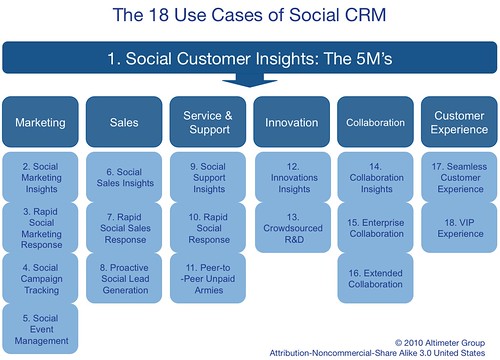
  • Social CRM Webinar Part 1: The 5Ms and Marketing Use Cases (Slides and Recording)

    The Market Took to the Social CRM Use Cases
    The Social CRM report by the Altimeter Group is a hit.  Within 30 days it has received over 30,000 views, been touted as the “Most Viral BtoB Report“, and brands and SCRM vendors are aligning their roadmaps in alignment with the use cases. There were over 800 registrants for the webinar, and we had nearly 300 attendees, over 135 of the registrants said they wanted to be contacted by a SCRM vendor. All of these numbers indicate that there’s interest in this new market, and we’re glad to help illuminate the pathway.

    Watch the Recording and Use The Slides
    Our belief in Open Research means we try to collaborate with the market on conducting research, then sharing a great deal of it so the market can build on top of it, improve it, and we can continue to learn. Yesterday, we hosted part 1 of the SCRM webinar series, and have made the slides and the recording available.

    Above: The slides, you can download on slideshare and reuse the content under creative commons

    Social CRM Use Cases: 5Ms and Marketing, by Altimeter Group from Altimeter Group on Vimeo.

    Above: The webinar recording. I apologize, my voice was a bit soft due to technical reasons however at 14 minutes in I switch headsets and it clears up.

    We also polled the attendees about their readiness to deploy
    When are you planning to invest in a Social CRM Solution? (41% of attendees responded, but this was at the end of webinar, so we don’t know how many still online.)

    • A) Not at this time (25%)
    • B) In the next 30 days (14%)
    • C) In the next quarter (14%)
    • D) In the next year (9%)
    • E) Not sure (35%)

    This means that 28% of the attendees were interested in investing on Social CRM solutions.

    Related Resources
    This is just the starting point, harness these other resources to become successful.

    Four Steps When Working with Social CRM Vendors
    After you’ve digested the report, and are starting to prepare for the 5Ms, approach social crm vendors with these four tips.

    1. Forward them the report.
    2. Ask them to define which use cases they currently specialize in.
    3. Ask to see a roadmap of which use cases they’ll be launching in coming quarters.
    4. Ask how they’ll work with other SCRM vendors that offer use cases that they can’t deliver.
  • Matrix: How To Choose Social Media Programs by Brand, Lifestyle, Product or Location

    Brands confused by choices on how to deploy social media programs
    I recently spoke to the global marketing team at a large technology company, and one of the questions being wrestled with was deciding if social media efforts should be setup by brand, vs product teams wanting to create their own unique pages and experiences.  A specific question emerged “Should we setup our efforts by product type or by brand?” There are drawbacks and upsides to each of these, and I wanted to layout the ramifications.

    [Whether companies setup their social programs by ‘Brand, Lifestyle, Product, or Location’ they must choose wisely. Each deployment as a different benefit and drawback. The savvy will use in combination.]

    Brands who choose poorly risk community backlash -those that do not choose risk worse
    Companies that choose poorly will have wasted internal efforts and resources, set up false expectations for customers and may struggle with trying to redact a program in public where customers are already assembling. In particular, social failures like Wal-Mart’s branded community ‘The Hub’ have now become a case study of doing it wrong. Yet having no strategy means that product teams, regional teams, and individual regions will do whatever they want –causing clean up for corporate late.

    Matrix: How To Choose Social Media Programs by Brand, Lifestyle, Product or Location

    What it is: Benefits: Drawbacks: What no one tells you:
    Brand Companies often created their own Facebook/Twitter/Blog site focused on the company logo, brand, and corporate news.  See early pioneer Direct2Dell, Sony Electronics Twitter, GM’s Fastlane Blog On brand. One stop shop for all things related to the brand.  Easy place to find company news, product announcements.  Often, corporate teams can support an ongoing program Less trusted. Will often lack engagement, personality, and as a result decreased trust.  If brand doesn’t allow customers to talk to each other or self-express, it’s odd talking to a logo. It’s important to set expectations on the type of communications that will happen, be sure to have a community policy in order to enforce. See Nestle’ case example
    Lifestyle Brands created lifestyle communities such as communities for Wells Fargo’s teen, Amex’s small business owners, or even by cultures like Asian Avenue or BlackPlanet Staying power. By joining customers in the way they already self-organize you’re matching their existing needs –beyond your product push Off message. Less control over the conversation which may extend beyond your brand and products and talk about what matters in their life.  Product focused teams may not have right mindset ‘customer-first’ mindset. First, find where they may already exist and consider joining. Create your own lifestyle deployment only to meet an unmet need.  Often this is at the mouth of the marketing funnel.
    Product Building a Facebook, Blog or Twitter feed for a specific product or product line.  See the Playstation blog, Doritos Facebook page, Specific info. Meets the needs of the Product Marketing Manager to give tight information about a product Granular and insular. Lack of customer focus and risk of investing in a community that could become irrelevant if the product reaches end of life. Lack of solution sell to lifestyle as consumer may want to purchase several products. If your product has staying power and a thriving community around it (like Xbox, PS3) with sub products around it it may make sense.  Consider this towards the bottom of the marketing funnel, or even customer support.
    Location Restaurants, hotels, and retail stores may want to create their own Facebook, MySpace, Yelp experience. Or specific regions may have different product sets and create their own communities to meet a unique culture.  See Four Seasons Twitter index Hyper targeted. Local markets may benefit from geo location marketing as location based social networks like GoWalla, FourSquare, MyTown, and Yelp grow.  Provide unique local experience. Lack of control. These individual pages may be setup by the managers daughter and lack true long term resources or ability to fend of sophisticated situations. Danger in these sites becoming abandoned over time, with no clear way to retire them without community backlash. Likely, this is already happening. Get ahead of it and provide the right training, processes, and hotlines for these disparate groups to have autonomy –but within clear set of guardrails protecting your brand.

    How to Choose The Right Mix:

    • First, be customer focused. Companies should first identify the social graphics of their customer base to understand where they are online.  Secondly, they should understand their social behaviors, who influences them, and how they influence others.  In most cases, customers have already assembled their own communities and analysis should be done on how to join them where they already are.
    • For best results, use in combinations. Rarely is the world an ‘or’ but an ‘and’.  Companies should know when to use these in an orchestrated combinations.  Sophisticated social strategists are mapping all of their programs against marketing funnels to know which tool should be used during what customer phase.
    • Think long term –not just by campaign. Don’t launch short term social efforts unless it’s just around a single event and the expectations are clearly set up front.  Grown fans, followers, or subscribers is an investment that will cost you, so plan on doing this for the long term –not a short one-off campaign.  Remember, in most cases, customer communities have been here before your brand was on the social web, and likely they will be here after your brand.
  • Framework: Rings of Infuence

    Recently, I spoke to a crowded room of senior marketers at a CPG retailer, one of the executives asked “What’s an indicator a company is advanced in the social space?”.  I gave three answers, and one of them was “Developing a thriving advocacy program to fight your battles”.  The executives, which were used to traditional advertising and direct marketing had a lightbulb go off as I showed them this framework.

    Companies unable to scale into social channels –hindered by traditional thinking
    Companies are unable to respond quick enough to the masses of customers complaining on social channels, they simple can not hire enough community managers and Social CRM systems are still being developed.  The old school thinking of traditional marketing putting the sole focus on voice of corporate communications, and sanctioned executives only.  Yet now, as social tools are pervasive (take a look at all the people accessing Facebook from their mobile phones) the gateways of public communication have been opened.   This gap in ability to scale and traditional t

    Brands must extend their strategy to the outside rings.
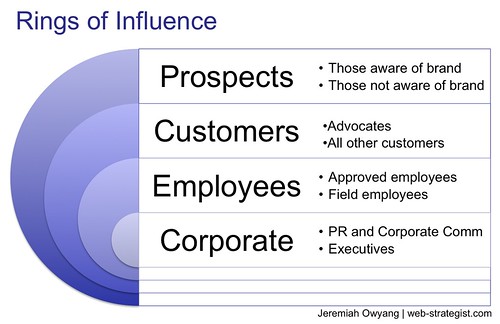
    In order to scale in both time and mass, corporations must now extend their communication strategy beyond just corporate communications and sanctioned ‘company representatives’ to include others in the mix.  In the following graphic of the “Rings of Influence” I’ve mapped out how other individuals can and should be used in the communications strategy.   I’ve worked on trust research at my former employer, and found that in most cases the closer in the rings (corporate) there’s less trust.  Independent studies, like Edelman’s 2010 trust barometer indicate similar findings, figures 7 & 8 are telling in this PDF. Inversely, the further out in the rings (prospects and customers) the greater the levels of trust.

    Framework: Rings Of Influence
    As brand embrace the larger circles, the greater opportunity for reach, trust  –and risk.  I hope you use this graphic in your planning docs and presentations, it’s licensed under creative commons as Attribution-NonCommercial-ShareAlike Creative Common.  Graphic assistance by Christine Tran, @christineptran

    Rings of Influence

    Role and Description The Opportunity: Who’s Doing It Right: What no one tells you:
    Prospects: Those that are not yet customers. Engaging soon-to-be-customers during their problem and pain stages and focusing them on your solutions is the goal. Build lifestyle communities to engage them in a ‘bigger-than-brand’ discussion such as CVS’s community for caretakers. You’ll really need to let go of hard marketing styles and focus on what IBM’s senior marketer Sandy Carter calls “light branding”.  Make sure you have a community kickstart plan.
    Customers: Existing buyers, some which are super engaged and vocal in the space. Enabling the voice of the customer has been a mainstay belief for product development, but most companies have not harnessed them for marketing and support. Build an active advocacy program that encourages them to fight your own battles like Intel Insiders, Microsoft MVP, Wal-Mart’s 11 moms program. Bazaarvoice enables companies like BestBuy to have ratings and reviews on their site –increasing flow through funnel Customers will love and hate you alike. If you harness their voices, expect to let both types of information come through in a strategic way. The trick? Use complaints as an opportunity to show openness and customer response in public. The savvy brands will trigger advocates to deal with detractors, use this checklist to get started.
    Employees: Rank and file as well as ‘approved employees’ who are enabled to use social. Regular rank and file customers that are knowledgeable about products and are close to customers are likely to be more trusted than veneered executives. Give your own rank and file the opportunity to voice their opinion like Premier Farnell gave many of their employees the ability to publish their own videos on a community like Element 14. Employees need guidelines, training, and processes. Don’t leave your company or your employees exposed, develop internal training programs, regular communications, and a place to share. See how Intel has created a light weight ‘certification’ program for employees who participate in social
    Corporate: The traditional and centralized communications group and sanctioned company representatives Corporate comms can benefit from social tools that allow the spread and sharing of company messages, and they can also build a social platform to stand on in order to fend of critics See how SouthWest Airlines has built a corporate blog for years, which gave them the standing power to fight back against detractor Kevin Smith. Also, see how Domino’s President used online video to respond in a human and more trusted way during an employee health crises. Lots of retraining when it comes to rethinking the approach in this space. Stop and breath, develop a measured set of steps a framework, control is not completely lost if you have a balance. This is an opportunity more than a threat.

    Harness All The Voices In Your Ecosystem –Not Just Traditional Corporate Voices
    Brands should stop focusing on the corporate ring alone –and benefit by using all the rings in a coordinated fashion.  I’ve broken down the roles into subsets in the above matrix, yet there are some key baseline considerations as your deploy, remember to:

    • Recognize that greater opportunity is abound at outer rings –but comes with increased risk. Brands are most comfortable operation in the inside rings, like ‘Corporate’, yet the greatest opportunity to leverage trust and reach happens at the outer rings of influence with ‘Customers’ and ‘Prospects.
    • Map the  rings to your existing customer experience timeline. These rings aren’t unlike traditional marketing funnels, except that there’s a focus on role and trust, over cycle. In most cases, prospects are in the outer mouth of a funnel, but customers, employees, and corporate can also participate in every step of the marketing funnel. Analyze which roles are needed in what aspects of the customer timeline –and map your strategy accordingly
    • Be pragmatic, and develop a roadmap: start with smallest ring and move out. Don’t jump on the largest ring of prospects without first getting grounded. Start at the inner circle and work you way out, building a foundation at the core and building on success and safety in experience. Companies that try to address prospects but lack the internal resources and ethos to deliver may find themselves offering false promises.

    This single graphic represents an entire presentation I’m developing for internal client workshops or keynote presentations at marketing and business conferences.  I love to share, and want to get your feedback in the comments below.

  • Matrix: Evolution of Social Media Integration and Corporate Websites

    Many Brands That Adopt Social Are ‘Throwing Away’ Hard Earned Traffic
    Many brands are jumping on the social media bandwagon, without giving proper thought about the impacts to their marketing effort.  In particular, many brands are putting ’social chicklets’ on their homepage to “Follow us on Twitter” or “Friend us on Facebook” without considering the ramifications.  

    [Brands that arbitrarily adopt social tools may be unknowingly undermining their own efforts. Instead, first understand the full ramifications as you integrate social with your corporate website. Secondly, have a clear roadmap]

    Marketers spend millions of dollars to get people to visit their corporate website, so why would they be so quick to send them away? Use this strategy matrix to help make your decisions. Be deliberate by first understanding the ramifications:

    Matrix: Evolution of Social Media Integration and Corporate Websites

    Sophistication Example Benefit Challenge
    1) Do nothing, no social integration Corporate websites that have no integration with social tools at all. Cheap. Ignorance is bliss, at least in the short term Your corporate website is irrelevant.
    2) Link directly away without a strategy Corporate homepages that have chickelts that say “Follow us on Twitter/Facebook/YouTube” sending traffic away, see sharethis, add this and tweetmeme Encourages growth of social channels Sending traffic away, without having a strategy
    3) Link away, but encourage them to share with a pre-populated message A chicklet that encourages new Twitter followers to Tweet at their friends “I’m no following X brand” Triggers a social alert as a form of endorsement Better than the above, it may not have a followup or call to action
    4) Brand experience is integrated in social channels Extending the brand to social channels, so the corporate experience is somewhat mirrored on social channels Regardless of wherever users go, they are still experiencing the brand Social channels sometimes serve better as a conversational area –not for traditional branding campaigns
    5) Aggregating the discussion on your site Aggregating select conversations from Tweets like the skittles homepage did, top discussions in communities or blogs, see Disqus and Echo. Centralizes the discussion on your site, making it a resource to first look at. Low cost content Lack of control over which content can be created, still links off site
    6) Social login systems that allow users to stay on site Using FB connect, or Twitter connect allow users to use their existing logins to access site, see how JanRain and Gigya (client) helps May increase sign ups, widening marketing funnel, chances are content is more accurate than a sign up form May not have access to email addresses, as users passthrough using social logins.
    7) Social login systems that allow users to stay on site, but triggers viral loop In addition to the above, there’s an actual social or interactive experience on the corporate site that triggers them to share with their friends Users stay on site, interact with brand or peers, yet recruit other members in social networks Requires planning, a campaign, and extensive resources.
    8. Complete integration between corporate site and social sites Other than URLs there’s no difference between a corporate site and a social site, the experiences are seamless Customers, prospects, and employees mix together, churning on new members and viral activity It doesn’t exist, yet.

    Be Deliberate: Use This Roadmap For Your Web Strategy
    Use this guide to map your current situation and where you plan to go, copy and paste the framework into your corporate planning deck, and identify where your assets are now.  Get actionable by taking these three steps:

    • Take inventory of current corporate website assets. Social strategists must determine what level of sophistication they are at now, and document in their project plans.  Take inventory of all corporate web assets and tag with this framework.
    • Identify what the desired state is, and then build a plan against it. Note that the further you go down in sophistication, the more resources and stakeholder buyin are needed.  Start small and slow, and be sure to have a strategy.
    • Don’t arbitrarily jump into the to social marketing space without measurable KPIs. Be deliberate in your actions.  Indicate on paper what the measurable goals are and how they’ll tie back to business metrics:  Increase brand awareness, increase leads, increase site conversion.

    Once you’re ready to get actionable, and are ready to integrate the technologies, see this important matrix of Roadmap: Make Your Corporate Websites Relevant by Integrating Facebook, Google, MySpace, LinkedIn, or Twitter.

  • People on the Move in the Social Media Industry: March 27, 2010

    potm-banner-2

    It’s only been one month since my last “on the move” and the submissions are increasing in quantity.  There appears to be either a trend of a lot of job movement right now, or the notoriety of the on the move series is increasing.  I’m going to guess it’s a lot of the former and a little of the latter.

    In an effort to recognize the changes in the social media space, I’ve started this post series (see archives) to both track and congratulate folks who get promoted, move, or accept new exciting positions. Please help me congratulate the following folks:

    Also, my submission form has changed to a new URL, the former Google form was giving me problems, so please use this one going forward.

    First of all, big shout out to BazaarVoice for their focus on human, here’s how they describe their onboarding process. Booong.

    • Long time friend Karl Long joins Netbase as director of Social Strategy and Design. He hails from Nokia, and is fanatical about cool tshirts.
    • Ryan Kruder is now VP of Marketing for Biz360, a social media monitoring and analytics company. Biz360 helps companies track who is saying what about their brand online and provides rich reporting to help make sense of the data.
    • Laura Ramos, former colleague and analyst on the Groundswell team at Forrester now joins Xerox as VP of Industry Marketing, congrats Laura, best wishes.
    • Andy Shaindlin hangs out his own shingle and will be consulting on Ideas, Trends and New Directions in Higher Education, he leaves Cal-Tech.
    • Dana Oshirojoins NetShelter as the Senior Social Media and Publishing Strategist, where she’ll continue to lead conversations, publish great content. She’ll continue to work with Read Write Start, and is one of the famed RWW journalists.
    • James Poulter leaves Ogilvy PR London to join as Digital Director at Euro RSCG Biss Lancaster.
    • Thomas Knoll joins Zappos as a community manager, great way to continue to build community spirit.
    • Jenny DeVaughn joins Bernard HODES Group as Director, Social Strategy Jenny joined the vast HODES digital team and provides clients with first-hand knowledge of best practices in social recruiting, sourcing and communications.
    • Steve Goldner joins Hachette Filipacchi Media as Director, Social Media. With a focus on Increasing traffic and advocates for HFM brand sites via strong relationships with users.
    • Dawn Foster joins Intel as Community Manager for MeeGo. She’ll be Intel’s community manager for the new MeeGo open source community.
    • Lynne d Johnson joins Advertising Research Foundation, SVP Social Media guide members on how they can best utilize social media to gain insights and achieve their business objectives.
    • Cosmin Ghiurau joins Samsung Mobile Strategic Manager Social Media & Emerging Technology. Cosmin will be setting strategy and overseeing Social Media initiatives from a Digital Marketing standpoint for all Samsung Mobile USA.
    • Katy Beale joins Poke as a Strategis focused on social media and digital insights & strategies for global mobile technology brand
    • David Nour founds The Nour Group, Inc. as a Managing Partner focused on Social Networking Strategist
    • Gerardo Dada joins Bazaarvoice as Sr. Director, Product Marketing, focused on Marketing Strategy, thought leadership, messaging
    • Scott Levine joins myYearbook asSenior Vice President of Business Development. Levine will partner with virtual currency sites, application providers, and media companies to advance myYearbook’s vision of creating the best place to meet new people.
    • Alyssa Gardina joins Razor as Social Media Strategist, she’ll be developing social media strategies for a variety of national clients.
    • Scott Gulbransen joins Sony Online Entertainment as Sr. Director of Global Public Relations & Coprorate Communications, and will lead all aspects of global communications including social media duties for the communications group at SOE
    • Calvin Wong has been promoted at appssavvy as Chief Operating Officer, he’ll be leader of operations at direct sales team for the social media space.
    • Matt Ceniceros joins Applied Materials asDirector, Global Media Relations. He’ll develop and execute traditional and social media strategy across the company’s diversified line of businesses and product categories.
    • Jason Abrahams joins FFWD Brands PR/Social Media Manager. Abrahams will play a role in strategy, message development and tactical execution of both traditional PR and social media for the agency’s key small business accounts.
    • Jessica Paponetti joins FFWD Brands asBrand Manager. Paponetti will play a role in strategy, message development and tactical execution of both traditional PR and social media for the agency’s key small business accounts.
    • Ed Lee joins Tribal DDB asDirector, Social Media. He will run the Radar DDB Toronto practice for Tribal DDB
    • Stefano Maggi joins We Are Social, Italy as Managing Partner. He will manage the Italian We Are Social, with Gabriele Cucinella and Ottavio Nava.

    How to connect with others (or get a job):
    Several people have been hired because of this blog post series, here’s how you can too:

    Submit an announcement
    If you know folks that are moving up in the social media industry, submit to this form

    Seeking Social Media Professionals?
    If you’re seeking to connect with community advocates and community managers there are few resources

    This list, which started with just 8 names continues to grow as folks submit to it. List of Social Computing Strategists and Community Managers for Enterprise Corporations 2008 –Social Media Professionals.

    Job Resources in the Social Media and Web Industry

  • Web Strategy Jobs powered by Job o Matic (Post a job there and be seen by these blog readers, these affiliate fees pay for my hosting)
  • Read Write Web keeps announcements flowing at Jobwire, although is broader than just social media jobs
  • Facebook group for community manager group in Facebook
  • Jake McKee’s community portal for jobs
  • Chris Heuer’s Social Media Jobs
  • SimplyHired aggregates job listings, as does Indeed
  • ForumOne Jobs for Social Media and Community
  • Teresa has a few jobs, some around community
  • New Media hire has an extensive job database
  • Social Media Headhunter
  • Social media jobs
  • Jobs in social media
  • Altimeter Group’s list of social media consultants and agencies
  • Social Media Strategists and Community Managers for 2010
  • Hiring? Leave a comment
    If you’re seeking candidates in the social media industry, many of them are within arms reach, feel free to leave a link to a job description (but not the whole job description, please)


  • Crisis Planning: Prepare Your Company For Social Media Attacks

    In case you haven’t been watching, Nestle’s Facebook Fan page has been overrun by critics around deforestation, sustainability and poor social media relations. While this isn’t the place to have a discussion on sustainability, let’s look at the ramifications this has to society, brands, fans, and Facebook.

    I spent a few hours reading and researching, it looks like members of Greenpeace launched an online protest, (read the initial report, then news here, here, here) spurring a groundswell of online criticism, a majority of it on their Facebook fan page.  (Update: It’s clear that Greenpeace helped in part organize this social attack, see hereherehere, and this timeline of events) Nestle’ responded defensively,  threatening to remove off-brand logos from it’s Facebook page resulting in a flurry of negative comments. It’s not totally clear if Greenpeace staged and executed the whole attack, but regardless, the community is relentlessly dog piling on the brand’s Facebook page.  While Nestle’ responded with a Q&A on their corporate site, it appears Nestle’ has retreated from the discussion –leaving the page open for detractors.

    Brands are Unprepared for Organized Social Attacks
    I’m not hear to pile on and criticize either parties, but I’d like to take a look at the ramifications and make pragmatic suggestions to be prepared. The last few days has taught us that:

    • While every company has critics, they can now organize a coordinated attack. Every company I work with has some degree of critics, it’s a natural state of the market.  Now, these critics may start to organize globally by using similar tools and technologies brands are to market themselves.   Expect coordinated and organized attacks from critics.
    • Facebook fan page brand-jacking is the new form of tree hugging. As movements form, the organized groups can stage mass attacks on brand Facebook fan pages, overrunning it with negative messages.  Like sitting in trees with banners to slow down clear cutting and spray paining messages on buildings, this is simply the digital form of real-world protest.  Expect more of this in the future –not less.  (Update: interesting perspective on “social media warfare“)
    • Ownership isn’t clear –yet the power belongs to community. The brands think they own the Facebook fan pages, but the fans can demonstrate power and take over ownership.  When you look closely, neither parties ‘owns’ the property, it belongs to Facebook –but don’t expect them to do much, brands are really on their own.

    Recommendations: Develop a Community Strategy and Practice Crises Response
    Don’t be scared. Instead, develop a plan, resources, and a crises response plan now.  It’s important you do this before it happens, rather than wait for the incident to occur.

    • Companies must have a community strategy –don’t jump without a parachute. Companies (and their agencies) are allured to adopt the latest tools like Facebook pages without thinking it through.  Don’t go without a clear set of policies, roles, and experienced staff, approach your Facebook fan page as you would opening a real-world store –don’t relegate management to a PR intern.   Unlike traditional advertising or email marketing, this is an ongoing relationship, so budget the right set of resources, monies, and programs for this long term effort.
    • Hire seasoned community managers –don’t relegate to PR intern. I know many companies that are throwing the Facebook fan page to the junior intern as they ‘get social media’ because they are Gen Y.  Change your mindset: think of your Facebook fan page as your physical store. Would you anoint a freshly minted student to run that physical store?   Instead, hire an experienced community manager that knows how to deal with angry members, foster relationships with advocates, and handle crises without breaking a sweat.
    • Plan and practice for the worse –yet live for the best. Companies should expect a full scale organized attack from critics.  One that will simultaneously overrun blog comments, Facebook fan pages, and an onslaught of blogs resulting in mainstream press appeal.  Start by developing a social media crises plan and developing internal fire drills to anticipate what would happen.  This doesn’t mean you should live your social efforts in fear, but instead, forge key relationships with members now that will defend your brand in the long run.  The goal?  To stay off this list of brands that got punk’d.

    Love to hear your thoughts from this, what should companies do to be prepared for a social assault?

    Whiteboard War Room Analysis: Nestle’ vs Greenpeace
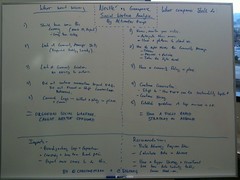
    Whiteboard War Room Analysis: Nestle' vs Greenpeace Social Warfare
    Update March 24th, a few days later. We’ve done a white board analysis breaking down exactly what went wrong and providing actionable recommendations on what brands should do. Also see Susan Etlinger’s share of voice analysis, yet Howlett suggests this doesn’t impact share prices Also read Ben Kiker’s suggestions

  • List of Social Media Management Systems (SMMS)

    Pain: Social Media Teams Are Challenged To Respond To the Distributed Conversations
    I’m starting to get a few briefings and requests from strategists LaSandra Brill, about new technologies that enable social marketers to quickly manage, maintain, and conduct reporting on multiple channels. The issue of lack of scale is resonating with social strategists –as a result, the market is developing new tools that will help them manage them. This is one component of Social CRM, which if you haven’t heard about, please read the report on the 18 use cases of Social CRM.

    Solution: As a Result, Social Media Management Systems are Emerging
    Like CMS and WMS for centralized website management, Social Media Management Systems (SMMS) empower social media teams to manage multiple distributed social channels from one location –enabling the opportunity to build deeper relationships by being in more places at once.

    Definition: Social Media Management Systems are collection of procedures used to manage work flow in a disparate social media environment. These procedures can be manual or computer-based and enable the manager to listen, aggregate, publish, and manage multiple social media channels from one tool.

    How it works: Three simple features In the most basic sense, these management tools do the following: 1) connect with social media channels like Facebook, Twitter, LinkedIn. 2) Allow the manager to quickly publish from one location to each of those channels, some provide ability to customize to each channel 3) Aggregate and Manage social data. The system allows the manager to see an aggregated view of what’s happening (from views to comments) and may offer some form of analytics and conversion metrics.


    List of Social Media Management Systems (SMMS)

    • Awareness Networks, Social Marketing Hub an enterprise class community platform has launched their own tool that has Facebook, youtube, flickr, Twitter, and of course connect with their own community features. In particular, this is an existing enterprise class vendor (previously I’ve published thorough research report on them) which bodes well to their level of potential levels of service, support, and market viability. (they’ve briefed me)
    • Buddy Media: Has a set of management tools that help brands with Facebook, Twitter, and monitoring and reporting.  You’ll find iterations for both brands and agencies.  They have case studies from large brands and media on their site.
    • Context Optional offers management tools for moderating Facebook pages
    • CoTweet was recently acquired by ExactTarget.  They provide Twitter integration tools, scheduling, workflow, listening tools, multiple author management, and management dashboard tools
    • Distributed Engagement Channel by DEC   Their system offers the ability to publish content, moderate UGC submissions, and track and optimize channel performance.  They also have features such as ID integration, media handling, and reporting.
    • KeenKong offers a dashboard like management tool that not only aggregates the conversation from Twitter and Facebook, but tries to make sense of it from Natural Language Processing.
    • MediaFunnel offers integration with Facebook and Twitter. They have several permission based workflows that include a variety of roles such as a contributor, administrators, publishers.  This is not unlike traditional editorial processes used in CMS systems.
    • Mutual Mind offers brand monitoring, permission based workflow as well as reporting tools.
    • Objective Marketer provides managers ability to structure their messages by campaigns, features include User Management with roles and permissions and workflows, scheduled content, integration,  analytics and reporting.  The tell me their current client makeup  is 60% Enterprises, 30% Agencies and 10% Bloggers / Independent Consultants.
    • Postling allows for individual clients or brand to manage assets like blog, Facebook Fan Page, Twitter account, and Flickr accounts from a single management system. There is also comment aggregation as well as workflow between teams.
    • SocialTalk provides integration with Twitter, Facebook, WordPress and MoveableType, this management tool provides governance, workflow, scheduling and other features.
    • SpredFast is an up and comer who recently briefed me, this Austin based company offers the core features and claims to have a 40% enterprise customer base. They have partners with Convio, Radian6, Crimson Hexagon, Sysomos, Trackkr, IBM, Porter Novelli, Sierra Club, HomeAway. They position their product as collaborative campaign management and offer features such as scheduling content, features that integrate with events and social stream like features similar to Friendfeed. (they’ve briefed me)
    • Sprinklr offers social media management tools, it’s interesting their website has a strong focus on listening first, before the publication.
    • Strongmail, a traditional email marketing platform offers platform that tracks the multi-stage sharing activity of the campaign all the way to conversion, analysis on reach, sharing activity, CT’s, feedback on Facebook fan page wall posts.
    • Vitrue: Offers social media management systems, that has integration with Facebook and Twitter, they offer scheduling features, and the ability to link multiple Facebook pages together.

    Use These Tools After You’ve Developed a Social Strategy
    Every technology has upsides and downsides, there are always tradeoffs. While these tools may help social strategists manage an unscalable situation — they have downsides:

    • Get personal with your market –avoid social media spewing: Just because you can, doesn’t mean you should. Spewing corporate content to every known social channel may make your life easier as a marketer, but could cause serious ramifications to the trust of your community. Remember that like fraternity row, each frat and sorority house has a different set of relationships, language, and interests –don’t think one type of content will fit all.
    • It’s the people stupid –not carpet bombing: One of the promises of social is to build meaningful relationships with customers –not apply traditional spray and pray marketing tactics. By using these tools, you could be missing out on true relationships that could be deeper, with more loyalty, and the benefits of advocacy.
    • Don’t get spread too thin: Being in all places at all times can mean you’re nowhere all the time. Pick your battles and remember that the needs of the LinkedIn community are far different than those of MySpace, be selective by first knowing your socialgraphics of your customer base.

    Industry Insights: A Commodity Feature, With Bandwagon Appeal
    Expect nearly every community platform (there are over 100) to launch these types of features, quickly followed by host of startups that specialize in this, then also the CoTweets of the world and other Twitter platforms like Seesmic to quickly get into the enterprise game. In a few quarters, expect the traditional CMS and WMS players to finally wake up and get relevant, followed by app developers in Salesforce appexchange to launch their own iterations. In the long run, this will be commodity set of features, just a check off in the overall suite of social business software but an important component of Social CRM.

    If you know a vendor that offers these features, please leave a comment, I’ll take a closer look, and plan to take some briefings with some of these vendors.  Note: I’m making many changes to this post, it’s being altered in near real time

  • Altimeter Report: The 18 Use Cases of Social CRM, The New Rules of Relationship Management

    18 Use Cases That Show Business How To Finally Put Customers First

    Social and CRM: How Companies Will Manage Their Social Relationships
    Over the last six months, I’ve been working closely with Ray Wang who is well known in the CRM space as an expert.  Coupled with my focus on social technologies we did a deep dive on how our worlds are colliding into the trend to Social CRM.  In our opening webinar when we announced our joining of the firm, we made it clear we’re looking at the holistic business, across multiple business departments –not silos or roles.

    Companies are unable to scale to keep up with the social phenomenon
    We know that customers are using these social technologies to share their voices, and companies are having a very difficult time to keep up.

    • For companies, real time is not fast enough. Companies need to be able to anticipate what customers are doing to say and do, in order to keep up. Although Motrin responded to angry mom’s within 24 hours –it was too slow.
    • Companies are unable to scale to meet the needs of social. No matter how many community managers Dell and ComcastCares hires to support, they’ll never be able to match the number of customers happening.  They need tools, and they need them now.
    • Customers don’t care what department you’re in they just want their problem fixed. Dooce’s support problem with Maytag quickly became a PR nightmare –had the support group known she was an influencer (and what it means), they could have serviced her better.

    Framework:  The 18 Use Case of Social CRM
    Above: Framework of the 18 Use Cases of Social CRM

    How To Use This Report: A Pragmatic Roadmap
    Regardless if you’re in IT or in a business unit, we wrote this to meet the needs of both groups.  This architecture lays out all the possibilities (18 use cases) defines the problem and goal for each, and suggests some vendors who to watch.  It’s also pragmatic, as it lays out a process on how to get started, baseline needs (listening) and what to do next.

    Action Items

    1. Sign up for the webinar series. This is a deep topic, and the report is only the tip of the iceberg.  As we’ve done in the past, we’re going to offer a series of free webinars on this topic to explore each of the use cases in gritty details.  Sign up for the webinar now, as we can only have 1000 attendees per webinar, as our last webinar had over 1100 registrants.
    2. Read then spread this report. Like open source, the Altimeter Group believes in open research, we want our ideas to grow, and others to take advantage of it.  So if you found the report helpful, please forward the report to internal constituents, partners, vendors, clients, and blog it.  Use it in your presentations, business plans, and roadmaps.  I’ve embedded it below, and there are download features for your own use.
    3. Have an internal discussion. Evaluate your current situation at your company, then draw up which business needs need to be tackled first, use the use cases as a roadmap by mapping out which phase comes first, and which phase comes second.
    4. Learn more and join the community of pioneers. This is new territory, we don’t have all the answers, so we’ve created at group in which pioneers can learn from each other.  It’s free, and the conversation has started already, jump into the group, and learn together.

    The Altimeter Approach
    Standing behind our belief in open research, the Altimeter Group wants to be part of the community, we:

    Involve the expert community in the research process
    Altimeter is unique as our partners can tightly co mingle our topic areas and see how they converge, we highlighted our vision when we joined. We seek to be stewards of community and during our six months of research we talked to way over 40 thought leaders, vendors, and companies that are approaching this space. We blogged ideas, engaged in conversations with the #scrm hash tag, and had working sessions with thought leaders like Paul Greenberg and Esteban Kolsky.   We approached research in an open way, and allowed for vendors to review the report and submit back their ideas, some of which we incorporated. This effort was a group effort and included a lot of heavy lifting from Christine Tran, operations who helped to schedule countless meetings, and guidance from Charlene Li, our founder.

    Provide a holistic view through deep collaboration
    We see that worlds are converging, and we model our research the same way, through really analyzing the mixtures of our different topic areas. For example, what was interesting is that my ‘marketing-speak’ and Ray’s ‘IT Speak’ often resulted in the tower of babel. Although we were talking about the same topic, he had to translate IT and marketing speak both ways.  After many puzzled looks, we embracing this, and realized that this isn’t unique to us but a sign of companies converging as a result of mass adoption of easy to share social tools.  Thus, we realized this framework that could meet the needs of the various camps would be helpful, companies need to move quickly, as customers have adopted social in rapid fashion.

    Use open research to grow ideas
    We want ideas to spread, and have made the entire report available at no cost on slideshare, and put up images on flickr, we hope you use them, under creative commons licensing of Attribution -Noncommercial – Share Alike Status, we believe in open –not closed research.  We’re trying a different business model, we want to involve the community of experts and publish our findings out there for everyone to benefit from, please support us by sharing it as much as possible, while we trial a new way of doing research.

    Update: I forgot to mention, this report was entirely funded by the Altimeter Group there were no sponsors. Also, we are open about disclosing who are clients are (providing they approve), as a result, we hope you’ll trust as more.

    Related links: I’ll roundup interesting links that discuss this report

    Translations

    Update: March 10th, From behind the scenes, we’re hearing of SCRM vendors and brands that are interested in deploying are using the framework as a roadmap, market requirements doc, and as a plan of what to do. Excellent.

  • Roadmap: Make Your Corporate Websites Relevant by Integrating Facebook, Google, MySpace, LinkedIn, or Twitter

    Finally, your corporate website can be relevant again
    Over the past few weeks, I’ve been conducting research to measure how different social networks allow for integration with corporate websites and their assets. Over 3 years ago, I wrote a piece on how corporate websites are becoming irrelevant, due to trusted decisions between prospects and customers taking place off the corporate site. This piece, which still gets traffic has been translated into over a dozen languages –the market recognizes that corporate sites can no longer operate as silos when customers have left.

    [Companies must integrate customers behavior on social networks to their corporate website to increase relevancy, word of mouth, and trust]

    A plethora of options creates confusion in the market
    Fast forward to 2010, and there too many options for brands to integrate these social features.  While many have used community platforms to allow customers to connect to each other on branded domains, this strategy works for loyal customers and often may not reach prospects.  Social networks, which have your customers and prospects, have taken note, and have launched a variety of products that allows their thriving communities of buyers and prospects to connect with static corporate sites.  The challenge?  There are so many features available, it’s confusing to figure out what to do.

    Use this data as a roadmap and guide
    Companies and organizations are confused by the wide variety of choices that social networks offer to help them connect to their customers, so I’ve created this menu to help them in understanding.

    Matrix: Feature Attribute Benefits of Social Integration

    Feature What it does Benefits Downsides What no one tells you
    Sharing Features Allows users to share content from corporate websites to social networks Free to deploy, as social newtorks offer features or Sharethis or Addthis Beyond sharing and simple analytics, there’s limited functionality It’s scary to send traffic away –but it cause viral effects you didn’t expect
    Embeds and Widgets Embed features on social networks (like Facebook Fan Reactions) on your corporate website Breathes real social interaction to static corporate sites, showing real world customer interaction Control over what’s being said is limited. If you don’t integrate this with your look and feel and use default features your site will look amateur
    Authentication Login to a website using a social networking login, often through two clicks like Twitter connect. Increase chances of interaction. Users hate filling out registration pages, so this allows them to ‘login’ faster using their own login. You have less ability to glean their email address, as they’ve logged in another route. In the long run, you’ll have disparate data. Social networks are really an identity play, by using this, they gain more control.
    Cross Publishing from my site to social networks “Pollination” Users can share information to specific friends in their social networks Rapid sharing of content, and sometimes the ability for users to specifically select who they’ll share to –this is beyond simple sharing features as activities and actions can quickly spread Spreading information means more disparate instances of data, making it hard for brands to maintain control. Careful.  Don’t allow for users to simply spam their friends with content, be selective.
    Real time updates Update websites in real time with social content on corporate sites. Enable your corporate site to really be real time through updates in social networks in real time, and vice versa. Not all content will be relevant, and excessive updates will become white noise. Use this for key events, or important customer transactions, not the mundane activity.
    Social Personalisation Serve up content based on users profile information and previous behavior, see VW’s early experiments Rather than subject customers to a generic user experience on your corporate website, customize the experience based on their social networking profile, increasing relevancy. Create a series of specific content types is costly, as well as the engine to develop this. Don’t assume what a customer does in Twitter is relevant to your own product, one size does not fit all.
    Social Context Present real time information based on their friends behavior, see HuffPo. Allow your users friends to increase relevancy by suggesting content and products to each other –increasing rate of action. This is very complicated system to create, and requires a mindset to let go to gain more as users may say and recommend things you don’t like. Every company is a media company, and the smartest companies realize they are a marketplace.
    Application Platform A platform that offers third parties to create web based applications using the social networks APIs, access to data Companies want to extend unique features onto social networks (like the most popular content on a corporate site) to increase interaction Costs to developing these applications are high, you need specific developers that understand the ever changing nuances of these platforms You’ll need long term resources or budget to do this and your existing team may not have the skill set.

    Now that we’ve established a clear sense of the benefits and risks, let’s dive in and understand who offers what.  I’ve created the following matrix that I will keep up to date, that will fast forward research activities.

    Who Offers What: Social Networking Integration Features

    Facebook Google LinkedIn MySpace Twitter
    Sharing Features Yes Yes Yes Yes, Share on MySpace Yes
    Embeds and Widgets Yes, Fan Box Yes, third parties Yes, 3rd parties Yes, every page offers embed code Yes, see Twitter Widgets
    Authentication
    without password
    Yes, FB
    Connect
    OAuth Yes, OAuth OpenID, OAuth, and MySpaceID Yes
    OAuth
    Cross Publishing
    (Pollination)
    Yes Yes (Buzz) Yes (via REST APIs) Yes, Share on MySpace Yes, + with 3rd party tools
    Real time
    updates
    between sites
    Yes (PubSubHubbub) Yes (via REST APIs) Yes, Real Time Stream Yes
    Social Personalization Yes Yes Yes (via REST APIs) Yes, this can be done through MySpace’s REST APIs. Yes. Access all twitter profile info and some behavioral data.
    Social Context Yes. see
    Examples
    Yes, with Google Friend Connect Yes (Most content on the site) Yes. MySpace Real Time Stream to get songs from friends, could also use data to suggest artists to others. Yes. One could show articles from the people you follow have shared or tweeted about. Example: Feedera digest.
    Application Platform Yes Yes Offers
    an OpensSocial platform

    to select partners
    Yes, OpenSocial. Yes. See wiki and getting started guide.

    Update:  Duzins, from Yahoo has left a comment below showing all of the capabilities that Yahoo has to offer, go into the comments to learn more.

    Recommendations: Develop a Pragmatic Strategy

    • First, understand your customers. It’s unrealistic for you to deploy all of the features above, in fact that would only confuse your customers. Instead do research and find out where your customers are.  Then, you’ll know which social network to focus on, and data showing their existing behaviors will tell you which features to focus on.
    • Integrate this with your website roadmap. Start simple then evolve. Don’t try to boil the ocean, start small with simple sharing features, then follow the stack as I laid out in the second matrix.  This is a roadmap that you should use to across the next few years as your corporate website evolves, fusing in social features.
    • Find partners and agencies that will guide you. Don’t go this alone, find agency partners, or technology providers that know this space and have experiences to reduce your risk.  For example, managing all the social connections is more than a brand can take on, for example Gigya, (an Altimeter client) manages all those connections for brands.  Forward this post to agency partners and ask them where they are on this roadmap and who they’ve partnered with to do this.

    Other Resources

    Research Sources
    I did my own research to fill in the matrix as much as possible, then went directly to folks that work at those social networks to verify. Thanks to the helpful and knowledgeable Josh ElmanChris MessinaAdam Nash, (LinkedIn), Amy Walgenbach (MySpace).

    Translations From The Community