Author: Main Feed – Environmental Defense

  • Fleet Efficiency: The Movie

    Like every good concept in the newish millennium, Environmental Defense Fund’s work on fleet efficiency is going multi-media.

    We teamed up with stresslimitdesign to create an engaging minute-long tilt shift video about the savings potential if all US corporate fleets took some simple steps to improve efficiency.

    For those of you not yet in the know, fleet efficiency is about reducing fuel consumption by taking incremental actions, including choosing better routes, avoiding idling and moving to higher MPG vehicles. These actions add up to fuel savings and emission reductions, especially when multiplied by the millions of vehicles in U.S. corporate fleets.

    Looking for more information about how to do it? Check out these tools:

  • Green Jobs in Texas: More Than Just Talk

    When I started working on the Texas Green Jobs Guidebook last spring, talking to community college and workforce development folks around the state quickly made it clear that there was serious lack of information on what a green job is and what a person needs to find one.

    There’s a lot of talk about green jobs and green economy, but for those who have lost their jobs, it could just sound like a lot of high-minded chatter. The reality is much different. Green jobs are real jobs that pay well and can offer long-term job satisfaction.

    This country is headed toward a price on carbon. We can’t continue to use and abuse our planet with a fossil-fuel driven economy forever. The future resides in innovative ways to grow our economies while being kinder to our planet. The path to that future is the clean technology path and it will be filled with green jobs—energy efficient plumbers, solar installation electricians, wind turbine sheet metal workers, roofing and skylight installers, forestry conservation workers, and on and on.

    The Texas Green Jobs Guidebook profiles more than 200 jobs, including the kinds of training needed and projected starting salaries.

    We were lucky to have the Texas Workforce Commission review this document. It’s not a political statement—it’s a resource for students, job seekers and policy makers to understand the bare bones necessities for a green, clean future with a robust economy and happy citizens.

  • SEC calls for public companies to disclose climate risks

    On Wednesday, in response to petitions from investor and environmental groups (including Environmental Defense Fund), the Securities and Exchange Commission (SEC) reached a landmark decision to add climate change to the list of business factors that public companies must disclose. The SEC’s new guidance requires companies to consider the risks and opportunities that climate change may present to their business – from potential legislation to severe weather patterns.

    Within EDF's Corporate Partnerships Program, we believe that this type of transparency is critical in our efforts to improve corporate environmental performance. Increased transparency around climate opportunities and risks will help firms make more informed investment decisions, and thus, reward companies that have positioned themselves to be cleaner and more competitive in the years to come.

    "Investors have a right to know which companies are planning to be part of the clean energy future and which are lagging behind, " said Environmental Defense Fund President Fred Krupp.

    It is vital that investors have this information as they make decisions about how to allocate capital, to ensure that funds are getting to the most efficient and innovative companies.

  • More Voices Add to the Chorus: Give Us a Job-Creating Climate Bill

    The State of the Union is the main topic of conversation this week, but President Obama wasn't the only one who had strong words about climate legislation.

    First, 17 U.S. Senators sent a letter to President Obama [PDF ]asking him to put "clean energy and climate legislation capable of creating new economic opportunities" at the top of his list of priorities for this year. The letter says:

    Legislation that invests in clean energy and puts a meaningful limit on carbon pollution will be a major job creator.

    Obviously, from what we heard Wednesday night, they'll get no argument from the President on that point.

    Second, a group of almost three dozen environmental, labor, faith and civic groups called on Senate leaders to avoid the trap of an "energy-only" bill and instead pass strong legislation that includes a cap on carbon pollution.

    In a letter to the Senate leaders [PDF], Majority Leader Harry Reid and Minority Leader Mitch McConnell, the groups — including EDF — say an energy bill alone would be "just more of the same" at a time when our economy needs a new direction.

    The letter points out that the U.S. passed major energy-only bills in 2005 and 2007 that haven't done much to stimulate the economy, and says:

    Energy and climate legislation must be connected and comprehensive to create the opportunity to build a new clean energy economy that secures our energy supplies, fosters innovation, and creates the new jobs we so desperately need here in the U.S.

    One more note: in an earlier post we told you about USCAP's new ad campaign. This week, Peter Molinaro talked to PBS's Judy Woodruff about those ads, USCAP's other work, and why big businesses like his Dow Chemical are pushing for climate and clean energy legislation, in partnership with environmental groups. You can watch that interview on PBS's web site.

  • Rolling Stone Calls out “The Climate Killers”

    YouIdiotsThe latest cover of Rolling Stone magazine didn't feature an indie star or up-and-coming talent. Instead, a simple black background pushed forward the words "YOU IDIOTS: meet the planet's worst enemies" and drew readers' attention to climate change.

    The 13-page article went through the latest chapter in climate legislation, without pulling any punches. It called out every major obstacle to climate legislation from the Heritage Foundation's disinformation to the "17 polluters and deniers who are derailing efforts to curb global warming." (Two EDF experts were quoted in the piece as well: our president, Fred Krupp, and chief economist, Dan Dudek.)

    While Rolling Stone writer Tim Dickinson captures a lot of the frustration felt in the climate campaign, he misses the mark when it comes to his closing. "The battle over global warming may already be over," he writes. "Where are the crowds marching the streets?" he asks.

    We are here.

    Well, we may not always be in the streets — but we are in the halls of Congress, pushing for action. And the front lines are packed with some unusual allies — steel-town mayor John Fettterman, companies and labor unions, EDF climate activists (add your voice!), and many more. This week, President Obama, too, reminded Congress that they are not done.

    This fight is far from over.

  • National Academy of Sciences Delves into the Delta: So Far So Good

    Ashley RoodAshley Rood is a Research & Outreach Associate with EDF.

    Beginning this past Sunday with an address by Congressman Costa, the National Research Council (NRC) of the National Academy of Sciences (NAS) started its review of water management in the Bay Delta. The nation's elite scientific panel will analyze and either support or refute the science (otherwise known as the Biological Opinions) behind how much water can be pumped out of the Delta for cities and farms while preventing the extinction of endangered species.

    I was at UC Davis this week, along with my colleagues Ann Hayden and Spreck Rosekrans, to watch the public workshops unfold. Although we were skeptical when this additional review was initially announced—we're cautiously optimistic that science will rule the day and this will rise above the sticky politics of the Bay Delta. Below, find out more about what the NRC will deliver and what we're looking for in this review.

    Highlights from the NRC public workshop 

    • The NAS NRC committee asked good questions–in particular, they were trying to drill deeper into the difficulties of balancing water supply and environmental sustainability
    • Melanie Rowland, General Counsel for the National Oceanic and Atmospheric Administration (NOAA) gave a great talk about the law that defines the scope of the scientific review. The Committee's sole task is to verify the science analyzing the impact of pumping water through the Delta (it is a review of a "consultation" under Section 7 of the Endangered Species Act). Other stressors (like water pollutants and invasive species) are not a focus in this review. This review will not focus on recovery, only preventing further "take" or harm to current populations of the listed species.
    • Transparency: one committee member suggested that the National Marine Fisheries Service (NMFS) is not being transparent enough with their day-to-day decision making on operations. NMFS responded that they recognize this gap and are working on getting their real-time operations posted on-line.
    • Integration: the committee suggested several times that the two Biological Opinions need to be well integrated—rather than working at odds with each other, the Opinions must be used together to protect fish in the Delta (and as mentioned above, this should all be done with transparency).
    • Fun Fact: the paper trail for the NMFS Opinion is 150,000 pages—a lot of pages for the NRC committee to get lost in over their 6 week review, but also a good example of how extensive the original research was for the biological opinions.

    What we're watching out for:

    1. The last NAS study in California dealt with the crisis on the Klamath River. The results were inconclusive and lacked operational guidelines about needed flows for fish in the watershed. The Klamath soon suffered from a devastating fish kill. 
    2. Politics as impetus: this elite and costly study was requested by Congress due to pressure from Central Valley farmers, and Central Valley Congressmen were the only representatives speaking at this week's public workshop—we want to ensure that NAS sticks to science and avoids being unduly influenced by politics.

    What we talked about during the public comments: (future in-depth blogs to follow)

    • Spreck Rosekrans suggested that the Committee recommend water transfers as a way to minimize the effects of the current pumping restrictions. Good water transfers provide incentives for water conservation; ensuring continued productivity on farms while providing the water that fish need. 
    • Ann Hayden championed the peer-reviewed science behind the Biological Opinions and emphasized the critical role of these Opinions in creating a scientific baseline for her work on the Bay Delta Conservation Plan.

    What will come out of this review?

    1. March 15, 2010: A report focused on the Biological Opinions. The NRC will determine if there are any alternatives to the current pumping restrictions in the Delta that can be implemented (for example: instead of turning the pumps down, could a "bubble curtain" be installed to discourage outmigrating juvenile salmon on the lower San Joaquin River from making a sharp left turn and "going with the flow" to their death at the pumps?) The NRC will also look at how potential conflicts between the Biological Opinions can be resolved.
    2. November 2011: Recommendations to integrate adaptive management approaches to balance water supply reliability and ecosystem sustainability in the Delta.

    We'll be tracking this for the long-haul as the committee's work unfolds. And we'll keep you posted on the balancing act of politics and science in the Delta.

    In the meantime, here are a few interesting articles to read:

  • Video: The Facts of Cap and Trade, From an Economist

    EDF is known for unconventional tactics. We often experiment with new ideas to find the ways that work. However, this time I had a chance to do something truly off-the-wall.

    I was asked to make a video with the coalition Clean Energy Works that explains cap and trade in a way that non-economists could understand, i.e., in English. (And with clever animation.)

    What were they thinking?

    Maybe the idea was just crazy enough to work. Here are a couple of reactions so far:

    Check it out, let us know what you think, and spread the word.

  • Climate, Clean Energy and the State of the Union

    When I turned on the State of the Union speech last night, I planned to listen very closely so I could hear any mention of a climate and clean energy bill.

    Turns out I didn't have to work that hard. President Obama talked about clean energy — and its potential to create jobs — throughout the speech.

    Here are some of the most relevant quotes:

    We can put Americans to work today building the infrastructure of tomorrow … There’s no reason Europe or China should have the fastest trains, or the new factories that manufacture clean energy products.

    We should put more Americans to work building clean energy facilities, and give rebates to Americans who make their homes more energy efficient, which supports clean energy jobs.

    Germany’s not waiting. India’s not waiting … They are making serious investments in clean energy because they want those jobs.

    We need to encourage American innovation … And no area is more ripe for such innovation than energy. You can see the results of last year’s investment in clean energy – in the North Carolina company that will create 1200 jobs nationwide helping to make advanced batteries; or in the California business that will put 1,000 people to work making solar panels.

    But to create more of these clean energy jobs, we need more production, more efficiency, more incentives. That means building a new generation of safe, clean nuclear power plants in this country. It means making tough decisions about opening new offshore areas for oil and gas development. It means continued investment in advanced biofuels and clean coal technologies. And yes, it means passing a comprehensive energy and climate bill with incentives that will finally make clean energy the profitable kind of energy in America.

    I am grateful to the House for passing such a bill last year. This year, I am eager to help advance the bipartisan effort in the Senate. I know there have been questions about whether we can afford such changes in a tough economy; and I know that there are those who disagree with the overwhelming scientific evidence on climate change. But even if you doubt the evidence, providing incentives for energy efficiency and clean energy are the right thing to do for our future – because the nation that leads the clean energy economy will be the nation that leads the global economy. And America must be that nation.

    The speech got a good reception from most environmental groups. EDF's president, Fred Krupp, said this:

    President Obama got it right when he said we must pass ‘a comprehensive energy and climate bill with incentives that will finally make clean energy the profitable kind of energy in America.’ The American people want less imported oil, less pollution, and more jobs – and Congress can deliver all three by passing a real clean energy bill that puts a limit on carbon pollution.

    If we're serious about creating jobs, beating the Chinese and Europeans in this new global market, and cutting imported oil, then Congress needs to move forward without delay and pass strong clean energy legislation. A traditional bill that completely exempts big companies from any limits on carbon pollution is a non-starter; it simply will not solve our most pressing national challenges.

    With all the divisions in Washington, this is an issue that should unite the two parties. Both nominees in the last presidential election supported limits on carbon pollution, and legislators of both parties are now working to find a bipartisan solution. Americans want Congress find a way to cut imported oil, cut pollution, and create new jobs. Now it's time to get the job done.

  • Ozone Standards: Why It Matters What the EPA Hears Next Week

    Next week, the United States Environmental Protection Agency (EPA) is holding three hearings across the country to hear what the public has to say about changing the National Ambient Air Quality Standards for ground-level ozone.

    dfj;af

    This view of downtown Los Angeles is why we should all care about ozone standards. Photo: C. Denning.

    Umm, what does that mean in English? Why should you or I care?

    First, a little background: ground-level ozone is not usually emitted directly into the air. It comes from chemical reactions between oxides of nitrogen (NOx), volatile organic compounds (VOC), and sunlight. Gasoline and diesel-fueled vehicles in the transportation and goods movement sectors are the largest source of nitrogen oxide pollution. 

    The problem is that ozone contributes to smog–that ugly, yellowish brown, cloudy mass you see hovering over city skylines. It almost makes you choke just looking at it. In fact, many that breathe this pollution have that problem. Numerous studies have linked ground-level ozone to asthma, lung tissue damage, respiratory illnesses, and even death. Children, older adults, and those who are active are especially at risk.

     The previous administration ignored the recommendations of the scientific community, and said a higher amount of ozone in the air was okay. The Obama administration, on the other hand, is looking at the science and is willing to act. Lowering the ozone standard could prevent as many as 12,000 premature deaths and have health benefit savings between $13 billion to $100 billion per year by 2020.

    We all deserve to breathe clean air and live in a healthy environment. We hope that the EPA will revise the standard to be the most health protective as possible.

  • Queen Quet, Chieftess of the Gullah/Geechee Nation, and EDF Host Fishermen Listening Session in Beaufort, SC

    Gullah/Geechee Fishermen Listening Session-Beaufort_SC_045The Oceans program has developed robust relationships with an array of people across the U.S. including fishermen, scientists, academics, and political leaders; however, it‘s not every day that it works closely with royalty. Over the past several weeks, the Oceans program has partnered with Queen Quet, Chieftess of the Gullah/Geechee nation, and the organization she founded, the Gullah/Geechee Sea Island Coalition in its effort to engage African-American fishermen in the Southeast – the voices of whom haven’t been apart of the conversation to sustain fisheries.

    For many years, Queen Quet has diligently championed the conservation of the rich Gullah/Geechee culture and heritage. The Gullah/Geechee is a minority group within the African-American population. Spanning from the coast of Jacksonville, North Carolina to Jacksonville, Florida, the Gullah/Geechee nation has upheld the linguistics and traditions of their West African ancestry. The Gullah/Geechee are a people that have lived off the land and water for over 300 years, and their inherent ties to these resources are pervasive throughout their way of life.

    Gullah/Geechee Fishermen Listening Session-Beaufort_SC_051Because the continuity of this way of life is pertinent for Queen Quet and her people who have fished for generations, she expressed a keen interest in collaborating with EDF to better understand the challenges facing African-Americans for what has been perceived as a changing rate of participation in subsistence and commercial fisheries. To best document the concerns of this community, EDF and the Gullah/Geechee Sea Island Coalition cosponsored a listening session in Beaufort, South Carolina on January 21st. The event was a great achievement and brought together local and state officials and approximately 30 fishermen. For a group that generally has not been present at public forums in the past, this turnout signified the importance of the subject.

    Gullah/Geechee Fishermen Listening Session-Beaufort_SC_047According to Queen Quet, seafood is one of the major sources of employment for the Gullah/Geechee. During the meeting, the fishermen openly shared their concerns about the fishing industry, drawing comments from nearly everyone in the auditorium throughout the night.

    The adversities identified by the community included size and catch limit restrictions, limited access to docks and oyster beds, depletion of fish stocks, unawareness of changing regulations and management decisions, and rising costs. These are the type of issues confronted by many of the fishermen with whom EDF works. Although the fishermen looked to EDF to present solutions to the issues identified, they also saw the value in shaping a collective voice. When asked, there was an incredible consensus by the fishermen to form a Black fishermen association encompassing the South Atlantic region.

    The information gathered from these sessions will be shared with political leaders such as Jim Clyburn (D-SC) and members of the Congressional Black Caucus to bring awareness to an issue affecting the livelihoods of their constituency and begin to chart a way forward. We intend to proceed with another listening session in North Carolina in April.

    As the session concluded, the attendees were interested in keeping this momentum strong and inquired about a follow-up meeting taking place. Needless to say, we were extremely heartened about this great start. We will work to continue to build a strong relationship with this community and help them find solutions to their challenges that will result in sustainable and healthy fisheries.

    Nicole Smith is a 2009 – 2010 Oceans Program Fellow working to engage African-American fishermen in the U.S. southeast.

  • State of the Union: Let’s Fix-it-First and Fix-it-for-All

    Last night’s State of the Union address focused on rebuilding the American economy and getting people back to work. In order to spur job growth, President Obama requested that Congress pass a second stimulus package, which could potentially include transportation and infrastructure spending.

    lhdflkahfd

    Let’s get people back to work on projects that are good for the environment and enhance our local communities for drivers, pedestrians, and bike riders. Author’s photo.

    In early December, we championed the concept of Fix-it-First for the portion of the House's Jobs Bill (HR 2847) dedicated to highways, roads and bridges. Fix-it-First is the idea that rehabilitation and operation of existing transportation investments should be prioritized over building new roads and expanding highways. Be it the Senate's version of the jobs bill or a second stimulus, Fix-it-First provides immediate jobs and ensures that long-overdue repairs are made.

    In addition to Fix-it-First, thanks to our friends at TransForm, a transportation advocacy group in the San Francisco Bay Area, we've learned a new term: "Fix-it-for-All." This principle goes beyond Fix-it-First, and includes cycling and pedestrian improvements. While we're spending public dollars to fix broken state highways and bridges, let's also improve local streets and roads so that drivers, cyclists and pedestrians can all get around. Let's help people get around in a way that is safer and reduces environmental impact.

    Local planning agencies that receive federal funding should follow a Fix-it-for-All approach when divvying funds. These projects, which simultaneously reduce environmental impacts and give improvements to everyone–including stroller pushers and bike riders–ought to get funded first.

    These two "Fix-Its" are complementary, and Congress should embrace these principles as they tackle a potential second stimulus, a jobs bill, or future transportation legislation.

    • Fix-it-First's distribution of the jobs money assigned to highways and roads will move us away from hasty investments in projects that were planned decades ago—before we understood the link between transportation and climate change.
    • Fix-it-for-All will ensure that the jobs money will help local systems upgrade and improve their own road, bicycle, and pedestrian networks to meet new economic and environmental standards.

    Applying the two "Fix-Its" to the jobs bill is a no-regrets approach. It will help stimulate jobs without stimulating pollution.

  • TSCA-geek contest: And the answer is …

    Richard Denison, Ph.D., is a Senior Scientist.

    The “identify-that-quote” contest I posted yesterday attracted quite a few responses, some as comments on the post, others in emails to me. Most people were on the right track in thinking that it was said decades ago, though one guess was of someone in the last decade. (I have to agree it does read like something EU Commissioner Margot Wallstrom might have said.)

    If this were a popularity contest, the hands-down winner would be Rachel Carson. Some said it must have come from Silent Spring, others from her 1963 Congressional testimony.

    U.S. Presidents scored well, with Ford, Johnson and Nixon each getting at least one vote, and a couple more people suggesting their speechwriters or people close to them.

    Several others got even warmer by zeroing in on the early days of EPA. Inaugural EPA Administrator Bill Ruckelshaus got a couple votes.

    There were three correct votes, however. One was from the very first responder, within minutes of my posting. He first emailed me, “I know, I know!” I encouraged him to post a comment, which he did: “Sounds like former EPA Administrator Russel Train, circa 1976!” said Daryl Ditz of the Center for International Environmental Law (a certified TSCA-geek for sure).

    Daryl’s correct response was followed a few hours later by a mystery commenter who identified himself only as “RB.” RB said “EPA Administrator Russel Train – 1976 – The year the Toxic Substance Control Act was passed.”

    And then just a few hours ago, a third correct response, from Roger McFadden of Staples: “Prophetic words of EPA Administrator Train in 1976 and now it is 2010. It is time to take action and stop the ‘chemical roulette’.”

    While the first two winners don’t appear to know how to spell Russell, I’ll overlook that and offer congratulations to them and our other winner. Russell Train served as the second EPA Administrator, serving under both Nixon and Ford from 1973 to 1977. 

    The first citation of this quote I could find is in an article from the New York Times News Service that ran in the Lexington, NC Dispatch on May 27, 1976, a few months before the signing of the Toxic Substances Control Act by President Ford on October 11, apparently quoting from a speech Train gave at the National Press Club. 

    The Pittsburgh Press on December 8, 1976 ran an article further quoting Train, presumably a further excerpt from the same speech:

    “We not only don’t know whether what’s going on out there is dangerous – we don’t even know what’s going on out there.”

    Though uttered before its passage, I know of no better statement of the dual failings of TSCA.

  • Tom Murray talks Green Returns at Private Equity Conference

    On Tuesday, Tom Murray, the managing director overseeing Environmental Defense Fund’s work in the private equity industry, addressed attendees at one of the most visible and well-attended industry conferences, the Dow Jones PE Analyst Outlook 2010 in New York City. Representing the only NGO at the conference, Tom added a unique environmental perspective to the insights of his fellow panelists.

    In his opening remarks, Tom said that he’s seeing a universal acceptance that financial engineering alone isn’t enough anymore and that going forward, multiple tools will be needed to create value, including a growing focus on operational improvement. In fact, an article in last week’s FT online called the growing demand for operations professionals one of the most significant shifts in the PE sector last year. Co-panelist Chuck Brizius, managing director at THL Partners, said his firm had also recognized the trend and would continue to focus on operational management in 2010.

    “The reason we’re here today is looking for new ways to create value. That’s where we think the environment comes in. A focus on environmental performance can create a strategic competitive advantage.”

    We know the opportunity is real, because we’ve done it – with impressive results – with Kohlberg Kravis Roberts & Co. L.P. (KKR), which is now taking it to scale across US and international portfolio.

    Our work with KKR is just the beginning; Environmental management can play a vital role in value creation across the industry. As a result of our work with KKR, we have developed a flexible approach for capturing environmental and financial benefits called Green Returns and hope that 2010 is the year that other PE firms adapt the Green Returns approach to their portfolios.

    Taken to scale across portfolios, a creative approach to environmental issues can create value by improving due diligence, boosting portfolio company performance, presenting new growth and investment opportunities and building stronger relationships with LPs and other stakeholders.

    “The opportunities are already there. What Green Returns provides is a new way to look at performance and provide metrics to help them capture environmental improvements.”

  • TSCA-geek contest: Who said this, and when?

    Richard Denison, Ph.D., is a Senior Scientist.

    No prize offered, but here's a little contest. Who can guess who said the following, in what context and when — without cheating by googling a phrase from it? Answer provided tomorrow.

    "Most Americans had no idea, until relatively recently, that they were living so dangerously. They had no idea that when they went to work in the morning, or when they ate their breakfast — that when they did things they had to do to earn a living and keep themselves alive and well — that when they did things as ordinary, as innocent, and as essential as eat, drink, breathe, or touch, they could, in fact, be laying their lives on the line. They had no idea that, without their knowledge or consent, they were engaging in a grim game of chemical roulette whose result they would not know until many years later."

    [Spoiler alert: Here’s a link to the answer.]

  • Texas Green Jobs Guidebook

    Download the Texas Green Jobs Guidebook [PDF] [800 KB]

    In this challenging economy, Texans are looking for available jobs and rewarding careers. An emerging area with great growth potential is green jobs. For example, national projections for smart grids alone include hundreds of thousands of related jobs. With a prepared workforce, Texas and Texans will have a competitive advantage attracting investment and development in renewable energy, energy efficiency, and other low-carbon technologies.

    This guide provides:

    • Profiles of more than 200 green jobs emerging or already available in Texas, including salary and educational requirements.
    • Resources for finding valuable apprentice programs.
    • A user-friendly directory, reviewed by the Texas Workforce Commission, for all job seekers regardless of their current skill set. Policymakers, students and career-changers may also find the guidebook a useful reference tool.

    Different kind of job guide

    Most green employment reports focus on high-level statistics, overall trends and general job types.

    This guidebook, reviewed by the Texas Workforce Commission, is a user-friendly directory for all job seekers regardless of their current skill set. Policymakers, students and career-changers may also find the guidebook a useful reference tool.

    Many green careers are available to applicants with less formal education and less traditional job experience. And many green jobs build on experience in manufacturing, installation, fabrication and operations for new careers in energy efficient plumbing, air conditioning, refrigeration installation and maintenance, solar panel distribution and installation, and more.

    These careers present major opportunities for individuals who face traditional barriers to employment and are real pathways out of poverty.

    Download the Texas Green Jobs Guidebook [PDF] [800 KB]

  • EDFix call #4 afterthoughts: Open Data

    EDFix Call #4 – Summary (7:48)

    Download MP3 | Subscribe in iTunes

    EDFix Call #4 – Full (43:39)

    Download MP3 | Subscribe in iTunes

    Get Call Updates by Email

    On January 11 we talked with Greg Norris and Jeff Rice about the open data requirements and effects of Life Cycle Assessment (LCA).

    They are working to aggregate data across supply chains that would help anyone calculate specific sustainability footprints: think beyond carbon footprints to other footprints for the carcinogenic, water-consumption, fossil-fuel and biodiversity effects that different products and processes have. You could envision analyses for safety, living wages, child labor and community impact.

    Early LCA efforts took a physicist's perspective, assessing what compounds a particular process leaves as by-products, for example. Now, using Linked Open Data methods from the semantic web, analyses can take other perspectives, such as an economist's.

    The natural question to ask is: why would a corporation share openly the raw data of its supply chain? Doesn't that reveal state secrets? One of the keys to corporate collaboration is focusing on the impacts of the supply chains.

    At that level, companies are jumping in. Owens Corning, for example, is funding the open-source Earthster project, which itself just spun out a data-interchange-standards project named Poseidon. (In a future EDFix call, we'll discuss Wal-Mart's Sustainability Index project.)

    Existing vendors in the LCA space such as GaBi, SimaPro and OpenLCA are joining the open effort, too. The availability of large amounts of open data should make their software and analytic skills more valuable, not less.

    As better structured data meets better analytic tools and deeper frameworks for analysis, our ability to make difficult choices should improve. Now we need to figure out how to boil down those decisions so that normal folks in everyday life can benefit from them, too.

    Please join us for our next EDFix call on January 25, at 9am Pacific, on Governing the Commons.

    You can also:

  • New Ad Shows Broad Support for a Climate Bill

    Thumbnail image of the ad showing broad support for climate change

    Click the image for a larger view of the ad.

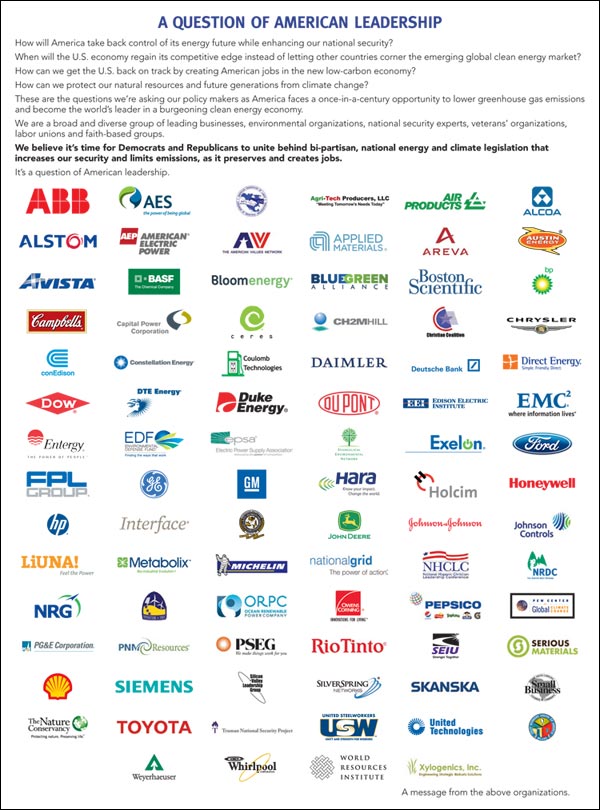
    Anyone who doubts that climate legislation has broad-based support should take a close look at a new ad that's running in the Wall Street Journal and Politico.

    88 groups put their names — and logos — on the line to call for a bipartisan energy bill.

    EDF is a participant of course, along with other environmental groups like NRDC and the Pew Center. But some of the others may surprise you: the Christian Coalition, Michelin, Campbell's, the AFL-CIO, Toyota, Owens Corning, Whirlpool.

    The message from all of them:

    We believe it's time for Democrats and Republicans to unite behind bi-partisan, national energy and climate legislation that increases our security and limits emissions, as it preserves and creates jobs. It's a question of American leadership.

    If you don't have a paper handy, take a closer look at the large and diverse group of clean energy champions here.

  • Focus on operations – including environmental management – key to results in PE world

    An article in Wednesday's Financial Times made the following observation about some fundamental changes afoot in the private equity industry:

    "During the credit boom, private equity tended to hire financial wizards. Now, operational experts are in demand as private equity houses fix up companies they own rather than wonder about dividend recaps."

    We've observed a similar trend in the private equity sector, and it's good news for both the environment and business in a tough economy.

    Increasingly, private equity firms are looking for ways to run leaner and more efficient businesses through a focus on company operations. From improving energy efficiency to cutting material and packaging waste to reducing water use, we believe that environmental management offers significant opportunities to do just that.

    In our partnership with private equity leader Kohlberg, Kravis and Roberts and Co., we are proving that a focus on operations can yield real business and environmental results. In 2008 alone, we helped identified over $16M in operational savings and avoided 25,000 metric tons of GHGs at three portfolio companies.

    KKR is expanding environmental management efforts across its portfolio. Stay tuned for 2009 results, coming soon.

  • Chemical industry reacts to EPA on CBI: Burglars claim to like new alarm system

    Richard Denison, Ph.D., is a Senior Scientist.

    After EPA announced yesterday that it will deny certain confidential business information (CBI) claims that have masked the identity of risky chemicals, two chemical industry trade associations responded favorably, saying they “welcome” the move as “the right thing to do.” 

    Entirely missing from their responses, however, was any acknowledgment of the fact that the EPA policy shift would not have been necessary but for the huge number of illegitimate CBI claims made by none other than the member companies of those same trade associations. In a classic case of industry-speak, the companies who have been effectively stealing information from the public about their chemicals try to obscure their nefarious role by now saying they welcome the new alarm system they have forced EPA to install.

    As I noted in a post to this blog on Wednesday, EPA’s new policy states that EPA will in general now deny any CBI claim intended to hide the identity of a chemical for which a company is submitting information, as required by law, indicating the chemical poses a substantial risk, if that chemical is already identified on the public version of the Toxic Substances Control Act (TSCA) Inventory. (My post also noted that further changes are needed if this problem is truly to be solved.)

    So what does the chemical industry think of this move by EPA?

    In an article in Chemical Week, Charles Drevna, the president of the National Petrochemical & Refiners Association is quoted as saying:

    "We support EPA’s action because it is the right thing do with regard to addressing health and safety concerns. We applaud the Obama Administration for taking this step that, frankly, previous administrations would have been wise to consider. In the case of health and safety information, it makes little sense to protect the identity of a chemical that is already publicly available on the TSCA inventory."

    And Chemical Watch (subscription required) quotes Mike Walls, the American Chemistry Council’s (ACC) vice president regulatory and technical affairs, as saying:

    “EPA’s announcement of a general policy on confidentiality claims associated with certain filings under TSCA is a welcome indication of the agency’s ability to apply its statutory authority to promote transparency. While ACC is still assessing the full impact of the policy on filings made under Section 8(e), in general the announced policy is consistent with ACC’s position that EPA and chemical companies should work together to enhance public access to chemical health and safety information.”

    Rhetoric versus deeds

    This new-found industry enthusiasm for transparency and working to enhance public access to chemical information is quite a reversal from its practice for decades of pressing every opportunity to claim information it submits to EPA as CBI, thereby denying public access to it. Indeed, it has learned that by flooding the agency with such claims, it can overwhelm EPA’s only defense mechanism: a time- and resource-intensive, case-by-case challenge process.

    The results? As reported by the Government Accountability Office (see pages 32-34):

    • EPA receives extensive illegitimate CBI claims, which must be honored until and unless challenged by EPA.
    • EPA is able to challenge only about 14 CBI claims out of thousands made each year, because it simply can’t afford to do more.

    Lest you think all this is in the past, consider the very latest posting by EPA of the “substantial risk” notices it receives, those posted for the month of November 2009:

    • 41 submissions covering 54 chemical substances were received.
    • For 32 of the chemicals, the chemical’s identity was claimed CBI by the submitter.
    • For at least 25 of these chemicals, the submitter is a member of the American Chemistry Council.
    • For an additional four of these chemicals, the company’s identity as well as that of the chemical were claimed CBI by its mystery submitter.

    It remains to be seen how the chemical industry’s rhetoric will stand up when the tougher needed changes are pursued, whether by EPA in efforts to use its existing TSCA authorities, or by Congress in seeking to rein in CBI abuses when amending TSCA.

    That will be the real test of whether or not we’re dealing with a truly reformed offender.

  • Climate Change Threatens Chemical Composition of the Oceans

    Rod FujitaThe recent U.N. Climate Change conference in Copenhagen highlighted the range of challenges associated with fighting climate change, from cutting energy use to financing clean technology in developing countries. Why the global sense of urgency and focus? Because the impacts of climate change are already being felt. Most of our discussions center on the dangers of sea level rise, which is already inundating low-lying islands and valuable wetlands; on changes in precipitation and air temperature, which will affect everything from agriculture to asthma; and on the shift in seasons and habitat that will make life difficult for trees, butterflies, and the other wildlife we are familiar with.

    Enormous threats indeed. And it is perhaps inevitable that we are focused on the land and our fellow terrestrial inhabitants. But let us not forget the fact that we are changing the ocean profoundly in many ways. A recent study suggests that over a third of the entire ocean is heavily impacted by human activities, and that there is no longer a single patch of seawater anywhere that can be said to be pristine. And incredibly, we are not just affecting patches of the ocean here or there – we are changing the very chemistry of the seas, chemistry that has remained stable for millennia and which defines the parameters for life in the sea and also for the habitability of the planet for us.

    All living systems are buffered from extreme change by their chemistry. If not for the carbonate/bicarbonate and other buffering chemicals in our blood, the pH (a measure of acidity) would fluctuate wildly and none of the myriad proteins or enzymes essential for life would function. Because pH is a logarithmic scale, very small changes in pH can be disastrous for life – for example, a change of less than one pH unit is lethal to humans. Oceans along coast

    The ocean is a gigantic living system, and is perhaps one of the best-buffered systems on the planet. Enormous quantities of buffering chemicals have been entering the ocean each year for billions of years. Remarkably, though, even the ocean is not impervious to the impacts of fossil fuel combustion and carbon dioxide emissions. 

    As atmospheric carbon dioxide concentrations have risen, the ocean has steadfastly taken up about 2 billion tons of it every year, protecting us from an even more serious climate crisis than we have already. However, carbon dioxide reacts with seawater to create carbonic acid. As a result, while the pH of the ocean varies widely in response to local conditions, scientists have detected a noticeable drop in pH (an increase in average acidity) over the last 20 years and project a decrease in pH by 0.3-0.4 units – a huge change – by 2100 if nothing is done to reduce carbon dioxide emissions. 

    It’s not surprising that such a fundamental change in the ocean is making life difficult for myriad creatures that have evolved under fairly stable conditions. Coral reefs are almost literally melting — it is much harder for corals to make the calcium carbonate shells that protect them and offer shelter to the rich biodiversity typical of reefs under acidic conditions, at the same time as the acidity dissolves their shells. Marine animals ranging from tiny copepods to tasty lobsters and crabs may also face tough times, since their shells also contain carbonates. Many varieties of plankton, the “grass of the sea”, are also vulnerable in an increasingly acidic sea, with potentially disastrous effects on the whole of the ocean’s web of life. 

    Moreover, as you might expect, as we stuff more and more carbon dioxide into the ocean its ability to take it up is reduced. You can only carbonate soda pop so much, until the gas starts to come out the top of the bottle. Some studies suggest that the ocean’s ability to assimilate our carbon waste may have decreased by about 10% just since in the last 10 years.

    What are the implications? We are gambling with a crucial feature of the planet’s life support system – the one that removes wastes, stabilizes the climate, and provides food. Because the ocean is complex and because pH is such a fundamental feature of the ocean, it is difficult to predict exactly what will happen. But it does seem likely that the rate at which we lose coral reefs – already in a precarious predicament due to sea level rise and warming – will increase if the ocean continues to acidify. It also seems safe to project that many, many species will suffer losses in productivity and reproduction and many others will not survive because this change is happening way too fast for them to adapt.

    If we are wise, ocean acidification will also cause us to think twice and several times more about pumping carbon into the ocean so we can continue our fossil fuel party, as some have suggested. This may be the worst possible response to ocean acidification: continue to emit carbon dioxide by burning fossil fuels, and inject some of it into the ocean either by stimulating phytoplankton to take it up with fertilizers or artificial upwelling, or pumping it directly in to the ocean. The best response to protect the ocean? Reduce carbon dioxide emissions and do everything we can to reduce the everyday threats to ocean life – pollution, overfishing, and the like – so ocean ecosystems will have the greatest possible scope to deal with acidification and temperature levels that are already “locked in”.

    References

    Canadell, J.G., C.L. Quere, M.R. Raupach, C.B. Field, E.T. Buitehuis, P. Ciais, T.J. Conway, N.P. Gillett, R.A. Houghton, and G. Marland, Contributions to accelerating atmospheric CO2 growth from economic activity, carbon intensity, and efficiency of natural sinks, Proc. Natl. Acad. Sci. USA, doi 10.1073, 2007.

    Anthony KRN, D. I. Kline, G. Diaz-Pulido, S. Dove, and O. Hoegh-Guldberg. Ocean acidification causes bleaching and productivity loss in coral reef buildersPNAS 2008 105:17442-17446; published online before print November 6, 2008, doi:10.1073/pnas.0804478105

    Beggs PJ, Bambrick HJ. Is the global rise of asthma an early impact of anthropogenic climate change? Environ Health Perspect. 2005;113 :915 –919[Web of Science][Medline][FindIt@Stanford]

    Benjamin S. Halpern, Shaun Walbridge, Kimberly A. Selkoe, Carrie V. Kappel, Fiorenza Micheli, Caterina D'Agrosa, John F. Bruno, Kenneth S. Casey, Colin Ebert, Helen E. Fox, Rod Fujita, Dennis Heinemann, Hunter S. Lenihan, Elizabeth M. P. Madin, Matthew T. Perry, Elizabeth R. Selig, Mark Spalding, Robert Steneck, and Reg Watson (15 February 2008). Science 319 (5865), 948. [DOI: 10.1126/science.1149345]. A meta-analysis shows that human activities have altered virtually all ocean ecosystems, at least to some extent, documenting those areas needing the most protection

    Fabry VJ, Brad A. Seibel , Richard A. Feely , and James C. Orr. Impacts of ocean acidification on marine fauna and ecosystem processes. ICES Journal of Marine Science: Journal du Conseil Advance Access published on April 1, 2008, DOI 10.1093/icesjms/fsn048. ICES J. Mar. Sci. 65: 414-432.

    Kleypas J A et al 2006 Impacts of Ocean Acidification on Coral Reefs and Other Marine Calcifiers A Guide for Future Research NSF, NOAA US Geological Survey, St Petersburg, FL, 18–20 April

    Le Quere, C., C. Rodenbeck, E.T. Buitenhuis, T.J. Conway, R. Langenfelds, A. Gomez, C. Labuschagne, M. Ramonet, T. Nakazawa, N. Metzl, N. Gillett, and M. Heimann, Saturation of the Southern Ocean CO2 sink due to recent climate change, Science, 316 (5832), 1735-1738, 2007.

    Orr, James C.; et al. (2005). "Anthropogenic ocean acidification over the twenty-first century and its impact on calcifying organisms". Nature 437 (7059): 681–686. doi:10.1038/nature04095.

    Schuster, U., and A.J. Watson, A variable and decreasing sink for atmospheric CO2 in the North Atlantic, J. Geophysical Res., in press, 2007.

    Takahashi T, Stewart C. Sutherland, Colm Sweeney, Alain Poisson, Nicolas Metzl, Bronte Tilbrook, Nicolas Bates, Rik Wanninkhof, Richard A. Feely, Christopher Sabine, Jon Olafsson, Yukihiro Nojiri, Global sea-air CO2 flux based on climatological surface ocean pCO2, and seasonal biological and temperature effects, Deep Sea Research Part II: Topical Studies in Oceanography, Volume 49, Issues 9-10, The Southern Ocean I: Climatic Changes in the Cycle of Carbon in the Southern Ocean, 2002, Pages 1601-1622, ISSN 0967-0645, DOI: 10.1016/S0967-0645(02)00003-6. (http://www.sciencedirect.com/science/article/B6VGC-452W7KK-2/2/cf337375806e31b8c4579d8e5d9a98c7)

    Zeebe RE and K Caldeira 2008. Close mass balance of long-term carbon fluxes from ice-core CO2 and ocean chemistry records. Nature Geoscience 1, 312 – 315.