Author: Main Feed – Environmental Defense

  • California’s updated economic analysis finds climate plan offers greener days ahead—part one: gross state product

    Last Wednesday, California’s Air Resources Board released a new economic analysis showing that California can grow its economy and reap immediate benefits from cleaner air while meeting air pollution reduction goals of its Global Warming Solutions Act of 2006 (AB 32). 

    EDF will be producing a series of blog posts that summarize what CARB learned about how AB 32 will impact California’s economy. After starting with today's post on CARB’s methods and findings about gross state product, we’ll cover topics about how the law will influence: 

    • jobs
    • household income
    • energy price "shock risk" reduction
    • …and look at CARB's work compared to other analyses  

    1. How CARB came up with the numbers 

    For the past two years, economists at California’s Air Resources Board (ARB) have been linking two models—Energy2020 and EDRAM—to simulate how California’s economy will fare under its climate action plan.

    This cyber marriage allows the agency to study how carbon pricing policy ripples through the economy first in energy-related investments (Energy2020), then in terms of capital and labor investments in all sectors (EDRAM) and then back again into energy-related responses (Energy2020).This iterative approach zeros in on statewide changes in output, income, employment and emissions as a result of climate policy. 

    Despite the convoluted modeling methods that make this computer jockey wish for the simpler days of Atari, the ARB has produced what its blue-ribbon advisory panel has called a “careful and competent analysis” that “makes a very important and well-founded contribution to our understanding of the potential economic impacts of AB 32.” 

    2. What the numbers show 

    The advisory panel succinctly placed ARB’s most recent findings in context by stating, “a general result emerging from the ARB’s analysis is that the impact of AB 32 on the California economy will be modest relative to the overall California economy.” 

    In terms of total output, California’s economy in 2020 is forecasted to be dramatically larger than it is now. The agency finds that climate policy will not have a significant influence on output (see first figure below), which concurs with a growing body of research indicating that climate policy will have a small and likely positive affect on the economy.

    Gross State Economic Productivity in 2020 with and without AB32 Implementation


    There will, however, be significant and important changes that greatly reduce our dependence on foreign oil and improve the health of our communities. We'll cover those in future blog posts.

    The figure below shows changes to the gross state product by sector, with and without AB 32.

    Economic Productivity by Sector with and without AB 32 Implementation


    3. How reliable are CARB’s numbers?

    All modeling studies, especially those forecasting far into the future, have limitations. Indeed, ARB’s findings about the economic and jobs implications of climate policy depend highly on what the program actually entails after it’s gone into effect, and what emissions and economic activity would be in comparison to “business-as-usual” if no climate policy action were taken.

    The advisory panel wrote that ARB has, “done a commendable job recognizing these uncertainties by assessing the economic costs of AB 32 under a range of scenarios.”

    The panel noted that “these policies can shift the driver of economic growth from polluting energy sources to clean energy and efficient technologies, with little or no economic penalty”, thus leaving us with cleaner air, better public health and an economy that is more secure and less dependent on foreign fuel.


  • Why power plants use so much water and what to do about it

    Can you name the single largest user of water in the United States?

    If you said power plants, you were right (see chart below)! More water is required to run power plants than any other industry. In Texas, approximately 157,000 million gallons (482,100 acre-feet) of water annually – enough water for over 3 million people for a year, each using 140 gallons per person per day – are consumed for cooling the state’s thermoelectric power plants while generating approximately 400 terawatt-hours (TWh) of electricity. Because of this, water is an important consideration in power plant planning.

    In New York state, power plant water use is causing some big problems. Daily withdrawals of more than 20 million gallons have annually killed 17 billion fish in various stages of life. Regulators are trying to address the problem by requiring the installation of closed-loop cooling, which would reduce water requirements by 93-98%. Is that a good idea? It depends. Simply requiring one type of cooling system may not consider all the factors which is important because retrofitting all existing plants can be very expensive and can lead to unintended consequences. 

     Three ways to cool and why does it matter?

    The typical power plant uses a fuel (coal, gas or nuclear) to heat water into steam, which then turns a turbine connected to a generator, which produces electricity. The steam is then condensed back into water to continue the process again. This condensation requires cooling either by water, air, or both. 

    In open-loop cooling, (see figure), large volumes of water are withdrawn from a water source (reservoir, lake or river), and flows through the heat exchanger to condense steam in a single pass before most is returned to the source. Open-loop cooling uses 40 to 80 times more water than other technologies but returns most of the water so it isn’t “consumed.” However, this large water withdrawal can have severe impacts on nearby users, as it will not be available for other needs. Additionally, water intake structures can kill fish and the elevated temperature of the return water can also create problems.

    Closed-loop cooling (see figure) is an alternative to open-loop cooling. Instead of withdrawing water and using it once, closed-loop cooling recycles water for additional steam condensation. There is also dry or air cooling which requires little to no water because it uses air instead of water to cool.

    The best technology depends on the location

    With all of these options, which cooling technology is the best one to use? The answer is location, location, location. Each one has benefits and drawbacks, but those drawbacks can seem larger in certain situations.

    For example, open-loop cooling would not be suitable near a water source with a large fish population or where other nearby water users also depending on the supply. However, it might be suitable for a plant with a cooling reservoir and limited wildlife. Similarly, dry cooling often makes the most sense in arid areas, where water is at a premium. 

    The best policy for plant planning would be one that requires a water availability study when the air permit application process begins. This study should list other water users, including the fish and wildlife, and define the proposed water source for the lifetime of the plant. Decisions on cooling technologies should be made after evaluating all these factors and involving the community. This helps ensure the needs of all users and plant security.

    One thing is certain, with today’s water management challenges, water can no longer be an afterthought to locating and building power plants.

  • How to Cut Freight Pollution Part II: Prioritize Federal Spending to Support Innovation


    Modernizing freight is a smart challenge that releases innovation and creativity. Photo: Port of Los Angeles.

    In our last post, we highlighted some innovative and promising port and corridor plans that improve freight transportation and cut pollution. As we said then, plans to improve freight and clean it up ought to be the norm, not the exception. So how can that be done?

    By breaking with tradition.

    Historically, the federal transportation bill has not directly addressed improving the surface freight sector. Past bills included funding for highway improvements that affect freight, but it takes more than good highways to make a good freight system. It takes better rail lines, smarter use of technology, cleaner ports, and more modern and efficient equipment—and that’s just part of the list. In a world economy that increasingly depends on moving products to meet a growing population’s demands, freight transportation as a whole needs more focused attention. In the federal transportation bill, it needs attention that will help it modernize while also reducing freight’s extreme pollution.

    This time around, it looks like freight might get more focus in the federal bill. The House Transportation and Infrastructure Committee bill introduced in August includes a section addressing freight improvement. And the Senate Energy and Public Works Committee is preparing to draft its own bill, and its leadership has said it will use the Houses’s framework as a starting point.

    This new attention will be most productive if environmental performance is an overt goal. The new federal transportation bill should ensure that precious public funds are spent to generate the greatest modernization and the best environmental performance for each dollar spent. One way to spur this is to ensure, as the House bill does, that freight corridors and hubs of national importance are identified and that improvement plans are developed.

    However, the House bill could still go farther. It does not ensure that improvement plans will result in better environmental performance and better freight transportation reliability. We believe it is possible—and necessary—to have both.

    The good news is that there’s still time to refine the House bill and to incorporate environmental performance into a freight improvement section in the Senate bill. We’ve been talking to a lot of folks in the freight sector lately and it seems clear that there’s an appetite to improve freight transportation’s environmental performance. Nobody wants to be a polluter, rather, the sector wants to be part of innovative and creative solutions to these challenging problems.

    The federal transportation bill offers a chance to create the world’s most advanced and least-polluting freight system—one that provides jobs, keeps the economy going, and doesn’t burden communities with life-threatening pollution. It ought to begin with corridor and port improvement plans that reduce pollution. Then the best plans that meet the dual performance goals of reliability and pollution reduction ought to be first in line when freight system funds are distributed. 

    We are a nation of inventors and entrepreneurs. Telling a freight transportation expert to come up with the best plan for modernizing a corridor’s performance and reducing freight transportation’s environmental impacts is a smart challenge that releases innovation and creativity.

  • The truth about “facts” from the Barnett Shale Energy Education Council

    No one can fault the natural gas industry for trying to make its case before influential policy makers and the public. But there's a certain responsibility associated with billing yourself as the purveyor of “facts:” Your information needs to be true. Loose use of facts will backfire on the natural gas industry.

    Last week, I went to a presentation by the Barnett Shale Energy Education Council at the Texas Capitol. The Council represents over a dozen companies including the seven largest producers in the Barnett (Devon, Chesapeake, XTO, EOG, Quicksilver, EnCana, and Range). This briefing for legislators and their staff was billed as the first installment of a road show bringing the “facts” about natural gas production in the Barnett Shale to the public. (Coincidentally, the Council’s capitol briefing took place on the same day a Pennsylvania paper reported on a similar effort by the American Petroleum Institute to tout the environmental record of the natural gas industry.)

    I found two factually-challenged statements made by the Council’s spokesperson, Ed Ireland, especially disappointing given the heightened public concern (in the Barnett and elsewhere) about air pollution associated with natural gas production.

    Council Spokesperson’s Statement 1: There is a ‘misperception’ that natural gas operations produce benzene.

    The Facts: While there is variability in the amount of benzene (and other hydrocarbons) contained in natural gas produced in different parts of the Barnett Shale, the fact is that benzene is commonly present at least in trace amounts – even in dry gas. The TCEQ’s experts have said say so. 

    Even the Council’s own website acknowledges that dry natural gas contains benzene. And then it further acknowledges that condensate tanks associated with natural gas wells emit benzene. Neither of these facts was included in the Council spokesperson’s sweeping and unequivocal statement at the Capitol briefing.

    Council Spokesperson’s Statement 2: Air quality studies to date show there is not a day-to-day problem associated with gas operations.

    The Facts: Contrary to the statement, there is evidence that gas operations can affect surrounding air quality in the region. This is especially true in parts of the Barnett Shale that produce condensate. TCEQ has conducted fairly extensive monitoring to date, though it could not be characterized yet as comprehensive (see January results). Other local governments and private citizens around the Barnett Shale have also commissioned their own monitoring analyses.

    Here is a summary of my take on the TCEQ’s air sampling: 

    Air pollution levels exceeded TCEQ’s health-based comparison value for benzene in at least one sample taken in every one of the counties TCEQ tested (Denton, Hood, Johnson, Parker, Tarrant and Wise). Note that list includes a sample with elevated benzene taken in Tarrant County.

    While TCEQ’s press release and much of the media coverage about its January report refers to 94 sites that were “surveyed,” measurements for benzene and other Volatile Organic Compounds (VOCs) were made only at 64 locations. Because many of the 64 monitoring sites were clustered around each other, we estimate from the aerial maps provided in TCEQ’s report that 32 unique areas around the Barnett Shale were sampled for VOCs.

    Benzene levels at 22 of the 64 monitoring sites were above the TCEQ’s long-term, health-based comparison value of 1.4 parts per billion. These sites are within 11 of the 32 unique areas sampled. At least seven of these 11 unique areas contain or are in close proximity to residences.

    Bottom line on TCEQ’s results: When one out of every three areas sampled throughout the Barnett Shale show elevated levels of benzene, it suggests that harmful air emissions are not a rare occurrence.

    And before anyone adopts the Council’s statement included in its handout, “TCEQ Fort Worth air quality tests found no detectable levels of benzene at any of the 116 [sic] natural gas sites tested,” please consider the following facts about TCEQ’s limited sampling campaign in the City limits during December 2009. Although 126 sites were “visited” by TCEQ in the Fort Worth area (98 within the city limits), only eight canister samples were taken and analyzed for benzene. And while benzene levels in these eight samples were reported as “not detected” by the TCEQ, the fine print in its report acknowledges that the lowest amount of benzene its analytical instrument could detect was two to seven times higher than the health-based comparison value of 1.4 ppb. 

    In other words, TCEQ's testing during the three-day Fort Worth campaign could have easily missed elevated benzene levels.

    The Opportunity for Natural Gas Producers

    Here is the bottom line: If the natural gas industry wants to deliver on the promise that natural gas – a valuable and potentially plentiful U.S. resource – can be a cleaner transition fuel to a low-carbon economy, then it must conduct its business in the most ethically and environmentally responsible way possible. Public relations campaigns based on flawed facts run the risk of further eroding public trust in the industry, thereby killing the proverbial golden goose (or shooting themselves in the foot).

    Rather than continuing to deny that there are emissions associated with their operations, natural gas producers should instead demonstrate to the public that they are employing all technologies that can cost-effectively minimize those emissions. We hope the Council’s members will encourage their non-profit education arm to do a better job of presenting the facts.

    At the Capitol briefing, someone in the audience asked if there was hope of moving past the status quo of dueling studies and parties trying to discredit other parties. The Council’s spokesperson offered that the effort being initiated by City of Fort Worth (to better characterize air quality impacts from natural gas production activities) could be a move in that positive direction. We couldn’t agree more.

  • Could an Urban “Jobs Surge” Boost Storm Surge Protection for Coastal Cities?

    Source: Bureau of Labor Statistics

    Spring has barely sprung, but thoughts have already turned to what millions of young Americans will do this summer. High school and college-aged students could once look forward to spending their lazy, hazy vacation days working as camp counselors or doing temp work at restaurants, farms, and local small businesses. But as the recession drags on, more and more middle-aged people are competing for these positions. As a result, it’s likely that the teenage unemployment rate, already at a three-decade high, will remain elevated again this summer.

    Though this problem cuts across racial and geographic lines, it is particularly acute in America’s cities and its minority communities, which are already wrestling with joblessness at levels well-above the national average. To fight this, a former mayor of New Orleans has now asked for a “jobs surge” in hard-hit urban centers to combat youth unemployment. (Funny enough, it echoes an idea we mentioned last month here on "Restoration and Resilience"). We think that this strategy should involve wetland restoration projects that will protect cities against storm surges and other natural hazards.

    The Summer Jobs Surge

    2009 average unemployment by racial background in the United States (Source: Bureau of Labor Statistics)

    In a report released last Wednesday, National Urban League President (NUL) Marc Morial, who led New Orleans from 1994 to 2002, asked the Obama Administration to devote $5 to $7 billion to an expansion of youth summer job programs. NUL estimates that this expansion could provide up to five million jobs for teenagers this summer.

    Conservation work in urban wetlands would be a natural fit for a more comprehensive summer jobs program. As we’ve begun showing in our analysis of the Central Wetlands Unit restoration, employment opportunities could be available for people with little education and few advanced skills. A “jobs surge” in coastal restoration and marsh rehabilitation could provide employment for young people and protection of vulnerable infrastructure in their neighborhoods.

    Not Just for New Orleans

    The benefits would not just be limited to communities in coastal Louisiana. Two of the country’s five largest cities – New York and Houston – lie in the zone of Atlantic hurricane landfalls. In these areas, restored wetlands could provide valuable services like storm surge protection, carbon sequestration, and wastewater treatment.

    Map of Jamaica Bay and surrounding neighborhoods in New York City (Source: Department of City Planning, New York City)

    Already, Mayor Michael Bloomberg of New York has allocated $115 million for rehabilitation of Jamaica Bay, a wetland area just south of John F. Kennedy (JFK) Airport, one of the nation’s busiest. Jamaica Bay is an important habitat for migratory birds along the Atlantic Flyway, and provides a storm surge buffer for JFK and nearby neighborhoods like Canarsie and Howard Beach. New York City should work with organizations involved in its Department of Youth and Community Development's Summer Youth Employment Program (SYEP) to get teenagers from Brooklyn, Queens, and other boroughs involved in this restoration work. In a similar way, wetlands near other urban centers could be targeted for investment and summer jobs programs.

    Let's hope lawmakers act fast. Otherwise, the only program coming this June to a couch near you will be a re-run of the young and the listless.

  • Environmental Groups: What do we want from business?

    A new book came out titled, Good Cop/Bad Cop: Environmental NGOs and their Strategies toward Business. Edited by Tom Lyon, Director of the Erb Institute for Global Sustainable Enterprise at the University of Michigan, the book is a deep examination of the drivers behind NGO engagement with business and the ways in which NGOs have influence in the corporate sector.

    It may be the first academic inquiry into the increasing role of NGOs in business.

    Or as Mark Van Putten notes in his forward, it’s an attempt to answer a question that I hear all the time: “What do environmental groups really want, anyway?”

    Through essays from social scientists, business theorists and NGO practitioners (full disclosure – I wrote a chapter on the organization and methods of Environmental Defense Fund), the book sheds light on the different factors that motivate different NGOs.

    How do national or global groups differ from local organizations, and why? How are these groups funded, and what impact does that have on their agenda and tactics? How does the way a group is organized influence its strategy and results? All of these questions are addressed and more.

    If you’re looking to really delve into the world of NGOs and about how they think and pursue their corporate strategies, take a look at this book.

  • Upcoming Events: Community Meeting on Sustainability in New Orleans, March 31

    This coming Wednesday, Grace Episcopal Church at 3700 Canal Street in New Orleans will be hosting a forum on energy use, environmental management, and economic opportunity in the Big Easy. Beth Galante of Global Green USA, who was recently appointed co-head of the New Orleans Sustainable Energy & Environment Task Force by Mayor-Elect Mitch Landrieu, will be chairing the meeting. It is scheduled to begin at 6:00 PM, and should serve as a great venue for local business owners and community advocates to share their ideas on greening the Crescent City.

    To learn more about this event, you can visit the website of the Lower 9th Ward Center for Sustainable Engagement and Development (CSED). If you won't be able to attend but would still like to make your voice heard, please e-mail questions and comments in advance to [email protected].

  • Edwards Aquifer “RIP” seeks water harmony between people and nature

    Guest post by Dianne Wassenich. Dianne is the executive director for San Marcos River Foundation. She holds a seat on the steering committee of the EARIP, and serves as its Public Outreach Chair.

    The Edwards Aquifer, located in Central Texas, is a unique groundwater system providing water to almost two million people, agriculture and many native species. Two decades of litigation and legislation have not solved the “wildlife vs. people” issues that can arise in the Edwards Aquifer, particularly during dry periods. But serious progress is being made toward a solution through a collaborative, consensus-based, stakeholder process called the Edwards Aquifer Recovery Implementation Program (EARIP). The goal of the group is to develop a plan to protect federally-listed endangered species, while balancing the region’s water needs and avoiding future litigation.

    Why it matters

    Comal and San Marcos springs, which provide the base flow for the San Marcos and Guadalupe rivers, are fed by the Edwards Aquifer. Recent computer models predict that a drought similar to the 1950’s drought of record would dry up Comal Springs for two years, and the San Marcos Springs would be in jeopardy. The aquifer also feeds the San Antonio and Nueces Rivers.

    In addition to putting many endangered species at risk, low spring flows create low river flows, which negatively affect wildlife and limits water supply for other uses impacting Edwards Aquifer-area and downstream communities, farmers and ranchers, and industries. The flow of these rivers is also critical to the health of the bays and estuaries which depends on freshwater inflows for fish and wildlife. 

    Who is Involved

    The EARIP was originally convened by US Fish and Wildlife (USFW) and codified by SB3 in the 2007 Texas Legislative session. The group is tasked with developing a management plan by 2012. Since its inception, a wide variety of stakeholders have been meeting often to accomplish this task, including: water utilities, environmental groups, cities, river authorities, agricultural and industrial users, downstream and coastal interests, and state and federal agencies. To date, stakeholders have raised almost $1million and over $2 million have been granted by USFW and Texas Legislature through the Texas Water Development Board. 

    Moving toward a solution

    The EARIP is on track to submit a Habitat Conservation Plan to the USFW for approval by September, 2012.

     The group is currently deciding what aquifer management changes and other measures are needed to protect the federally listed species. Several subcommittees have reviewed scientific studies and made recommendations, and more evaluations and studies are being completed this summer. Recharge projects are being considered as well as many other kinds of projects that would protect the species during very dry times. 

    Get Involved

    In April, public meetings about the Habitat Conservation Plan will be held in seven counties in the Edwards Aquifer region, stretching from Kerrville to Corpus Christi. 

    Dates, locations and information about the process are available online. Comments on the program can be submitted on the site until June 2, 2010.

    Learn more at: http://earip.tamu.edu/. 

  • Come out in support for Salmon: Salmon Summit: April 1st, 10am – 1pm, Fort Mason

    A guest post by Paul Johnson, Founder & President of Monterey Fish Market, a wholesale and retail fish market in the San Francisco Bay area. Paul also works with environmental and fishery groups to influence public policy

    Paul Johnson of Monterey Fish Market

    When I walk down to the docks, when I stop to look down Fish Alley at the end of Fisherman’s wharf, I see ghosts. I see the hundreds of small boat salmon fishermen that used to work local waters to support their families. I remember Fish Alley being a bustling market place; restaurants and markets came from all over the city to buy fresh fish from local waters, businesses that sold gear and gas and beer and boots thrived. It was part of the heart and soul of San Francisco. Today boats lay idle, fish wholesalers and support businesses have closed and thousands of jobs have been lost.

    Much of the blame for these changes can be laid to the troubles of a California icon – wild King Salmon. The most important King salmon run on the west coast, fall run Sacramento River salmon, is experiencing a catastrophic collapse. In 2005, 800,000 mature salmon returned to the Sacramento River and its tributaries to spawn, and then last fall less than 39,000 fish returned. The problem has not been overfishing; it is the ever growing appetite of some San Joaquin Valley corporate farms for unsustainable levels of water to irrigate subsidized crops.

    Salmon fishing in California and Oregon has been closed for two years to protect our threatened salmon; 23, 000 jobs related to salmon have been lost and thousands of businesses from boat builders to restaurateurs have been impacted. Wild salmon are an economic resource that supports an entire community; my own small wholesale seafood business and many others like it were dependent on the wild salmon season to provide as much as 35% of the year’s profit. Other businesses have been hit harder; no one is repairing their boat or buying new gear, and there are no recreational fishermen to stay in motels and frequent the markets of small coastal communities.

    And its not just about jobs, by pushing salmon to the edge of extinction, we are losing much more than a fish — we are losing a healthy, sustainable food source, a culture and a way of life. For thousands of years wild salmon have been tied to the culinary, economic and cultural heritage of the West. There was a time when salmon were central to the lives of all who lived here.

    Our salmon, the environment and the salmon community just want a fair share of the water, something that some politicians can’t seem to understand. The Fox news / Sean Hannity bandwagon has framed the issue as “the delta smelt versus jobs.” But I think many Californians can see through this false argument and recognize that if we manage our water system better, we can find a sustainable balance for agriculture and for fishermen. We need to have our voices heard so that elected officials in Congress can seek a fair compromise. It is not right to choose some special agricultural interests over the entire salmon industry in California. Some in Congress want to suspend all the protections for salmon and other Delta fish and just give in to agricultural demands for more water at all costs. This isn’t right.

    We owe it to future generations to insure that they are able to enjoy salmon as a delicious wild food, have the opportunity to make a living from a sustainable resource and live amongst a creature that so magnificently connects the forests, streams and the sea to all of us. My way of life depends on this and tens of thousands of others stand with me.

    Come show your support for wild California salmon, sport and commercial fishermen and coastal communities at Fort Mason on April 1st from 10:00 am to 1:00 pm when a coalition of salmon advocates, including members of congress who care, will host a salmon summit.

  • 60 Fishermen, 23 EDF Staff, 89 Meetings: Lawmakers Hear About Catch Shares

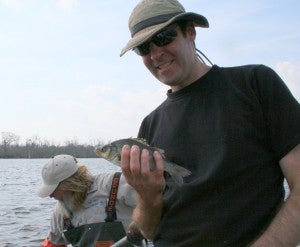
    EDF Oceans Communications Director Tom Lalley holding a fish on a boat with Willy Phillips of NC

    A frenetic week in Washington, D.C. brought Congressional leaders together with fishermen.

    Early mornings, full days and late nights were the norm as fishermen spread the message that catch shares are important for their future. Funding for the national catch shares program is included in the Fiscal Year 2011 budget.

    Read full post »

  • Walmart Redux: Citizens and Consumers

    I wouldn't normally write about the same subject twice in a row, but the impassioned responses to last month's column on Walmart's move to cut carbon emissions from their supply chain made me want to give it another think. Thanks to all of you who took the time to be considerate, whether or not we agree. And a shout out to the poet!

    The comments, many angry or hurt, suggest that we here at EDF haven't done a good enough job of explaining what we do, why, and who pays for it.

    Reducing personal consumption won't by itself solve global warming

    Let's start with the premise that when it comes to solving the climate crisis, simply reducing personal consumption is not enough. The problem is much too large, and developing far too rapidly. Plus, many people don't even yet feel enough concern about climate change to motivate them to make changes.

    Consider this: What if, instead of committing itself to reducing carbon emissions, Walmart had simply said: "Who cares about global warming? We don't believe in it. We don't want to revamp anything until regulations force change." Ask yourself: Would we be better off?

    This gets me to the work of EDF–harnessing markets to protect the environment by "making it profitable to put out less pollution" as president Fred Krupp says. EDF has been a pioneer and leader in working strategically with companies for 20 years. This is why I was drawn to their work in the first place; it manages the nifty trick of being idealistic, ambitious and pragmatic. EDF is dedicated to solving what I think of as the defining crisis of our century: mitigating pollution that began with the industrial revolution, and has been magnified by the post World War II chemical revolution.

    EDF is interested working with market leaders–companies whose decisions affect whole economic sectors. So yes, EDF does support free enterprise, or capitalism. No, EDF is not against all consumption. Yes, EDF has a track record of protecting the environment. And most emphatically NO–EDF does not take money from its corporate partners. The environment is their only client. EDF is funded by generous individuals and foundations.

    Remember these? You no longer see Styrofoam containers at most fast food restaurants because EDF worked with market-leader McDonald's to cut waste.

    It's now 20 years since EDF first worked with McDonald's to reduce its packaging waste by 150,000 tons. This was followed by a highly successful project with McDonald's to curb the use of human antibiotics in animal agriculture. Since then EDF has worked with Whole Foods and Wegman's to clean up the shrimp farming industry; it has worked with Walmart to cut waste; it has worked with FedEx to develop hybrid delivery trucks, and in the process transformed the entire delivery industry. The list goes on.

    "Markets by themselves, much like currents in a river, are neither good nor bad," says Gernot Wagner, an EDF economist who sees himself as a "pragmatic" optimist. "Properly guided, they can be a force for good. Entrepreneurs see environmental challenges as opportunities rather than hindrances."

    It is interesting how many readers of last month's column frame their environmentalism as a choice between consuming or not consuming, forgetting, it seems, that we have to define ourselves first as citizens, not as consumers. Of course, every living creature consumes. The needless, mindless consumption that wastes precious resources, pollutes and even kills, is another matter.

    LandfillTo change our throwaway culture, we must be citizens first, then consumers.Town Hall

    All of us can be more watchful of our habits, without necessarily giving up on vacations, or raspberries in February. Every day scientists learn more about the consequences of our choices, whether in the metals in our fish, the emissions from our cars, the chemicals in our soaps, the microwave radiation from our cell phones or the fertilizers on our fields. Every day, it seems, we learn something more that inspires us to make adjustments in our consumption.

    Personal action, however, can be expensive. Not everyone can immediately, or ever, afford to buy a new car. Not everyone can immediately, or ever, afford to install new geothermal or solar systems; not everyone can immediately, or ever, afford to retrofit their houses with new insulation. Until the prices for many "green" items come way down, they will not be widely adopted. That does not mean we ought to shoulder a massive guilt trip–that would be inappropriate, and counterproductive. The burden of responsibility has to be on us collectively–on our governments, and our corporations, those entities that have the largest impact on our lives.

    It is our job, as consumers, to decide how to spend our money. It is our job, as citizens, to decide how to spend our energy. Speak out, lobby, protest, persuade, agitate, march, sit-in, write, sing, or dance. Do what you can. I believe we should be angry, and that our voices should be harnessed to demand better leadership from our elected and appointed officials–and our media.

    Why is it that as the effects of global warming intensify, polls show that fewer people feel it is of significant concern? Those of us whose job it is to communicate the findings of scientific research have only ourselves to blame.

    People often ask me how I feel about "preaching to the converted" in this column. I think we can see in the wide-ranging responses to Walmart's decision to cut emissions that there is no consensus among environmentalists–much less the general public–about how to move forward. There is no such thing as "the converted." Anyway, I have an aversion to that phrase, as it implies faith, as does the idea of "belief" in climate change, and faith and belief are not the appropriate response to peer-reviewed scientific data. Simple learning and understanding will suffice, as will putting out accurate, verifiable data to the contrary. So far there isn't any sound science behind the claim that global warming doesn't exist.

    It is every citizen's job to get smart. You don't have to become a climate scientist and reanalyze data, necessarily–just as you don't have to become a cell biologist to accept a doctor's recommendations. Read up on the science, learn the facts, and stop mumbling politely when someone tells you that what you see all around you during these "extreme weather events" as we now call them (as though they were some form of sport), isn't really happening.

    Shop at Walmart or shop at the bodega on the corner, but make sure that's not the only way you are putting your money where your mouth is.

    Personal Nature
    Take action! Exercise your voice as a citizen and tell the Senate to cap the pollution causing global warming.

  • Flows for a Healthy Delta: We need them now and we need them for the long haul

    Senior Water Resource Analyst

    Given that the State Water Resources Control Board’s flow proceeding finished yesterday, it is worth highlighting yet another reason why this work is so necessary and timely. As a reminder, the SWRCB is charged with determining the volume and timing of flows in the Bay-Delta necessary to support a healthy ecosystem, including protecting imperiled fisheries. This is no easy task, but a necessary one if we are going to develop a long-term sustainable solution for the Delta.

    Indeed, the Bay-Delta Conservation Plan (BDCP) process, has struggled with this question since it started back in 2006. The challenge in the BDCP has been the inevitable difficulty of attempting to develop a plan that simultaneously provides water supply reliability and contributes to the recovery of species, such as salmon. While we have a somewhat clear idea as to the water supply goals we do not yet have agreement about the level of flows necessary for species recovery. The State Board's current task is narrow because it is charged with determining what the Bay-Delta ecosystem needs without – at this time – addressing water supply impacts. This does not make its work task any easier, but makes very clear what question must be answered.

    Once the State Board has completed its work this August, their flow recommendations will provide critical and necessary guidance for the BDCP, which is scheduled to have a draft plan completed by the end of 2010. This will provide the BDCP with a solid foundation of scientifically credible freshwater flows to support a healthy ecosystem, a starting point to determine the level of water supply reliability that can be achieved without jeopardizing species.

    Without these flow recommendations from the State Board, it is highly likely that the BDCP would continue to spin its wheels and delay the completion of a final plan – further jeopardizing the long term sustainability of the Delta as well as the fisheries, farms and cities that depend on it.

  • Global Deforestation Slowing, but Much More Needs to Be Done

    This post was co-authored by Director of Tropical Forest Policy Steve Schwartzman and International Climate Change Policy Analyst Gus Silva-Chavez.

    Deforestation

    Deforestation accounts for about 15 percent of the man-man carbon emissions that contribute to climate change

    The latest global deforestation estimate from the United Nations Food and Agriculture Organization (FAO) indicate that deforestation rates slowed from 2000 – 2010 relative to the 1990s. The UN News Centre says:

    Between 2000 and 2010, some 13 million hectares of forests were converted annually to other uses, such as agriculture, or lost through natural causes, down from 16 million hectares per year during the 1990s, according to the assessment which surveyed 233 countries and areas.

    This is welcome news, and is in part due to Brazil’s major efforts to slow its slash and burn juggernaut. But deforestation still puts more greenhouse gas pollution into the atmosphere than the global transportation sector. Much more needs to be done to get a handle on the problem.

    Brazil is a good example of how to do that; deforestation is way down from the 2004 peak, and the country now has a national economy-wide emissions reductions target (including an 80% reduction in Amazon deforestation by 2020) that is federal law. Brazil has become a world leader on climate change. Federal and state governments are cracking down on the lawless frontier, and companies are increasingly unwilling to buy beef and soy from newly cleared lands.

    But the large-scale positive incentives to reward forest conservation and sustainable land uses are not yet in place. For this trend to last when commodity prices go up (as they inevitably will), we need a price signal from the carbon market to make living forests worth as much or more than dead ones: reducing emissions from deforestation and forest degradation (REDD).

    The U.S. Senate continues to put together the pieces of its climate bill, and just this week a group of environmental, industry, agricultural and forestry groups called for offsets and REDD to be included in the Senate package.

    At the UN level, negotiations on REDD will continue this year. The efforts at the international and U.S. level are exactly the types of strong signals that are vital to ensuring that the declining trend for deforestation continues. EDF believes that if REDD is made a reality and successfully implemented, the signal for forest protection will lead to lower and lower emissions in coming years.

  • EDF’s Tim Fitzgerald Appears on the Kojo Namdi Show to Talk Bluefin Tuna and Sustainable Sushi

    Yesterday, Tim Fitzgerald, EDF's Senior Oceans Policy Specialist and Marine Scientist who leads our sustainable seafood work, appeared on the Kojo Namdi Show with Casson Trenor to discuss sustainable sushi and ask the question to listeners, "how well do you know your sushi?"
    With the recent defeat of a proposed ban by the U.N. Convention on International Trade in […]

  • Using renewable energy instead of natural gas saved Austin almost $50 million

    Settling down with my usual bedtime reading last night – Austin Energy's Annual Report of System Information – two tables caught my attention: the "Fuel Costs" (in total $) table on page 2, and the "Energy By Fuel Type"(in total MWh) table on page 3. Hiding in those tables are some meaningful numbers that refute the current thinking that with natural gas prices so cheap, nothing can possibly be cheaper. A little bit of math shows that renewable energy is an even cheaper option.

    Tables From Austin Energy's Annual Report of System Information

    It's unfortunate that the charts above didn't compare the fuel costs of different resources on a relative basis, but we can do that by simply dividing the fuel costs by the energy from each fuel to arrive at a $/MWh value for each resource.

    Environmental Defense Fund Calculations Based on Above Tables

    When I did that, I found that on a $/MWh basis, Austin's purchases of renewable energy in 2009 were still $5/MWh cheaper than gas, saving Austinites money even as natural gas prices were at historic lows. In 2008, when gas prices were higher before the recession, renewable energy was about $54/MWh cheaper. In the Texas grid (ERCOT), renewable energy almost always replaces natural gas in the "generation stack" so this adds up to a savings of about $50 million for Austinites in the last two years.

    These calculations don't include the additional cost to the utility of owning & operating the gas plants, which for the renewable energy purchase agreements are wrapped up into the "Fuel Cost" table. Including those values for a more "apples to apples" comparison pushes the price of natural gas up another $5-$6/MWh, further tipping the scales in favor of renewable energy in Austin.

    Roger Duncan provided strong leadership during his time at Austin Energy by seeking out the meaning behind seemingly innocuous tables like these. His decisions lead to immediate savings for Austin customer and significant future savings as the cost of fossil fuels continues to increase. Hopefully city leaders will have the foresight to choose a general manager who can look past the bland numbers in annual reports like Roger did to see the real information: even with historic fossil fuel price dips during the worst recession since the Great Depression, renewable energy is still cheaper than fossil fuels.


  • Elizabeth Sturcken Recognized for Making Strides in Sustainability

    The article below from GreenEconomyPost.com includes Environmental Defense Fund''s own Elizabeth Sturcken, the managing director in our San Francisco office who oversees our work with Walmart. Read her recent blog post about why she's excited Walmart's recent carbon commitment.

    Celebrating Women in Sustainability: 10 Women Making Strides in Sustainability

    There is an increasing number of women who are in leadership roles in sustainability. As part of Women’s History Month, let’s take a look at 10 women who are making strides in sustainability and shaping ethical consumerism. Add women in sustainability that you admire to the list in the comments section.

    by Aysu Katun, Green Economy Post

    In their book “Women in Green,” authors Kira Gould and Lance Hosey argue that women are more likely than men to support environmental causes through voting, activism and consumer choices. Whether this argument is true or not, there is an increasing number of women who are in leadership roles in sustainability. As part of Women’s History Month, let’s take a look at ten women who are making strides in sustainability and shaping ethical consumerism.

    Erin Carlson

    As Director of Yahoo! for Good, the company’s Social Responsibility department, Carlson is responsible for leading Yahoo!’s environmental strategy and corporate social responsibility programs. Her primary focus is inspiring Yahoo!’s audience of over 500 million people to be more green in their daily lives through use of Yahoo! products. She helped guide the development of a new Yahoo! Green site to encourage people to take eco-friendly actions and has driven the creation of Yahoo! Earth Day sites since 2005. She also spearheaded Yahoo!’s worldwide initiative to become carbon neutral and rallied grassroots efforts by launching a Green Team of hundreds of employees across the globe.

    Prior to joining Yahoo!, Carlson worked at Nike Inc. in Apparel Sustainability and at Business for Social Responsibility as Environment Program Manager.

    Karen Flanders

    Karen Flanders has 20 years of experience working on sustainability matters having worked domestically and internationally within corporations, NGOs as well as intergovernmental organizations. She is currently a Senior Associate at The Prince’s Rainforest Project responsbile for corporate outreach. Shea Senior Associate with the University of Cambridge Programme for Sustainability Leadership (CPSL). Through CPSL, she is a Senior Associate with The Prince’s Rainforest Project, where she is currently working to engage the support of corporate America to call for emergency action to help combat climate change by addressing rainforest destruction. She is also on the board of the Women’s Network for a Sustainable Future.

    Prior to joining CPSL, she served as the director of sustainability for the Coca Cola Company for eight years. Flanders lived and worked in Europe for 12 years and led European and global advocacy campaigns for WWF – the conservation organization. Fluent in French and Dutch, her affinity for cross-cultural communications dates back to her tenure with a pan-European agency, where she advised corporations such as Mars, L’Oreal and others on European CSR policies.

    Hannah Jones

    Hannah Jones holds the position of Vice President of Sustainable Business and Innovation at Nike and manages the company’s global corporate responsibility efforts, including responsible competitiveness, community investments, social innovation and considered product innovation. She has been working with Nike since 1998 when bad publicity surrounding labour issues was at its height.

    Before joining Nike, Jones served as a consultant to Microsoft and Kimberly-Clark on both companies’ community affairs programs. She also worked as the European manager of Community Service Volunteers Media, an UK-based non-governmental organization, where she led pan-European campaigns centering on youth issues.

    Diane MacEachern

    Diane MacEachern is a founding member of Green Moms Carnival, a blogging network of mostly moms who reach millions of consumers with their green lifestyle tips, product reviews and shopping suggestions. MacEachern is also the founder & CEO of Big Green Purse and publisher of the award-winning www.biggreenpurse.com; and she is the best-selling author of Big Green Purse: Use Your Spending Power to Create a Cleaner, Greener World and Save Our Planet: 750 Everyday Ways You Can Clean Up The Earth. MacEachern is also a regular commentator on Martha Stewart’s Whole Living radio program.

    Christina Nicholson

    In her current role as Director of Sustainable Development, Christina Nicholson is responsible for driving sustainability as a strategic agenda throughout both corporate and brand activities within Pottery Barn and Williams-Sonoma brands. She has also joined the Sustainable Furnishings Council (SFC) board of directors.

    Her background in finance, sustainable design and marketing make her uniquely qualified for this cross sector challenge and she is making great headway on materials and supply chain, energy use and both internal and external brand communications and education. You can watch a video about some of the actions she is taking at William-Sonoma here.

    Bonnie Nixon

    Bonnie Nixon and her green team of dedicated sustainability experts are responsible for the short and long term vision, strategy, marketing, messaging and stakeholder relations program for Hewlett Packard.

    Over the last decade at HP, Nixon has worked with top level management on environmental, health, safety and social polices and procedures and designed and implemented a world class ethical sourcing and supplier relationship management program.

    Prior to joining HP, as an experienced environmental mediator, she has spent more than 24 years working with business, government and non-governmental entities on environmental and social impact assessments and programs.

    Dianne Dillon-Ridgley

    Environmentalist and Human Rights Activist, Dianne Dillon-Ridgley has worked for thirty years on issues of the environment and sustainability, and gender and CSR, both domestically and internationally. Since 1997 she has been a director at Interface, Inc., global manufacturer of modular carpet and a leader in sustainable design. She was a director at Green Mountain Energy for the first six years and still chairs the Environmental Integrity Committee for the company.

    She was appointed by the White House to the US delegation for the Earth Summit in Rio, UNGASS-’97 & WSSD in South Africa, making her the only person to serve on all three US delegations. She was also appointed by former President Clinton to the PCSD, his council on Sustainable Development. In the recent US election she worked for 18 months on the Obama campaign from its earliest days in Iowa and was part of the
P-CAP: Presidential Climate Action Project.

    Emma Stewart

    Emma Stewart, Ph.D., is currently the Senior Program Lead of Autodesk’s Sustainability Initiative. In this role, she leads the design software company’s efforts to optimize its environmental footprint and model sustainability best practices to its 9 million architect, engineer, manufacturing, and construction customers.

    Prior to that, she founded and directed the Environmental R&D Division at Business for Social Responsibility, where her team designed corporate initiatives to analyze and adapt to ‘horizon’ issues such as payments for ecosystem services, water footprinting, carbon offsets and trading, climate lobbying, and sustainable product design.

    Elizabeth Sturcken

    Elizabeth Sturcken is the Managing Director of the Corporate Partnerships program at Environmental Defense Fund (EDF) where she develops and implements joint projects with leading companies to create environmental change.

    She is currently leading a team of people working with Wal-Mart to create broad environmental change in areas including climate change, China, seafood, and packaging.

    In the past, Sturcken led a FedEx project to develop environmentally advanced heavy-duty delivery vehicles. She also led a project with UPS to create innovative changes in their express delivery packaging, resulting in environmental, business and customer benefits.

    Kathrin Winkler

    Kathrin Winkler is Vice President and Chief Sustainability Officer at EMC Corporation, where she is charged with providing vision and leadership in the development and implementation of EMC’s strategy for environmental and social sustainability. In her previous role as Sr. Director for EMC’s hardware engineering group, Kathrin founded the company’s Engineering Green Team and its Design for Environment program, which are driving leadership designs in environmental stewardship and energy efficiency throughout EMC’s product portfolio.

    Kathrin joined EMC in 2003 as Director, NAS Product Management. Her past positions included Principal Consultant/Analyst specializing in enterprise management systems and service level architectures at Renaissance Worldwide, Vice President Technical Marketing in a Web services security startup, and Consultant Software Engineer in Network Systems Engineering at Digital Equipment Corporation. In addition to her work at EMC, Kathrin serves as a Director of EcoLogic Development Fund, a non-profit organization dedicated to community-based conservation in Central America and she is on the board of The Green Grid, a consortium of IT companies and professionals seeking to improve energy efficiency in data centers and business computing ecosystems around the globe. She blogs her experiences working with sustainability issues at EMC, on her blog, Interconnected World.

    This content originally ran on Green Economy Post

  • How to Cut Freight Pollution, Part I: Port and Rail Corridor Examples

    Ports, intermodal distribution centers, and busy freight corridors are vital to our global and domestic trade system. They are also highly polluting and harm our environment and our health. In many cities, ports and intermodal railyards are the single largest polluters, and as we wrote in a previous blog post, it is estimated that nearly 21,000 people die every year as a result of heavily polluting diesel engines, the most commonly used engines in freight transportation.

    All ten of the largest U.S. ports have taken some steps towards cleaning up their activities and several rail yards and corridors have , too. We've highlighted some of these plans in our recent report, The Good Haul [PDF], and there are some others out there. Unfortunately, these programs are not the norm, and some are certainly better than others.

    Port Cleanup Plans

    A container ship at the Port of LA using alternative marine power (power via the city’s grid) instead of burning diesel fuel while at dock. Photo: Port of LA.

    One promising cleanup plan is at the ports of Los Angeles and Long Beach. This comprehensive cleanup plan has already taken 2,000 dirty trucks off of the road, which has reduced truck related emissions by 80%.

    Another good actor is the Port of Seattle. Its Seaport Air Quality Program looks to clean up all aspects of the port's operations. The port has also worked with U.S. EPA, the Washington Department of Ecology and the Puget Sound Clean Air Agency to retrofit and replace all cargo handling equipment with cleaner engines.

    Railyard and Corridor Cleanup

    In addition to port cleanup plans, railyards and rail corridors also have low-hanging fruit. Chicago's railyard cleanup program, the Chicago Region Environmental and Transportation Efficiency (CREATE) Program focuses on three freight corridors and one passenger rail corridor, building new overpasses and underpasses, enhancing grade safety and upgrading tracks. These infrastructural changes will streamline the Chicago rail system, which handles 29% of the revenue earned by U.S. Class I freight railroads. Air quality improvements are expected to save the community $1.12 billion in reduced health care and loss of life costs between 2003 and 2042, and the cleaner air will translate to seven more smog-free days every summer.

    Railyard and corridor cleanup plans have promising environmental results. Author’s photo.

    Another rail plan worth noting is Norfolk Southern's Crescent Corridor Initiative. This initiative upgrades a 1,400 mile long corridor between Louisiana and New Jersey along Interstate 81. The plan includes straightening curves, improving signals, and building new terminals. Upon completion, the project aims to shift more than 1 million truckloads of freight to rail, saving more than 170 million gallons of fuel per year.

    Plans like these ought to be the norm for major freight corridors and hubs. In out next blog, we'll share how we think the federal transportation bill can encourage smart freight transportation policies.

  • EPA Proposes New Rules for Reporting Methane Emissions

    The Environmental Protection Agency has proposed new rules for reporting greenhouse gas emission, including some that would require the oil and gas industry to collect data on its emissions by this coming January.

    One of the public benefits of the new rules would be more disclosure about methane emissions. Methane has a warming potential 24 times that of carbon dioxide.

    EDF attorney Pamela Campos says:

    Rigorous emissions data is the foundation of well-designed public policy … The public has been left in the dark about methane emissions from the oil and gas industry. EPA's leadership in requiring disclosure of this potent greenhouse gas will mean more rigorous information and smarter policies to address pollution.

    Read more from EPA here, and EDF's reaction here.

  • Nature Conservancy: Protecting Land Helps Protect Water Resources

    Laura Huffman, Executive Director of the Nature Conservancy of Texas, has opinion pieces in the San Antonio Express News, Dallas Morning News, and Austin American Statesman newspapers this week discussing how the protection of vital open space and wildlife habitat benefits our water resources. Among other measures, she highlights open space initiatives over the Edwards Aquifer, the need for using conservation easements and other tools to help private landowners protect open space in the fast-growing Dallas/Fort Worth area and the massive Balcones Canyonland Conservation Plan in the Travis County area. Worth a read!

  • Fishermen Come to D.C. to Educate Lawmakers About Catch Shares

    United States CapitolApproximately 50 fishermen have arrived in Washington, D.C. today to tell members of Congress how important catch shares are to their future. Funding for the national catch shares program is included in the Fiscal Year 2011 budget. The fishermen are in Washington to talk to their Congressional representatives and Senators about how conventional management is increasingly pushing fishermen off the water and how catch shares is a solution that keeps fishermen working – even while fish stocks recover.

    Today more than 60 federal stocks are overfished or undergoing overfishing. Thousands of fishing jobs have been lost as fisheries have declined under the current management system. This adverse impact from conventional management continues to increase as many valuable fisheries face huge closures or dwindling seasons, which will have devastating impacts on fishing jobs and coastal communities.

    During their visits to Capitol Hill, fishermen will tell lawmakers how catch shares are locally designed to meet economic, social, and conservation goals. Catch shares management is not a one-size-fits-all approach; rather programs are designed to meet the specific needs and goals of each fishery.