Author: Mark Liberman

  • Morgenbesserisms

    A footnote in Steven Strogatz’s NYT opinion piece on negative numbers (he’s in favor of them, I think) is a good excuse to revisit my inadequate (but apparently canonical) collection of the witticisms of Sidney Morgenbesser (“If P, so why not Q?“, 8/5/2004), and to ask if anyone has more to add to the list.

    I’ll contribute some quotations from Wikipedia that were missing from my 2004 list:

    Morgenbesser was leaving a subway station in New York City and put his pipe in his mouth as he was ascending the steps. A police officer told him that there was no smoking on the subway. Morgenbesser pointed out that he was leaving the subway, not entering it, and hadn’t lit up yet anyway. The cop repeated his injunction. Morgenbesser repeated his observation. After a few such exchanges, the cop saw he was beaten and fell back on the oldest standby of enfeebled authority: “If I let you do it, I’d have to let everyone do it.” To this the old professor replied, “Who do you think you are, Kant?” The word “Kant” was mistaken for a vulgar epithet and Morgenbesser had to explain the situation at the police station.

    To B.F. Skinner, “Let me see if I understand your thesis. You think we shouldn’t anthropomorphize people?”

    Morgenbesser once set this as an exam question: “It is often said that Marx and Freud went too far. How far would you go?”

    “The only problem with pragmatism is that it’s completely useless.”

    When asked his opinion of pragmatism, Morgenbesser replied “It’s all very well in theory but it doesn’t work in practice.”

    Asked to prove a questioner’s existence, Morgenbesser shot back, “Who’s asking?”

  • This delayed and dominating echo

    From reader GK:

    One of your recent LL postings jogged an old memory. In the early 70s I sometimes hung out at Brown’s college radio station, and one evening I was working on creating an ad in the production studio there. Somehow I managed (by accident) to set up the following situation: I was speaking into a microphone whose input fed into the record head of a reel-to-reel tape player, while listening to the output from the play head. I wore thickly padded earphones. The tape first passed the record head, then — after a fractional-second delay — the play head, so that I was hearing my own voice on that delay. Despite my best efforts, I could not utter an entire sentence, but would grind to a halt almost immediately. I wonder whether this effect has been observed in experiments (I would guess so). It’s not surprising, of course, but I found it to be a powerful demonstration.

    This effect is indeed well studied experimentally. It now goes by the name “delayed auditory feedback” (often abbreviated DAF).

    The first documentation of DAF, as far as I know, was almost 60 years ago: Bernard Lee, “Some Effects of Side-Tone Delay“, Journal of the Acoustical Society of America 22(5): 639, 1950:

    I wish to call to the attention of those who have not yet observed it an interesting experiment in the field of psycho-acoustics which may be duplicated by anyone having access to a magnetic tape recorder with separate recording and playback heads, as for example, the Presto PT-900.

    By plugging a telephone headset into the playback jac, a person’s voice may be returned to his own ears but delayed by the length of time the tape requires to move from one magnet to the next. The effect of this delayed and dominating echo is startling — it will cause the person to stutter, slow down while raising his voice in pitch or volume, or stop completely.

    (These days, you don’t need a tape recorder — it’s more convenient to use a computer program, e.g. this one.)

    Back in the spring of 1950, Lee interpreted his observations in tune with the intellectual fashions of the times:

    I believe that this phenomenon invites the application of fundamental concepts presented by Norbert Wiener in his book Cybernetics, since the elements necessary for Wiener’s analogy between an electonic circuit oscillating with feedback and the means by which we govern many of our everyday physiological functions are strikingly manifest.

    And he describes the effects in almost novelistic terms:

    Of the subjects tested thus far, some develop a quavering slow speech of the type associated with cerebral palsy; others may halt, repeat syllables, raise their voice in pitch or volume, and reveal tension by reddening of the face. There seem to be different effects depending on whether the subject is reading, extemporizing, counting, reciting, speaking a foreign language, etc. Some have challenged the disturbance, but none have as yet defeated it. A prolonged session (more than two minutes) is physically tiring.

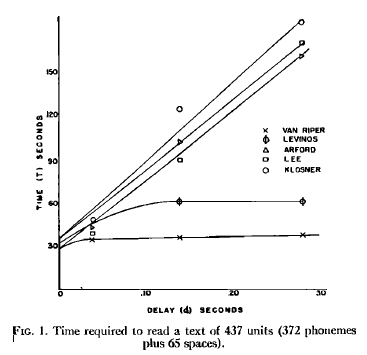
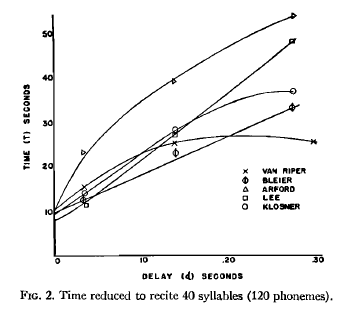
    A couple of months later, he reported some quantitative experimental results, in Bernard S. Lee, “Effects of delayed speech feedback“, Journal of the Acoustical Society of America, 22(6): 824–826, 1950:

    When a person’s own voice is returned to his ears by technique of the multiheaded magnetic tape recorder and earphone a startling disturbance of his speech may be noted. A delay of about 1/4 sec. may cause the subject to speak very slowly but if he maintains normal speed, stuttering characterized by repetition of syllable or fricatives may occur. The level of the returned speech must be somewhat about that hard through bone conduction in order to be effective. This phenomenon seemed especially worthy of attention because of the important role played by the aural monitor of speech and because of the unudual opportunity afforded to experimentally hybridzie a neural and electronic network. A similar psychological upset of speech in certain auditoriums equipped with public address systems has been noted in the past.

    He measures the effects in terms of the time to read a short prose passage:

    And similarly, the time to recite 40 syllables:

    As you can see, there are considerable individual differences. (And quaintly, back in those pre-IRB days, he gives us the names of the subjects…)

    Since 1950, there have been thousands of publications on related topics — see Aubrey Yates, “Delayed Auditory Feedback”, Psychological Bulletin 60(3) 1963 for an indication of how extensively the topic had been investigated within a decade of Lee’s discussions. One reason for the interest is the idea, present in Lee’s first article, that this phenomenon may reveal something important about the process of speaking — and perhaps about the origins of some clinical disfluencies.  Another reason is the paradoxical discovery that some people who stutter may become more fluent with moderate amounts of DAF (typically less than 100 msec) — see e.g. Peter Howell, “Effect of delayed auditory feedback and frequency-shifted feedback on speech control and some potentials for future development of prosthetic aids for stammering“, Stammering Research 1(1): 31–46 (2004) for a review.

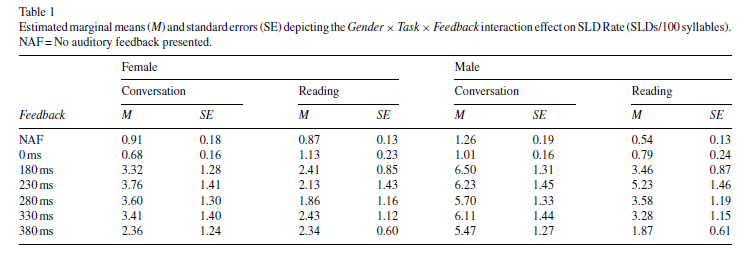
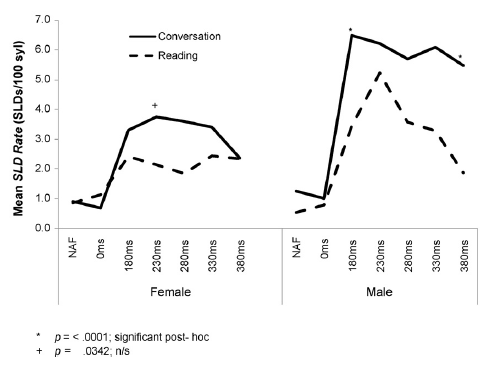
    Another (somewhat random) observation that may be of interest to some is the significant (average) effect of speaker sex on response to DAF, as documented in David Corey and Vishnu Cuddapah, “Delayed auditory feedback effects during reading and conversation tasks: Gender differences in fluent adults“, Journal of Fluency Disorders 33:291-305, 2008.

    Here’s their table showing the gender differences in “stuttering-like disfluencies” (SLDs) in conversation and in reading:

    And the same information (at least the mean values) in graphical form:

    You’ll recall from Lee’s 1950 paper that there are significant individual differences in response to DAF, within as well as across sexes, so I thought I’d try to calculate effects sizes (in terms of Cohen’s d) for the data in table 1. In order to do that, I converted the standard errors to standard deviations, given that there were 20 male and 21 female subjects, and then divided the differences in the means by the pooled standard deviations. This is not really an appropriate measure, given 0 is the lowest possible count, and the performance distribution must have included a certain number of 0s, but we’d need all the original data to calculate more appropriate measures, like differences in quantiles.

    Conversation Reading
    NAF -0.42 0.56
    0 -0.46 0.32
    180 ms -0.54 -0.27
    230 ms -0.38 -0.47
    280 ms -0.35 -0.32
    330 ms -0.42 -0.17
    280 ms -0.55 0.17

    (Negative numbers indicate fewer errors, on average, among female subjects. See e.g. here for a discussion of what an effect size of d=0.5 means — with the warning that this metric is hard to interpret when we’re dealing with small positive-integer measures of performance… If the quantity under study were continuously variable, and not limited to positive integers, then an effect size of -0.5 in this case would lead us to expect that about 64 times out of 100, a randomly-selected trial involving a female subject would show fewer errors than a randomly-selected trial involving a male subject.)

    As Corey et al. explain, these sex differences (among non-stutterers) are suggestive, given the large sex differences in the prevalence of stuttering:

    Developmental stuttering (DS) is characterized by unintended speech dysfluencies. Specifically, people who stutter experience unintended repeated movements (repetitions of speech sounds) and fixed postures; the latter can take the form of prolonged speech sounds or prolonged silences during speech. Although DS has been widely studied, its etiology remains unknown. The condition begins spontaneously in about 4%of children, and about 75% of these recover spontaneously during childhood. The remaining 25% (1% of the population) continue to stutter throughout adulthood. The prevalence of DS is strongly linked to gender, both among those who recover from childhood stuttering and among those whose stuttering persists into adulthood, with males being more likely than females to experience DS and less likely than females to recover. As a result, the gender difference in DS prevalence increases with age, with the male-to-female ratio growing from about 2:1 in children to about 4:1 to 5:1 in adults. (See the paper for citations to back up these various quantitative and qualitative statements.)

    There are lots of theories about where these differences come from; but that’s enough for today.

  • Imprudent not to expect a silver bullet?

    From Paul Kay, this passage from an email recently sent by the Chair of the UC Berkeley Academic Senate:

    As background, the state continues to anticipate a very large deficit this year.  While the Governor’s budget did call for restoring approximately $300M in funds cut last year from the UC budget, it would probably not be prudent – in my view – to assume that our budgetary situation for 2010-11 will be better than 2009-10.  In addition, the Governor’s proposed constitutional amendment, which called for shifting money to higher education by privatizing the state prison system, has attracted no political support (and a great deal of criticism as a policy proposal).  While UCOP has been apparently working with to develop alternative constitutional amendments, it would again be imprudent not to expect a silver bullet.

    As Paul points out, the missing words between with and to (“the Governor’s Office”?) suggests that this note was sent in haste, so that the overnegation in the last phrase may be an editing error.

    For example, the author might have begun with “it would be prudent not to expect a silver bullet”, and then decided to change it to “it would be imprudent to expect a silver bullet”, but made only one of the two required changes.

    Still, Paul observes, it’s also probable that the fog of multiple negation — especially in modal contexts — also played a role.

    But there’s also something interesting going on with the “silver bullet” metaphor.  Even at Berkeley, I doubt that the author really meant to bring up witches and werewolves. The Lone Ranger doesn’t quite fit, either.   But as the Wikipedia article explains,

    The term has been adopted into a general metaphor, where “silver bullet” refers to any straightforward solution perceived to have extreme effectiveness. The phrase typically appears with an expectation that some new technology or practice will easily cure a major prevailing problem.

    Maybe there’s been a merger with Paul Ehrlich‘s “magic bullet” phrase.  Anyhow, a quick web search shows that there’s a lot of talk going around about expected silver bullets, little or none of it from evil supernatural creatures.

    [Update — the OED explicitly suggests that the sense “A simple, miraculous solution to a complex and difficult problem” is related to the medical magic bullet phrase, and gives citations back to 1951:

    1951 Bedford (Pa.) Gaz. 19 Sept. 1/3 There are those who warn against viewing the atom as a magic weapon… I agree. This is not a silver bullet which can deliver itself or otherwise work military miracles. 1971 Chron.-Telegram (Elyria, Ohio) 18 Mar. 18/4 Drug abuse, as virtually every other major problem, is multicausative and not given to simplistic silver bullet solutions.

    I guess it was the misnegation that set me off in the wrong interpretive direction, with a flash of the UC Berkeley Faculty Senate as a gathering of witches and werewolves being warned that “it would be imprudent not to expect a silver bullet”.]

  • Language Log TV

    From a reader:

    I dreamt that I some cars were racing back and forth in front of my house with lights and speakers all over them. Someone asked me what it was all about and I said “It’s Liberman and the Language Log folks checking out the doppler effect”

    This woke me up and as I thought about it, I realized  that Language Log would make a great television program.

    Sort of a mixture of Mythbusters, NCIS, and Sesame Street? Or maybe a cross between 60 Minutes and Glenn Beck? I guess I don’t want to know.

  • Relationship R & D

    One of Language Log’s early posts linked to Daniel Zettwoch’s Deadlock, which illustrates in cartoon form Jason Shiga’s application of game theory to the dynamics of relationship formation. But Shiga’s research represented only an individual-investigator approach to the problem. Now, just in time for Valentine’s day, The Onion shows us what Big Science can do:


    NASA Scientists Plan To Approach Girl By 2018

    Meanwhile, at the New York Toy Fair on February 12, Mattel announced that the winner of a world-wide vote for Barbie’s Next Career was Computer Engineer:

    To ensure the doll accurately reflects this occupation, Barbie® designers worked with the Society of Women Engineers and the National Academy of Engineering to ensure that accessories, clothing and packaging were realistic and representative of a real computer engineer.  Looking geek chic, Computer Engineer Barbie® wears a t-shirt featuring binary code and computer/keyboard icon along with a pair of black knit skinny pants. Computer Engineer carries a Barbie® smart phone, fashionable laptop case, flat watch and Bluetooth earpiece. With stylish pink-frame glasses and a shiny laptop, she is ready to conquer the day’s tasks on the go or from her desk.

    The suggested range of projects struck me as a bit stereotypically feminine:

    “Girls who discover their futures through Barbie will learn that they – just like engineers – are free to explore infinite possibilities, and that their dreams can go as far as their imaginations take them,” said Nora Lin, President, Society of Women Engineers. “As a computer engineer, Barbie will show girls that women can design products that have an important and positive impact on people’s everyday lives, such as inventing a technology to conserve home energy or programming a newborn monitoring device.”

    In a world that features TV characters like Abby Sciuto, Computer Engineer Barbie’s imagination might well soar beyond baby monitors and home thermostats, as important as those are.  In fact, she might be just what that NASA project needs.

  • Words and opinions

    It’s a commonplace observation that survey results depend on how questions are worded.  But I don’t think I’ve ever seen a larger effect of synonym-substitution than the one reported by a recent CBS News/New York Times poll about the U.S. military’s DADT (“Don’t Ask Don’t Tell”) policy.

    Question: Do you favor or oppose ___ serving in the military?

    “Homosexuals” “Gay Men & Lesbians”
    Strongly Favor 34% 51%
    Somewhat Favor 25% 19%
    Somewhat Oppose 10% 7%
    Strongly Oppose 19% 12%

    On the face of it, the two wordings of the question seem to refer to exactly the same set of circumstances. But do they? Do (many) people these days think, for example, that “gay men and lesbians” refers to sexual orientation, while “homosexuals” refers to sexual practices? Or is this large difference in the distribution of opinions purely a question of connotation?

    A similarly striking effect was seen in responses to the question “Do you favor or oppose ___ being allowed to serve openly?” Changing the description from “homosexuals” to “gay men and lesbians” swung opinion in favor from 44% to 58%, and opinion in opposition from 42% to 28%:

    “Homosexuals” “Gay Men & Lesbians”
    Favor 44% 58%
    Oppose 42% 28%

    According to the (rather skimpy) details provided,

    This poll was conducted among a random sample of 1,084 adults nationwide, interviewed by telephone February 5-10, 2010. Phone numbers were dialed from random digit dial samples of both standard land-line and cell phones. The error due to sampling for results based on the entire sample could be plus or minus three percentage points.

    No breakdown by sex or age is given.

    A cynical commenter at TPM suggested the control experiment of asking people if they favor  “heterosexuals” serving openly in the military.

    One of the classic  discussions of such effects is Tom Smith, “That Which We Call Welfare by Any Other Name Would Smell Sweeter: An Analysis of the Impact of Question Wording on Response Patterns“, The Public Opinion Quarterly 51(1) 1987:

    A recent experiment on the General Social Survey (GSS) comparing three different versions of spending priorities scales revealed systematic differences by question form and some large differences between particular referents used. The largest observed difference in support for spending was between the traditional category “welfare” and the two variant forms “assistance for the poor” and “caring for the poor.” Two of the three forms used in the 1984 experiment (excluding “caring”) were again employed on the 1985 survey and again showed a large effect. When we compared these results to other surveys that (1) employed some type of program priority question and (2) inquired about “welfare” (or some variation that used this term) and about” the poor,” “the unemployed,” or “food stamps”( in one variation or another), we found that the effects were large, similar in magnitude, and persistent across time and survey organization. As Table 1 shows, on average support for more assistance for the poor is 39 percentage points higher than for welfare. Similarly, support for the unemployed always exceeds support for welfare (averaging 12 percentage points), although the margin is somewhat variable. Only support for food stamps is as low or lower than support for welfare.

    But the denotations of “welfare” and “caring for the poor” are arguably different — one is a bureaucracy, and the other is a moral obligation.

    [Update — Differences of this general kind have been noted, and to some extent studied, since the 1940s.   There are a number of obvious categories of explanation, including (1) different actual denotations of the words and phrases used, at least among the people surveyed,  (2) evocation of differently-evaluated frames by the metaphorical associations of words and phrases, (3) simple positive vs. negative connotations or associations of particular words or phrases, independent of any difference in denotation or in metaphorical frame.

    The empirical studies that I’ve seen don’t seem to distinguish these different types of effects very carefully.  For example, the study cited above presents a lot of facts about how differently people respond to different ways of phrasing questions about “welfare”-like programs, but doesn’t do (or cite) any empirical studies of why they respond in these different ways.

    There are also well-known effects of context,  including especially the previous questions in the survey, the characteristics of the people asking the questions, and so on.

    I’m not very familiar with this research area, but what I know of it suggests that linguists (including psycholinguists, sociolinguists and so on)  have not played as much of a role it in as might be appropriate.]

    [Update #2 — this particular poll result was also discussed in the NYT’s Caucus blog yesterday, with some additional break-down by sub-group:

    Democrats in the poll seemed particularly swayed by the wording. Seventy-nine percent of Democrats said they support permitting gay men and lesbians to serve openly. Fewer Democrats however, just 43 percent, said they were in favor of allowing homosexuals to serve openly. Republicans and independents varied less between the two terms.

    The blog post promises that “Complete poll results and article will be available this evening at www.nytimes.com” (i.e. yesterday evening), but nothing seems to have shown up yet.]

  • Them there I’s

    It’s no longer just imperial pontificators like George F. Will and Stanley Fish. The Obama-is-a-narcissist-and-his-use-of-I-proves-it meme has spread like kudzu, wrapping itself around the brainstem of every Fox News sub-editor and provincial pundit in the land. You couldn’t kill it with a blowtorch.

    Fox News, specifically, has decided to count first-person pronouns in every speech Obama gives. Thus “The I’s Have It: Obama Hits 34 I’s in Washington D.C.“, FOXNews.com, 2/7/2010:

    Much attention has been given to President Obama’s persistent use of “I” when giving speeches to sell his administration’s agenda. Is he taking responsibility — or, as his critics say, is he still in campaign mode? FoxNews.com is tracking the president’s speeches all this month and will report back after each to see whether The “I’s” Have It.

    In the case of President Obama’s Feb. 6 DNC speech, Fox counts 3,092 words and 34 “‘I’ references”. Using their transcript, I get 3094 words and 40 total first-singular references (22 I, 11 I’m, 3 I’ve, 2 me, 2 my), for a rate of 1.29 per hundred words. He also used 172 first-person-plural words (83 we, 36 our, 21 we’ve, 20 we’re, 9 us, 2 we’d, 1 ourselves) for a rate of 5.56 per 100 words, and a We/I ratio of 4.3.

    But these numbers are uninterpretable without some point of comparison.  Is 1.29%  I-words a lot for a speech of this type? A little? A moderate amount?  Luckily there were a few competing political speeches at about the same time. Perhaps the most widely-covered was Sarah Palin’s Feb. 6 speech at the Tea Party Convention. In CNN’s transcript (eliminating commentary and question text), I get 118 first-singular pronouns in 6973 words(75 I, 12 my, 12 I’m, 11 me, 6 I’ll, 2 I’ve ), for a rate of 1.69 per hundred, or about 31% more I-fulness than Obama.

    Palin also used 247 1st-plural pronouns (107 we 83 our 38 us 9 we’ve 9 we’re 1 we’d), for a rate of 3.54 per 100 words (about 57% less we-fulness than Obama), and a we/I ratio of 2.09 (less than half Obama’s ratio).

    House minority leader John Boehner (R-OH) appeared on Meet The Press on Jan. 31. His remarks comprised 1353 words, including 27 first-singular pronouns, for a rate of 1.996 per 100, which is about 55% more ego-referential than Obama’s DNC speech. Rep. Boehner used 70 first-plural pronouns, for a rate of 5.17 (making him almost as we-ful as Obama), but his we/I ratio was significantly lower, at 2.59.

    On Feb. 10, Rep. Paul Ryan (R-WI) appeared on All Things Considered to discuss his budget plan. Based on the WBUR transcript, he used 35 first-person-singular pronouns, for a whopping I-fulness rate of 4.28%.  Ryan’s we-word count was just 16, for an anemic we-fulness index of 1.96, and an exceptionally ego-involved we/I ratio of 0.457.

    Satire aside, let me emphasize again my conviction that these numbers are meaningless without further context and analysis, except perhaps as an index of pundits’ idiocy or malice.  Such proportions vary widely with formality, interactivity, and other obvious factors — and there are several different sorts of I and we, as James Pennebaker explains in his post “What is ‘I’ saying?“, 8/9/2009.  But those who think that such counts and rates are a useful measure for one public figure should be honest enough to try the same metric across the board.

    [For a great deal of further commenter discussion about this post, some (though not all) by people who have read it, see The Volokh Conspiracy.]

    [And a comparison of pronoun rates in the nomination acceptance speeches of Obama and McCain is here.]

  • Ever get a buzz from reading a press release?

    My education in the rhetoric of press relations continues. On February 8, the BioMed Central Press Office sent out an email to registered readers with the Subject line “Chocoholic mice fear no pain”. On February 9, a press release under the same title appeared on Eureka Science News wire, which began

    Ever get a buzz from eating chocolate? A study published in the open access journal BMC Neuroscience has shown that chocolate-craving mice are ready to tolerate electric shocks to get their fix.

    A quick glance of the study in question (Emanuele Claudio Latagliata et al., “Food seeking in spite of harmful consequences is under prefrontal cortical noradrenergic control“, BMC Neuroscience, provisional publication date 8 February 2010) is enough to show that it’s not about “chocolate-craving mice” but rather about the effects on mice of “exposure to a food restriction experience”.

    Basically, mice like chocolate, but if you give them electric shocks when they try to get at it, their “chocolate-seeking behavior” is “suppressed”, i.e. they tend to learn not to enter a section of their cage (the “chocolate-chamber”) where the chocolate can be found, instead spending more time in the “empty-safe chamber”. However, if you first starve them a bit (by subjecting them to a “moderate food-restriction schedule” adjusted to cause a loss of 15% of body weight over five days, and then give them two days of ad libitum feeding to cancel acute nutritional deficits), the electric shocks are less effective at suppressing their chocolate-seeking behavior.

    Thus the control-group mice and the food-restricted mice have exactly the same experience of chocolate, and exactly the same innate taste for it. The FR group is not so much “chocolate-craving” as “food-craving”. Rather than “chocolate-craving mice are ready to tolerate electric shocks to get their fix”, a more accurate description would be “mice who have been starved are more willing to ignore possible electric shocks to get at food”. (The real — and I think important — scientific interest of the article is in the “prefontal cortical noradrenergic” part, but never mind that.)

    There are two strokes of public-relations genius here. One is the experimenters’ choice of chocolate as the food to try to condition mice not to seek. Chocolate-seeking is surely much easier to sell to readers (and thus to editors) than Purina-Mouse-Chow-seeking. The second clever move is the PR choice to spin this as being about addiction to chocolate rather than about reaction to enforced dieting.

    I wasn’t the only one to notice these rhetorical choices — see Jessica Palmer, “Cocoa Madness: aberrant chocolate-seeking mice run rampant!“, Bioephermera, 2/8/2010.

    Anyhow, it seems to be working. Current headlines and ledes via Google News include “Mice Endure Electrical Shocks for Chocolate” (“Is chocolate as addictive as heroin? Possibly.”); “Chocoholic mice really crave chocolate” (“Italian scientists say they’ve showed chocolate-craving mice so desire chocolate, they will tolerate electric shocks to pursue the food.”); and so on.

    And responding to a request for jokes from readers in the NYT, Paul Seaburn of Spring, Tex., sent in this one:

    Scientists in Italy have developed a strain of chocolate-craving mice that love chocolate so much, they will tolerate electric shocks to pursue the food. They’re called female mice.

    I was happy to see that one news agency, ANI, seems to have discarded the suggested spin in favor of something much closer to the truth, but still likely to interest the public: “Going on a diet can trigger lifetime of overeating” (“A study has found that going on a diet could trigger a lifetime of overeating and even cause changes to the brain.”)

    The “lifetime of overeating” is a bit of a stretch, given that the mice were just two days removed from their “food-restriction schedule”); and it always amuses me to see people so impressed by the idea that behavioral changes might be associated with “changes in the brain” (as opposed to changes in the soul, I guess); but still, this is pretty good.

  • Words of love?

    For my sins, I was recently appointed to the Linguistic Society of America’s Public Relations Committee. This is a new venture for the LSA, and boy, do we have a lot to learn. This was brought home to me, yet again, when I read Sarah Kershaw’s “A Viagra Alternative to Serve by Candlelight“, NYT 2/9/2010:

    [T]he chocolate fondue offered on the Valentine menu at MidAtlantic in Philadelphia comes with a possible secret weapon for anyone trying to put a man in an amorous frame of mind: doughnuts. But don’t be too quick to load up, because according to one study, male sexual response was heightened by the scent of doughnuts only if it was combined with licorice, not exactly a standard pairing. (The only combination of fragrances the study found to be more potent is perhaps even less common: lavender and pumpkin pie.)

    Intrigued, I read on, and discovered that in the cited “study”,

    [V]aginal and penile blood flow was measured in 31 men and women who wore masks emitting various food aromas. This was the study that found men susceptible to the scent of doughnuts mingled with licorice. For women, first place for most arousing was a tie between baby powder and the combination of Good & Plenty candy with cucumber. Coming in second was a combination of Good & Plenty and banana nut bread.

    The study, conducted by the Smell and Taste Research Foundation in Chicago, also found that the aroma of cherries caused a sharp drop in excitation among women, as did the smell of meat cooked over charcoal.

    (I was going to point with alarm to the apparent absence of linguistic researchers with the equipment needed to measure vaginal and penile blood flow, but this would no doubt result in a series of cruel jokes in the comments section, so let’s pretend that I didn’t mention it.)

    Kershaw’s article then walks these fascinating results back a bit, though perhaps not quickly enough to forestall a run on cucumbers and Good & Plenty at markets worldwide:

    Alan R. Hirsch, who conducted the experiments, said the responses did not prove that the scent of pumpkin pie was an ingrained physiological response that would lead the average man to enjoy all the benefits of increased penile blood flow. Indeed, he suggested, the scents could have invoked potent memories for his small sample of subjects, like a Thanksgiving-weekend fling many years ago, or a bad experience with cherries.

    Anyhow, a quick web search showed some other topical references to Hirsch’s work, generally without any caveats, e.g. “Romantic dinner starts with alluring, sensuous cuisine“, St. Louis Globe-Democrat 2/10/2010

    Cinnamon, ginger and clove, the spices found in pumpkin pie spice have profound effects according Dr Alan Hirsch at the Smell and Taste Treatment and Research Foundation in Chicago, reporting men find its aroma particularly arousing. Hirsch’s aroma hot button short list for women? Cucumbers and Good and Plenty Candies.

    I figured that all this must be the result of a recently-published study about smell and sexual arousal. And since the LSA PR committee has recently been trying to learn to navigate the ecology of flack and hacks, I thought I’d look at this one for some additional guidance in how the game is played. However,  I couldn’t find any press releases in the usual places, nor did a search of Google Scholar for the author’s name and various plausible keywords turn up anything recent.

    In fact, looking at the author’s web page suggests that the research in question actually dates from the late 1990s: Hirsch, A.R. and Kim, J.J.: “Effects of Odor on Penile Blood Flow-A Possible Impotence Treatment,” Psychosomatic Medicine 57(1), 1995; Hirsch, A.R.: “Scent and Sexual Arousal,” Medical Aspects of Human Sexuality 1(3):9-12 1998; Hirsch, A.R., Gruss J., Bermele C, Zagorski D, and Schroder, M.A., “The Effects of Odors on Female Sexual Arousal” , Psychosomatic Medicine, 60:95 1998; Hirsch, A.R., and Gruss, J.J.: “Human Male Sexual Response to Olfactory Stimuli,” J. Neurol. Orthop. Med. Surg. 19:14-19 1999; Hirsch A.R. “Smell and Sexual Arousal”, in Frederick F.J (ed.), Encyclopedia of Food Science and Technology, 1999.

    There are also some patents (“Use of odorants to treat male impotence, and article of manufacture therefor“, U.S. Patent 5885614, filing date feb. 23, 1996; “Use of odorants to alter blood flow to the vagina, and article of manufacture therefor“, U.S. Patent 7108872, filing date Nov 7, 2000), and a popular book, Scentsational Sex: The Secret to Using Aroma for Arousal, 1998.

    Ten or fifteen years later, the nation’s mass media still feature Dr. Hirsch in the run-up to Valentine’s Day. Now, that’s public relations!
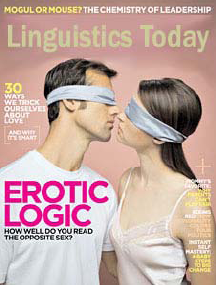
    But where are the linguistic studies with titles like “Words of love: Lexicographical influences on vaginal blood flow”, or “Raising to subject position: Erectile dysfunction and grammatical agency”? I bet the authors would score a couple of decades of Valentine’s Day interviews, never mind the patent rights.

    For an LSA talk a few years ago, I even mocked up a magazine cover — unfortunately, there’s still no content to back it up.

    Dr. Hirsch has something to teach us in areas other than sex. His other publications include Hirsch, A.R.: “Effect of an Ambient Odor on Slot-Machine Usage in a Las Vegas Casino”, Chemical Senses 18(5) 1993; ; Hirsch, A.R. “Effects of Garlic Bread on Family Interactions”, Psychosomatic Medicine, 62(1):103-104, 2000; Hirsch, A.R., Ye Y., Lu Y., Choe M., “The Effects of the Aroma of Jasmine on Bowling Score”, International Journal of Essential Oil Therapeutics, 1(2): 79-82, 2007; and so on.

    Deborah Tannen has the “family interaction” stuff covered. But as far as I know, Vegas and bowling are pretty much virgin territory, linguistically speaking.

    [Update — since a few readers seem to be taking the smell/arousal stuff somewhat seriously, I thought I’d better follow my nose, so to speak, and check it out.

    In the body of the post, I noted four apparently-relevant journal articles cited on Dr. Hirsch’s web page (along with some book chapters that I’ll leave to someone else to track down). Three of these citations are so obscure as to raise the question of whether they actually exist, while one of them is a short conference abstract describing some apparently-underwhelming research.

    The first article (Hirsch, A.R. and Kim, J.J.: “Effects of Odor on Penile Blood Flow-A Possible Impotence Treatment,” Psychosomatic Medicine, Vol. 57, No. 1, 1995, p. 83) must be wrongly cited, because there is no such article in volume 57, issue 1 of Psychosomatic Medicine, nor indeed (as far as I can determine by searching the journal’s web site, PubMed, and Google Scholar) in any other issue of that or any other journal.

    The second article (Hirsch, A.R.: “Scent and Sexual Arousal,” Medical Aspects of Human Sexuality, Vol. 1, No. 3, June, 1998, p. 9-12) is also a puzzle. There are other online citations to a journal named “Medical Aspects of Human Sexuality”, but the National Library of Medicine thinks that it ceased publication in 1992. And the title “Scent and sexual arousal” is not indexed in PubMed, and shows up on Google Scholar only in the bibliography of another of Dr. Hirsch’s articles, and in one of his patents.

    I’m happy to say that the third article (Hirsch, A.R., Gruss J., Bermele C, Zagorski D, and Schroder, M.A.: “The Effects of Odors on Female Sexual Arousal.” Psychosomatic Medicine, Vol. 60, 1998, p. 95) does exist in a form that I can verify — it’s one of the Abstracts of Papers for the 1998 Annual Meeting of the American Psychosomatic Society. Here’s the abstract:

    While odors have been demonstrated to impact on male sexual arousal, as measured by changes in penile blood flow, the analogous study in women has not been done. To determine this, the effect of odors on vaginal blood flow was ascertained. Nineteen nonmenstruating, nonanorgasmic women were studied. The average age was 31.8 years. Eight were single, seven married, and four divorced. They were on no medications. All scored normosmic on the University of Pennsylvania Smell Identification Test. Vaginal blood flow was measured while subjects sequentially wore eight surgical masks impregnated with odors and two blank masks which served as controls. Surgical masks were applied in a double blind randomized fashion. Vaginal blood flow was measured for 1 minute followed by a three minute odor free interval. The effect of odor was calculated based on changes from the average of the blood flow while wearing the blank masks. Vaginal blood flow changes were as follows:
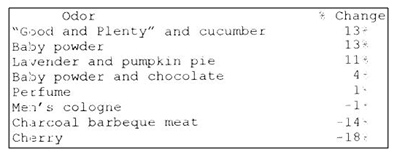
    Since some odors in nonanorgasmic women enhance vaginal blood flow, the evaluation of odors for the treatment of sexual arousal disorders in women may be warranted.

    I note that there were only eight odors tested, so only a tiny portion of the odor space was involved; and we don’t get standard deviations or any other indication of inter-subject consistency.

    The fourth article (Hirsch, A.R., and Gruss, J.J.: “Human Male Sexual Response to Olfactory Stimuli,” J. Neurol. Orthop. Med. Surg., Vol. 19, 1999, p. 14-19) again frustrated my attempts to track it down. The Journal of Neurological and Orthopaedic Medicine and Surgery apparently does (or did?) exist, with offices located at 2320 Rancho Drive, Suite 108, Las Vegas NV 89102-4592, but apparently it does not have a web site, the National Library of Medicine doesn’t index it, ISI’s Journal Citation Reports doesn’t list it, the University of Pennsylvania Library doesn’t subscribe to it, and in general it seems to have, shall we say, a rather low profile, despite the fact that 14 of Dr. Hirsch’s publications have appeared there.]
  • In your face, Reginald

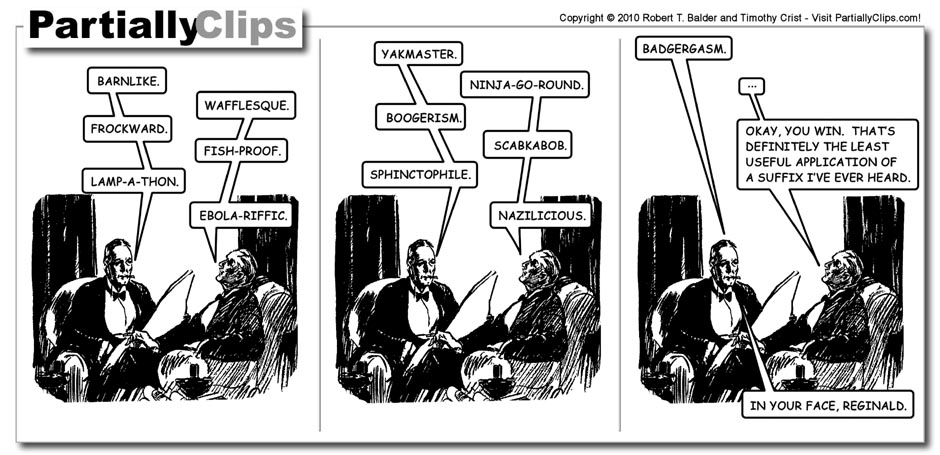
    The most recent PartiallyClips:

    (Click on the image for a larger version.)

    I was disappointed not to find any evidence that over-enthusiastic spell checking has led to actual “moral gelatinism”. But badgergasm does have some genuine (if puzzling) web hits.

  • -onger

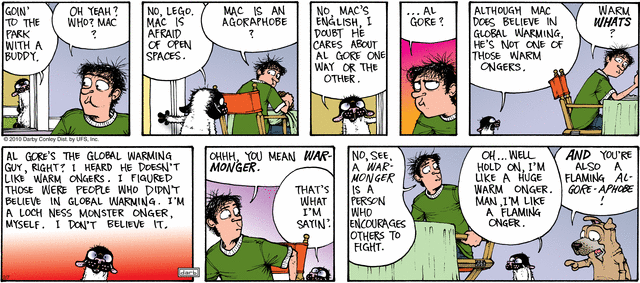
    Today’s Get Fuzzy illustrates the perils of morphological decomposition:

  • Mistakeholders

    Stakeholders” is a 25-year-old piece of management-speak that has been adopted enthusiastically by some software professionals. Thus “Understanding Organizational Stakeholders for Design Success“:

    The term was introduced in a seminal book by R. Edward Freeman called Strategic Management (1984). The word stakeholder was used to stand in contrast to the neoclassical view of the firm as catering to stockholders. Freeman used the term stakeholder analysis to remind management that it was in the long-term interests of the company to pay attention to the interests of those who have an impact on or are impacted by the activities of the company. The present article uses the “stakeholder analysis” concept to extend the focus of user experience practitioners beyond the end user, to the organizational context of the [software] project.

    This leads to a pun that (like most flashes of inspiration) is obvious in retrospect:

    The people who have come to rely on features that are actually implementation errors are called ‘mistakeholders’.

    (The link attributes this to Chip Morningstar on friam, 2/5/2010, though I haven’t been able to find it there.)

    Generalizing back from software design to social and cultural change in general, it’s worth noting that most of the people affected by most policy changes are in some sense mistakeholders.  This follows logically from the fact that most of the consequences of any policy are unanticipated adaptations and interactions.

    Publishing opportunity of the day: there appear to be more than 18,000 books about stakeholders, but none so far about the (arguably much larger category of)  mistakeholders.  Open opportunities include  Mistakeholder strategy: the world of emergent profits, or Monetizing unintended consequences: How to win by targeting mistakeholders.

  • Two brews

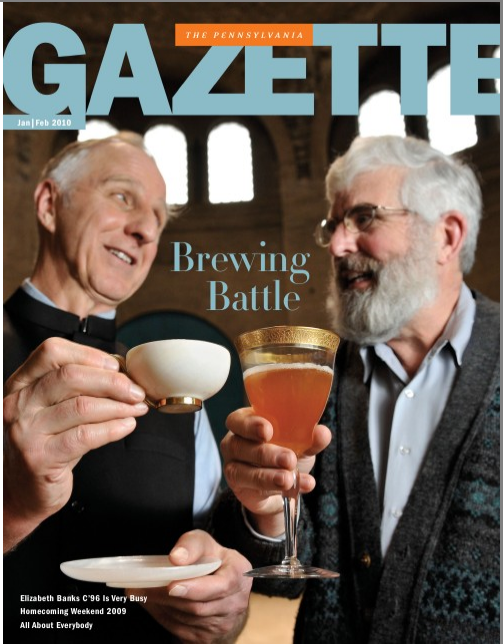
    The cover of the January-February issue of the Pennsylvania Gazette has a nice picture of Victor Mair lifting a glass with Patrick McGovern, to illustrate an article about Patrick’s new book Uncorking the Past: The Quest for Wine, Beer, and Other Alcoholic Beverages, and an interview with Victor about his new book with Erling Hoh, The True History of Tea. (There are some excerpts from the two books as well.)

    The reasons to be interested in the books, and to enjoy these two articles in one of the best alumni magazines around, are mostly not linguistic ones.  However, a couple of language-related points stuck with me.

    One was Patrick McGovern’s title, “scientific director of the Biomolecular Archaeology Laboratory for Cuisine, Fermented Beverages, and Health at the Penn Museum”.   My reasons for finding this interesting are non-obvious, not to say weird.

    I’ve noticed over the years that a surprisingly large fraction of smart undergraduate students have a surprising amount of trouble with what seems to me like a spectacularly simple-minded idea: the simple parallelism between form and meaning that linguists generally call “recursive compositionality”, and compiler writers  call “syntax-directed translation”.

    A trivial example of this would be the relation between form and meaning in arithmetic expressions: thus in evaluating (3+2)*5, you first add 3 and 2, and then multiply the result by 5; whereas in evaluating 3+(2*5), you first multiple 2 and 5, and then add 3 to the result.  Similarly, in evaluating English complex nominals, the phrase stone traffic barrier normally means a traffic barrier made out of stone, not a barrier for stone traffic, and thus its meaning implies the structure (stone (traffic barrier)).  A plausible way to think about this is that you first create the phrase traffic barrier, and the associated concept, and then combine that — structurally and semantically — with stone.  In contrast, the phrase steel bar prices would most plausibly refer to the prices of steel bars, and thus implies the structure ((steel bar) prices).

    There are many formalisms for representing and relating linguistic form and meaning, but all of them involve some variant of this principle.  It seems to me that understanding this simple idea is a necessary pre-condition for being able to do any sort of linguistic analysis above the level of morphemes and words.  But when I first started teaching undergraduate linguistics, I learned that just explaining the idea in a lecture is not nearly enough.  Without practice and feedback, a third to a half of the class will miss a generously-graded exam question requiring them to use parentheses, brackets, or trees to indicate the structure of a simple phrase like “State Department Public Relations Director”.

    In fact, even a homework assignment with feedback is not always enough, even with a warning that the next exam will include such a question.  For some reason that I don’t understand, this simple analytic idea is surprisingly hard for some people to grasp.

    Anyhow, I generally create a homework assignment and a couple of exam questions to train and test these concepts and skills. And in order to prevent some students from relying on the archives of past homeworks and exams stored (I’m told) at some fraternities and sororities, I need to find new examples every year. So things like “scientific director of the Biomolecular Archaeology Laboratory for Cuisine, Fermented Beverages, and Health at the Penn Museum” go into my file of possible future homework questions.

    And in a completely different vein,Trey Popp’s article on Patrick McGovern also has a nice example of parodied wine talk:

    “We think that chewing is probably the earliest way that humans would have transformed starch into sugar” in order to get fermentation going, McGovern explained in his lecture. Modern beer relies on the enzymes released by sprouted and malted barley to get this job done, but malting barley can be a little tricky. Our saliva contains an enzyme called ptyalin that does the same thing. “It may not sound very appetizing to think of people preparing their beverages this way, but once you get an alcoholic beverage, it does kill off any harmful bacteria.”

    He paused for a beat. “And it might add some special flavors, too. You never know.”

    Well, not until you slug it down, anyway. Compared to the saffron-kissed honey of Dogfish Head’s Midas Touch, or the chili-tinged chocolate notes of its Maya- and Aztec-inspired Theobroma, the special flavors in the spit-primed Chicha ran more toward funky pink peppercorns with a hint of fraternity basement.

  • Huh

    I write this from gate 27 at SFO, on my way back to Philadelphia from a meeting that was interesting and productive, but didn’t have a lot of direct linguistic relevance.  I did manage to fit in breakfast with Geoff Nunberg and lunch with Paul Kay, and  Paul pointed me to Andrea Baronchelli et al.,  “Modeling the emergence of universality in color naming patterns“, PNAS 1/25/2010, which I’ll post about after I’ve had a chance to read it — in combination with Paul’s own recent paper, Terry Regier, Paul Kay, & Naveen Khetarpal, “Color naming and the shape of color space“, Language 85(4) 2009, which has been at the top of my to-blog list for a week or so.

    In the few minutes before my plane boards, I’ve got time to register one linguistic observation of possible interest:  earlier this morning, as I was checking out of the place I’ve been staying, something happened that made me wonder whether American “huh” might be heading in the direction of Canadian “eh”.

    I handed in my key and checked that the bill was paid, and at the end of the transaction, as I was leaving, the clerk said “Thanks, huh.”  The (low falling) intonation was the same as he might have been expected to use with a vocative tag (e.g. “Thanks, man”).

    I’m used to Canadian “Thanks, eh” (see “The meaning of eh“, 5/1/2005); and I suspect (without having a specific instance in mind) that many British speakers might be fine with “Thanks, innit”.  But in my previous experience, the uses of “huh” include requests for clarification (“Huh? Sorry, I didn’t hear that.”), expressions of mild surprise (“Huh. That’s odd.”), or invitations to join in the expression of a presumably shared opinion (“Nice weather, huh.”) The latter two can have either rising or falling intonation.

    But I don’t believe that I’ve ever heard “Thanks, huh” before.

    Now, this was Berkeley, where everything from the flora to the obituaries reminds you that you’re not in Kansas anymore.  But I’ve visited NoCal several times a year for the past few years, and if this kind of extension of “huh” is a local change in progress, then I’ve missed it.

    So maybe the clerk was a Canadian transplant, who noticed that “huh” was the American equivalent of “eh” in some contexts, and overgeneralized a bit.  Or maybe this was just a random cultural mutation, a flash of noise in the linguistic meme pool.  Either way, keep your ears open — “thanks, huh” may be coming to an interaction near you.

  • Dr. Frankenstein in Yat

    A few days ago, TPM linked to an political ad in the New Orleans Coroner’s race, which gives a good example of a particular NO accent (known as “Yat“) about which A.J. Liebling wrote in The Earl of Lousiana:

    There is a New Orleans city accent . . . associated with downtown New Orleans, particularly with the German and Irish Third Ward, that is hard to distinguish from the accent of Hoboken, Jersey City, and Astoria, Long Island, where the Al Smith inflection, extinct in Manhattan, has taken refuge. The reason, as you might expect, is that the same stocks that brought the accent to Manhattan imposed it on New Orleans.


    Liebling’s comment follows a piece of dialog in which a lawyer talks about “Uncle Oil” (i.e. “Earl”). See Walt Wolfram and Ben Ward, American Voices, for more information.  Back in 2004, Language Hat mentioned Yat, with a link to a page now called “A Lexicon of New Orleans Terminology and Speech“.

    The YouTube ad is apparently an exaggeration of what one of the TPM commenters calls “a very old scandal [where] some very small bone chips and some corneas were removed during autopsies without permission of the relatives, according to their lawsuit”. (See this article for more information.)

  • What he used to be and who they are now

    Edward Wyatt (“Creators of ‘Lost’ Say the GPS Unit Is Plugged In“, NYT 1/28/2010) quotes Damon Lindelof, an executive producer of Lost, exploring the use of they as an indefinite singular pronoun in free variation with he:

    “There’s an inherent process when you’re ending something to sort of be thinking about the beginning,” Mr. Lindelof said. “One of the things that I think we are trying to do — all of us, the actors and the writers as well, in the sixth season — is to show the audience the before,” as well as the after.

    Therefore episodes in the final season will continue to provide plenty of back story. That way viewers “have some sense of, ‘Oh, this is what he used to be and who they are now,’ ” Mr. Lindelof added. “So you really get a sense of how far that person’s come.”

    The show’s other executive producer, Carlton Cuse, offers a nice Hollywood expression for explanatory detail:

    “Obviously not every question’s going to be answered,” Mr. Cuse said. “We felt if we tried to just answer questions, it would be very pedantic. Apart from that, we also really embrace this notion that there’s a fundamental sort of sense of mystery that we all have in our lives, and certainly that is a huge part of the lives of these characters.”

    “To sort of demystify that by trying to literally explain everything down to the last little sort of midi-chlorian of it all would be a mistake in our view,” he added.

    For those of you who insist on literally explaining singular they down to the last little sort of midi-chlorian of it all — and you know who you are –  previous LL posts on the subject can sort of be found here and here.

    [Update — Ben Sprung sent in this related observation:

    I was reminded of something I jotted down over the weekend. During the women’s final of the Australian Open, the chair umpire said:

    “Ladies and gentlemen, the line judge called it out, and then corrected themselves. We will replay the point.”

    I thought it was interesting because rather than an attempt at gender neutrality (the line judge is clearly either male or female), it was an attempt to create a certain distance, or, perhaps, a *generalized* neutrality. As in, let’s not consider the line judge on a personal level because we wish to hold the view that line judges are completely impartial beings, for the moment.

    Using themselves with a singular and definite antecedent is certainly striking, whatever the explanation.]

  • We can’t be second to none

    An interesting misnegation was broadcast today on NPR’s Weekend Edition Sunday, in a segment under the title “Exactly How Do We Go Forth and Innovate“.  Liane Hansen quoted president Obama’s SOTU passage about innovation and leadership in science and technology, including the phrase “Well, I do not accept second place for the United States of America”.

    And she asked Rob Atkinson of the Information Technology and Innovation Foundation, “The president referred to innovation several times in his speech. What did you think? Was there anything new there?”

    His response began:

    There wasn’t a- a lot new there,  I think I- I- what I was most impressed with was when he said “we can’t be second to none”.

    To be “second to none” is to have no superiors. And so if we can’t be second to none, then we must have at least one superior — we can’t be in first place, or even tied for first place. Rather, we must be in second place, or in some lower place. So literally, what Mr. Atkinson said is inconsistent with what he (and president Obama) meant.

    Among the four main causes of misnegation, this is most likely a case of #1, the principle that Larry Horn calls Multiplex negatio ferblondiat: our poor monkey brains just can’t deal with complex combinations of certain logical operators.

    However, it’s also possible that cause #3 is also playing a role here: negative concord is alive and well in English. That’s certainly what’s happening in the chorus of Jeannie Ortega’s song Crowded:

    I don’t know what you been thinking about me
    Did you think this was gonna be that easy?
    Hell no, you must be going crazy!
    Why don’t you get out of my life,
    Get out of my sight,
    Get off of my back.

    Why don’t you get back to your world,
    Go back to your girl,
    I think you owe her.

    I know what’s going on
    I won’t be second to none.

    Back off ’cause you’re crowding my space,
    You need to get out of my face.

    “I won’t be second to nobody” would be the normal way to say “I won’t be second to anybody”, in the varieties of English that enforce negative concord, and it’s natural enough for someone to re-interpret the common collocation “second to none” as involving a more formal instance of the same phrase.

    Jeannie Ortega, or whoever wrote Crowded? Sure.  Rob Atkinson? Unlikely.

    [Hat tip to Jonathan Lundell.]

  • Lasciate ogni poesia

    According to Dave Itzkoff, “Abandon All Poetry, but Enter Hell With Attitude“, NYT 1/29/2010:

    There’s a new edition of Dante’s “Inferno” that’s recently begun appearing in bookstores. Same words. Different cover. It’s got a big picture of a muscular fellow in a spiky crown and an overline that says, “The literary classic that inspired the epic video game.”

    It’s true. “Inferno” is now a video game, with a brawny, armor-clad Dante as its protagonist.

    The guys at Electronic Arts’ Visceral Games studio found it necessary to give Dante a little help:

    “If you’re trying to make an action game, it’s thin,” Jonathan Knight, the game’s executive producer, said of the original text. “It’s Dante, who’s kind of passive, and he’s a poet and he’s philosophical. We had to take the bold step of saying, ‘How do we make this guy an action hero?’” […]

    “It’s a highbrow/lowbrow project by design,” Mr. Knight said. “If you know the poem, the game has a lot to offer. If you just want to mash buttons and kill demons, that’s all it has to be for you.”

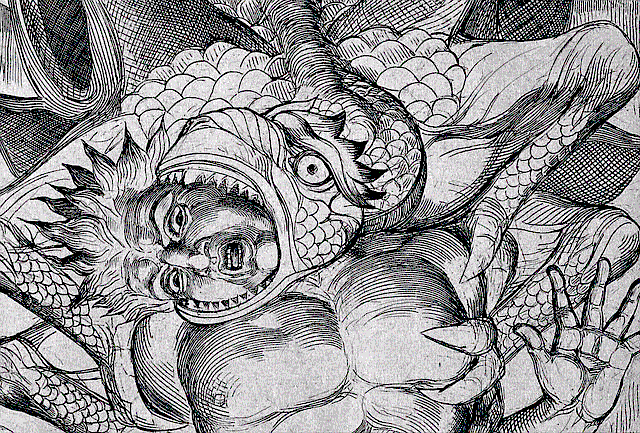
    But Dante’s abs and greaves to the side, Mr. Knight’s artists are not the first to explore the less philosophical aspects of the Inferno. There’s some T-rated stuff in William Blake’s 1826 Dante engravings:

    And here’s William Bouguereau’s 1850 “Dante and Virgil in Hell”:

    Of course, in 1850 there wasn’t a Facebook App to send your friends to hell. And the original 1867 edition of Henry Wadsworth Longfellow’s translation didn’t have an armored scythe-wielding Dante on its cover, as the 2010 Del Rey paperback re-issue does.

    Anyhow, the NYT headline’s “Abandon all poetry” meme-instance reminded me of a strange blog post that I recently read, “Let Poetry Die“, by Patrick Gillespie.

    His argument is this:

    I love poetry.

    But as far as the public is concerned, poetry died with the modernists. […]

    [W]hen any human being, let alone poets, can act without consequence, the dogs of mediocrity, narcissism and hedonism will be let loose. In the past, public reception was the choke collar that largely kept mediocrity at bay, but when poets were able to create their own audience (themselves) all those checks and balances evaporated.

    It’s my own opinion that [this] attitude is toxic and anathema to great art and poisonous to art in general. It’s a shame and the results are indisputable. When poets left their audience, their audience left them.

    And so, he says, we should stop giving poets grants to write poems for each other, or salaries to teach poetry to college students, and instead let them engage in a Darwinian struggle for a mass audience — or at least, one that’s big enough to pay the rent. “[I]t would be better if all poets were thrown to the dogs of public opinion.”

    I found this post strange, not because of Gillespie’s conclusion, but because of what’s obviously missing from his argument.  There’s a group of recent poets who never left their audience, and whose audience never left them: the lyricists of popular songs. There’s W.C. Handy, Irving Berlin, Ira Gershwin, Robert Johnson, Woodie Guthrie, Hank Williams, Chuck Berry, Smokey Robinson, Stephen Sondheim, Joni Mitchell, Bob Dylan, Dolly Parton, John Lennon, Paul Simon, and hundreds of others, whose audience has been bigger than Dante’s ever was.

    Thus one version of the proposed experiment has already been done, and the results are open for interpretation. The basic issues involved are old ones, and it’s worth noting that Dante has been engaged with them since the beginning. In addition to La Divina Commedia, he wrote De Vulgari Eloquentia, after all.

    And when Longfellow translated Dante in the middle of the 19th century, it was part of a self-conscious intellectual conspiracy to promote mass appreciation of classical works in “modern languages”. Thus K. P. Van Anglen, “Before Longfellow: Dante and the Polarization of New England“, Dante Studies 2001:

    [Dante]’s local reception also reflects Boston’s literary politics, especially the fears of its educated elite; and so, derivative or not, he was deployed in a distinctly American cultural context for self-conscious ideological, political, and social ends. It is to that context, and to those fears and politics and ends that we must therefore turn if we are to understand Dante’s early New England reception.

    When Longfellow was a boy, Boston was still dominated, as it had been since its foundation, by “a socially and culturally distinct class” as high-minded as it was tenacious in asserting its influence. Known (from their main religious affiliation) as the ‘Boston Unitarians,’ these “prosperous merchants and their professional allies exercised leadership in Boston,” using their influence to make the city “the most important literary center in the United States,” and “eastern Massachusetts . . . the most intellectually exciting part of the country.” In doing so, they wanted Boston to be a “republic of letters, . . . not a democracy,” an enclave in which they would function as “a New England clerisy” maintaining cultural domination. This goal was all the more pressing since they believed in the “irreconcilable antagonism between belles lettres on the one side and democracy and the marketplace on the other”; and so they “conceived of the critic’s office as essentially political and social: like the vigilant Federalist statesman, the critic was to police the commonwealth of letters to keep out the unworthy.”

    On balance, then, I suspect that both Dante and Longfellow would have been pleased with the new edition of the Inferno.

  • Spokespirate

    It’s still January, but I’ve already got a nomination for the 2010 WOTY competition: spokespirate:

    Saying the US and Europe “have no moral authority” to control the aid going to Haiti, Somali pirates say they plan to donate booty from their hijackings to the relief effort. The pirates have taken in more than $150 million in the past 2 years, by one estimate, and now aim to redistribute some while thumbing their noses at the Western powers. “They are the ones pirating mankind for many years,” a spokespirate tells Agencia Matriz del Sur.

    Needless to say, this is not entirely original.  But I haven’t previously seen it used in reference to actual ship-hijacking pirates.

    Spokes-X has become a reasonably productive pattern, though only a few instances (e.g. spokesmodel) have graduated from the realm of humorous neologisms (such as spokesathlete, spokesbimbo, spokesdrone, spokesfool, spokeskitteh, spokesmime, spokesmoron, spokesnazi, spokespoet, spokesrobot, spokeszombie, …).

    [Hat tip to David Donnell]