At a restaurant recently, a waiter was asked about the difference between two pinot noirs available by the glass, and responded by describing one of them as “more fruit forward”, while the other was “more reticent”. I’m familiar with fruit forward as a bit of winetalk, but this time it occurred to me to wonder where this particular construction came from, and where it’s going.
The OED has no examples of fruit-forward, but glosses fashion-forward (under the lemma fashion) as “adj. designating clothing, a person, etc., at the cutting edge of fashion” with a citation from 1948:
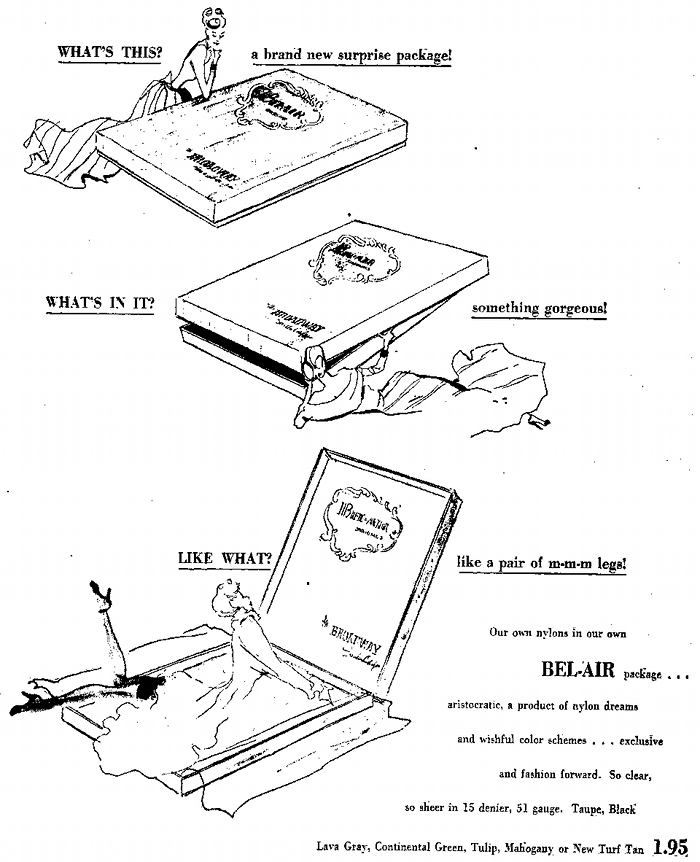
1948 Los Angeles Times 26 July I. 16 (advt.) Our own nylons in our own Bel-Air package..aristocratic, a product of nylon dreams..exclusive and fashion forward.
Courtesy of ProQuest Historical Newspapers, an image of the ad is here. The structure is not entirely clear, but the syntax is no doubt the same as in phrases like “She walks with queenly dignity, shoulders back and chin up” — and fashion forward… (Or, with less queenly dignity, ass backward.)
In 1948, this was presumably a regular (if metaphorical) nonce formation, with the forward part in some amalgam of its normal meanings of “towards the front, in the direction which a person or thing faces”, or “in advance, in front, ahead”, or “advanced, extreme”, or perhaps even “presumptuous, pert; bold, immodest”. But within a few decades, fashion-forward became a common and even cliched modifier. Thus Ron Alexander, “A Shoe-Sandal for Men: Surprise Summer Hit”, NYT 8/26/1979:
At Saks, Roots’s Canadian versions of the shoe (average price, $50) are selling best in taupe, sand and natural and most of the men buying the style style are described as “the younger, fashion-forward customer.”
Or again, Ron Alexander, “The Evening Hours”, NYT 1/4/1985:
“It’s not a big party, just the immediate family is here,” she said, surveying the 100 or so fashion-forward guests, including Ris e Marcade, a bartender, who wore a black leather tunic over her black rubber leggings plus a rather hefty hat of Persian lamb and seal, and a crafts shop owner, Anthony Robinson, who wore a beach towel with a red lobster on it in place of his lost scarf.
The earliest example of winetalk fruit forward that I’ve been able to find is from 1975 (Nathan Chroman, “Three Classic Examples of Different Wine Styles”, LA Times 9/11/1975):
The three wines were classic examples of differing styles. The Heitz wine was rich and round, balanced with fruit and oak. The Parducci wine was completely different, with no aging in oak and with much of the Chardonnay fruit fully forward to the taste and easy to recognize.
The Sterling wine is closer to the Heitz in style, yet is more restrained in oak with good balance and with the fruit forward as well.
As in the case of the 1948 example of fashion forward, this looks like a syntactically and semantically productive construction. The prepositional phrase “with much of the Chardonnay fruit fully forward to the taste” is structurally similar to “with a blue baseball cap backward on his head”; and forward here presumably means that the “fruit” is metaphorically “front and center”, i.e. the characteristic taste of the grape variety reveals itself early and plainly, or in the front of the mouth, or perhaps is “extreme” or “bold”.
But again, the collocation caught on as a common and even cliched modifier. The earliest example of fruit forward in the New York Times is accompanied by a negative meta-comment (Frank Prial, “Wine Talk: In Washington, the Renegades of Cabernet”, 3/21/2001):
In Washington, the days are longer and the nights are cooler than in California. For the red wines, this translates into higher acidity and tougher tannins. Words like plump and sweet and fruit-forward (oh, execrable term!) are rarely applied to Washington cabernets.
But the execration of fruit-forward seems to have retired in 2005 with Frank Prial, and wine writers in the NYT now join their colleagues in using it freely. Thus Sarah Wildman, “Spain’s Quiet Corner”, NYT 8/26/2007:
On the banks of the Avia River, Viña Mein has been one of the leaders in the effort to reinvent Galician wines by taking what wine growers in Europe call a New World approach to creating rich, fruit-forward, easy drinking whites, planting only native vines — like savory white-wine grapes, primarily treixadura, godello and albariño.
Or Alice Gabriel, “Tastings Can Help Reduce the Guesswork”, NYT 10/28/2007:
He liked his wines big, extracted, fruit forward, and dismissed a particularly elegant French wine as meager, tight and tannic.
Meanwhile, in the world at large, X forward has become a productive construction in winetalk:
An earth forward Cabernet that features red pepper & a spicy note.
A well made Chianti with more earth forward tones.
It’s a little tight and acid-forward, though the impression is of a wine that expands into an intense mid-palate.
Crisp and acid forward wine; elegant and subtle.
While dry vermouth is crisp, angular, acidic and herb-forward, Lillet is rounder, featuring prominent orange and honey.
Very grapefruit and green grass forward.
A truly unique Merlot this wine stays fruit and spice forward all the way to the finish.
Very spice forward with heavy dark fruit flavors.
Australian shiraz tends to be more spice-forward.
Also in beertalk:
The taste was hops-forward, to say the least. It’s even hops-middle, and hops-finish, too.
Not a stout-forward imperial stout, and not an oak-forward oak-aged stout. Interesting, and quite complex, but I can’t say that I particularly like it.
This is a great beer, but I would have preferred a more vanilla forward beer.
It’s simply chocolate-forward without being ridiculous about it.
Anyway, what is your favorite way of getting a beer (stout) that is chocolate forward with minimal roasty bitterness?
And in foodtalk more generally:
He features dozens of herb-forward Italian recipes in his book.
Not every dish succeeds. An herb-forward beet and pomegranate soup fails to find the right balance of flavors; a precarious tower of ricotta and beet ravioli interspersed with scallions tumbles with the effort of cutting through the rubbery grilled onions.
This is the ideological opposite of New York pizza, thick and hearty where New York pushes thin and light, bright with fresh tomato flavor and toppings like spinach and mushroom that explode in your mouth where New York slices are often cheese-forward, bubbling crisp and deliciously greasy enough to have you reaching for a fourth napkin before you’re halfway through.
In fact, while we were immersed in working on a sliceable chocolate we completely overlooked the opportunity to make a more chocolate forward ganache and play with chocolate fillings.
Jack’s seafood fra dialblo is a spice-forward blend that includes an ocean of gifts from the sea.
It has a peppermint aroma combined with a flavor that is chocolate forward with a peppermint finish.
I haven’t seen any similar generalizations in fashion writing — searches for things like “ruffles forward” and “fur forward” don’t get me anywhere — but my ignorance of the genre may be at fault here.
Nor do I see any signs of spread to other domains. We wouldn’t normally describe an especially exuberant grammarian as being “syntax forward”, or an especially expensive government program as being “deficit forward”. Would we?
[From this quick scan of the history, it’s not clear to me whether fruit forward developed by analogy to fashion forward, though the dates mean that this is plausible. And it’s also possible, in one or both cases, that there was some influence of French “mode en avant” or “fruit en avant”, though I suspect that the French terms are calques of the English ones rather than vice versa.]

 Geoff Maynard’s