Author: Mark Liberman

  • Harper’s handwringing?

    Two items in the March 2010 Harper’s Index™:

    Projected percentage decline in U.S. job listings for tenure-track language and literature professorships this year: 37
    Total percentage decline in those disciplines since 2001 this will represent: 51

    This is implicitly  contrasted, in Harper’s Index style™, with the next two items:

    Number of U.S. university presidents who currently earn more than $1 million per year: 24
    Number who did in 2002: 0

    The job-listing numbers are sourced to the Modern Language Association website, and I believe refer to its Job Information List.  According to the 2009-2008 report, last year’s numbers were 897 for tenure-track jobs in English and 669 for jobs in foreign languages, for a total of 1,566, down from 1,244 + 905 = 2,149 in 2007-2008.

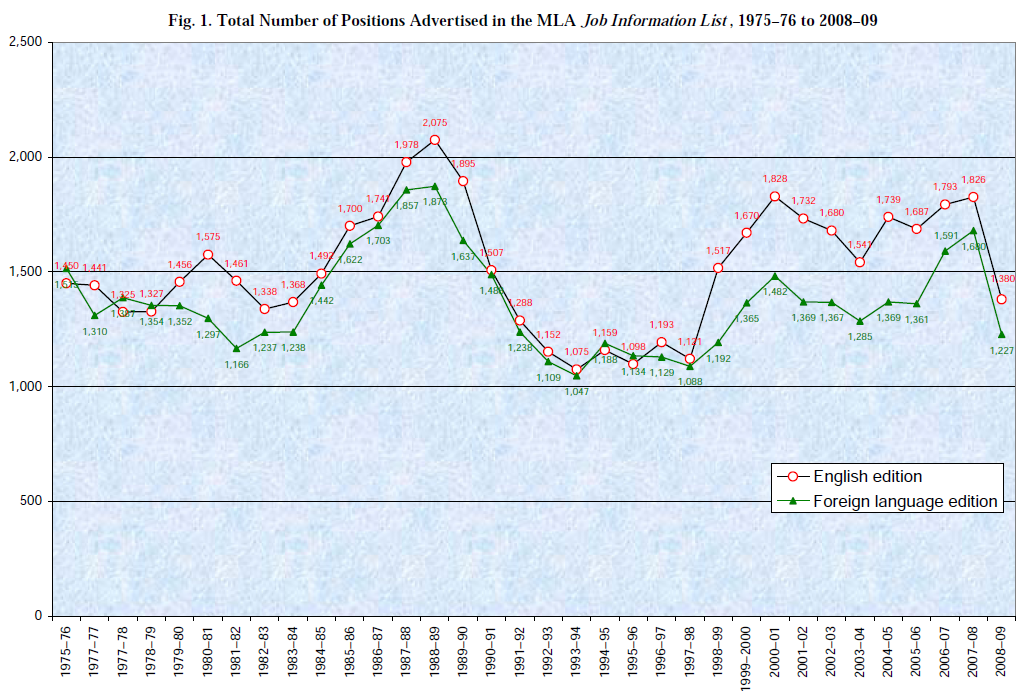
    A further decline of 37% in 2009-2010 would imply a total of 986, which is 54% down from the 2007-2008 figure. This graph (which shows total job listings, not just tenure-track listings) implies that 2000-2001 (though a local maximum) was not as high as 2007-2008:

    And the projected decline will bring job totals below the level of the trough in the mid-1990s. According to David Laurence’s preface to the 2008-2009 report:

    The financial crisis of 2008 made its consequences painfully evident in the 2008–09 MLA Job Information List (JIL). After trending upward between 2003–04 and 2007–08, the number of jobs advertised in the JIL in 2008–09 declined since 2007–08 by 446 (24.4%) in English and 453 (27.0%) in foreign languages. In the English edition 1,202 ads announced 1,380 jobs; in the foreign language edition 1,106 ads announced 1,227 jobs (ads that departments later marked “search canceled” have been excluded from these counts). In both numerical and percentage terms, this year’s declines mark the largest single-year decreases in the thirty-four-year history of the JIL counts.

    If the projection cited in the Harper’s Index holds up, the declines for 2009-2010 will set a new record, at least for declines in percentage terms.

    It’s plausible to see this as nothing but a reflection of the same poor economic conditions that are leading throughout the economy to high unemployment and poor job creation relative to job loss. But one of my colleagues in an English department has been wondering out loud whether this might also be part of a longer-time trend, associated with static or declining overall faculty sizes;  increase in the proportion of adjunct, part-time or other non-tenure-track instructors;  lower retirement rates; and shifts of resources away from (certain areas in) the humanities.

    One reason that this matters is that projections of future job numbers (ought to) inform choices about the size of graduate programs.

    These specific numbers are only marginally relevant to PhD programs in the field of linguistics, since few of the MLA listings are likely prospects for new linguistics PhDs, and many if not most academic linguistics jobs are advertised elsewhere. Also, a significant fraction of linguistics PhDs take industrial or other non-academic research jobs.

    Still, the problem of matching supply and demand exists in one form or another, all across higher education. Most of the time, there are either too many of a given specialization, or not enough; and the feedback loop has a delay of 5-7 years in it (allowing 5 years for graduate school and a couple of years for undergrad preparation).  Economic oscillations with a period of a few years can be managed, somewhat painfully  — students can choose to leave school earlier or later, for example. But large-scale trends are harder to deal with, especially if people don’t recognize what’s happening.

    The worst example that I’ve ever seen was the boom and bust in the computer-science job market associated with the dot-com bubble, and the associated rise and fall in undergraduate enrollments and graduate-school demand.

    As for the rise in the salary of upper-level university administrators, I’m not sure what to make of it. The most obvious thing to say is that it’s related to the general rise in upper-management salaries across the economy, and that it’s generally smaller than what’s happened to CEO salaries in other organizations of similar size. In neither case is it clear to me that society as a whole is better off than if this reallocation hadn’t happened, but I don’t see any reason to complain about university presidents in particular.

    [For some information about the supply side, there are various reports on the web site of the Association of Departments of English, including the Report on the Survey of Earned Doctorates, 2006.]

  • Academic book review taken to court

    We’ve previously covered the British Chiropractic Association’s libel suit against Simon Singh, and the successful effort by Nemesysco to force a critical article to be withdrawn from the International Journal of Speech, Language and the Law. Both of these cases involved the peculiar situation of English libel law, which (in the opinion of many) makes it too easy for wealthy plaintiffs to bully authors and publishers into silence.

    An interesting case now in process involves an even more straightforward threat to intellectual discourse, in that both the plaintiff and the defendent are academics, and the contested writing is a critical book review in an academic journal. And this time the court is in France, not England.

    You can read about the whole story in an editorial by Joseph Weiler, “Book reviewing and academic freedom“, The European Journal of International Law, 20(4):

    Readers of EJIL will be aware of the two book review websites which have been associated for some time with this Journal and of which I am, too, Editor-in-Chief: www.globallawbooks.org and www.Europeanlawbooks.org. You will find links to them on the very Homepage of www.ejil.org and www.ejiltalk.org. On 25 June 2010 I will stand trial before a Paris Criminal Tribunal for refusing to remove a book review written by a distinguished academic to which, however, the author of the book in question took exception. The matter is of serious concern to EJIL, but more generally to academic book reviewing in general.

    The book in question is Dr Karin N. Calvo-Goller, The Trial Proceedings of the International Criminal Court. ICTY and ICTR Precedents, Martinus Nijhoff Publishers, 2006. The (largely) negative review was by Professor Thomas Weigend, “Professor of Law, Director of the Cologne Institute of Foreign and International Criminal Law. Director of the Cologne Institute of Foreign and International Criminal Law and currently Dean of the Faculty of Law at the University of Cologne”.

    I have no opinion on the merits of  Calvo-Goller’s criticisms of Weigend’s review. [The editor] Weiler’s offer to allow her space to rebut the review strikes me as generous, appropriate, and a better deal than most reviewed authors get:

    It would be perfectly in order for you to write a comment which, after editorial approval, could be posted on the website and seen by anyone who reads the review.

    Dr. Calvo-Goller’s decision to go forward with a legal case, in contrast, strikes me as a very bad thing. Most academic journals operate on a financial shoestring. If any significant fraction of the recipients of negative reviews — or negative evaluations in the literature review sections of research papers — decided to bring suit, most such journals would be driven out of business quickly, even if they won all the cases.

    Despite the best efforts of editors, reviews and other discussions in scholarly, scientific and technical journals are not always accurate and not always even fair. (And frankly, editors don’t always put as much effort as they ideally should into checking such things, either because they trust the reviewer, or because they agree with the reviewer’s conclusion, or because they’re too busy with other things.)

    But the law courts are surely a terrible way to try to settle such matters. Judges, juries, and lawyers are not in general competent to understand the issues involved; and the process is slow and expensive at best. The sort of offer that Weiler made to Calvo-Goller — to place a rebuttal next to the review, with readers invited to evaluate both — is a much better option, in my opinion.

    From Weiler’s (first) letter to Calvo-Goller:

    I am very glad for you that other reviewers, such as Professor Ambos, reviewed the book favorably. But it is a very normal occurrence that the very same book is reviewed favorably by one reviewer and critically by another. I do not doubt for one moment the integrity of Professor Ambos (it is really not necessary to point out to me that you never met him etc.) but if, as seems to be the case, you are trying to suggest that because there is a favorable book review by one distinguished reviewer, the integrity of another, unfavorable review, is automatically called into question, I must politely express my dissent. The Talmud has long ago taught us that even contradictory conclusions can both be the living word of God. (Ellu veEullu Divrey Elohim Chayim).

    [Hat tip — Elizabeth Peña]

  • Light runners

    The Miami Herald recently ran a story under the headline “Light runners will get temporary reprieve“.  Reader RS was baffled. Arguments at the Winter Olympics over bobsled design rules? A problem with proposed weight classes for marathon contestants? The deck explains:

    Delays in the installation of Miami Beach’s red-light camera program has led to a grace period extension for violators and continuing questions about the money expected from the program.

    One curious aspect of the general question of surveillance cameras has always interested me. (It’s not relevant to these red-light cameras, as I understand their operation, but I’ll explain it here anyhow.)

    It’s against federal law to record a conversation without a court order or the consent of at least one of the parties to the conversation. (Many states have stronger laws, making it illegal to record a conversation without the consent of all the parties involved.) This generally seems to be interpreted to forbid setting up surveillance microphones, even in public places, though the question of when “implicit consent” might be invoked, due to the lack of expectation of privacy, or some kind of notification that recording might be taking place, is a complex one.

    But video recording is not considered to be covered by such laws, and therefore setting up surveillance cameras in public and semi-public places doesn’t seem to raise any legal issues.

    This distinction was underlined for me a few years ago, when there was a dispute about an arrest that took place in the entry-way of a building on my campus. The parties involved disagreed about what was said. There was a surveillance camera that recorded the interaction, including gestures and facial expressions and so on, but of course there was no audio track.

    A more recent example is implicit in the Lower Merion High School webcam scandal. The issue there is that LANrev’s “Theft Track” system, which school officials used to check up on stray school-provided laptops, activates the computers’ built-in webcams. As far as I know, this system doesn’t activate the built-in microphones, presumably because if it did, it would be in violation of federal and state anti-eavesdropping laws. In this case, most people seem to regard the webcam activation as a violation of privacy, in a way that surveillance cameras in public places are not.

    Note that conversations in sign language would be more completely recorded by such devices, whether webcams or surveillance cameras. And as high-resolution cameras and digital storage come closer and closer to being free, I guess we can expect the quality of these recordings to improve, perhaps to the point where some lip reading might be possible.

    Anyhow, I’ve always found it interesting that the laws and practices dealing with the recording of human interactions seem to be so different for video compared to audio. Is this because people really do see them as different? Or is it because the anti-wiretapping and eavesdropping laws were written before large-scale video surveillance was technically feasible?

    People’s moral reactions to such things seem to depend very much on the situation and on their own connection to it. Most people are appalled, I think, at the idea of school officials using the built-in microphones in school-provided computers to eavesdrop on students. But when I ask people to imagine that their laptop has been stolen, and that they learn of a hidden feature of its operating system that allows them to activate the webcam and microphone to eavesdrop on the thieves, they have a much more positive reaction.  The question of whose ox is gored also often seems to affect people’s reactions to the legal and moral status of various forms of eavesdropping within the family, as discussed here and here.

    But anyhow, whatever exactly the constraints of the current law are, I’ve always thought it was interesting that surveillance cameras are proliferating everywhere, for example in stores and offices, but always (?) without audio.

  • Aksking again

    [This is to follow up, as promised, on yesterday’s brief note, “Racist sociolinguistics from El Rushbo?“] On Feb. 22, President Obama met with a group of state governors at the White House, as described in Peter Baker and Sam Dillon, “Obama Pitches Education Proposal to Governors“, NYT 2/22/2010. He opening the discussion with an 11-minute speech. Video of the whole thing is here. About nine minutes into the presentation, he says:

    First, as a condition of receiving access to Title 1 funds, we will ask all states to put in place a plan to adopt and certify standards that are college and career ready in reading and math.

    He pronounces the word ask as [æksk].  On Rush Limbaugh’s radio program later in the same day, Limbaugh played the cited sentence, and makes a big deal of this pronunciation.  Among other things, he says:

    ((See-)) this is- this is what- this is what Harry Reid was talking about –  Obama can turn on that black dialect uh when he wants to and turn it off.

    Who’s he trying to reach out here to, the Reverend Jackson?

    (An extended audio clip of Limbaugh’s remarks is here.)

    Henrik Herzberg suggests (“Decoding Limbaugh“, The New Yorker, 2/23/2010) that Obama’s [æksk] is actually not a matter of slipping into “black dialect” (which might use the older pronunciation [æks] for ask), but just a speech error, whereby an extra [k] slipped into the standard pronunciation, promoted by the word access earlier in the sentence.

    Herzberg’s analysis seems plausible to me. It explains the otherwise mysterious  [ksk] sequence, but more important, it makes sense of the fact that neither in this passage, nor in the rest of the address, are there any other signs of what Limbaugh called “black dialect”, whether in pronunciation or morphosyntax or vocabulary choice.  I don’t see any way to guess the color of Obama’s skin by listening to that presentation. If he decided to “turn on that black dialect”, he did it for less than 100 milliseconds in an 11-minute speech.

    As a general marker of informality in Obama’s presentation, we could look at “g-dropping”. As a point of reference, let’s take g-dropping rates in one of the presidential debates of October 2008, which I discussed in “Empathetic -in’“, 10/18/2008:

    In the first 40 minutes of the first presidential debate (transcript, mp3), Senator Obama used 84 gerund-participles, and dropped 8 g’s. A g-dropping rate of about 10% is not at all out of line for someone in his position — in comparison, in the same period of the same debate, Senator McCain dropped 10 g’s in 66 opportunities. (In both cases, I’ve left out all instances of the sequence “going to”, which is especially interesting but also behaves in a special way.)

    In the cited remarks to the assembled governors on Feb. 22, President Obama used 68 gerund-participles, and dropped 5 g’s.  So by that metric, he used somewhat fewer informal pronunciations  than during the pre-election debates. And I conclude that Limbaugh’s little riff on black dialect is completely disconnected from the reality of Obama’s presentation. It seems to be gratuitous “race-baiting”, just as Herzberg suggests.

    In this context, Ann Althouse’s defense of Limbaugh strikes me as bizarre:

    But Limbaugh didn’t say: “Obama can turn on that black dialect when he wants to and turn it off.” He said: “This is what Harry Reid was talking about. Obama can turn on that black dialect when he wants to and turn it off.” Hertzberg took out the part about Harry Reid!

    Suppose that I respond to this by asserting again that there was no basis in Obama’s speech for bringing up the topic, and adding “See, this is what Jesse Taylor was talking about –  Ann’s a terrible person whose every move is designed to cocoon her fragile psyche from the crushing realization that she will never be particularly good at anything”.  [To avoid misunderstanding, I don’t think any such thing.]

    At this point, if Geoff Nunberg observed that my attack on Prof. Althouse’s character was not justified by anything she wrote in that post, and must reflect some animus against her personally or against some group she belongs to, he’d be absolutely right.

    And if Victor Mair then tried to defend me by saying

    But Liberman didn’t say “Ann’s a terrible person whose every move is designed to cocoon her fragile psyche from the crushing realization that she will never be particularly good at anything.” He said “This is what Jesse Taylor was talking about — Ann’s a terrible person whose every move is designed to cocoon her fragile psyche from the crushing realization that she will never be particularly good at anything.” Nunberg took out the part about Jesse Taylor!

    Victor’s defense would be technically true, but logically irrelevant. You can’t defend a false characterization of someone’s motivations or actions by noting that the attack was a paraphrase of a third party’s remarks, especially if your reference is completely out of context.

    [As for  what Harry Reid is supposed to have said, back in 2008, about Obama’s dialect,  let me refer you back to John McWhorter’s sensible comments in TNR.]

    [And really, IMHO, the most linguistically noteworthy aspect of Obama’s speech was the phrase “college and career ready” — yet another achievement for Ben Zimmer’s “most likely to succeed” WOTY nominee!]

    [Update 2/26/2010 20:45 — as evidence of what some of Limbaugh’s fans think this is all about, check out the comments at freerepublic.com:

    Just in case you missed Obama talking without a teleprompter (I believe) today at the Governors Meeting, here is a funny moment. Well not really funny, like you want to laugh, more like sad funny that while he was talking about education and the need for improvement, he was mentioning Title 1 funds and said “AX”… Maybe President Obama needs to brush up on his pronunciation some before giving a speech on how we need to improve….Oh and the correct word is ASK.

    There’s that negro dialect…

    that dialect gets no response from me. I will repeat it back to them and ask them what it means.

    Ah, he’s just playing to his base.

    Just don’t axe him to see his birth certificate…

    how he speaks depends on who this AH be talken too

    Ax not wut u can do fer yo cuntree butt ax wut yo cuntree gonna do fer U!

    A little ebonics for the soul

    I don’t know the origin of this, but I know and work with many Black people who speak the same way; ‘aks’ where the word ‘ask’ is concerned. They understand what the word means, but it seems to me that is physically difficult for them to pronounce it correctly. Long ago, I attributed it to education level, but I’m not really sure if that is it either. Further, I live in the midwest and it is fairly prevalent here. It almost seems as if it is something they can turn on or off at will depending to whom they are speaking.

    Harry was right (for once)… YoBama can seamlessly switch on the negro dialect when he wants to.

    Obama is so pathetic. He’s afraid of being called “Uncle Tom” I guess.

    For some reason, American Negroes have a difficult time with the word “ask.” They nearly always pronounce it “axe”. Michelle Obama has a horrible speech problem. She cannot pronounce the letters “st” or “sh”. I am not a speech pathologist, and I do not know why Negroes cannot pronounce certain letter combinations.

    Maybe there can be some of the stimulus money alotted for studying this. I have always wondered why “Nergros” have a hard time with such word as ask (axe) and David (Davit) to name a couple. There is a college educated well raised “Negro” here at work that says ax instead of ask and I would love to know why?

    Just brushing up on that negro dialect for when he really needs it…

    And so on…]

  • Racist sociolinguistics from El Rushbo?

    Politicians’ slips of the tongue hit the news from time to time, with observers often trying to read more into them than is really there.  But Hendrik Hertzberg (“Decoding Limbaugh“, The New Yorker, 2/23/2010) argues that Rush Limbaugh has recently reached a new low in mean-spirited misinterpretation. [Update: more here.]

  • Nothing that wasn’t something one might not hear

    Reading Dana Stevens “Ferguson and Fry Rock Late Night by Having Actual Conversation“, Slate 2/24/2010, Mark Paris came across this sentence:

    There was no part of their chat that wasn’t something one might not overhear at an interesting dinner party.

    His reaction, in email to me, was “I know what was meant, but didn’t it go one negation too far?”

    Apparently Dana Stevens though so, or perhaps some editor-like person at Slate intervened, because by the time I got to the story, the sentence read

    There was no part of their chat that wasn’t something one might overhear at an interesting dinner party.

    Assuming that Mark didn’t hallucinate the first version, this certainly belongs in our collection of overnegations.

    This pattern is no where near as common as the favorites (like “cannot be underestimated” or “fail to miss“), but versions of it are Out There:

    She most likely assumes there’s heavy risk involved with his lifestyle, and that wasn’t something she didn’t want to expose herself to.

    That looks like a really fun cut to do – I just can’t believe that wasn’t something I didn’t think of…

    Leia might have argued against his obvious hatred for their former leader, but she couldn’t swear that it wasn’t something she didn’t feel herself.

    To watch her hoop you’d never know that it wasn’t something that didn’t just come naturally to her the first time.

    I’m not saying there weren’t things that didn’t need improvement in the Rod Lurie version.

    [Update — Jill Beckman reports that NBC’s coverage of the Ladies short program Tuesday night included the phrase: “There isn’t a position that she doesn’t hit that isn’t gorgeous.”

    This example underlines the fact that the extra negatives can be in various places.

    Thus the original example “There was no part of their chat that wasn’t something one might not overhear at an interesting dinner party” was corrected to “There was no part of their chat that wasn’t something one might overhear at an interesting dinner party” (removing the third negative), but might also, somewhat less felicitously, have been corrected to “There was no part of their chat that was something one might not overhear at an interesting dinner party” (removing the second negative).

    But the NBC commentator’s observation can only be corrected to “There isn’t a position that she hits that isn’t gorgeous“, and not “There isn’t a position that she doesn’t hit that is gorgeous“.

    Homework assignment: explain the difference by translating (the relevant parts) into predicate calculus.]

  • Rules grammar change

    Doyle Redland has the story:


    This is yet another reminder of how easy it often is, especially in speech, to communicate with a shared lexicon but no shared syntax.

    I was disappointed that Mr. Redland didn’t correct the U.S. grammar secretary’s chronology, but I guess that journalistic conventions don’t allow the reporter to contradict a source in his own voice, and time constraints made it impossible to bring in an expert to date Anglo-Saxon correctly. (I’ll pass over in silence the question of what Anglo-Saxon syntax was really like.)

    [Tip of the hat to reader SGK]

  • Radioaesthetics and ultimatonic field patterning

    Ben Goldacre recently featured this lovely job advertisement:


    A couple of the words were new to me: radioaesthetics turns out to mean “dowsing”, basically; and ultimatonic fields are presumably the fields associated with ultimatons, as discussed in the Urantia book.

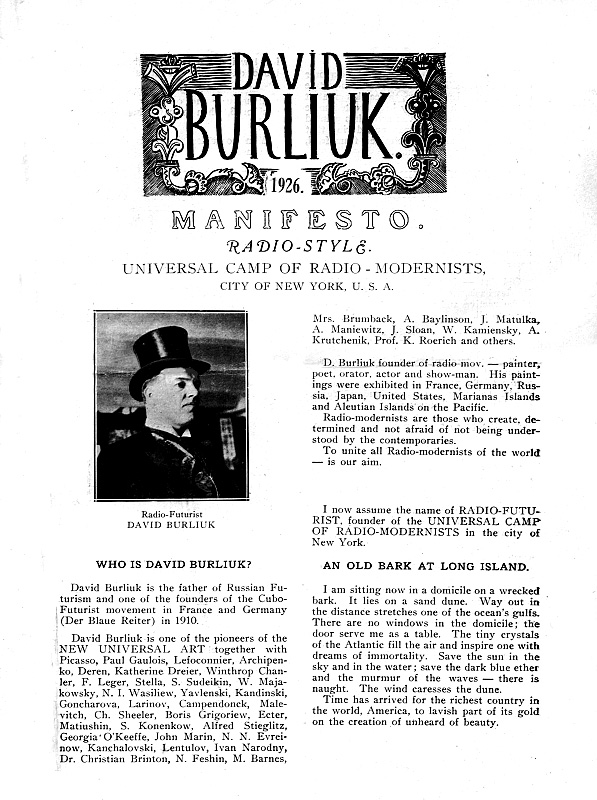
    I was quite disappointed in radioaesthetics, which I briefly hoped would turn out to involve some sort of modern form of David Burliuk‘s Radio-Futurism:

    Burliuk and his wife were among the Russian emigrés who were close friends of my grandparents, and thereby became honorary aunts and uncles of mine. (Until I was twelve or so, I thought I had dozens of real aunts and uncles, members of a family whose size and diversity should have tipped me off…)

    Anyhow, I guess that aesthetics in radioaesthetics has the (otherwise obsolete) meaning “Of or pertaining to sensuous perception, received by the senses”, rather than the derived but now-usual “Of or pertaining to the appreciation or criticism of the beautiful”.

    Both radioaesthetics and ultimatonic are currently missing from the OED.

  • Weird grammar

    Grammar is back in the news in Australia, and not in a good way. According to Justine Ferrari, “Grammar guide an ‘education disaster‘”, The Onion Australian 2/20/2010:

    ONE of the world’s most respected authorities on grammar has written to every school principal in Queensland, warning them of an error-strewn grammar guide distributed by the state’s English Teachers Association.

    University of Queensland emeritus professor Rodney Huddleston says he was forced to write to schools directly because the English Teachers Association of Queensland refused to acknowledge or correct the 65 errors he had identified in its teaching guide on grammar, printed as a series of eight articles in its magazine.

    The whole thing is bizarre. We’re talking about a school grammar guide that includes analyses like these:

    In The small boy won’t eat his lunch,”won’t” is an adverb.
    In The small boy is capable of eating his lunch, “capable of” is an adverb.
    In a set of bowls, “set of” is an adjective.
    In Sam’s folder, “Sam’s” is a possessive pronoun.

    There’s more about the controversy in a series of LL posts from 2008: “Queensland grammar brouhaha“, 6/13/2008; “Grasshoppers and women on horseback as frogs“, 6/15/2008; “ETAQ strikes baq: more from Queensland“, 6/20/2008; “Twenty selected Coalface errors“, 6/21/2008. And a collection of relevant documents is here, including the cited letter from Rodney Huddleston to Queensland school principals.

    If the English Teachers’ Association of Queensland can’t accept help from Rodney Huddleston, they ought at least to call in Dave Barry, whose  approach to grammatical analysis is as eccentric as ETAQ’s, but funnier:

    Q. Please explain the correct usage of the word “neither.”
    A. Grammatically, “neither” is used to begin sentences with compound subjects that are closely related and wear at least a size 24, as in: “Neither Esther nor Bernice have passed up many Ding Dongs, if you catch my drift.” It may also be used at the end of a carnivorous injunction, as in: “And don’t touch them weasels, neither.”

    Q. Is there any difference between “happen” and “transpire”?
    A. Grammatically, “happen” is a collaborating inductive that should be used in predatory conjunctions such as: “Me and Norm here would like to buy you two happening mommas a drink.’” Whereas “transpire” is a suppository verb that should always be used to indicate that an event of some kind has transpired.
    WRONG: “Lester got one of them electric worm stunners.”
    RIGHT: “What transpired was, Lester got one of them electric worm stunners.”

    An infinitive is the word to and whatever comes right behind it, such as “to a tee”, “to the best of my ability,” “tomato,” et cetera. Splitting an infinitive is putting something between the “to” and the other words. For example, this is incorrect:
    “Hey man, you got any, you know, spare change you could  give to, like, me?”
    The correct version is:
    “… spare change you could, like, give to me?”

    Or more historically and systematically:

    When Chaucer’s poem was published, everybody read it and said: “My God, we need some grammar around here.” So they formed a Grammar Commission, which developed the parts of speech, the main ones being nouns, verbs, predicants, conjectures, particles, proverbs, adjoiners, coordinates, and rebuttals.

    And, of course:

    Q. Please explain how to diagram a sentence.
    A. First spread the sentence out on a clean, flat surface, such as an ironing board. Then, using a sharp pencil or X-Acto knife, locate the “predicate,” which indicates where the action has taken place and is usually located directly behind the gills. For example, in the sentence: “LaMont never would of bit a forest ranger,” the action probably took place in a forest. Thus your diagram would be shaped like a little tree with branches sticking out of it to indicate the locations of the various particles of speech, such as your gerunds, proverbs, adjutants, etc.

  • Another approach to media relations

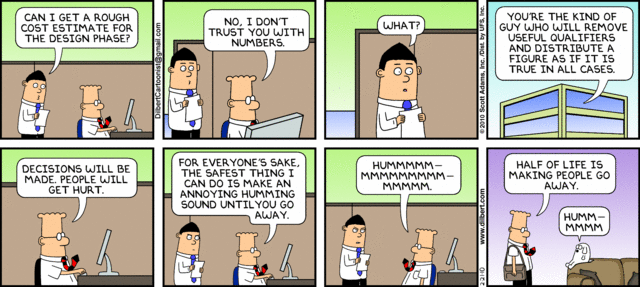
    Today’s Dilbert suggests a way for engineers to deal with product planners and marketing types, which many potential sources in technical fields will recognize as a tempting strategy for dealing with the press:

  • Metaphor of the week

    William J. Broad, “Doubts Raised on Book’s Tale of Atom Bomb“, NYT 2/20/2010, discusses a minor scandal of historical documentation: the descriptions of a claimed “secret accident with the [Hiroshima] atom bomb”, revealed in a recent non-fiction best-seller, turn out to have been based on lies and fabrications.

    That part didn’t especially surprise me, but this quotation brought me up short:

    “This book is a Toyota,” said Robert S. Norris, the author of “Racing for the Bomb” and an atomic historian. “The publisher should recall it, issue an apology and fix the parts that endanger the historical record.”

    I still haven’t erased my mental association between Toyota and concepts like “fanatical devotion to quality control”, despite the recent bad news about sticking accelerators and malfunctioning brakes. But when mild-mannered atomic historians start using your brand as a metaphor for sloppy and dangerous production errors, you’ve clearly got trouble.

  • Divergent histories of languages and genes

    Charles Darwin saw the history of languages as a model for “descent with modification” in biological evolution; and researchers from Thomas Jefferson to Luigi Luca Cavalli-Sforza and beyond have been excited about the idea of combining linguistic, biological, and geographical evidence to shed light on the history of human populations.

    Most recent linguists and anthropologists who are knowledgeable about such topics have been skeptical about how close we should expect linguistic and biological descent to be, in general. There are many ways, both wholesale and retail, for people to end up speaking a language different from the language of their ancestors, and similarly many ways for genes to flow from one speech community to another.

    A recent contribution to the skeptical side of the discussion is Hafid Laayouni et al., “A genome-wide survey does not show the genetic distinctiveness of Basques“, Human Genetics, published online 1/16/2010.

    Here’s their abstract:

    Basques are a cultural isolate, and, according to mainly allele frequencies of classical polymorphisms, also a genetic isolate. We investigated the differentiation of Spanish Basques from the rest of Iberian populations by means of a dense, genome-wide SNP array. We found that FST distances between Spanish Basques and other populations were similar to those between pairs of non-Basque populations. The same result is found in a PCA of individuals, showing a general distinction between Iberians and other South Europeans independently of being Basques. Pathogen-mediated natural selection may be responsible for the high differentiation previously reported for Basques at very specific genes such as ABO, RH, and HLA. Thus, Basques cannot be considered a genetic outlier under a general genome scope and interpretations on their origin may have to be revised.

    There’s an excellent discussion of the article by Razib Khan, “The Basques may not be who we think they are“, Gene Expression 2/18/2010.

    (I believe that “FST” is a form of Wright’s coefficient of relatedness — see e.g. Hilde M. Wilkinson-Herbots, “Coalescence Times and FST Values in Subdivided Populations with Symmetric Structure“, Advances in Applied Probability 35(3) 2003. I guess I should point out that the analysis in the Laayouni paper is based on a linear (SVD) decomposition of (a relatedness measure derived from) a large (~280k) number of SNP frequencies. I don’t know enough about the methods and the assumptions behind them to evaluate how strong an argument their results constitute against “the genetic distinctiveness of Basques” — I suspect that the phrase chosen in their title, “…does not show the genetic distinctiveness of Basques”, is a fair way to put it.)

    For some general linguistic background, see Don Ringe, “The linguistic diversity of aboriginal Europe“, 1/6/2009.

  • The population memetics of un-ed-ing

    English freely allows past participles to be used as pre-nominal modifiers, and in the natural course of events, such participle+noun combinations often become collocations or fixed expressions: fried chicken, pulled pork, mulled wine, hard-boiled eggs, rolled oats, cracked pepper, combed cotton, wrought iron, dropped ceiling,

    English speakers also tend to weaken or omit final coronal consonants, a process that linguists call t/d deletion: thus [lɛf] for left.  Although t/d deletion is stigmatized, in fact all normal English speakers do it some of the time, at least in some contexts.  As a result, fixed expressions that start out as participle+noun are sometimes re-analyzed so as to lose their -ed ending.  This happened long ago to ice(d) cream, skim(med) milk, pop(ped) corn, wax(ed) paper, shave(d) ice, etc. It’s happened more recently (I think) to ice(d) tea, cream(ed) corn, and whip(ped) cream.

    A few weeks ago, reader JM reported one of these that’s new to me: “bake goods” for baked goods, in a flier from his son’s school.

    This one is definitely out there on the web. Some examples are in a context featuring some other non-standard spellings — thus one page advises us to “keep the kids happy and your time not waisted” by following its instructions on “How to Keep Your Bake Goods Soft”; and another page asks “How often do you make homemade bake goods?”, and starts the answer “I use to make several kinds of cookies each week…”

    But other examples are otherwise pretty much standard: check out Mutt Face Bake Goods (“Treats for Dogs and their Pets”) in Seguin, TX; or the Countryside Bake Shop in Auburn KY (“Along with bake goods we also do vegetable trays, fruit trays, meat & cheese trays, potato salad, chicken fingers, chicken salad, ham salad and the list goes on”), or this 2005 article in the Westchester County Business Journal, “New bake goods store gives all net profits to nonprofits“.

    I don’t know whether this is a new trend, or a sporadic but stable variant that’s been around for a long time, regionally or at low frequencies.  I suspect the latter: thus Google Books turns up this, in a 1918 History of Saginaw County, Michigan:

    Or this example from the July 1975 issue of Kiplinger’s Personal Finance (in the item under “Yeast baking” in the middle of the right-most column):

    In both of those last examples, the phrase “bake goods” occurs twice in the same paragraph, making it less likely that it’s a typographical error.

    The April 1916 edition of Baker’s Review has five instances of “bake goods”, in contexts like “With one of these ovens you can produce the highest quality of bake goods with the lowest possible cost for fuel and repairs”. On the other hand, the same issue of the same journal has 21 instances of “baked goods”…

    The development of large, well-dated, searchable digital archives will eventually make it possible to study the population memetics of such variants in an empirically grounded way.

    [Update — I should add that in some cases, there are alternative plausible derivations besides t/d deletion. In particular, some combinations (like ice tea) are plausible as noun-noun compounds; and other examples (like shave ice) may reflect the influence of language varieties (in that case, Hawaiian Creole) that entirely or variably lack the -ed affix.]

  • Language and meta-language

    Or maybe it should be text and meta-text. Anyhow, John D. Muccigrosso wrote to point out something that’s obvious in retrospect, namely that all those pages that say “This page intentionally left blank” are thereby not, in fact, left blank.

    In looking for examples, I discovered that the earliest example of this that Google Books can find seems to have been published around 1922.

    Is this

    • an artefact of the scanning, indexing, or searching methods used?
    • the result of a change in wording, with the same idea expressed with different words in earlier times?
    • a genuine cultural innovation, so that before 1922, intentionally-blank pages were simply left blank without any self-identifying advice to the reader?

    At some point, Federal regulations seem to have imposed such a requirement — presumably on certain classes of government documents, though I can’t tell exactly from the “snippet view” at the link just provided.

  • “It doesn’t entirely unjibe”

    Jane Velez-Michell interviews Amy Bishop’s friend Rob Dinsmore (this segment begins about 4:58 into the video clip embedded after the jump):

    JV-M So police say, Rob, they called nine one one on the neighborhood kids a whole bunch of times, that she stopped an ice cream truck from coming into the neighborhood, she was upset about the dirt bikes, about the uh motorized bikes, about any bikes, um and she would- apparently they would even videotape the kids in their neighborhood uh to try to intimidate them. Now does that jibe with the person you know?
    RD: Um it doesn’t entirely unjibe. The um she used to complain about that neighborhood all the time, and now it’s a very insular little neighborhood, it’s like a a little circular drive or a- a cul-de-sac or something, the way I remember it, …


    According to the OED, jibe is an American invention, of obscure origin (“perh. phonetically related to chime“), meaning “To chime in (with); to be in harmony or accord; to agree”.

    There don’t seem to be any prior uses of the form unjibe on the web, though perhaps I haven’t searched diligently enough. It makes perfect sense in this context.

    [Hat tip to reader MLR.]

  • Icktheology

    A couple of days ago, when I posted about Nicholas Kristof’s take on the electrophysiology of politics, I limited my discussion to a 2008 Science article about the relationship between physiological reactions to “threatening images” (like a spider on someone’s face) and political attitudes towards “protective policies” (like immigration). Thanks to a couple of enterprising readers, I found a readable .pdf of a 2009 manuscript from the same (University of Nebraska) laboratory, which Kristof also discusses, on the relationship between physiological reactions to “disgusting images” and attitudes towards “sex items” like gay marriage. And as promised, I have a bit more to say after reading it.

    Taken together, the two papers are more convincing than either one alone, since the combined results call into question the idea that the measured physiological differences might simply be due to the greater uneasiness of (more conservative) townies being hooked up to electrodes in a university laboratory, compared to (more liberal) university faculty, students, and staff. But the second paper confirms some of the concerns that I had about the size of the effects in the first paper. And it also shows that I was off base when I wrote that “This is not a case of egregious journalistic misunderstanding or over-interpretation”. In particular, Kristof doesn’t just exaggerate, he directly contradicts the 2009 paper’s findings when he writes that

    Liberals released only slightly more moisture in reaction to disgusting images than to photos of fruit. But conservatives’ glands went into overdrive.

    The 2009 paper is Smith et al., “The Ick Factor: Physiological Sensitivity to Disgust as a Predictor of Political Attitudes“. The subjects in the study appear to be the same 50 Lincoln-area people used in the 2008 Science paper, and in fact, the data in the two papers seem to have come from the different aspects of the same two sessions, one involving answers to several political and psychological questionnaires, and the other involving measurements of physiological responses to seeing a series of still images. (Perhaps this is wrong, and it’s just that the time period, the procedures, and the number of subjects are so similar as to give this impression.)

    Political attitudes were measured by ascertaining reactions to16 brief issue-prompt items presented in the well-known Wilson-Patterson format (Wilson and Patterson 1968) in which respondents indicate agreement or disagreement (they can also equivocate). The specific prompts employed … and cover a range of topics including taxes, defense, and social issues.

    The three possible answers were coded as 0, 0.5, and 1, in such as way as to make the more (conventionally) “conservative” position equal to 1.

    To measure self-report, we employed the standard disgust sensitivity survey battery, DS-R (Disgust Sensitivity-Revised). […] [A] full discussion of this widely-used battery can be found at the Disgust Scale Homepage maintained by Jonathan Haidt.

    To measure physiological response to disgust, we relied upon one of the most common indicators of physiological activity: skin conductance. […]

    In order to stimulate possible disgust reactions, participants were shown five individual disgusting still images scattered throughout the sequential showing of a large number of individual images. Each image appeared on a computer screen for 15 seconds and was separated from the succeeding image by an inter-stimulus interval (ISI) of 10 seconds. Subsequent factor analysis indicated that responses to three of the five disgusting stimuli loaded heavily on the same factor, so our central measure of physiological disgust sensitivity is based on readings obtained during viewing of these three identified disgusting images: an emaciated body, human excrement, and a person eating a mouthful of worms.

    One thing that struck me as odd about this is two of the three “threatening” images used in the 2008 Science paper also strike me as having a substantial “ick factor”: the authors describe them as “the face of a frightened person, a dazed individual with a bloody face, and an open wound with maggots in it”. And many people might find the “disgusting” images somewhat “threatening” as well, it seems to me. (This will become relevant to the discussion later on.)

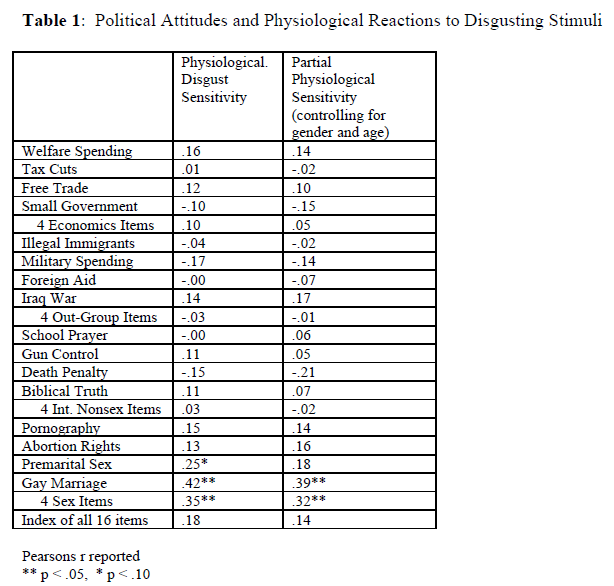
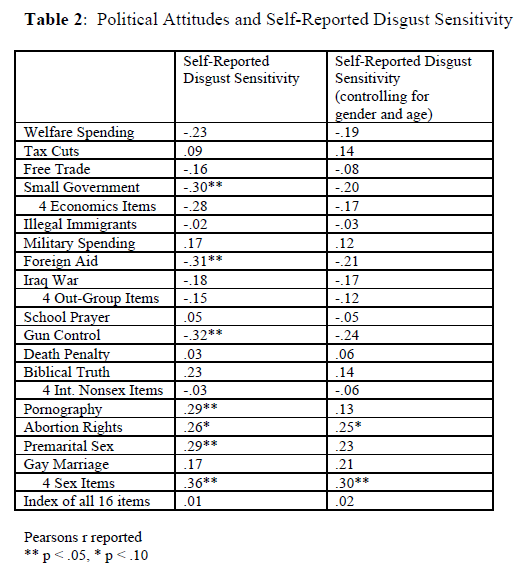
    In any case, the results show clearly that Kristof’s statement (“Liberals released only slightly more moisture in reaction to disgusting images than to photos of fruit. But conservatives’ glands went into overdrive.”) is not just an exaggeration of the size of the effect, as I suggested in my earlier post, but a qualitatively false assertion. Here’s the table showing correlations of subjects’ phsyiological responses to the “disgust” images with their political attitudes:

    The overall correlation with conservative attitudes in general (represented by the “index of all 16 items”) is a small (and statistically insignificant) 0.18 — and falls to 0.14 if gender and age are controlled for.  6 of the 16 items have negative correlations, meaning that the glands of people who responded as “liberals” on those items tended to respond more strongly than those who responded as “conservatives” (though the difference was not judged to be statistically significant).  8 of the remaining 10 items had positive but statistically insignificant correlations. The only questionnaire items with significant positive correlations to the disgust-picture skin-conductance responses were “Gay Marriage” and “Premarital Sex”.

    Now, this calls into question my suggestion that perhaps “conservatives” responded more strongly (to the “threatening” pictures) because they were in an environment that made (at least some of) them (at least somewhat) more ill at ease than the “liberals” were. In this data, people with conservative positions on Small Government, Illegal Immigrants, Military Spending, and the Death Penalty, had (on average) weaker SCL reactions than people with liberal positions on those issues did. Of course, the data is clearly very noisy, and so maybe this is all just noise.

    But still, the pattern undermines the “social distance” hypothesis, and it flatly contradicts Kristof’s asssertion about those conservative glands going into overdrive.

    At this point, I’d like to reiterate the point that we’re dealing with between-group differences that are small relative to the amount of within-group variation, even in the case of the strongest observed connections between physiology and politics. In my earlier post, I made this point by calculating the difference in means in terms of pooled standard deviation, and showed what sort of distributional overlap this implies. This time, I’ll do it in terms of correlations.

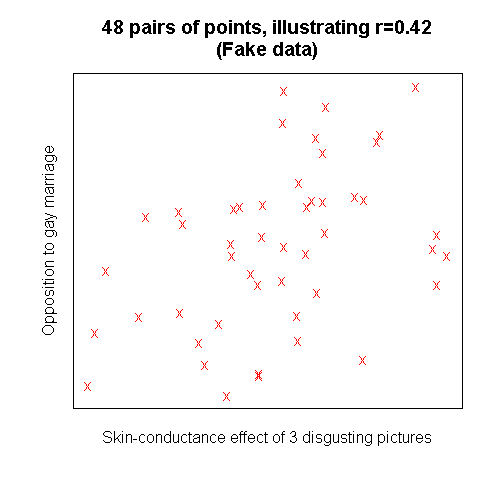
    The strongest correlation observed in this study is r=0.42, between SCL responses to “disgusting” pictures and attitudes towards Gay Marriage. What does this mean? Graphically, if we had two continuous variables, and plotted one of them against the other, the scatter-plot would look something like this:

    This is fake data, alas, since the actual underlying results are not published. I created it with this little script in the R statistics language. (Sorry about the lack of indentation — WordPress’s brain-dead interface eats all line-initial spaces…)

    C=0
    NoiseGain=50
    while(C != 0.42){
    X1 = 1:48 + NoiseGain*runif(48)
    X2 = 1:48 + NoiseGain*runif(48)
    C = round(cor(X1,X2),digits=2)
    }
    plot(X1,X2, type="p", pch="x", col="red",
    main="48 pairs of points, illustrating r=0.42\n(Fake data)",
    xlab="Skin-conductance effect of 3 disgusting pictures",
    ylab="Opposition to gay marriage",
    yaxt="n", xaxt="n",
    mgp=c(1,1,1))

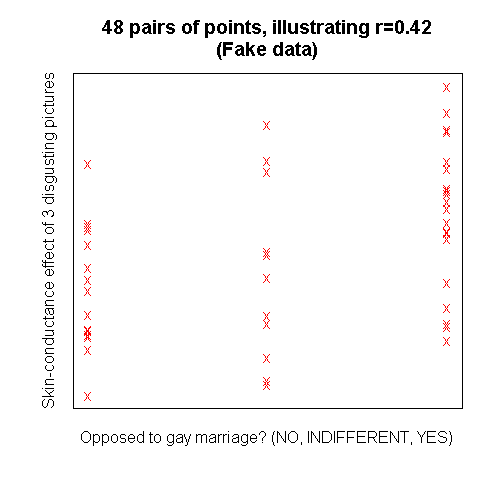
    To be more accurate, I should quantize the political-attitude results into the three bins of their survey responses. Doing that, we get an illustration like this one:

    The R code:

    C=0
    while(C != 0.42){
    X1 = 1:48 + NoiseGain*runif(48,min=-0.5,max=0.5)
    X2 = 1:48 + NoiseGain*runif(48,min=-0.5,max=0.5)
    X2[X2<=16] = -1
    X2[X2>16 & X2<=32] = 0
    X2[X2>32] = 1
    C = round(cor(X1,X2), digits=2)
    }
    plot(X2,X1, type="p", pch="x", col="red",
    main="48 pairs of points, illustrating r=0.42\n(Fake data)",
    ylab="Skin-conductance effect of 3 disgusting pictures",
    xlab="Opposed to gay marriage? (NO, INDIFFERENT, YES)",
    yaxt="n", xaxt="n",
    mgp=c(1,1,1)

    Again, this is not the real data — I’d love to have the real data to show you, but anyhow, given a correlation of r=0.42, it must look something like this.  And again, you can see that the range of skin-conductance effects overlaps very substantially across the categories of political attitudes.  It’s probably a real effect, unlikely to have arisen through sampling error — though I’d feel better about this if I was sure that they’d done a correction for multiple comparisons, and if the set of “disgusting” pictures involved hadn’t been adjusted post hoc:

    In order to stimulate possible disgust reactions, participants were shown five individual disgusting still images scattered throughout the sequential showing of a large number of individual images.[…]. Subsequent factor analysis indicated that responses to three of the five disgusting stimuli loaded heavily on the same factor, so our central measure of physiological disgust sensitivity is based on readings obtained during viewing of these three identified disgusting images.

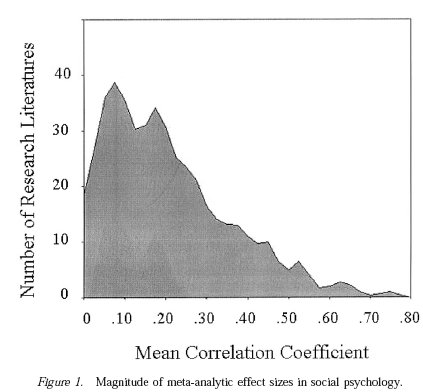
    I should emphasize that a correlation of 0.42 is nothing to be ashamed of. As I noted in a post a few months ago, a metanalysis of research results in Social Psychology shows that the mode of published correlations is below r=0.1, and 0.42 is well out on the upper tail:

    But the point is that we’re dealing with small-to-moderate shifts in heavily-overlapping distributions, not some sort of partition of the population into purity-seeking conservatives and ick-tolerant liberals (if that’s even the right description for what’s happening here).

    And now the question of their variables really mean comes to the fore. There are a few things that make this less clear than one would like it to be.

    The most important puzzle is the strange divergence between their physiological and psychological measures of disgust sensitivity. Recall that they also “employed the standard disgust sensitivity survey battery, DS-R (Disgust Sensitivity-Revised)” to measure their subjects’ self-reported disgust sensitivity. This measure also correlated with attitudes toward Gay Marriage (and to a lesser extent with other sex-related political attitudes):

    So what comes next is unexpected :

    The roughly parallel results for physiological and for self-reported disgust sensitivity naturally lead to suspicions that the two measures correlate strongly with each other. Surprisingly, however, despite the fact that both measures are related to political attitudes involving sexuality, self-reported disgust sensitivity is unrelated to physiological disgust sensitivity (as measured by skin conductance changes caused by the viewing of disgusting stimuli). The simple bivariate correlation of the two is substantively small, inverse (r = -.15), and statistically insignificant (p = .32).

    Note also that self-reported disgust sensitivity also correlated with liberal attitudes on Welfare Spending, Small Goverment, Foreign Aid, and Gun Control. These effects were reduced but not eliminated by controlling for sex and age, with sex playing the most important role — women tended to have higher self-reported disgust sensitivity than men:

    One possible reason for the absence of a bivariate relationship is the potentially confounding effect of gender. It may be that differences (physiological and otherwise) between males and females need to be controlled in order for a relationship between physiological and self-reported disgust sensitivity to appear.

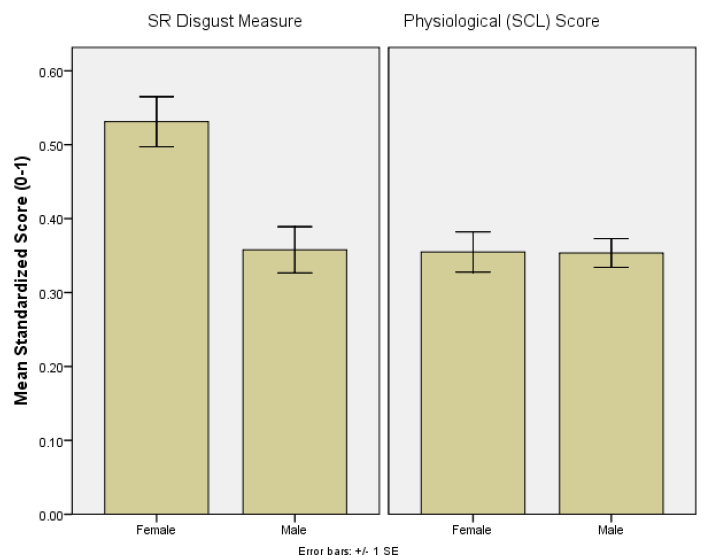
    Interestingly, while the data suggest important differences between males and females, these differences are not physiological and they do not seem to be the reason for the absence of a correlation. As indicated in Figure 1, where the range of both physiological and self-reported disgust sensitivity has been standardized to run from 0 to 1 in order to facilitate comparisons, mean gender differences occur for self-reported disgust sensitivity (p < .01) but not for physiological disgust sensitivity (p = .82). Perhaps females claim to be more disgust sensitive because, due to societal norms, they often feel pressure to be disgust sensitive whereas males often feel pressure to be disgust insensitive. Though this interpretation is only speculation, we can state with some certainty that, when the focus of attention is on physiology, the difference between males and females is substantively minute and statistically insignificant. When the focus is on self-report, however, males claim to be substantially and significantly less sensitive to disgust than females. Previous scholarship (and, undoubtedly, folk wisdom) holding that “women are more disgust sensitive than men,” (Inbar, Pizarro, and Bloom 2009) is more accurately summarized as women report being more disgust sensitive than men.

    Here’s their Figure 1:

    Note that (as discussed here) this is typical of sex differences on other emotional dimensions such as “empathy”:

    In general, sex differences in empathy were a function of the methods used to assess empathy. There was a large sex difference favoring women when the measure of empathy was self-report scales; moderate differences (favoring females) were found for reflexive crying and self-report measures in laboratory situations; and no sex differences were evident when the measure of empathy was either physiological or unobtrusive observations of nonverbal reactions to another’s emotional state.

    The sex/gender – self-report/physiology stuff is interesting, but as the authors explain, it doesn’t account for the unexpected disconnection between their measures:

    These gender differences in self-report are substantial, however they do not account for the lack of overall correlation between reported disgust sensitivity and physiological disgust sensitivity. A partial correlation of reported and physiological disgust sensitivity controlling for the effects of gender still does not produce a statistically significant relationship (r = -.18; p = .23) and exactly the same numbers result when both gender and age (another variable that could rightly be thought to affect physiological readings) are included as control variables (r = -.18; p = .23). In sum, individuals who believe themselves to be particularly disgust sensitive or particularly disgust insensitive are unlikely to be reporting sentiments that in point of fact relate to their physiological responses to disgust. People are not particularly adept at reporting their emotional states and the gender differences in self-report but not in physiology encourage the conclusion that societal pressures could be more crucial in shaping self-reports than physiological responses.

    So in the end, I’m left wondering what space of “dispositional temperaments” is really at issue here, and what its relationship is to the measurements that they’re using.

    If you remove all the interpretations and just look at the data in this study, we’ve got something like a 48 X 24 matrix (48 subjects by 16 political questions plus physiological responses to 5 images plus the DS-R measure plus sex plus age). There are more than 200 pairwise correlations, plus a much larger number of potential multivariate analyses. A few of these turn out to be statistically significant. (After Bonferroni correction? I’m not sure.) Specifically, if we look at some of the inter-relationships among various of the political questions, subject sex and age, reactions to three of the pictures, and the DS-R measure, we get a pattern that partly makes sense in terms of Haidt’s theory of purity-conscious conservatives, and partly (maybe mostly?) doesn’t.

    To the extent that I understand all of this, the results seem at least as puzzling as they are intriguing. And given how murky the political, psychological, and physiological spaces are, and how weak the interconnections tend to be, it worries me that most of the people who are thinking in public about these things tend to talk about them in the essentialist terms implied by the use of generic plurals (“… conservatives … liberals …”)  This includes not only people like Kristof, who probably don’t know any better, but also people like Jonathan Haidt and the authors of this study, who clearly do.

  • Sex-change surgery and universal grammar

    [Guest post by Neal Goldfarb.]

    The United States Tax Court recently decided that payments for sex-reassignment surgery are deductible as medical expenses. Among the 15 judges, there were six separate opinions, with five of the judges dissenting. Most of the debate dealt with questions like whether Gender Identity Disorder is a “disease” (a key term in the statue) and if so whether sex-reassignment surgery, which doesn’t change the patient’s subjective sense of gender identity, constitutes a “treatment” for the disease (ditto).

    Those are issues with interesting linguistic dimensions, but what I want to talk about here is a different aspect of the case: the dispute about how to interpret disjunction under negation—i.e., how to interpret expressions such as I don’t know anything about linguistics or tax law (with don’t signaling negation and or signaling disjunction).

    In the case decided by the Tax Court, the IRS had ruled that sex-reassignment surgery isn’t deductible, on the theory that it amounts to cosmetic surgery, which the tax code excludes from its definition of medical care. The code defines cosmetic surgery as—

    any procedure which is directed at improving the patient’s appearance and does not meaningfully promote the proper function of the body or prevent or treat illness or disease.

    The language in boldface is what’s at issue here.

    The Tax Court rejected the IRS’s position, with the majority of the judges concluding that sex-reassignment surgery was a treatment for the disease of Gender Identity Disorder and therefore wasn’t cosmetic surgery. (The majority didn’t decide the question whether the procedure is “directed at improving appearance”—though that’s how the dissenters characterized it—or whether it promotes the proper function of the body.)

    On the majority’s interpretation, the boldfaced language above means that an appearance-improving procedure doesn’t count as cosmetic surgery if it either promotes proper bodily function or prevents or treats illness or disease. The dissenters, on the other hand, argued that for such a procedure to be excluded from the cosmetic-surgery category, it has to both promote proper bodily function and prevent or treat illness or disease. In other words, the dissenters were equating (1a) with (1b), while the majority equated it with (1c):

    1a. does not [(meaningfully promote…) or (prevent or treat…)]

    1b. [does not meaningfully promote…] or [does not prevent or treat]

    1c. [does not meaningfully promote…] and [does not prevent or treat]

    One of the dissenting opinions accused the majority of ignoring the statute’s plain meaning:

    The majority’s analysis proceeds as if the statute employs “and” rather than “or” between the “meaningfully promote the proper function of the body” and “prevent or treat illness or disease” prongs. Respondent appears to agree with this interpretation in lieu of a plain reading of the statute. In essence, the majority and respondent engage in reconstruction, rather than strict construction, of section 213(d)(9).

    Judge Halpern, who voted with the majority and wrote a separate concurring opinion, wasn’t buying this argument. In explaining why he didn’t buy it, he invoked principles of formal logic:

    Because the second part of the test contains two expressions separated by “or”, that part of the test contains a “disjunction”; i.e., a compound proposition that is true if one of its elements is true. Importantly, however, the second part of the test contains not just a disjunction (i.e., (p or q)), but rather the negation of a disjunction (i.e., not (p or q)). Judge Foley errs because he assumes that the expression “not (p or q)” is equivalent to the expression “(not p) or (not q)”….

    In formal logic, there is a set of rules, De Morgan’s laws, relating the logical operators “and” and “or” in terms of each other via negation. [Citation to Wikipedia.] The rules are:

    not (p or q) = (not p) and (not q)

    not (p and q) = (not p) or (not q)

    The first of the rules would appear to govern the disjunction in section 213(d)(9)(B), which is of the form “not (p or q)”.

    To which the dissenters responded:

    Judge Halpern’s mechanical application of De Morgan’s laws is not prudent. Simply put, congressional intent is not subservient to De Morgan’s laws.

    Judge Halpern is right about what the statute’s language means, but in framing his explanation in terms of formal logic, he’s on somewhat shaky ground (and not just because he opened himself up to the dissent’s glib putdown). The problem is that natural languages don’t necessarily follow the rules of formal logic. Indeed, the whole point of formal logic is to provide an artificial language that avoids the messiness of natural language.

    Now, it just so happens that for expressions in the form not (p or q), English does in fact behave consistently with De Morgan’s law. Or at least it usually does. The sentence I’m not free this week or next week is generally interpreted to mean ‘I’m not free this week and I’m not free next week.’ But it can also be interpreted to mean ‘Either this week or next week—I can’t remember which one—I’m not free.’ (These examples are adapted from the Cambridge Grammar of English Language.) I suspect that the latter interpretation arises only in a fairly narrow range of contexts, but in any event, the point remains that De Morgan’s laws don’t invariably apply in English.

    There’s an even bigger deviation from De Morgan’s laws in the case of negated conjunction (as opposed to negated disjunction). According to De Morgan’s laws, not (p and q) = (not p) or (not q). But in English, not (p and q) is more often interpreted as (not p) and (not q). So I’m not free this week and next week is generally interpreted as ‘I’m not free this week and I’m not free next week.’ But again the Morganian interpretation is also possible, especially (only?) if the and is stressed: I’m not free this week AND next week will typically be interpreted to mean ‘It is not the case that I’m free both weeks (but I am free one of them).’

    Note that in the case of disjunction, stressing the coordinator (or) doesn’t have the same effect as in the case of conjunction. That is, it doesn’t cancel the default (non-Morganian) interpretation. On the contrary, it reinforces it. I’m not free this week OR next week is interpreted as ‘I’m not free this week AND I’m not free next week.’

    Not all languages follow the same pattern as English. For instance, Japanese apparently doesn’t follow De Morgan’s laws in the case of negated disjunction. So in Japanese, not (p or q) = (not p) or (not q). Or at least that’s true for adult speakers of Japanese. Young Japanese-speaking children, it seems, do follow De Morgan’s laws, but then switch over when they more completely master the language. (See, for example, Andrea Gualmini & Stephen Crain, “Why No Child or Adult Must Learn De Morgan’s Laws“, Proceedings of the 24th Annual Boston University Conference on Language Development, Cascadilla Press, Somerville, MA (2004).)

    In fact, Stephen Crain argues that in all languages disjunction is interpreted consistently with De Morgan’s law in at least some structures, and that this is evidence supporting the nativist side of the debate over whether knowledge of language is innate. Here’s the abstract to his paper “The Interpretation of Disjunction in Universal Grammar“:

    Child and adult speakers of English have different ideas of what ‘or’ means in ordinary statements of the form ‘A or B’. Even more far-reaching differences between children and adults are found in other languages. This tells us that young children do not learn what ‘or’ means by watching how adults use ‘or’. An alternative is to suppose that children draw upon a priori knowledge of the meaning of ‘or’. This conclusion is reinforced by the observation that all languages adopt the same meaning of ‘or’ in certain structures. For example, statements of the form ‘not S[A or B]’ have the same meanings in all languages, and disjunctive statements receive a uniform interpretation in sentences that contain certain focus expressions, such as English ‘only’. These observations are relevant for the long-standing “nature versus nurture” controversy. A linguistic property that (a) emerges in child language without decisive evidence from experience, and (b) is common to all human languages, is a likely candidate for innate specification. Experience matters, of course. As child speakers grow up, they eventually learn to use ‘or’ in the same way as adults do. But, based on findings from child language and cross-linguistic research, it looks like certain aspects of language, including the interpretation of disjunction, are part of the human genome.

    There are some obvious questions: Is Crain correct in saying that disjunction is interpreted consistently with classical logic in (at least some constructions in) all languages? And that adult speech in languages like Japanese really provides children learning to speak no evidence for the interpretation of disjunction that they start out with?

    However, I’m pointing out Crain’s work, not as an opening to talk about whether there’s such a thing as Universal Grammar, but as an exercise in Six Degrees of Something-or-Other. Here we have a decision interpreting the United States Internal Revenue Code that turns (at least in part) on an issue that might be relevant to figuring out the fundamental nature of language. And I thought tax law was boring.

    [Guest post by Neal Goldfarb.]

  • Annals of human-computer interface improvement

    In the old days, when a proposal was ready to go out from my university to NSF or NIH or whatever, a pile of paperwork was circulated around so as to get the needed cascade of signatures: principal investigator, department head, budget office, and so on. A couple of years ago, the office of research administration replaced this inefficient process with a new web-based system.

    Such systems can be a great thing. Several years earlier, NSF automated its submission procedures via a system called “FastLane”, and in my opinion, it’s been a big success. Submission, reviewing, and reporting have become much easier. The system is pretty much self-explanatory, and there are good help pages for aspects that may be confusing.

    But our new internal review software was different.

    If you’re in the approval chain for a proposal, you get an email with a web link. When you click it, you have to authenticate yourself through the university’s Kerberos server. Then this display appears in the upper left-hand corner of the browser window (which is otherwise empty):

    The first time I had to navigate this process, it completely baffled me. I tried everything I could think of, over the course of a couple of hours, and couldn’t get it to accept the approval I was trying to enter. I wasn’t trying to do anything fancy — all I wanted to do was the equivalent of signing the transmittal form; and I consider myself pretty good at figuring out difficult interfaces. But this one defeated me.

    There was no page of instructions, and asking questions up through a couple of layers of bureaucracy failed to find anyone who had any clue what might be going wrong. When I took a break to go ask some questions, I discovered another wrinkle.

    The web link in the original email is a fairly complex one:

    https://www.pennera.upenn.edu/messaging/ReviewItem.asp?RoutedStepID=FOO

    where FOO is something like “7FC01A8C4FF9C104E043A57B5062C104″.

    When I gave up and decided to go for help, I deleted the email, figuring that I’d be able to get back to my “Items to Review” in this system just by signing on to the research-administration web site. That’s what I do (for example) in NSF’s FastLane system, or other systems of that kind that I’ve used.

    Fat chance. If you don’t have the magic cookie, you apparently can’t get to the approval page. And I’d deleted the email. So when my first couple of hours of trial-and-error ended in failure, there was a delay while several more layers of bureaucracy tried to figure out how to reconstruct the link for me. (The details of this process were mercifully hidden from my view.)

    Anyhow, after visiting the offices of a couple of administrators who also couldn’t figure out how to coach me through entering an approval, I went back to trial-and-error, and eventually I discovered how to accomplish the digital equivalent of the old-fashioned “sign on the line”.

    Actually, somebody may have given me the crucial secret clue, I don’t remember… but in case you ever need to deal with a version of this particular system, I’ll reveal the trick to you now.

    The first step is to click on “Item(s) to Review”, and then check the boxes that indicate you’ve reviewed them. That much I had tried dozens of times before — but the key insight is that after checking the boxes, you need to click on the little icon in the upper-left-hand corner, in order to “save your work”. That icon, in case it puzzles you as much as it puzzled me, is not a low-res image of a computer monitor serving as the program’s logo — rather, it’s a low-res image of a floppy disk, serving as the program’s Save button. “Save” = “floppy disk”, get it? This from a program that was introduced within the last couple of years, roughly a decade after the last floppy disk drive was consigned to a museum.

    Then you need to click on “My Decision”. (This won’t work unless you’ve previously saved the result of checking off the “Items to Review”, by the way.) This will give you a menu of alternatives that includes “Approved”. And having selected “Approved”, you need to click on that floppy disk again., otherwise it’s all for nothing. (None of the other menu items will accomplish anything except to confuse you.)

    OK, so I learned how to “sign on the line”, via what must be one of the least intuitive human interfaces ever designed. (And I speak with some authority on this question…) In the couple of years since then, I’ve been through the process many times.

    But yesterday, there was something new. I authenticated myself, as usual, but instead of the familiar ugly little rainbow menu, I got a page reading in its entirety:

    error ‘8000ffff’

    /home/websec.asp, line 40

    I tried several times, with the same result. So I figured that the server must be down.

    Things still weren’t working this morning, but our business administrator had figured out (by trial and error) that the site aparently now works only with Internet Explorer. And sure enough, Firefox and Chrome get the error messages, but IE 8 works.

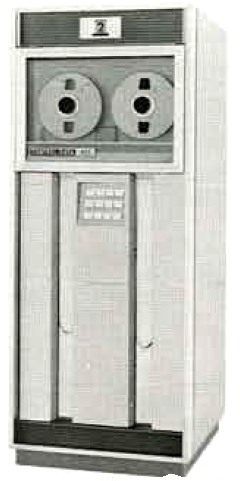
    Amazingly, it seems that software development continues on this system, and they’ve now accomplished the extraordinary feat of making it even more opaque and difficult to use. I have a suggestion for the next iteration: maybe they should replace the “floppy disk” icon with a tiny image of a seven-track tape drive. And then they could add a chartreuse menu item labelled “Advanced Features” that lets you sign in octal. (Octal EBCDIC, of course.)

  • Future perfect continuous passive?

    Yesterday’s Dinosaur Comics explores the far reaches of verbal morphosyntax in English:

    (As usual, click on the image for a larger version.)

    There are some terminological issues, but it would be inappropriate to be critical of someone who uses the term “passive” to refer to a genuine instance of the passive voice.

    The system is in principle recursive, so that nothing but a bit of effort stands between you and semi-plausible uses of even more elaborate forms, like “will have been going to have been being done by me”.

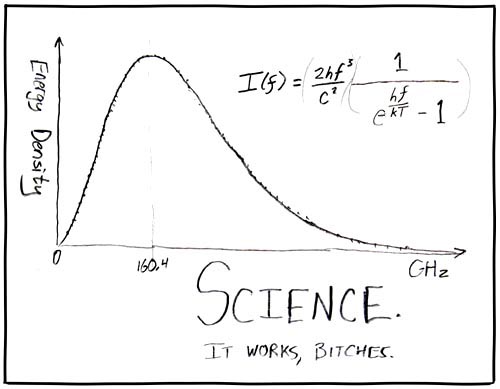
    A small usage note: final vocative “bitches” has become a sort of particle indicating ironic triumph, used even (or especially?) in otherwise PC contexts, e.g. the well-known xkcd strip:

    And of course the t-shirt as well:

  • Physiological politics

    Carl Zimmer, among other readers, has pointed me to the latest outbreak of bio-political punditry. This time it isn’t David Brooks, but rather Nicholas Kristof, “Our Politics May Be All in Our Head“, 2/13/2010:

    We all know that liberals and conservatives are far apart on health care. But in the way their brains work? Even in automatic reflexes, like blinking? Or the way their glands secrete moisture?

    That’s the suggestion of some recent research. It hints that the roots of political judgments may lie partly in fundamental personality types and even in the hard-wiring of our brains.

    Researchers have found, for example, that some humans are particularly alert to threats, particularly primed to feel vulnerable and perceive danger. Those people are more likely to be conservatives.

    Kristof’s “recent research” link goes to Kevin Smith, Douglas Oxley, Matthew Hibbing, John Alford, and John Hibbing, “The Ick Factor: Disgust Sensitivity as a Predictor of Political Attitudes“. The abstract:

    Mounting evidence suggests political attitudes connect to broad, dispositional, perhaps biological temperaments. We add to these empirical results by reporting a correlation between certain political attitudes and physiological reactions to disgusting stimuli such as human excrement and worms being eaten. Specifically, we find that individuals whose skin conductance levels increase when viewing disgusting images are more likely to adopt “conservative” positions on homosexuality and perhaps a broader range of “sex and reproduction” issues, a result that serves as a useful illustration of the larger point that political attitudes cannot be separated from generic physiological traits.

    This is listed as a “Paper prepared for presentation at the annual meeting of the Midwest Political Science Association”, April 2008; but unfortunately, the copy available at the link given is almost impossible to read (because the type is so small, with no method that I could find to enlarge it), and I couldn’t find another copy on line. [Update — a helpful reader showed me how to get a .pdf, and so I’ll blog about Ickology as time permits.]

    However, a similar set of ideas and experiments are presented in a more accessible way in Douglas Oxley, et al., “Political Attitudes Vary with Physiological Traits“, Science 321:5896, 9/19/2008:

    Although political views have been thought to arise largely from individuals’ experiences, recent research suggests that they may have a biological basis. We present evidence that variations in political attitudes correlate with physiological traits. In a group of 46 adult participants with strong political beliefs, individuals with measurably lower physical sensitivities to sudden noises and threatening visual images were more likely to support foreign aid, liberal immigration policies, pacifism, and gun control, whereas individuals displaying measurably higher physiological reactions to those same stimuli were more likely to favor defense spending, capital punishment, patriotism, and the Iraq War. Thus, the degree to which individuals are physiologically responsive to threat appears to indicate the degree to which they advocate policies that protect the existing social structure from both external (outgroup) and internal (norm-violator) threats.

    In other words, the Science paper deals with reactions to sudden noises and theatening visual images, correlated with political attitudes toward level of support for what the authors call “protective policies”. The nearly-unreadable conference paper makes an analogous argument about reactions to disgusting images correlated with political attitudes towards “sex and reproduction issues”, especially homosexuality. So I’m going to discuss the Science paper — if someone can point me to a readable copy of the “disgust” paper, I’ll be happy to apply the same analysis there.

    (By the way, you can see from the quoted abstracts that Kristof’s account of this work is not very different from what the authors themselves have to say about it. This is not a case of egregious journalistic misunderstanding or over-interpretation.)

    In the rest of this post, I’m going to go over some aspects of the analysis in the Science paper, and argue that the explanation offered is at least excessive and possibly wrong.  I’m somewhat hampered in doing this by the fact that some relevant aspects of the authors’ data are not published, and also by (what I found to be) some ambiguities in the presentation of their data and their models. If as a result I’ve misunderstand what they did or how they interpreted it, I apologize in advance. I plan to write to the authors and ask for clarification and for a copy of their original data, which would allow me (and others) to make a more full and fair evaluation.

    First, who were the subjects?

    Subjects were recruited in May of 2007 by the Bureau of Sociological Research at the University of Nebraska-Lincoln (BOSR). BOSR contacted a random sample of residents of Lincoln, Nebraska. This initial telephone call followed an introductory letter and was used to pose a limited number of items to respondents with the intention of obtaining a group of individuals with strong political convictions toward whom intense and more focused investigation would be directed. The following three questions were used to screen potential subjects. Yes or no response categories were given for all three questions.

    1. Do you follow politics or political issues closely?

    2. Is there a certain political issue or set of political issues you feel strongly about?

    3. Have you ever supported a particular political issue or cause?

    A total of 1310 people were contacted and 608 of them completed the screening items. Subjects were recruited for this particular project only if they responded “yes” to all three questions. A total of 143 respondents did so and were agreeable in principle to coming to the lab. BOSR was able to schedule (and secure the attendance of) 48 individuals at both sessions (survey and physiological) of this project. Health problems rendered the data from one individual unusable and mechanical problems with a sensor spoiled the data from another, leaving a final total of 46 participants.

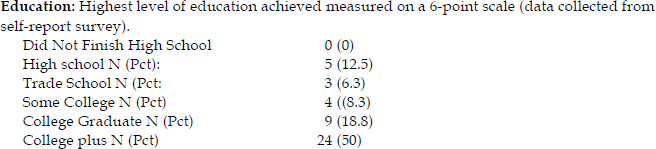
    Their sample of 46 subjects included 29 males and 17 females; and the distribution of education levels was also rather skewed:
    So how did Oxley et al. measure the subjects’ political attitudes about “protective policies”?

    The dependent variable … is an additive index of 18 issue items based on a standard Wilson-Patterson battery. For each issue, respondents were asked to “please indicate whether you agree or disagree with the topic listed,” and were given “agree,” “disagree,” and “uncertain” response options. These options were coded as “1” when they indicated support for protective policies (e.g. for agreeing with the death penalty, or for disagreeing with pacifism), “0” when they indicated opposition to protective policies (e.g. for disagreeing with the Patriot act, or agreeing with pornography), and “.5” for an uncertain response.

    As I understand it, they made no special efforts to create the bimodal distribution of summed opinion scores that resulted:
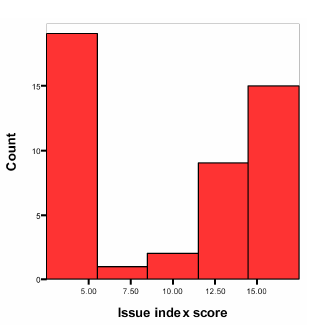
    They then ran two psychophysiological tests on the same set of subjects. One was a measure of “skin conductance level” (SCL) recorded while

    [e]ach participant was shown three separate threatening images (a very large spider on the face of a frightened person, a dazed individual with a bloody face, and an open wound with maggots in it) interspersed among a sequence of 33 images.

    “Conductance” here is the inverse of resistance, measured in log μ-Siemens:

    After logging the data to normalize the distribution, we computed the change in the mean level of skin conductance (SCL) from the previous interstimulus interval (10 s) to the stimulus of interest (20 s). This calculation isolates the change in skin conductance induced by the stimulus and reduces the effects of baseline variations across participants.

    (Issues of units, normalization, and measurement intervals aside, this is basically the same phenomenona that goes under the older and somewhat more familiar name of “Galvanic Skin Response” or GSR, and is caused by changes in the autonomically-induced activity levels of sweat glands.)

    The other physiological measure was the EMG associated with startle blinks, elicited in response to unexpected noise bursts, where “higher blink amplitudes … are indicative of a heightened ‘fear state’”.

    Here’s the authors’ graphical presentation of the basic result for the SCL measurements. They divided their 43 subjects into those who scored above the median on the “support for protective policies” questionnaire, and those who scored below the median. There was little difference between the groups in response to the non-threatening pictures, but a statistically-significant difference in response to the threatening pictures:
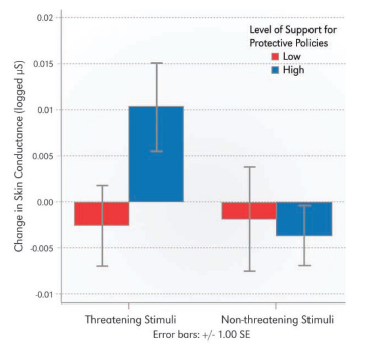
    Nicholas Kristof describes the analogous results in the sex-disgust paper this way:

    Liberals released only slightly more moisture in reaction to disgusting images than to photos of fruit. But conservatives’ glands went into overdrive.

    “Overdrive” is a bit of a stretch, I think — for comparison, here’s a table from Rosalind Picard and Jennifer Healey, “Affective Wearables“, ISWC97, showing SCL changes for five subjects as a result of some simple activities such as standing up or coughing:
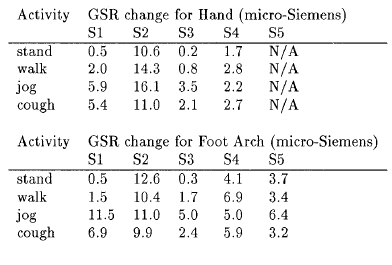
    The difference in means between Oxley et al.’s “high” and “low” protective-policies groups is about .0125 log μS. Assuming that they used natural logs, this difference seems to be about two orders of magnitude less than  the (unlogged) amounts that Picard and Healey measured as the effect of coughing — log(2.4) = 0.88; log(9.9) = 2.29.  (This seems like such a preposterous difference that I wonder whether I’ve got something seriously wrong here — but in any case, I hereby register some skepticism about the “going into overdrive” description…)

    Without making any cross-study assumptions, we can evaluate the effect size in Oxley et al.’s results. From the graph reproduced above, you can see that the difference between the mean (SCL response to threatening pictures) of the “high” and “low” protective-policies groups is about .0125 log μS, with a standard error of about .005 log μS. Given that there were 23 subjects in each category, this translates to a standard deviation of about .005*sqrt(23) ≅ .024 log μS, so that the effect size is about d = .0125/.024 ≅ 0.52.

    Though statistically significant, this is only a moderate-sized effect — the associated overlap between the two distributions can be represented graphically this way (assuming normal distributions with equal variances):
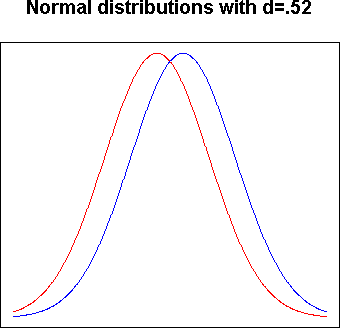
    We can quantify this difference in intuitive terms by calculating how often a randomly-selected person from the “high support for protective policies” group would have a greater average skin-conductance change, on viewing threatening pictures, than a randomly-selected person from the “low support for protective policies” group would: about 64% of the time.

    We can also compare another effect from the same study, namely amount of education. This factor is presumably a matter of “individuals’ experiences” rather than biology — but contrary to what (Kristof’s description of) this line of research might lead to you to think, its predictive effect in this experiments was as large as or larger than the effect of the “biological” variables.

    As a result of fitting this regression equation

    they derived the following coefficients:
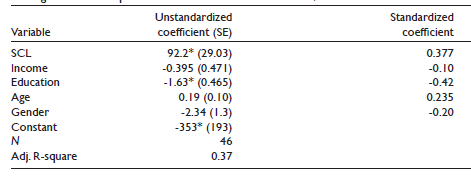
    The coefficient of -1.63 for the six-level Education scale means that someone in the “College-Plus” categories was predicted to be  5*1.63 = 8.15 (out of 18) points lower on the “protective policies” scale than someone with a high school education (other things in the regression being equal).

    What about the magnitude of the skin-conductance effect? Well, the coefficient is 92.2, which means that the more a subject’s SCL reacted to threatening images, the higher their “protective policies” attitude scale was. But recall that the average SCL measurement for the high-protective group was about 0.01, and the average SCL measurement for the low-protective group was around -0.0025 (these measures are log μ-Siemens, so a negative value just means that the conductance measurement was below 1). So the predicted average effect is around 0.01*92.2= 0.922 for the high-protective group, and -0.0025*92.2 = -0.2305 for the “low-protective” group, or an overall mean difference of about 1.15  (out of 18) between the groups attributable to the skin-conductance differences.

    In the Supplementary Online Material, we learn the the overall standard deviation of their SCL data was 0.022 log μ-Siemens. So to equal the predicted effect of 8.15 political-attitude points between high-school and college-plus, we’d need an SCR difference of 8.15/(92.2*0.022) = 4.02 standard deviations.

    We can draw a similar conclusion by comparing the standardized regression coefficients of 0.377 for SCL and -0.42 for education.

    So the SCL “effect size”  was modest, not only in the sense that the difference in means between two politically-defined groups was only about half of the within-group standard deviation, but also in the sense that it appears to have somewhat less predictive leverage than educational level does.

    The same comparisons for eye-blink amplitudes lead to similar conclusions.  The easiest way to see this is by comparing the standardized regression coefficients for Mean (eye-blink) amplitudes (0.286) and Education (-0.458):
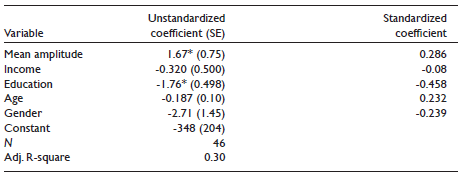
    For this model, the predicted effect of the span from highschool to college-plus is 5*-1.76 = -8.8 political-attitude units,  and (since the SOM gives  the standard deviation of eye-blink amplitude as 0.93) we’d need 8.8/(0.93*1.67) = 5.7 standard deviations of change in eye-blink amplitude to have the same effect as the educational span.

    All of this suggests that the “biological” factors of SCL and eye-blink amplitude are somewhat less potent, in this experiment, than the “social” factor of educational level. But it seems to me that in this case, the “biological” factors might turn out to be partly “social” factors after all.

    Why? Well, it’s likely that political opinion in Lincoln divides to some extent along town-gown lines. It’s also plausible that town-gown uneasiness is not unknown in Lincoln, and that a non-academic with conservative opinions, coming into a University laboratory to get wired up with electrodes for a study of political opinions, might have a somewhat higher overall anxiety level than university faculty, students or staff would. This could be true independent of educational level — my own experience is that non-academic lawyers and doctors, for example, often seem a bit uneasy around academics. (And vice versa, but in this case it’s the academics who are wielding the electrodes.)

    Furthermore, people who are more on edge, in an unfamiliar environment that they perceive as potentially hostile or at least potentially embarrassing, are likely to show greater autonomic reactions to negative stimuli. (In a crude analogy, suspenseful music and unsettling camera angles tend to make you jump higher when the cinematic equivalent of “threatening images” appear.)

    An argument of this form suggests that (at least some fraction of) the (already modest) statistical effect of the physiological variables on political opinion might not reflect individual “dispositions” at all (whether innate or acquired), but rather might be the result of greater social distance (from the experimental setting) for a significant fraction of the people at one end of the political spectrum being tested.

    Despite my skeptical comments, it seems to me that this work is interesting and worthwhile. It’s entirely plausible that political attitudes are associated with “dispositional temperaments”, and it’s also plausible that “dispositional temperaments” owe something to nature as well as nurture. But it seems to me that it’s exactly when theories are plausible that we should be most scrupulous in examining the evidence: as Dick Hamming used to say, “Beware of finding what you’re looking for”.