Author: Methuselah

  • Running – is it Paleo / Primal?

    I’ve just posted an article on Train Now Live Later about running that may interest Pay Now Live Later readers.

    There’s Running, and there’s Running

    In the article I review a couple of great books that have inspired me to consider distance running, when done a certain way, to be very much part of a Paleo / Primal lifestyle.

    I also question how much attention we should pay to the studies that suggest running is damaging to our health, given the myriad forms it can take and the tendency of these studies to focus on one particularly extreme type.

  • Intermittent Binging – Could it be Good for You?

    Set aside, if you can, the fact that my own intermittent binging invariably involves excessive alcohol and the consumption of vile (yet divine) cakes whose ingredients list requires a PHD in Chemistry for any meaningful interpretation.

    Instead, focus on the pattern of calorie consumption it creates. My hypothesis is that intermittently consuming a lot of food might actually be good for you under certain circumstances.

    When I binge, I eat a large number of calories over one weekend, then spend the next 4-6 weeks eating fewer calories than I need on a day to day basis. I do this consciously because I want to maintain my body composition – but no doubt it’s made easier by increased leptin levels from the extra fat stored, and by the beneficial effect on appetite control of the Paleo/Primal food I eat during the recovery phase.

    In the ‘wild’ I might have experienced 4-6 weeks of calorie deficit simply because each day I spent a little more energy finding food than the food gave back. Then, just occasionally, I would find a tree laden with fruit, or a stash of honey. Perhaps around the same time an especially large animal was killed. Knowing that both the fruit and the meat might not last beyond a couple of days my family and I would eat as much of it as possible.

    The main difference between this and my modern binges is the type of food: in the wild I would have eaten healthy food and less of it. My modern junk fests are driven to unnatural levels of calorie consumption by ingredients specially engineered to stimulate the senses into gross over-consumption.

    So on the one hand we have these larger cycles of calorie fluctuation, perhaps spanning weeks, and involving occasional feasts followed by a slow, semi-instinctive reduction in daily calories; but on the other, we have our friend, intermittent fasting. This is the ‘inner’ cycle of calorie consumption – eat well for a couple of days, then fast.

    Perhaps in the wild, food would be totally absent for a day or two because the group is moving camp or there are a couple of failed hunts. In my modern equivalent, I choose to fast until dinner time on one or two days per week. On days between fasts, I eat slightly more than I would if I never fasted. However, my total weekly consumption would typically be slightly less than I need, because I am between binges.

    People who practise CR (calories restriction) do so because they believe being in calorie deficit creates favourable conditions in the body, allowing it to be healthier and better protect itself against disease; and there is some evidence to support this. The trouble is, as anyone who’s seen documentaries on the subject will know, many CR enthusiasts appear distinctly emaciated and spend most of their time hungry.

    Yet there is evidence that intermittent fasting, by periodically creating a profound calorie deficit, can provide the same benefits to longevity, without requiring a net calorie reduction. For example, by going without food for 24 hours a couple of times a week and you can spend the rest of the time eating as much as your overall activity levels dictate you need. You don’t need to be hungry all the time – just sometimes; and you won’t look like an escapee from a prison camp.

    So calorie deficit can apparently work in more than one way – a large deficit over short periods, or a slight deficit over long periods. By combining intermittent fasting with intermittent binging, I might spend more time in some kind of deficit than with intermittent fasting alone. This raises the following questions:

    1. Does my combined approach provide any additional benefits?
    2. Does the fact that my binges are based on junk food sabotage any benefits anyway?

    I, and everyone who expressed solidarity in the comments of my last binge confession, have to believe the answer to the second question would be yes. As soon as you start finding excuses to intermittently binge, they surely will become less intermittent. Fortunately, binges carry with them their own disincentive to excessive frequency – how awful they make you feel.

    So the real question to consider is whether intermittent feasting – what we might have done in the wild – is worth consciously combining with intermittent fasting, and if so whether it might reduce binging frequency.

  • The Anatomy of a Binge – and Why I Need to Get Ill

    I once again I have thrown myself to the bottom of the health ladder and am currently clawing my way back from non-Paleo, through pseudo Paleo towards proper Paleo.

    Last weekend, it was my friend’s birthday party. We live in society in which celebration is inextricably bound to food and alcohol. The significance of the former is usually signified by the volume of the latter. Accordingly, the itinerary for this party saw the revellers hitting a cocktail bar valiantly early, after which, a few hours later, a restaurant. Then, one of our friends hosted the rest of the night at his house, where the breathtakingly well-stocked drinks cabinet was seemingly incapable of depletion.

    The night was a reminder of how social triggers usually precipitate my binges, and how alcohol seems to play a physiological as well as a psychological role; as well as the drunken state eroding will power at the time, the hangover later creates sugar and salt cravings.

    Yet the following day it was evening before I was able to muster the energy and stomach space for food. Great – a 24 hour fast, I hear you say; but if my last meal the day before was eaten at midnight, and I continued to drink calorie-crammed alcohol through most of the early hours of the next morning, I suspect I don’t qualify for much praise.

    Thus, at 8pm, a rag bag trio of casualties (Mrs M, a fellow party-goer and me) summoned the strength of will to attend our local Chinese restaurant – what better way to satiate those hangover urges than with that heady mix of salty and sweet of food.

    Before the weekend, I had resolved to eat healthily the night after the party. As we traipsed up the road to Wong’s, I inwardly chuckled at my naivety.

    After half a bottle of wine, a crispy duck and a plate of chicken and cashew nuts, I was ready to put the final nail in the coffin. On the way home, as we rolled past the local supermarket, I dodged in to grab a couple of slices of cheesecake. Back at home, these were quickly devoured and I stumbled into bed soon afterwards, where no doubt this grotesque cocktail of poisons slowly fermented in my outraged gut.

    The next day started well. Loosely following my three-day binge recovery plan, I planned to eat low carb, mostly Paleo, but not worry about volume. I would ease my way out of the binge mentality with Paleo treats. I took a couple of fat-laden free-range pork chops out of the freezer, laying the groundwork for a tasty Paleo evening meal.

    For breakfast, in spite of not being sure whether I was genuinely hungry, I feasted on coconut cream, fruit, nuts and cocoa powder:

    But by lunch, I’d been gripped by the need to indulge. Nut butter, my normal, pseudo Paleo crutch, was somehow not offering what I needed, so I bought a block of cheese, rationalising that
    at least it’s low carb and, according to some, the least bad dairy option.

    I also bought some smoked mackerel fillets.

    Thus, my lunch, eaten semi-hungry, was this:

    Make no mistake – this was a lot of food. I could probably have comfortably survived until dinner the next day on this alone; but a couple of hours later I found myself being offered chocolate cake by my friend whose birthday we had celebrated at the weekend. It had to be finished, after all. Two slices later, all hope of having an appetite for the pork chops was gone.

    Yet emotionally I was already locked into the pork chops. With Mrs M away that week, dinner in front of the TV was to be the highlight of the evening.

    And so, in spite of a complete lack of hunger, I later devoured both pork chops, along with broccoli drowned in melted cheese:

    It had been important to finish the cheese so I could eat clean the next day. This is, of course, nonsense – I could have wrapped the cheese up and simply not eaten it the following day. I then finished off with some chocolate eggs Mrs M had left lying around; I had already eaten chocolate cake earlier, so it ‘made no difference.’

    I’ve already messed up today anyway

    and

    So that I can make a clean start tomorrow

    … are two of the most frequently used rationalisations in our house.

    The following day, I fasted until lunch, when I was meeting birthday boy. Today was going to be 100% Paleo. From the menu, I selected a half roast chicken; but I forgot to ask them to hold the fries and instead of changing my order, rather slyly convinced myself I would leave the fries on the side of the plate.

    When the food arrived, at first I did indeed avoid the fries; but when my friend offered me a breaded onion ring, I obeyed. Then I dipped a piece of chicken into his sour cream dip. I was clearly daring myself to have another day of eating garbage – and before long I’d decimated my fries, half of his fries and a fistful of those frightful sauce sachets, ranging from ketchup to mayonnaise.

    From the pub we proceeded directly to the cake shop, where we bought one fruit tartlet each. Mine was gone in seconds. I could have eaten another without blinking, but already birthday boy was balking.

    “You’re not even in the same league, are you?” said I, by now resigned to another day of dietary self-destruction.

    Back in the cake shop, I acquired a blackberry and apple turnover…

    … and finally, some chocolates to finish:

    That evening I ate homemade soup. Even I have my limits, and no amount of rationalisation would have convinced me to shovel any more crap on top of the mound of filth now festering in my intestines.

    For the rest of the week I was pretty good, though I still hadn’t yet got my moderation mojo back. I was eating Paleo meals that were too big then binging on nuts.

    Finally, on Friday, I pulled a perfect Paleo day out of the bag. These were the highlights:

    9 minutes intense interval training
    – 60 seconds of very cold shower
    – Fasted all day until dinner
    – Drank only water and herbal tea
    Organic chicken with roasted vegetables for evening meal

    Then, last night, just as I was about to escape the orbit of planet binge – engine trouble. One too many wines, and I lost the plot. The primary rationalisations this time were

    well I haven’t really recovered from the last binge, so layering another day on top will make little difference

    I can start afresh next week

    I think the photos speak for themselves.

    I have become finely tuned to the effects of eating bad food, so had no trouble connecting the post-binge puffy eyes, lack of alertness, uncomfortable guts and morning grogginess with the non-Paleo lapses of the last 18 months; but apparently these consequences are not enough to deter me.

    That’s why I need to get ill. I think this would put me off – or at least reduce the frequency.

    Since the start of last year, I have not had so much as a cold. Is it the vitamin D supplementation? Or perhaps the post-binge super-Paleo days like Friday? Maybe it’s the Paleo eating I do the rest of the time. Maybe all of them. Whatever the reason, it seems too easy. I need to be taught a lesson.

  • Doctors and their Good Intentions: The Blood Test Fiasco Continues

    “I suggest you stop taking vitamin D.”

    Such was the well-intentioned advice of my consultant haematologist recently. He was concerned about my kidney function.

    It all started when I turned up for my regular blood test about an hour after a savage workout in the gym. These tests are to monitor a condition called ‘aplastic anaemia’. My view is that there is nothing wrong with me – but that’s another story.

    On the day of the blood test, my haematologist was upbeat. For several years I’ve had very stable blood counts, albeit that they are at the ‘lower end of normal’. Not low enough to require action, not high enough for me to be left alone. Hence, I’ve been on the blood test merry-go-round since about 2004.

    This time I took a photo of the blood being taken:
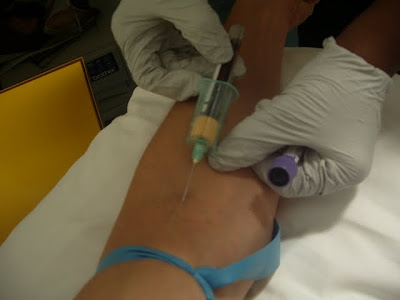

    Every 6 months, this is is the conversation:

    “How are you feeling?”
    “Fine”
    “No symptoms?”
    “No.”
    “Okay, see you in 6 months.”

    I have always been deeply suspicious of these ‘normal’ ranges, given the things ‘normal’ people do, diet and exercise-wise. Yet all kinds of changes have taken place in my life since 2004, not least turning Paleo and starting vitamin D supplementation. I have even deliberately eaten wheat to see whether that would change the numbers. Yet they have scarcely changed. Until now.

    My suspicion is that some people simply have lower blood counts that others, yet function fine. I think low counts can be caused by many factors – and depending on the cause, health may or may not be affected.

    This time, two of the key numbers had rocketed. The white cell count had gone from 3.0 to 7.7 and the neutrophil count from 1.3 to 6.7. The other numbers had not really changed.
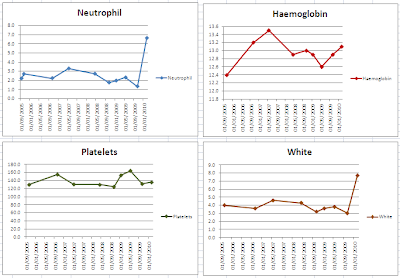
    As far as the consultant was concerned, this was great news. He even wondered whether they had mixed up my sample with someone else, before quickly waving the idea away with his hand in case I thought he was being serious.

    Should I be pleased? I am not sure – forgive me if I don’t start arranging a party. After all, I feel just as healthy as I always have and, no, I do not have any symptoms. Whilst I accept it’s possible to feel fine but not be well, one has to assume some significance from 6 unbroken years of feeling fine, during which the sum total of my illness has been two, short, mild colds.

    If anything, I ought to worried. It will not be possible to untangle the multiple and no doubt interdependent factors behind my blood counts – but surely common sense should raise alarm bells when there are changes to a system that aint broke.

    Have I pummelled my body into having normal counts by my too-frequent forays into a ‘normal’ lifestyle? A look at the flagged points and associated posts on my body composition graph are enough to give you an idea of what I’ve been up to since the start of 2009.

    On the other hand, perhaps there really was a problem, and either the vitamin D, the Paleo diet or both have helped cure it – but it just took a year or more for the benefits to filter through to the blood counts.

    We will never know.

    Three days later, I got a call from my haematologist. He wanted to talk about creatinine. I had forgotten they were even testing my creatinine levels. The creatinine tests take a few days to come through, which was why he had not mentioned them on the day.

    Creatinine is one of the by products of muscle activity. Since the kidneys are responsible for removing the creatinine from the blood, high levels are taken as a sign of poor kidney function. Of course it rather depends on how long the kidneys have had to do their job. If you’ve recently generated a lot of creatinine then even a fine pair of kidneys may not have got rid of it all when the test is done.

    “I can probably clear this up straight away”, I told him.

    Pleased with myself for having worked hard enough at the gym to affect a blood test, I recounted my activities with relish.

    “Yes I suppose that could have had some effect”, he conceded.

    I was also pleased with myself for knowing also that vitamin D toxicity can effect kidney function, so I mentioned my daily winter dose of 4000 IU, swelling even further with pride at my savvy decision to supplement.

    This, on reflection, was a bad idea. First, because I was expecting a member of the medical profession to be impressed by my decision to supplement something which based on official guidelines, I do not need to. Second, because I was bringing into the discussion something about which I probably know more than he does.

    Was I prepared to explain the research that had convinced me that the official healthy range is wrong? Would I try to convince him of the credentials of the organisation I get the test kit from? He’s a nice guy, but he’d have to be a lot nicer to let some upstart armchair pseudo-medic tell him what’s what.

    When he had finished politely listening, he suggested the following:

    1. Stop taking vitamin D
    2. Avoid intense exercise for a few days before my next blood test
    3. A visit to the kidney specialist

    A week later, I found myself once again amongst the unwell, as I sat in the ultrasound department waiting to have my kidney function checked. I had mixed feelings about this. On the one hand, I applauded his caution and was glad to be the subject of such careful scrutiny. I can see why people develop Münchausen syndrome.

    On the other hand, the evident poor health of the people who invariably surround me when I am waiting for these tests leaves me with an abiding sense of misplaced attention.
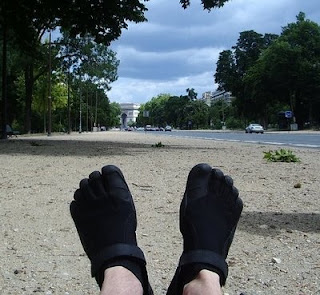
    While the ultra scan doctor glided her device around my gel-lubed abdomen and I dutifully breathed in and out when bidden, I noticed the nurse at the end of the bed eying my Vibram Five Fingers curiously.

    “What are they?!” she half asked, half laughed.

    “Vibram Five Fingers,” I said. They allow you to go barefoot without being barefoot.”

    She pondered this information, then appeared to come to a conclusion. “Very cool,” she declared. End of conversation.

    When the scan was over, the expected news was delivered. “Your kidneys are working fine.”

    Nevertheless, procedure dictates that I must pay a separate visit to the kidney specialist, with whom I will discuss this and the creatinine readings. By then it will be less than a month before my next regular blood test. The merry-go-round continues.

    In case you were wondering, I will not stop taking vitamin D. I will, however, avoid intense exercise on the morning of the next blood test.

    ————-

    Meanwhile, elsewhere, the medical establishment was potentially threatening the vitamin D levels of someone else.

    One of my relatives was recently prescribed drugs to treat high blood pressure. Not particularly high, you understand – but high enough, in the opinion of the doctor, to merit treatment.

    A few weeks later, she noticed her asthma was a little worse than usual, but paid no attention. By chance, she later came across information on the Internet suggesting the drug she was taking could cause coughing symptoms.

    Back at the doctor’s, she was told this is a common symptom of the drug she was taking, and she was duly put on different drug instead. Two things bugged me about this. First, that she was not warned about the potential side effect. Should thing like that be left up to the patient to notice? Second, what are the potential side-effects of the new drug? And could there be side effects that don’t make themselves known so conspicuously?

    So I did a little digging of my own. The new drug is what’s called a calcium blocker. This family of drugs acts by blocking the calcium channels, which apparently has a blood pressure-lowering effect. But guess what? It also affects the ability of the body to produce vitamin D. The fact that calcium blockers are said to have ‘interactions’ with vitamin D, means doctors may recommend against vitamin D supplementation for people taking them.

    Ironically, my relative has reduced the vitamin D dose she takes based on the information I drew her attention to, not on the advice the doctor, who is not aware of the vitamin D.

    I have not read enough about this to be sure – but instinctively I am not comfortable. If calcium blockers inhibit the body’s production of vitamin D then presumably sunlight becomes a less potent source and so more, not less supplementation is needed in our sun-starved UK climate. If any readers have knowledge in this area, your thoughts would be appreciated.

    I don’t wish to paint an unduly bleak picture, nor to denigrate the efforts or intentions of doctors. I know one or two personally and they are amongst the most genuinely caring people I know.

    One of them sent me an article recently, featured on the front page of a prominent medical publication, covering the potential importance of vitamin D. So things are changing. I just hope they change quickly enough so that my relative and others I care about can avoid being sucked into the downward vortex of prescription drugs.

    See Also:

    My Yellow Skin Mystery
    My Wheat Experiment
    My Wheat Experiment Blood Test Update
    My Vitamin D Defficiency
    How I Got My Vitamin D into the Sweet Spot

  • Primal Weekend at Lake Vyrnwry

    In case you are wondering, this is pronounced ‘Lake Vern-ree‘, or at least that’s close enough to avoid being laughed at by the locals.

    The Welsh don’t go in for easy-to-pronounce names, a fact comically illustrated by the spectacle of Mrs M trying to read out the names of villages as she navigated from the road atlas during the journey.

    For anyone looking for a superb weekend holiday destination in Wales, they could do a lot worse than this. There are links in the main article.

    The highlights of the weekend were:

    1. A gonad achingly cold wild swim, lasting all of 30 seconds.
    2. Some primal/paleo meals, interspersed with a fast – not easy when Mrs M is making liberal use of room service under your nose.
    3. A long, slow run (or persistent hunt) around the lake, starting pre-dawn and covering forest, hills and road.

    I’ve posted a full write up of the swim, run and meals, with photos on Train Now Live Later.

  • Battling the Coffee Demon

    I’ve always been good at stopping things others appear hopelessly addicted to.

    In 1996 I gave up smoking with scarcely a glance back; and when I became interested in nutrition about 8 years ago, I systematically removed foods from my diet with ruthless, almost mechanical ease. Sugar, salt, cereal, tomato ketchup, cheese – I just kept going until everything bad was eliminated from my diet. It didn’t matter how much I enjoyed them – I just stopped eating them.

    My friends regarded me with amused suspicion. Was this guy human?

    At some point during by diet clampdown, caffeine came under the hammer. I think at one stage I went at least 2 years without any caffeine from any source. I drank a lot of herbal tea.

    So it came as quite a surprise in the last two months when I developed a caffeine problem I seemed unable to kick.

    Regular readers will know that I tend to binge (for example.) I am pretty strict most of the time, but occasionally lapse in spectacular style. Granted, the gaps between binges last year were rather close together, but even at 6 weeks apart, I like to think the net health outcome was better than the steady drip-drip of a moderately unhealthy life.

    It started at Christmas, during one of my ‘lapses’. I’d had coffee before during lapses, but for some reason, this time was different – this time I came to truly appreciate the ritual of making real coffee, its taste, sharing it with others and filling the house with that rich aroma.

    Back at work in the New Year, a colleague offered to buy me a coffee. Christmas binge over, I should have said no – but I didn’t. As it happened, it was a particularly strong coffee, so bam – I was wired. I got more stuff done in three hours than ever before; and it felt great.

    A few days later, I discovered how easy fasting can be with the help of coffee. A strategic cup at 11am more or less obliterated the appetite for the bulk of a 24-hour fast; it also gave me something to look forward to during the first few hours of the day when the long day ahead without food seemed a little daunting.

    For a while I alternate-day fasted with ease, when normally I would struggle after a few days.
    I started to enjoy the coffee-drinking rituals I’d established with my colleague, and the caffeine-fuelled meetings at which we’d seemingly cover way more ground than normal. When I felt tired at work, either because of a particularly savage gym session or because I had not slept well, I would have a coffee. Brilliant! I must have upped my productivity by 25%.

    You get the picture.

    It didn’t take long for the honeymoon to end. First, I quickly re-learned the 12pm rule – drink much coffee after that and my sleep was affected. I would sometimes drink two cups instead of one, and the energy and focus would metamorphose into a fidgety anxiety which, paradoxically, affected my concentration.

    My response to coffee began to vary and it became a lottery how I would feel. If I drank coffee every day, the caffeine hit diminished so that even throwing back a large one didn’t have the same effect. Sometimes I’d get the nervous adrenaline and mild muscular tension but none of the benefits. Once or twice I found myself thinking “I wish I’d skipped that coffee. I just want to feel normal.”

    The fasting benefit also diminished. The coffee still helped, but not as much. Hunger started to slice through the superficial caffeine lift, reminding me that I was fasting more often than is normally comfortable.

    Curious to understand what I was doing to myself, I read this article on Fitness Spotlight. Apparently, caffeine stimulates our adrenal glands. It manufactures a physiological stress response. Done regularly, that cannot possibly be good. Everything I read told me it was a bad idea to drink coffee every day. So I decided to stop.

    Four weeks later, I was still on the merry-go-round. Several times, I had given up for a few days, then re-started. I’d invented rules, re-written rules, made and broken promises to myself and explored just about every self-motivation approach I knew; but it hadn’t worked. My weaving, dodging and self-deceptive chicanery had inexplicably sabotaged my normally iron resolve.

    First, I rationalised that I should moderate rather than give up, clinging onto the idea that I would be able to simply have coffee occasionally. “I’ll treat myself to a coffee on a Friday” and “I’ll only have coffee on fasting days” were two of my favourites.

    Ever present was the phrase “Life’s too short”, an irritating mantra that had been plaguing me since last year, regularly whispered in my ear by that the little horned fella at all the wrong moments. This single, corrosive idea led to defeat after defeat in these inner skirmishes, and I would find myself once again over-caffeinated mid-afternoon, less than 24 hours after I’d sworn blind I’d never drink another cup.

    Then, a couple of days ago, something suddenly when “pop”. I’d had a terrible night’s sleep and was fasting. I’d also done some sprints in the morning, which as the day progressed added to my fatigue. Everything cried out for a double espresso.

    The night before I had decided that enough was enough. Nothing unusual about that – I’d given up coffee at least a dozen times already, so no reason to think it would work this time. Except that on this day, when I went through the all my usual rationalisations, excuses, rule re-inventions and psychological self-trickery, none of them seemed to work.

    The fact was, I’d got sick of bitching to myself about it. I’d worn myself down. The message had finally got through.

    There were particular buttons I’d been pushing which I think had the most powerful effect. I had been saying to myself:

    1. This is what makes you who you are – you can just top things,” – so failure threatened to strike at the very heart of my identity
    2. You don’t have a right to get what you want all the time” – something patronising I often say to other people so it resonates strongly when directed at myself: I don’t like being a hypocrite
    3. Hyping up your system on a daily basis like this is chipping away at your health,” – this threatened to sabotage the supposed health advantage of my ‘strict then binge’ approach.

    Finally – I started writing this blog post. Let’s face it, I will look like a tool if I trumpet my success then mess it up.

  • A Hymn to the Lifestyle: Part 2 – Pseudo Paleo

    In part 1, Paleo at its Best I waxed lyrical about the joys of being 100% tuned into the Paleo lifestyle.

    A couple of years ago I went for months on end without a single lapse; but last year, thanks in no small part to a seemingly endless procession of celebrations that demanded full immersion, I fell off the wagon often enough to understand the profound differences between Paleo at it’s best and ‘Pseudo Paleo’.

    Not Breaking the Emotional Food Ties

    For me, Pseudo Paleo is characterised by a failure to emotionally let go of non-Paleo foods. This recent article on PāNu makes the point well. Kurt talks about the culinary alchemy with which we try to approximate non-Paleo foods using ingredients which, taken in isolation are each technically Paleo.

    A good example is my recipe for Paleo/Primal chocolate, posted last summer. It seems highly unlikely our ancestors had the time, materials or inclination to process, assemble and create the ingredients for those chocolates – especially since they could spend a fraction of the time preparing just as tasty (in a different way) at a fraction of the energy cost. Survival is, after all, about the trade-off between the energy required to acquire and prepare food and the energy it provides.

    I have no evidence that these pretend Paleo foods are less healthy in any tangible or immediate way; but what they do to me is much more insidious – they maintain the emotional ties with the non-Paleo equivalents. I may be eating chocolate made from concentrated coconut cream, cocoa powder and dried blueberry, but I am thinking about real chocolate.

    Junk Food Stand-Ins and Impostors

    As I mentioned in Paleo at its Best, when I am truly Paleo, I genuinely relish eating nothing but meat, vegetables, eggs, fish, nuts and seeds. The powerful emotional associations formed in childhood (I talk more about that here) fade away and I am utterly content with the joys of real food. That joy takes weeks to develop and is sabotaged when I instead seek pleasure from junk-food stand-ins and Paleo impostors.

    Dodgy Digestion

    In fact, concentrated versions of technically Paleo foods are my main weakness. When I am in Pseudo Paleo mode, I keep jars of tahini, and nut butter in the house, along with bags of almond powder and dessicated coconut. I routinely plunder these stores after a meal, eating large spoons full at a time and returning several times. My nut binges, too, take on a new dimension, ending only when the reality of my stomach’s disquiet becomes clear, after which I invariably spend the night in mild gastric discomfort.

    Hunger Control

    Hunger control is a crucial part of being truly Paleo for me. Low-carb eating and especially Paleo eating give you a better chance of responding to your appetite the way nature intended… but in my experience, Pseudo Paleo foods inflame the appetite in a way that truly Paleo foods do not.

    Admittedly Pseudo Paleo foods do not inflame the appetite as badly as real junk food – but they inflame it nevertheless. When I am in Pseudo Paleo mode, I cannot let go of the idea that each meal is an opportunity to guzzle until I am more than satisfied. True Paleo meals don’t lend themselves to gluttony – overeating meat and vegetables feels counter intuitive. Overeating nut butter is supernaturally hard to avoid.

    In pseudo mode, I seek smoked fish and salted meats; supermarket-sold pre-cooked chicken with its perplexing additives are something I become fixated with. I find that foods laced with these flavour enhancers, despite technically adhering to the low-carb and broad Paleo ethos, play havoc with my appetite.

    Fasting Debt

    In Pseudo Paleo mode my fasting works in reverse. I am always playing calorie catch up. I skip meals because I gorged on half a jar of tahini the night before, not because it feels like my body would benefit from a fast and I would like to emulate the experience and benefits of temporary food shortage.

    I feel like one of those guys who always owes money. Instead of earning my meals with activity and fasting, I am paying for them with interest by skipping planned meals and going for unnecessary walks around the block.

    Taking the Easy Way Out

    Finally, I take the easy way out more often than I feel I should.

    Instead of following through with a planned, savage, painful workout, I may move it to another day. Perhaps I had a bad night’s sleep or decide my body needs a rest. Clearly there is a line to be drawn between what is sensible in a stressful modern life, and the need to buckle down and take the pain so that at other times you appreciate the easy life. In Pseudo mode, I stray too far from that line into easy street.

    Then there’s the coffee fasting. A 24-hour fast is a cinch when you load up on caffeine – at least that’s the effect it has on me. Part of the value of the fast is to experience the hunger. I see coffee as cheating and find the evening reward is diminished when in Pseudo mode I resort to it.

    And finally, cold showering, that paragon of the discomfort model – of how exposure to fleetingly uncomfortable stimuli can help you cope more easily with the milder discomforts of day-to-day life. In Pseudo mode I find reasons to shorten the cold section at the end of my shower, or avoid it altogether. I lose the resolve and the appreciation of the payback.

    Identity?

    In my case there are factors at play relating to identity, pride and control. Everyone, I am sure, is different. It’s possible that some of the elation and well being I talk about in Paleo at its Best are diminished in Pseudo Mode partly for psychological reasons. It’s in my nature to be ‘all or nothing’ and I love to evangelise. No doubt these are important to my identity and my state of mind plays a part in my perception of overall health.

    But enough psychobabble. The fact is that most of the time I am not in Pseudo Paleo mode – and just now I am at the right side of a good 6-week run. Bit too much coffee, but otherwise good.

    You Decide

    The joys I talked about in Paleo at its Best are not easily earned – last year all it took was one week out of every six in Pseudo mode to strip away much of the buzz. The only way to find out whether Paleo at its Best is worth the extra effort for you is to put in the work required to get there, then decide for yourself.

    A Hymn to the Lifestyle – Part 1: Paleo at its Best

  • The Overpowering Stench of the Pharmaceutical Industry

    Many corporations, lobbyists and establishments favour the pursuit of money over the health of human beings. I don’t often write about it because it’s too depressing – but I got a little out of my system in the first Nutshell video and last year’s article about HFCS.

    I listened to a radio programme on the BBC last week which so effectively exposes the cynical, grasping, manipulative mentality of the pharmaceutical industry, I just had to share it.

    Fellow bloggers regularly expose the same issues, but somehow, hearing such a long and detailed exposé from an institution like the BBC, with candid testimonies from former employees, really brought it home. You can read the accompanying news story on the BBC website, or listen to the whole, one-hour program if you have time:

  • A Hymn to the Lifestyle: Part 1 – Paleo at its Best

    Lately I’ve realised how much difference to how I feel the level of Paleo adherence makes.

    I always knew others chose their own interpretation, but until I’d experienced it myself, the implications were not clear.

    From 2007 until early 2009 I was, with the exception of one or two spectacular lapses, pretty much 100%. Last year, things went a little awry.

    To some extend inspired by Dr Dan’s recent fightback on At Darwin’s Table, I thought I’d tell you what I’ve learned. In part 1: Paleo at its Best.

    At its best, it can be transformational. When I am 100% dialled into the Paleo/Primal lifestyle, there are days when I feel fantastic.

    Mentally, I am alert and able to think clearly – some of my most inspired and productive moments at work have come on days like this.

    My digestion feels brand new – it’s as if I’ve outsourced digestion to someone else, such is the low profile kept by my innards. Intestinal wind seems like a distant teenage memory, like acne or warts. When the need for ablution comes, it does so expectedly, regularly and takes place with such effortless routine that I feel like calling a friend to celebrate.

    I feel fit. Not just in a raw, VO2 max sort of way, but in a rounded way. My exercise sessions are brutal, but brief and functional – mainly bodyweight, sprints and swimming – things that feel like they have a purpose. I find myself semi-consciously tailoring the frequency, variety and setting to match a vague notion of the kind of environment I was built to exist in. This is not romanticism, you understand – simply an objective analysis of the most appropriate way to behave if I want to be in tune with my genes.

    My joints, muscles and tendons are free from significant stiffness and feel ready to take on a range of demands. When I’m walking to work I look out for tree branches to briefly swing from or steps to jump up to or down from. I almost clutch at the ground with my Vibram Five Fingers, seeking uneven areas on which to relish the stimulus and gain extra traction with the toes.

    Elsewhere, the sense of power over my environment is heightened by uncomfortable experiences I happily put myself through. I quickly learn that to feel truly comfortable in my environment I need to experience some hardship. I start my showers cold, moving to hot water only after 30 seconds, then finishing with another 30 seconds of cold at the end. Sometimes I have an opportunity to swim in the wild, where the more extreme cold makes the shower seem like a breeze; it’s no fun…. but it is fun, because when it’s over, I feel more alive than ever.

    Hunger, satiation and my body’s hormonal balances seem to be in perfect harmony. Again semi-consciously, I regulate my eating to reflect the imagined availability of food to a hunter gatherer.

    I eat more on workout days, because it feels instinctively right. I go into sessions a little hungry and emerge with the righteous appetite of the successful hunter. I spend more time hungry than not. This feels right. I earn my food. I eat slowly, savouring every mouthful.

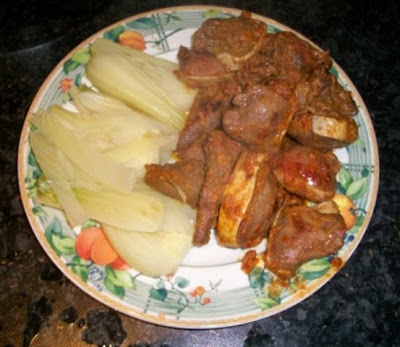
    There’s nothing on my mind but the Paleo fundamentals. Animal and vegetable. I fall asleep thinking about roast chicken and daydream about slow-cooked tongue with steamed vegetables.

    My mindset is so fundamentally Paleo that overeating is scarcely an issue… and my hunger is so in tune with my requirements that even when I do have a hearty meal, I skip the next one without thinking about it. Once, twice or even three times a week I throw in a 24 hour fast, dealing with the mild hunger with total control – not a cross word in sight. I look forward to dinner, yet do not crave it.

    I feel lean, I look lean. I box in front of the mirror. I look stupid, but I feel great.

    I get tired early when it’s dark, and in the morning I wake up early. My mind is alive with ideas. Sometimes I don’t get enough sleep and feel tired – but one day in three I sleep like a log.

    I imagine this is how I was meant to sleep. I console myself that whilst modern man may have the luxury of being out like a light for 8 hours, maybe sleeping light, alert for danger, is the truly Paleo way. I learn to function happily on the bad days after poor sleep because I know that on the good days I will be stalking the modern landscape like a panther.

    Zzzzzzzzt!…sound of needle scratching off record.

    If only this were the reality. Yes, I have achieved Paleo at its best for months at a time; but I have also, especially recently, spent months at a different level. The irony, of course, is that the knowledge of what could be sullies what is. Many would kill to feel as good as I do at the moment; but having felt so much better, I am not impressed. It’s not that I don’t do everything I described above. I just don’t do them all at the same time…

    A Hymn to the Lifestyle: Part 2 – Pseudo Paleo

  • Paleo/Primal by Numbers: Email Template for Friends & Family

    Last year a lady I work with asked me about Paleo/Primal as an approach to weight loss. So I gave her the elevator pitch. Well okay, in fact I pinned her down and talked until she developed ‘the glaze’, then later sent links to various articles, blogs and, of course, the Nutshell video.

    A couple of weeks later, she confessed that she’d not read the information. She’d been very busy.

    But the truth was, she didn’t really want that much detail. Not everyone wants to know why – they just want to know how.

    So I agreed to send her an email telling her what to do and skipping the science and anthropology lecture. When I’d finished, it occurred to me that many of you probably find yourselves in the same position with friends and relatives.

    So here it is – the Paleo/Primal Friends and Family Email Template – copy it, customise it and send it. I hope it saves you some time.

    ——————————

    Dear [name]

    As discussed, here is a one-pager which I hope will get you started on Paleo/Primal without daunting you with too much science and history. If you decide to give it a go and have any questions once you get started, just drop me a line.

    All the best,
    [me]

    —————————–

    Summary
    You will be shifting from a high-carb diet, which includes processed foods and sugar, to a low-carb, possibly higher protein, definitely higher fat diet which excludes starchy carbohydrate and sugar.

    This will seem counter-intuitive because of the fat makes you fat and causes heart disease dogma which is, take my word for it, a load of crap (I have more info on that if you want it.) This may sound like ‘fake moon landings’ conspiracy theory, but you’ll just have to trust me.

    You can shift about 2 lbs a week by sticking to this way of eating. Bear in mind that the first week may see a greater weight loss if your current diet contains more salt.

    What to Eat
    Meat, seafood, eggs, vegetables, salad, fruit (but not too much), nuts, seeds.

    What not to eat
    Bread, rice, pasta, potato, cereal, wheat, dairy, beans, any processed food, sugar.

    The Fat Question
    Fat is healthy – even saturated fat. The one type of fat to avoid is vegetable fat. This means margarine, vegetable cooking oils and processed foods that contain vegetable oil. In addition, whilst eating the fat from free-range animals is healthy, eating animal fats from industrially farmed animals is not as healthy. Avoid the latter if you can.

    How Much Protein?
    Just follow your nose on this one – eat as much meat/fish/eggs as feels natural, but if you are not normally much of a meat-eater you will need to make an effort to eat more. Most people have been conditioned to eat less meat that they should by the regular appearance of brown starchy crap alongside, which displaces those calories.

    The Subtleties
    If you have to eat dairy, stick to cheese – it’s low carb. Choose free-range meat, non-farmed fish and organic eggs. If I told you what I know about farming processes you’d never eat factory animals again anyway.

    Ham is not meat, nor are most of the ghastly packets of sliced stuff peddled by supermarkets.

    Don’t guzzle fruit juice. Ideally ditch it. Likewise dried fruit – it’s just proxy sugar.

    Drink booze as little as possible, but feel free to have a few glasses of wine when you fancy it. Clearly booze is calories and probably carbs too unless you are on the neat vodka, so just bear in mind that more booze generally affects progress with the weight loss. Don’t get rubbered or you will head for the cakes and blow the lot in one night. Take it from me.

    Food Ideas and Cooking Suggestions
    It’s quite hard to eat enough fat at first. Here are some excellent sources: extra virgin olive oil, nuts, coconut, avocado, animal fat (don’t cut the fat off free-range meat – it’s good for you!)

    Coconut is incredibly healthy. Use coconut oil for cooking instead of vegetable oils. Buy coconut cream/milk in tins and creamed coconut in a block/sachet. Great for cooking as a cream substitute.

    Look out for nut butters. Not that you’ll be needing it for bread – I cook with it or put it on the side of the plate with meals; or just eat it by the spoonful as a treat. Mmmm!

    In the evening just cook like you would normally cook, but skip the starchy brown stuff. Do more veggies, more meat and eat the fat. Try using extra virgin olive oil generously on your veggies if your meat or fish is lean.

    Pudding – fruit/nuts with coconut cream.
    Lunch pots for work – tinned fish and salad with avocado. Boiled eggs in salad. Leftovers from the night before, like cold chicken.
    Breakfast – scrambled eggs, omelet, fruit, nuts etc. Not cereal – it’s the devil’s work.
    Snacks – nuts and seeds are a great way to fill the gap when you are still hungry after a meal or need a snack.

    Isn’t this Like the Atkins Diet?
    Yes, insofar as it’s a low carbohydrate diet. But Atkins did not care so much what you ate: he just restricted the amount of carbohydrate you could eat. Some people abused this and ate nothing but clotted cream, bacon and one slice of white bread per day, so Atkins got a bad reputation.

    Paleo/Primal ensures not only low carb but that the food is consistent with what hunter gatherers ate, which, funnily enough, is nutritionally excellent and what our bodies were designed for.

    How Does it Work?
    First of all, carbohydrate is not so good at satisfying your appetite and usually causes blood sugar to rise and fall in a short space of time.

    Fat and protein, on the other hand, are good at satisfying your appetite. So you naturally eat fewer calories without needing to go hungry all the time.

    In addition, there are two other important effects of eating low carb: it inhibits your body’s fat storing mechanisms and promotes your body’s fat burning mechanisms – which funnily enough usually leads to a reduction in body fat!

    Exercise
    Exercise is not necessary for the weight loss, but can contribute to success – and of course is good for you!

    But don’t do lots of cardio. It simply increases your appetite and makes you crave carbs. Daily, grinding cardio was never something we were built for, and in any case if you are trying Paleo/Primal over just a few weeks then it will definitely sabotage your efforts in an unadjusted body and may affect your energy levels.

    By ‘unadjusted’, I mean this: when you eat low carb for 6-8 weeks, your body’s energy systems re-align to use fat as an energy source; so once you get to that point, doing occasional longer cardio sessions is fine.

    To start with, however, short, intense, interval-based exercise is the best companion to the program. For example, 15–30 minutes of weight training, or any activity where you exert maximum effort for short bursts, then rest in between (cycling, sprinting, swimming, circuit training.)

    Less is more. Your metabolism works for you through the rest of the day. If you work hard enough, 10 mins is all you need. Ideally, no more that 2-3 times a week.

    Finally…
    Don’t obsess about whether you are getting enough of this or enough of that. Just avoid, the bad, focus on the good and it should take care of itself. You instinctively know when you are overeating, so try not do do it too often.

    Take solace in the fact that you are doing yourself a lot of good in the process – this is a very healthy way to live: the weight loss is an incidental by-product.

    —————————–

  • Live (ish) Graph of My Body Composition

    I’ve been tinkering with this for a few months and decided today it’s ready to publish.

    Click on the image, here, or on the link in the right sidebar to go to the chart.

    The data is kept online in a Google spreadsheet and streamed directly into the chart image. So when I update online, the chart updates. There are also embedded notes and links to take you to related posts or Twitter entries.

    Feedback welcome – does it work okay on your browser? Does the format make sense? Anything else you’d like it to do?

  • Making the Most of Animals: Part 3 – Beautiful Bones

    [Click on the small pictures in the main story to see larger images]

    In part 1 I talked about the value of offal and in part 2 about the value of fat.

    In both cases these often discarded treasures are much healthier from animals that have lived a happy life; and although organic, free-range meat costs more, eating rather than discarding these parts can compensate for the additional expense.

    In part 3, I am going to tell you about the value of bones. There are three opportunities: making soup from leftover bones, eating what’s inside the bones (marrow) and eating the bones themselves.

    Soup

    This applies to smaller animals that can be roasted in the oven. Theoretically I suppose it applies to any animal but since we lack the facilities to spit roast entire hogs, I have no experience with using bigger carcasses in this way. For us, it applies to duck, chicken, rabbit and other poultry such as pheasant or partridge.

    At the end of the meal, even the most determined carnivore cannot strip the bones of every morsel of goodness. Believe me I have tried – Mrs M sometimes finds me hunched over the dessicated remains of a roast chicken, mouth and lips surrounded by meat and grease, speculatively gnawing in search of some overlooked morsel of meat.

    Here’s what we do. After we’ve used all the easily available meat, we take what’s left – usually a collection of bones or a semi-dismantled carcass – and cook it for several hours. I also include the leftover bones from our plates. This may seem unhygienic given we have been chewing on our respective bones – but they are going to be blitzed for hours, so it really isn’t.

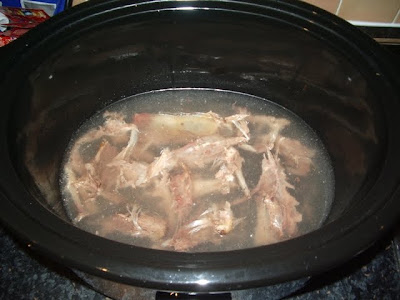
    We break up into smaller parts any pieces that can be, then put them into the slow cooker. The idea is to add just enough water so that the pieces are covered and will remain covered as the water evaporates. We find an extra inch of water is usually enough when we cook overnight.

    You can also simmer the pieces in a pan on the stove – but Mrs M was always nervous about leaving a pan on the stove overnight so using this approach we rarely cooked the bones for more than a few hours before bed. This is not really long enough to fully loosen the meat and (as we will see later) soften the bones. With the slow cooker it is easier to set the heat low enough to make overnight cooking appropriate; and it allays Mrs M’s fears because slow cookers are self-contained and designed to be left in this way.

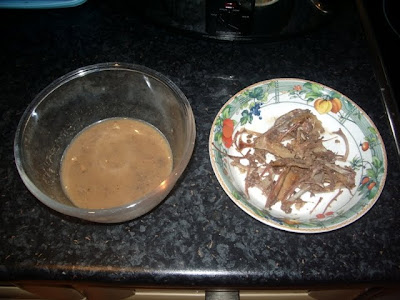
    To make the soup you could simply sieve the hot liquid and make the soup from that – but you’d lose a lot of the good stuff, in my view. Instead, we first let the contents of the pan cool. Then I methodically remove the bones and gristle with my hands, ensuring we get all the little pieces of meat not already separated by stirring. This can be fiddly, but ultimately it’s rewarding. You usually get a few crunchy bits and pieces in the last two spoonfuls of soup, but that’s okay.

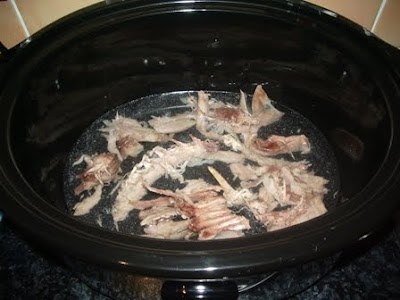
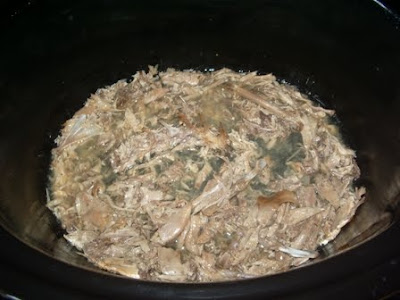
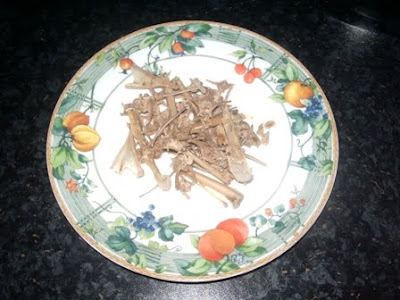
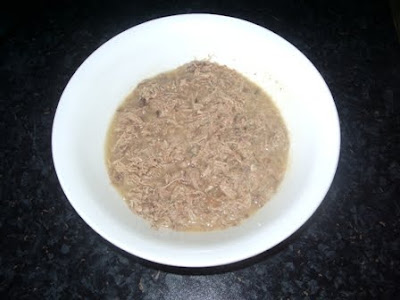
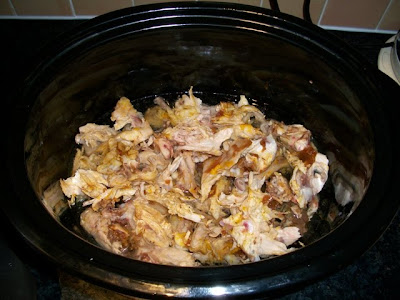
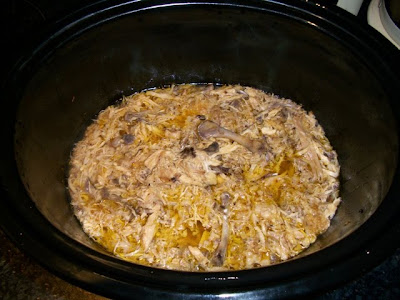
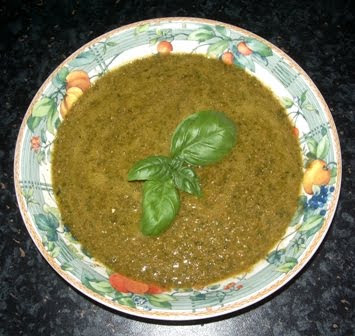
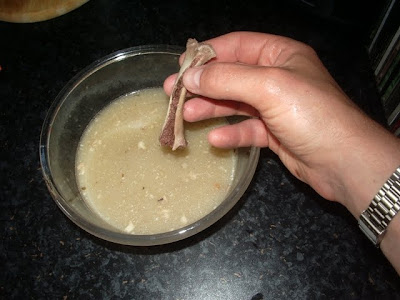
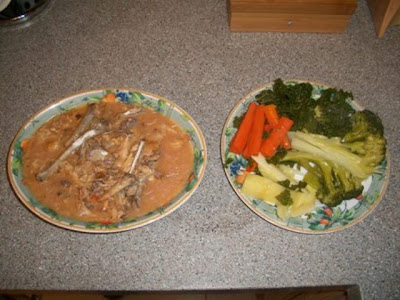
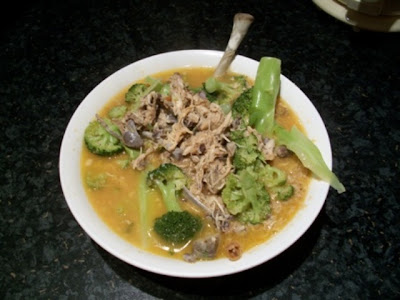
    Here are some photos taken when we made soup from rabbit bones. This was the cooked rabbit: . After the meal, these were the bits left to slow cook , and this was the result after several hours of slow cooking with some stirring to separate the meat from the bones: . These were the bones I picked out and this was what was left . Finally, after some additional ingredients, the soup: . This is how those ingredients are added:

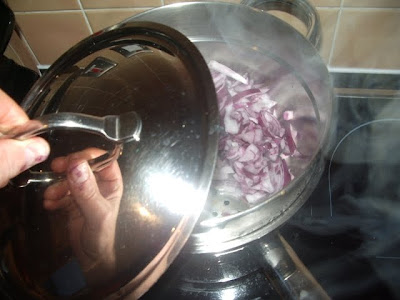
    First, I steam some vegetables. Typically this is celery, onion, mushroom, carrot, parsnip or a combination. Once softened, they are added and blended into the mixture. As well as adding flavour, the vegetables thicken the soup – this is particularly important since thin soups are somehow not satisfying, yet the normal thickening agents like corn flour are not on the menu.

    Next I add one or more of the following:

    • Coconut water (if I’ve just opened one)
    • Coconut cream (from a tin)
    • Unsalted tomato puree (we almost always add at least some – it’s a good salt substitute)
    • Lime/lemon/orange juice (squeezed from the fresh fruit)

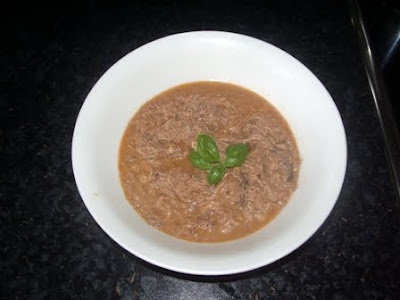
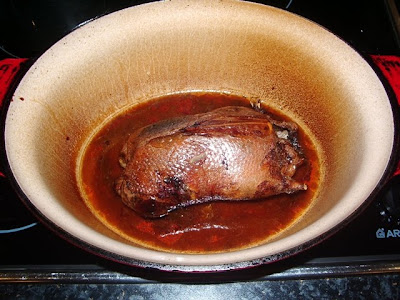
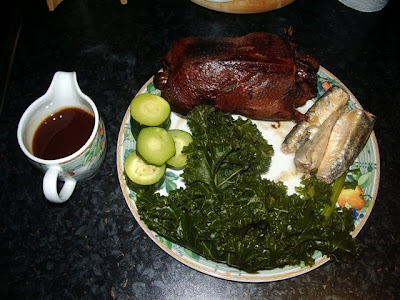
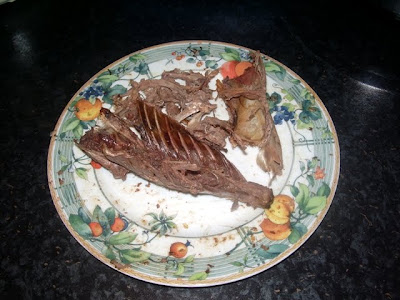
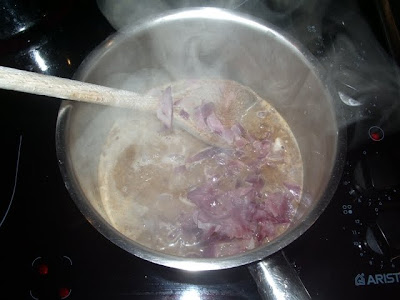
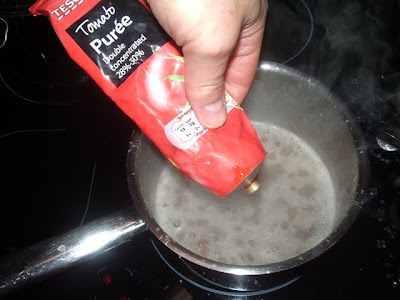
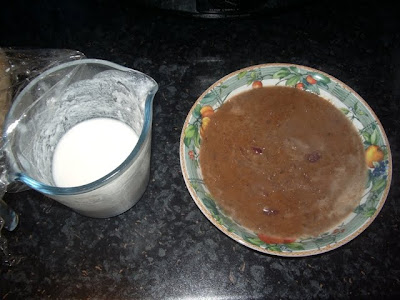
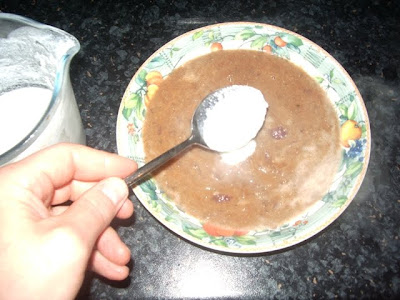
    You can see some of this in action with these photos from a wild duck we ate last year. This was the duck after roasting and this was the meal it made . This was the leftover carcass and these are were broken up pieces in the slow cooker . After slow cooking and manual bone removal, these were the separate components: . The contents of the bowl went into a pan and while that heated up an onion was chopped, steamed and added . This was blended and some tomato puree added . In this case, I added the coconut cream cold , threw on a basil leaf, and it was ready to serve: .

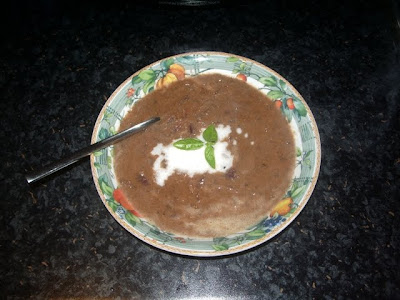
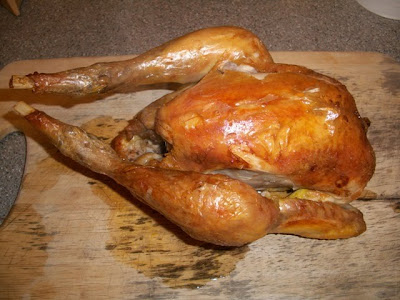
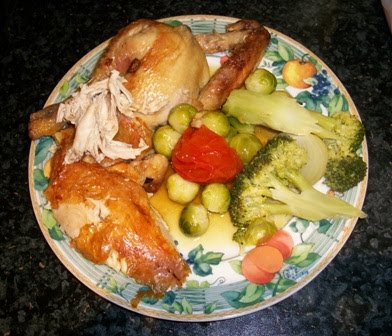
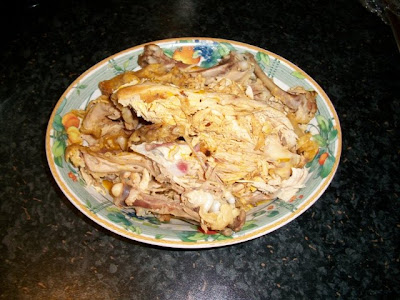
    When we roasted a chicken last year , creating this fine meal , there was this leftover carcass which went into the slow cooker like this , came out like this , and ended up making a couple of bowls of this: . I think we actually used spinach in that case.

    It’s usually me who makes these soups, and as I often remind you, I’m no chef. So the choice of ingredients is usually fairly arbitrary and simplistic. I know duck and orange go together, chicken and mushroom is a familiar combo so these usually get paired. Often it depends on what we have in the fridge at the time.

    The strange thing is that Mrs M always likes the result. Maybe we are easy to please, and obviously our palates are pretty sensitive when we are eating strictly Paleo; but I am convinced that tomato puree and coconut cream, in the right proportions, are a great, simple base for this kind of soup.

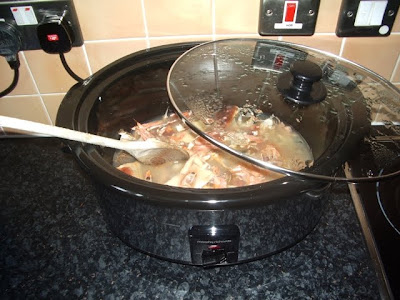
    Finally, let’s not forget our old friend, crab soup. Last year I ate a lot of fresh crabs, making soup from the leftover shell pieces. Here is a photo of the pieces in the slow cooker: . The fiddly step where you take out the bits from the slow cooked mixture is especially fiddly for crab shell; but crab soup with bits of crab meat included is much nicer than crab soup without, so again, it’s worth the effort.

    Eat the Marrow

    I have read that bone marrow was prized by hunter gatherers, is high in fat and protein and is extremely good for you. However, I have not been able to unearth any of the links… so please add anything you have to the comments.

    Either way, it’s also very tasty, and often gets overlooked. I have only eaten bone marrow from two sources. First, from lamb leg bones – usually this can be accessed by using a thin fork handle to poke inside the bone, followed by a lot of undignified sucking and banging.

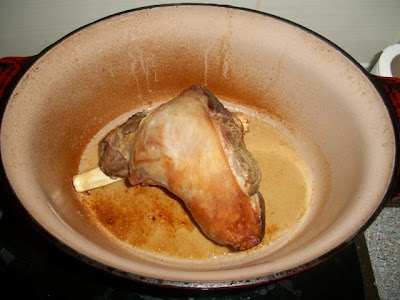
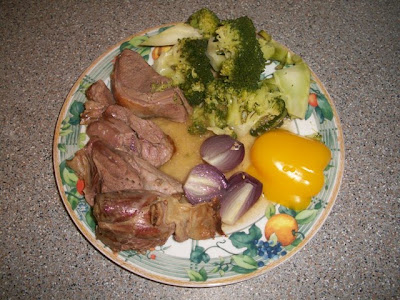
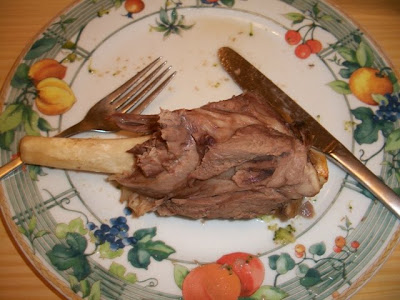
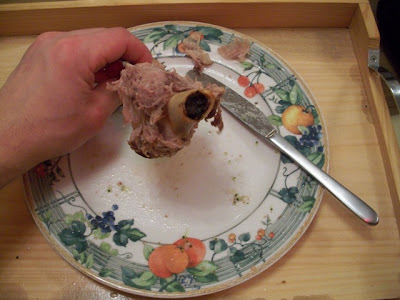
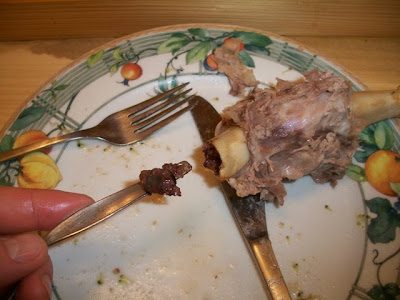
    Here are some photos taken last night. We roasted this leg of lamb to make this meal , after which I set about the bone to eat any remaining meat . You can see the marrow in this shot , then here how I managed to scoop it out with the handle of a spoon. I then spend a while sucking and banging the other end, from which eventually I managed to get the rest of the marrow out.

    Definitely not one for the restaurant; but worth the effort when you’re at home.

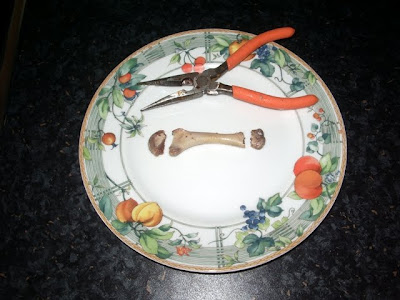
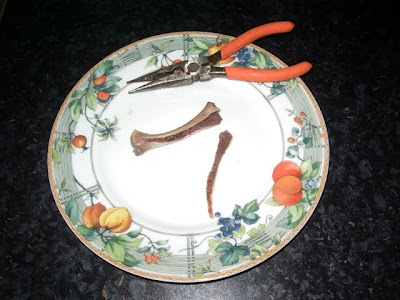
    Second, from chicken leg bones. Having boiled chicken bones to make soup and separated the bone out , I once wondered whether I could increase the nutritional value of the soup by breaking open the bones and squeezing out the marrow into the soup mixture. This I did with the help of some pliers . It was quite an effort.

    Later, I realised this was not necessary because instead I could simply…

    …Eat the Bones

    The arrival of the slow cooker meant we were cooking the bones for 8 hours or more. I noticed that when I was removing bits of meat from the bones with my hands, the bones would sometimes crumble. So I tried eating one – and lo, it was good. The texture was crumbly – rather like the bones in tinned salmon or sardines. It felt fine to eat them.
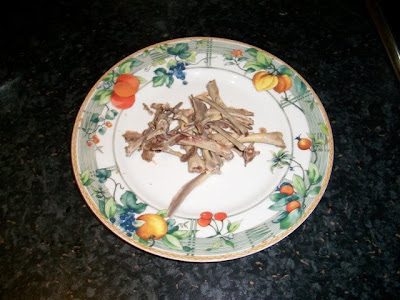
    Here are a couple of fine, recent meals I made of complete slow-cooked chicken carcasses . There was nothing left at the end. The middle parts of the larger bones were a little harder to chew, but this only applied to one or two.

    I’ve only ever eaten chicken bones. It may be equally possible with the other animals we roast but I’ve not tried yet.

    Anyway, you won’t be surprised to learn this is a step too far for Mrs M. However, recently I introduced bones to her diet by stealth, by making…

    …Soup and Bones Together

    When the bones are this soft, you can throw them into the blender. The result is a soup that requires no thickening. With the standard coconut cream and tomato puree base it makes pretty good eating. Depending on your tolerance for crunchy bits, you may wish to do more blending than me. I was happy with a 60-second blast but Mrs M was driven to return hers to the blender for a further three 60-second blasts and was still not entirely happy.

    Feathers?

    I am convinced feathers are coming into fashion any day now. I just need to convince my boss and my social circle of this, then I can truly make the most of poultry 😉

    See Also:
    Making the Most of Animals: Part 1 – Wonderful Offal
    Making the Most of Animals: Part 2 – Glorious Fat

  • How Five Fingers Turned Me into a Transvestite

    It’s cold in the UK at the moment. Brass monkey weather.

    Walking though the city recently, I was aware of a gaping hole in my insulation. Whilst my feet were kept warm by snugly-fitting Vibram Five Finger Treks and my legs by fleece-lined trousers, in between there was nothing. A whistling gale sliced across my ankles like a razor.

    I was passing a ladies’ accessories shop, when it struck me.

    Have you got any leg warmers? I enquired within.

    Over here, pointed the young lady assistant, coming out from behind the desk in spite of the I-don’t-want-help vibes I thought I was giving.

    Before us lay an array of multi-coloured Cindy Lauper-esque leg warmers.

    She, ahem, wants them in plain black, I said.

    The girl removed a pair from the display. We’ve only the fishnets in plain black, she said.

    I looked doubtful, but she grinned encouragingly. Go on – girls like a bit of kinky!

    Okay, I said weakly. My deception had left me unable to reason convincingly.

    Later, under the scrutiny of my compadrés, I was naturally subject to ridicule. You’re gay, was the sing-song verdict of one. Another emailed this YouTube link.

    Ridicule I can tolerate, but cold ankles I simply won’t stand for.

  • Making the Most of Animals: Part 2 – Glorious Fat

    In part 1 I talked about the importance of eating the meat from animals that have been well treated. Quite apart from any ethical consideration, the fact is it’s better for you.

    I also mentioned the cost benefits of including offal in your carnivorous repertoire – first, because bought separately it’s very cheap, and second because if you bought the whole animal in the first place, you are getting more food for your money.

    The same arguments apply to another part of the animal people routinely squander – the fat.

    For example, when you buy a lamb chop, very often there is a fairly thick rind of fat on it. This probably contains more calories than the meat (as most of you know, fat has 9 cals/g whereas carbs and protein has 4) – but how healthy that fat is depends very much on how the animal was reared.

    Quality Matters

    As I wrote in part 1, it’s not wise to compromise to eat the fat from industrially farmed animals: they are fed with food like corn and wheat, and kept in unnatural conditions, as a result of which their fat contains more omega 6 and less omega 3 than wild or free-range animals. Eating the fat from such meat is probably not very good for you, though ironically this is not for the reasons the sat-fat-heart brigade claim.

    Some Photos of My Fatty Meals

    Pork scratchings

    Chicken skin

    Lamb fat

    Duck skin

    They key point: fat from free range, organic, or pastured animals is actually good for you.

    Eating the Fat Makes the Meat Cheap

    Another irony lies in people’s tendency to avoid buying organic, pastured or free-range meat because of the cost. Very often these same people can be seen scraping the fatty offcuts into the bin after a meal or carefully separating the skin from a duck or chicken leg.

    The point is that if they bought high quality food, and therefore were able to eat all of the serving, they would need less to be satisfied because of the additional calories from the fat – and it would taste nicer too.

    When Mrs M and I buy a small organic chicken, it makes up to four meals. There are all kinds of fatty parts to the animal, many of which become crispy if cooked properly. Personally, I am happy to guzzle the fatty parts whether crispy or not, so I can be satisfied by a much less meat than I would otherwise need.

    A £10 organic bird therefore means £2.50 per meal. If we bought a crappy, industrially farmed bird for £5 we’d have no choice to but to avoid the fat, so the cost would be the same because we’d only get two meals out of it.

    As an aside, I do appreciate some people may be getting their meals for £1.25 because they eat all of the chicken, in spite of the conditions it was raised in, and that for some this is the only way they can afford to live.

    Conditioned Avoidance

    We have been conditioned to cut the fat off our meat.

    The diet-heart hypothesis – the idea that eating saturated fat leads to heart disease – is so thoroughly entrenched in the psyche of most people that there is an instinctive urge to avoid conspicuous animal fat.

    I won’t bore you with the science here, but regular readers of the blogs in my blog roll will know this is a notion that’s being quietly and systematically demolished by authors, commentators and researchers, leaving an ever-dwindling group of establishment die-hards holding aloft a tattered flag.

    Even Mrs M, now a fully paid up Paleo queen, cuts the fat off meat when it’s not crispy or when there is what she perceives to be ‘just too much of it.’ As for my Mum and Dad, who themselves have been Paleo for some time, it took them quite a while to get used to the idea that fat is good.

    The Power of Indoctrination

    What gets me is that nobody wants to leave the crispy skin from a chicken breast. I don’t know many people who’d pass up a pork scratching (albeit accompanied by ooh, I shouldn’t) and the crispy fat from a lamb or beef steak is surely divine.

    Yet the same people who seem unable to exercise the willpower necessary to stop eating sugar, cakes or chocolate, appear suddenly to have this iron resolve when it comes to animal fat. As I recall, I was just the same some years ago. I guess this is testament to the power of indoctrination. No one wants to die. You die of heart attacks. We are told fat gives you a heart attack. I don’t remember anyone ever saying that about sugar, albeit that it may turn out to be true.

    Paleo Subtleties

    It would be remiss of me not to mention that there are differing opinions among advocates of Paleo/Primal eating about how much animal fat we should eat. Some say that wild animals are relatively lean and that our liking for fat was naturally regulated when we were evolving by its relative scarcity. Others say we should freely consume it.

    I just wing it. For me, variety is the watchword. On some days I eat white fish or offal, which contain relatively little fat anyway – on these days I get most of my fat from olive or coconut oil. On days when I do eat fatty animals I eat the fat freely.

    In part 3 – soups and bones. Yes I said bones – you can eat them. Really.

    See Also:
    Making the Most of Animals: Part 1 – Wonderful Offal
    Making the Most of Animals: Part 3 – Beautiful Bones

  • The Three-Day Binge Recovery Plan

    What I am about to tell you might be utter nonsense. My sole qualifications are that in recent months I have done a lot of binging and recovering. I certainly don’t advocate this, and I’m usually quite annoyed with myself when it happens; but given it does, one must be prepared.

    The 3-day plan places structure and context around what I think are important principles, but I suggest you tailor your own strategy based on those principles, rather than assume the three-day timeline has any special meaning.

    Less Illness?

    Before I describe the plan, I will say this: my theory is that this approach makes illness less likely because it coaxes the body back to full strength rather than frog-marching it there. Being an obsessive, I have in the past worn the hair shirt on days following bad behaviour. In the past, a few binges close together have caused illness. This year, an unprecedented number of consecutive binges have not yielded illness. Anecdotal, but for me, powerful.

    Day 0: The Binge

    You drink too much alcohol. You probably also eat too much, some or all of which is junk – sugary food, salty food, and processed food – all the things you would normally avoid. The following day, recovery must start.

    Day 1: Healthy Food and Fresh air

    1. Eat healthy food: but don’t go hungry; eat as much as you need to satisfy. You may be worrying about all the excess calories you ate/drank the day before. Forget it – there will be an opportunity to compensate on days 2 and 3. Perhaps have some healthy treats. Plan to cook your favourite meal .The spectre of comfort eating will loom – if your binge included alcohol, the chances are your salt and sugar balances will be all over the place, so you may want to have more fruit than usual if you are craving sweetness.
    2. Don’t try to fast: this will be a struggle if you have a hangover – better to provide your body with the nutrients it has been deprived of forced to give up in the last 24 hours.
    3. Don’t go to the gym or exercise: it is tempting to go to the gym on day 1 – you will feel so much better afterwards. But resist this temptation – your body is at a low ebb and the risk of illness is probably greater later on if you kick it while it’s down. Feeling good in the short term does not mean it’s the best thing to do. Let your body recover first, then the benefits of the exercise will be most fully realised, and not at the expense of illness risk. ABOVE ALL, do not do some kind of long, hard cardio session – this will definitely knock back your immune system.
    4. Get some air: you won’t get the same buzz as you would from a gym session, but you will feel better nevertheless. A good walk will make you feel better about the night before without hitting your body in any significant way.

    Day 2: Fast

    1. Fast / reduce your food intake. Today, this will be easier. If you already do intermittent fasting, it will come naturally; if you don’t, then just do whatever you can to reduce your calories and give your system a day of rest.
    2. Still don’t go to the gym or do hard exercise! This will be getting tough, but you must continue to resist the temptation. One thing at a time. If you wait one more day then the chances are you won’t suffer a decline in performance as a result of the binge. Plus, if you are fasting or eating less, then the increased appetite from exercise might make it harder, give that you are still not fully ‘in balance’, appetite-wise.

    Day 3: Gym/Exercise

    1. Go to the gym or do some hard exercise: now you are ready. By now most of the garbage has worked its way through your system and you are restored to something approximating the day before your binge. As well as making you feel good afterwards, the stresses you apply during exercise will now also confer their usual benefits in the medium term. Short, interval-based intense exercise is better – but of course this applies at all times, not just post-binge.

    See Also:
    Articles on Fasting, Binging and Appetite

  • Making the Most of Animals: Part 1 – Wonderful Offal

    Offal is not to everyone’s liking; and photographs of it being dissected and prepared are probably to even fewer people’s liking – so if you are squeamish about that sort of thing, you might want to duck out now.

    For me this is not about morality. Treating an animal well and making the most of its body when you kill it is better for your health and better for your wallet, so it’s a compelling case regardless of ethics.

    Since we’re on the topic, though, I would observe the following: our physiology has evolved more slowly than society has developed. Hardly surprising when you contrast the mechanism of natural selection with that of cultural development. Hence, vegetarianism – a perfectly reasonable concept borne of advanced cultural thinking, yet ill-suited to our bodies.

    There is a point of view that a good carnivore at least shows respect for the animals he or she eats by ensuring they are well treated and using as much of the creature as possible. To me this makes sense – but I am not a table-thumping evangelist of animal rights; as I say, for me this is a health and finance no-brainer.

    However, please note: eating every part of a badly fed/treated animal is not a wise compromise. Intensively farmed animals are likely to have an unfavourable fat profile and contain antibiotics.

    My point about cost is this: given that eating well-treated animals is essential to ensure healthy meat, then the cheaper way to do this is by eating all of those animals.

    Free Food

    Mrs M and I have been buying most of our non-wild meat from Fordhall Farm in central England. This is how we ensure the animals have been treated well.

    They run a delivery service, but we prefer to drive over in the summer, when it’s possible to see the animals in the fields or enclosures and witness their freedom first hand. The team who run it have even featured on television, where we learned more about the lengths to which they go to ensure a natural existence for the animals.

    Last year, I asked whether they had any offal for sale, other than the few parcels of liver in the frozen section. No, but we have some to give away, was the response. Why would you give it away, I wanted to know. Because otherwise it gets thrown away.

    Healthy Food

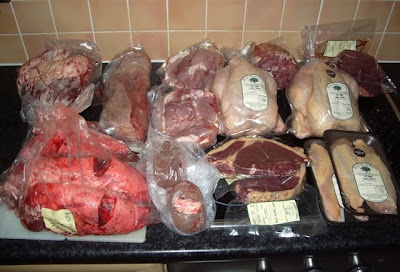
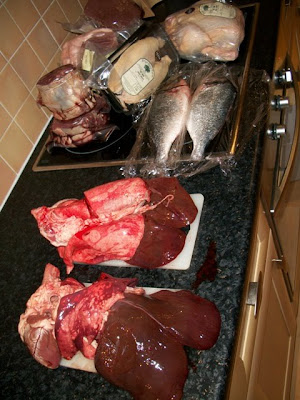
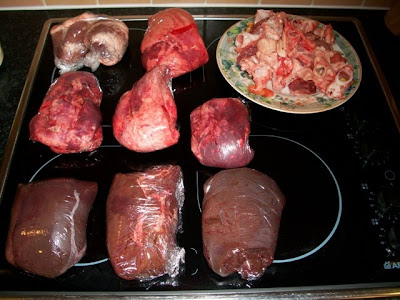
    That day, along with our usual purchases, we returned home with a cow’s heart the size of a soccer ball, two lamb plucks (liver, heart and lungs all still joined together), a cow’s tongue and two pig’s kidneys:

    Chopped up, this made a staggering 16 meals; and I mean man-sized meals. We are talking 300-400 grams of meat per meal. For zero cost.

    What’s more, this is the good stuff. Offal is packed with vitamins, minerals, healthy fats and probably much more besides. Our ancestors would have fought over these parts.

    Squeamish

    The trouble is, people are squeamish about offal. Mrs M is only now taking gentle steps towards eating the stuff. For the last year, I have been eating the offal on days when she is eating with friends or otherwise I make her an omelet or fish instead.

    Part of me wants to shout about offal from the rooftops so that the world wakes up and stops shovelling this amazing food down the drain and can therefore use half as much land to provide the same amount of food. The other part of me wants to keep schtum so that the few of us who like the stuff continue to get it on the cheap.

    Clearly the first part of me has triumphed, because I am writing this post.

    Dealing with Offal

    I’ll show you how I deal with these parts of the animal when I get them home and how best to cook them; but don’t expect recipes: this is about practicalities. I’ll add links to recipe ideas on other blogs at the end.

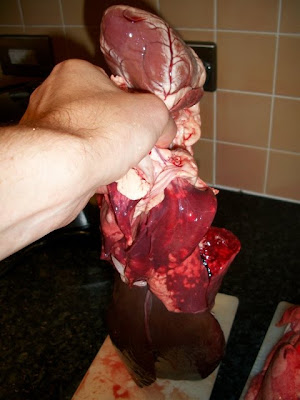
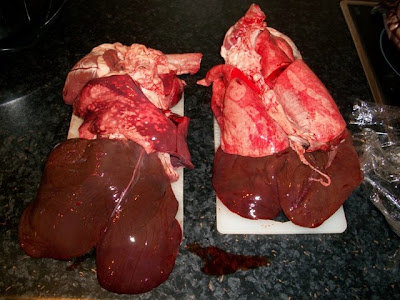
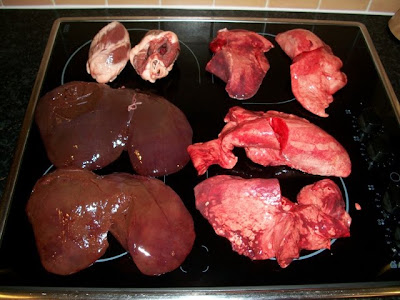
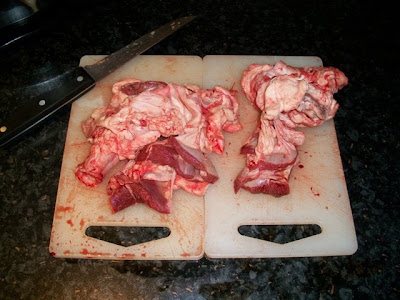
    This weekend, we came home with two lamb plucks as well as our usual haul: . I laid these on a couple of chopping boards, , then separated the liver, heart and lungs into individual pieces by severing then from the main windpipe of the lamb: . What remained was various pieces of fatty, between-organ tissue, bits of muscle and windpipe itself: .

    In total, this lot made nine large meals: .

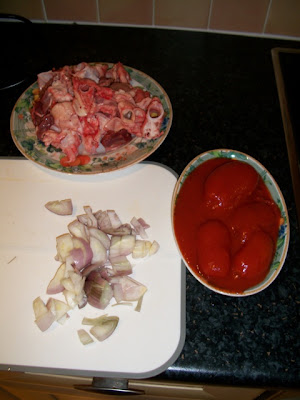
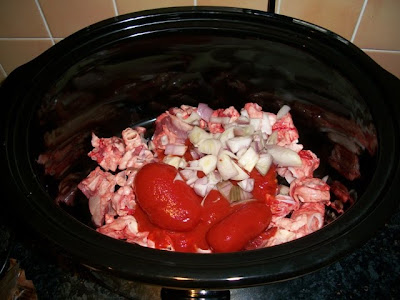
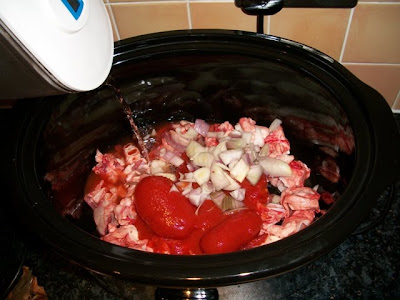
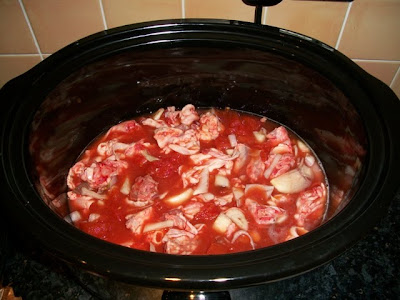
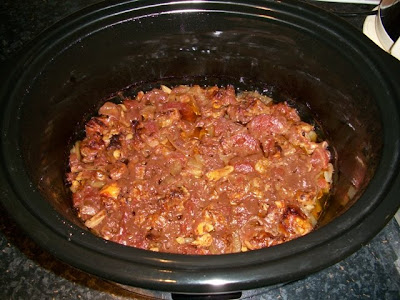
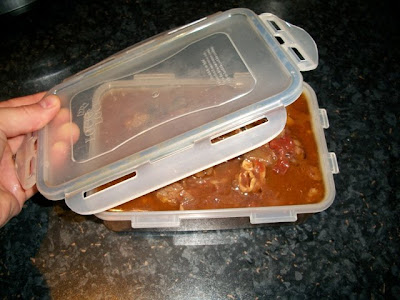
    I took the bits and pieces and slow cooked them with onion, tomato and garlic (I forgot to photograph the garlic): . Five hours later, I put it into a container and into the freezer: .

    Tongue

    This is one of the toughest parts of the animal I have tried. In the early days I sliced it up and stir fried it. It was very tough. In fact I did this again recently because I had not thought ahead. It took be almost 2 hours to chew through the lot: .

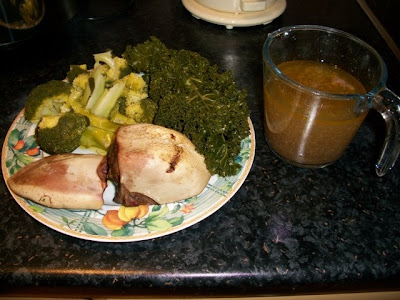
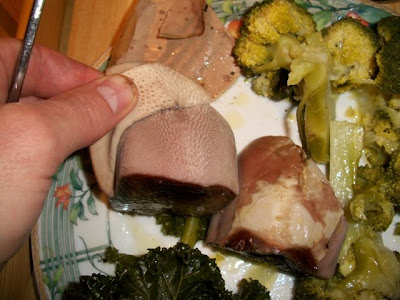
    Braising on low heat heat for up to 2 hours will tenderise the meat more and create a tasty, if thin, gravy…but the smart money is on slow cooking. We bought a slow cooker recently for £30 ($50) and have never looked back. After 5 hours, this piece of tongue was so tender I was able to peel the skin off with my hand: . It was as nice as any fillet steak I have ever had.

    Heart

    I’ve eaten lamb, pig and cow heart. The texture and flavour is rather like a toned down version of liver. Less tender, less piquant. Although you can cook heart by braising or even frying and find it just about tender enough to eat, it does benefit from longer cooking too. Hearts come with a ‘crown’ of fat around the top – this is delicious and it would be a crime to cut this off.

    A cow’s heart usually weighs about 2 kilos, from which I create about 5 portions – here’s one I cut up recently (along with a tongue): .

    This is a meal of one such portion, braised: . You can see the tasty fat ‘bubbles’ on the left of the piece of meat.

    Kidney

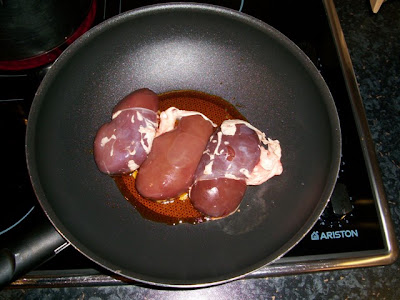
    Kidneys are happy being fried, so this is how I tend to cook them. They can be slightly rubbery, so you may prefer to cook them for longer in casseroles or just by themselves… but I am too lazy for that and in any case they really are reasonably tender when fried. The ammonia smell that sometimes emanates from cooking kidneys is not to everyone’s taste. Here are some pig kidneys I recently made a meal of: .

    Liver

    This one’s easy: just slice it and fry it. The composition of liver is such that it is tender by nature and in fact the only real danger to its palatability is overcooking, which can make it tough.

    Lung

    This is the one organ meat I hesitate to recommend unreservedly. It’s not the taste, but the consistency which is a problem. Not surprisingly given its function, it’s somewhat aerated, and so lacks density, which for me is main appeal of meat.

    I have learned that slicing and frying lung is not the best approach. I have not tried slow cooking yet, but did discover that when I braised the whole piece for 90 minutes, the result had an acceptable tenderness, albeit that it still had that insubstantial, aerated quality.

    Heads, Brains and Others…

    There are some parts of the animal I have not mentioned because we have never tried them.

    Heads: we were once offered a pig’s head at the farm. I wasn’t sure whether we were expected to cook it or put it on the bed of a rival gang member. In the end we said no, mainly because we figured out we did not have a pot big enough to cook it in. Apparently you make something called brawn using pigs’ heads and other parts such as trotters and bones. I am sure the heads of other animals can be cooked in the same way.

    Brains: you occasionally see brains on the menu in expensive restaurants. I have never been offered brains at the farm. It’s a bit of a sensitive issue in the UK after the BSE debacle and perhaps the one thing people are most unsure about eating. That scene from Hannibal doesn’t help.

    Stomach: two dishes I am aware of are tripe, which is made from the stomach of the sheep and haggis, made from the stomachs of cows. I have tried neither, nor have we been offered the stomach of animals at the farm.

    There are, I am sure, many others.

    How to Make Offal Less Unappealing

    Getting used to the idea of eating offal, or persuading someone you cook for to try it can be a challenge. Here are my tips:

    1. Don’t let them see it beforehand (if you are cooking for someone else)
    2. Try to make it look as unlike its original form as possible
    3. Casseroles or stews are a good way to disguise
    4. Use plenty of herbs and spices like garlic – the smell of cooking will win you/them over
    5. Follow a recipe: it will diminish that sense that it’s ‘not right’.
    Recipes

    If you want to see the eating of offal in action, follow me on twitter or keep and eye on the My Meals photo page on this blog. I post photos of my meals on most days, and eat offal about 3 times per week.

    As Mrs M is not yet on board, I revert to plain preparation for offal dishes: at best, I use tomato, onion, garlic, perhaps coconut cream. If I am stir frying I use coconut or red palm oil. The latter is worth exploring because it can add a lovely bacon-like flavour.

    At worst, I simply slow cook it in water.

    For some better recipe ideas, search on Google. There are plenty out there. Mark Sisson has done a couple of good articles on offal and recipes for it:

    Mark’s Daily Apple: Organ meat recipes
    Mark’s Daily Apple: More detailed post about offal (including tripe and brains).

    See Also:
    Making the Most of Animals: Part 2 – Glorious Fat
    Making the Most of Animals: Part 3 – Beautiful Bones

  • Supplements – What I Take and Why

    Many people would like to take a single tablet each day that ensures optimal health. Thus was born the multi-vitamin. But you can’t. It’s not that simple.

    Until recently, my Father required an entire cupboard in the kitchen to house the collection of tablets and potions from which his daily supplementation was administered. My relentless re-education campaign is paying off: we are now down to a single shelf.

    Over the years I went from no supplementation to lots of supplementation then finally to judicious supplementation. I’d like to spare you the effort of making the same journey.

    First of all, a couple of assumptions to make clear.

    1. I eat a Paleo diet (most of the time.) Thus, the nutrient density of my food is high and well proportioned. My meat is mostly wild or organic / grass fed / free range. My fruit and veg is mostly organic. Yes, the nutrient density of modern fruit and vegetables, organic or otherwise, is lower than those our ancestors gathered; and yes, modern life throws at us additional toxins such as pollution. However, I doubt our ancestors had consistent access to the volume of fruits and vegetables we do. I believe this offsets the reduced nutrient content and additional toxin load.
    2. I have no special requirements. I am not pregnant (and barring some kind of unwelcome miracle, never will be) and I am not aware of any congenital deficiencies. My research has been based on my requirements as a normal healthy male.
    What Supplements do I Take?
    Vitamin D

    I have read a lot about this (see the articles in my bookmarks under the vitamin D tag.) There is a growing consensus that it’s a crucial ingredient to our wellbeing, and one whose healthy levels have been underestimated. People mistook average levels for healthy levels. Modern man spends much less time in the sun, so our bodies are not able to make what they need; and since it’s almost impossible to compensate for this via diet, we have a problem only supplementation or regular holidays can solve (unless you are lucky enough to live somewhere sunny.)

    I have written about how I got tested, revealing a significant deficiency, then supplemented to achieve improved levels.

    I buy this product.
    Summer: 3000 iu per day when I do not sunbathe. Zero iu when I do.
    Winter: 4000 iu each day.
    I get tested every 6 months, and adjust supplementation accordingly. I am still learning.

    Priobiotics

    I don’t agree with everything Mark Sisson says about supplementation, but there’s no doubt he knows his stuff, and it’s his views on probiotics in this post which have driven my policy. The key points I have learned are:

    • We need healthy bacteria in our guts.
    • Some things we do in our life kills the friendly bacteria (e.g. antibiotics, illness, stress.)
    • Unlike our forefathers, we are very hygienic. So the friendly bacteria does not tend to get replaced naturally.
    • Once re-introduced, friendly bacteria can grow and flourish by itself.

    Based on this information I take a day’s worth of acidophilus once a month, just to be sure. If I get an upset stomach now and again, or have a couple of days of stress, this will ‘re-seed’ my friendly bacteria culture.

    I buy this product (but not from this shop)
    Once day per month: 36 mg Lactobacilli culture x 4.

    Serrapeptase

    I have my Mother to thank for this one. Several years ago she noted I was taking ibuprofen tablets like smarties. I was playing a lot of sport and constantly had sprains or muscular issues to combat.

    Since then I have learned how bad Non-Steroidal Anti-Inflammatory Drugs (NSAIDs) – of which ibuprofen is one – can be. They mess with your stomach in a way which (to a layman like me) sounds a lot like the impact grains have.

    What are the alternatives? Well, many of the healthy foods I am already consuming have anti-inflammatory effects. Omega 3 fatty acids, for a start; and apparently cherries have excellent anti-inflammatory effects – but how many jugs of cherry juice would I need to combat a sprained ankle?

    Bottom line: serrapeptase is a naturally occurring substance with a long track record of largely side-effect-free use as a powerful anti-inflammatory. So when I am injured, I take that.

    I buy this product (but not from this shop)
    When injured, I take 60,000 or 120,000 iu 3 times per day. I have no real basis for this dosing other than the knowledge that side effects are rare even at high doses, and I have never experienced any.

    What Supplements would I Consider Taking?
    Omega 3 Oil

    I have read a fair bit about this too, but don’t seem to have bookmarked anything. The key point is that the ratio of omega 3 to omega 6 fatty acids in our diet is very important to health. As hunter gatherers this was not an issue. Wild food is high in omega 3. However, processed food and industrially farmed animals are high in omega 6. Supplementation with omega 3 can therefore be a good idea to combat the modern diet.

    Nevertheless, I do not supplement with omega 3 because:

    • You can get omega 3 from foods. Oily fish is an excellent source. I eat sardines, mackerel and herring by the bucket load. These are small, wild-caught, oily fish. Size is important because small fish have not lived long enough for significant quantities of cancer-causing toxins to build up in their fatty tissue. I also eat tinned salmon.
    • As I mentioned, most of the time I don’t eat modern or industrialised food anyway, so my omega 6 intake is generally low.
    • I don’t like spending money I don’t have to.
    Why Won’t I Take Anything Else?

    I will preface my final point with the following statement: I am always learning and certainly do not know it all. A year ago I would have written this blog post and not even mentioned vitamin D. Next week I may read an article that convinces me I should supplement with something else. For now, my views on further supplementation are as follows:

    Mankind barely even ‘gets’ the human body at the moment. We are about as good at knowing the full effects of a supplement as we are at predicting the weather beyond next week. This is a good analogy because like the body, the weather is an immensely complex system in which everything interacts with everything else.

    We run crude tests where we change one variable out of billions, then draw our conclusions from a few measurements over a few months.

    We evolved to receive our nutrients from food, which is also a complex combination of many substances. Yet we identify single molecules in that food and think that by supplementing just that molecule we can compensate for eating material that barely qualifies as food.

    So I will continue to ‘supplement’ with real food, except in cases (like vitamin D) where I am convinced this is not possible and where I am willing to take the gamble of consuming an isolated substance that crudely approximates what nature intended.

  • Hunter Gatherer in Goat Herding Shame

    [Click on the small pictures in the main story to see larger images]

    Okay, I admit it. I’m a fraud. While promoting the hunter gatherer lifestyle I was secretly herding and milking goats.

    Now that I have come clean, let me tell you about our recent experiences as herders.

    In July Mrs M and I stayed at a gîte in France, 3000 feet above sea level in the Pyrenees. The British couple who own the property live in an adjoining house and keep various animals, some as pets, others as a resource.

    Mrs M and I would like, one day, to be self-sufficient. What better way to guarantee our food is not sullied by modern techniques? So in July we took a keen interest in the animals and what it took to look after them.

    “You can’t really go on holiday” was one of the key things we were told.

    After the July holiday, Mrs M and I were so taken by what we’d seen that we offered to look after the animals if the family ever wanted to take a holiday.

    “Yes please – how about October?” was the response

    Training

    We arrived a couple of days before the family were due to go away. We needed to be trained.

    The Animal Inventory

    Here is the list of animals:

    Goats – 4
    Sheep – 2
    Chickens – 20
    Cats – 2
    Dog – 1

    The Delinquent Dog

    The wild card in the menagerie was the dog, Tango (pronounced Tongo, since he is French!) In July he gave the impression of being well-intentioned but partially unhinged. Even once he knew who you were, he could do any of three things when he encountered you – bark repeatedly, ignore you, or press himself distractedly against you with a sort of offhand affection.

    He was kept indoors when the postman came. We would need to establish some trust and authority or he could be trouble.

    The Routine

    As with many humans, animals are at their most stable and happy when they have a good routine. During the two days of training, I took these notes:

    The routine was as follows:

    First light:

    1. Turn off the electric fence around the chicken houses
    2. Give food and water to the five chicken enclosures
    3. Open each chicken house and release the free-range hens from their shed
    4. Let the sheep out of their enclosure

    After Breakfast:

    1. Prepare milking pots and food for the goats
    2. Drive down to the goat shed
    3. Milk Cordelia, who is currently pregnant, meanwhile giving straw to the other 3 goats
    4. After milking, rope up the goats and take them to their enclosure
    5. Check the electric fence and turn it on.
    6. Check the water in the enclosure and replenish if necessary.
    7. Take the milk back, filter it, and freeze it

    Mid afternoon:

    1. Corn for the chickens – the free rangers congregate by the garage for this, the others have it thrown over into their enclosures
    2. A little more food for the young cockerels because one of the hens from another enclosure flies over and eats from their food tray
    3. A little corn to the sheep from the hand, to retain their domesticity

    Evening:

    1. Shut the chickens away and turn on their electric fence
    2. Shut the sheep away
    3. Shut the goats away

    The Perks

    Of course there are some perks to all this work. Even though it was winter, one of the free range ladies did oblige us with a couple of eggs during our tenure, which I duly consumed with some leftover lamb:

    In addition, how could we resist having a coffee each morning with raw, minute-fresh goat’s milk?

    Food and Meals

    We had a number of fine evening meals. This was largely courtesy of Carfour supermarket’s organic section rather than the local butcher, who was closed for the week:

    As well as keeping animals, they also have a fairly large vegetable patch, in which she grows pumpkins and courgettes, amongst other things. Our hallway looked like this when we arrived:

    Needless to say, we were invited to help ourselves.

    While I was mooching around the grounds barefoot, I trod on a few hard lumps in the grass. On inspection, I discovered a number of buried sweet chestnuts. There is a large chestnut tree there and although there were almost no chestnuts remaining on the ground, it appeared the many squirrels had kindly set some aside for us earlier in the month 😉 We roasted these with one of our dinners.

    I also found a buried walnut, but sadly was unable to locate the tree from which it had come.

    We also ate at a couple of restaurants – the photos below are of (we think) a duck gizzards starter. The main course was duck breast in a rosemary sauce.

    The Disappearing Hen

    The first two days in charge went like clockwork. We felt like Dr and Mrs Doolittle.

    But this was too good to be true. The thing about animals is that like humans, they have their own agenda, and it does not always tally with that of their keepers.
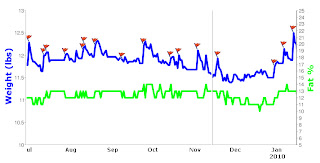
    On the second evening, only five of the free range chickens reported for bed. We had shut away all the other chicken houses, the electric fence was on, and it was almost completely dark. Had the fox eaten her? This seemed highly unlikely, given we had been around all day, and being eaten by a fox is not something one would expect a chicken to do quietly.

    So we rang Suzanne, who told us that this particular chicken occasionally roosted in a tree when it was mild. So, reluctantly, we closed the free range hen house for the night.

    The following morning, with relief, we discovered the missing hen had rejoined the gang. This is her:

    The Traumatised Mouse

    On the third day, I found a mouse behind Tango’s water bowl. It’s eyes were closed and it appeared unable to move much. I was not sure whether it was a baby mouse from a large species whose eyes were not yet open or an adult mouse from a small species, potentially traumatised by one of the cats. The fact that it was hairy suggested the latter. I put the mouse somewhere safe and quiet to recover or die, whichever nature decided.

    Goat Pandemonium

    Also on the third day, Mrs M and I were relaxing on the patio after lunch . The sheep were grazing nearby, the free-range hens were grubbing around by the garage and Tango the dog was snoozing at our feet.

    The sound of animal bells is a common one in the Pyrenees – there are sheep, cows and horses all around in the fields and hills, all wearing bells so they can be easily located. Our goats also had bells. So when we heard the faint sound of bells getting closer, we didn’t think much of it.

    But as the sound grew closer and more rythmic, Mrs M and I looked at each other. Was the farmer using our driveway to move his sheep? The sound got louder and louder and panic began to creep in. Whatever was wearing the bells was clearly about the make an appearance from behind the hedges.

    When it did, pandemonium broke out. It was the goats, who had leapt over their electric fence and come trotting up the drive. A whirlwind of feathers erupted as they ploughed through the chickens. The sheep bolted. Tango did what any dog would do and barked loudly and incessantly. Meanwhile, two of the goats had mounted the patio table and were inspecting our lunch plates.

    Mrs M managed to get Tango inside and I managed to get hold of the billy goat’s collar and that of Miranda, the light brown girl goat. They did not like this, but one has to be firm. I led them back down the drive. The herd instinct compelled the other two to join us and once we were round the corner they all began trotting back. Goats are clever. They knew exactly what they were doing. Mrs M and I felt rather like stand-in teachers being taken advantage of by a rowdy class of pupils.

    Wildlife

    The wildlife in the Pyrenees is spectacular at this time of year. We have recently bought a new digital camera and were able to capture some of the flora and fauna we found:

    Exercise

    I did some great Paleo/Primal workouts in between all this, an account of which, including some videos, can be seen on Train Now Live Later: Hikes, Rope Climbing and Log Throwing in the Pyrenees.

    The Menagerie Grows

    The day after Mrs M and I left, the family bought three ducks. Their home will be in an enclave of the sheep enclosure. We hope, time permitting, to get the opportunity to do this again. We certainly feel very lucky to have been able to do it once.