Author: Pan-African News Wire

  • Congo President Joseph Kabila Calls For United Nations Force to Leave

    pa.press.net
    06/04/2010 04:06

    Congo calls for UN force to leave

    UN Secretary General Ban Ki-moon refused to confirm a date for the pull-out of peacekeepers from Congo

    Congo’s president has called for the UN’s 20,000-strong peacekeeping force to leave before September 2011 so the country can “fly with its own wings,” but the UN secretary-general is not signing off on a date, according to a report.

    Ban Ki-moon said he wants to ensure that military operations against rebels in eastern Congo are successfully completed, that well trained and equipped Congolese army units can take over the UN force’s security role, and that the government extends its authority in areas freed from armed groups before the largest UN peacekeeping operation in the world departs.

    The secretary-general did recommend in the report to the Security Council that the withdrawal start immediately with up to 2,000 troops leaving peaceful areas of the central African nation by June 30, the 50th anniversary of Congo’s independence.

    President Joseph Kabila initially wanted the UN force, known by its French acronym MONUC, out of Congo before the independence celebrations. But following a visit to Kinshasa last month by UN peacekeeping chief Alain Le Roy, where Kabila stressed “that it was now time to allow the country to fly with its own wings,” the government “decided to be more flexible and shift that date to August 30, 2011,” the report said.

    Congo was engulfed in civil wars from 1996 to 2002, drawing in half a dozen nations and leading to deployment of the UN force in 1999 to support implementation of a ceasefire that was repeatedly broken. Following a 2002 agreement that ended much of the fighting, MONUC has supported the reunification of the country and the country’s first democratic elections in more than four decades in 2006, which Kabila won.

    Kabila’s government, however, has since struggled to assert its control in the east and has had difficulty building effective institutions and integrating former fighters into a national army.

    Ban took note of Kabila’s desire for all UN troops to be gone by September 2011, but did not endorse it.

    An assessment team he sent to Congo recommended withdrawing the UN force over a period of three years if the security situation continued to improve and the government accomplished a series of “critical tasks,” according to the report.

    The team concluded that “a continued significant presence of the MONUC force was essential in the Kivus and Orientale provinces” in the volatile east, but not in the other eight provinces where the government could independently maintain law and order and protect civilians, the report said.

    The secretary-general said the 50th anniversary of Congo’s independence provides an opportunity for the government and people “to turn the page on a period of the country’s history that has too often been disfigured by conflict and violence”.

  • Will Obama’s Housing Plan Really Stop Foreclosures?

    April 5, 2010

    New York Times Editorial

    Foreclosure Prevention 2.0

    If all goes according to plan, the Obama administration’s new antiforeclosure effort will prevent many more foreclosures than its current one and do more to moderate the decline in home prices. That is a big if.

    One of the big drawbacks to the administration’s original plan, launched a year ago, is that it focuses on reducing a troubled borrower’s monthly payment by lowering the interest rate. That ignores the fact that unemployed borrowers often cannot afford even reduced payments. And those who are “underwater” — who owe more than their homes are worth — often lack the ability and the incentive to keep up with payments.

    Another problem with the original plan is that participation has been largely voluntary; lenders were offered incentives to join but were not compelled. The improved plan attempts to address the problems of borrowers who are unemployed or underwater. And for jobless homeowners, lenders that participate in the plan will be required to help in some cases.

    For borrowers receiving unemployment benefits, lenders will be required to lower payments to no more than 31 percent of gross income for at least three months, provided the borrower is not more than 90 days’ delinquent. Unpaid amounts will be added to the loan’s principal, to be repaid later. After several months, the hope is that the borrower will have found new work and will qualify for a loan modification in which payments will stay at the reduced amount.

    Unfortunately, if the borrower does not find new work, he or she may lose the house anyway. Foreclosure will have been postponed, but not prevented.

    For borrowers who are deeply underwater and behind in their payments, lenders will be “required to consider” reducing the loan’s principal. They will also be encouraged to reduce principal for underwater borrowers who are still current in payments.

    Those efforts would reduce the monthly payment and restore some home equity, but as with earlier antiforeclosure efforts, lenders are not required to help. Despite government incentives to modify bad loans, lenders might wait to see if bigger incentives are offered later. They may also prefer foreclosure to modifications because the long foreclosure process lets them postpone taking losses.

    If lenders do participate, the new plan could prevent nearly 1.5 million foreclosures from now through 2012, compared with an estimated 650,000 under the old plan, according to Moody’s Economy.com. Many foreclosures will also be delayed, though not ultimately prevented, as lenders assess whether borrowers qualify for help under the new plan. Taken together, preventing and postponing foreclosures would help stabilize house prices in the near term and thus reduce the threat that foreclosures pose to the nascent economic recovery.

    But foreclosures would still be a problem. Even if the new plan saves 1.5 million homes, an estimated 3.6 million homes will be lost between now and 2012. That portends a weak housing market for a long time, which, in turn, portends a long, slow recovery.

    For now, lenders call the shots. If the new plan doesn’t work, the administration must find a way to compel them to rework troubled loans. The risks from the spree of bad lending and bad borrowing — foreclosures, falling house prices, economic hardship — are still there.

  • Deadly Blasts Hit Baghdad Embassies

    Sunday, April 04, 2010
    23:32 Mecca time, 20:32 GMT

    Deadly blasts hit Baghdad embassies

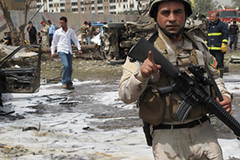
    At least 42 people have been killed and 224 others wounded in a series of three car bombings across the Iraqi capital of Baghdad.

    Security officials said the attacks on Sunday targeted foreign diplomatic missions, with blasts occurring near the embassies of Iran, Germany and Egypt.

    Major-General Qassim al-Moussawi, an Iraqi security forces spokesman, said two of the bombings occurred in Baghdad’s Mansour district, in the west of the capital, while the third blast occurred in Salhiya district, near the Iranian embassy.

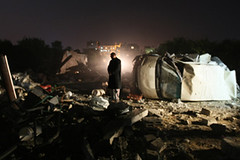
    At the Egyptian embassy, the bomber rammed his car into a concrete blast wall, causing a three-metre deep crater in the street.

    “The car crashed into the blast wall and the guards of the embassy shot the terrorist but he went and blew himself up,” al-Moussawi said.

    “The same thing happened with the Iranian embassy.”

    Embassies hit

    The authorities said they foiled two other attacks aimed at diplomatic targets by stopping suspected bombers’ vehicles and defusing their explosives.

    Hasan Kazemi Qomi, the Iranian ambassador, said it was unclear whether his embassy was a target in the attacks.

    “The explosion happened at the embassy gate, targeting visitors and Iraqi police,” he told the AP news service. “There was some damage to the embassy building but no employees were harmed inside.”

    After the explosions, smoke could be seen rising above the city as helicopters circled overhead and gunfire echoed through the streets.

    The attacks come a day after uniformed gunmen left 25 people deadin the village of Albusaifi just to the south of the capital.

    Some of the victims were members of the Iraqi security forces while others were part of local Awakening Councils or Sahwa, which are comprised of Sunni fighters who allied with US forces to combat al-Qaeda in Iraq.

    The blasts also come at a time of political uncertaintyfor Iraq following last month’s inconclusive parliamentary elections.

    Political struggle

    Al Jazeera’s Zeina Khodr, reporting from Baghdad, said the attacks appeared to have confirmed fears that security could deteriorate due to the political instability.

    “This has been the real fear, the very fact that the security situation could destabilise simply because of the political negotiations taking place to form a new Iraqi government,” Khodr said.

    The result of the election has triggered a bout of political wrangling as Iyad Allawi, the former prime minister, tries to form a government after winning a narrow victory in the polls. Analysts say the uncertainty could last for weeks.

    “The terrorists seized this time between the end of the elections and the forming of the government to target the political process,” said Abdul-Rasoul al-Zaidi, an Iraqi civil defence official.

    In the hours before Sunday’s blasts, Iraq’s Green Zone, site of many international agencies and government buildings in the capital, came under mortar fire.

    Meanwhile, a car bomb in the restive northern city of Mosul killed three people and wounded 25 others, including seven policemen thought to be the target of the attack.

    Source: Al Jazeera and agencies

    Triple car bombing hits Baghdad

    Three suicide car bombs have hit the centre of Iraq’s capital, Baghdad, in quick succession, killing at least 41.

    The attacks, which injured more than 200 others, appear to have been aimed at foreign embassies.

    The bombings shatter a period of relative calm after last month’s parliamentary elections. No-one has said they organised the attacks.

    The BBC’s Jim Muir in Baghdad says the insurgents want to send a message that Iraq remains very unstable and unsafe.

    On Saturday, gunmen killed 25 people believed to be linked to Sunni militias opposing al-Qaeda in a village south of Baghdad.

    Gunshots

    The first two bombs went off within about a minute of one another, in Mansour – a fairly smart suburb on the western side of the city, housing many embassies.

    The Egyptian, German and Syrian missions were all affected by the blasts.

    But security around their buildings is tight, and the brunt of the explosions hit passers-by in the streets, our correspondent says.

    Each of the multiple bombings which have hit Baghdad over the past year has been “themed”- clearly with the aim of conveying the message not only that the insurgents can strike several targets simultaneously, but that they can focus on a particular type of target each time.

    In August, October and December last year, they carried out co-ordinated attacks on government ministries. In January, it was the turn of the big hotels in central Baghdad.

    Now, it seems to be foreign embassies that were singled out for attention by the suicide bombers.

    The attacks come at a sensitive moment, with politicians embroiled in trying to form a government which all agree should reach out to regional countries, especially Arab states which have been slow to restore full diplomatic ties with Baghdad.

    “I saw children screaming while their mothers held their hands or clutched them to their chest,” one man told the Associated Press news agency.

    “Cars were crashing into each other in streets, trying to find a way to flee.”

    The political movement headed by Ahmad Chalabi, the Iraqi National Congress, said that its headquarters close to the Syrian embassy were also affected by the attack, and that many of it guards and employees were among the casualties.

    Another minute or so later, a third suicide bomber blew his car up near the Iranian embassy, closer to the city centre. Here again, many people in nearby streets and buildings were among the dead and injured.

    The authorities in Baghdad say security forces shot and killed a man before he could detonate a fourth car bomb near the former Germany embassy, which is now a bank.

    A number of Iraqi guards working for foreign missions were among those killed. Egypt said several of its staff were wounded by shrapnel.

    Spain said its embassy and the adjacent German mission were also damaged.

    Our correspondent says Sunday’s attacks bore all the hallmarks of earlier bombings, for which the Islamic State in Iraq – the umbrella group for militant Sunni Islamist insurgents – took responsibility.

    But the same organisation vowed to disrupt the general elections in March, which went ahead undeterred.

    This was also the first wave of co-ordinated attacks in Baghdad for more than two months, and the magnitude of each explosion was considerably less than the massive bombs that struck government targets last year, our correspondent says.

    Those attacks – last August, October and December – killed hundreds of people.

    Story from BBC NEWS:
    http://news.bbc.co.uk/go/pr/fr/-/2/hi/middle_east/8602478.stm
    Published: 2010/04/04 19:30:25 GMT

  • ANC Youth Leader Julius Malema Hails Zimbabwe Empowerment Drive

    Malema hails Zim’s empowerment drive

    By Zvamaida Murwira
    Zimbabwe Herald

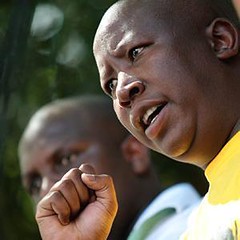
    Firebrand African National Congress youth president Cde Julius Malema yesterday saluted Zimbabwe’s indigenisation and empowerment programme saying that was the basis for waging the liberation struggle.

    The tough-talking ANC youth leader said it was imperative that indigenous people take a keen interest in empowering themselves, as imperialists would never voluntarily hand over wealth to them.

    He was addressing Zanu-PF youth wing members last night at New Donnington Farm near Norton, owned by Reserve Bank of Zimbabwe Governor Gideon Gono.

    “Having attained political freedom, you can’t shy away from economic emancipation,” said Cde Malema, who had earlier during the day toured Zimplats Mine plant near Chegutu and Ngezi Mine in Mhondoro.

    South Africa, said Cde Malema, had a lot to learn from Zimbabwe’s experience both in terms of land redistribution and black empowerment since Harare had attained its independence much earlier than Tswane.

    While there might be criticism of Zimbabwe’s empowerment regulations, what was critical was the political will shown by the country’s leadership.

    “As long as there is political will, nothing is impossible. As politicians we are activists but we have people to implement it — the technocrats, people whom we pay who should then polish our ideas. They should not tell us that it is not possible. Once they tell us that then they are firing themselves. But we should be told that it might take long to implement,” he said.

    He paid tribute to Dr Gono for the shrewd way he handled Zimbabwe’s economy, which he said, had been under siege by imperialist forces that imposed illegal sanctions.

    “He has manoeuvred, even the best economists cannot explain how he did it to make the economy survive under sanctions,” he said.

    Cde Malema hailed President Mugabe for his visionary leadership, saying the President could not relinquish power when the enemy was bent on reversing the gains of the revolution.

    “In South Africa we had (Oliver) Tambo, who served for 30 years as ANC leader without being challenged. All of us said we needed a unifying figure, ” he said.

    The ANC youth leader urged Zanu-PF youths to be vigilant and to conduct themselves in an exemplary way to attract more supporters.

    Speaking at the same occasion, Dr Gono said he was not opposed to indigenisation and empowerment but his views had been misconstrued to mean that he did not want the economy to be in the hands of the majority.

    “I can speak with certainty that nobody has come to where he is without the helping hand of this Governor. I know how painful it is to support a cause and get punished for it. My own children had to be expelled from schools abroad because of my support of this Government,” said Dr Gono.

    He implored the authorities to guard against situations where the elite would continue benefiting from the indigenisation policies at the expense of the majority poor.

    “We are, however, witnesses when good policies have failed our people on the altar of implementation. We are also sounding our minister to be on the lookout for those who will be greedy. The process must not benefit those who have over the years benefited,” he said.

    Youth Development, Indigenisation and Economic Empowerment Minister Saviour Kasukuwere said the rich mineral deposits the country has should be fully utilised to build infrastructure such as hospitals and roads, among others.

    It was high time that Zimbabweans benefited from the rich resources the country is endowed with, he said.

    “The journey is going to be long, you need not to be faint-hearted,” added Minister Kasukuwere.

    He called for a deliberate policy by banks to have a 30 percent quota of their deposits reserved for lending to youths and the disadvantaged.

    “We must support our youths, I am sure Dr Gono will help us in that regard,” he said.

    The Zanu-PF youth wing donated 10 heifers to ANC youth wing, as well as a bull to Cde Malema.

    Minister Kasukuwere pledged 10 additional heifers.

    The party’s national youth executive member, Cde Patrick Zhuwao, said the heifers would spur the recepients to look for grazing land, hence realise the need to redistribute land to the black majority.

    Cde Malema, who arrived on Friday, is expected to leave today.

  • Nigeria Yet to Reap Full Benefits of Oil Exploration, Says President Jonathan

    Nigeria yet to reap full benefits of oil exploration, says Jonathan

    Over N3 trillion federal revenue missing, says Bankole

    From Collins Olayinka (Abuja) and Charles Coffie-Gyamfi (Abeokuta)
    Nigerian Guardian

    ACTING President Goodluck Jonathan has decried what he described as the inability of Nigeria to fully tap the economic advantages inherent in oil and gas for speedy economic emancipation of Nigeria after 50 years of commercial exploration of the products began in the country.

    He spoke yesterday just as the Speaker of the House of Representatives disclosed that over N3 trillion collected by Federal Ministries, Departments and Agencies (MDAs) within the last five years landed in private pockets as they were not remitted to the Federation Account as provided for by the Constitution.

    According to a statement released at the weekend, Jonathan spoke at a roundtable meeting organised by the Nigerian Extractive Industries Transparency Initiative (NEITI) in Abuja last week.

    The Acting President noted that while oil has served as a catalyst for development in other oil endowed countries, the case in Nigeria is different as the country is yet to know whether the commodity is a blessing or merchant of death and underdevelopment.

    Jonathan, who spoke through the Permanent Secretary, Office of the Secretary to the Government of the Federation, Alhaji Sani

    Mohammed, said: “However, 50 years after, the promise of oil is yet to be realised. As is the case with most mineral-rich countries, valuable resources have not translated to sustained improvements in living standards.”

    He submitted that for Nigeria to begin to move towards harnessing the potentials of the oil industry to the fullest, the government has in the past few years introduced measures that were aimed at improving transparency and accountability in the sector.

    Jonathan highlighted that the signing of NEITI bill into law by the Federal Government in 2007 signifies the commitment of the Nigerian government to promoting transparency in the extractive sector.

    He underpinned the importance of NEITI to the Nigerian economy thus: “The comprehensive process, financial and physical audit of the oil and gas sector periodically carried out by NEITI has significantly improved information flow. With the pioneering 1999-2004 and 2005 audit reports, unprecedented amount of revenue information has been brought into the public domain, with Nigeria recovering millions of dollars from under-payments of taxes and royalties by extractive industry companies.”

    The Acting President declared that the strength of NEITI lies in its representation of diverse stakeholders, establishing a new model of collaboration between industry, government, and civil society, and creating a forum for them to interact.

    He added: “This multi-stakeholder structure of the NEITI and its
    participative nature means that all stakeholders – governments,
    industries and civil society groups – are actively involved in
    designing, steering, and governing the process.”

    He stated that it is only when government is able to allow revenues of all sectors to be monitored and publicised and the citizenry is able to see how earnings from their natural resources are being utilised, that resources from extractive industry can actively translate to good schools, hospitals, roads and food and other means of livelihood.

    In his remarks at the event, the Executive Secretary of NEITI, Haruna Sa’eed, said the high level of poverty among Nigerians clearly betrays the nation as an oil endowed one.

    He said: “Looking at our natural resource endowment both in the oil and gas sub-sector and the solid mineral sub-sector, it is clear that Nigeria has no business with poverty. It is sad that we are
    categorised today among countries that have been plagued with the so called natural resource curse. And I make bold to say this is
    reversible.”

    Sa’eed stated that the signing of NEITI by the Federal Government demonstrated its commitment to reversing the worrying trend.

    He opined that the stakeholders’ driven nature of NEITI allows for frank conversations on how best to collectively make progress.

    Sa’eed revealed that audit reports conducted so far have highlighted areas of anomalies which NEITI is working on to correct. However, he was quick to explain that the exercise is not a witch-hunting one.

    He said: “We have put together a remedial action plan to ensure that the recommendations of the auditors for improvements are implemented. This process is still on-going. Let me commend all of you who have been working with us in this regard. As I say from time to time, the NEITI audit is not a witch-hunting exercise. A more transparent extractive industry in Nigeria is a win-win situation for everybody and that is what we are promoting.”

    Sa’eed decried the situation where in the last 50 years of engaging in commercial oil processing, Nigeria is yet to know exactly how many barrels of oil that are produced in its shores.

    However, Bankole who made the stunning disclosure in Abeokuta yesterday, further revealed that “similarly, our investigative hearings revealed that only N11 million of about N548 billion generated by the Nigeria Ports Authority (NPA) within a given period was remitted to government coffers.”

    He stated that one of the major factors militating against full budget implementation is the “habit of little or no attention to outcome by Ministries, Departments and Agencies of approved development projects.”

    The Speaker, however, stated that the National Assembly has further strengthened the budget process in Nigeria by enacting the fiscal responsibility Act to provide for prudent management of the nation’s resources. The Act, he said, also aims at ensuring long-term macro-economic stability of the national economy, secure greater accountability and transparency amongst others.

    Bankole spoke in Abeokuta after he had been inducted as a member of the prestigious Abeokuta Club.

    Apparently to prove wrong his opponents who accused him of non-performance in office, Bankole reeled out his achievements as a Speaker. Said he: “Under my leadership, the House has shown a clear vision of where Nigerians would like the nation to be since we have lost so much time and resources as a result of prolonged dictatorship and insensitive leadership.”

    According to him, thorough performance of oversight functions by the House Committees had revealed that the nation had lost trillions of naira through the manipulation of the unspent funds and outright manipulations. His words: “Our commitment to oversight activities as it relates to tracking and monitoring of budget implementation led to the recovery of over N450 billion and N300 billion unspent funds from the 2007 and 2008 budget respectively.”

    He listed his other achievements to include construction of block of classrooms, ICT centres, and an administrative block at the University of Agriculture, Abeokuta (UNAAB) at a cost of N200 million.

    He further told his kinsmen: “As your elected representative, I have not forgotten my roots nor have I forgotten that you sent me to Abuja to represent your interests.”

    Explaining that even before he became the Speaker he had sponsored the purchase of NECO forms for over 11,000 indigenous students.

    “Only three weeks ago, I facilitated the release of N100 million for educational infrastructure to Ogun State from the ETF (Education Trust Fund). In addition to the above personal and constituency projects in my constituency, it is to the glory of God that I have been able to attract over 54 Federal projects to Ogun State”, adding that such projects cut across power, roads, water, skills acquisition, ecological and solar street lights.

    “It’s on record that as an ordinary member of the House from 2003 to 2007, I directly facilitated/assisted in projects worth N700 million. In 2008, the figure was N1.8 billion and in 2009 it was N20 billion,” he added.

    According to him, this is apart from influencing the appointment of indigenes as ministers and members of Federal Boards and agencies. At present, he said, he is the President of the Afro-Arab parliament. Bankole hinted that what the House was focusing on as far as the review of the constitution was concerned was to empower the Independent National Electoral Commission (INEC) to be financially autonomous.

    He assured his audience, which included Egba monarchs, that he would not let them down as he would always strive to preserve and promote the integrity of the House and the entire legislature.

    The House, he said, was committed to pursuing the necessary ideals of making laws for peace, order and good governance.

    The President of Abeokuta Club, Chief Edward Koleoso in his speech, commended the leadership style of Bankole, saying the record of his performance in office had been a source of inspiration to many Nigerians, especially the youths.

    According to him, the Speaker is a man born great with a fountain of knowledge and wisdom, “an icon shinning among his peers.”

    According to him, the club was founded in 1972 with the main objective of developing Egbaland and its people.

  • Israel Threatens to Escalate Attacks on Gaza

    Israel Threatens To Escalate Attacks On Gaza

    Israel has warned a widescale military operation against Gaza could follow a string of air strikes, which injured three Palestinian children.

    The strikes, on the western part of Gaza City, came in response to rocket attacks from Hamas-controlled Gaza into southern Israel.

    Foreign Office sources expressed concern at the threat of intensifying hostilities and urged the two sides to show restraint.

    Sky News Middle East correspondent Dominic Waghorn said the violence reflected a steady increase in tension in the region.

    Almost 20 rockets were fired out of Gaza last month, one of them killing a Thai farm worker in southern Israel,” Waghorn said.

    Two Israeli soldiers were killed in a border clash a week ago, and there were air strikes overnight.

    Now Israel’s deputy prime minister Silvan Shalom is threatening an escalation in Israeli military activity if the rocket fire does not stop.”

    Hamas claims it has been trying to restrain the rocket fire among its own militants and other groups.

    Israel said whether or not that is true, it still holds Hamas responsible for peace in the strip.

    The latest air strikes were launched against Hamas targets, Waghorn said.

    Hospital officials said the Israeli aircraft left three Palestinian children wounded by flying glass.

    Witnesses and Hamas officials claimed air strikes blew up two caravans near the town of Khan Younis, while another missile was reported to have hit a cheese factory in Gaza City, setting it on fire.

    Helicopters struck twice in the central refugee camp of Nusseirat, destroying a metal foundry.

    An Israeli military spokesman said the attacks targeted two weapons-manufacturing plants and two arms caches.

    An Israeli offensive in the Gaza Strip early last year was designed to counter Hamas rocket attacks.

    Sources at the Foreign Office said: “We are concerned by today’s strikes and the escalation of violence in Gaza and Southern Israel over the past week. We call on all parties to show restraint.

    We encourage Israelis and Palestinians to focus efforts on negotiation and to engage urgently in US-backed proximity talks.”

  • Returning Nigerian Ministers to Lose Former Portfolios

    Returning ministers to lose former portfolios

    Headlines Apr 5, 2010
    By Emmanuel Aziken

    ABUJA—FEW of the 13 returning ministers may get back the portfolios they held in the just dissolved cabinet, Presidency sources said yesterday.

    Snippets of the tentative list of cabinet positions as gathered by Vanguard, showed that none of the ranking members in the just dissolved cabinet may get back the positions they held in the cabinet list that is to be unfolded tomorrow.

    Vanguard learnt that the plan by Acting President Goodluck Jonathan to redistribute them despite the intensive lobby by some of the returning ministers and their godfathers followed revelations of schemes some of them had buried in the appropriation bill that has just been passed into law.

    Of the ministers returning to the cabinet, only Mrs. Fidelia Njeze from Enugu State is known to have been penciled down to return to her duty as Minister of State, Agriculture, while others have either been taken elsewhere and their former portfolios given to other ministers-designate.

    Mrs. Akunyili’s former portfolio at the Ministry of Information and Communication, it was learnt, is to be taken by Capt. Emmanuel Ihenacho while the former Minister of State, Petroleum, Mr. Odion Ajumogobia is to take office as the Minister of Foreign Affairs. Vanguard learnt authoritatively that he is to be assisted by three assistants.

    Erstwhile Minister of Justice and Attorney General of the Federation, AGF, Mr. Kayode Adetokunbo is to cede his immediate last position to Mr. Mohammed Adoke, SAN. Vanguard could not confirm Adetokunbo’s portfolio but there were suggestions that he could be headed back to the Ministry of Labour on account of his wild popularity among the stakeholders in that sector.

    Senator Bala Mohammed, leader of the National Interest Group, NIG, and secretary of the Northern Senators Forum, NSF, in the Senate, Vanguard learnt, has been designated as the Minister of Power against suggestions that he could be headed to the Aviation portfolio.

    Senator Chris Anyanwu, PDP, Imo East, has, however, urged Acting President Jonathan not to succumb to pressures from godfathers but to assign ministers to the positions they are best suited for.

    In an interview, Senator Anyanwu said: “We should begin to put people in areas where they are more suited for. Before you scout somebody to come and work for you, you must have known about that person, his antecedents and capability to deliver, and you must have a clear idea of what you want to do with that person.”

    The cabinet is expected to be inaugurated tomorrow.

  • Nigeria, US to Sign Historic Agreement on April 7

    Nigeria, US Sign Historic Agreement Wednesday

    •Ratify deal on N’Delta, trade, energy and security

    From Tokunbo Adedoja in New York, 04.04.2010

    In the first major bi-national agreement with an African country in a long time, the United States will on Wednesday sign a historic comprehensive commission pact with Nigeria in New York. Under the bi-national commission agreement, the two countries would be cooperating in four areas.

    The areas, according to the Nigerian Ambassador to the United States, Professor Adebowale Adefuye, are trade and energy; Niger Delta; electoral reform; and peace and security.

    The agreement is expected to be followed by the visit of Acting President Goodluck Jonathan to the United States for the nuclear security summit which holds between April 11 and 14. Diplomatic sources in Washington told THISDAY that the Acting President had already accepted President Barack Obama’s invitation to the summit.

    Speaking to THISDAY in New York, Ambassador Adefuye said the Secretary to the Government of the Federation, Alhaji Ahmed Yayale, would sign on behalf of Nigeria as leader of the delegation consisting of top government officials while the United States Secretary of State, Senator Hilary Clinton, would sign for her country.

    The signing ceremony is coming barely a week after the US put aside the emergency aviation security measures she announced on January 3, this year, which classified Nigeria as a “country of interest”, following the botched attempt to bomb an American airliner by a Nigerian, Umar Farouk Abdulmutallab.

    Diplomatic sources also told THISDAY last night that the development would further strengthen relations between the two nations.

    The Nigerian-US relations have continued to improve since the restoration of democracy in 1999 and the two countries have been cooperating on many important foreign policy goals, including regional peacekeeping.

    While an estimated one million Nigerians and Nigerian-Americans are believed to live, study, and work in the United States, over 25,000 Americans live and work in Nigeria.

    The exclusion of Nigeria from the list of countries visited by Obama during his first official visit to Africa last year, however, brought to the front burner, the fears that Nigeria might gradually be losing its prime status in American foreign policy focus to neighbouring countries on the West African coast.

    The US Secretary of State, Clinton, visited Nigeria last August in her first official trip to Africa, during which time she held talks with top Nigerian government officials and expressed US position on several issues especially the anti-corruption war, which she said had lost steam.

  • ANC Youth League Leader Says “We Want the Mines”

    Malema: ‘We want the mines’

    HARARE, ZIMBABWE Apr 04 2010 08:11

    South Africa’s fiery ruling party youth leader on Saturday vowed to overhaul ownership of the country’s key mining industry.

    “We hear you are going straight for the mines, that is what we are going to do in South Africa,” Julius Malema, the African National Congress Youth League president, told a rally in Zimbabwe’s capital Harare.

    “They have exploited our minerals for a very long time. We want the mines, now it’s our turn.”

    Zimbabwe last month put in operation a law that requires foreign companies valued at over $500 000 to divest 51% of shares to non-white locals within five years.

    Malema has repeatedly called for South Africa’s mines, a cornerstone of the economy, to be nationalised but President Jacob Zuma’s government has brushed off the demands as not being official policy.

    The controversial youth leader, who is being hosted by Zimbabwean President Robert Mugabe’s ruling party youth chapter, also echoed South Africa’s backing of the lifting of Western sanctions against the veteran leader and his inner circle.

    At the rally, Malema sang Ayesaba Amagwala [The Cowards are Scared], which a South African court this week banned him from using after outrage that it incited violence against whites.

    Malema will also visit Brazil, China, Chile, Cuba and Venezuela in a tour of nationalisation programmes. – AFP

    Source: Mail & Guardian Online
    Web Address: http://www.mg.co.za/article/2010-04-04-malema-we-want-the-mines

  • Tutu Leads Fight to Halt Anti-Gay Terror Sweeping Africa

    Tutu leads fight to halt anti-gay terror sweeping Africa

    DAVID SMITH | JOHANNESBURG, SOUTH AFRICA – Apr 04 2010 07:08

    Battle has been joined against the criminalisation of homosexuality in Africa. Last week, Archbishop Desmond Tutu and more than 60 civil society and human rights groups called on Uganda to reject proposed punishments for gay sex that range from life imprisonment to the death penalty.

    Activists in Malawi were steeled by pressure from Human Rights Watch for the dropping of a case against the first gay couple to seek marriage in the conservative country. Steve Monjeza (26) and 20-year-old Tiwonge Chimbalanga will stand trial this week after holding a traditional ceremony last December.

    Human Rights Watch said: “The case is an affront to essential principles of non-discrimination and equality. It singles out two people as criminals simply because they love each other.”

    The case has focused attention on a homophobic backlash sweeping Africa, partly because gay men and lesbians are becoming more assertive about their rights, partly because of intolerance fanned by interventions from evangelical churches in America.

    ‘Men who want to breathe into other men’s ears’

    Last month the challenge was put in context when the Zimbabwean prime minister, Morgan Tsvangirai, often lionised by Western liberals, backed President Robert Mugabe’s position that gay rights could have no place in the national constitution.

    Tsvangirai was widely quoted as saying: “The president has spoken about gay rights, about some men who want to breathe into other men’s ears. I don’t agree with that. Why would you look for men when our women make up 52% of our population? Men are much fewer than women.”

    The Movement for Democratic Change, has made commitments that the state should not interfere in the private lives of its citizens, but Tsvangirai’s remark probably owed something to realpolitik: support for gay rights could be a huge vote-loser in a heavily Christian society where homosexual activity is outlawed.

    Gay sex is illegal in 36 countries in Africa. In Kenya recently, police raided a gay wedding and arrested guests. South Africa is often regarded as a beacon of hope because it was the first country on the continent to legalise same-sex marriage. Yet campaigners say the fight against bigotry is far from over, pointing to incidents of murder and so-called “corrective rape” against lesbians. Last year, Lulu Xingwana, the arts and culture minister, walked out of an exhibition because it featured photographs of nude lesbian couples that she found “immoral” and “against nation-building”.

    Import from the West

    A favourite claim among critics of homosexuality is that it is an import from the decadent West and alien to African culture. But this has been challenged by historical evidence of homosexual people and practices being accepted in traditional societies before the arrival of European settlers.

    In a recent column in the Guardian, Blessing-Miles Tendi cited the Azande people in the north-east of what is now the Democratic Republic of the Congo, where it was acceptable for kings, princes and soldiers to take young male lovers.

    In fact, argue campaigners such as Peter Tatchell, is it not homosexuality but rather the laws against it that were imposed Africa by the West. Many African states are using the very laws introduced by European colonialists more than a century ago to persecute gay men and lesbians today.

    guardian.co.uk © Guardian News and Media 2010
    Source: Mail & Guardian Online
    Web Address: http://www.mg.co.za/article/2010-04-04-tutu-leads-fight-to-halt-antigay-terror-sweeping-africa

  • White Far-right, Racist in South Africa, Eugene Terreblanche, is Killed in South Africa

    Sunday, April 04, 2010
    03:01 Mecca time, 00:01 GMT

    S African far-right leader killed

    Terreblanche was released from prison in 2004 after serving a sentence for attempted murder

    Eugene Terreblanche, the South African white far-right leader, who fought to preserve apartheid in the early 1990s, has been beaten and hacked to death at his farm.

    Police said Terreblanche was attacked at his farm outside of Ventersdorp, on Saturday, allegedly in a dispute over unpaid wages, the Johannesburg Star newspaper has reported.

    Two workers, a 21-year-old man and a 15-year-old boy, were arrested and charged with murder, the Star reported.

    ‘Hacked to death’

    “He was hacked to death while he was taking a nap,” one family friend, a member of Afrikaner Resistance Movement (AWB), told the Reuters news agency, requesting anonymity.
    profile

    Local media quoted another party member as saying he was beaten with pipes and machetes.

    “Terreblanche’s body was found on the bed with facial and head injuries,” the AFP news agency quoted a police spokesman as saying.

    Terreblanche, 69, had kept a low public profile since his release in 2004 from prison after serving three years of a five-year term for for attempted murder.

    He had lived in relative obscurity despite the revival of his party two years ago and recent efforts to form a united front among white far-right groups.

    The killing comes at a time of worries over increasing racial polarisation in South Africa, heightened by a row over the singing of a song by the head of the ruling ANC party’s youth league with the lyrics “Kill the Boer”.

    Terreblanche always described himself as a Boer.

    He had founded the white supremacist Afrikaner Weerstandsbeweging (AWB) party in 1970, to oppose what he regarded as the liberal policies of the then-South African leader, John Vorster.

    Terreblanche wanted to create all-white states within South Africa in which blacks would only be allowed as guest workers.

    ‘Kill the Boer’

    He threatened to take the country by force if the white government capitulated to the African National Council.

    Ebrahim Fakir, an African analyst, told Al Jazeera that it is unlikely Terreblanche’s political cause will “necessarily die with him”.

    “It may lose some of its momentum; It may of course lose some of the fiery rhetoric that [Terreblanche] was known for in arguing for Afrikaner rights.

    “Whether it loses momentum or not is a moot point, quite simply because it never gathered large amounts of steam in the first place. It didn’t have much social support even amongst Africaners.

    “There is no doubt that Terreblanche’s death will exacerbate racial tensions in the immediate area in which he lived.

    “But you will have this kind of tête-à-tête going on with black South Africans feeling a sense of victory, of rising above oppression and sending perhaps a not so subtle message that after the accumulation of years of racism is something which will be met in an equally brutal way,” he said.

    After the white government conceded, the ANC overwhelmingly won 1994 elections and has won every election since with more than 60 per cent of votes.

    But the AWB – whose flag resembles the Nazi Swastika – was revived in 2008.

    The Afrikaners are descendants of the Boers, the first whites who arrived in South Africa 300 years ago and avoided assimilation with English-speaking settlers.

    Their short-lived republics, in the Orange Free State, Transvaal and northern Natal, were broken up after the 1899-1902 Anglo-Boer War.

    Terreblanche wanted to reconstitute them.

    Source: Al Jazeera and agencies

  • Senegal Unveils “African Renaissance” Statue

    Senegal unveils “African Renaissance” statue

    Mark John, Reuters April 4, 2010, 5:18 am

    DAKAR (Reuters) – Senegal inaugurated its giant “African Renaissance” monument on Saturday, brushing aside complaints that the $28 million personal project of President Abdoulaye Wade was a waste of money and un-Islamic.

    Wade arrived at the statue of a man, woman and child to the sounds of African drumming and dancers in traditional costume as hundreds of his supporters watched, some waving banners urging him to seek another term in 2012 elections.

    He said the monument was for all of Africa. “It brings to life our common destiny,” he said. “Africa has arrived in the 21st century standing tall and more ready than ever to take its destiny into its hands.”

    Slightly bigger than New York’s Statue of Liberty, the monument perched on a hill overlooking the capital Dakar has been criticized as a waste of money in a country with crumbling infrastructure and welfare provision.

    One imam in the mainly Muslim West African state issued a fatwa on Friday condemning the statue as idolatrous, a charge dismissed by Wade’s allies.

    Its supporters argue that Africa, many of whose states are still struggling to find their feet a half a century after independence, needs symbols of hope for the future.

    “Every architectural work sparks controversies — look at the Eiffel Tower in Paris,” pro-Wade senator Ahmed Bachir Kounta told Reuters of the 19th-century structure labeled by early critics as an expensive eyesore.

    Wade, who at 83 has confirmed he will seek reelection in 2012, invited around 30 African and other heads of state to the ceremony, and several including Zimbabwe President Robert Mugabe were in attendance.

    At the foot of the statue sat dozens of facepainted children representing a charity for impoverished youth which is due to receive cash from the monument’s tourist proceeds.

    Wade wore a modern western-style suit to the inauguration while his wife wore a colorful boubou, a flowing full-length garment traditional in West Africa.

    RISING COST OF LIVING

    Many Dakar residents, struggling with increasingly frequent power cuts, disintegrating city roads and scarce formal employment, have mixed feelings about the monument.

    “In 2010, Africa has to re-born,” said 36-year-old Thierno Dienj, who was among the crowd at a small anti-government rally on Saturday.

    “But this monument doesn’t take into account the rising cost of living here,” he said, repeating a common complaint about price increases in basic foodstuffs and public transport.

    The notion of an “African Renaissance” came to the fore in the 1990s amid optimism that the continent was shaking off the effects of colonialism and Cold War-era meddling by superpowers.

    Leaders such as Wade and former South African President Thabo Mbeki used the idea to drive projects such as the New Partnership for Africa’s Development (NEPAD), an economic development programme which has achieved modest results so far.

    (Additional reporting by Diadie Ba and Kim Gjerstad; writing by Mark John and Richard Valdmanis; editing by David Stamp)

  • Pension Funds Still Waiting For Big Payoff From Private Equity

    April 2, 2010

    Pension Funds Still Waiting for Big Payoff From Private Equity

    By JENNY ANDERSON
    New York Times

    Private equity deal-makers, those kings of corporate buyouts, made billions for themselves when times were good. But some of their biggest investors, public pension funds, are still waiting for the hefty rewards they were promised.

    The nation’s 10 largest public pension funds have paid private equity firms more than $17 billion in fees since 2000, according to a new analysis conducted for The New York Times, as the funds flocked to these so-called alternative investments in hopes of reaping market-beating returns.

    But few big public funds ended up collecting the 20 to 30 percent returns that private equity managers often held out to attract pension money, a review of the funds’ performance shows.

    Many public pension funds are struggling to recover from a collapse in the value of their portfolios, despite large private equity investments that were supposed to help cushion their losses.

    Fees are at the center of the debate over the divergent fortunes of private equity managers and their investors, because fees often make a big dent in any investment gains.

    That “raises the question as to why they accept to pay this level of fees,” said Oliver Gottschalg, a professor at the HEC School of Management in Paris who conducted the study on private equity fees.

    State and local pension assets declined by 27.6 percent from the end of 2007 to the end of 2008, wiping out $900 billion, according to the Government Accountability Office.

    Those poor returns have rankled some longtime private equity investors like the California Public Employees’ Retirement System, or Calpers. In September 2009, it “strongly endorsed” principles proposed by the Institutional Limited Partners Association, which represents private equity investors, to keep management fees in check and improve disclosure about fund performance.

    The funds vary in how they report their performance and calculate their returns, allowing a significant number to classify themselves as “top quartile,” or the best performers.

    “The fees paid to private equity managers has been a source of great frustration,” Joseph A. Dear, the chief investment officer for Calpers, said in an interview, adding that the managers “shouldn’t be making a profit on the management fee. They should make money when their investors make money.”

    Still, despite the high fees, he said the funds’ performance had been good. “We don’t expect 20 percent,” he said. “We expect 3 percent more than public markets, net of fees.”

    Private equity executives generally say their fees are justified by their market-beating returns. Reached by e-mail on Friday, Robert W. Stewart, a spokesman for the Private Equity Council, the industry’s trade association, declined to comment.

    Public funds pay a lot of money to managers of so-called alternative investments like private equity, venture capital, real estate and hedge funds. In 2009, the Pennsylvania Public School Employees’ Retirement System paid $477.5 million in fees — 20 percent more than it did in 2008 and 283 percent more than in 2000, the earliest year for which data was available.

    These funds generally charge fees totaling 2 percent of the money they manage and then take 20 percent of the profits they generate.

    And yet, even after paying hundreds of millions of dollars in fees, the Pennsylvania fund is ailing. It lost more than a quarter of its value during its latest fiscal year and is now worth less than it was a decade ago, although its performance has improved recently.

    Private equity owes its explosive growth largely to America’s pension funds. Buyout funds raised $200 million in 1980 and $200 billion in 2007. According to Prequin, a financial data provider, public pension funds were the biggest contributors over that period and now have $115.9 billion invested in private equity.

    But these investments have not worked out as well as many had hoped. According to data from the Wilshire Trust Universe Comparison Service, the median returns for public pension funds with assets greater than $5 billion were negative 18.8 percent over one year, negative 2.8 percent over three years, and 2.4 percent over five years.

    Indeed, research conducted by several university professors challenge the private equity firms’ premise that returns beat the stock market over long periods of time.

    Two professors, Steven Kaplan of the University of Chicago and Per Strömberg of the Stockholm School of Economics, contend that, after fees, many private equity investments just about match or even trail the returns of the broad stock market between 1980 and 2001.

    Additional research by Ludovic Phalippou of the University of Amsterdam and Mr. Gottschalg of the HEC School of Management shows that private equity funds underperformed the Standard & Poor’s 500-stock index by 3 percent annually from 1980 to 2003, after accounting for fees.

    To be sure, private equity returns have beaten abysmal stock market returns over the last decade, helping to provide a cushion at some funds. For Pennsylvania’s public school workers, the 10-year return for private equity was 9.5 percent, even after deducting for fees, compared to 3.6 percent for all assets, including stocks and bonds.

    The largest pension fund investors put a significant chunk of their money in private equity during the bubble years, from 2005 to 2008, according to a separate analysis by Mr. Gottschalg. Of the top 10 pension funds, eight invested more than 45 percent of their total capital in private equity during that period.

    Mr. Kaplan said that the funds started during the boom years, so-called vintage funds, were likely to disappoint investors.

    “The deals of 2006 and 2007 will not perform very well,” Mr. Kaplan said, referring to mergers and acquisitions led by private equity firms that have not yet been cashed out through a sale.

    Some big funds are doubling down on private equity anyway. In November 2007, the Washington State Investment Board, whose $75 billion fund is among the most heavily invested in private equity, increased its commitment to that asset class to 25 percent, from 15 percent, and its real estate allocation to 13 percent, from 12 percent.

    Others, however, are retrenching. As of last September, the Pennsylvania State Employees’ Retirement System, a $24.3 billion fund that is distinct from the school workers’ fund, had 23 percent of its pension investments in hedge funds, another 23 percent in private equity and venture capital, and an additional 8.4 percent in real estate — bringing its total in alternative investments to more than 54 percent.

    A spokesman for the fund, Robert Gentzel, said it was working to scale back those allocations to 12 percent for private equity and venture capital and 9 percent for hedge funds.

  • President Says Guinea-Bissau is Calm

    Friday, April 02, 2010
    05:39 Mecca time, 02:39 GMT

    President says Guinea-Bissau ‘calm’

    Supporters demanded soldiers release Carlos Gomes Jr, the prime minister being held at his home

    Guinea-Bissau’s president has said the situation in his country is “calm” after soldiers arrested the army chief and prime minister in an apparent coup attempt.

    Malam Bacai Sanha told public radio on Thursday that the army chief had been detained and the prime minister – who had earlier been taken by soldiers – was at home, apparently under house arrest.

    Sanha put the situation down to some “confusion between soldiers”.

    A military source said soldiers had escorted Carlos Gomes Jr, the prime minister, to his home after his arrest and soldiers were controlling the streets in the area.

    About 40 officers were also said to have been arrested.

    Antonio Indjai, the newly-designated army chief, said on national radio that the show of force by mutinous solders was purely a military problem and the army remained submissive to political power.

    “The Guinea-Bissau armed forces would like to make the point that events which occurred this Thursday morning are a purely military problem and do not concern the civil government.

    “The army reiterates its attachment and its submission to political power. Military institutions remain, and will remain, submissive to political power.”

    Show of support

    National radio broadcasts were interrupted by military music – often a signal that a coup is taking place – and hundreds of demonstrators gathered outside the government headquarters after news of the arrest spread, to demand the prime minister’s freedom.

    Indjai threatened to kill Gomes – whose nickname is “Cadogo” – in a public radio broadcast if his supporters continued to press for his release.

    “We ask you to stop anything that attracts a crowd in the streets. If you do not do this, we will have to kill Cadogo,” the general said.

    Indjai said Jose Zamora Induta, the army chief of staff, and Gomes “must pay for all the crimes they have committed”.

    During his news conference, Indjai was accompanied by Bubo Na Tchuto, a former head of the navy, who had earlier left a UN building in Bissau where he had spent 94 days.

    A group of soldiers went to the UN office and walked out with Na Tchuto, who had been taking refuge there after being suspected of leading a failed 2008 coup.

    Ban Ki-moon, the UN secretary-general, urged “the political leadership of Guinea-Bissau to resolve differences by peaceful means and to maintain constitutional order and ensure respect for the rule of law”, on Thursday.

    Jean Ping, the African Union commission chairman, said in a statement that he was following the events “with great concern”.

    “In the face of developments which show the volatile nature of the situation in the country and reveal the urgent need for reform of the defence and security sector, the commission chairman calls on all Guinea-Bissau armed forces to respect republican order,” the statement said.

    Spain, the holder of the rotating European Union presidency, on Thursday called for a swift re-establishment of “legitimate order”.

    ‘No problem’

    Despite the turmoil and international concern, Sanha said on Thursday that “there is no problem”.

    “There was a situation of confusion,” Sanha said in a statement broadcast on Portugal’s Antena 1.

    “There was a confusion between soldiers that reached the government, but the situation is calm.

    “We are going to try to work on calming the situation and resolve the problem,” he said.

    The former Portuguese colony has seen repeated coups since independence in 1974.

    A new crisis erupted in March 2009 when Joao Bernardo Vieira, the then president, was murdered by troops, apparently in revenge for the killing, hours earlier, of the armed forces chief.

    The country has been overwhelmed by the international drugs trade, becoming a key transit point in cocaine smuggling between South America and Europe.

    Source: Al Jazeera and agencies

  • Israel Bombs Palestinians in Gaza

    Friday, April 02, 2010
    07:03 Mecca time, 04:03 GMT

    Israel pounds Gaza with missiles

    Hamas said that Israeli missiles hit two caravans, a cheese factory and a metal foundry

    Three children have been reported injured in eastern Gaza City after Israeli aircraft carried out a series of missile attacks across the Palestinian territory.

    Palestinian hospital officials said the children were injured by flying debris after the air raids that came in the early hours of Friday.

    Al Jazeera’s Casey Kauffman, reporting from Gaza, said there were attacks in at least six locations.

    He said that work on tunnels, which are often used for smuggling goods into the blockaded territory, had stopped for fear of the strikes and the Hamas government had also ordered police stations across Gaza to be evacuated.

    Witnesses and Hamas officials said that Israeli missiles hit two caravans near the town of Khan Younis and a cheese factory, while helicopters attacked a metal foundry in the Nusseirat refugee camp.

    ‘Rocket fire response’

    The Israeli military said it had targeted weapons manufacturing and storage facilities in the central Gaza Strip, in Gaza City in the north and the southern Gaza Strip, all in response to rockets fired from the territory.

    “Nearly 20 rockets and mortars were fired at Israel from the Gaza Strip during March, killing one man in the community of Netiv Ha’Asara and doubling the number of rockets fired this year,” a statement from the Israeli army said.

    “The IDF [Israeli military] will not tolerate any attempt to harm the citizens of the State of Israel and will continue to operate firmly against anyone who uses terror against it. The IDF holds Hamas as solely responsible for maintaining peace and quiet in the Gaza Strip.

    Al Jazeera’s Jacky Rowland, reporting from Jerusalem, said the rocket attack came despite a warning earlier in the day by the Israeli military that it would “respond harshly against any attempt to disrupt the calm in Israel’s southern communities”.

    There was no claim of responsibility for Thursday’s lone rocket, which caused no casualties, but the Israeli army had said in its earlier statement that it held Hamas, the Palestinian faction which controls Gaza, “solely responsible for maintaining peace and quiet in and around” the territory.

    Fawzi Barhoum, a Hamas spokesman, told Al Jazeera that Hamas held the Israeli government led by Binyamin Netanyahu responsible for the “escalation”, but said the air raids had been expected because of threats by Ehud Barak, the defence minister, and other ministers.

    He also blamed “the international community and the Arabs” for failing “to do anything about the situation in Gaza”.

    “The absence of the international community and the Arabs has allowed the Israelis to escalate the situation,” he said.

    Source: Al Jazeera and agencies

    Multiple Israeli strikes hit Gaza

    Israeli planes have carried out 13 air strikes on the Hamas-ruled Gaza Strip, Palestinian sources have told the BBC.

    Four of the strikes took place near the town of Khan Younis, where two Israeli soldiers were killed in clashes with Palestinian fighters last week.

    The Israeli military has told the BBC the operation was targeting four weapons factories.

    The strikes are the most serious for more than a year, says the BBC’s Jon Donnison from Jerusalem.

    The director of ambulance and emergency in the Palestinian Ministry of Health, Dr Muawiya Hassanein, said that three children including an infant were slightly injured by flying debris.

    Witnesses and Hamas officials said the Israeli raids targeted metal workshops, farms, a milk factory and small sites belonging to the military wing of Hamas.

    ‘Retaliation’

    “Israel will not tolerate terroristic activity inside Gaza that threatens Israeli citizens,” the Israeli military said in a statement released to the BBC.

    Palestinian news agencies reported that Israeli aircraft dropped leaflets over parts of Gaza on Thursday warning residents of retaliation for last Friday’s killings of the soldiers in Khan Younis.

    They were the first Israeli soldiers to be killed in hostile fire in Gaza in over a year. The military wing of Hamas claim responsibility for those attacks.

    Hamas said police stations and training facilities were among the targets of Israel’s overnight raids.

    Tensions in the region are running high after a recent Israeli government announcement of plans to build 1,600 new homes for Jewish people in East Jerusalem, which the Palestinians want as a capital of a future state.

    Militants in the Gaza Strip have recently stepped up rocket fire directed at Israel.

    On Wednesday, they fired a rocket into an empty field in southern Israel, but there were no reports of casualties or damage, military sources said.

    Story from BBC NEWS:
    http://news.bbc.co.uk/go/pr/fr/-/2/hi/middle_east/8600285.stm
    Published: 2010/04/02 00:49:51 GMT

  • U.S. to Release First ‘State of Africa’ Report

    US to release first ‘State of Africa’ report

    Article by: laurian clemence

    The US will release its first “State of Africa” report in Johannesburg and other African capitals on Monday.

    The report, compiled by Charles Stith, former US ambassador to Tanzania, claims to tell what is going on in Africa as the leaders of the continent themselves see it.

    It is a preliminary to the African presidential or government leaders’ roundtable meeting, which will convene in London on April 22 and continue in Boston, US, on April 27 and 28.

    The agenda will be dominated by comment on ways in which to improve capital flows into Africa.

    “Previous reports on Africa that I had seen were incomplete,” Stith said at a briefing at the US Embassy in Gaborone yesterday.

    “There was nothing from the leaders themselves on what they thought or about the path on which they were taking their countries”.

    This report chronicled the contributions of select African presidents to the growth and development of their respective countries, he said.

    “It is a statement that Africa is more than the sum of its problems. It is a counter to much of the commentary on Africa, which focuses on the problems, without mentioning Africa’s potential,” Stith said.

    “A report like this helps provide greater insight into the aspirations and issues that are important to the leadership on the continent of Africa,” he added.

    Africa was important for the US – and Stith admitted oil was one reason for that.

    “As the Middle East has become muddled there is a clear strategy to increase the amount of oil the US imports from Africa,” he said.

    “There must be an appreciation that Africa’s economic security is ultimately related to America’s economic and national security.

    It is not simply the moral imperative to respond to Africa’s problems that begs US attention. The necessity of helping Africa fulfil its potential is equally compelling”.

    Stith’s report may complete the picture, but maybe not as objectively as he would like. It is largely compiled from State of the Nation messages previously broadcast by the Heads of State.

    “We have not analysed or updated them,” Stith admitted at the briefing.

    The report features 14 countries: Benin, Botswana, Cape Verde, Ghana, Kenya, Malawi, Mauritius, Mozambique, Nigeria, Senegal, South Africa, Tanzania and Zambia.

    The April “roundtable” will be strongly on trade and investment related.

    Stith will by then have completed a seven nation swing through Africa, which will prominently include all of US President George W Bush’s Africa trade hubs; the Southern Africa hub is in Botswana, others are in Ghana and Kenya. He will have also visited Mauritius and Tanzania.

    The hubs were set up over 2003 to complement the US initiative of the African Growth and Opportunity Act (Agoa).

    Agoa, described by Bush as “regional hubs for global competitiveness”, they are part of the African Development and Enterprise Programme, which the US has funded with $5-million.

    In South Africa, Stith has already briefed De Beers’ chairperson Nicky Oppenheimer on the roundtable, in Botswana President Festus Mogae and former President Sir Ketumile Masire.

    “South Africa and Botswana are linchpins of development in Africa… President Masire is respected around the continent, he is a great man, a man of stature,” Stith said.

    Advance briefs from the report quote Botswana as being singled out in the Economic Freedom of the World Report 2003 as “a shining example of freedom” and ranked alongside Norway and Japan as having one of the world’s highest levels of economic freedom.

    In no area is the cooperation more noticeable than in the support the US gives Botswana’s in its fight against HIV-Aids, an epidemic which the US has long considered a threat to the stability of southern Africa.

    “Aids-related deaths of large numbers of citizens of African countries could affect development and the effectiveness of public administrations,” former US ambassador to Botswana John Lange said.

    The US in January further swelled Botswana’s Aids war chest.

    Under Bush’s President’s Emergency Plan for HIV/Aids Relief (Pepfar) it gave Botswana a $9,5-million first instalment of a $19-million grant to fight Aids.

    Overall, Pepfar commits to a five-year $15-billion approach to combating the disease in 15 countries in Africa and the Caribbean.

    “Botswana’s success in having its entire first instalment application approved is a testament to the hard work and coordination of the government,” said US ambassador to Botswana Joseph Huggins. –

    Sapa.
    Edited by: laurian clemence

  • United Nations Pursues Multi-pronged Strategy for Peaceful Elections

    Côte d’Ivoire: UN pursues multi-pronged strategy for peaceful elections

    1 April 2010 –From high-level political meetings to workshops and sporting events, the United Nations mission in Côte d’Ivoire (UNOCI) is deploying a multifaceted strategy to create a peaceful environment for the repeatedly delayed elections that are intended to reunify the divided country.

    UNOCI is “following very closely” consultations between Côte d’Ivoire’s President, Laurent Gbagbo, and President Blaise Compaoré of Burkina Faso, the African mediator in the crisis that began in 2002 when civil war divided the country into a rebel-held north and Government-controlled south, mission spokesman Hamadoun Touré said today.

    Originally scheduled as far back as 2005, the elections have been repeatedly delayed, most recently from November to last month, but a new crisis erupted in February when Mr. Gbagbo dissolved the Government and the Independent Electoral Commission (IEC). Since then Secretary-General Ban Ki-moon’s Special Representative, Y. J. Choi, has been holding intensive talks with all concerned, including the IEC’s newly appointed president Issouf Bakayoko.

    At today’s weekly news briefing, Mr. Touré reaffirmed UNOCI’s readiness to help the new IEC executive facilitate the resumption of appeals regarding registration on the electoral list, assuring Mr. Bakayoko that the mission will make its human, material and logistical resources available.

    The latest impasse began in January after the production of a second electoral list, with some 5.3 million confirmed people and around 1 million people still needing to be confirmed.

    Continuing his efforts to establish a peaceful electoral environment, Mr. Choi today met with leaders of various youth organizations.

    Other mission initiatives listed by Mr. Touré include a workshop yesterday in Abidjan, the country’s largest city and commercial centre, attended by 60 artists, focusing on their commitment and contribution to a peaceful environment, and a seminar in Adzope on civil society’s commitment to promote a peaceful environment, attended by 40 representatives of various organizations, institutions and traditional chiefs from seven localities in Agnéby Region.

    In Daloa, 20 directors of private non-profit radio stations took part this week in a training workshop aimed at improving their processing of information and suitably informing voters.

    Finally, in Séguéla, a mini-marathon and a football tournament are to be used to promote peace.

    “All these initiatives have the same objective, revolving around three major principles: maintaining peace and security, preserving the achievements made so far including the provisional electoral list, and producing the definitive electoral list as soon as possible,” UNOCI said in a news release.

  • South African Deputy President Montlanthe Addresses Economics Conference

    SA: Motlanthe: Address by the Deputy President of South Africa, at the Economics Conference, Johannesburg (30/03/2010)

    Source: The Presidency

    Title: SA: Motlanthe: Address by the Deputy President of South Africa, at the Economicst Conference, Johannesburg

    I am honoured to address this seminal gathering, the Economist Conference.

    Indeed this eminently valuable conference comes at an auspicious time in South Africa’s history.

    We have come through the sharpest recession in many decades with all our institutions intact.

    We did not escape damage-many thousands of families are still suffering the effects of the recession.

    But we can offer them real hope because we know that our basic economic institutions are sound and strong, and ready to move forward with confidence.

    We have just experienced one of the most dangerous worldwide economic recessions in recent history.

    Several countries that no-one would have expected to be vulnerable have essentially been declared insolvent.

    They are now negotiating terms with their creditors, and seeking financial assistance from multilateral agencies and neighbours.

    Many countries suddenly found that their policies were not sound, that they were over-borrowed, or that their regulatory mechanisms were poorly designed or poorly managed.

    We did not have those weaknesses. We did not have unmanageable excesses of credit; we did not overindulge in international borrowing, and we did not allow our private financial institutions to pursue unsustainable strategies.

    We did not have a debt crisis and we did not have a banking crisis.

    Certainly, the crisis exposed some weaknesses in South Africa: we lost many more jobs and faster than we expected; we did not have in place enough mechanisms to counteract the impact of the fall in demand on our companies; and we understood better than ever that an employment boom must be built on a more diverse economy.

    An economy that simply exports raw materials and provides services to local consumers is not diverse enough to underwrite long term growth and insulation from crises. I will say more about this later.

    The fundamental point is that we emerged not only with our institutions still soundly in place, but with an enormous vote of confidence from international investors.

    According to a recent bulletin of the South African Reserve Bank, South Africa received a net inflow of R113.4 billion from foreign investors during 2009. In other words, over $15 billion net foreign investment flowed into South Africa in 2009.

    I am proud to say that South Africa was seen as a safe haven in times of crisis, a refuge for investors seeking the most secure investments.

    Sixteen years ago South Africa was the first country to lose money in an international crisis.

    Wherever the crisis was-Indonesia, Russia, Mexico or Brazil-the instinct of investors was to evacuate “dodgy markets” like South Africa.

    Sixteen years ago we were pariahs in the world economy. Today South Africa is the only African country that is a full member of the G20 Finance Ministers meeting and even more importantly of the G20 Summit structure.

    Our role as an emerging and stable market has been valued by many.

    Similarly, South Africa’s contribution to the G20 and other international economic forums has not been inconsiderable.

    The Purchasing Managers Index, which has proved to be a very reliable indicator in South Africa, is now over 60 points.

    This indicates that the demand for manufactured products is growing rapidly in South Africa. The PMI is now at the highest level since March 2007 which was almost the peak of our boom.

    Inflation is now in the South African Reserve Bank’s designated target zone, and it is expected to continue to fall for a while.

    This has allowed the Reserve Bank to cut interest rates by half a point, bringing our prime overdraft rate to 10%.

    It is 29 years since the prime interest rate was as low as 10%. In this connection we should, programme director, note that our interest rate cut last week was not a panic cut like many of the cuts in interest rates elsewhere in the world. We can, therefore, make so bold as to say we are cutting because we can- not because we have to.

    Our balance of trade is now quite strong. Even though we are importing capital goods for our massive government capital investment programme in transport and electricity, our exports have compensated.

    We are in the fortunate position now, economically speaking, to be growing quite well, without an excessive demand for imported consumer goods.

    Our official forecasts of our gross domestic product are 2.3% growth in 2010 rising to 3.6% growth in 2012. We do not hide the fact that these are conservative forecasts.

    We are aware that most academic and private sector estimates of our expected growth over the next few years are considerably higher than government’s forecast.

    We would all be happy if that were the case, and perhaps not all that surprised.

    It would allow us to devote more revenue to our priorities, especially in education and health, and perhaps it would allow us to begin to scale back our debt sooner than we have predicted.

    We believe that it is better to have surprises on the upside than on the downside.

    We have learned a great deal from the recession. I have talked about some of those lessons already.

    On this account, the fact that we ran a deliberate budget surplus in 2007 in spite of its unpopularity is now unquestionably vindicated.

    The macroeconomic lessons were that growth far above capacity is not sustainable, and we must make provision for rainy days, especially when the sun shines brightly.

    Another positive thing we learned is that, in the worst of times, a crisis brings the people together.

    Accordingly, The Presidency called a meeting of our labour, community and business leaders in early December 2008, before the crisis fully hit us.

    We agreed at that meeting that we would work together as a social partnership to mitigate the crisis and soften the impact of the crisis on our people.

    By mid-February we had an agreement: the “Framework for South Africa’s Response to the International Economic Crisis”.

    We agreed collectively to this Framework, and we implemented it collectively.

    The social partnership team continues to meet to review the situation as we are not yet out of the woods. We have by no means yet made up the jobs we lost during 2009.

    But we instituted a range of measures to provide finance to firms in distress and measures to fund training layoffs as an alternative to
    retrenchment.

    We set aside more than R10 billion to assist firms and workers in need.

    We persuaded the banks to consider catering to the needs of their clients in trouble before it was too late.

    We all agreed that government’s already planned massive infrastructure investment programme would be the centrepiece of our strategy to lessen the effects of the crisis and turn the economy around.

    The partnership we built to counteract the crisis is a remarkable legacy, and a platform to build on for the future.

    We also learned, I am afraid, that we need to think more about the nature of our economic growth path.

    Indeed, losing nearly a million jobs in one year showed that many of the jobs created were in sectors that are sensitive to consumer demand.

    Too much of our boom in the period up to 2008 was based on the expansion of consumer credit, and not enough of it was based on the real expansion of our productive capacity.

    This is why we have introduced the second iteration of our Industrial Policy Action Plan, and that is why we are thinking about how our growth path could be more firmly based on the expansion of production.

    Programme director,

    You will have heard earlier today from Minister Davies and Minister Patel on these matters, so I will not repeat their presentations, though I echo and affirm their approaches.

    In the Presidency we have made significant reforms to underwrite a more carefully developed economic development strategy for the future.

    Minister Collins Chabane heads a team whose job it is to monitor and evaluate the effective implementation of priority government programmes.

    Minister Trevor Manuel, has accepted the challenge to establish a National Planning Commission in the Presidency.

    The role of the planning commission is to think about the long term issues that should preoccupy government: what environmental constraints will influence our growth in twenty years and how do we address them; how many skilled people will we need in 2030 and how will we train them to the highest internationally benchmarked levels; how will we ensure that all our of people receive good health care at reasonable cost?

    These are the questions we need to focus on if we are to move forward.

    We want all of our people to live in conditions free of the scourge of poverty and under-development in the not so distant future.

    How will we get there in a sustainable way? This is the question that we have asked Trevor Manuel and the National Planning Commission to answer.

    Like South Africa, the rest of Africa has come through the international recession quite well. Many African countries avoided entering recession.

    In their recent world economic forecasts, the IMF noted that the growth prospects for Africa were amongst the best in the world, behind only China and India.

    As shown by the November 2008 African Ministerial Conference on the global financial crisis, this positive view did not mean that Africa did not see the need to contrive ways to tackle the worst effects of global financial crisis Tunis

    Jointly organized by the African Development Bank (AfDB), the African Union (AU)and the Economic Commission for Africa (ECA), the event brought together African finance ministers, central bank governors and finance experts from across the continent to reflect on the impact of the global financial crisis on the African economy.

    Furthermore, as Africans we have always put a premium on the economic value of regional integration as a springboard to development.

    To this end, the Tripartite Summit of the Regional Economic Committees, agreed on a programme of harmonisation of trading arrangements amongst the three RECs, free movement of business persons, joint implementation of inter-regional infrastructure programmes as well as institutional arrangements on the basis of which the three RECs would foster cooperation.

    I need hardly point out to this audience the significance of African growth prospects for South Africa.

    We have already proved our ability to provide many much-needed, top-quality goods and services in African markets.

    Our top firms are competing more effectively in Africa, and with greater determination, ingenuity and commitment than ever before.

    Deepening democracy and rising growth in Africa are close to our hearts. But they are also very much in our interests.

    On average, we are an advanced country in many ways-we are about to host a memorable FIFA World Cup.

    Yet, we still have much to do to address poverty and inequality.

    We have a lot of growing to do, and a lot of work still is needed to reduce our severe inequalities. But we have the competence and the confidence to do it.

    In Africa, as in South Africa, there are great challenges. But we have more and more capacity and knowledge about how to get it right.
    We have learnt a great deal about what we can do right in the past 16 years.

    The lessons are deeply learned in our society, even though, as it is to be expected in any normal democracy, you may hear some discordant voices from time to time.

    As in China and India, our people now understand the benefits of economic reform and development. This is increasingly true in many other African countries.

    Ladies and gentlemen

    We are fully aware of the rugged terrain we have to trudge both as a country, in regionally. Nevertheless, we believe we are equal to the task. Collective effort is our rock of dependability, and thus we will not fail. We dare not fail.

    Thank you
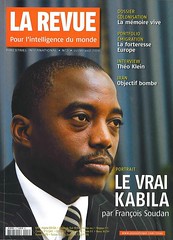
  • Federal Judge Finds N.S.A. Wiretaps Were Illegal

    March 31, 2010

    Federal Judge Finds N.S.A. Wiretaps Were Illegal

    By CHARLIE SAVAGE and JAMES RISEN
    New York Times

    WASHINGTON — A federal judge ruled Wednesday that the National Security Agency’s program of surveillance without warrants was illegal, rejecting the Obama administration’s effort to keep shrouded in secrecy one of the most disputed counterterrorism policies of former President George W. Bush.

    In a 45-page opinion, Judge Vaughn R. Walker ruled that the government had violated a 1978 federal statute requiring court approval for domestic surveillance when it intercepted phone calls of Al Haramain, a now-defunct Islamic charity in Oregon, and of two lawyers representing it in 2004. Declaring that the plaintiffs had been “subjected to unlawful surveillance,” the judge said the government was liable to pay them damages.

    The ruling delivered a blow to the Bush administration’s claims that its surveillance program, which Mr. Bush secretly authorized shortly after the terrorist attacks of Sept. 11, 2001, was lawful. Under the program, the National Security Agency monitored Americans’ international e-mail messages and phone calls without court approval, even though the Foreign Intelligence Surveillance Act, or FISA, required warrants.

    The Justice Department said it was reviewing the decision and had made no decision about whether to appeal.

    The ruling by Judge Walker, the chief judge of the Federal District Court in San Francisco, rejected the Justice Department’s claim — first asserted by the Bush administration and continued under President Obama — that the charity’s lawsuit should be dismissed without a ruling on the merits because allowing it to go forward could reveal state secrets.

    The judge characterized that expansive use of the so-called state-secrets privilege as amounting to “unfettered executive-branch discretion” that had “obvious potential for governmental abuse and overreaching.”

    That position, he said, would enable government officials to flout the warrant law, even though Congress had enacted it “specifically to rein in and create a judicial check for executive-branch abuses of surveillance authority.”

    Because the government merely sought to block the suit under the state-secrets privilege, it never mounted a direct legal defense of the N.S.A. program in the Haramain case.

    Judge Walker did not directly address the legal arguments made by the Bush administration in defense of the N.S.A. program after The New York Times disclosed its existence in December 2005: that the president’s wartime powers enabled him to override the FISA statute. But lawyers for Al Haramain were quick to argue that the ruling undermined the legal underpinnings of the war against terrorism.

    One of them, Jon Eisenberg, said Judge Walker’s ruling was an “implicit repudiation of the Bush-Cheney theory of executive power.”

    “Judge Walker is saying that FISA and federal statutes like it are not optional,” Mr. Eisenberg said. “The president, just like any other citizen of the United States, is bound by the law. Obeying Congressional legislation shouldn’t be optional with the president of the U.S.”

    A Justice Department spokeswoman, Tracy Schmaler, noted that the Obama administration had overhauled the department’s procedures for invoking the state-secrets privilege, requiring senior officials to personally approve any assertion before lawyers could make it in court. She said that approach would ensure that the privilege was invoked only when “absolutely necessary to protect national security.”

    The ruling is the second time a federal judge has declared the program of wiretapping without warrants to be illegal. But a 2006 decision by a federal judge in Detroit, Anna Diggs Taylor, was reversed on the grounds that those plaintiffs could not prove that they had been wiretapped and so lacked legal standing to sue.

    Several other lawsuits filed over the program have faltered because of similar concerns over standing or because of immunity granted by Congress to telecommunications companies that participated in the N.S.A. program.

    By contrast, the Haramain case was closely watched because the government inadvertently disclosed a classified document that made clear that the charity had been subjected to surveillance without warrants.

    Although the plaintiffs in the Haramain case were not allowed to use the document to prove that they had standing, Mr. Eisenberg and six other lawyers working on the case were able to use public information — including a 2007 speech by an F.B.I. official who acknowledged that Al Haramain had been placed under surveillance — to prove it had been wiretapped.

    Judge Walker’s opinion cataloged other such evidence and declared that the plaintiffs had shown they were wiretapped in a manner that required a warrant. He said the government had failed to produce a warrant, so he granted summary judgment in favor of the plaintiffs.

    But Judge Walker limited liability in the case to the government as an institution, rejecting the lawsuit’s effort to hold Robert S. Mueller III, the F.B.I. director, personally liable.

    Mr. Eisenberg said that he would seek compensatory damages of $20,200 for each of the three plaintiffs in the case — or $100 for each of the 202 days he said they had shown they were subjected to the surveillance. He said he would ask the judge to decide how much to award in punitive damages, a figure that could be up to 10 times as high. And he said he and his colleagues would seek to be reimbursed for their legal fees over the past five years.

    The 2005 disclosure of the existence of the program set off a national debate over the limits of executive power and the balance between national security and civil liberties. The arguments continued over the next three years, as Congress sought to forge a new legal framework for domestic surveillance.

    In the midst of the presidential campaign in 2008, Congress overhauled the Foreign Intelligence Surveillance Act to bring federal statutes into closer alignment with what the Bush administration had been secretly doing. The legislation essentially legalized certain aspects of the program. As a senator then, Barack Obama voted in favor of the new law, despite objections from many of his supporters. President Obama’s administration now relies heavily on such surveillance in its fight against Al Qaeda.

    The overhauled law, however, still requires the government to obtain a warrant if it is focusing on an American citizen or an organization inside the United States. The surveillance of Al Haramain would still be unlawful today if no court had approved it, current and former Justice Department officials said.

    But since Mr. Obama took office, the N.S.A. has sometimes violated the limits imposed on spying on Americans by the new FISA law. The administration has acknowledged the lapses but said they had been corrected.

  • Pages From History: Paul Robeson and the Paris Peace Conference of 1949

    INTERVIEW WITH PAUL ROBESON, JNR.

    Paris Peace Conference of 1949

    INTERVIEWER: Roll 10114, interview with Paul Robeson, twelfth of February. Now can you describe for me what it was about your father’s political stance and beliefs in the late forties and his standing as an American and as an actor, you know, that made him a prominent figure and how the sort of grounds, how that changed by the end of the late forties.

    PAUL ROBESON: Dad’s status in American in the 1940s, especially the middle forties, is important to understand in order to figure out what happened later. He was a unique black figure, in the sense that he was a dominant cultural figure and in 1944 he had done Othello, he had established himself as one of the leaders of the American stage, the concert stage, legitimate stage, movie industries, so he was an unprecedented Negro, as they called us then, as we called ourselves then too. As a matter of fact, in 1944 there was the magazine ‘The American’ called Paul Robeson as America’s number one Negro, whatever that means. But in any case, he was viewed not only as a great black artist, but as a great artist and as a spokesperson for black people. When there was the Herald Tribune forum, they called on dad to speak for black America, rather than the head of the NACP. So he was a personal friend of the Roosevelts and so on. So from this immense stature, he challenged really the, you’d have to say, the cultural foundations of racism in America. He would not accept the idea, well, we’ll let you through as a talented individual, don’t worry about all your folks back there, just play the game and everything’ll be fine. He said, oh, no, no, no. Any system that doesn’t give my entire people equal opportunity is not a legitimate system. So from that vantage point of being that popular, of challenging very basic issues, he was controversial in the mid-forties, at the very height of his popularity. Interestingly enough the FBI was busily investigating him, at the same time as being invited to the White House, in some cases unbeknownst to the administration. But in any case, the whole situation changed when the Cold War began and all of a sudden from respected ally, the Soviet Union became the Cold War enemy, the evil empire, Iron Curtain, Churchill’s speech in 1946. And dad continued his challenge to Cold War. He felt that peaceful relations with the Soviet Union were perfectly possible and he continued his attitude of friendship towards the Soviet Union. And that, combined with his, well non-racially correct stance on racial issues, you might say, for the establishment, that was too much. So the combination of those two things made him from everybody’s all-American into, by 1949, as the events we’ll talk about later on will show, America’s sort of enemy-number-one. America’s number one dissident, you might say, America’s Andrei Sakharov, if one wants to make an analogy.
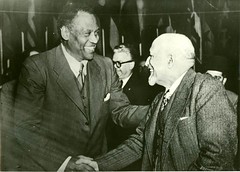
    INT: That’s great. Now you mentioned the FBI surveillance, would you be able to tell me a little bit about you know what you saw of that and, you know, how it affected his life?

    PR: On the FBI surveillance of dad when he was at the peak of his career, what’s interesting is we have a Freedom of Information Act, by which you can request documents from the government, including FBI documents, and I got thousands of them, of course many are missing, a lot of them are heavily edited, but they show that in the early 1940s he was under close surveillance, indeed in 1943, when he was at the peak of his popularity, Hoover illegally placed him on something called the Custodial Detention List, that in an emergency he would be gathered up and put in a concentration camp as a dangerous subversive. This at the same time he’s being invited to the White House. And it was against the law actually and was not cleared by the Attorney General, then the Attorney General in the Roosevelt administration. So Hoover did this… J. Edgar Hoover, head of the FBI did this quite on his own.

    INT: Right. And would you have any sort of evidence at all of FBI, you know, tampering with his car or actually interfering with his concerts, that sort of thing…

    PR: (Interrupts) Later. After the real break came, after the Cold War, I would say beginning of 1948, 1949, he made a tour through the South on behalf of the Progressive Party in 1948 and on the way there, there was a car accident in which he fortunately was not injured, but the left front wheel came off the car. Fortunately, it didn’t swerve, it would have gone into the on-coming traffic, it was on a highway. And there’s little doubt in my mind that the FBI was responsible for it, because the surveillance shows that they had the car under surveillance and the driver under twenty four hour surveillance, so it’s difficult to assume that they didn’t know about the sabotage. So by 1948, the FBI was trying to not only neutralise him, but if an accident happened to him, so to speak, they would be very happy.

    INT: And what was the incident with his passport being withdrawn? Was that a common thing to do to people?

    PR: That’s only after… Actually, that happened in 1950, after the Korean War began, and what led up to it were the incidents in ’48 and ’49 particularly, when dad challenged both the Cold War policies of the US towards the Soviet Union, the US support of colonialism abroad and challenged the treatment of African Americans here at home. As a matter of fact, he told President Truman that if there wasn’t an anti-lynching bill, that African Americans in the South would avail themselves of their constitutional right to armed self-defence and compel military intervention by the federal government. That led to an immense clash, matter of fact, President Truman jumped up and shook his finger at dad and dad simply stood up calmly and waited for Truman to finish, but the Secret Service men on either side of him actually stepped forward and opened up their jackets, showing their 45s. So that was the atmosphere on issues like that. So by then, by the time he lost his passport, he was immensely… probably one of the most controversial people in the United States and already branded as traitor to the country, enemy number one Communist agent, black super militant, everything under the sun. Precisely because of the incidents in ’49 and confrontations like the one with Truman that I described over what was happening to blacks, after they had fought in the Second World War for democracy and came back to the same kind of discrimination.

    INT: Sure. You told me before about the concert series, I can’t remember which year it was in, but there was a whole tour of the United States set up for him to do that concert series and then that was cancelled effectively.

    PR: Actually the most controversial year of dad’s life began in 1949. At the end of 1948, Truman had won the election and dad had backed the Progressive Party, which lost badly, but Truman, President Truman co-opted the domestic programme of the Progressive Party, that’s why he won, instituted FEPC, desegregated the army and so on, combined that with a very aggressive foreign policy, anti-Soviet foreign policy. But dad felt very encouraged at the end of 1948 and he’d taken a year off to do concerts for civil rights causes, union causes and said, well now I feel the danger of Fascism here has averted, has been averted and I’m going to go back to my career and do my concerts and, you know, I’ve done my political stint, I’m going to go back to work. So he had a hundred and some concerts scheduled and was looking forward to resuming his artistic career. Actually, becoming less political, not more political. And it so happened that all of the concerts were cancelled, not because of the concert agency, but because the FBI had literally put pressure on the local agents, threatening them that if they had a Robeson concert, that they, the FBI, in collaboration with local political leaders, would put these agents out of business. So they were intimidated and cancelled dad’s tour. So, he was suddenly under siege. He couldn’t… you know, he couldn’t function as an artist, a artist in the United States. Again, it so happened that that same month, I guess it waJanuary… no around Christmas 1948, he got an offer from a British concert impresario, who invited him with the highest fees ever paid a concert artist to do a European tour, England, Scandinavia, France and so he accepted and interestingly enough, he got his passport and so he left on this tour and there begins the story of the 1949 tour and a peace conference in Paris and the most controversial remarks that my father ever made.

    INT: Right…

    (Interruption)

    INT: Great. So you mentioned the European tour was at that point set up. Can you tell me what happened, just briefly what happened at the Paris concert.

    PR: The Paris Peace Conference was something that dad had planned to go to, he was a member of the World Council of Peace and the gathering was quite controversial, because it was sponsored by the Soviet Union and by pro-Communist and Communist organisations all over the world. But dad had decided to go and actually he went and spoke and sang, because he felt that the Cold War was not inevitable and that there was some way that the West and East could resolve their major differences, particularly since he felt that we were headed towards World War Three. It turned out from later official documents, that he was correct. That in 1949, the US was actually considering Project Broiler, which was an atomic first strike against the Soviet Union, to take them out before they could recover from World War Two and in any event, in a very tense situation, dad, still a very popular artist in the United States and especially all over Europe, including England, went to the conference as a spokesman in the American establishment view, as a spokesman for world Communism, quote unquote. So his appearance there was very controversial and the second aspect was he sang ‘Joe Hill’ and spoke extemporaneously about the progressives in America did not want war against the Soviet Union and so on and so forth, nothing really unusual, accept challenging the foundations of American policy, but nothing seemingly too controversial. What came over the wires was that Paul Robeson said that black Americans would not fight for the United States in a war against the Soviet Union. What’s fascinating about that dispatch is that it turns out from my research that the AP had put the dispatch on the wires as dad was stepping up on the rostrum. So, it appeared in American evening papers before he had any idea that he had been quoted like that and it was made up out of whole cloth, not quite out of whole cloth, they used bits and pieces of speeches he’d made elsewhere on this tour, stitched them together in a way that sounded like his style of speaking, added this phrase, Negroes will not fight for the United States in a war against the Soviet Union and put it on the wires. And immediately the State Department and the machinery of government here spread this Robeson has said thus and so, he’s a traitor to the country and pressured black leaders to denounce him and pledge loyalty to the United States. Many did, some didn’t, but it became issue number one. Paul Robeson, Communist traitor to the US. And dad went on with his tour, went to Oslo and Denmark, to Norway, Denmark, Sweden and with no idea really that this was going on till they called him from New York and said, hey, you’d better say something, that you’re in immense trouble here in the United States. He decided to not make any comment about it till he got back and to make things even tougher, he decided to go on and accept his invitation to the Soviet Union. So in the midst of this he turns up in Moscow and thereby hangs a fascinating tale.