Category: Energy

  • EcoDog Expands as Developer Puts Energy Watchdog in New “Eco-Savvy” Homes

    ecodoglogo
    Bruce V. Bigelow wrote:

    When I had breakfast recently with Ron Pitt, he pointed out that there are only about 100 or so major, investor-owned utilities in the United States—but there are roughly 70 million owner-occupied single-family homes.

    So why, in the name of God’s greenhouse gases, are so many venture-backed startups focused on developing cleantech innovations and smart grid technologies for sale to utilities?

    It’s a rhetorical question, but Pitt has a point. “People keep wanting to turn the smart grid into the next Internet,” he said. “I keep hearing people talk about ‘What is the next killer app?’” But Pitt, who has a lot of experience in software development and in the solar electric market, said there is no open control of the power grid, and the smart grid—unlike the Internet—does not want to be free. As Pitt puts it, “SDG&E [San Diego Gas & Electric] could care less about enabling new technologies that allow entrepreneurs to make money.”

    Pitt’s skepticism may go against the current, especially since the Obama Administration awarded more than $3.4 billion in grants last fall to spur the development of smart grid technologies meant to trim utility bills, reduce blackouts, and promote renewable energy. Most, if not all, of that money went to utility-led projects.

    But as the founding CEO of San Diego-based EcoDog, Pitt has put his money where his opinions are. As we reported last summer, EcoDog’s principal product is Fido, a home energy-monitoring device that …Next Page »


  • Freshly discovered reserves of combustible ice can power China for 90 years

    combustible ice_1

    Eco Factor: Low-emission fuel sources discovered in China.

    China has discovered new sources of frozen combustible ice on the tundra of the Qinghai-Tibet Plateau, which according to researchers can supply China with 90 years worth of energy. The new reserve equals at least 35 billion tons of oil and is one of the newest sources of energy to be discovered.

    (more…)

  • Fuzzy VISION

    Like spreadsheets, open-loop models are popular but flawed tools. An open loop model is essentially a scenario-specification tool. It translates user input into outcomes, without any intervening dynamics. These are common in public discourse. An example turned up in the very first link when I googled “regional growth forecast”:

    The growth forecast is completed in two stages. During the first stage SANDAG staff produces a forecast for the entire San Diego region, called the regionwide forecast. This regionwide forecast does not include any land use constraints, but simply projects growth based on existing demographic and economic trends such as fertility rates, mortality rates, domestic migration, international migration, and economic prosperity.

    In other words, there’s unidirectional causality from inputs  to outputs, ignoring the possible effects of the outputs (like prosperity) on the inputs (like migration). Sometimes such scenarios are useful as a starting point for thinking about a problem. However, with no estimate of the likelihood of realization of such a scenario, no understanding of the feedback that would determine the outcome, and no guidance about policy levers that could be used to shape the future, such forecasts won’t get you very far (but they might get you pretty deep – in trouble).

    The key question for any policy, is “how do you get there from here?” Models can help answer such questions. In California, one key part of the low-carbon fuel standard (LCFS) analysis was VISION-CA. I wondered what was in it, so I took it apart to see. The short answer is that it’s an open-loop model that demonstrates a physically-feasible path to compliance, but leaves the user wondering what combination of vehicle and fuel prices and other incentives would actually get consumers and producers to take that path.

    First, it’s laudable that the model is publicly available for critique, and includes macros that permit replication of key results. That puts it ahead of most analyses right away. Unfortunately, it’s a spreadsheet, which makes it tough to know what’s going on inside.

    I translated some of the model core to Vensim for clarity. Here’s the structure:

    VISION-CA

    Bringing the structure into the light reveals that it’s basically a causal tree – from vehicle sales, fuel efficiency, fuel shares, and fuel intensity to emissions. There is one pair of minor feedback loops, concerning the aging of the fleet and vehicle losses. So, this is a vehicle accounting tool that can tell you the consequences of a particular pattern of new vehicle and fuel sales. That’s already a lot of useful information. In particular, it enforces some reality on scenarios, because it imposes the fleet turnover constraint, which imposes a delay in implementation from the time it takes for the vehicle capital stock to adjust. No overnight miracles allowed.

    What it doesn’t tell you is whether a particular measure, like an LCFS, can achieve the desired fleet and fuel trajectory with plausible prices and other conditions. It also can’t help you to decide whether an LCFS, emissions tax, or performance mandate is the better policy. That’s because there’s no consumer choice linking vehicle and fuel cost and performance, consumer knowledge, supplier portfolios, and technology to fuel and vehicle sales. Since equilibrium analysis suggests that there could be problems for the LCFS, and disequilibrium generally makes things harder rather than easier, those omissions are problematic.

    Some other issues come to light as well. Generally, the spreadsheet is of high quality – it’s peer-reviewed heritage and careful construction shows. I only found one issue that I’d consider to be an outright error, but there are some other weaknesses:

    • Fudge factors are used to make confusing units conversions and sweep model-data inconsistencies under the rug. One is used to “correct” for the fact that vehicle fleet dynamics don’t match data, because the fleet is initialized to zero and loss rates are not calibrated.
    • Possible disparities in data streams (e.g., between reported sales and vehicle registrations) are not addressed. In our experience, closed-loop models reveal data problems more often than not. Uncritical use of data in open-loop models permits data problems to go unchallenged.
    • A number of functional relationships in the model are extremely difficult to understand, even for an expert.
    • While the model captures vehicle miles traveled (VMT) variation across vehicle age cohorts, it does not capture VMT variation over time. Since there have been large changes in VMT since the 70s, this would appear to be a significant omission.
    • The treatment of fuel components and blends is rather inflexible (a better outcome can be achieved with arrays in a more structured modeling environment).

    This inventory could be incomplete, because the spreadsheet model contains generic structure replicated across multiple worksheets. Auditing the structure of one sheet doesn’t guarantee that others are sound.

    The bottom line? From a report we wrote detailing our findings (available on request):

    In spite of the issues above, the model seems generally appropriate to the purpose of accounting for physically feasible pathways that achieve efficiency or intensity goals. It seems obvious, though, that physical feasibility is not sufficient for policy feasibility. To develop workable policies and avoid “can’t get there from here” situations, it would be desirable to have a model that linked changes in new vehicle and fuel shares to driving forces (availability, cost, and other elements of attractiveness). That would mean closing a number of feedback loops that are missing from the tree structure above, including:

    • Effects of the LCFS on the internal taxes and subsidies fuel providers would have to impose in order to balance their portfolios

    • Market clearing for fuels, i.e. effects of fuel prices on supply investment incentives and demand for driving, efficiency, etc.

    • Vehicle manufacturer behavior, particularly the incentive to innovate to create new vehicle platforms in response to potential fuel price and consumer preference developments

    • Fueling infrastructure behavior, similar to the above, and perhaps including a geographic component.

    While the structure and parameters defining some of these feedbacks may be uncertain, ignoring them is not a sound alternative. Omitting feedbacks is to assume that they have zero gain – the one value which we know to be wrong.

    It’s actually quite straightforward to construct an alternative model that captures the same dynamics as VISION, but with greater transparency, efficient and flexible use of arrays, calibration to data, and separation of data and structure. That provides a platform for elaboration and exploration of the missing dynamics. It’s possible to have greater dynamic complexity and a more intuitive model at the same time, because a lot of the detail complexity (like annual vehicle cohorts) really isn’t needed for most purposes. We’ve had a number of interesting conversations around a very simple model of transportation, including only a first-order fleet, refining and import capacity, market clearing through fuel price, road congestion, and the consumer’s decision to drive.

    For a really compelling look at the dynamics of vehicles and fuels, my next installment will take a look at Jeroen Struben’s thesis work.

    while the model captures VMT variation across vehicle age cohorts, it does not capture VMT variation over time. Since there have been large changes in VMT since the 70s, this would appear to be a significant omission
  • St. Vincent & the Grenadines: Drought

    From St. Vincent and the Grenadines, Empath says: “This drought is the longest in my memory.”

  • Really Smart (and Social) Energy: GroundedPower’s System Pinpoints User Motivations to Lower Home Energy Consumption

    GroundedPower
    Erin Kutz wrote:

    These days, it seems there’s nothing that can’t be accomplished by the use of online social communities. Even lowering energy consumption.

    That’s the approach taken by GroundedPower, a Gloucester, MA-based startup that produces a system that monitors consumers’ real-time energy consumption and spurs them with goal-setting and online community engagement to lower that consumption over time.

    The company formed in mid 2008 from the union of a psychologist and educational software developer (CEO Paul Cole), a utility company veteran (president Carl Gustin), and a software engineer who previously helped found an online behavior change program to help smokers quit (VP of engineering Michael Bukhin).

    Monitoring consumer energy usage for information purposes isn’t new. Existing smart grid technology includes intelligent monitoring systems that track the electricity coming from homes. But the point of GroundedPower’s Interactive Customer Engagement System (iCES) isn’t just to tell consumers where and how much energy they’re consuming, but to help them change their behavior in practical ways. The company uses the psychology background its founder Cole to incite consumers to lower energy consumption based on what really makes people tick

    “It became clear that information by itself without helping people to think on what to do about it wasn’t going to help,” Cole says he, and the other founders, discovered when they initially started developing their product. “That brought us to an integrated system where there’s a self-audit capability and social feedback.”

    iCES starts with a monitor on home energy meters, which sends information to a wireless gateway device in the home. The gateway then transmits that information (via Ethernet) to GroundedPower’s online dashboard, which users can access by logging onto the company’s Web portal. Once logged into the system, users can view their energy consumption, set goals, and create profiles to compare their households to others in the iCES user community.

    “Our whole premise is that information alone will not create a persistent behavior change,” says David Rosi, the company’s senior VP of marketing, sales, and business development.

    The energy monitoring system then allows users to set goals for their household energy consumption based on different sets of motivation, such as money, the environment, competition, learning, and encouragement. For those who recognize their main motivation as the dollar, their iCES interface reports their energy consumption and savings to them in terms of monetary value.

    GroundedPower’s system also allows users to track their energy usage based on carbon output or kilowatt hours, to appeal to the environmentally minded. For the competitive types, users can …Next Page »


  • IBM Develops Infinitely Recyclable Plant-Based Plastic [Plastics]

    Earlier this week, IBM researchers announced a discovery that could lead to plastics made from plants instead of petroleum. The new plastics will be more energy efficient, more versatile, and infinitely recyclable (until we move to our space colony). More »


  • LCFS in Equilibrium II

    My last post introduced some observations from simulation of an equilibrium fuel portfolio standard model:

    • knife-edge behavior of market volume of alternative fuels as you approach compliance limits (discussed last year): as the required portfolio performance approaches the performance of the best component options, demand for those approaches 100% of volume rapidly.
    • differences in the competitive landscape for technology providers, when compared to alternatives like a carbon tax.
    • differences in behavior under uncertainty.
    • perverse behavior when the elasticity of substitution among fuels is low

    Here are some of the details. First, the model:

    structure

    Notice that this is not a normal SD model – there are loops but no stocks. That’s because this is a system of simultaneous equations solved in equilibrium. The Vensim FIND ZERO function is used to find a vector of prices (one for each fuel, plus the shadow price of emissions intensity) that matches supply and demand, subject to the intensity constraint.

    Each fuel is characterized by a supply curve around a normal price and quantity point. Fuels have a specified true emissions intensity, as well as a measured emissions intensity. The latter might differ from the former because of uncertainty about indirect emissions, for example. Consumers choose among fuels with a specified cross-elasticity. Emissions and other metrics emerge from their fuel choices.

    A run illustrates what happens when we turn this on:

    base+lcfs

    The top panel shows demand, while the bottom panel shows prices. Groups of bars, from left to right, represent each fuel. Three are fossil-based: gasoline from conventional oil, enhanced-recovery oil, and unconventional oil (Venezuelan heavy or oil sands), with increasing emissions intensity. The next three are bio-based (though they could be anything, really): “conventional” which looks like corn ethanol and improves only modestly on gasoline; “better” which is about 2/3 less emissions intensive (and about like California electricity); “transformative” which has near-zero emissions and costs a lot.

    In the base case, demand is met mostly with fossil oils and some conventional biofuel, because these are the cheapest options. Imposing a 20% emissions cut through an LCFS transforms the market from blue to red. The high-intensity fossil fuels are driven out of the market, and a lot more “better” biofuel gets used. Conventional biofuel demand doesn’t increase a lot because it’s not good enough to contribute a lot to meeting the standard.

    The bottom panel shows how this is achieved: fuel providers have to raise the prices of conventional fuels (to suppress demand) and lower the price of low-emission alternatives. Essentially there’s an internal system of subsidies on fuels exceeding the LCFS, and tax on fuels that don’t meet it.

    When you start exploring the behavior of the LCFS and alternatives like an emissions tax, some interesting features emerge. For example, it’s possible to use a tax to achieve the same total emissions as the LCFS, or the same emissions intensity, but not both at the same time. They’re just different instruments. A tax achieves the same total emissions at a lower cost, but higher intensity, than the LCFS does. The difference between matching emissions ($100/ton) and intensity (over $1000/ton) is huge.

    emissions intensity
    Emissions Intensity

    Demand in a tax-controlled market is also distributed quite differently. The tax raises the price of all fuels, because they all have some emissions. As a result, the alternative fuel market is quite a bit smaller, particularly for “conventional” biofuels that have fairly high emissions intensity.

    taxMkt

    When you add uncertainty, things get even more complicated. Consider, for example, the effect of uncertainty about fuel performance. From a regulator’s perspective, just how good is that cellulosic ethanol? Does it contribute to indirect (market mediated) emissions from deforestation? From a provider’s perspective, what intensity do you think the Air Resources Board will assign your product? The emissions of conventional gasoline are pretty well known, but there’s a lot to argue about when it comes to more exotic alternatives.

    Here’s a histogram of true emissions from tax (red) and LCFS (blue) approaches to control, from some Monte Carlo runs with error in assessing the emissions intensity of each fuel:

    trueEmissions

    Notice that I didn’t manage to exactly match the mean outcomes – it could be done, but I didn’t take the time; I just matched the deterministic outcomes. So, problem number one: a deterministic assessment of the market could be misleading.

    Also notice that the LCFS results in a higher variance in emissions (this is also true for intensity). The LCFS amplifies modest measurement uncertainty into big quantity (demand) uncertainties. Here’s the market for “better” biofuels:

    better

    This has interesting consequences for technology developers. If you’re a provider of a new low-carbon fuel, would you like to have a smaller but more predictable market provided by a tax, or the bigger-on-average market provided by the LCFS, with a heavier left tail of bad outcomes?

    I think there are two classes of insight here. First, the equilibrium model shows that there are all kinds of counterintuitive behaviors arising from the intensity constraint in the LCFS. HH&K suggest clever ways to fix some of those. But it’s also important to step back and look at the big picture: the fuel-vehicle market isn’t in equilibrium. Sure, markets for fuels clear day-to-day, and some fuels (like ethanol and gasoline) can be blended to some extent, and thus are highly fungible. But really, a lot of new ideas (high alcohol contents, plug-in hybrids, CNG, fuel cells) require changes to the vehicle fleet and fueling infrastructure to be coordinated with fuel supply itself.

    In that case, it’s rather silly to look only at the short run equilibrium. It’s essential to consider the vehicle fleet and other capital stocks. The general challenge is that the LCFS is not terribly robust to disturbance in the short run (as the uncertainty results above suggest). If decision makers set aggressive targets, and capital stocks don’t move as expected, the resulting short term equilibrium can be rather extreme. That could lead to unravelling of the whole policy. No sensible politician knowingly takes such risks, so a likely alternative is “safe” standards that don’t achieve as much as a robust policy could.

    We actually extended this model to explore capital turnover for a breakthrough fuel startup, but if I told you the details I’d have to kill you. However, I’ll provide some hints in the next post or two on this topic.


    My model isn’t currently cleaned up enough to distribute, but you can get HH&K’s Matlab code. I have no idea how similar the two are, as I haven’t seen the Matlab code (I built my version from the idea expressed in the abstract of an earlier draft, while stuck in an airport on the way to an LCFS workshop).

  • Q&A on China’s Carbon Intensity Target

    This post originally appeared on ChinaFAQs.org.

    China recently confirmed an ambitious goal to reduce its economy’s carbon intensity by 40-45% from 2005 levels by 2020. WRI’s China Director Zou Ji, a former Chinese climate negotiator, discusses the significance of this step by the world’s largest greenhouse gas emitter, and what it means for China’s relations with the United States and the world.

    Q: Why has China, a developing country, made these ambitious commitments to a clean energy economy?

    China has done so because it is in the country’s own interests. First, China has a huge population that will suffer very much from the negative impacts of climate change. Second, China faces a big energy security problem, and energy savings programs can help to address that problem. Third, actions to reduce greenhouse gases will also reduce emissions of health-threatening pollutants common in China such as sulfur dioxide (SO2) nitrous oxides (NOX) and particulates.

    If U.S. Senators visited China and witnessed the progress being made in the deployment of renewables and more efficient technologies, they would understand how real and important this agenda is to China.

    Q: What is the significance of China’s commitment to the international negotiations on a new climate treaty?

    The fundamental significance is that China’s action will encourage other key countries in the negotiations – the United States, the European Union and the other so-called BASIC countries (India, Brazil and South Africa) to take more constructive steps toward a new global agreement. The Copenhagen Accord is a political agreement. My impression is that China wants to reflect the spirit of the Accord in further negotiations within the two track UNFCCC (UN Framework Convention on Climate Change) process which they hope will result in some kind of legally binding document at the next Conference of the Parties in Mexico in November. However, China’s intensity target also sends a signal that, no matter how the international process plays out, China will be taking domestic action to transition to a low carbon economy.

    Q: What is the significance in terms of U.S. – China relations on climate change?

    China-U.S. cooperation in these areas will be very important for two reasons. First, because these countries are the two biggest greenhouse gas emitters and the largest developed and developing countries, the effectiveness of their actions will be critically important to the world’s efforts to address climate change. Second, because the United States has the most advanced clean technologies and China has a huge market. We need to make the two complementary through bilateral and international cooperation. The United States can help China do more, faster, in a way that will benefit China, the United States, and the world.

    Q: How can the United States and the international community be sure that these commitments will be fulfilled?

    Verifying commitments made by all parties is a matter of trust between countries. There is general agreement that the targets set by developed countries, the nationally appropriate mitigation actions committed to by developing countries, together with assistance in financing, technology and capacity building, must all be subject to monitoring, reporting and verification (MRV).

    But for China, I think U.S. questions about verification have good answers. China is already going down this path – of low carbon development – and will continue to do so, because it is in China’s best interests. Moreover, China is preparing to develop a domestic system for greenhouse gas accounting and statistics. This will be a key step in enhancing the basis of the agreed international process for MRV.

    Q: How will China meet these ambitious targets? What policy signals and measures will be signposts?

    If U.S. Senators visited China and witnessed the progress being made in the deployment of renewables and more efficient technologies, they would understand how real and important this agenda is to China. Energy efficiency measures are being applied in many areas of Chinese life – heating and cooling systems, construction, household appliance codes. Much more money is also being allocated to clean technology development, for example for photovoltaic solar power, electric vehicles, smart grid deployment and carbon capture and storage. The government has shut down many smaller polluting power plants and factories in recent years, and is now considering how to allocate public finance to support the carbon intensity targets, including looking at the feasibility of a carbon tax.

  • Citizens gather in Washington to end ‘mountain bombing’ of Appalachia

    mtr_lobby_week_2010.jpgMore than 200 citizen lobbyists from across the nation gathered in Washington, D.C. this week to urge Congress to pass legislation curbing mountaintop removal. This especially destructive form of coal mining involves blasting off the tops of Appalachian mountains and dumping the waste into headwater streams below, a practice known as “valley fills.”

    Share/Bookmark

    The activists taking part in Alliance for Appalachia’s fifth annual End Mountaintop Removal Week are pressing for passage of two bills — the Clean Water Protection Act (H.R. 1310) and the Appalachia Restoration Act (S.696) — that would reinstate a long-standing regulation under the federal Clean Water Act prohibiting industries from burying streams and other waterways under waste.

    H.R. 1310’s primary sponsor is Rep. Frank Pallone (D-N.J.), and the measure has more than 160 co-sponsors to date. S. 696’s primary sponsor is Sen. Benjamin Cardin (D-Md.), and it has 9 co-sponsors. They include Sen. Lamar Alexander (R-Tenn.), whose state does not allow valley fills.

    Mountaintop removal mining became widely used across Appalachia in the 1970s as a cheaper and less labor-intensive way of extracting coal than traditional underground mining. Today the practice is most common in West Virginia and eastern Kentucky, with utilities in North Carolina and Georgia the nation’s top consumers of mountaintop removal coal.

    The citizen lobbyists heard presentations from a number of activists working to end mountaintop removal. They included Mickey McCoy with Kentuckians for the Commonwealth, who said:

    “They have a lot of soft words for what they’re doing. Like ‘pond’ for slurry. We’re talkin’ 72 acres! That’s a lake. And ‘spill.’ ‘Spill’ is what happens when your son reaches over the table and spills his sister’s milk. These are floods. Even mountaintop removal doesn’t sound too bad if you say it real fast. They should really be calling it ‘mountain bombing.’”

    The D.C. gathering comes as the Obama administration — which has promised to take “unprecedented steps” to curb damages from mountaintop removal — announced that it was delaying the release of guidelines for mining companies seeking valley-fill permits. Originally scheduled for release this week, the guidelines are reportedly going to come out next week, the Charleston Gazette reports.

    In a question-and-answer session following a speech she delivered on Monday at the National Press Club, EPA Administrator Lisa Jackson noted that while her agency does not have the authority to regulate mining practices, it does have authority over how those practices affect water quality.

    The same day as Jackson’s speech, a group of anti-mountaintop removal activists including Upper Watauga Riverkeeper Donna Marie Lisenby with North Carolina-based Appalachian Voices met with EPA staff at the agency’s headquarters. The activists came bearing gifts: black water from Appalachian streams poisoned by coal mining.

    Here’s a video from iLoveMountains.org with more information about this week’s action:

    (Photo from iLoveMountains.org.)

  • Mexico faces future of imports as production dries up

    Greenwire: Mexico’s long-celebrated national oil company — Petróleos Mexicanos, or Pemex — could end up burdening the country as domestic oil production slips.

    After being one of the world’s top oil exporters, Mexico may need to begin importing oil before the end of the decade. The loss of Mexico could spell trouble for the United States, since Mexico provides about 12 percent of crude oil imports.

    “As you lose Mexican oil, you lose a critical supply,” said Jeremy Martin, who directs the energy program at the Institute of the Americas at the University of California, San Diego. “It’s not just about energy security but national security, because our neighbor’s economic and political well being is largely linked to its capacity to produce and export oil.”

    The reason for the decline: Mexico’s once-rich fields are drying up. The large Cantarell field has seen its output drop by 50 percent in recent years. Meanwhile, Pemex is having difficulty devising a way to get to the oil-rich pockets under the Gulf of Mexico, potentially the largest untapped underwater source on the planet. The government has been reluctant to bring in a foreign company to help with the drilling, though Pemex was given more leeway to negotiate with foreign companies two years ago. President Felipe Calderón has been more focused on passing as many oil reforms as possible, even as they are challenged in court.

    Pemex employs about 140,000 people and is seen as the country’s most important company. Oil money funds most projects, including school construction and the war on drugs. However, the national pride that comes with owning an independent oil company may have to be set aside for a partnership with a foreign firm to get the expensive equipment needed to drill into the gulf. Even that will require a rewriting and reinterpretation of constitutional language barring foreign firms from booking Mexican oil fields (Krauss/Malkin, New York Times, March 8). – JP

  • NW Energy Angels Names Director

    Gregory T. Huang wrote:

    Seattle-based Northwest Energy Angels announced today it has hired Margo Shiroyama as its new executive director. Shiroyama is a veteran of the Washington Technology Industry Association, Northwest Entrepreneur Network, enterpriseSeattle, and the Washington Biomedical Device Innovation Zone. Martin Tobias and Jeff Morris founded Northwest Energy Angels in 2006. The angel group provides early-stage capital to cleantech entrepreneurs and helps connect investors with promising startups. Its members have invested a total of more than $2 million in 16 companies.


  • Helix Wind Replaces CEO

    Bruce V. Bigelow wrote:

    San Diego’s Helix Wind (NASDAQ OTC Bulletin Board: HLXW), which makes vertical-axis wind turbines, today named Scott Weinbrandt, the president and board chairman, to replace co-founder Ian Gardner as CEO. Gardner also resigned from the company’s board, along with another director, Gene Hoffman. In its statement, Helix Wind also says it also has been in discussions with an investor to complete a financing of up to $1 million to be used for general working capital needs and for professional fees.


  • Clean Energy, Mass Transit Far More Popular than Nuke Plants and Oil Drilling

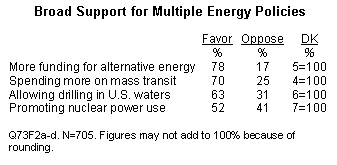
    Last week, Pew released a survey with the headline ‘Support for Alternative Energy and Offshore Drilling.’ The piece begins, “The public continues to favor a wide range of government policies to address the nation’s energy supply…”

    That is accurate, but it doesn’t get at the most striking data. The most important finding in the survey is the fact that clean energy and mass transit investments are vastly more popular than nuclear investments and offshore drilling.

    Here is how Pew presents the data (Figure 1):

    As a mini-case study on how informational graphics can add significant meaning to this sort of data, I’ve created a few simple charts.

    This chart (Figure 2) shows the approval and disapproval numbers for the four policy options:

    And this chart (Figure 3) shows the net approval numbers for the four policy options…

    Presenting the information in text only format, as Pew chose to do in Figure 1, leaves the reader to their own devices to identify the most compelling data. While the data is technically accurate, it fails to bring the meaning of the data to the forefront. Pew’s accompanying analysis of the polling data also somehow fails to identify the massive gap in net approval for the policies they surveyed.

    Creating a simple chart (Figure 2) based on the data itself adds significant value to the presentation of the data, especially for the casual reader. The reader can tell at a glance that clean energy investments are significantly more popular than polluting energy sources, and that unpopularity follows the opposite pattern.

    Going one step further and doing simple arithmetic to determine the net approval for each of the policies in the survey, as I’ve done with Figure 3, brings the most striking data to the forefront. The fact that more than 50% of Americans support a variety of policies to produce-more or consume-less energy is not, in itself, especially meaningful. But the fact that the net approval for some of these policies is 40-60%, while it is barely 10% for others, is fairly compelling.

    Originally posted at EnviroKnow.

    Tags: , , , ,

  • A123 Nabs Navistar EV Deal

    Ryan McBride wrote:

    A123 Systems (NASDAQ:AONE) reports today that it will supply its advanced lithium-ion battery systems for Warrenville, IL-based Navistar, which plans to use the batteries in electric trucks it is developing in a joint venture with Tokyo-based Modec. Watertown, MA-based A123 says that it expects to manufacture the batteries for the Navistar (NYSE:NAV) vehicles at its plant in Livonia, MI, which is due to open this month and begin production in the second half of this year.


  • Blanche Lincoln’s Army of Lobbyist Disciples

    It’s been obvious for some time that Sen. Blanche Lincoln (D-Ark.) was unlikely to support comprehensive climate legislation. What wasn’t clear was the extent of her influence, which, according to a new report by the Sunlight Foundation, goes well beyond her single vote in the Senate:

    Six of Lincoln’s former staffers currently lobby for interests invested in influencing carbon capping legislation. These interests include oil & gas trade groups, agriculutural [sic] companies, the airplane industry and biofuel and bioenergy firms. […]

    The most influential of Lincoln’s former staffers is Kelly Bingel, a lobbyist for Mehlman Vogel Castagnetti. Bingel is a former chief of staff to Lincoln and has been called “Sen. Lincoln’s alter ego.” Bingel’s clients include two incredibly powerful organizations opposed to carbon capping: the American Petroleum Institute (API), the lead trade group for the oil industry, and Koch Industries, one of the largest oil manufacturing, trading and investment companies in the country.

    One of the two owners of Koch Industries is David Koch, who has taken credit for sponsoring much of the Tea Party movement — whose adherents are no great supporters of climate legislation. Other former Lincoln staffers now lobby on behalf of the anti-cap-and-trade USA Rice Federation, the utility-advocacy Edison Electric Institute and the agricultural giant Monsanto. (The latter two have voiced support for climate legislation, but have sought to secure favorable terms for their industries.)

    Need further evidence of the massive Lincoln-lobbying-industrial complex? According to Sunlight, Lincoln’s the top recipient of campaign funds from the oil and gas industries and a variety of agricultural industries.

    Of course, given the entrenched history of close ties between lobbyists and the Hill, none of this should come as a surprise — but it does serve as a reminder of the powerful forces environmental advocates are up against.

  • The Smart Grid is Coming! What’s a Smart Grid?

    SDG&E Smart Meter
    Bruce V. Bigelow wrote:

    Several hundred utility executives, government regulators, and engineers have gathered in downtown San Diego this week for a three-day conference that is focused on what may be the utility industry’s biggest paradigm shift since the Tennessee Valley Authority electrified the Southeastern United States.

    The only problem is that it’s the biggest paradigm shift that people have never heard of.  A Harris Poll recently highlighted the fact that U.S. utilities have committed billions of dollars to upgrade the electric grid by installing new “smart meters” in homes and businesses. But the Harris Poll shows about two-thirds of Americans (68 percent) have never heard the term “smart grid” and 63 percent don’t know what a smart meter is.

    So for at least some people, you got it here first: Instead of merely tracking how much total electricity (or gas, or water) a customer uses each month, a smart meter tracks a customer’s usage continuously throughout the day and uses wireless technology to automatically transmit the data in real time to the utility. This automated meter reading technology makes it possible for regulators to set prices that vary at different times of day—and which encourage or discourage consumption—based on the relative cost of power production and periods of peak energy demand. As the Harris Poll shows, if the price of electricity changes according to how much it actually costs to produce, three out of four people want to be able to see and control how much electricity they are using.

    So why are smart meters a big deal? And why should technology innovators care? A few highlights from the “Metering America” conference are in order:

    —In California, the big three investor-owned utilities are in the process of deploying 12 million smart meters, covering about 80 percent of the state’s population at an estimated cost of $4.5 billion, according to Commissioner Nancy Ryan of the California Public Utilities Commission. Ryan told the “Metering America” conference that utility rates based on time-of-day pricing related to the cost of producing electricity must be coupled …Next Page »


  • Heat-Channeling Carbon Nanotubes Produce 100 Times More Energy than Li-ion Batteries [Nanotubes]


    Johnny Cash can’t have known about carbon nanotubes when he sang about rings of fire, but MIT scientists have shown how they can create electrical current—about 100 times as much energy per unit of weight as lithium-ion batteries.

    The new experiments involved nanotubes, or submicroscopic structures just a few billionths of a meter in diameter, that can conduct both electricity and heat. Engineers coated the nanotubes with reactive fuel that produces heat by decomposing, and then ignited it with laser beams or high-voltage sparks.

    That set off a fast-moving heat wave that traveled through the nanotube’s hollow cylinder 10,000 times faster than in the reactive fuel itself, and reached a temperature of 4,940 degrees F (3,000 Kelvin). The fast-moving heat also pushed electrons along the tube and created a noticeable electrical current.

    Such combustion waves were studied mathematically for a century, according to Michael Strano, a chemical engineer at MIT. Strano first predicted that a nanotube or nanowire could channel the heat pulse and create electrical current, but now his group has realized that prediction.

    Some semiconductor materials can also produce an electric current when heated, but the carbon nanotube experiments defy predictions by thermoelectric calculations. Strano noted that the heat wave seemed to carry along electrons or other electrical charge carriers, not unlike how an ocean wave can pick up debris.

    The possibility of creating substantial energy on such a tiny scale could lead to new ultra-small electronic devices the size of rice grains, whether for implantable medical chips or other tiny sensor applications.

    Strano’s MIT group plans to continue improving the efficiency and cut back on wasted energy given off as heat and light. Strano also suggested that a different reactive fuel coating for the nanotubes might produce alternating current — an intriguing contrast to current energy-storage systems that all produce direct current.

    [MIT]


  • Skies cloudy for solar energy in 2010

    The sun is setting on solar energy companies, at least if you ask J.P.Morgan, which has downgraded several businesses in the sector.

    Christopher Blansett, analyst with J.P.Morgan, said in a note to clients Tuesday that demand for solar installations around the world will decline in the second half of 2010.

    "Our updated global solar demand model calls for about 7.5 gigawatts of installations in 2010 with our work suggesting 4.5GW of this coming in the first half of the year … As solar stocks have historically traded in-line with volume demand, we view this as a particularly negative indicator for the group," he said.

    He also warned that companies were aggressively expanding capacity to chase market share, which could lead to an oversupply of as much as 3-4GW.

    Instead, Mr. Blansett recommends long investors look into LED and wind sectors, which have "better underlying fundamentals" over the next year.

    After reviewing the sector, Mr. Blansett has downgraded First Solar Inc. and Energy Conversion Devices Inc. to Underweight from Neutral, and Evergreen Solar Inc. to Neutral from Overweight.

    He's also slashed the price target for First Solar  to US$85 from US$140, Energy Conversion Devices to US$6 from US$15, and withdrawn the US$5 target for Evergreen without posting a replacement figure.

    Mr. Blansett maintains a Neutral rating on Ascent Solar Technologies (to US$5 from US$9.50), an Underweight on MEMC Electronics Materials (US$12), and an Overweight on Applied Materials, Inc. ($16).

    Eric Lam

  • Senate Primacy and the Meaninglessness of Waxman-Markey

    Over at Mother Jones, Kate Sheppard asks a good question: Was the Waxman-Markey energy and climate bill, debated ad nauseum and eventually passed by the House last June, just a waste of time? After all, the tripartisan Senate group now crafting similar legislation has decided to drop cap-and-trade — the central provision of the House measure — from the eventual Senate bill, which will be significantly less aggressive in combating climate change.

    The answer, I think, is something approaching “yes,” although probably for broader reasons than Kate implies in her piece. The real issue at hand is the fundamental weakness of the House vis-à-vis the Senate. Last spring, when we were all obsessing over every detail of the climate debate in the House Energy and Commerce Committee, I think we didn’t quite appreciate just how subordinate the House had become to the Senate, for the simple reason that we hadn’t yet seen the health care sausage-making play out.

    Now it seems clear that if health care is to pass at all, House liberals will be forced to swallow their pride and pass a much less progressive Senate bill verbatim, even if there’s room for some smallish changes via reconciliation down the line. Likewise with climate legislation: For all the weeks and months of work that went into producing — and whipping the votes for — the Waxman-Markey bill, the liberals in the lower chamber will almost certainly have to bite the bullet and pass something resembling whatever eventually comes out of the Senate (if anything).

    One has to wonder when the House will lose its desire for vigorous debate over its bills — given that they’re likely to be supplanted by their Senate counterparts — and when we in the media will stop devoting so much ink (or so many pixels) to House debates that are likely to be rendered close to meaningless. I know I, for one, feel a bit silly for having spent so much time scrutinizing every compromise that threatened to undermine the efficacy of the Waxman-Markey bill, now that they all seem just about moot.

  • France’s Sarkozy calls for new era of nuclear power

    Greenwire: French President Nicolas Sarkozy today called on international development agencies to begin financing nuclear power projects in the developing world, saying such projects have been unfairly ignored in the past.

    “I can’t understand why nuclear power is ostracized by international finance,” he said. “It’s the stuff of scandal.”

    Agencies like the World Bank, the European Bank for Reconstruction and Development and others must make civilian nuclear uses a priority, he said in welcoming delegates from 60 nations to a two-day conference promoting peaceful uses of nuclear energy.

    France has the world’s second-largest nuclear power sector, supplying 75 percent of its electricity. The state-owned nuclear firms, EDF and Areva, are both major players in developing next-generation nuclear plants.

    Sarkozy will advance France’s spread of the technology — and the lucrative contracts that may follow — by creating an International Institute of Nuclear Energy, which will include an international nuclear school, he added (Jean-Louis de la Vaissiere, AFP/Yahoo News, March 8). – PV