Category: Energy

  • Google Buys DocVerse, Madrona Backs ShopIgniter, ISB Gets Mystery Gift, & More Seattle-Area Deals News

    Gregory T. Huang wrote:

    In the week since Google’s acquisition of Picnik, the Northwest deals scene came back to earth a little bit. But there was a decent amount of activity in software, Internet, mobile, and cleantech, much of it from Oregon-based companies.

    —Seattle’s Institute for Systems Biology received a five-year, $6 million gift from a venture capitalist in California who wishes to remain anonymous, as Luke reported. The cash will be used to help the Institute move to a new facility that’s twice as large as its current location, recruit new faculty, and support research on personalized medicine, biofuels, and global health.

    DocVerse, the collaborative-document software startup that was founded in Seattle but moved to San Francisco in 2008, was bought by Google for an undisclosed price. The startup’s technology might help Google Docs work (or compete) better with Microsoft Office. DocVerse was started in 2007 by former Microsofties and MIT alums Shan Sinha and Alex DeNeui.

    —Portland, OR-based DeltaPoint won $170,000 in angel investment capital at an annual Oregon Entrepreneurs Network startup competition. The company is developing diagnostic software that performs “virtual biopsies” on suspected cancers.

    —Medford, OR-based UpWind Solutions raised $10 million in Series B funding, according to an SEC filing. The investors weren’t disclosed, but the form lists Michael Linse of Kleiner Perkins Caufield & Byers and Mark Lewis of MissionPoint Capital as directors of the company. UpWind provides operations and maintenance services for utility-scale wind projects

    —Bellevue, WA-based Ignition Partners participated in a $23 million growth equity round for San Francisco-based Cloudmark, a mobile-messaging security firm. The round was led by Summit Partners and joined by Nokia Growth Partners, both new investors.

    —Scott Kveton, the co-founder and CEO of Portland-based mobile startup Urban Airship talked about his company’s recent funding round from True Ventures and Founder’s Co-op. But even more interesting was his account of his team’s guerrilla marketing tactics (involving donuts and danishes) outside the Apple Worldwide Developers Conference last summer, which helped Urban Airship connect with customers early on.

    —Portland-based ShopIgniter scored $3 million in Series A funding led by Madrona Venture Group in Seattle. Former Madrona venture partner Matt Compton has become ShopIgniter’s CEO, and Madrona co-founder and managing director Tom Alberg has joined the company’s board. ShopIgniter started in 2008 and is looking to meld the worlds of commerce and social media in a new way.

    —Seattle-based Vulcan Capital, Paul Allen’s venture outfit, participated in a $15 million Series E round for Audience, a Mountain View, CA-based voice processing semiconductor firm. New Enterprise Associates, Tallwood Venture Capital, and VentureTech Alliance also participated in the funding. The round follows another infusion of $15 million about a year ago.


  • Fallbrook Reveals Development Deal

    Bruce V. Bigelow wrote:

    San Diego’s Fallbrook Technologies, which is developing a new and more-efficient design for a continuously variable transmission, says today it has signed an agreement with Hodyon of Austin, TX, for joint development of a new air conditioner compressor for medium and heavy-duty vehicles. Financial terms of the agreement were not disclosed. Fallbrook says its deal with Hodyon is part of its broader effort to develop its technology for alternators, air conditioner compressors, and other automotive accessory drives.


  • The World Bank Eskom Support Program

    South Africa’s plans for a new coal power plant bring up difficult decisions for the World Bank.

    Please contact Smita Nakhooda (snakhooda@wri.org) or Davida Wood (dwood@wri.org) for further information.

    The prospect of a $3.75 billion World Bank loan to support the Medupi Supercritical coal plant in South Africa has raised questions about the future of development assistance in a warming world. The coal plant, part of the national South African utility Eskom’s program to expand generation capacity, is expected to provide 4,800 MW of electricity. Construction of the plant has already begun, and contracts for key components have been signed. Yet Eskom’s longer-term electricity expansion program may have problematic implications for environmentally and socially sustainable development in South Africa. There are trade-offs between increasing South Africa’s electricity generation capacity and reducing its greenhouse gas emissions (as laid out in the country’s national Long-Term Mitigation Scenarios) that must be reconciled. Electricity planning processes to date, however, have been neither transparent nor inclusive.1 The assumptions that coal is the most viable long-term option for South Africa need to be revisited through open, fact based debate on all available energy options.

    An Urgent Need for Energy

    South Africa has been in the middle of an electricity crisis since 2008: demand significantly exceeds supply, in a marked turn of events for a country that was once awash in cheap electricity. Major investments in new electricity generation have not been made since the 1980s.

    The Medupi coal plant for which World Bank funding is sought was originally just one of more than five large scale coal plants that Eskom proposed to build as part of a large capacity expansion program to stop the gap. Eskom and the Department of Energy (DoE) proposed the core elements of this build program in a draft 20-year Integrated Resource Plan (IRP) for the electricity sector in September 2009. At the end of last year, the government approved an interim five year IRP plan, pending consultations on a longer term plan for the sector, recognizing the need to address the longer term implications of electricity development.2

    Questioning Conventional Assumptions

    The full costs and benefits of the options for meeting near and long term energy needs must be considered more carefully than in the past. Eskom’s projections of 80,000 MW of future demand for electricity by 2028 are debatable. Historically, electricity planners –and Eskom in particular– have been overly optimistic about these projections to justify new investments in infrastructure.3 Financing a massive capital expansion program is certainly not cheap in the immediate term: after Eskom originally requested a 45% per year increase in the price of electricity over three years, the National Energy Regulator of South Africa allowed it an increase of approximately 25% per year between 2010 and 2013.4

    All base-load electricity options pose risks, and may have hidden costs. The draft IRP emphasized these risks for low carbon options such as renewable energy, without acknowledging the risks of continued dependence on coal fired power.5 There is limited transparency about the terms on which Eskom contracts coal, and the costs of coal have been escalating.6 Interruptions in coal supply caused by transport failures and weather events have shown that coal plants are also not always reliable.7

    In addition, the operation of large coal fired power plants is enormously water intensive in a country where water scarcity is a pressing environmental challenge. Acid drainage from mining already poisons many of the country’s water systems, and restoring water ecosystems is costly.8 When the implications of climate change are also factored in, the viability of conventional coal in the long term looks far less certain.

    While the importance of reliable electricity supplies to support economic development and reduce poverty has been central to the rationale for the Eskom program, there has been little emphasis to date on how to meet the enduring challenge of extending access to electricity to the 30% of South Africans who still lack it.

    Difficult Decisions for the World Bank

    A broad based coalition of local civil society groups within South Africa, and global NGOs are voicing their opposition to the World Bank’s support for the Medupi power plant. They have called in particular on the US government, the largest shareholder of the World Bank, to withhold support for the project, referencing the government’s new policies which suggest that coal should only be supported as an option of last resort.

    The role of the World Bank in the energy sector has been complex and controversial. It has a history of financing mega-infrastructure projects that raise significant environmental and social risks, and supporting private sector oriented reforms that have delivered limited social or environmental benefits.9 Attention to environmental considerations in its energy sector lending, particularly climate change, has been uneven.

    At the same time, the Bank is interested in financing climate change activities in developing countries, and positioning itself as a lead low carbon growth support agency. The US $6.3billion Climate Investment Funds (CIFs) that it administers on behalf of the Multilateral Development Banks (MDBs) represent a pilot effort to explore this space.

    Last year, the Clean Technology Fund (CTF) of the CIFs committed US$500 million to support renewable energy and energy efficiency in South Africa. The concentrating solar thermal plant and the wind farm included in the 2009 electricity IRP will be largely financed by the MDBs. These will be the first large-scale renewable energy facilities to come onto South Africa’s grid.

    The World Bank also has supported ongoing technical assistance efforts to support renewable energy and energy efficiency programs, and is presently financing the South Africa’s DoE to develop a white paper that will shape future policy on renewable energy.

    A Need for Transparency and Debate

    The underlying problem is that there has been little transparency or public debate of the assumptions that underpin long term plans for how to meet energy needs within South Africa. While the draft IRP developed by Eskom and DoE is referenced extensively in the report of the World Bank expert panel, it has never been officially publicly disclosed in South Africa, though it was leaked to the media earlier this year.10

    A bigger problem is that the electricity IRP should be informed by an Integrated Energy Plan that sets a macro framework for the entire energy sector in South Africa. Public participation in the development of the Energy Plan is required in the 2008 National Energy Act. So far, no Integrated Energy Plan has been developed. Transparency and public participation are especially crucial when such long term investments that affect public interests are being made, and consumers and taxpayers pay the bills.

    The realities of climate change require the World Bank to support countries to seriously consider every possible alternative to carbon intensive coal power as they make decide how to meet their energy needs. In the context of the Eskom Support Program, the World Bank must recognize the limitations of the decision-making processes to date, and support improvements in governance.

    Policy and regulatory frameworks that better manage the environmental and social externalities of conventional energy technologies are needed. The capacity of institutions to weigh the options, and implement effective low carbon programs must be supported. Creative approaches to enhance technical capacity as well as accountability for impact are also necessary.

    If the World Bank is to support developing countries to transition to a sustainable energy future, and to be a credible actor in channeling climate finance, what role can and should it play in supporting conventional technologies? These are difficult decisions that all its shareholders will need to weigh carefully.

    This article builds on the research findings of the Electricity Governance Initiative South Africa Assessment, coordinated by Idasa, in collaboration with a wide cross section of civil society and research institutions in South Africa including WWF-South Africa, the International Labour Research Group, Earthlife Africa, the Energy Research Center at the University of Cape Town, the Democratic Governance and Rights Unit of the Faculty of Law of the University of Cape Town, Sustainable Energy Africa, and the Green Connection. The assessment considered transparency, public participation, accountability and capacity in policy and regulation of the electricity sector in South Africa and is available online at http://electricitygovernance.wri.org

    The Electricity Governance Initiative is a global effort to bring civil society, government, and other sector stakeholders together to improve transparency, inclusiveness and accountability in decision-making to support sustainable energy choices. WRI (USA) and Prayas Energy Group (India) coordinate the Initiative which is active in India, Indonesia, Thailand, the Philippines, Central Asia, Brazil, and South Africa.


    1. The Electricity Governance Initiative in South Africa: Shedding a Light on the Power Sector, Idasa, February 2010. 

    2. Department of Energy Notice No. 1243, Electricity Regulation Act 2006: Determination regarding the Integrated Resource Plan and new Generation Capacity. 31 December 2009. See also unpublished Draft Integrated Resource Plan for Electricity in South Africa, 23 September 2009 available at http://www.mg.co.za/article/2010-01-08-eskoms-secret-tariff-plan-revealed 

    3. For example, Eskom capacity expansions in the 1970s and 1980s were premised on projected electricity growth demand rates of more than 7%, whereas the actual growth that ensued was on the order of 2% – 4%, resulting in a significant electricity surplus. See Andrew Marquard, The Origins and Development of South African Energy Policy, University of Cape Town, Jan 2006. p168. Also echoed in the comments of former Chairman of the Eskom Board Bobby Godsell to the National Press Club of Cape Town on 26 Feb 2010. 

    4. Eskom later scaled its request back to 35% in November 2009. Eskom was previously allowed an interim price increase of 31% in June 2009.While the tariff increases have been unpopular and their economic impact remains to be seen, they may represent a move towards more cost reflective tariffs, and may create an additional incentive for greater efficiency. 

    5. Draft Integrated Resource Plan for Electricity in South Africa, 23 September 2009: See table 7. 

    6. Eskom, Proposed Revenue Application Multi-Year Price Determination 2010/11 to 2012/13, September 2009 http://www.nersa.org.za/documents/electricity/TransnetPriceI… ; Eskom Revised Eskom Revenue Application Multi-Year Price Determination 2010/11 to 2012/13, November 2009. http://www.nersa.org.za/documents/Home/WelcomeNote/EskomMultiYearPriceDetermination.aspx 

    7. For example, ‘Anglo Closes 3 South African Coal Mines due to Rain’, Reuters, March 2008. 

    8. Mariette Liefferink “The true cost of coal: Price escalations, land grabs and water shortages” in The New Nexus of Power and Accountability in Energy, Institute for Security Studies, November 2009. 

    9. Navroz Dubash, ed. Power Politics – Equity and Environment in Electricity Reform, WRI, 2002. See also internal evaluations such as World Bank, Private Sector Development in the Electric Power Sector: A Joint OED/OEG/OEU Review of the World Bank Group’s Assistance in the 1990s, July 2003. Available at http://www-wds.worldbank.org/external/default/WDSContentServer/WDSP/IB/2003/08/19/000090341_20030819104810/Rendered/PDF/264270UG0PGD.pdf 

    10. Eskom’s Secret Tariff Plan Revealed. 8 Jan 2010, Mail and Guardian. http://www.mg.co.za/article/2010-01-08-eskoms-secret-tariff-plan-revealed 

  • MIT researchers produce electricity from carbon nanotubes

    carbon nanotubes electricity_1

    Eco Factor: Generating electricity from carbon nanotubes.

    A team of scientists at MIT have discovered a new way to generate electricity using carbon nanotubes. Described as “Thermopower Waves,” the new phenomenon can cause powerful waves of energy to shoot through carbon nanotubes. Like a collection of flotsam propelled along the surface by waves traveling across the ocean, it turns out that a thermal wave traveling along a microscopic wire can drive electrons along, creating an electrical current.

    (more…)

  • Road Train Autopilot Saves Money, Would Mercifully Restore Driving-While-Texting [Road Train]

    It was only a matter of time before some compulsive texter found a way to get text messaging and driving together again. Called the Road Train, it’s mean to save fuel, but we know it’s true purpose, don’t we? [BBC]

    The Road Train is based on drafting, that age-old technique that NASCAR drivers use to make passing easier and that those suicidal Mythbusters proved was legit when they coasted 10 feet behind a big rig at constant velocity.

    In this case, however, the system is automated. Cars opt in and opt out at the driver’s convenience, forming a moving, amorphous “train” of vehicles that maintain constant speed and distance form one another thanks to software.

    Unlike many cool ideas/concepts, this one is actually being tested, right now, in Europe by Ricardo UK.

    The three-year trial will see seven wireless-linked vehicles traveling the continent as part of an attempt to achieve a 20% fuel consumption reduction per vehicle. Reduced travel times and congestion are also goals.

    And don’t forget texting. We may soon return to a world where texting while driving is just obnoxious, not deadly, as it is today. [BBC via Treehugger]


  • Drought in Philippines Forces Blackouts

    Low reservoir levels have caused several hydroelectric plants to shut down or cut operations in the Southeast Asian country.

    Philippines’ President Gloria Arroyo declared a power crisis in the southern island of Mindanao because hydroelectric plants are providing only half of the electricity demanded in the area, the Manila Times reports.

    “Capacities of hydroelectric power plants continue to be limited in Mindanao due to a very low water inflow to their reservoirs brought about by El Niño,” a spokesperson for National Grid Corp, which oversees electrical transmission, told the Manila Standard Today.

    Luzon, the country’s largest island, is also starting to be affected by the drought. The Magat hydroelectric plant stopped operations on Thursday because of low reservoir levels, and several other facilities were forced to curtail operations, according to MST.

    The capital city of Manila, which is located on Luzon, was subjected to hour-long rolling blackouts Thursday, as were cities in seven neighboring provinces.

    To increase generating capacity, Arroyo would need Congress to pass a special resolution that grants her emergency powers through the Electric Power Industry Reform Act of 2001, which deregulates electrical supply.

    Emergency powers would allow the government to lease large generating units and enter into short-term power supply contracts with two diesel plants, the Manila Times reports.

    But some politicians say that government provision of electricity would be a regression.

    The government should let private companies provide the power with rate regulation from the Department of Energy, Liberal Party campaign manager Florencio Abad told the Philippine Star. Others critical of the administration say the power outages are the result of Arroyo’s poor planning during her decade-long rule.

    “This is criminal negligence,” said Sen. Benigno Aquino III to the Philippine Star. “We know that El Niño was going to visit the country. [The national government] knew that Mindanao was going to have a power supply problem. They should have mapped out a plan earlier on.”

    Both the climatic conditions and the criticisms of the government echo the current situation in Venezuela. Reservoirs levels there have fallen to critical levels, causing power rationing and periodic blackouts.

    Such risks occur when countries rely heavily on hydroelectric power without adequate backup generating capacity.

    Source: Manila Times, Manila Standard Today, Philippine Star

  • Coffee-Powered "Carpuccino" Infuriates Car Lovers, Coffee Lovers, Pun Lovers [Cars]

    Point: As my fellow Jalopnik readers would agree, the thought of an au-to-MO-bile running on some coffee beans is equally laughable and insulting. Counterpoint: As my fellow coffee drinkers would agree, this is an utter disgrace to our holy bean.

    Countercounterpoint: Carpuccino? Really?

    A while ago we read that coffee-based biofuels were feasible. Knowing the internet as we do, we figured it was only a matter of time before somebody took that novel possibility and turned it into an absurd reality. We were right! The Carpuccino, a 1988 Volkswagen Scirocco modified to run on ground coffee, will drive 210 miles between Manchester and London in the coming weeks.

    The trip will require over 150 pounds of coffee, with the car getting a mileage of roughly 1.4 miles per pound. The vehicle can hit speeds of 60mph, though the trip could take as long as ten hours, as the car has to stop every 60 miles to clean out its coffee filters (seriously).

    The joke on wheels was built by the BBC1 show Bang Goes The Theory as a reminder that unconventional fuels can power vehicles. Sidebar: the Carpuccino’s trip will cost up to 50 times as much as it would if it were running on gas.

    All that being said, I think we can agree to set aside whatever qualms we may have with the Carpuccino in light of its similarities, aesthetic and otherwise, to Doc Brown’s Mr. Fusion-equipped DeLorean from Back to the Future II.

    Espresso? Where we’re going we don’t need espresso. [Daily Mail via Green Diary]


  • East Timor: Oil wealth and national survival

    East Timor possesses only 0.04% of the world's known oil reserves – with its known reserves around only half of those of Brunei, according to one estimate. But for a small, poor nation of roughly 1 million people, this is still very significant.

    When the country gained independence in 2002, revenues were already streaming into Timorese coffers from the area south of the island called the Timor Gap. Even though Australia and East Timor have yet to agree on final maritime boundaries, the oil coming from Timorese oil fields is already the country's greatest source of revenue. (There is also yet-to-be-exploited natural gas in the Timor Gap.)

    Image by SkyTruth shared under a CC license

    Image by SkyTruth shared under a CC license

    Donors and Timorese leaders were keen to prove that petroleum resources could be a blessing and not a curse, calling in experts from Norway to learn from that country's famous Sovereign Fund.

    The basic idea: set aside the massive influx of revenues and spend only what is earned from careful investment of that revenue. A sovereign fund, called the Petroleum Fund, was designed and its existence even alluded to in the Constitution. The subsequent Petroleum Fund Law has very strict and specific wording in relation to what can be withdrawn from the fund.

    As Lu Olo, formerly a resistance leader, said in his (unsuccessful) 2007 presidential campaign [tet]:

    Osan ne‘e foin maka iha tinan ida ne‘e, liu husi Orsamentu Jeral do Estado, nebé hasai husi Fundo Mina Rai. Osan mira rai nian, fahe tuir kanal estadu nian, la‘os fahe arbiru deit, hanesan esmola ne’eb’e ema riku fó ba ema kiak. Osan Mina Rai nian pertense ba povu.. Povu iha direito ba hetan benefísius dezenvolvimentu nian. Timor-Leste nia. ósan, fo tuir Fundu Komunitáriu nian, la‘os halo karidade. La halo hanesan, foin dadaun ema balu fahe mantas nebé mai husi rai seluk. Fundu Komunitáriu simu osan nebé transfere tuir leis, tuir direitos povu nian, hahú kedas hó Asembleia Konstituinte. Ne‘e osan povo nian ba ajuda povu. Ne maka independénsia. Hamrik no tani nafatin prinsipius nebé hamanas ita nia laran no halu ita luta ho brani iha Frente Armada, iha Frente Klandestina nor Frente Diplomatika Ne‘‘e maka nasionalismu lolós, ne maka independensia lolós.

    The money goes to the people at a grass roots level, for sustainable projects in agricultural development. This money only became available in this years budget because of the Petroleum fund. This money is being distributed through proper institutional channels, not thrown around like gifts from the rich to the poor. This money belongs to the people. Development is the people's right. This is not charity, like giving away blankets that come from foreign powers. This is transferring funds legally and constitutionally, according to the rights that our people have under the Constitution I steered through the Constituent Assembly. This is the peoples own resources going back to the people. That is what independence is. Standing up and remaining true to principles that have inspired us and have made us brave in our struggle in the Armed Front, the Clandestine Front and the Diplomatic Front. This is true nationalism, this is true independence.

    The Petroleum Law states that no more than the Estimated Sustainable Income (ESI) shall be drawn down in any given year from the Petroleum Fund. The Law allows for the exceeding of this Income only with Parliamentary approval. The ESI is the key mechanism by which future generations are guaranteed benefits from the natural resources long after they have run out. On any given year the value of the ESI depends on the price of oil and other factors.

    The current coalition government in Timor, which came to power in 2007, controversially drew down more than this “sustainable income” in 2008 and 2009 – invoking a clause in the Petroleum Fund Law allowing for exceptional transfers from Fund. The issue was taken to the highest level of the Timorese judiciary in late 2008.

    Increases in recurrent expenses, such as subsidies for food and salaries for civil servants and parliamentarians, along with large infrastructure projects have dramatically increased government budgets.

    Timor's local petrol stations by Ernst Neumeister

    Timor's local petrol stations by Ernst Neumeister

    In its Annual Report for 2009, local NGO Luta Hamutuk refers to people from Ermera District asking questions about the oil money during a community briefing

    Participants asked for clarification in respect of petroleum fund law […] since reality had showed that government had taken beyond 3% [ESI] to be put into state general budget. Why after such money being taken, still that many of infrastructure projects like roads, schools, and clinics have been performed inappropriately? Where does the money go? Is there any indication of corruption?

    Even powerful international institutions have sounded the alarm in their own way. La'o Hamutuk, an NGO set up to monitor Timor's post-independence development, quoted the World Bank's Country Director as saying in April 2009

    If expenditure continued to expand at 25 percent per annum, and if medium-term oil prices were to stabilize at about $60 per barrel, which is not impossible, then the Petroleum Fund would be completely exhausted within 8-10 years.

    Blog Loron Ecónomico pointed out [pt] that the Petroleum Fund's value actually decreased for the first time between November and December of 2009:

    Por ele se pode verificar que entre o fim de Novembro e o fim de Dezembro passados o Fundo viu o seu capital baixar de 5.464,4 milhões de dólares para 5.376,6 milhões. Isto ficou a dever-se principalmente à combinação de dois factores: uma perda de valor dos títulos que constituem o Fundo Petrolífero devido à queda das bolsas internacionais, por um lado, e e à transferência para o Orçamento Geral do Estado de um pouco mais de 150 mil dólares.

    Verificou-se, pois, uma queda do valor do Fundo durante o mês de Dezembro de 2009.

    [The report] shows that between the end of last November and December the Fund saw its capital drop from US$5.464 billion to $5.376 billion. This was due principally to the combination of two factors: a loss in the value of securities that constitute the Petroleum Fund due to the drop in international markets, on one hand, and the transfer to the State Budget of a little more than US$150 million. There was also then a drop in the Fund in the month of December 2009.

    This year, the Petroleum Fund Law is up for review and this could lead to significant changes in the management of Timor's oil wealth.

    Another potentially huge change is the creation of a National Oil Company. There may be political consensus around the idea, given that the current government is moving boldly ahead with the creation of the National Petroleum Authority, and the opposition while in government also appeared to favor a National Oil Company.

    Last year, Vice Prime Minister (and one-time Governor of Indonesian Timor) Mário Carrascalão said to an international conference on the topic

    80% of state revenues come from oil but those revenues are not produced by us. We are just watching other companies develop our resources. It is like before under the Portuguese occupation. It was the same; we just watched. It was also the same under the Indonesian occupation; we just watched. Now there is no occupation. But we are taking the rewards for work done by others.

    For sure, we are lacking experience. But the time is right, now.

    One real concern is that a National Oil Company would probably pay better than government regulatory bodies, and could draw away all of the talent from regulating the oil and gas sector. Besides a lack of trained people to work for the Company, one of the issues will be how it pays for capital investments necessary for its growth. (The suggestion that capital could come directly from the Petroleum Fund has some worried.)

    Along with the issue of Land, debates over the Petroleum Law and the National Oil Company will likely be heated this year, and continue to gain importance over the coming years.

    (Des)envolvimentu by Timor Cartoon shared under a CC license.

    (Des)envolvimentu by Timor Cartoon shared under a CC license.

    Poet “Minarai” (meaning “Oil” in Tetum) shared a sobering sentiment on the group poetry blog Timor Do Norte ao Sul [pt]

    QUANDO O PETROLEO DORMIA
    NO NOSSO TEMPO DE INFANCIA
    PAZ E AMOR SEMPRE EXISTIA
    POBREZA NAO TINHA IMPORTANCIA

    AGORA LIQUIDO INFERNAL
    QUE ACORDASTE EM TERRA MINHA
    TROUXESTE GRANDE VENDAVAL
    MATANDO O AMOR QUE A GENTE TINHA

    While the oil lay dormant
    When we were still just kids
    Poverty was not so significant
    Love and peace always existed

    Now infernal liquid mess
    That you awoke in my home
    You brought a great tempest
    Killing the love that we'd grown

    This post was the first of a series of two on Timor's natural resource wealth. The second post will look at the ongoing negotiations over maritime boundaries, future natural gas exploration in the Timor Sea, and the issue of a pipeline.

  • Wind Up Socket is one easy way to save energy

    wind up socket_1

    Eco Factor: Concept socket switches off appliances after a specified interval.

    For all those who are tired of systems that keep alerting them about the energy being consumed in their house and the appliances that are still plugged in, industrial designers Dongwon Joo and Jieun Choi have come up with a concept that will make energy conversation a bit easy. Dubbed the Wind Up Socket, the concept product automatically switches off appliances connected to it after a specified interval, preventing any waste.

    (more…)

  • Endangered Sage Grouse Loses to Energy Interests

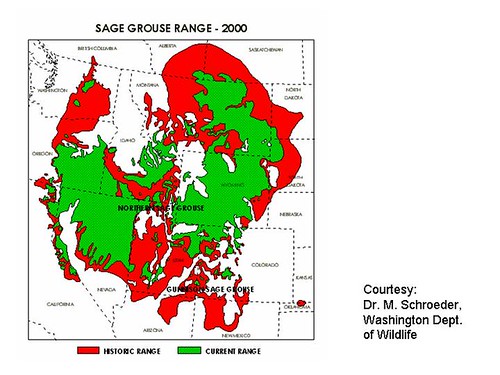
    The Fish & Wildlife Service has just announced that the sage grouse is a candidate for listing as an endangered species, but its listing will be precluded because its habitat overlaps with oil, gas, and wind development across the West.
    As Representative Jason Chaffetz (R-UT-03) states, classily:

    The only good place for a sage grouse to be listed is on the menu of a French bistro.

    The sage grouse, also known as sagehen, is well known for its courtship rituals. Male birds strut, flex, preen, puff up their pecs, and grunt like Muscle Beach bodybuilders.

    The sage grouse lives in cowboy country — the sagebrush, plains, and high deserts across the West, from California’s Owens Valley to the Dakotas. One bird needs a lot of territory — it’s sensitive to any activity within four miles of its nesting grounds. And its territory has been covered by an intricate spiderweb of humans and their accoutrements: roads, pipelines, cattle, sheep, prairie fires, invasive plants such as cheatgrass, oil derricks, and (mostly proposed) wind turbines. The grouse is considered a keystone species, meaning that its health indicates the health of an entire landscape. It’s almost no surprise that its numbers have dropped from 16 million to a few hundred thousand.

    The bird is no stranger to litigation. The Bush administration refused to list the bird following a petition. The Western Watersheds Project won a lawsuit in which the judge held (this is a shocker!) that a senior political appointee illegally tampered with the scientific determination whether to list the species. The Bush administration then decided to -run out the clock- engage in further studies until Obama took office. The listing has been described as a litmus test for conservation in the Obama administration.

    Today, the Obama administration announced a compromise in which the bird is listed as “warranted, but precluded” by higher priorities:

    The Interior Department says it won’t list sage grouse as endangered or threatened but will classify the bird among species that are candidates for federal protection.

    The finding is good news for the wind energy and oil and gas industries, which will still face scrutiny in grouse habitat but will have more leeway than if the bird were listed.

    As the New York Times editorialized earlier this week, the “warranted-but-precluded” status holds out the promise, or threat, of more stringent regulations, and requires good faith efforts from affected state governments and the Bureau of Land Management.

    The Fish & Wildlife Service press release spins it as “expanding common sense efforts” to preserve its habitat, hoping for voluntary conservation by private landowners “while ensuring that energy production, recreational access and other uses of federal lands continue as appropriate.”

    In other words, the sage grouse is likely to join the pika. Poor silly bird never had a chance, going up against our energy needs.

    Tags: , , , , , ,

  • A Recap of ZINO Green Seattle Investment Forum

    Cathi Hatch wrote:

    What an exhilarating day! Yesterday we produced ZINO Green Seattle at the offices of our ZINO Society major sponsor, McKinstry.

    The McKinstry team jumped through hoops to make everything for the entire event absolutely perfect for the 150 people attending. We are so appreciative of all the time, effort and resources that McKinstry used to make this event so successful. Super stars Genevieve Guinn and Tony Stewart led the effort for McKinstry.

    We are also very appreciative of the support of all of our other major sponsors including Puget Sound Business Journal, Davis Wright Tremaine, Puget Sound Energy, and supporting sponsors Enterprise Seattle, Graham & Dunn, Perkins Coie, and Stoel Rives.

    Included on the business session agenda were brief five-minute presentations by 14 entrepreneurs who shared overviews of their businesses, traction to date, market pipelines, financial projections, and any important information for potential investors to consider; a “Courtside Chat” with McKinstry CEO, Dean Allen; an expert panel comprised of “green” experts who shared some of their insights with us (see photo below) and then questioned the best investment opportunity finalists in the Due Diligence LIVE! segment.

    Facilitating the panel was George Erb, Editor of Puget Sound Business Journal, and included on the panel were Ash Awad, VP-Energy, McKinstry; Bert Gregory, CEO, Mithun; Rick LeFaivre, Managing Director, OVP; Steve Reynolds, CEO, Puget Sound Energy; and Haeryung Shin, Clean Tech Chair, Davis Wright Tremaine.

    At the conclusion of the business session, awards were presented, wine was uncorked, and guests were invited to tour the new McKinstry Innovation Center under construction across the street.

    ZINO Green Seattle panel

    The ZINO Green Seattle ZINO Zenith Award Winners (AKA people’s choice awards) were Burt Hamner of Hydrovolts, for Best Presenter, and Nano Ice for Best Investment Opportunity.

    The best investment opportunity finalists who will be going forward into due diligence as potential fund winners are: Nano Ice, Eco Carpet Inc., Hydrovolts, Virticus, and Canvas Solutions.

    The full list of presenting companies who presented at both ZINO Green Portland on February 24, 2010, and at ZINO Green Seattle on March 4, 2010, includes:

    .

    AmeriStar Solar Tracker

    BioXcelerator Technologies

    Building Runner

    Canvas Solutions

    Eco Carpet

    EMME

    Environmental Energy & Engineering Co.

    G.R. Green Building Products

    Hydrovolts

    KersTech Vehicle Systems

    Lagotek Corporation

    Nano Ice

    sengWare

    Virticus

    Zebigo.com


  • UpWind Solutions Raises Cash

    Gregory T. Huang wrote:

    Medford, OR-based UpWind Solutions, a provider of operations and maintenance services for utility-scale wind projects, has raised $10 million out of a $29 million round of Series B preferred stock, according to a regulatory filing. The investors weren’t disclosed, but the SEC form lists Michael Linse of Kleiner Perkins Caufield & Byers and Mark Lewis of MissionPoint Capital as directors of the firm. UpWind is led by president and founder Bo Thisted. The company works with wind energy project developers and owners over the lifetime of their turbines or wind farms.


  • Jamaica: Consumer Win

    “Thank you OUR (Office of Utility Regulations) for standing up for the Jamaican consumers by telling the JPS (Jamaica Public Service) no to their latest attempt of robbery!”: Stunner lets loose.

  • Artificial photosynthetic process could run your house on a bottle of water

    photosynthesis

    Eco Factor: Process to produce energy using artificial photosynthesis.

    After receiving $400 million in funding, ARPA-E’s first conference witnessed MIT chemist Dan Nocera proving that artificial photosynthesis could power an entire household using just sunlight and a bottle of water. Nocera has developed a special catalyst that splits water into its constituents that is hydrogen and oxygen, which can provide enough energy to run a house.

    (more…)

  • Innovation Summit Highlights Drug Development, Cleantech, and Potential Impact of Drought

    Bruce V. Bigelow wrote:

    The La Jolla Research & Innovation Summit held yesterday at the Salk Institute was a smaller and a much more modest affair than the inaugural summit that Connect CEO Duane Roth organized last year. I have some impressions from the morning presentations:

    —Climatologist Dan Cayan of UCSD’s Scripps Institution of Oceanography explained why multiple computerized models of climate change indicate that Southern California will become significantly hotter and drier over the next 100 years. What Cayan left unsaid is the critical importance of water to the life sciences community in semi-arid San Diego, which gets just 10 inches of rainfall a year (on average) and imports most of its water from Northern California and the Colorado River basin. Biocom, the San Diego regional biotech industry association, began during the drought of 1991, when the San Diego City Council proposed a water-rationing plan that included shutting off water for several hours a day to manufacturers—including life sciences facilities.

    —When someone in the audience asked about current prospects for desalination technology, Australian-born Tony Haymet, who is director of Scripps Oceanography, stepped to the microphone to explain that desalination remains very expensive. If I understood him correctly, Haymet said desalination is more than four times the cost of conventional water treatment. In Australia, where much of the population lives in a coastal climate similar to San Diego, Haymet said a prolonged dry spell led to a concerted effort to reduce excessive water use. The results are dramatic. Haymet said urban Australia has reduced its daily water consumption by 77 percent, from 130 gallons per person to 30 gallons per person. In contrast, the Scripps director says average daily water use in California today exceeds 300 gallons per person. So there’s room for improvement. Haymet noted, however, that …Next Page »


  • There’s More Ingenuity In This Wooden Marble Machine Than the Sum of My Entire Existence [Science]

    Equipped with a marble, some wood and the principles of potential energy, kinetic energy and gravity, one man built a remarkable machine that warps your very sense of what’s physically possible. Prepare yourself, then hit the clip at 2:30.

    While this video eventually ends, the device can keep going, sending the marble in a loop from the top to the bottom to the top (to the bottom…) without stop, as long as a single weight is repositioned to reset various components.

    And, if for some reason, you’re one of those guys thinking to himself, “Meh, I could do that.” Please, please do. [Reddit via CrunchGear]


  • Soane Energy’s Oil-Grabbing Polymers Could Make a Necessary Industry Less Noxious

    soane-energy-logo
    Wade Roush wrote:

    When you hear the phrase “cleantech,” you generally think of green hills studded with wind turbines, or buildings sheathed in shiny solar panels. The oil sands of Alberta—where mining companies foul vast amounts of freshwater while extracting crude oil from surface deposits, leaving behind huge, toxic tailings ponds—don’t usually come to mind.

    But the way inventor/entrepreneur David Soane sees it, the global economy is going to stay hooked on petroleum for quite some time. So the more scientists can do to make oil extraction cleaner, the less damage we’ll do to the planet during the transition to a post-fossil-fuel future.

    At his latest startup, Cambridge, MA-based Soane Energy, the former U.C. Berkeley professor is applying his knowledge of polymer chemistry to do exactly that. The company’s “ATA” technology—for “activation, tethering, and anchoring”—uses custom polymers that efficiently remove oil-bearing particles from the water used in oil extraction. The technology works great in Soane’s lab, and now the startup is collaborating with several operators to see whether it will work on the huge scale required in Canada.

    David Soane“I believe that in the distant future, ideally, all energy should be renewable,” Soane says. “I’m a firm believer that we should continue to invest in solar, geothermal, and wind. But there is a transition period that may last 50 to 100 years. Meanwhile, we can’t blindly continue to do things they way they’ve been practiced. This technology is one little example, hopefully Soane Energy’s contribution, toward managing this transition period.”

    Soane is probably most famous for founding Nano-tex, the Oakland, CA, company that supplies polymers used by clothing makers such as L.L. Bean and Eddie Bauer to render textiles water- and stain-resistant. It is interfaces—in Nano-tex’s case, the interface between the polymer-protected cloth and water—that really fascinate Soane, and believe it or not, there’s a direct connection between the textile technology and the idea of cleaning up tailings ponds.

    Polymers, which are basically chains of repeating chemical units, are useful at interfaces because chemists can splice together chains from two halves with different chemical properties. One end of such a chain might be tailored to attached to a substrate, such as a piece of cloth, while the other might be designed to be …Next Page »


  • S4 to Build Waste-to-Fuel Plant

    Gregory T. Huang wrote:

    S4 Energy Solutions, a joint venture by Houston, TX-based Waste Management (NYSE: WM) and Bend, OR-based InEnTec, said today it plans to build a waste-to-fuel facility at a landfill in Arlington, OR. The plan is for the plasma gasification plant to convert municipal solid waste into clean fuels and renewable energy. Construction is slated to begin early this summer, creating up to 28 jobs; the facility, once operational (around the end of 2010) will employ up to 16 permanent workers. S4 Energy Solutions was formed in May 2009 and is led by CEO Jeff Surma.


  • Seaweed Biofuel Company, Seattle’s Bio Architecture Lab, Struck by Chile Quake

    bioarch
    Luke Timmerman wrote:

    One of Seattle’s most interesting clean energy startups is feeling the impact from the earthquake last weekend in Chile.

    Seattle-based Bio Architecture Lab, a University of Washington spinoff that’s developing microbes to turn seaweed into renewable fuel, has built a big part of its business on relationships in Chile. The company has an office in Santiago, and received part of its initial $8 million venture round from Santiago-based Austral Capital. A Chilean economic development group has poured in another $7 million, local university and oil industry partners are involved, and some permits have been issued to run a pilot project in Chile’s coastal waters.

    “Fortunately, BAL employees in Chile are safe and accounted for, which is the most important thing for us,” says Niki Parekh, Bio Architecture Lab’s CEO. “We are watching developments in Chile closely, but as you can imagine the first priority for the government is to respond to the crisis. We don’t know for sure what impact, if any, this event will have on our long term plans. Our thoughts are with the people of Chile, especially those who have suffered as a result of the earthquake.”

    Niki Parekh

    Niki Parekh

    We wrote last November when Bio Architecture Lab raised its initial venture round, and formed a partnership with DuPont that has secured a $9 million research grant from the U.S. Department of Energy’s ARPA-E program. The vision was to use seaweed, also known as “macroalgae,” as the crucial raw material for renewable fuel.

    Bio Architecture Lab has focused on this multi-cellular form of algae for a number of reasons. It is cheap and abundant. Seaweed is also thought to be more environmentally sustainable than other sources of biomass feedstock like corn or soybeans, since seaweed doesn’t need to compete with crops for land, creating the “food vs. fuel” dilemma. Bio Architecture Lab’s belief, which is still being tested in R&D, is that it can convert seaweed into renewable butanol at low cost, and at industrial scale.

    The ocean aquafarming industry in the U.S. is tiny, so Chile was a natural place to test this hypothesis. Chile has an established aquaculture industry, partners who were open to support the new clean energy economy, high-density seaweed, and 4,000 miles of ocean coastline. The project was considered a big deal in Chile—before the quake, anyway. The goal is to produce 165 million liters of biofuel per year, or about 5 percent of Chile’s annual petrol consumption, according to a local report in January by MercoPress.

    With or without the Chile partnership, the research appears to be moving forward. Just yesterday, DuPont formally announced that it has matched the federal ARPA-E grant in order to put a combined $17.7 million into the project to create renewable butanol with Bio Architecture Lab. More than 60 scientists from DuPont and Bio Architecture Lab—spread among sites in Wilmington, DE, and Berkeley, CA—will test the idea. This aquafarming project is to be situated off the southern California coast.


  • Backpack Power Plant: You ARE the Grid [Energy]

    Bourne Energy’s BPP-2 puts a 30-pound, 500-watt generating hydroelectric plant on your back. That’s like being able to walk around with 60 solar panels. And when civilization finally collapses, I’ll be dragging mine to an as yet undisclosed location.

    You can use the Backpack Power Plant in any stream deeper than four feet. It also operates silently, with no heat or exhaust emissions, and can be “bottom-mounted” for total invisibility: all good things for hiding from the roving hordes of the post-apocalyptic dystopia. The set-up is pretty straightforward as well:

    To install the civilian BPP, you would dig two trenches on opposite sides of a river and insert a lightweight anchor into each. Then, you’d run a synthetic rope between the anchors and the BPP. [The] company designed the system to work like the high-tension mooring systems that hold up floating oil rigs.

    There’s a military version already in use that can operate in a variety of flow rates, but the $3,000 civilian edition is designed for streams moving 7.5 feet per second. The main target audience is developing countries, where a portable generator of this magnitude could make a huge difference for remote villages and towns.

    It’s a prototype for now, but you and I both know they’ve got a hard deadline of 2012 if they really want this thing put to good use. [Wired]