Category: Energy

  • Voyager Capital Makes Cleantech Investment

    Gregory T. Huang wrote:

    Seattle-based venture firm Voyager Capital has co-led a $14 million Series B investment in Coulomb Technologies, a Campbell, CA-based startup focused on electric vehicle infrastructure. Voyager and Rho Ventures co-led the financing for Coulomb, which makes technologies for vehicle charging stations. Daniel Ahn, a Voyager managing director based in Silicon Valley, is joining the Coulomb board. The deal may signify Voyager’s increasing interest in the “clean IT” sector; the West Coast firm is primarily known for its investments in software, wireless, and digital media.


  • Adding Environmental Risk to the Financial Equation

    Despite projections, many financial analysts ignore the risks and opportunities associated with environmental trends. ENVEST seeks to change this.

    Climate change and other environmental trends can have a major impact on companies and industrial sectors. Recently, the SEC advised publicly held companies to inform investors of any potential risks of climate change. This guidance comes at a time when nearly half of global money managers are ignoring climate change risk completely when they make their investment decisions, according to a recent survey. Why?

    Investment and Environmental Risk

    Environmental data, even when available, does not fit neatly into the financial models that investors commonly use. Environmental trends are complex and have a long time horizon, making them difficult to accurately quantify and predict. As one analyst put it, “If it’s going to be a problem in 2025, tell me about it in 2024.”

    Even with these challenges, financial analysts are starting to realize that they will have to change their approach to environmental issues if they want to keep on top of risks facing companies. A better grasp of risk will translate into better (and more sustainable) investment decision-making. That’s why WRI’s ENVEST has been producing research for over 10 years that explores innovative ways of overcoming the inherent challenges in analyzing environmental trends for a financial audience.

    ENVEST Work in the Food and Beverage and Asian Power Sectors

    ENVEST’s upcoming report on the food and beverage sector in Asia uses scientific climate change predictions about projected crop yield to analyze potential risks. For example, a climate change induced crop price increase of 1% would have a sevenfold impact on the profitability of a sugar company.

    In its upcoming report on the Asian Power sector, ENVEST uses geographical information systems (GIS) maps that show the intensity of water scarcity in certain geographic areas overlaid with locations of current and planned power generating facilities. The mapping shows that over half of existing and planned capacity for major power companies, representing 74GW, is located in areas that are already considered water scarce or stressed.

    Both reports also identify the risk factors that would make companies in these two sectors vulnerable to environmental trends, and support investors in engaging with companies about how they are positioned to manage these risks by providing guiding questions.

    From Financial Risk to Opportunity

    ENVEST is constantly exploring new ways to move research forward in this field, both by looking at expanding the traditional focus from equity to debt markets and from risk to opportunity, and by looking at evolving analytical approaches. Past ENVEST work has used techniques such as peer-to-peer exposure ranking within a sector (2004’s Changing Drivers on the automotive sector) and mapping of company assets in environmentally sensitive areas (2002’s Changing Oil on the oil and gas sector).

    Though there is a way to go before environmental trends analysis becomes a mainstream practice in the financial community, we believe that markets that fully account for environmental risks will ultimately shift capital to companies and projects with sound environmental strategies. ENVEST is working to contribute research and ideas to continue the evolution of this vitally important space.

  • GE Oil & Gas summit starts with over $300M in deals

    For 900 business leaders gathered in Florence, Italy this week, having a “power lunch” is something taken quite literally. Representatives from many of the world’s largest oil and gas producers have assembled for today’s kick-off of the 11th GE Oil & Gas Annual Meeting — which is an interactive set of working sessions and talks in which GE and global customers such as Chevron, Shell, Petrobras and ExxonMobil share best practices and tackle technology challenges. The Oil & Gas team is also making a number of announcements this week at the summit, including a new contract in Abu Dhabi valued at over $200 million; one in Slovakia for $102 million; and the first order of GE’s latest subsea equipment by Shell U.K. for North Sea fields.

    In his keynote address, Claudi Santiago, President and CEO of GE Oil & Gas, said, “We are innovating to meet tomorrow’s energy challenges and over the next three years will spend more than $500 million on R&D.”
    Stepping on the gas: In his keynote address, Claudi Santiago, President and CEO of GE Oil & Gas, said, “We are innovating to meet tomorrow’s energy challenges and over the next three years will spend more than $500 million on R&D.” Many of GE Oil and Gas’ breakthrough technologies come from GE’s global research labs, but it also has refashioned innovations from GE’s aviation, transportation and healthcare businesses.

    In the video clip at left, Claudi Santiago tells the group that prospects for 2010 are “more encouraging,” adding that emerging economies will likely be the source of new oil and gas demands. He also noted the “big role” that gas will play in meeting growing electricity demands.

    Claudi also stressed key components of GE’s innovation strategy such as pursuing partnerships, leveraging technologies from sister industries at GE, and being the industry leader in testing prototypes and proving technology concepts.

    GE Oil & Gas has invested over $9 million in a new test bed to extend the capabilities of its Massa, Italy, facility, seen above, in preparation for the oncoming increase in liquefied natural gas, or LNG, activity. The new bed is designed for thermodynamic and mechanical tests on large compressors. Tours of the facility are being conducted for attendees at this year’s summit.
    High-tech bedfellows: GE Oil & Gas has invested over $9 million in a new test bed to extend the capabilities of its Massa, Italy, facility, seen above, in preparation for the oncoming increase in liquefied natural gas, or LNG, activity. The new bed is designed for thermodynamic and mechanical tests on large compressors. Tours of the facility are being conducted for attendees at this year’s summit.

    Michael Bellamy

    As Michael Bellamy, General Manager of Marketing for GE Oil & Gas, says in the audio clip below: “To meet rising demand for oil & gas, oil companies are having to open up new production frontiers with reliable technology that minimizes risk, drives production efficiency and addresses environmental sustainability. In our industry, asset owners and operators are, quiet rightly, cautious and even conservative when considering the perceived risks associated with being the first to adopt new innovations. Therefore, reliable innovation is absolutely critical.”

    Listen Now

    The Abu Dhabi deal announced today is to supply Hyundai Engineering & Construction with eight gas turbines and related services. Abu Dhabi’s Habshan facility is one of the largest gas processing complexes in the world. Read the announcement.

    The Slovakia deal is to upgrade three pipeline compression stations — that were purchased in 1991 — to bring the facilities into compliance with new European Union directives to decrease carbon dioxide and nitrous oxide emissions. “This is a far more cost-effective solution than replacing this equipment outright with new units,” said Rastislav Nukovic, director of strategic projects for the pipeline’s operator, Eustream. Read the Slovakia announcement.

    And the subsea equipment deal marks the first order by Shell U.K. Ltd of GE’s newest technology — the S-Series Subsea Tree — that has reduced its weight by 20 percent and is intended for harsh, shallow-water fields. Said Shell’s Jan Duinhoven: “Reliable, more compact and cost effective solutions are required in the mature Southern North Sea to be able to profitably develop the remaining gas accumulations.” Read the subsea equipment announcement.


    Start ‘em up! GE’s Massa, Italy testing facility is seen here in an aerial view. The complex is designed to help customers avoid the typically more expensive and longer cycle test configurations used elsewhere. The Massa plant is located 75 miles west of Florence and packages turbo compressor units in addition to testing equipment. It also hosts new customer training facilities, where trainees can familiarize themselves with “live” start-ups of equipment.

    * Read today’s announcement about the summit
    * Learn more about the 2010 annual meeting
    * Read the annual meeting agenda
    * Learn more with our Oil & Gas fact sheet
    * Read the “Innovation Now” brochure
    * Read more Oil & Gas stories on GE Reports
    * Read the Q1 2010 edition of the GE Oil & Gas Customer eNewsletter
    * Visit the Oil & Gas website

  • UL Environment launches energy efficiency certification mark

    New mark offers third-party certification of compliance with energy efficiency standards

    UL Environment, Inc. (ULE), a wholly-owned subsidiary of Underwriters Laboratories (UL) and a global leader in environmental evaluation and certification, announced today that it is launching the Energy Efficiency Certification (EEC) program for compliance with energy efficiency standards and regulations.

    Consumers will be able to look for the EEC Mark for verification that products have been tested and proven to meet government energy efficiency specifications.

    The Mark will appear on home products including appliances, heating, air conditioning and refrigeration systems, high tech equipment, and lighting products.

    “Consumers want to be confident that the products they are purchasing are truly performing to the energy efficiency specifications they claim,” said Steve Wenc, President, ULE.

    “This certification program lends credibility to manufacturers producing energy-efficient products and allows them to prove energy performance to their customers.

    UL has more than a century of public trust when it comes to product testing and certification, and we are pleased to be able to offer a new UL Mark that addresses the issue of credibility in energy efficiency performance.”

    The EEC Mark will appear on products and the packaging of products that are proven to meet energy efficiency requirements outlined by standards and regulations such as ENERGY STAR®, Natural Resources Canada (NRCan) and California Energy Commission (CEC).

    The mark incorporates UL Environment’s leaf encapsulating the familiar “UL” initials and includes the words “Energy Verified” in black text.

    UL Environment publishes the results of products earning the mark on its Web site, ulenvironment.com, giving consumers the option of cross-checking EEC Marks printed on products and determining that specific energy efficiency performance requirements have been met.

    The EEC Mark will be rolled out in phases, with the long-term intent of using the Mark for many types of products.

    This is the latest service offering from ULE, which offers Environmental Claims Validation(SM) (ECV), a service testing and verifying individual self-declared environmental claims and Sustainable Products Certification(SM) (SPC), a service testing and certifying products to accepted industry standards for environmental sustainability.

    About UL Environment, Inc.

    UL Environment (ULE) is helping support the growth and development of sustainable products and services in the global marketplace through standards development and independent third-party assessment and certification.

    ULE is a wholly owned subsidiary of Underwriters Laboratories, a global leader in conformity assessment that has been testing products and writing standards for more than a century.

    ULE currently offers Environmental Claims Validation(SM)  (ECV), a service testing and verifying manufacturers’ self-declared environmental claims and Sustainable Products Certification(SM) (SPC), a service testing and certifying products to accepted industry standards for environmental sustainability.

    ULE is developing additional environmental standards, as well as training and advisory services to support organizations in the sustainable products and services industry.


  • Verari Founder Tells Death and Life Story, IPO Activity Increasing, Aptera Looks to Sell Through Best Buy Stores, & More San Diego BizTech News

    Bruce V. Bigelow wrote:

    Was there any BizTech news besides Apple iPad news last week? The answer is yes, but not a lot. We’ve got it here, plus a little speculation about San Diego’s iPad connection.

    Diego-based V-Vehicle raised $62.3 million in venture capital in 2009, enough for the stealthy startup automaker to rank No. 2 in Southern California VC deals last year, according to Dow Jones VentureSource. Most of the other deals that made our list of Top 10 deals of 2009 involved life sciences companies. But Fallbrook Technologies, which is developing an innovative and more energy-efficient transmission, raised a total of $29.4 million last year and placed No. 7.

    —David Driggers, who founded a San Diego computer business in 1991 that became Verari Systems, told me that the high-performance computer maker failed last month because it needed money, and servicing its monthly loan payment was crushing profit margins. He also explained why he’s optimistic about the future of Verari Technologies, a new company that acquired the old Verari’s assets and restarted the business.

    Aptera Motors CEO Paul Wilbur told a Rotary Club luncheon in his hometown of Salina, KS, that the Carlsbad-CA electric car-maker is teaming up with electronics retailer Best Buy to sell the futuristic-looking two-seater vehicle through 300 of the nationwide chain’s larger stores. Wilbur’s announcement was reported by the Salina Journal.

    A total of 53 companies registered to begin selling shares of their stock through an IPO during the fourth quarter of 2009, according to the U.S. IPO Pipeline study that was released last week by Ernst & Young. That’s not a record, but it was the highest number of IPO filings in a quarter since 2007—and is an optimistic sign, according to Jackie Kelley, who is Ernst & Young’s Americas IPO leader in Irvine, CA. San Diego’s Trius Therapeutics and Carlsbad, CA-based Maxlinear filed for IPOs in November.

    —Before Apple’s iPad announcement last week, there was considerable speculation about what components Apple had chosen for its 1.5-pound window to the Internet. Northeast Securities analyst Ashok Kumar suggested that Qualcomm was supplying the wireless wide area network (WWAN) chip for wireless networks connectivity. But it still isn’t clear days after the Apple iPad made its debut. In an e-mail, Frost & Sullivan mobile analyst James Brehm tells me, “It could be Ericsson, Infineon, Broadcom, Qualcomm, etc….we’re not really sure.” Brehm adds, “If it isn’t Qualcomm, it isn’t necessarily a bad thing for Qualcomm.”


  • Portland Government Plans 200-ft. Tall Energy-Saving Plant Wall [Green]

    Portland, Oregon is so into the green movement that they’re going to cover their federal building from floor to ceiling with a 200-ft. wall made from living, breathing vegetation.

    The living wall is more than just a pretty facade, however, as city officials claim it will lead to savings of about $280,000 per year in energy costs. Add in some solar panels (also part of the overall $133 million plan), and the building will use about 60-65% less energy than a similar-sized office.

    And, being a plant, the multi-fin wall is seasonal. Designers say that in the summer its foliage will provide cooling shade; in the winter months the wall will thin, providing light when the weather cooperates.

    One issue yet to be tackled by architects is irrigation. Rainwater from the roof is one suggestion, while water recycled from the building’s plumbing is another.

    Another issue is cost. Senators John McCain of Arizona and Tom Coburn of Oklahoma have both criticized the project for being a complete waste of economic stimulus money (see also: The Bridge to Nowhere). Even so, the project is on track for completion in 2013. [New York Times]


  • Any Hope For Meaningful Carbon Limits?

    photo: kk+ via Flickr

    photo: kk+ via Flickr

    What Rahm Emanuel’s new priority ordering on health care also does is it pushes all the bigger bills to the end of the line, in particular, the climate and energy legislation which was already hanging by a thread.

    On Wednesday, The New York Times declared the climate bill DOA, based on some quotes from Lindsey Graham, who has been leading bipartisan talks on the issue, saying that cap and trade was “going nowhere.” Graham walked back those words later, releasing a statement that he is still committed to a comprehensive bill.

    But what would that bill look like? Graham keeps saying he wants more “business-friendly” climate legislation, but the Waxman-Markey bill that came out of the House was already loaded with giveaways to polluting industries. Nevertheless, the President in his State of the Union address used his climate and energy section to deliver a conservative wish list:

    The capitulation to conservative narratives was particularly glaring on the subjects of climate and energy. He began well, introducing the eminently sensible notion that the U.S. needs to get cracking on creating clean energy jobs lest we have our lunch eaten by China, Germany, and India. “I do not accept second place for the United States of America,” he thundered.

    Well good then! What does that mean? This was the opportunity. There are thousands of stories he could have told: about the burgeoning interest in energy efficiency and building retrofits, the cheapest and most labor-intensive way to reduce emissions; the astoundingly fast spread of distributed energy, driven by innovative financing models; the rapid growth and falling costs of wind and solar thermal power; the spread of bright green, low-carbon, walkable cities, where people benefit by living more sustainable lives. There are so many fascinating, inspiring, untold stories around energy right now. This was a real chance to open the public’s eyes to the amazing revolution happening around them—a revolution that can benefit them, employ them, and inspire them.

    Instead “what it means” was, in order: nukes, offshore oil and gas drilling, biofuels, “clean coal,” and … well, that’s it. That’s right, in listing what “clean energy” means the president did not mention renewable energy. That’s just stunning. It’s 2010 and renewable energy isn’t even an afterthought? Seriously?

    Obama used many of these same issues today at the Republican conference retreat. This serves just to demoralize progressives who would otherwise fight for a legitimate clean energy bill. The section on energy received the lowest rating in dial-testing by MoveOn.org members. Obama may just be saying the right words to get a bill passed inside Washington, but outside the Beltway, none of the advocates will possible go to bat for a bill like this.

    That said, is there any hope for carbon limits? Not Congressional legislation per se, but limits? That becomes a slightly more hopeful question. Because the EPA has registered carbon dioxide as a polluted that must be regulated under the Clean Air Act, and the rulemaking process will simply have to go into effect in the absence of legislation, provided that Lisa Murkowski’s gambit to block the EPA fails. From an executive standpoint, Obama today ordered the federal government to reduce their personal emissions by 28% over the next decade, and he pledged an overall 17% cut by 2020 on all greenhouse gas emissions. That announcement was contingent on legislation, but the EPA could easily step in and make that a target in their rulemaking.

    Also, in potentially the announcement with the most wide-ranging effects, the SEC has set a rule encouraging corporate disclosure on climate change-related issues.

    Companies must consider the effects of global warming and efforts to curb climate change when disclosing business risks to investors, the U.S. Securities and Exchange Commission said.

    Guidelines approved today require companies to weigh the impact of climate-change laws and regulations when assessing what information to include in corporate filings, the commission said. The SEC is responding to investors who said companies aren’t providing enough data on the potential risks to their profits and operations from environmental-protection laws.

    “I do not believe that public companies today are doing the best job they possible can do with respect to their current mandated disclosures,” SEC Commissioner Elisse Walter said today. The decision “is designed to improve the quality of disclosures filed by U.S. public companies for the benefit of investors.”

    These steps move us to a new regime, where climate change and carbon saturation in the atmosphere are taken into account in all walks of life – the public and the private sector. Brad Johnson has more.

    So, to answer the question I posed: an unqualified maybe. Aren’t you glad you slogged through 774 words for that?

  • Tajikistan: Power Plant as a National Idea

    TajikVoice posts (and Andrey translates) stories of real people in Tajikistan, telling how they are being forced to “voluntarily donate” money to the construction of the Rogun dam and hydroelectric power plant.

  • Student “Tech Treks” Lend Reality to B-School Case Studies

    James Luong wrote:

    Earlier this month, we wrapped up two consecutive weeks of treks—business school jargon for trips that combine company visits and cohort-building activities—organized by MBA students at MIT’s Sloan School of Management in the bicoastal innovation hubs of Greater Boston and Silicon Valley.

    Ninety MIT Sloan MBAs enjoyed sun and mild weather while visiting companies in California immediately after the New Year. Another 30 MBAs ventured through the deep freeze to visit companies in the Boston area a week later. Despite the climatic differences of the two regions, both provided a wealth of innovative startups from which we could learn. All together, nearly 80 companies hosted company visits to describe their businesses and answer questions about their industries, technology, and entrepreneurship.

    As an organizer of the energy track on both the Boston and Silicon Valley treks, I was privileged to visit a spectrum of companies at the forefront of energy innovation.

    While all company visits were eye-opening and beneficial to our understanding of the complex energy ecosystem, a few stand out in my memory. In California, I visited Silverspring Networks, which provides infrastructure, applications and services to build reliable “smart grids.” Serious Materials brought innovation back to the building material space by creating, amongst many products, energy efficient windows that pay back in savings within two years. In Boston, Oasys Water, an early stage company, has developed a low-energy process to produce clean drinking water from industrial or municipal waste water and seawater. Beacon Power has developed technology to store energy in flywheels to modulate the frequency of voltage on the energy grid. Each company has found disruptive technology-driven solutions for new or developing market spaces.

    Company executives’ practical insights on business and industry became an extension of the classroom itself. At MIT Sloan, we learn about the importance of partnerships with customers, suppliers, and financiers and of understanding the regulatory and policy framework. On the trek, we were able to hear anecdotes about how key partnerships and favorable changes in regulatory environment had become critical inflection points in many company’s business trajectory. In some cases, these first-hand accounts from executives and the Q&A that ensued provided vivid color to business school case studies.

    Perhaps of more immediate concern for MBAs, the treks have also become an informal component of the courting ritual between students and potential employers. The visits not only facilitated introductions between companies and students, but also shed light on opportunities in the job market. In energy, specifically, almost all companies we visited were optimistic about their future business prospects. However, many have aggressively reduced headcount to cope with last year’s economic crises, and have found creative ways to maintain key staff while waiting for favorable conditions to scale up again.

    This is a sobering reality for MBA students laden with education loans. But startups and technology innovations continue to draw the interest of business school students like myself because of the fast-paced culture and the potential to shape the future.


  • Feds On Nuclear Energy: “Open to All Options” Except Yucca Mountain

    Two years: That’s how long a new “blue ribbon” commission assembled by the Department of Energy has to finalize a report that will look at a path forward for nuclear energy in the U.S. power supply. Created under an executive order from President Obama, the 15-person commission announced today plans to “conduct a comprehensive review […]


  • Switching smart grids from ‘demo’ to ‘deploy’ at WEF

    As we described yesterday, one of the hot conversations for GE Energy at this year’s annual meeting of The World Economic Forum in Davos, Switzerland is the immense benefit that can result from reducing the amount of gas that’s flared from drilling projects. Another critical energy topic at Davos — where more than 2,500 business leaders and officials are meeting in over 200 working sessions — is how to move smart grid efforts from smaller-scale, demonstration phases to mainstream rollouts.

    John Krenicki, GE Energy’s president and CEO, is in Davos and one of the points he’s focusing on during his panel discussions is how to drive city-scale deployments of proven smart grid technologies. For example, GE is working with partners in Miami, Florida to deploy more than 1 million advanced wireless “smart meters” — giving the project the potential to be the most comprehensive and holistic smart grid city implementation ever launched in the U.S. While it’s a huge win for Miami’s energy future, for the gains to really move the needle on efficiency and productivity, they need to be replicated at the city level around the world.

    Click on the image above to see GE’s vision of a Net Zero Energy Home.
    Just the beginning: Other pieces of the puzzle being talked about at Davos focus on helping consumers understand that smart meters, although a critically important foundation in smart grids, are just a gateway to a more sustainable and economically competitive future. Regulatory frameworks are also on the agenda, as they need to be adapted so that utilities are rewarded for changing and driving efficiency. Click on the image above to see GE’s vision of a Net Zero Energy Home.

    As Bob Gilligan, Vice President, GE Energy — Transmission and Distribution, just wrote in an essay published on arabianbusiness.com: “Smart grid technologies can increase energy efficiencies and improve utilization of the existing electrical infrastructure. Asset optimization technologies can help prolong electrical transformer life. Energy management systems can accommodate the integration of higher percentages of cleaner energy sources into the electrical system.” And smart grid technologies can meet the challenge of renewable energy sources like wind and solar, he writes, by helping to manage the fluctuations that come from these sources. “Smart grid is not a vision of the future,” he says, “but rather a solution to the energy and environmental challenges facing us today.”

    Part of the conversation in Davos is the way in which these smart grid efforts can go hand in had with other energy efficiency solutions that are within easy reach. In an article he wrote for the WEF, “Towards a More Energy Efficient World,” John Krenicki says: “Incremental improvements, when multiplied across the scale of the energy sector, can result in huge gains in energy efficiency and carbon reductions.” John writes that his “favorite opportunities” on the supply side start with the substantial quantities of electricity that are lost in the transmission and distribution of power. “For example, in the United States, line losses approach 6 percent of total generation; in India, these losses can reach 25 percent of generation,” he writes. “The technology exists to minimize these line losses.”

    His other favorites include utilities investing in technologies that save power by reducing and optimizing voltage and capturing the heat that’s generated when producing electricity to create more power — a technology known as combined heat and power, or “cogeneration.”

    Read more about GE Energy on GE Reports in the stories below:
    * “Putting flare gas on the firing line at the WEF in Davos
    * “Thinking locally with energy tech at Copenhagen
    * “Google & GE call for home energy info in Copenhagen
    * “Transformers Part 2: Flipping NJ’s smart grid switch
    * “Building smart washers/dryers in KY to create 430 jobs
    * “Getting smarter about the smart grid
    * “Carbon-neutral Masdar City plugs in smart appliances
    * Learn about GE’s smart grid efforts in Florida, Oklahoma and Houston

  • PetroBakken’s next Cardium takeover target

    PetroBakken Energy Ltd.’s $476-million cash and stock deal for Result Energy Inc. marks its second major acquisition in the Cardium play. The company now holds 150 net sections of land and has identified more than 400 potential drilling locations.

    While the transaction looks expensive at an implied price of $5,600 to $6,300 per acre of Cardium land, only time will tell what the economics of the play truly are and what the land eventually yields.

    One thing is clear: PetroBakken is making an aggressive move into the Cardium and this won’t be the last acqusition in the area, according to Raymond James analyst Justin Bouchard. The company has roughly $750-million of cash in the coffers.

    Mr. Bouchard noted that potential targets on PetroBakken’s radar likely include West Energy Ltd., Midway Energy Ltd., Bellatrix Exploration Ltd. and Bonterra Oil & Gas Ltd.

    Jonathan Ratner

  • Alnara Adds $35M, Harvest Power Teams Up with Waste Management, & More Boston-Area Deals News

    Rebecca Zacks wrote:

    We spent some time this week looking at the data on last year’s venture deals, big and small, while New England’s tech and life sciences companies announced some of the first deals of 2010.

    —All but one of the 10 biggest Boston-area private equity deals in 2009 were closed by life sciences firms, a survey by Dow Jones VentureSource revealed. The largest deal, however, was clinched by Watertown, MA-based lithium-ion battery maker A123Systems (NASDAQ: AONE), which scored a whopping $99.9 million in a Series F financing before it went public in September.

    —Life sciences firms also dominated the list of pint-sized financing deals, worth between $100,000 and $1 million, that our partner ChubbyBrain put together for us. Erin gave the rundown of the 21 such deals in December, which included companies working in fields glucose monitoring for diabetics, private air travel booking, and beer brewing.

    —Harvest Power, a Waltham, MA-based startup aiming to turn yard and food waste into high-quality compost and renewable fuels, inked a deal with Houston, TX-based garbage hauling behemoth Waste Management (NYSE: WM). Under the terms of the alliance, Waste Management will help Harvest expand to more cities, starting with the East and West Coasts, and will provide the Massachusetts firm with raw material for its composting process and fuel production systems.

    —Cambridge, MA-based Clarus Ventures contributed $17 million to a Series D financing for Irvine, CA-based Neomend, a developer of surgical hydrogels. The round, which totaled $30 million, included investments from Novo Ventures, Prospect Venture Partners, Sanderling Ventures, and Vivo Ventures.

    —Landslide Technologies, a developer of customer relationship management software with offices in Burlington, MA, and Pittsburgh, PA, raised $8 million in growth capital. Pittsburgh-based Adams Capital Management led the deal.

    Alnara Pharmaceuticals of Cambridge raised $35 million in a Series B financing round led by MPM Capital. Bessemer Venture Partners, Frazier Healthcare Ventures, and Third Rock Ventures also participated. Alnara is preparing to seek FDA approval for its first product, an enzyme-replacement drug for patients with cystic fibrosis.


  • Bill Gates Funds Geoengineering and Climate Projects, Steve Ballmer on China, and Other Microsoft-Related News

    Microsoft
    Gregory T. Huang wrote:

    Lest Apple take all the headlines this week, a certain software powerhouse in Redmond, WA, is making waves in its own way. Analysts and stockholders are anxiously awaiting the results of Microsoft’s fourth-quarter earnings call today, with some predicting a boost in revenues thanks to Windows 7. But there are other things going on too.

    —OK, he doesn’t technically work at Microsoft anymore, but chairman Bill Gates has certainly been in the news a lot lately. One item you might not have noticed, however, was a report this week from Science magazine reporter Eli Kintisch. He wrote that Gates has been funding academic research on geoengineering, climate change, and energy since 2007. According to the story, Gates has put up at least $4.5 million to explore things like altering the stratosphere to reflect some solar energy, filtering carbon dioxide from the atmosphere, and brightening ocean clouds. None of this is surprising, given Gates’s involvement with huge, Earth-scale projects at places like Bellevue, WA-based Intellectual Ventures. But the specific connections to the University of Calgary, the Carnegie Institution for Science, and Silicon Valley inventor Armand Neukermans are interesting.

    —Microsoft CEO Steve Ballmer went on the record yesterday about doing business in China. This is a topic I have some familiarity with, having documented Microsoft’s research and development efforts in the Middle Kingdom over the past decade. Ballmer’s post comes on the heels of the flap involving Google in China. He didn’t say anything earth-shattering, but his comments reinforced the notion that Microsoft has been in China far longer than Google has, and has built up deeper relationships with Chinese government officials and businesses.

    He wrote, “We have done business in China for more than 20 years and we intend to stay engaged, which means our business must respect the laws of China. That’s true for every company doing business in countries around the world: we are all subject to local laws.” Ballmer continued: “At the same time, Microsoft is opposed to restrictions on peaceful political expression, and we have conversations with governments to make our views known. In every country in which we operate, including China, Microsoft requires proper legal authority before we remove any Internet content; and if we remove content, we give users notice.”

    —On the healthcare-IT front, Ryan reported today that Microsoft’s HealthVault software platform for managing electronic health records has expanded to its third country (after the U.S. and Canada), via a licensing deal from German conglomerate Siemens. The partnership was created through Siemens’ IT services and solutions division. Financial terms weren’t given, but it could be an important step in getting Microsoft’s health-related products to be adopted much more widely.


  • White House Sprinkles High-Speed Rail Money Across the Country

    The White House just announced its plan to spend $8 billion on high-speed rail, and it looks … pretty diluted.

    The biggest chunk of cash — $2.25 billion — will go toward California’s planned rail line connecting Los Angeles to the Bay Area. But as Brad Plumer points out, Gov. Arnold Schwarzenegger (R-Calif.) had hoped for twice that amount, and the project is expected to cost $42 billion total. Next comes $1.25 billion for an Orlando-Tampa line — Obama is in Tampa today to make the announcement — followed by $1.1 billion for a St. Louis-Chicago line. (See the full map of projects below.)

    None of these cash amounts will actually be enough to build the lines, of course. And things get messier as you go further down the list. The Northeast Corridor, for instance — where the utility of trains is already well proven and a high-speed line from Washington to Boston would generate tremendous excitement — only gets $112 million, while the car-dominated state of Texas receives a mere $4 million.

    But that won’t stop Transportation Secretary Ray LaHood from getting downright giddy. On his Facebook page, he writes, “TODAY is the day! Welcome to the age of American High-Speed Rail, brought to you by President Obama and the Recovery Act.” And his blog is full of lofty praise, with lines such as, “I’ve said it before, and I believe it even more today: this is an absolute game-changer for American transportation” and “Today, as promised, we change the game.” He also includes a brief explanation of how these particular projects were selected:

    Now, the particular investments we’re making today–they make sense. We’re connecting cities that are too close for efficient air travel but–with the highways connecting these cities nearly choked beyond capacity–too far for productive road travel. Cities like St. Louis and Chicago.

    Here’s a map of the projects, with a breakdown of where the money will be spent. Click to enlarge:

    rail map

  • DiCaprio and other celebs launch ‘This is our Moment’ for clean energy

    Environmentalism is getting an injection of fun, but with a serious aim.

    Today, some of the nation’s best-known and critically acclaimed celebrities, Leonardo DiCaprio, Edward Norton, Jason Bateman, Felicity Huffman and Forest Whitaker, along with rising stars Chace Crawford, Emmy Rossum and Justin Long, are leading a campaign to help citizens sound the call for clean energy in Washington.

    (Noted professor Cornell West also makes a cameo appearance in the video, impishly declaring “Tweet this!)

    The program, launched today by these actors and the Natural Resources Defense Council, is called  This is Our Moment. It’s main thrust: To help people contact their senators, even flood their email boxes, make videos and generally get viral in pushing for an American clean energy bill.

    Those who want to register their support for clean energy action can use social networking tools at the website to spread the message. Fans of the movement will be able to embed a video player on their Facebook page or blog, and more. (Tweet this! says West.)

    This is Our Moment supports legislation to shift the nation’s energy production from fossil-fuel based power sources to non-polluting, renewable sources such as wind and solar power.

    The viral campaign was timed to begin after President Obama’s State of the Union address, in which he called for passage of a clean energy bill. The U.S. House passed such a measure in 2009, but the legislation, called the Clean Energy, Jobs and American Power Act, has been stalled in the Senate.

    Advocates say that passage of the bill would create local jobs, free the U.S. from dependence on foreign oil and greatly reduce carbon emissions, which scientists warn are fueling accelerating climate change.

    “This is our moment – our moment to fight for a cleaner and more secure future,” said DiCaprio, a longtime environmentalist and an NRDC Trustee, in a news release. “The time is now for people across the country to stand up and have their voices heard. We all must call on the Senate to act on this historic opportunity.”

    Those opposed to a clean energy and climate action bill in the Senate have raised questions about the accuracy of the science of climate change. They’ve also called for the nation to pursue all energy sources, an approach opposed by environmentalists who want less of the nation’s energy to come from the burning of fossil fuels. Gasoline engines and coal-fired power plants generate the majority of carbon emissions in the U.S. and in countries around the world.

    In his State of the Union address, Obama called on Congress to pass clean energy legislation so that the U.S. can remain a world manufacturing leader.

    China, as well as India and most European nations, are adding wind and solar capacity, creating a large world market for clean energy technology expertise and goods.

    Major U.S. firms, such as General Electric among others, make components for wind turbines. Several Silicon Valley companies are developing cheaper and more efficient solar tools, both for large industrial and home installations.

    Like what you see on YouTube? Here’s the longer version by the “This is Our Moment” celebs:

    Said NRDC President Frances Beinecke: “This is one of the most important pieces of legislation of our time – we cannot let our moment pass us by. Our Senators need to hear all of us loud and clear.”

  • Perspective: Water, Energy, Economy, Poverty and Haiti

    Circle of Blue’s columnist, Dr. Paul J. Sullivan, returns this week with a look at living conditions in Haiti before the disaster.
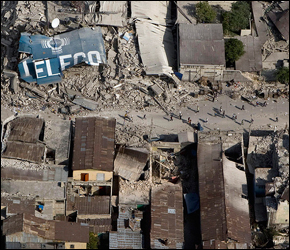
    Haiti after the earthquake. Photo United Nations Development Programme

    Haiti after the recent earthquake. Click to enlarge.

    By Dr. Paul J. Sullivan
    Special to Circle of Blue

    The average Haitian has been living the life of a disaster victim even before the earthquake. It is the poorest country in the Western Hemisphere. Its human development and other indices were about what one would find in some of the poorest sub-Saharan countries. Mismanagement, corruption and just plain venality have forever been human-caused security earthquakes in this sad country.

    The average GDP per capita in the country was about $600. However, if one calculates how much is owned by a very small percentage of the country, and how much of the GDP is made from these tightly controlled assets, then the GDP per capita for the average Haitian was much lower than $600. Maybe it was closer to $300-400. About 80 percent of Haitians lived on less than $2 a day while about 60 percent lived on less than $1 a day. Only about 50 percent of Haitians had some form of health care prior to the earthquake and about 3 percent had telephones. The very wealthy, the leaders of the street gangs, and the drugs dealers lived very well amidst this grinding and spirit-crushing impoverishment.

    About 50 percent of Haitians were illiterate, and roughly 50 percent of the school-aged children were enrolled in school prior to the earthquake. Families needed their children to help keep the family from falling even further into the sinkhole that is poverty in Haiti. But, by lacking education, they remained stagnant, falling further. It is all so terribly sad.

    Unemployment prior to the earthquake, and for many years previous to it, was about 50 to 60 percent. Skilled labor is scarce. The opportunities to get skills is even less. Most Haitians are trapped in the stagnant, debilitating addiction called chronic and intense poverty. The country has been on the economic life support of foreign and remittance labor from expatriates for years–now it is in economic cardiac arrest.

    Six of the most important resource insecurities and paucities Haiti faces are energy, clean water, sanitation, deforestation, land degradation and coral reef degradation. These are all intimately interconnected in this land of devastation and destitution.

    “About 70 to 80 percent of Haitians had no access to clean water prior to the earthquake. A very small percentage of people had access to piped water, and this was mostly in the cities.”

    About 70 to 80 percent of Haitians had no access to clean water prior to the earthquake. A very small percentage of people had access to piped water, and this was mostly in the cities. Sewer systems and wastewater treatment were close to non-existent. Only the very rich or the very lucky had access to water treatment from privately-owned systems or from systems donated by well-meaning, but very much stressed NGOs and aid organizations. There was little access to safe water and the rates of water poisoning from bacteria and disease were very high. Many children and others died from water-borne illnesses over the years. Maternal mortality was quite high in part due to the lack of clean water. In the rural areas only about 45 percent of the richest groups had access to safe water. Now think how the poorest live.

    In all of this there is a stunning bit of data that also reminds me of Sub-Saharan Africa. Haiti uses only 8.3 percent of its available renewable freshwater resources (other sources peg this figure at 7.5 percent) even though many children in school and workers on the job often go the entire day with little to drink.

    Only about 13 percent of Haitians had legal access to electricity. When you add in the stolen electricity maybe 25 percent had access to electricity. Electricity was produced by three small and decrepit thermal power plants, which are fueled by imported oil products since Haiti has no refinery, and a feeble hydropower plant in the hills near the Dominican Republic, the Peligre Dam, which took over 20 years to build and much less than that to rot into a shadow of its effective self.

    Haiti had one of the lowest demands for electricity per capita in the world. It had the worst electrical system in the Western Hemisphere. The main port for importing the fuels for the thermal plants is damaged and the plants may also be quite damaged.

    Electricity is needed for development. This has been proven time and time again. It is also needed to move water and to clean water. Safe water is hard to have without electricity or, at least, another reliable source of energy to clean and move the water. (To complete the sad circle of water and energy for Haiti: on a good year the Peligre dam produces about one-third of the electricity produced in Haiti, but it has often been subject to the ravages of drought.)

    Given that Haiti is disaster prone maybe one of the best solutions for Haiti for its energy poverty and insecurity is to set up non-grid electricity. Some options include solar, wind, geothermal and other renewable and off-grid energy sources. Off-grid power is less prone to systematic collapse during and after disasters. It could also be a much less expensive way to improve electricity access to those in the rural areas and poorer areas of the towns and cities who have been outrageously underserved. Large electricity grid connections are very expensive to build and fairly easily subject to damage by natural and other disasters.

    It is clear that Haiti’s thermal and hydro generating stations are in grave need of repair and much better management and maintenance. It is also clear that for Haiti to rebuild it will need energy and lots of it. Right now it has very little financial, skill, management, administration and leadership capacity to make this happen.

    Energy is required to clean and to move water. But, then again, you need the energy, finance and leadership to build the water transport and distribution system to get the clean water to the people first. In most areas of Haiti this does not exist. In many of the hill areas people relied on streams, often polluted and filthy, for their water. Piped water is rare in much of Haiti. And this is a country not far from our coast, and a neighbor in need.

    Energy starvation in Haiti has also been intimately related to deforestation, land degradation, coral reef ruination, and the lowering of fisheries and land agricultural yields. The main source of energy for Haitians has always been biomass. This has usually been in the form of charcoal briquettes and other energy forms developed from chopping down trees and gathering up agricultural and other waste for cooking, etc. The aching drive for energy has massively deforested the country. Attempts to turn this around seem to have had minimal impact relative to the overall problem.

    As the trees were uprooted and destroyed, the best soils washed away. The ability of the land to hold the precious water of Haiti was also uprooted. Some of the soil that washed away went into the sea and damaged some of the coral reefs. This damaged some of the fisheries. There have also been devastating land and mudslides. Expect more of these.

    To be fair, however, if you were desperately poor and had no other way to cook, and you were illiterate and had no knowledge of the effects of your actions and you needed to do what was needed to do for your family’s survival what would you do? Add to all of this that indoor cooking with biomass is a huge source of health problems in Haiti and we have a vicious circle of water, energy, land, and other resource poverty circling about in the midst of economic, educational and knowledge poverty, which is in turn circling about in health poverty.

    Electricity, be it from grid power or from distributed solar, wind, etc. can also make medical clinics more viable. Energy helps keep medicines cool and helps sanitize the water, instruments, operating tables and more that are needed in hospitals and clinics.

    The energy-water connections can help develop jobs and the dignity that goes with them. The negative synergy of interconnections amongst energy, water, land, food, health, jobs, education, leadership and more have lead to devastation and destitution in Haiti so far. Those same synergies can be turned positive by the proper leadership, investments, training and education, for Haitians, and with considerable help from those outside of Haiti. In no way does the average Haitian have the financial capacity to rebuild after this.

    Mismanagement, corruption and just plain venality are not victimless crimes. Poverty is not a victimless existence. Leadership is required to turn this situation around. Sadly, I doubt anybody expects this great and benevolent leadership to move into the crumbled presidential palace anytime soon.

    The next time you leave the tap running and the lights on you might want to think of Haiti. Most people there can do neither and never could.

    Read more on the health conditions in Haiti, and the pre-quake living conditions in the country.

    Dr. Sullivan is a professor of economics at the National Defense University, Adjunct Professor of Security Studies and STIA at Georgetown University, and an adviser to Sudan projects at the United States Institute of Peace. He is an internationally recognized expert on the Middle East, parts of Africa, and international energy, water and other resource security and conflict issues.

  • Putting flare gas on the firing line at the WEF in Davos

    More than 2,500 business leaders, government officials and individuals are now in Davos, Switzerland for The World Economic Forum’s Annual Meeting. With over 200 working sessions being held over five days under the banner: “Improve the State of the World: Rethink, Redesign, Rebuild,” participants will be zeroing in on topics that range from Haiti to the environment and the economy. One area in which GE Energy will be rolling up its sleeves at the conference is the global issue of flare gas — as reducing it offers an incredible near-term opportunity to create value from a wasted resource while significantly reducing greenhouse gas emissions.

    When gas is a by-product of oil development but immediate markets are not available, in some countries there are insufficient incentives to capture and use that gas. Instead it is vented or flared.
    Why flare? When gas is a by-product of oil development but immediate markets are not available, in some countries there are insufficient incentives to capture and use that gas. Instead it is vented or flared. The hurdles to productive gas use grow if domestic gas and electricity prices are controlled at low levels or if high levels of contaminates, such as hydrogen sulfide, increase the cost of gathering, processing and transporting this associated gas.

    Approximately 150 billion cubic meters of natural gas are flared into the global atmosphere each year — which is roughly equivalent to the annual gas use of every residence in the U.S. It’s also the same as a 400 million metric ton contribution to global greenhouse gas emissions — which is roughly equivalent to the annual emissions of 77 million cars, or about 34 percent of the US fleet. Flaring also leads to large impacts on local populations in terms of environmental degradation, which can result in loss of livelihood and severe health issues.

    One key area in the spotlight is what's called “associated gas flaring,” or the flaring of byproduct gas produced by oil wells.
    Missed opportunity: One key area in the spotlight is what’s called “associated gas flaring,” or the flaring of byproduct gas produced by oil wells. While gas flaring has been part of the oil industry since its inception, some of the largest waste gas streams occur in remote areas where lack of a market, lack of pipeline access, and/or small volumes do not justify the expense of gas gathering.

    The technology to address the problem exists today — in fact, much work has been done over the last decade so that large scale flaring is rare at new projects. However the next phase of flare reduction at old and isolated sites is going to be more challenging, which is why industry and governments need to work together to address the issue.

    Flare gas reduction is timely for Davos because the role of the international community is seen as critically important if widespread action is to make a difference. International organizations like the World Bank’s Global Gas Flaring Reduction Initiative, the International Energy Agency, and the G8 have all already seized upon the issue.

    Davos represents another unique opportunity to make the case that gas flaring is really a global environmental issue — and one that offers long-term financial benefits and associated cost reductions to countries and developers.

    Major oil producing countries including Algeria, Saudi Arabia, and Indonesia have made progress in gathering and utilizing their associated gas.
    Burning issue: Major oil producing countries including Algeria, Saudi Arabia, and Indonesia have made progress in gathering and utilizing their associated gas. In fact, most new oil developments, such as those in Algeria, Angola or Kazakhstan, incorporate associated gas re-injection and gas gathering as part of the overall development plan. But there’s still work to be done in Nigeria, other parts of the Middle East, and Russia — which is the largest flaring nation, but has reduction goals targeted for 2014.

    * Read more GE Energy stories on GE Reports
    * Read “Smart grid wind technologies breeze into solar
    * Read “Thinking locally with energy tech at Copenhagen
    * Read “Google & GE call for home energy info in Copenhagen
    * Read “Builder of largest US wind farm inks $1.4B turbine deal
    * Watch “Transformers Part 2: Flipping NJ’s smart grid switch

  • East Coast Could Get A Hydrogen Highway

    It has been awhile since we talked about hydrogen cars. In fact, auto manufacturers the world over seem to have pushed hydrogen vehicles to the side of their plate (next to the spinach and garbanzo beans). There are of course exceptions, such as Mazda and Mercedes, but electric cars are all the rage right now, and hydrogen arguably has more infrastructure issues to overcome. The biggest issue; where does one get hydrogen?

    A Connecticut company called SunHydro wants to deploy 11 solar-powered hydrogen fueling stations (SunHydro, get it?) along the East Coast, creating the area’s first hydrogen highway.

    Read more of this story »