Category: Energy

  • A Quick Exercise to Boost Your Energy

    Filed under: , ,

    Leonor Mowry, director of Village Yoga in Toronto’s Forest Hill Village and co-author of Advancing Your Yoga Practice: The Art of Slowing Down, says that humans are governed by cycles — whether we know it or not — and there are both times of the … Read more


    Permalink | Email this | Linking Blogs | Comments

  • The Struggle for Indigenous and Freshwater Rights at Copenhagen and Beyond

    A look back at the concerns of indigenous communities during the historic climate talks in Copenhagen last month.

    Copenhagen Climate Protest

    Photo © J. Carl Ganter / Circle of Blue
    On the ground with activists from around the world at one of the biggest demonstrations during the United Nations climate talks in Copenhagen last month. Grassroots organizers and underrepresented groups banded together to give voice to the water consequences of climate change.

    By Aubrey Ann Parker
    Circle of Blue

    For two weeks in Copenhagen last month climate negotiators debated carbon levels, emissions, and balancing the financial burden of saving the planet among developed and developing countries. Still, even as international leaders wrestled with the complex mix of geopolitics, science, economics, and diplomacy, another important ingredient in the climate crisis was barely mentioned: the effect of the warming planet on the Earth’s freshwater.

    The same oversight, however, was not repeated by public interest organizations and water advocates who also were in Copenhagen, especially indigenous representatives from underdeveloped countries that are most vulnerable to climate change and the diminishing access to fresh water.

    Numerous groups, such as the Khapi community in Bolivia and the Tagalog in the Philippines, banded together in Copenhagen to explain at a number of meetings and public events how climate change is already threatening their access to food and water, as well as the sustainability of their thousands years old cultures. Some of the strongest voices were heard during the World Water Movements and COP15: Proposals and Strategies for Water and Climate Justice panel.

    Debating Water as a Right to Life
    “Almost all countries, except those that are victims of climactic disaster, are not interested in dealing with water,” said Riccardo Petrella, author of The Water Manifesto and founder of the Lisbon Group, a think tank that critically analyzes globalization. “Because if they deal with water, they have to deal with the right to life.”

    Petrella, one of the members of the World Water Movements Panel, criticized the economic model that categorizes water as a commodity rather than a “precious community resource and fundamental human right.” Currently there is no international law to regulate the right to freshwater supplies, but Petrella argued that the United Nations climate negotiations, which are expected to continue in Cancun, Mexico near the end of the year, should be the gateway to further reform. If water were to be included in the global climate agreement under negotiation, nations would be responsible for ensuring the preservation of both these “common goods,” Petrella said.

    “It is not your right to good energy,” he said. “Nor your right to a good car—your four by four powered by green oil. We need to challenge the type of consumption that is part of today’s [climate] negotiations, which should lead to a global contract—not only on energy and on agriculture—but also on water and the right to life for everybody.”

    “We should defend water as a common good,” he added, “because it is an instrument of the right to life.”

    “We should defend water as a common good,” he added, “because it is an instrument of the right to life.”

    André Abreu of France Liberté, a French-based foundation that works to improve access to fresh water, also spoke during the discussion and cautioned that identifying the connections between water and climate isn’t enough. Different policy must take shape. Since the right to water and the right to life are synonymously interchangeable, he claimed that water protection should instead be tied to necessity.

    “Floods, dryness, temperature—all are main aspects to climate change have a link to water,” Abreu said. “But we know that it is fuel first at these negotiations. Water is not considered with the importance that it deserves.”

    Abreu warned that the presence of transnational companies during negotiations at the Bella Center, where the UN Climate Change Conference was held, was very dangerous. He said he was especially weary of businesses that offered to use green technologies to fight food and water shortages.

    The Philippines: A Look at the Hydropower Dilemma
    Public restiveness around the world over climate and water issues is increasing in developing nations. In the Philippines, for instance, southern areas of the country could experience intense droughts, while erratic rainfall and typhoons are projected for the north. In September, a flood led to 900 deaths.

    In November, more than 100 members of the northern Tagalog indigenous communities marched 100 miles to protest the Laiban dam project on the Kaliwa and Kanan rivers, which could potentially displace 4,500 families.

    Although this project—located near the Marikina-Infanta earthquake fault line, according to the Philippine Daily Inquirer—is not for energy, critics of the project assert it will divert 1.9 billion liters per day for domestic water supply in the nearby city of Metro Manila by flooding 28,000 hectares of rain forests that previously currently serve as a carbon sink.

    Around the same time, indigenous communities protested the Pulangi V dam project in Bukidnon, which would increase the city of Mindanoa’s electricity grid by more than 300 megawatts by 2015, but submerge 80,000 hectares of land—including sections of seven towns and the sacred ancestral lands of the Pulangi-Manobo tribe, according to Indigenous Peoples Issues and Resources.

    Dianne Roa—co-author of a report on alternative power industry reform in the Republic of the Philippines and another panelist for the event—said that hydropower is a complex issue that involves prioritizing amongst domestic water use, downstream agricultural use, or low-carbon energy.

    Roa explained that for several years the water district of the southern city of Davao has been fighting for the possession of the last remaining potable river in the area. Meanwhile the Hedcor corporation has proposed a large hydropower project for the Tamugan River. Opponents claim the dam diverts valuable drinking water and destroys the aquatic ecology while giving corporate control to a public entity.

    “Hydropower makes use of climate change in packaging itself,” Roa said, “presenting itself to the public as clean energy, therefore it is good. This complicates things—not simply for ensuring access to water for drinking—but also that our need for water is not exploited for private profit at the expense of our climate and the environment.”

    Roa argued that the existing framework that has been used for the last century in water management does not have the capacity to address the complex issues of the intimate reflections between climate change and water, as described in her three Philippine examples. Including water in the UN climate agreement would not be enough. In fact, she said, the issue could become even more dangerous if water is treated as a commodity, allowed to succumb to the same problems that energy and carbon emissions have in the market economy.

    “Once water is in the UNFCC, the more difficult step will be creating a new framework such that water doesn’t go down the same path as energy,” Roa said.

    Bolivia: Melting Glaciers and Resource Migration
    In addition to alternative energy pressures, climate and water problems have been a driving force behind resource migration for indigenous communities.

    The pace of glacial melting and retreat is accelerating in Bolivia, according to a recent article in The New York Times. In the Andean region in Bolivia, more than 1,000 indigenous communities depend on tropical glaciers for their water sources. During the rainy season, ice mass is added to glaciers while the water slowly runs off the mountains and is used for food, sanitation, and drinking during the dry season.

    Indigenous Rights

    Photo © J. Carl Ganter / Circle of Blue
    Cristian Dominguez is the secretary of Natural Resources of the Bolivian Confederation of peasant Trade Unions or CSUTCB. CSUTCB played a significant role in demonstrating against Bolivia’s previous president, Carlos Mesa, and supports the nationalization of natural gas reserves and opposes water privatization in the country.

    “We don’t have a glacier anymore. There is no ice. Just a mountain of rocks,” said Roxana Castellon, an attorney with Agua Sustentable, a non-profit that provides a forum for stakeholders to discuss water issues in Bolivia. Castellon appeared at one meeting in Copenhagen during which she showed two photos displayed side-by-side. One was of a snowcapped Chacaltaya Glacier in 1945, while the other, taken 50 years later, showed only a small piece of ice at the top. Earlier this year, the same perennial mass of ice completely disappeared.

    “This glacier for us signifies life because the water cultivates our crops—we need these waters,” said Alivio Aruquipa, who was representing the Andean Khapi community. In Palca, a municipality of La Paz, 48 families consisting of the 1,500 Aymara indigenous peoples depend on the Illimani glacier to regulate the seasonal flow of water. In the last 10 years, the Illimani has experienced 10 percent loss of ice. Aruquipa explained that scientists have consulted his people, and given the life expectancy of the glacier as 7 to ten years before it is nothing more than “a big black rock.”

    “We don’t know where we are going to go. Like the ice, the source of our lives will be disappearing too. Where are we going to go?” Aruquipa and his people are very worried because they have heard stories of what happened when glaciers have disappeared in other places around the world. The Khapi community is traditionally an agricultural community, and many families do not speak Spanish. He fears they will not have a chance to integrate into other places easily.

    Bolivian President Evo Morales has heard the complaints and announced in December his intention to hold an alternative climate summit in April, one that will bring together governments and indigenous leaders to discuss the rights of natural resources. It is to be held in Cochabamba, the country’s capital.

    “Without water, our plants will dry out and our animals with die. Our lands—the area will become a desert,” said Aruquipa. “But we are based at the Illimani by tradition for many years. We have our own language and our own cultural traditions, which we would lose if we were to leave because the [glacier] water is part of our culture.”

    Aubrey Ann Parker, an undergraduate student at the University of Michigan, is a reporter for Circle of Blue where she specializes in data visualization. Reach her at [email protected].

  • Projects address shortage of isotope used in medical diagnostics

    Greenwire: The Department of Energy has funded two projects aimed at producing a reliable supply of the isotope Molybdenum-99, a key component of radiology testing that has been in short supply for almost a year.

    Normally used in about 40,000 procedures per day, the isotope became scarce last May when its main producer, a reactor in Chalk River, Ontario, was forced out of commission by a leak.

    General Electric Co. announced yesterday it has received $2.25 million from DOE to develop a new production method for the isotope. The company intends to place a similar material called Molybdenum-98 into a nuclear power reactor, barraging the material with neutrons and causing some of it to become Molybdenum-99.

    Another company, Babcock and Wilcox Technical Services Group Inc., has received $9 million toward the development of a new reactor. By using low-enrichment uranium, the reactor would mitigate the need to send weapons-grade uranium overseas.

    U.S. Reps. Edward Markey (D-Mass.) and Fred Upton (R-Mich.) have sponsored a bill banning the production of medical isotopes from bomb-grade uranium. The bill passed the House and has not yet faced a vote in the Senate (Matthew Wald, New York Times, Jan. 25). – GN

  • Saudi Arabia To Use Solar Energy for Desalination Plants

    New initiative will decrease the country’s reliance on oil for its electrical needs.

    Solar Array
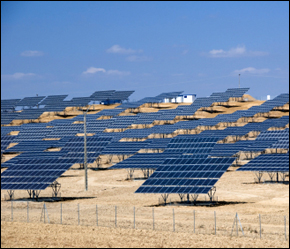
    Saudi Arabia’s national science agency announced a new initiative to build solar-powered desalination plants to reduce water and energy costs by 40 percent, Arab News reports.

    “Desalination is our strategic choice to supply an adequate amount of drinking water to people across the Kingdom,” said Finance Minister Ibrahim Al-Assaf at the launch ceremony. Different sources estimate that between 50 to 70 percent of the country’s drinking water is desalinated, a process that requires a lot of energy.

    Saudi Arabia uses 1.5 million barrels of oil per day at its plants, according to Arab News. But the solar-powered plants will help keep costs down. Prices for desalinated water have been trending upward in Saudi Arabia in recent years, said the Saudi Minister of Water and Electricity, Emirates Business reported.

    “There has been no breakthrough in the cost of desalination. The gradual reduction in cost due to improvement in technology has been mostly offset by increased material and labor cost,” said Minister Abdullah Al Hussayen at the International Desalination Association conference in November 2009.

    Saudi political leaders hope research from the initiative will position the country as a major producer of renewable energy.

    “Saudi Arabia aspires to export as much solar energy in the future as it exports oil now,” said Petroleum and Mineral Resources Minister Ali Al-Naimi.

    Research and development will be carried out by King Abdulaziz City for Science and Technology–-the national science agency–-and the King Abdullah University for Science and Technology.

    The initiative will be carried out in several stages, and the first plant will be a small, 30,000 cubic meter per day facility in Al-Khafji. In comparison, the Shoaiba 3 project on Saudi Arabia’s west coast is the world’s largest plant, producing 880,000 m3/d .

    During the initiative’s second phase, a 100,000 m3/d plant will be built. Eventually a network of plants across the country.

    Source: Arab News, Emirates Business

    Read more about global desalination trends in Circle of Blue’s report Drinking from the Sea

  • Inside Seattle Genetics’ Big Partnership, Motricity Files for $250M IPO, VC Stats for 2009, & That’s About It for Seattle-Area Deals News

    Gregory T. Huang wrote:

    It was a quiet week for deals in the Northwest—too quiet. Maybe companies are steering clear of breaking news so they don’t get drowned out by all the big quarterly earnings news and Apple’s much-anticipated product announcement tomorrow. Probably there’s a storm coming.

    —Ryan took us inside a major partnership between Bothell, WA-based Seattle Genetics (NASDAQ: SGEN) and Millennium in Cambridge, MA. The deal, which we originally reported last month, calls for Millennium to sell Seattle Genetics’ experimental drug for Hodgkin’s and other lymphomas in all markets outside the U.S. and Canada. Millennium, which began a research collaboration with Seattle Genetics back in 2003, is acting as the Bothell firm’s global development and marketing partner, thanks to Millennium’s global parent company, Japan-based Takeda Pharmaceutical.

    —Wade reported that Harvest Power, a Boston-area renewable fuels company that has operations in Seattle and Vancouver, BC, has formed a partnership with Waste Management (NYSE: WM), the Texas-based waste hauling giant. Waste Management has invested an undisclosed amount to help Harvest Power expand to more cities, starting with the East and West Coasts.

    —Dow Jones VentureSource broke out VC data for Washington state in the fourth quarter of 2009, as Bruce reported. The venture dollars invested shot up almost three-fold in the quarter, when $239.4 million was invested in 25 companies, compared with the same quarter in 2008, when less than $85.6 million was invested in 18 companies. For all of 2009, however, Dow Jones showed a 9 percent decline, with $793.4 million invested in 107 companies, as compared to $875.6 million in 97 companies the prior year.

    —Bellevue, WA-based Motricity, a software firm that helps wireless carriers and media companies deliver mobile data services to customers, filed a form S-1 with the SEC, saying it plans to sell up to $250 million in an initial public offering. The company was founded in 2001 and is backed by more than $400 million in venture funding; it moved headquarters from North Carolina to Washington following its $135 million acquisition of the mobile services unit of InfoSpace (NASDAQ: INSP) in 2007. Motricity generated revenues of $117.1 million in the 12 months ending on September 30, 2009, but is not profitable.

    —Lastly, we had a fascinating guest post from entrepreneur Jasper Kuria, a former Microsoftie, on the reasons behind the “evil” term sheets that VCs negotiate with startups they want to fund, and the ensuing strategy discussions about company growth and exits.


  • U.S. Wind Industry Installed a Record 10,000 Megawatts of New Generating Capacity in 2009, a 39% Increase in Capacity

    2009AWEANationalTotalCapacities

    2010Jan26: The U.S. wind industry installed a record 9,900 MW of new generating capacity in 2009, a 39% increase in wind generation capacity compared to the year before (New York Times). “The U.S. wind energy industry shattered all installation records in 2009, chalking up the Recovery Act as a historic success in creating jobs, avoiding carbon, and protecting consumers,” said AWEA CEO Denise Bode. “But U.S. wind turbine manufacturing – the canary in the mine — is down compared to last year’s levels, and needs long-term policy certainty and market pull in order to grow.  We need to set hard targets, in the form of a national Renewable Electricity Standard (RES), in order to provide the necessary stability for manufacturers to expand their U.S. operations and to seize the historic opportunity we have today to build up a thriving renewable energy industry” (AWEA).

    Reference: AWEA http://www.awea.org/newsroom/releases/01-26-10_AWEA_Q4_and_Year-End_Report_Release.html#_edn1; New York Times http://www.nytimes.com/2010/01/26/business/energy-environment/26wind.html

    Read the White House Press Release – The Winds of Recovery are Blowing Across the Nation http://www.whitehouse.gov/blog/2010/01/26/winds-recovery-are-blowing-across-nation

    Image Description: Map shows installed megawatts (MW) for each U.S. state. Top states in terms of total wind power capacities: Texas (9,410), Iowa (3,670), California (2,794), Washington (1,980), Minnesota (1,809). Image Location: AWEA http://www.awea.org/projects/ Image Permission: This work is copyrighted and unlicensed. However, it is believed that the use of this work to illustrate the subject in question, Where no free equivalent is available or could be created that would adequately give the same information, on Interlinked Challenges, hosted on servers in the United States by Michigan State University, qualifies as fair use under United States copyright law.

  • Harvest Power Strikes Deal with Waste Management to Turn Trash Into Fertilizer and Fuel

    Harvest Power Logo
    Wade Roush wrote:

    Homes and businesses in North America generate about 55 million tons of organic waste every year, and that’s without even counting sewage. Roughly half of this solid waste comes from grass clippings and other biomass from the typical yard, and the other half is food scraps. Most of the yard waste gets recycled, but most of the leftover food doesn’t.

    Harvest Power, a young Waltham, MA-based company with an office in Seattle and a processing center near Vancouver, BC, that generates high-quality compost and renewable fuels, wants to fix that. This week, it got a big boost from a major strategic partner, the Houston, TX-based waste hauling goliath Waste Management, Inc. (NYSE: WM).

    Harvest announced yesterday that Waste Management has agreed to invest to help the company expand to more cities, starting with the East and West Coasts. But even more important, according to co-founder and CEO Paul Sellew, the giant partner will provide Harvest with raw material for its composting process and, in the near future, its biogas and syngas production systems.

    “It’s all about feedstock,” says Sellew. “We need feedstock to manage, and WMI, being the largest waste management company in North America, has many millions of tons of material that we will have access to.”

    Formed in 2008 by Sellew, a composting industry veteran, and former Bain Capital vice president Nathan Gilliland, Harvest Power is headquartered in Waltham and has collected more than $40 million in capital so far through a combination of equity offerings, debt, and grants. Its backers include Menlo Park, CA-based Kleiner Perkins Caufield & Byers—which incubated and provided seed funding for the company—as well as German venture firm Munich Venture Partners, and now Waste Management.

    The $40 million total includes a $9.85 million equity round disclosed in a regulatory filing in December. The company isn’t saying exactly who participated in that round, or whether WMI’s investment was part of it. But it did say that as part of the agreement with WMI, Kleiner Perkins and Munich Venture Partners have increased their investments.

    Harvest Power compost facility

    Harvest isn’t an aggressive technology developer like most venture-backed cleantech firms, Sellew acknowledges. So far, the main technology it has pursued is large-scale composting, an age-old process in which bacteria act to break down huge, aerated piles of yard and food waste. The company’s sole existing facility, in the Richmond section of greater Vancouver, can handle 300,000 metric tons of waste each year, turning it into odor-free compost that can be sold as fertilizer to farmers, garden centers, landscapers, and municipal governments.

    By the end of 2010, according to Sellew, the company intends to bring two more technologies online at the Richmond facility. The first is anaerobic digestion, in which waste material is loaded into closed chambers where microorganisms break it down into carbon dioxide and methane. This “biogas” can be burned to produce heat or electricity, or it can be processed and compressed into natural gas. The second is wood gasification, in which wood chips are fed into a high-temperature combustion chamber and broken down into carbon monoxide, hydrogen, and methane—a combination known as “syngas” that can also be burned to generate power. (Two Massachusetts startups that Xconomy has covered, Ze-gen and IST Energy, are among the other companies pursuing waste gasification as a power source.)

    The new investment from Waste Management, Kleiner Perkins, and Munich will help the 50-employee company add staff, especially engineering talent, Sellew says. But there’s no new technology to invent here, he says—it’s all a matter of expanding processing capacity and adapting existing waste-handling technologies to the kinds of organic food waste that’s commonly generated in North America. “Composting and anaerobic digestion and gasification are all well-understood processes, so we don’t view that there’s any kind of substantive research and development risk,” Sellew says. “These technologies are ready to be rolled out.”

    With Waste Management as a new partner, Harvest will be able to do that faster. It’s the second deal in less than a year Waste Management has made with a Boston-area cleantech firm: last June the company said it would become the exclusive distributor of solar-powered trash compacting receptacles built by Needham, MA-based Bigbelly Solar.


  • California Announces Huge Incentive for Solar Hot Water

    solar thermal

    The California Public Utilities Commission has announced a nearly statewide financial incentive for solar hot water that will bring down costs for most utility customers by 51% to 60%, into a 3 year payback period. Customers of California’s three largest utilities can now get a 30% rebate for solar hot water. If they add the rebate to the new 30% Federal tax credit, they are saving 60%. The credit cap for apartment owners is set at $500,000, and the credit cap for commercial buildings is $250,000.  This will significantly help California reduce its greenhouse gas emissions, since it is estimated that buildings who install solar hot water reduce natural gas use by 25% to 90%.

    via Cleantechnica

  • San Diego’s Top 10 Venture Deals of 2009

    Top 10 List
    Bruce V. Bigelow wrote:

    The good folks at Dow Jones VentureSource provided us with a list of the 10 biggest private-equity deals in Southern California in 2009, but it might have been just as easy if Dow Jones had focused solely on San Diego. Seven of the region’s 10 biggest deals of 2009 were in the San Diego area, with six deals representing substantial venture investments in life sciences companies. Bear in mind, of course, that the vast majority of California’s venture deals occur in the Bay Area.

    Irvine-CA based Fisker Automotive broke the tape in Southern California with total funding of $85 million in 2009, according to Dow Jones VentureSource. Fisker piled on with additional funding earlier this month, announcing it had raised $115.3 million in new private equity funding as well as a partnership with battery supplier A123Systems of Watertown, MA. (And as Xconomy Boston’s Ryan McBride reports, A123 not only raised almost $100 million in 2009, but went public last year in a $380 million IPO.)The other two big deals that were beyond San Diego’s hallowed borders were Pasadena, CA-based eSolar, which got $40 million last March, and Irvine-based Visiogen, which also got $40 million last April.

    San Diego-based Zogenix, a specialty pharmaceutical company, raised $71 million in a later-stage round to support the January 13 introduction of its medical device, which enables patients to self-administer a 6-milligram dose of sumatriptan, a fast-acting pain-killer for migraine headaches.

    In putting together a list of San Diego’s “Top 10 Deals of 2009″ with just seven deals, I decided to add my best guess of three more contenders, drawn from reports right here at Xconomy San Diego, to round out our top 10 list. One curiosity about the data from Dow Jones VentureSource is that it did not count the sizable $50 million funding round that Helicon Therapeutics disclosed in a Form D filing in June. The company’s website says it moved to San Diego in 2008 from Farmingdale, NY.

    You’ll notice that three companies raised $50 million rounds, meaning they’re tied for the No. 4 spot. You can learn more about all the companies by following the links.

    The list:

    1. Zogenix, San Diego, CA—$71 million (Series C)

    2. V-Vehicle, San Diego, CA—$62.26 million (Series A)

    3. Tandem Diabetes Care, San Diego, CA—$52.3 million (Series B)

    4. Sangart, San Diego, CA—$50 million (Series F)

    4. PhotoThera, Carlsbad, CA—$50 million (Series E)

    4. Helicon Therapeutics, San Diego, CA—$50 million (Series F)

    5. Victory Pharma, San Diego, CA—$45 million (Series A)

    6. Fate Therapeutics, San Diego, CA—$30.49 million (Series B)

    7. Fallbrook Technologies, San Diego, CA—$29.4 million (Series A, two tranches)

    8. MPex Pharma, San Diego, CA—$27.5 million (Series D)


  • Smart grid wind technologies breeze into solar

    As momentum builds for making power grids smarter, so too is the need to harness and integrate more renewable energy sources on a large scale for utilities. One way in which that is happening at GE is by sharing the technological advances being made in two key renewable sources — wind and solar. As science blog Earth2Tech recently described the work: “Solar, like wind, is intermittent — power from the sun fluctuates when clouds pass overhead and wind doesn’t blow consistently. Now General Electric, which has been a major player in helping to integrate wind into the world’s power grids, wants to do the same for solar.” One way in which GE Energy is doing this is by taking the converter technology that plugs wind energy into the grid to make a “solar inverter” — basically a technology that takes the direct current generated by solar panels and converts it to alternating current used on the power grid.


    Moment in the sun: Because the energy output of a solar power plant is directly related to the availability of the sun, anticipating the load that the solar power plant will provide can present a challenge for the utility grid, causing the plant to trip off-line. In order to ensure that solar power plants stay online, the variability needs to be managed so that it is more predictable — even during disturbances such as intermittent cloud cover.

    As Earth2Tech explained: “To modify the inverter for solar, GE changed the way it connects to power projects, because solar panels generate direct current, which must be turned into the alternating current used by most appliances, whereas wind turbines generate alternating current… GE also modified the software to enable utilities to monitor and control the solar power plants. And the inverter had to be packaged with a new skin suitable for outdoor installations, as wind inverters are usually kept inside the towers, while solar inverters need to be able to survive the elements.”


    Family tradition: Engineering and design of GE’s Brilliance Solar Inverter was completed at GE’s controls center of excellence in Salem, Virgina. GE already makes 4,000 wind converters annually and has increased production at the Salem facility to include solar. The technology was adapted from that used with GE’s fleet of 1.5 MW wind turbines — over 12,000 of which are in the field.

    According to New Energy Finance, demand for solar energy has grown about 30 percent per year for the past 15 years, while hydrocarbon energy demand typically grows less than 2 percent a year. As wind and solar power plants increase in size and number to meet these demands, they are beginning to have a greater impact on the grid, displacing more traditional sources of power generation.

    “We believe that there will be significant growth in large-scale projects as the United States and the world strive to meet renewable energy targets,” said Victor Abate, vice president-renewables for GE Power & Water. “The challenge will be integrating these larger solar projects — which are also powered by a variable fuel source — in a reliable way.”


    Solar’s mission control: SunIQ is the name of GE’s suite of solar plant monitoring and controls systems. “The software that comes with the inverter presents information about solar projects in the same way that utilities and power-plant operators are already familiar with viewing power plant data,” Earth2Tech notes. GE’s work in renewables includes a global services organization that offers 24/7 remote monitoring and diagnostics centers and parts support.

    * Read “Solar-powered water purification units ship to Haiti” on GE Reports
    * Read a blog post by Oliver Mayer, who developed the solar-powered water units in GE’s labs
    * Read stories about GE Energy’s latest projects on GE Reports
    * Learn about our solar research in “Catching rays with solar sails” on GE Reports
    * Read about our research into large scale energy storage for renewables
    * Learn more at about GE’s solar inverter
    * Read “GE Puts Wind Converter to Work for Solar” on Earth2Tech.com
    * Read the announcement about GE’s SunIQ technology

  • Under the Radar Deals: 20-Something New England December Financings Worth $1M or Less

    Radar
    Erin Kutz wrote:

    We recently summarized the major December equity investments in Massachusetts’ tech and life sciences startups, but the New England region also had some more pint-sized deals worth noting. They’re between $100,000 and $1 million—what we like to call the under-the radar-deals tracked by our partner, New York-based ChubbyBrain, an information services company developing tools for investors, startups, and hopeful entrepreneurs.

    While these financings—some based in equity and others in debt—are small enough that we don’t typically cover them in our breaking news briefs or deals roundups, we’ve often looked at them as signs of what’s to come in industry investing, or bellwethers of which stealthy companies are on the rise. The December under-the-radar list brings us companies working on innovative solutions in spaces as diverse as glucose monitoring for diabetics, open-heart surgery alternatives, local advertising for newspapers, ADHD diagnostics, private air travel booking, your golf game, and beer brewing.

    A total of 21 such deals went down in the region last month, with 12 in equity-based funding and nine in debt-related financing. Massachusetts wrapped up the vast majority, with 13 of these smaller deals. Connecticut and New Hampshire each had a trio of December financings, while Rhode Island and Maine each took one home.

    Life sciences companies, particularly in the medical device realm, were prominent on the under-the-radar list, with technologies addressing a myriad of physical and mental ailments, from ADHD to cellulite to respiratory disease. One of the medical devices investments went to Myomo, a Boston-based company we reported on last April after it had slashed staff by 66 percent—from 12 to four full-time employees–and scaled back operations to a more virtual environment.

    The company was slowed by sluggish sales of its robotic elbow brace, designed to help stroke victims recover movement of partially paralyzed limbs. Myomo looks like it has regained some of its footing, though, judging by a December equity investment of $616,765 that VP of communications Matt Burke says comes from a range of private investors as part of a Series C round. An SEC filing reveals the total venture round to be targeting $1 million.

    A good chunk of the region’s under-the-radar financings went to …Next Page »


  • Harvest Power Cuts Deal with Waste Management, Snags More VC Cash

    Harvest Power, which builds, owns and operates facilities to turn yard clippings and other organic waste into renewable energy and composted soil, announced today that it is partnering with Waste Management, a leading waste services company, to expand its organics recycling operations. As part of the agreement, Waste Management — along with returning venture backers Kleiner Perkins […]


  • Bill Gates Posts Annual Letter, Backs Khosla

    Gregory T. Huang wrote:

    Bill Gates has posted his 2010 annual letter for the Bill & Melinda Gates Foundation. The letter focuses on innovation and the foundation’s efforts in education, food, and health—tackling ambitious projects in online learning, agriculture, vaccines, malaria, and HIV, to name a few. Gates also has invested in Vinod Khosla’s most recent clean energy fund, which is just one highlight from his extensive interview with CNET. Gates is also an investor in the San Diego biofuel firm Sapphire Energy, and TerraPower, a nuclear energy spinout from Bellevue, WA-based Intellectual Ventures.


  • Energy and Climate Are Low 2010 Priorities for Americans

    The Pew Research Center today released its annual poll of the public’s priorities for the new year. Topping the list is “strengthening the nation’s economy,” which is a 2010 priority for 83 percent of Americans surveyed, followed by “improving the job situation” (81 percent) and “defending US against terrorism” (80 percent).

    And in dead last? “Dealing with global warming,” with 28 percent, which places global warming below all 20 of the other issues polled.

    Even worse news for climate activists is that “dealing with [the] US energy problem” is the issue that suffered the greatest decline from last year, dropping from 60 to 49 percent. (”Dealing with global warming,” despite its two-point drop, was also the lowest-ranking priority in 2009.) Backers of cap-and-trade legislation on the Hill have sought to recast the debate from one centered on climate change — which has never scored many political points — to one focusing on energy independence, thought to be a political winner. But given that a minority of Americans now believe in the urgency of either climate or energy issues, the messaging task ahead for environmental activists is a difficult one indeed.

    And it looks as if they won’t get much help from the president. Sen. John Kerry (D-Mass.) is specifically asking Obama to “underscore that climate and energy reform is a priority for 2010.” But climate activists fear that it won’t receive so much as a mention in Wednesday’s State of the Union speech.

  • Home Fuel Cell Maker ClearEdge Power Adds On $11M

    If you know one fuel cell startup, it might be Bloom Energy — the secretive 8-year-old company with at least $250 million in financing. But another startup, 7-year-old ClearEdge Power, has begun to rack up customers for its $50,000 fuel cell device  – and it’s just raised another $11 million in equity financing, according to a filing […]


  • Drilling chemicals used in new gas wells remain underground

    (From ProPublica, which originally posted this piece, which was co-published with Politico, on Dec. 27, 2009.)

    ProPublica

    For more than a decade the energy industry has steadfastly argued before courts, Congress and the public that the federal law protecting drinking water should not be applied to hydraulic fracturing [2], the industrial process that is essential to extracting the nation’s vast natural gas reserves. In 2005 Congress, persuaded, passed a law prohibiting such regulation.

    Now an important part of that argument — that most of the millions of gallons of toxic chemicals that drillers inject underground are removed for safe disposal, and are not permanently discarded inside the earth — does not apply to drilling in many of the nation’s booming new gas fields.

    Three company spokesmen and a regulatory official said in separate interviews with ProPublica that as much as 85 percent of the fluids used during hydraulic fracturing is being left underground after wells are drilled in the Marcellus Shale, the massive gas deposit that stretches from New York to Tennessee.

    A hydraulic fracturing operation in Bradford County, Pa. It's possible that for each modern gas well drilled in the Marcellus and places like it, more than three million gallons of chemically tainted wastewater could be left in the ground forever.(Photo courtesy of the New York State Environmental Impact Statement)
    A hydraulic fracturing operation in Bradford County, Pa. (Photo: the New York State Environmental Impact Statement)

    That means that for each modern gas well drilled in the Marcellus and places like it, more than 3 million gallons of chemically tainted wastewater could be left in the ground forever. Drilling companies say that chemicals make up less than 1 percent of that fluid. But by volume, those chemicals alone still amount to 34,000 gallons in a typical well.

    These disclosures raise new questions about why the Safe Drinking Water Act, the federal law that regulates fluids injected underground so they don’t contaminate drinking water aquifers, should not apply to hydraulic fracturing, and whether the thinking behind Congress’ 2005 vote to shield drilling from regulation is still valid.

    When lawmakers approved that exemption, it was generally accepted that only about 30 percent of the fluids stayed in the ground. At the time, fracturing was also used in far fewer wells than it is today and required far less fluid. Ninety percent of the nation’s wells now rely on the process, which is widely credited for making it financially feasible to tap into the Marcellus Shale and other new gas deposits.

    Congress is considering a bill that would repeal the exemption, and has directed the Environmental Protection Agency to undertake a fresh study of how hydraulic fracturing may affect drinking water supplies. But the government faces stiff pressure from the energy industry [3] to maintain the status quo — in which gas drilling is regulated state by state — as companies race to exploit the nation’s vast shale deposits and meet the growing demand for cleaner fuel. Just this month, Exxon announced it would spend some $31 billion to buy XTO Energy, a company that controls substantial gas reserves in the Marcellus — but only on the condition that Congress doesn’t enact laws on fracturing that make drilling “commercially impracticable.”

    The realization that most of the chemicals and fluids injected underground remain there could stoke the debate further, especially since it contradicts the industry’s long-standing message that only a small proportion of the fluids is left behind at most wells.

    But while the message has not changed, the drilling has.

    The Marcellus Shale, denoted in brown, primarily cuts across large swaths of New York, Pennsylvania, Ohio and West Virginia. (Map by Jennifer LaFleur/ProPublica)
    The Marcellus Shale, denoted in brown, primarily cuts across large swaths of New York, Pennsylvania, Ohio and West Virginia. (Map by Jennifer LaFleur/ProPublica)

    In the nation’s largest and most important natural gas fields, far more chemicals are being used today than when Congress and the EPA last visited the fracturing issue, and far more of those fluids are remaining underground. Drilling companies say that as they’ve drilled in the Marcellus they’ve discovered that the shale rock — which is similar to many of the nation’s largest natural gas projects in Louisiana, Texas and several other states — holds more fluids than they expected.During hydraulic fracturing, drillers use combinations of some of the 260 chemical additives associated with the process, plus large amounts of water and sand, to break rock and release gas. Benzene and formaldehyde, both known carcinogens, are among the substances that are commonly found.

    If another industry proposed injecting chemicals — or even salt water — underground for disposal, the EPA would require it to conduct a geological study to make sure the ground could hold those fluids without leaking and to follow construction standards when building the well. In some cases the EPA would also establish a monitoring system to track what happened as the well aged.

    But because hydraulic fracturing is exempt from the Safe Drinking Water Act, it doesn’t necessarily have to conform to these federal standards. Instead, oversight of the drilling chemicals and the injection process has been left solely to the states, some of which regulate parts of the process while others do not.

    As the industry was lobbying Congress for that exemption — and ever since — the notion that most fluids would not be left underground continued to emerge as a recurring theme put forth by everyone from attorneys for Halliburton, which developed the fracturing process and is one of the leading drilling service companies, to government researchers and regulators.

    “Hydraulic fracturing is fundamentally different,” wrote Mike Paque, director of the Ground Water Protection Council, an association of state oil and gas regulators, to Senate staff in a 2002 letter advocating for the exemption, “because it is part of the well completion process, does not ‘dispose of fluids’ and is of short duration, with most of the fluids being immediately recovered.”

    In May, ProPublica heard a similar explanation from the industry-funded American Petroleum Institute.

    “Hydraulic fracturing operations are something that are done from 24 hours to a couple of days versus a program where you are injecting products into the ground and they are intended to be sequestered for time into the future,” said Stephanie Meadows, a senior API policy analyst who has been closely involved in fracturing legislation issues. “I don’t see the benefit of trying to take that sort of sequestration type activity and applying it to something that is temporary in time.”

    Asked how much fracturing fluid can remain underground, and whether it could be as high as 30 percent, the figure that was still being included in government reports earlier this year, Meadows said: “I guess I didn’t know that the statistics are that high.”

    Neither the American Petroleum Institute nor the Ground Water Protection Council responded to requests for further comment.

    EPA officials maintained in 2005, and say now, that the volume of fluids left underground had little to do with its opinion that hydraulic fracturing for gas wells is not the same as underground injection. They say that distinction is because the primary function of the two types of wells is different: Gas wells are for production processes, while most EPA-regulated underground injection wells are intended for storage.

    But Stephen Heare, director of the EPA’s Drinking Water Protection Division in Washington, said that both the circumstances and the drilling technology have evolved. When asked to explain how hydraulic fracturing today is different from other forms of underground injection, he said the bottom line was simple.

    “If you are emplacing fluid, it does not matter whether you are recovering 30 percent or 65 percent of it, if you are emplacing fluids, that is underground injection,” Heare said. “The simple explanation for why hydraulic fracturing is different from other injection activities,” he added, is that hydraulic fracturing “is exempt from regulation under the Safe Drinking Water Act.”

    The argument that fracturing should not be regulated by the EPA became prominent in the 1990s, after the EPA said that fracturing lay outside the scope of the Safe Drinking Water Act, because the primary purpose of gas wells was energy production, not fluid disposal.

    A 1997 Alabama lawsuit challenged that position, and the 11th Circuit Court of Appeals ruled against the EPA.

    [2] In that decision, the judges wrote that “According to the state agency, hydraulic fracturing is not underground injection because it does not result in permanent subsurface ‘emplacement’ of the fluids, as these fluids are pumped out of the ground before methane gas is extracted out of the well.” But the judges called that assertion “untenable” and ordered the EPA to regulate fracturing in Alabama under the Safe Drinking Water Act. They also ordered the EPA to more clearly define fracturing as a type of underground injection, a move that could have paved the way for regulation in other states as well.

    But in 2005, before such regulation could happen, Congress stepped in and gave hydraulic fracturing its special exemption from the Safe Drinking Water Act.

    When Congress voted for the exemption, it referred to a 2004 EPA report, which concluded that fracturing did not pose a threat to drinking water. That report, which has since been criticized as incomplete, said that while some of the fracturing fluids remained underground, “Most of the fracturing fluids injected into the formation are pumped back out of the well along with groundwater and methane gas.”

    Lee Fuller, vice president of government affairs for the Independent Petroleum Association of America, said that the emphasis on wastewater removal was made to help legislators understand how fracturing was different from underground injection, but that those legislators also knew that much of the water stayed underground when they voted for the exemption.

    “The EPA study said there was a certain amount of the water that does stay in the fractured formation. That information was known,” he said, adding that more of the water may seep out over the life span of the well. “So I think there was an understanding of it on the part of the proponents of the proposal.”

    In the 2004 report, the EPA said as much as 59 percent of fracturing fluids can remain underground. A 2009 Department of Energy report titled Modern Shale Gas put that figure at 30 to 70 percent, but emphasized that most wells fall into the lower end of that range, explaining that “the majority of fracturing fluid is recovered in a matter of several hours to a couple of weeks.”

    Just six months ago that point was reiterated in testimony before the House Committee on Natural Resources, when the Interstate Oil and Gas Compact Commission repeated a statement that former Alabama state geologist Donald Oltz made in the 1997 Alabama court case: “Almost all hydraulic fracturing fluid is recovered to the surface after a hydraulic fracturing operation.”

    That statement contrasts sharply with the latest reports from regions where gas drilling is on the upswing.

    Spokesmen for Cabot Oil and Gas, Range Resources and Fortuna Energy — three of the most active companies developing gas resources in the Marcellus Shale — say that more water is trapped underground in newer drilling areas because the “tight shale” that is loath to give up the gas is likely to hold on to the fluids too.

    “It’s not like you pump a volume of water into the frack and then it gives you that volume back,” said Ken Komoroski, a spokesman for Cabot Oil and Gas, who says only 15 to 20 percent of the fluid comes back out. “Most of the water and sand stays in the formation compared to in other geologic formations.”

    In Pennsylvania, where regulators had once predicted that drilling in the Marcellus would produce about 19 million gallons of wastewater per day, that estimate has been revised to just a fraction of that volume, largely because so much of the fluid is remaining underground.

    Range Resources now reuses 100 percent of the wastewater it extracts from its Pennsylvania wells by diluting it with fresh water and using it to drill more wells, said spokesman Matt Pitzarella. Range has been able to do that, Pitzarella said, in part because it’s extracting only 20 percent of the 4 million gallons it pumps underground for each of its wells.

    Gas industry officials say the amount of fluids they leave behind in their wells should have no bearing on whether hydraulic fracturing is or is not regulated by the federal government. What’s important is managing the risk, says the Independent Petroleum Association’s Fuller, a job he says the industry is doing very well without additional oversight.

    “You are wrapping yourself around a distinction of whether something should or should not be regulated under the Safe Drinking Water Act as opposed to whether something does or does not pose an environmental risk,” said Fuller, who asserts that despite numerous reports of contamination in drilling areas, the fracturing process has never been conclusively proven to be the cause.

    Regulation, Fuller said, “may shut down natural gas drilling for a long time, but it is not going to make the environment any better.”

    It will fall to Congress — and then to the EPA — to decide whether that is truly the case. Sponsors of the Frack Act hope for a vote this spring. If it passes, and if the EPA finds reason to change the conclusions it reached in 2004, the agency would then have to decide exactly how fracturing will be addressed by the Safe Drinking Water Act.

    “The thinking we did then, the study that we did then, we were really looking at a different set of circumstances,” said Heare, the EPA’s Drinking Water Protection Division director. “The agency has not investigated the impacts of hydraulic fracturing in other settings such as shale gas production and at this time is unable to quantify the potential threat.”


    Write to Abrahm Lustgarten at [email protected].

  • Betting on Water

    A new project will help identify and measure the water-related risks facing companies and their investors, and lead to better environmental decisions.

    Water scarcity, water pollution and water competition are various risks that could significantly harm a company’s operations. Even so, they are often overlooked by investors, financial analysts and businesses. Piet Klop, Senior Fellow in WRI’s Markets and Enterprise program, answers questions about why water matters to companies.

    What do you mean by “water risk”?

    Water risks, in short, are disruptions, costs, revenue losses, or growth constraints due to water shortages and declining water quality – all can affect asset performance and the profitability of a company.

    There can also be a reputational cost. Sustainable growth requires companies to be constructive when sharing any kind of resources with the communities where they operate.

    Without any sense of water risk, companies are inadvertently betting that water will be available in the long term.

    Investors are also becoming savvier. They want to know about these risks in order to make better investment decisions.

    How can investors, financial analysts and companies measure water-related risks?

    WRI is working, in partnership with Goldman Sachs and General Electric, on developing a Water Index. It will use publicly available data on indicators for water quality and water scarcity, and create map overlays combining and comparing the various risks.

    The index also has to account for the fact that water is inherently local. Risks will be different depending on the region and the sector. We’re building a standard methodology that is flexible enough to be replicated in different regions and sectors, and is transparent enough so that people can make sense of it.

    There’s a huge demand for this. No one has really cracked it yet. Earlier attempts have focused mostly on quantifying water footprints as companies’ impact on the environment. This index flips it, and looks at the environment’s impact on companies. This is a key paradigm shift, as it allows investors and others to assess how water-risk affects a company’s operations and bottom line.

    If this is going to serve the needs of the target audience, which is financial analysts, risk underwriters, and investors, it has to be timely and adaptable to different regions of the globe.

    What sectors are most exposed to water risk?

    The food and beverage industry, the power industry, mining, and manufacturing are particularly exposed to water risk. They depend on large quantities of water for production, and in the case of semi-conductor manufacturing that water needs to be of very high quality. Power plants, for example, depend on large quantities of water for cooling. If the water isn’t available, or if they can’t discharge cooling water into rivers or lakes because they are already too hot, they have to shut down.

    Where will you first develop and test the Index?

    We are starting in China, but we really could have started anywhere, since many river basins around the world are water-stressed. We chose the Yellow River Basin in China because it is water scarce and power demands are growing at 10 percent a year or so. Coal is the fuel of choice for power generation there. Coal which brings with it a huge water demand, not just in the power plant itself but in its supply chain, because it also requires huge amounts of water to process.

    How do companies’ decisions change when they take water risk into account?

    It depends on the sector. Our prototype is initially focusing on thermal power generation and its water risks. There are options to make the sector less vulnerable. Plants can be built on better sites where more water is available. Authorities and investors can choose a different power source overall – coal, for example, is very water-intensive compared to natural gas. And wind power doesn’t require any water at all. There is technology available to make power plants more water efficient, but these come with a tradeoff in overall efficiency and cost. With “dry cooling,” plants can cool with air rather than water, but this reduces overall efficiency by 20-30% or more. That’s a lot, and it means there’s sometimes a tradeoff between carbon emissions and water use. You can try to engineer your way out of water scarcity, but there’s no free lunch. It comes at a cost.

    Why is it so challenging to calculate water risk?

    Right now it’s hard to quantify these risks as well as we would like to. When, or what chance is there, that you’ll be hit by a drought? There’s really no way to know for sure, but investors need to know about timing to be able to include this kind of thing in their cash flow analysis. They need to know the probability and magnitude of an impact before they can put a real cost on it. It’s hard to do, as it is for many other environmental issues. But that’s why we’re here. If it were easy, it would happen all by itself.

    But right now, without any sense of water risk, companies are inadvertently betting that water will be available in the long term, without really thinking about it deeply. They are making long-term bets on water that, in the next 40 years, might no longer be available.

  • A schoolyard that generates power, collects rainwater and sorts waste

    school1.jpg

    Here is one schoolyard that teaches with a difference. Edible schoolyard along with Work AC and the Alice Waters’ Chez Panisse Foundation has designed a new schoolyard that has a series of interlinked sustainable systems where the building will produce heat and energy. Not only that, it will also collect rainwater, process compost and even sort waste, all with an off-grid infrastructure.

    school2.jpg

    This is how the school gets in the children to understand the concept of eco-friendliness. They bring in the children to the kitchen classroom where the kids have their meals. Now this is where the green aspect of the classroom comes into picture where the kids who prepare meals are shown how the classroom collects rainwater for reclamation.

    school3.jpg

    The mobile greenhouse extends the growing season by covering 1600sf of soil in the colder months and gardens will allow the children to care for plants.

    school4.jpg

    A systems wall, a series of spaces that include a cistern, space for composting and waste-sorting, solar batteries, dishwashing facilities, a tool shed and a chicken coop, rests on the opposite side of the yard

    school5.jpg

    This is definitely a very all encompassing and well integrated method of involving children to understand and develop environment sensitivity.

    school6.jpg

    school7.jpg
    [archdaily]

  • South Korea Plans Giant Eco Dome [Architecture]

    The Ecorium Project, South Korea’s planned nature reserve, is a stunner. The 33,000 sq. meter park includes a wetland reserve, a wild plant area, and maybe—just maybe—two dudes and their hilarious hijinks.

    The structure will comprise a series of connected domes, each of which contains its own greenhouse.

    Sponsored by the National Ecological Institute of South Korea and designed by Samoo, the Ecorium Project is going to be as much an educational center as it is a preserve. It’ll also be energy-efficient itself, with each greenhouse being capable of detecting external climate conditions and making the appropriate adjustments inside. The exterior will be made of metal panels, low-iron and low-e double glazing, wood and plexiglass.

    While there’s no word on when it will be completed—or started, for that matter—it’s great to see a project like this moving past the concept phase and into development. [World Architecture News via Inhabitat]


  • Top Trends for the Decade Ahead in Venture, Tech, Genomics, IP, and More Innovative Fields

    iStock_000004618375XSmall
    Luke Timmerman wrote:

    We hit a nerve last month when we asked leading innovators in high-tech, biotech, cleantech, and venture capital to write guest editorials about the transformational changes they see coming in their fields over the next decade. We got so many thoughtful submissions from the advisers we call “Xconomists,” and other tech leaders, that we figured it would be handy to provide a little roundup of these stories in case you missed any.

    I’m not going to try to find a common theme in these opinion pieces, because they are really all over the map. Some are short, some are long. Some looked a full decade out, others looked at the coming year, and one (McKinsey & Co.’s Steve Davis) peered out a century. So when you have a little spare time, scan the headlines, click, and enjoy. We learned a lot, and we’ll be watching to see how much of this stuff actually comes true.

    Exponentials R Us: Seven Computer Science Game-Changers from the 2000’s, and Seven More to Come” (Ed Lazowska, University of Washington, Dec. 24, 2009)

    The Startup Whisperer’s 2010 Technology Predictions” (Matt Hulett, RealNetworks, Jan. 4, 2010)

    2010 Venture Capital Oscar Predictions” (Michael Greeley, Flybridge Capital Partners, Jan. 5, 2010)

    Five Biotechnologies That Will Face Away This Decade” (Stephen Friend, Sage Bionetworks, Jan. 6, 2010)

    Top Five Innovations to Watch in the Coming Decade” (Robert Nelsen, Arch Venture Partners, Jan. 7, 2010)

    Top Five Disruptive Biotech Ideas to Watch in the Coming Decade” (David Walt, Tufts University, Jan. 8, 2010)

    The Intellectual Property Century” (Steve Davis, McKinsey & Co., Jan. 11, 2010)

    Be of Good Cheer in New Year, All Ye Entrepreneurs and Startup Founders” (Mike Elconin, Tech Coast Angels, Jan. 12, 2010)

    Achieving New Heights in Energy Efficiency in 2010” (Nathan Rothman, Optimum Energy, Jan. 13, 2010)

    Genomic Advances of the 2000s Will Demand an Informatics Revolution in the 2010s” (Eric Schadt, Pacific Biosciences, Jan. 14, 2010)

    Can Molecular Medicine Survive its Teenage Years and Reach Its Potential This Decade?” (Matt O’Donnell, University of Washington, Jan. 15, 2010)

    Top Five Innovations to Look for in Search-Based Marketing in 2010” (Russ Mann, Covario, Jan. 18, 2010)

    Top Five Trends in the Future of Work” (Brent Frei, Smartsheet, Jan. 19, 2010)

    Hardware Versus Software: The Defining Technology Battle of This Decade” (Sim Simeonov, FastIgnite, Jan. 20, 2010)

    Genomics Laid the Foundation for Big Global Health Advances to Come This Decade” (Ken Stuart, Seattle Biomedical Research Institute, Jan. 21, 2010)