|
"AdMob’s new Interactive Video Ad Unit brings together consumers’ love of watching videos on their mobile device with advertisers’ goal of providing an interactive, social experience for consumers," said AdMob CEO Omar Hamoui. "We are excited to create new ways for advertisers to engage with consumers on their mobile devices and for the developers behind the most popular and engaging iPhone applications to effectively monetize."
The first ads will begin running this week in select (but unnamed) applications across AdMob’s iPhone ad network. This network has reached over 20 million iPhones and iPod Touch devices around the world this year so far. A video demonstrating the new video ad unit can be viewed here.
Related Articles:
> Google Buys Mobile Ad Firm For $750 Million In Stock
> Usage of Mobile Web and Apps Doubles in 2 Years
> That’s a Lot of Mobile Advertising!

 ARM and more than 35 other companies have banded together to create an alliance dubbed the Solution Center for Android, which is aimed at increasing the resources available for developers trying to build for the relatively young OS on top of ARM hardware. Android, an open-source, Linux-based OS pioneered by Google, is the underlying operating system in several popular smartphones such as those from HTC and the Motorola Droid. However, as computer companies plan netbooks based on the ARM architecture (known as smartbooks), ARM and several other companies, including Texas Instruments and Mentor Graphics, determined that the Android OS needed more infrastructure to support these more complicated consumer devices. ARM and more than 35 other companies have banded together to create an alliance dubbed the Solution Center for Android, which is aimed at increasing the resources available for developers trying to build for the relatively young OS on top of ARM hardware. Android, an open-source, Linux-based OS pioneered by Google, is the underlying operating system in several popular smartphones such as those from HTC and the Motorola Droid. However, as computer companies plan netbooks based on the ARM architecture (known as smartbooks), ARM and several other companies, including Texas Instruments and Mentor Graphics, determined that the Android OS needed more infrastructure to support these more complicated consumer devices.
The Solution Center will serve as a go-to place for developers to get information on development tools, as well as resources and services optimized specifically for Android on the ARM platform. The end result should be better devices that are able to get to market quickly. And because ARM is so prevalent in other consumer gadgets scattered around the home, it’s possible that the alliance will help bring Android to more devices.


 If free Wi-Fi marketing is a good idea, as Om and Stacey argued last week, free Wi-Fi marketing in airports is an especially good idea, according to a new study from JiWire. The San Francisco-based mobile advertising company — which, of course, has skin in the game — found that more than half of airport Wi-Fi users hold an executive or management position, more than half have annual household incomes of more than $100,000 and 75 percent plan to make a big-ticket purchase in the next 12 months. If free Wi-Fi marketing is a good idea, as Om and Stacey argued last week, free Wi-Fi marketing in airports is an especially good idea, according to a new study from JiWire. The San Francisco-based mobile advertising company — which, of course, has skin in the game — found that more than half of airport Wi-Fi users hold an executive or management position, more than half have annual household incomes of more than $100,000 and 75 percent plan to make a big-ticket purchase in the next 12 months.
And of those logging on ahead of their departures, more than 80 percent spend in excess of 30 minutes online, with nearly one-third of them connected for over an hour. Which means there’s plenty of time for advertisers to make their pitches. As David Staas, senior VP of marketing for JiWire, said in a release:
“Business travelers are a highly coveted audience for both business and consumer-oriented advertisers due to their purchasing power, but are traditionally very difficult to reach.”
The surge in Wi-Fi use on mobile devices provides an opportunity — and a challenge — for network operators looking to provide connectivity over multiple networks. But it also provides a channel for advertisers willing to pay the cost of connectivity in exchange for the opportunity to reach consumers on the go. And as JiWire’s study highlights, some of those users — especially the ones in airports — are very attractive indeed.

 
 China Unicom is continuing to trumpet the iPhone’s prospects in China — despite widespread conviction that it’s too expensive there. As Stacey recently noted, Daniel Amir, director and senior research analyst of semiconductors at Lazard Capital Markets, has cited China Unicom officials as saying they’d sold some 30,000 iPhones in the country since its launch there on Oct. 30. China Unicom is continuing to trumpet the iPhone’s prospects in China — despite widespread conviction that it’s too expensive there. As Stacey recently noted, Daniel Amir, director and senior research analyst of semiconductors at Lazard Capital Markets, has cited China Unicom officials as saying they’d sold some 30,000 iPhones in the country since its launch there on Oct. 30.
And the company’s chairman, Chang Xiaobing, says he expects the device to become the best-selling smartphone in the country, Bloomberg is reporting. So should we buy all this iPhone love from China Unicom?
“We’re very confident about the market position of the iPhone,” Bloomberg quotes Chang as saying. The report also quotes IDC analyst Aloysius Choong, who said that “Unicom must lower its prices if it wants to access the mass market for the iPhone.”
That last fact is likely to be true. In China, a 32GB iPhone 3GS sold at launch for 6,999 yuan ($1,024) without a service contract; add that in and over two years a Chinese subscriber will pay some $3,000. Android phones, on the other hand, are likely to cost less in China given that Dell and other players providing them aren’t smartphone titans, and Android phones could play into pre-existing preferences for open source platforms that exist there.
China Unicom’s Chang is also denying that users will choose iPhones sold on the gray market, according to Bloomberg. Sales of gray market phones “won’t be very significant,” he claims, even though we just reported on iSuppli’s numbers showing that gray market phones are moving briskly in China.
Come on now. These pronouncements from China Unicom sound like little more than PR spin. There are many valid questions to be asked about the iPhone’s future in China. After all, the device will probably be hindered from using certain kinds of technology (it will get Wi-Fi, but only following a battle involving China’s government), there won’t be the same freedom to choose applications as there is elsewhere, and it’s very expensive relative to Chinese salaries. Only a few short weeks after the iPhone’s Chinese launch, it’s just too early to read the tea leaves.

 
 Could your smartphone one day notify you that you are in the early stages of a life-threatening disease — long before a doctor does? Strong signs indicate that mobile phones will become capable of that and many more types of medical diagnostic tasks. The race is on at UCLA, UC Berkeley and other organizations to imbue cell phones with imaging and microscope-like functionality that could turn them into lifesavers on a grand scale. Commercial companies offering $10 hardware parts aimed at these applications and more are starting to take shape. Here are more details on the escalating and exciting development of the pocket doctor. Could your smartphone one day notify you that you are in the early stages of a life-threatening disease — long before a doctor does? Strong signs indicate that mobile phones will become capable of that and many more types of medical diagnostic tasks. The race is on at UCLA, UC Berkeley and other organizations to imbue cell phones with imaging and microscope-like functionality that could turn them into lifesavers on a grand scale. Commercial companies offering $10 hardware parts aimed at these applications and more are starting to take shape. Here are more details on the escalating and exciting development of the pocket doctor.
Mobile phones could have a bright future in simple but powerful medical applications aimed at poverty- and disease-stricken parts of the world, as well as at average Joes and Janes. For example, researchers at UCLA have developed a phone-based imaging technology called LUCAS (Lensless Ultra-wide-field Cell monitoring Array platform based on Shadow imaging) that has the potential to monitor the condition of people with HIV and malaria. Phones with LUCAS onboard can capture an image of a blood or saliva sample then illuminate it with short wavelength blue light in such a way that a remote doctor can make a diagnosis.
 Professor Aydogan Ozcan at UCLA is behind LUCAS and is one of the leading researchers working on imaging applications for mobile phones. You can visit his research group’s web site here. Just last week, Ozcan and his team made waves with a $10 part for mobile phones that can act like a microscope, without a lens (see the photo here). The hope is that the technology will allow early disease detection and that it could be built into most cell phones. Ozcan has formed a commercial company, Microskia, to spread the technology, as The New York Times recently reported. Professor Aydogan Ozcan at UCLA is behind LUCAS and is one of the leading researchers working on imaging applications for mobile phones. You can visit his research group’s web site here. Just last week, Ozcan and his team made waves with a $10 part for mobile phones that can act like a microscope, without a lens (see the photo here). The hope is that the technology will allow early disease detection and that it could be built into most cell phones. Ozcan has formed a commercial company, Microskia, to spread the technology, as The New York Times recently reported.
 Ozcan isn’t the only researcher who foresees mobile phones notifying us that we are sick as soon as the earliest signs of disease appear. Berkeley researchers have developed a cell phone microscope, CellScope, that is aimed at making on-the-go diagnoses. Berkeley researchers also foresee cell phones becoming capable of imaging early stage tumors directly on the phones, as seen in the simulation of a breast cancer tumor at left (and as discussed in the video below). Ozcan isn’t the only researcher who foresees mobile phones notifying us that we are sick as soon as the earliest signs of disease appear. Berkeley researchers have developed a cell phone microscope, CellScope, that is aimed at making on-the-go diagnoses. Berkeley researchers also foresee cell phones becoming capable of imaging early stage tumors directly on the phones, as seen in the simulation of a breast cancer tumor at left (and as discussed in the video below).
 Emerging open-source apps also are aimed at mobile phone-based medical applications. EpiSurveyor is an ambitious, open-source, database-driven platform for gathering and sharing medical data using mobile phones. It’s widely used in Africa and Indonesia, and its developer, Dr. Joel Selanikio, has won prestigious awards for it. He developed it because he noticed that cell phones are in use even in the poorest parts of the world. Emerging open-source apps also are aimed at mobile phone-based medical applications. EpiSurveyor is an ambitious, open-source, database-driven platform for gathering and sharing medical data using mobile phones. It’s widely used in Africa and Indonesia, and its developer, Dr. Joel Selanikio, has won prestigious awards for it. He developed it because he noticed that cell phones are in use even in the poorest parts of the world.
Among the huge drivers for innovation surrounding medical diagnostic and data collection tools for mobile phones are the sheer ubiquity of the devices, and how they are always with us. It’s entirely likely that, over time, mobile phones will become the most commonly used tools for medical diagnostics — our pocket doctors.


 AdMob, the mobile advertising firm that recently made headlines thanks to a Google acquisition, might have become part of the Apple fold if things had worked out differently, according to a report by Bloomberg that appeared this weekend. Apple reportedly approached AdMob with interest before the Google deal went down. AdMob, the mobile advertising firm that recently made headlines thanks to a Google acquisition, might have become part of the Apple fold if things had worked out differently, according to a report by Bloomberg that appeared this weekend. Apple reportedly approached AdMob with interest before the Google deal went down.
That’s according to “people familiar with the matter” speaking to Bloomberg. It isn’t clear which side of the deal the source was on, but he or she declined to go on record since the proposed talks were never made public. Apple is said to have contacted AdMob “a few weeks” before Google made its successful $750 million bid for the firm.
If true, the rumors point to the increasingly fierce competition between two major players in the mobile phone game. Google’s Android is being adopted by more and more manufacturers and distributed on more devices everyday. To have a piece not only of the revenue from the use of Android apps and devices, but also from the advertising that appears on those phones, is a huge boon for the search giant.
It’s unclear why Apple’s bid didn’t succeed, if it was indeed made. It’s possible that Google made a better offer while Apple was still in talks with AdMob, or that the advertising firm used the Apple offer as a bargaining tool in enticing Google. All of the companies involved in both deals declined to comment on the reports made by the anonymous source.
Acquiring a mobile ad firm would have been a bit of a departure for Apple, which is still a hardware manufacturer first and foremost, but it is a logical move for Cupertino to make. Many of the ads AdMob displays in mobile apps direct users back to other programs in the App Store, so essentially Apple would just be closing the loop and taking in additional revenue by promoting its own revenue-generating software delivery method. Plus, it could probably use the company to place hardware ads as well, promoting less successful products through the massively popular iPhone.
If Apple is genuinely interested in getting into online advertising, it could attempt another acquisition, or it may start hiring staff with the necessary skill sets. I’d hazard a guess that if the computer maker did make a failed bid for AdMob, it’ll be twice shy about getting into the game now, since Google now controls an intimidating 30 percent to 40 percent of the mobile advertising market. It’d be hard to gain a solid foothold at this point.


 Sprint announced WiMAX service today in San Antonio and my hometown of Austin, Texas, so this is just to tell y’all I’m playing with a modem and will be letting folks know how it all works, once I activate the darn thing. Currently Sprint doesn’t support a USB modem for Macs (but I’m assured that one is coming, likely in time for the holidays), which means I need a PC to activate my modem on. But then I can use a personal hotspot product that converts the WiMAX signal to Wi-Fi to test it out on my MacBook (and iPod Touch)! So send me your questions, concerns and anything else WiMAX-related, and I’ll try to address them or get them answered. Personally, I want to see if this is something I could replace my wired connection with, or if it’s really just what I’d use instead of my 3G MiFi while I wait for LTE. Sprint announced WiMAX service today in San Antonio and my hometown of Austin, Texas, so this is just to tell y’all I’m playing with a modem and will be letting folks know how it all works, once I activate the darn thing. Currently Sprint doesn’t support a USB modem for Macs (but I’m assured that one is coming, likely in time for the holidays), which means I need a PC to activate my modem on. But then I can use a personal hotspot product that converts the WiMAX signal to Wi-Fi to test it out on my MacBook (and iPod Touch)! So send me your questions, concerns and anything else WiMAX-related, and I’ll try to address them or get them answered. Personally, I want to see if this is something I could replace my wired connection with, or if it’s really just what I’d use instead of my 3G MiFi while I wait for LTE.


 Evernote, a Mountain View, Calif.-based company that makes one of my favorite cross-platform apps, called (what else) Evernote, has raised $10 million in new funding. The new round was led by Morgenthaler Ventures, a respected Sand Hill Road firm with a deep history. Evernote had previously raised $6.5 million in VC funding. Phil Libin, Evernote’s CEO, tells The New York Times that he is going to be using the money to expand to new geographic markets and add new platforms. At present the app works on Android, iPhone, BlackBerry, Mac, PC and Palm’s WebOS. As you all know, I am a big fan of the application and its freemium business model. It probably is the single most useful app on my computer and my phones. (Related articles from WebWorkerDaily: Evernote Wants to Be Your Long-term Memory and How to Use Evernote for Collaboration.) Evernote, a Mountain View, Calif.-based company that makes one of my favorite cross-platform apps, called (what else) Evernote, has raised $10 million in new funding. The new round was led by Morgenthaler Ventures, a respected Sand Hill Road firm with a deep history. Evernote had previously raised $6.5 million in VC funding. Phil Libin, Evernote’s CEO, tells The New York Times that he is going to be using the money to expand to new geographic markets and add new platforms. At present the app works on Android, iPhone, BlackBerry, Mac, PC and Palm’s WebOS. As you all know, I am a big fan of the application and its freemium business model. It probably is the single most useful app on my computer and my phones. (Related articles from WebWorkerDaily: Evernote Wants to Be Your Long-term Memory and How to Use Evernote for Collaboration.)


 If you read the reviews, it becomes obvious that I am part of a small minority of folks who haven’t been blown away by the new Droid, a Google Android OS-based smartphone made by Motorola that Verizon Wireless launched Nov. 5 in the U.S. All the accolades are actually turning into smashing sales for the Droid, according to data collected by Flurry, a San Francisco-based mobile analytics company. How big are the sales? (Find out below the fold.) If you read the reviews, it becomes obvious that I am part of a small minority of folks who haven’t been blown away by the new Droid, a Google Android OS-based smartphone made by Motorola that Verizon Wireless launched Nov. 5 in the U.S. All the accolades are actually turning into smashing sales for the Droid, according to data collected by Flurry, a San Francisco-based mobile analytics company. How big are the sales? (Find out below the fold.)
We have been following the Droid pretty closely, and once we learned that the device had a solid (if not blockbuster) weekend, we decided to get a better grasp of the Droid-fever that seems to be spreading across the nation. Flurry, which tracks the usage of mobile applications across various platforms, ran a query at our behest to get us a clearer (if not totally accurate) picture of the Droid launch and its market penetration.
 Flurry has come up with a stunning number: 250,000 Droids sold in the first week vs. 1.6 million iPhone 3GS devices sold in the first weekend. Apple said it sold over a million devices in the first weekend of the launch of iPhone 3GS, so 1.6 million is pretty close to the mark. There has been talk that nearly 200,000 units of Droid were on the shelves at the time its debut, so it is not far-fetched to peg the total sales for the week at 250,000. (Related post: “iPhone 3GS vs. Droid: How Do They Really Stack Up?”) Flurry has come up with a stunning number: 250,000 Droids sold in the first week vs. 1.6 million iPhone 3GS devices sold in the first weekend. Apple said it sold over a million devices in the first weekend of the launch of iPhone 3GS, so 1.6 million is pretty close to the mark. There has been talk that nearly 200,000 units of Droid were on the shelves at the time its debut, so it is not far-fetched to peg the total sales for the week at 250,000. (Related post: “iPhone 3GS vs. Droid: How Do They Really Stack Up?”)
Flurry monitors about 10,000 apps across iPhone and Android and claims that it tracks apps on approximately two out of three unique iPhone and Android handsets. To estimate first week sales totals for the myTouch 3G, Droid and iPhone 3GS, Flurry detected new handsets within its system, and then made adjustments to account for varying levels of Flurry application penetration by handset. Flurry additionally cross-checked its estimates against Apple actual sales, released for the iPhone 3GS, which totaled 1 million units sold over the three days of sales, June 19-21. [Flurry statement]
If Flurry results are accurate, then Motorola and Verizon have a winner on their hands. This is the fastest-selling Android device to date. It also helps that Motorola and Verizon have budgeted $100 million to promote it. As the gadget makes it way across the world, one can expect sales of Droid to go higher. Motorola predicts it will sell a million units by the end of 2009. That works to about $100 per customer in acquisition costs for Motorola and Verizon. (Related posts: “What You Need to Know About the Droid” and “What Are the Downsides to Droid?”)
The average Android app session length is about four minutes vs. two minutes for iPhone apps, Flurry found. I believe that is because the Android apps are not as intuitive to use as the iPhone apps, but hey, that’s just me. What do I know — I don’t think Droid is that hot, and it sold a quarter million units in week one.
PS: Check out this great comment from one of our readers, Nicholas. “Currently, we are witnessing the evolution of mobile technologies past the computing paradigm of laptops, desktops and workstations, and Motorola needs a more cohesive idea of what can and will be accomplished in the mobile space,” he writes. Agreed — and that is why I find MotoBlur, the company’s communications-based interface, more interesting than its hardware. It could, with some work, become the new way of consuming large amounts of data.


 If you’re a baseball fan like I am, then you know that it in order to win, teams need more than just marquee stars. The role players, pinch hitters and relievers — all have to contribute in order for a team to win. A weak link can blow a game. Same goes for companies — every member of the team has a role to play. Why do I bring this up? Apple’s iTunes App Store and its murky and muddled policies. If you’re a baseball fan like I am, then you know that it in order to win, teams need more than just marquee stars. The role players, pinch hitters and relievers — all have to contribute in order for a team to win. A weak link can blow a game. Same goes for companies — every member of the team has a role to play. Why do I bring this up? Apple’s iTunes App Store and its murky and muddled policies.
Apple’s designers and engineers have done a good job putting together what is an iconic product, the iPhone. Its software gurus have helped foster the app revolution. But it when it come to the App Store approval process, Apple is blowing it.
Let me put it in terms Apple and its management can understand: The foggy and opaque App Store approval process is as big a disaster as Dell’s DJ MP3 Player.
For months now, I have watched the twists and turns of the Apple App Store drama with a degree of bemusement. After all, the rejection (or approval) of quirky and pointless apps aimed at hormone-challenged post-pubescent boys weren’t of concern to me. I couldn’t get upset over Google Voice fiasco, but that was understandable (not acceptable) because it was coming in the way of the carrier voice service. But lately, things have gotten a bit out of control.
The irrational approval process and reasons behind it given by the apparatchiks of Cupertino are driving developers to extreme frustration — especially those who have been Apple loyalists for years. Earlier this week, Joe Hewitt, a well-known programmer and a Facebook employee, threw up his hands in frustration over Apple’s App Store approval process and said he wants to work on a different project. (Check out my video interview with Joe Hewitt.)
No, Facebook isn’t killing its iPhone app — it is a corporation, after all, and will bend over backwards to appease Apple — but Hewitt is someone who’s made many vital contributions toward turning the iPhone into a major platform. He was carrying Apple’s water long before the rest of the 100,000 apps showed up, which is just one of the reasons why he was nominated to GigaOM’s Top 15 Mobile Influencers List earlier this year. When he speaks, I listen — plain and simple. And he expressed his anger in 140 characters.
Today, Rogue Amoeba, a company that is well-known within the Apple community for its audio-focused products, is publicly beating its head against the Great Wall of Cupertino.
Rogue Amoeba wanted to ship a bug fix for their app, Airfoil Speakers, but it took the better part of four months to get it approved. It was an arduous process, one that made the inner workings of the government bureaucracies look like a model of efficiency. The net-net, as described by company CEO Paul Kafasis in a blog post, is this:
First, be aware that Apple is acting as a gatekeeper, and preventing you from getting the software that developers such as ourselves are trying to provide you. We wanted to ship a simple bug fix, and it took almost four months of slow replies, delays, and dithering by Apple. All the while, our buggy, and supposedly infringing version, was still available. There’s no other word for that but “broken.” Right now, however, the platform is a mess. The chorus of disenchanted developers is growing and we’re adding our voices as well. Rogue Amoeba no longer has any plans for additional iPhone applications, and updates to our existing iPhone applications will likely be rare.
Others, such as programmer Jeff LaMarche, disagree with the disenchanted developers and have come to the defense of Apple. But I’m more inclined to side with Kafasis, as this is a problem that flares up more often than California wildfires.
John Gruber, who pens the Daring Fireball blog and is one of the most respected Mac-related writers out there, offers a very balanced view of the situation — and finds Apple at fault. “At a certain point good developers are just going to say, ‘I don’t need this,’” Gruber writes.
Gruber, as we’ve seen in the past, has the ear of the senior management at Apple. So perhaps his fair and balanced assessment is going to help Apple wake up from its stupor.
Apple has a very serious problem on its hands, one that can derail its grand plan. It needs to fix this as quickly as possible. Otherwise the company is going to blow the game in the bottom of the ninth — much like the Phillies in Game 4 of the 2009 World Series.


Global mobile phone sales reached 308.9 million units in the third quarter of 2009, a slight increase of 0.1 percent from the third quarter of 2008, according to a new report from Gartner.
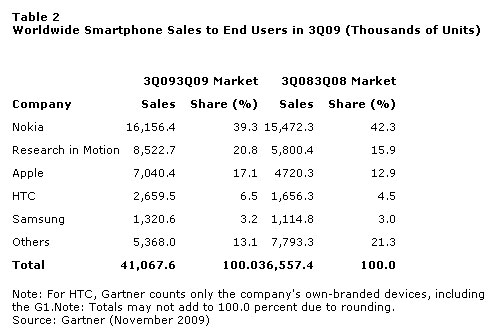
Smartphone sales showed solid growth with more than 41 million units sold for a 12.8 percent increase from the same period last year.
"The third quarter of 2009 saw the announcement of many new mobile devices, including several Android smartphones ready for the holiday season in the fourth quarter, but hardware commoditisation and the growth in open platforms will make it harder for them to stand out," said Carolina Milanesi, research director at Gartner.
"Many devices will reach the market in time for Christmas, and mobile carriers will run incentives for consumers during the holidays. We expect sales of mobile devices in the fourth quarter of 2009 to show year-over-year growth," said Ms Milanesi.
"As many vendors and industry watchers call for a decrease in sales into the channel, our sell through data is showing that 2009 performance will be flat rather than down over 2008."
Nokia led the mobile market in Q3 with 36.7 percent of the share, followed by Samsung at 19.6 percent and LG with 10.3 percent market share.
Nokia also ranked at the top in smartphone sales with 39.3 percent of the market, followed by Blackberry maker Research in Motion with 20.8 percent and Apple with 17.1 percent.
"Smartphones continued to represent the fastest-growing segment of the mobile-devices market and we remain confident about the potential for smartphones in the fourth quarter of 2009 and in 2010," said Ms Milanesi.
Related Articles:
>Google Launches Custom Search For Smartphones
>Buy A Blackberry From Walmart Get A $100 Gift Card
>Apple And LG Rank High In Consumer Satisfaction


 Google’s Android OS-based phones and Apple’s iPhone maybe get all the media love, but one analyst firm believes that it will be RIM’s BlackBerry that will be the smartphone king of the U.S. market in five years. Pyramid Research expects the device to be the biggest beneficiary of the move to smartphones. Google’s Android OS-based phones and Apple’s iPhone maybe get all the media love, but one analyst firm believes that it will be RIM’s BlackBerry that will be the smartphone king of the U.S. market in five years. Pyramid Research expects the device to be the biggest beneficiary of the move to smartphones.
According to their research, smartphones represented 31 percent of the new handsets sold in the U.S. in 2009, more than double from 15 percent in 2007. They expect 60 percent of the new handsets to be sold in 2014 to be smartphones. The BlackBerry, which currently has 50 percent of the total U.S. smartphone market, will see that share decline to 37 percent, but the increase in terms of total smartphone sales is going to keep it ahead.


|
 Telecom gear vendor ZTE will step up its game in the crowded smartphone space next year with an Android-based handset, and Google is rumored to be working on its own device. But as the smartphone market continues to heat up, manufacturers are learning the hard way that the key to success in mobile phones lies in the software — not the hardware.


 The Asia-Pacific region is getting ever-closer to faster mobile broadband, with network operators in Japan, Singapore, Australia and Indonesia readying their Long Term Evolution networks. Today NTT DoCoMo, Japan’s largest mobile operator, affirmed its


 With of an


 Adobe today
 Motorola and Verizon, thanks to their $100 million marketing efforts, are going to sell some 600,000 Droids during the fourth quarter of 2009, according to Mark McKechnie of Broadpoint AmTech, a boutique research firm. He had initially expected about 200,000 device sales following the launch, but he has upped his forecast: Motorola should sell another 200,000 Droids by Black Friday and 150,000-200,000 during the remainder of the holiday season. This would bring the total to some 600,000 Droids for 2009.

