Category: Mobile

  • BlackBerry Bluetooth Mini Stereo Speaker Gives You A Speakerphone That Goes Anywhere For $79.99

    bb-speaker

    BlackBerry’s accessories are almost as interesting as its first BB10 shipping hardware, and in addition to an external battery charger, they’ve also got a Bluetooth Mini Stereo Speaker/speakerphone that’s extremely portable, delivers decent sound and won’t cost you an arm and a leg at $79.99. Plus, the unique design means it clips onto your sun visor in the car for hands-free communication.

    The sound quality from the speaker is decent, much better than a lot of more expensive devices (though I’d still prefer a Jambox for audio fidelity), and it can actually go quite loud. Not room-filling or anything, but plenty loud for private listening. But the main advantages are the fact that it acts as a very good Bluetooth speakerphone, charges via micro USB (and can be charged with your external Z10 charger), can go weeks without a charge and has a 3.5mm headset jack, which essentially makes it a Bluetooth receiver for use with a stereo or headphones.


    The hardware accessory market is a place where it’s hard to compete with platforms like iOS and Android, and that’s likely why BlackBerry is taking an early interest in doing things itself. And they’re off to a good start in that regard, if my experience with this speaker is any indication.

  • The First BlackBerry 10 Device To Make U.S. Debut In March, Coming To All Four Major Carriers

    availability

    We’re right in the thick of RIM’s big BlackBerry 10 announcement in New York, and it’s been nothing if not eventful so far. CEO Thorsten Heins just recently unveiled the new BlackBerry Z10 (full review here) a little while ago, and now the topic of conversation has turned to something else: availability. RIM’s first BlackBerry 10-powered device will first appear in the UK and Canada, with sales beginning tomorrow across the pond and Feb. 5 in the Great White North for $149.99 on a 3-year contract.

    It’ll arrive in the U.S. in March, with pre-orders starting at the four major carriers, including Verizon, AT&T, Sprint and T-Mobile today, according to BlackBerry’s Alec Saunders. Pricing in the U.S. has yet to be announced for all carriers, but Verizon has said it will provide the Z10 at $199 on a two-year term for new agreements. And while on stage BlackBerry said that the Z10 will come to the U.K. tomorrow, on through all major UK channels, including EE, Phones4u, CPW, Vodafone, O2, Three UK, and BT.

    BlackBerry 10 first started undergoing carrier testing back in October, and by the end of the month Heins announced that more than 50 carriers had begun testing the veteran smartphone maker’s new mobile OS. Heins said that the delay in U.S. launch of the Z10 was due to American carriers taking longer to test new devices than those in other countries. That’s not exactly wonderful for BlackBerry, since the devices will go to market in the U.S. well after the company’s splashy Super Bowl marketing campaign launches.

    The Z10 has already made some progress getting its regulatory approval, which could suggest we’ll see it on AT&T’s network first, but that will depend on more factors than just government sign-off.

    As for the keyboard-toting Q10, it’ll be available in an “April timeframe,” Heins said at the event. That’s a global expected launch date, and there are no details yet on where it will launch first.

    Additional reporting by Darrell Etherington

  • The Blackberry Z10 Is A Solid First Offering For BB10 Hardware, But The App Gap Looms Large

    z10-13

    This is either beginning or the end for BlackBerry (formerly known as RIM). This is BB1o day, when BlackBerry debuts its smartphone running its latest software. The company’s hopes are resting on this bold new device, and to some extent, a nation’s as well. I’ve been using the BlackBerry Z10, RIM’s flagship BB10 handset, for a week now, and in that time I’ve been putting this new smartphone through its paces.

    I can safely report that based on my experience, BlackBerry has come a long way, but BlackBerry still has a very long way to go, and whether or not users will continue to stick around for the remainder of that journey will depend a lot on how fast the app ecosystem can grow.

    • 4.2-inch, 1280 x 768 display with 356 ppi
    • Dual core 1.5 GHz processor, with 2GB of RAM
    • 16GB internal storage, expandable with MicroSD cards up to 32 GB in size
    • User-replaceable 1800 mAh battery
    • 8MP rear camera with 1080p video recording, 2MP front camera with 720p video recording
    • Runs BlackBerry 10 OS

    The Z10 hardware is a departure from BlackBerry devices of old, and actually inherits very little design language from anything RIM has put out before, except the BlackBerry PlayBook. That’s a good thing, in my opinion – the hardware feels fresh, and also manages to come across as noticeably distinct from Android OEM devices or the iPhone.

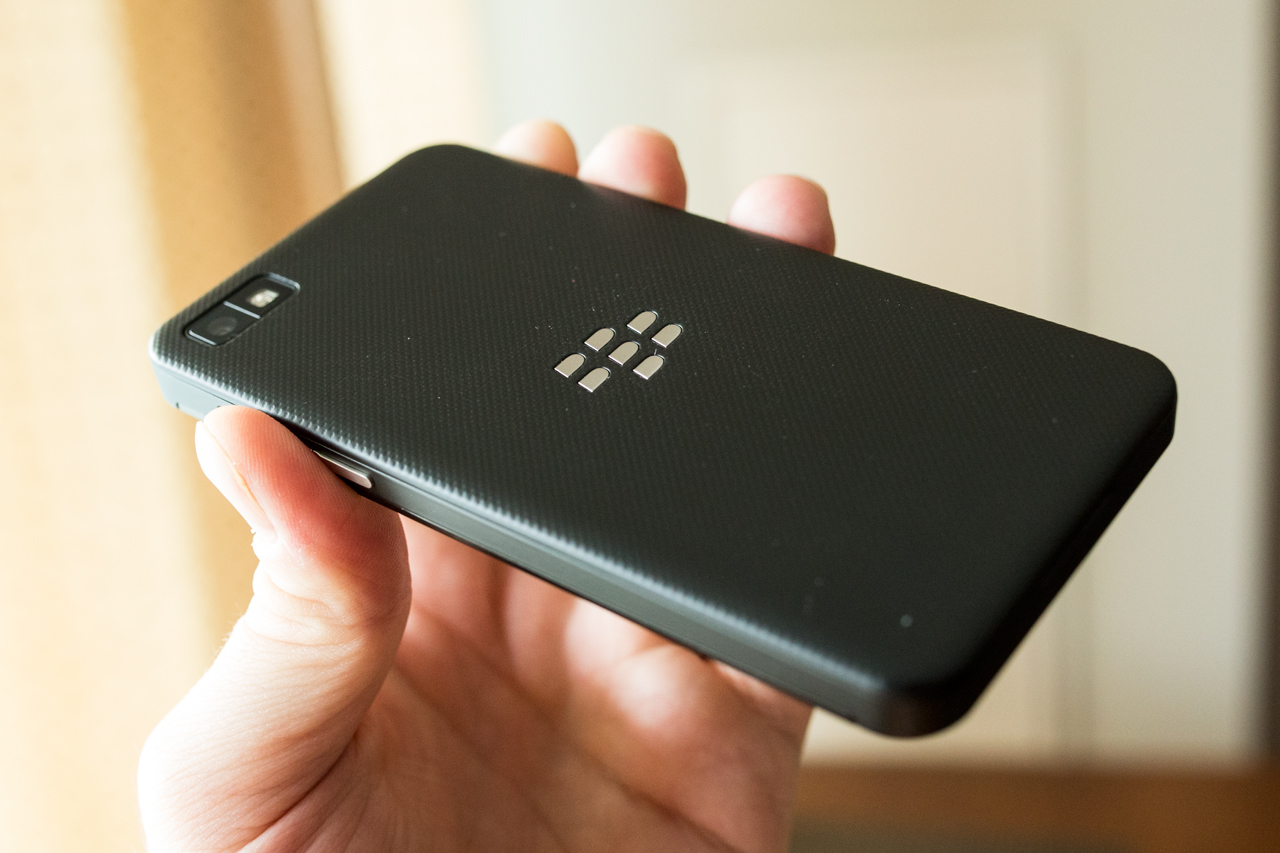
    As for the actual look and feel, the Z10 definitely impresses overall. It doesn’t feel overly big at 130mm by 65.6mm by 9mm, which makes it slightly thicker and larger in surface area than the iPhone 5, and pretty close to the Nexus 4. It’s a light device, since it’s mostly made of plastic, but it doesn’t feel cheap; the pebbled back cover has a pleasant feel in the hand, and it’s practical too, since it’s slightly grippy. That also means that when you set it down on a smooth surface, it won’t slowly edge its way off, something both the iPhone 5 and Nexus 4 are guilty of in my experience.


    The Z10 lacks any physical buttons on its front, owing to the gesture-based nature of the BB10 operating system, and has a wake/sleep/power button located on the top center of the device, as well as volume up/down buttons on the right side (which also both double as hardware shutter triggers for the camera) and a play/pause button between those. There are three ports on the device: a micro HDMI slot for A/V out, a micro USB port for data transfer and charging, and a 3.5mm headphone jack on the top left, just next to the sleep/wake button.

    Other hardware features include the trademark BlackBerry notification LED, which flashes a dire red to indicate there’s something new to check out in terms of messages, updates, etc., and a micro SD slot and micro SIM card slot under the back cover, which pops on and off easily but doesn’t feel at all loose when attached. The supplied 1800 mAh battery doesn’t last very long under normal usage conditions, but more on that later.

    BlackBerry 10 is a completely new mobile OS, and that means there’s a lot of new ground to cover when reviewing its software. But it’s possible to break down what’s new into a few key areas that will make the most difference to the average user.

    Gesture-based Navigation System

    BB10 is all about swiping to navigate. You swipe up to wake the devices, swipe right to check out BlackBerry Hub and view your notifications, swipe left to access your currently running apps and the home screen, and swipe down to check out both system-wide and app-specific settings. It’s different from what most users will be used to on either iOS or Android, but some aspects will be familiar to webOS users. Overall, while it’s different, it’s a surprisingly intuitive experience, and one that exceeds the tacked-on touch experience of BB OS 7 and earlier.


    Gesture controls took me virtually no time to get used to, and in fact, I found that going back to Android and iOS devices after extended use, I was trying to use the same gestures to do things like unlock devices. The so-called “Peek”, which lets you swipe and hold to view notifications and then quickly dismiss them was likewise something that quickly became second nature.

    It wasn’t all good, though. I found it was easier to accidentally activate the screen and even unlock it (without password protection) with the touch sensitive screen than with a hardware unlocking button. I also wasn’t crazy about the fact that swiping up to return from the notification hub brings you to the active apps screen, meaning you always have to swipe left one more time to get to apps. This is made somewhat better by the fact that you can tap a line of dots at the bottom to access specific pages of apps directly, as well as Hub and your active apps screen, something which you can’t do on stock Android or iOS.

    Accounts & Sharing

    One of the best parts of BlackBerry 10 is the fact that you can share directly to a number of different services thanks to account integration. Sign in at the system level with your Facebook, Twitter and Foursquare credentials, and set up Evernote to share and access notes content directly from that service. BBM sharing is also present throughout, as well as Bluetooth (the Z10 has low-power Bluetooth 4.0 on board) and NFC. Sharing options in BB10 are one of BlackBerry’s strong suits with this new product, and I’m sure they’ll add more services as users express a need for them, too.

    BlackBerry Hub

    I mentioned it already above, and users of other BlackBerry devices and the PlayBook will likely be familiar with the basic concept already, but Hub is technically new to BB10 and it works well as an aggregated inbox displaying all new activity from your phone, including new emails, texts BBMs, @ mentions on Twitter, third-party app notifications and more. It’s definitely useful, but is it more useful than Notification Center or Android’s pull down notification area? That’s debatable. It’s more of an actual destination within your phone, something you can live in and work from, but that can actually be counter-intuitive at times, like when you’re looking at a Twitter mention, and the back button takes you to Hub, not the Twitter home stream. But it also comes in handy, like when it provides contextual info on meetings, including information on attendees.


    Keyboard

    BlackBerry went with a touchscreen device as the first to market for BB10, but the software keyboard they created is designed to help convince hardware keyboard fanatics that there might be a better way. It features a unique prediction engine that lets you swipe up as you type to autocomplete words, and predicts the next term based on probability. In practice, that sounds very cool, but practically speaking, I found little use for it. It took more time to verify that a word was indeed what I wanted to type than it would have to just complete it myself, and when I would try to let go and trust it, often it would require that I go back, delete and replace owing to a mistaken prediction. When you enter your social media and email credentials, BB10 digs through your content to try to learn your typing style for better predictions, but that didn’t improve things noticeably for me.

    Luckily, you lose little by ignoring that feature and typing as you might be used to on an iPhone or Android device. And that’s when the keyboard really shines. It’s fast, responsive, and less prone to errors and typos thanks to wide virtual keys and a learning feature that detects when you’re repeatedly hitting one letter when you mean to hit the one next to it and remaps the key to stop that mistake from happening. This may well be the best stock software keyboard in the business, to make a long story short.

    Active Frames

    BB10 does true multitasking, which in itself is impressive (though that might contribute to the sub-par battery performance I experienced), but Active Frames are its real unique contribution. These provide reformatted info for native BB10 apps when they’re active but minimized, sort of like a cross between live tiles and Android’s widgets. They might show your latest checkin, for instance, for the Foursquare app, or display recent status updates for BBM. Active Frames are great when they’re available and well-implemented, which unfortunately isn’t often. BlackBerry needs to somehow make sure that third-party developers are making good use of Active Frames, since I found most apps didn’t provide any info when pinned to the multitasking screen, which is likely due at least in part to the fact that apps ported from Android through one of two methods can’t even offer Active Frame functionality.


    BBM

    BBM recently got voice chat, and now it has video chat, too. Both of these work over Wi-Fi and cellular, and both worked quite well in my testing, on both kinds of connections. Overall, BBM is still the single best messaging platform integrated into a mobile OS, easily beating iMessage in terms of reliability, but voice and video are huge steps towards modernizing the service, and very welcome additions.


    One of the most impressive features also comes via BlackBerry Voice: OS-wide screensharing. You can actually tap a button to let the person you’re video-chatting with see everything you’re doing on your own device, not just media or pictures. It’s like having the full power of a desktop Skype call on your mobile, but for free and built into the OS at the system level. Easily one of my favorite features of BB10 and the Z10.

    Camera

    BlackBerry has talked up BB10′s camera features, and the Z10 packs a camera with table stakes specs for the current smartphone market. It performs well, and provides images comparable to a lot of the devices out there currently, though they might not be quite up to par with iPhone 5 images. But the real story is the software, anyway, which includes the much-vaunted TimeShift feature for selecting faces independently from the rest of the shot.


    TimeShift works very well, and seems like magic when it does. Basically your phone takes a rapid series of photos, then auto-detects faces in the picture series (be warned, this doesn’t work reliably in very low light conditions), and then lets you select which face to use. The interface for using it is excellent and intuitive, and it does a great job of handling even changed head positions without making the final photo look bizarre. TimeShift is awesome, but it’s also a feature developed by an outside company that has since been purchased by Nokia, which means we likely won’t see it evolve much on BlackBerry’s mobile platform. Even as-is, it’s impressive, but I’m not sure how much I’d end up using it in practice: mobile photography is useful because it’s quick and casual, and I’m not generally inclined to fuss that much over editing those pics after the fact.

    On the video side, HD video recording is great, and there’s a neat feature called Story Maker that arrives as a new standalone app for BB10 which lets you basically create quick movies (complete with video clips, still shots, transitions, titles and soundtracks) about as easily as you can modify photos on Instagram. It’s a neat trick, but once again, perhaps of limited daily usefulness.

    Browser

    BlackBerry is proud of the BB10 browser, which does score very high on the HTML5 test. That’s impressive, and this is definitely the best web browsing experience I’ve ever had on a BlackBerry device. Note that the default search engine is Bing, but you can also set it to Yahoo or Google if you prefer. The browser renders websites very quickly, there’s a “Reader” mode that quickly reformats text-heavy pages, and the omnibar approach that combines search and URL fields into one is my preferred way to do it on mobile devices. Solid all around, in other words.

    BlackBerry Bridge & BlackBerry Link

    BlackBerry has released a couple of pieces of software that help the Z10 connect to other devices, including its own PlayBook and desktop computers. Bridge, if you have a PlayBook, works as it did in previous versions, providing remote control and network sharing. Link on the desktop is an improvement over previous BlackBerry syncing software, but it’s still not a complete smooth experience, but arguably desktop syncing isn’t as important as it once was for mobile devices.

    Voice Control

    The Z10 manages a trick that has been mostly Siri’s territory, offering built-in voice commands for tasks like texting, BBM, sending an email, calling and posting social network statuses or updates. It does this with around as much effectiveness and accuracy as Siri, if not more, but it lacks the ability to go deeper to search for local hotspots, make reservations or more. This is another area where BlackBerry’s efforts look like playing catch-up, but don’t quite go far enough to match what’s already available elsewhere.

    Maps

    BlackBerry Maps are powered by TomTom, the GPS navigation hardware and software company. And that’s probably why they offer turn-by-turn voice guided driving directions, but they don’t offer much beyond that. Points of interest are fairly limited compared to the competitor’s offerings, there’s no walking directions or any kind of public transit, and the maps themselves aren’t all that nice to look at. Maps may be a sore spot for Apple right now, but BlackBerry’s offering is worse, and that’s not good. Third-party apps could make up this deficiency, but as it stands, there’s very little out there to improve the situation.

    And so we come to BlackBerry World, which is a crucial area for consumers looking at BB10 as a real contender to the existing mobile platforms out there. And unfortunately, this is where BB10 shows its weakness. The platform is otherwise solid, and an impressive effort for a company that until now lagged considerably with its smartphone devices, but the app gap can’t be denied by even the most steadfast BlackBerry supporter.

    Even given launch partners whose apps weren’t available while I was conducting my review, there’s simply very little to work with here. The top charts are still littered with apps that are either naked in their cash grab attempts, weak clones of successful titles on other platforms, or just plain underwhelming. BlackBerry has done a lot to encourage developers to come to BB10, but I think this might simply have been a bridge too far. And that’s unfortunate, because all else being equal, it’s going to make the decision for a lot of consumers.

    Some of the apps that are there are good, and BlackBerry has clearly done their best to launch with as many quality, big-name partners as they could manage. But it’s the same situation that Windows Phone faces, yet potentially even worse: BlackBerry may have attracted a fair number of apps to the platform through their portathon and other efforts, but if the App Store and Google Play have proven anything, it’s that you have to crack millions of eggs to make a decent omelette in the mobile software game. Numbers are one thing, but the quality gap is what strikes you when you navigate to the apps section of BlackBerry World.


    The Z10′s display is strong, with resolution and pixel density right up there with the best in iOS and Android competitors (and exceeding most). It does seem a tad washed out and muted in terms of its color rendering compared to the best in iOS and Android displays to my eye, however, but that’s a very minor quibble. Brightness also isn’t the best, and I found I had to turn it up completely to get it where whites didn’t seem too dim, plus there’s no option to disable auto-brightness at all, which is likely in the interest of drawing out battery life, but frustrating nonetheless. Another place where a lack of user control shows: you can’t disable screen lock, instead maxing out at a 5 minute window after which it turns off automatically.

    The display itself is an achievement, however, for BlackBerry, which has been nowhere near the top of the market in this regard for years. Text renders very crisply, as you can see from the screens above, and it has very good touch response. I did notice the screen felt a tad gritty faster than my other touchscreen devices, however, and had to be wiped down more frequently with an eyeglasses cloth.

    This is the part that BlackBerry users aren’t going to like; battery life on the Z10 isn’t anywhere close to what you’d get on your BB7 or earlier hardware, which is likely the price BlackBerry had to pay to get everything up to snuff with the competition. In my testing, I found that playing locally stored video on a constant loop, while connected to a cellular network and running a few apps in the background, the Z10 managed an impressive 9 hours of battery life, and while doing a browser test that performed a loop of random Google image searches on Wi-Fi (made more difficult by the fact that I couldn’t turn off screen lock), it managed 5 hours and 45 minutes.

    But in real-world use, I found it hard to get through a standard day without the Z10 running dry. Left untouched, the smartphone seems to sip battery, but once you start using it for any length of time, it gets quite warm (warmer than my iPhone 5 or Nexus 4 by a long shot) and mows down battery quickly. Keeping track of how much it’s using isn’t easy, either; there’s no way to monitor battery performance beyond a basic visual icon, and no detailed battery info in system settings.

    With the Z10, BlackBerry has created a smartphone that’s worthy of being mentioned in the same conversation as the latest Android devices and the iPhone. That alone is an accomplishment for a company that has seemed on the verge of extinction for quite a while now. But a lot of what they’ve provided with this flagship device is narrowing, or at best, eliminating the feature and hardware gap between it and the two mobile platforms that have legions of users already, including a number who have already migrated away from BlackBerry devices.

    BlackBerry 10, and by extension the Z10, need to be Cinderella stories to bring BlackBerry back from where it is now, and while extremely solid and with a few very impressive features, I’d be hard-pressed to say there’s anything here that will necessarily convince an Android-loving BlackBerry convert to come back to the platform. Thanks to BlackBerry Balance, the BlackBerry Enterprise Server-dependent feature that I wasn’t able to test but that silos work and personal life on one account, I imagine a number of enterprise IT departments will embrace it. And it’s still a good mobile OS, good enough that it should also slow the tide of users flowing away from BlackBerry. But based on my testing, it’s not yet close to being a conversion experience for those already on other platforms, and that’s exactly what BlackBerry needs.

    More than RIM’s name changed when they launched this phone. However, even more needs to change – app availability and batter life being tantamount – before this can truly right BB’s sinking ship.


  • In the platform wars, open is ultimately more valuable than closed, says Betaworks

    When it comes to the future of the web, there are a few incubator-style seed investors that are worth paying attention to, and New York-based Betaworks is likely at or near the top of that list — founder and CEO John Borthwick has been an early proponent of some of the foundational shifts in social media and web services, including the rise of Twitter. In the latest version of his letter to shareholders and in a phone interview with GigaOM, Borthwick said that one of the themes he finds most compelling is the ongoing tension between the open web and closed platforms like Facebook, Apple and even Twitter. And in the end, he says, open will prevail.

    Although Facebook may look indestructible on the social networking side, with its $70-billion market cap and its billion-plus user base, and Twitter may seem equally dominant in another aspect of the real-time information economy, Borthwick argues in his letter that these big, incumbent platforms “are not as well positioned for the future as you might think.” For one thing, he says the drive to monetize these platforms is pitting the needs of those companies against the interests of their users:

    “One of the big stories of 2013 is the rising tide of tension between what the users want to do on a platform and what that platform’s owners want their users to do, in order to expose them to an adequate quantum of advertising. Platforms feel they have to impose controls to get users to do what the users don’t want to do naturally. It is reasonable to expect that some of these platforms will overplay their hands, creating significant opportunities for new social networks to emerge.”

    The islands won’t prosper like the oceans

    In an era when bandwidth is so readily available, and users have become accustomed to all of their data living somewhere in the cloud — a philosophy that has ironically been encouraged by those same incumbent platforms — Borthwick argues that many users are “ready, willing and able to move” to another network or service if push comes to shove. Having attracted users so rapidly in part by teaching them how “rootless and transient” their relationships can be, he says, some of these companies will ultimately learn how easy it is to lose touch with their user base.

    “Platforms are typically trying to control and centralize experiences with the opposing tension being the pull of their users at the edge. As billions more users join these networks over the next few years, the pull of the edge will get even stronger. That pull will make centralized architecture models hard, if not impossible, to execute against. There will be exceptions, but the islands won’t prosper like the oceans.”

    location-map-610x407

    Even with a company like Apple, which many would say is the quintessential closed and controlling platform, Borthwick argues there is evidence of how powerful open can be: namely, the response when Apple shut out Google’s map application in favor of its own lower-quality application. The response from users seems to be part of a larger trend in which many are switching from Apple apps and services to Google ones (I wrote about some of my own experiences in that area recently, and why I am considering switching to an Android).

    In our interview, Borthwick made it clear that openness does not necessarily equal free, and that some bastions of openness such as Google are only free at certain layers of what he calls the application “stack” — so, for example, Gmail and Google Maps are open, but the search algorithm is not. The Betaworks founder also agreed with Benchmark partner Bill Gurley, who said in a post last year that Google is very good at building “moats” around its core properties by offering free versions of software and services that integrate with them. Android arguably fits that strategy, Borthwick said.

    Open systems are more resilient and more valuable

    In any case, for Betaworks and its companies and offerings — which include the revived version of Digg and a range of experimental apps like Tapestry, as well as established companies like Chartbeat and Bitly — Borthwick says that open will remain the key to long-term viability and success. And closed platforms such as Facebook (and Twitter, which he argues is becoming more and more closed in an attempt to monetize its user base as quickly as possible) are growing more and more risky:

    “It is a core Betaworks conviction that open systems will prove more compelling, more resilient and more valuable to users than closed. Or to say it perhaps a bit more precisely: In a multiplatform world where open and closed systems will always co-exist, the force and power of openness will ensure the existence of a viable ecosystem for application and service builders like betaworks.”

    There are plenty of other things worth reading in the letter, including an assessment of the evolution in financing for venture-backed startups (something the company and its seed-stage, incubator-style focus are clearly a part of) as well as the implications of the “contextual internet,” in which apps and services respond more intelligently to what we are doing and where we are doing it. And Borthwick argues that data will be the killer factor for any company that wants to become successful, whether with advertising or any other content. Read the whole thing here.

    Post and thumbnail images courtesy of Shutterstock / Luis Santos and Flickr user Dunechaser

  • Samsung warns that competitive pressures will decimate smartphones’ profitability

    Samsung Warning Smartphone Margins
    Remember the good old days when smartphones were seen as the most surefire way to make a quick profit? Well, those days may be gone for good. As The Telegraph notes, Samsung (005930) put out a warning in its earnings guidance on Friday that may signal the end of sky-high smartphone margins. Overall, Samsung projects that “demand for smartphones in developed countries is expected to decelerate, while their emerging counterparts will see their markets escalate with the introduction of more affordable smartphones,” meaning that manufacturers will be competing fiercely with one another to see which one can move the most low-cost smartphones into emerging markets.

    Continue reading…

  • Nokia may finally give Verizon a high-end Lumia smartphone

    Nokia Laser Verizon Windows Phone
    Strangely, Nokia (NOK) has yet to offer a top-line Windows Phone device on Verizon Wireless (VZ) even though it’s the largest carrier in the United States. The company’s high-end Lumia 920 smartphone is only available on AT&T (T), while Verizon have been stuck with the mid-range Lumia 822. This may be about to change, however. According to The Verge, Nokia is preparing a flagship device for Verizon’s 4G LTE network. The handset, codenamed Laser, is said to feature similar specs to the Lumia 920 and will be heavily backed by Microsoft (MSFT).

    Continue reading…

  • Verizon sells AT&T $1.9 billion worth of valuable 700MHz spectrum

    Verizon AT&T Spectrum Deal
    Give Verizon (VZ) some credit — it seems willing to spread the spectrum wealth around. Verizon on Friday announced a deal to sell rival AT&T (T) several spectrum licenses on the valuable 700MHz band for a total of $1.9 billion. In addition to paying almost $2 billion in cash, AT&T will also give Verizon some of its AWS spectrum band licenses in “certain western markets, including Los Angeles, Phoenix, Fresno and Portland, Oregon.” Quartz late last year estimated that Verizon had slightly more mobile data spectrum on hand than AT&T, although it noted that both companies could potentially be dwarfed by rival Sprint (S) if it completes its proposed acquisition of Clearwire.

  • Huawei is now the world’s third largest smartphone vendor, but still far behind Samsung and Apple

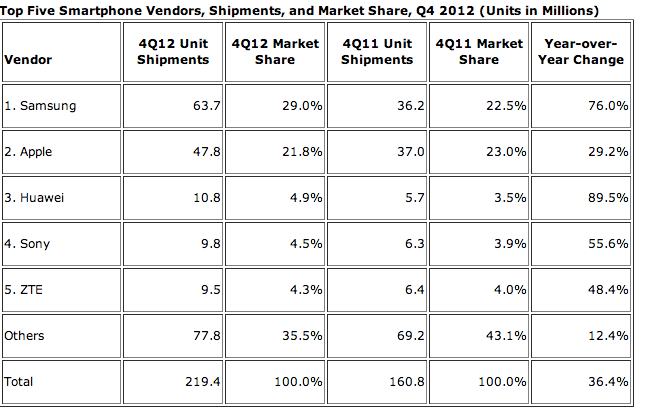
    Smartphone Market Share Q4 2012
    Research firm IDC released the latest numbers from its Worldwide Quarterly Mobile Phone Tracker this week and found that a total of 482.5 million mobile phones were shipped in the fourth quarter of 2012, an increase from 473.4 million in 2011. Smartphones accounted for nearly half, or 45.5%, of all mobile phone shipments, the highest percentage ever. Samsung (005930) and Apple (AAPL) remained the two top vendors with market shares of 29% and 21.8% respectively. The report did include some surprises, however.

    Continue reading…

  • Memo to Marissa: Partnering with everyone else is not a winning strategy for Yahoo

    According to attendees at the World Economic Forum in Switzerland, the venue for Yahoo CEO Marissa Meyer’s interview on Friday was so packed it was standing-room only, and demand for the livestream crashed the feed. And what was the recipe for success that everyone was so keen to hear about? According to Mayer, the moribund portal will come alive again not by its own hand, but by partnering with everyone else — i.e., Google, Apple and Facebook. Yahoo’s CEO is clearly trying to make a virtue out of the company’s weaknesses, but it’s hard to see how that is a winning strategy.

    In the interview with Bloomberg (which is embedded below), Mayer listed all of the things that Yahoo doesn’t have — including any proprietary hardware, software, an operating system, a social network, etc. (she could have added a search engine as well, since Yahoo has outsourced that to Microsoft) — but tried to argue that this was actually a benefit, not a disadvantage:

    “Given that we do not have mobile hardware, a mobile OS, a browser, or a social network, how are we going to compete? I think that the big piece here is that it really allows us to partner… we work with Apple and Google in terms of the operating system. In terms of social network, we have a strong partnership with Facebook. We’re able to work with some of these players that have a lot of strength in order to bolster our user experience that we offer on the Yahoo site.”

    Why would Apple or Google care about Yahoo?

    yahoo_logo

    This is a valiant effort on Mayer’s part, but what exactly does Yahoo have to offer Apple or Google in terms of a “partnership” around their operating systems and platforms? The web portal may still have millions of visitors a month who come to its news pages or other sites, but how does any of that benefit Apple or Google? Are they going to pay for access to that? Unlikely. Do either of them — or Facebook for that matter — really care about whether they get anything from Yahoo? Also unlikely.

    In her reply to another question, Mayer said that one of Yahoo’s strengths is that it is a player in all of the things that people like to do on their smartphones, whether it’s email, weather, news, photos or sports scores. Those daily mobile habits, she argued, are the key to Yahoo’s success:

    “When I thought about the strategy for Yahoo I pulled the list of what people do on their phones in rank order of frequency. If you ignore a few exceptions… the list looks like e- mail, check the weather, check the news, share photos, get financial quotes, check sports scores, play games. The nice thing at Yahoo is that we have all the content that people want on their phones. We have these daily habits. I think whenever you have a daily habit and providing a lot of value around it, there is opportunity to not only provide that value to the end user but to create a great business.”

    It’s true that Yahoo still has plenty of users who have Yahoo email addresses, check Yahoo News, share photos through Flickr (especially now that it has an actual usable mobile app) and look at sports scores or go to Yahoo message boards. But it’s also true that these numbers have not been growing very much at all lately — if anything, they have been shrinking, as other players like Google and Facebook and Apple (Yahoo’s alleged partners) carve away the businesses that Mayer is describing. What kind of future is that?

    Yahoo’s goal is the same as everyone else’s

    googleplusoneicon

    Mayer also talked about how the key to Yahoo’s strategy around these daily habits was to make sense of all the data about people’s activities and use that to show them relevant content — in other words, the exact same thing that Facebook and everyone else has their eye on. Yahoo may want to be the “Google of content,” but so does Google. The big problem for Yahoo is that there’s no reason to believe it can do a better job at this than any of those other companies, who have more data and more resources to devote to doing so.

    Compounding that problem is the fact that Facebook and Apple and even Google are becoming less likely to want to share their data with others, not more. Facebook has been busy for some time cutting off access by outside parties, and there’s no reason to think that will stop — and while Yahoo may currently have a contract that gives it access to the Facebook graph (a prescient deal it signed in 2009), that contract comes to an end fairly soon. So what does Yahoo do then?

    Mayer may be staking her future on the idea of outsourcing everything, but it is not a new idea at Yahoo: it is the same kind of approach the company has been taking ever since it decided to turn its search engine over to Microsoft. What does Yahoo actually own? Some pageviews and daily visitors (although it is mostly renting them, not owning them). The problem for Mayer is that the value of that asset is declining rapidly, and it’s not clear what replaces it.

  • Digital by default – a new reality for development?

    A few weeks ago I went to see the new James Bond film Sky Fall. Without giving away too much, at one point in the film James Bond goes to a remote part of the UK. The area is portrayed as far away from the hustle and bustle of London and as remote from government as possible. Living in Scotland, I immediately recognised the location as the beautiful Glen Coe. But what I found slightly at odds was that although Glen Coe is remote, the fact is that in this day and age I could probably still stay connected to all my government work from there.

    This “new reality” hit me this week when I participated in a flagship event called SPRINT13, organised by the UK’s Government Digital Service (GDS). GDS are a new team that have embarked on a huge set of projects with a range of government departments. The aim of these projects is to go beyond providing open data to make what government does more responsive to citizens, and cheaper.

    The old has left town and a new digital reality is coming to you – January 2012

    For instance, as I heard at the conference, the Department for Environment, Food and Rural Affairs is planning, in less than two years, to administer all support to UK farmers online. This will slash costs at the same time as breaking up the work so that small and medium companies can bid to create and manage the IT system for the payments. Generally, as outlined in this Economist article, transaction costs can be brought down by 20 times if departments “go digital” rather than use paper, by 30 times if they go digital rather than use post, and by 50 times if their online services replace face-to-face transactions.  There are many other examples on the GDS blog, all equally inspiring.

    All this inspiration got me wondering to what extent DFID incorporates these ideas when we work with governments in developing countries.

    We all know the stats – the fact that Africa’s mobile phone market has expanded so much it’s become larger than the EU or US markets with over 650 million subscribers. Hundreds of new broadband cables have been laid across African countries, as this presentation outlines. This infographic provides a great illustration of this transformation, and there is more up-to-date data in this report from the African Development Bank, African Union and World Bank.

    The transformation is something governments in developing countries recognise. Take Kenya, which has a multi-pronged digital strategy. Over 60 villages and schools are benefitting from digitisation, through an initiative known as “Pasha” Centres. A new “sillicon valley” of East Africa called “Konza” is being built. Government data is increasingly being published online. Such changes are happening elsewhere too, and some of the top global apps that help reduce poverty have benefited from UK aid.

    At the same time, there’s a long way to go.  According to World Bank data, here in the UK, 82% of people have access to the internet. So it makes sense that the government is aiming for all of our services that handle over 100,000 transactions per year to be “digital by default” by 2015 – from making farm payments to collecting road taxes, to using the internet to update health records after treatment.  Only 12% of people in Sub-Saharan Africa currently have internet access – the rationale is not the same.  But it is also changing rapidly. A new form of satellite broadband is being developed to bring millions more online. Chinese and UK/France companies are partnering to launch a new browser, cleverly tailored to low-cost smartphones to provide quick access to very familiar apps like Facebook and Twitter in English and Arabic.  This will increase demand. The key, as with the changes GDS has made, is to make the technology “locally relevant” – keeping the citizen, the end user, in mind.

    At SPRINT13, it slowly dawned on me that any government that doesn’t keep up with this new digital reality will not only be left in the dark, it will also face mounting costs.

    A few weeks ago, DFID launched our Digital Strategy, along with several other government departments, which outlines all the work we are doing to take on board this “new reality”. Unlike James Bond, even if we work in remote places, we really don’t want to be difficult to reach.  In fact, we want your creative ideas on how going digital can help us do more for development. So please do feedback below!

  • Verizon Said To Be Getting A Flagship Nokia Windows Phone (Codenamed “Laser”) Of Its Own

    lumia 900-10

    Don’t get me wrong, HTC’s Windows Phone 8X is great and all, but the rest of Verizon Wireless’ Windows Phone lineup (think the Nokia Lumia 822 and Samsung’s ATIV Odyssey) is a bit lacking in the oomph department.

    If a new report from The Verge’s Tom Warren holds true though, that may not be the case for too much longer. According to sources within Verizon, the carrier is gearing up to release a flagship Nokia Windows Phone with a spec sheet similar to the Lumia 920.

    There’s precious little other information about this device aside from the fact that it’s apparently codenamed “Laser,” and that Verizon reportedly plans to throw its considerable weight behind the device (unlike the case with the ATIV Odyssey, the poor thing). What exactly that means for Verizon is still unclear, but I can hazard a guess or two.

    I chatted with a high-level Nokia representative at Microsoft’s San Francisco Windows Phone 8 event who told me that strong retail partnerships with the country’s carriers was a priority for the Finnish company. That said, it wouldn’t be a shock to see Verizon retail workers getting some extended hands-on time with a forthcoming Windows Phone; after all, an informed retail sales force is key to Nokia moving units to those who don’t spend their days feverishly scouring tech blogs. AT&T also spends a considerable chunk of change on advertising the Lumia 900 when that was the hot new Windows Phone, and Verizon may well be doing the same (the fact that Microsoft is said to be chipping in some funds for advertising certainly doesn’t hurt).

    Oh, and just in case you were hoping against hope that the Laser name actually sticks, you can probably stop now. The moniker was used for a Pantech dumbphone not too long ago, which means the chances of strolling into your local Verizon store and picking up a hot new Laser are pretty slim.

  • Intel Makes Mobile Push Into Africa Via Partner Safaricom, Releases Android-Powered Yolo Smartphone

    lexington

    It’s no secret that Intel is gunning to gain some mobile traction in emerging markets, and the chipmaker doesn’t seem to be wasting any time in 2013. Kenyan wireless operator (and Intel partner) Safaricom has just officially revealed Africa’s first Intel smartphone, the Android-powered Yolo at an event in Nairobi.

    Yeah, you read that right: the Yolo.

    Now despite what you make of its name, the phone isn’t actually encouraging young, tech-savvy Africans make poorly-considered life decisions. Instead, it seems more like the continuation of some weird existing naming practices — Intel’s first Atom-powered Android smartphone for instance was dubbed the XOLO X900 when it made its debut in India in April 2012.

    The announcement doesn’t come as much of a surprise since Intel’s Mobile and Communications VP Mike Bell pointed out at CES that Safaricom (among other carriers in developing regions) would release smartphones based on the company’s value-oriented smartphone reference design in Q1 2013. That focus on highly cost-sensitive markets means that the Yolo and its ilk don’t exactly have a spec sheet that will set your world on fire — the Yolo sports a 3.5-inch touch display, and its Atom Z2420 processor can hit speeds of up to 1.2GHz, encode and decode 1080p video, and support HSPA+ data speeds. Naturally, that sort of performance is reminiscent of the sorts of devices you can find on domestic store shelves a few years ago (a sentiment Engadget echoed when they got some brief hands-on time at CES), but it’s still a pretty compelling package considering the competition in Kenya.

    Of course, there’s always the issue of cost to deal with. Safaricom will soon begin selling the Yolo (and 500MB of free data access) for Kshs. 10,999 (roughly $126) — sounds like a pretty sweet deal, but companies like Huawei have already waging a price war with devices like the $80 IDEOS smartphone on the front line. Really, with the explosion of even less expensive smartphones in Kenya and beyond, one has to wonder how much of a market Intel will actually be able to carve out in Africa.

  • Pebble Smart Watch iPhone And Android Apps Now Available, Just In Time For First Shipments

    PnOiadU

    Pebble, the Kickstarter darling and connected smart watch, announced just yesterday that its product was now beginning to ship out to backers in limited quantities, but its iPhone app had yet to be approved. Today, the company announced to its Kickstarter backers that both the iPhone and Android apps are available now, which means they’ll be fully functional for users of both types of devices when they arrive at backer doors.

    Of course, the apps won’t do anything on their own without any hardware to talk to, but at least the icon is very attractive, and it’s something to help soothe the pain of having to wait so long to actually get your hands on the Pebble itself. When you do get hardware, you’ll be able to update your Pebble software, install and remove custom watch faces for the device, and also send test messages to the watch for troubleshooting purposes. The Pebble team says that they’ll be updating the free app on a regular basis, presumably with more features.

  • Apple Patents Smart Shoes That Feature Embedded Sensors, And Alarms For When You Need New Ones

    Image (1) shoesuntied.jpg for post 195299

    Apple has been dabbling in wearable tech, at least when it comes to the U.S. Patent Office, and a new application uncovered Thursday by AppleInsider adds to that growing category. Apple has filed for a patent covering so-called “smart shoe” systems which feature sensors that can track wear and usage and tell you when you need to replace them, charting your progress on a companion app for a mobile device, or via built-in LED lights, speakers or displays.

    In its description of how this would work, Apple suggests embedding the processor and other electronics in the shoe’s heel, where there is plenty of room to house such components. Sensors can be housed in the sole, heel, and all along the shoe at points where detecting where provides a good indication of how worn out a shoe is getting. The sensors could include simple pedometers, activity or motion detectors that can translate any kind of motion into a timed unit of use (which can tell a user if they’re past the 500 hours recommended for a walking shoe, for instance), or a body bar that can detect weight and resistance to give more of a qualitative measure to use.

    The power for the sensors can either be supplied by a built-in battery, or from a generator that uses the actual motion of walking to recharge an energy store. Why not harness kinetic energy when the whole point of what you’re making is to track movement to begin with?

    Apple has applied for patents related to shoes before, like the one it was granted last January for embedded sensors in clothing that could inform your workouts. The idea is that the best way to craft workouts to actually help people achieve their goals is by monitoring their actual activity as reported by the garments closest to their bodies, rather than through depending on individuals to report their own habits accurately. Today’s shoe patent filing isn’t focused on health quite as directly, but it could be used in tandem with that kind of system to provide a holistic view of workout and activity habits, including how fast and often you’re wearing out your footwear.

    While many companies are looking at wearable computing in the form of smart watches or glasses-based heads-up interfaces (Apple included), there seems to be a background current at Apple devoted to more subtle and invisible incarnations of on-body tech. As with any patents, there’s no guarantee we’ll ever see these inventions ship, but wearable computing is bound to be a growing concern for any major consumer electronics maker in the next few years.

  • Samsung Galaxy Note 8 Reportedly Caught On Camera, Inherits Design Language Of Galaxy Note II

    tab4_b_7733

    Samsung’s Galaxy Note 8 is rumored for an official unveiling at Mobile World Congress next week in Barcelona, but this week it’s been the subject of a lot of rumors and speculation ahead of release. Today, there’s a new leak from Italy’s DDAY.it that purports to show the Galaxy Note 8 in action in the hands of an actual user. The pics are a lot more convincing than the SamMobile leak of a brochure shot of the same from earlier in the week, with a design that’s reminiscent of Samsung’s most recent smartphones.

    The Galaxy Note 8 that’s apparently depicted in these photos looks essentially like a blown up Galaxy Note II, with a rounded rectangle shell framing an 8-inch display. Down at the bottom of the bezel you see a physical home button, framed on either side by a back button and what looks like a multitasking button as touch-sensitive keys. You can also see a front-facing camera, as well as a rear camera without a visible flash. There’s also an S-Pen holster integrated into the bottom right of the rear casing, as you can see in the first image above.

    The Galaxy Note 8 is supposedly going to arrive with 2GB of RAM on board, with the front camera pegged at 1.3 megapixels, and the rear at 5 megapixels. The display is supposed to be around 1280 x 800, which, while not mind-blowingly dense, still beats the iPad mini with 189 ppi vs. 163 ppi for Apple’s smaller tablet. A report from earlier this week suggest it will have a 1.6GHz quad core processor under the hood.

    A MWC unveiling makes sense for this device, since Samsung showed off the Galaxy Note 10.1 with S-Pen at the event in Barcelona last year. And this design, while different from the SamMobile leak from Tuesday, bears a striking similarity to that device, meaning one or the other likely represents a slightly different pre-production design.


  • Cambridge University To Open £25M Graphene R&D Centre With Backing from Nokia, Plastic Logic & Others

    cambridge university logo

    Material scientists and nanotechnologists get very excited about the potential of graphene — a one-atom-thick sheet of bonded carbon atoms which is exceptionally strong, lightweight and flexible and is a better conductor than silicon  – but they are not the only ones to see huge potential in it. Nokia, Plastic Logic, Philips, Dyson, and BaE systems are among more than 20 industry partners who have pledged £13 million worth of support for a new graphene R&D centre to be established at Cambridge University. The Centre is also backed by more than £12 million of government funding.

    It’s unclear exactly what kind of support Nokia et al will be providing the centre but we’ve reached out to Cambridge University for more information and will update this story with any response. Nokia does already have an R&D lab in Cambridge, at the University’s Broers Building — one of a network of labs Nokia operates. According to the website, Nokia’s Cambridge lab studies ”physical, chemical and biological phenomena and manipulation of matter at the nanoscale enables generation of knowledge for enhancing human capabilities”.

    The new Cambridge Graphene Centre aims to develop graphene from a material with a lot of raw potential — researchers have already been looking at how graphene could improve battery capacity, and exploring its water-repelling properties —  to a point where it can “revolutionise flexible, wearable and transparent electronics”. Future industrial applications envisaged by the University are said to lie in the areas of “flexible electronics, energy, connectivity and optoelectronics”. So, hopefully, bendy, see-through wearable smartphones here we come — albeit, not tomorrow.

    One of the issues scientists have with graphene to-date is making (i.e. growing) large quantities of it — large enough to be useful for industrial applications. Graphene sheets are also difficult to manipulate and connect with other materials. So one of the projects the Centre will undertake will look specifically at the “manufacturability” of graphene and other, layered, 2D materials — focusing on a growth method called chemical vapour deposition that has been used to enable industrial scale production of other materials, such as diamond, carbon nanotubes and gallium nitride.

    As well as tackling graphene manufacturing, the Centre will investigate how graphene can be integrated into networked devices — “with the ultimate vision of creating an ‘Internet of things’” — and look into how it can improve the performance of super-capacitors and batteries. So potentially improving the longevity of consumer electronics devices, such as phones and MP3 players, but also aiming to provide “a more effective energy storage for electric vehicles [and] storage on the grid”.

    “Graphene’s potential is beyond doubt, but much more research is needed if we are to develop it to a point where it proves of benefit to society as a whole,” said Professor Sir Leszek Borysiewicz, Vice-Chancellor of the University of Cambridge, in a statement.

    Professor Andrea Ferrari, who will be the Centre’s Director, added in a statement: “We are now in the second phase of graphene research, following the award of the Nobel Prize to Geim and Novoselov. That means we are targeting applications and manufacturing processes, and broadening research to other two-dimensional materials and hybrid systems. The integration of these new materials could bring a new dimension to future technologies, creating faster, thinner, stronger, more flexible broadband devices.”

    The Cambridge Graphene Centre will start “activities” on February 1 this year, although the dedicated research facility isn’t slated to open until the end of the year. Its activities will be funded by a more than £12 million government grant, allocated to the University in December by the Engineering and Physical Sciences Research Council.  A further £11M of European Research Council funding will support activities with the Graphene Institute in Manchester, and Lancaster University.

    Cambridge University’s full release follows below.

    A centre for research on graphene, a material which has the potential to revolutionise numerous industries, ranging from healthcare to electronics, is to be created at the University of Cambridge. The University has been a hub for graphene engineering from the very start and now aims to make this “wonder material” work in real-life applications.


    The Cambridge Graphene Centre will start its activities on February 1st 2013, with a dedicated facility due to open at the end of the year. Its objective is to take graphene to the next level, bridging the gap between academia and industry. It will also be a shared research facility with state-of-the-art equipment, which any scientist researching graphene will have the opportunity to use.

    The Centre’s activities will be funded by a Government grant worth more than £12 million, which was allocated to the University in December by the Engineering and Physical Sciences Research Council (EPSRC).  The rest of this money will support projects focusing both on how to manufacture high-quality graphene on an industrial scale, and on developing some of its potential applications.

    Graphene is a one-atom thick layer of graphite with remarkable properties. It is exceptionally strong, yet also lightweight and flexible, enables electrons to flow faster than silicon and functions as a transparent conductor. Researchers in industry and academia are keen to harness its potential to make significant technological advances. This work might lead to numerous new devices and applications which could then be commercialised by industry and help to boost economic growth.

    There is still much to be done before that early promise becomes reality. The first job for those working in the Cambridge Graphene Centre will be to find ways of manufacturing and optimising graphene films, dispersions and inks so that it can be used to good effect.

    Professor Andrea Ferrari, who will be the Centre’s Director, said: “We are now in the second phase of graphene research, following the award of the Nobel Prize to Geim and Novoselov. That means we are targeting applications and manufacturing processes, and broadening research to other two-dimensional materials and hybrid systems. The integration of these new materials could bring a new dimension to future technologies, creating faster, thinner, stronger, more flexible broadband devices.”

    Professor Sir Leszek Borysiewicz, Vice-Chancellor of the University of Cambridge, said: “Graphene’s potential is beyond doubt, but much more research is needed if we are to develop it to a point where it proves of benefit to society as a whole. The pioneering work of Cambridge engineers and scientists in fields such as carbon nanotechnology and flexible electronics, coupled with our record working with industry and launching spin-out firms based on our research, means that we are in a unique position to take graphene to that next level.”

    Professor Bill Milne, who will be part of the Centre’s management group, said:  “Graphene has amazing fundamental properties but at the moment we cannot produce it in a perfect form over large areas. Our first aim is to look at ways of making graphene that ensure it is still useful at the end of the process. We have to find modes of production that are consistently effective – and there is still a lot of work to be done in this respect.”

    One such project, led by Dr Stephan Hofmann, a Reader and specialist in nanotechnology, will look specifically at the manufacturability of graphene and other, layered, 2D materials. At the moment, sheets of graphene that are just one atom thick are difficult to grow in a controllable manner, manipulate, or connect with other materials.

    Dr Hofmann’s research team will focus on a growth method called chemical vapour deposition (CVD), which has already opened up other materials, such as diamond, carbon nanotubes and gallium nitride, to industrial scale production.

    “The process technology will open up new horizons for nanomaterials, built layer by layer, which means that it could lead to an amazing range of future devices and applications,” Dr Hofmann said.

    The Government funding for the Centre is complemented by strong industrial support, worth an additional £13 million, from over 20 partners, including Nokia, Dyson, Plastic Logic, Philips and BaE systems. A further £11M of European Research Council funding will support activities with the Graphene Institute in Manchester, and Lancaster University.

    Its work will focus on taking graphene from a state of raw potential to a point where it can revolutionise flexible, wearable and transparent electronics. The Centre will target the manufacture of graphene on an industrial scale, and applications in the areas of flexible electronics, energy, connectivity and optoelectronics.

    Professor Yang Hao, of Queen Mary, University of London, will lead Centre activities targeting connectivity, so that graphene can be integrated into networked devices, with the ultimate vision of creating an “internet of things”.

    Professor Clare Grey, from Cambridge’s Department of Chemistry, will lead the activities targeting the use of graphene in super-capacitors and batteries for energy storage. The research could, ultimately, provide a more effective energy storage for electric vehicles, storage on the grid, as well as boosting the energy storage possibilities of personal devices such as MP3 players and mobile phones.

  • Apple’s Q1 2013 Breaks iPhone And iPad Sales Records With 47.8M, 22.9M Units Sold Respectively

    Screen Shot 2013-01-23 at 2.49.12 PM

    Apple just released its earnings report for Q1 2013, ending in December of last year, with a solid hardware quarter overall. The iPhone dominated with 47.8 million units sold in the quarter, up quarterly and yearly, with Apple also breaking records with 22.9 million iPads sold.

    The iPhone 5 saw its first full quarter of availability this period, as well as a nice holiday sales boost. Analysts had suggested earlier this month that iPhone 5 production orders had been cut on signs of weak demand.

    22.9 million iPads sold is a solid increase from last quarter’s 14 million. It’s also a 33 percent YOY increase, up from 15.4 million last year. The iPad missed predictions last quarter.

    Though Apple doesn’t break out specific numbers on various models, it’s fair to assume the iPad mini, which was available for the majority of the period, played a part in the increased sales along with the holiday spike. And let’s not forget, Apple also introduced an upgraded 4th-generation iPad with Lightning port alongside the little guy.

    However, the iPad mini has more to make up for, as its gross margin is significantly lower than other products.

    Apple sold 47.8 million iPhones over the three-month period, vs. 26.9 million last quarter and 37 million last year. That represents YOY growth of 23 percent.

    Analysts believe that the iPhone may have already saturated developed markets like the U.S. and the UK, which are Apple’s strongest regions, which explains the production cuts.

    However, Apple is rumored to be developing two versions of the next-gen iPhone, and one is said to be a budget model aimed at developing markets.

    In terms of iPods, the new family of colorful iPod products has managed to breathe a little life into a flagging business for Apple. The introduction of the iPhone has most certainly chomped into this segment of the business, but Apple still managed to sell 12.7 million, up from 5.3 million last quarter, representing a YOY loss of 18 percent.

  • T-Mobile Has The Nexus 4 In Stock! You Guys! Hurry!

    nexus 41

    If you’re quick, you can snag a Nexus 4 from T-Mobile right now for $199 on contract. Ever since its launch, the phone has been rather hard to purchase. Blame Google. Blame LG. But it doesn’t matter now, ’cause you can buy one right this very second.

    The Nexus 4 launched on the Google Play store late last year. It sold out almost immediately. T-Mobile then started selling the phone in some retail locations last week. Now, right on schedule, the Nexus 4 is available through its website as long as you’re willing to sign a contract — which is kind of a bummer.

    Part of the Nexus 4′s breakout success comes from its original pricing. Google cut the wireless carrier out of the picture and sold the phone at a fair price without requiring a new contract. At $349 the phone was slightly more than a comparable iPhone, but owners weren’t locked into a 2 year service agreement.

    So, if you’re willing to lock yourself into a two-year agreement, here’s the link to the hottest Android phone currently on the market. If not, keep on refreshing the Nexus 4′s Google Play product page. It’s bound to be in stock sometime in 2013.

  • Chromebooks

    According to Google, Chromebooks are built and optimized for the web. So we will get a faster, simpler and more secure experience from the Chromebooks.  Chromebooks boot in 8 seconds and resume instantly with full support for the latest web standards and Adobe Flash. Chromebooks will be available on June 6.  I can’t wait to test drive one.


    Filed under: Future Technology Tagged: Chromebook, Google, laptop, mobile, technology

  • Social Media Revolution

    Socialnomics has created several versions of Social Media Revolution.  These videos provide interesting social media and mobile statistics that are based on the book Socialnomics by Erik Qualman.

    Filed under: Social Media Tagged: facts, figures, media, mobile, revolution, social, statistics