A lot of people who own smartphones never bother to link them to their home Wi-Fi networks when available, according to virtual hotspot provider Devicescape. Since a good deal of smartphone usage occurs at home, tapping into home Wi-Fi would not only save these folks data plan charges, but more often than not, provide them with a faster more resilient connection than their operator’s 3G or 4G networks.
The problem is there are a lot of people who don’t realize their phones will link to their home networks — they either can’t figure out how to configure their devices’ Wi-Fi settings or they’ve disabled their Wi-Fi from the get go. Devicescape on Thursday said it has developed a new bit of software that attempts to lure those customers onto their own home networks.
Called Personal Curator, the smartphone client utilizes Devicescape’s radio management and network detection technologies, along with a machine-learning algorithm, to identify when a user is at home and a wireless network is available. If the smartphone’s Wi-Fi radio is disabled, Personal Curator will activate it and prompt the user to connect, walking them through the device configuration process.
Devicescape claims that as many as 30 percent of smartphones never connect to an available home Wi-Fi network, which would mean an enormous quantity of traffic that could easily be shunted onto a cheap broadband connection is instead heading toward the cell towers. That number seems high, but it’s not entirely out of the question. I’ve configured the Wi-Fi settings of many a friend or relative who never bothered to do it themselves.
Devicescape is selling Personal Curator to carriers, who would pre-install it on the smartphones they sell and have the biggest vested interest in coaxing customers on to as many Wi-Fi networks as possible. Devicescape estimates operators would save $631 in lifetime network data delivery costs for each subscriber that it can lure onto a home network.
Frankly, that figure is a bit absurd. It assumes that customers who don’t use their home Wi-Fi today will wander the world blithely unaware of Wi-Fi for the rest of their lives. It also assumes all smartphone users are created equal (More technically savvy users who consume more data tend to be more aware of their device’s networking capabilities).
Still, for Devicescape’s core customers, Personal Curator could be a very attractive service. The company’s whole business model is designed around the idea of providing cheap ubiquitous Wi-Fi to carriers. Through crowdsourcing, it has identified and mapped 12 million open access points around the world, and its client software automatically links to those nodes whenever they’re available.
It counts among its customers MetroPCS (now part of T-Mobile USA and mobile virtual network operators like Republic Wireless, which offer subscribers cheap unlimited data plans. Any packet those operators ship over the unlicensed airwaves is a direct cost savings. And once connected to home Wi-Fi, smartphone owners would likely use the heck out of it. A recent Sandvine report shows that 20 percent of all traffic traversing home broadband connections comes from a phone or tablet.
Devicescape has grown considerably in the last year. It now sells its products to eight carriers in North America and Europe (including U.S. Cellular and Bouygues Telecom). It has also struck deals with Intel and Microsoft to embed its software directly into the former’s Ultrabook and tablet connection manager and the latter’s WP8 software. Devicescape revealed today that it has now managing 1.5 billion Wi-Fi connections monthly, a 50 percent increase in 12 months.
Based in San Bruno, Calif., Devicescape hopes to draw more attention to itself next week at North America’s biggest mobile trade show, CTIA Wireless. It’s releasing an Android app called Magnifi CTIA that will let anyone connected to thousands of Las Vegas access points in its curated virtual network for the duration of the show.
Apple recently denied allegations from the United States Justice Department that suggested it was the ringleader in a conspiracy to fix eBook prices. The trial isn’t set to start until next month, but AllThingsD posted a now-public document the DoJ plans to use as evidence when making its case. In the email from late Apple co-founder to News Corporation’s James Murdoch, Jobs writes that News Corp. should “throw in with Apple and see if we can all make a go of this to create a real mainstream e-books market at $12.99 and $14.99.” Apple stands accused of colluding with book publishers to stop eBook vendors like Amazon from selling titles at discounted prices. Apple is now the lone defendant in the price-fixing trial after the four book publishers originally indicted settled out of court with the DoJ. A copy of Jobs’s full email follows below.
I think we can all agree that virtual currency is the worst part of any digital marketplace. Often times, you’re forced to buy more points than what’s needed for the product in question, and then you’re stuck with 20 points that can’t be used for anything. One of the worst offenders is the Microsoft Points system, but it may finally be on its way out.
The Verge reports that Microsoft is planning to get rid of Microsoft Points with the launch of its new game console. Instead, Microsoft will focus on selling gift cards that allow consumers to purchase content across the Windows Store, the Windows Phone Store and Xbox Live Marketplace.
For those who don’t like gift cards, Microsoft will thankfully also support cash transactions via credit and debit cards. Now we can only hope that Microsoft will support transactions of any amount without having to load a minimum amount upfront. It’s pretty annoying that I have to pay $10 on Nintendo’s 3DS eShop to buy a $5 game. Microsoft would be wise to avoid that scenario at all costs.
It seems that Microsoft is planning on unveiling its new gift card system around E3. It won’t be implemented at that point, however, as Microsoft will apparently start using the new system when the next Xbox launches. We might even see the official launch of Windows 8.1 at that time. If that’s the case, Microsoft may go all out in promoting apps and the new gift cards on both the next Xbox and Windows 8.1 machines.
Microsoft, who just received a cease and desist letter from Google for a separate issue, has now had a new “Scroogled” ad allegedly leak to the public, though it was allegedly meant for Microsoft employees.
This one attacks Chrome, saying that it tracks you everywhere and whatnot.
It’s unclear why Microsoft would bother to put together a Scroogled ad for the benefit of its own employees, but a spokesperson told The Verge, it’s “an internal video that was leaked.”
Good thing Avinash Kumpati has it available on YouTube:
Pat Robertson is well-known for making controversial statements. In addition to failed end of the world and presidential election predictions, the well-known conservative Christian has blamed everything from the 9/11 attacks to hurricane Katrina on gay people and non-Christian society.
This week, Robertson has made headlines again, this time for blaming the victim of marital infidelity.
While addressing questions on his Christian Broadcasting Network, Robertson told a woman who was cheated on and trying hard to forgive her husband that men can be expected to do that sort of thing. He goes on to tell her that she should be grateful for all of the things he provides for her and attempt to “fall in love with him again.”
“Stop. Talking. About. The. Cheating,” said Robertson. “He cheated on you. Well, he’s a man, ok. So, what you do is begin to focus on why you married him in the first place. On what he does good. Does he provide a home for you to live in? Does he provide food for you to eat? Does he provide clothes for you to wear? Is he nice to the children?…”
After that, things get a bit cathartic for Robertson, who gets specific on a scenario the question did not even mention.
“You’re praying ‘oh, God, keep me not to hate him for what he did when he was with that stripper in that hotel room ten years ago and I’ll never forgive him…please help me.’”
Robertson goes on to make his excuse for men even clearer, and implies that the woman who sent the question may, in fact, be at fault.
“Like it or not, males have a tendency to, uh, wander a little bit and what you want to do is to make a home so wonderful that he dosen’t want to wander.”
One of the design issues facing data center operators is the projected life cycle of the facility, and the ability of its infrastructure systems to be upgraded in order to feasibly and cost effectively extend its long term viability. The data center is evolving at a much faster pace over the last several years, especially when compared to the pace of change over the previous 35 years. Designs and systems that were once considered as Leading Edge can become the new normal State-of-the-Art reliable modern facilities, with a good long life cycle, if they have been well planned and have solid technical underpinnings. One such example is the use of “fresh air free cooling”, which would have been seen at unthinkable less than 10 years ago is becoming more common (see part 3 Energy Efficiency).
The Software Defined Data Center
IT systems have moved to virtualize every aspect of the IT landscape; i.e. the Virtual Server, Storage and Network. The next step is the virtualization of the data center – the “Virtual Data Center” which is a term that has begun to appear along with “Software Defined Data Center.”
While this sounds a bit fanciful, it does not mean that the physical walls and rows of racks of the data center will literally move or morph with the click of mouse. However, it refers to the concept that all the key IT components (servers, storage and networking) will be fully virtualized and transcend the underlying limitations of a physical data center. This does not mean the physical data center will cease to exist, but it does imply that the new data centers must be able to be ready and be flexible enough to accommodate more changes in IT hardware designs and their new requirements. Virtualization has helped improve availability and resource allocation and effectiveness, yet in many cases the physical facility designs have not necessarily reflected the changes that can result by a fully virtualized IT architecture.
The complete Data Center Knowledge Executive Guide on Data Center Design is available in PDF complements of Digital Realty. Click here to download.
Having a single monitor can be a difficult task if you’re used to working with more than several windows at once. Windows OS makes available a few shortcuts for switching between applications and organizing them on the desktop, but for some users this is not enough, and extra desktops are required for better efficiency.
Did you know that patients with heart stent surgeries who are depressed and don’t take their antidepressants triple their health care costs compared to similar patients who take their antidepressants? Our client did not. With databases full of conditions, treatments and patient characteristics, they had been busy examining other things. This particular question, with an interesting answer, had simply not been asked. For a real-world example of automatically evaluating a million variable combinations, see this case study with McKinsey that we are presenting at StrataRx. Excerpt: “From an analytical perspective, due to the large number of potential variable combinations, it is impossible to preconceive of and evaluate all of the potential hypotheses.”
In traditional analytics, manual pattern evaluation is the weak link that slows speed-to-insight and risks overlooking key insights. In an hour, humans can only explore dozens out of the millions of potential patterns hidden in the data. In minutes, BeyondCore explores those millions of possibilities, conducts rigorous statistical tests and presents the most important insights, without the risk of human bias or error. Users then examine the short list to further refine the most relevant insights. Competitors who focus on building faster and more powerful tools for human experts to ask specific questions of their data are simply missing the point.
BeyondCore’s automated algorithms test, rank and present the very best patterns your data has to offer. There is a fundamental difference between merely answering your questions and discovering questions with useful answers. BeyondCore identifies the best questions to ask.
One of the more prominent criticisms of Samsung’s Galaxy S4 is that its preloaded apps clog up a lot of the device’s internal storage, to the point where only about half of the 16GB model’s storage space is actually available for use. A Samsung spokesperson now tells The Inquirer that the company is “reviewing the possibility to secure more memory space through further software optimisation” and “is committed to listening to our customers and responding to their needs as part of our innovation process.” All the same, it’s hard to imagine Samsung freeing up significant amounts of space on the Galaxy S4 since the company sees its own unique apps and services as a key part of differentiating the device from other high-end smartphones.
Last night, many boldly ventured where no man had gone before: to see Star Trek Into Darkness, which opened in some theaters at midnight. The film, which is a sequel to JJ Abrams’ 2009 reboot of the classic series, has been highly anticipated ever since its lyrical trailer materialized late last year. Writes critic Betsy Sharkey of The Los Angeles Times, “So many things are done right that even with the bombast, Into Darkness is the best of this summer’s biggies thus far. It’s a great deal of brash fun, and it should satisfy all those basic Trekkie cravings.”
Here, two talks to watch as you buy tickets for the movie’s official opening tonight. First, a talk from JJ Abrams himself, “The mystery box,” given at TED2007:
And second, check out this talk from the incredible George Takei, aka the original Captain Sulu. At TEDxBroadway, the actor talks about why he’s created a musical about Japanese-American internment:
Google kicked off its annual developers conference, Google I/O, on Wednesday, with a keynote lasting nearly four hours. It’s always expected that Google will make a bunch of announcements at these events, and they certainly did. This year’s hasn’t been the sexiest Google I/O full of new gadgets and big new services, but it has focused a great deal on developers, and isn’t that supposed to be the point anyway?
We’re not going to get into all the announcements here. You can follow this page to see all of that. I do, however, want to draw attention to some of the things Google has announced that have implications specifically for businesses. It’s worth noting that a lot of Google’s announcements came in blog posts, rather than in the keynote.
Maps
One of the biggest announcements to come out the event was a complete overhaul of Google Maps. This was expected thanks to a leak last week, and then another one earlier this week, but it is still a huge deal, as Google Maps is one of the company’s most popular products. It also plays a major role in how people find businesses using Google from the desktop, tablets, and from mobile devices. Google actually announced revamps for each of these devices as well.
The new Google Maps for Android smartphones and iPhones is coming this summer, and will include a new Zagat experience, with Zagat badges appearing in the interface, as well as Google Offers integration. If you find Starbucks, for example, you can see an offer from them, and save it for later or use it.
There is also a new five point rating scale across Google Maps for mobile and desktop.
With the new tablet interface, Google will point users to businesses and destinations by categories with a new discovery feature called “Explore”.
With the new desktop Maps experience, Google highlights things it thinks matter to users. “And the more you interact with the map, the better it gets,” says Google. “When you set your Home and Work locations, star favorite places, write reviews and share with friends, Google Maps will build even more useful maps with recommendations for places you might enjoy.”
“In addition to a customized map, we’ve also made it easier to uncover the best local gems,” the company says. “Search results are labeled directly on the map with brief place descriptions and icons that highlight business categories and other useful information – like restaurants that are recommended by your Google+ friends. Info cards provide helpful information such as business hours, and ratings and reviews so you can quickly decide where to eat, drink and play.”
The interface also allows people to zoom in right into indoor imagery, where available.
Changes to how Google does search are always of interest to businesses, because it’s the top way people find them. There’s not necessarily a lot in the way of SEO news coming out of Google I/O (though there was certainly plenty from Matt Cutts earlier this week), but you should still be aware of the search announcements that were made.
The biggest thing is that Google is bringing the conversational search that Android and iOS users have been enjoying to the desktop via Chrome. Soon, users will simply be able to talk to Google when they want to know something, and Google will talk back. Google SVP Amit Singhal discusses this on the Inside Search Blog:
People communicate with each other by conversation, not by typing keywords — and we’ve been hard at work to make Google understand and answer your questions more like people do. Already, you can tap a mic, talk to Google in a more natural way and get responses spoken back to you on Android, iPhone, and iPad devices.
Today, we previewed what this conversational experience will look like in Chrome on your desktops and laptops. Soon, you’ll be able to just say, hands-free, “OK Google, will it be sunny in Santa Cruz this weekend?” and get a spoken answer. Then, you’ll be able to continue the conversation and just follow up with “how far is it from here?” if you care about the drive or “how about Monterey?” if you want to check weather somewhere else, and get Google to tell you the answer.
He also announced improvements to Google’s Knowledge Graph, including newly supported languages, and the ability to provide answers to what it thinks will be your next questions.
Singhal explains, “You’ll also get smarter answers to questions like ‘what’s the population of Canada?’ Not only will Google answer that question, but you also get an answer to the next few follow-up questions people often ask. In a single card, you’ll see how Canada’s population changed over time — and a comparison with California and Australia.”
Finally, Google Now got some new cards, and the ability for users to set reminders. More on all of this here.
While not part of the Google I/O announcements, Matt Cutts also made another announcement via Twitter. He said, “It’s safe to assume webspam will continue to tackle link networks that violate” Google’s quality guidelines, and that they just took action on thousands of linkselers in a “paid-link-that-passes-PageRank” network.
YouTube Gets New Ecommerce Feature
Also not part of the keynote announcements, Google announced a feature for YouTube, which could prove to be a pretty big deal in ecommerce. They’re now letting businesses include “Buy Now” buttons on their YouTube channels, so users can purchase products through various retailers.
“Every day, millions of people turn to YouTube for advice, from learning how to do the perfect smokey eye to trying out a new recipe for mashed potatoes,” says Danielle Tomassini from the Google Shopper team. “People are using YouTube not just for entertainment, but to learn a new skill, find more information, and shop for products. This presents a unique opportunity for consumer goods brands to reach shoppers in the moment and provide them with an easy way to go from watching a video to purchasing the product.”
The new offering comes in the form of a new channel gadget, and lets users shop for products from various retailers from the comfort of the YouTube channel they’re already browsing.
“This new channel gadget will enable shoppers to seamlessly move from browsing how-to videos and featured products to finding which retailers carry them, check availability, compare prices and make a purchase, all with fewer clicks than today,” says Tomassini.
Google has launched the gadget with Unilever to highlight hair products from TRESemmé.
Curiously, the offering is not part of the Google Shopping ecosystem Google has created, but rather utilizes GloTo.
There are a lot of interesting things happening with Google Wallet.
For one, there’s a new API that could have a huge impact on converting mobile sales. According to Google, 97% of mobile shoppers abandon their shopping carts. This is mostly due to all of the hoops they have to go through to complete the process (like filling out big forms). The Instant Buy API makes the process much faster and easier.
“The Instant Buy API is designed for merchants and developers selling physical goods and services, who already have a payment processor and are looking to simplify the checkout experience for their customers,” says Prakash Hariramani, Senior Product Manager for Google Wallet. “Developers selling digital goods within their apps will continue to use Google Play In-app Billing, which offers full payment processing capability, including support for carrier billing and gift cards.”
And speaking of Gmail, Google is adding quick actions to let people RSVP, check-in and leave reviews right from their inboxes. Buttons will appear next to certain types of messages, and people can take actions without even having to open the email. Businesses can add custom actions to their emails.
Google announced the Google Wallet Objects API to let businesses connect loyalty programs, offers, etc. to Google Wallet.
“Consumers want access to all of their loyalty cards, offers, and more on their smartphone,” says Group Product Manager Pali Bhat. “An average household has 18 loyalty cards but use less than half of these cards regularly because of the inconvenience. And the same goes for tickets, membership cards and other items.”
Users will be able to save loyalty programs, offers, etc. directly to their Google Wallet, and businesses will be able to showcase their brands, acquire users and engage them through instant loyalty sign-up, real time updates and offers.
“With Google’s location services, your users get timely notifications about their saved Wallet objects,” notes Bhat. “Additionally, with a simple upgrade path to Google Offers, you can distribute your offers across Google properties — including Adwords, the Google Display Network and Google Maps for Mobile — and benefit from Google’s targeting capabilities.”
They also announced that more phones – Samsung Galaxy S4 (Sprint), HTC One (Sprint) & Samsung Galaxy Note II (Sprint & US Cellular) – get the Google Wallet app.
Google+
Google+ has received a total of 41 new features, and a general redesign, and it could present some new opportunities and challenges in getting your content seen in Google’s growing social network. Included is a multi-column layout, bigger media, new animations, and a “related hashtags” feature:
“Suppose, for example, that you’re reading about your favorite sports team,” says Google SVP Vic Gundotra. “We’ll look at the post, determine what it’s about, and tag it accordingly. Behind the scenes, we’ll also identify and rank relevant conversations across the network. When you click on the related hashtag, we’ll flip the card, and let you browse related content inline.”
It looks like Google+ optimization could get more complex (as it certainly has with rival Facebook, not to mention Google’s crown jewel – search). More on the rest of the features here.
Google Cloud Platform
Google made some announcements about its Cloud Platform, including making Google Compute Engine available to all businesses and developers. It comes with sub-hour billing charges for instances in one-minute increments with a ten-minute minimum, so you don’t pay for minutes you don’t use.
“Shared-core instances provide smaller instance shapes for low-intensity workloads,” says Google’s Urs Hölzle. “Shared-core instances provide smaller instance shapes for low-intensity workloads. Advanced Routing features help you create gateways and VPN servers, and enable you to build applications that span your local network and Google’s cloud. Large persistent disks support up to 10 terabytes per volume, which translates to 10X the industry standard.”
This is really all just the tip of the iceberg when it comes to new stuff Google has in store, but these are some of the things businesses should be paying attention to. Of course, it really depends on what type of business you run. Android developers have a ton of new stuff to dig into that we didn’t even mention here, for example.
Which new Google offering (if any) do you think will have the greatest impact on your business? Tell us in the comments.
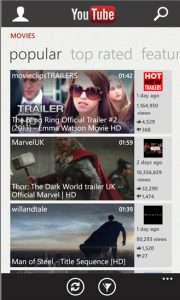
Little over a week ago, Microsoft released a native YouTube app for Windows Phone 8 which replaces the old iteration that displayed a mobile view of the popular video sharing website. The app, however, doesn’t show ads, which generate major revenue for parent company Google.
As a result, the search giant is not overly keen about the implementation and sent Microsoft a letter demanding it to remove the YouTube app for Windows Phone 8. The complaints focus on the ability to download content, the lack of ads and the removal of playback restrictions on “certain platforms”. I reached out to Microsoft for a comment on Google’s claims and here’s the software giant’s response:
YouTube is consistently one of the top apps downloaded by smartphone users on all platforms, but Google has refused to work with us to develop an app on par with other platforms. Since we updated the YouTube app to ensure our mutual customers a similar YouTube experience, ratings and feedback have been overwhelmingly positive. We’d be more than happy to include advertising but need Google to provide us access to the necessary APIs. In light of Larry Page’s comments today calling for more interoperability and less negativity, we look forward to solving this matter together for our mutual customers.
It is worth noting that the YouTube app developed by Microsoft is not the sole offering for Windows Phone 8 which forgoes displaying ads. Metrotube, the highest rated YouTube app in the Store’s “music+video” category, also does not show ads and neither do other ones that I have used so far.
A visit to the mobile YouTube website from Internet Explorer for Windows Phone reveals a similar tale. There are no ads displayed anywhere within the browser window. Therefore, isn’t Google a bit too overzealous in the case of the YouTube app for Windows Phone 8 (developed by Microsoft)?
The cease and desist letter demands the removal of the YouTube app by May 22 and does not seek any alternative solution. Microsoft appears keen to bury the hatchet, as the company said that it can introduce ads as long as Google does its part of providing access to the “necessary APIs”.
On April 1st, Twitter co-founder Biz Stone confirmed that he was working on a new startup called Jelly. He was kind of forced into revealing his hand, after news of the project leaked in late March. When Stone announced the company, he said that he was going to wait to share much of the details, since “news of Jelly emerged unexpectedly.”
Since then, we’ve received little else to go on. The project’s focus continues to be shrouded in secrecy, and we really only know that it will be primarily mobile-based, free, and won’t be ready for quite a while. In the meantime, Biz Stone has been revealing team members – including former Twitter employee Ben Finkel (co-founder and CTO), Twitter’s Kevin Thau (COO), and employee #1, designer Austin Sarner.
Today, in a blog post, Stone has announced that Jelly has just closed its Series A funding, lead by Spark Capital with investment from SV Angel. With that, Spark General Partner Bijan Sabet in now on Jelly’s Board of Directors.
Stone has also revealed some of Jelly’s early investors, and it’s an interesting list:
Jack Dorsey, Co-founder and CEO of Square
Bono, Musician and Activist
Reid Hoffman with the Greylock Discovery Fund
Steven Johnson, Author and Entrepreneur
Evan Williams and Jason Goldman via Obvious
Al Gore, Politician, Philanthropist, Nobel Laureate
Greg Yaitanes, Emmy Winning Director
Roya Mahboob, Afghan Entrepreneur and Businesswoman
Dorsey and Evan Williams – duh. But Bono and Al Gore? Hmm.
“We chose angels like Al Gore, a Partner at KPCB and Chairman and Co-founder of Generation Investment Management, Greg Yaitanes, a Hollywood director, and Roya Mahboob, an entrepreneur doing amazing work for women in Afghanistan partly because they work in divergent fields. Knowledge diversity is something we prize highly and is also something that will be represented in our product,” says Stone.
When Jelly was first officially announced, Stone said this:
People are basically good – when provided a tool that helps them do good in the world, they prove it. Jelly is a new company and product named after the jellyfish. We are inspired by this particular animal because neurologically, its brain is more “we” than “me.” Also, for the past 700 million years, this decentralized structure has been wildly successful.
“Help them do good in the world.” Is that the key phrase here? Is Jelly some sort of mobile social good app? Who knows, I guess we’ll just have to wait and see, as Stone is quite serious about keeping a tight lid on this thing. But the addition of Bono, Al Gore, and an Afghani activist hints that Jelly will be striving to do some sort of international good at the very least.
“Big Bang Theory” is about to wrap up its latest season tonight, and actor Simon Helberg–who plays Howard–says fans shouldn’t expect anything to be wrapped up in a neat little package.
“This time, the adventure is for Leonard,” Helberg said, referring to the character played by Johnny Galecki. “Howard finds Stephen Hawking’s crew is sending out an expedition to the North Sea, and he gets Leonard a job, going on a boat for four months.”
The problem is that Leonard and his girlfriend Penny have just hit a sweet spot in their relationship, and now he will be forced to choose between his dream and his dream girl.
The show has earned major viewership in the past couple of seasons, becoming popular even with all the science-speak the characters use. Perhaps it’s the relatable way they have about them that draws viewers in, as they are all still struggling with the same problems the rest of us do despite having genius IQ’s.
“I think we’re all having a good time,” Helberg said. “And I think the show is far from being stale. It is kind of constantly — not reinventing itself — but just expanding on these characters. So, yeah, I think we’re going strong for now, as long as people keep inviting us in.”
Hot on the heels of the release of Firefox 21 FINAL, Mozilla has released Firefox 22.0 Beta 1, giving adventurous users a glimpse into possible new features and improvements that may land in the next stable release just six weeks from now. Version 21 includes a number of minor new features and improvements, including better protection against unauthorized third-party cookies.
There are also platform-specific improvements for both Windows and Mac builds, plus the usual round of tweaks and performance enhancements to round off the update.
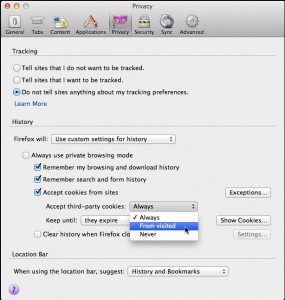
The extra protection against cookies takes another step towards final release, despite stirring up opposition from some ad agencies unhappy with the way it helps counter targeted advertising. By default, all third-party cookies are blocked in Firefox 22 Beta, but users can relax the settings to allow third-party cookies from sites previously visited.
To switch on this feature, which mirrors that already present in Apple’s Safari web browser, visit Firefox’s Preferences or Options dialog, switch to the Privacy tab and select “Use custom settings for history” before choosing “From visited” under “Accept third-party cookies”.
Elsewhere, the Windows build implements one major improvement for owners of higher resolution displays by following the display scaling options set in Windows. As a result, when users increase their display scaling, Firefox will automatically display larger text to follow suit.
One Mac-only enhancement in Firefox 22 is the addition of a download progress bar to the dock icon, allowing users to keep an eye on downloads without having to open the main window. The final new feature sees the Firefox 5 HTML5 audio/video player gain a new Play Speed option, allowing users to slow down or speed up playback.
Another confirmed change is that plain text files now wrap within the Firefox window, making them easier to read. Developers can now also reveal which fonts are being used on a page thanks to the built-in font inspector (select Fonts in the right-hand pane to access it). One feature that doesn’t appear to have (yet) migrated across from Firefox 22 Aurora, however, is support for using the Pointer Lock API outside of full-screen mode.
Firefox 22.0 Beta 1 is available now as a free, open-source download for Windows, Mac and Linux. Users can also download Firefox 21.0 FINAL too. Note that Firefox Beta installs over existing Firefox FINAL installations.
The South African rand has lost most ground amongst emerging market currencies, according to Reuters data, falling almost 10 percent so far this year to hit 4-year lows against the dollar.
That is perhaps not so surprising given the country’s high level of dependence on the minerals and mining sectors, which have been disrupted by labour strikes along the same lines evident in the summer of 2012. Lonmin, the world’s third largest producer of metal, said it stopped its production of its Marikana mine near Rustenburg following strikes over wages.
Net commodity exports – Morgan Stanley and UNCTAD
With the metals and mining sectors accounting for 60 percent of South Africa’s exports, the strong relationship between these sectors and the rand is not surprising. A falling currency has a knock-on effect of facilitating inflation, especially as imports grew faster than exports for the first quarter of 2013. Meanwhile platinum prices have been in a gradual downwards trend since February.
The currency could be in for a deeper slide if mining companies’ wage negotiations are not made within the July 1 timeframe, while the central bank is not expected to act. According to Phoenix Kalen, CEEMEA Economist at RBS:
The central bank of South Africa trusts that the currency will eventually stabilise. I don’t think they will intervene in the currency via interest rates hikes, and furthermore, rand weakness is a consideration against cutting interest rates.
RBS added in a note:
We believe that the SARB will keep interest rates on hold at 5 percent for the remainder of the year.
Amplats, a unit of Anglo American and the world’s biggest platinum producer, said last week it would cut 6,000 jobs from its mines near Rustenburg, less than the 14,000 originally planned.
Mining-related strikes last year that resulted in the death of 34 workers reduced growth at the country’s factories and lead to credit rating downgrades. More unrest will be most unwelcome for the country’s economy. But with falling platinum prices and persistent inflation. the rand could be in for more of a slide.
A look at the Beagle supercomputer at the Computation Institute at the University of Chicago. It’s one of the tools the university is using in its biomedical computation program. (Photo: University of Chicago)
An ambitious project at the University of Chicago aims to lead the nation in biomedical computation, by making the region the largest hub in the world for genetic and medical information.
At the forefront of the effort is Bionimbus, an open source cloud-based system for managing, analyzing and sharing genomic data. Developed by the Institute for Genomics and Systems Biology (IGSB) at the University of Chicago, the Bionimbus community cloud is operated by the Open Cloud Consortium‘s Open Science Data Cloud, and an open source version of Bionimbus available to those who wish to set up their own clouds.
Bionimbus is designed to support next-generation gene sequencing instruments and integrates technology for analyzing and transporting large datasets. The Open Cloud Consortium (OCC) currently distributes around one petabyte of scientific data to interested users and plans to roughly double that amount of data in each of the next several years. Most OCC users are at universities and institutes that are on high-speed networks Internet2 or National Lambda Rail.
Pritzkers Assist With Fundraising
Recently Hyatt Hotels Chairman Tom Pritzker and his wife Margo hosted a fundraiser to introduce the project to about 50 influential friends. Pritzker is a university trustee and has hosted many annual dinners for the University of Chicago Medicine.
“Frankly, I’ve walked away from any one of the dinners really excited about whatever the topic was because it’s like a window into the future,” Pritzker told the Chicago Tribune. “You get to sit here, and for two hours someone is painting a picture for you of what the world is going to be like 10 to 15 years from now.”
During the fundraiser University of Chicago computer scientist Ian Foster presented a map of global fiber-optic networks, highlighting the densely populated Chicago area. With Chicago being the crossroads of information, the big data project hopes to leverage that geographic advantage for building the genome storage hub.
“Business, innovation, discovery, jobs still depend on taking raw materials and turning them into refined products,” Foster said. “Often, nowadays, the raw material is data and the refined material is knowledge.”
Leveraging Beagle Supercomputer
University of Chicago Computation Institute (C.I.) senior fellow and IGSB associate senior fellow Robert Grossman has been working on the Bionimbus Cloud for approximately four years. He states that it is currently one of the largest clouds to hold genomic data. It is the first project of its kind authorized by the National Health Institute (NIH) to use public data about genomes to perform biomedical research.
Argonne National Laboratory and IGSB are collaborating on two big data projects, using the Beagle supercomputer and the Bionimbus Cloud. The Beagle supercomputer was launched last month by the University of Chicago Biological Sciences Division and the Computation Institute. The 150 Teraflop system contains 186 blades, housed in 8 Cray XE6 cabinets.
With a goal to revolutionize the way clinical researchers analyze and collect medical data, the big data projects will simulate biological processes in order to understand the causes of certain diseases like cancer, and to compile knowledge about basic patient outcomes and recent medical discoveries in order to discern more effective diagnoses and treatments.
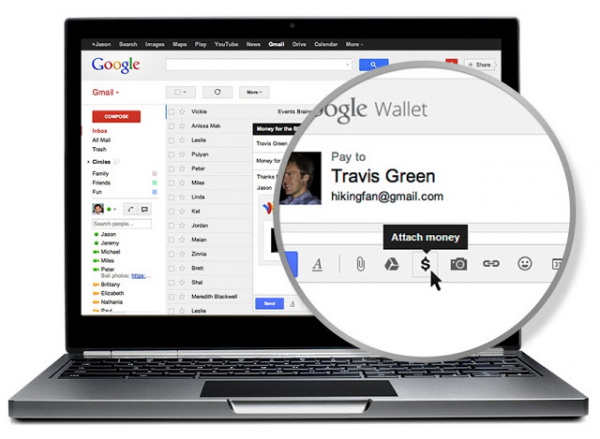
Think about how to send money electronically and it’s probably PayPal that springs to mind first. But if Google gets its way, Google Wallet is about to become much more popular. For anyone in the US, Google Wallet is now integrated into Gmail meaning that it is possible to send money as easily as sending an email.
Sending money works in much the same way as attaching a file to a message — you can attach payment to an email just as you would an image or other file. You may not see it just yet — Google plans to roll the feature out over the next few months — but once activated you’ll see a $ button at the bottom of the Compose window. It’s clear that Google is making electronic payments as simple as possible to help the company take a bigger share of the electronic payment pie.
If you have money in your Google Wallet, sending money is free of charge as is the case when making transfers directly from your bank account. The payment system can also be used to make debit and credit card payments using cards you have associated with your account, but these will incur a 2.9 percent fee per transaction. As you would expect, receiving money is free.
Should you start to get impatient with waiting for the feature to be enabled in your account, check with people you know to see if they already have access to it. As soon as someone else sends you money, email based payments will be enabled in your own Gmail account as well.
One week ago, veteran American Idol judge Randy Jackson announced that he will not be returning for the 13th season of the hit network TV show. Jackson was the last remaining of the original three judges on the show, which also included Paula Abdul and Simon Cowell.
Now, it appears that another current judge will not be returning for another year of American Idol.
According to an Us Weekly report, pop star Nicki Minaj will not be returning as a judge in the next season of the show. The report cites an unnamed “insider” as saying Minaj will instead be cutting another album, touring, and accepting endorsements. It was also stated that she had only expected to judge on one season of American Idol.
Earlier reports suggested Samsung might finally ditch its flimsy-feeling plastic for better build quality on its upcoming Galaxy Note III, but a new report suggests those plans have been scrapped. SamMobile says that while Samsung tested Note III designs that included a metal case and even a flexible plastic display, it ended up choosing a design that takes most of its queues from the new Galaxy S4. As such, we can expect a plastic case and a similar shape, though the report notes that the new phablet will also feature a smaller bezel around the display just like the Galaxy S4. Despite the phone’s rumored 6-inch display, it may still be manageable as a result. Samsung’s Galaxy Note III is expected to launch this fall.
 Called Personal Curator, the smartphone client utilizes Devicescape’s radio management and network detection technologies, along with a machine-learning algorithm, to identify when a user is at home and a wireless network is available. If the smartphone’s Wi-Fi radio is disabled, Personal Curator will activate it and prompt the user to connect, walking them through the device configuration process.
 It counts among its customers MetroPCS (now part of T-Mobile USA and mobile virtual network operators like Republic Wireless, which offer subscribers cheap unlimited data plans. Any packet those operators ship over the unlicensed airwaves is a direct cost savings. And once connected to home Wi-Fi, smartphone owners would likely use the heck out of it. A recent Sandvine report shows that 20 percent of all traffic traversing home broadband connections comes from a phone or tablet.


 Having a single monitor can be a difficult task if you’re used to working with more than several windows at once. Windows OS makes available a few shortcuts for switching between applications and organizing them on the desktop, but for some users this is not enough, and extra desktops are required for better efficiency.


 Little over a week ago, Microsoft released a
  Hot on the heels of the