Category: News

  • What The Heck Is Sony Teasing In This New Trailer?

    Sony is going to announce a new game on May 21. It’s codenamed Panopticon. There’s no word on platforms yet, but it could very well be a PS4 game. Here’s the first trailer that gives us a good look at the game while telling us absolutely nothing about it:

    People are already drawing comparisons to Square’s The World Ends With You. That’s probably not the case, however, as this is a Sony Japan Studio game. The studio is already hard at work on Rain and Puppeteer for the PS3 so it will be interesting to see if this is a PS3 or a PS4 launch game. I’m willing to bet on the latter as Sony Japan Studio has typically always had a game out at or near the launch of a new console.

    Either way, we’ll find out more on May 21. I’m excited to find out more, and the buzz on the Internet seems to indicate I’m not alone.


  • Cee Lo Green, Christina Aguilera Come Back To “The Voice”

    Cee Lo Green and Christina Aguilera are both coming back as judges on “The Voice” after they took a hiatus to work on their respective projects.

    Aguilera left to headline a tour, and Green went on to focus his efforts on a Vegas show. Their big red chairs were kept warm by Usher and Shakira, who seem to have enjoyed their time on the show, but the original judges want their spots back. Aguilera has already signed her contract–which will pay her $12.5 million for a fifth season–and Green is negotiating his. The show has gained popularity in the last couple of seasons, and producers say they will continue to work with their celebrity judges in order to keep everyone happy.

    “These are current touring artists, so it’s a matter of balancing schedules. They’re all in demand, and we’re just balancing it all,” executive producer Mark Burnett said.

    Maroon 5 singer Adam Levine and country star Blake Shelton are also set to return for the next season.

  • Extract JPEGs from almost any file with deJPEG

    If you’re viewing a PDF and find an image you’d like to reuse, then extracting it is usually easy enough: just right-click the picture, select Copy, and it’ll be sent to the clipboard, ready for pasting wherever you need.

    This approach isn’t exactly convenient if you want to extract a large number of images, though. And it may not work with some PDF files, or other file and document types. In situations like these, what you really need is a more automated approach, a program which can extract the JPEGs from almost anything – and that’s exactly what deJPEG claims to do.

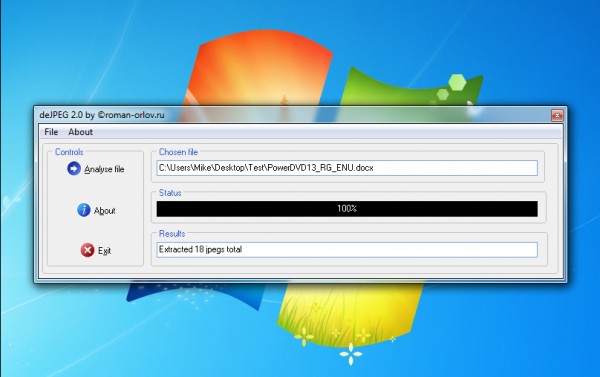
    The program is compact, portable and extremely straightforward. Just point it at your document, click “Analyze”, and the program will scan through every byte of the source file, looking for JPEG-like structures, and saving anything it finds as separate files.

    The best part of this approach is that it’s not relying on any knowledge of file formats. DeJPEG doesn’t care whether the target is a PDF file, a spreadsheet, a database or anything else; whatever you give the program, it does precisely the same thing, just searching for and extracting any embedded JPEGs. And so it stands at least a chance of working with most file types (and won’t break because there’s some minor format change, either).

    But this lack of specific format support also leads to problems. In particular, if the content of your target is compressed (as with Office documents, say) then deJPEG isn’t going to notice that. It’ll scan the file as it is, rather than reading the decompressed stream, and so will miss any JPEGs it might contain.

    DeJPEG’s interface is also rather more basic than we’d like. You can’t define an output folder, for instance – any extracted JPEGs are automatically saved to the same folder as the source.

    Does it work, though? We had some odd failures; pointing the program at a few documents delivered oddly distorted images, others extracted files didn’t appear to be regular JPEGs at all. But in the majority of our tests deJPEG worked perfectly, sometimes extracting hundreds of images in just a few seconds.

    We can’t definitively say deJPEG will work for you, then – it all depends on the source files. But if this kind of application could save you time, then it’s certainly worth a try. Go grab a copy, check it out on your own documents.

  • Pebble Nabs $15M In Funding, Outs PebbleKit SDK And Pebble Sports API To Spur Smartwatch App Development

    pebble-outdoors

    Get ready for a whole lot more Pebble. The smartwatch company just announced several software enhancements for the Pebble and a $15M Series A led by Charles River Ventures. Pebble is not going to sit around, scared of iWatch rumors. They’re plowing forward on their own accord and committed to providing the best platform possible for developers and consumers.

    “We are pledging to support the developers hacking on Pebble,” stated Pebble CEO Eric Migicovsky told me in an interview. “We want to make the Pebble the go-to place for developers.” And with that the company released its first SDK last month and is following it up today with several big improvements.

    The cash injection will be used to increase the company’s software engineering team’s headcount and allow the company to scale to meet still-growing customer demand. CVS’ Partner George Zachery is joining Pebble’s board of directors, a move that excites Pebble CEO Eric Migicovsky.

    “George is the one that shared our vision of wearable computing,” Eric told me in a chat this morning. Several angels also participated in the round, but Eric indicated that Charles River Ventures funded the majority of the Series A. This round of funding joins the $375k the company previously received from four angel investors, including Paul Buchheit, a partner at Y Combinator, and Tim Draper of venture capital firm Draper Fisher Jurvetson. And don’t forget about the $10.3M Pebble raised on Kickstarter.

    “The tremendous response we received from Kickstarter backers validated our belief in the value of a smartwatch as a wearable computer, but also in the value an open platform brings to truly personalizing the watch to their daily activities”, said Migicovsky, Pebble’s founder in a released statement today. “This new investment will help us build out the Pebble development ecosystem and deliver on Pebble’s extraordinary potential.”

    Pebble is still working on fulfilling the 85,000 orders placed on Kickstater. To date 70,000 have reached early supporters. “It’s pretty crazy thinking there are 70,000 Pebbles out there,” Eric told me proudly. “Tens of thousands” of additional orders have been placed, Eric said.

    The company is aiming for retail availability in four to six months.

    Pebble also announced several software enhancements for its smartwatch today. The SDK, which the company appropriately calls the PebbleKit, enables third party apps to send and receive data from the smartwatch.

    This two-way communication is a huge step forward for the smartwatch, allowing the watch to display a large variety of information including weather and sports scores or even act as a remote control for the phone itself. Until now, apps were limited to basic functions like just display a watch face or displaying a simple game of snake.

    Pebble also released the Pebble Sports API, enabling developers to build GPS-enabled smartwatch apps similar to the RunKeeper app announced a couple of weeks back.

    Since releasing its initial SDK back in April, Pebble states the kit was downloaded over 8,000 times, resulting in over 5,000 unique watchapps with 300,000 installs during the last month. Owners are clearly hungry for more Pebble features.

    The Pebble was supposed to usher in a new era of productivity by strapping a communication device to our wrist, but the initial feature set was limited even with the first SDK release. However, Pebble is keeping at it and today’s funding announcement and software development release should result in a big harvest of fresh apps.

    “Everyone is talking about wearable devices,” Eric explained. “We’re very happy that Pebble is a platform people can build on today.”

    Wearables is the next big thing. There’s no denying that. Even if Apple skips the iWatch device, Google Glass and others are pushing forward the thought of wearable computing. But the Pebble is here today and developers have latched onto the platform, outing custom watch faces, games, and apps. With the Pebble, the future is here now.


  • PernixData Raises $20 Million for Software-Defined Storage

    Here’s our review of some of this week’s noteworthy links for the data center industry:

    PernixData closes on $20 million round.  Software-defined storage platform company PernixData announced the close of an over-subscribed $20 million Series B financing. The round was led by Kleiner Perkins Caufield & Byers (KPCB) with additional support from existing investors Lightspeed Venture Partners and industry leaders Mark Leslie , John Thompson and Lane Bess. The Flash Virtualization Platform (FVP) from PernixData disrupts the storage market by enabling virtualized datacenters to take advantage of an architecture that decouples storage performance from storage capacity. With this additional investment, PernixData will grow its sales and marketing globally, continue its ambitious R&D roadmap, develop a channel eco-system and accelerate go-to-market plans with leading players in the server and storage industries. “PernixData is solving one of the biggest outstanding issues in enterprise data centers: the cost and performance of storage,” said Matt Murphy of KPCB. “Pernix has the opportunity to do for storage what VMware did for compute. The technical team they’ve assembled for such an ambitious mission is unparalleled.”

    Violin Memory speeds Oxford Press. Violin Memory announced it has helped Oxford University Press to improve its SAP IPM application performance by three times – cutting month end processing by two and a half days, and reducing average dialog response time; the time it takes from the first dialog request to the presentation of the final data – by 30 percent. Working with solution partner SCC Oxford Press selected the Violin Memory 6212 Flash Memory Array, an all-silicon shared storage system with industry-leading performance (up to 1 million IOPS) and ultra-low latency. “Most importantly we’ve removed the daily impact and the pressing risk to our month end close caused by the ever-lengthening batch processing times required as the data-set grew,” said Mark Harwood, SAP Lifecycle for Oxford University Press. “The decision to choose Violin Memory was made much easier by the professional approach shown by their team throughout our engagement, which has helped us to better understand all-flash memory arrays, an area of technology that is new to us.”

    HP expands liquid cooling to Z820 workstations. Asetek announced that HP (HPQ) has expanded the availability of Asetek liquid cooling to include single processor Z820 workstations. Previously only available in dual CPU configurations, the more affordable single CPU Z820 with Asetek’s integrated sealed loop liquid cooling provides reduced system noise and increased productivity. The design win is expected to translate into an 8-10 percent increase in Asetek’s workstation business.  “HP has always been on the cutting edge of workstation technology,” said Scott Chambers, Senior Director of Marketing at Asetek. “The expansion of Asetek liquid cooling within the Z820 line further validates Asetek liquid cooling as a valuable addition for improved productivity”.

  • How To Get Others To See Your Potential

    Overcoming people’s past perceptions of you isn’t easy. When I launched my consulting business seven years ago, I was astonished to find — years later — that acquaintances and even friends hadn’t kept up with my career transition. They’d ask about my past work in politics or nonprofit advocacy, oblivious to the changes that had been consuming my life. It wasn’t their fault, however. These days, we all have thousands of Facebook friends or LinkedIn connections; it’s just not realistic to keep up with everyone’s latest developments. But the fact that they weren’t aware of my new business meant I was losing out on referrals and potential clients. I realized I had to ensure they took notice.

    Of course, you can’t just prop someone’s eyelids open, A Clockwork Orange-style, and force them to read your white papers or watch your webinars. So how do you get other people to realize, and remember, what you’re doing now — and grasp what you’re truly capable of?

    Create content. As a knowledge worker, it can be hard to demonstrate your expertise to anyone besides your boss. But the Internet — and the ability for anyone to start publishing content — has given us a profound opportunity. Just as a graphic designer has a portfolio she can display of her best logos and brochures, you should be creating intellectual property (blog posts, podcasts, videocasts — even a savvy and professional Twitter feed can count) that demonstrates your expertise. If you’ve changed careers, or are trying to move up the ladder at your company, others may still think of the “old you.” Creating solid content reminds people of your new skills and knowledge (it’s hard to ignore it if they see links to your blog posts every day in their social media feed) and enables people to judge you based on the quality of the material you produce, not your past history or credentials.

    Leverage social proof. It’s a term psychologists love to use — “social proof.” Basically, it means that people look to others around them to judge the value of something. (If a book has 1,000 five-star Amazon reviews, it must be good.) So how can you leverage this heuristic to help your career? If you’re going to bother getting involved with a professional organization, you should make it a point to take a leadership role, because the social proof of being seen as a leader will have exponential benefits. Alan Weiss, a consultant who was the president of the National Speakers Association’s New England chapter in the mid-1990s, thought his business would decline during those years because of the extra volunteer time commitment required. “But to my surprise,” he told me, “I did about $250,000 more business. The visibility naturally accrues to you, and even though you don’t seek it out, people come to you for interviews and advice. Your visibility grows and your brand grows.”

    Find a wingman. It’s true: no one likes a braggart. But you can avoid the problem entirely, a powerhouse group of researchers led by Jeffrey Pfeffer of Stanford and Robert Cialdini of Arizona State discovered, by having someone else do the bragging for you. “People don’t like people who self-promote,” Pfeffer told me. “But ironically, even if you self-promote through the mouths of other people, somehow that stigma doesn’t get associated with you. It’s much better to have someone else toot your horn.” If you can afford one, you could certainly hire a publicist. But another option is to find a like-minded “wingman” and take turns promoting each other. At cocktail parties or conferences, you and your friend can make a point of mentioning each other’s accomplishments or bringing up conversational topics where your partner excels. It may sound artificial, but it doesn’t have to be. Just consider it a chance to help your friend shine — and let him reciprocate.

    In a frenetic world where we’re all stretched far beyond Dunbar’s number (the famed idea that humans are optimized to handle about 150 social relationships), it can be exceedingly hard to get noticed by others — and especially to ensure they’re thinking about us in the ways we’d like. But we have to take action somehow, or risk missing out on professional opportunities simply because we’re not on others’ radars or they don’t recognize our skills. By creating robust and regular content, mobilizing social proof, and finding a wingman to help spread the word, we can begin to break through and take charge of our reputation in the world.

  • Real-Time Command and Control in NOCs

    Simon Clew is Sales Director at Adder Technology Limited

    Simon-Clew-tnSIMON CLEW
    Adder Technology

    Since the arrival of virtualization, the Keyboard, Video and Mouse (KVM) market for data centers has changed dramatically. KVM is no longer as critical within the data center as it once was, rather the focus has shifted to improving KVM within the network operating centers (NOC), which run and manage multiple data sources.

    Today’s NOCs and Command/Control Centers are characterized by vast arrays of screens and control panels being used and managed by a team of busy, and more than likely stressed, individuals. In these hubs of activity the ability to notice and react quickly to any situation is critical; otherwise it could result in a catastrophic data center shut down. For example, Emerson Network Power surveyed 41 data center companies and discovered that the average cost of an outage was $507,000.

    A key element for ensuring responsiveness in NOC and CCC’s is to give operators the ability to see clearly and in real-time what is occurring in the systems they are managing or using. This was the cause of huge problems for many NOC/CCC operators due to ineffective KVM solutions being used to view and control what was happening on a system network. Often the image on the screen would be poor-quality or pixilated. Even at the desk the image may appear to be acceptable but enlarged onto a video wall such small imperfections are hugely magnified underlining the limitations of analogue systems. Add to this the inherent latency of legacy KVM solutions, the lack of support for input devices such as touch screens; this all limits the operator’s agility to act

    Real-time Control

    We have moved towards the NOC where there is a real focus on real-time control. For example, in NOCs running a range of data centers, operators are looking at a multitude of data sources. If any of these are affected by a serious situation, the controller will need to act immediately. Those looking after data centers that are part of a critical infrastructure system, such as power distribution and management, will not have time to wait for a system to boot up and connect to the affected machine.

    Fortunately, with the advent of digital video and USB connectivity, real time control and low latency video are a reality. Another benefit offered by improved KVM in NOCs is the simplification of operator functions through the use of specialist input devices such as keyboards containing a number of unique keys or touchscreens and tablets – combined with common access card readers and multifunction mice.

    Digital KVM is also making an impact in NOCs through providing the ability to command and control multiple screens (and computers) seamlessly using just one keyboard and mouse, a capability offered in switching solutions such as the Adder CCS4USB. Allowing an operator to monitor several systems from one work station has a range of benefits, not least of which is improved efficiency.

    Industry Perspectives is a content channel at Data Center Knowledge highlighting thought leadership in the data center arena. See our guidelines and submission process for information on participating. View previously published Industry Perspectives in our Knowledge Library.

  • Beckham to Retire From Soccer This Year

    David Beckham, perhaps the most well-known soccer player of his generation, is now set to retire. BBC News is reporting that Beckham intends to retire from playing soccer after his season in France’s Ligue 1 is over. The season ends on May 26.

    Beckham’s current team, Paris Saint-Germain (PSG), last weekend locked up its first Ligue 1 title in almost 20 years. The victory caused fans in Paris to celebrate, which turned into a riot after protesters clashed with police. Dozens of fans were injured and arrested, and shop windows along the Champs-Elysees were broken.

    During his 20-year career, Beckham has won championships in four different leagues – the Premier League with Manchester United, La Ligua with Real Madrid, Major League Soccer with the Los Angeles Galaxy, and now Ligue 1 with PSG. He also won the FA Cup and Champions League with Manchester United, captained the English soccer team for six years, and scored goals in three different World Cups.

    “I’m thankful to PSG for giving me the opportunity to continue but I feel now is the right time to finish my career, playing at the highest level,” said Beckham. “If you had told me as a young boy I would have played for and won trophies with my boyhood club Manchester United, proudly captained and played for my country over one hundred times and lined up for some of the biggest clubs in the world, I would have told you it was a fantasy. I’m fortunate to have realised those dreams.”

  • Pass the champagne! Windows Phone pips BlackBerry to third place

    Change the rules of the game and you change the hierarchy. Two days ago research company Gartner released its latest report on the state of smartphone market which, based on sales, places Windows Phone in fourth place, just behind BlackBerry in terms of share. Today, IDC also released its latest report for Q1 2013, that measures shipments, and the two smartphone operating systems trade places — Windows Phone now surpasses BlackBerry for the third spot in the charts.

    That switch means Microsoft and Nokia have a reason to celebrate, in spite of numerous barbs coming from pundits. “Windows Phone claiming the third spot is a first and helps validate the direction taken by Microsoft and key partner Nokia”, says IDC’s Kevin Restivo. But the research company suggests that the operating system still has a long way to go: “Given the relatively low volume generated, the Windows Phone camp will need to show further gains to solidify its status as an alternative to Android or iOS”.

    Android and iOS Are Not Untouchable

    “Underpinning the worldwide smartphone market is the constantly shifting operating system landscape”, says IDC’s Ramon Llamas. “Android and iOS accounted for more than the lion’s share of smartphones in the first quarter, but a closer examination of the other platforms reveals turnaround and demand for alternatives. Windows Phone has benefited from Nokia’s participation, and BlackBerry’s new BB10 devices have already hit a million units shipped in its first quarter of availability”.

    Android and iOS dominate smartphone shipments in Q1 2013. Together, the two operating systems reign over 92.3 percent of the market. Combined, shipments top 199.5 million units, which is 59.1 percent higher compared to the 125.4 million units in the first quarter of 2012.

    Android Shipments Surge

    The green droid accounts for 75 percent of the market, up from 59.1 percent in Q1 2012, with shipments growing by 79.5 percent to 162.1 million units in Q1 2013 from 90.3 million units in Q1 2012.

    Samsung is the top Android manufacturer with 41.1 percent of the market. The South Korean maker is followed by “a long list of vendors with single-digit market share, and an even longer list of vendors with market share less than one percent”, says the market research company. “The intra-Android competition has not stifled companies from keeping Android as the cornerstone of their respective smartphone strategies, but has upped the ante to innovate proprietary experiences”.

    iOS’ Aging (Still) Doesn’t Affect iPhone Demand

    Apple’s iOS (or iPhones) claims a smaller piece of the pie with 17.3 percent market share, down from 23 percent in Q1 2012. Shipments increased by 6.6 percent to 37.4 million units in Q1 2013 from 35.1 million units in Q1 2012.

    IDC says that the market demand is still strong for iPhones, even though “the iOS experience has remained largely the same since the first iPhone debuted in 2007”. The research company briefly discussed the future of the platform: “online rumors and speculation predict a massive overhaul of the user interface when iOS 7 debuts”.

    Blame Nokia for Windows Phone’s Success

    The podium is completed by Windows Phone. Microsoft’s smartphone operating system accounts for 3.2 percent of the market, up from 2.0 percent in Q1 2012, due to shipments of 7.0 million units, a number 133.3 percent higher compared to the 3.0 million units in Q1 2012.

    Nokia is responsible for 79.0 percent of the Windows Phone shipments and has sold 20.3 million units since the company embarked on its Windows Phone journey. “Other vendors continue to offer Windows Phone devices, but mainly as an alternative to their signature Android devices”, says IDC. “The gains made by Windows Phone demonstrate both end-user demand and OEM support”.

    Old Smartphones Keep BlackBerry in the Game

    BlackBerry’s market share only slightly decreased in Q1 2013, but shipments tumbled. The smartphone operating system is at 6.3 percent share, down from 6.4 percent in Q1 2012, with shipments of 6.3 million units, 35.1 percent lower than the 9.7 million units in Q1 2012.

    IDC however is optimistic about the Canadian manufacturer’s future. “BlackBerry formally introduced and shipped more than a million units running on its new BB10 platform, a significant breakthrough for the company”. The majority of shipments come from BB7 handsets, which “were well received within key markets”.

    Manufacturers Ignore Linux…

    The fifth spot is taken by Linux, which in Q1 2013 had a 1.0 percent market share, down from 2.4 percent in Q1 2012. Shipments decreased by 41.7 percent to 2.1 million units in Q1 2013 from 3.6 million units in Q1 2012.

    This is the lowest level since Q1 2012, triggered by manufacturers that have switched to Android. “This is shaping up to be a pivotal year for the open-source operating system, as multiple platforms, including Mozilla, SailFish, Tizen, and Ubuntu are expected to introduce or launch their first smartphones in the coming months”, says IDC.

    …And Symbian Too

    Things aren’t looking well for Symbian either. The operating system has a 0.6 percent share of the market, down from 6.8 percent in Q1 2012. Shipments have decreased as well, by 88.5 percent, to 1.2 million units in Q1 2013 from 10.4 million units in Q1 2012.

    As I pointed out in “Windows Phone battles BlackBerry for a distant third-place“, Symbian’s decline is triggered by Nokia’s (Symbian’s biggest supporter) decision to focus on Windows Phone. IDC confirms: “The decline for Symbian-powered smartphones was expected as its primary OEM supporter Nokia has transitioned to Windows Phone and Japanese vendors have moved to Android”. Symbian shipments are still expected to head into 2014, albeit in lower numbers.

    Photo credit: Kesu/Shutterstock

  • After loving to hate Tesla, many scramble to show their love

    Last week electric car maker Tesla hit the goal of delivering its first profitable quarter in the history of the decade-old company, and since then Tesla’s stock has soared and traded at over $90 per share. At the same time, review giant Consumer Reports said last week that Tesla’s Model S outscored “every other car in our test ratings.” That’s every other car out there, not just other electric cars.

    What followed those milestones has been an interesting mix of attention on Tesla from the media and bloggers — including surprise, extreme 180-degree about-face, and a general lovefest — as well as attention from Wall Street, which bifurcated into newly won-over Tesla-believers and disturbed Tesla shorters. What most of these people fail to realize is that the road to true innovation in the auto industry takes a very long time.

    Tesla Model SOn the blogging front, for example, in a Business Insider post on Wednesday called What Everyone Got Wrong About Tesla, a writer chronicles the criticism of Tesla over the years. The writer didn’t include my least favorite article from all of 2013 written on Tesla, by Henry Blodget, editor-in-chief of Business Insider, called “The Tesla Nightmare Shows Why Today’s All-Electric Cars Are (Basically) Dead On Arrival.”

    It’s not that electric cars won’t struggle (see my long investigative piece on Fisker), but that many people just don’t get how the ecosystem, technology, and marketplace work and are so quick to make declarations about electric cars for the sole purpose of getting attention and — if you’re a blogger — page views. Tesla has actually emerged as a success story, not in the last week, but gradually over a decade by overcoming hurdles every day.

    Another company took a very long time to twist and turn, and finally come out on top, too: Apple. And some of Tesla’s most gushy recent love-fest posts are about its comparison to the design-centric gadget maker: Tesla is the new Apple, Would Apple really buy Tesla? (no), and Elon Musk is the new Steve Jobs. Like the legions of Apple and Jobs fanboys, Tesla and Musk are now on the way to developing their own fanboys that will track their every move and product.

    Tesla Model SWhen it comes to investors, short interest (the amount of shares that investors have sold short, expecting the stock to drop in price) in Tesla since the company went public in 2010 has been nothing short of remarkable. According to Bloomberg, “short interest in Tesla was 40 percent of available shares as recently as April 19, more than 11 times the average of companies in the Russell 1000.”

    But following Tesla’s milestone’s last week, short interest dropped by 17 percent in the five days through May 13, noted Bloomberg — Tesla shorters were forced to “buy $276 million worth of the automaker’s shares, pushing the company toward the biggest rally in the Russell 1000 Index (RIY) this year.”

    I don’t remember a company in recent years, other than maybe Apple, that has had such massive skepticism from media and investors, followed by such intense love. This week there’s Apple-style product rumors buzzing about Tesla showing off a self-driving Model S, and launching a battery-swapping service (that would actually be cool). Usually it’s the love-hate relationship unfolds the other way around. The internet is a weird place.

    Tesla actually made it past its most recent dangerous startup phase over half a year ago. Back in November 2012 Tesla CEO Elon Musk said that Tesla had “made it through the Valley of Death,” and reached its goals for scaling up Model S production.

    Musk might be a media and stock puppeteer (see the 5 lessons from the NYT, Tesla dust up) but as a leader of a public company it’s not in his best interest to publicly lie. Tesla was clearly on its way to success back then — after nine years of overcoming hurdles. The earnings and stock are just a delayed sign of that performance. And before that Musk made it through the darker periods of the company in 2008, by personally floating the company and even borrowing money from friends.

    The reality is that Tesla has just started on its full court press on announcements, media coverage, and stock growth, and is hoping for a marketcap that rivals the big auto companies. These are 10 milestones that Tesla hopes will enable it to hit a $43 billion marketcap.

    Tesla will also no doubt hit some hurdles as it tries to transition into a larger auto maker — if anyone remembers it delayed its Model X launch by a year to the end of 2014. But it’s actually pretty hard to be an independent new automaker, and true game-changing innovation is even harder and takes a very long time.

    Related research and analysis from GigaOM Pro:
    Subscriber content. Sign up for a free trial.


  • New Mac spyware discovered at Oslo conference

    Today security firm F-Secure announces the discovery of a new Mac-based spyware program, the latest in what has become a small, but growing trend. Attacks have previously affected Apple itself, as well as users in the wild. The latest problem was discovered at a recent conference in Oslo, Norway.

    The Oslo Freedom Forum, an event that is designed around the world’s most influential dissidents, innovators, journalists, philanthropists, and policymakers, just wrapped up on May 15. During a workshop on freedom of speech, Jacob Applebaum, an independent computer security researcher, discovered a new and previously unknown backdoor on an African activist’s Mac.

    F-Secure is currently investigating this, but has found that it is signed with an Apple Developer ID. The security firm also has determined that the program dumps screenshots into a folder called MacApp and that there are two C&C servers related to this attack, neither of which could be reached — one is unresolved, while the other is “forbidden”.

    F-Secure has dubbed this malware with the catchy name of “Backdoor: OSX/KitM.A. (SHA1: 4395a2da164e09721700815ea3f816cddb9d676e)”, and is continuing its investigation.

    Ironically, the Oslo Freedom Forum revolves around helping users to secure their devices against government monitoring. The finding is just one more reminder that Macs are no more secure than Windows, just simply less targeted.

    Photo Credit: Brian A Jackson/ShutterStock

  • AirWatch Receives $25 Mln from Accel Partners

    AirWatch said on Thursday that it has received $25 million from Accel Partners. AirWatch is a mobile security provider that is based in Atlanta with offices worldwide.

    PRESS RELEASE

    ATLANTA–(BUSINESS WIRE)–AirWatch®, the global leader and innovator in mobile security and the largest Enterprise Mobility Management (EMM) provider, announced a $25 million investment by Accel Partners. The funding will help AirWatch accelerate global growth, scale their research and development team and support the innovation and adoption of their content collaboration solution, Secure Content Locker™.

    “Both firms have been collaborative, and we look forward to leveraging Insight’s resources and Accel’s network and expertise as our rapid growth presents new opportunities for the business.”

    The AirWatch platform, featuring industry-leading mobile device management and application management, also incorporates the most secure content management solution. These solutions can be used stand-alone for unique BYOD requirements or as a comprehensive, highly scalable enterprise-grade mobility platform.

    “Accel Partners and Insight Venture Partners recognize the massive potential of this space, and we are excited to partner with the best growth investors from both coasts,” says John Marshall, president and CEO, AirWatch. “Both firms have been collaborative, and we look forward to leveraging Insight’s resources and Accel’s network and expertise as our rapid growth presents new opportunities for the business.”

    “We are proud to have partnered with both Insight Venture Partners and the best management team in mobile enterprise at AirWatch,” says Ryan Sweeney, partner, Accel. “We believe that enterprise mobility currently represents the next big secular technological shift we will encounter, and AirWatch has emerged as the dominant company in this increasingly important category.”

    As companies continue to deploy mobile devices, applications and content in record numbers, AirWatch has established itself as the trusted partner of choice for global companies including Delta, Lowe’s, United Airlines, Bureau of Alcohol Tobacco, Firearms and Explosives (ATF), Skanska, PepsiCo, Henry Ford Health System, Mount Sinai Medical Center, Best Buy and Abbott Laboratories. The company currently secures more than 500 new clients per month, and oversees mobile management for businesses that rank among the world’s best, including:

    • Four of the top five global Fortune companies

    • The top four global energy companies

    • Six of the top 10 global airlines

    • Six of the top 10 global pharmaceutical companies

    • Seven of the top 10 global consumer product companies

    • Five of the top 10 global luxury goods companies

    • Two of the top three global hotel groups

    • Nine of the top 10 U.S. retailers

    • Three of the top five U.S. medical device companies

    Along with an experienced management and leadership team with decades of understanding mobile complexities, AirWatch retains the most feature-rich EMM platform. The AirWatch EMM platform features integration with leading technology partners focusing on network access control, identity and certificate management, enterprise wireless LAN management, enterprise architecture integration, managed service providers and unified communications. AirWatch’s notable partnerships include Aruba Networks, BMC Software, Cisco, Dimension Data, IBM Global Technology Services, Jeppesen (a Boeing company), Juniper Networks and Siemens Enterprise Communications.

    Accel Partners aims to identify and support companies that are leveraging technological disruption to define and own new categories. Accel Partners has been fortunate to partner with Facebook (social web), Cloudera (Hadoop for big data solutions), Atlassian (software development and enterprise collaboration), Qualtrics (real-time enterprise feedback), and other innovators who have defined their industries. Accel has also actively invested in the growth of the mobile ecosystem through support of companies like MetroPCS, Lookout, Braintree, AdMob, MoPub, Spotify, Supercell, and Rovio.

    About AirWatch

    AirWatch is the world’s largest mobile security and enterprise mobility management provider with more than 6,500 customers and more than 1,200 global associates. The largest customer base, combined with the largest research and development team in the industry, allows AirWatch to provide the broadest functionality at the lowest cost. The AirWatch platform, featuring industry-leading mobile device management and application management, also incorporates the most secure content management solution, Secure Content Locker™. These solutions can be used stand-alone for unique BYOD requirements or as a comprehensive, highly scalable enterprise-grade mobility platform.

    © 2013 AirWatch LLC. All rights reserved. AirWatch® and the AirWatch logo are trademarks of AirWatch, LLC. All other brands and trademarks mentioned in this press release are the property of their respective owners.

    About Accel Partners

    Founded in 1983, and managing over $9.6 billion in capital, Accel Partners has a long history of partnering with outstanding entrepreneurs and management teams to build world-class businesses. Accel today invests globally using dedicated teams and market-specific strategies for local geographies, with offices in Palo Alto, California, New York City, London, and Bangalore, as well as in China via its partnership with IDG-Accel.

    Accel has helped entrepreneurs build over 300 successful technology companies, many of which have defined their categories, including 99designs, Actuate, AdMob, Agile Software, Alfresco, Angry Birds (Rovio), Atlassian, BBN, Bonobos, Braintree, Brightcove, Cloudera, ComScore, Diapers.com (Quidsi), Dropbox, Etsy, Exclusively.in, Facebook, Flipkart, Fusion-IO, Gameforge, GlamMedia, Groupon, Imperva, Infinera, Interwoven, IronPlanet, JBoss, Kayak, Lookout, Macromedia, metroPCS, MoPub, Myntra, OPOWER, Polycom/PictureTel, Playfish, Portal Software, QlikTech, Rapt, Real Networks, Redback, Responsys, Riverbed, Spotify, Squarespace, SunRun, Trulia, UUNet, Veritas, Walmart.com, Webroot, Wonga, XenSource and Zimbra.

    The post AirWatch Receives $25 Mln from Accel Partners appeared first on peHUB.

  • Sanctum 2 Review (PC)

    There are never enough points for all the weapons I want and never enough building blocks to make sure that enemies have a hard time reaching my core.

    The paragraph above sums up my feelings before starting each new wave battle in Sanctum 2 and also explains why the game is an interesting mix of tower defense and first person-shooter that should appeal to fans o… (read more)

  • Portland Police Brake for Ducks, Even in Hot Pursuit

    This may be the most intense police pursuit you’ve ever seen. Traffic Officer Mark James of the Portland Police Bureau caught a car doing 52 in a 35, endangering the lives of every motorist on the road.

    Hot on the trail and catching up to the speeder, James hit a roadblock. Inncent lives were at stake. Of course, officers are sworn to protect and serve – even if those that need protection are on the featherier side of things.

    The violator got away. Damnit, foiled by ducks again.

    [via reddit]

  • So Google Compute Engine is out, your move Amazon

    Now that the fog of hype is starting to lift from the Moscone Center  where Google rolled out its promised Amazon cloud killer, don’t expect the folks up in Seattle to stand still. As Amazon Web Services has made clear over the past 7 years, inaction is not an option.

    Amazon CTO Werner Vogels and CEO Jeff Bezos on stage at AWS: Reinvent

    Amazon CTO Werner Vogels and CEO Jeff Bezos on stage at AWS: Reinvent

    Here are a few things AWS (which after all, remains the cloud to beat) could do to shore up its defenses as GCE, Windows Azure and soon VMware’s AWS competitor (to be re-announced May 21) come online.

    1: Get more granular in pricing

    One headline item Wednesday was Google’s decision to rent cloud instances by the minute instead of by the hour (well, you have to buy a minimum of 10 minutes with incremental charges for each additional minute.) AWS rents by the hour, which is something it could well change. Both companies are late to this particular feature however: Both Cloud Sigma and Profitbricks have offered sub-hour models for some time.

    2: Keep pounding on enterprise support …

    And management options like Trusted Advisor, which instructs AWS users on how to deploy their workloads more efficiently and more securely.  The knock on Google remains that it (let alone its cloud) doesn’t “get” the enterprise — millions of  Google Apps and Gmail business users notwithstanding. A CIO might ask herself: “Gee, do I want to trust my workloads to a search and advertising company? I still can’t believe I’m trusting some of them to a book seller! “

    If enterprise is a key business, you have to keep earning it.

    3: Prove that AWS is an Amazon corporate priority

    The perception that Amazon.com, Jeff Bezos and corporate don’t care that much about AWS continues to dog the cloud services arm. It was a big deal that Bezos showed up at AWS: Reinvent last year, but he really doesn’t talk about the cloud business all that much. What might help there? BREAKING OUT AWS REVENUE! If AWS is a $2 billion-a-year-plus business, get transparent about it. And talk profitability, not just revenue. Come on guys, it’s time.

    4: Keep the services coming

    Much was made of Google’s brand new NoSQL database service, which, as my colleague Derrick Harris pointed out, is “eerily similar” to Amazon’s DynamoDB. Google SVP Urs Hölzle noted that Google, 11 months after announcing GCE, rolled out 10TB persistent disk, something that an “unnamed competitor” hadn’t done in its 7 years. That may be, but AWS has lots of other services and perks and maturity counts — especially among corporate buyers.

    So, Amazon. It’s your move.

    Related research and analysis from GigaOM Pro:
    Subscriber content. Sign up for a free trial.


  • Google Wallet arrives for additional Sprint and U.S. Cellular smartphones

    Google_Wallet_Card


    Google officially announced via Twitter that its Wallet service is now available for the Sprint variations of the Galaxy S 4 and HTC One smartphones, as well as the Sprint and U.S. Cellular variations of the Galaxy Note II smartphone as well. This means that all owners of those phones will need to do is simply visit the Play Store and grab the latest update in order to get in on the awesome payment action. Naturally, it would be nice for more devices to take advantage of the great service, but at least Sprint as usual, is ensuring its customers can take advantage of the awesome service.

    Hit the link below to grab the latest update.


    Google_wallet_qr_code

    Play Store download link

    Come comment on this article: Google Wallet arrives for additional Sprint and U.S. Cellular smartphones

  • Group Behind Copyright Alert System Had Its Company Status Revoked

    Earlier this year, a big hoopla was made about the Center for Copyright Information and its Copyright Alert System, otherwise known as “Six Strikes”. In short, those caught downloading pirated content on BitTorrent would be sent warnings that soon turned into punishments of increasing severity. Now the non-profit that caused a stir earlier this year has found itself in a spot of trouble.

    TorrentFreak reports that the Center for Copyright Information had its company status revoked last year. The Columbia Department of Consumer and Regulatory Affairs revoked its status after finding that the non-profit founded by the MPAA and RIAA never filed the proper paperwork or paid its fees.

    So, what does this mean for the CCI? It means that it won’t be able to do business in the United States until it gets all of this cleared up. Doing so won’t be that difficult though. In fact, a source close to the CCI told TorrentFreak that it’s already submitted the proper paperwork to have its status as a company reinstated. Even if its status is reinstated, the CCI may still face fines and other civil penalties.

    Of course, all of this is rather interesting in the larger context of the “six strikes” system. There have been no widespread reports of warnings being sent out since the introduction of the system in February. It’s hard to say why that is the case, but the CCI’s troubles suggest that it may not be on top of everything just yet. It’s not exactly surprising either considering that the rollout of the Copyright Alert System was delayed for over a year.

    Those hoping for the death of the Copyright Alert System will be disappointed though. It’s not dead, and it wont die anytime soon. Still, the Copyright Alert System may be all bark and no bite for a while as the CCI works to reinstate its company status.

  • BitPay Raises $2 Mln Seed Round Led by Founders Fund

    BitPay said Thursday it raised an additional $2 million in seed financing led by Founders Funds, which includes three founders of PayPal. Heisenberg Capital also participated. BitPay is a payment service provider that specializes in e-commerce and enterprise solutions for virtual currencies.

    PRESS RELEASE

    ATLANTA — May 16, 2013 –BitPay Inc, the world’s leading payment processor for bitcoin, announces it has raised an additional $2M in seed round financing led by Founders Fund, which includes three founders of PayPal.

    “ECommerce companies see the tremendous value that frictionless international payments bring to their businesses as they expand into emerging markets. BitPay’s ambitions have been global from the outset, and at Founders Fund we have been impressed with the company’s tremendous growth as they sign up hundreds of new customers a day, turning the potential for opportunity into a reality,” said Brian Singerman a Partner at Founders Fund.

    Also joining this round is Max Keiser’s fund Heisenberg Capital, a London-based fund focused on bitcoin companies. The terms of the seed round were not disclosed, although 100% of the existing seed shareholders exercised their pro rata rights to maintain their ownership percentage in BitPay.

    “We were not looking to raise any capital until later this year, but we could not ignore the opportunity to have Founders Fund involved with BitPay,” says Tony Gallippi, co-founder and CEO of BitPay. “There’s no single investment firm we would rather have on our team right now than Founders Fund.”

    BitPay added over 1,900 new merchants during the month of April, and they continue to dominate the bitcoin payments space by signing up over 100 new merchants per day. Through BitPay’s service, around $5 million per month worth of bitcoins are spent on goods and services with merchants around the world. Businesses selling electronics, precious metals, and other low-margin products over the internet are seeing a large increase in profitability by accepting bitcoin payments.

    BitPay continues to hire Software Engineers for its Atlanta-based headquarters, with two positions open now for experienced node.js developers who are excited about bitcoin, as well as a Senior UX Designer. The company continues to add resources to product development and engineering of its world-leading bitcoin payment platform.

    About BitPay

    BitPay is a Payment Service Provider (PSP) specializing in eCommerce, B2B, and enterprise solutions for virtual currencies. Visithttps://bitpay.com.

    The post BitPay Raises $2 Mln Seed Round Led by Founders Fund appeared first on peHUB.

  • Emerging European bonds: The music plays on

    There seems to be no end to the rip-roaring bond rally across emerging Europe.  Yields on Turkish lira bonds fell to fresh record lows today after an interest rate cut and stand now more than a whole percentage point below where they started the year.

    True, bonds from all classes of emerging market have benefited from the flood of money flowing from central banks in the United States, Europe and Japan, with over$20 billion flowing into EM debt funds since the start of 2013, according to EPFR Global. Flows for the first three months of 2013 equated to 12 percent of the funds’ assets under management.

    But the effect has been most marked in emerging European local currency bonds — unsurprising, given economic growth here is weakest of all emerging markets and central banks have been the most pro-active in slashing interest rates.  Emerging European yields have fallen around 50 basis points since the start of the year, compared to a 20 bps average yield fall on the broader JPMorgan index of emerging local bonds, Thomson Reuters data shows.

    The IMF today advised Poland to continue cutting rates “without delay” to boost the economy. That should give another leg-up to zloty bonds, where short-dated yields are already at record lows.

    The flows have also been a boon to troubled countries such as Hungary that might otherwise have scrabbled for money. Instead, Budapest had by end-April fulfilled more than 65 pct of its 2013 funding needs and has since indicated it might not need to tap international bond markets again this year.

    But the catch is that the central bank money-printing won’t last forever, with Fed officials already hinting at tapering off the $85 billion a month asset purchase programme. Once that happens, a stronger dollar and higher U.S. yields are inevitable. Both have always spelt bad news for emerging assets and this time will be no different.

    In the local currency debt space, central Europe is possibly most vulnerable to an investor exodus.  An RBS index of 10-year bonds from central Europe, Middle East  and Africa is currently yielding 4.75 percent. That’s almost a 300 basis-point premium over Treasuries.  But note: the average for the GBI-EM index is 5.2 percent. RBS analysts ask at what level of bond yield will flows begin to dry up? They say:

    If it is yield differentials with developed markets, then a lot more. If we use real yields as reference and if past inflation is any use, then most countries already pay zero or negative real yields. That makes CEEMEA bonds already expensive. 

    They note however:

    Expensive is not a “relevant” word when faced with a wall of money. It is making money that is relevant.

    As Citi’s chief executive famously said at the height of the pre-crisis markets boom, as long as the music plays, you’ve got to get up and dance.  The  music is of a different kind these days, but it is still playing. And for now, investors are still dancing.

  • Watch Replay Coverage of LIVE Segment with Jeff Gadway at BlackBerry Live 2013 [VIDEO]

    Did you miss our first ever live broadcast at the 2013 BlackBerry Live conference? Well, you’re in luck; we recorded the hour-long session and are publishing the segments for all to see. Jeff Gadway is no stranger to the Inside BlackBerry blog, so we brought him on air to talk about the all the news to come out of the BlackBerry Live keynote.

    Catch his take on some of the best announcements and the showing of strength from the BlackBerry leadership team. Watch the brief video below for all the details:

    [ YouTube link for mobile viewing ]

    Let us know if you have any questions for Jeff in the comments below. For those of you perplexed by the “tie you to a chair” reference — check out this video from early on in the BlackBerry 10 marketing days where Jeff and I show off some features in a fun way. Thanks for being a good sport, Jeff!