
Category: News
-
Not just another pretty face: Apple’s iPhone 5S to see big internal overhaul
-
Next version of Android to feature Bluetooth Smart support, expected in the coming months

While many were disappointed to hear nothing of a new release of Android yesterday at the Google I/O keynote, there is some good news on the horizon. An update is coming, and it will feature Bluetooth Smart support. It seems a little minor to have an Android-wide update for something as trivial as this, so we’re obviously expecting some more new features to come with the update as well.
The Android team could be slowing the pace at which they release updates so that they can give manufactures a chance to can catch up, and so that they can also improve their overall reputation for slowly released updates. Either way, we’ll know what comes of all this in a few months. More to come…
Sources: Android And Me, Vince Mi
Come comment on this article: Next version of Android to feature Bluetooth Smart support, expected in the coming months
Visit TalkAndroid for Android news, Android guides, and much more! -
Samsung Galaxy S 4 is the world’s first smartphone to recieve coveted TCO certification

Samsung’s Galaxy S 4 smartphone is certainly comes with all of the bells and whistles out there for power users, but it is now environmentally-friendly thanks to its recent TCO certification— a first for any smartphone. In case you’re not familiar, TCO Development is an group that prides itself on identifying products that are environmentally-friendly, economically viable and socially responsible manufacturing. The construction of the Galaxy S 4 is confirmed to not only be a reliable device, but it is also free of harmful metals like nickel, which can allow the phone to be recycled safely at a future date:
“In the social category, Samsung demonstrated that it is committed to socially responsible manufacturing and is compliant with International Labour Organization and United Nation conventions. In the environmental category, it was found that the GALAXY S4 was free from many hazardous materials such as nickel, beryllium, and mercury which, if present, would have severely restricted its potential to be recycled at the end its lifecycle. In terms of economic viability, the power efficiency of the charger was praised, as was the smartphone’s industrial design which boosts reliability”.
Congrats to Sammy on this major milestone!
source: Android Central
Come comment on this article: Samsung Galaxy S 4 is the world’s first smartphone to recieve coveted TCO certification
Visit TalkAndroid for Android news, Android guides, and much more! -
Jessica Alba: Street Fighter Photos Tear Up Web
Jessica Alba’s photos pretty much always get attention on the web, usually because she’s donned some form of sexy gear. But this time, it’s all about Hadouken.
Hadouken, which was started by Japanese schoolgirls, involves photos that are made to look like special effects are going down in real life. Alba has posted several tries on her Instagram account, all with varying levels of success. The latest, though, is making rounds online because it looks pretty damn good. Check it out.


-
Using a Samsung phone on a Telefónica network? Get ready for carrier billing
Samsung has agreed to let customers on Telefónica’s network charge their apps and content to their phone bill or take the payment out of prepaid credit, rather than having to use a credit card. The agreement covers apps, services and content bought through Samsung’s own app store, which runs on the Android and Bada platforms.
This is a big win for Spain-based Telefónica, which is trying to get as many partners as possible to plug into its BlueVia billing API. It’s previously managed to get Google, Facebook, Microsoft and BlackBerry to agree to play along, but Samsung is the first major phone manufacturer to sign up. It also happens to be the world’s top phone manufacturer, having shipped 70 million smartphones in the first quarter of this year.
Carrier billing makes it easier to sell smartphones to people, particularly in emerging markets, who lack a bank card. Telefónica has 315 million mobile customers around the world, and is particularly strong in Latin America. The fact that Google Play is already plugged into Telefónica’s billing API means that, without this deal, Samsung was risking its cardless Android customers finding it easier to buy through Google’s storefront than Samsung’s.
As Lee Epting, vice president of Samsung’s Media Solutions Centre Europe, said in a statement:
“Samsung is committed to ensuring that our customers have choice and convenience when purchasing content on our devices. Our partnership with Telefónica Digital allows us to deliver yet another easy and convenient purchasing experience to our Samsung Hub and Samsung Apps customers.”
The “direct-to-bill” option will roll out first to Telefónica’s O2 business in Germany first, during the coming months, then to its other operating businesses in a phased deployment.
We’re going to be seeing more of these carrier billing arrangements in the future, and that’s a good thing for all concerned. Not only does it mean more apps and content will be sold, benefiting their producers, but it also means the telcos themselves aren’t shut out of the value chain.
And, if the carriers manage to be involved beyond the provision of basic data services, it may stop them complaining about returns on their network investments and trying to do heinous, net-neutrality-shredding things like charging content providers for their traffic. Everyone’s a winner.

Related research and analysis from GigaOM Pro:
Subscriber content. Sign up for a free trial.- The future of mobile: a segment analysis by GigaOM Pro
- Updated: Forecast: global mobile subscribers, 2010-2015
- 2012: the year of confusion for NFC payments


-
Amazon Prime Adds NBC Universal Shows: Hannibal, Grimm, Suits, and More
Good news for Amazon Prime Instant Video customers today, as Amazon has just announced an expanded licensing agreement with NBCUniversal that will bring a handful of NBC, USA, and SyFy shows to the streaming video service.
Starting today, subscribers will get access to prior seasons of NBC’s Grimm, Hannibal, and Smash, USA’s Suits and Covert Affairs, and SyFy’s Defiance, Alphas, Eureka, and Warehouse 13.
“We listen carefully to our customers to find out which TV shows and movies they find the most entertaining,” said Brad Beale, Director of Digital Video Content Acquisition for Amazon. “Our expanded agreement with NBCUniversal gives Prime members access to even more exclusive content that they can stream instantly, at no additional cost. Compelling shows like Covert Affairs, Defiance, Grimm, Hannibal and Suits are big wins for our customers and we look forward to adding more titles soon.”
The deal also bring a couple of kids shows to Kindle FreeTime Unlimited – Curious George and The Land Before Time.
Earlier this year, Amazon Prime added Food Network and Travel Channel shows, as well as FX’s hit series Justified and PBS’ Downton Abbey (which they nabbed exclusive rights to, snatching it away from Netflix and Hulu). Last month, Amazon released a series of pilots produced by Amazon Studios. Viewer feedback will determine which of the 14 shows are given a full run.
-
New J.C. Penney Logo Spotted in Ads and Mailers
J.C. Penney has had a rough year for its brand. When former Apple executive Ron Johnson took over as the company’s CEO, he transformed the company, eschewing established department store pricing schemes such as coupons and constant sales in favor of lower overall prices. The strategy was an incredible failure, and now J.C. Penney has removed Johnson and secured billions in loans to stay afloat.
One of the things Johnson changed was the J.C. Penney logo. The new logo was a red, white, and blue squared symbol that only contained the company’s initials – jcp. It was meant to symbolize the department store’s new commitment to treat its customers “fair and square.” Now, the J.C. Penney logo may be changing again, the third time in as many years such a change has occurred.
As pointed out over at Business Insider, the company’s latest ad features a brand new J.C. Penney logo at the end. The ad is a “thank you” of sorts for customers who have returned now that prices are higher and sales are back. It’s a follow up from an earlier commercial in which J.C. Penney apologized for the changes customers saw over the past year. Both ads feature a clean, lowercase “jcpenney” logo at the end.
Though the logo change can also be seen on recent J.C. Penny coupon mailers, the “jcp” logo can still be seen all over the company’s website and social media account. J.C. Penney has not formally announced a logo change.
-
Upgraded ASUS Fonepad announced, will feature better processor and extra storage

ASUS has already announced the successor to their Fonepad model, which was confirmed to feature a better processor and extra storage. The new phone will ship with an Intel Atom Z2460 chip running at 1.6GHz and a whopping 32GB of build-in storage. It seems as though nothing else has been changed, which means the device will come with a 7-inch 1280 by 800 pixel IPS display, 1GB of RAM, a 3MP main camera, and a microSD slot for additional storage space.
Obviously the key feature of the Fonepad is the 3G radio built-in, allowing this tablet to make phone calls and browse the web without relying on WiFi. The phone has been confirmed to launch in Taiwan for the equivalent of $300 USD, which isn’t too bad when comparing it to the original ASUS Fonepad. There is no news about other markets the phone will be launched in, if any. We’ll update you when any news breaks.
Source: Engadget
Come comment on this article: Upgraded ASUS Fonepad announced, will feature better processor and extra storage
Visit TalkAndroid for Android news, Android guides, and much more! -
Checking out the New BlackBerry Q5 with Product Manager Aman Bhalla [VIDEO]
This year at the BlackBerry Live conference, the social media team tried something new — for the first time we had a live one-hour broadcast featuring special guests from around the company. Topics ranged across consumer, enterprise and developer streams. It was a lot of fun having the chance to connect live with all of you, thanks to those who tuned in.
For those of you who’ve missed it, we captured all of the action and have broken it up into short segments for you to watch. Aman Bhalla, Product Manager for the new BlackBerry Q5 stopped by the studio to show us all around the funr and youthful new phone. Check it out in the video below
[ YouTube link for mobile viewing ]
Have you got questions for Aman? Let us know in the comments below and we’ll work to get them answered.

-
Google Sends Microsoft Cease And Desist Letter
Google has sent a cease and disist letter to Microsoft for building a native YouTube app for Windows 8, and violating its terms of service in three areas.
In the letter, Google explains, “It appears that the application: (1) allows users to download videos from YouTube; (2) prevents the display of advertisements in YouTube video playbacks; and (3) plays videos that our partners have restricted from playback on certain platforms (e.g. mobile devices with limited feature sets). These features directly harm our content creators and clearly violate our Terms of Service.”
Here’s the letter in its entirety (via The Verge):
Microsoft has responded to the situation. The Verge quotes a spokesperson as saying: “We’d be more than happy to include advertising but need Google to provide us access to the necessary APIs. In light of Larry Page’s comments today calling for more interoperability and less negativity, we look forward to solving this matter together for our mutual customers.”
You can hear Page’s comments near the end of the Google I/O keynote here.
Google has so car given Microsoft until May 22nd to remove the app. It launched last week.
-
Apple reveals the 50 billionth app download winner
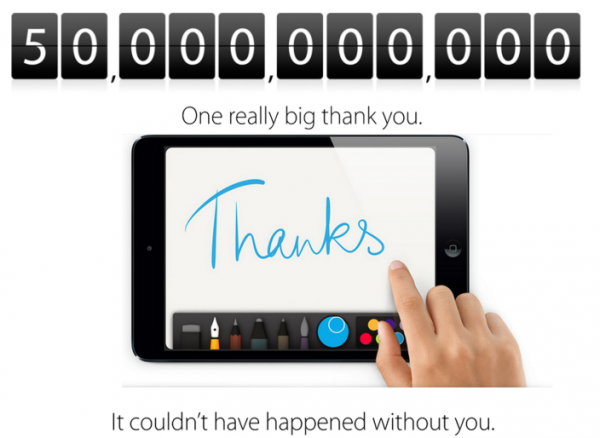
It’s been a while coming. Two weeks ago my colleague Alan Buckingham wrote that Apple was fast closing in on a remarkable milestone — 50 billion unique downloads (excluding re-downloads and updates) from the App Store — and said the “big event seems destined to take place within the next 24 hours”.
It actually took around 14 days from that point for the 50 billionth download to happen (or be announced at least), and for the winner of the $10,000 App Store gift card Apple put up as a prize to be revealed.
The lucky downloader was Brandon Ashmore from Mentor, Ohio who claimed his spot in Apple’s record book by downloading Say the Same Thing by Space Inch (personally I was hoping it would be the Condom Size penis-measuring app).
In making the announcement, Apple revealed the usual amazing statistics, including that App Store customers are now downloading more than 800 apps per second at a rate of over two billion apps per month.
Eddy Cue, Apple’s senior vice president of Internet Software and Services said, “Apple would like to thank our incredible customers and developers for topping 50 billion apps downloaded. The App Store completely transformed how people use their mobile devices and created a thriving app ecosystem that has paid out over nine billion dollars to developers. We’re absolutely floored to cross this milestone in less than five years”.
-
You call Google Glass wearable tech? Heapsylon makes sensor-rich fabric
True innovators are a little nuts. So when Davide Vigano starts talking about the need to reinvent the fashion industry via technology, anyone who has seen a person wearing Google Glass or the ubiquitous plastic wrist bands that track fitness goals might be forgiven for rolling their eyes: Both are decidely unfashionable outside the geek community.
Yet Vigano, who is the CEO of Heapsylon, a startup based out of Redmond, Wash. and wears Armani shirts (casual Armani, but still Armani), thinks he has a solution to wearable computing that people will find, well … wearable.
At first glance Heapslylon makes a pair of smart socks that mimic many of the data gathering functions of any other fitness tracker on the market. Except that they are socks. And it’s tough to imagine one wearing the same pair of sensor-packed socks each day or even wearing socks every day. How is this a good idea? How is this the future of fashion and technology?

The Sensoria smart sock and anklet.
But just as the Kindle Fire is merely a vehicle for Amazon’s real ambitions, as opposed to the sum of them, Heapsylon isn’t really in the sock business. The socks are made of a special material that the company developed — it is reportedly comfortable, washable and packed with sensors. And that material is the crux of what Heapslyson has developed. The socks are both an effort to put the new material through its paces with the hardest-working piece of clothing in a person’s wardrobe, as well as an application to showcase what the material can do.
Heapsylon was started in October 2010 by three former Microsoft employees: Davide Vigano, Mario Esposito, who is the CTO at Heapsylon, and Maurizio Macagno, the VP of development at the company. Both Macagno and Esposito worked on the Kinect, but all three left Microsoft to pursue this vision of combining technology and fashion in a way that could advance both industries.
“The outfit is the computer,” said Vigano of their vision. But after they quit, and started playing around with tiny sensors and conductive fabrics they realized that there was a gap between what they wanted and what technology could provide. So they set about researching materials. The result of that is the fabric that they have since turned into socks.
“Quite frankly we thought it would easier,” said Vigano. “The materials research has been challenging to say the least.”

The anklet for the Sensoria smart sock.
The sock and they accompanying hardware that tracks the data from the sock’s sensors are called the Sensoria Fitness smart socks. There will be two or maybe three pressure sensors in the sock that will share exact data on how many steps a person takes, their stride, whether they tend to turn in or out when they run, and maybe even weight change. The socks come with an ankle bracelet that gathers the data from the sick and transmits it (see above.) It will eventually be possible to use the socks as a scale to track your weight once Heaspylon gets the algorithms down.
Vigano said the company plans to launch the package of the socks and the hardware via a crowd-funding platform like Kickstarter or Indiegogo within the next month or two. While at first it will be targeted at the hard-core running market, the socks might find a home in other sports such as golf, where tracking the weight on the ball or heel of the foot can help improve performance. The price for the package is yet to be determined. And he declined to share the cost of the sensor-rich fabric.
But perhaps most important for the future of Heapsylon, and the future of fashion-forward wearables, is that Vigano aims to license the fabric technology and the data it gathers from its socks for other uses. For example, the material could be used in football helmets to measure the incidence of concussions, or the exact footfall data from the sock might supplant the general data provided by a pedometer for a person’s run. And other companies might use the socks to develop data profiles around other sports, like the golf example above.

The Heapsylon employees and founders.
There’s also no reason to stick only with pressure sensors. Other sensors could be embedded into the Heapsylon fabric, although the company hasn’t focused on that as a small startup with a a relatively small and undisclosed amount of angel funding. Vigano hopes to seek a formal venture round after the crowd-funding campaign proves (or disproves) the market opportunity.
For now, the five-person startup is heading toward a production version of the Sensoria Sock hoping that it will be the launch of a revolution in wearable computing that goes far beyond the smart watches and accessories available today. If Heapsylon’s vision of making technology disappear into fabric gains ground, then perhaps Vigano’s future Armani shirts might not just look good, but they could do good by sharing relevant data that monitors his health or his whereabouts for loved ones.
Of course, such data could also be used for less-then-noble causes, or the market may never buy into the idea of smart socks. But as someone who looks at the intersection between technology and fashion, I welcome anyone who wants to develop a product that emphasizes the form, the function and the feel of the wearable tech as opposed to just the tech.
Not everyone wants to look like they just got off the Caltrain at Mountain View.

Related research and analysis from GigaOM Pro:
Subscriber content. Sign up for a free trial.- Analyzing the wearable computing market
- Podcast: Mobile winners and losers in 2012 and what to expect in 2013
- How emerging technologies will influence collaboration

-
No One Likes to Be Changed

Listen to the language that any leader, consultant, or HR professional uses, and you’ll hear them expound at length about how “we” need to change “them.” That says it all: the fact is, no one likes to be changed, even if the change is ultimately beneficial.
In his recent HBR blog post, Ron Ashkenas argues that the reason most change management initiatives fail is due to stunted managerial capability to implement change. He points out — correctly, I believe — that in many organizations the responsibility for change initiatives has come to rest with HR, and not with the line supervisors and managers. However, I believe that there’s a deeper, more fundamental problem with the way we frame the whole notion of change management. In fact, I propose that we dispense with the concept of “change management” entirely. History shows that’s a recipe guaranteed to foment fear, resistance, and — ultimately —failure.
Many factors underlie that failure. Research shows that there’s actually a decrease in cognitive function when people feel as though they lack control over their work environment. Moreover, repetitive change initiatives — particularly ones that include layoffs — inevitably lead to cynicism and often to a kind of learned helplessness.
A far more effective approach would be to actually involve workers in solving business problems. As Dan Pink writes in his book Drive, the autonomy and skill development that comes with solving problems for oneself will do more to overcome resistance and motivate change than any strategy a cloistered HR professional or consultant can develop. I’m partial to A3 Thinking as a powerful way to solve problems, but the truth is — the tool you use doesn’t really matter. The key is to pose a business problem to the workers actually doing the job and then having them design the change. Consider the following cases:
- A group of senior R&D engineers at Abbott Vascular spent six to seven hours each day handling email. They were demoralized and frustrated by their inability to find time to do any engineering. On their own, they developed a new communication protocol that defined when and how to use email (never for urgent or complex issues), and now they can safely unshackle themselves from their smartphones and focus on engineering issues.
- The interventional radiologists at a major cancer center were asked by leadership to lower costs and increase revenue by accelerating room turnover. They decided to standardize the devices (stents, guidewires, catheters, etc.) they use for basic cases. Reducing the variation lowered inventory-carrying costs and enabled technicians and nurses to set up rooms more quickly.
- In her book, Sleeping with Your Smartphone, Leslie Perlow recounts how she set a goal of one day per week of “predictable time off” for a team of consultants at the Boston Consulting Group. The consultants themselves then devised radically different work habits and client communication procedures to make it happen — an initiative that has now been adopted by over 900 teams worldwide.
- A typical Toyota assembly line in the U.S. makes thousands of operational changes in the course of a single year. As journalist Charles Fishman writes, “that number is not just large, it’s arresting, it’s mind-boggling.” Toyota doesn’t have change management consultants driving those changes; the workers themselves make them.
In each of these cases, it’s easy to imagine how externally imposed solutions by leadership or HR would have been fiercely resisted, leading to lengthy disquisitions on how to manage or overcome employee intransigence. The real secret to successful change, therefore, is not to change people at all. Let them figure out how to solve their own problems, and they’ll do the rest.
-
400G Network Deployed Using Cyan Blue Planet SDN
Here’s our review of some of this week’s noteworthy links for the data center industry:
Cyan selected by GlobalConnect for 400G network. Cyan (CYNI) customer GlobalConnect, the leading Danish alternative provider of network and hosting services, announced it has completed the deployment of a 400G network employing the Cyan Blue Planet software-defined networking (SDN) system and Z-Series packet-optical platform throughout Denmark. The Denmark-wide 400G rollout is anchored by Cyan Z-Series packet-optical transport platforms (P-OTPs). The GlobalConnect network spans Denmark with 12,000 fiber route kilometers and includes extensions into northern Germany and southern Sweden. The network upgrade allows GlobalConnect to deliver a wide variety of ultra-high-capacity wavelength and Ethernet services to enterprise customers and data center operators, as well as wholesale services to other carriers. “Many people think that the name of the game for service providers is simply adding more and more capacity,” said Peter Olsen, GlobalConnect chief technical officer. ”While capacity is certainly crucial, unless we can drive enhanced capabilities and features into our network we will suffer from bandwidth commoditization. Working with Cyan, we’ve been able to architect a next-generation network that is operationally more efficient, delivers the scalability we need, and provides a means to deliver enhanced services to our customers.”
Yahoo! Japan deploys Juniper QFabric. Juniper Networks (JNPR) announced that Yahoo! Japan has deployed a Juniper Networks QFX3000-M QFabric System at its new environmentally friendly “Shirakawa Data Center.” It is a large-scale IT data center that covers the Tokyo metropolitan area and East Japan. It now operates a single-layer network fabric based on Juniper Networks QFabric technology to deliver more cost-effective, low-latency performance and linear scalability. The deployed system will support up to 768 ports of 10 Gigabit Ethernet (GbE) with low latency, providing YAHOO! Japan customers with a high-quality online experience, no matter where they are. A MX960 3D Universal Edge Router is also implemented at the site to support advanced services. ”YAHOO! Japan is a pioneer in Internet service delivery, and Juniper Networks has been proud to play a part of this success for many years,” said Douglas Murray, senior vice president, Juniper Networks Asia Pacific. ”Implementing QFabric as the network foundation of its new state-of-the-art data center will support the company’s expansion and future innovation in Japan seamlessly. It also serves as a testament to QFabric traction in Japan and throughout the Asia Pacific region.”
EdgeCast and Telia Sonera partner. EdgeCast Networks and TeliaSonera announced a managed CDN agreement that will bring new site acceleration and CDN solutions to TeliaSonera’s customer base while expanding the reach and capacity of the EdgeCast network. Under the agreement, both companies will make significant investments in high-performance network infrastructure, along with sales and marketing efforts, to address the massive demand for acceleration and CDN solutions across TeliaSonera’s Nordic markets. TeliaSonera will leverage its massive regional network presence, along with EdgeCast’s proven CDN technology, to build out a regional CDN that will be directly connected to EdgeCast’s worldwide network. “TeliaSonera is the premier, dominant provider in a critical region — and after many years working with them, I’m excited we’re bringing our relationship to this new level,” said James Segil, co-founder and president of EdgeCast Networks. “They have a huge number of deep customer relationships, and will now be able to offer those customers powerful and proven CDN solutions.”
-
Galaxy Note 3 not expected to offer flexible display or metal design

More unconfirmed reports recently revealed that the Samsung Galaxy Note 3 will not feature any kind of flexible display or metal design. Instead, the phone will maintain a prototype similar to the Galaxy S 4, featuring a plastic body. It seems as though the main reason behind this is because the company cannot mass-product flexible screens and metal materials in sufficient quantities for such a device.
It’s a little disappointing that we won’t get to see some new innovative features in Samsung’s next big phone, but we’re sure they’ll be coming down the pipeline very soon. This is still just a rumor, so we’ll keep on the lookout for more information on the topic and give you updates as they come out.
Source: SamMobile
Come comment on this article: Galaxy Note 3 not expected to offer flexible display or metal design
Visit TalkAndroid for Android news, Android guides, and much more! -
Microsoft reportedly prepping 7.9-inch Surface for June launch, Samsung to supply displays

-
LeAnn Rimes Feud With Brandi Glanville Just Keeps Going
LeAnn Rimes has a long and storied past with Brandi Glanville; since LeAnn married Brandi’s ex, Eddie Cibrian, the two have been going at it in the press nonstop. Brandi was initially upset that Eddie cheated on her with LeAnn while the two of them were filming a movie together, but now she’s set her sights on LeAnn’s mothering skills and even the way she gives Mother’s Day gifts.
Glanville took to Twitter to talk about LeAnn’s gift–a bouquet of flowers–and said that the two of them don’t speak when they run into each other in public.
I thanked @leannrimes on twitter4 my flowers.Our relationship is that we still dont even say hi at baseball.I dont have her number-thats it
— Brandi Glanville (@BrandiGlanville) May 13, 2013
LeAnn reportedly replied with, “This was actually the first acknowledgement of my gesture I was made aware of. I didn’t see anything else sent to me. It wasn’t for the ‘thank you.’ It was to just simply say Happy Mother’s Day,” though that tweet appears to have been deleted. She did seem to allude to the situation in another post, however.
I’m always amazed at how twisted things can get. Was just speaking about this in an interview and it never ceases to amaze me.
— LeAnn Rimes Cibrian (@leannrimes) May 13, 2013
LeAnn has claimed in the past that she entered a rehab program to learn how to cope with stress after two of Brandi’s friends allegedly began harassing her and making threatening phone calls. They have also had Twitter wars before, after Brandi accused LeAnn of keeping laxative pills in her purse and being negligent when Brandi’s son ate them, thinking they were candy.
-
Still Playing Games On Google+? You Have Until June 30 To Clear Out
Does anybody still play games on Google+? If you do, Google’s got some bad news.
Google announced at Google I/O that it’s shutting down Google+ Games on June 30. Now, it doesn’t mean that the games on Google+ will cease to exist. They’ll just cease to exist on Google+. As such, Google recommends that players get in touch with the developers of their favorite games to find out where their favorite games will be hosted after June 30.
Why is Google shutting down Google+ Games? The short answer is Google Play game services. It’s a rich set of APIs that allow game developers to offer a googlified game experience across Android, iOS and the Web. The games even have built in Google+ support for matchmaking and other services so those who still play games with friends on Google+ will be able to continue to do so on the new service.
Google Play game services may be making Google+ Games redundant, but it’s probably not the only reason for the closure. Around this time last year, Google+ Games lost two major developers – Wooga and PopCap. Both developers said that they were removing their games from the service after finding that the player base on Google+ wasn’t worth their time. There haven’t been reports of any major developers leaving Google+ Games since then, but it might have been a sign of things to come as Google itself apparently feels the player base on Google+ isn’t worth supporting.
So, what happens to the players who have invested hundreds of hours, and maybe even hundreds of dollars, into Google+ Games? Google says that “some games will be migrating data to an alternative destination where you can continue to use your unused payments.” You’re going to have to contact the developer of your favorite games to find out all the details though.
[h/t: Engadget]
-
Tommy Chong Touts the Economic Benefits of Weed
Tommy Chong, along with co-star Ceech Marin, became famous in the 70s and 80s for the Ceeech & Chong movies, which satirized and glorified many aspects of hippie and stoner culture. Now, Chong is, unsurprisingly, advocating for the legalization of marijuana.
According to an Associated Press report, Chong recently stated that marijuana could be the cure for the ailing U.S. economy. Chong stated that legalizing and taxing marijuana and hemp could provide enough revenue to “save the world.” From the AP:
“Look at the situation we’re in now. Sequesters. Cuts. Everything cut across the board. Now, the government is tapped into the biggest cash crop in the world,” Chong said. “There’s little manufacturing cost. You don’t have to do anything except watch it grow and get a couple of hippies to cut it and then put it in a bag.”
Chong, who revealed last year that he battled prostate cancer, still tours occasionally with Marin. He is also using social media to promote marijuana legalization. His Facebook and Twitter accounts are filled with statements such as these:
weed saved my life… tc
Mary Jane… tc
What a great mother’s day eh? Smoked some Kush and enjoyed the day…what can I say..tc
Weed can change everything #InAWorldLikeThis … tc
Pot brings out the muse because pot is the muse…..tc
kush for lunch… tc
-
Google Gives Businesses A New Reason To Use YouTube
Google is now letting businesses use YouTube to sell products. Businesses have been using YouTube to market products almost as long as YouTube has been around (at least since businesses figured it out that it could be about more than cat videos), and for quite some time, businesses have been able to advertise through clickable ads inside of YouTube videos.
Now, Google is taking the YouTube ecommerce thing to a whole new level by essentially letting users shop for products right through the business’ YouTube channel.
“Every day, millions of people turn to YouTube for advice, from learning how to do the perfect smokey eye to trying out a new recipe for mashed potatoes,” says Danielle Tomassini from the Google Shopper team. “People are using YouTube not just for entertainment, but to learn a new skill, find more information, and shop for products. This presents a unique opportunity for consumer goods brands to reach shoppers in the moment and provide them with an easy way to go from watching a video to purchasing the product.”
The new offering comes in the form of a new channel gadget, and lets users shop for products from various retailers from the comfort of the YouTube channel they’re already browsing.
“This new channel gadget will enable shoppers to seamlessly move from browsing how-to videos and featured products to finding which retailers carry them, check availability, compare prices and make a purchase, all with fewer clicks than today,” says Tomassini.
Google has launched the gadget with Unilever to highlight hair products from TRESemmé.
“There is a growing interest for ‘hair how to’ videos on YouTube with millions of users going to YouTube to learn about hairstyles and hair care,” says Tomassini. “By providing hair tutorial videos, tips and tricks, and interviews with trendsetters, TRESemmé has already generated more than 2.7 million views on their channel. Through their newly designed channel, TRESemmé can also now connect these consumers with the products they’re watching in the demo videos in a faster more efficient way, shortening the shopping journey.”
You can see the feature in action at the TRESemmé YouTube channel.

As you can see, this includes not only a “Buy Now” button, but product reviews and a “Learn More” button, which enables the business to share details about the product, to hopefully help convince customers to buy it:

When the user clicks “Buy Now,” they’re presented with the option to select the products they want to purchase. While TRESemmé only has a single product highlighted here, one can only assume that businesses can include more. It’s unclear what the limit on this might be.

From there, users can comparison shop from stores that have the product available, and see if it is in stock. When they click on one of the stores, they’re taken to the product page on that store’s site.

It’s interesting that Google isn’t tying this into Google Shopping (otherwise, you wouldn’t be seeing Amazon there). That doesn’t mean they won’t in the future.
Google is actually offering the gadget as a premium offering for its consumer goods clients, produced through GloTo.
So far, Google isn’t making it incredibly easy to just go and set one of these channels up. Right now, you have to speak with a Google representative to determine “if the shopper channels is the right solution for your brand”.
The feature could play a major role in turning YouTube into a major driver of ecommerce. However, there are some things greatly holding it back. One is the aforementioned lack of Google Shopping integration, but another major factor is that it requires users to actually be on a channel page. How much YouTube viewing do you do from the channel page? If your’e like me, probably not a whole lot.
People consumer videos from their YouTube homepage stream, when they’re shared via social media, and when they’re embedded on other web pages. None of these scenarios will cater to sales through this new feature (unless ads pointing to to the channel as the landing page are placed within the videos).
But this could just be a starting point, and could grow into something much bigger.


